
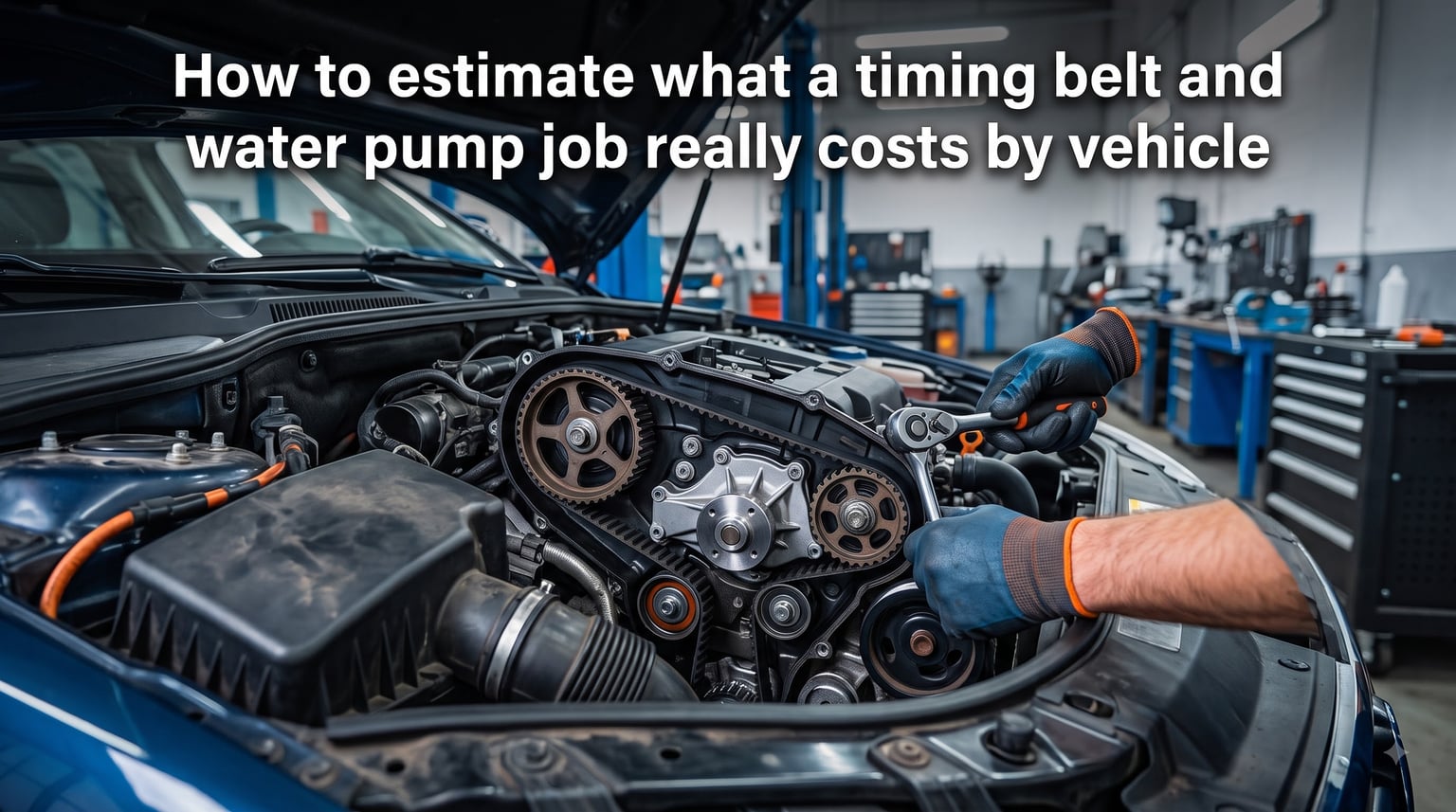
If you have ever called three shops for a timing belt and water pump quote and gotten wildly different numbers, you already know how confusing this repair can be. One shop says $600. The dealership quotes $1,800. A friend swears they paid $1,100 at an independent mechanic. The range feels impossible to make sense of without understanding what drives the price.
This guide walks you through a clear methodology for estimating timing belt and water pump replacement cost before you pick up the phone. I will break down parts versus labor, show you typical ranges by vehicle type, explain why shops quote so differently, and give you the tools to read any estimate with confidence.
By the end, you will know what a fair price looks like for your specific car, which add-ons are legitimate and which are upsells, and how to save 25% or more by timing this job correctly.
Table of Contents
What a Timing Belt and Water Pump Actually Do?
Your timing belt is a reinforced rubber strip that connects the crankshaft (which moves the pistons) to the camshaft (which opens and closes the valves). It keeps these two systems in perfect synchronization so the pistons and valves never collide. On most engines, if that belt breaks or slips even a few degrees, the damage is immediate and severe.
The water pump sits right behind the timing cover on many vehicles. It circulates coolant through the engine block and radiator to pull heat away from the combustion process. Without it, your engine overheats within minutes and can warp the cylinder head or blow the head gasket.
Here is why their proximity matters for your wallet: replacing either one requires removing the same timing cover, belts, and pulleys. Shops have to do 80% of the same disassembly work for each part individually. That shared labor is the reason mechanics almost always recommend doing both at the same time.
Timing Belt vs Timing Chain: Know Which One You Have
This is the single biggest source of confusion I see in forums. People get quoted for a “timing belt” on a car that actually has a timing chain, and they end up paying for a service they do not need.
A timing belt is made of reinforced rubber with nylon cords. It runs externally along the front of the engine behind a plastic or metal cover. Belts wear out and require scheduled replacement, typically between 60,000 and 100,000 miles.
A timing chain is metal, runs internally, and is lubricated by engine oil. Chains generally last the life of the engine and rarely need scheduled replacement. If your vehicle has a chain, the timing belt replacement cost conversation does not apply to you at all.
How do you tell which one you have? Check your owner’s manual maintenance schedule. If it lists a timing belt replacement interval, you have a belt. If there is no such interval mentioned, you likely have a chain. You can also call a dealer parts department with your VIN and ask directly.
Common vehicles with timing belts include most Honda Civic and Accord models through 2026, Subaru non-turbo engines, many Toyota engines, and most Acura V6s. Vehicles with timing chains include most BMWs, Mercedes, newer Nissans, and Ford EcoBoost engines.
Why Timing Belt and Water Pump Replacement Cost Is So Variable?
Several factors explain why you might see a $500 quote and a $1,500 quote for what sounds like the same job on similar cars.
Parts quality is the first variable. A budget aftermarket timing belt kit might cost $120, while an OEM kit from the dealership can run $350 or more. The same spread applies to water pumps, where a cheap rebuild might be $40 and an OEM cast-iron pump can hit $200.
Labor hours are the second factor, and they swing wildly by engine design. A transverse four-cylinder in a compact car might take 3 hours. A V6 crammed into a minivan engine bay can take 6 or 7 hours because the mechanic has to dismount the engine or remove multiple components just to reach the timing cover.
Shop type and location also drive the spread. Dealerships charge $140-$200 per labor hour in most markets. Independent shops typically run $90-$130. Your geographic region matters too. The same job in San Francisco will cost noticeably more than in rural Ohio.
Cost Breakdown: Parts vs Labor
Let me walk through what you are actually paying for when you get a timing belt and water pump replacement. Understanding this breakdown is what lets you compare quotes intelligently.
The timing belt kit itself typically runs $100 to $350. This includes the belt, tensioner, and idler pulleys. OEM kits from the dealer sit at the high end, while aftermarket options from brands like Gates, Dayco, or Continental are cheaper.
The water pump adds another $50 to $250. Most quality pumps are cast aluminum or iron with steel impeller blades. Cheap pumps with plastic impellers tend to crack and fail early, so this is not the place to save $30.
You will also need fresh coolant ($20-$40), a new thermostat if recommended ($15-$40), and possibly a serpentine belt ($25-$50) since the old one has to come off anyway.
Labor is where the real money sits. At 3 to 7 hours at $100 to $180 per hour, you are looking at $300 to $1,200 in labor alone for most vehicles.
Put it all together and the combined timing belt and water pump replacement cost lands between $500 and $1,500 for most cars. Economy vehicles sit at the low end. Luxury and V6-powered vehicles push toward the top.
Average Timing Belt and Water Pump Replacement Cost by Vehicle Type
This is where the numbers get specific. I have pulled real-world pricing from repair forums, shop estimates, and owner reports to give you a realistic range by vehicle category.
Economy and Compact Cars
Vehicles like the Honda Civic, Toyota Corolla, and Nissan Sentra with four-cylinder engines typically run $500 to $900 for the combined job. These engines have accessible timing covers and shorter labor times of 3 to 4 hours.
A Honda Civic owner on a mechanic advice forum reported paying $620 at an independent shop for a full kit including belt, water pump, tensioner, and coolant. That is right in the middle of the expected range.
Midsize Sedans and Wagons
The Honda Accord, Subaru Outback, and Toyota Camry with larger four-cylinder or flat engines typically run $700 to $1,200. Subaru engines in particular can take extra labor time because of the boxer layout.
A Reddit user shared a quote of $1,400 for a 2006 Subaru Outback timing belt and water pump job. That sits at the higher end but is not unusual for Subaru, where the engine design adds complexity.
Minivans and SUVs with V6 Engines
The Honda Odyssey, Toyota Sienna, and similar V6-powered minivans typically run $800 to $1,300. The V6 engine fills the bay, and mechanics often need to remove engine mounts or access components from underneath.
Honda Odyssey owners frequently report quotes between $900 and $1,200 at independent shops and $1,300 to $1,600 at dealerships for the full job including all recommended parts.
Luxury and European Vehicles
Acura, BMW, Audi, and similar vehicles push the cost to $1,200 to $2,800. Parts are more expensive, labor times are longer, and some European engines require specialized tools or procedures.
One Acura TL owner shared a quote range of $2,350 to $2,800 from multiple shops. That sounds high, but Acura V6 timing belt jobs are among the most labor-intensive in this category.
Real Forum Example: VW TDI
A Volkswagen TDI owner on Reddit reported paying $1,137.68 total for a complete job including the timing belt, water pump, drive belt with tensioner pulleys, coolant, and hazardous waste disposal. That detailed breakdown is exactly what you should ask for from any shop.
Another owner paid $1,649.99 at a dealership for a full timing belt kit including tensioner, drive belt, water pump, and coolant flush. The dealership premium was about $500 over what an independent shop would charge for the same parts and labor.
Why You Should Replace Them Together?
The short answer is that you save roughly 25% on total cost by doing both at the same time rather than separately. Here is why that math works.
Replacing the timing belt requires removing the timing cover, belts, pulleys, and in many vehicles the water pump is actually driven by the timing belt itself. The mechanic is already in there. Adding the water pump adds maybe 30 minutes of labor and the cost of the part.
If you skip the water pump and it fails two years later, the shop has to redo all that same disassembly work. You pay the full labor charge a second time. Given that water pumps typically last about as long as timing belts, the risk of paying twice is real.
I have never seen a case where a qualified mechanic recommended skipping the water pump during a timing belt job. The consensus across forums, shop owners, and manufacturer service guides is unanimous on this point.
What Else Should Be Replaced at the Same Time
A complete timing belt job involves more than just the belt and pump. Knowing what should be included helps you spot legitimate recommendations versus upsells.
The tensioner and idler pulleys should always be replaced with the belt. These are spring-loaded and bearing-equipped components that wear out on the same schedule as the belt. A good timing belt kit includes them automatically.
The serpentine belt (also called the accessory or drive belt) runs the alternator, power steering, and air conditioning. Since it has to come off during the timing belt job, replacing it at the same time adds minimal labor cost and saves you a separate visit later.
Coolant should be drained and refilled any time the water pump is replaced. A full coolant flush costs extra but is worth doing if your coolant is old or discolored.
The thermostat and its gasket are often recommended. This is a borderline call. If your thermostat is working fine and the coolant has been changed regularly, you can usually skip it. But if the system is being opened up anyway and the thermostat is cheap, replacing it is not unreasonable.
Front engine seals are sometimes recommended if there are signs of oil seepage. This is a legitimate recommendation if you can see oil around the seal area. If the area is clean and dry, it is an upsell you can decline.
Warning Signs Your Timing Belt or Water Pump Is Failing
Catching a failing timing belt or water pump before it fails completely can save you thousands. Here are the signs to watch for.
A ticking or clicking noise from the front of the engine is one of the earliest warning signs. This often indicates the belt is loose, fraying, or the tensioner is failing. Do not ignore it.
If the engine cranks but will not start, the timing belt may have already broken. On an interference engine, this means the valves have likely bent and you are looking at a full engine rebuild or replacement.
Coolant pooling under the front of the car, especially toward the passenger side, points to a leaking water pump. The weep hole on the pump housing is designed to leak when the internal seal fails, giving you a warning before the pump seizes.
Engine temperature spikes or the temperature gauge climbing into the red zone means the water pump is not circulating coolant effectively. Pull over immediately to avoid head gasket damage.
Misfires, rough idle, or a noticeable drop in performance can indicate the timing belt has jumped a tooth. This means the valve timing is off and the engine is no longer running in synchronization.
If you can see the belt through an inspection cover or access port, look for visible cracks, fraying, glazing, or missing teeth. Any of these mean the belt is at the end of its service life.
When to Replace: Mileage and Age Intervals?
The standard replacement interval for most timing belts falls between 60,000 and 100,000 miles. Your owner’s manual has the exact number for your specific engine and model year.
Honda and Acura typically recommend replacement at 105,000 miles on newer models or 60,000 miles under severe service conditions. Subaru generally sets the interval at 105,000 miles. Toyota and Nissan vary by engine, ranging from 60,000 to 90,000 miles.
Age matters as much as mileage. Rubber degrades over time regardless of use. A car driven only 30,000 miles in 10 years still has a 10-year-old belt. Most manufacturers and mechanics recommend replacement at 7 to 10 years of age even if the mileage interval has not been reached.
If you bought a used car and do not know when the belt was last replaced, assume it needs replacing. A $40 car history report or a call to the previous service shop can sometimes confirm the last replacement date.
DIY vs Professional Installation: Is It Worth It
Doing this job yourself can save $300 to $800 in labor, but it is one of the more challenging DIY repairs. Here is an honest assessment of whether it makes sense for you.
The skill level required is intermediate to advanced. You need to understand engine timing marks, torque specifications, and belt tensioning procedures. A mistake here does not mean a rattling noise. It means bent valves and thousands in engine damage.
You will need specialty tools beyond a basic socket set. A harmonic balancer puller, a torque wrench, a belt tensioner tool, and possibly an engine support bar if mounts need to be removed. These tools can add $100 to $300 to your upfront cost if you do not already own them.
A quality timing belt kit with water pump costs $150 to $400 depending on your vehicle. Add $40 for coolant and $25 for a new serpentine belt. Your total parts cost is similar to what a shop pays, so the savings come entirely from avoiding labor charges.
I recommend DIY only for experienced home mechanics who have access to a detailed service manual or factory repair procedure for their specific engine. If you have never done a brake job or a head gasket, this is not the place to start learning.
For everyone else, an independent shop with good reviews is the sweet spot. You get professional results at a fraction of dealership pricing, and the work typically comes with a warranty on parts and labor.
How to Get an Accurate Estimate Before You Commit
The difference between a good quote and a bad one often comes down to what is included. Here is how to make sure you are comparing apples to apples.
Get at least three quotes. Call two independent shops and one dealership. Ask each for an itemized breakdown listing every part and the labor hours separately. Any shop that gives you a single lump-sum number without detail is a red flag.
Verify the labor hours against a flat-rate guide. Sites like RepairPal give estimated labor times by vehicle and ZIP code. If a shop quotes 6 hours and the flat-rate guide says 3.5, ask why. There may be a legitimate reason, but you deserve an explanation.
Ask whether the quote includes OEM or aftermarket parts. OEM (original equipment manufacturer) parts come from the vehicle’s brand and cost more. Quality aftermarket parts from established brands are perfectly acceptable for this job and can save you $100 to $200.
Watch for pressure tactics. If a shop tells you the belt could break “any day now” on a car with 50,000 miles and no symptoms, get a second opinion. Reputable shops explain the interval, show you the condition, and let you decide without urgency.
Confirm what is and is not included. Does the quote cover coolant, disposal fees, and shop supplies? These small add-ons can add $50 to $100 to the final bill if they are listed as extras rather than built into the estimate.
Interference vs Non-Interference Engines: Why It Matters
This distinction changes everything about how urgently you need to replace the timing belt.
In an interference engine, the valves and pistons occupy the same space in the cylinder at different points in the cycle. The timing belt is what keeps them from colliding. If the belt breaks, the valves stop moving, the pistons keep going, and they smash into each other. The result is bent valves, damaged pistons, and sometimes a destroyed cylinder head. Repair costs run $3,000 to $5,000 or more.
In a non-interference engine, the valves and pistons never share the same space. If the belt breaks, the engine stops but no internal damage occurs. You need a tow and a belt replacement, but the engine survives.
Most modern engines are interference designs because they allow higher compression and better efficiency. Honda, Acura, Subaru, and most European manufacturers use interference engines. Some older Toyota and Nissan engines are non-interference.
If your vehicle has an interference engine, do not push the replacement interval. The risk of a $4,000 engine rebuild versus a $700 preventive replacement makes the math simple.
FAQs
How much should a water pump and timing belt replacement cost?
For most vehicles, the combined timing belt and water pump replacement cost ranges from $500 to $1,500. Economy cars typically land between $500 and $900, midsize vehicles run $700 to $1,200, and luxury or V6-powered vehicles can reach $1,200 to $2,800. Parts account for roughly $200 to $600, with labor making up the rest.
How many hours does it take to replace a water pump and timing belt?
Labor time ranges from 3 to 7 hours depending on the vehicle. Compact four-cylinder engines with accessible timing covers take about 3 to 4 hours. V6 engines in minivans and SUVs can take 6 to 7 hours because of tight engine bay clearance and additional component removal.
At what mileage should the timing belt and water pump be replaced?
Most manufacturers recommend timing belt replacement between 60,000 and 100,000 miles. Honda and Acura typically set the interval at 105,000 miles, while Subaru uses 105,000 miles as well. Age also matters, so replace the belt at 7 to 10 years even if mileage has not been reached.
Should the timing belt and water pump be replaced together?
Yes. Replacing both at the same time saves about 25% compared to doing them separately because the labor to access the timing cover is shared. The water pump is often driven by the timing belt and has a similar service life. Skipping it risks paying full labor again when the pump fails later.
Is it worth fixing a timing belt on a car?
In almost all cases, yes. A timing belt replacement costs $500 to $1,500, while a broken belt on an interference engine causes $3,000 to $5,000 in damage. The preventive repair is significantly cheaper than the consequence of skipping it, especially on interference engines used by Honda, Subaru, and most European brands.
Is replacing a water pump a big job?
On most vehicles, yes. The water pump sits behind the timing cover, which means significant disassembly is required. When done as part of a timing belt replacement, the additional labor is minimal because the area is already accessed. Done as a standalone repair, it can take nearly as long as the full timing belt job.
Conclusion
Estimating timing belt and water pump replacement cost comes down to knowing your vehicle type, understanding the parts and labor breakdown, and comparing quotes with the right questions. Economy cars typically run $500 to $900, midsize vehicles land around $700 to $1,200, and luxury or V6 models can push past $2,000.
Always replace both components together to capture the 25% labor savings. Confirm whether your vehicle has an interference engine, which makes timely replacement critical. And get at least three itemized quotes before committing to any shop.
The goal is simple: walk into any repair shop knowing what a fair price looks like for your specific car. With the numbers and methodology in this guide, you now have that baseline.