
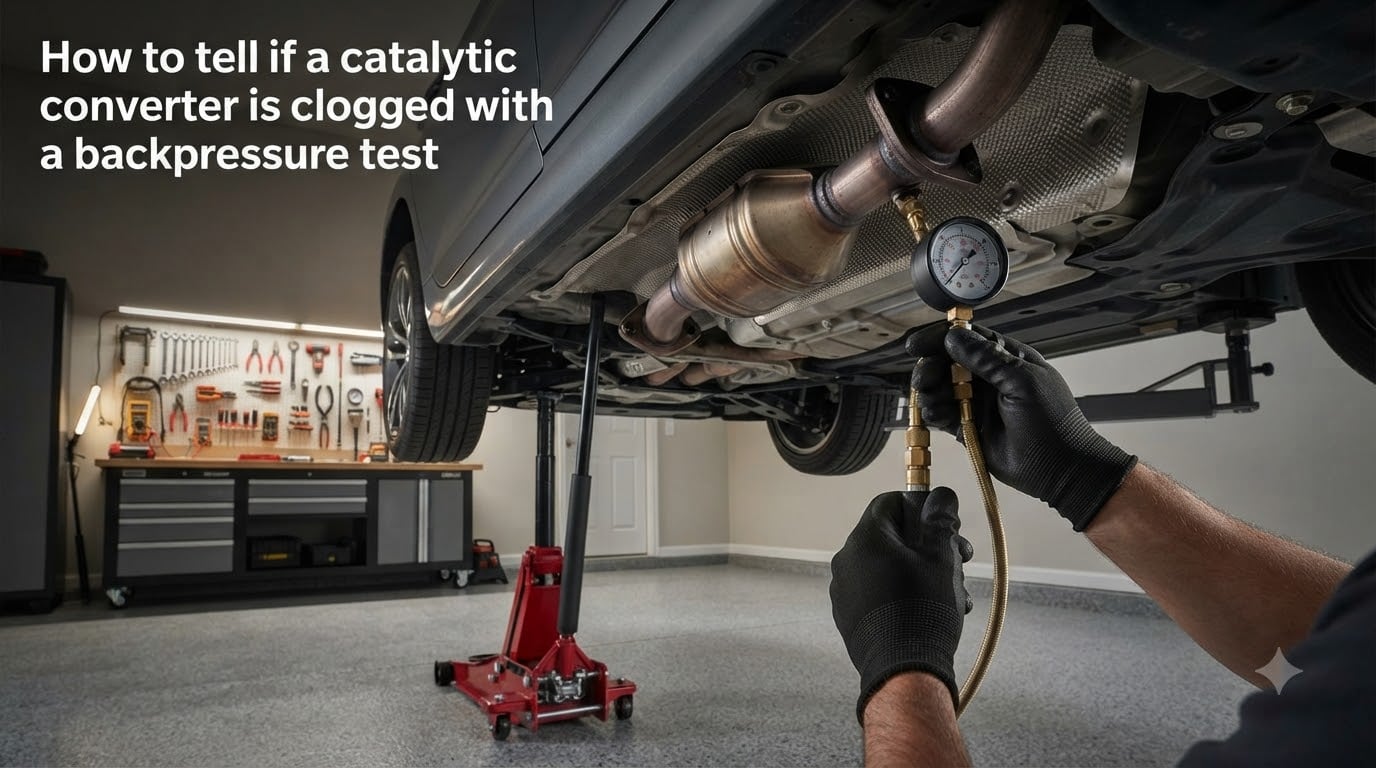
A sluggish engine, a sulfur smell, and a glowing check engine light can all point to the same culprit. I have run a catalytic converter backpressure test on dozens of cars in my own garage, and it remains the most direct way to confirm a clog without spending a dime at a shop.
This guide walks through the exact procedure I use, the pressure numbers that tell you the converter is restricted, and the alternative tests you can run when a pressure gauge is not on hand. You will also learn how to separate a clogged converter from a bad oxygen sensor, which is the number one source of misdiagnosis in the forums.
Table of Contents
What Is a Catalytic Converter and Why Backpressure Matters?
A catalytic converter is an emissions control device mounted in your exhaust system between the engine and the muffler. Inside its steel housing sits a ceramic honeycomb coated with platinum, palladium, and rhodium. Those three precious metals trigger chemical reactions that convert carbon monoxide, hydrocarbons, and nitrogen oxides into less harmful gases before they exit the tailpipe.
Backpressure is the resistance exhaust gases meet as they push through that honeycomb. A healthy converter creates almost no measurable restriction. A clogged one traps exhaust inside the engine, which is why a backpressure test is the gold standard for confirming a restricted catalytic converter.
Think of it like a partially blocked sink drain. Water still flows, but pressure builds behind the blockage. Your engine experiences the same effect. Cylinder filling suffers, exhaust valves work harder, and temperatures inside the converter climb until the honeycomb starts glowing red hot.
Two key terms to keep straight. Exhaust backpressure is pressure measured in front of the converter with the engine running. Intake vacuum is the suction the throttle body creates. When the converter clogs, exhaust backpressure rises and intake vacuum drops at the same time.
7 Warning Signs Your Catalytic Converter Is Clogged
Before you grab a gauge, look for these symptoms. I have learned that catching two or three together usually means a restriction is worth testing for.
Loss of Power and Sluggish Acceleration
The exhaust cannot escape fast enough, so the next cylinder’s exhaust stroke fights against trapped gas. Your throttle response feels flat, especially when climbing hills or merging onto the highway.
Sulfur or Rotten Egg Smell
When the converter cannot process exhaust chemistry, unburned sulfur exits the tailpipe. That distinct rotten egg smell is hydrogen sulfide, and a heavy converter clog often produces it.
Illuminated Check Engine Light with P0420 or P0430
P0420 (bank 1) and P0430 (bank 2) are the diagnostic codes every car sets when the downstream oxygen sensor sees a catalyst that is not doing its job. The light alone is not proof of a clog, but it is the strongest signal to run a backpressure test.
Rattling Noise Under the Car
When the ceramic honeycomb cracks, broken pieces rattle inside the steel can. I have heard this most clearly at cold start. Substrate failure almost always coincides with reduced flow and increased backpressure.
Engine Stalling or Hard Starting
Severe restriction can stall an idling engine or prevent it from starting altogether. Excess exhaust pressure bleeds back through the exhaust valve and fouls the air-fuel mixture.
Reduced Fuel Economy
The engine controller adds fuel to compensate for incomplete combustion. A drop of 2 to 4 MPG is common once a restriction sets in, especially on highway driving.
Failed Emissions or State Inspection
If your state tests tailpipe emissions, a clogged catalyst will push hydrocarbon and NOx readings well above the legal limit. Failed tests usually trigger a backpressure check next.
How to Perform a Catalytic Converter Backpressure Test Step by Step?
This is the procedure I trust most. It takes about 30 minutes and requires only basic tools you may already own.
Tools You Will Need
Drill or air-powered die grinder with a 1/8 inch bit for the test port
Pressure gauge rated 0 to 15 PSI, or a vacuum gauge with a 0 to 30 in-Hg scale
18 x 1.5 mm O2 sensor socket or a long extension and 22 mm wrench
Thread sealing tape (PTFE)
Shop rags and safety glasses
Step 1: Warm the Engine to Operating Temperature
Run the engine until the temperature gauge reaches the middle and stays there. A cold engine produces thicker exhaust and artificially high pressure readings. A fully warm engine gives consistent numbers.
Step 2: Remove the Front Oxygen Sensor
Locate the upstream O2 sensor bolted into the exhaust pipe just before the catalytic converter. Use the O2 sensor socket while the engine is still warm. Set the sensor aside without yanking the wiring harness.
Step 3: Drill a 1/8 Inch Test Port
Insert the drill bit into the open O2 sensor bung and run a slow, straight hole into the exhaust pipe. Tap lightly so the bit does not snap off inside. I usually drill about half the depth of the bit.
Step 4: Install the Pressure Gauge
Wrap PTFE tape around a brass adapter fitting. Thread it into the drilled hole and tighten until snug. Attach your pressure gauge hose to the adapter. Make sure all connections are airtight.
Step 5: Record the Idle Reading
Start the engine and let it idle for 60 seconds. Note the pressure. Normal is under 1.5 PSI at idle. Most healthy converters register closer to 0 PSI. Forum users have logged readings near 9 PSI at idle, and those cars always had a confirmed restriction.
Step 6: Record the 2500 RPM Reading
Have a helper hold engine speed at 2500 RPM for 10 seconds. Watch the gauge and read the highest stable number. Healthy converters show under 3 PSI. Readings above 5 PSI confirm a clogged catalyst.
Step 7: Interpret the Results
Use these thresholds to judge your readings. Anything above the normal range is a sign of restriction that usually warrants replacement.
Healthy converter: 0 to 1.5 PSI at idle and 0 to 3 PSI at 2500 RPM.
Mild restriction: 1.5 to 3 PSI at idle and 3 to 5 PSI at 2500 RPM.
Severe restriction: above 3 PSI at idle and above 5 PSI at 2500 RPM.
Confirmed clog: above 5 PSI at idle and above 8 PSI at 2500 RPM.
Step 8: Seal the Test Port
Remove the gauge and adapter. Wrap a short sheet-metal screw with PTFE tape and thread it into the hole to seal the exhaust. Reinstall the O2 sensor and torque it to spec. Drive the car gently for a week to confirm the seal holds.
Warning: Wear safety glasses when drilling the test port. Hot metal shavings can fly back toward your hands. Work in a well-ventilated area because exhaust fumes build up quickly with the O2 sensor removed.
How to Tell If the Catalytic Converter Is Bad or the O2 Sensor?
Replacing the wrong part is expensive and frustrating. Here is how to tell the difference.
A bad oxygen sensor usually sets P0420 alongside slow upstream response. The converter is fine but the sensor misreports catalyst efficiency. Swap the sensors side to side and see if the code follows. That is the cheapest confirmation.
A truly clogged converter produces high backpressure during the gauge test. The O2 sensor reports a normal-looking voltage pattern because it sees what is in front of it. The real failure is downstream, where exhaust cannot flow.
If your car runs rich, misfires often, or burns oil, the underlying cause is probably a fault upstream of the converter. Fix the engine issue first, then re-test backpressure before condemning the converter itself.
Alternative Ways to Test a Clogged Catalytic Converter
Not every home mechanic owns a pressure gauge. Here are two tests that work without drilling your exhaust.
Vacuum Gauge Test
A vacuum gauge plugged into the intake manifold tells a similar story. With a healthy exhaust, idle vacuum holds steady around 18 to 20 in-Hg. When the converter is restricted, the needle slowly creeps downward as the engine runs. Hold 2500 RPM steady. A reading that drops more than 2 in-Hg over 30 seconds points to exhaust restriction.
Infrared Temperature Test
An infrared thermometer pointed at the exhaust pipe just before and just after the converter gives you a clear signal. The inlet side should run 100 to 200 degrees hotter than the outlet on a working converter. If the outlet is hotter, the exhaust is not flowing through and the converter is acting like a brick wall.
OBD-II Scanner Method
A scanner that displays live oxygen sensor voltage lets you watch both banks in real time. A clogged converter makes the downstream sensor voltage mimic the upstream sensor voltage for long stretches. The two signals stop contrasting, which is exactly what the P0420 code is reporting.
What Causes a Catalytic Converter to Clog and How to Prevent It?
Knowing the cause helps you stop a new converter from failing the same way.
Common Causes
Persistent engine misfires pump raw fuel into the exhaust. That fuel ignites inside the converter and melts the ceramic substrate. Oil consumption from worn valve seals or piston rings coats the honeycomb and bakes it into a solid plug. Running rich from a failing oxygen sensor or fuel pressure regulator builds carbon over time.
Prevention Tips
Address check engine lights quickly, especially misfire codes. Change your oil on schedule and watch for blue-tinted exhaust smoke. Replace upstream O2 sensors at the first sign of sluggish fuel trim behavior. Use the correct spark plugs and avoid leaded race fuel in street-driven cars.
Frequently Asked Questions
How much back pressure should a catalytic converter have?
A healthy catalytic converter produces under 1.5 PSI at idle and under 3 PSI at 2500 RPM. Readings above 3 PSI at idle or above 5 PSI at 2500 RPM indicate restriction that needs attention.
Can a clogged catalytic converter cause back pressure?
Yes. A clogged catalytic converter is the most common cause of elevated exhaust backpressure. As the honeycomb substrate breaks down or fills with carbon, exhaust gases cannot flow through, and pressure builds in front of the converter.
How do I know if my catalytic converter is severely clogged?
Severe clogging shows up as power loss under load, sulfur smell, illuminated check engine light, stalling at idle, and backpressure readings above 5 PSI at idle or above 8 PSI at 2500 RPM.
What can be mistaken for a clogged catalytic converter?
A failing oxygen sensor, a clogged exhaust muffler, a restricted catalytic converter, a bad mass airflow sensor, and engine misfires can all produce similar symptoms like power loss, rough idle, and check engine lights.
How to test catalytic converter back pressure?
Drill a 1/8 inch test port in the exhaust pipe just before the catalytic converter, install a pressure gauge rated 0 to 15 PSI, record the idle reading, then record the reading at 2500 RPM. Readings above 3 PSI at idle or 5 PSI at 2500 RPM indicate restriction.
Final Verdict
A catalytic converter backpressure test is the most reliable way to confirm a clog at home. Watch for the warning signs first, run the gauge test next, and use a vacuum or temperature test to verify before you spend money on parts.
If your readings fall into the severe category, replace the converter and address the root cause, whether that is a misfire, oil consumption, or a stuck-rich fuel system. A fresh converter on a broken engine will fail again within months.
Save your test data and the diagnostic trouble codes before the repair. That record is gold if the replacement is under warranty or if you want to confirm the new converter is performing as expected.