
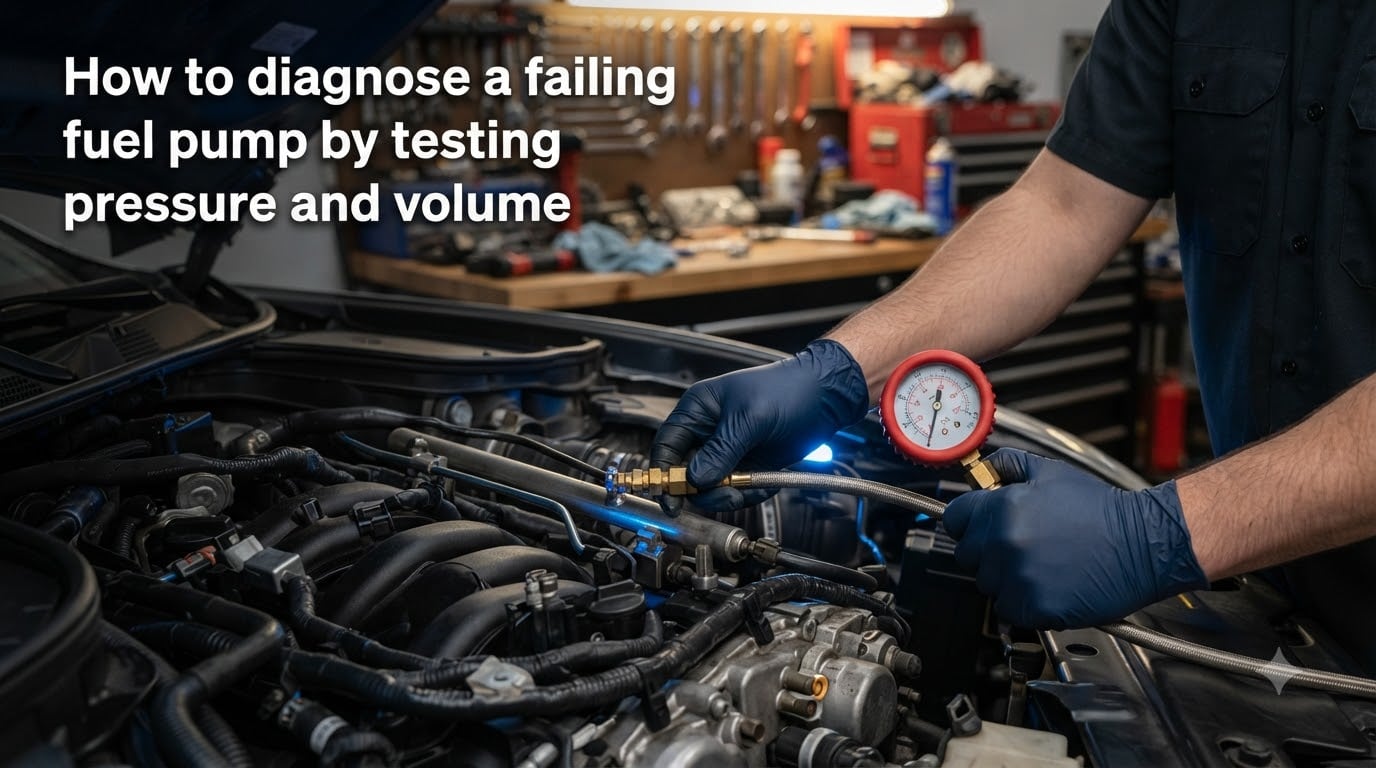
If your engine sputters, hesitates, or refuses to start, the fuel pump is a prime suspect. Diagnosing a failing fuel pump requires testing both pressure and volume, not just one or the other. A pump can hold correct pressure yet still fail to deliver enough fuel for normal operation. In this guide, I’ll walk you through the exact procedures our team uses to diagnose fuel pump failures, including the pressure-only mistake that costs DIYers hundreds in wasted parts.
Table of Contents
Signs and Symptoms of a Failing Fuel Pump
Before pulling out a gauge, listen to what your car is telling you. The most common sign of a failing fuel pump is engine sputtering under load. I see this constantly in forum posts: the car runs fine at idle but bucks and stumbles when you merge onto the highway or climb a hill.
Hard starting is another classic symptom, especially when the engine is warm. A weak pump cannot maintain residual line pressure, so the next start requires the pump to build pressure from scratch. If your car fires up cold but struggles when restarted after a short stop, suspect the pump.
Listen for a high-pitched whine coming from the fuel tank area when you turn the key to ON. A healthy pump makes a brief hum for 2-3 seconds. A failing pump often whines louder, longer, or with a metallic grinding sound.
Other symptoms worth noting:
Loss of power during acceleration
Engine stalling at low speeds or stoplights
Poor fuel economy (up to 20% drop)
Engine surging at constant throttle
Check engine light with codes P0230, P0231, P0232, or P0171/P0174 (system too lean)
One Reddit mechanic summed it up well: “If your truck runs fine for 20 minutes then falls on its face, the pump is starving hot.” Heat-related failures are extremely common because electric pumps rely on fuel flow for cooling.
Why You Need to Test Both Pressure and Volume?
Here’s the diagnostic mistake I see every week: someone checks fuel pressure, sees it matches the spec, and concludes the pump is fine. Then they replace the fuel filter, the regulator, and the injectors, and the problem persists. The pump had pressure but not volume.
Fuel pressure measures force in PSI at the fuel rail. Fuel volume measures actual delivery in gallons per hour or liters per minute. A worn pump with a weak internal spring can still hold 58 PSI at static pressure but collapse when the engine demands high flow. Think of it like a balloon with a tiny hole: it inflates to full pressure but empties in seconds.
Real example from a Stack Exchange thread: a mechanic tested a Toyota and got perfect 43 PSI at the rail. The engine still ran lean under load. A volume test revealed the pump delivered only 0.8 LPM instead of the required 2.5 LPM. The check valve was leaking internally, bypassing fuel back to the tank.
This is why every professional fuel system diagnosis includes both tests. Skipping the volume test turns a 30-minute diagnostic into a parts-cannon nightmare.
Tools You’ll Need for Fuel Pump Testing
You can perform both tests at home with basic equipment. Here’s what our team keeps in the shop:
Fuel pressure gauge with Schrader valve adapter (most fuel-injected cars have a test port on the fuel rail)
Flow meter OR a graduated container marked in liters/quarts
Fuel line disconnect tools (usually 3/8″ and 5/16″ quick-disconnect fittings)
Safety glasses and nitrile gloves
Fire extinguisher rated for Class B fires
Vehicle service manual for your specific PSI and flow specs
Wiring diagram if testing the pump circuit
A decent fuel pressure gauge runs $25-50. A flow meter costs $80-200. If you only want to buy one tool, start with the pressure gauge and use the container method for volume testing. I’ll cover both methods below.
How to Test Fuel Pump Pressure Step by Step?
Pressure testing is the easier of the two procedures. Here’s the exact method our technicians use:
Step 1: Locate the fuel rail test port. Most fuel-injected engines have a Schrader valve on the fuel rail, similar to a tire valve. It usually has a black or colored cap labeled “test” or simply capped. If your engine doesn’t have a test port, you’ll need a T-fitting adapter that installs between the fuel line and rail.
Step 2: Depressurize the system (optional but recommended). Remove the fuel pump fuse or relay, start the engine, and let it stall. This relieves residual pressure and prevents a fuel spray when you connect the gauge.
Step 3: Connect the gauge. Wrap a rag around the test port. Remove the cap and quickly attach the gauge hose. You’ll hear a brief hiss as any remaining pressure equalizes.
Step 4: Read key-on pressure (engine off). Turn the ignition to ON without cranking. The pump should run for 2-3 seconds and pressurize the system. Note the reading. For most cars, expect 35-65 PSI depending on engine type.
Step 5: Read running pressure (engine running). Start the engine and let it idle. The reading should drop slightly from the key-on number because the regulator bleeds off excess pressure to the return line.
Step 6: Read pressure under load. Have an assistant hold the gauge while you snap the throttle. Pressure should briefly spike then return to baseline. A reading that drops below spec under load indicates a weak pump or clogged filter.
Step 7: Compare to spec. Check your service manual for exact numbers. A pressure reading more than 10% off spec (high or low) indicates a problem.
How to Test Fuel Pump Volume Step by Step?
Volume testing catches what pressure testing misses. Here are two methods:
Method 1: Flow meter (preferred)
Step 1: Disconnect the fuel feed line at the engine. This is usually a quick-disconnect fitting near the fuel rail or engine bay.
Step 2: Connect the flow meter inline between the feed line and the engine. Make sure the meter is oriented correctly (in/out arrows).
Step 3: Have an assistant crank the engine for 10 seconds while you observe the flow rate. A typical 4-cylinder needs 1.5-2.5 LPM at idle. A V6 or V8 needs 2.5-4.0 LPM.
Step 4: If you do not have an assistant, turn key to ON (not start) and let the pump run for its prime cycle (about 3 seconds). Multiply the LPM reading by 20 to estimate per-minute flow.
Method 2: Container measurement (budget option)
Step 1: Disconnect the fuel return line at the fuel rail or pressure regulator. Route the return line into a graduated 4-liter container.
Step 2: Crank the engine for exactly 30 seconds. Use a stopwatch.
Step 3: Measure the volume collected. A healthy pump on a 4-cylinder should deliver at least 0.5-0.75 liters in 30 seconds. A V8 should deliver 1.0-1.5 liters.
Step 4: Multiply by 2 to get LPM, or by 31.7 to convert to GPH.
These numbers are rough baselines. Always cross-reference your vehicle’s factory specification. A reading 25% below spec means the pump is failing.
Understanding Normal Fuel Pressure Specifications
Pressure specs vary widely by engine type. Here’s a general reference for 2026:
Port fuel injection (most modern cars): 35-65 PSI running, with key-on pressure typically 3-5 PSI higher
Direct injection: 50-300 PSI at the rail (high-pressure pump adds to low-pressure supply)
Older throttle body injection: 15-30 PSI
Carbureted vehicles (mechanical pump): 4-7 PSI
Diesel common rail: 15-30 PSI low-pressure stage, then 5,000-30,000 PSI at the injectors
Your vehicle’s exact spec is in the service manual or fuel system specification sticker under the hood. If you don’t have the manual, manufacturer databases and forum-specific subcommunities (like honda-tech.com or powerstroke.org) almost always have the numbers.
What Can Be Mistaken for a Bad Fuel Pump?
Half the “bad fuel pumps” I’ve diagnosed over the years turned out to be something else. Before condemning the pump, rule out these lookalike failures:
Clogged fuel filter: Most common culprit. A restricted filter mimics a weak pump because it limits flow even when pressure looks normal.
Failed fuel pressure regulator: A stuck-open regulator bleeds pressure to the return line, causing low running pressure but normal key-on pressure.
Bad fuel pump relay: The pump runs for 3 seconds at key-on then shuts off. If the relay fails, the pump never runs and pressure reads zero.
Failed fuel injectors: One clogged injector can cause a misfire that feels like a fuel delivery problem.
Wiring or ground issues: Corroded connectors, especially the ground at the tank, reduce pump voltage and output.
Vacuum leaks: On older engines, a vacuum leak causes lean codes that mimic fuel delivery problems.
The differential test: if your fuel pressure AND volume both test good, the pump is fine. Move your attention to the filter, regulator, or injectors.
Common Causes of Fuel Pump Failure
Understanding why pumps fail helps you prevent repeat failures. The leading cause is running the tank low. Electric in-tank pumps use the surrounding fuel for cooling. When fuel level drops below a quarter tank, the pump overheats and wears prematurely.
Contaminated fuel is the second-biggest killer. Dirt, rust from a rusty tank, and water all destroy pump internals quickly. If your fuel filter shows metal flakes when you cut it open, the pump is shedding material and replacement is urgent.
Electrical problems like low battery voltage, corroded grounds, or a failing alternator force the pump motor to work harder, generating excess heat. Heat is the enemy of pump windings.
Age and wear are inevitable. Most pumps last 100,000-150,000 miles. If your vehicle is approaching that mileage with original fuel system components, preventive replacement is cheaper than a tow.
Safety Precautions Before Testing
Fuel testing involves flammable liquid under pressure. Take these precautions:
Work in a well-ventilated area away from sparks or open flames. Fuel vapors are heavier than air and pool in low spots like a garage floor. A shop fan is worth the effort.
Wear safety glasses. Fuel under pressure sprays in a fine mist that irritates eyes severely. I learned this the hard way on a 90°F day when a Schrader valve released unexpectedly.
Keep a Class B fire extinguisher within reach. No smoking, no running engines in adjacent bays, and no using phones that might spark.
Depressurize the system before disconnecting any lines. Fuel in a pressurized line sprays 3-4 feet and ignites from a cigarette 10 feet away.
Disconnect the battery if you are removing the pump or working on the tank. A spark near an empty fuel tank is a documented garage fire cause.
When to Replace vs Repair the Fuel Pump?
Once you’ve tested pressure and volume, the decision tree is straightforward:
Low pressure + low volume: Replace the pump. Both metrics below spec point to a failed pump motor or weak check valve.
Normal pressure + low volume: Replace the pump. The check valve or internal bypass is leaking; pressure builds but flow drops.
Low pressure + normal volume: Check the regulator or restriction first. The pump is moving fuel but the system cannot hold pressure.
Normal pressure + normal volume: The pump is fine. Diagnose injectors, filters, or sensors.
Most modern fuel pumps are sealed units and cannot be repaired. Replacement involves dropping the fuel tank, which is a 2-3 hour job for a DIYer. Many shops charge $400-800 for pump replacement on common vehicles. Aftermarket pumps cost $80-200; OEM pumps run $200-400.
If the pump replacement requires dropping a full tank of gas, plan ahead. Siphon the tank first or drive it down to near-empty before starting.
Frequently Asked Questions
How do you test a fuel pump to see if it’s bad?
Test both pressure and volume. Connect a fuel pressure gauge to the fuel rail test port and read key-on pressure (most cars: 35-65 PSI). Then perform a volume test by measuring fuel flow with a flow meter or by collecting fuel from the return line in a graduated container. If either reading falls 10-25% below manufacturer spec, the pump is failing.
What can be mistaken for a bad fuel pump?
Clogged fuel filter, failed fuel pressure regulator, bad fuel pump relay, clogged fuel injectors, corroded wiring or ground, and vacuum leaks all produce symptoms similar to a failing pump. Always test fuel filter flow and check relay operation before condemning the pump.
What is the normal PSI for a fuel pump?
Most port-injected gasoline engines run 35-65 PSI. Direct injection engines run 50-300 PSI at the rail. Older throttle body injection runs 15-30 PSI. Carbureted engines with mechanical pumps run only 4-7 PSI. Always check your specific vehicle’s service manual for exact specifications.
How to test fuel pump volume?
Disconnect the fuel return line and route it into a graduated container. Crank the engine for 30 seconds and measure the volume collected. A healthy 4-cylinder pump delivers at least 0.5-0.75 liters in 30 seconds; a V8 should deliver 1.0-1.5 liters. Alternatively, install an inline flow meter for a direct LPM reading.
Final Thoughts on Diagnosing a Failing Fuel Pump
Testing both fuel pressure and volume is the only reliable way to diagnose a failing fuel pump. Pressure alone misses internal leaks that cause volume drop, and volume alone misses regulator and restriction issues. Run both tests in the same session for a complete picture.
Prevention is simple: keep your fuel level above a quarter tank, replace the fuel filter every 30,000 miles, and address electrical issues promptly. If your pump tests fail on either metric, replacement is the only lasting fix. Most pumps are sealed units and not field-repairable.
For complex cases involving intermittent failures or direct injection systems, a professional scan tool that monitors fuel trim and short-term/long-term fuel correction can pinpoint pump issues that mechanical tests miss. When in doubt, consult a shop with fuel system diagnostic experience.