
Last winter, my temperature gauge sat stubbornly below the midline on a 15-minute commute, and the cabin heater blew air that never warmed past lukewarm. I assumed it was a busted temperature sensor until I touched the upper radiator hose with my bare hand and found it hot within two minutes of a cold start. That hose was hot way too early. The thermostat was stuck open, and once I knew what to look for, the diagnosis took about ten minutes. If you’re trying to figure out whether your thermostat is stuck open or stuck closed, this guide walks through the exact symptoms I check, the temperature numbers that matter, and the tests I run before touching any tools.
In this guide, I’ll show you how to tell if your thermostat is stuck open or stuck closed by reading your temperature gauge, your heater output, and your radiator hoses. You’ll get specific numbers (like the 75°C threshold that almost always confirms a stuck-open thermostat), step-by-step test methods you can run at home, and clear guidance on when it’s safe to keep driving versus when you need to pull over and call a tow truck.
Table of Contents
What Does a Car Thermostat Do and Why Does It Matter?
A car thermostat is a temperature-controlled valve that sits between your engine and the radiator. Its job is to manage coolant flow so the engine warms up quickly and then stays within an optimal operating range of roughly 85°C to 105°C (185°F to 220°F).
When the engine is cold, the thermostat stays closed. This blocks coolant from circulating through the radiator, so heat builds up fast inside the engine block. Once the coolant hits the thermostat’s rated opening temperature (most passenger cars use 82°C to 95°C), the valve opens and lets hot coolant flow into the radiator, where air cooling (and the fan) drop its temperature before it cycles back through the engine.
Two mechanisms do this work in most vehicles. Older and many modern cars use a wax pellet thermostat, where a sealed wax element expands as it heats and pushes a rod that opens the valve. Others use a bimetal strip that bends with temperature. Both designs are reliable, but both can fail. When they stick, the engine either runs too cold (stuck open) or overheats (stuck closed).
Running outside that 85°C to 105°C window hurts your engine in different ways. A cold-running engine wastes fuel, fouls spark plugs, increases emissions, and may keep the check engine light on. An overheating engine warps cylinder heads, blows head gaskets, and can seize the motor entirely. Catching a stuck thermostat early protects you from both extremes.
Thermostat Stuck Open vs Stuck Closed: Key Differences at a Glance
The quickest way to tell if your thermostat is stuck open or stuck closed is to look at where your temperature gauge sits and how your heater behaves. Here’s a comparison you can use as a checklist before doing any hands-on testing.
| Symptom | Stuck Open | Stuck Closed |
|---|---|---|
| Temperature gauge reading | Stays below midpoint, often near “C” | Climbs past midpoint toward “H” |
| Time to reach operating temp | Never reaches operating temp | Reaches operating temp quickly, then keeps rising |
| Upper radiator hose temperature | Hot within 1-2 minutes of cold start | Stays cool even when engine is hot |
| Cabin heater output | Lukewarm or cold air, even after 15+ minutes | Very hot at first, then drops as engine overheats |
| Coolant flow visible (rad cap off, cold) | Coolant already circulating | Coolant stationary in radiator |
| Check engine light codes | P0128 common | P0217 common |
| Cooling fan behavior | Rarely kicks on | Runs constantly at high speed |
| Fuel economy | Drops noticeably | Often unchanged |
| Immediate risk level | Low (drive to shop usually OK) | High (stop driving ASAP) |
Notice how each row points to the opposite end of the temperature spectrum. That contrast is your first big clue. If your symptoms all sit in the “cold” column, the thermostat is stuck open. If they all sit in the “hot” column, it’s stuck closed.
How to Tell if Your Thermostat Is Stuck Open: 6 Telltale Signs?
A thermostat stuck open means coolant circulates through the radiator constantly, even when the engine is cold. The engine can’t build up heat. Here are the six signs I look for first.
1. Temperature gauge stays low. After 15 minutes of driving, your gauge should sit roughly at the midpoint (often around 90°C on most cars). If it stays down near the “C” mark or barely climbs off cold, the thermostat isn’t closing to let the engine warm up.
2. Upper radiator hose heats up almost immediately. On a cold start, feel the upper radiator hose (the one coming from the thermostat housing to the radiator). With a working thermostat, it stays cool for a few minutes until the engine reaches operating temperature. With a stuck-open thermostat, that hose warms up within 1-2 minutes because coolant is already flowing freely.
3. Cabin heater blows lukewarm air. Your heater core is part of the coolant loop. If the engine never reaches operating temperature, the coolant stays cool, and so does the air coming through your vents. If passengers are commenting that the heater “just doesn’t seem to work” even after a long drive, that’s a strong stuck-open signal.
4. P0128 check engine light code. This code means “Coolant Temperature Below Thermostat Regulating Temperature.” It’s the most common diagnostic trouble code triggered by a stuck-open thermostat and is one of the cleanest ways to confirm the diagnosis with an OBD2 scanner.
5. Reduced fuel economy. A cold-running engine runs richer (more fuel) to compensate. If your MPG drops by 10-15% with no other explanation, a stuck-open thermostat is a likely culprit, especially when combined with other symptoms on this list.
6. Coolant circulates immediately after refilling. With the radiator cap off on a cold engine, a stuck-open thermostat will show coolant already moving. A working thermostat keeps the coolant stationary until the engine warms up.
How to Tell if Your Thermostat Is Stuck Closed: 6 Warning Signs
A thermostat stuck closed blocks coolant from reaching the radiator at all. Heat builds up inside the engine with nowhere to go. These six symptoms tell you that’s happening.
1. Temperature gauge climbs into the red. The needle should sit near the middle on a normal drive. If it pushes past three-quarters or into the “H” zone, coolant isn’t flowing through the radiator. Anything above 105°C (220°F) on the gauge is overheating territory.
2. Upper radiator hose stays cool while the engine overheats. This is the classic “radiator is cold but engine is hot” symptom that confuses a lot of drivers. The hose stays cool because no hot coolant is reaching it. The thermostat is shut, blocking the flow.
3. Coolant warning light or P0217 code. Many cars will throw P0217 (“Engine Overheating Condition”) when temperatures climb past their threshold. The coolant temperature warning light on your dash means the same thing. If you see this, stop driving as soon as it’s safe.
4. Heater output drops as the engine overheats. Counterintuitively, a stuck-closed thermostat can produce strong heat at first because the engine is running hot, then drop off as the system vents coolant or forms air pockets. Watch for steam, sweet-smelling coolant odors, or a sudden loss of cabin heat combined with a climbing gauge.
5. Cooling fan runs constantly at high speed. The fan is doing extra work to compensate for no coolant flow. If you can hear the fan roaring even at idle and the temperature gauge keeps climbing, the thermostat is likely stuck shut.
6. Coolant bubbling or overflowing from the reservoir. With nowhere to go, coolant boils inside the engine and pushes back into the overflow tank. If you see bubbling in the reservoir or coolant spitting out under pressure, the thermostat is almost certainly stuck closed and the system is overheating.
Which Is Worse: A Thermostat Stuck Open or Closed?
A thermostat stuck closed is worse in the short term. A stuck-open thermostat means your engine runs cold, wastes fuel, and may trigger a check engine light, but it usually won’t leave you stranded or damage the engine immediately. You can typically drive a car with a stuck-open thermostat to a shop without major risk, though you should fix it within a few weeks because of the long-term wear on engine components and the emissions impact.
A stuck-closed thermostat is an emergency. Continued driving with the thermostat shut risks warped cylinder heads, a blown head gasket, or even a seized engine. If your temperature gauge climbs into the red or you see steam, pull over, shut off the engine, and let it cool before adding coolant or driving further. Towing to a shop is often the safer call.
Mechanics sometimes describe a stuck-open thermostat as “the safe failure” because it lets the engine keep running, even if inefficiently. A stuck-closed thermostat is the failure that destroys engines.
How to Test Your Thermostat Without Removing It (Infrared Thermometer Method)
You can confirm a stuck thermostat without pulling any parts using an infrared thermometer. It’s the easiest test if you want results in under 10 minutes.
Step 1. Start with a cold engine. Park the car and let it sit overnight or for at least 4 hours.
Step 2. Point your infrared thermometer at the upper radiator hose near the thermostat housing and note the temperature.
Step 3. Start the engine and let it idle. Take a temperature reading on the upper hose every 2 minutes.
Step 4. Compare your numbers to the expected pattern:
Working thermostat: hose stays within 5-10°C of ambient for the first 5-10 minutes, then climbs sharply as the engine hits operating temperature.
Stuck open: hose temperature rises within 1-2 minutes of starting, climbing close to engine temperature quickly.
Stuck closed: hose stays cool (within 5°C of ambient) even after 15 minutes of idling, while the engine temperature gauge climbs past the midpoint.
Step 5. Cross-check with your temperature gauge. If the gauge reads low but the hose is hot quickly, it’s stuck open. If the gauge climbs into the red but the hose stays cool, it’s stuck closed.
How to Bench Test a Thermostat (Hot Water Test)?
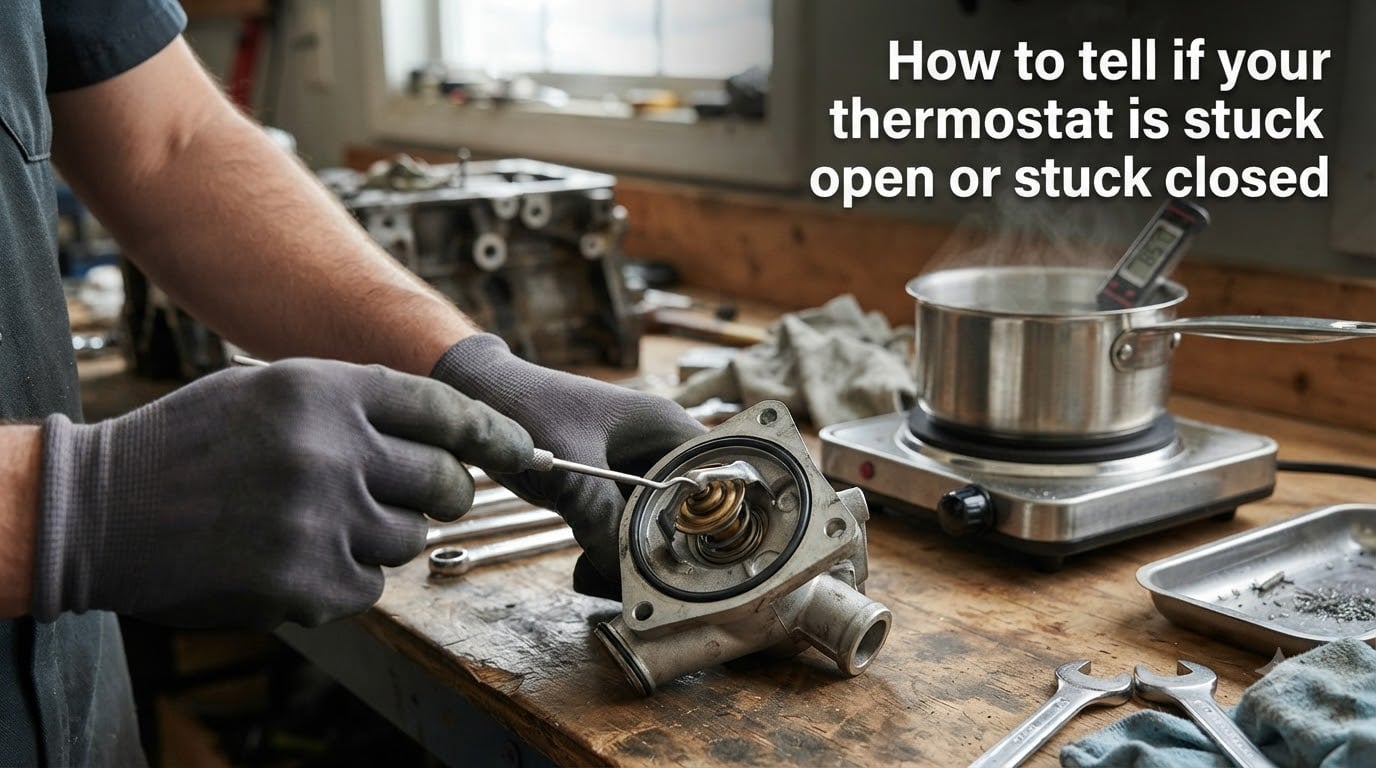
If you’ve already removed the thermostat or plan to, the hot water bench test gives you a definitive yes/no answer in about 10 minutes. You only need a pot of water, a stove, and a thermometer.
Step 1. Remove the thermostat from the thermostat housing. (On most cars, this means draining some coolant, unbolting the housing cover, and lifting the thermostat out. Make sure the engine is cool first.)
Step 2. Suspend the thermostat in a pot of cold water on the stove. Don’t let it touch the bottom of the pot, or your reading will be off.
Step 3. Put a thermometer in the water and slowly heat the pot. Watch the thermostat valve.
Step 4. Note the temperature at which the valve begins to open. The rating is usually stamped on the thermostat itself (common values are 82°C, 88°C, and 95°C). The valve should start opening within 2-3°C of its rated temperature.
Step 5. Bring the water to a full boil. The valve should open fully at around 10-15°C above the rated temperature. If the valve doesn’t move at all during the test, the thermostat is stuck. If it moves but doesn’t open fully, it’s worn and should be replaced.
If the thermostat doesn’t open at its rated temperature, you’ve confirmed a stuck-closed unit. If it opens but doesn’t fully close again when you cool it in the fridge for 30 minutes, it’s stuck open.
Common Causes of Thermostat Failure
Thermostats usually fail for one of four reasons, and knowing the cause helps you prevent repeat problems.
Age and wear. Most thermostats last 5-10 years or around 100,000 miles. After that, the wax pellet or bimetal element degrades and may stick.
Sediment and debris in old coolant. If you haven’t flushed your coolant on schedule, rust and sediment can jam the valve. This is one of the most common failure causes in older cars.
Wrong coolant mix. Coolant that’s too concentrated or too diluted changes the boiling point and can accelerate element wear. Stick to the mix ratio your manufacturer specifies (often 50/50 with distilled water).
Electrical failure (electronic thermostats). Some newer cars use electronically controlled thermostats. These can throw fault codes when their heater or sensor fails, and the diagnostic approach usually requires a scan tool.
Risks and Secondary Damage From Each Condition
Stuck-open and stuck-closed thermostats cause different kinds of damage over time. Knowing the risks helps you prioritize the repair.
With a stuck-open thermostat, the engine runs rich and cold. Over weeks or months, this fouls spark plugs, increases oil contamination with fuel, raises hydrocarbon emissions, and may foul the catalytic converter. Fuel economy suffers by 10-15% in most cases. None of this is sudden, but the long-term repair bill can add up if you ignore it.
With a stuck-closed thermostat, the damage is sudden and expensive. Warped cylinder heads, blown head gaskets, and cracked engine blocks are all on the table once temperatures climb above 115°C (240°F). Coolant can also boil, causing air pockets that worsen overheating. In diesel engines, a stuck-closed thermostat can also prevent DPF regeneration, which triggers a separate set of expensive problems.
Repair vs Replace: When to DIY and When to Call a Mechanic
Most thermostat replacements are a 30-60 minute job for a home mechanic with basic tools. The parts themselves typically run in the $20-60 range for most vehicles. Where you spend is on coolant (you usually need to drain some), a new gasket or O-ring, and possibly a thermostat housing if yours is corroded.
DIY makes sense if you have basic hand tools, a place to drain coolant safely, and a service manual for your specific car. Some thermostat housings are buried under intake manifolds or other components, which can turn a simple job into a 4-hour project.
Take it to a shop if you don’t have a safe place to drain coolant, your thermostat is hard to access, or the overheating has been severe enough that you suspect secondary damage. A mechanic can also pressure-test the cooling system after replacement to make sure no air pockets are left behind.
Tips to Prevent Thermostat Problems
A few maintenance habits go a long way toward keeping your thermostat healthy.
Flush coolant on schedule. Most manufacturers recommend a coolant flush every 5 years or 100,000 miles for long-life coolant, sooner for conventional green coolant.
Use the right coolant. Check your owner’s manual for the spec. Honda, Toyota, GM, and European makes often require specific formulations that aren’t interchangeable.
Address small leaks quickly. Low coolant levels let air into the system, which can leave deposits on the thermostat element.
Don’t ignore the temperature gauge. If you notice the gauge running higher or lower than usual, even slightly, it’s worth checking. Thermostats usually fail gradually before they stick completely.
Replace the thermostat and gasket together. If you’re replacing one, replace both. Skipping the gasket is the most common cause of post-repair coolant leaks.
Frequently Asked Questions
Can a stuck thermostat fix itself?
No. Once a thermostat sticks, it stays stuck until you replace it. Heat cycling may temporarily free a partially stuck valve, but it will stick again. Plan on a replacement thermostat rather than waiting for the problem to resolve.
How serious is a stuck open thermostat?
A stuck-open thermostat is serious over time but not an emergency. Your engine will run cold, waste fuel, trigger a check engine light, and may foul spark plugs or the catalytic converter. You can usually drive to a shop, but get it replaced within a few weeks.
How long can you drive with a thermostat stuck open?
You can typically drive for several days or even a couple of weeks with a stuck-open thermostat without causing immediate engine damage. Watch for worsening fuel economy, rough idle, or persistent P0128 codes, and get it fixed promptly to avoid long-term wear.
How long can you drive with a thermostat stuck closed?
Drive only as long as it takes to get off the road safely. A stuck-closed thermostat causes the engine to overheat within minutes, and continued driving risks warped heads, blown head gaskets, or a seized engine. If the gauge climbs into the red, pull over and shut off the engine.
Do thermostats usually stick open or closed?
Both failures happen, but thermostats tend to stick closed slightly more often in older vehicles because sediment accumulates in the valve seat. Stuck-open failures are more common when the wax element degrades with age and loses its expansion force.
Can I temporarily unstick a stuck thermostat?
You can tap the thermostat housing gently with a wooden handle to free a partially stuck valve, but this is a temporary fix at best. A stuck thermostat will keep sticking. Plan a replacement rather than relying on a tap to keep you going.
How do I know if my temperature sensor or thermostat is bad?
A bad temperature sensor usually produces inconsistent gauge readings or codes like P0115 or P0117 without any change in actual engine temperature. A bad thermostat produces symptoms that match real temperature shifts, like a consistently cold or consistently overheating engine. If the upper radiator hose is hot too early, it’s the thermostat. If the hose behavior matches the gauge but the reading seems wrong, suspect the sensor.
Final Verdict: Diagnosing a Stuck Open or Closed Thermostat
Diagnosing whether your thermostat is stuck open or stuck closed comes down to reading three things together: your temperature gauge, your cabin heater output, and your upper radiator hose. If all three point cold, the thermostat is stuck open and you can usually drive to a shop. If all three point hot, the thermostat is stuck closed and you should pull over as soon as it’s safe.
The infrared thermometer test confirms your suspicion without pulling any parts, and the hot water bench test gives you a definitive answer if you’ve already got the thermostat out. Either way, plan on a replacement rather than hoping the valve unstucks itself.
Once you’ve confirmed a stuck thermostat, schedule the replacement. The parts are inexpensive, the labor is reasonable, and ignoring the problem either costs you fuel economy (stuck open) or risks catastrophic engine damage (stuck closed). If you found this guide helpful, bookmark it for the next time your temperature gauge starts acting up.