
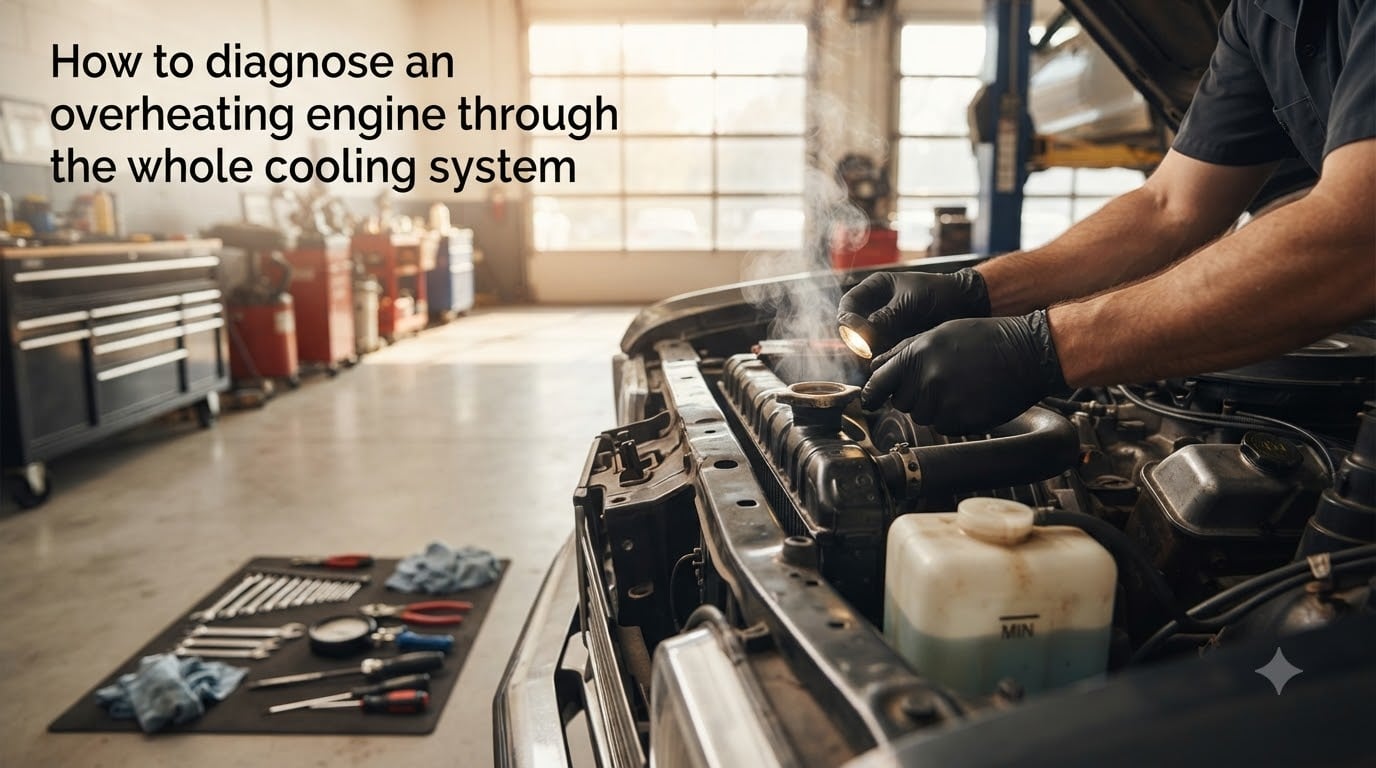
Last summer I watched steam pour out from under the hood of my old pickup on a highway on-ramp. The temperature gauge climbed fast, the heater started blasting cold air, and I had about ten seconds to decide what to do. That moment is exactly why I wrote this guide on how to diagnose an overheating engine through the whole cooling system – because a calm, ordered diagnosis is the difference between a $40 repair and a $4,000 engine rebuild.
Overheating is the single most expensive problem you can let slide. Warped cylinder heads, blown head gaskets, and seized engines all start with a temperature gauge that crept past the halfway mark. The good news is that about 80 percent of overheating causes come from five components you can check in your driveway with basic tools. I have put together a step-by-step procedure that walks through every component in the order I check them on customer cars.
By the end of this guide, you will know how to identify whether your problem is the thermostat, the water pump, the radiator, the cooling fan, the radiator cap, or something deeper like a head gasket. I will also show you how to spot the difference between overheating at idle and overheating on the highway, because that pattern alone tells you where to look first. In 2026 there is no reason to guess when the cooling system itself gives you so many clues.
Table of Contents
How an Engine Cooling System Works?
The cooling system is a closed loop that moves hot coolant out of the engine and back through the radiator to dump heat. Coolant leaves the engine through the upper radiator hose, enters the top of the radiator, travels down through thin tubes while air is pulled or pushed across them, and returns through the lower radiator hose to the engine. A thermostat sits between the engine and the upper hose and only opens once the coolant reaches about 195 degrees F, which lets the engine warm up quickly.
The water pump is the heart of this loop. Driven by the serpentine belt or timing belt, it pushes coolant through the engine block, cylinder heads, and heater core. The radiator cap is a pressure valve that holds the system at roughly 15 psi, which raises the boiling point of coolant to around 265 degrees F instead of 212. The cooling fan pulls air through the radiator when the car is stationary or moving slowly, and the overflow tank catches any coolant that expands as it heats.
Understanding the flow matters because cooling system diagnosis is really a flow problem. If coolant is not moving, or it is moving but not being cooled, the temperature climbs. Every test in this guide checks one piece of that flow.
Signs Your Engine Is Actually Overheating
Before you start pulling parts, confirm the engine is truly overheating and not just running a little hot. I have seen plenty of customers panic because a gauge needle sat at the three-quarter mark on a 95-degree day, which can be normal under heavy load. Here are the reliable signs:
The temperature gauge needle crosses into the red zone or sits far above the midpoint.
The check engine or coolant temperature warning light appears.
Steam or sweet-smelling vapor comes from under the hood.
The heater suddenly blows cold air at idle or in traffic.
You hear a metallic pinging or knocking sound from the engine bay.
Coolant is visibly leaking under the car or boiling inside the overflow tank.
If you see at least two of these together, assume real overheating and act. A single warm gauge reading on a hot day is not a crisis, but a gauge pegged in the red with steam is.
What to Do Immediately When the Temperature Gauge Spikes?
The first sixty seconds matter more than the next hour. Pull over safely, turn the A/C off, and crank the heater to its highest setting. Yes, the heater. It acts as a small auxiliary radiator and pulls heat out of the coolant. I have watched cars drop ten degrees in just a minute with the heater blasting.
Next, put the transmission in Neutral or Park and let the engine idle for two to three minutes so the cooling fan can move air. Do not rev the engine to cool it faster – that generates more heat. Only shut the engine off once the gauge has dropped back below the halfway mark.
Never remove the radiator cap on a hot engine. Coolant under pressure can erupt and burn you badly. Wait until the engine is fully cool, which usually takes 30 to 45 minutes, before opening anything. Once cool, you can begin the full diagnostic procedure below.
Step-by-Step: How to Diagnose an Overheating Engine Through the Whole Cooling System
This is the diagnostic order I follow on every overheating car. Start at step 1 and work down. Skipping ahead is how people replace a perfectly good thermostat when the actual problem is a clogged radiator.
Confirm the engine is fully cool and the ignition is off.
Check the coolant level in the overflow tank and radiator.
Inspect the coolant color, smell, and texture for contamination.
Visually scan all hoses, the radiator, and the water pump for leaks.
Pressure test the system with a cooling system pressure tester.
Test the thermostat in a pot of water on the stove.
Squeeze the upper radiator hose with a warm engine to check circulation.
Inspect the radiator cap with a cap tester or by spring tension.
Check the water pump for shaft play, leaks, and bearing noise.
Verify the drive belt and belt tensioner condition.
Test the cooling fan operation in both directions and at temperature.
Check the fan relay, fuses, and temperature sensor switches.
Flush the radiator and heater core if flow is sluggish.
Perform a combustion leak test to rule out a head gasket.
Most cooling issues are caught by step 5, 6, or 7. If those three pass, move to the mechanical checks. If everything passes, you are likely looking at a head gasket or a cracked head – both of which need a shop.
Check the Coolant Level, Quality, and Mix Ratio
Low coolant is the most common cause of overheating and the easiest to fix. With the engine cool, open the overflow tank and look at the level against the MIN and MAX marks. Also, slowly open the radiator cap and check the level inside the radiator itself – some cars only draw from the overflow when the radiator is low.
Topping off with plain water dilutes the mix. Coolant should be roughly 50/50 distilled water and antifreeze. A weaker mix boils at a lower temperature and also freezes sooner. Most cars call for an OAT or HOAT formulation – check the owner manual because mixing types can cause gel clogs.
Look at the coolant color. Healthy coolant is bright green, orange, pink, or yellow depending on the type. If it looks rusty, oily, or has a milky sheen, that is a major clue. A milky color means oil is mixing with coolant, which points to a head gasket. Rusty coolant means the system has not been flushed in years and the passages are likely clogged.
Diagnose the Thermostat and Radiator Cap
The thermostat is a small wax-filled valve that opens at a calibrated temperature. When it sticks closed, coolant never flows to the radiator and the engine overheats within minutes. To test it, remove the thermostat, suspend it in a pot of water on the stove with a thermometer, and slowly heat the water. The thermostat should start to open near 180-195 degrees F and be fully open by about 10 degrees above its rated temperature.
If it stays closed or opens late, replace it. Thermostats are cheap and a 20-minute job. I have replaced more stuck thermostats than any other cooling part on cars over ten years old.
The radiator cap is the part most people ignore. A weak cap lets the system lose pressure, which lowers the boiling point of the coolant. Even a 5 psi drop can cause overheating under load. You can test it with a hand pump cap tester, or simply press the spring with your thumb – the cap should feel firm and not spongy. Replace the cap any time you do a major cooling system service.
Test the Water Pump and Drive Belt
The water pump spins coolant through the engine. If it fails, the engine can overheat in under a minute. Start by wiggling the water pump shaft by hand (with the engine off and belt removed) – any play means the bearings are worn. Look at the front of the pump for a coolant weep hole that is leaking. A dry, crusty white residue under the pump is a giveaway.
With the engine idling and warm, listen to the pump area. A failing bearing makes a high-pitched whine or grinding noise that rises with RPM. The impeller can also erode from poor coolant quality, so even a quiet pump may not be moving enough coolant.
While you are there, inspect the drive belt. Cracks, glazing, fraying, or a shiny underside mean the belt is slipping. A slipping belt reduces water pump speed and also kills the alternator and power steering. A belt that looks old and is over 60,000 miles should be replaced regardless.
Inspect the Radiator, Hoses, and Cooling Fan
With the engine cool, squeeze the upper and lower radiator hoses. They should feel firm but not rock-hard. A spongy hose that stays compressed means internal collapse – replace it. Look for bulges, cracks, dried-out sections, and especially for wet spots that betray a slow leak.
Look at the radiator itself. Bugs, road debris, and leaves can block the fins so badly that airflow is gone. I once diagnosed a car that over-heated only at highway speed because a plastic bag was plastered over the entire front of the radiator. Shine a flashlight through the fins from behind – you should see light on the other side.
For the cooling fan, run the engine until it reaches operating temperature and watch whether the fan kicks on. The fan should turn on within a few minutes of idling and produce strong airflow. If the fan never spins, check the fuse, the relay, and the temperature sensor switch. Wiggle the fan blades by hand (engine off) – any wobble or grinding means the motor is failing.
Diagnose Overheating at Idle vs on the Highway
Where and how the car overheats tells you a lot. Here is the pattern I use to shorten the diagnosis.
Overheats only at idle or in traffic: the cooling fan is the prime suspect. Airflow is low at standstill, so the fan has to do all the work.
Overheats only on the highway at speed: airflow at speed is high, so the problem is usually restricted coolant flow – clogged radiator, bad thermostat, or weak water pump.
Overheats on the highway but cools on side streets: a partially stuck thermostat that opens under low demand but not under high load.
Overheats with full coolant: head gasket, combustion leak, or exhaust gas in the cooling system. Skip straight to the combustion leak test.
Intermittent overheating that comes and goes: air pocket in the cooling system, a slow leak you can not find, or a failing temperature sensor.
A clear pattern saves hours of guessing. If the car only overheats at idle, do not waste time on the radiator – go straight to the fan.
Pressure Testing the Cooling System at Home
A cooling system pressure tester is a hand pump that connects to the radiator in place of the cap. You pressurize the system to the cap rating (usually 15 psi) with the engine off and watch the gauge for 15 minutes. If the needle drops, coolant is leaking somewhere. Use a flashlight to look for drips on hoses, the water pump, the heater core, and along the radiator seams.
Pressure testing is the fastest way to find a leak you can not see. Heater cores leak inside the cabin, leaving a damp carpet on the passenger side. A bad head gasket can leak externally between the engine and transmission bellhousing.
You can rent a pressure tester at most auto parts stores for free with a deposit. It is the single best $30 tool for this kind of job.
Head Gasket Warning Signs and the Combustion Leak Test
The head gasket seals coolant passages between the engine block and the cylinder head. When it fails, combustion gases push into the coolant, pressurizing the system and blowing coolant out the overflow. Symptoms include white sweet-smelling exhaust, milky coolant, bubbles in the overflow tank with the engine running, and a coolant loss you can not explain.
The combustion leak test is simple and cheap. With the engine warm and idling, remove the radiator cap, place a funnel or block tester over the radiator opening, and let the engine run. If you see a steady stream of bubbles – not an occasional one – gases are entering the cooling system. There is a chemical test fluid you can also use that changes color when exhaust gases are present.
If the test is positive, stop driving the car and arrange a tow. Continually running an engine with a blown head gasket will warp the head or destroy the engine.
When to Stop DIY and Call a Professional Mechanic
DIY diagnosis has a real limit. If you have checked the coolant, thermostat, radiator cap, water pump, fan, and hoses and the engine still overheats, the problem is probably inside the engine – a head gasket, a cracked head, or a blocked engine passage. These need a machine shop.
Also call a mechanic if you do not feel safe around hot coolant, pressurized systems, or hot engine components. The same goes for anyone without a basic tool set, a floor jack, and a service manual for their car. There is no shame in towing a car to a shop.
A reputable mechanic should run a full cooling system pressure test, a combustion leak test, and a cooling system dye test before recommending any major repair. If a shop wants to replace a head gasket without these tests, get a second opinion.
Prevention and Maintenance to Avoid Future Overheating
Once your car is fixed, a thirty-minute annual routine keeps the cooling system healthy. Flush the coolant and replace it every 2 to 5 years depending on the type. Inspect the hoses, belt, and clamps each spring. Check the coolant level monthly, especially in older cars. Keep the radiator fins clean by gently spraying water from the engine side.
A one-dollar radiator cap pressure test each year is good insurance. Replace the thermostat and radiator cap every 50,000 miles as preventive parts – they are cheap and the labor is the same as it would be during a failure. A few hours of prevention saves thousands in tow trucks and engine work.
FAQs
Why is my engine overheating even though the coolant is full?
Full coolant with overheating usually means coolant is not moving or heat is not being released. The most common causes are a stuck thermostat, a failed water pump, a clogged radiator, an inoperative cooling fan, or a head gasket that is letting combustion gases into the cooling system. Check those five in order before assuming the gauge is wrong.
What are the steps to diagnosing an overheating cooling system?
Start with the engine cool. Check the coolant level and condition, then pressure test the system. Inspect the radiator cap, thermostat, water pump, drive belt, hoses, and cooling fan. Finally, run a combustion leak test to rule out a head gasket. Replace the cheapest and most likely parts first – thermostat and radiator cap solve most cases.
How to tell if a water pump or thermostat is bad?
A bad thermostat usually causes fast overheating, no heat from the heater, and a clear temperature rise within minutes of driving. A bad water pump causes overheating under load, a whining or grinding noise from the front of the engine, and visible coolant leaking from the pump weep hole. A pressure test and a stove test of the thermostat will confirm which one is at fault.
How to tell if an engine is actually overheating?
Real overheating shows the temperature gauge in the red zone, the check engine or coolant warning light, steam from under the hood, a heater that suddenly blows cold air, or a sweet smell of coolant. A single high reading on a hot day with A/C running is not unusual. Two or more of these signs together confirms real overheating.
What is the number one cause of an overheating issue?
Low coolant is the leading cause of overheating, often from a small leak that goes unnoticed for weeks. After that, a stuck thermostat and a failing radiator cap are the most common. A bad water pump and a clogged radiator are next. Head gasket failures are the rarest but the most expensive.
Can an overheated car be fixed?
Yes, most overheating cars can be fixed. If the engine was caught at the first sign of overheating, simple repairs like a thermostat, radiator cap, hose, or water pump will restore it. If the engine was driven hard while overheating, the damage may include a blown head gasket, warped head, or engine replacement. Early action is the difference between a $50 repair and a $4,000 one.
Where does coolant go when an engine overheats?
Coolant escapes through the overflow tank when the system pressure exceeds the radiator cap rating. It can also leak externally from hoses, the radiator, the water pump, or the heater core. A pressure test with the engine off will pinpoint the leak. If no external leak is found but coolant keeps disappearing, the head gasket is sending coolant into the exhaust or combustion chamber.
Final Thoughts on Diagnosing an Overheating Engine
Learning how to diagnose an overheating engine through the whole cooling system is one of the most useful skills a car owner can build. Most cooling problems are mechanical, predictable, and fixable with basic tools and a calm diagnosis. The order matters: coolant, thermostat, radiator cap, water pump, fan, then head gasket. Move through that list and the answer usually shows up before step five.
If you take one thing from this guide, take the emergency steps. Pull over, turn off the A/C, blast the heater, idle for two minutes, and shut down only when the temperature drops. That habit alone has saved more engines than any repair. The next time the gauge climbs, you will know exactly what to do and where to look, and that is the whole point.