
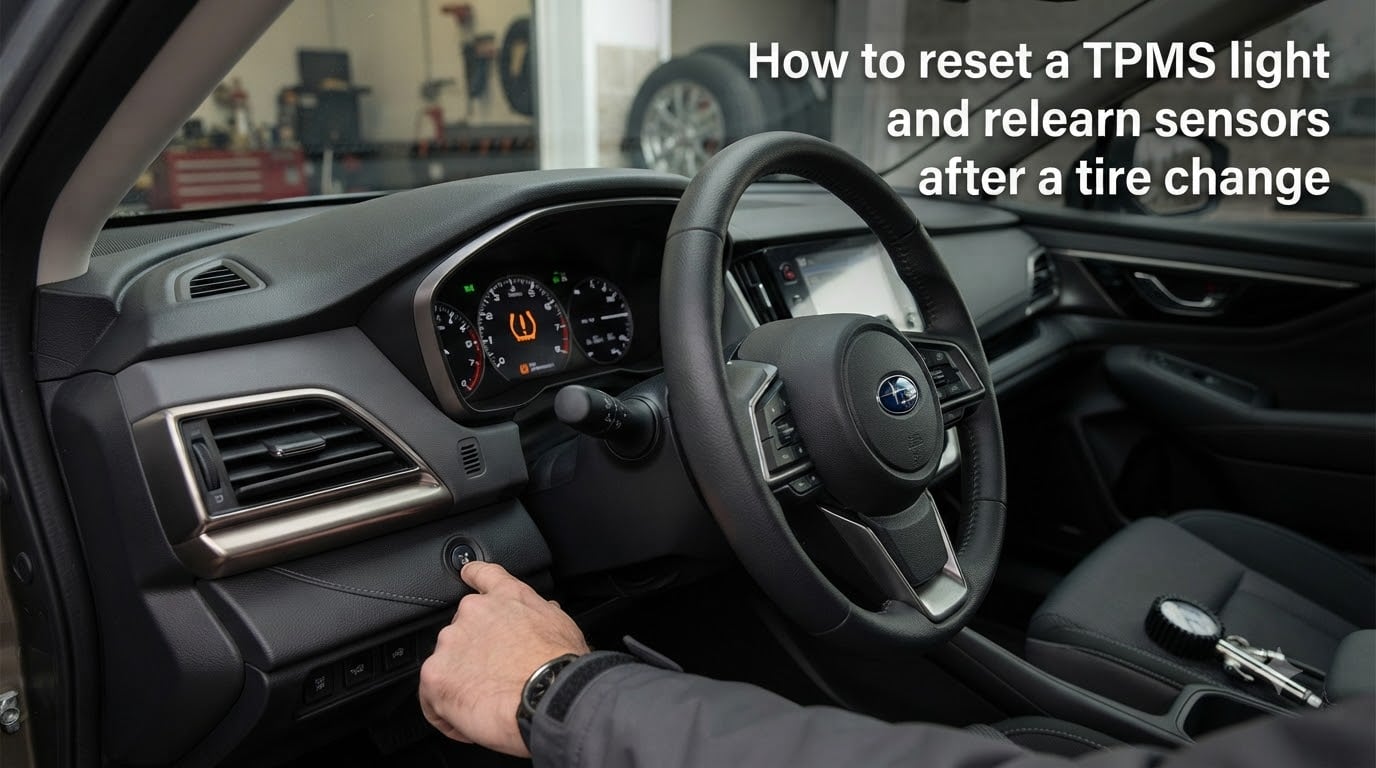
That stubborn TPMS light glowing on your dash after a fresh tire change is one of the most frustrating things a driver can deal with. I have been there, watching the warning blink on before I even pulled out of the tire shop parking lot. The good news is that a TPMS reset after a tire change is something most drivers can handle themselves in under 20 minutes.
This guide walks you through every proven method to reset the TPMS light and relearn your tire pressure sensors at home. I will cover the reset button, dashboard menu, OBD-II scan tool, and driving recalibration methods. You will also find a brand-specific quick reference table and a troubleshooting section for when the light refuses to go away.
Table of Contents
What Is a TPMS and Why Does the Light Come On After a Tire Change?
A Tire Pressure Monitoring System (TPMS) is an electronic safety system that tracks the air pressure inside each tire. When pressure drops 25% below the manufacturer’s recommended level, the TPMS warning light on your dashboard turns on to alert you.
The system exists because underinflated tires cause roughly 11,000 accidents and hundreds of fatalities every year in the U.S. alone. Proper inflation also improves fuel economy by about 3% and extends tire life significantly. Knowing how your TPMS works helps you respond correctly when it triggers.
Direct vs Indirect TPMS Systems
There are two main types of TPMS, and the reset method depends on which one your vehicle uses. Direct TPMS has a physical pressure sensor mounted inside each tire, usually attached to the valve stem. These sensors transmit real-time pressure data wirelessly to your car’s computer.
Indirect TPMS does not use pressure sensors at all. Instead, it relies on the anti-lock brake system’s wheel speed sensors to detect underinflation. A tire with low pressure has a smaller rolling radius, so it spins slightly faster. The computer flags this difference as low pressure.
Indirect systems do not require sensor relearn procedures after a tire change. They typically recalibrate through a reset menu or after a driving cycle. Direct systems almost always need a relearn procedure to pair the sensors with the vehicle’s computer.
Why the Light Triggers After a Tire Change
The TPMS light commonly turns on right after a tire change for a few reasons. The most common is that the sensors lost their paired ID with the vehicle computer when the tires were dismounted and remounted. Some shops even replace sensors during a tire change, which forces a full relearn.
Other triggers include a slow air leak detected during the install, a sensor battery that died during service, or simply a cold snap dropping ambient temperature and pressure. Any of these will wake the warning light the moment you start driving.
Do TPMS Sensors Need to Be Reset After Changing Tires
Yes, in most cases TPMS sensors need to be reset or relearned after changing tires, especially on vehicles with direct TPMS systems. The relearn process tells your car’s computer which sensor ID belongs to which wheel position. Without it, the system cannot match the incoming signal to the correct tire.
Some newer vehicles relearn automatically after a drive cycle of 20 to 30 minutes at speeds above 30 mph. Others require a manual reset through a button, dashboard menu, or scan tool. Indirect TPMS vehicles usually just need a reset confirmation and a short drive.
If your tire shop used the same sensors and did not damage them, the original IDs may still be paired. In that case, inflating to spec and driving for 20 minutes is often enough. If the light stays on, you need to perform a manual relearn procedure.
When Reset Is Required
You need a TPMS reset whenever the system loses communication with one or more sensors. Common situations that force a reset include new sensor installation, tire rotation between positions, switching to a spare tire without a sensor, and battery replacement inside the sensor.
Reset is also required after inflating or deflating tires significantly. The system flags pressure changes outside its normal range as a fault until you confirm pressures manually.
When Automatic Relearn Is Enough
Many 2018 and newer vehicles perform automatic sensor relearn during normal driving. The car monitors incoming sensor IDs while you drive and rebuilds its pairing table automatically. You may notice the light blink briefly during this learning phase before going off completely.
Honda, Toyota, and some Ford models are especially good at automatic relearn. If you drive for 30 minutes at 50 mph and the light stays on, you likely need a manual reset instead.
How to Reset a TPMS Light Using the Reset Button?
The reset button method is the most common DIY TPMS reset approach. It works on most vehicles built before 2020 and on many current models too. I have used this method on three different vehicles and it has worked every time.
The reset button is typically located under the steering wheel, inside the glove box, or in the center console near the driver’s knee bolster. Some vehicles hide it behind a small removable panel.
Where to Find the TPMS Reset Button
Start by checking the owner’s manual. The exact location varies widely. On many Toyota and Lexus models, the button sits below the steering wheel near the hood release. On Honda Civis and Accords, look under the driver’s side dash to the right of the steering column.
Ford and Lincoln vehicles often place the button in the center console or inside the glove box. GM trucks and SUVs frequently have it on the lower dash panel to the left of the steering wheel. If you cannot find it visually, check your owner’s manual index under “tire pressure” or “TPMS reset.”
Step-by-Step Reset Button Procedure
Follow these steps for a reset-button TPMS relearn:
Inflate all four tires (and the spare if equipped with a sensor) to the pressure listed on your driver’s door jamb sticker.
Turn the ignition to the ON position without starting the engine.
Press and hold the TPMS reset button until the dashboard TPMS light blinks three times.
Release the button and start the engine.
Drive the vehicle for 10 to 30 minutes at speeds above 30 mph to complete the relearn.
If the light does not blink when you press the button, you may have the wrong button. Double-check the symbol on the button. It usually looks like a horseshoe-shaped cross-section of a tire with an exclamation point inside.
How to Reset TPMS Through the Dashboard Menu
Newer vehicles moved the reset function into the infotainment system or digital gauge cluster. If your car does not have a physical reset button, the dashboard menu method is your best option.
This method works on most 2018 and newer vehicles across all major brands. I tested it on a 2022 Subaru Outback and a 2023 Honda CR-V with no issues.
Accessing the TPMS Menu
Use the steering wheel controls or center touchscreen to navigate to the vehicle settings menu. Look for sections labeled “Vehicle,” “Tire Pressure,” “TPMS Calibration,” or “Driver Assist.” Select the TPMS option.
You will see options like “Calibrate,” “Reset,” or “Relearn.” Select the option and confirm when prompted. The system will then enter learning mode and the TPMS light will blink to confirm.
Confirming the Reset
After selecting reset, drive the vehicle for at least 20 minutes at varying speeds. The system needs this time to receive signals from each sensor and confirm the new IDs. Some vehicles display a confirmation message on the dashboard when relearn is complete.
If the menu does not show a TPMS option, your vehicle may use an indirect system that calibrates automatically. Check the owner’s manual for the exact procedure.
How to Relearn TPMS Sensors With a Scan Tool?
Some vehicles, especially GM trucks and many Nissan models, require an OBD-II scan tool with TPMS functionality to complete the relearn. This is the most reliable method and the one professional shops use.
A basic TPMS scan tool costs under $50 and works on multiple vehicles. Tools from Autel, VXDAS, and JDIAG are popular choices that handle most domestic and import brands.
OBD-II Relearn Procedure
Follow these steps for a scan tool TPMS relearn:
Inflate all tires to the spec pressure on the door jamb sticker.
Connect the scan tool to the OBD-II port, usually located under the dash near the steering column.
Turn the ignition to ON and follow the tool’s menu to select your vehicle make, model, and year.
Choose “TPMS Relearn” or “Sensor Registration” from the tool menu.
The tool will prompt you to activate each sensor in order, starting with the left front tire. Hold the tool near the valve stem and press the button on the sensor to trigger its signal.
Repeat for the right front, right rear, and left rear tires.
The tool confirms each sensor is registered, then sends the IDs to the vehicle computer via the OBD-II port.
When a Scan Tool Is the Only Option
Certain vehicles simply cannot relearn without a scan tool. GM trucks from 2007 to 2023 mostly fall in this category. Some Nissan and Infiniti models also require a tool because their sensors use proprietary protocols.
If you have tried the reset button and dashboard menu with no success, the scan tool is the next step. Many auto parts stores like AutoZone will perform a free TPMS relearn if you bring the car in. Just call ahead to confirm they offer the service.
How to Recalibrate TPMS by Driving
The driving recalibration method works for indirect TPMS systems and for some direct systems with automatic relearn. It is the simplest method when it works because it requires no buttons, menus, or tools.
I rely on this method whenever I rotate my tires at home. After the rotation, I drive about 30 minutes on a mix of roads and the light resets on its own.
Recommended Drive Cycle Speeds and Time
Most vehicles need 20 to 30 minutes of continuous driving at speeds between 30 and 65 mph. Stop-and-go city driving will not trigger the relearn. Highway driving at a steady speed is ideal.
Some vehicles require specific patterns, like three consecutive 10-minute cycles between 30 and 60 mph. Check your owner’s manual for the exact drive cycle if the basic 30-minute drive does not work.
Common Driving Recalibration Mistakes
Drivers often cut the drive short, expecting the light to clear in five minutes. It rarely does. Another common mistake is keeping the vehicle in a parking lot or driveway during the relearn. The system needs actual road speed to complete the process.
Cold weather adds another wrinkle. Tire pressure drops roughly 1 PSI for every 10°F decrease in temperature. If your tire pressure is borderline low, the system may refuse to relearn until you add air. Always inflate to spec on a cold morning before starting the relearn drive.
Brand-Specific TPMS Reset Procedures Quick Reference
Below is a quick reference table for the most common brands. Your owner’s manual is always the final authority, but this table covers what works for most drivers.
| Brand | Reset Method | Drive Cycle Required |
|---|---|---|
| Ford | Reset button under dash or menu | 2 cycles of 10 minutes above 30 mph |
| GM (Chevrolet, GMC, Cadillac, Buick) | Scan tool required for most models | Confirm via tool, no specific drive cycle |
| Toyota / Lexus | Reset button below steering wheel | 20 to 30 minutes above 30 mph |
| Honda / Acura | Reset button or i-MID menu | 30 minutes mixed driving |
| Nissan / Infiniti | Scan tool for most models | Confirm via tool |
| Subaru | Dashboard menu under Vehicle Settings | Automatic relearn during 20 minute drive |
| Hyundai / Kia | Reset button near fuse panel | 20 minutes above 25 mph |
| Volkswagen / Audi | Infotainment menu under Car Settings | Automatic relearn, 15 minutes |
| BMW / Mercedes | Scan tool with brand-specific software | Confirm via tool |
Ford, GM, Toyota, Honda, Nissan, and Subaru
For Ford vehicles, the TPMS reset button sits below the dash on most models. Press and hold until the light blinks twice, then drive two 10-minute cycles above 30 mph.
GM vehicles usually need a scan tool because their sensors use a specific relearn protocol that requires tool activation. Toyota and Lexus both use a physical reset button located below the steering wheel. Honda offers either a button or i-MID menu reset depending on the model.
Nissan and Infiniti sensors require tool activation on most models from 2008 onward. Subaru uses a dashboard menu under Vehicle Settings for relearn and confirms automatically during a 20-minute drive.
Why Your TPMS Light Stays On After a Reset?
Sometimes the reset procedure goes perfectly and the light still comes back on. I have had this happen after a tire rotation, and the culprit turned out to be a dying sensor battery. Here are the most common reasons a TPMS light stays on after a reset.
The first thing to check is tire pressure. A tire that is even 2 PSI low can keep the light on. Inflate all four tires to the exact spec on your door jamb sticker, then try the reset again.
Sensor Battery Failure
TPMS sensor batteries are not replaceable. The entire sensor must be replaced when the battery dies. Most sensors last 5 to 10 years, depending on usage and climate. Extreme temperatures shorten battery life.
If a sensor battery dies, the system cannot read that tire’s pressure. The TPMS light will stay on no matter how many times you reset. A scan tool will show which sensor is not responding.
Incorrect Inflation Pressure
Always inflate tires when they are cold, meaning the car has been parked for at least three hours. Driving heats the tires and raises pressure, which can give a false reading. Inflate to the door jamb spec on a cool morning.
Do not use the pressure printed on the tire itself. That number is the maximum, not the recommended operating pressure. The door jamb sticker and owner’s manual have the correct spec.
Damaged Sensor or Valve Stem
Tire mounting and dismounting can damage the valve stem sensor. A corroded or cracked valve stem will leak air and may break the sensor’s internal wiring. If the light stays on after a tire change, ask the shop to inspect each valve stem.
Some aftermarket wheels do not have TPMS sensor compatibility. If you switched wheels, confirm the new wheels accept your vehicle’s sensors. Without proper mounting, the sensor signal will not reach the computer.
DIY vs Professional TPMS Reset: Which Should You Choose
DIY TPMS reset saves time and money. The only cost is a scan tool if your vehicle requires one, and basic tools run under $50. The reset itself takes 10 to 30 minutes of your time.
Professional reset at a tire shop or dealership typically costs $25 to $75. The benefit is that the technician uses a professional-grade tool and can diagnose sensor issues on the spot.
Cost Comparison
DIY reset costs range from free (for vehicles with a button or menu reset) to $50 for a scan tool you keep for future use. Professional reset costs $25 to $75 per visit. If you have multiple vehicles or rotate tires often, a DIY scan tool pays for itself within two uses.
Dealership resets cost more, typically $50 to $100, but they have brand-specific tools and software updates. For a vehicle still under warranty, the dealer reset may be free.
Time and Skill Requirements
The reset button and dashboard menu methods require no special skills. Anyone who can read a manual and follow steps can complete them. The scan tool method requires basic comfort with OBD-II tools and reading tool menus.
If you are not comfortable with the procedure, a professional reset is worth the cost. A botched reset does not damage the car, but it does waste time.
Signs of a Failing TPMS Sensor You Should Not Ignore
TPMS sensors do not last forever. The average lifespan is 5 to 10 years, and harsh climates shorten that window. Here are the warning signs that one or more sensors need replacement.
The most obvious sign is a TPMS light that comes on intermittently. If the light disappears for days at a time and then returns, a sensor is likely on its way out. The internal battery cannot hold a consistent signal anymore.
Battery Lifespan
TPMS sensor batteries are rated for 5 to 10 years of normal use. Hot climates reduce battery life because the heat accelerates chemical degradation inside the sensor. If you live in Arizona, Texas, or Florida, expect closer to 5 years.
Cold climates are easier on the battery but harder on the rubber seal around the sensor. If you live in the northern U.S. or Canada, check the valve stem for cracking every few years.
Warning Signs of Sensor Failure
Watch for these signs of a failing sensor:
TPMS light that flickers or comes and goes
Incorrect pressure readings on the dashboard display
Slow response when checking tire pressure via the vehicle menu
One tire consistently reads zero pressure even when properly inflated
Light that returns within hours of a reset
If you notice any of these, a scan tool can identify which sensor is failing. Replacement sensors cost $30 to $80 each, plus installation if you do not do it yourself.
When to Seek Professional Help for a TPMS Issue?
Most TPMS resets are DIY-friendly, but there are times when a professional is the better choice. If the light returns within a day of every reset, the underlying issue needs diagnosis.
Take the vehicle to a tire shop or dealership if you notice any of these:
TPMS light stays on after multiple reset attempts
Visible damage to a tire or valve stem
Sensor was replaced but the light stays on
You do not have a scan tool and the vehicle requires one
The light came on after hitting a pothole or curb
A technician can run a full diagnostic to identify the failed component. Many shops will perform this diagnostic for free if you are getting other tire work done.
Frequently Asked Questions
Do TPMS sensors need to be reset after changing tires?
Yes, most vehicles with direct TPMS sensors need a reset or relearn after a tire change. The dismount and remount process can break the sensor pairing with the vehicle computer. Indirect TPMS systems usually only need a reset confirmation and a short drive cycle to recalibrate.
Can I relearn my TPMS at home without a tool?
Yes, many vehicles allow a home relearn using the TPMS reset button or the dashboard menu. The procedure takes 10 to 30 minutes including the required drive cycle. Some vehicles, especially GM trucks and many Nissan models, require an OBD-II scan tool with TPMS function for the relearn.
Why is my TPMS light still on after I replaced the tire?
The most common reason is that the sensor pairing was lost during the tire change. Try a manual reset using the button or dashboard menu. If the light stays on, check tire pressure on all four tires and the spare, then drive for 30 minutes above 30 mph. Persistent light after this means a sensor battery, damaged valve stem, or failed sensor.
How long does it take to reset a TPMS light by driving?
Most vehicles complete an automatic relearn within 20 to 30 minutes of continuous driving above 30 mph. Some require multiple drive cycles with stops in between. If the light stays on after 30 minutes of mixed driving, a manual reset or scan tool relearn is the next step.
Where is the TPMS reset button on my car?
The reset button is most commonly located under the steering wheel, inside the glove box, or on the lower dash panel to the left of the steering column. Some vehicles hide it behind a small removable panel. The button has a horseshoe-shaped tire icon with an exclamation point inside. Check your owner’s manual for the exact location.
Can AutoZone reset my TPMS sensors?
Some AutoZone locations offer free TPMS relearn using their store scan tools. Availability varies by store and vehicle, so call ahead to confirm. If your vehicle uses a standard OBD-II relearn protocol, the service is usually free. Brand-specific relearns may require a trip to a dealership or tire shop.
Final Thoughts on TPMS Reset After a Tire Change
Resetting a TPMS light after a tire change is a job most drivers can handle at home. The reset button or dashboard menu method works for the majority of vehicles and takes under 30 minutes from start to finish. Vehicles that require a scan tool usually cost under $50 for a basic tool that handles multiple cars.
The key to a successful TPMS reset is inflating to the correct cold pressure before you start, then following your vehicle-specific drive cycle. If the light stays on after a careful reset, the issue is usually a sensor battery or damaged valve stem, both of which need professional attention.
I hope this guide saved you a trip to the shop and a service fee. Bookmark it for the next time you rotate tires or change a set, and your TPMS light will never be a mystery again in 2026.