
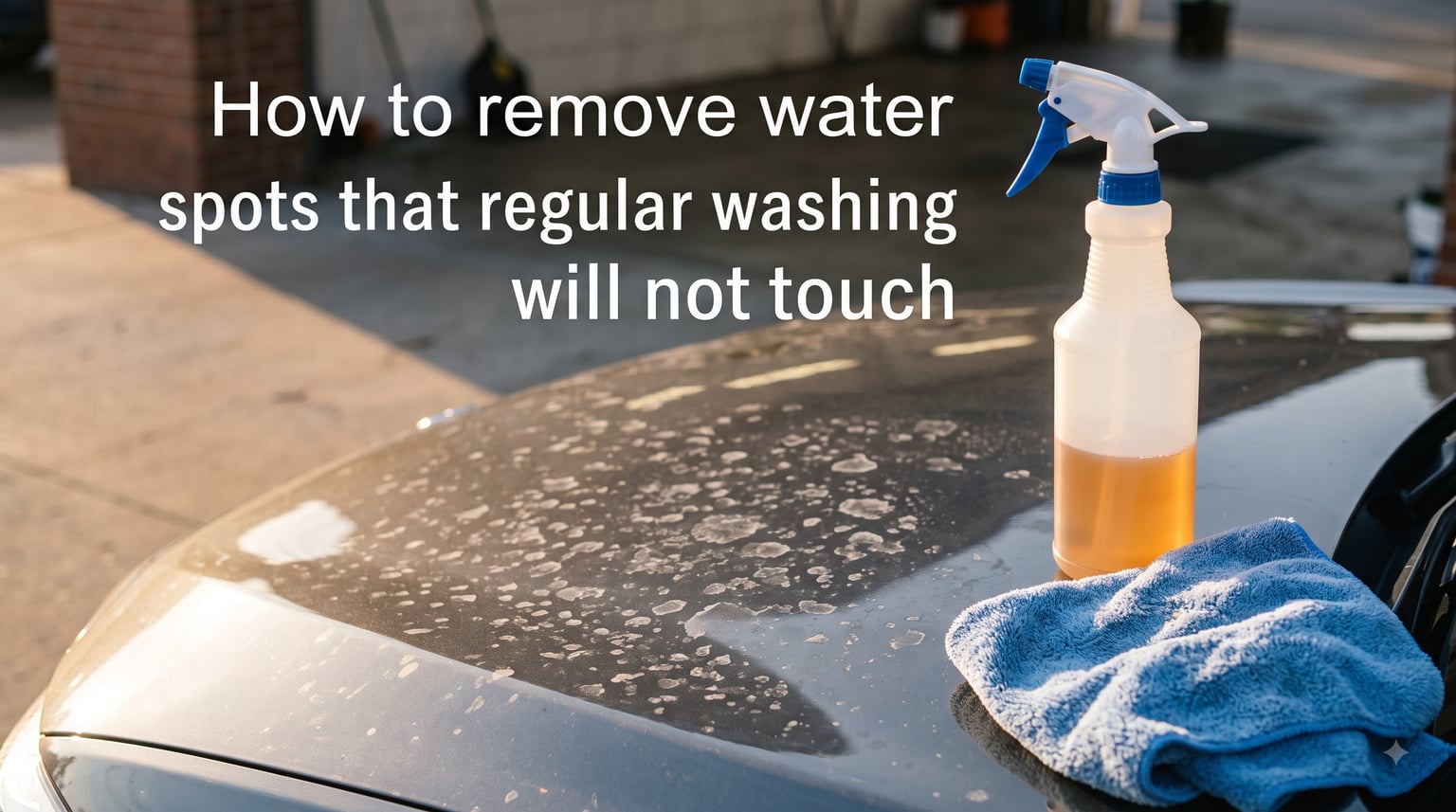
You washed your car. You dried it carefully. And those chalky white circles are still staring back at you.
If you’re searching for how to remove water spots that regular washing will not touch, you’ve already done the obvious things. Soap, water, microfiber, repeat. None of it worked. That frustration is valid, and the reason it failed is actually good news: once you understand what’s happening on the surface, the fix becomes straightforward.
I’m going to walk you through the exact progression I use myself, starting with the gentlest vinegar solution and moving up through clay bar treatment, polishing compounds, and finally knowing when to hand the job to a professional detailer. By the end, you’ll know exactly which type of spot you have, which method will kill it, and which mistakes will make things worse.
Table of Contents
Why Regular Car Washing Won’t Remove Stubborn Water Spots?
Regular car washing removes loose dirt, dust, and fresh water residue. It cannot dissolve mineral deposits that have bonded to your paint or glass.
Here’s what’s actually happening. Tap water, sprinkler water, and rain all carry dissolved minerals, primarily calcium, magnesium, and silica. When that water evaporates, the minerals don’t disappear with it. They stay behind as a thin crust on the surface.
On a fresh spill, this crust sits loosely on top of the paint and rinses away easily. But under the summer sun, the water bakes off faster than the minerals can drift away. Heat essentially welds those minerals to the clear coat.
Car shampoo is designed to lift dirt and oil. It has no chemical action against calcium carbonate or silica. That’s why you can scrub a water spot for ten minutes with your favorite soap and still see it when you rinse. The spot isn’t dirt. It’s a mineral film bonded to the finish.
The fix needs chemistry, not just friction. Either an acid (like vinegar) to dissolve the minerals, or a mild abrasive (like a clay bar or polish) to physically remove the layer they sit on.
The Different Types of Water Spots You Need to Identify First
Before you grab any product, look closely at the spot. The fix you need depends on how deep the damage goes.
Type 1: Fresh Mineral Deposits (Surface Only)
A new spot from last night’s dew or this morning’s rain. The minerals sit on top of the clear coat and have not bonded. You can usually feel the difference by running a clean fingertip across the paint. A fresh spot feels slightly chalky. These come off with a vinegar solution or even a quality detail spray.
Type 2: Bonded Mineral Stains
Spots left by sprinklers, overnight dew, or rain that dried in the sun. The minerals have fused to the surface and won’t budge with normal washing. They feel rough under your fingernail and look dull or chalky white. These require a clay bar treatment or a mild acid wash.
Type 3: Etched Spots (Clear Coat Damage)
Spots that have been baking in the sun for days or weeks. The minerals didn’t just sit on top; they sat long enough to eat into the clear coat itself. You’ll see a faint ring or crater, sometimes visible only at certain angles. These need polishing, not just cleaning.
Type 4: Acid Rain or Alkaline Burn Marks
Industrial fallout, bird droppings mixed with rain, or pollution-heavy rainwater can leave chemical burns. These look like permanent dull patches, often irregular in shape. Mild cases respond to polishing. Severe cases may need professional correction or even repainting.
Most car owners deal with Type 1 and Type 2. Type 3 and 4 require more caution and, often, more tools.
Mild DIY Methods: Vinegar, Detail Spray, and Quick Fixes
Always start with the gentlest method that can work. Vinegar is your first line of defense for fresh and lightly bonded spots.
The White Vinegar Solution
Mix one part distilled white vinegar with one part clean water in a spray bottle. The acidity is strong enough to dissolve calcium and magnesium but mild enough to be safe on clear coat when used briefly.
Wash and dry the car first so you’re working on a clean surface.
Spray the vinegar solution directly onto the spot.
Wait 30 to 60 seconds. Don’t let it dry on the paint.
Wipe with a clean microfiber towel, flipping to a fresh side often.
Rinse the area with clean water to neutralize the acid.
This is the method the detailing community recommends most often. It’s cheap, safe, and effective for Type 1 and many Type 2 spots.
What About WD-40?
Yes, WD-40 can help with very light spots. The petroleum carrier loosens the mineral film and gives you a window to wipe it away. Spray a small amount on a microfiber towel (never directly on hot paint), work the spot gently, then wash the area with soap to remove the oily residue.
WD-40 is a short-term fix, not a long-term solution. The oil can attract dust and interfere with any sealant you apply afterward, so always follow up with a proper wash.
Will Dawn Dish Soap Remove Water Spots?
Not effectively. Dawn is excellent at cutting grease, but it has no chemistry to dissolve minerals. It might help with the cleaning step before you attack the spots, but it won’t budge a bonded mineral deposit on its own.
Step-by-Step: Removing Stubborn Water Spots at Home
Here’s the exact sequence I follow when a customer hands me a car covered in sprinkler spots or after a road trip through hard water country.
Step 1: Wash the Car Thoroughly
Start with a full two-bucket wash using a pH-balanced car shampoo. This removes loose contamination so you can see exactly what you’re dealing with. Dry the car with a clean microfiber drying towel.
Step 2: Try the Vinegar Test
Apply the vinegar solution to a small spot and wait 30 seconds. Wipe. If the spot disappears, you’re dealing with a Type 1 deposit and the vinegar will handle the whole car.
Step 3: Move to Clay Bar Treatment
If vinegar doesn’t remove the spot, the minerals have bonded mechanically to the surface. A clay bar pulls them out without abrading the clear coat. Work one panel at a time with a quality clay lubricant.
Step 4: Inspect and Re-Wash
After claying, wash the area again to remove clay lubricant residue. Inspect under good lighting at multiple angles. Most spots will be gone at this point.
Step 5: Polish Only If Etching Remains
If you still see rings or craters, the clear coat itself has been etched. A light polishing compound with a dual-action polisher will level the surface. By hand is possible for tiny spots but tiring for larger areas.
Step 6: Seal or Wax the Paint
Once the surface is clean and smooth, protect it. A fresh coat of wax, paint sealant, or ceramic coating will make future water spots easier to remove and give you more time before minerals bond.
Clay Bar Treatment for Bonded Contamination
A clay bar is a synthetic resin putty that grabs bonded contamination and pulls it off the paint surface. It’s the right tool when vinegar fails but the surface isn’t yet etched.
Knead the clay until it’s soft and pliable. Spray the panel with clay lubricant, then glide the clay across the surface in straight lines. Never in circles. You’ll feel the clay “grab” at contamination, then glide smoothly when the surface is clean.
Fold the clay frequently to expose a fresh surface. Drop the clay on the ground and throw it away, it will pick up grit that will scratch your paint.
Clay barring a full car takes 60 to 90 minutes the first time. It’s labor-intensive but extremely safe for clear coat when done with enough lubricant.
When Polishing and Paint Correction Become Necessary?
Polishing removes a microscopic layer of clear coat to level the surface and erase etching. It’s the only way to fix Type 3 spots that have actually damaged the finish.
For a small area with one or two etched spots, you can do this by hand using a fine finishing polish and a foam applicator pad. Work the polish in small circles with light pressure, then buff off with a microfiber towel.
For larger areas, a dual-action polisher saves hours and gives better results. But polishers are unforgiving tools. Too much pressure or the wrong pad can burn through the clear coat, leaving you with a worse problem than the original spots.
If you’re not comfortable with a polisher, this is the right point to stop and call a professional.
Common Mistakes That Make Water Spots Worse
I’ve seen every one of these mistakes on customer cars, and each one makes the original problem harder to fix.
Scrubbing with a dry towel. Dry friction on bonded minerals scratches the clear coat and pushes the minerals deeper.
Working in direct sunlight. Heat flashes off your cleaning solution before it can work, and bakes the minerals deeper.
Using household bathroom cleaners. Tile and bathroom cleaners are too aggressive and will dull or etch the clear coat.
Skipping the test spot. Always test any product on a small, hidden area first, like the lower door panel.
Letting vinegar dry on the paint. Vinegar is safe when used briefly but can etch if left to dry in the sun.
Polishing before claying. Polishing over bonded contamination grinds minerals into the clear coat.
The fastest way to make a water spot permanent is to ignore the type and reach for the strongest product you own.
How to Prevent Water Spots From Coming Back?
Once you’ve cleaned the paint, a few habits will keep it that way.
Drying the car immediately after washing is the single biggest prevention. Every minute water sits on the paint, minerals are bonding. Use a waffle-weave microfiber drying towel and work from the top down.
Apply a paint sealant or ceramic coating every 6 to 12 months. These create a hydrophobic layer that causes water to bead and roll off instead of evaporating in place. When water does sit longer, it’s easier to remove.
Park in a garage whenever possible. If you can’t, avoid parking under trees where sap and bird droppings mix with rain, and avoid parking near lawn sprinklers. Sprinkler water often contains fertilizer and iron, which leaves especially stubborn spots.
Keep a spray bottle of quick detailer in your car. A quick wipe-down right after an unexpected rain will prevent 90 percent of the spots you’d otherwise have to remove later.
When to Call a Professional Detailer?
DIY makes sense for fresh and lightly bonded spots. It stops making sense when the spots have etched the clear coat or cover a large area.
A professional detailer has the tools to measure clear coat thickness, the polishers to remove etching evenly, and the lighting to spot problems you’d miss in a home driveway. Correction work for a full car runs a few hundred dollars but brings the paint back to like-new condition.
If you’ve tried vinegar and clay and the spots still show, that’s your signal. The next step requires abrasives, and abrasives require experience.
FAQs
How do I get rid of stubborn water spots on my car?
Start by washing the car with a pH-balanced shampoo, then apply a 50/50 white vinegar and water solution to the spots. Wait 30 seconds, wipe with a microfiber towel, and rinse. If the spot remains, use a clay bar with lubricant to pull bonded minerals off the surface. Polish only if etching has set into the clear coat.
Will Dawn dish soap remove water spots?
Dawn cuts grease but has no chemistry to dissolve the calcium and magnesium in mineral deposits. It helps clean the surface before spot removal but will not remove bonded water spots on its own. Use a vinegar solution or clay bar for actual spot removal.
Does WD-40 actually remove water spots?
WD-40 can loosen light mineral films so they wipe away, but it is a temporary fix. The oily residue must be washed off afterward, and it will not fix etched spots. Use it only as a quick pre-cleaner before a proper wash and clay bar treatment.
What dissolves hard water spots on car paint?
Mild acids dissolve the calcium carbonate and magnesium in hard water spots. White vinegar is the most accessible option. For tougher spots, dedicated water spot removers use a slightly stronger acid blend. Always neutralize with a rinse and never let the solution dry on the paint.
Why do my water spots keep coming back?
Spots reappear when the underlying cause is not addressed. Hard water in your area, sprinkler overspray, parking under trees, and skipping the drying step all leave minerals on the paint. Apply a paint sealant or ceramic coating after cleaning to create a hydrophobic barrier that slows future bonding.
Final Thoughts on Stubborn Water Spot Removal
Water spots that survive a normal car wash are not a mystery. They are bonded mineral deposits, and they require chemistry or mild abrasion to remove.
Start with vinegar, escalate to a clay bar, and reserve polishing for spots that have actually etched the clear coat. Protect the finish afterward with a sealant or coating, and dry the car quickly every time it gets wet. That progression handles 95 percent of what you’ll run into as a daily driver.
If you’re staring at stubborn water spots that won’t budge after a normal wash, you now have a clear path forward. Pick the method that matches the damage, work in the shade, and test first. Your paint will thank you.