
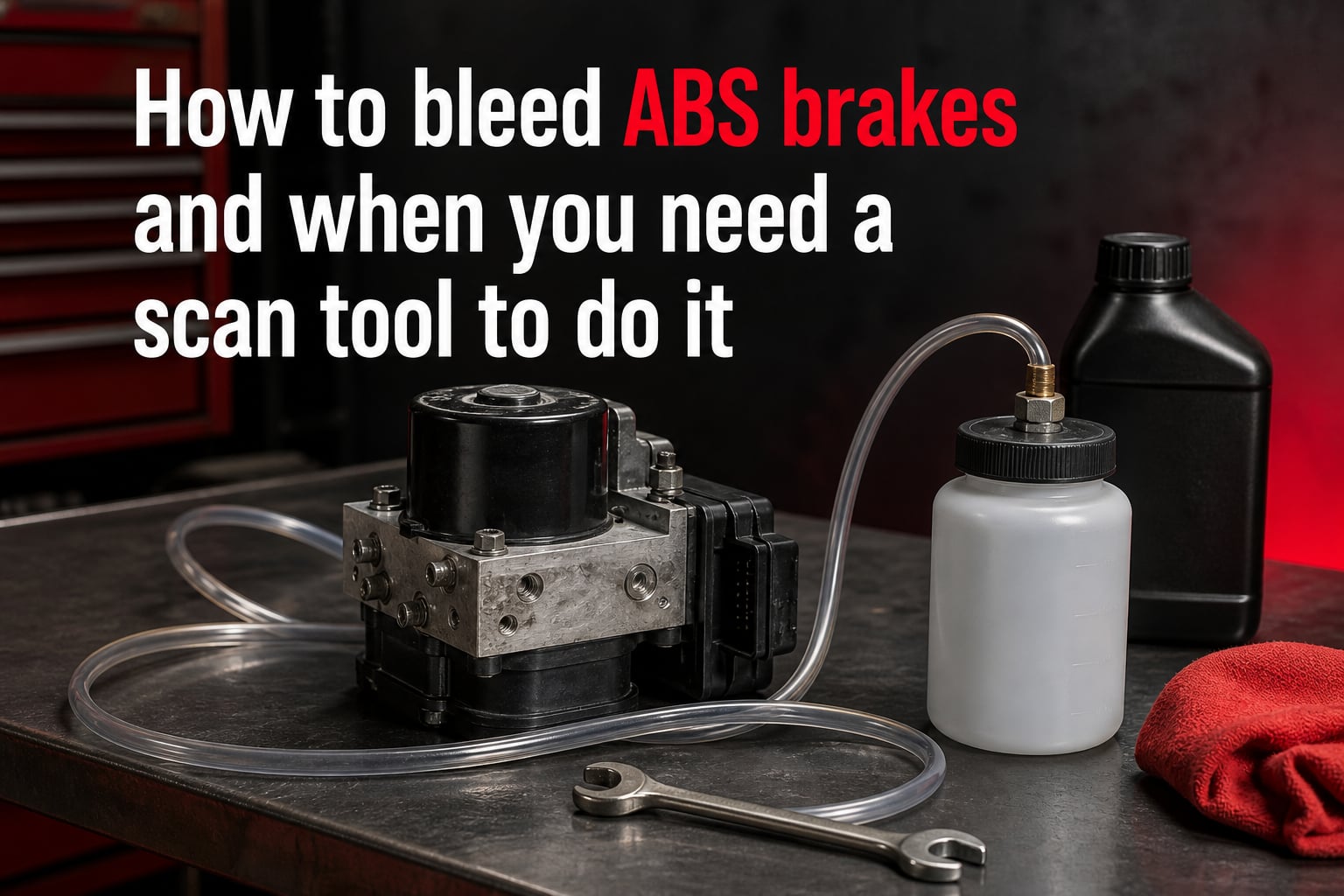
Learning how to bleed ABS brakes the right way can save you from a dangerous spongy pedal and an expensive trip to the shop. The challenge is that anti-lock brake systems trap air inside the hydraulic control unit, where a standard manual bleed cannot reach it. Depending on your vehicle, you may get away with a simple gravity or pedal bleed. On many late-model cars and trucks, though, you need a bi-directional scan tool to cycle the ABS solenoid valves and pump before the system will bleed properly.
This guide walks you through the entire process so you can figure out which method your vehicle requires and get the job done correctly the first time.
Table of Contents
What Is ABS and Why Bleeding It Is Different?
ABS stands for anti-lock brake system. At the heart of it sits the ABS module, also called the hydraulic control unit or hydraulic modulator. This aluminum block contains solenoid valves, a pump motor, and internal channels that route brake fluid to each wheel. The valves open and close rapidly during a panic stop to prevent wheel lockup.
The problem is that those internal channels create dead-end pockets where air bubbles can hide. When you do a traditional manual bleed, you only push fluid from the master cylinder straight to the bleeder screws at each wheel. That path bypasses the internal passages inside the ABS module entirely. So even after a perfect four-corner bleed, air can remain trapped inside the modulator, leaving the pedal soft and low.
This is exactly why ABS bleeding is different from bleeding an older non-ABS system. On a vehicle without ABS, flushing fluid through the bleeder screws removes all the air because there are no hidden chambers. On an ABS-equipped vehicle, you have to physically open the solenoid valves and run the pump to flush those internal passages clean.
Signs You Need to Bleed Your ABS Brakes
A soft, spongy brake pedal is the number one symptom of air trapped in the brake lines or ABS module. The pedal may travel farther than normal before the brakes engage, or it may sink slowly under steady pressure. You might also notice that the brake pedal goes almost to the floor on the first pump but firms up on the second.
Other warning signs include:
The brake warning light or ABS light stays illuminated on the dash.
Braking feels weak or delayed, especially in wet conditions.
You just replaced a caliper, wheel cylinder, brake hose, or master cylinder and introduced air into the system.
The brake fluid is dark, milky, or more than two years old.
If any of these apply, plan to bleed the full system. And if the pedal is still soft after a standard bleed, trapped air in the ABS module is the most likely culprit.
When You Need a Scan Tool vs When Manual Bleeding Works
This is the question every DIYer asks: do I actually need a scan tool to bleed ABS brakes? The honest answer is that it depends on your vehicle and what work you just performed. Here is how to decide.
You can usually get away with a manual bleed when:
You only changed the fluid as routine maintenance and no air entered the ABS module.
You replaced a single caliper or hose and kept the line from running dry.
You have an older vehicle (pre-2000s many domestic trucks and SUVs) with a simpler ABS design.
The pedal feels firm after a standard four-corner gravity or pedal bleed.
You need a scan tool with bi-directional ABS bleeding capability when:
You replaced the ABS module or hydraulic control unit itself.
You let the master cylinder run dry and air entered the ABS unit.
The pedal remains soft and spongy after multiple manual bleed attempts.
You own a late-model GM truck (Silverado, Sierra, Tahoe, Suburban), many Ford vehicles, most Jeeps, or certain European cars that require the automated bleed function.
You want to do the job once instead of guessing and repeating it.
Many forum users on GMT400, CorvetteForum, and Reddit confirm that GM vehicles from the late 1990s onward commonly require a scan tool for a proper ABS bleed. The scan tool sends a command through the OBD-II port that cycles the solenoid valves and runs the pump motor for roughly 60 seconds, pushing trapped air out into the brake lines where your normal bleed can flush it.
How to Bleed ABS Brakes: Manual Method Step by Step?
If your situation falls into the manual-bleed category, here is the full procedure. This is the same process you would follow on any hydraulic brake system, and it works on many ABS-equipped vehicles as long as no air got into the ABS module itself.
Step 1: Gather your supplies. You need fresh DOT 3 or DOT 4 brake fluid (check your manual for the correct spec), a clear vinyl bleeder hose, a catch bottle, a lug wrench, a bleeder wrench or box-end wrench that fits the bleeder screws (usually 10mm or 8mm), and safety glasses.
Step 2: Top off the master cylinder. Fill the reservoir to the MAX line and keep the cap on loosely. Never let the reservoir drop below the MIN line during the process or you will pull more air into the system. Check it after every wheel.
Step 3: Start at the wheel farthest from the master cylinder. The standard sequence is right rear, left rear, right front, left front. This pushes air through the longest lines first.
Step 4: Clean the bleeder screw and attach your hose. Spray the area with brake cleaner so dirt does not enter the caliper. Slide the clear hose over the nipple and submerge the other end in a little fresh fluid in your catch bottle.
Step 5: Crack the bleeder open about a quarter turn. Have a helper slowly press the brake pedal to the floor and hold it. Close the bleeder screw before they release the pedal. Repeat until you see no bubbles in the clear hose, usually four to six cycles per wheel.
Step 6: Move to the next wheel in sequence. Top off the master cylinder between each corner. When all four wheels are done, pump the pedal with the engine off until it feels firm, then start the engine and check the pedal feel again.
If the pedal is rock solid, you are done. If it is still spongy or sinks, you likely have air trapped in the ABS module and need to move to the scan tool method or the drive and slam technique below.
How to Bleed ABS Brakes: Scan Tool Method Step by Step
When a manual bleed is not enough, the scan tool bleed is the factory-correct procedure. You need a scan tool with bi-directional control, also called active tests or special functions. Not all OBD-II scanners have this. Basic code readers will not work. You need a tool that can send commands to the ABS module, not just read codes.
Step 1: Do a manual bleed first. The scan tool procedure is always done in combination with a standard pedal or pressure bleed. Run the full four-corner manual sequence described above before you touch the scan tool so the brake lines are mostly clear.
Step 2: Connect the scan tool to the OBD-II port. Turn the ignition to the ON position without starting the engine. Navigate to the ABS module menu and look for a function labeled Automated Bleed, ABS Bleed, Service Bleed, or Modulator Bleed. The exact name varies by manufacturer and tool.
Step 3: Follow the on-screen prompts. The scan tool will cycle the ABS solenoid valves and run the pump motor. This process typically runs in one or two 60-second cycles. The tool will tell you when to open specific bleeder screws and when a helper should pump the pedal.
Step 4: Bleed the wheels as the tool instructs. Some tools have you open the right rear bleeder during the first cycle, then the left rear during the second. Keep the clear hose attached and watch for bubbles. The pump activation pushes trapped air out of the hydraulic modulator and into the lines.
Step 5: Repeat if needed. If the tool offers a second automated bleed cycle, run it. After the scan tool finishes its routine, do one more manual bleed pass on all four wheels to flush any remaining air.
Step 6: Clear codes and test. Use the scan tool to clear any ABS codes that were set during the process. Pump the pedal with the engine off until firm, start the engine, and verify the pedal height and feel are correct. Take a slow test drive in a safe area and confirm the ABS warning light is off.
Alternative: The Drive and Slam Technique
If you do not own a capable scan tool and your vehicle does not strictly require the automated bleed, many forum users report success with what they call the drive and slam method. The idea is to physically trigger the ABS pump on a low-traction surface so the solenoid valves cycle naturally and push trapped air into the lines.
Find a gravel road, wet grass, or an empty dirt lot. Drive at about 20 to 25 mph and brake hard enough to activate the ABS. You will feel the pedal pulse and hear the pump motor run. Do this three or four times, then immediately bleed all four wheels using the manual method.
This technique does not work on every vehicle. Many late-model GM and European cars will not fully clear the ABS module this way. But for older domestic trucks and some Asian vehicles, forum members on GMTruckClub and Reddit confirm it can save a scan tool purchase. It is worth trying before you spend money on a tool rental.
Tools and Materials You Will Need
Having the right tools makes the difference between a clean job and a frustrating mess. Here is what to gather before you start:
Brake fluid: Check your owner’s manual for the exact DOT rating. Most vehicles use DOT 3 or DOT 4. Never mix DOT 5 silicone fluid with DOT 3 or 4.
Bleeder wrench: A 10mm or 8mm flare-nut or box-end wrench prevents rounding off the soft bleeder screws.
Clear vinyl tubing: Size it to fit snugly over the bleeder nipple so you can see bubbles.
Catch bottle: A small plastic bottle with a drilled cap keeps fluid off your wheels and paint.
Brake cleaner and rags: Clean the bleeder area before opening it to keep dirt out.
Jack and jack stands: Never work under a vehicle supported only by a hydraulic jack.
Bi-directional scan tool (if needed): Look for one that lists ABS automated bleed as a supported function for your make and model.
Helper or one-person bleeder kit: A pressure bleeder or one-way valve kit lets you do the job solo.
Common Mistakes and How to Avoid Them
The number one mistake is letting the master cylinder reservoir run dry during the bleed. One moment of inattention and you pump a full load of air into the system, including the ABS module. Top it off after every wheel and keep an eye on the level constantly.
Another frequent error is using the wrong brake fluid. DOT 3, DOT 4, and DOT 5.1 are glycol-based and generally compatible. DOT 5 is silicone-based and is never compatible with the others. Mixing them causes seal damage and brake failure. Always verify the spec on the reservoir cap.
People also round off bleeder screws by using the wrong wrench or pulling at a bad angle. Bleeder screws are soft and seize easily. Soak them with penetrating oil the night before, use a proper flare-nut wrench, and apply steady pressure. If one snaps, you will be replacing the caliper or wheel cylinder.
Skipping the final test drive is another error. A pedal that feels fine in the driveway can still have a small air pocket that only shows up under real braking load. Take a slow, safe test drive and confirm the ABS does not trigger unexpectedly and the pedal stays firm.
Troubleshooting a Persistent Soft Pedal After Bleeding
Still soft after bleeding all four wheels? This is the most frustrating scenario and one most guides skip. The first thing to check is whether air is actually trapped in the ABS module. If your vehicle requires the scan tool bleed and you skipped it, that is your answer. Run the automated bleed or try the drive and slam method and bleed again.
If you already did the scan tool bleed and the pedal is still soft, inspect the master cylinder. A master cylinder that has been run dry or is worn internally can bypass fluid and never build full pressure. Symptoms include a pedal that slowly sinks when held steady with the engine running.
Check for a leaking brake hose. An internally collapsed rubber hose can act like a one-way valve, trapping pressure at the caliper or preventing the brakes from releasing. This often shows up as one wheel dragging or pulling to one side.
Finally, verify you used the correct bleeding sequence. Some vehicles with a split-diagonal system require a different order than the standard far-to-near pattern. Check a factory service manual for your specific make and model if the standard sequence is not working.
FAQs
Do I need a scan tool to bleed ABS brakes?
Not always. If you only did routine maintenance or a simple caliper swap with no air entering the ABS module, a standard manual bleed often works. You need a bi-directional scan tool if you replaced the ABS module, ran the master cylinder dry, or the pedal stays soft after a manual bleed. Many late-model GM, Ford, and European vehicles require the automated scan tool bleed as the factory procedure.
How do you get air out of your ABS without a scan tool?
Bleed all four wheels manually first. Then try the drive and slam method: find a safe gravel or dirt surface, drive about 20 mph, and brake hard enough to trigger the ABS pulse three or four times. The pump activation can push trapped air into the brake lines. Immediately bleed all four wheels again. This works on many older domestic vehicles but may not fully clear the module on newer cars.
What scan tool can bleed an ABS module?
You need a bi-directional scan tool with active test or special function capability, not a basic code reader. Look for a tool that lists ABS automated bleed as a supported function for your make and model. Mid-range professional scanners and some app-based OBD2 dongles with paid software offer this. Always confirm vehicle compatibility before buying.
Do you need the engine running to bleed ABS brakes?
No. For a manual pedal bleed, the engine should be off. For the scan tool automated bleed, the ignition is typically turned to ON without starting the engine. Follow the specific instructions displayed by your scan tool during the procedure.
Do I bleed brakes with the reservoir cap on or off?
Leave the cap off or loosely in place during the bleed so you can monitor and top off the fluid level. Keeping the cap fully seated makes it harder to add fluid and check the level between wheels. Just keep the reservoir covered enough to prevent dust entry.
Why is my brake pedal still soft after bleeding?
The most common cause is air still trapped in the ABS module that a manual bleed cannot reach. Run a scan tool automated bleed or the drive and slam method and re-bleed. Other causes include a worn master cylinder, an internally collapsed brake hose, or using the wrong bleeding sequence for your vehicle.
Conclusion
Knowing how to bleed ABS brakes correctly comes down to understanding when a manual bleed is enough and when you need a scan tool. Start with a clean four-corner manual bleed, and if the pedal stays soft, move to the automated scan tool bleed or the drive and slam method. Always use the correct DOT fluid, keep the reservoir full, and test the pedal under real driving conditions before calling the job done. Safe braking depends on a firm pedal, so take your time and get it right.