
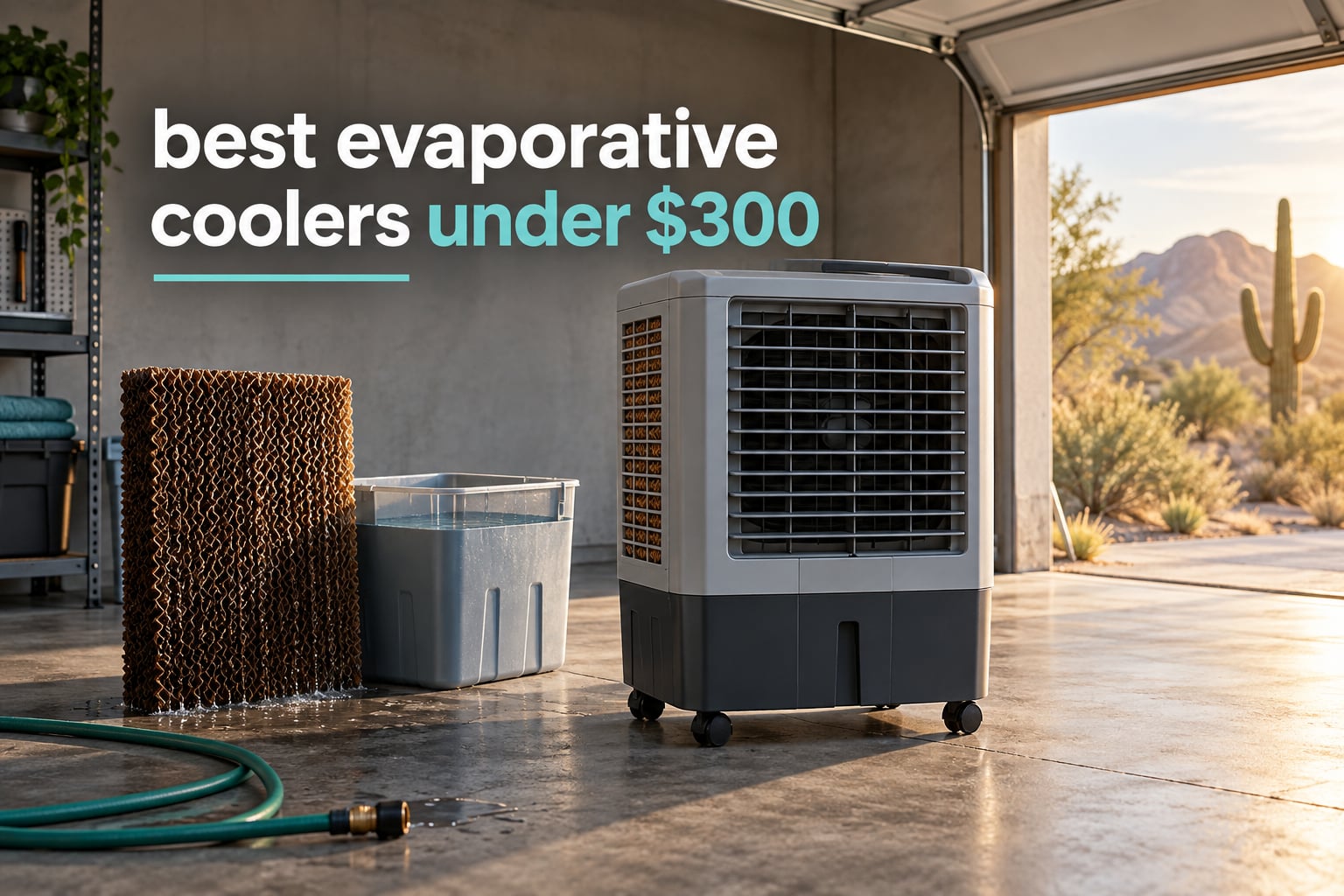
An evaporative cooler is not an air conditioner with a different label. It is a fan, a wet pad, and a water tank, and the pad only cools the air when the water can actually evaporate out of it. That single fact decides whether a 300 dollar budget buys you a working cooler or an expensive box fan with a reservoir attached.
We spent 2026‘s summer sorting through every sub-300 dollar evaporative cooler worth sorting through, reading the manufacturer specs against the buyer reviews, and checking where the honest limits sit. The short version: an evaporative cooler earns its money in dry air, in spaces that are not bedrooms, and when you can live with moving a lot of air. If any one of those three conditions fails, you want a different product, and we will tell you which one.
This is the list we would hand to a friend with 300 dollars, a garage or a spare room, and a dry enough summer. We have written this as the best evaporative coolers under 300 dollars guide for 2026, with every pick held to the price cap. If you want the short answer first, the top three are below.
Disclosure: as an Amazon Associate we earn from qualifying purchases. That never changes which unit we rank first.
Table of Contents
Top 3 Best Evaporative Coolers Under $300 in October

Ashihoti 4-IN-1 Evaporative Cooler
- 3 gallon top-fill tank
- 6 speeds and 3 modes
- 45 dB at 65W
- 360 degree casters

DREO 40 Inch Swamp Cooler Tower
- 35 dB cross-flow impeller
- 80 degree oscillation
- Removable tank and pad
- 55W draw

VEVOR 1400 CFM 5 Gallon Cooler
- 1400 CFM airflow
- 5 gallon top-fill and hose ready
- Dry-run protection
- Patio and garage ready
A note on how to read the list: the first pick is the strongest all-round buy, the second is the one that makes the most sense for the least money, and the third is the cheapest honest attempt at real room airflow. Everything below them earns its place for a narrower job.
Best Evaporative Coolers Under 300 Dollars in 2026
| Product | Specs | Action |
|---|---|---|
| Ashihoti 4-IN-1 Evaporative Cooler |
|
Check Latest Price |
| DREO 40 Inch Swamp Cooler Tower |
|
Check Latest Price |
 Antarctic Star Windowless Tower Cooler Antarctic Star Windowless Tower Cooler |
|
Check Latest Price |
| VEVOR 1400 CFM 5 Gallon Cooler |
|
Check Latest Price |
 Hessaire DC18 Mobile Evaporative Cooler Hessaire DC18 Mobile Evaporative Cooler |
|
Check Latest Price |
 PNTCK 3-IN-1 Swamp Cooler Tower PNTCK 3-IN-1 Swamp Cooler Tower |
|
Check Latest Price |
 SereneLife 2500 CFM 8 Gallon Cooler SereneLife 2500 CFM 8 Gallon Cooler |
|
Check Latest Price |
 Uthfy 4000 CFM 13.5 Gallon Cooler Uthfy 4000 CFM 13.5 Gallon Cooler |
|
Check Latest Price |
Two numbers do most of the work in that table. The first is CFM, which tells you whether the unit can physically move enough air to matter for your space. The second is tank size, which tells you whether you will be carrying jugs of water to the kitchen sink twice a week or once a month. Everything else is comfort.
1. Ashihoti 4-IN-1 Evaporative Cooler – Best Overall
Evaporative Air Cooler, 4-IN-1 Portable Air Conditioners,Swamp Cooler,2402
65W and 45 dB
3 gallon top-fill tank
Up to 200 sq ft
6 speeds, 3 modes, 12h timer
Pros
- Top-fill tank is genuinely easy to reach
- 6 speeds and 3 modes give real control over airflow
- 45 dB is quiet enough for a home office
- 360 degree swivel casters make room to room moves painless
- 1292 reviews at 4.2 stars is the most proven unit here
Cons
- Ice packs barely chill the output
- Acts like a fan more than a cooler
- Remote is confusing for some buyers
The Ashihoti 4-IN-1 is the pick we would buy first out of this entire list, and the reason is the boring stuff. It draws 65 watts, it measures 45 decibels, it holds 3 gallons in a top-fill tank, and it sits on swivel casters. That combination is the difference between a cooler you actually use all summer and a cooler you drag out twice in July.
Its stated coverage is up to 200 square feet, and the manufacturer lists an airflow of 100 CFM in the technical details. Read those two numbers together, because the second one tells you this is a personal and small-room device that will not lower the temperature of a large living room. In a bedroom, a home office, a dorm, or a small den, pointed at yourself with the door cracked, that is exactly the right job.
The three modes and six wind speeds are more than a spec-sheet flourish. Six speeds is unusual at this tier and it lets you drop to a genuinely quiet setting at night rather than choosing between loud and off. The 12 hour timer and the 16 foot remote are the two features owners mention most, and both work as advertised for most buyers.
What you do not get is a compressor. Buyers hoping for a 10 degree drop get a steady stream of air that feels cooler than room temperature because the pad is wet and the room is dry enough. The 65 percent five-star share says most people are satisfied with that framing, and a smaller group of reviewers are not.
Why we made this the top pick
Review volume is the single most useful signal on a category with no lab testing to check. At 1292 reviews and a 4.2 average, this unit has been run through far more real summers than anything else on the list, and the complaints that survive that volume are the manageable ones: ice packs underperforming, remote codes being fiddly, and a cooling effect that is modest in a small sealed room.
It also wins on the unglamorous details. Abs plastic body, freestanding mount, 12.5 pounds, 26.3 inches tall. That is a unit you can move with one hand, store in a closet between June and July, and set up again without assembly.
Where it falls short
It will not cool a 400 square foot room, and the listing coverage language will tempt you to try. Buyers who sealed the room and expected real cooling came away disappointed, which is a fair outcome rather than a defect. The 1 gallon reservoir figure in the product details and the 3 gallon figure in the technical list also disagree, so treat the physical tank size as the smaller number until you have it in hand.
And the ice compartment is cosmetic more than functional. Several reviewers note that the packs melt quickly and do not chill the output meaningfully. Buy it for the evaporative pad, not the ice.
2. DREO 40-Inch Swamp Cooler Tower – Budget Pick and Quietest
DREO Evaporative Air Swamp Cooler, 40″ Cooling Fans that Blow Cold Air | 80° Oscillating Standing Fan for Bedroom with Ice Packs, Removable Water Tank, Remote Control, 4 Speeds, White and Black
35 dB at 55W
1017 CFM airflow
80 degree oscillation
300 sq ft coverage
Pros
- Quietest unit in the roundup at 35 dB
- Cross-flow impeller pushes up to 22 ft/s
- Removable tank and cooling pad are easy to clean
- Four speeds with remote and timer
- 55W draw keeps running cost low
Cons
- Lowest two fan speeds are very weak
- Water sensor can read a full tank as empty
- Tank is awkward to remove with the supply line attached
The DREO tower is the most interesting machine in the group from an engineering angle. It uses a cross-flow impeller rather than a conventional axial fan, which is how it reaches 35 decibels while moving what the manufacturer lists as 1017 CFM and up to 13000 cubic feet of air per hour. That is an unusual amount of air for a unit this quiet, and it is why this is the sleeper pick of the list.
At 40 inches tall and 11.4 inches wide, the footprint is narrow enough for a corner, a desk gap, or beside a bed. Owners describe it as a hybrid between a tower fan and a swamp cooler, which is an accurate description of what you are buying: airflow first, evaporative assistance second.
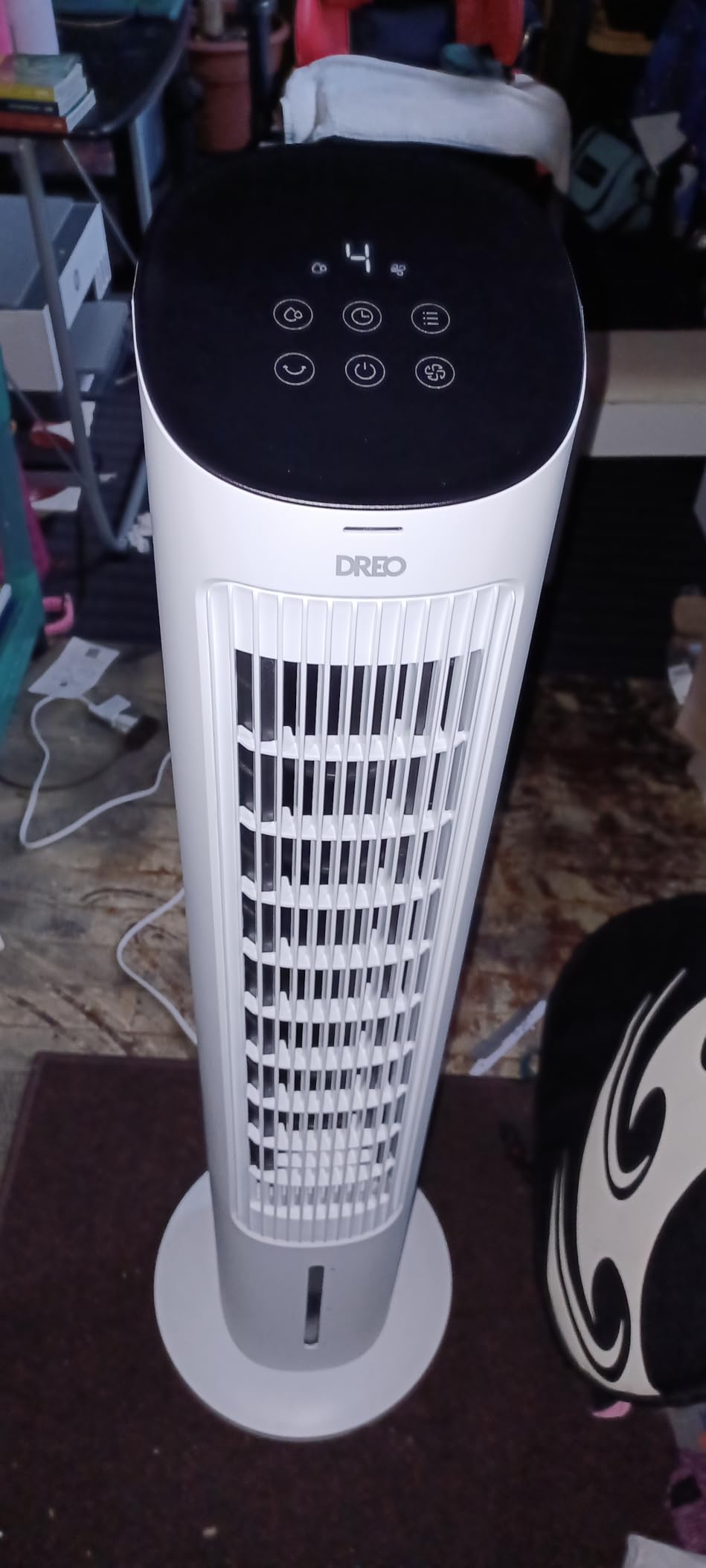
The 12 month warranty extends to 30 months if you register, which is better coverage than most of this category offers. The removable rear grille, removable cooling pad, and removable tank are all genuinely user-serviceable parts rather than sealed assemblies, and that matters more for long-term ownership than any app feature.
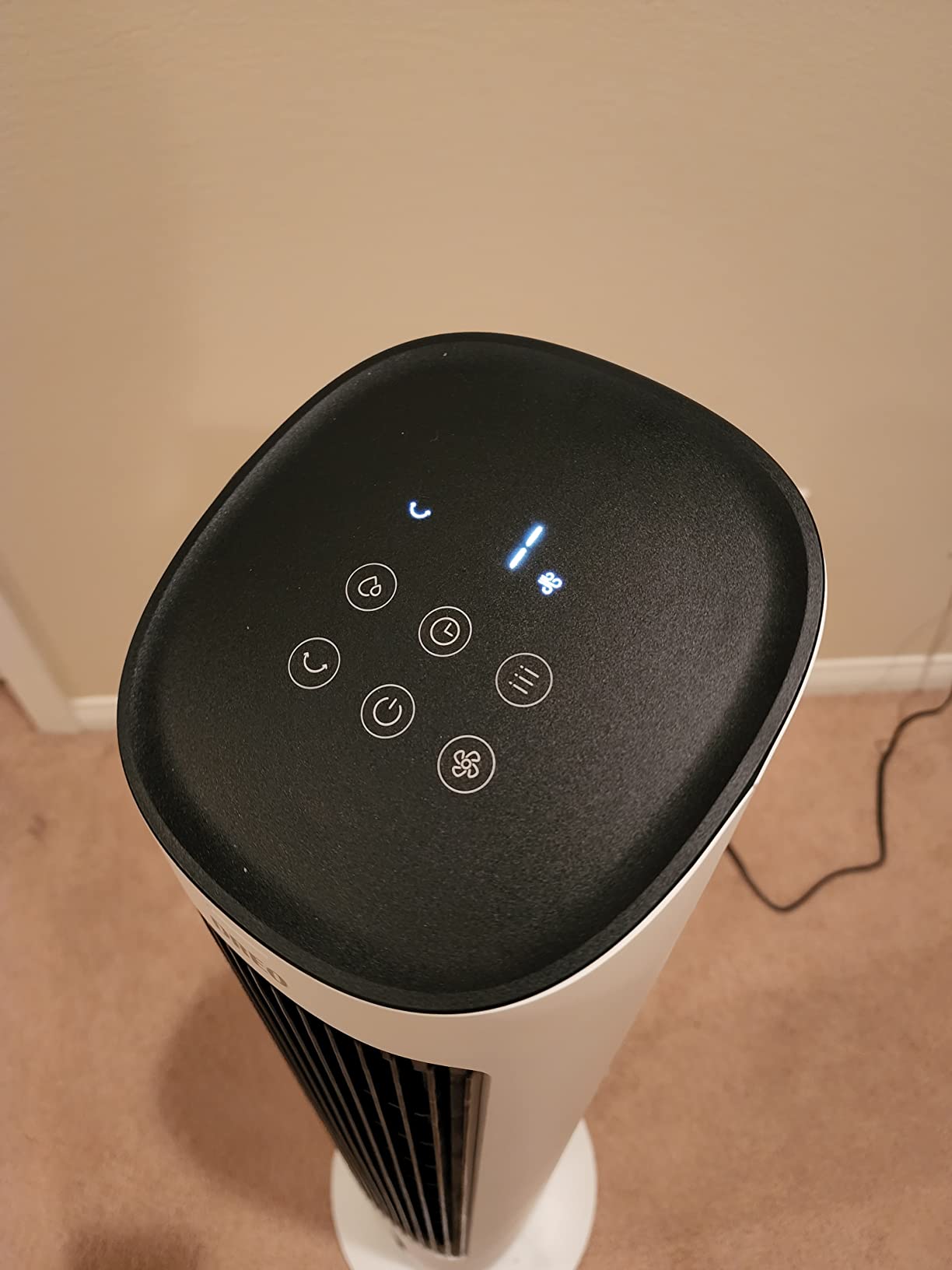
Buyers consistently report lower electricity use, which tracks with the 55 watt figure. In a genuinely dry room, several owners say it cools noticeably better than a plain fan, which is the outcome you should expect from a unit that is moving that much air through a wet pad.
Why it beats the cheaper towers
Airflow per decibel is the entire argument. A 35 dB unit you leave running all night in a bedroom is a different product from a 60 dB unit you switch off because it is unbearable. The 80 degree oscillation spreads a 22 ft per second stream across a wide arc, so one unit placed in a corner covers a room instead of one desk.
Compare that to the Antarctic Star and PNTCK units below, which are smaller, cheaper, and cooler. For a room where noise is the deciding factor, the DREO is the one that stays switched on.
Where it falls short
Speeds 1 and 2 are weak. Multiple reviewers describe a big step up to speed 3, which means you effectively have two useful settings rather than four. The water supply sensor has also generated complaints where a partially full tank reads as empty and water sits stagnant, so drain it fully between uses.
Removing the tank is awkward because the supply line attaches underneath, and the ice packs melt fast enough that owners plan around re-freezing them. In a humid room, the honest answer is that no setting on this dial helps.
3. Antarctic Star Windowless Tower Cooler – Best for Narrow Spaces
Antarctic Star Windowless Evaporative Air Cooler, Portable Air Conditioner
Up to 7 m/s wind speed
4 speeds, 3 modes, 80 degree swing
15 hour timer
Ice packs and aroma pad
Pros
- Slim 11 inch square footprint at 40 inches tall
- Long throw distance with an 8 meter air delivery
- Runs quietly with no mechanical buzz
- Aroma pad and reusable ice packs add versatility
- Simple internal layout needs little maintenance
Cons
- Cooling effect drops sharply in humid air
- 21 percent of ratings are one star
- Remote settings are fiddly to map
- Behaves closer to a fan than a cooler
At 11.4 inches square, the Antarctic Star is the narrowest full-height tower here, and for a tight apartment, a dorm room, or a corner where a 16 inch unit simply will not fit, footprint is a real buying criterion. It rises to 40 inches, which puts the air stream above desk height and above the top of a nightstand.
The control set is generous for a personal unit: four speeds, normal, natural, and sleep modes, an 80 degree automatic swing, a 15 hour timer, and a digital display. The reusable ice packs and the integrated aroma pad for essential oils are the sort of detail that usually only shows up on higher priced machines.
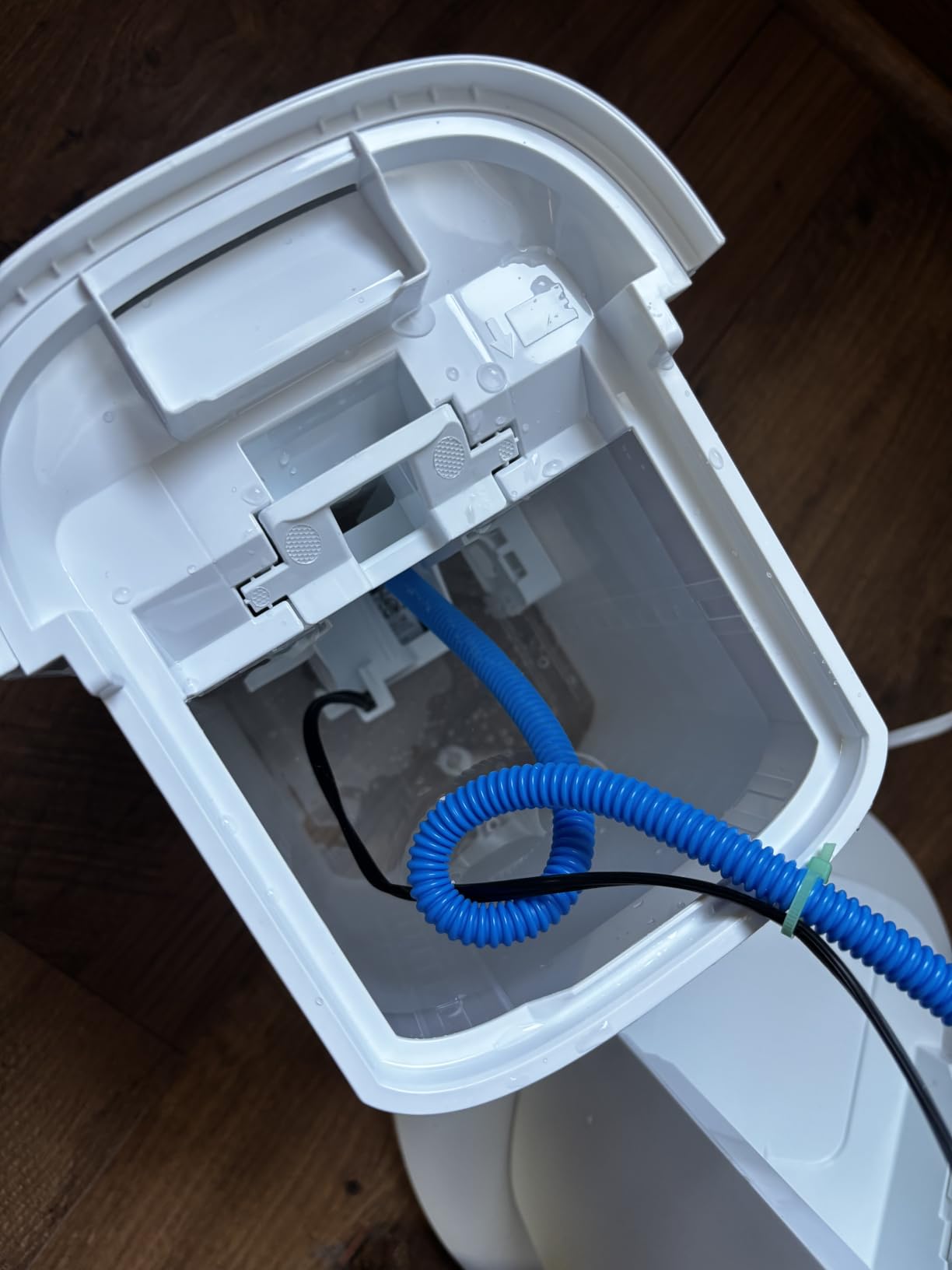
Owners like the quiet motor and the long throw, and the windowless design means no window fixture, no exhaust, and no installation of any kind. The manufacturer describes it as low power for all-day operation, which fits the category even though a specific wattage figure is not published.
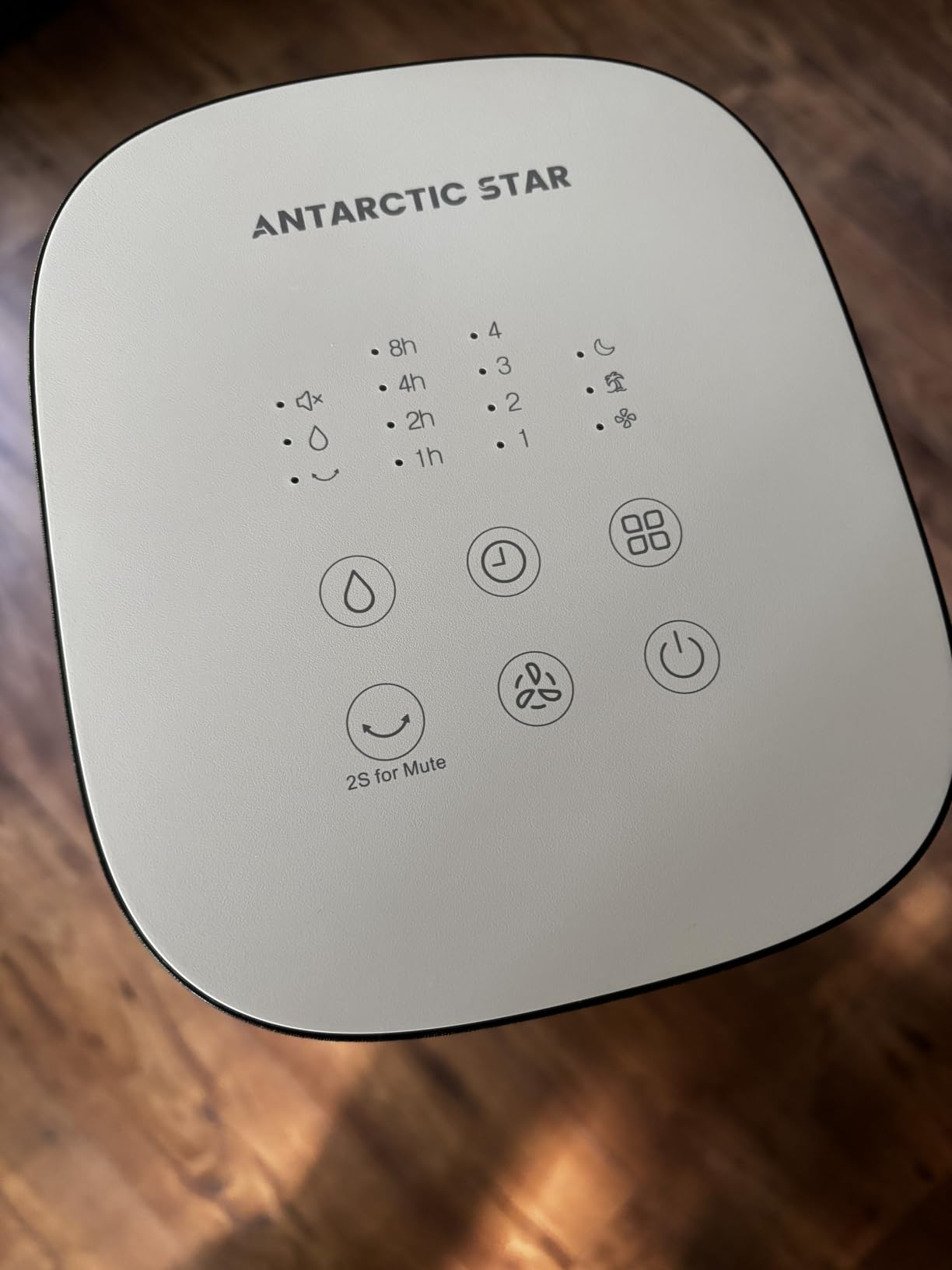
What holds it back is the same thing that limits every evaporative cooler, expressed more sharply here. The 49 percent five-star share alongside a 21 percent one-star share is the widest spread on the list, and that gap is entirely about whether the buyer expected real cooling or a good fan.
When the narrow footprint is the deciding factor
If your constraint is square inches rather than square feet, this is the right shape. An 11 inch square base slides beside a bed, into a narrow hallway, or between a desk and a wall. A 12 hour timer and a sleep mode let it run overnight without supervision, and the one-year warranty covers the usual first-season failures.
For a home office where you sit within a few feet of it, the 7 m/s wind speed and 8 meter delivery are genuinely useful. This is a personal comfort device, and treating it as one produces happy buyers.
Where it falls short
Do not buy it to cool a room. The recurring complaint across the reviews is limited cooling and a sharp drop in effectiveness in humid conditions, which is the physics, not a defect. Several buyers describe it as closer to a fan than a cooler, and that is the honest framing.
The remote control also gets called out as fiddly to map to modes, so expect a few evenings of learning which button does what. If you need genuine room cooling in a dry climate, look at the VEVOR or the Hessaire instead.
4. VEVOR 1400 CFM 5-Gallon Cooler – Best Budget Patio Cooler
VEVOR Evaporative Air Cooler,1400 CFM 11X31 inch Air Cooler,3 Speeds Cooler Portable Air Conditioner,Energy-Saved Swamp Cooler for party,pool and patio,5 Gal Water Tank & 550 Sq.Ft…
1400 CFM airflow
5 gallon top-fill and hose-ready tank
60W at 60 dB
550 sq ft claimed coverage
Pros
- 5 gallon tank with optional garden hose connection
- 1400 CFM moves real air for a patio or garage
- Low water protection prevents pump dry running
- Mechanical buttons stay legible over time
- Two ice packs included
Cons
- Cannot approach the cooling of a real air conditioner
- Weaker indoors and in humid air
- Vertical aim is manual
- One sided pad limits evaporative area
Here is the value pick. For a family that wants airflow over a patio table, a pool deck, or a garage workbench, the VEVOR delivers 1400 CFM from a 5 gallon tank at 60 watts, and it accepts a garden hose so you can stop thinking about refills entirely. For that specific job, it is hard to argue with the value.
The 5 gallon tank is the headline number. Compared with the 1 to 3 gallon tanks on most of the personal units here, it is the difference between refilling twice a week and topping it up when you pass by it. The optional hose connection pushes that further, and it is the single feature owners mention most warmly.
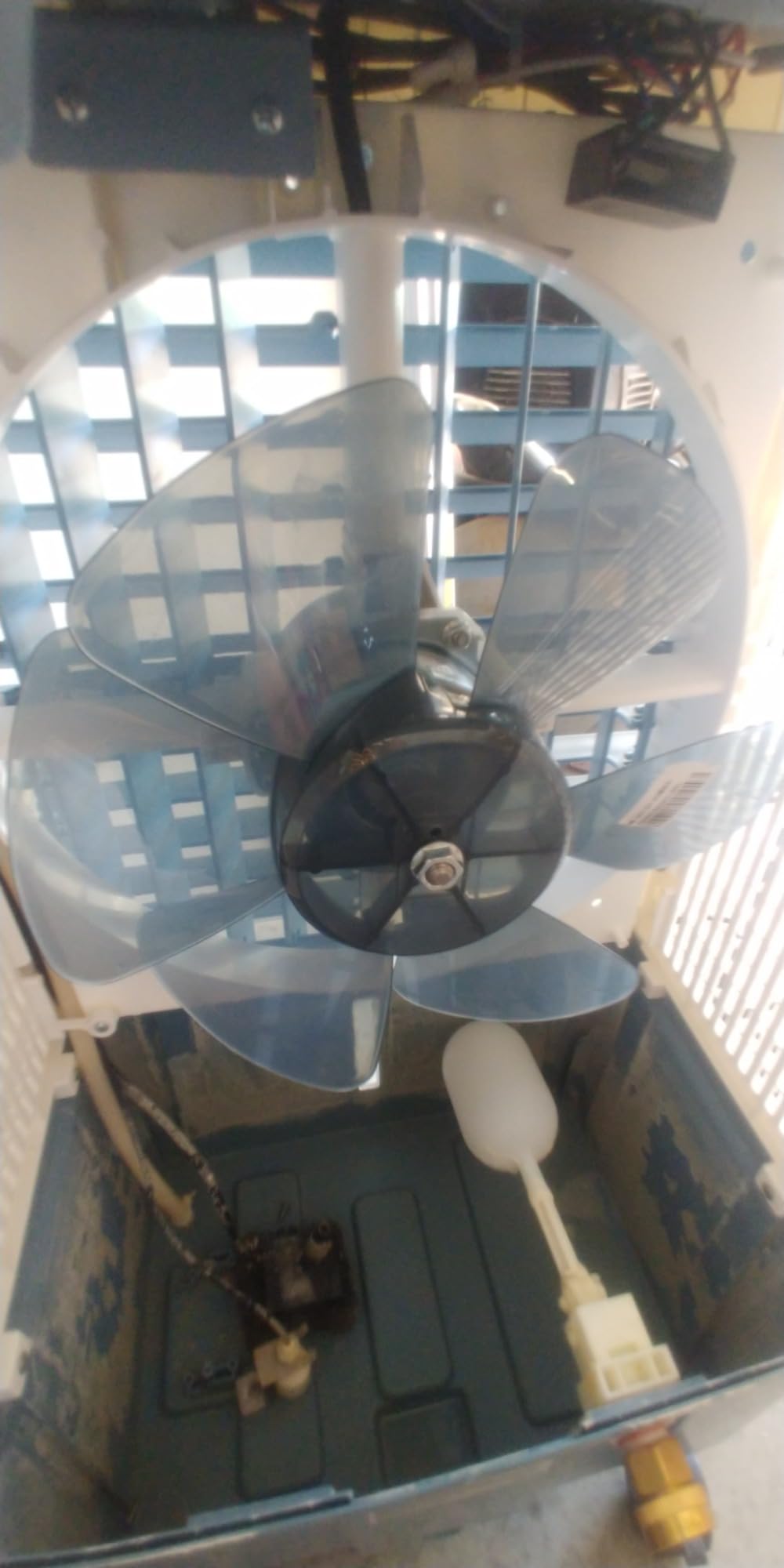
It also has the sensible outdoor extras. A 0 to 72 degree automatic horizontal swing with a manual vertical louver, two ice packs to chill the water, a low water indicator, and a safety function that shuts the pump off rather than letting it run dry. Mechanical buttons are unglamorous and absolutely the right call on a unit that will live on a patio.
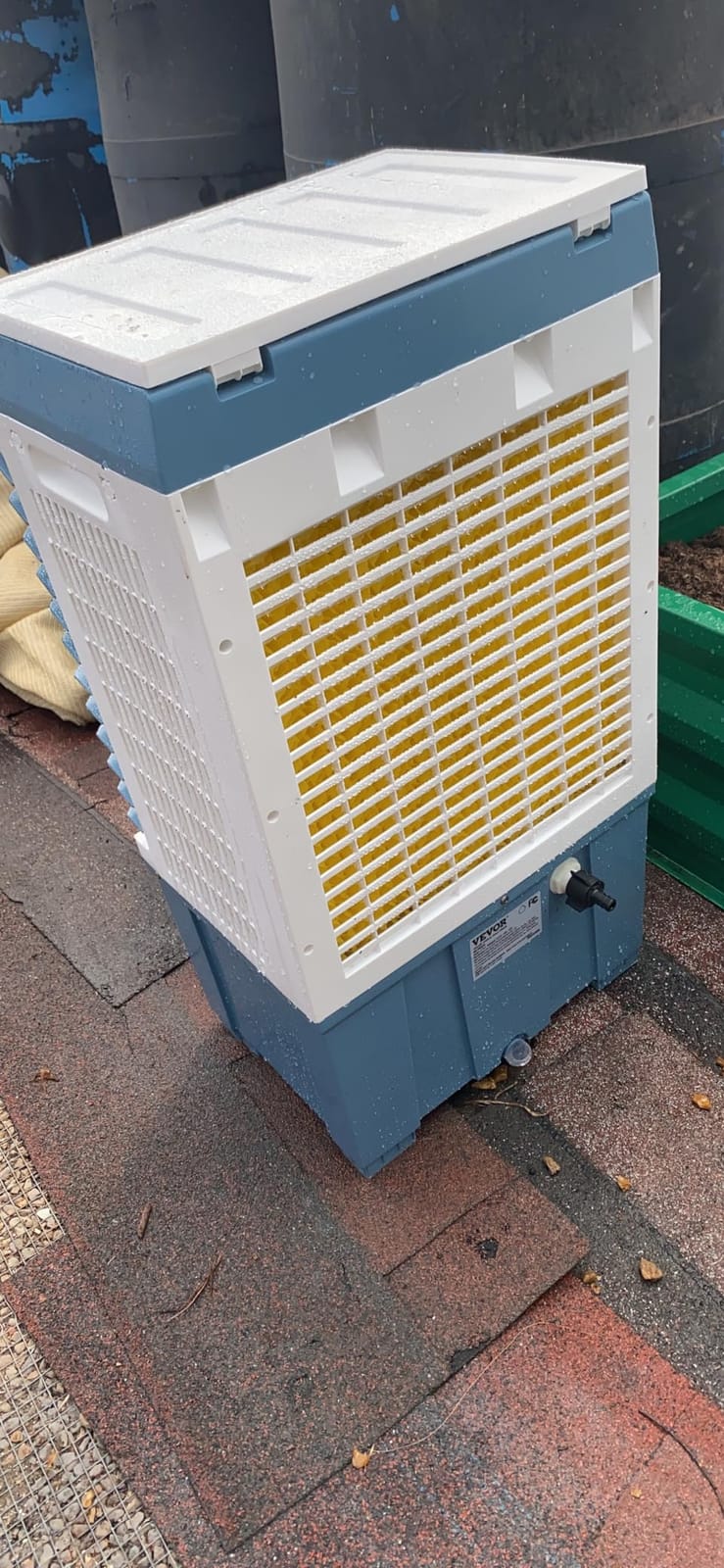
The claimed coverage is about 550 square feet, which is at the aggressive end of what 1400 CFM delivers. Treat it as a generous outdoor number for an open-sided space rather than an indoor sealed room. In a covered garage in dry air it performs well, which is why we included it.
Why outdoor buyers should look here first
Evaporative coolers do best where humidity is already low and air can move freely, which is exactly an open patio, a covered carport, or a ventilated garage. This unit is designed for that, and at 13.4 pounds it can be dragged out and back without a fight. Our separate guide to evaporative coolers for garages goes deeper on the setup for workshop spaces.
The dry-run protection deserves a mention because it is absent on several cheaper units. A pump that shuts itself off when the water is low is a pump that survives season three.
Where it falls short
The 60 dB figure rules it out of a bedroom. That is not a defect either, it is simply what 1400 CFM sounds like, and pretending otherwise would be doing you a disservice.
Two build details limit it. The cooling pad is one-sided, which cuts the evaporative surface area compared with three-sided designs, and the vertical louver is manual, so aiming it at a seated group means walking over and turning it. Owners are consistent that it is a garage and patio tool, and less effective indoors or in humid air.
5. Hessaire DC18 Mobile Evaporative Cooler – Best for Cordless Work Sites
Hessaire DC18 Mobile Evaporative Cooler
Runs on 18V and 20V tool batteries
900 CFM airflow
2.8 gallon tank
42 pounds
Pros
- Runs on any 18V or 20V tool battery you already own
- 900 CFM that people notice on their skin
- Build quality holds up outdoors
- Easy tank refill and setup
- Quiet for the volume of air it moves
Cons
- Battery sold separately
- 42 pounds is genuinely heavy to lift
- Manual voltage warning conflicts with the included adapter
- Dry air only
- Return shipping can be costly
The Hessaire DC18 solves a problem no other unit on this list solves. It runs on any 18V or 20V tool battery, or on the included 115V AC adapter. If you already own a battery platform, that is the entire purchase justification: a garage, a job site, a trailer, or a campsite where there is no outlet.
At 900 CFM with a 2.8 gallon tank, it moves enough air to cool a person standing in front of it, which is the way these units get used in the field. The manufacturer’s own documentation is explicit that it is not an air conditioner and is designed to reduce heat stress. We appreciate that honesty more than an inflated coverage claim.
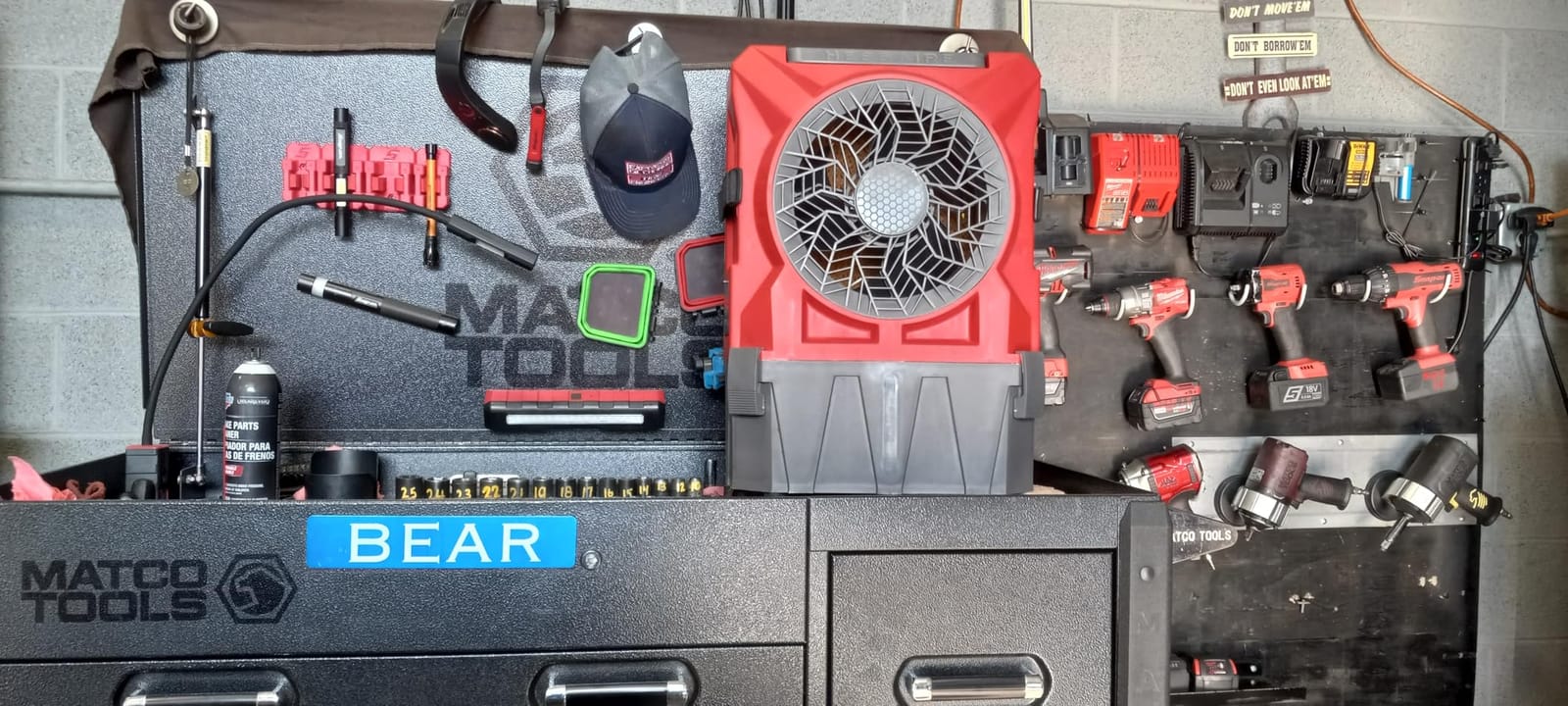
Reviewers in genuinely hot, dry conditions are enthusiastic, and the 75 percent five-star share is the highest in this roundup. That figure comes with an asterisk: 54 reviews is a small sample, so treat it as a positive signal rather than a settled verdict. Our weighting gave it credit for build quality and feature fit, not for the star average alone.
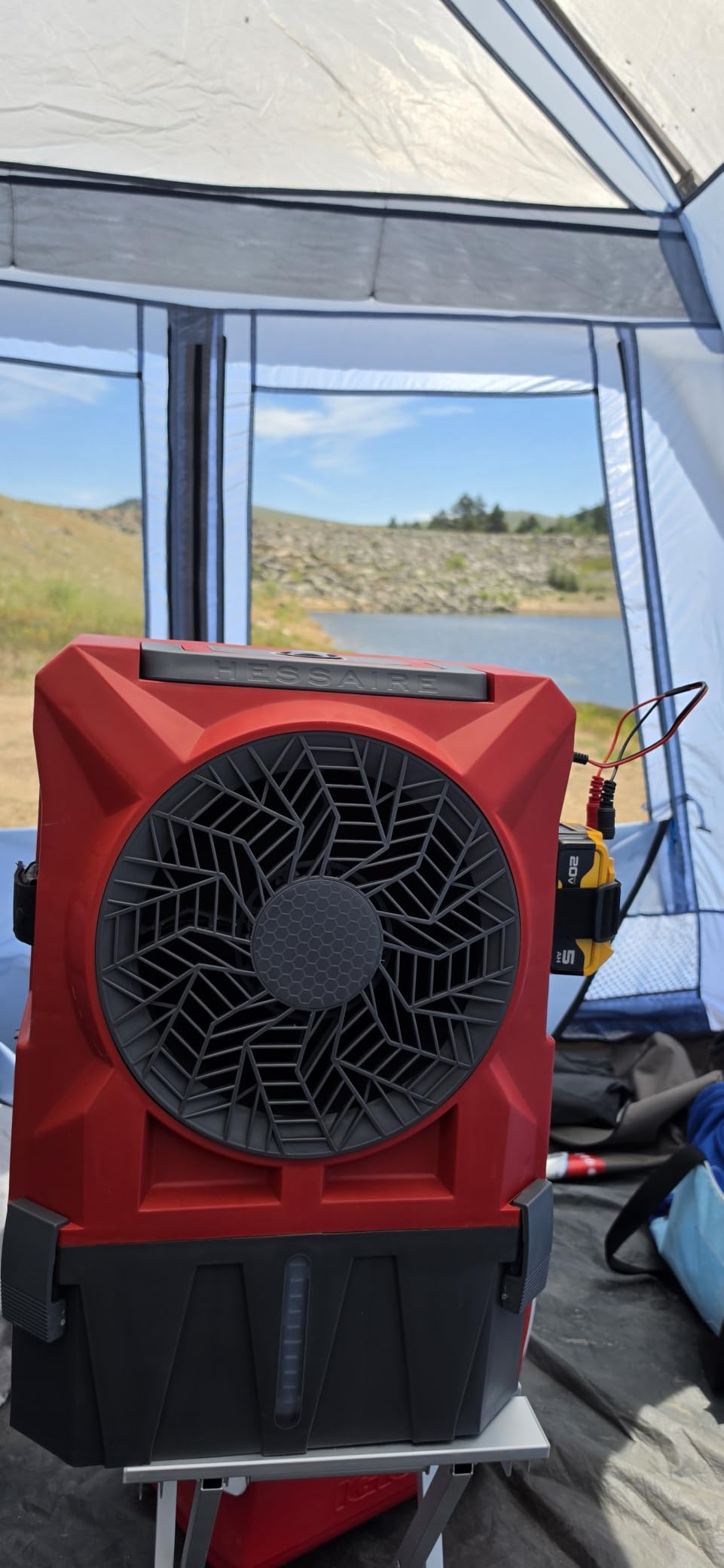
The 42 pound weight is the real drawback. Owners who load it into a truck bed or carry it across a shop floor describe it as heavy and awkward to pack away at the end of a job, and that is worth factoring in before you commit.
Why cordless changes the equation
A 115V cooler and a 42 pound cooler is a two-person job. A battery-powered one is a one-person job, and on a job site, a campground, or in a trailer with no mains power, it may be the only option that works at all. The 18V and 20V platform compatibility also means you are borrowing a battery you already paid for rather than buying a proprietary pack.
Our earlier coverage of electric coolers for travel goes into the wider picture of off-grid cooling if you are building out a setup like this.
Where it falls short
The battery is not included, so budget for one if you do not have a pack already. And there is a documentation problem worth knowing about: the manual warns against batteries over 20V while the supplied AC adapter outputs 24V, which has confused several buyers.
Effectiveness drops sharply in humid air, and return shipping can be expensive, which makes this a poor choice if you are unsure. Know your return window before you order something this heavy.
6. PNTCK 3-IN-1 Tower Cooler – Best for Bedrooms and Dorms
PNTCK Portable Air Conditioners, 3-IN-1 Swamp Cooler with 3 Fan Speeds, 4 Modes, 12H Timer, Remote, Ice Packs, 2.1Gal Water Tank, Evaporative Air Cooler for Bedroom Dorm Office Garage Home
2.1 gallon tank
4 modes including sleep
12 hour timer and child lock
25 inch tall, 10 pounds
Pros
- Compact 25 inch body fits under a desk or table
- Four modes including a dedicated sleep mode
- 2.1 gallon tank with a visible water level
- 80 degree oscillation with manual vertical adjustment
- Child lock and adjustable blades around pets and kids
Cons
- Behaves like a fan with added moisture
- Weakens in humid climates
- Included ice packs are small
- Some buyers report unresponsive controls
The PNTCK 3-IN-1 tower is built around one constraint: not being in the way. At 10 inches deep, 8 inches wide, 25 inches tall, and 10 pounds, it goes under a desk, beside a bed, or into a dorm room where a 40 inch tower is simply not a candidate.
It also has the best feature-to-size ratio on the list. Three speeds, four modes including a dedicated sleep mode, an 80 degree automatic swing with manual up and down adjustment, a 12 hour timer, a child lock, a remote, and a top touch panel. For a personal unit, that is a lot of control in a small box.
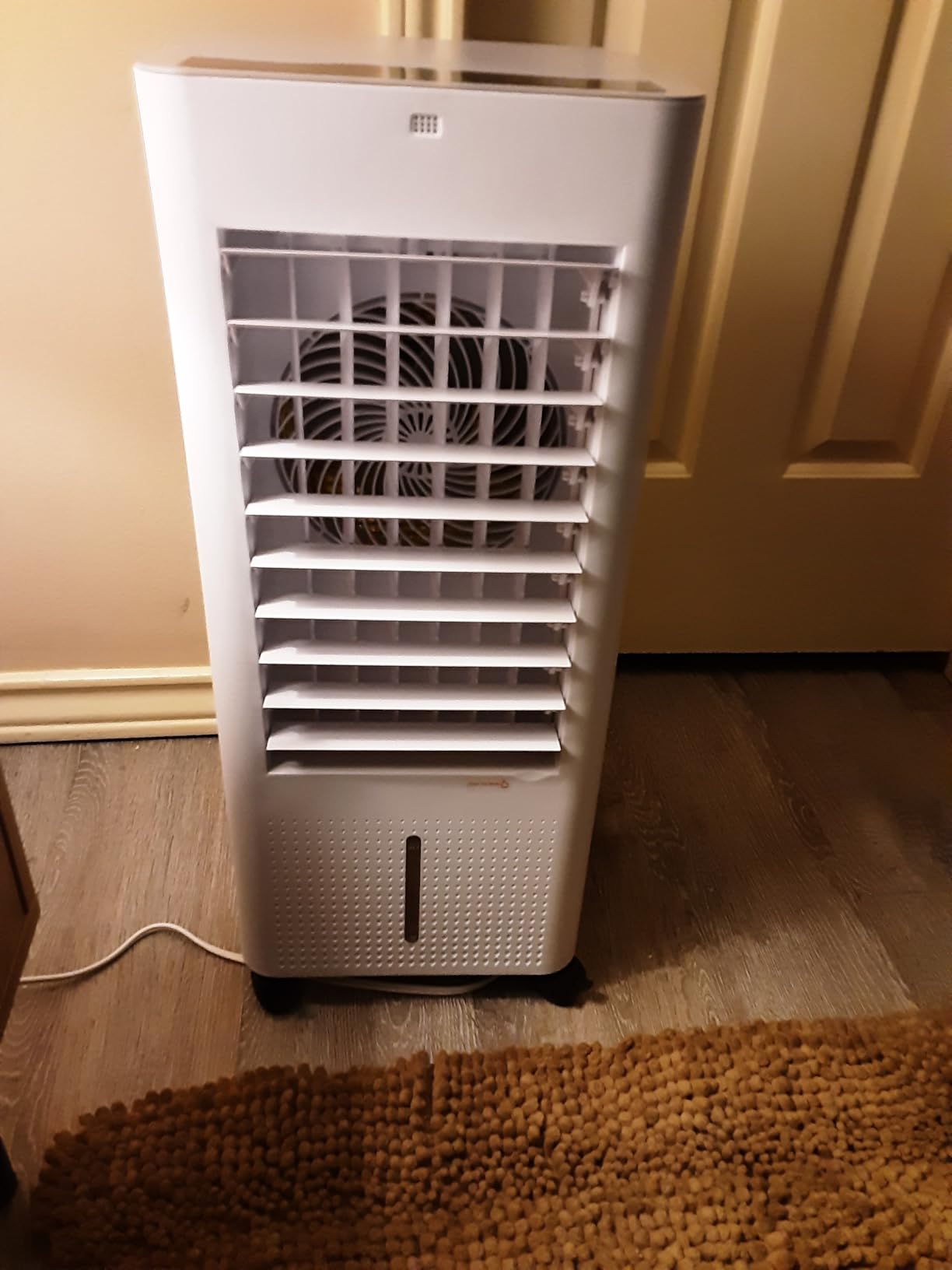
The 2.1 gallon tank with a visible water level is a sensible middle ground. It runs longer than a 1 gallon unit without turning into a chore to refill, and you can see the level at a glance rather than lifting the lid and guessing. Four universal casters and a built-in handle make it genuinely portable between rooms.
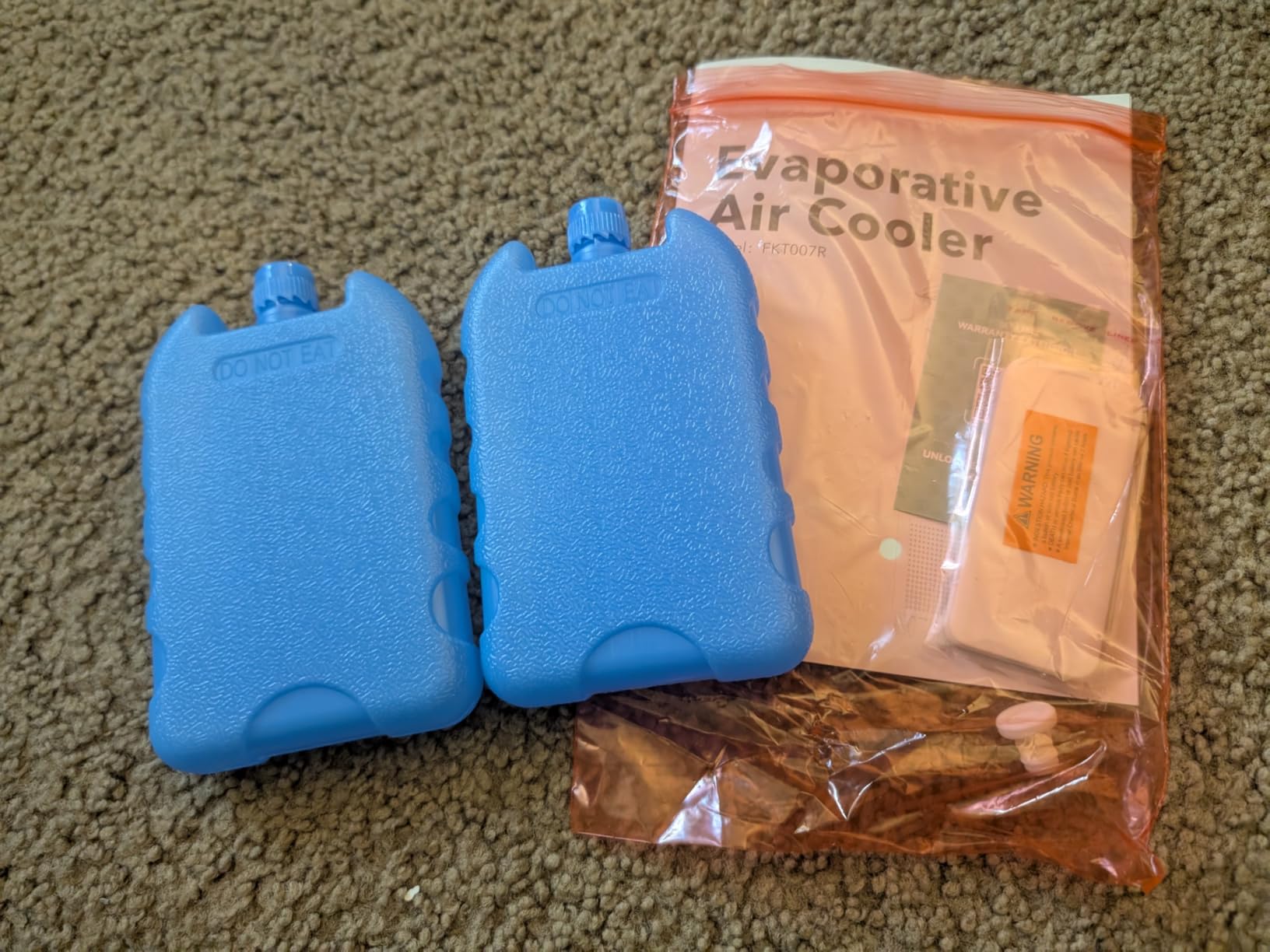
With 85 reviews at 4.2 and only 10 percent one-star, the sentiment is unusually clean for the category. Buyers generally know what they bought: a quiet, feature-rich personal cooler for a bedroom, dorm, or office, with all the same humidity caveats attached.
Why this fits a bedroom and the DREO does not always
It is smaller and cheaper than the DREO, so it is easier to place and easier to move. If you need airflow directly on your face while you sleep, the compact form and the sleep mode are the reasons to choose it. If you need the room itself to be several degrees cooler, neither device will do that in a humid house.
Our broader cooling and cooling-system guides cover the fixed-installation side for anyone whose real problem is a room that stays hot rather than a person who is warm.
Where it falls short
Same honest limit as everything else in the personal category: the cooling power is limited and it behaves more like a fan with added moisture. Reviewers say so directly, and in humid climates the performance drops further.
The included ice packs are small and need frequent swapping, and a few buyers report the remote or the touch panel being less responsive than they would like. Neither is a deal breaker at this size and price, but do not expect much from the ice compartment.
7. SereneLife 2500 CFM 8-Gallon Cooler – Best for Long Runs Without Refills
SereneLife Portable Swamp Cooler Air Conditioner – 2500 CFM Airflow, 8 Gallon Water Tank Portable Evaporative Air Cooler for Room & Outdoors, WiFi, Humidifier & Fan Modes, Ice Packs & Remote Included
2500 CFM airflow
8 gallon detachable tank on casters
140W at 65 dB
WiFi app and remote
Pros
- 8 gallon tank on wheels removes the lifting problem
- 2500 CFM with wide oscillation for direct cooling
- WiFi and app control on top of remote and touch
- Useful humidifier mode alongside cooler and fan
- Clean modern design with handles and casters
Cons
- Refrigeration grade cooling is overstated
- 30 percent of ratings are one star
- Pump cannot fully drain the tank
- Top section must come off to add ice
- Heavy fill with rough casters
This is the tank champion, and it is the reason we included it. An 8 gallon, 30 liter detachable tank on caster wheels means nobody is lifting 32 pounds of water, which is the single most common complaint about large-capacity coolers. It rolls to where you need it and you fill it with a hose or a pitcher.
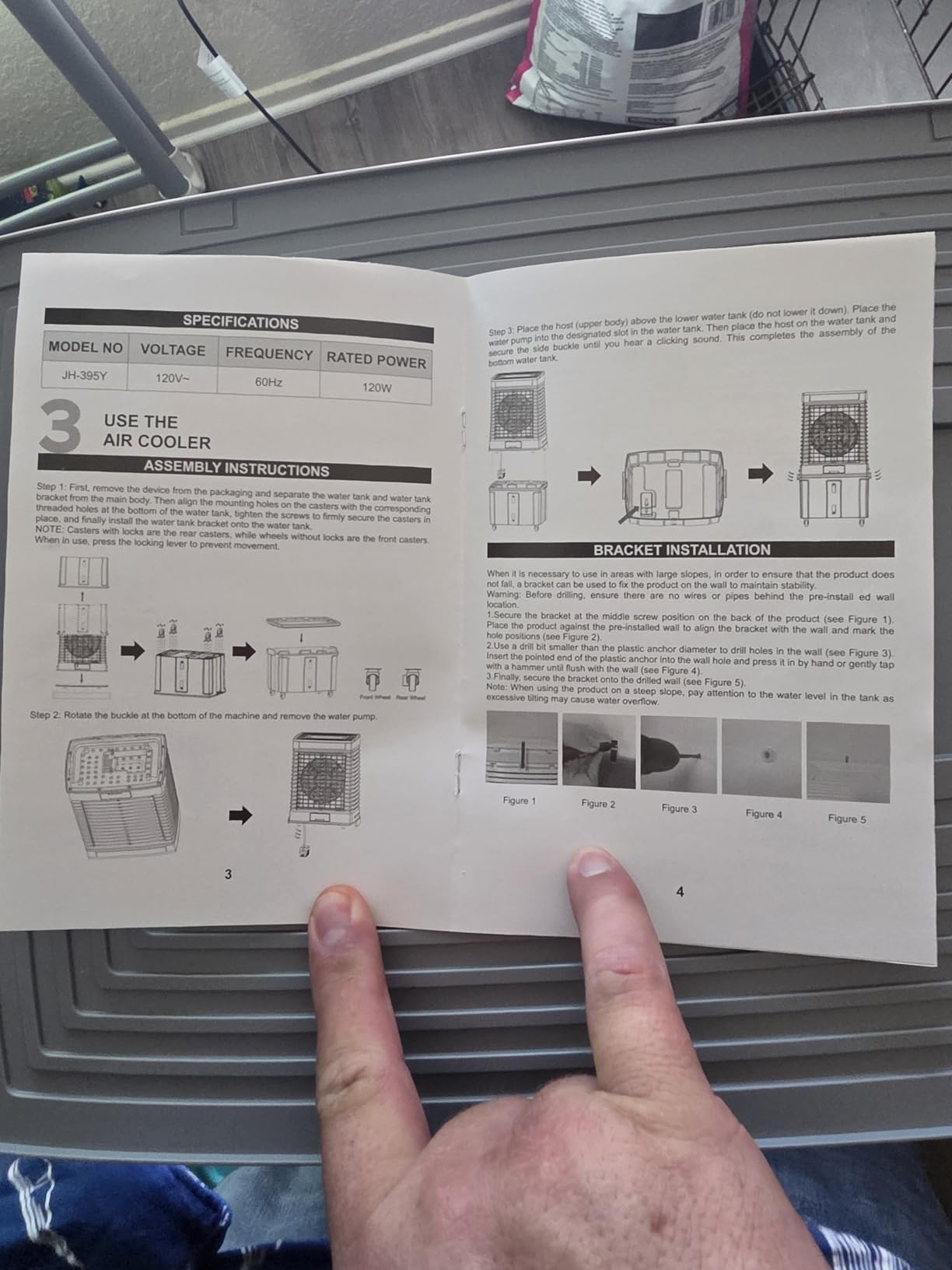
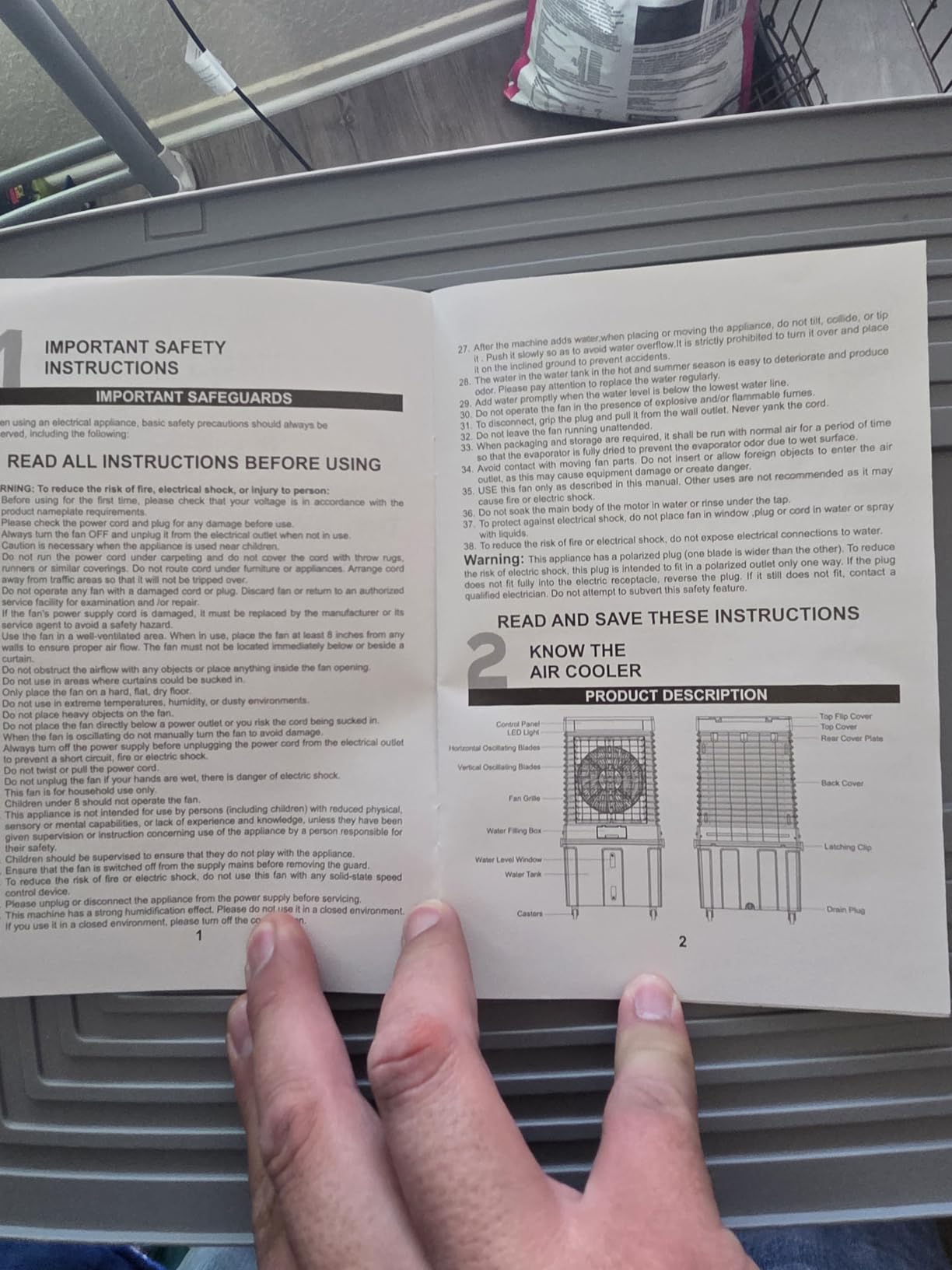
The 2500 CFM airflow with wide oscillation and adjustable up and down swing is genuinely substantial for a portable unit. It also runs as a fan, a cooler, or a humidifier, with a 12 hour timer, a washable filter, an auto-dry pad system, WiFi and app control, a remote, and an LED touch panel.
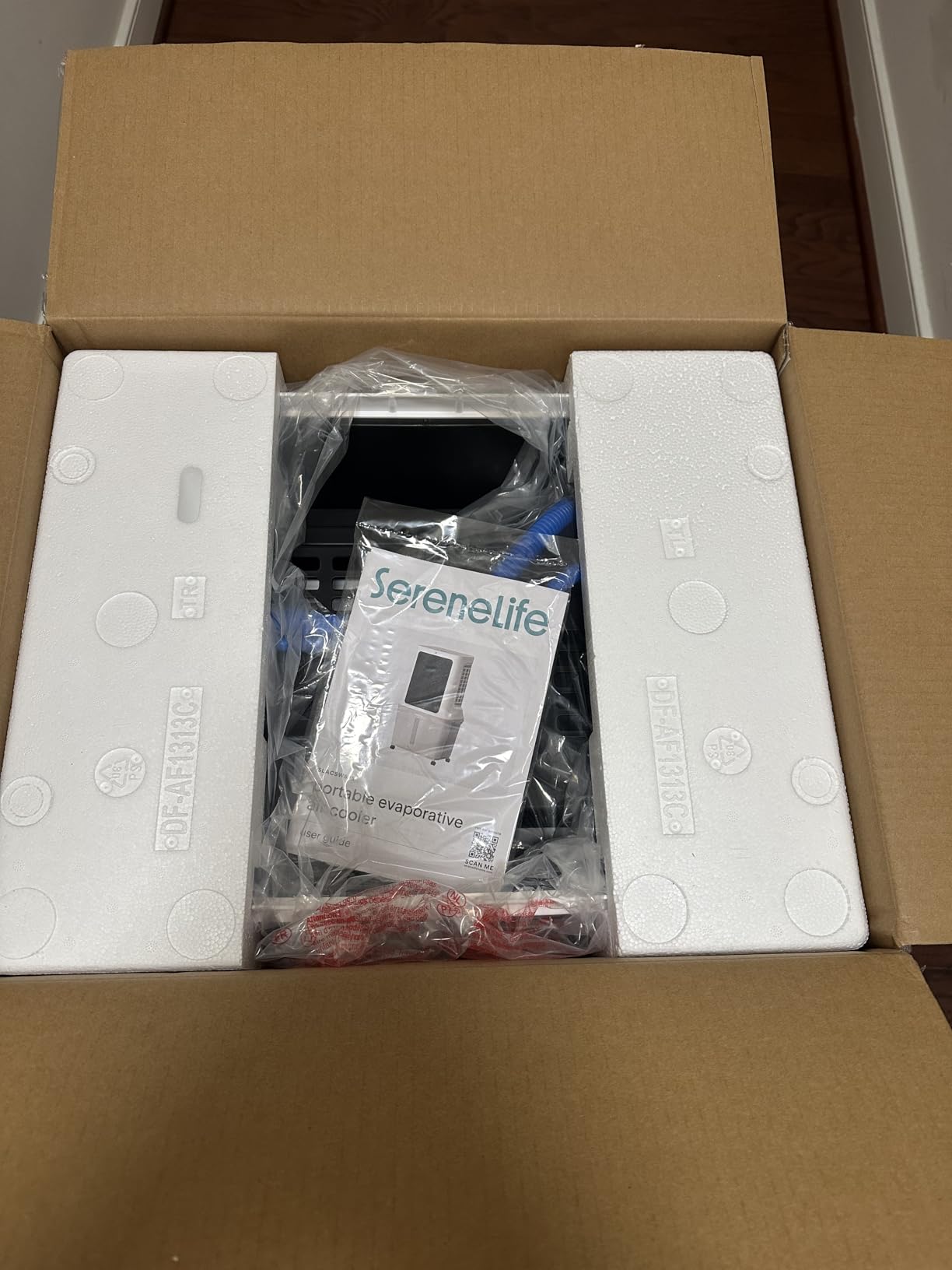
Those are strong hardware specs. The problem is that the specs have outrun the results, and this is the lowest-rated product we included at 3.2 stars with 30 percent one-star ratings. We kept it on the list because the tank and the airflow are real and the design is genuinely thoughtful, not because the reviews are happy.
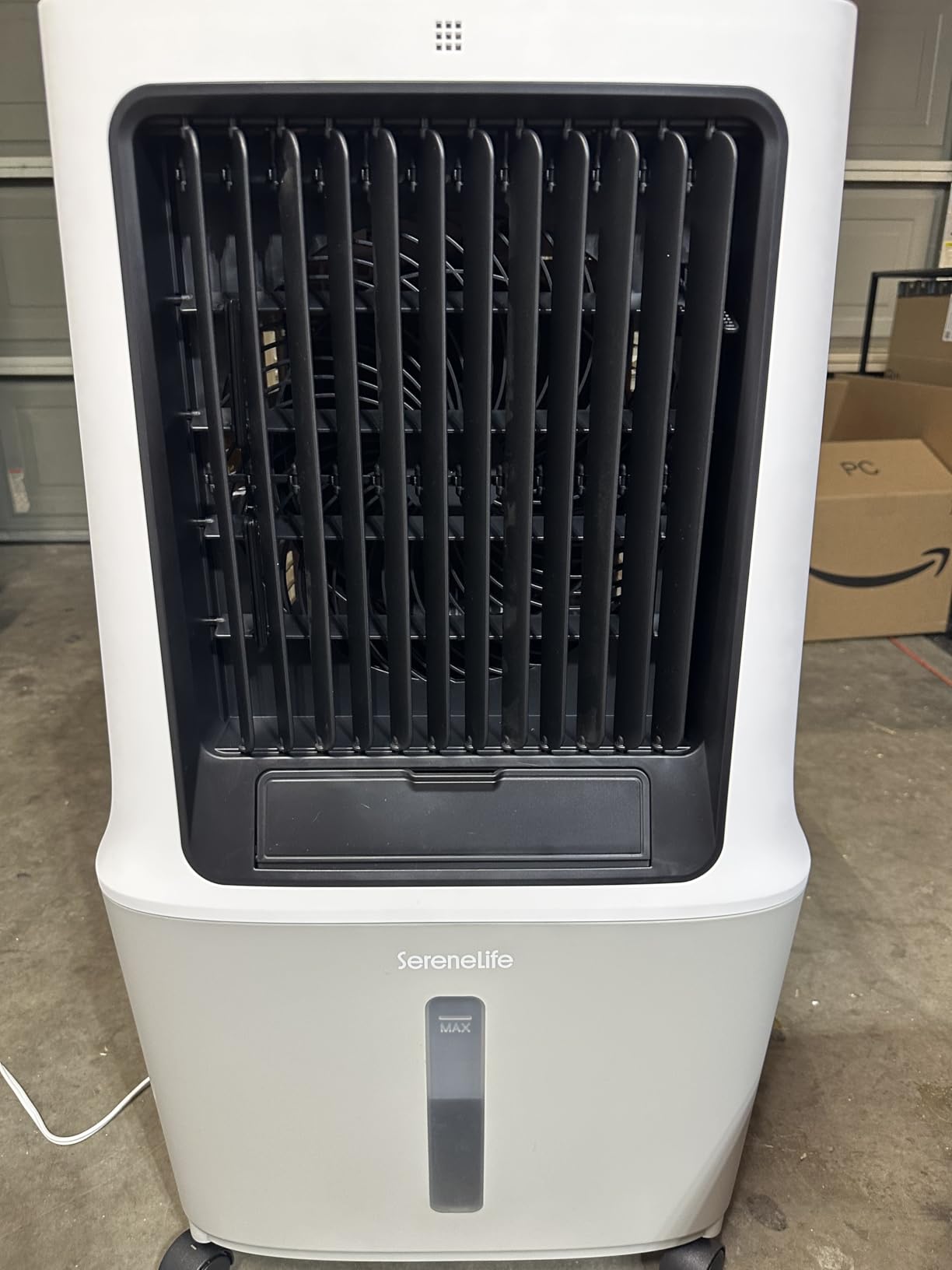
Buyers who measured the outcome measured only a 1 to 2 degree temperature drop, even with ice packs and cold water. That is not nothing, but it is well short of the refrigeration-grade cooling the product category implies. At 140 watts and up to 65 dB, it is also the loudest and most power-hungry unit on the list.
Why the 8 gallon tank is still worth considering
If your plan is to run this continuously through a long dry weekend, on a covered patio or in a large ventilated garage, the refill math is decisive. Eight gallons removes a recurring chore that the 2 to 3 gallon units create every couple of days. The auto-dry pad system and washable filter also reduce the maintenance burden that usually comes with a tank this size.
The WiFi and app control is genuinely useful for a unit you do not want to walk across the room to adjust.
Where it falls short
Water handling is the weak point. The pump cannot fully drain the tank, so standing water and drippage remain when you try to service it, and the top section must be detached to add ice, which invites spills. The filled tank has no handles and the casters are rough, so moving it sloshes.
It is also unsuitable in humid air, where it adds stuffiness rather than relief, and some units reported clogging or leaking in under a year. Read the one-star reviews before committing 32 pounds of water to a spot in your garage.
8. Uthfy 4000 CFM 13.5-Gallon Cooler – Best for Big Dry Rooms
Uthfy 4000CFM Swamp Cooler for Large Room, 41” Evaporative Air Cooler with 13.5Gal Detachable Water Tank, 12H Timer, Ambient Light, 120° Oscillation, Indoor & Outdoor Air Conditioner for Patio, Garage
4000 CFM at 34 ft/s
13.5 gallon detachable tank
45 dB at 120W
3 sided cooling pads
Pros
- Highest airflow figure in this group at 4000 CFM
- 13.5 gallon detachable tank with three refill methods
- Quiet at 45 dB even on the top speed
- 4 ice packs and up to 36 hours of stated runtime
- Four wheels with two brakes plus a drain port and dry-run protection
Cons
- Several buyers report it cannot cool the claimed 700 sq ft
- Cooling pads are thinner than premium rivals
- Pump reliability complaints including stopping at half full
- Thin plastic and weak clamps
- Shipped ice packs arrived empty or leaked
The Uthfy is the biggest machine in the roundup and the one most likely to disappoint you. It claims 4000 CFM at 34 feet per second, carries a 13.5 gallon detachable tank, and ships with 4 ice packs. The hardware is genuinely large. Whether it delivers is a different question, and we are going to be straight with you about it.
There are owners who measured a 10 to 12 degree temperature drop with ice packs in a dry environment, and they are the reason this is on the list at all. They are the minority. A 3.1 average with a 33 percent one-star share is the second-lowest in this group, and that pattern is typical of high-CFM imports where the airflow number outruns the physical pads behind it.
What it does well is paper specifications. Three-sided high-density cooling pads, three speeds, three modes, 120 degree oscillation, a 12 hour timer, an ambient LED light, a display screen, four wheels with two brakes, a drain port, and dry-run protection that stops the pump when water is low. The tank offers three refill routes: top fill, hose port, or removing the bottom tank.
At 45 dB and 120 watts it is quieter and more efficient than the SereneLife, and the 24.3 pound empty weight is manageable even though a full 13.5 gallon tank is a different proposition. This is the only unit here with a drain port, which makes end-of-season storage far easier.
Who this actually suits
A large, very dry, very open space. A covered patio in the arid Southwest during peak summer, a big ventilated workshop, a warehouse bay with air moving through it. Places where the ambient humidity is low enough that a large wet pad genuinely pulls heat out of the air, and where the 34 feet per second throw actually reaches you.
If your use case is a garage with a 700 square foot footprint in a dry climate, the claimed coverage is at least in the right conversation. If your use case is a living room, this is the wrong machine and you will feel the difference.
Where it falls short
Several buyers report it cannot cool the claimed 700 square feet in practice, and the pads are thinner than those in premium competitors, which means the rated CFM figure likely assumes dry pads. Wet-pad performance will be lower than the box says.
Pump reliability is the most serious issue, with reports of pumps that never engage or stop while the tank is still half full. Build quality draws complaints too: thin plastic, weak clamps on the top housing, and ice packs that arrived as empty shells or leaked gel. Several buyers gave up and moved to a higher-priced unit. Buy it knowing you are gambling on the pump.
Will It Actually Cool You? The Humidity Check
Yes, it can work in extreme heat, and the limiting factor is humidity rather than temperature. Evaporative cooling works by pulling warm dry air across a wet pad so the water absorbs heat as it turns to vapor. When the air is already carrying most of the moisture it can hold, that evaporation slows to a crawl and you are left with a fan blowing humid air.
The number to remember is 60 percent relative humidity. Below that, and ideally below 45 percent, an evaporative cooler will drop the air temperature noticeably. Desert interiors, high-desert summers, and dry inland afternoons are ideal. Gulf Coast, Florida, and humid Eastern summers are not.
Which answers the most common question in this category: is it just a fan with a water tank? Sometimes, yes. Under 500 CFM, or in a sealed room, or in air above 60 percent humidity, the honest description is exactly that. The units that are not just fans are the ones moving 900 CFM or more through a pad you can keep wet, in a room with a door or window open.
That last part matters more than most listings admit. A sealed room with an evaporative cooler running is a room with rising humidity, which feels worse over time, not better. Keep a window cracked, keep a door open, and the unit works the way it is supposed to.
How Many CFM Do You Need for Your Room?
Match airflow to space, and discount the square footage claim on the box by at least a third. Advertised coverage assumes an open, dry, well-ventilated space; a furnished, closed room needs more air moving, not less.
Up to 200 square feet, personal comfort. Under 500 CFM is enough. A dorm, a home office, a bedside unit. This is a personal cooler, and it will not change the room temperature.
200 to 500 square feet, one room. Aim for 900 to 1400 CFM. This band covers bedrooms, small living rooms, offices, and home gyms in dry climates. The DREO and the Hessaire DC18 sit comfortably in it.
500 to 1000 square feet, open space. Look for 2500 to 4000 CFM and treat the claimed square footage optimistically. At this size you are almost always talking about a garage, workshop, or covered outdoor area rather than a living room.
More than 1000 square feet. No portable evaporative cooler under 300 dollars is the right answer. A whole-house or commercial system is a different purchase, and one of these units will simply circulate warm air.
Air throw matters as much as volume on a covered patio. Air needs to travel at roughly 15 miles per hour or better at the vent before you feel it from several feet away, which is why the units that quote a feet-per-second figure tend to feel more effective outdoors than the ones that only quote CFM.
Water Tank Size and Refill Options
Tank size is the most underrated specification in this category, because it determines whether you will use the cooler or abandon it in a corner. A 1 gallon tank is a twice-daily chore. A 5 gallon tank is a weekly one. An 8 gallon tank is a monthly one, and anything above that is a monthly one or never if you hook up a hose.
1 to 3 gallons. Personal and small-room units. Fine for a bedroom you run at night with a timer, provided you accept refilling before bed.
3 to 5 gallons. The practical middle for anything you expect to run during the day. Top-fill matters enormously here, since a bottom-fill tank means tipping 20 pounds of water.
8 gallons and up. Continuous operation. Pair it with caster wheels and a detachable tank, and ideally a hose port. The SereneLife and Uthfy are the two units here in this band, and both accept a hose.
Hose compatibility is the single best feature nobody advertises loudly enough. A garden hose to a cooler’s inlet turns a maintenance item into a non-event, and owners with continuous water supply report never thinking about refills again.
Watch for a top-mounted inlet. Some budget units put the fill port at the bottom of a large tank, which is a design failure disguised as capacity. Every unit on this list fills from the top or from a removable tank.
Evaporative Cooler or Air Conditioner?
Buy an evaporative cooler if you are in dry air and want moving air cheaply. Buy an air conditioner if you need the room temperature to come down, or if you live somewhere humid, or if the space is a bedroom where noise decides the outcome.
The running cost difference is not close. The evaporative coolers in this roundup draw between 55 and 140 watts, which is a fan plus a small pump. A portable or window air conditioner in the same budget bracket runs a compressor and typically draws several hundred watts. Over a summer of daily use, that gap becomes a real number on your electricity bill, and it is the strongest argument for evaporative cooling in a dry climate.
The bedroom is where we would steer you away. No unit under 300 dollars is both powerful and quiet. The DREO at 35 dB is the closest compromise we found, and even it has two weak fan speeds. If the room has to be quiet and cold at 3 am, a window air conditioner is the honest purchase.
What evaporative coolers do have is air movement, and that is genuinely valuable in a garage, a workshop, a covered patio, or during a heat wave when you simply need to be able to work outside. Buyers who treat them that way report far better results than those hoping for a room-temperature change.
Maintenance and Troubleshooting
Evaporative coolers fail at the pump and the pad, not the motor. Nearly every owner forum thread about this category is a pump thread or a pad thread, which is good news, because both are cheap and recoverable problems.
Pad care is the highest-leverage habit. Once a month, pull the pad out, rinse it under a hose, and let it dry fully before refitting. Wetting a pad and letting it dry daily is how scale and algae take hold, and a scaled pad is a pad that no longer moves heat. This applies to the DREO, which is the unit here with a genuinely removable pad, and it is worth doing even on units where removal is a chore.
If your cooler is not pumping water, work through this list in order. Empty the tank and confirm water is actually present. Check the pump inlet filter for debris. Look for a kinked, disconnected, or pinched supply tube between the tank and the pump housing. Confirm the float or sensor is not reading a partially full tank as empty. Then check the pump itself, which is the last and most expensive item on the list.
Two more habits pay for themselves. Run the unit for ten to fifteen minutes after your last fill with the pad area open to the air so the pad dries rather than sitting wet, and at the end of the season drain the tank completely and leave it open until it is bone dry. Standing water over a closed tank is how you get the smell that ends someone’s ownership of a cooler.
Dry-run protection is the feature to check before buying. A unit that shuts its pump off at low water will still be running in three summers. Several units on this list have it, and the ones without it are the ones where an unattended refill schedule matters more.
What 300 Dollars Gets You at Each Budget Tier
Across a decade of cooling appliances, the 300 dollar ceiling buys you a real choice between three distinct products. Knowing which one you are shopping for saves a lot of disappointment.
Personal and small-room units, roughly 60 to 110 dollars. Tower form factors under 500 CFM with 1 to 3 gallon tanks. Quiet, feature-rich, genuinely good as personal comfort devices. The trap is expecting them to cool a room. Several listings claim 300 to 500 square feet for these, and that number is optimistic by a wide margin.
Mid-capacity portables, roughly 110 to 200 dollars. This is where the balance tips. You get 900 to 1400 CFM, 3 to 5 gallon tanks, and enough pad area to make a dry garage or covered patio genuinely more comfortable. Most of our picks live here, and it is where the 300 dollar budget is best spent.
High-capacity units, roughly 200 to 300 dollars. 2500 to 4000 CFM with 8 to 13.5 gallon tanks, oscillation, remotes, and app control on some. The paper specs are impressive and the physical pads and pumps are the most likely to disappoint. Buy for a specific large, dry, open space, not as a default upgrade.
The small-unit trap deserves repeating because it is the number one source of refund-driven bad reviews in this category. A 100 CFM unit with a 1 gallon tank is a fan with a water reservoir. It is a good fan and a fine personal cooler, and it will not lower the temperature of a room. Buy it for the airflow and the moisture, and you will be happy. Buy it as a room cooler, and you will be disappointed within a week.
For what it is worth, the mid-capacity tier is the sweet spot under this cap. It is where airflow, tank size, and build quality come together before the import compromises start.
Frequently Asked Questions
What is the best budget evaporative cooler?
The Ashihoti 4-IN-1 is our top budget pick: a 3 gallon top-fill tank, 6 speeds, 3 modes, a 12 hour timer, 45 dB operation at 65 watts, and 1292 reviews at 4.2 stars. For the quietest option under 300 dollars, the DREO 40 inch tower runs at 35 dB. For outdoor airflow, the VEVOR 1400 CFM unit with a 5 gallon hose-ready tank is the value choice.
Are evaporative air coolers worth it?
They are worth it in dry climates for garages, patios, workshops, and single rooms where quiet operation does not matter. They add humidity while cooling, and they do not lower humidity the way an air conditioner does. If your summer humidity sits above 60 percent, an evaporative cooler is the wrong purchase.
Will a swamp cooler work in 100 degree weather?
Yes, if the air is dry. Ambient temperature is not the limiting factor, relative humidity is. Below roughly 60 percent RH, and ideally under 45 percent, a well-watered pad will pull real heat out of the air. Above that threshold it performs like an ordinary fan.
Is it cheaper to run a swamp cooler or an AC unit?
Substantially cheaper. The evaporative coolers in this roundup draw between 55 and 140 watts, roughly a fan plus a small pump, while a portable or window air conditioner in the same price band runs a compressor and draws several hundred watts. Over a summer of daily use the gap is a meaningful saving.
What are the common problems with evaporative coolers?
Almost all of them are water-handling problems rather than motor problems. Expect mineral scale on the cooling pad, a clogged pump inlet filter, a water sensor reading a partially full tank as empty, a pump that no longer primes, and standing water that causes odor if the tank is never dried out. Rinse pads monthly and drain the tank at the end of the season.
Do evaporative coolers need to be vented out of a window?
No window vent is required, since there is no exhaust air. But you do need airflow in the room. Keep a window cracked or a door open, otherwise the moisture the unit adds has nowhere to go and humidity builds until the space feels worse than before.
The Bottom Line
The best evaporative coolers under 300 dollars are the Ashihoti 4-IN-1, the DREO 40 inch tower, and the VEVOR 1400 CFM unit, in that order. The Ashihoti wins on proven reliability and the details that decide whether you keep using it. The DREO wins on quietness and airflow per decibel. The VEVOR wins on tank size and outdoor value.
Check your humidity before you check anything else. If your summer afternoons are under 60 percent relative humidity, any of these three will earn its place. If they are not, save the money and buy an air conditioner instead, because a swamp cooler in humid air is a fan that makes the room worse.
And size the unit to the airflow you need, not the square footage on the box. A 1400 CFM unit with a 5 gallon tank beats a 4000 CFM unit with a 33 percent one-star rate every time. That trade is the whole roundup, and we will take it every 2026 summer.