
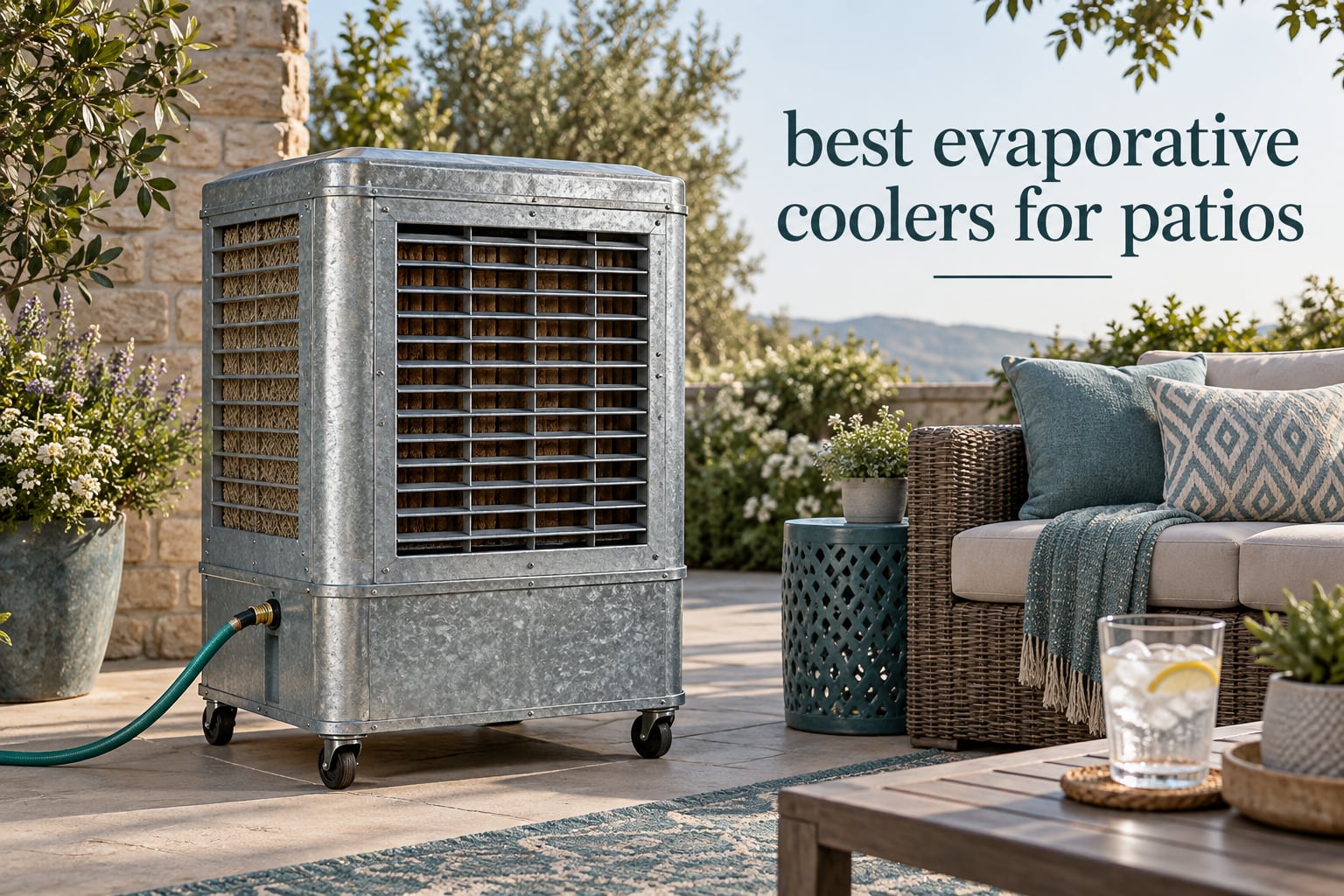
A patio in July is one of the hardest rooms in the house to cool. The roof is overhead, the walls are low, and the air outside the walls is already 100 degrees, so there is nothing to draw the heat into. That is the whole argument for the best evaporative coolers for patios: they do not move heat anywhere, they make the air they move wetter so the water takes the heat out of it as it evaporates. That single mechanism decides where these machines work and where they disappoint, so we start there.
Here is the constraint that decides most purchases. An evaporative cooler, also called a swamp cooler, only cools when the surrounding air is dry enough to absorb evaporated water. Owner consensus in the r/phoenix and r/hvacadvice communities puts the useful ceiling around 45 percent relative humidity, with real temperature drops of 20 to 30 degrees in genuinely arid air. Above roughly 50 percent humidity the machine still moves air, but it mostly adds moisture to your patio, which is the opposite of what you bought it for.
Our team worked through ten of the most-reviewed evaporative coolers sold for outdoor use, weighing the published airflow figures against the coverage claims, the tank sizes against how long a real gathering runs, the noise ratings against conversation, and the housing materials against full sun. We looked at every one of them as patio equipment first and room cooler second, because a unit that lives on a covered patio in direct sun fails in ways a bedroom unit never does.
What you get below is a ranked list, a patio sizing ladder, a water system decision guide, and a clear answer on when an evaporative cooler is the wrong purchase entirely. If your patio is in a humid region, read the humidity section before the product list. We also cover the same category for enclosed spaces in our evaporative cooler guide for garages, since garages and patios share the same dry-air requirement.
Table of Contents
Top 3 Best Evaporative Coolers for Patios in October

Hessaire MC37M 3100 CFM
- 3100 CFM airflow
- 950 sq ft coverage
- 10.3-gallon tank
- garden hose float valve
- locking casters
Hessaire MC37V Mobile
- 3100 CFM airflow
- 10.3-gallon tank
- 4 locking casters
- oscillating louvers
- 3-sided cooling pads

OEMTOOLS 23969 5300 CFM
- 5300 CFM airflow
- 1600 sq ft coverage
- 14.6-gallon tank
- built-in tool tray
- GFCI plug
Best Evaporative Coolers for Patios in 2026 Full Comparison
All ten machines below are real outdoor-rated evaporative coolers rather than indoor humidifiers dressed up for the patio. The figures are the manufacturers’ own, and where owners report a gap between the claimed airflow and the felt airflow, we say so in the individual reviews.
| Product | Specs | Action |
|---|---|---|
| Hessaire MC37M 3100 CFM |
|
Check Latest Price |
| Hessaire MC37V Mobile |
|
Check Latest Price |
| OEMTOOLS 23969 5300 CFM |
|
Check Latest Price |
 Uthfy 40 inch 4800 CFM Uthfy 40 inch 4800 CFM |
|
Check Latest Price |
 Arctic Air Outdoor Arctic Air Outdoor |
|
Check Latest Price |
 VEVOR 1400 CFM VEVOR 1400 CFM |
|
Check Latest Price |
 SereneLife 2500 CFM WiFi SereneLife 2500 CFM WiFi |
|
Check Latest Price |
 SereneLife 1800 CFM 4L SereneLife 1800 CFM 4L |
|
Check Latest Price |
 SereneLife 1500 CFM 15L SereneLife 1500 CFM 15L |
|
Check Latest Price |
 Uthfy 6000 CFM 47 inch Uthfy 6000 CFM 47 inch |
|
Check Latest Price |
1. Hessaire MC37M 3100 CFM Evaporative Cooler – Best Overall for Most Patios
Hessaire MC37M 3100CFM Evaporative Cooler
3100 CFM
950 sq ft
10.3-gallon tank
59 dB
39 pounds
Pros
- Proven design with the largest owner review base in the group
- Hose-ready float valve for continuous fill
- Three-panel intake for wide outdoor coverage
- Locking casters
- Plastic body will not rust
Cons
- Noticeably loud on medium and high
- Fit and finish described as mediocre by some owners
- Door latch and float valve are small parts that can fail
The MC37M is the unit we keep coming back to after working through this list. It has been in production long enough that its failure patterns are well documented, and with 4733 owner reviews there is almost no scenario you can imagine that somebody has not already tested. Our team treats it as the default recommendation because nothing in the category does the fundamentals better for a mid-size patio.
The numbers line up sensibly. 3100 CFM of airflow over a claimed 950 square feet is a reasonable ratio for an outdoor space, and the 10.3-gallon reservoir gives three to four hours on one fill according to the manufacturer, which lines up with what owners report at full speed. The three-panel high-velocity intake is the part that matters outside, because a single-sided intake simply cannot pull enough air through a soaked pad to cool a deck.
Owners in arid areas of the Southwest, Southern California and Colorado consistently describe running it on the low setting and pulling mid-70s air across a large open area. The knob controls and the water gauge at window level make the setup simple enough that a first-time owner gets it running without a manual.
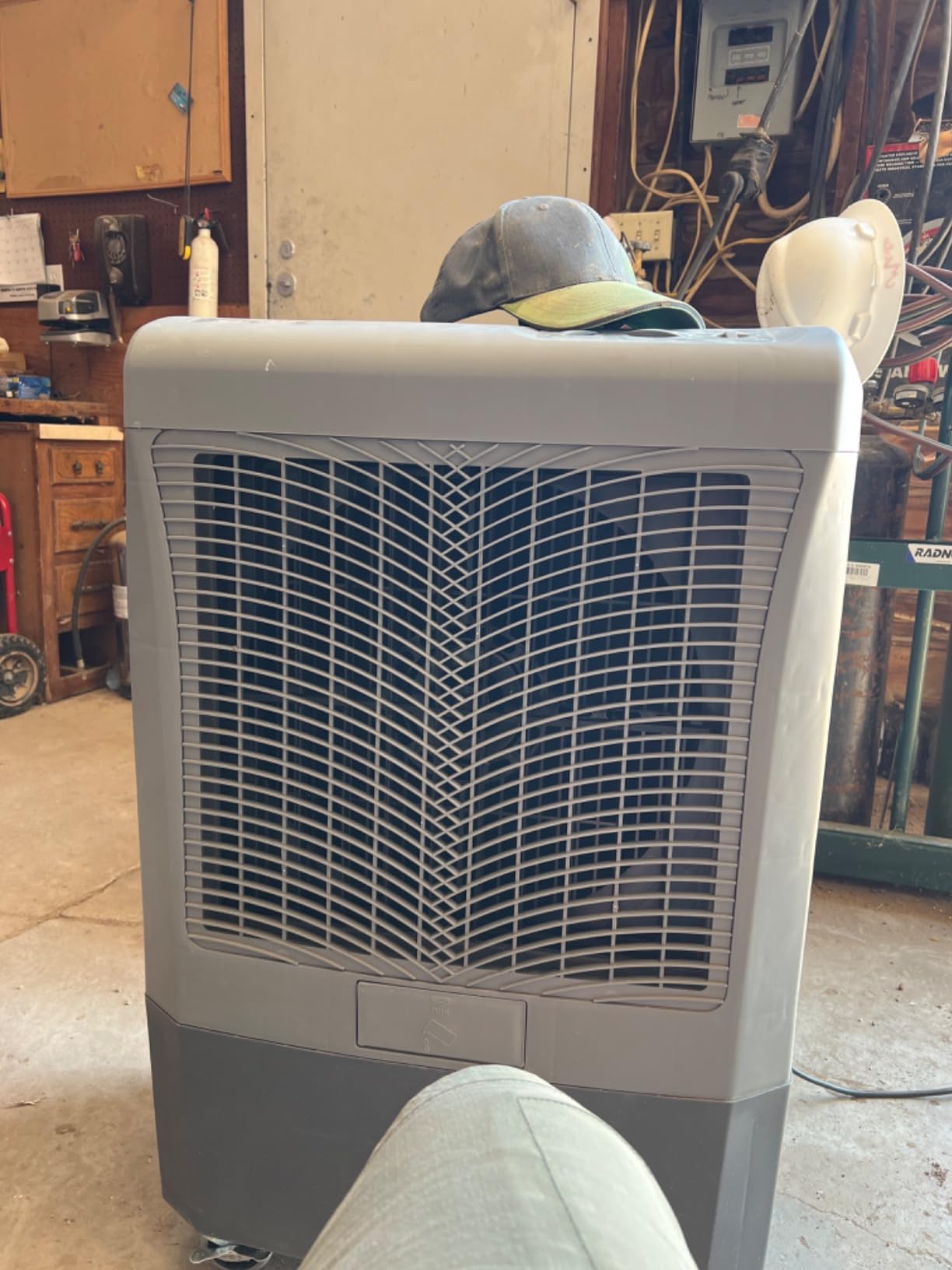
The weaknesses are consistent too, which is another way of saying people have been running this thing for years. At 59 dB it is loud, and on medium and high it is loud enough that you plan your conversation around it rather than through it. That is a real cost on a patio where the whole point is sitting outside with people.
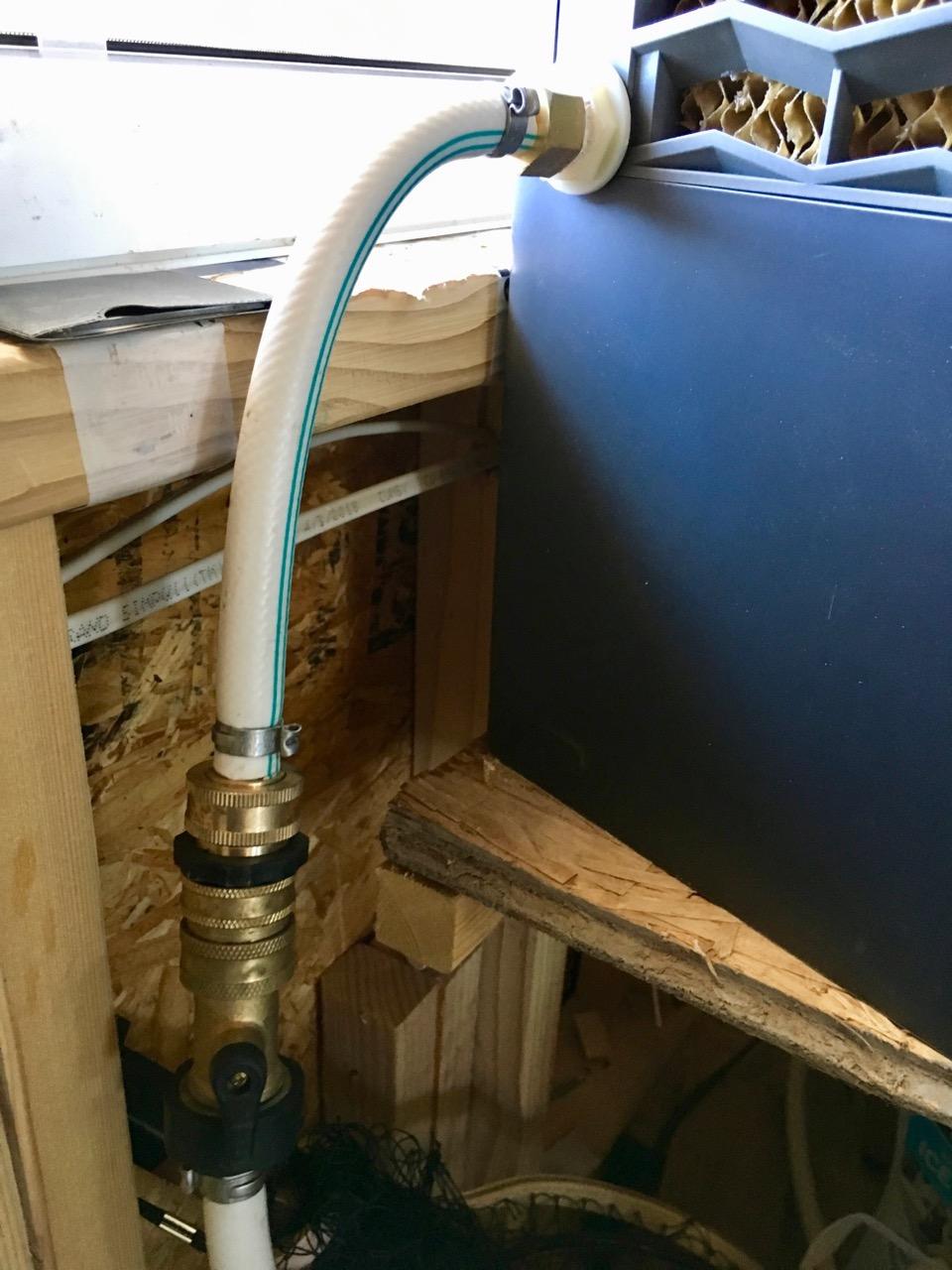
Build quality is the other recurring theme. Owners frequently describe the plastic shell and fit and finish as cheap-feeling, and the manual-fill door latch is a small plastic piece that some report snapping. If you run a hose into it continuously, watch the float valve, because a pinhole there causes slow overfilling. The owner workaround that comes up repeatedly is to run hose-fed for a few hours, then switch to manual fill for the rest of the session.
Check the outlet and the noise floor before you commit
This unit draws 250W at 115V, so it wants a GFCI-protected outdoor outlet and a cord rated for outdoor use rather than a light-duty indoor extension lead. Position it a few feet back from the opening you are cooling through, angled so the discharge air travels the length of the patio. On the low setting it is acceptable background noise; on high it will end conversations.
Pick a different unit if noise or build matters more than proven reliability
If your patio is a small conversation pit where silence is the priority, this is the wrong machine. If you are worried about plastic softening under years of direct sun, the metal-framed options later in this list handle that better. If you plan to run it eight hours straight on a long party, the tank means a mid-session refill unless you hook up the hose.
2. Hessaire MC37V Mobile Evaporative Cooler – Most Compact in the Group
MC37V MOBILE EVAPORATIVE COOLER
3100 CFM
950 sq ft
10.3-gallon tank
4 locking casters
40 pounds
Pros
- Highest average rating of any unit here at 4.6
- Stainless steel screws and no reported rust after years
- Meaningful cooling reported on dry-climate decks
- Four locking casters for real mobility
- Continuous fill via included float adapter
Cons
- Audible on high speed
- Full tank lasts about four hours before a refill
- Pads and tank need periodic cleaning against mineral buildup
The MC37V is the same 3100 CFM mechanical design as the unit above, but the build is a clear step up and owners notice. At 4.6 average across 325 reviews, it holds the highest rating of anything in this roundup. That number matters less as a marketing point than as a signal that the complaints are about the category rather than about this particular cabinet.
Long-term owners specifically mention stainless steel screws and the absence of rust, which sounds mundane until you have carried a plastic cooler through three summers of full sun. The four heavy-duty locking casters are a genuine improvement over the two-wheel arrangement on many competitors, and they matter on a patio where you are constantly repositioning to catch the breeze.
Independent rotary controls for fan, pump and oscillation are a small ergonomic win. Being able to run the pump without the fan, or shift the swing without touching the speed, is useful when the sun moves across your patio and the useful discharge angle changes hour by hour.
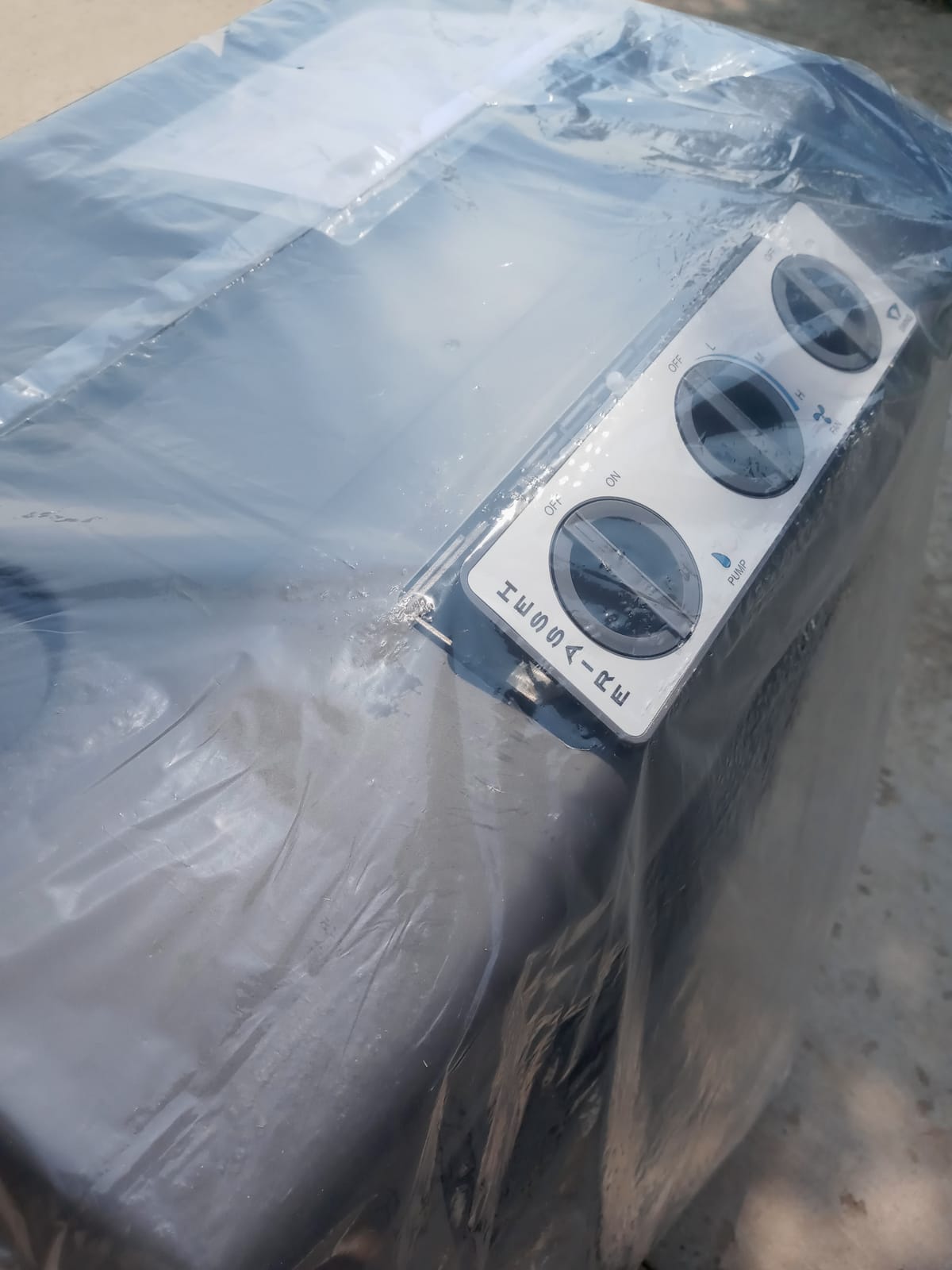
On the cooling side, owners report real results on decks and patios in dry parts of Arizona and Texas, with the same low-setting-is-the-sweet-spot pattern as the MC37M. The three-sided rigid high-density pads give it a larger evaporation surface than single-sided budget designs, which shows up in how quickly the discharge air feels different from ambient.
The trade-offs are the category’s standard ones. High speed is audible, a full 10.3-gallon tank gives roughly four hours, and the pads and tank need periodic cleaning to keep mineral scale from choking the flow. One owner reported a unit arriving used and coated in powdery residue, which is worth checking for the moment the box opens.
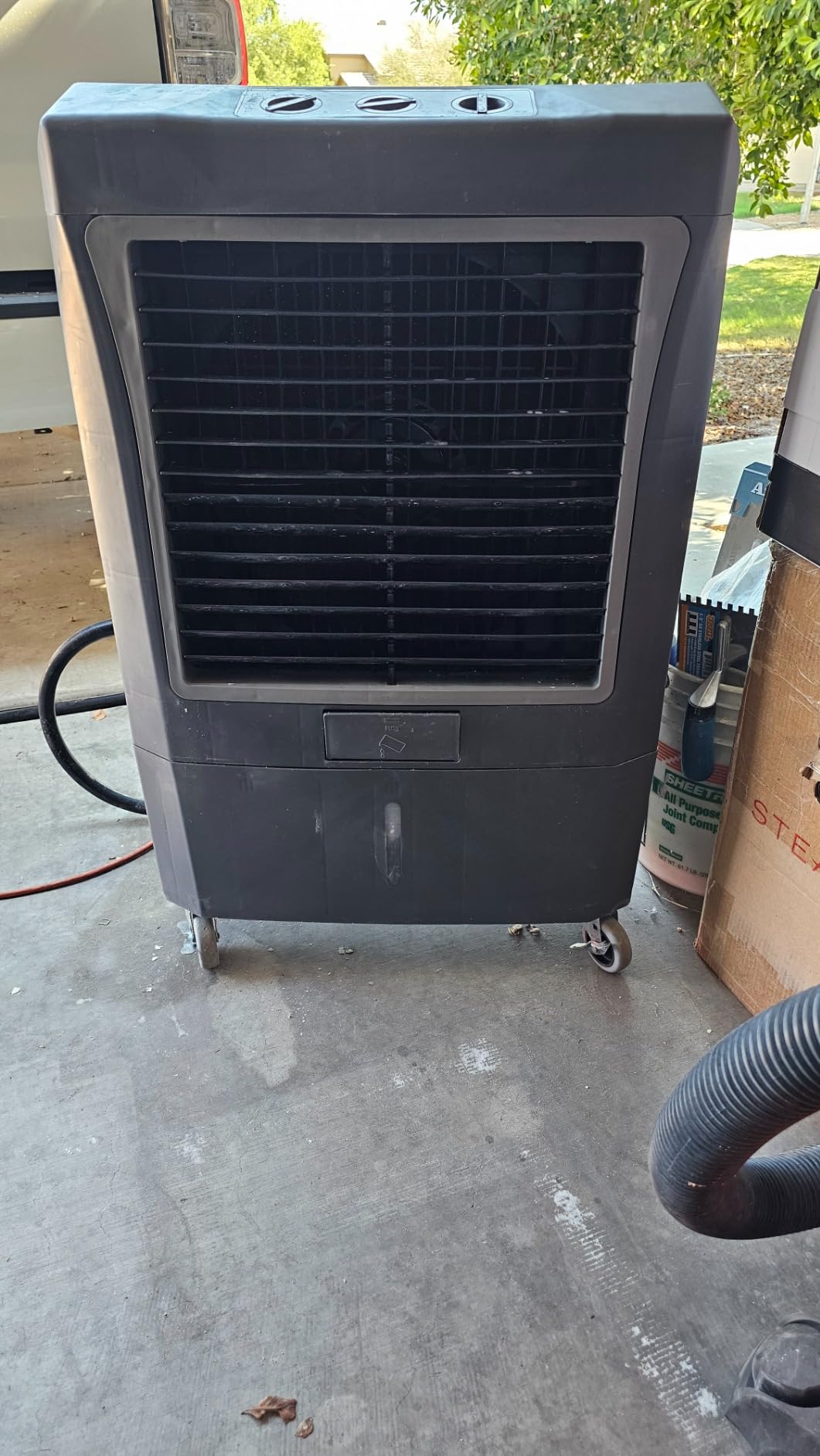
Confirm the water path before a long party
If you want this running all afternoon, use the included float adapter and a garden hose so the top-up is automatic. Otherwise you are managing a ten-gallon reservoir by hand while hosting. Set the unit on a level surface with a drain path, and put a mat under it, because a patio that drains toward your door is the wrong place for a slow seep.
Consider this if your patio gets baked sun all day
This suits people whose patio has no shade structure and whose main worry is a plastic shell degrading over consecutive summers. It costs more attention than the budget units but less than the commercial-scale units, and the caster mobility means one machine can cover a patio during the day and a garage corner in the evening. It suits a household that plans to keep it for several seasons.
3. OEMTOOLS 23969 5300 CFM Swamp Cooler – Best for Large Covered Patios
OEMTOOLS 23969 3-Speed Portable Swamp Cooler Cools 1600 sq ft, 5300 CFM
5300 CFM
1600 sq ft
14.6-gallon tank
68 dB
57 pounds
Pros
- Highest airflow and largest stated coverage in the group
- Largest tank at 14.6 gallons for long run times
- Built-in tool tray useful in a workshop
- Large casters ease a 57-pound unit
- GFCI plug included
Cons
- Highest price point here by a wide margin
- 68 dB is too loud for quiet settings
- Must sit at an open window or door
- Heavy frame is a two-person move
If your patio is genuinely large, roughly 1600 square feet of covered outdoor room, this is the unit in the roundup built for that job. At 5300 CFM with a 14.6-gallon reservoir, it is the biggest machine here by airflow and by water capacity, and it has a 430W draw to match. That draw is the part most buyers skip over, and it changes your electrical planning.
The high-density media panels are claimed to deliver 80 percent more evaporation surface area than a standard panel, which is the sort of claim that matters when you are trying to cool a space with a high ceiling and hard surfaces. The brand also states the unit can drop air temperature by 15 to 30 degrees in dry conditions, and reviewers in arid areas report real drops that match that range.
The built-in tool tray is unusual and genuinely useful if the unit lives in a workshop or on a job site as much as on a patio. Combined with the included GFCI plug, it tells you the manufacturer built this for a working environment rather than a furnished one.
There is no customer photo set for this model, so we leaned on the spec sheet and the owner reports here. At 62 reviews with a 4.2 average, the sample is small, and roughly 63 percent of those reviews are five-star, which tells you satisfied buyers stay positive while unhappy ones are less common but sharper.
The negatives are structural rather than quality-related. At 68 dB this is the loudest unit in the roundup, which makes it a poor fit for a screened porch where conversation matters. At 57 pounds it is a two-person move, and it has to be positioned at an open window or door to perform, which is the single biggest constraint on where you can put it.
Check your circuit before ordering this one
430W at 120V is roughly 3.6 amps, and running that through a long outdoor extension cord is how cords get warm. If you have a nearby GFCI outlet, use it. If you do not, having an electrician add one is a better afternoon than a tripped breaker during a party. Keep the unit close to the opening and keep the run short.
Look elsewhere if your patio is mid-sized
For a patio between 600 and 1000 square feet, this unit is more machine than you need, and the extra size brings noise and weight rather than useful cooling. A 3000 CFM unit handles that space with a smaller footprint and a much lower draw. This is the right pick for a covered outdoor room that genuinely needs to cool a large group, and the wrong pick for a typical suburban deck.
4. Uthfy 40 Inch 4800 CFM Swamp Cooler – Best Metal Frame for Full Sun
Uthfy 40″ 4800 CFM Swamp Cooler, Large Evaporative Cooler with 11 Gal Water Tank, 3 Speeds, 120° Oscillation, 3 Ice Packs, Metal Frame Portable Air Conditioners for Outdoor, Patio, Shop, Yard, Factory
4800 CFM
970 sq ft
11-gallon tank
50 dB
galvanized metal frame
Pros
- Galvanized metal frame instead of typical plastic
- Low 50 dB running for a unit this size
- 4800 CFM with 120-degree oscillation for even coverage
- Four 360-degree casters with two lockable
- Copper motor and 200W draw
Cons
- 4.0 average rating shows mixed satisfaction
- Ice packs need frequent swapping to stay effective
- Cooling depends heavily on dry ambient air
- Oscillation motor adds slight mechanical noise
Almost every cooler in this category is molded plastic, which is exactly why this one stands out. A galvanized iron frame, a copper motor and triple high-efficiency intake panels make the Uthfy 4800 the pick for a patio with no roof cover and full western exposure. Plastic housings go chalky and brittle after a few seasons of direct ultraviolet light; a metal frame does not.
At 4800 CFM it moves more air than most units in the roundup while registering only 50 dB, which is a strong combination for outdoor use. The 120-degree automatic oscillation spreads the discharge across the seating area so you are not constantly adjusting the unit, and the copper motor is a genuine step up in expected service life.
Four 360-degree caster wheels, two of them lockable, make a 40-inch machine something one person can actually move. For a household that drags the cooler between the patio, the garage and a covered side area, that is not a minor feature.
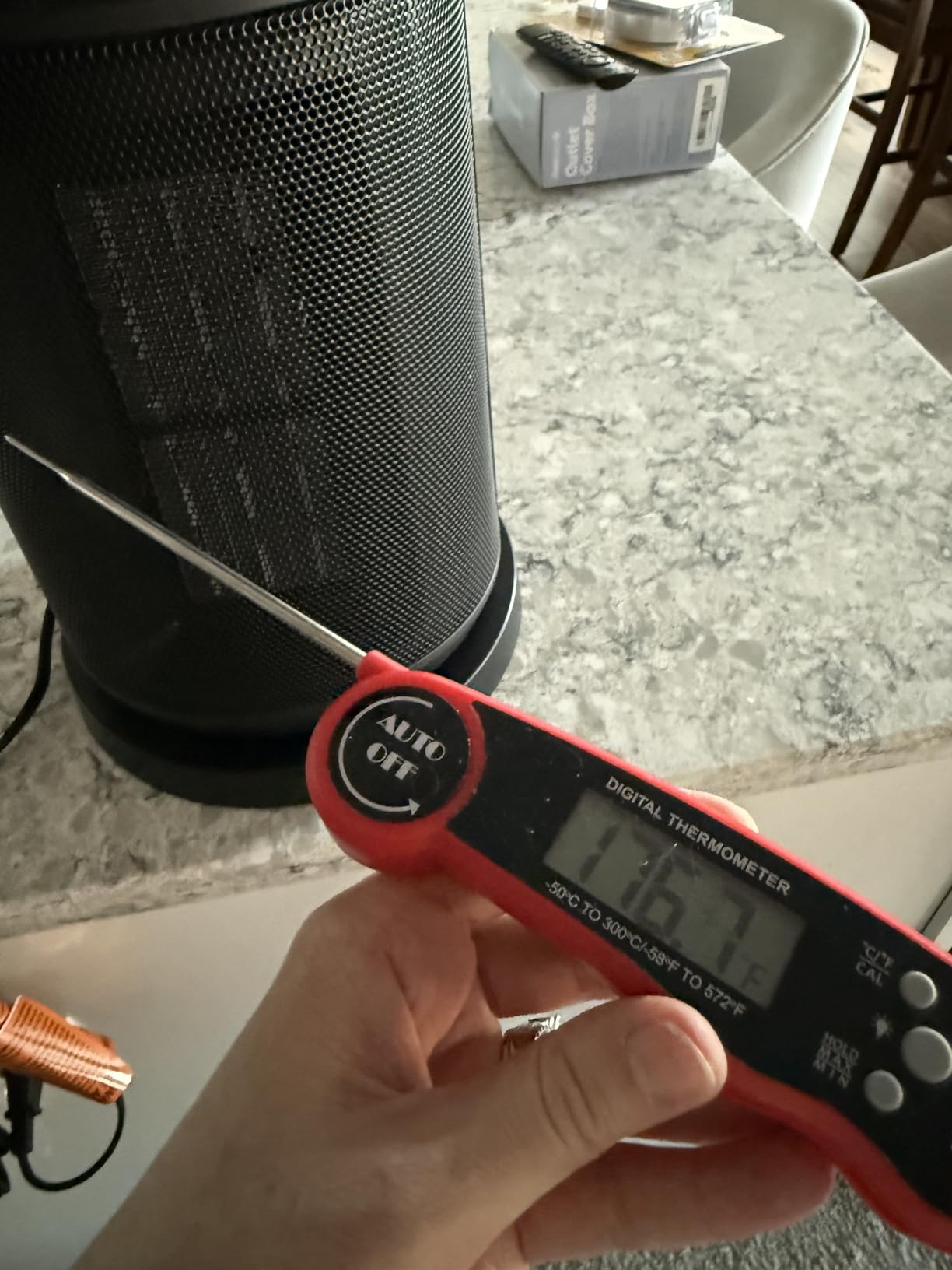
It ships with a 4-in-1 composite ice curtain and three ice packs. Treat the ice as a bonus rather than a system. Reviewers are candid that the packs need frequent swapping, and once they melt they simply add a little extra coolness to the water, which the pads were already doing.
The 11-gallon tank accepts a manual top fill or a continuous auto-refill through a built-in drain port, and the 200W draw at 120V is modest for the airflow it delivers. That low draw is one reason it runs off ordinary patio outlets without drama, and it helps on a circuit shared with an outdoor kitchen.
Judge the 970 sq ft claim by your seat count
The coverage figure is 970 square feet, which is smaller than the CFM would suggest. Read the two numbers together. A family-sized seating group under partial shade will feel the difference from a plain fan. A 20-person party spread across a wide open deck will feel the airflow fade sooner than the CFM figure suggests. Position it upwind of the seating rather than in the middle of it.
Pick this one for sun exposure, not for silence at the table
The metal frame and copper motor are the reasons to choose it when the patio bakes. If your priority instead is the quietest possible table conversation, the 47-inch Uthfy later in this list is quieter on paper, and the Arctic Air is quieter still for one person. This is the pick for a patio that needs to survive a decade of summer sun with minimal care.
5. Arctic Air Outdoor Evaporative Cooler – Best Cordless Personal Cooling
Arctic Air Outdoor Evaporative Cooler, Portable & Ultra-Quiet Air Cooler with 4 Fan Speeds, USB Rechargeable, 6-Hour Battery Life, Great for the Beach, Pool, Deck, Garden & More,White
350 CFM
personal misting fan
USB rechargeable
4.8 pounds
2 misting jets
Pros
- Genuinely portable at 4.8 pounds with a carry handle
- USB rechargeable so no outlet is needed
- Mist plus fan works well for personal spot cooling
- LED mood lights for evening use
- Weather-resistant housing
Cons
- Cools only the person directly in front of it
- Battery runtime degrades from about 4 hours to under 1
- Reservoir lid does not seal and leaks when carried
- Mist mode adds a high-pitched noise
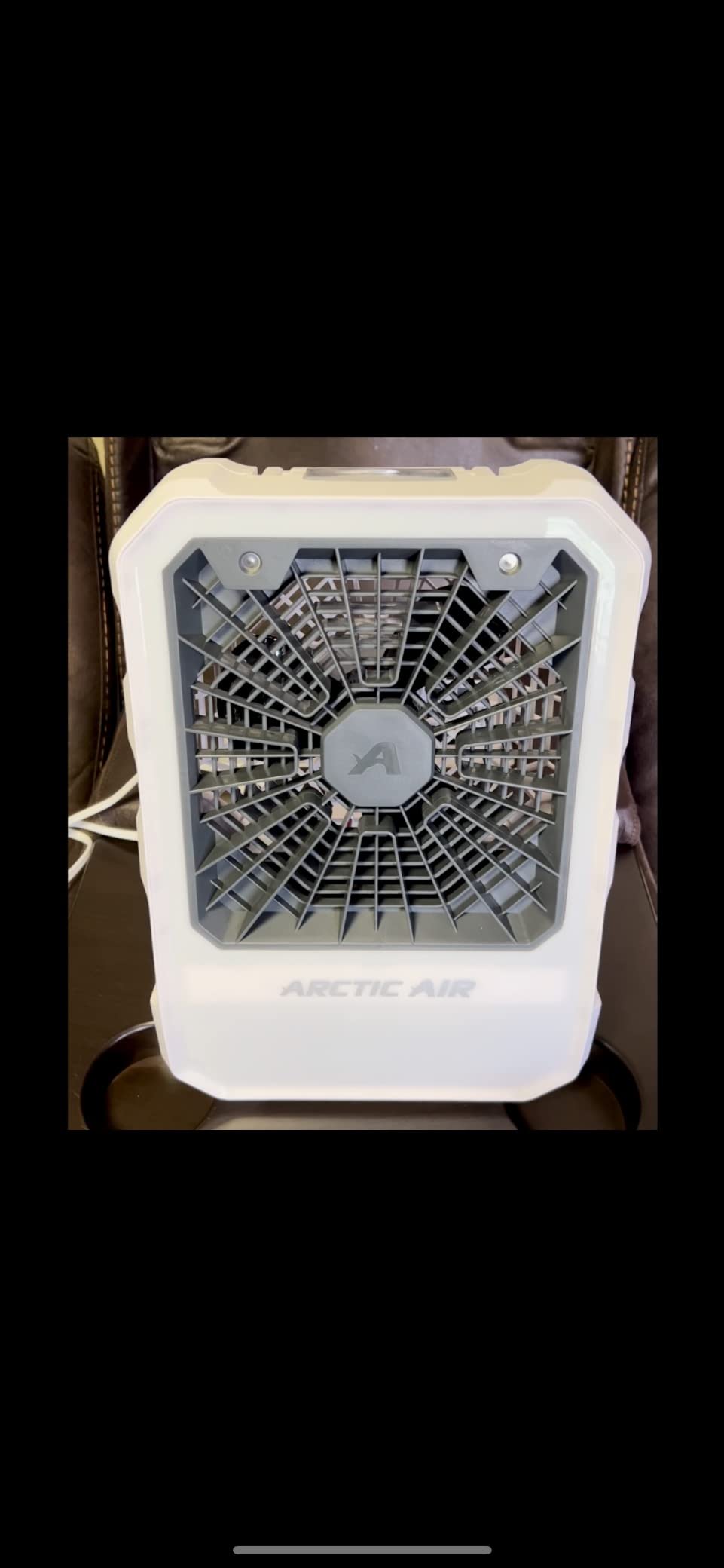
Be clear about what this is. At 350 CFM the Arctic Air Outdoor is a personal misting fan, not an area cooler, and it will not cool a patio. It cools the one person holding it or sitting two feet in front of it, which makes it a different category of purchase from everything else in this list.
That is still a real use. At 4.8 pounds with a built-in carry handle and a USB rechargeable battery, it goes anywhere: a bleacher, a picnic table, a pool edge, a beach. Two high-capacity misting jets plus four fan speeds including turbo produce a strong directed breeze, and users like combining the mist with cold water for a better direct effect on skin.
It also has an optional garden hose hookup for continuous water flow, which is unusual for a unit this small. If you position it near a spigot, it can run as a personal misting station all afternoon without anyone watching a tank.

The complaints are serious enough to factor into your decision. Battery runtime degrades quickly, with several owners reporting a drop from around four hours to under an hour within months of use. The 3.5 average rating, with about a fifth of reviews at one star, reflects that pattern rather than a single defect.
The tank lid does not seal securely, so the unit leaks if you carry it while full. The mist feature produces a high-pitched noise on some units that people find irritating at a table. And the airflow is the lowest in the roundup, low enough that several buyers report a basic box fan performs better for moving air. The airflow only blows upward and cannot be aimed across a group.
Test the battery before you rely on it
Charge it fully and run it for an afternoon before the first gathering. If you need it for more than a couple of hours away from an outlet, keep a second battery or accept the limitation. Do not fill the tank and then walk with it, because that is the exact scenario the lid seal fails in.
Use it as a personal unit or skip it
Choose it when you sit on a patio with no power nearby, or when you want directed cooling at a specific chair while someone else runs the area unit. Skip it if you are trying to cool a group, because nothing at 350 CFM reaches a second seating area. The seven LED mood lights are a nice touch for evening use but do not change the cooling equation.
6. VEVOR 1400 CFM Evaporative Air Cooler – Most Versatile for a Small Patio
VEVOR Evaporative Air Cooler,1400 CFM 11X31 inch Air Cooler,3 Speeds Cooler Portable Air Conditioner,Energy-Saved Swamp Cooler for party,pool and patio,5 Gal Water Tank & 550 Sq.Ft…
1400 CFM
550 sq ft
5-gallon tank
60 dB
13.4 pounds
Pros
- Lightest full-size option here at 13.4 pounds
- 72-degree oscillation plus adjustable louvers
- 5-gallon tank accepts a garden hose
- Water shortage protection with a low-water indicator
- 60W draw is easy on any outdoor circuit
Cons
- 1400 CFM covers only about 550 sq ft
- Single-sided pads give less cooling than 3-sided designs
- 60 dB is audible on a quiet patio
- Plastic construction feels basic
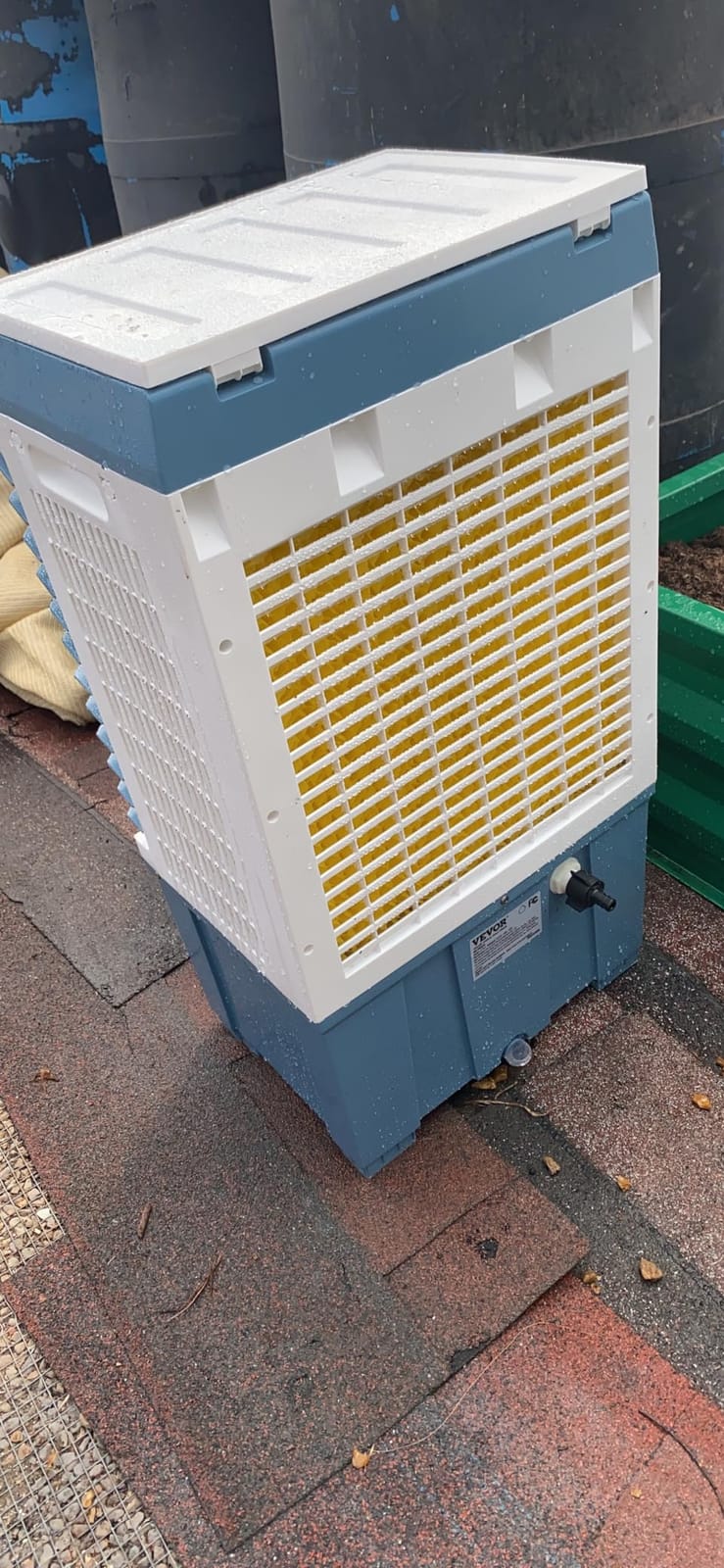
The VEVOR is the unit to buy when a patio is small, the budget is fixed, and you want something you can carry to the storage closet yourself. At 13.4 pounds it is the lightest full-size cooler here, roughly a third the weight of the standing units, and that changes who in the household is willing to move it.
The feature list is longer than the price would suggest. You get 72 degrees of automatic oscillation plus manually adjustable vertical louvers, a 5-gallon tank that accepts a garden hose for continuous fill, two ice packs, and water shortage protection with a low-water indicator that stops the pump running dry. The mechanical buttons are a nice detail, since they stay legible after months of use unlike soft-touch panels.
It also works as a fan, a humidifier and an evaporative cooler in a 3-in-1 arrangement. That versatility is why we see it recommended for patios, pool decks and party settings, and why it is a reasonable patio companion even when it is not doing the cooling itself.
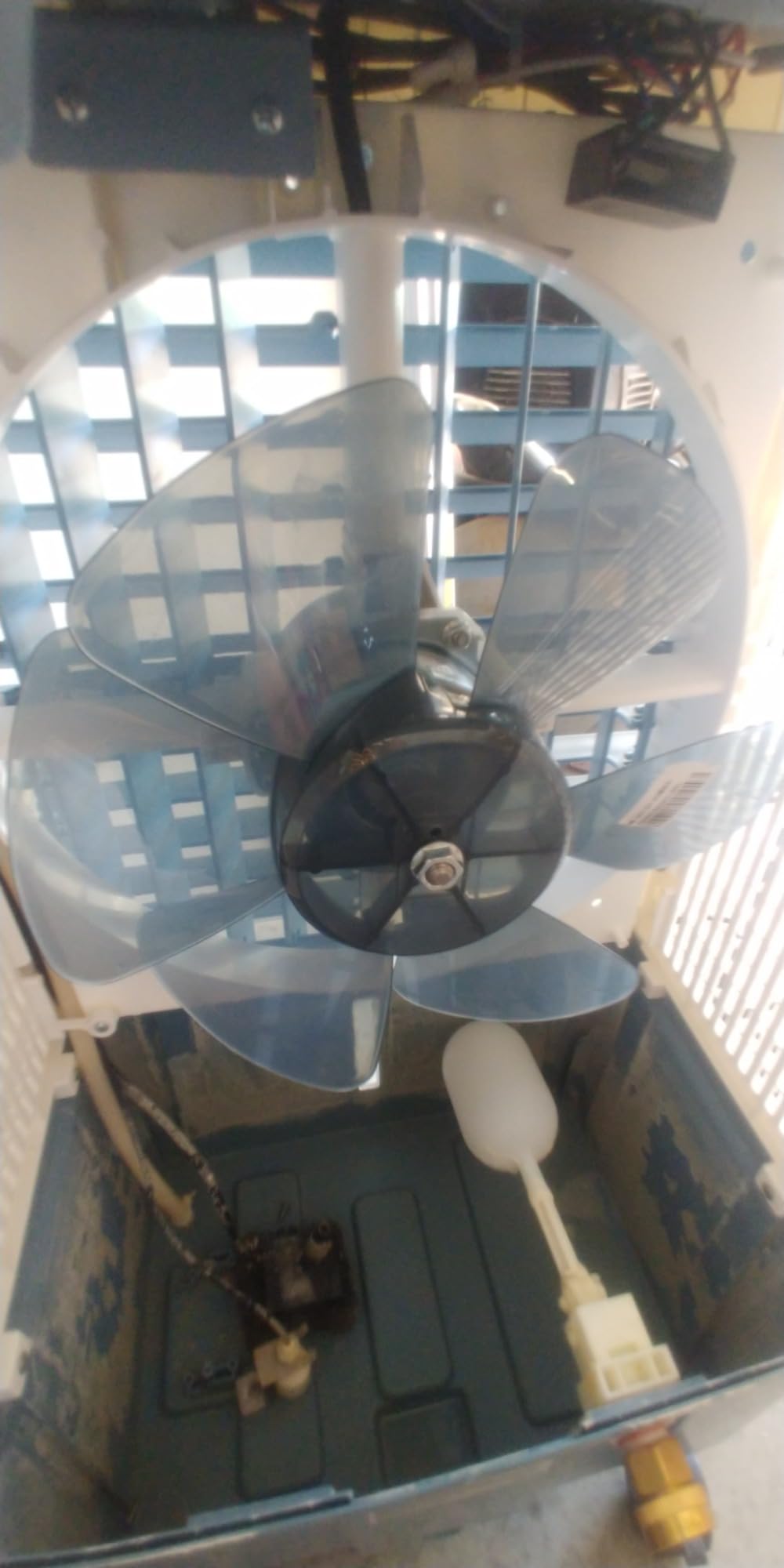
Where it falls short is airflow. 1400 CFM over a claimed 550 square feet is a real limit, and owners describe the effective area as noticeably smaller than the larger units. The single-sided rigid cooling pads also produce less effective cooling per unit of airflow than the three-sided designs in this roundup, which is the main technical reason its 3.7 rating sits where it does.
At 60 dB it is audible in a quiet setting, which matters for a small patio where the unit is usually close to where you are sitting. The manufacturer is explicit that it will not match air conditioner performance and that it works best in dry outdoor air, and the plastic shell feels basic to the hand.
Set your expectations to a small seating area
This works for a two-person bistro table under partial shade, or a spot along a wall of a larger deck. It will not cool a 900-square-foot covered patio, and a 3000 CFM unit in that space changes the experience completely. If you can stretch to a mid-size unit, the jump in real cooling is worth more than the features this one adds.
Pick it for portability, not for power
Choose this unit for a renter, a small balcony, a garage corner or a patio that has to be stowed every night. The 60W draw at 120V means you can run it from almost any outlet or a modest extension cord without thinking about the circuit. Do not buy it expecting to handle a large gathering.
7. SereneLife 2500 CFM Swamp Cooler with WiFi – Best for Smart Control
SereneLife Portable Swamp Cooler Air Conditioner – 2500 CFM Airflow, 8 Gallon Water Tank Portable Evaporative Air Cooler for Room & Outdoors, WiFi, Humidifier & Fan Modes, Ice Packs & Remote Included
2500 CFM
400 sq ft
8-gallon wheeled tank
WiFi app and remote
65 dB
Pros
- 8-gallon tank on a wheeled base that rolls to a tap
- WiFi app plus remote and touch panel
- Strong airflow for the class
- 3-in-1 cooler fan and humidifier with a 12-hour timer
- Quiet on the lower settings
Cons
- Lowest average rating here at 3.2 with 30% one-star reviews
- Reported to clog and leak from the top within about 8 months
- Pump cannot fully drain the tank
- No carry handles and rough casters on a filled unit
- Cooling reported at only 1 to 2 degrees
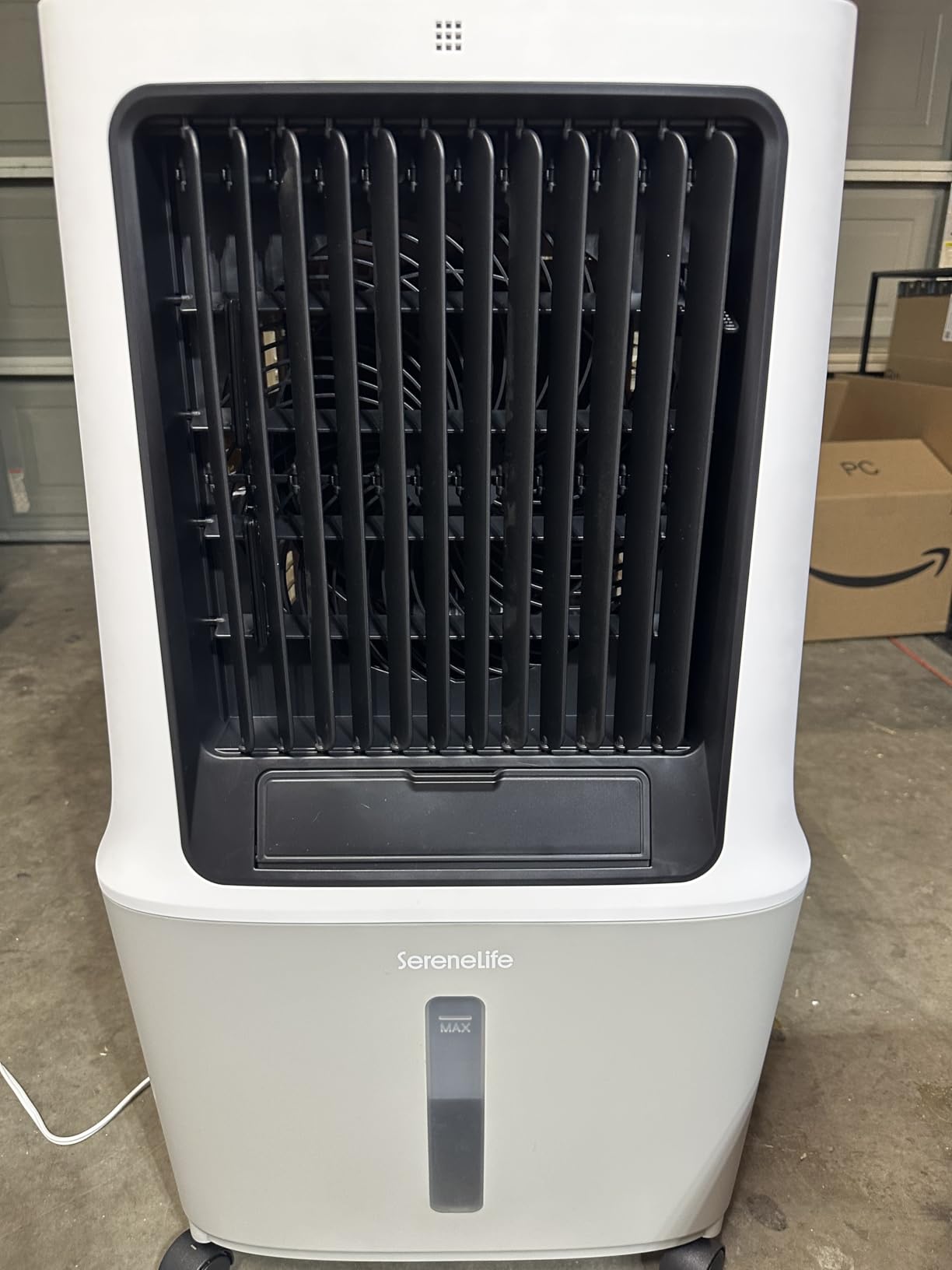
The feature list here is the longest in the roundup. 2500 CFM with 360-degree oscillation, an 8-gallon tank on a wheeled base that you can roll to a bath or shower to fill, WiFi app control alongside a remote and an LED touch panel, three modes for cooler, fan and humidifier, a 12-hour timer, two ice packs, a washable filter and an auto-dry pad system. The tank-on-wheels refill design is the single smartest idea in the category.
And yet the 3.2 average rating is the lowest of the ten units here, with about 30 percent of reviews at one star. That gap between the specification sheet and the ownership experience is the most important thing to understand here. Owners like the airflow, which they describe as a very powerful air stream, and they like the quiet low settings as background noise.
What owners report against it is durability. Multiple owners describe the unit clogging and leaking from the top within roughly eight months. The water pump cannot fully drain the tank, which leaves standing water behind and produces heavy drippage when the top section is removed.
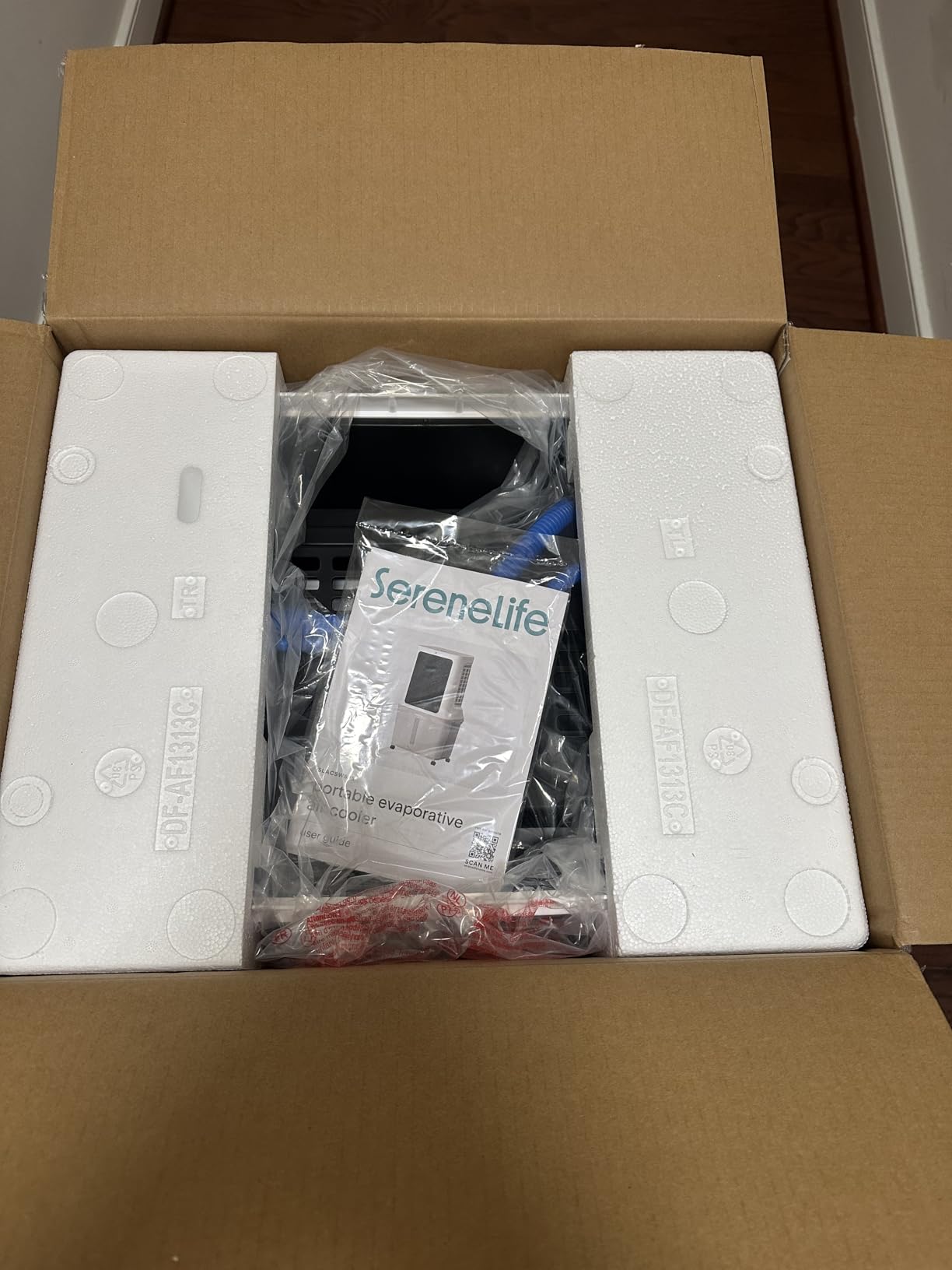
The tank on castors has a downside nobody mentions in the marketing. There are no carry handles, and the casters are not smooth, so a filled 8-gallon unit is awkward and spill-prone to move. The secondary top-fill opening is small enough that a hose is effectively required for refilling.
Cooling results are the other issue. Owners report only a 1 to 2 degree drop in a small bedroom, even with ice and chilled water. The manufacturer markets it at 52 dB but also publishes a 65 dB rating, so the noise number depends on which mode you are in. At 140W it is easy on power.
Check the app and the fill setup against your patio
If your patio is near a spigot, a hose makes the small fill opening a non-issue and the app lets you start cooling before guests arrive. If there is no water source nearby, you are moving a heavy, drip-prone tank by hand, and that is when the missing handles become a real problem. Neither of those things is obvious from the photos.
Skip it if you want long-term reliability
Despite the feature count, we would not build a primary patio cooling plan around this unit given the reported leak and clog pattern within a year. The 2500 CFM figure is real for airflow, but the rated 400-square-foot coverage is small, and the 8-gallon tank is doing more work for the pump than a simpler design would.
8. SereneLife 1800 CFM Cooler with 4L Detachable Tank – Best for Small Spots
SereneLife Portable Evaporative Air Cooler with 4L Detachable Water Tank, 1800 CFM Evaporative Cooler with Remote & Ice Packs, Indoor Outdoor Air Cooler Portable for Room Use, (White & Gray)
1800 CFM
700 sq ft
4L detachable tank
65 dB
11 pounds
Pros
- Lightweight at 11 pounds with smooth mobility
- Detachable 4L tank with water shortage alarm
- Four included ice packs improve perceived cooling
- Remote plus a 1 to 7 hour timer
- 80W draw on an ABS housing
Cons
- Cooling effect limited and some owners compare it to a standard fan
- 65 dB is audible on higher settings
- Small 4L tank needs frequent refilling
- Ice packs need constant swapping
This is a compact indoor and outdoor unit aimed at a personal zone rather than a patio. At 1800 CFM it is rated for spaces up to 700 square feet, which sounds generous until you set it in a real outdoor area with no walls to keep the cool air in, which is the situation a patio creates.
What works well is the physical design. Eleven pounds with smooth mobility means one person moves it without ceremony, and the detachable 4L tank lifts out so you can fill it at a kitchen sink rather than carrying the whole unit to a spigot. A water shortage alarm with pump protection stops the pump from running dry, which is a small thing that prevents a common failure.
Four ice packs are included, and owners consistently say they improve the perceived cooling noticeably. With a remote control and a 1 to 7 hour timer, you can set it running before a gathering and leave it alone. The 80W draw at 120V is the lowest real cooling draw in the roundup.
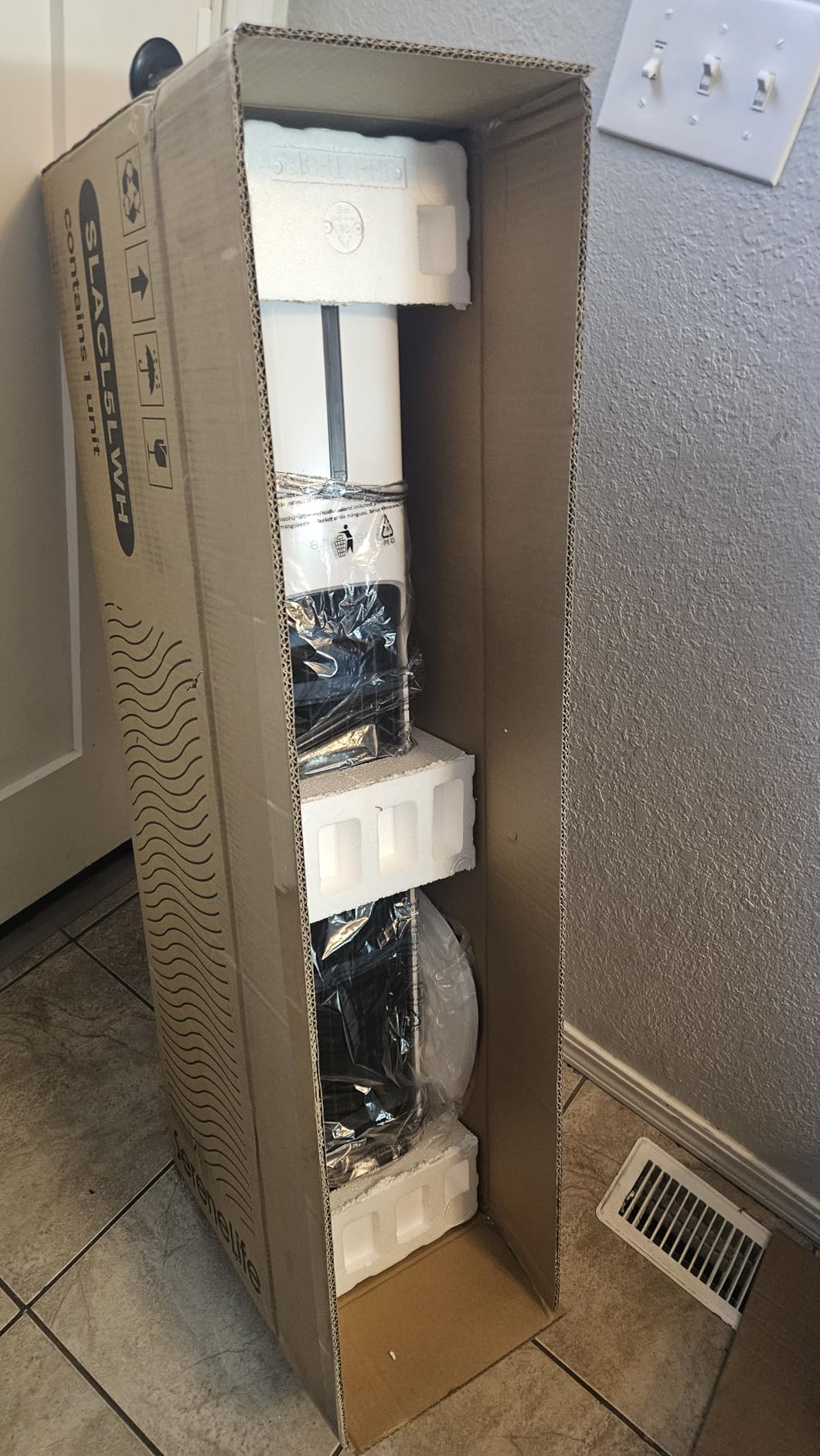
Against that, the 3.6 rating reflects that it behaves more like a fan with light cooling than a genuine area cooler. Several owners say it performs like a standard fan. At 65 dB it is audible on higher settings, which is odd for a unit this small and light.
The 4L tank is small enough to need frequent refills during a long evening, and the ice packs need constant swapping to stay effective, which makes them a repeated chore rather than a set-and-forget feature. The ABS housing is fine for a bedroom and marginal for a patio with direct sun.
Aim it at a seat, not at the patio
The productive way to use this is pointed at one chair or a small section of a bench. Cool air in an open space disperses fast, so a unit like this works as a personal cooling station rather than a patio climate system. If you want a group to cool down, you need the airflow of a standing unit.
Pick it for a covered nook or a spare room
This suits a small balcony, a screened nook or a home office that needs cooling in the afternoon. The low draw and light weight make it easy to move between them. It is a sensible companion to a larger patio unit, not a replacement for one, and owners who expect a patio-sized temperature drop end up disappointed.
9. SereneLife 1500 CFM Cooler with 15L Tank – Best for Rolling Spot Cooling
SereneLife Evaporative Air Cooler with 15 L Detachable Water Tank, Air Cooler with 1500 CFM Cooling Power, Indoor Outdoor Oscillating System with Wheels, Remote & Ice Packs, (Black & White)
1500 CFM
700 sq ft
15L detachable tank
65 dB
11 pounds
Pros
- 15L detachable tank among the larger capacities at this size
- Rolling wheels make it easy to move between rooms
- Top-fill design with an easy-to-read water level indicator
- Four ice packs included and two fit at a time
- Low 80W electricity use
Cons
- Lowest-rated unit here at 3.1 with 32% one-star reviews
- Multiple owners report no cooling and fan-like performance
- Some say it makes a space warmer and more humid
- Fan appears underpowered to evaporate water
- Instructions are unclear
The specification sheet for this one reads like a mid-size cooler: 1500 CFM, a 20.1 MPH wind speed, a 15L detachable tank, 60-degree oscillation across three wind modes, a 12-hour timer, remote control, four ice packs and rolling wheels, all on an 80W draw. The 3.1 average rating, with 32 percent of reviews at one star, is the weakest in the roundup.
The reviews split sharply. Some owners in small rooms and dry garages say it works well, runs quietly and handles a compact space nicely. A substantial group says the fan is too weak to evaporate the water effectively, and that in a dry climate it makes the space warmer and more humid. That second group is the one to design around, because it is the failure mode of an undersized fan with a wet pad.
There is no customer photo set for this model, so we are relying on the specification data and the owner reports. What is clear is that the 15L tank and the wheels are the design strengths. A detachable 15L tank on a rolling base is genuinely convenient for moving between a garage and a patio, and the top-fill layout with a readable level indicator is better than most.
Check whether your space can accept added humidity
If your area already runs humid in summer, a unit that some owners describe as adding moisture is a poor choice. Dry, enclosed and small is the condition where this design works, and our notes on garage evaporative cooling go into that scenario in more detail. Set it up, run it for an hour and judge the result before committing your summer to it.
Choose a larger unit for an open patio
An open patio dissipates cool air constantly, so a 1500 CFM unit loses its effect quickly. The weak fan is the deciding factor: on a patio you want enough airflow to keep the pad saturated and the discharge air moving. If your goal is a garage corner or a covered nook, this is fine. If your goal is a patio, pick a 2500 CFM unit or larger.
10. Uthfy 6000 CFM 47 Inch Swamp Cooler – Best for Quiet Operation
Uthfy 6000 CFM Swamp Cooler Air Conditioner, Outdoor Evaporative Air Cooler with 13.5 Gal Water Tank, Remote, 120° Oscillation, 12H Timer, 47″ Portable AC with Copper Motor for Patio, Garage
6000 CFM
1300 sq ft
13.5-gallon tank
45 dB
35 pounds
Pros
- Low 45 dB running for a 47-inch standing unit
- 13.5-gallon tank with 3-side pads for long runtime
- Quick to assemble and running within about 10 minutes
- 26-foot remote plus a 12-hour timer
- Locking wheels and two carry handles
Cons
- Low 3.3 average rating with 25% one-star reviews
- Advertised 6000 CFM appears overstated beyond about 15 feet
- Listed height differs between the 47-inch listing and 44-inch box
- Ice packs melt within minutes in warm conditions
- Adds humidity outside arid climates
45 dB is the number that makes this unit interesting. It is the lowest noise rating in the roundup, and it comes on a 47-inch standing unit with 6000 CFM of claimed airflow, a 13.5-gallon tank and 120-degree oscillation. If your patio is a conversation space where a 59 to 68 dB machine would end the conversation, this is the one to look at first.
Owners report near-silent running, quick assembly and being operational within about ten minutes, plus genuine temperature drops of 10 degrees or more in very dry climates when started early in the day. The remote reaches 26 feet, which is enough to change speed from a chair, and the 12-hour timer handles unattended running.
Two reinforced carry handles and four 360-degree locking wheels make a 35-pound unit manageable. The top fill plus a front hose connection gives you both refill styles, and the 250W draw at 120V with a copper motor is a sensible power-to-output ratio.
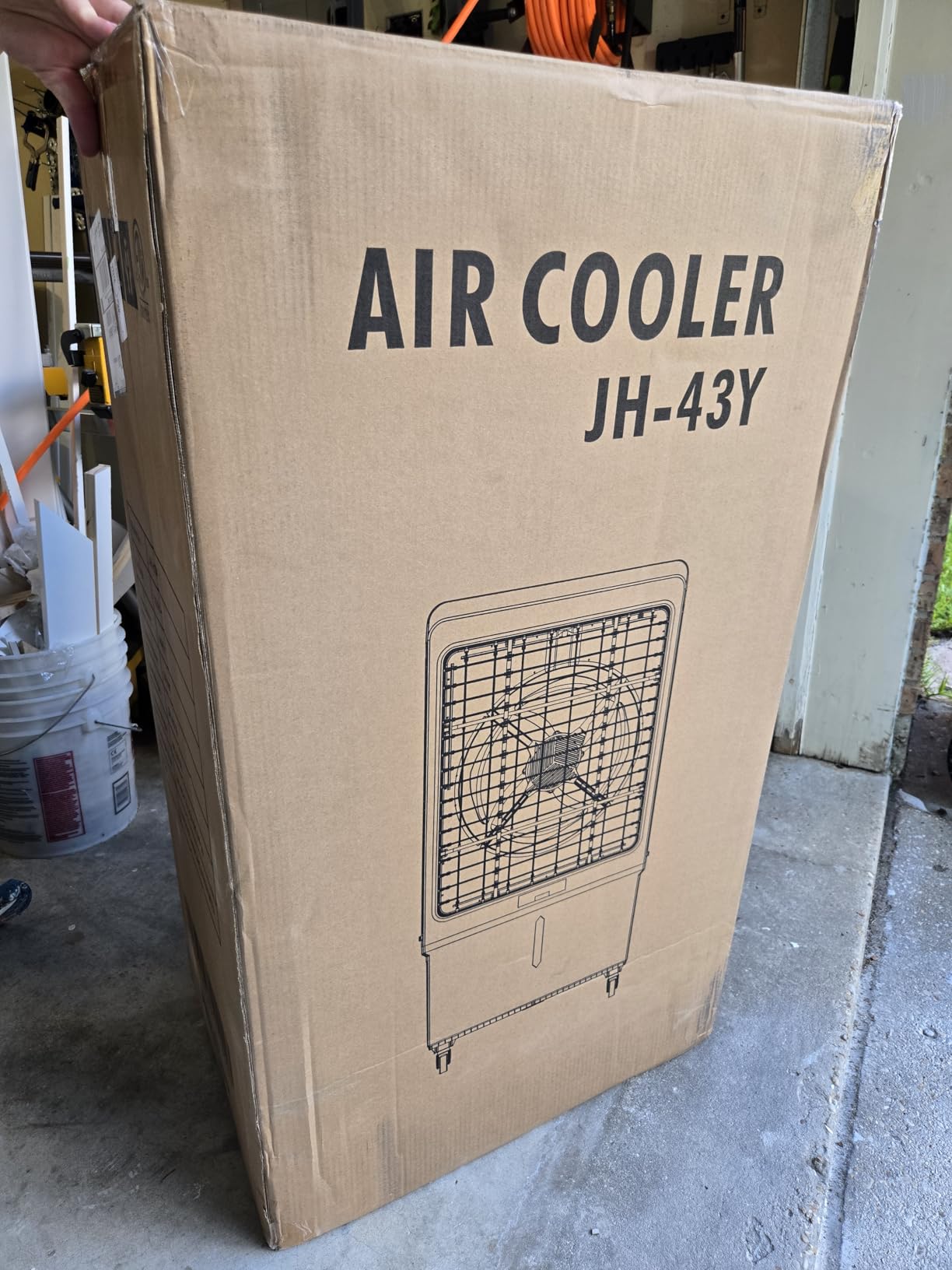
The problem is that the airflow claim does not always hold up. Owners report that the air falls off sharply beyond about 15 feet, which is well short of what 6000 CFM implies. That gap between the specification and the felt performance is a large part of the 3.3 rating, with 25 percent of reviews at one star. The review base is small at 32, so the evidence is thinner here than for the units above.
There are also quality details worth knowing. The listed height differs between the 47-inch product listing and a 44-inch marking on the box. The four included ice packs melt within minutes in warm conditions, so they are not a real cooling aid outdoors. One owner reported the water pump stopped circulating after two days, with no customer service phone line available.
Test how far the air actually travels
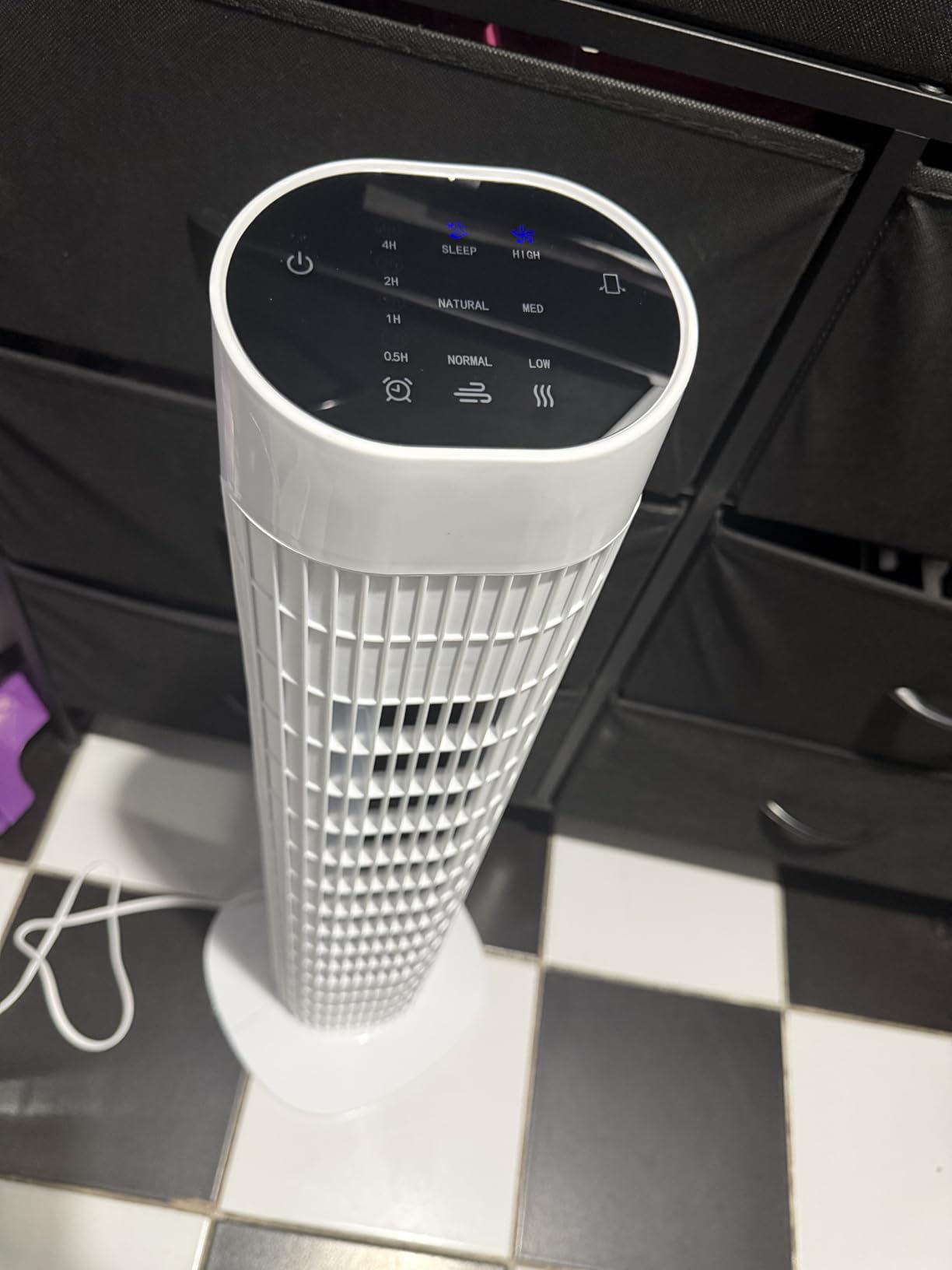
Set it up at one end of your seating area and feel the discharge from your normal seat before you plan around it. The reported 15-foot falloff is fine for a compact table group and not fine for a long deck. Positioning matters more here than with the smaller units, because the usable zone is narrower than the box claims.
Pick it when noise is your top constraint
This is the pick for a patio where the group is small, the seating is close together, and a loud fan is unacceptable. It is not the pick for a large open area, where a lower-rated but more honest airflow figure will serve you better. Check the pump early in the first week, since that is the failure owners report.
How to Choose an Evaporative Cooler for Your Patio in 2026
Choosing between ten similar-looking cabinets comes down to five decisions, in this order: does your climate allow evaporative cooling at all, how big is the space, how will you supply water, where does the power come from, and how much noise can your group tolerate. Get those right and the brand barely matters.
Check your humidity before you buy anything
This is the step that decides whether you are satisfied or disappointed. Evaporative cooling removes heat by turning water into vapor, and the air can only accept that vapor if it is dry. Below 40 percent relative humidity, evaporative coolers are effective and can drop air temperature by 20 to 30 degrees. Between 40 and 50 percent, expect moderate cooling and rising humidity. Above 50 percent, you have an expensive fan.
Look up the relative humidity for your area during the hottest part of your summer, not the annual average. Desert and high-desert cities, inland valleys and semi-arid regions generally qualify. Gulf Coast, Florida and coastal areas in summer generally do not. If you are on the border, an indoor hygrometer is a cheap way to find out before you spend anything.
Match the airflow to your patio size
Coverage claims in this category are marketing numbers. Airflow is the physical number that matters, because it determines how fast air moves through the wet pad and how far the cooled discharge travels. A useful ladder: 300 to 1400 CFM handles a single seating spot or a small balcony; 1800 to 2500 CFM covers a compact patio of roughly 400 to 700 square feet; 3100 CFM is the sweet spot for a mid-size patio around 950 square feet; 4800 CFM and above is for large covered outdoor rooms, though treat the felt range as shorter than the claim.
Two multipliers apply. A covered or screened patio holds cooled air better than an open deck, so the same unit works harder there. A patio with partial afternoon shade performs better than one in full western sun. The rule of thumb is to size up one step if your patio is open on three sides, because open air disperses the discharge continuously.
Choose the water system before the brand
There are three practical options, and they suit different patios. Manual fill means lifting a tank to a faucet or carrying it to the sink, which is simple and fine for a small tank but a chore for anything above 8 gallons. Hose-fed continuous fill uses a float valve to hold the water level, which is right for all-day gatherings but has a documented seepage risk on some units, so have a plan for an overflow.
The third option is a detachable tank, which is the most convenient of all. The tank rolls or lifts off and goes to the nearest tap, so you never move the whole machine. Owners of the 8-gallon wheeled design in this roundup rate that arrangement highly for exactly this reason. For a patio near a spigot, it is the option we would pick first.
Evaporative cooler, misting system or portable AC
This is the question searchers ask most, and the answer depends on humidity rather than preference. An evaporative cooler is the only option that cools a large open area cheaply, but it only works in dry air. A misting system works in any humidity because it cools skin directly rather than the air, so it is the right choice for a humid patio where you only need a few people comfortable. A portable air conditioner works in any humidity and is genuinely the coldest option, but it needs an exhaust hose to a window and uses considerably more electricity.
On a patio, a portable AC has a structural problem: the hose has to reach an opening, and most patios do not have a window within reach. That is why evaporative coolers dominate outdoor use despite their humidity limit. In a humid region, the realistic answer is a misting fan for personal cooling plus shade, not an evaporative cooler.
Plan the electrical path and the placement
Patio electricity is where most people cut corners. Use a GFCI-protected outlet, which every unit here is designed around, and use an extension cord rated for outdoor use. Anything drawing 250W or more, including the 430W unit in this roundup, should go on a properly rated outdoor-rated cord, and running that load through a long cheap cord is how cords get warm enough to be a hazard.
For placement, position the unit several feet back from the opening you are cooling through, aimed so the discharge air travels along the length of the seating rather than into the group’s faces. Cross-ventilation is required: an evaporative cooler needs a path for warm air to leave, so an open door or window on the far side of the patio matters as much as the unit itself. Point it out of the sun if you can, and lock the casters so vibration does not walk it across the slab.
Set a pad maintenance and storage routine
Cooling pads are consumables and mineral scale is the leading cause of reduced performance. Owners across this category report rinsing pads weekly, running a descaling tablet through the tank in hard water areas, and letting the pads dry fully before winter storage. Storing a pad wet over the off-season is what cracks them, and a cracked pad is the fastest way to lose cooling capacity.
Plan for a ten-minute rinse every week or two during heavy use, and dry the unit out before putting it away. If your water is hard, the descaling step is not optional. A related decision is ice: the ice packs included with several of these units are a pleasant bonus rather than a meaningful upgrade, so treat them as a comfort feature rather than part of your cooling plan.
While you are planning storage, it is worth picking up the fundamentals of the other half of summer comfort. Our electric cooler picks cover the drinks side of a long patio afternoon, and our rotomolded cooler guide covers the long-duration ice chests that handle a full day without leaking.
Frequently Asked Questions
What size evaporative cooler do I need for my patio?
Match airflow to space, not the coverage number on the box. 300 to 1400 CFM handles one seating spot or a small balcony, 1800 to 2500 CFM covers a compact patio of roughly 400 to 700 square feet, 3100 CFM suits a mid-size patio near 950 square feet, and 4800 CFM or more is for large covered outdoor rooms. Size up one step if your patio is open on three sides, since open air disperses the cooled discharge continuously.
Why do evaporative coolers not work in humid weather?
Evaporative cooling removes heat by turning water into vapor, and the air can only take up that moisture if it is dry. Below 40 percent relative humidity, cooling is effective and can drop air temperature by 20 to 30 degrees. Between 40 and 50 percent expect moderate cooling and rising humidity. Above 50 percent the unit is essentially an expensive fan that adds moisture to your patio.
Is a swamp cooler the same as an evaporative cooler?
Yes. Swamp cooler and evaporative cooler are two names for the same technology. A pump wets cellulose cooling pads, a fan draws hot air through them, water evaporates and absorbs heat, and the cooled air is pushed out into the space. The term swamp cooler is simply more common in the western United States.
Will a swamp cooler work in 100 degree weather?
Heat is not the limiting factor, humidity is. In dry air, a swamp cooler running in 100 degree heat is exactly the environment it is designed for, and owners in arid regions report 20 to 30 degree temperature drops. The same unit in 100 degree heat at 70 percent humidity will barely cool anything and will add moisture to your patio instead.
What are the downsides of using a swamp cooler outdoors?
The main downsides are a hard humidity limit, the need for cross-ventilation with an open window or door, and constant water consumption on a float valve system. Outdoor use also exposes the housing to ultraviolet light, which degrades plastic shells. Noise is a real factor, with many of these machines measuring between 59 and 68 dB, and the cooling pads need weekly rinsing to prevent mineral buildup in hard water.
Final Verdict: Which Evaporative Cooler Wins for Patios
The Hessaire MC37M is the pick for most people. It is the most proven evaporative cooler in this roundup with 4733 owner reviews, it covers a mid-size patio, and its 10.3-gallon tank takes it through most of a gathering on one fill. If you want better hardware rather than more history, the MC37V is the same cooling design with a build quality owners repeatedly call out.
For large covered patios, the OEMTOOLS 23969 covers the most area with the biggest tank. For a patio with no shade, the metal-framed Uthfy 4800 handles full sun better than any plastic unit here. For a quiet conversation pit, the 45 dB Uthfy 6000 is the only one worth testing. If your summer humidity sits above 50 percent, save your money and buy a misting fan instead. That is the honest answer for the best evaporative coolers for patios in 2026: the right machine depends far more on your climate than on the brand name.