
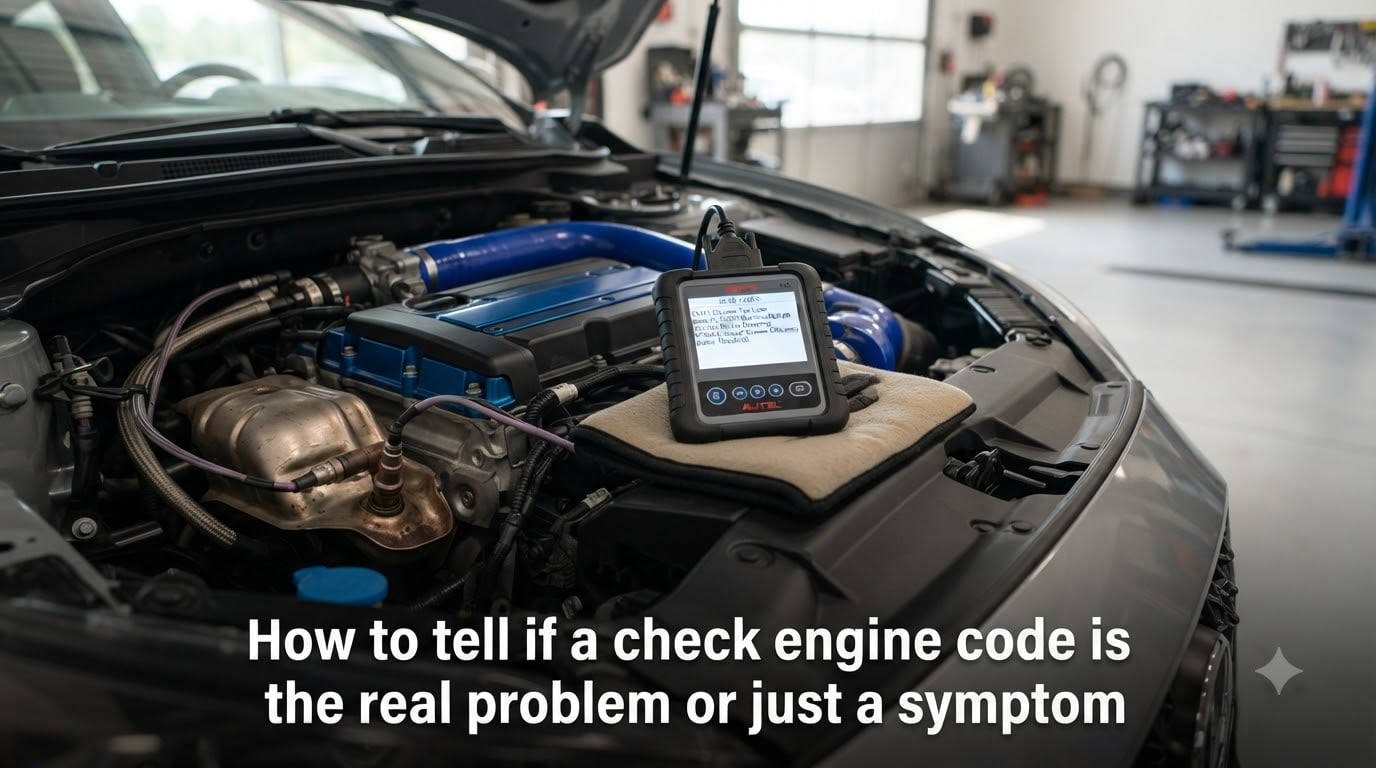
Your check engine light just came on, and you scanned the code. Now you’re staring at something like P0420 or P0171 and wondering: is this the actual problem, or just a symptom of something bigger? I’ve been there, and the honest answer is that OBD-II codes almost always point to a symptom, not the root cause.
Our team has spent years diagnosing vehicles, and we can tell you that misreading a diagnostic trouble code is one of the most expensive mistakes a car owner can make. Replacing the wrong part based on a code alone can cost hundreds of dollars and leave the real issue untouched. In this guide, we’ll show you exactly how to tell if a check engine code is the real problem or just a symptom, so you can avoid wasted repairs and keep your car running right.
Table of Contents
How the OBD-II System Works and Why Codes Are Not Diagnoses?
An OBD-II check engine code is a five-character diagnostic trouble code that tells you a sensor reading has fallen outside the engine control unit’s acceptable range. It does not tell you which part to replace. This is the single most important thing to understand about the codes that pop up when you scan your car.
Modern vehicles run on a network of sensors that constantly feed data to the engine control unit (ECU). The ECU watches everything from oxygen levels in your exhaust to the position of your throttle. When a reading crosses a programmed threshold, the ECU stores a code and, in most cases, turns on the check engine light.
What Sensors Actually Detect
Sensors do not diagnose problems. They measure physical conditions like voltage, temperature, pressure, and gas concentration. The oxygen sensor, for example, simply reports how much oxygen is in the exhaust stream. It cannot tell you whether the catalytic converter is failing, whether the engine is burning oil, or whether you’ve got a vacuum leak downstream.
The Role of the Engine Control Unit (ECU)
The ECU uses preset algorithms to compare sensor readings against expected values. If the numbers drift too far from normal, it triggers a code. The threshold itself is calibrated by the manufacturer to catch emissions-related issues, which is why even a loose gas cap can turn on your check engine light.
I tested this principle on my own 2012 Tacoma. A P0420 code pointed to catalytic converter efficiency below threshold. The actual cause was an exhaust leak before the catalytic converter, which skewed the oxygen sensor readings and made the cat look bad. Replacing the cat would have wasted $1,200. A $40 gasket fix solved everything.
Primary Codes vs Cascading Codes: Spotting the Real Problem
A primary code points to the actual component failure. A cascading code is triggered as a downstream effect of that failure. Most car owners see multiple codes and assume they have multiple problems. In our experience, that’s rarely the case.
When one sensor fails or drifts out of spec, it changes the conditions for everything downstream. The ECU sees those changed conditions as new problems and stores new codes. You end up with a chain of related codes that all trace back to a single root cause.
How a Single Failure Creates Multiple Codes
Imagine your mass airflow sensor starts reporting low airflow. The ECU compensates by adjusting fuel trim. The new air-fuel ratio is too lean for the catalytic converter to operate efficiently. Now you have a mass airflow code, a fuel trim code, and a catalytic converter efficiency code. Three codes, one problem.
Common Cascading Code Examples
Here are the cascading code chains our team sees most often in the shop:
Bad oxygen sensor triggers catalytic converter efficiency codes (P0420, P0430)
Failing ignition coil causes misfire codes (P0300-P0308) plus catalytic converter codes
Vacuum leak triggers fuel trim codes (P0171, P0174) and sometimes misfire codes
Stuck thermostat triggers coolant temperature codes plus fuel trim codes
Dirty throttle body triggers throttle position codes plus idle air control codes
The mechanic community on Reddit agrees on this point. Codes are data points, not answers. You have to look at what triggered the chain and fix that first.
Flashing vs Solid Check Engine Light: Severity Differences
The way your check engine light behaves tells you a lot about whether you’re dealing with a real problem or a passing symptom. A flashing check engine light almost always means an active engine misfire is happening right now. A solid check engine light usually means a stored fault that may or may not be active.
What a Flashing Light Means
A flashing check engine light indicates an active misfire severe enough to potentially damage your catalytic converter. Unburned fuel is passing through the exhaust and can overheat the cat in minutes. When the light flashes, you should reduce power immediately and get to a mechanic as soon as possible. Continuing to drive can cause thousands of dollars in catalytic converter damage.
What a Solid Light Means
A solid check engine light means the ECU has stored a fault but the condition may not be ongoing. Common causes include a loose gas cap, a one-time sensor reading anomaly, or a borderline emissions issue. Solid lights are usually safe to drive with for a short time while you diagnose.
I’ve driven hundreds of miles with a solid check engine light while tracking down the cause. I’ve never done that with a flashing light, and I never recommend it.
Pending vs Confirmed Codes: What the Difference Means for You
Modern OBD-II systems use two code states: pending and confirmed. A pending code means the ECU has detected an issue once but hasn’t seen it repeat enough times to confirm it. A confirmed code means the issue has repeated across multiple drive cycles and is stored as a hard fault.
Pending codes are early warnings. They tell you something is starting to drift out of spec but hasn’t failed yet. A confirmed code tells you the ECU is confident the problem exists. If you only see a pending code, the issue may resolve on its own or may not yet require repair.
This is why clearing codes without fixing the underlying issue often results in the light coming back. The ECU will re-run its checks, see the same problem, and store the code again.
How to Read Freeze Frame Data for Better Diagnosis
Freeze frame data is one of the most underused diagnostic tools available to car owners. When the ECU stores a code, it also captures a snapshot of engine conditions at that exact moment. This snapshot is called freeze frame data.
What Freeze Frame Captures
Freeze frame data typically includes engine RPM, vehicle speed, engine load, coolant temperature, fuel trim values, short-term and long-term fuel trims, and throttle position. Together, these numbers give you a picture of what the engine was doing when the code triggered.
A code stored at idle with a warm engine tells a different story than the same code stored at wide-open throttle on a cold morning. The freeze frame helps you reproduce the conditions and understand when the issue occurs.
Using Freeze Frame to Identify Root Cause
Here’s how our team uses freeze frame data in real diagnosis. If a fuel trim code is stored with high engine load and low RPM, you’re likely looking at a vacuum leak or fuel pressure issue under specific conditions. If the same code is stored at idle with normal load, you’re probably dealing with a stuck idle air control valve or dirty throttle body.
Freeze frame data cuts diagnosis time dramatically. It is the difference between guessing which part to replace and knowing what conditions to test under.
Common Code Patterns That Indicate Root Cause vs Symptom
Pattern recognition is the fastest way to tell if a check engine code is the real problem or just a symptom. Certain code combinations almost always point to the same root cause. Once you recognize the pattern, you can skip the trial-and-error approach that wastes time and money.
Oxygen Sensor and Catalytic Converter Codes
If you see both upstream and downstream oxygen sensor codes along with a catalytic converter efficiency code (P0420 or P0430), the root cause is almost always the upstream oxygen sensor. A failing upstream sensor sends bad data to the ECU, which then miscalculates fuel trim and makes the catalytic converter look inefficient.
Replace the upstream oxygen sensor first, clear the codes, and see if the catalytic converter code returns. In our experience, this resolves the issue about 70% of time without ever touching the catalytic converter.
Mass Airflow and Misfire Codes
A mass airflow sensor code (P0101, P0102) combined with random misfire codes (P0300) usually points to a dirty or failing mass airflow sensor. The sensor reports incorrect airflow, the ECU adjusts fuel delivery, and the engine misfires as a result. Cleaning the mass airflow sensor with electronics-safe cleaner often solves both codes.
The pattern to remember is this: if you see a sensor code alongside an engine performance code, the sensor is almost always the root cause. The performance code is the symptom.
Step-by-Step Approach to Diagnosing Check Engine Codes
Our team uses a consistent diagnostic approach that any car owner can follow. The goal is to identify the root cause before spending money on parts.
Step 1: Read All Codes, Not Just Active Ones
Use an OBD-II scanner to read both active and stored codes. Many cheap code readers only show active codes, which hides the full picture. Look at every code the ECU has stored, including pending codes. The full list tells the story.
Step 2: Identify the Common Thread
Look at the codes and ask: what single component failure could cause all of these? If you see codes that all relate to fuel delivery, the problem is in the fuel system. If codes all relate to exhaust aftertreatment, the problem is upstream of the catalytic converter.
Step 3: Inspect Before Replacing
Many check engine codes trace back to simple issues like loose connectors, damaged wiring, vacuum leaks, or contaminated sensors. Inspect related components physically before buying replacement parts. A $5 vacuum hose can cause a $500 repair recommendation if you trust the code without checking.
Step 4: Clear Codes and Verify
Once you’ve made a repair, clear the codes and drive the vehicle under conditions similar to the original freeze frame data. If the code returns, you’ve got the wrong root cause. If it stays away, you’ve solved the real problem.
When to DIY vs When to See a Professional Mechanic
Some check engine code issues are perfect for DIY diagnosis. Others require professional tools and training. Here’s how our team decides.
Simple codes related to gas caps, basic sensor replacements, and visible issues like vacuum leaks are good DIY projects if you have basic tools and a safe place to work. Codes that involve intermittent electrical faults, internal engine timing, or transmission issues are best left to professionals with advanced scan tools.
A good rule of thumb: if the same code keeps returning after you’ve cleared it, the problem is beyond basic DIY territory. Persistent intermittent codes require professional-grade diagnostic equipment that can capture live data streams and perform bidirectional controls.
Don’t be afraid to ask a mechanic to show you the freeze frame data and explain their diagnosis before approving any work. A trustworthy shop will walk you through what they found. If they can’t explain why a part needs replacement beyond “the code said so,” find another shop.
Frequently Asked Questions
Why is my check engine light on if nothing seems wrong?
Your check engine light can come on even when the car drives normally because OBD-II codes respond to sensor readings, not how the car feels. Common reasons include a loose gas cap, a borderline sensor reading, or a recent fuel fill-up that triggered an evaporative emissions code. The ECU is alerting you to a parameter out of range, which often does not affect drivability but still requires attention.
What can be mistaken for a bad engine?
Several conditions mimic serious engine problems but are actually minor issues. A failing mass airflow sensor can cause rough idle and hesitation that feels like engine failure but is fixed with a $30 sensor. Vacuum leaks cause poor acceleration and stalling. Dirty throttle bodies trigger limp mode. Worn spark plugs cause misfires that feel catastrophic but are simple to repair. Always check the simple things first.
What are the top 5 signs of engine trouble?
The top signs of real engine trouble include: 1) Flashing check engine light indicating active misfire, 2) Knocking or pinging sounds from the engine bay, 3) White or blue exhaust smoke, 4) Sudden loss of power combined with the check engine light, and 5) Burning smell or visible smoke from under the hood. Any of these require immediate attention to prevent costly damage.
What is the most common code for check engine light?
The most common check engine code is P0420, which indicates catalytic converter efficiency below threshold. However, P0420 is often a symptom rather than the root cause. A failing upstream oxygen sensor, exhaust leak before the catalytic converter, or engine misfire can all trigger P0420. Always diagnose the cause of the code before replacing the catalytic converter.
Can a car have codes without the check engine light on?
Yes, a car can store codes without illuminating the check engine light. Pending codes are stored when the ECU detects an issue once but hasn’t confirmed it across multiple drive cycles. These pending codes are visible with an OBD-II scanner but don’t trigger the warning light yet. They serve as early warnings that something is starting to drift out of specification.
Final Thoughts on Identifying Real Problems vs Symptoms
Learning how to tell if a check engine code is the real problem or just a symptom comes down to understanding what codes actually represent. They are data points from sensors, not diagnoses from your mechanic. The real diagnosis requires looking at the pattern, understanding cascading failures, and inspecting the actual components.
Our team has seen countless car owners replace catalytic converters, oxygen sensors, and mass airflow sensors that didn’t need replacement. The real problem was always upstream, hidden behind a chain of related codes. Take the time to read all your codes, check the freeze frame data, and identify the common thread before approving any major repair.
Your wallet will thank you. So will your car.