
I still remember the first time a transmission taught me a lesson. I was merging onto the highway in my old pickup, and as the truck shifted from second to third, the engine roared like I had stomped the gas. The RPMs climbed, hung for a beat, then snapped into gear with a jolt. I had no idea if that was a shift flare, a slipping transmission, or just a “characteristic” I was supposed to ignore.
If you have ever pressed the gas and felt your automatic transmission hesitate, surge, or slam between gears, you have already asked the same question I did: what is happening, and is it serious? This guide walks through how to diagnose automatic transmission shift flare or harsh shifting using real-world checks you can do yourself, with insights pulled from forums, service bulletins, and what our team has seen in the shop.
We will cover the difference between shift flare, harsh shifting, and transmission slipping, list the most common causes, walk through a step-by-step diagnostic process, and show you which check engine light codes point to which problems. By the end, you should know whether your issue is a quick fix, an adaptive reset, or a sign to head straight to a transmission specialist.
Table of Contents
What Is Shift Flare?
A shift flare is a momentary RPM spike during a gear change where the engine revs higher than expected before the next gear fully engages. It feels like a brief loss of power followed by a soft “slipping” sensation, even though the transmission is not actually wearing out the clutches yet. The engine sounds like it is revving freely for one to two seconds while the transmission catches up.
Shift flare most commonly shows up during upshifts between second and third, third and fourth, or fourth and fifth gears. It happens when the transmission cannot build enough hydraulic pressure fast enough to clamp the next clutch pack. The unloaded RPM climbs briefly, the next gear engages, and the revs fall back down. Drivers often describe it as the transmission “slipping into gear” or “searching for the right gear.”
According to forum users on r/MechanicAdvice and Powerstroke.org, the 4L60E transmission in GM trucks and the Aisin Warner gearboxes in Volvo XC70s are notorious for showing upshift flare between second and third as an early warning sign. The flare can come and go with temperature, which makes it frustrating to diagnose at a shop on a short test drive.
What Is Harsh Shifting?
Harsh shifting is when the transmission engages the next gear with a sudden, hard jolt instead of a smooth handoff. Instead of the engine revving up like in a flare, the RPMs barely move and you feel a thump, clunk, or bang through the seat. It can feel like someone tapped the brakes while you pressed the gas.
Harsh shifting is different from shift flare because the gears do engage, and they engage fast. The problem is that the clutch packs grab too quickly or with too much pressure. Drivers often describe it as the transmission “slamming” or “kicking” between gears. Harsh shifting is most common during light-throttle upshifts at low speeds, especially the 1-2 and 2-3 changes.
Our team has seen this in plenty of Ford, GM, and Chrysler products after a fluid change, a battery disconnect, or a software update. The Transmission Control Module (TCM) sometimes forgets its adaptive learning and uses default shift pressures that are too aggressive until it relearns your driving style. In those cases, the harshness usually goes away within 50 to 100 miles of normal driving.
What Is Transmission Slipping?
Transmission slipping is a sustained loss of power transfer where the engine RPM climbs but the vehicle speed does not increase proportionally. Unlike a flare, slipping does not resolve itself in a second or two. It feels like driving in neutral while the engine revs, and it can happen at any speed or throttle position.
Slipping is the most serious of the three conditions because it means clutch material is worn, hydraulic pressure is critically low, or a major internal component has failed. If you feel the engine revving high while the car barely accelerates, or if you hear a whining or buzzing noise that changes with vehicle speed, you are looking at a slipping transmission. Continued driving will destroy the clutch packs and turn a repairable problem into a full rebuild.
Forum members on ls1tech.com and g8board.com have shared stories of ignoring a brief flare for months, only to end up with a slipping transmission that needed a $3,000+ rebuild. The pattern is consistent: flare first, then harshness as compensation, then slipping as the final failure.
Shift Flare vs Harsh Shifting vs Slipping: Comparison Table
Here is a quick side-by-side comparison so you can place your symptom before going deeper into the diagnosis. The columns describe what each condition feels like, the most common cause category, and how serious the issue typically is.
| Condition | What It Feels Like | Most Common Cause | Severity |
|---|---|---|---|
| Shift Flare | RPM climbs briefly (1-2 seconds) between gears, then settles | Slow clutch apply due to worn seals, weak solenoid, or low line pressure | Moderate – early warning sign |
| Harsh Shifting | Hard jolt or thump when gear engages, little RPM change | High line pressure, failed pressure solenoid, or worn engine mounts | Moderate to high – depends on cause |
| Transmission Slipping | Engine revs high but vehicle does not accelerate; sustained power loss | Worn clutch packs, contaminated fluid, or torque converter failure | High – repair soon |
Common Causes of Shift Flare
Shift flare has a handful of repeating culprits across most makes and models. Understanding them helps you point your diagnostic steps in the right direction.
- Worn clutch packs. As friction material wears, the clearance inside the drum increases and the clutch takes longer to apply. This is the classic cause of 2-3 shift flare in the GM 4L60E, where the 3-4 clutch pack is a known wear item past 100,000 miles.
- Faulty shift solenoids. Solenoids control fluid flow to the clutch packs. If a shift solenoid is sticking or weak, the hydraulic command arrives late and the gear change is delayed, producing a flare.
- Valve body wear. The valve body routes fluid to the right circuits at the right time. Worn bores or stuck valves cause pressure leaks that delay the next apply. Many transmissions from the late 1990s and early 2000s have valve body updates from the manufacturer to address this.
- Low line pressure. Line pressure is the main supply of hydraulic force. A weak pressure regulator, a failing pump, or a leak at the seals can drop line pressure below spec, producing flare and eventually slipping.
- Degraded or contaminated fluid. Old fluid loses viscosity and breaks down. Debris in the fluid can clog small solenoid orifices and slow the apply. A burnt smell or dark brown color is a red flag.
Common Causes of Harsh Shifting
Harsh shifting has its own list of usual suspects, and several overlap with the flare causes. The key difference is that harsh shifting usually points to too much pressure or too fast an apply, not too little.
- Failed pressure control solenoid. The pressure control solenoid regulates line pressure. When it sticks open, line pressure runs high and every shift feels like a kick. This is one of the most common harsh-shift causes on Ford and Chrysler products.
- Dirty or wrong fluid. The wrong fluid type or extremely dirty fluid can change shift feel overnight. We have seen harsh shifts appear within 20 miles of a botched fluid change.
- Adaptive learning reset. Disconnecting the battery, a reflash, or a new TCM can wipe the adaptive memory. Default pressures are firmer until the TCM relearns your driving style.
- Cold fluid behavior. When transmission fluid is cold, it is thicker and hydraulic response is sluggish. Many cars shift firmly on the first 5-10 minutes of driving until the fluid warms up. This is normal but can feel harsh.
- Worn engine or transmission mounts. A broken mount lets the powertrain move under torque, which feels like a harsh shift even when the transmission is healthy. Always check mounts before condemning the transmission.
Step-by-Step Diagnosis: How to Diagnose Automatic Transmission Shift Flare or Harsh Shifting
Here is the diagnostic procedure our team uses when a customer brings in a vehicle with rough shifting complaints. These same steps work for a home mechanic with basic tools and a $30 OBD2 scanner.
Step 1: Check Transmission Fluid Level and Condition
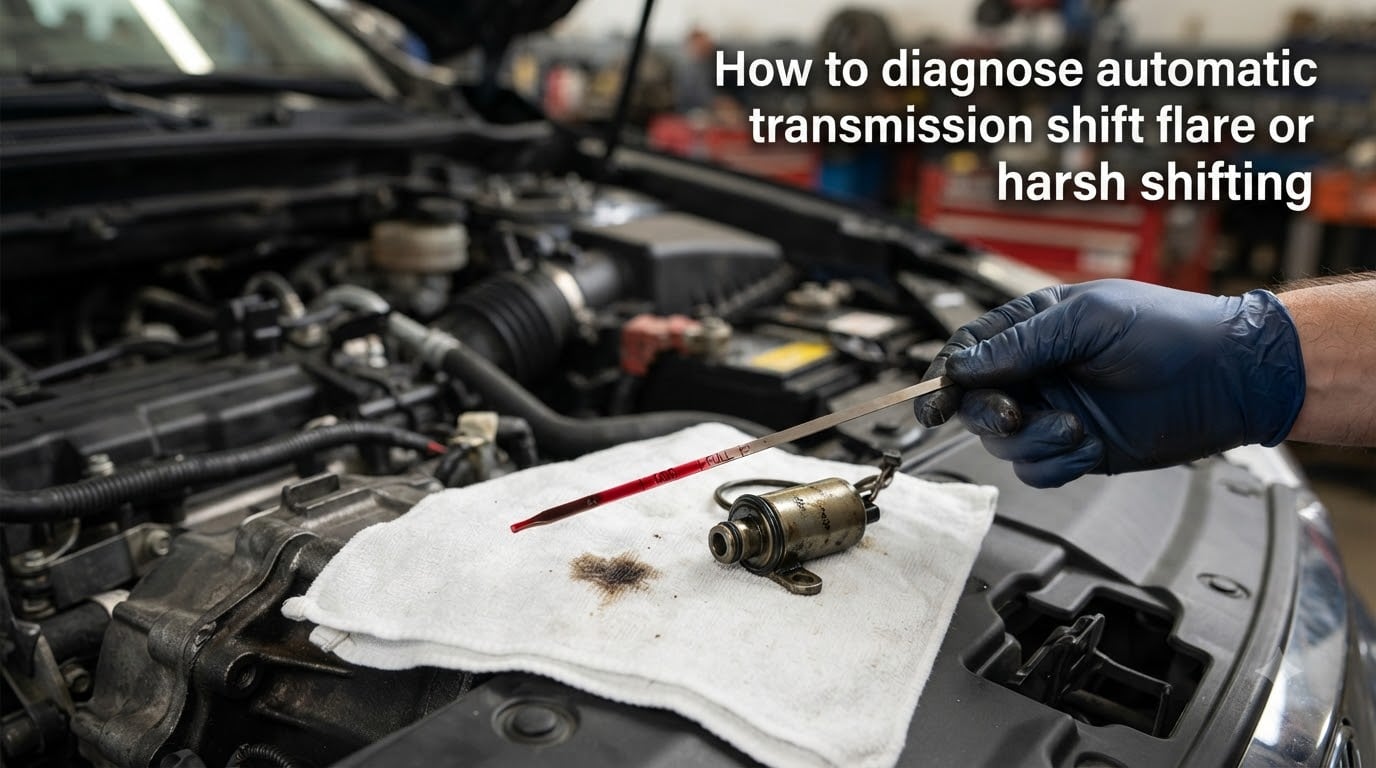
Start with the easiest check first. With the engine idling in Park on a level surface, pull the transmission dipstick and check the level on the hot mark. Low fluid causes both flare and slipping because the pump cannot maintain line pressure. Overfull fluid causes foaming and aerated pressure, which also produces harsh shifts.
Look at the color and smell. Healthy fluid is red or pink and smells like syrup. Burnt fluid is dark brown or black and smells like charcoal. Metal particles on the dipstick or a sticky black coating mean internal damage and warrant a professional inspection.
Step 2: Scan for Diagnostic Trouble Codes (DTCs)
Plug an OBD2 scanner into the port under the dash and pull codes from both the engine and transmission modules. Even if the check engine light is off, the TCM often stores pending codes that point to the right system. Write down every code and look up its description. Specific DTCs related to shift flare and harsh shifting are covered in the next section.
Step 3: Perform a Structured Road Test
A road test lets you reproduce the problem under controlled conditions. Drive in each gear manually if possible, paying attention to which shifts flare or slam and under what load. Note whether the issue happens cold, warm, at light throttle, or at full throttle. A pattern tells you a lot: cold-only usually means fluid viscosity, warm-only usually means wear, and light-throttle-only usually points to line pressure.
Step 4: Compare Cold Start vs Warm Driving Behavior
Most shift flare and harshness problems behave differently depending on fluid temperature. On a cold morning, drive the car for 10 minutes and note every rough shift. Then drive the same route after the gauge reads normal operating temperature. If the issue disappears when warm, you are looking at a fluid or viscosity problem. If it only shows up warm, internal wear is more likely.
Step 5: Inspect External Components
Before opening the transmission, check the easy stuff outside the case. Inspect engine and transmission mounts for cracks or collapsed rubber. Inspect the wiring harness to the transmission for chafed wires or corroded connectors. Check the vacuum line to the pressure regulator on older vehicles. Many harsh-shift complaints turn out to be a $40 mount or a $10 connector.
Transmission Diagnostic Trouble Codes to Know
If your scanner returns any of the codes below, write them down and look up the freeze-frame data. Freeze-frame data records the conditions when the code set, which helps confirm whether the code relates to your shift complaint.
- P0700 – Transmission Control System Malfunction. This is a generic code telling you the TCM has set another code. Always look for a sub-code from the TCM to get the real story.
- P0715 – Input/Turbine Speed Sensor Circuit Malfunction. A bad input speed sensor confuses the TCM about what gear the transmission is actually in, often producing flare between gears.
- P0750 – Shift Solenoid A Circuit Malfunction. Points to a sticking or failed shift solenoid, which is one of the top three causes of shift flare.
- P0753 – Shift Solenoid A Electrical. This usually means a wiring issue or a solenoid that has shorted internally. Common after 100,000 miles.
- P0962 – Pressure Control Solenoid A Control Circuit Low. The pressure control solenoid regulates line pressure. A fault here is a classic cause of harsh shifting.
- P0741 – Torque Converter Clutch Circuit Performance or Stuck Off. If the lockup clutch is not applying or releasing correctly, you can feel flare or harshness at cruising speeds.
Most cheap OBD2 scanners only read engine codes. For transmission codes, you need a scanner that supports enhanced or manufacturer-specific diagnostics. The BlueDriver and FIXD are popular affordable options, while professional shops use Snap-on or Autel tools that read every module on the vehicle.
Cold Start vs Warm Driving: Why Temperature Matters
One of the most common forum questions is why a transmission shifts fine when warm but feels rough right after a cold start. The short answer is fluid viscosity. Cold transmission fluid is thicker, hydraulic response is slower, and pressure builds up faster in the apply circuits. The result is firmer shifts for the first 5 to 15 minutes of driving.
Some harshness on a cold start is normal, especially in cold climates or after the car has sat overnight. If the harshness is mild and clears up once the temperature gauge sits at its normal position, you are probably looking at healthy behavior. If the harshness stays the same or gets worse as the car warms up, internal wear or pressure issues are more likely.
Conversely, if a transmission shifts perfectly when cold and only flares or slips when hot, you are looking at a different problem. Heat-thinned fluid cannot maintain line pressure, so worn seals or a weak pump will only show their weakness once the fluid thins out at operating temperature. This is one of the most common heat-related transmission failures.
When to Seek Professional Help
Some problems you can handle at home, but others need a transmission specialist. Here are the warning signs that mean it is time to stop driving and book an appointment.
- Metal particles or silver glitter in the fluid or on the dipstick. This means internal clutch or planetary gear wear is happening right now. Continued driving will destroy the transmission within miles.
- Visible fluid leak under the car. A transmission that is running low on fluid cannot cool or lubricate itself. Even small drips add up over time.
- Burning smell from under the hood. Hot, burnt fluid is a sign of internal slippage and overheating. The transmission will fail soon if the smell persists.
- Check engine light plus a transmission code. A code from the TCM is the TCM telling you it cannot keep up with the problem. Do not ignore it.
- Vehicle will not move or moves only in one gear. This is a mechanical failure. Tow the vehicle to a shop rather than driving it.
When you take the vehicle to a shop, ask for a transmission fluid analysis and a pressure test. A pressure test connects gauges to test ports on the transmission case and measures line pressure in each gear. Pressure that is below spec in any gear points to a worn pump, leaking seals, or a failed pressure regulator. Most shops charge between $100 and $200 for a proper diagnostic, which is far cheaper than guessing and replacing the wrong part.
Frequently Asked Questions
What does a transmission flare feel like?
A transmission flare feels like a brief loss of power between gears. The engine RPMs climb for one to two seconds during an upshift, then settle back down once the next gear engages. It is often described as the transmission slipping momentarily, but the difference is that a flare resolves on its own while true slipping continues.
What causes shift flare in a 4L60E?
The most common cause of shift flare in a GM 4L60E, especially between second and third gear, is a worn 3-4 clutch pack. Other causes include weak shift solenoids, valve body wear, and degraded transmission fluid. Above 100,000 miles, the 3-4 clutch is the first component to show wear.
Can I drive with harsh shifting?
You can drive with mild harsh shifting for a short time, but it is not a good idea to ignore it. Harsh shifting often progresses into slipping, and continued driving accelerates wear on the clutch packs and bands. If the harshness is severe or sudden, have the vehicle inspected soon.
Why does my transmission shift hard only when cold?
Cold transmission fluid is thicker and creates higher hydraulic pressure at idle. This makes shifts feel firmer for the first 5 to 15 minutes of driving. Mild cold harshness is normal, especially in winter. If the harshness stays the same or worsens once the fluid warms up, internal wear or a pressure issue is more likely.
Can a fluid change fix shift flare?
A fluid and filter change can fix shift flare when the cause is old, contaminated, or low fluid. If the flare is caused by worn clutch packs or a failing solenoid, a fluid change will not solve it. In some cases, the wrong fluid type can even make shifting worse, so always use the manufacturer-specified fluid.
How do I know if my transmission is slipping or just shifting hard?
If the engine RPM climbs but the vehicle does not accelerate, you are slipping. If the gears engage with a hard jolt but the RPMs stay where they should, you are just shifting hard. Slipping is a sustained problem that worsens with throttle, while harsh shifting is a brief jolt at the moment of gear change.
Final Thoughts on Diagnosing Automatic Transmission Shift Flare or Harsh Shifting
Diagnosing automatic transmission shift flare or harsh shifting comes down to three things: understanding which condition you have, identifying whether it is temperature-dependent, and pulling codes before throwing parts at the problem. Start with a fluid check, scan for DTCs, perform a structured road test, and rule out the easy stuff like mounts and connectors before assuming the transmission itself is worn out.
If your test drive points to internal wear or if the scanner returns transmission-specific codes, take the vehicle to a shop that offers a pressure test and a fluid analysis. Spending a small amount on a proper diagnosis almost always saves money compared with guessing. And if your transmission is slipping, do not keep driving it – a flare that turns into slipping is how $200 problems become $3,000 problems.