
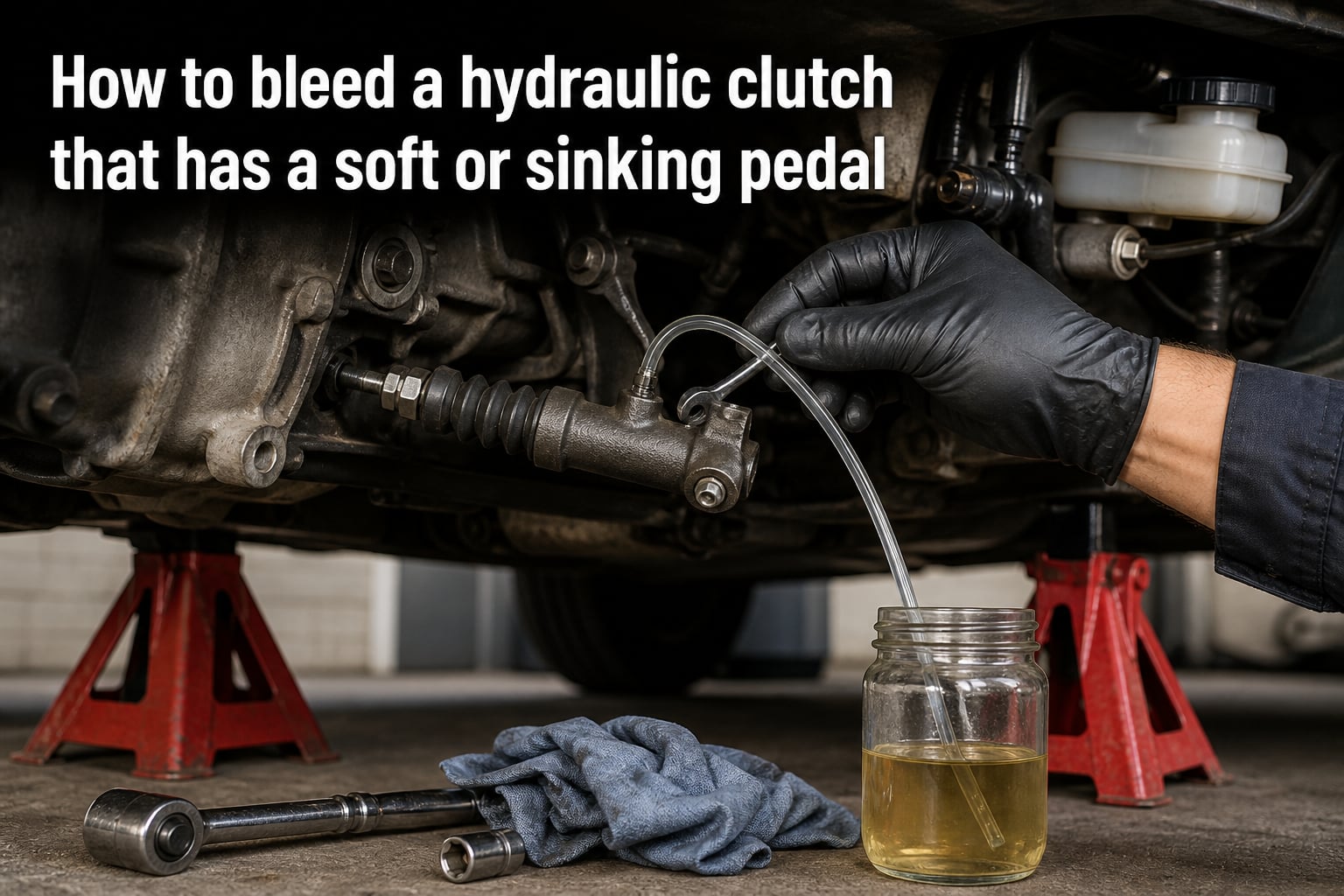
A soft or sinking clutch pedal means air has crept into your hydraulic system, and fluid alone cannot save you. The fix is bleeding, but anyone who has spent a weekend pumping the pedal only to watch the bleeder drip air bubbles for hours knows the standard method does not always work.
Our team has bled clutches on everything from classic British roadsters to modern daily drivers, and we have seen the same frustrating pattern. You bleed the system, the pedal feels firm for a day, and then it goes soft again. The reason is almost always that air is trapped at the highest point in the system, and the bleeder valve is not where the air wants to leave.
This guide shows you how to bleed a hydraulic clutch using four different methods, including a positioning trick that the Austin-Healey community figured out decades ago and that solves the stubborn cases the standard method cannot fix. By the end, you will know exactly how to bleed a hydraulic clutch and how to make the pedal stay firm.
Table of Contents
Why Your Clutch Pedal Goes Soft: How Air Gets Into the Hydraulic System?
A hydraulic clutch works because fluid does not compress. When you press the pedal, the master cylinder pushes fluid through the line to the slave cylinder, which moves the throwout fork. The whole system depends on a solid column of fluid with no gaps.
Air compresses easily, so even a small bubble acts like a spring in the line. That is what your foot feels as a soft, spongy, or sinking pedal. The master cylinder pushes the pedal, but the air absorbs some of the force before it reaches the slave cylinder.
Air enters the system in a few common ways. The fluid level dropped low enough that the master cylinder drew in air during normal operation. A seal in the master cylinder or slave cylinder started leaking, and the low spot pulled in air on the return stroke. Or you recently replaced a component and introduced air during the swap.
The tricky part is that air does not stay where you put it. Bubbles travel to the highest point in the hydraulic line, and on most vehicles, that high point is somewhere along the steel hard line between the master and slave cylinders. If your bleeder valve is on the slave cylinder at a lower position, you can pump fluid all day and the air pocket will just sit there, unmoved.
Symptoms that confirm air in the system
The pedal feels spongy and you can press it further than normal before the clutch disengages. The pedal sinks to the floor on long drives and slowly returns. Holding the pedal to the floor for 30 seconds makes it creep lower. Shifting becomes difficult, especially into first and reverse.
Tools and Supplies You Need to Bleed a Hydraulic Clutch
Before you start, gather everything so you are not running back and forth with a wet bleeder open. Here is the checklist.
Fresh DOT 3 or DOT 4 brake fluid (check your owner’s manual for the spec, and never mix DOT 5 silicone with DOT 3 or 4)
Box-end wrench or line wrench sized to your bleeder screw (usually 8mm, 9mm, or 10mm)
Clear plastic hose that fits snugly over the bleeder valve (fuel line or aquarium tubing works)
Clean glass or plastic jar to catch the old fluid
Shop rags and a bucket of water for spills
Jack and jack stands if you need to access the slave cylinder from below
For one-person jobs, add a speed bleeder (1/4-20 thread is the most common size for import vehicles) or a vacuum pump like a Mity-Vac. For the positioning trick later in this guide, you may also need a small zip tie and a helper to hold the slave cylinder at the right angle.
Which brake fluid should you use
Most hydraulic clutches use DOT 3 or DOT 4 glycol-based brake fluid. DOT 3 is cheaper and works fine for most daily drivers. DOT 4 has a higher boiling point and is better if you drive hard, tow, or live in a hot climate. DOT 5.1 is the high-performance version that some European cars require.
Never use DOT 5 silicone fluid in a system that originally used DOT 3 or 4. The seal materials are different and silicone fluid will cause seal swelling or hardening, depending on the rubber compound. Check your master cylinder reservoir cap for the specification.
Should the reservoir cap be on or off during bleeding
The cap comes off so you can monitor fluid level and top off as needed. Leaving the cap on can build a vacuum and starve the master cylinder of fluid, which pulls more air into the system. Keep the cap off and the reservoir topped up to the max line throughout the bleed.
How to Bleed a Hydraulic Clutch: Standard Two-Person Method?
This is the method most automotive guides start with, and it works on most vehicles the first time. You will need a helper inside the car to operate the pedal.
Locate the bleeder valve on the slave cylinder. It looks like a small bolt with a hole through the center, usually on the side or top of the slave cylinder body near the transmission bellhousing.
Fit the clear hose over the bleeder and put the other end in your catch jar with enough fluid in the jar to submerge the hose end. This prevents air from being sucked back into the system.
Top off the master cylinder reservoir with fresh fluid. Make sure it is full before you start.
Have your helper press the clutch pedal to the floor and hold it there. Do not let them pump it.
Open the bleeder valve about half a turn. Old fluid and air bubbles will flow out through the hose. Close the bleeder before your helper releases the pedal.
Have your helper slowly release the pedal. Repeat steps 4 and 5 until no more air bubbles come out and only clean fluid flows.
Check the master cylinder reservoir between every cycle. If it runs dry, you will pull more air into the system and start over.
When the fluid runs clear with no bubbles, close the bleeder firmly, remove the hose, top off the reservoir to the max line, and replace the cap.
This method works because pressing the pedal forces pressurized fluid through the system and out the bleeder, carrying air with it. The pause with the bleeder closed allows the master cylinder to draw fresh fluid from the reservoir without introducing air.
How do you know when bleeding is complete
You will see solid fluid with no bubbles in the clear hose. The pedal will feel firm and consistent at the same height every time you press it. The clutch will disengage crisply with the pedal at roughly the same position it was when the system was healthy.
The Slave Cylinder Positioning Trick That Solves a Stubborn Soft Pedal
If you have done three bleeding sessions and the pedal still goes soft within a day, the air is trapped at the highest point in the system, and your bleeder valve is not at the highest point. This is shockingly common on vehicles where the slave cylinder is mounted below the hydraulic line.
The fix comes from the Austin-Healey community. The key insight is that you need to physically position the slave cylinder so the bleeder valve is at the highest point of the slave cylinder body. On most vehicles, that means unbolting the slave cylinder from the bellhousing, rotating it so the bleeder points straight up, and bleeding it while holding it in that position.
Step-by-step positioning trick
Disconnect the hydraulic line from the slave cylinder but do not let it drip. Have a rag and a plug ready for the line end.
Unbolt the slave cylinder from the bellhousing. On most vehicles, two bolts hold it in place.
Hold the slave cylinder in your hand with the bleeder valve pointing straight up. The inlet port should be lower than the bleeder.
Fill the slave cylinder with fresh fluid through the inlet port until it overflows. Tap the body gently to dislodge any trapped air.
Connect the hydraulic line and hold the slave cylinder in the upright position. Have your helper fill the master cylinder and slowly pump the pedal.
Open the bleeder with fluid flowing out. Close it when no more bubbles appear.
Reinstall the slave cylinder on the bellhousing, then do a standard pedal bleeding session to remove any air introduced during reinstallation.
This works because gravity pulls the air bubble to the bleeder opening. When the bleeder is on the side or bottom of the slave cylinder, the air just sits at the top of the cylinder body, nowhere near the outlet. Tipping the slave cylinder so the bleeder is at the highest point puts the air right where you want it to leave.
When the bleeder is on the wrong port from the factory
On some vehicles, the bleeder valve and the inlet port can be reversed at the factory. The bleeder ends up on the bottom and the inlet on the top. Gravity works against you in this configuration, and no amount of pumping will clear the air. The fix is to swap the fittings or, in some cases, replace the slave cylinder with a correct-parts unit. Check the service manual for your specific vehicle if bleeding by the book does not work.
One-Person Bleeding Methods: Speed Bleeder and Vacuum Pump
You do not always have a helper handy. Two tools make this a solo job: a speed bleeder and a vacuum pump.
Speed bleeder method
A speed bleeder is a replacement bleeder screw with a built-in check valve. When you open it, fluid and air come out. When you close it, the check valve prevents air from being sucked back in. This means you can pump the pedal, open the bleeder, close it, release the pedal, and repeat without a helper holding the pedal down.
For most Japanese and European vehicles, the bleeder thread is 1/4-20. For American vehicles, it is often 3/8-24 or M10x1.0. Confirm your thread size before buying.
To install, remove the original bleeder screw and thread in the speed bleeder. That is the whole conversion. Some people use a small zip tie around the speed bleeder body to absorb vibration and keep it from loosening over time.
Vacuum pump method
A vacuum pump like the Mity-Vac attaches to the bleeder valve and pulls fluid and air out under suction. The trick is to keep the master cylinder reservoir topped up so the pump does not pull air through the master cylinder seals.
This method is faster than the two-person method but can introduce air if the pump sucks faster than fluid can flow. Work slowly and watch the clear hose for steady fluid flow without bubbles.
Gravity Bleeding and Reverse Bleeding: When Standard Methods Fail
For really stubborn systems, two more methods exist. Both work when the standard two-person method fails due to air trapped in high spots.
Gravity bleeding
Gravity bleeding is the simplest method but the slowest. You open the bleeder valve, top off the master cylinder reservoir, and let gravity pull the fluid through the system. Air bubbles will rise and exit the bleeder on their own.
The catch is that it takes hours. You need to check the reservoir every 30 minutes and top it off. Some vehicles take 4 to 8 hours to fully gravity bleed. The benefit is that gravity will find the highest point and push air out, even if the bleeder is not at the highest point of the system.
Reverse bleeding
Reverse bleeding pushes fluid backward through the system, from the slave cylinder toward the master cylinder. You do this by attaching a syringe or hand pump to the bleeder valve and forcing fluid backward through the hydraulic line. This pushes air back up to the reservoir where it can escape through the open cap.
Reverse bleeding is especially useful when the bleeder valve is positioned below the slave cylinder inlet port, because normal bleeding will leave air trapped at the top of the slave. Reverse bleeding pushes that air out the top of the master cylinder reservoir.
Why Your Clutch Pedal Is Still Soft After Bleeding?
If your pedal feels firm for a day and then goes soft, the air is still somewhere in the system. The most common causes are listed below.
The master cylinder has a worn seal
When the master cylinder piston seal wears, it can draw air back into the system on the return stroke. You will see the fluid level drop in the reservoir over a few days, and the pedal will gradually soften. A master cylinder rebuild or replacement is the only fix.
The slave cylinder has a leaking piston seal
Same idea as the master cylinder, but on the slave side. Fluid leaks past the piston seal and air gets pulled in on the next pedal press. Sometimes you can see fluid dripping from the slave cylinder boot, but often the leak is internal and you only see the symptom of a soft pedal.
Air trapped in the master cylinder itself
Air can get trapped inside the master cylinder body, especially if the reservoir was empty or low for a while. Bleeding the slave cylinder does not always remove air from inside the master cylinder. To clear it, you need to bleed the master cylinder first by loosening the outlet line at the master cylinder and letting fluid flow until no bubbles appear, then re-bleed the slave.
The bleeder valve is at the wrong port
As mentioned earlier, some vehicles have the bleeder and inlet ports reversed at the factory or the bleeder is on the bottom of the slave cylinder. Bleeding from the wrong port will leave air in the system no matter how long you pump.
Damaged or stretched hydraulic line
If the metal hard line between the master and slave cylinders has a crack or a loose fitting, it will pull air in. Check the line for damp spots, especially at the fittings and any section that runs close to the exhaust.
Safety Precautions Before You Start Bleeding
Brake fluid is corrosive and toxic, so wear nitrile gloves and safety glasses. It eats through paint in seconds, so cover any painted surfaces with a rag. Keep the catch jar upright so you do not spill used fluid on the ground.
Never reuse the old fluid. Wipe it up with a rag and dispose of it at a parts store or hazardous waste facility. Glycol-based brake fluid absorbs water over time, which is why you should always start with fresh fluid from a sealed container.
Do not bleed the clutch with the engine running unless your specific vehicle requires it. On most vehicles, the engine should be off. Pressing the pedal with the engine running on some hydraulic systems can cause fluid to be pushed back into the reservoir, which is the opposite of what you want.
Frequently Asked Questions
Why is my clutch pedal soft after bleeding?
The most common reason is air trapped at the highest point in the hydraulic line, away from the bleeder valve. A worn master cylinder or slave cylinder seal can also pull air back into the system. Try the slave cylinder positioning trick or check for leaking seals if the pedal goes soft again within a day of bleeding.
How do you get air out of a hydraulic clutch system?
Open the bleeder valve on the slave cylinder and have a helper press the clutch pedal to the floor while you watch for bubbles in the clear hose. Close the bleeder before the pedal is released. Repeat until no more air bubbles come out. Keep the master cylinder reservoir topped up so no new air is drawn in.
How do you force bleed a clutch?
Force bleeding means pushing fluid through the system under pressure stronger than pedal pressure alone. The most common methods are a vacuum pump attached to the bleeder, a pressure bleeder attached to the master cylinder reservoir, or reverse bleeding where fluid is pushed backward from the slave to the master cylinder.
Do you bleed a clutch with the cap on or off?
The cap comes off. You need to monitor the fluid level and top off the reservoir during bleeding. Leaving the cap on can create a vacuum that prevents fluid from flowing properly and pulls more air into the master cylinder.
What is the easiest way to bleed a hydraulic clutch by yourself?
Install a speed bleeder, which is a replacement bleeder screw with a built-in check valve. This lets you pump the pedal, open the bleeder, close it, and release the pedal without a helper. The check valve prevents air from being sucked back in. For most import vehicles, the thread size is 1/4-20.
How do you know if there is air in the hydraulic clutch system?
The pedal feels soft or spongy, sinks to the floor under holding pressure, and shifts become difficult especially into first and reverse. Air bubbles in the clear hose during bleeding confirm the problem. The pedal will feel firm again once all air is removed and the fluid is solid.
Final Thoughts on Getting Your Hydraulic Clutch Pedal Firm Again
Bleeding a hydraulic clutch is one of those repairs that looks easy on paper but trips people up in the real world. The standard two-person method works on most vehicles, but the surprising number of soft-pedal complaints comes from air trapped where the bleeder valve is not, not from a broken procedure.
If your pedal still goes soft after a clean bleed, work through the methods in order. Try the slave cylinder positioning trick. Install a speed bleeder for one-person jobs. Move to gravity or reverse bleeding if those fail. And if the pedal still softens after a few days, replace the master cylinder or slave cylinder rather than bleeding again, because a worn seal will keep pulling air in no matter what you do.
That is how to bleed a hydraulic clutch with a soft or sinking pedal and actually keep it firm. Start with the simplest method, escalate to the positioning trick if you need it, and do not be afraid to replace a worn component if the bleeding keeps coming back.