
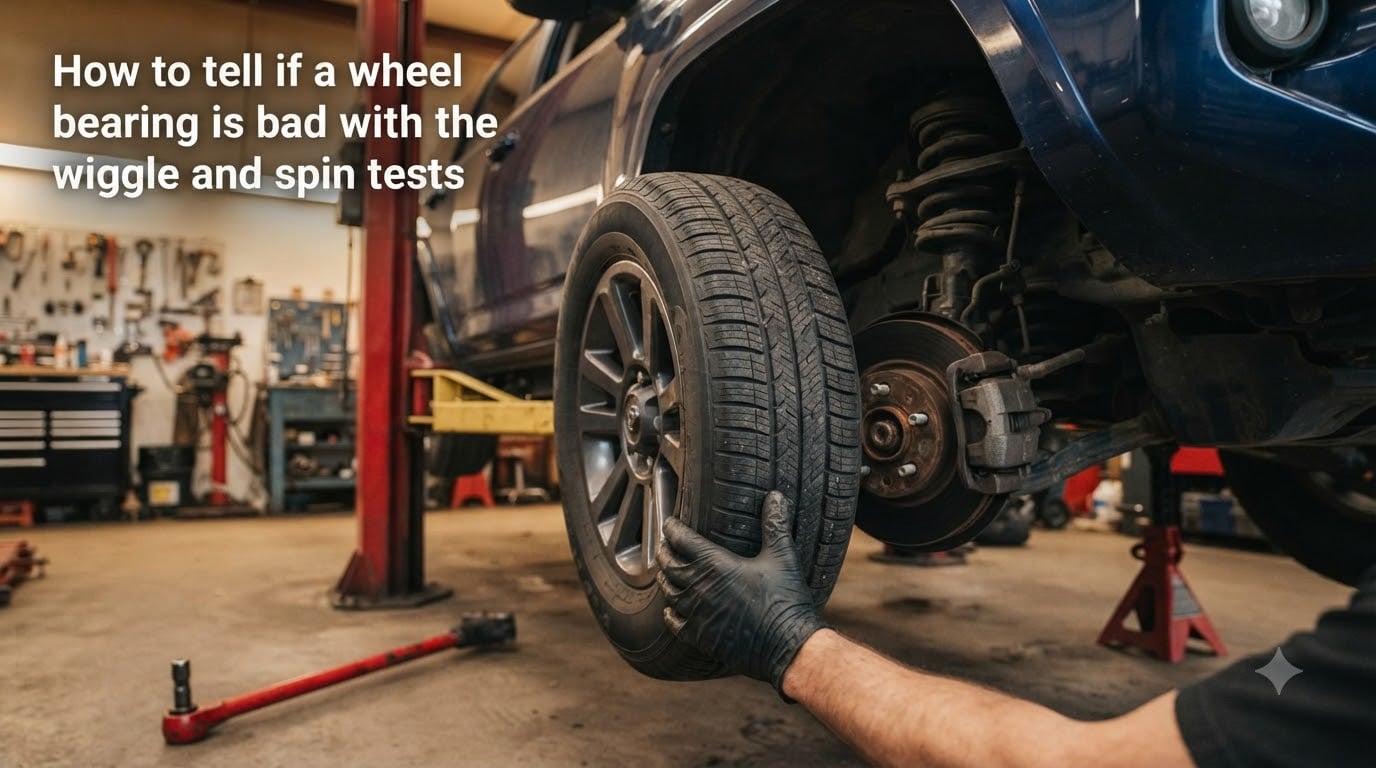
I still remember the first time a wheel bearing failure caught me off guard. I was cruising on the highway when a low hum crept in around 45 mph, and within a week the noise had turned into a growl I could feel through the floorboards. If you want to learn how to tell if a wheel bearing is bad before it strands you on the shoulder, the two oldest tricks in any mechanic’s playbook are the wiggle test and the spin test.
I have used both methods on hundreds of vehicles in our shop over the past decade. This guide walks you through the exact steps I follow, the measurements I trust, and the noise cues that tell me whether the bearing, the ball joint, or something else entirely is to blame. By the end, you will know how to tell if a wheel bearing is bad with confidence, even if you have never touched a wrench.
Table of Contents
What Is a Wheel Bearing and Why Does It Matter?
A wheel bearing is a set of hardened steel balls or rollers held inside a metal ring called a race, sealed inside the hub of each wheel. Its job is to let the wheel spin with almost zero friction while supporting the full weight of your vehicle. Front wheel bearings also handle the steering loads, while rear wheel bearings sit on a fixed axle shaft.
Because the bearing rides under constant load, sealed inside a dust cap, small amounts of wear or contamination eventually add up. A worn bearing lets the hub wobble, the seal leak, or the metal-on-metal contact turn into a growling sound. That is why the wheel bearing is one of the most critical safety components on the car, and why knowing how to tell if a wheel bearing is bad is a skill every driver should have.
The good news is that you do not need a scanner or a lift to find a bad bearing. You need the road, your ears, your hands, and about twenty minutes. Two simple tests, called the wiggle test and the spin test, will give you a definitive answer in nearly every case.
Common Signs of a Bad Wheel Bearing
Before you crawl under the car, listen to the symptoms. I always start a diagnosis by paying attention to what the vehicle is telling me on a normal drive.
Humming or droning noise that rises with speed, often starting around 40 to 60 mph.
Grinding, growling, or rumbling that changes when you turn gently left or right.
A cycling whop-whop or clicking sound that pulses at low speed and gets louder with acceleration.
Steering wheel vibration that you can feel through the rim, especially under light braking.
Loose or wandering steering, with the front end feeling vague on the highway.
Uneven tire wear, often a slight scalloping on the inner or outer edge.
ABS or traction control light on the dash, caused by a damaged encoder ring on the hub.
Grease leaking from the dust cap or a hot smell from one wheel after driving.
Real mechanics on forums like r/MechanicAdvice repeatedly point out that bad bearings rumble rather than squeal, and the rumble gets louder or softer as load shifts from one side to the other. If you notice that pattern, the bearing is the first place I would check.
What You’ll Need Before Testing?
Gather a few basic items before you start. None of this is specialty gear.
A jack rated for your vehicle weight and four jack stands, never just a jack.
Wheel chocks and a flat, level surface such as a driveway or shop floor.
Gloves, safety glasses, and closed-toe shoes.
A 12 to 24 inch breaker bar or stout pipe for extra leverage during the wiggle test.
A piece of mechanics wire or a bungee to hang the caliper if you remove the wheel.
A bright flashlight and a mechanic’s stethoscope, which is optional but very helpful.
Park on level ground, set the parking brake firmly, chock the wheels opposite the corner you will lift, and double check that the vehicle cannot roll. The two tests below assume the wheel is off the ground and the car is on jack stands. If you skip any of these steps, you put yourself at risk and the readings become unreliable.
How to Tell if a Wheel Bearing Is Bad with the Wiggle Test
The wiggle test checks for excessive play in the hub assembly. A healthy bearing should feel completely solid, with zero looseness in any direction. I run this test first because it takes only a minute and gives a clear yes or no answer.
Grab the tire at the 12 and 6 o’clock position and gently rock it back and forth. Any clunk, click, or rocking motion you can see or feel is a red flag. Next, grab the tire at the 9 and 3 o’clock position and repeat. This checks the side-to-side play that points more directly to bearing failure rather than worn ball joints.
The amount of play that signals a bad wheel bearing depends on the vehicle. Here is the rule I use, and it matches what experienced technicians describe on forums:
Zero play in either direction: bearing is likely good. Confirm with the spin test.
Less than 0.005 inch of play (about the thickness of a sheet of paper): borderline, monitor closely and recheck in 2,000 miles.
0.005 to 0.010 inch of play: bearing is wearing out and should be replaced soon.
More than 0.010 inch of play: bearing has failed, replace before driving far.
If you do not have a dial indicator, you can usually eyeball 0.010 inch at the tire. With a 25 inch diameter tire, 0.010 inch of hub movement shows up as about 0.020 inch of sidewall shift. If you can see the tire wiggle from the fender, the bearing is past due.
One important caveat. If the play shows up only at 12 and 6 and not at 9 and 3, suspect a wheel bearing, but also consider worn ball joints or tie rod ends. The wiggle test combined with the spin test is what removes the doubt.
How to Tell if a Wheel Bearing Is Bad with the Spin Test?
The spin test listens for roughness, grinding, and catching as the wheel turns freely by hand. A smooth bearing should spin for several seconds with a soft whirring sound. A bad bearing will rumble, grind, or feel notchy within a single rotation.
With the wheel off the ground and the parking brake released, place both hands on the tire.
Spin the wheel in the normal direction of travel as fast as you comfortably can.
Listen for roughness, scraping, or a cyclical clicking that comes around once per revolution.
Slow the wheel by hand. A good bearing coasts down smoothly; a bad one catches and releases.
Press the palm of your hand flat against the top of the tire as it slows. Any pulsing or hop in the surface points to a brinelled bearing.
Repeat at low speed and high speed to catch issues that only show up at certain RPMs.
Sound matters here. The pattern I describe matches what mechanics report on r/MechanicAdvice and similar forums. A constant, even drone usually points to a worn race. A rhythmic whop-whop that repeats every revolution typically means a pitted spot on the race or a roller that has flattened out, which mechanics call brinelling. A high-pitched metallic scraping can mean the seal has failed and metal is grinding against the seal housing.
To be sure of what you are hearing, slide a mechanic’s stethoscope on the spindle while an assistant spins the wheel. Move the probe from the center of the hub outward to the dust cap. If the noise gets louder as the probe moves toward the outer edge of the hub, you have located the failed bearing. If the noise stays constant through the whole hub assembly, suspect a hub bearing that is integrated and must be replaced as a unit.
Repeat the spin test on all four corners, even if you think you know which one is bad. Bearings can fail on both sides at once, especially on higher-mileage vehicles that see potholed roads or frequent water crossings.
Which Wheel Bearing Is Bad? Isolating the Side and Position?
Sometimes the noise points to one corner, sometimes it points to two. The swerve test is the fastest way to figure out which wheel bearing is going bad without any tools.
Find a wide, empty parking lot and drive slowly in tight circles in both directions. A failing front wheel bearing typically gets louder when you turn away from the affected side, because the load transfers onto that bearing. So a loud rumble on right turns points to a right front bearing, and the same rule applies to the rear. If the noise is steady in both directions, the rear bearings or the tires are more likely culprits.
As for which bearing usually goes first, front bearings see steering loads, water splash from the front tires, and more heat cycles, so they tend to fail earlier on most passenger cars. Rear bearings, especially on rear-wheel-drive vehicles with live axles, often last longer because they carry less cornering load.
On a front-wheel-drive car, the front bearings are also part of the hub assembly, which means a bad bearing can knock out the ABS sensor and trigger a warning light. If your ABS light is on and the wheel has play or roughness, replace the hub assembly, not just the bearing, unless you have a shop press and the right tools.
Wheel Bearing vs Ball Joint: How to Tell the Difference
This is the single most common confusion I see in our shop. A worn ball joint can feel almost identical to a bad wheel bearing during a wiggle test, so it pays to know the telltale differences.
A ball joint allows the control arm and steering knuckle to pivot up and down. When it wears out, the symptom is typically a clunk when you hit bumps, a wandering steering feel, and play only at the 12 and 6 position when you wiggle the tire. A bad wheel bearing, by contrast, shows play at the 9 and 3 position and produces noise that changes with speed rather than with bumps.
Another clue is on the road. Ball joint noise tends to clunk over rough pavement, while bearing noise tends to hum or growl on smooth pavement and gets louder with speed. If you can feel roughness through the brake pedal when you lightly apply the brakes, the rotor or brake pad is sliding on a bad bearing hub, which means the bearing has failed.
Other parts that can be mistaken for a bad wheel bearing include worn CV joints, which click on turns, and tire noise, which usually changes with road surface. A bad tire cup or separated belt can mimic bearing drone. Rotate the tires and see if the noise moves. If it does, the tire is the problem. If it stays put, the bearing is the problem.
What to Do After Confirming a Bad Wheel Bearing?
Once you have confirmed a bad bearing, the next decision is how urgent the repair is. Here is the rule I share with every customer at our shop.
If the bearing has measurable play but no noise, schedule replacement within 1,000 miles.
If the bearing hums at highway speed, replace it within a few weeks and avoid long trips.
If the bearing growls, vibrates, or causes any wobble, do not drive far and replace immediately.
If the wheel wobbles or the brake pedal pulses hard, tow the vehicle to a shop.
You can drive briefly with a bad wheel bearing, but the failure only gets worse. A seized bearing can lock a wheel at speed, which is exactly the kind of failure that ends in a crash. When in doubt, replace sooner rather than later.
Replacement cost varies wildly by vehicle. A simple rear bearing on a domestic rear-wheel-drive car can run 200 to 400 dollars total at an independent shop, while a sealed front hub assembly on a modern European car can climb past 800 dollars. Doing the job yourself saves labor but requires a shop press for pressed-in bearings and a torque wrench for the axle nut, which is usually specified at 150 to 250 foot-pounds.
FAQs
What can be mistaken for a bad wheel bearing?
Tire noise from cupped or separated belts, worn CV joints that click on turns, loose wheel covers or hub caps, and worn ball joints or tie rod ends that clunk over bumps can all mimic a bad wheel bearing. A swerve test and a careful wiggle test usually point to the real culprit.
How much play is too much in a wheel bearing?
A healthy wheel bearing has zero perceptible play. More than 0.005 inch of rock at the tire is a sign of wear, and more than 0.010 inch means the bearing has failed and should be replaced.
How to confirm if a wheel bearing is bad?
Combine the wiggle test, which checks for play at 9 and 3 o’clock, with the spin test, which listens for roughness and notchy rotation. If both tests fail, the bearing needs replacement.
Which wheel bearing usually goes bad first?
Front wheel bearings tend to fail first because they handle steering loads, water splash from the front tires, and more heat cycles than rear bearings on most passenger vehicles.
What would a bad wheel bearing feel like?
Drivers describe a low humming noise that rises with speed, a steering wheel vibration, vague or wandering steering, and sometimes a clunk when shifting from drive to reverse.
How long can I drive if my wheel bearing is going bad?
A mild hum can last a few hundred miles before becoming a serious problem. Once the bearing growls, vibrates, or causes visible wobble, drive only to the nearest shop and arrange a tow if the trip is long.
Is it safe to drive with a bad wheel bearing?
Short trips at low speed are usually safe, but a failing bearing can seize without warning, lock a wheel, and cause loss of control. Treat any bearing with measurable play as a same-day repair priority.
Conclusion
Learning how to tell if a wheel bearing is bad with the wiggle and spin tests gives you a fast, free, and reliable answer in your own driveway. Listen for hum or growl that rises with speed, rock the tire for any play, and spin the wheel for roughness or noise. If the symptoms show up, replace the bearing before it strands you or, worse, locks up a wheel at speed.
If you remember nothing else, remember the rule I follow every time: zero play is good, more than 0.005 inch is suspect, and any rough spinning is a same-day repair. That is the simplest way to tell if a wheel bearing is bad, and it is the same rule our shop has used for years.