
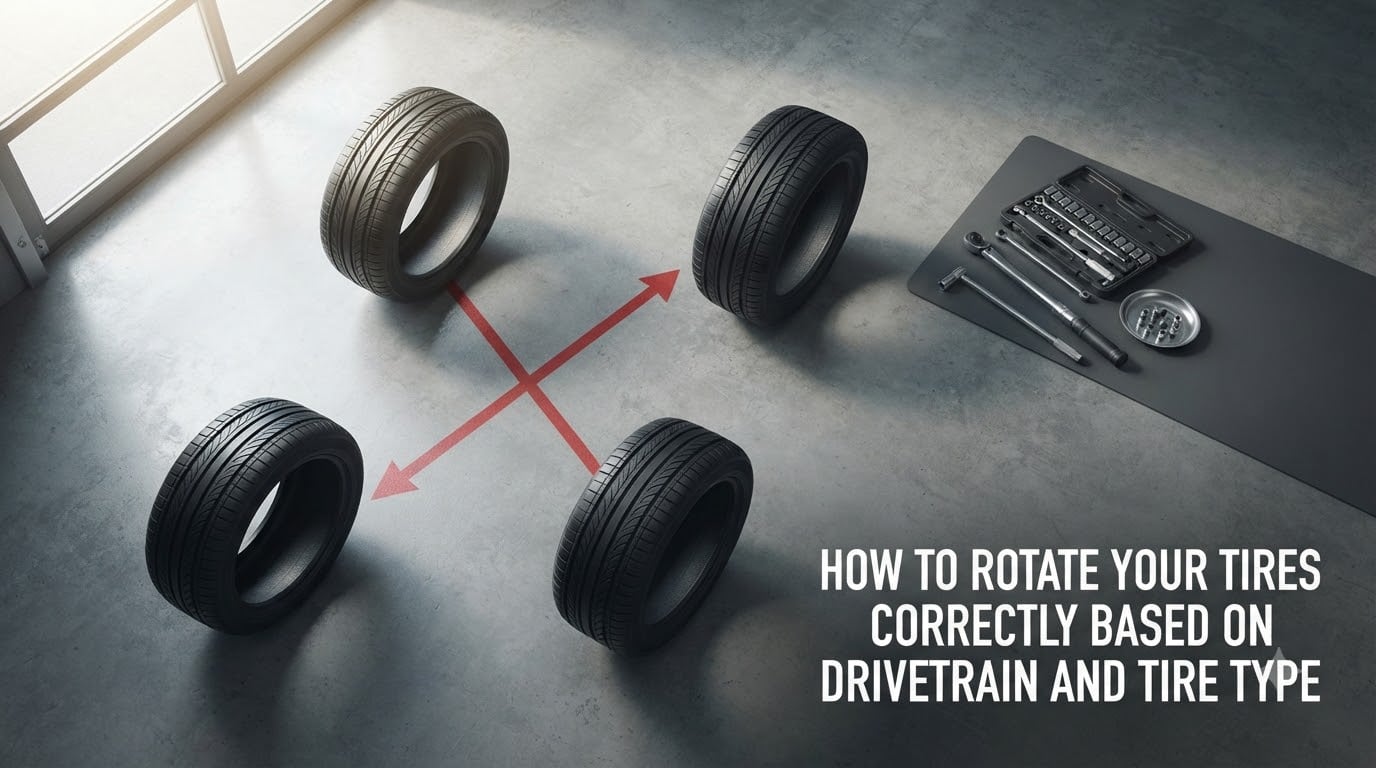
If your front tires are bald while your rear tires still have tread, your rotation pattern is wrong. Learning how to rotate your tires correctly based on drivetrain and tire type saves money, extends tire life, and protects your drivetrain, especially on all-wheel-drive vehicles where even minor mismatches cause expensive damage.
I have rotated tires on everything from a Honda Civic to a one-ton dually truck over the past 15 years. The pattern that works for one vehicle can ruin tires on another. This guide breaks down exactly which tires move where, how often to do it, and the rules that apply to directional tread, staggered fitments, and full-size spares.
Table of Contents
What Is Tire Rotation and Why It Matters?
Tire rotation is the practice of periodically moving your vehicle’s tires from one position to another to ensure even tread wear. Each wheel position experiences different forces. Front tires handle steering and most of the braking load, while rear tires manage traction and stability. Rotating spreads this uneven wear across all four tires so they wear out as a set rather than in pairs.
The Tire and Rim Association, along with most tire manufacturers, recommends the 3% rule: when tread depth difference between any two tires exceeds 3%, handling and traction become unpredictable. Once tires fall outside that 3% window, your vehicle’s anti-lock brakes and stability control may react incorrectly on wet or slippery surfaces.
AWD vehicles are especially sensitive to uneven wear. The center differential and transfer case in an AWD system are designed to send equal torque to all four wheels. When one tire has noticeably less tread, that wheel spins slightly faster, forcing the drivetrain to compensate constantly. Over time, this extra stress destroys viscous couplings, transfer cases, and transmissions.
How Often Should You Rotate Tires by Vehicle Type?
The general rule is every 5,000 to 7,500 miles, but your specific interval depends on your vehicle and how you drive. Here is the breakdown I follow:
Front-wheel drive (FWD) sedans and crossovers: every 5,000 to 7,500 miles. Front tires wear roughly twice as fast as rear tires because they carry weight, steer, and brake.
Rear-wheel drive (RWD) cars and trucks: every 5,000 to 7,500 miles. Rear tires wear faster under acceleration, so they benefit from regular rotation too.
All-wheel drive and 4WD (AWD/4WD): every 3,000 to 5,000 miles. The drivetrain sensitivity makes more frequent rotation critical. Subaru, Audi, and Tesla specifically call for shorter intervals in the owner’s manual.
Electric vehicles (EVs): every 5,000 to 7,500 miles. Instant torque and heavier battery weight accelerate wear, particularly on the driven axle.
Performance vehicles: every 3,000 to 5,000 miles. Sticky compounds and staggered fitments wear unevenly and need more attention.
Light trucks and SUVs: every 6,000 to 8,000 miles unless towing frequently, in which case drop to 5,000.
A good rule of thumb is to rotate every other oil change if you change oil every 5,000 miles. Costco’s policy of waiting until 6,500 to 7,000 miles is fine for FWD/RWD but stretches the safe limit for AWD.
Tire Rotation Patterns by Drivetrain
The pattern you use depends on whether your vehicle drives the front wheels, rear wheels, or all four. The mnemonic that ties it together is simple: cross to drive. Tires on the drive axle end up on the opposite side of the vehicle.
The ‘Cross to Drive’ Mnemonic
“Cross to drive” means tires from the driven (powered) axle move to the opposite side of the car when rotated. Tires from the non-driven axle move straight front-to-back on the same side. Following this one rule prevents most rotation errors I have seen in the shop.
Front-Wheel Drive Rotation (Forward Cross)
The forward cross is the standard pattern for FWD vehicles:
Rear passenger tire moves to front driver side.
Rear driver tire moves to front passenger side.
Front passenger tire moves to rear driver side.
Front driver tire moves to rear passenger side.
Front tires cross to the opposite rear corner, and rear tires cross to the opposite front corner. This balances the heavy wear FWD vehicles put on the front axle.
Rear-Wheel Drive Rotation (Rearward Cross)
RWD vehicles use the rearward cross, which is the mirror image of the FWD pattern:
Front driver tire moves to rear passenger side.
Front passenger tire moves to rear driver side.
Rear passenger tire moves to front driver side.
Rear driver tire moves to front passenger side.
Front tires cross to the opposite rear corner, and rear tires cross to the opposite front corner. This addresses the faster wear RWD vehicles experience on the rear axle under acceleration.
All-Wheel Drive and 4WD Rotation (X-Pattern)
For AWD and full-time 4WD vehicles, use the X-pattern (also called the modified cross). All four tires move diagonally:
Rear passenger tire moves to front driver side.
Rear driver tire moves to front passenger side.
Front passenger tire moves to rear driver side.
Front driver tire moves to rear passenger side.
This is the same as the FWD forward cross pattern. AWD systems benefit from this fully crossed pattern because they share wear characteristics with both FWD and RWD vehicles. Some tire makers recommend the straight front-to-back swap for AWD to avoid mixing wear patterns too aggressively, so check your owner’s manual first.
Five-Tire Rotation With Full-Size Spare
If your vehicle has a full-size spare (not a compact donut), include it in the rotation:
Rear passenger tire moves to front driver side.
Rear driver tire moves to front passenger side.
Front passenger tire moves to rear driver side.
Front driver tire moves to rear passenger side.
Spare tire moves to front passenger side (cycling through all positions over multiple rotations).
Compact temporary spares should never be included in rotation. They are rated for limited speed and distance and will wear out instantly if driven normally.
Six-Tire Rotation for Dually Trucks
Dually trucks with dual rear wheels need a different approach. The outer rear tires wear fastest because they handle the most cornering load:
Front driver tire moves to outer rear driver side.
Front passenger tire moves to outer rear passenger side.
Outer rear driver tire moves to inner rear driver side.
Inner rear driver tire moves to outer rear passenger side.
Outer rear passenger tire moves to inner rear passenger side.
Inner rear passenger tire moves to front driver side.
Run this pattern every 5,000 miles. Dually rear tires can wear out in 20,000 to 30,000 miles if ignored.
Directional vs Non-Directional Tire Rotation Rules
Tire type changes everything about how you rotate. Non-directional tires (symmetric tread pattern) can swap side-to-side freely. Directional tires (asymmetric tread pattern with arrows on the sidewall pointing in the direction of rotation) must always stay rotating in the same direction.
For directional tires, rotate front-to-back only on the same side. Never swap a left-side tire with a right-side tire. This means:
Directional tires on FWD or RWD: front-to-back on the same side only. Front driver moves to rear driver, front passenger to rear passenger.
Directional tires on AWD: same rule applies. Front-to-back only, no crossing.
If you have staggered fitment (wider tires on the rear axle, common on rear-wheel-drive sports cars), the rear tires cannot move to the front at all because they will not physically fit. Rotate side-to-side on the rear axle only and front-to-back only on the front axle.
Check the sidewall of each tire for a rotation arrow before you start. If you see arrows pointing in a specific direction, treat those tires as directional even if they look symmetric.
The Two-Tire Rotation Rule: New Tires Go on the Rear
When you replace only two tires, the new pair always goes on the rear axle. This is a safety rule from the Tire Industry Association that many drivers overlook.
Rear tires with deeper tread prevent oversteer and loss of vehicle control on wet roads. Front tires with worn tread may lose traction during braking, but the driver still has steering control. The opposite is not true: when rear tires lose grip, the back of the vehicle swings around with little warning.
Even if your front tires are more worn, put the new ones on the back. Rotate the partially worn front tires to the rear. Yes, this means your fresh tread ends up where it wears slower. The trade-off is worth it because hydroplaning on worn rear tires is one of the leading causes of single-vehicle accidents.
TPMS, Alignment, and Post-Rotation Checks
After rotating, your Tire Pressure Monitoring System (TPMS) may need a reset. Many vehicles relearn automatically after driving 20 to 30 minutes above 25 mph. Others require a manual reset procedure through the infotainment system or by pressing a button under the dash. Check your owner’s manual before assuming a TPMS warning light after rotation means a problem.
Lug nuts should be torqued to manufacturer specification (typically 80 to 100 lb-ft for passenger cars, 120 to 150 lb-ft for trucks). Use a torque wrench, not an impact gun alone. Over-tightened lug nuts warp brake rotors and make future rotations difficult.
Use rotation as a checkpoint for alignment. If you notice uneven wear patterns across the tire face (more wear on the inside or outside edge), the vehicle needs an alignment. Rotation fixes wear from position, not from misalignment.
Common Tire Rotation Mistakes to Avoid
I have made or seen all of these. Avoid them and your tires will last tens of thousands of miles longer.
Using the wrong pattern for your drivetrain. RWD vehicles need the rearward cross, not the forward cross. Mixing them up accelerates wear instead of preventing it.
Rotating directional tires side-to-side. This reverses the tread pattern and destroys wet traction instantly.
Forgetting the spare. A full-size spare left untouched for years develops flat spots and dry rot.
Skipping rotation on AWD. Mismatched tread depth on AWD vehicles destroys drivetrains faster than any other maintenance mistake.
Not checking torque. Lug nuts tightened by impact gun alone often end up at 150+ lb-ft and warp rotors.
Ignoring TPMS after rotation. A steady TPMS light after a tire swap usually just needs a relearn procedure, not a new sensor.
Now that you know how to rotate your tires correctly based on drivetrain and tire type, the rest is just setting a reminder. Mark your odometer at each rotation and stick to the interval. Your tires, your wallet, and your drivetrain will thank you.
FAQs
What is the correct order for rotating tires?
The correct rotation order depends on drivetrain. FWD vehicles use the forward cross (rear tires cross to opposite front, front tires cross to opposite rear). RWD vehicles use the rearward cross (front tires cross to opposite rear, rear tires cross to opposite front). AWD vehicles use the X-pattern, which is identical to the forward cross.
What is the 3% rule for tires?
The 3% rule means the tread depth difference between any two tires on the same axle should not exceed 3% (roughly 2/32 inch). Beyond this difference, handling, braking, and traction become unpredictable, especially on wet roads. This is why tire makers require all four tires on AWD vehicles to be within a tight tolerance.
Should I rotate my tires 5000 miles or 10000 miles?
For most FWD and RWD vehicles, every 5,000 to 7,500 miles is standard. For AWD, performance vehicles, and EVs, every 3,000 to 5,000 miles is safer. Waiting 10,000 miles between rotations is too long for any modern vehicle, especially AWD systems where mismatched tread depth can damage the drivetrain.
What are common tire rotation mistakes?
The most common mistakes are using the wrong pattern for your drivetrain, rotating directional tires side-to-side (which reverses the tread pattern), forgetting to include a full-size spare in the rotation, skipping rotation on AWD vehicles, over-tightening lug nuts with an impact gun, and ignoring the TPMS light after rotation.
Is it really necessary to get your tires rotated?
Yes, regular tire rotation is necessary. Without it, front tires on FWD vehicles wear out in 20,000 to 30,000 miles while rear tires last 50,000+, forcing you to replace tires in pairs. Rotation equalizes wear, extends tire life by 20% to 30%, maintains consistent traction and handling, and protects AWD drivetrain components from damage caused by mismatched tread depth.
Can directional tires be rotated side to side?
No. Directional tires, identified by arrows on the sidewall pointing in the direction of rotation, must always rotate in the same direction. They can only be rotated front-to-back on the same side. Swapping them side-to-side reverses the tread pattern and severely reduces wet traction and hydroplane resistance.
How long does a tire rotation take?
A professional tire rotation takes 20 to 30 minutes, often offered free with an oil change. Doing it yourself at home takes 30 to 45 minutes including jacking up the vehicle, swapping tires, and torquing lug nuts. Most shops include rotation in routine maintenance packages at no extra cost.