
Knowing how to safely plug or patch a tire and when a tire cannot be repaired can save you hundreds of dollars and keep your family safe on the road. I learned this the hard way after a roofing nail ruined a perfectly good tire, and since then I have researched industry guidelines from USTMA, RMA, and talked to mechanics who do this work every day.
This guide walks you through the exact safety thresholds professional technicians follow, the difference between a plug, a patch, and a combo repair, and the warning signs that mean you need to replace a tire instead. By the end, you will know exactly when a DIY repair is acceptable, when a professional repair is required, and when no repair is safe at all.
Table of Contents
Tire Plug vs Patch: What Is the Difference
A tire plug is a temporary, external fix that fills the puncture hole from the outside using a sticky rubber-coated cord. A tire patch is a permanent, internal seal applied to the inner liner of the tire after the tire is removed from the wheel. The industry standard for a truly permanent repair is the plug-patch combo, which uses both methods together.
These three approaches serve different purposes:
String/rubber plug (external): Inserted from outside the tire without removing it from the rim. Considered a roadside emergency fix by USTMA, not a permanent repair.
Patch (internal): Applied to the inner liner after dismounting the tire. Seals air loss but does not fill the puncture channel itself.
Plug-patch combo (combination repair unit): A patch with an attached rubber stem that fills the puncture and seals the inner liner in one piece. This is what AAA, Discount Tire, and USTMA recommend as the only true permanent repair.
When I asked a Discount Tire technician why he refused to plug my tire, he explained that external plugs can work loose over time and let moisture reach the steel belts, which causes corrosion from the inside out. That conversation alone convinced me the combo repair is worth the extra cost.
The 1/2 Inch Rule: Where a Tire Can Be Safely Repaired
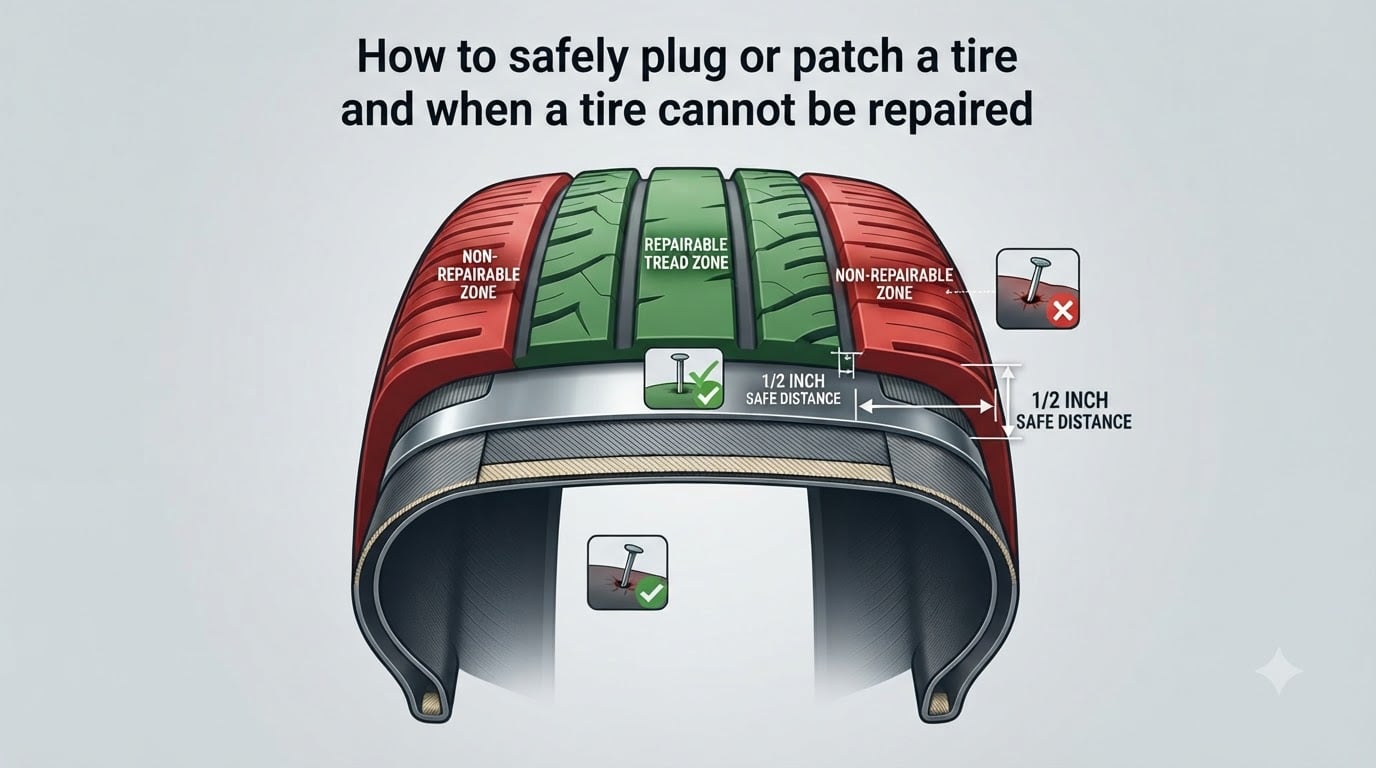
For a safe repair, the puncture must be located 1/2 inch or more from the shoulder belt edge of the tire, where the internal steel belts begin. The puncture diameter itself must also be 1/4 inch (6mm) or smaller. These two measurements are the foundation of every industry repair guideline.
The repairable zone is the crown of the tread, between the two shoulder belt edges on either side of the tire. Anything closer to the sidewall, shoulder, or belt edge falls into a no-repair zone because that area flexes constantly and cannot hold a seal reliably.
The reason for this rule is structural. The shoulder and sidewall flex thousands of times per mile. Any plug or patch in that zone would work loose under normal driving conditions. Beyond 1/2 inch from the belt edge, the tread area is rigid enough to maintain a seal for the life of the tire.
If you cannot measure the distance because the object is still embedded, mark the spot with chalk and bring it to a shop. Do not pull the object out before a technician confirms the puncture is in a repairable zone.
How to Safely Plug or Patch a Tire?
Professional tire repair follows a strict procedure outlined in USTMA and RMA guidelines. While a basic string plug can be done at the roadside, only the steps below meet industry standards for a permanent, safe repair.
Step 1: Remove the tire from the wheel
The tire must be dismounted from the rim so the inner liner can be inspected and prepped. Skipping this step is the single biggest reason DIY repairs fail.
Step 2: Locate the puncture from the inside
Mechanics mark the injury channel from inside, then measure the distance to the nearest shoulder belt edge. Anything under 1/2 inch from the belt edge means the tire should be replaced.
Step 3: Buff and clean the inner liner
A carbide buffing tool roughens the rubber around the puncture so the vulcanized patch bonds properly. The area is then cleaned with a solvent to remove debris and talc.
Step 4: Apply vulcanizing cement
A thin layer of cement is applied to both the buffed area and the back of the patch. This chemical adhesive bonds the rubber at a molecular level when cured under heat and pressure.
Step 5: Insert the plug-patch combination unit
The rubber stem is pulled through the puncture channel from the inside until the patch seats firmly against the inner liner. The exposed stem is trimmed flush with the tread surface.
Step 6: Cure and remount
The tire is inflated and remounted onto the wheel, then balanced. Most shops re-torque the lug nuts to spec and recommend a re-check at 50 miles.
The Plug-Patch Combination Method (Industry Standard)
A combination repair unit is a single piece that includes a vulcanized patch bonded to a rubber stem. When installed properly, it fills the puncture channel and seals the inner liner at the same time. USTMA, RMA, AAA, and Discount Tire all call this the only proper permanent repair.
Yes, you can plug a tire and then patch it, but the proper way to do it is with a combo unit, not as two separate repairs. A standalone patch does not fill the puncture channel, and a standalone plug does not seal the inner liner. The combo unit solves both problems in one installation.
Many shops refuse to patch a tire that was previously repaired with an external string plug. The reason is that the original plug may have already allowed moisture to penetrate the steel belts, and any new repair could fail unpredictably.
When a Tire CAN Be Repaired?
A tire is a candidate for repair only when every item on the checklist below is true. If even one fails, the tire should be replaced.
Puncture is in the tread area (not sidewall or shoulder)
Damage is at least 1/2 inch from the shoulder belt edge
Puncture diameter is 1/4 inch (6mm) or smaller
No prior improper repair on the same tire
Tread depth is still above 2/32 inch legal minimum
No signs of belt separation, bulges, or impact damage
Tire has not been driven severely underinflated
When all of these conditions are met, a plug-patch combo repair is appropriate and considered permanent for the remaining life of the tire.
When a Tire CANNOT Be Repaired?
Some tire damage cannot be repaired safely under any circumstances. If you notice any of the warning signs below, replace the tire instead.
Sidewall punctures or cuts
The sidewall flexes constantly and contains no internal structure to hold a seal. Any repair in this zone will fail, often at highway speeds.
Shoulder area damage (within 1/2 inch of belt edge)
The shoulder transitions between the rigid tread and the flexible sidewall. Repairs here cannot withstand the constant stress and will work loose.
Puncture larger than 1/4 inch (6mm)
Large punctures destroy too much structural integrity. Standard patch materials cannot seal them safely.
Multiple punctures close together
If two repairs would be within 16 inches of each other, the tire should be replaced. The weakened area cannot hold multiple seals.
Belt separation, bulges, or impact damage
Any visible bulge, vibration, or internal separation means the tire’s structure is compromised. These tires can fail without warning.
Previous improper repair
A tire with a string plug already installed, especially one showing signs of leakage, often has hidden moisture damage to the steel belts. Most reputable shops will not patch over a prior DIY plug.
Severe underinflation driving (run-flat damage)
If you drove on a flat or severely underinflated tire for any distance, the sidewalls have likely been damaged internally. Replacement is the only safe option.
Temporary vs Permanent Repairs
An external string plug is a temporary fix intended only to get you off the shoulder and to a repair shop. It is not approved by USTMA or RMA as a permanent solution. Once a combo patch-plug is installed by a qualified technician, the repair is considered permanent for the remaining life of the tire.
How long can you drive on a plugged tire? On an external string plug alone, treat it as an emergency fix and have the tire professionally repaired within 50 to 100 miles. A combo repair can be driven on indefinitely, provided the tire still has legal tread depth.
The difference comes down to whether the inner liner is sealed. Plugs from outside do not reach the inner liner, so moisture can travel along the puncture channel and corrode the steel belts over time. A combo repair seals both ends of the puncture, which is why it lasts.
Professional vs DIY Repair: What to Consider
DIY string plugs are acceptable as roadside emergencies to get you to a shop. They are not acceptable as a long-term solution. Professional repairs cost more because they include dismounting the tire, prepping the inner liner, and installing a proper combination unit.
Most tire shops charge between $20 and $45 for a combo patch-plug repair. The same job performed by a dealership may run higher. A new tire, by comparison, often costs $100 or more, so the math usually favors repair when the tire is otherwise in good condition.
If you choose the DIY route, treat it as temporary. Buy a quality plug kit, follow the instructions, and book a professional repair as soon as you can. The most common reason DIY repairs fail is that drivers treat them as permanent when they were never meant to be.
Common Mistakes to Avoid
After reading hundreds of forum threads and talking to mechanics, I have seen the same repair mistakes repeated over and over. Avoid these and you will be ahead of most drivers.
Driving on a flat or underinflated tire to “save the repair” — this destroys sidewalls internally
Using a string plug as a permanent fix without ever sealing the inner liner
Pulling the nail out before measuring the distance to the belt edge
Repairing a tire with visible bulges, cracks, or tread below 2/32 inch
Ignoring slow leaks because the tire “still holds air” — small leaks let moisture in
Trusting a $5 can of tire sealant as a long-term fix — sealants break down and damage sensors
If you remember nothing else, remember this: the inner liner must be sealed for a repair to be permanent. Everything else is secondary.
What to Do Immediately After Discovering a Puncture?
If you hit a nail or screw and notice a pressure loss, do not pull the object out. Drive slowly to the nearest safe location, check the pressure, and decide whether to reinflate and head to a shop or change to your spare. Mark the location with chalk if possible, and avoid highway speeds until the tire is inspected.
If the tire is fully flat, change to the spare rather than driving on the flat. Driving on a flat destroys the sidewall and almost always means the tire is no longer repairable.
FAQs
What should I do if a tire cannot be patched?
Replace it. Sidewall damage, shoulder punctures within 1/2 inch of the belt edge, punctures larger than 1/4 inch (6mm), multiple close punctures, visible bulges, or prior improper repairs all mean the tire must be replaced rather than repaired.
Can you plug a tire and then patch it later?
A proper repair uses a single plug-patch combination unit, not a plug at one time and a patch later. Most reputable shops refuse to patch over an existing external string plug because moisture may have already damaged the steel belts.
How long can you drive on a plugged tire?
On an external string plug alone, treat it as a temporary fix and get a professional combo repair within 50 to 100 miles. A proper plug-patch combo installed by a technician is permanent for the remaining life of the tire.
Why don’t tire shops plug tires anymore?
Many shops still offer string plugs but consider them temporary only. The industry standard permanent repair is the plug-patch combo because external plugs do not seal the inner liner, which allows moisture to corrode the steel belts over time.
What is the 1/2 inch rule for tire repair?
The puncture must be located 1/2 inch or more from the shoulder belt edge, where the internal steel belts begin. Punctures closer to the sidewall or shoulder fall into a no-repair zone because the constant flexing prevents a reliable seal.
Conclusion
Understanding how to safely plug or patch a tire and when a tire cannot be repaired comes down to three core rules. The puncture must be 1/2 inch from the shoulder belt edge, the diameter must be 1/4 inch or smaller, and the inner liner must be sealed. When all three conditions are met, a professional plug-patch combo is a permanent fix for the life of the tire.
If you find yourself with a puncture this week, do not pull the object out. Mark the location, check your pressure, and head to a shop that performs USTMA-standard combo repairs. Ask specifically whether the technician will dismount the tire, buff the inner liner, and install a combination unit. If they only offer an external plug from the outside, go somewhere else.
The few dollars you save on a cheaper repair are not worth the risk of a blowout at highway speed. Trust the industry standards, follow the checklist, and your repaired tire will serve you reliably until the tread wears down.