
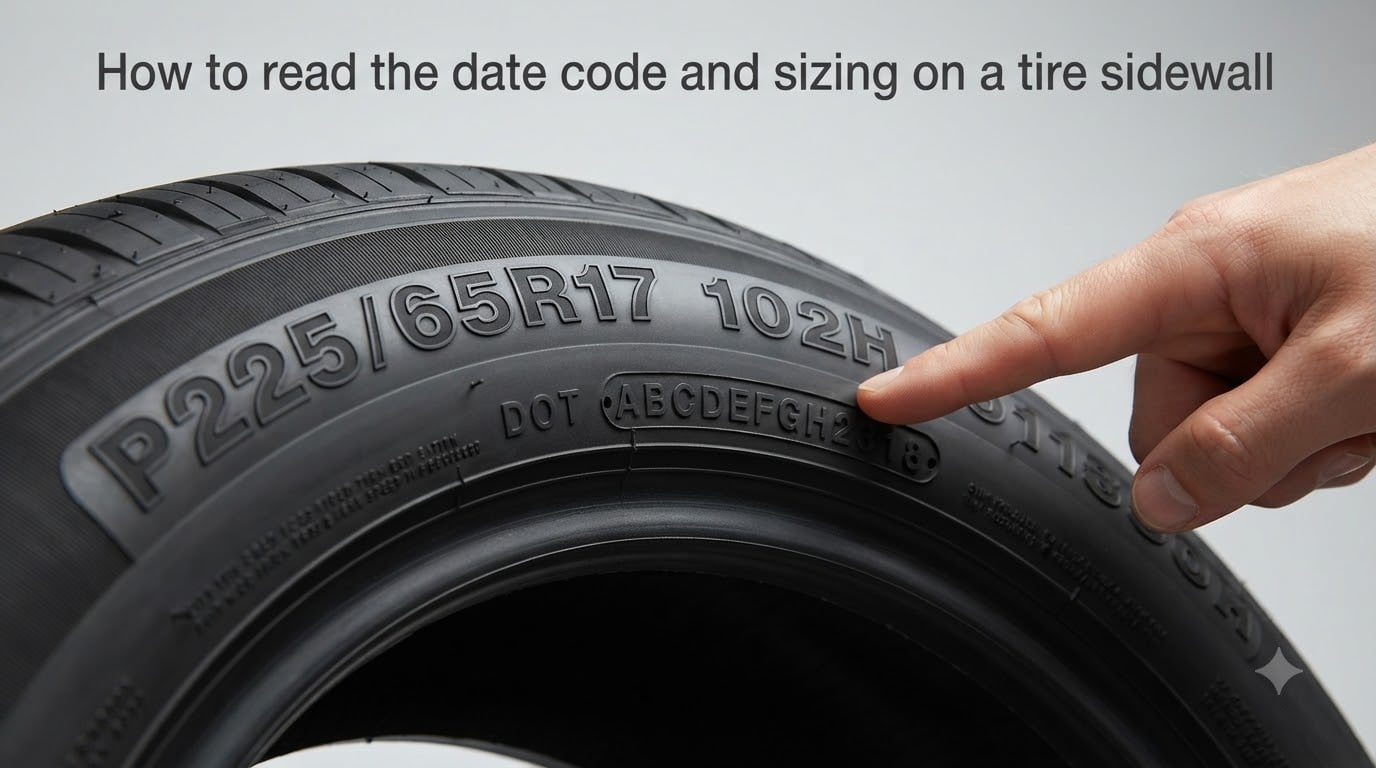
I still remember the first time I crouched next to a tire and tried to make sense of the markings stamped into the rubber. Letters, numbers, symbols – it looked like an alien language. After spending years working with mechanics and helping our team decode hundreds of tires for readers, I can tell you that once you learn the system, reading a sidewall takes about 30 seconds.
In this guide, I will walk you through everything printed on a tire sidewall – from the size format to the DOT date code – so you can confidently read any tire you encounter. You’ll learn exactly how to find the manufacture date, decode load and speed ratings, and spot winter tire markings, even when the date code is on the inner sidewall you can’t easily see.
Table of Contents
What the Tire Sidewall Numbers and Letters Actually Mean?
A tire sidewall is a coded information panel that tells you the tire’s size, type, load capacity, speed rating, and manufacture date. Every marking on that black circle of rubber is there for a reason – either to identify the tire, certify it meets safety standards, or tell you how old it is.
When I break down a sidewall for our team, I divide it into four groups: the size code (something like P225/55R17), the DOT safety code ending in the date (such as DOT … 2322), the UTQG ratings, and special markings like M+S or 3PMSF. Once you know which group you’re looking at, every other letter and number falls into place.
How to Read Tire Size from Sidewall: The Complete Format?
The size code on a tire follows a standardized format that looks like this: P225/55R17 95H. Let me walk you through each piece one at a time, because every character means something specific.
The first letter is the tire type. P means passenger car tire, LT means light truck, ST means special trailer, and T means temporary spare. If there’s no letter at all, the tire is a Euro-metric passenger tire with different load assumptions than the P version.
Next comes the three-digit section width in millimeters. In P225/55R17, the 225 is the width of the tire from sidewall to sidewall – 225 millimeters. Wider tires generally offer more grip but reduce fuel economy and may hydroplane more easily in heavy rain.
The two digits after the slash are the aspect ratio – the sidewall height as a percentage of the width. So 55 means the sidewall is 55% as tall as the tire is wide. A 225/55R17 has a sidewall height of about 124 mm. Lower aspect ratios (like 40 or 35) mean shorter sidewalls, sharper steering response, and a firmer ride.
The letter R stands for radial construction – the most common type today, where the internal cords run perpendicular to the direction of travel. You may also see D for diagonal or bias construction, which is rare on modern passenger vehicles. Some tires show RF for run-flat design.
The final two digits in the size string – 17 in our example – are the wheel diameter in inches. This number must match your wheel exactly; a 17-inch tire will not mount on a 16-inch wheel. After the size comes the load index (95) and speed rating (H), which I’ll cover in detail below.
Understanding Tire Type Prefixes (P, LT, ST, T)
Choosing the right prefix matters more than most drivers realize. A passenger car tire (P) has different load curves and pressure requirements than a light truck tire (LT), even if both fit the same wheel.
P – Passenger: Designed for cars, minivans, and light crossovers. Optimized for ride comfort, low noise, and good fuel economy. Load range is typically SL (Standard Load) or XL (Extra Load).
LT – Light Truck: Built for pickup trucks, SUVs, and vans carrying heavier loads. Has stiffer sidewalls and higher load capacity. Often labeled with a load range like LT245/75R17 Load Range E.
ST – Special Trailer: Made specifically for trailers – not for steering or drive axles. ST tires have different speed ratings (usually 65 mph max) and are not suitable for use on passenger vehicles.
T – Temporary: Found on compact spare tires. Designed for short distances at reduced speeds (usually 50 mph max). I always tell readers to drive on the spare only as far as needed to get the regular tire repaired or replaced.
Decoding the DOT Date Code to Find Tire Age
The DOT date code is the most important marking for safety because tire rubber degrades over time, even when the tread looks fine. Every tire sold in the United States carries a DOT symbol followed by a serial number, and the last four digits are the manufacture date.
For tires made after the year 2000, the format is WWYY – two digits for the week, two digits for the year. So 2322 means the tire was made in the 23rd week of 2022, which falls in early June. 4714 would be the 47th week of 2014, late November.
There are 52 weeks in a year, so if you see a date code like 5319, that tire came out in the last week of December 2019. Codes go from 01 (first week of January) to 52 or 53 (last week of December).
For tires made before 2000, the format is only three digits: YYY. The last three digits represent week and decade, but the decade is ambiguous. A code reading 259 could mean the 25th week of 1989, 1979, or even 1999 – you cannot tell which.
This is why pre-2000 tires with 3-digit codes often have a small triangle (called a decade marker) next to the date, pointing to a specific decade on the sidewall. If you see a triangle next to a 3-digit code, that’s how the manufacturer indicated which decade applies. If no triangle is present, you’ll need to check the tire’s manufacturing records or assume the oldest plausible decade.
The full DOT serial includes a plant code at the start (two letters or letters-and-numbers identifying the factory), an optional size code in the middle, and the date code at the end. A complete DOT code might look like: DOT M6R2 8MMR 0821, meaning it was built in plant code M6R2 in the 8th week of 2021.
How to Find the Date Code on a Mounted Tire
Here’s a question that comes up constantly in forums: “Why can’t I find the DOT code on my tire?” The answer surprised me the first time I learned it – DOT codes appear on only one sidewall.
By federal regulation, the DOT code is placed on one side of the tire. Tire manufacturers choose the side based on production convenience, so the DOT might be on the inner sidewall, facing the vehicle. If you’ve been checking only the outside of your tires and seeing no date code, try looking at the inside sidewall.
To read the inside of a mounted tire, turn the steering wheel fully in one direction and look at the exposed inner sidewall. You can also use a flashlight and a small mirror to peek behind the wheel without removing it. If your tires have aluminum or chrome wheels that block the view, you may need to remove the wheel entirely to inspect the inner sidewall.
This is also why tire sellers are required to show the DOT date when selling new tires – because customers can verify the age at the point of purchase. If you’re buying used tires, always check the date code on both sidewalls before agreeing to the sale.
Load Index and Speed Rating Explained
After the tire size, you’ll see two more characters – a number and a letter – that together tell you the load index and speed rating. These are critical for safety because exceeding either rating can cause tire failure.
The load index is a numerical code that corresponds to the maximum weight each tire can carry when properly inflated. In our example P225/55R17 95H, the 95 means each tire can carry 1,521 pounds (690 kg). Load index values range from 0 (about 99 lbs) to 150 or higher for commercial truck tires.
To use the load index correctly, you need to know your vehicle’s gross axle weight rating (GAWR) from the door placard, then divide by 4 to get the load per tire. Make sure your tire’s load index multiplied by four meets or exceeds the heaviest axle load.
The speed rating is a letter indicating the maximum speed the tire can sustain under load. H in our example means the tire is rated for speeds up to 130 mph (210 km/h). Here are the most common speed ratings you’ll encounter:
S – 112 mph (180 km/h) – common on family sedans and minivans
T – 118 mph (190 km/h) – typical for many passenger cars
H – 130 mph (210 km/h) – found on sport sedans and coupes
V – 149 mph (240 km/h) – high-performance summer tires
W – 168 mph (270 km/h) – ultra-high-performance tires
Y – 186 mph (300 km/h) – exotic and supercar applications
Speed ratings also affect other tire characteristics – a V-rated tire typically has stiffer sidewalls and better cornering grip than an S-rated tire of the same size. When replacing tires, match or exceed the original speed rating for safety.
UTQG Ratings: Treadwear, Traction, and Temperature
The Uniform Tire Quality Grading (UTQG) system was created by the U.S. Department of Transportation to give consumers a way to compare tires. Three grades appear on the sidewall: Treadwear, Traction, and Temperature.
The treadwear grade is a comparative number based on controlled testing against a reference tire that scores 100. A tire rated 400 should last roughly four times longer in the test conditions than the reference. Common grades range from 60 (racing tires) to 800+ (long-life touring tires). For typical passenger use, treadwear between 400 and 600 represents a good balance of longevity and grip.
The traction grade measures wet stopping ability on straight-line asphalt. Grades are AA, A, B, and C, with AA being the highest. Most modern tires score A or AA – if you see a C rating, consider replacing that tire with something safer.
The temperature grade indicates the tire’s resistance to heat buildup at high speeds. Grades are A, B, and C, with A being best. A tire with a C temperature grade is only rated for sustained speeds up to 85 mph – which is why I recommend A or B grades for any vehicle that sees highway driving.
One important note: UTQG grades are self-reported by manufacturers and tested under controlled conditions. They are useful for comparing brands but don’t capture real-world performance across all weather conditions.
M+S and 3PMSF: Winter and All-Season Tire Markings
Two symbols on the sidewall tell you about a tire’s cold-weather capability: M+S and the 3PMSF (Three-Peak Mountain Snowflake) symbol.
M+S stands for “Mud and Snow” and indicates a tire with tread patterns designed for improved traction in mud and snow compared to standard tires. However, M+S is a manufacturer’s self-declaration – there is no performance standard required to earn the marking. Many all-season tires carry M+S simply because their tread blocks are spaced appropriately.
The 3PMSF symbol – a mountain peak with a snowflake inside it – is a different story. This marking requires the tire to meet specific snow traction performance standards (at least 110% better than a reference tire in a standardized snow test). If you see the 3PMSF symbol, the tire is genuinely capable of severe winter service.
In regions with strict winter tire laws (like Quebec, Germany, or parts of Scandinavia), only tires with the 3PMSF symbol count as winter tires – M+S alone is not sufficient. If you live somewhere with heavy snow and ice, look for 3PMSF before trusting any winter tire claim.
For all-season tires, you’ll typically see both M+S and 3PMSF, indicating decent cold-weather capability without being a dedicated winter tire. Dedicated summer tires will have neither marking and should not be driven in freezing temperatures.
Other Markings You May See: Tubeless, OE, and Maximum Load
A few additional markings round out the sidewall information panel.
TUBELESS or TUBE TYPE tells you whether the tire requires an inner tube. Nearly all modern passenger tires are tubeless, but you may still see this marking on motorcycle, bicycle, or specialty tires.
OE markings identify tires as Original Equipment for specific vehicle models. You might see codes like AO (Audi), MO (Mercedes-Benz), or VO (Volkswagen). These tires are tuned to match the vehicle’s suspension and performance targets, and they often cost more than standard replacements.
MAX LOAD and maximum inflation pressure appear near the rim. For example, you might see “MAX LOAD 690 kg (1521 lbs) AT 300 kPa (44 psi).” These are the absolute limits – not the recommended operating pressures, which are listed on the vehicle’s door placard.
Some tires also show a TWI (Tread Wear Indicator) marker – small bars of rubber inside the main tread grooves that become flush with the surface when the tire reaches 2/32 inch of remaining tread, which is the legal minimum in most U.S. states.
Tire Age and Safety: When to Replace Tires by Date
Even tires with deep tread can fail if the rubber has aged past its safe service life. Most tire manufacturers and safety organizations recommend replacing tires at 10 years from the manufacture date, regardless of tread depth.
After 5 years, I recommend having your tires inspected annually by a qualified tire shop. They will check for cracking, dry rot, sidewall damage, and other age-related deterioration that you might miss from a casual glance.
Heat, sunlight, and improper storage accelerate aging. A tire that has been sitting in a warehouse for 5 years before being sold is functionally older than its service life suggests – which is why the date code matters when buying new tires, not just used ones.
If you see a tire with a manufacture date older than 5 years from today, I’d negotiate a discount or pick a fresher alternative. Tires over 6 years old should be inspected carefully even if they appear new.
Common Mistakes When Reading Tire Codes
After helping our team decode hundreds of sidewalls, I’ve noticed a few common mistakes people make.
First, confusing the date code week and year digits. 0821 is August 2021 (week 8), not 2028. The last two digits are always the year.
Second, assuming both sidewalls show the same date code. Only one side has the DOT – the other side may have no date at all, or a different style of marking entirely.
Third, ignoring the load index. A tire with a lower load index than required can overheat and fail under heavy loads, even at legal speeds.
Finally, treating M+S as proof of winter capability. For genuine snow performance, only the 3PMSF symbol counts.
FAQs
How do I read the tire size on my sidewall?
Look for a string like P225/55R17. The first letter is the type (P for passenger, LT for light truck). The first three digits are width in millimeters, the next two are aspect ratio (sidewall height as percent of width), R means radial construction, and the last two digits are wheel diameter in inches. After the size, you’ll see the load index (number) and speed rating (letter).
How do I find the manufacture date on a tire?
Find the DOT code on the sidewall – it starts with the letters DOT followed by a serial number. The last four digits are the date: the first two digits represent the week of the year (01-53), and the last two digits represent the year. For example, 2322 means the 23rd week of 2022. For tires made before 2000, only the last three digits are present, indicating week and an ambiguous decade.
What does the number and letter after the tire size mean?
That is the load index and speed rating. The number (for example, 95) corresponds to a maximum load in pounds – you can look up the value in a load index chart. The letter (for example, H) indicates the maximum speed capability – H is rated for 130 mph. Always match or exceed the original equipment ratings when replacing tires.
How long are tires good based on the date code?
Most manufacturers recommend replacing tires 10 years after the manufacture date shown in the DOT code, regardless of tread depth. After 5 years, have the tires inspected annually for cracking, dry rot, and sidewall damage. Tires stored in hot warehouses may age faster than the date suggests, so check the DOT code before buying any tire, new or used.
Final Thoughts on Reading Tire Sidewall Codes
Learning how to read the date code and sizing on a tire sidewall gives you real power as a consumer. You can check tire age before buying, verify the correct replacement size for your vehicle, and understand the performance ratings that affect safety.
Start by finding the size code on your current tires – that is the foundation for any replacement purchase. Then locate the DOT code and confirm the manufacture date. With those two pieces of information, you’re already ahead of most drivers. The rest of the markings – load index, speed rating, UTQG, and winter symbols – help you choose tires that match how and where you drive.