
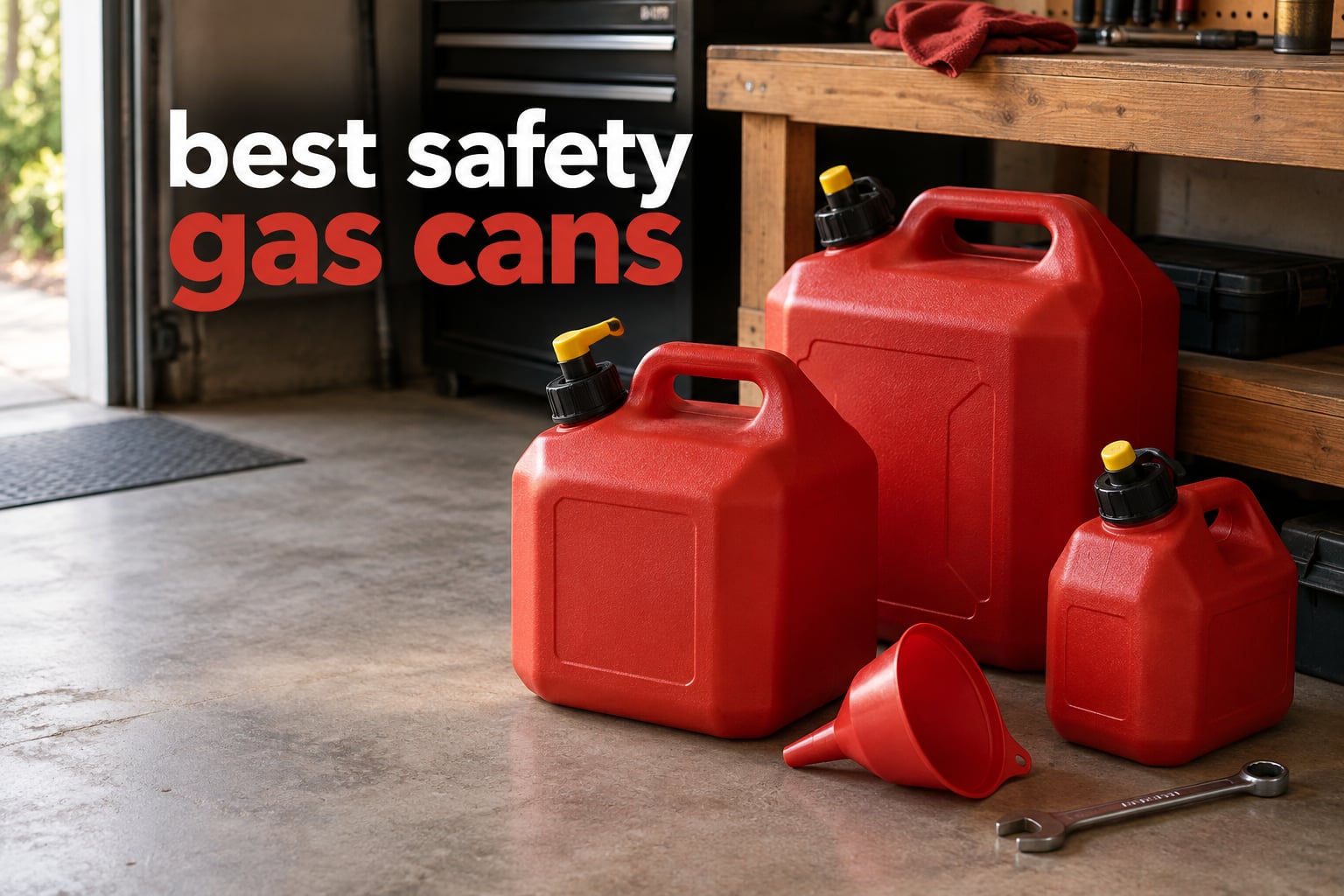
A good safety gas can is not a plastic jerry can with a screw cap. It is a purpose-built fuel container with a flame arrester in the spout, a self-closing spring lid, pressure venting and a leak-proof seam. My overall pick after working through the category is the Eagle 5 Gallon Type I Red Safety Gas Can (B00004Y75M) — lead-free 24-gauge galvanized steel, a gasketed cap that self-closes the moment you let go, a non-sparking flame arrestor, and FM, UL and ULC approval alongside OSHA 1910.106 and NFPA 30 compliance. It comes with the F-15 funnel in the box, so it is usable the day it arrives.
That is the short answer. The rest of this guide covers the twelve cans worth your attention in 2026, what actually separates a certified safety can from a lookalike, how Type I and Type II designs differ, and where metal genuinely beats plastic and where it does not. I also spend real space on storage, transport and second-hand inspection, because those are the three areas where well-meaning owners get hurt, and almost no roundup covers them properly.
One thing to clear up early: three of the twelve containers below carry a NOT FOR USE WITH FUEL label. They are excellent jugs for oil, coolant, non-potable water, mixing and yard work, and they are not safety gas cans in any regulatory sense. I have kept them in the list and labelled them honestly rather than quietly dropping them, because plenty of people buy a can for the wrong job and find out at the pump.
Table of Contents
Top 3 Picks for Best Safety Gas Cans (September 2026)

Eagle 5 Gallon Type I Safet…
- 24-gauge galvanized steel
- Self-closing gasketed cap
- FM and UL approved
- F-15 funnel included

No Spill 1405 2.5 Gallon…
- Thumb-button pour control
- 7/8 inch funnel spout
- 20 mesh stainless screen
- ASTM CARB EPA

Justrite Type II Safety Can
- Safe-Squeeze trigger
- 9 inch flexible metal hose
- Stainless flame arrester
- FM and TUV certified
Best Safety Gas Cans at a Glance In 2026
| Product | Specs | Action |
|---|---|---|
| Eagle 5 Gallon Type I Red Safety Gas Can |
|
Check Latest Price |
| No Spill 1405 2.5 Gallon Gasoline Gas Can |
|
Check Latest Price |
| Justrite Type II Gasoline Safety Can Red |
|
Check Latest Price |
 SureCan 5 Gallon Type II Rotating Spout Container SureCan 5 Gallon Type II Rotating Spout Container |
|
Check Latest Price |
 Justrite Type I Gasoline Safety Can Red Justrite Type I Gasoline Safety Can Red |
|
Check Latest Price |
 Wavian USA 20 Litre NATO Jerry Can and Spout Wavian USA 20 Litre NATO Jerry Can and Spout |
|
Check Latest Price |
 Scepter 5 Gal Gas Can SmartControl Spout Scepter 5 Gal Gas Can SmartControl Spout |
|
Check Latest Price |
 Midwest Can 2310 Safe-Flo 2 Gallon Gas Can Midwest Can 2310 Safe-Flo 2 Gallon Gas Can |
|
Check Latest Price |
 VP Racing 35221 5.5 Gallon Motorsport Jug VP Racing 35221 5.5 Gallon Motorsport Jug |
|
Check Latest Price |
 Fuelworx 5 Gallon Stackable CARB Compliant Can Fuelworx 5 Gallon Stackable CARB Compliant Can |
|
Check Latest Price |
 VP Racing 3846 5.5 Gallon Camo Motorsports Jug VP Racing 3846 5.5 Gallon Camo Motorsports Jug |
|
Check Latest Price |
 VP Racing 3572 5.5 Gallon Orange Motorsport Jug VP Racing 3572 5.5 Gallon Orange Motorsport Jug |
|
Check Latest Price |
What Makes a Safety Gas Can Different From a Jerry Can
A safety gas can has five things a standard fuel jug does not. Here is the direct answer, feature by feature.
Flame arrester. A fine mesh screen sits inside the spout. Vapour passes out; an external spark or flame cannot travel back in and ignite the vapour inside the can. This is the single most important feature, and it is the reason OSHA, CARB and FM all require it.
Self-closing spring lid. The moment you release the lever, the cap snaps shut. Drop the can mid-pour and it seals itself rather than emptying onto the driveway.
Automatic pressure venting. Heating fuel expands, and a sealed can either bulges or bursts. Certified cans vent automatically and hold shape.
Leak-proof construction. Weldless, double-interlocked bottom seams on steel cans, or fused multi-layer walls on plastic, so the container does not weep fuel through a hairline crack.
Third-party approval markings. FM, UL, ULC, TUV, plus OSHA 1910.106 and NFPA 30 language, and a CARB or EPA executive order number for California. If those markings are absent, it is a container, not a safety can.
The reason this matters is the failure mode. A jerry can has a simple push cap with no arrester and no vent, so a static spark from your jacket or a dropped wrench can ignite the vapour escaping an open spout. A safety can removes both failure modes, which is why the certification marks are not marketing decoration.
Type I vs Type II Safety Cans: Which One Do You Need?
Type I and Type II refer to the number of openings, and that single design choice drives everything else about how the can pours.
A Type I safety can has a single opening used for both filling and dispensing. You unscrew or lever the cap, fill through the same spout you pour from, and replace the cap. It is simpler, has fewer parts to fail, and is the traditional FM and OSHA workhorse. The Eagle UI-50-FS and the Justrite 7150100 are both Type I. The trade-off is that you have to line the spout up with the receiving opening and hold the can at an angle.
A Type II safety can has two separate openings: one to fill, one to dispense, each with its own self-closing cap. Because the fill port is distinct, the dispense port can vent continuously while you pour, which gives a steady, glug-free flow instead of the gurgling stop-start you get from a single-opening can. Type II cans usually add a flexible hose or a rotating spout so you can fill narrow necks without tipping the can. The Justrite 7250130 and the SureCan SUR5SFG2 are both Type II.
My rule of thumb: Type I if you are filling equipment with wide, easy-to-reach openings and you want the simplest, most certified design available. Type II if you pour into mower tanks, generator tanks, boat fills or anything with a small filler neck, because the controlled flow saves you the fuel you would otherwise spill chasing a wobbling stream.
1. Eagle 5 Gallon Type I Red Safety Gas Can — Best Overall
Eagle 5 Gallon Type I Red Safety Gas Can for Gasoline
5 gallon galvanized steel
Type I single opening
24-gauge lead-free steel
FM UL and ULC approved
Pros
- Powder-coated galvanized steel resists rust dents and scratches
- Self-closing gasketed cap stays leak-free in a truck bed
- Non-sparking flame arrestor plus automatic venting
- F-15 funnel included so it works out of the box
- FM UL and ULC approved and OSHA 1910.106 compliant
Cons
- Weighs 5.3 pounds empty so a full can is heavy to lift
- Type I design needs accurate alignment when pouring
This is the can I keep coming back to, and it earned the top spot on the combination of rating, review volume and certification coverage rather than on any single spec. At 4.7 stars across more than 8,200 reviews it carries the highest average rating in this group, and it holds the number one position in Amazon’s Hazardous Storage Cans category, which tells you how much actual daily use it absorbs.
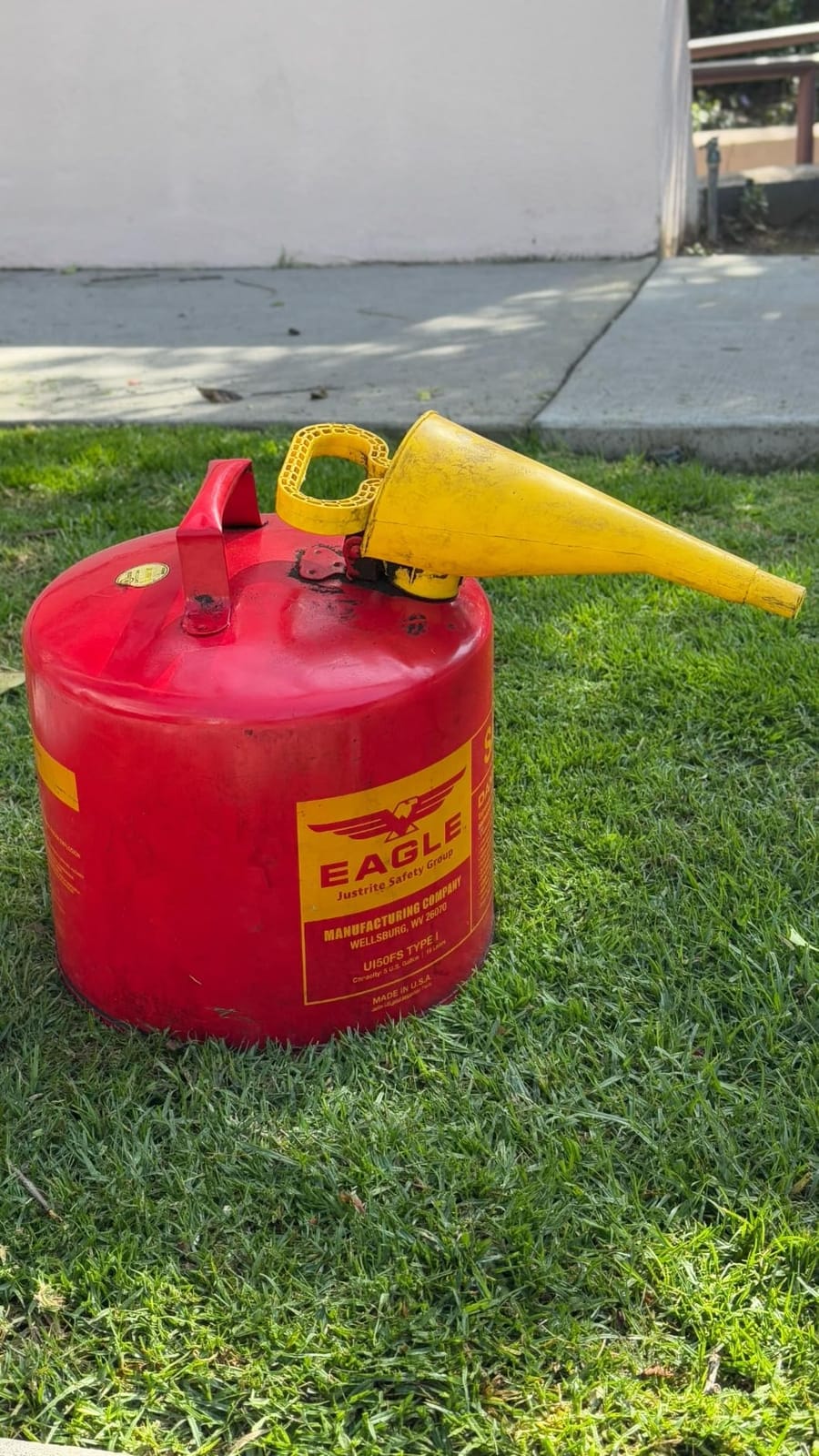
The construction details are what separate it from cheap steel lookalikes. Lead-free 24-gauge galvanized steel with a baked-on powder-coat finish resists rust, dents and scratches, and the fixed handle is joined by a double interlock no-weld bottom seam that resists the bottom-seam failures that plague cheaper cans. The gasketed spout cap self-closes, so if you tip it in a truck bed it stays sealed, and the cap assembly opens automatically to vent internal vapours.
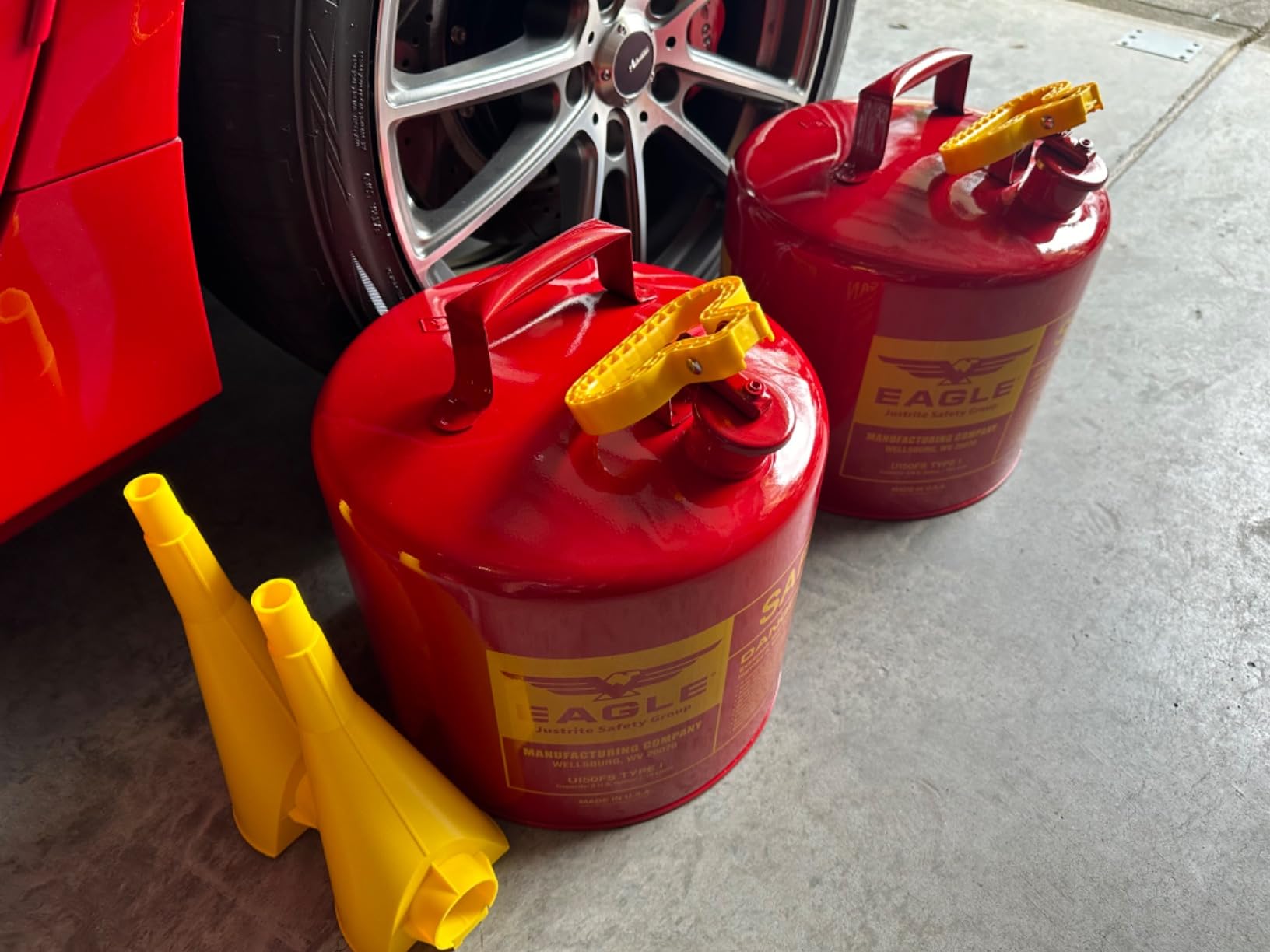
Weight is the honest drawback. At 5.3 pounds empty, a full five-gallon can is not a one-hand carry, and if you are moving fuel from a vehicle to a generator more than once a week you will feel it every time. Owners who have switched from plastic to steel usually stop noticing after a few weeks, because the can stops cracking and stops weeping fuel into the bed liner, which is the entire point.
The F-15 funnel is a detail that matters more than it sounds. Many competing steel cans ship bare, and you end up pouring through a household funnel with no flame arrester, which defeats the purpose. This one arrives complete.
What you should check before buying a Type I steel can
Look for the approval markings stamped or printed on the can itself, not just the box. FM, UL or ULC plus a reference to OSHA 1910.106 and NFPA 30 is the combination you want. Marketplace listings of unbranded steel cans frequently claim approval without carrying any, and the certification text is the only reliable way to tell the two apart.
Also check the gauge and the finish. 24-gauge galvanized steel with a powder coat will outlive thinner unlined carbon steel by years, and the powder coat is what keeps a red can from turning orange around scratches.
Who should skip this can
If lifting a full five-gallon can is a genuine physical limitation for you, or if you are pouring into small, awkward filler necks several times a week, this is not the right tool. A Type II can with a hose or a 2.5 gallon plastic can will be easier on your back and easier to aim. For wide openings, one-handed transport and long-term storage, nothing here beats it.
2. No Spill 1405 2.5 Gallon Gasoline Gas Can — Best Value
No Spill 1405 2.5 Gallon Gasoline Gas Can
2.5 gallon HDPE
Thumb button pour control
7/8 inch funnel spout
20 mesh stainless screen
Pros
- Thumb button gives genuinely precise controlled pouring
- Narrow 7/8 inch funnel spout reaches small equipment openings
- Integrated 20 mesh stainless steel screen
- Attached dust cover keeps the spout clean
- HDPE body meets ASTM CARB and EPA requirements
Cons
- 2.5 gallon capacity means more trips to the pump
- Not a Type I or Type II certified safety can
With more than 10,000 reviews at a 4.6 average, this is the most-proven container in the entire roundup, and for a specific reason: most people do not actually need five gallons. They need enough to fill a push mower, and they need to do it without throwing out your back.
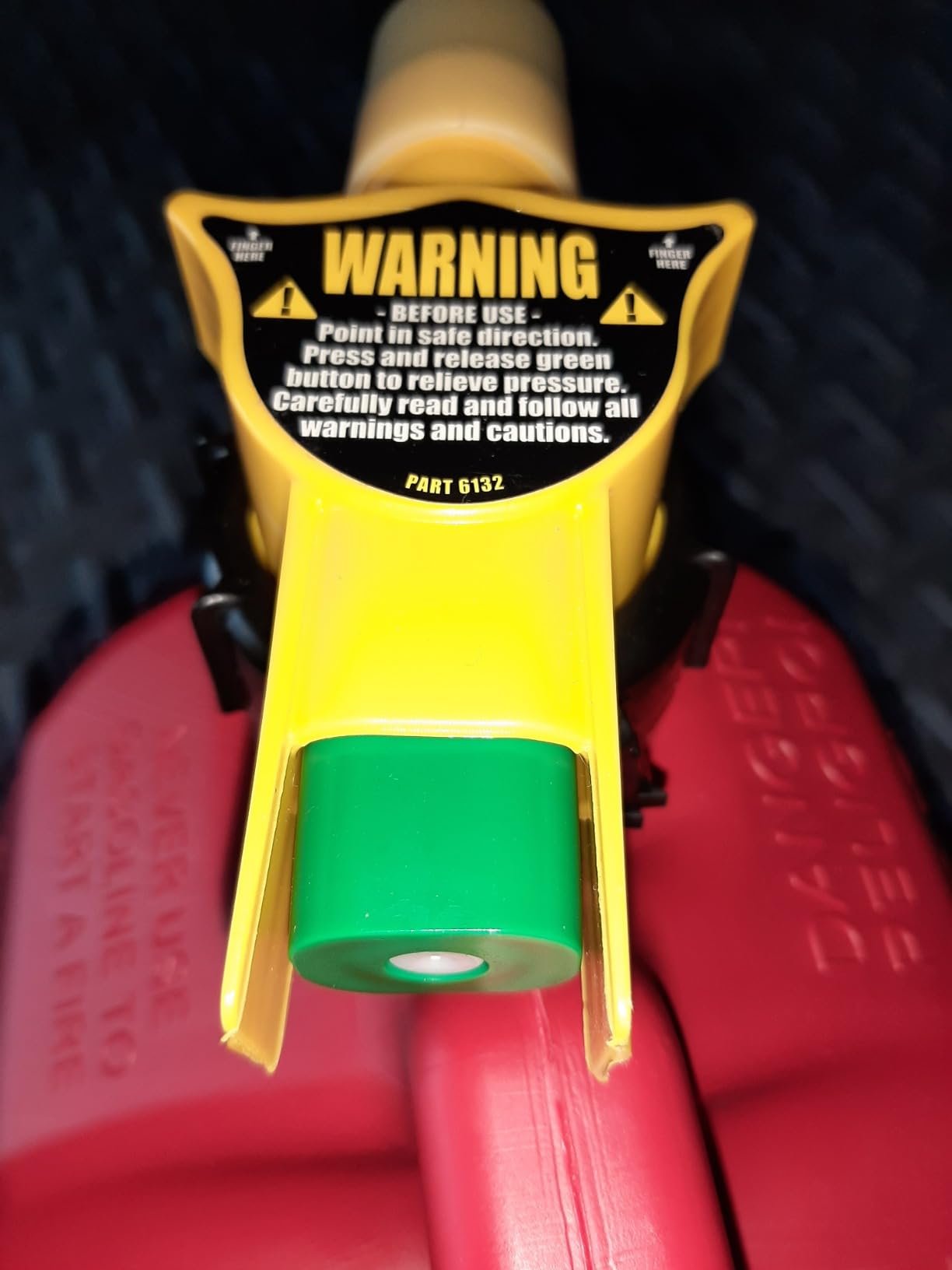
The thumb button is the feature people notice first. Squeeze and fuel flows; release and it stops dead. That is a very different experience from the lever-and-catch designs on larger cans, and it makes topping up a small engine genuinely one-handed. The 7/8 inch funnel spout is the other quiet winner, because it will reach the narrow filler necks on string trimmers, blowers and older equipment where a standard spout misses and you end up funnelling through a dish.
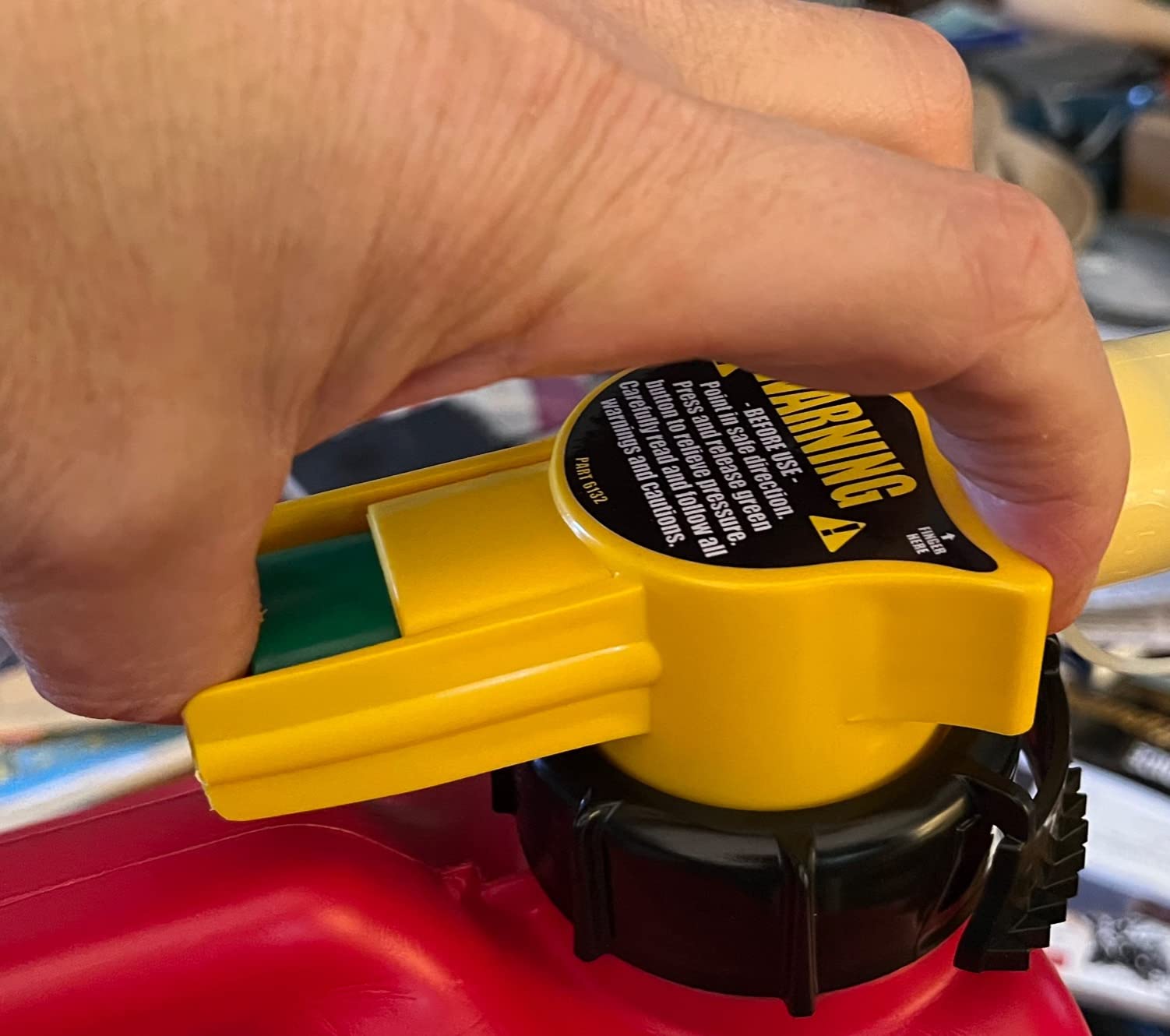
The screen is a 20 mesh stainless steel unit, integrated rather than a loose plastic insert, and the attached dust cover stops the spout collecting grit when the can lives in a shed. The body is high density polyethylene that meets ASTM, CARB and EPA requirements, at 2 pounds empty and 8 by 14.75 inches.
Be clear-eyed about what this is not. It is a well-made fuel container with a flame-mitigation screen, and it is enormously popular, but it is not stamped with FM or UL approval the way the steel cans in this list are. If your work involves handling fuel where a regulator or inspector expects a certified can, buy steel. For home equipment refuelling, this is the container most owners end up buying twice.
Where the 2.5 gallon size actually pays off
Think about total carried weight rather than capacity on paper. A full 2.5 gallon can is an awkward but manageable one-hand load that sits at your side. A full five-gallon can has to be tipped and held with both hands, and it stays that way for as long as the pour takes. For a walk from the shed to the mower, the smaller can wins comfortably.
It is also the right size for mixing. If you cut two-stroke oil at a 50 to 1 ratio, a smaller can gives you room to swirl the mix properly instead of trying to mix fuel across five gallons in a can that is already full.
When to buy the bigger can instead
If you run a portable generator for a power outage, a riding mower, or any equipment that burns through a tank in a single session, five gallons means one fill instead of two. Also consider that some employers and campgrounds require a certified safety can for any fuel over a certain volume, and this one does not carry that marking.
3. Justrite Type II Gasoline Safety Can with 9 Inch Hose — Best for Narrow Fill Necks
Justrite Type II Gasoline Safety Can, Red Galvanized Steel, FM Approved
5 gallon alloy steel
Type II twin opening
9 inch flexible hose
FM UL ULC and TUV certified
Pros
- 9 inch flexible metal hose makes filling narrow openings easy
- Safe-Squeeze trigger delivers smooth glug-free flow
- Galvanized steel with chemical-resistant powder coat
- FM Approved and UL/ULC Listed and TUV Certified
- Ergonomic lift lever speeds up refilling
Cons
- Heaviest unit here at 8.7 pounds when empty
- Premium cost for a home-use can
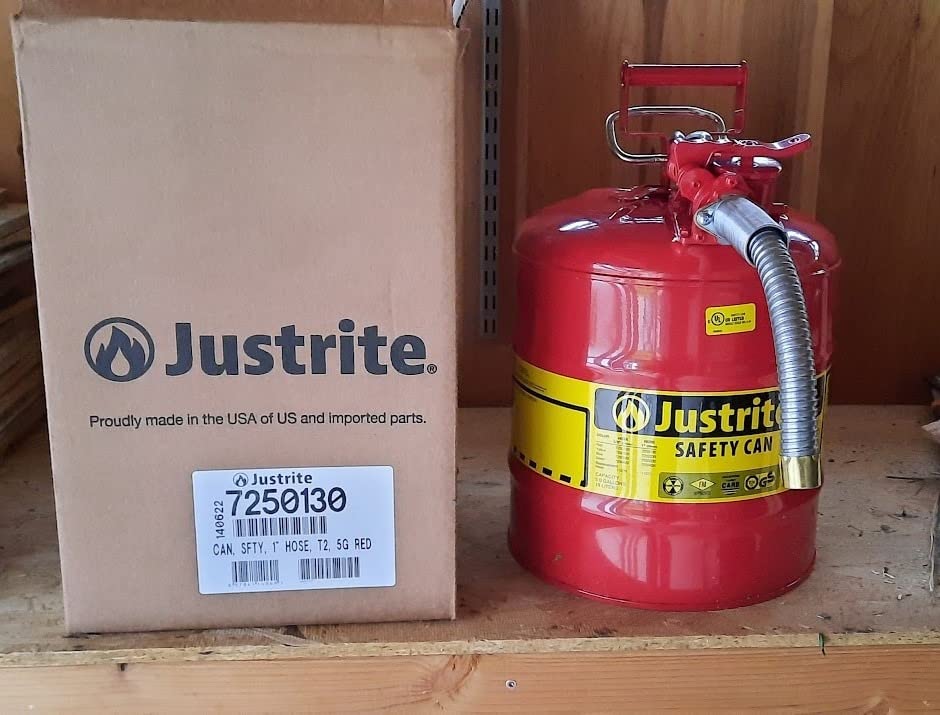
If you fill a lot of narrow necks, the Justrite Type II is the most refined pour control in this group. The patented manifold and Safe-Squeeze trigger combine with a 9 inch flexible metal hose, and together they let you fill a small tank or a piece of equipment without wrestling to line up an opening. The hose simply goes where you point it while the can stays upright.
Certifications are the deepest stack here: FM Approved, UL and ULC Listed, TUV Certified, with OSHA and NFPA compliance stated. The stainless steel flame arrester is a step above the brass screens used on many competitors, and the self-closing leak-tight lid handles both openings. The galvanized steel body carries a chemical-resistant powder coat and is pressure-tested, and the ergonomic lift lever makes getting the lid open a one-hand job.
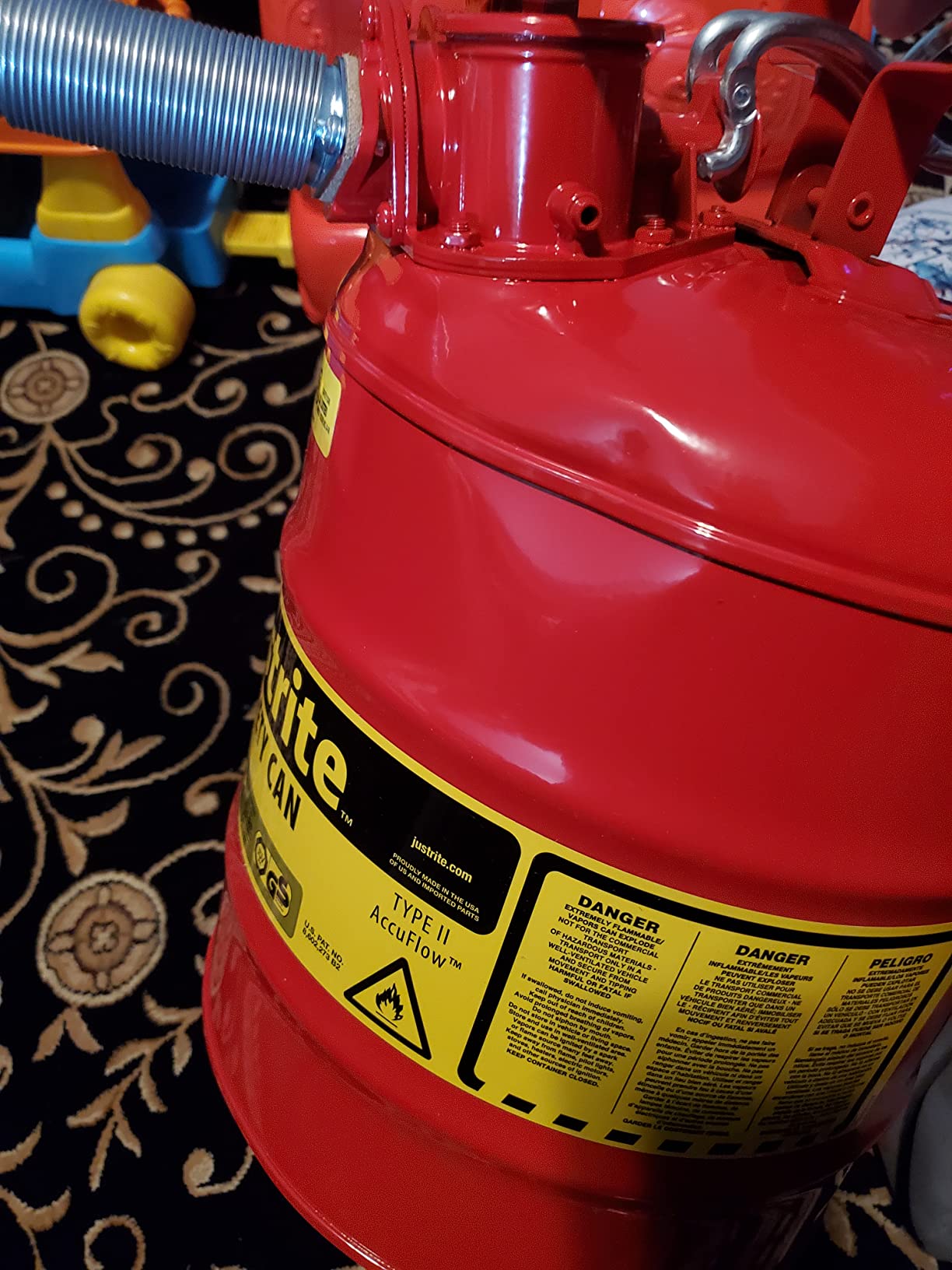
At 8.7 pounds empty and 11.7 by 10.9 inches, this is the heaviest unit in the roundup, and a full can is a real two-hand lift. That is the cost of the refined mechanism, and it is the reason this is a premium pick rather than the default recommendation. For a workshop where someone refills equipment all day, the control is worth it. For occasional use, it is more can than you need.
Justrite builds this as a serious industrial container, not a garden-shed accessory, and the approval stack reflects that. If you are buying one can for a workshop rather than a mower, this is the level of hardware the job deserves.
When the flexible hose earns its keep
The hose matters most when you fill through openings you cannot see. A mower tank under a deck, a boat fill below a gunwale, or a generator tank recessed behind a frame are all cases where a rigid spout means holding a full five-gallon can at an uncomfortable angle and hoping. The 9 inch hose removes that entirely.
It also makes decanting into a second, smaller can far easier, which is the move you need when you are topping up something that takes a litre rather than five gallons.
Who should buy a simpler can instead
If you are filling wide, visible openings once a month, the extra mechanism is not earning its weight. The Eagle Type I covers that case at half the empty weight. Choose this can when fill speed, fill accuracy and certification depth are all priorities, and you are filling enough to feel the difference.
4. SureCan 5 Gallon Type II Rotating Spout Container — Best for Spill Control
SureCan 5 Gallon Type II Storage Container – Rotating Spout, Self-Venting Design & Spill-Controlled Dispensing – Durable Multi-Purpose Utility Can (Red, SUR5SFG2)
5 gallon plastic
Type II self-venting
Thumb trigger and rotating spout
3-year limited warranty
Pros
- Rotating spout and thumb trigger pour without tipping the can
- Fast controlled dispensing owners rate as quick as a plain jerry can
- Thick wall construction with double o-ring spout seal
- Replacement spout seals and o-rings sold separately
- Made in the USA with a 3-year limited warranty
Cons
- Spring-loaded fill cap tends to pop off during filling
- Fill cap cannot be removed without forcing it
- High cost for a plastic can
The SureCan exists to solve one specific frustration: modern safety cans are hard to get fuel out of. Its solution is a downward-rotating spout you aim where you want the fuel to go, plus an ergonomic thumb trigger, so the can never needs tipping. Owners consistently report that once you get used to it, dispensing is as quick as a plain jerry can, without the aiming.
It is a self-venting Type II design, which supports steady dispensing and reduces splashing, and the spout uses a double o-ring seal with the trigger acting as a third barrier. The 3-year limited warranty and the availability of replacement spout seals and o-rings at sensible cost is a genuine advantage over sealed plastic designs that are disposable when a part cracks.
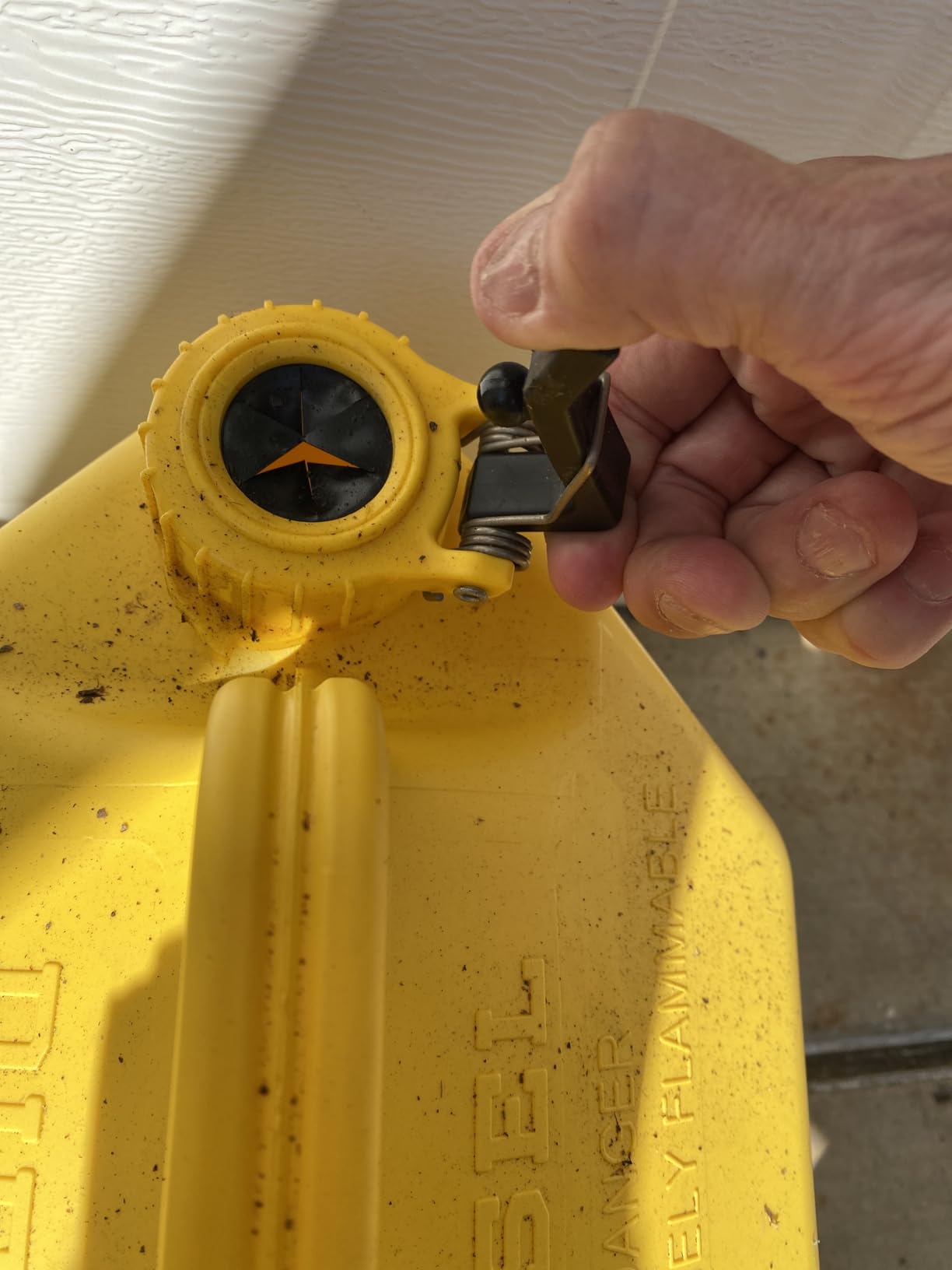
The repeated weakness is the fill cap. Several owners report the spring-loaded cap popping off during filling at the pump, and the locking mechanism on the fill lid is weak enough that it can detach when a pump nozzle is inserted. A loose plastic fragment left inside the can has also been reported. None of that is a reason to skip the can, but you should check the fill cap and its lock before every fill, and you should not store fuel in it long-term if the cap is loose.
This one sits at 4.6 stars across 1,454 reviews, which is a strong score on a smaller base. If you are done with cans that dump fuel when you tip them, it is the most direct fix available.

Whether the rotating spout is worth the trade-offs
Ask yourself how often you pour. If you are topping up a mower once a week, a conventional spout with a self-closing cap is enough. If you transfer fuel several times a week into small tanks, the rotating spout removes a real source of spills and the payback arrives quickly.
Also consider the fill cap seriously. Buy it if you are willing to make the cap and lock a pre-fill check item. Skip it if you want a can you can leave full in a shed for months without thinking about it.
Who will be disappointed by this can
Anyone who wants the indestructibility of steel. This is a plastic can with a good mechanism, and the mechanism has more parts that can wear than a Type I steel can with a single cap. It is also not stamped with FM or UL approval, so it does not satisfy workplaces that require a certified container.
5. Justrite Type I Gasoline Safety Can — Best for Long-Term Storage
Justrite Type I Gasoline Safety Can, Red Galvanized Steel, Made in the USA
5 gallon alloy steel
Type I single opening
Counterbalanced handle
Stainless flame arrester
Pros
- Spring-loaded lever guarantees zero spillage when released
- Galvanized steel preserves fuel far longer than plastic
- Deep stainless mesh screen allows full-depth nozzle insertion
- Integrated bottom lip levels the can when set down
- FM Approved and UL/ULC Listed and TUV Certified
Cons
- Higher cost than plastic cans of the same capacity
- Funnel not included and sold separately
- 7 pounds empty makes a full can heavy to hold at an angle
This is the Justrite Type I, and the difference from the Eagle is mechanical refinement rather than a step up in rating, at 4.6 across 2,194 reviews. The counterbalanced swinging handle does something clever: it stays open while you grip it, so the same hand that lifts the lid holds it open, and the can stays balanced while you pour. The integrated bottom lip levels the can when you set it down, which is a small courtesy that stops you tipping a loaded can over while you wrestle the cap off.
Long-form owners overwhelmingly frame this as a lifetime purchase that replaces leaking plastic cans. The recurring themes are the spring-loaded cap, the counterbalanced handle, and the fact that a metal can keeps gasoline potent far longer and does not leak fuel odour into a vehicle cabin. The deep stainless mesh screen is deep enough to allow a full-depth fuel nozzle insertion, so you can also use it to refuel from a bulk container.

The gripes are consistent: it costs more than plastic, the funnel is sold separately, and at 7 pounds empty a full can is heavy to hold at an angle. Some buyers also feel the steel gauge is not substantially heavier than cheaper generic steel cans, which is a fair criticism of the category at large.

What the counterbalanced handle changes in practice
Two hands are working on this can at once: one on the handle, one on the cap. The counterbalanced swing means the hand already holding the handle is the hand that holds the lid open, so the cap never has to be wedged, propped or gripped awkwardly. On a full five-gallon can, that is the difference between a controlled pour and a two-handed wrestling match.
The integrated bottom lip is the other quiet gain. When you set the can down, the lip finds level ground and the can settles flat, rather than rocking on its curved base while you try to remove the cap.
What you give up by choosing this over the Eagle
You give up the included funnel, which the Eagle ships with, and you give up roughly a pound and a half of empty weight. You do not give up certification: both are FM Approved, UL and ULC Listed, TUV Certified, with OSHA and NFPA compliance. The choice between them is really about handle feel and whether you already own a flame-arrested funnel.
6. Wavian USA 20 Litre NATO Jerry Can and Spout System — Best for Off-Road
Wavian USA Authentic NATO Jerry Can and Spout System – Rust-Proof, EPA & CARB Compliant, Red, 20 Litre, Metal Gas Can 5 Gallon
20 litre alloy steel
NATO specification
0.9mm cold-rolled steel
EPA and CARB compliant
Pros
- True NATO-spec 20 litre can with recessed welded seams
- Reviewers report it stays airtight even carried full and on its side
- Thick gauge steel and anti-corrosive coating survive rough use
- Stackable design unlike most plastic cans
- Trusted by military and off-road users
Cons
- Highest cost in the roundup
- Included plastic nozzle widely criticised by owners
- A full transfer can take 7 to 10 minutes
This is not a Type I or Type II safety can, and it is worth including anyway because reviewers describe it as the most genuinely leak-proof container they have owned. It is a NATO-specification 20 litre can built from 0.9mm cold-rolled steel with an anti-corrosive coating, with recessed, continuously welded seams, a three-position NATO handle, and a rubber-gasketed lever-lock lid with a locking pin. It is EPA registered (SGVYPMETALJC-001-R01) and CARB certified (EO G-26-143), so it is legal across North America.
Owners repeatedly confirm it holds fuel tight even lying on its side in a vehicle, and the welding quality is praised as clearly superior to no-name Euro-style cans. It is also stackable, which almost no plastic can manages honestly. This is the pick if your fuel lives in a truck, a camper or a trailer and you need a container that survives being knocked about.
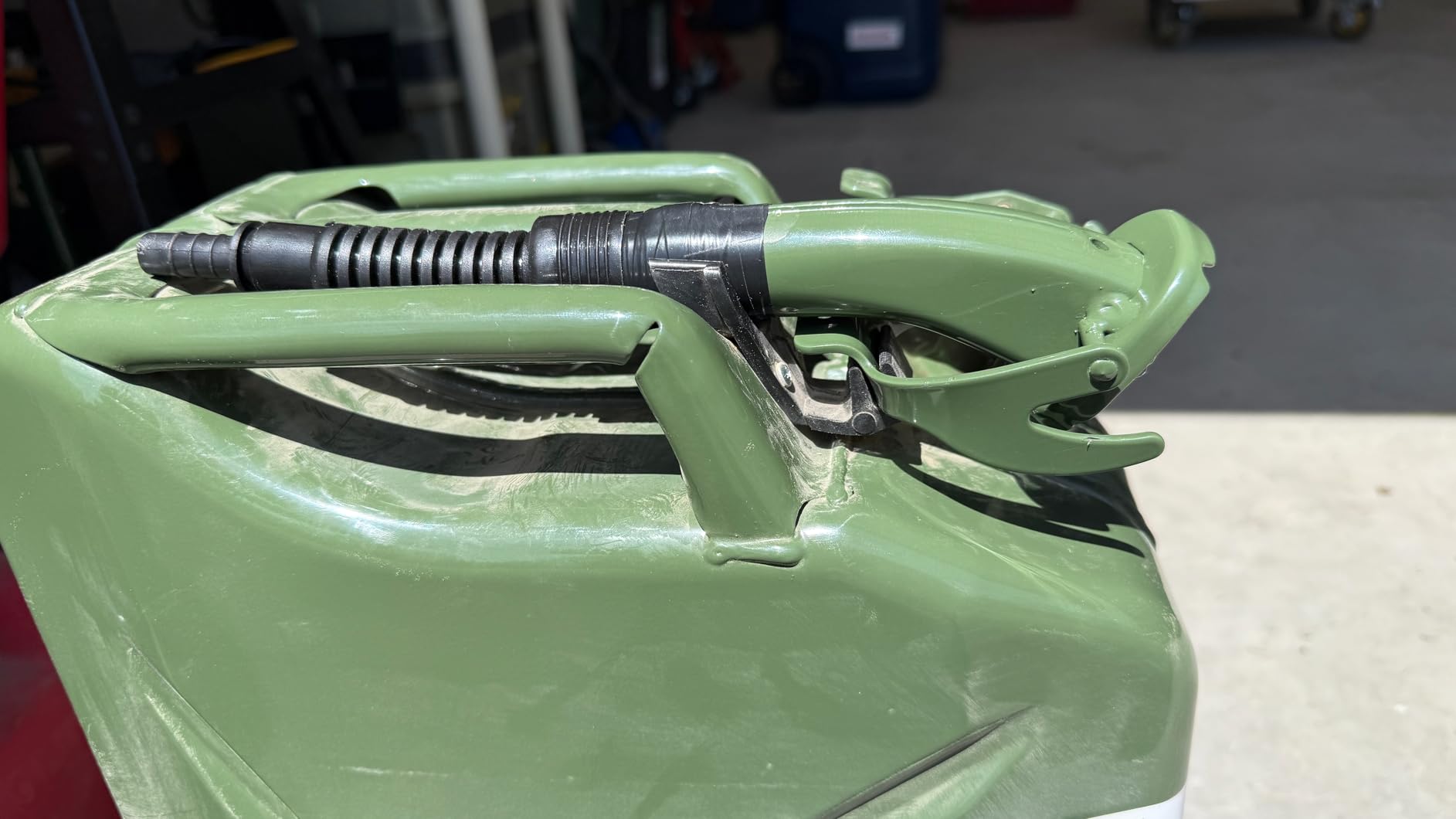
The dominant criticism is the supplied plastic nozzle, which multiple owners call nearly useless. The near-universal advice is to remove the white plastic filter sleeve and add a separate NATO long-nose flexible spout, which reviewers say transforms the pour. Pour speed is slow even with the better spout, with a full five-gallon transfer commonly taking 7 to 10 minutes, and there is no side handle, so a full can is awkward to hold at an angle.
It is the most expensive can here, and it is worth that only if leak-proofness in rough conditions is your top priority over dispensing speed.
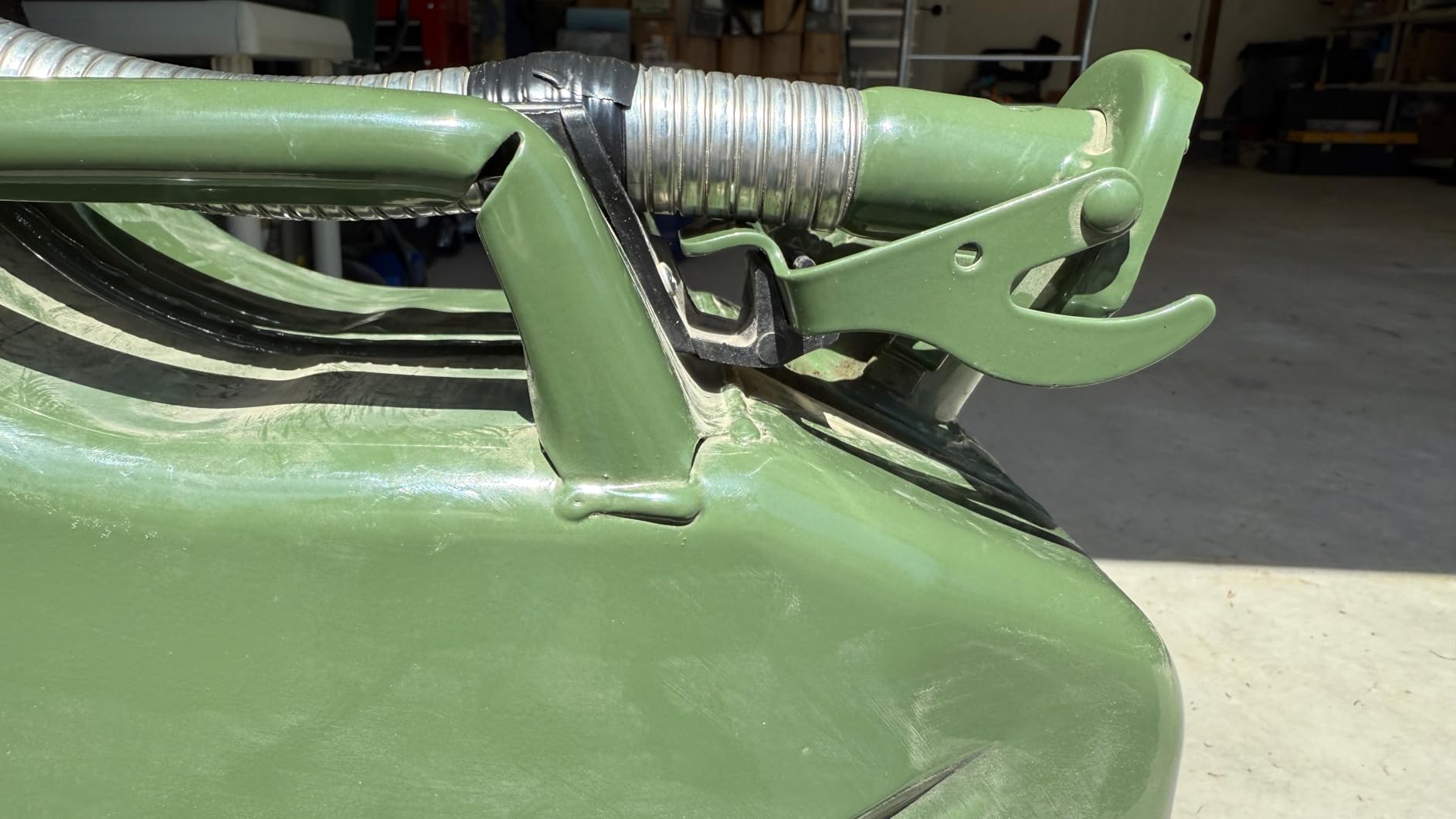
What the off-road community gets right and wrong about roof transport
Forums full of campers and overlanders repeatedly raise carrying a full can on a vehicle roof, and the consensus in those threads is unambiguous: do not. A container failure in that position, whether from heat expansion, an unsecured lid or a puncture, puts a spreading fuel fire above the vehicle and above the people in it. A thread on the Grand Design owners forums records exactly this warning against placing a flammable liquid on a roof.
Transport fuel in the bed of a pickup, in a secured cargo area, or in an exterior compartment rated for it, upright and restrained so it cannot tip. Never through a pass-through into a living space. Every recommendation in this roundup assumes you solve transport that way, because no can design makes roof transport acceptable.
When this can is the wrong choice
If you need fast dispensing, look elsewhere. Seven to ten minutes for a full transfer is a long time to stand in a cold yard, and the supplied nozzle is the weak point. If you refill often, add a proper long-nose flexible spout or choose a can with a built-in controlled flow.
7. Scepter 5 Gallon Spill Proof SmartControl Gas Can — Best for Fast Fills
Scepter 5 Gal Gas Can, Spill Proof SmartControl Spout, Spout Extender, Red
5 gallon plastic
SmartControl lever spout
Integrated air vent
ASTM F852
Pros
- SmartControl spout meters flow and cuts drips and spills
- Fills up to 3 gallons per minute with included funnel
- Light at 2.5 pounds while holding 5 gallons
- EPA and CARB compliant with child-safety certification
- 2-year manufacturer warranty
Cons
- 4.3 average with a 9 percent one-star share
- Polypropylene spout and moving plastic parts degrade with fuel exposure
- Flow control requires squeezing the lever through long fills
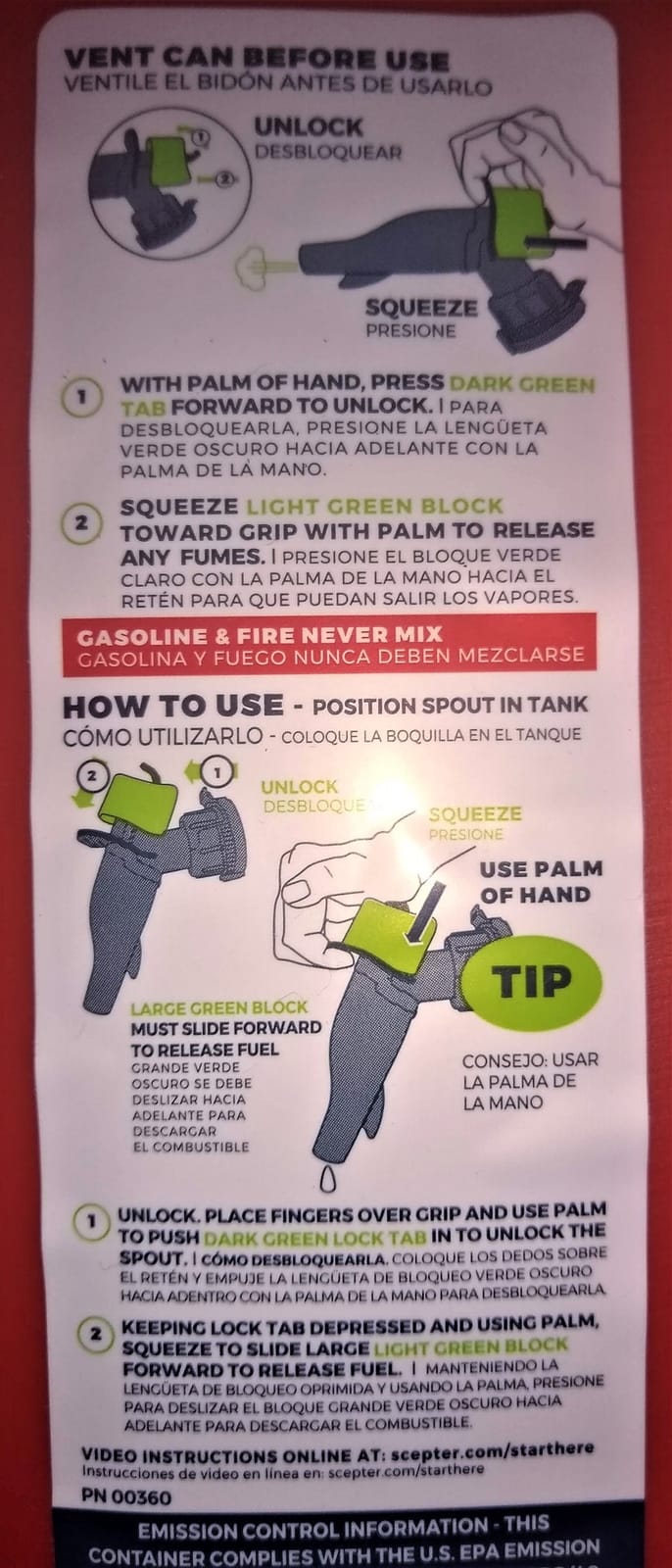
The Scepter is the fast-filling option. The SmartControl lever lets you choose a trickle or a full stream rather than dealing with an on-or-off valve, and the integrated air vent in the spout combined with the included funnel produces fill rates up to 3 gallons per minute. That matters most at the pump, where standing in line holding a nozzle is the part everyone dreads.
It is also light, at 2.5 pounds empty while holding five gallons, roughly half the empty weight of the steel cans in this roundup. The 5-layer construction limits vapour leaks and preserves gasoline longer than a single-layer jug, there is a flame mitigation device, and it meets ASTM F852 with EPA, CARB and child-safety certification. The rear handle and storage ring keep the bonus funnel with the can.
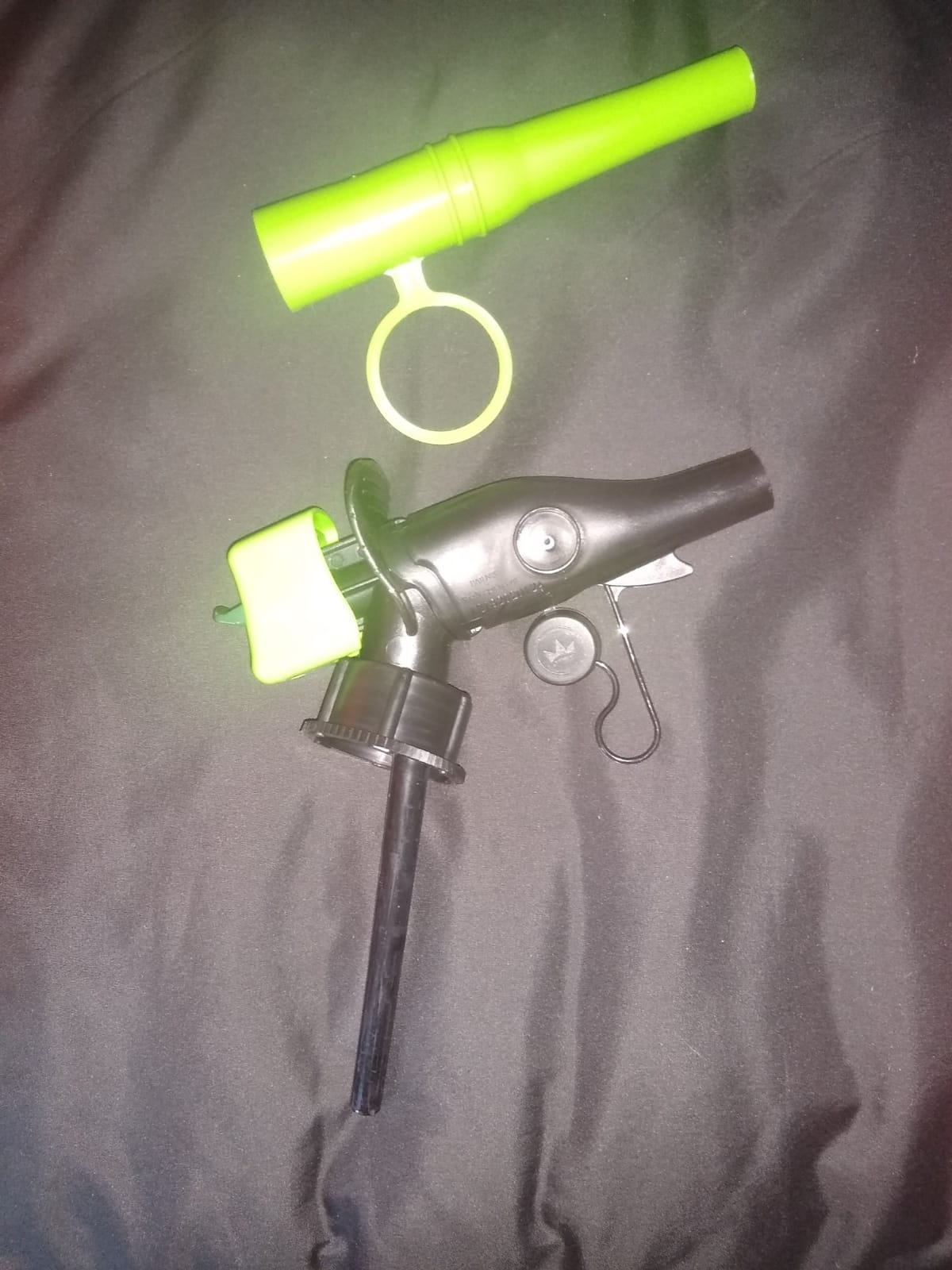
At 4.3 stars across 3,515 reviews, it sits below the steel cans in this roundup, and the reason shows up in the reviews: 9 percent one-star. The complaints concentrate on the polypropylene spout and its moving plastic parts degrading with repeated fuel exposure, and on the lever requiring a sustained squeeze during long fills. Buy it for speed and lightness, not for lifetime durability.
Why the fill rate matters at the pump
Three gallons per minute changes a real experience. A 2.5 gallon fill at that rate is under a minute of nozzle time, versus several minutes of standing there watching a thin stream. The integrated air vent in the spout is what allows it, because venting is usually what throttles fill speed in a safety can.
The flip side is real: fast filling at a pump means you need a slow, attentive hand on the lever. The trickle setting exists for exactly that, and using it is the difference between a clean fill and a splash down your leg.
How long this can is likely to last
Treat the spout as a consumable and the can outlives it. Polypropylene parts exposed to gasoline repeatedly will stiffen and crack long before the HDPE body gives up, and that is where the one-star reviews come from. The 2-year manufacturer warranty and the EPA, CARB and child-safety compliance are real, but the mechanical parts are the weak point to watch.
8. Midwest Can 2310 Safe-Flo 2 Gallon Gas Can — Budget Pick
Midwest Can 2310 Safe-Flo Auto Shut Off 2 Gallon Gas Can – Durable Fuel Container with FlameShield Safety System & Quick-Flow Spout – Red – 1 Pack
2 gallon and 8 ounces
HDPE with barrier layers
Quick-Flow spout
Exceeds CARB and EPA
Pros
- Quick-Flow spout with auto shutoff prevents overfilling and spills
- 2.5x faster flow than a standard spout
- FlameShield combines internal flame mitigation with vapor-locking spout
- Compact 2 gallon size is easy to carry
- Barrier HDPE construction limits vapour escape
Cons
- 4.2 average with an 11 percent one-star share
- Auto shutoff can make simple pouring feel finicky
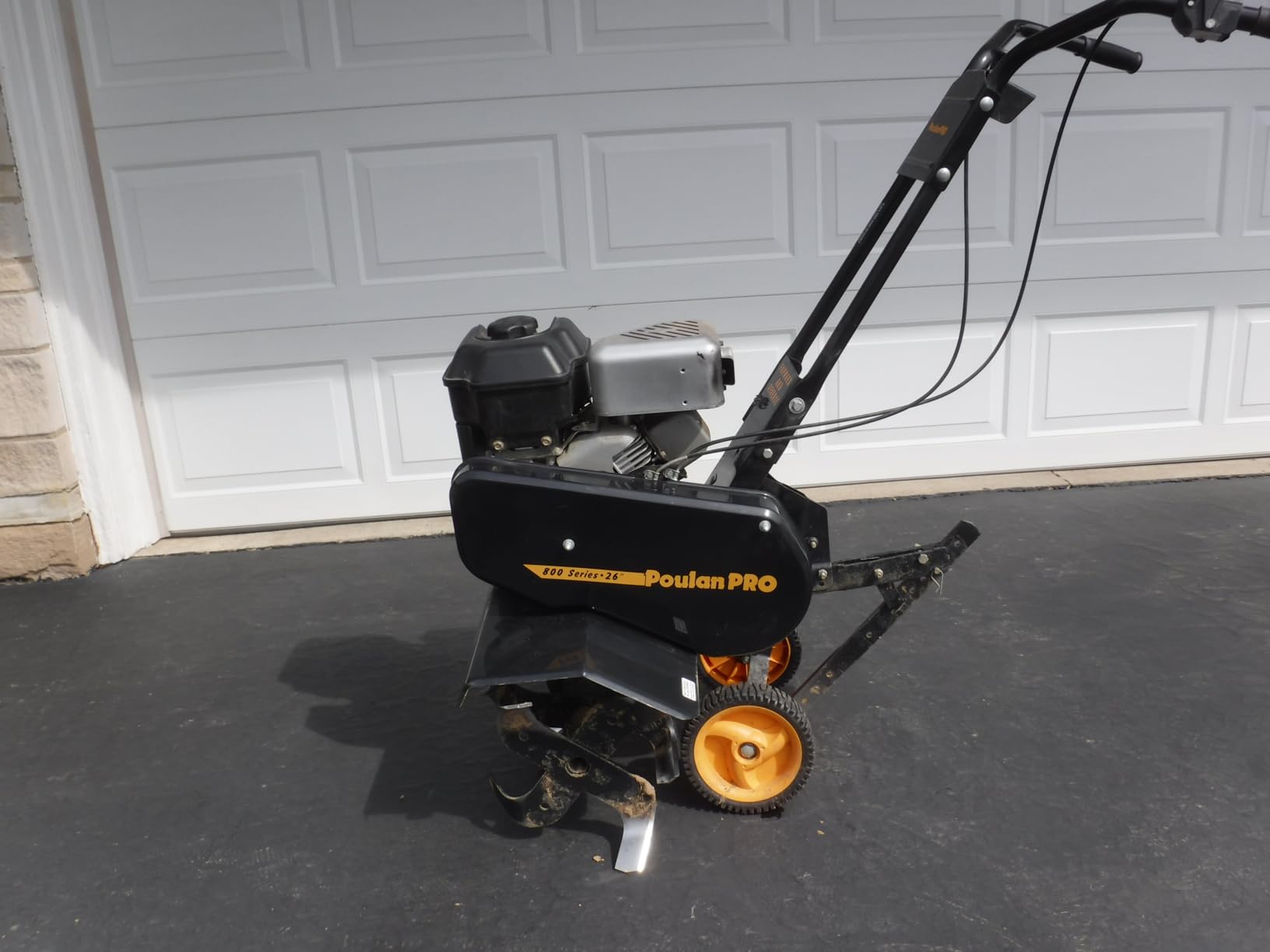
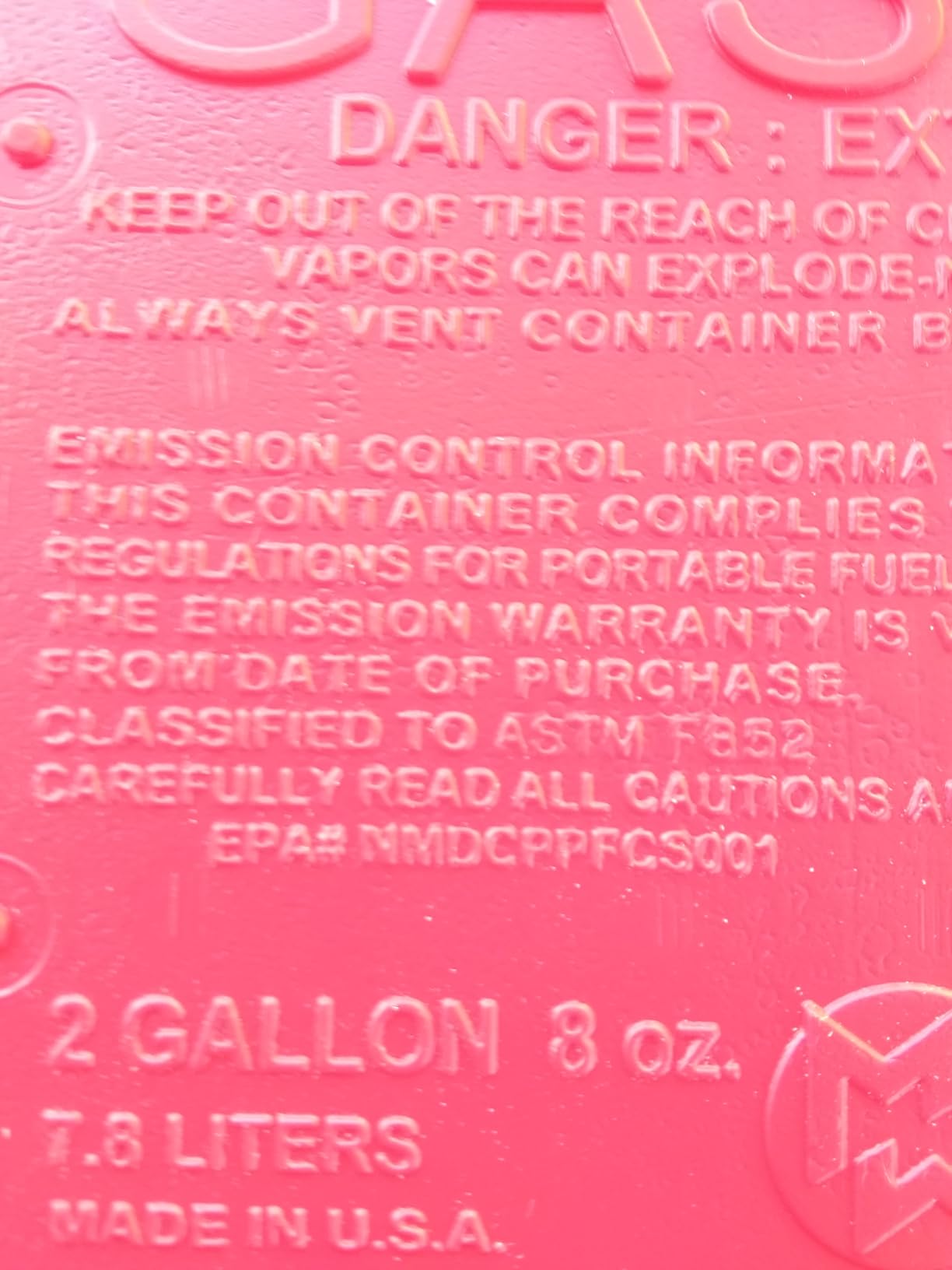
The Midwest Can is the smallest can here, and it targets a specific job: two-stroke mixing and small engines. It holds 2 gallons and 8 ounces of gas and oil mixes, which gives you working room to swirl a ratio properly instead of mixing across a nearly full five-gallon can.
The FlameShield Safety System is the part worth understanding. It combines an internal flame mitigation device with a vapor-locking spout, so you have two layers of vapour control rather than one. The Quick-Flow spout delivers 2.5x faster flow than a standard spout and the auto shutoff stops the flow when you release it, which prevents overfilling. The body is HDPE with barrier materials intended to virtually eliminate hydrocarbon emissions, and it exceeds CARB and EPA regulations with a 1-year warranty.
It also has a 4.2 average across 1,318 reviews, with an 11 percent one-star share. The recurring complaint is that the auto shutoff mechanism adds friction to what should be a simple pour, and safety systems that fight you tend to get worked around, which defeats their purpose. I would pick the No Spill 1405 for the same capacity class if the two were the same price.
What FlameShield actually does for you
It layers protection. The internal flame mitigation device sits inside the can near the vapour space, and the vapor-locking spout is the second layer at the point where vapour actually escapes. Neither layer replaces the other, which is why it holds up better under repeated handling than a single-screen design.
The barrier materials in the HDPE are the third element, and they target emissions rather than ignition: they slow the escape of hydrocarbons, which matters if the can lives in a garage rather than a shed.
When the auto shutoff is more nuisance than help
Auto shutoff is tuned for topping up, where you release the lever at the filler neck. It is less comfortable when you are decanting a measured amount into a small container and want the last of the fuel out, because the mechanism engages to stop flow and you then work around it. That friction is the single most common complaint in the reviews here.
9. VP Racing 35221 Motorsport Jug with 14 Inch Hose — Best for Non-Fuel Fluids
VP Racing 35221-CA, 5.5 Gal. Square Patriotic Motorsport Jug w/ 14 Inch Deluxe Filler Hose Close-Trimmed Cap and Neck for Tighter Seal
5.5 gallon HDPE
14 inch deluxe filler hose
Close-trimmed cap and neck
NOT FOR USE WITH FUEL
Pros
- 14 inch deluxe hose reaches awkward filler necks on older vehicles
- Close-trimmed cap and neck create a tight leak-free seal
- Built with 30 percent more material than conventional jugs
- Extra wide base grip makes a full jug manageable
Cons
- Labeled NOT FOR USE WITH FUEL in the listing and on the product
- Included hose will not screw into the cap without a separate threaded cap
- 21 inch tall profile takes more cargo space than a standard can
Read the label before anything else: this jug and its listing are both marked NOT FOR USE WITH FUEL. It appears in fuel jug searches and it is not a safety gas can, so do not put gasoline in it. What it is very good at is moving heavy non-fuel fluids — motor oil, coolant, gear fluid, non-potable water, premixed concentrate — without leaking.
For that job it is excellent. The 14 inch deluxe filler hose reaches awkward filler necks on older vehicles, and the close-trimmed cap and neck create a tight seal, which is the reason owners describe these as the only jug style that seals perfectly without the fiddly new-regulation spouts. The body uses even-density plastic reinforcement in the high-stress corner areas and is manufactured with 30 percent more material than conventional motorsport jugs, so it feels rigid rather than floppy. The extra wide base handgrip makes a full jug manageable, and at 5 pounds empty it is lighter than most 5.5 gallon containers.
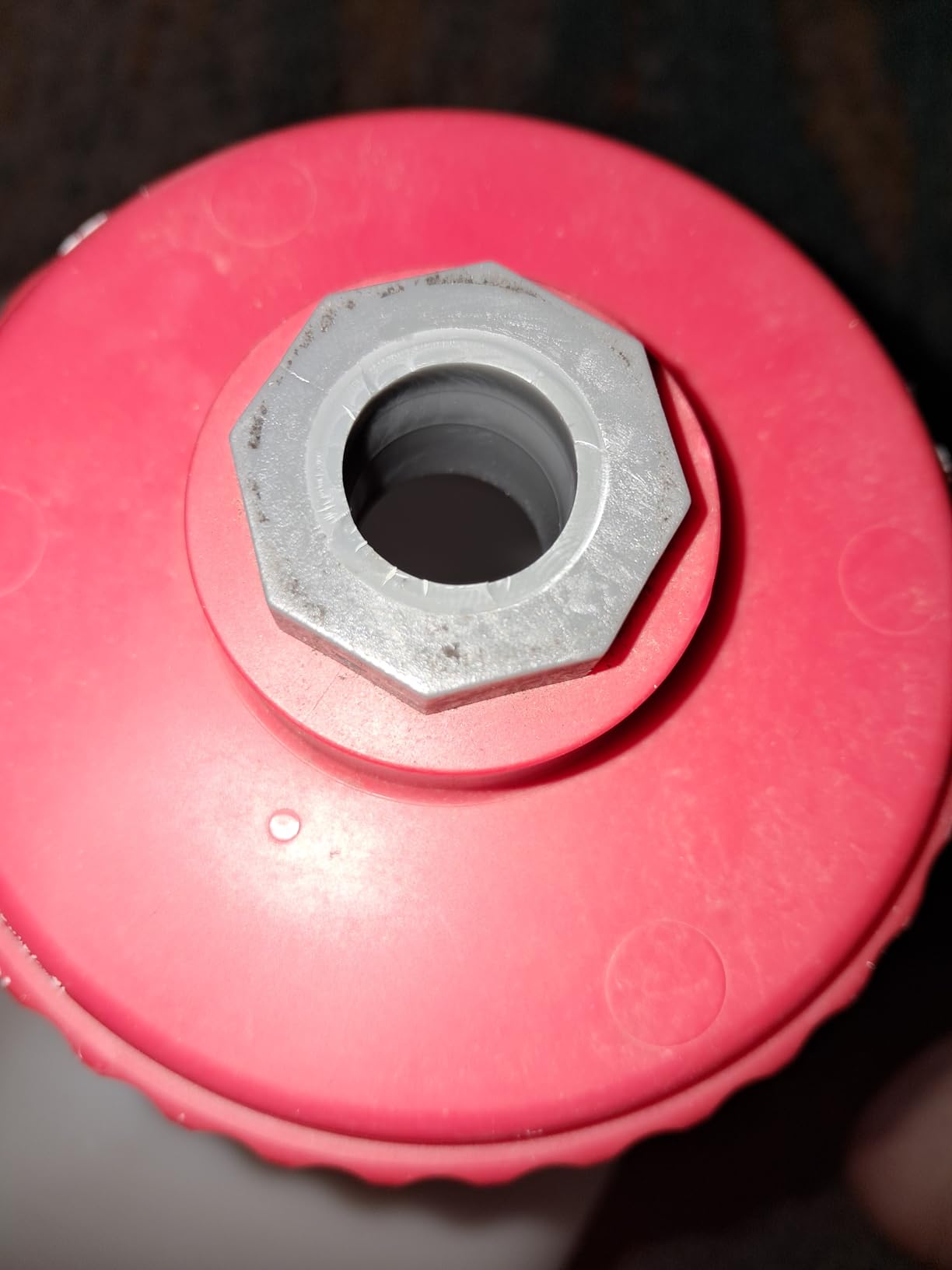
One practical trap: the included hose will not screw into the cap without a separate threaded cap, and a few buyers have only discovered that after the jug arrived. Check the parts list before you commit. The 21 inch height also eats more cargo space than a standard can, so measure your trailer or bed before buying two.
Jobs this jug is genuinely right for
Moving used motor oil, coolant, premixed concentrate or non-potable water across a property without a dribble down the tailgate. The close-trimmed seal is the reason it outperforms generic jugs here, and the 14 inch hose means you do not have to hold a five-gallon load at a steep angle to reach an awkward filler.
It is also a good weekend-project container, because the tank is not going to be sitting in a hot vehicle for months waiting to be used.
What you must not do with it
Do not put gasoline, diesel or kerosene in it. The label is explicit and it is there because the jug is not certified for fuel vapour service, not because of a marketing technicality. Buying this expecting a fuel can is the single mistake its reviewers report, and the returns that follow are handled by automated responses, so the time cost lands on you.
10. Fuelworx 5 Gallon Stackable Gas Can — Best for Stacking
Fuelworx 5 Gallon Gas Can, CARB Compliant, Stackable, Red
5 gallon HDPE
Push-button fast-flow vent
360 degree nozzle
Dual handles
Pros
- Genuinely stackable and interlock when empty saving space
- Push-button fast-flow vent empties fuel in under 60 seconds
- Swivelling spout lets you orient the trigger for dispensing
- Dual handles make carrying and pouring easier
- Thick HDPE construction reviewers say should last a long time
Cons
- Internal mesh screen makes pump filling slow and splash-prone
- Stiff child-safety ring must be torqued fully to avoid leaking
- Plastic body can deform in heat or altitude changes
Stacking is the entire pitch here, and it is a real advantage in a shed, a trailer or a truck bed where floor space is the constraint. These cans interlock when empty, and with two handles for carrying and pouring plus a swivelling 360 degree nozzle that lets you orient the trigger, the ergonomics are better than the price suggests.
The push-button non-spill fast-flow vent is the other selling point. Reviewers say it empties the can in less than 60 seconds, which is genuinely useful for draining old fuel or for emptying a can before storing it. Made in the USA, in HDPE, at 1 kg.
The complaints are specific and worth weighing. The internal mesh screen slows filling at a pump and causes splash-back. The child-safety locking ring is stiff and has to be torqued fully or the can will weep. The trigger and the vent button together effectively require two hands, which is awkward when you are trying to hold a funnel. The wide mouth means standard replacement spouts will not fit if you break it. And the plastic body can deform or expand in heat or at altitude, which is the complaint that shows up repeatedly in forum threads about cans ballooning on a hot vehicle.
At 4.3 across 334 reviews, the review base is small. Rating distribution skews positive with 69 percent five-star and 13 percent four-star. If you are stacking cans in a shed, this is the only one here that genuinely does it.
Whether stacking is worth the filling compromise
Look at what you get: a push-button vent that empties in under 60 seconds and a 360 degree swivelling nozzle, so you are not hunting for an orientation that lets the trigger sit under your fingers. That combination is genuinely better than most five-gallon cans for a quick top-up.
What you trade is the fill. The internal mesh screen slows pump filling and causes splash-back, and the trigger plus the vent button together effectively need two hands. If you fill rarely and store a lot, that is a good deal. If you fill often, the Scepter is faster and the Midwest Can has fewer moving parts.
Check this before the first hot summer
Two things to inspect. The child-safety locking ring is stiff and has to be torqued fully or the can will weep, so find that out on day one rather than in August. And the plastic body can deform or expand in heat or at altitude, which is exactly the ballooning reported by owners who left cans in a hot vehicle.
For that reason I would keep it in a shaded shed rather than in a truck bed over a long trip, and check the body shape before every fill.
11. VP Racing 3846 Camo Motorsports Jug — Best for Compact Carry
VP Racing 3846-CA, 5.5 Gallon Motorsports Jug Camo Square w/Hose
5.5 gallon HDPE
14 inch hose
3.2 pounds empty
Camo finish
Pros
- Rigid reinforced body that reviewers report does not leak
- 14 inch hose makes pouring into tight openings straightforward
- Simple no-frills design without new-regulation safety spouts
- Lighter at 3.2 pounds than other 5.5 gallon jugs
Cons
- Labeled NOT FOR USE WITH FUEL despite appearing in fuel jug searches
- Return service described as repetitive automated responses
- Refund processing reported as slow
This is the same core jug as the previous VP Racing entry in a camo finish, and at 3.2 pounds empty it is the lighter of the two 5.5 gallon containers here. The reinforcement sits in the high-stress corner areas, the body is built with 30 percent more material than conventional utility jugs, and the extra wide base grip plus ergonomic venting handle make it easy to carry and pour.
Reviewers report a rigid body that does not leak at all, and the 14 inch hose makes tight filler necks straightforward. The design is also refreshingly simple, with none of the new-regulation safety spouts, which owners who dislike fiddly mechanisms genuinely appreciate. The camo graphics appeal to off-road and hunting users, and at 358 reviews the feedback is newer and more polarised than the rest of this list.
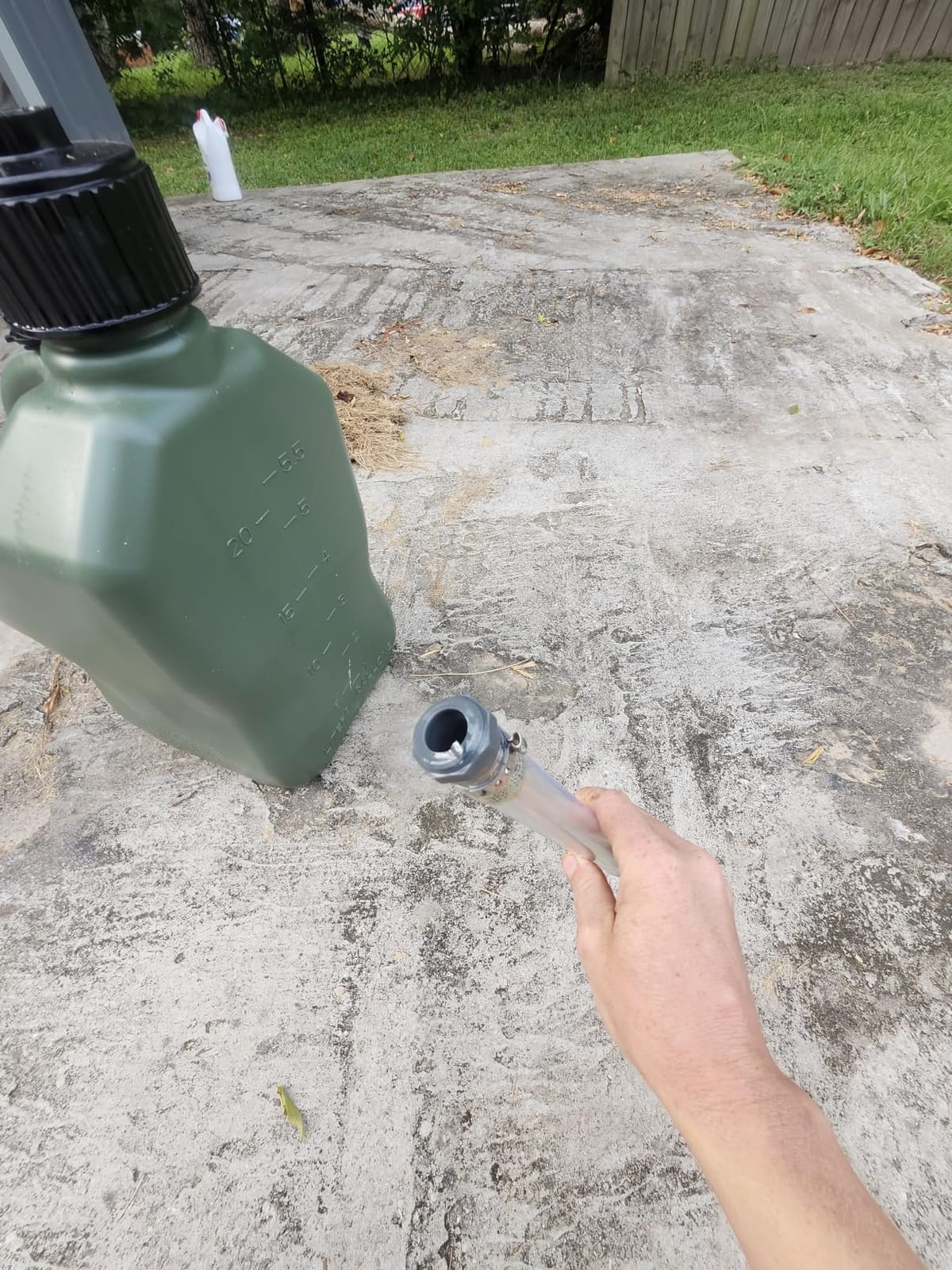
Every one-star and two-star review traces back to the same thing: the NOT FOR USE WITH FUEL label, combined with the fact that the jug appears prominently in fuel jug searches, so buyers expect a fuel can and return it. The follow-on complaints are about customer service, with returns answered by repetitive automated responses and slow refund processing. Neither of those is a fault in the product, but both will cost you time.
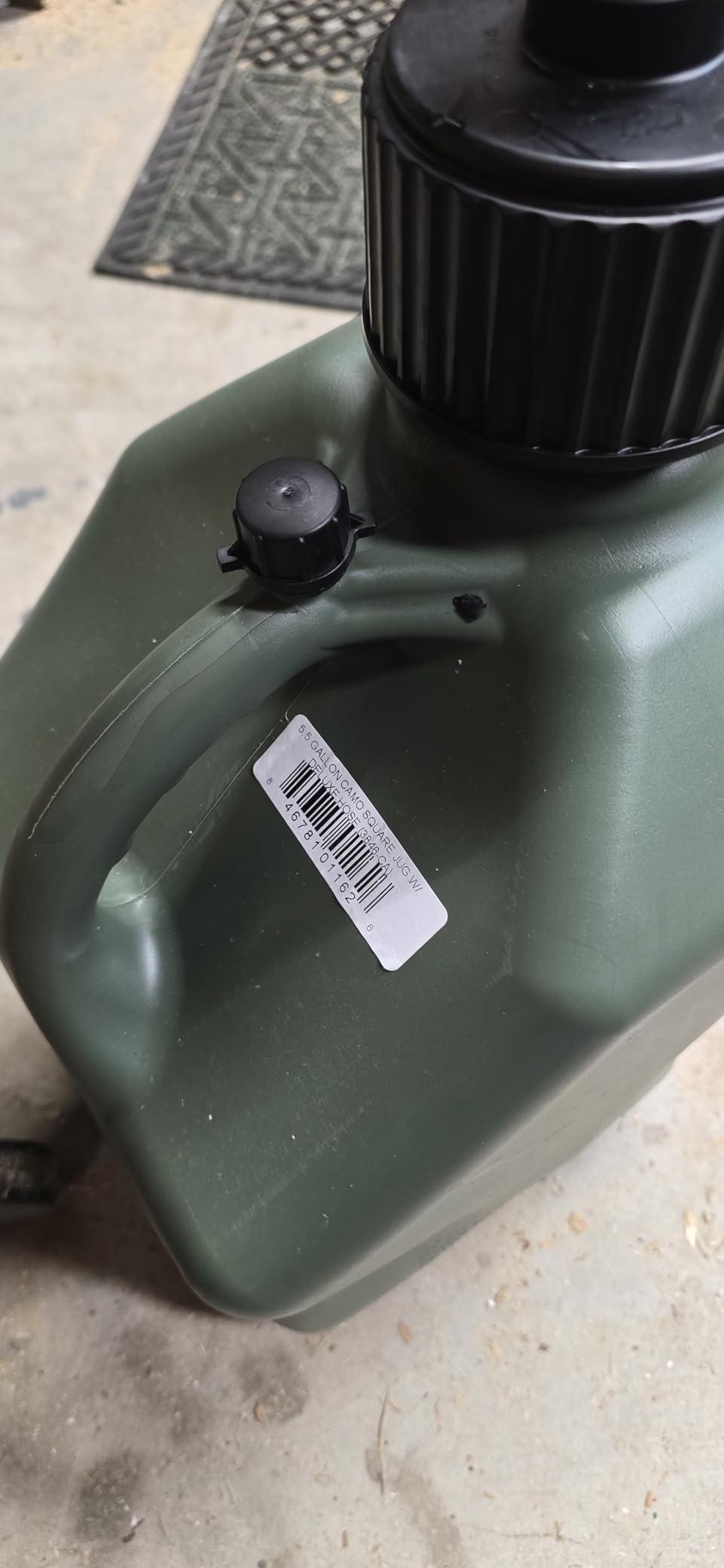
Why this one is lighter than the Patriotic jug
Both hold 5.5 gallons with a 14 inch hose and the same reinforced body, but this one tips the scales at 3.2 pounds empty against 5 pounds for the Patriotic model. If you are carrying fluid across a yard or up to a workbench regularly, that difference is the whole argument.
The camo finish is also the more practical of the two outdoors, where a bright graphic jug in a truck bed attracts more attention than you would like.
Read the listing before you order, not after
The mismatch between the search context and the label is the whole story on this product. Confirm you want a non-fuel fluid container before you buy, and if you have any intention of putting fuel in it, choose a different can entirely.
Everything else about it is straightforward: a rigid reinforced body reviewers report does not leak, a 14 inch hose for tight openings, and a simple design with none of the new-regulation safety spouts that owners either love or hate.
12. VP Racing 3572 Orange Motorsport Jug — Best for Farm and Field
VP Racing 3572-CA Motorsport Jug – Orange, 5.5 Gallon Racing Fuel Jug, High Density Polyethylene
5.5 gallon HDPE
Even-density reinforced walls
Extra wide bottom grip
Not for fuel use
Pros
- Reinforced even-density HDPE resists cracking and deformation
- Built with 30 percent more material than standard jugs
- Extra wide bottom grip and ergonomic handle aid precise pouring
- 5.5 gallon capacity suits garage and farm fluid handling
Cons
- Not approved for use with fuel
- 3.2 pounds empty is heavier than some containers of a similar size
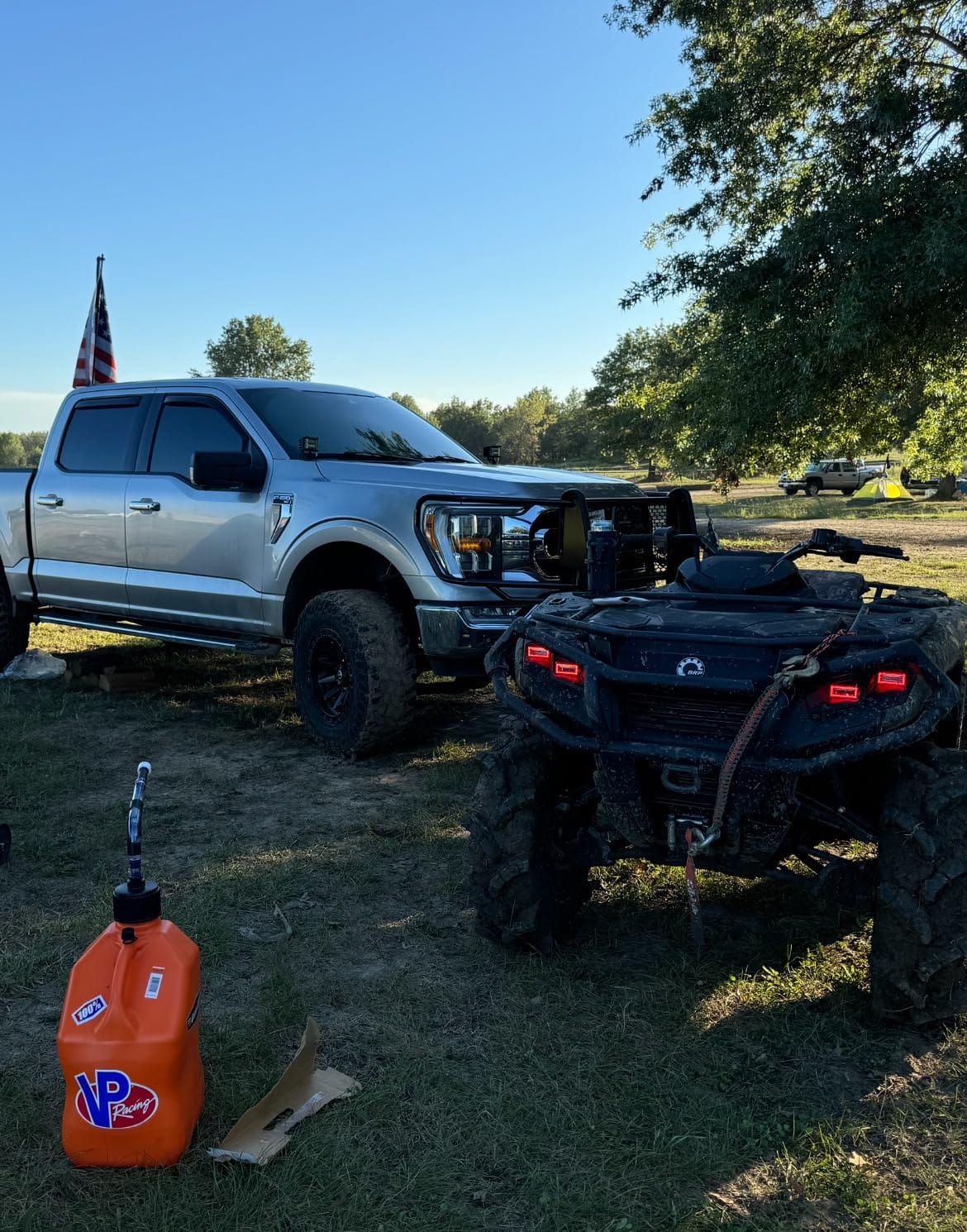
This orange jug rounds out the list with a straightforward multipurpose container. The design targets non-fuel applications explicitly, such as automotive fluids, non-potable water, animal feed and outdoor materials, and reviewers mention using it for mixing and dispensing industrial fluids and animal attractants around farms and workshops.
The construction is the same reinforced even-density HDPE used across the VP Racing jug range, with extra material in high-stress areas to resist cracking and deformation, and an extra wide bottom grip with an ergonomic handle for lifting, carrying and precise pouring. With 77 percent five-star and 8 percent four-star ratings across 233 reviews, approval is broad.
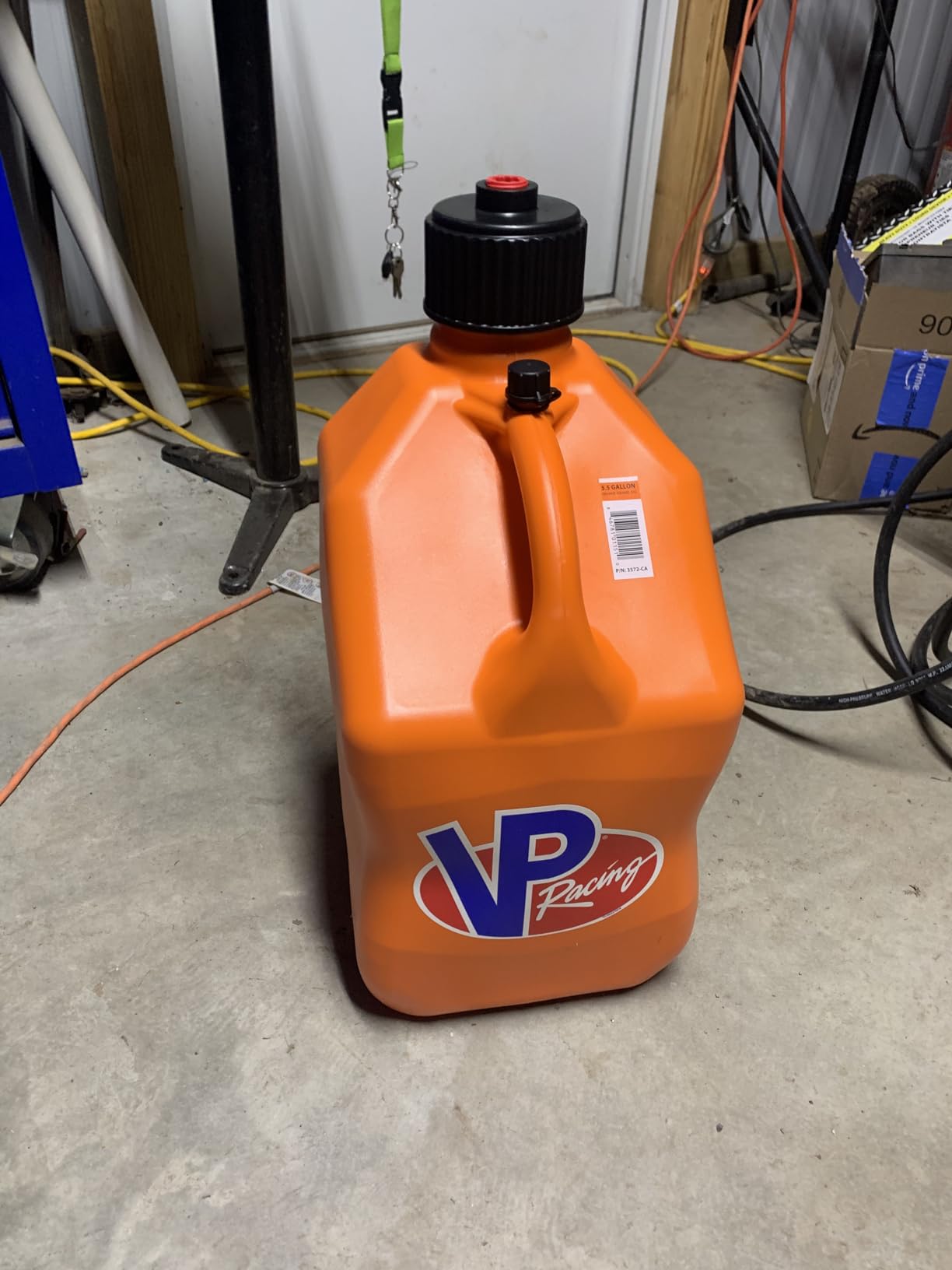
The limitation is straightforward: it is not approved for fuel, and at 3.2 pounds empty it is a heavier lift than some containers of a similar size. If you are mixing fertiliser solution, carrying water to a far paddock, or moving hydraulic fluid across a property, it does that job well and will outlast a thin-walled generic jug.
Where this jug earns its place on a property
Animal feed, water and non-potable mixing, plus industrial fluids and automotive fluids, are exactly the workloads it is designed for. The wide bottom grip takes the load when you are lifting a full jug out of a trailer bed, and the venting handle is positioned so you can pour without tipping the base into the mud.
It is also the one in this range that reviewers describe as versatile enough to be a general-purpose shop jug rather than a specialist one.
How to choose between the three VP Racing jugs
All three share the same reinforced HDPE body, the 30 percent extra material and the wide-grip ergonomic handle, and all three are labelled not for fuel. Choose on graphics and weight: the Patriotic model is 5 pounds, while the camo and orange models are 3.2 pounds each.
None of them is a safety gas can, so keep it out of the fuel conversation entirely and pick a certified can from the top of this list for that job.
Metal vs Plastic Gas Cans: Which Should You Buy?
Metal wins on fire resistance, fuel shelf life and long-term durability. Plastic wins on weight, cost and controlled dispensing. Here is the honest comparison.
Fire and spark resistance. A steel can does not melt or deform near a heat source, and it does not build the static charge that plastic bodies can in low-humidity conditions. Steel cans also hold their shape under heat expansion instead of ballooning.
Fuel preservation. This is the quiet advantage owners notice most. Gasoline stored in a sealed steel can keeps its potency far longer than the same fuel in plastic, because plastic walls are slightly permeable to hydrocarbons. That matters enormously if you are storing fuel for a generator you hope never to run.
Weight. The Eagle is 5.3 pounds empty, the Justrite Type I is 7 pounds and the Justrite Type II is 8.7 pounds. The Scepter holds five gallons at 2.5 pounds empty. A full steel can is a two-hand lift in every case here, while a full plastic can is a one-hand carry at your side.
Sealing and durability. Steel cans use welded or no-weld interlocked seams and last decades. Plastic cans have more moving parts — spouts, levers, o-rings, child locks — and each one is a wear point that degrades with repeated fuel exposure, which is exactly what owners of the lower-rated plastic cans in this list criticise.
Dispensing control. Plastic wins comfortably. A rotating spout, a thumb trigger and a self-venting Type II layout give flow control that a rigid steel spout cannot match without adding a hose, which is why the two Type II cans in this list are the most refined pourers.
Practical advice. Buy steel for anything long-term, anything near an ignition source, and anything in a vehicle. Buy plastic for weight, for frequent small pours, and for a second can that lives in the back of a truck. Most serious owners end up with one of each.
How We Evaluated These Safety Gas Cans
Rather than invent a laboratory, here is exactly how this list was built and where the information comes from.
We ranked on six criteria: the certification markings stated on the product, the presence of a real flame arrester rather than marketing language, the quality of the sealing mechanism, the pour control offered, the review volume and rating spread, and the physical build specification including gauge, finish and weight.
Approval marks came first because they eliminate the market’s biggest problem: unbranded marketplace cans that use the word “safety” with nothing behind it. Review volume mattered because a 4.6 from 10,000 owners tells you far more than a 4.9 from forty, and this roundup spans 233 to more than 10,000 reviews. Weight and capacity were considered together rather than separately, since a heavier can only be a problem if you are carrying it.
Where the data disagreed, we followed the reviews, and each weakness is stated as plainly as each strength in the write-ups above. The No Spill 1405 carries the largest review base in the list, so the complaints about it are the most thoroughly documented. We also flagged the three containers that are not approved for fuel rather than quietly presenting them as safety cans.
Every safety claim here rests on stated construction, published specifications and what tens of thousands of owners report in practice, not on our own test rig.
How to Store and Transport Fuel Safely
Owners argue about this constantly on forums, and the recurring questions are about temperature, altitude and vehicle transport. Here is the guidance that comes up consistently.
Store it outside. A detached shed is the right place. A fuel can in an attached garage shares an air volume and a wall with your house, and a fire there becomes your fire. Keep cans away from pilot lights, water heaters, furnaces and charging stations.
Store it upright, in the shade, and full. A full can has far less air and vapour space, so evaporation and the pressure that causes ballooning are minimised. Never store a part-full plastic can in a hot shed or a hot vehicle over a weekend.
Do not carry fuel on a roof or through a living space. This is the clearest consensus in the overlanding and RV communities: a container failure on a roof, or a pass-through into a living area, creates an ignition source above or inside the vehicle. Transport upright in a bed, cargo area or exterior compartment, restrained so it cannot tip.
Fill outdoors, upright, on concrete, and never in a passenger compartment. A single static spark from clothing is enough. Bond and ground the receiving tank if you are transferring between containers.
Inspect before every fill. Check the cap and its lock, the arrester screen for blockage, and the body for ballooning or a weeping seam. A bulging can is telling you something.
Fuel colour coding is worth memorising: red for gasoline, yellow for diesel, blue for kerosene. Diesel and gasoline fittings are not interchangeable, so check what your equipment takes before you fill anything.
For the machines that consume this fuel, our [best gas chainsaws guide](https://www.minormania.com/best-gas-chainsaws/) covers the small-engine end of things.
Buying Guide: What to Look for in a Safety Gas Can
Check the approvals first. FM, UL or ULC, plus OSHA 1910.106 and NFPA 30 language, is the benchmark. In California, look for a CARB executive order number, and an EPA registration for metal cans. If none of those markings appear on the can itself, walk away regardless of the listing claims.
Confirm a real flame arrester. A metal or stainless mesh screen inside the spout, ideally deep enough to allow a full-depth nozzle. Brass is acceptable; stainless lasts longer. A can with a “flame mitigation device” described only in plastic terms is a lower tier.
Look for a self-closing lid. It should seal the instant you release the lever or trigger. On Type II cans, both openings need their own self-closing cap.
Check the venting path. A vacuum-relief or automatic pressure-relief vent keeps the can from bulging in heat. This is what stops the ballooning owners report on plastic cans left in hot vehicles.
Match the can to the job. Type I for wide openings and simplicity, Type II for narrow necks and controlled flow. Two and a half gallons for hand-carried top-ups, five for generators and riding equipment.
Look for the seam and the gauge. No-weld double-interlock bottom seams and 24-gauge galvanized steel are the marks of a can built to last. On plastic, look for multi-layer or barrier construction rather than thin single-layer plastic.
For bigger jobs, our [best gas wood chippers picks](https://www.minormania.com/best-gas-wood-chippers/) cover the equipment that needs the most fuel per fill.
Consider the warranty and spares. A 2 to 3 year warranty and a stocked replacement spout seal or o-ring is a real signal. It is also why we rate the Scepter’s spares availability as a genuine plus.
Plan for retirement. Retire a plastic can when it cracks, permanently deforms, weeps at the seam, or when the spout mechanism no longer seals. Retire a steel can when rust perforates the body or the arrester screen is damaged. Do not repair a leaking fuel container.
How to Inspect a Used or Second-Hand Safety Can
Buying a used can is common, and no roundup we found publishes a checklist. Use these seven points.
Read the markings. Look for the approval text and the manufacturer. No markings means it is not a safety can no matter what the seller says.
Check the colour code matches the fuel you intend. Red gasoline, yellow diesel, blue kerosene.
Inspect the flame arrester. The mesh must be present, intact and not blocked. Poke it gently; if it is corroded through or packed solid, the can is finished.
Test the self-closing cap. Open it and release. It must snap shut with no drift. A cap that stays open leaks fuel into whatever it is sitting in.
Look for deformation. Bulging, collapsed sides or a warped lid are heat or age damage. Even if it looks fine now, it will fail in a hot vehicle.
Check the seams and base. Run your fingers along the bottom seam and every weld. A weeping stain, rust-through or a hairline crack is disqualifying.
Smell test, then wash and dry it. A can that reeks of fuel has been stored open or leaking; that smell will contaminate whatever you pour next. Let it air for a day in the shade before filling.
If any point fails, buy a new can. The cost of a replacement is trivial next to a fuel fire, and a failed can tells you nothing about why it failed. If you also need somewhere to put the fuel you drain out of it, our [diesel oil catch can reviews](https://www.minormania.com/best-diesel-oil-catch-cans/) cover the other side of that job.
Frequently Asked Questions
What are the best safe gasoline containers?
For most people the Eagle 5 Gallon Type I is the best safe gasoline container overall: 24-gauge galvanized steel, a self-closing gasketed spout cap, a non-sparking flame arrester and FM, UL and ULC approval. The No Spill 1405 2.5 gallon can is the best value pick for lawn equipment, and the Justrite Type II is the best for filling narrow necks with its 9 inch hose.
What gas cans are OSHA approved?
Look for approval markings printed on the can itself: FM Approval, UL or ULC listing, and reference to OSHA 1910.106 and NFPA 30. In this roundup the Justrite Type I and Type II cans, and the Eagle Type I, all carry FM, UL and ULC approvals with OSHA and NFPA compliance stated. Plastic cans are typically ASTM, CARB and EPA compliant rather than OSHA or FM approved.
Are there any gas cans that are leak-proof?
No container is absolutely leak-proof, but the build matters more than the word on the label. Look for no-weld double-interlock bottom seams on steel cans, or fused multi-layer barrier walls on plastic. Reviewers report the Wavian NATO can stays airtight even carried full and on its side, and the Eagle and Justrite Type I cans use interlocked seams that resist the bottom-seam failures common in cheaper cans.
Are metal gas cans safer than plastic ones?
Yes, for fire resistance, fuel preservation and long-term durability. Steel does not melt or deform near heat, does not build static as easily, does not balloon under temperature or altitude changes, and keeps gasoline potent far longer because it is not permeable to hydrocarbons. Plastic wins on weight and on dispensing control, which is why rotating-spout Type II designs use plastic.
Do I need a CARB compliant gas can?
In California, yes. CARB requires certified fuel containers for consumer and commercial use, and a compliant can will show a CARB executive order number alongside EPA compliance. The No Spill 1405 and the Midwest Can 2310 are listed as CARB compliant, and the Scepter 5 gallon can is EPA and CARB compliant. Outside California it is still worth having, since it also meets EPA emissions rules.
Related reading: if the equipment on the other end of the fuel line is a chainsaw, our [best gas chainsaws tested and reviewed](https://www.minormania.com/best-gas-chainsaws/) guide covers the machines that drink from these cans.
Final Verdict
The best safety gas can for most people in 2026 is the Eagle 5 Gallon Type I. It carries the highest rating in this roundup, it is FM, UL and ULC approved with OSHA 1910.106 and NFPA 30 compliance stated, the spout cap self-closes, and the flame-arrested F-15 funnel is in the box. It will also still be in service long after the plastic jugs you replace it with have cracked.
Buy the No Spill 1405 if you only ever fill hand-held equipment and want something light and precise. Buy the Justrite Type II if you pour into small, awkward openings all day and will accept the weight. Buy the Wavian NATO can if your fuel lives in a vehicle and leak-proofness matters more than pour speed. And buy one of the VP Racing jugs for oil, water and mixing, not for fuel.
Whichever you choose, keep it upright, keep it out of an attached garage, and never carry it through a living space or on a roof. That habit matters more than any feature on the label.