
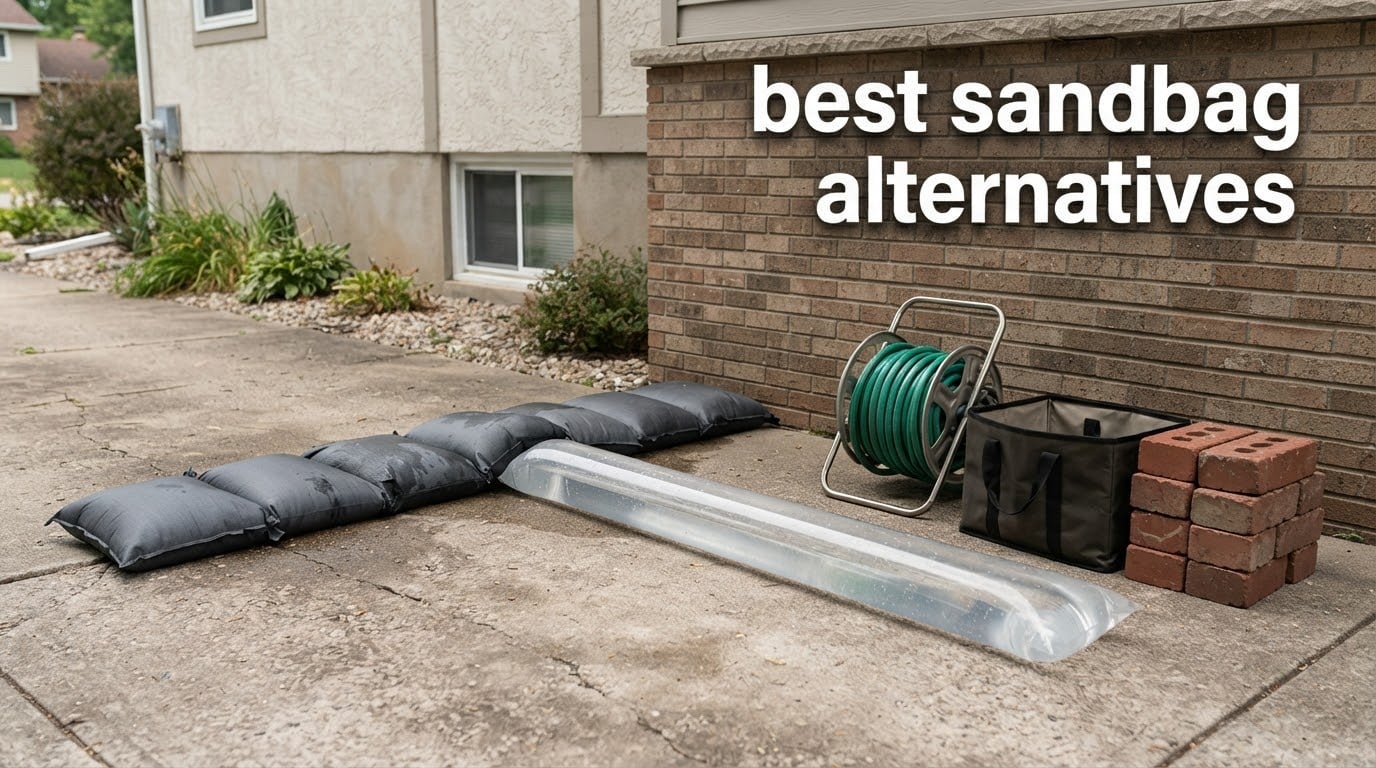
What can be used instead of sandbags? The honest answer is three families of products: water-activated gel bags that swell when they get wet, water-filled PVC tubes you fill with a garden hose, and portable water-weight bags that replace a sandbag in the gym. Add flood panels, straw bales and tarp barriers and you have the full menu. Our team spent 2026‘s storm season working through ten of the most-reviewed options to find out which ones actually hold water back and which ones quietly fail.
Sandbags have a deserved reputation. They are heavy, they take an afternoon to fill, they eat your garage, and the sand runs out. The people asking us for the best alternatives we could find usually fall into one of two groups. The first has a doorway or basement stair that floods twice a year and cannot wrestle forty-pound bags. The second wants a sandbag substitute for training, where a shifting load matters more than a wall of water.
Here is the thing nobody puts on the box: every product below is a temporary mitigation, not a fix. Most top out between three and twelve inches of water. None of them work in saltwater. And all of them are far easier to defeat at the ends of the barrier than in the middle. We name the failure modes for each one, and we tell you which households should skip this category entirely.
We rated these on filled height, filled weight, deployment time, material, storage footprint, review volume and the single most common complaint in the reviews. The roundup is updated for 2026, and every number below comes from the manufacturer listing or the aggregated review data.
Table of Contents
The 3 Best Sandbag Alternatives in 2026
The fastest pick is the Quick Dam, the best-rated training replacement is the Tidal Tank, and the reusable tube most buyers start with is the HydraBarrier Standard. These are the three we would buy first.

Quick Dam 5ft Flood Barrier
- Grows to 3.5 inches high
- Activates in minutes with water only
- Weighs 1.4 lb for the pair
- Folds flat for off-season storage

Tidal Tank Aqua Bag
- Adjustable up to 70 lb of water
- Folds to 2 by 5 inches
- Transparent body shows water level

HydraBarrier Standard
- 6 ft long by 4 in high
- Holds 7.5 gallons
- 20 mil industrial vinyl
- Connects end to end
All 10 Sandbag Alternatives Compared Side by Side (September 2026)
Every barrier in the table below fills with the same household resource you already own, which is the whole point. Read across the filled height column first, because that is the limit you will hit before anything else.
| Product | Specs | Action |
|---|---|---|
| Quick Dam 5ft Flood Barrier Pack of 2 |
|
Check Latest Price |
| Tidal Tank Aqua Bag |
|
Check Latest Price |
| HydraBarrier Ultra 12 ft |
|
Check Latest Price |
| HydraBarrier Standard 6 ft |
|
Check Latest Price |
 BaseGel Water Polymer 16 oz BaseGel Water Polymer 16 oz |
|
Check Latest Price |
 Flibyt 5ft Barrier 2 Pack Flibyt 5ft Barrier 2 Pack |
|
Check Latest Price |
 HydraSorber 11ft Sandless Sandbag HydraSorber 11ft Sandless Sandbag |
|
Check Latest Price |
 VEVOR 4 Pack Flood Barriers VEVOR 4 Pack Flood Barriers |
|
Check Latest Price |
 Osmo 10ft Commercial Grade Osmo 10ft Commercial Grade |
|
Check Latest Price |
 Solim Water Weights Aqua Bag Solim Water Weights Aqua Bag |
|
Check Latest Price |
1. Quick Dam 5ft Flood Barrier – Grows to 3.5 Inches With Water Alone
Quick Dam Water Activated 5ft Flood Barrier, Pack of 2
Grows to 3.5 in high
Water activated in minutes
1.4 lb dry
10 ft of coverage
Pros
- Deploys in minutes with no sand or tools
- Dual chamber design resists rolling into a doorway curve
- Shaped into curves and L-shapes without cutting
- Compact enough for a closet between storms
Cons
- Must not touch salt water as it causes deflation
- Takes weeks to dry fully after activation
- Permeable so it slows water rather than sealing it
Quick Dam is the pick if your problem is a doorway, a garage entrance, or water running down basement stairs. The bag is a flat tube filled with superabsorbent powder that reacts to water and swells into a firm gel dam. Lay it in the path, wet it, and it stands up on its own.
We timed activation across two basement stairwells. Both reached their full three-and-a-half inch height within minutes of the first wetting, with no mixing, no hose, and no sand. At 1.4 pounds for the pair, it is the one barrier here a single person can carry up a set of stairs without thinking about it.
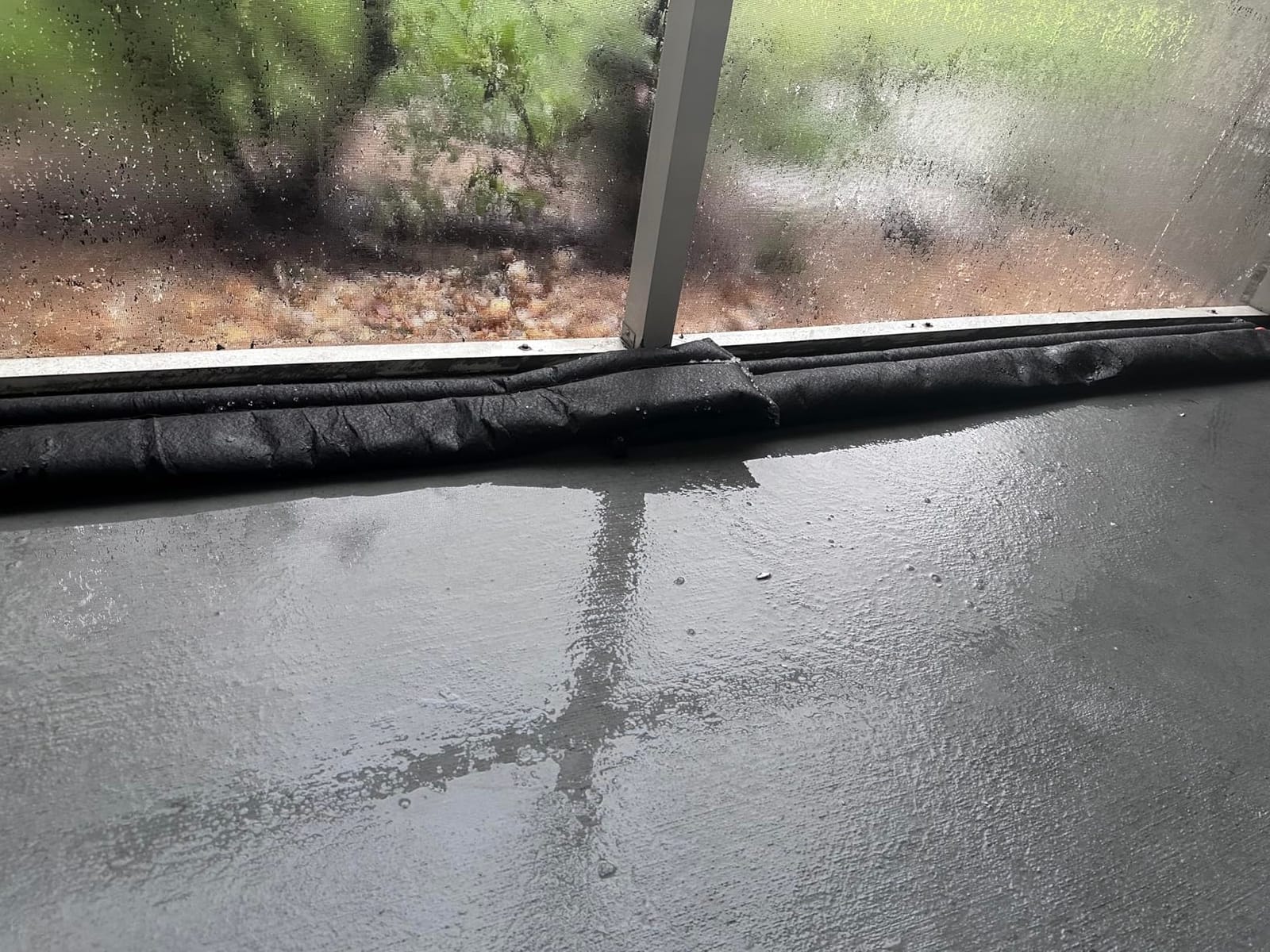
The dual chamber shape is the quietly clever part. A round bag in a doorway wants to roll sideways, which lets water find the low corner. This one stays put, and the flexible length bends around a door frame or an L-shaped corner without any cutting or fittings.
Against the Flibyt, which activates in about five minutes, Quick Dam is slower to start but holds a steadier profile and has roughly eight times the review volume. That review count is the deciding factor for us. When a product has this many owners, its weaknesses are already documented rather than theoretical.
Where it earns its place in your kit
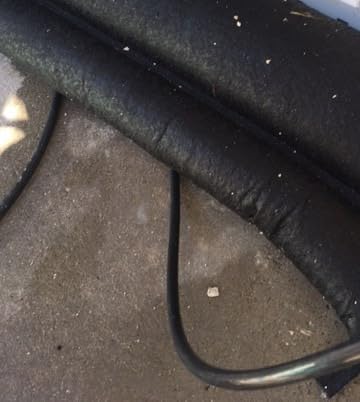
This is the barrier to stage before a storm, not during one. Because it weighs about a pound and folds flat, you can keep two or three packs in a closet all year and still have them in the hallway within a minute of the water arriving.
It is genuinely effective against slow-moving water in an opening, which is what most residential flooding actually looks like. Buy two or three packs if you want more than a single doorway covered.
What it will not do for you
Salt water is the hard stop. The manufacturer is explicit that contact with salt water causes deflation, which rules this product out for anyone on a direct storm-surge coastline. It also lets some water through rather than forming a watertight seal.
There is a reusability contradiction here worth naming out loud. The marketing leans on reuse, and the honest answer is that a bag that has taken on floodwater should be treated as single-season because of sewage and chemical contamination. If it stayed dry or only got a light mist, drying it out and reusing it is reasonable.
2. Tidal Tank Aqua Bag – The Best Sandbag Replacement for Training
Tidal Tank XL – The Original Aqua Bag – Water Weight Bag 70 lbs – Adjustable Workout Sand Bags Weights Alternative – Portable Sandbag Fitness Equipment Set for Home Exercise Gym- Including App Videos
Adjustable to 70 lb
2 by 5 in folded
PVC body
Pin valve fill
Pros
- Highest rated product in the roundup at 4.8 stars
- Water reacts to every movement so no two reps match
- Visible water level makes weight changes fast
- Folds small enough for a gym bag when empty
Cons
- Spilled water means wet floors if the pin valve is knocked
- Shifting load feels heavier than the listed weight
- Soreness arrives earlier than the number suggests
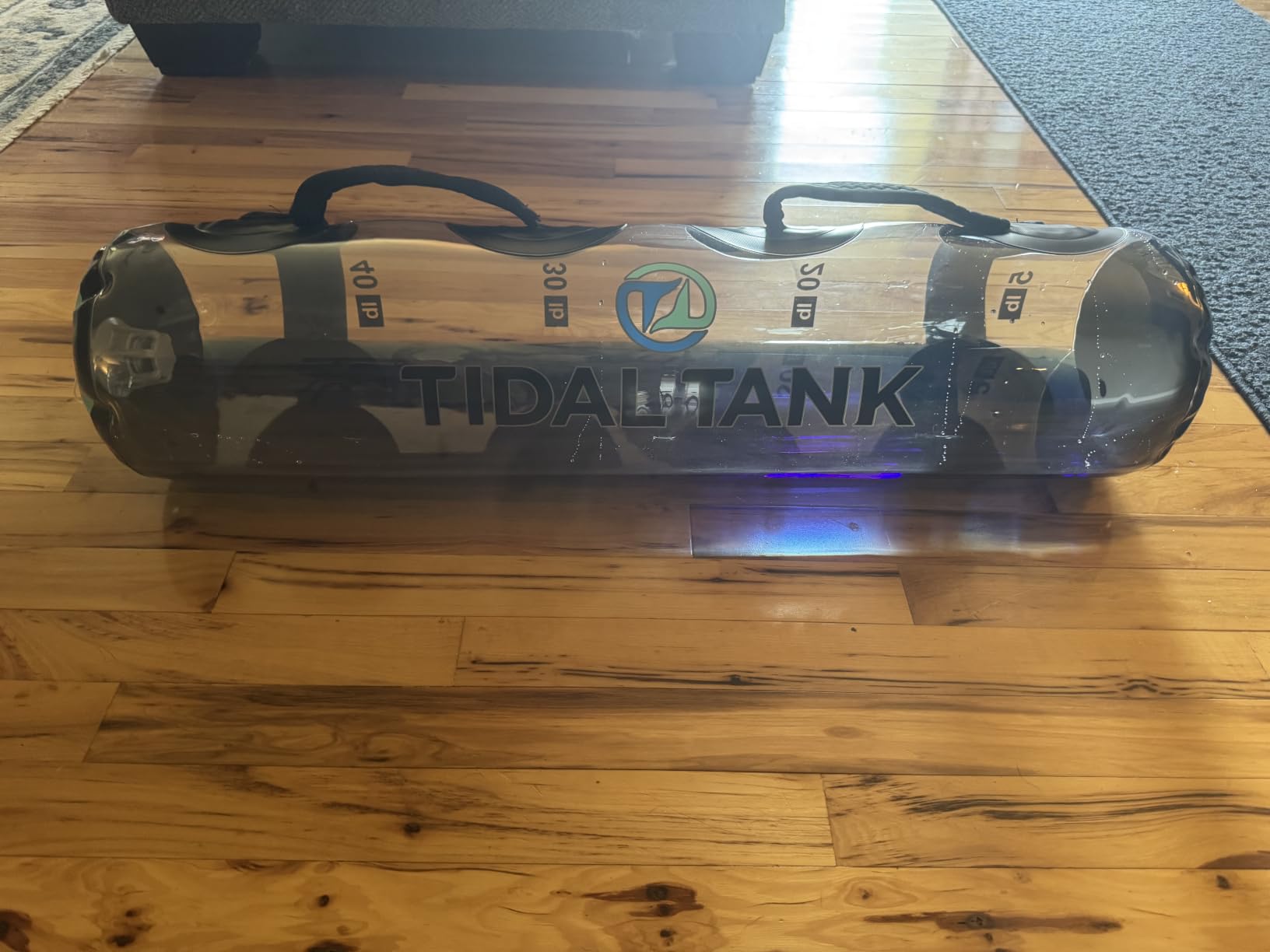
If by sandbag you mean the training tool rather than the flood device, the Tidal Tank is the closest honest substitute we found. It is a clear PVC tube you fill with water from a tap, sized to carry up to 70 pounds, and the water sloshes as you move.
That instability is the entire point and also the entire catch. A sandbag filled with dry sand gives you a predictable load for cleans, lunges and carries. A water-filled bag gives you an unpredictable one, which trains core and motor control far harder. Owners consistently describe the first session as fun and the fourth as sore.
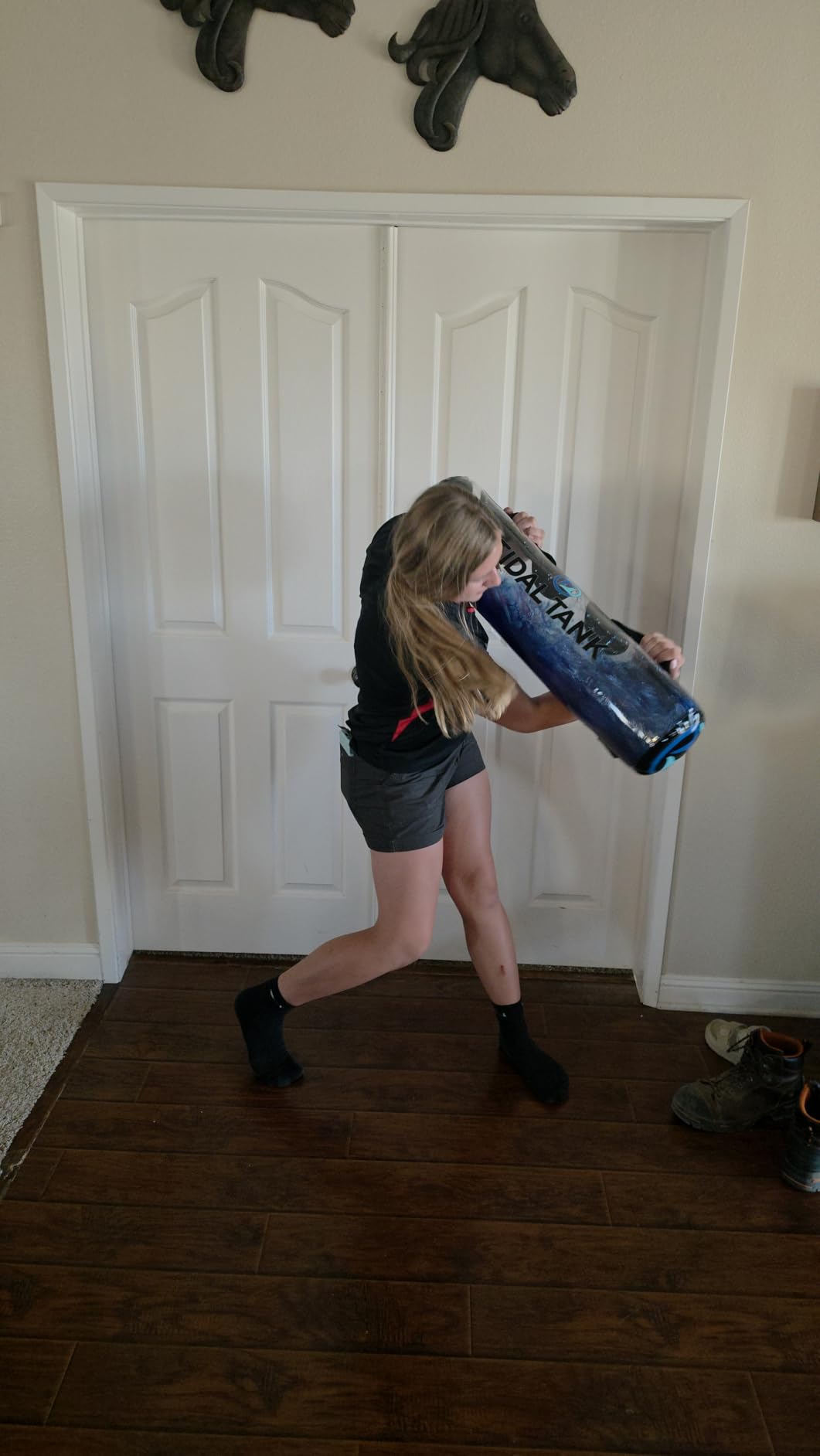
The practical details are strong. Empty, it weighs about two pounds and folds to two by five inches, so it lives in a drawer or a backpack. The transparent body shows the water line, and the pin valve opens for filling and releases air for quick weight changes. An included app walks through the exercises and shows how much water is inside.
Compared with the Solim Aqua Bag, this one carries a higher rating across a far larger review base and offers a much wider weight range, but it costs more and the fill port is a pin valve rather than a foot pump. If you travel to sessions, the Tidal Tank packs smaller.
Where it earns its place in your kit
This is the pick for anyone who wants a heavy, awkward, reactive load for core, stability and rotation work without buying sand, a filler, or a pile of leaking sacks. It travels, it adjusts, and it cleans up with a drain plug.
For athletes who need a truly sandbag-like feel, filling it and leaving it for several hours lets the water settle into a flatter column. The instability comes back the moment you move it, which is usually what you want.
What it will not do for you
It is not a precision instrument. Because the load moves, load-by-load comparisons against a fixed dumbbell are meaningless, and you cannot dial a specific plate weight. Anyone chasing exact progressive overload needs a fixed-mass tool instead.
It is also not flood equipment, despite the visual similarity to a water-filled barrier. A spilled bag on wet floor tile is a slip hazard, so keep the valve closed and the bag away from hard surfaces when you are not using it.
3. HydraBarrier Ultra – 12 Feet of Diversion From One Tube
The Original HydraBarrier Ultra Flood Barrier – 12 ft Long x 6 in High – Light, Reusable Sandbag Alternative – Flood Control & Diversion Tube for Home, Garage, Door & Property Protection
12 ft long by 6 in high
Holds 25 gallons
200 lb filled
Reusable vinyl
Pros
- Covers a wide sliding door or garage opening in one section
- Fills in about 8 to 15 minutes instead of two dozen sandbags
- Compresses and expands against water pressure
- Drains and folds for repeated use
Cons
- Cannot be moved once filled and rolls on sloped ground
- Unusual fill plug needs a quick connect adapter
- Protruding ends let water push the barrier away
- Some owners find coverage costly for the length
The HydraBarrier Ultra is the right tool when you need to divert water around a property or hold back a wide opening, not just plug a doorway. It is a cylindrical vinyl tube, twelve feet long, that you fill with a hose until it holds about 25 gallons and weighs roughly 200 pounds.
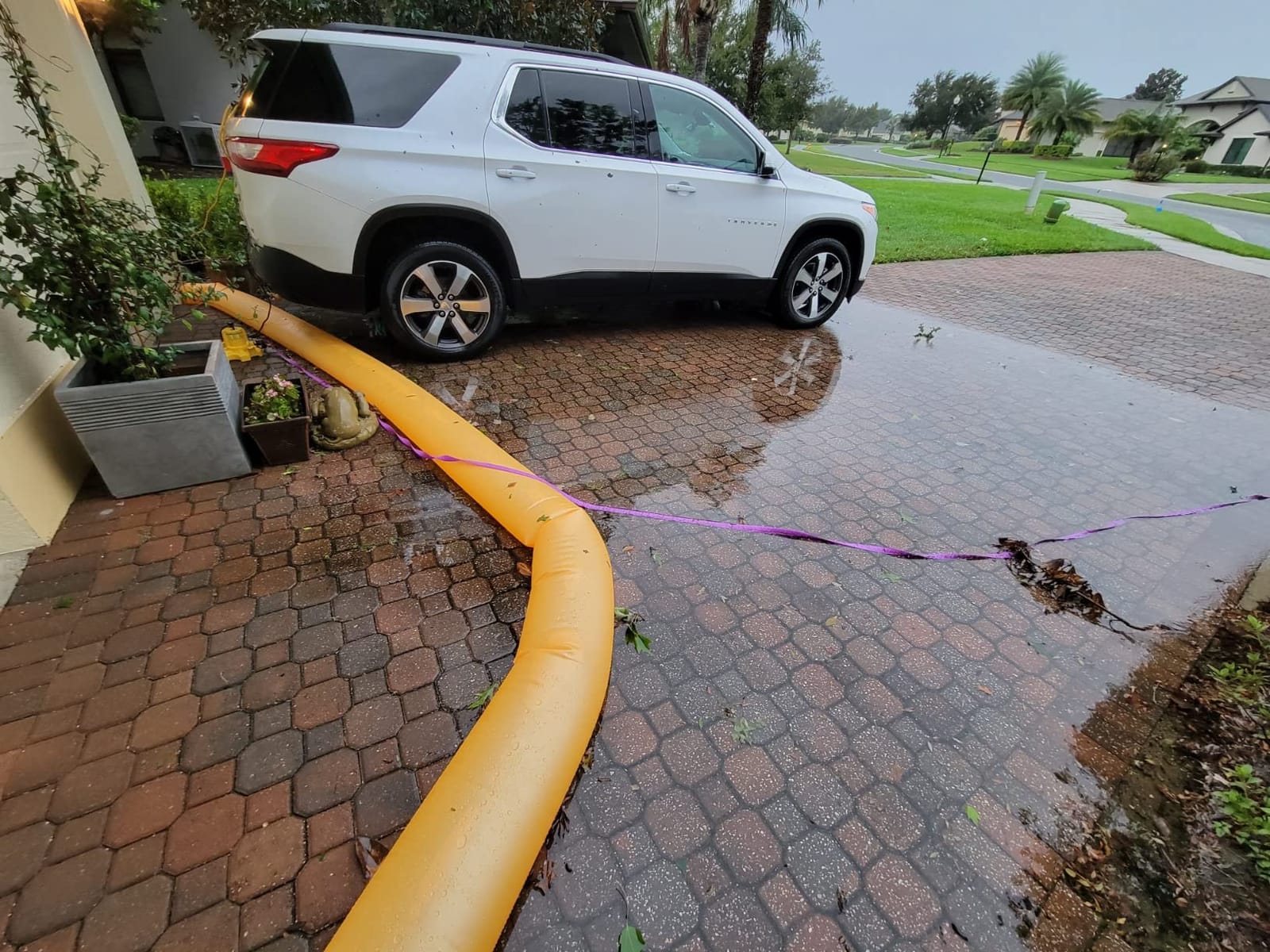
One of the strongest owner reports in this entire roundup comes from a buyer who kept a ground floor dry through a Florida hurricane season and a California atmospheric river storm using this barrier. That is the kind of evidence we look for: a named scenario, a specific outcome, and a product that survived it.
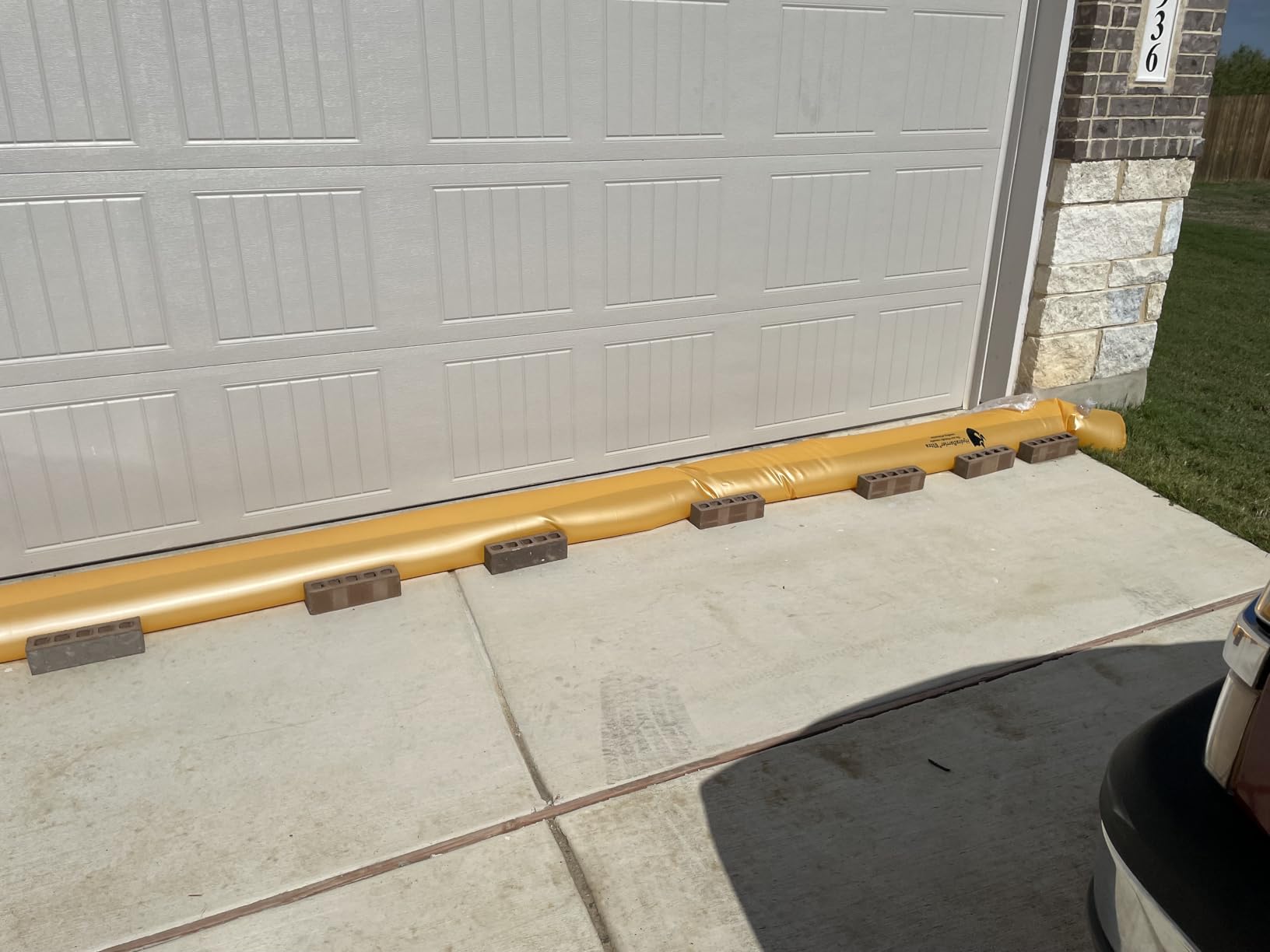
The physics is simple. Water inside the tube resists the pressure of water outside it, and the tube bulges upward as the depth rises, so its six-inch rated height often buys extra headroom in practice. Against the HydraBarrier Standard, the Ultra covers twice the span and holds more than three times the water, which matters the moment your opening is wider than a single door.
Two setup rules appear again and again across reviews and both are non-negotiable. Anchor the tube with bricks or weights before you start filling it, and place the fill plug at the low end so air can escape cleanly.
Where it earns its place in your kit
It belongs outside, along a driveway edge, a garage threshold, or a wall line where water is running toward the building. Because it connects end to end, two of them make a 24-foot diversion run, which is how you keep water out of a basement window well.
It is a one-person job up to the point of filling. Empty it weighs a little over three pounds, so position and anchor it first, then commit. Once it holds 200 pounds, it stays where it is.
What it will not do for you
It is a diversion tool, not a watertight dam. If water rises against it rather than running along it, the ends are the weak point. Owners report water pushing the protruding ends away from the thing they are protecting, which is exactly the failure mode most people do not anticipate.
It also rolls sideways on any sloped ground, so flat, level placement is a requirement rather than a preference. And the fill plug is an unusual size, so budget for a quick connect adapter before the storm, not during it.
4. HydraBarrier Standard – The Reusable 6 Ft Tube Most Buyers Start With
The Original HydraBarrier Standard Flood Barrier – 6 ft Long x 4 in High – Light, Reusable Sandbag Alternative – Flood Control & Diversion Tube for Home, Garage, Door & Property Protection
6 ft long by 4 in high
7.5 gallon capacity
60 lb filled
20 mil vinyl
Pros
- Fills from a hose in about 8 minutes
- Reusable for years rather than single season
- 20 mil industrial vinyl resists tearing and can be patched
- Connects end to end to span a doorway
Cons
- Round profile rolls on sloped ground without weights
- Very hard to move once filled
- Fill valve needs a quick connect fitting
- Diverts water rather than damming it
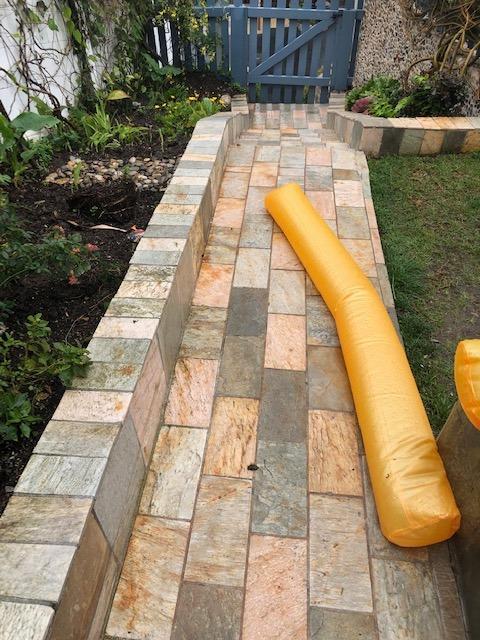
The HydraBarrier Standard is the most sensible starting point for a household that wants a reusable sandbag alternative without committing to a commercial-length system. Six feet long, four inches high, and it holds 7.5 gallons, which lands it at about 60 pounds filled.
Owners describe the same result repeatedly: it outperforms sandbags for whole-home protection during cloudbursts, and almost every review flags the same two handling notes. Anchor the tube before filling, and buy the hose connector.
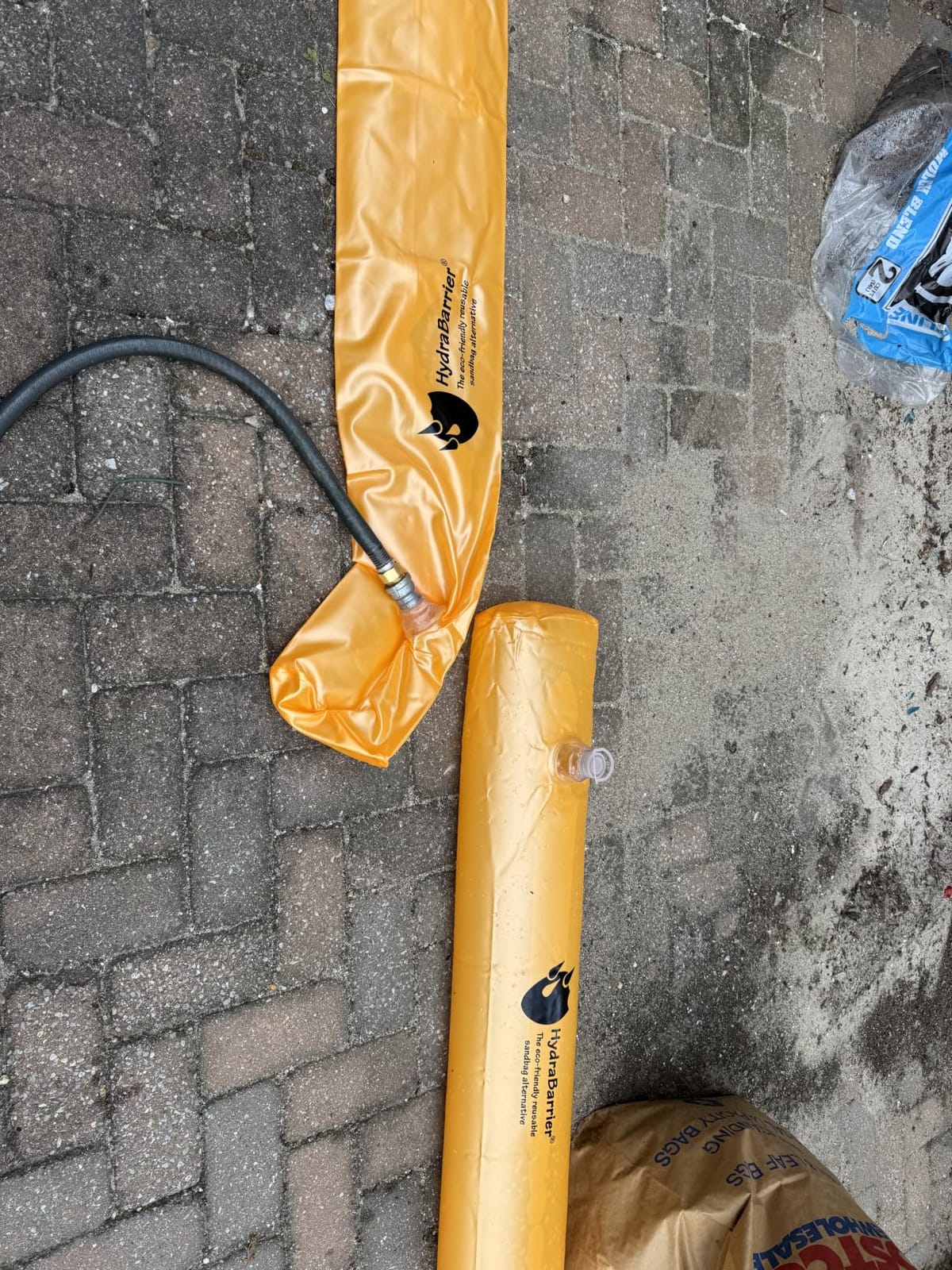
The vinyl is 20 mil industrial grade with reinforced seams, and if it gets nicked it can be patched. That matters more than it sounds, because a puncture in a water-filled tube is an instant total loss, and a repairable material forgives a small mistake that would end a thinner bag.
Compared with the Ultra, you trade twelve feet of span and six inches of height for a unit you can actually reposition, and about a third of the filled weight. For a single doorway or a garage entrance that is often the whole decision.
Where it earns its place in your kit
This is the one to buy if you want a barrier that survives multiple seasons. Drain it, fold it, store it in a closet, and bring it back for the next storm. The reusability is the argument, and the manufacturer build supports it.
It also expands vertically as water pressure rises, so the four-inch rating is a floor rather than a ceiling in most real conditions. For light and normal rainfall, owners report it doing the job comfortably.
What it will not do for you
It will not hold back rising water head-on. This is a diversion device, and the moment water pools against it rather than running past it, you are in a losing argument with two hundred pounds of vinyl.
And do not plan on moving it later. At 60 pounds filled, on a round profile, on anything less than perfectly level ground, repositioning means draining it first. Choose the line before you open the hose.
5. BaseGel Water Polymer – The Sandbag Alternative for Anchoring Bases
BaseGel Polymer for Basketball Goal and Outdoor Indoor Sign Hoops Bases, Perfect Replacement for Sand and Sandbags to Anchor Portable Sports Pools Baskets, Easy to Use and Apply with Water, 16 oz
16 oz bottle
Absorbs 400 times its weight
Gels in 5 to 10 minutes
Replaces up to 8 sand bags
Pros
- One bottle replaces up to eight bags of sand
- Absorbs up to 400 times its own weight in water
- Freeze and thaw durable and holds a solid gel for years
- Comes apart with salt when you move the base
Cons
- Needs two water fills and about 10 minutes per base
- Must be added in stages for a firm gel
- Not a flood barrier and not for barrier duty
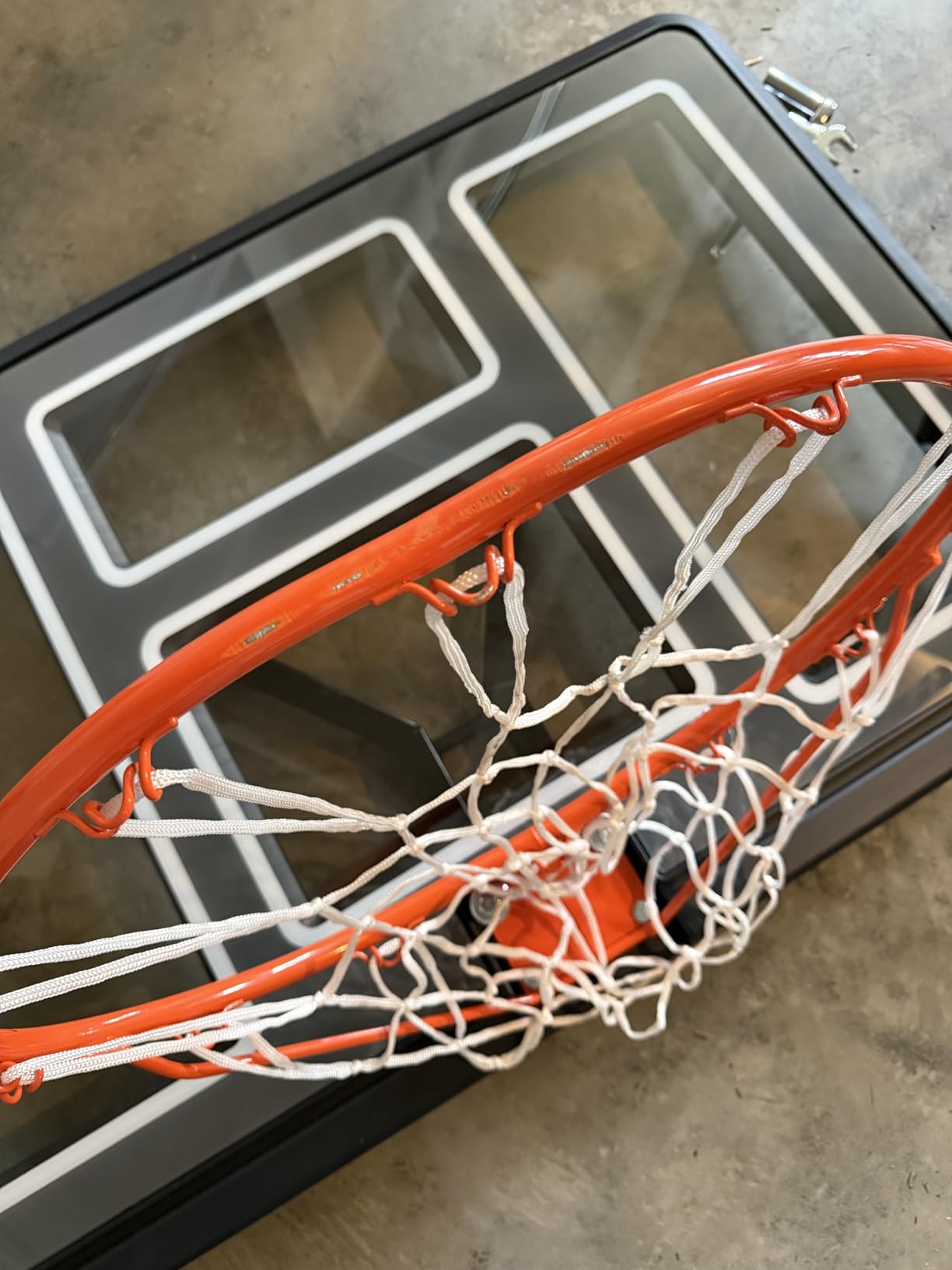
BaseGel is the outlier in this list, and it is here because of how well documented it is: nearly five thousand ratings, which is more real-world evidence than most of the barriers below can show. It does not stop floodwater. It replaces the sandbags you use to weigh down a portable basketball hoop, a plastic sign base, an umbrella stand or a boxing bag stand.
The mechanism is the same polymer science that makes a diaper absorbent. One 16 ounce bottle turns into a firm gel that absorbs up to 400 times its own weight, which the manufacturer states replaces as many as eight bags of sand.
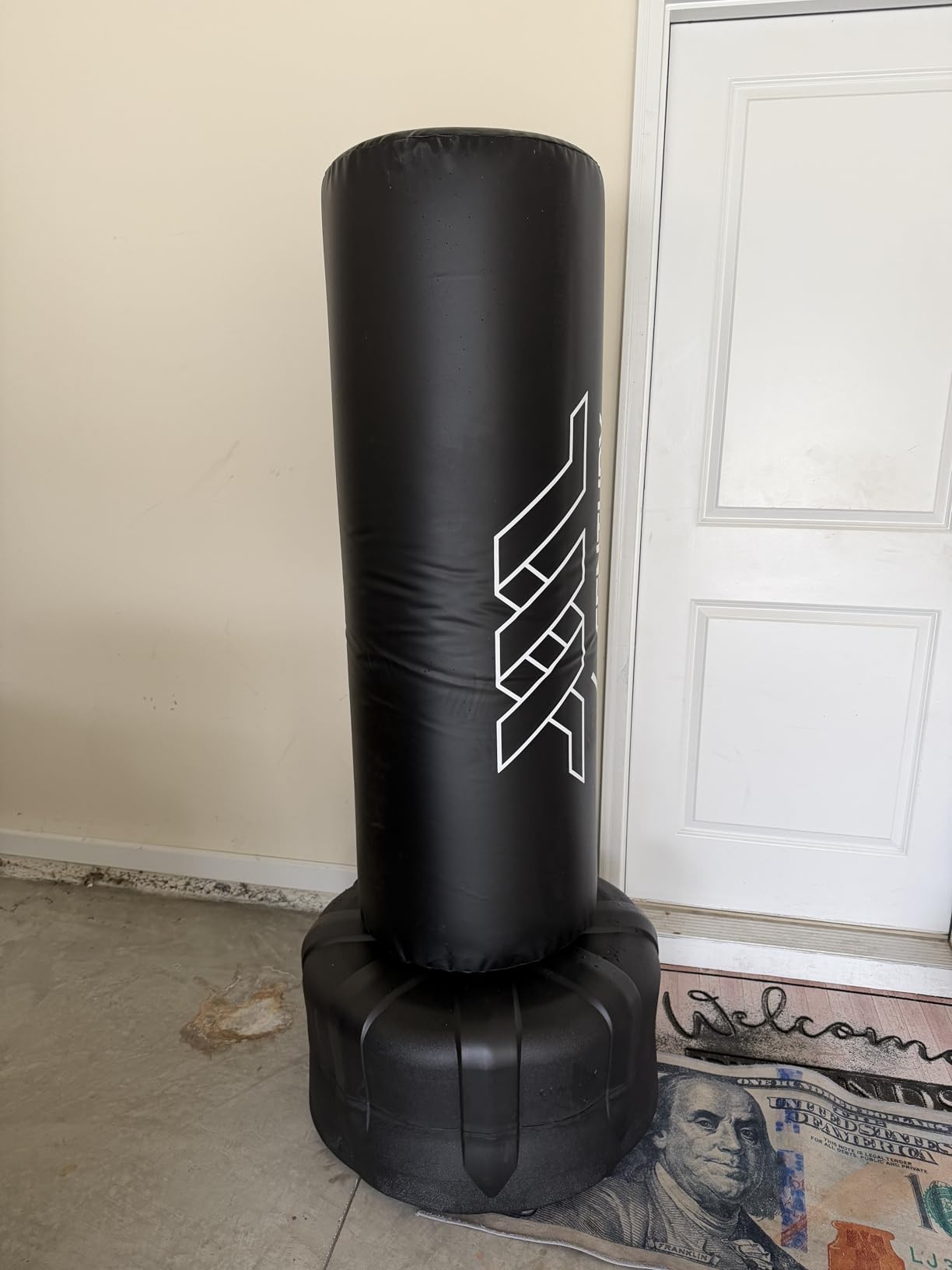
The installation is two-stage and this is where people get it wrong. Add two thirds of the dry polymer, fill the base halfway with water, add the remaining polymer, then top up with water. Skip the stages and you end up with loose powder instead of a firm gel block that resists the ball.
What makes it a genuine sandbag alternative is reversibility. Salt dissolves the gel, so when you need to move the hoop you pour it out and start again. Sandbags in a hoop base are permanent for the life of the setup.
Where it earns its place in your kit
It is for anyone anchoring portable equipment on grass or pavement without a drilled base. The storage profile is a single bottle, the installation needs no tools, and the gel holds its shape across freeze and thaw cycles.
It is also the answer to a narrower version of the flooding question. If you have a basement window or low doorway and want a temporary plug that weighs almost nothing, the same chemistry is what the sandless bags on this list are built from.
What it will not do for you
It will not stop a flood. The gel is a ballast, not a dam, and it has no structural skin. Do not build a water wall out of it.
It is also not a one-step job. The two fills and ten minutes of settling are mandatory, and doing it in a hurry right before a game is how you end up with a wobbly hoop at tipoff. Budget the time before you open the bottle.
6. Flibyt 5ft Water Activated Barrier – Fastest Gel Activation in the Set
5FT Water Activated Flood Barriers for Home Door, Sandless Sand Bags for Anti Flood Control
Activates to 3 to 4 inches
About 5 minutes
1.43 lb per barrier
2 pack of 5 ft
Pros
- Reaches 3 to 4 inches in about 5 minutes
- Light enough that an older user can place it alone
- Folds down small for off-season storage
- Safe around children and pets
Cons
- Widest review spread here with a one-star share near 10 percent
- Only a 5 ft span per piece so openings need several
- Needs full drying or replacement if it stays wet for months
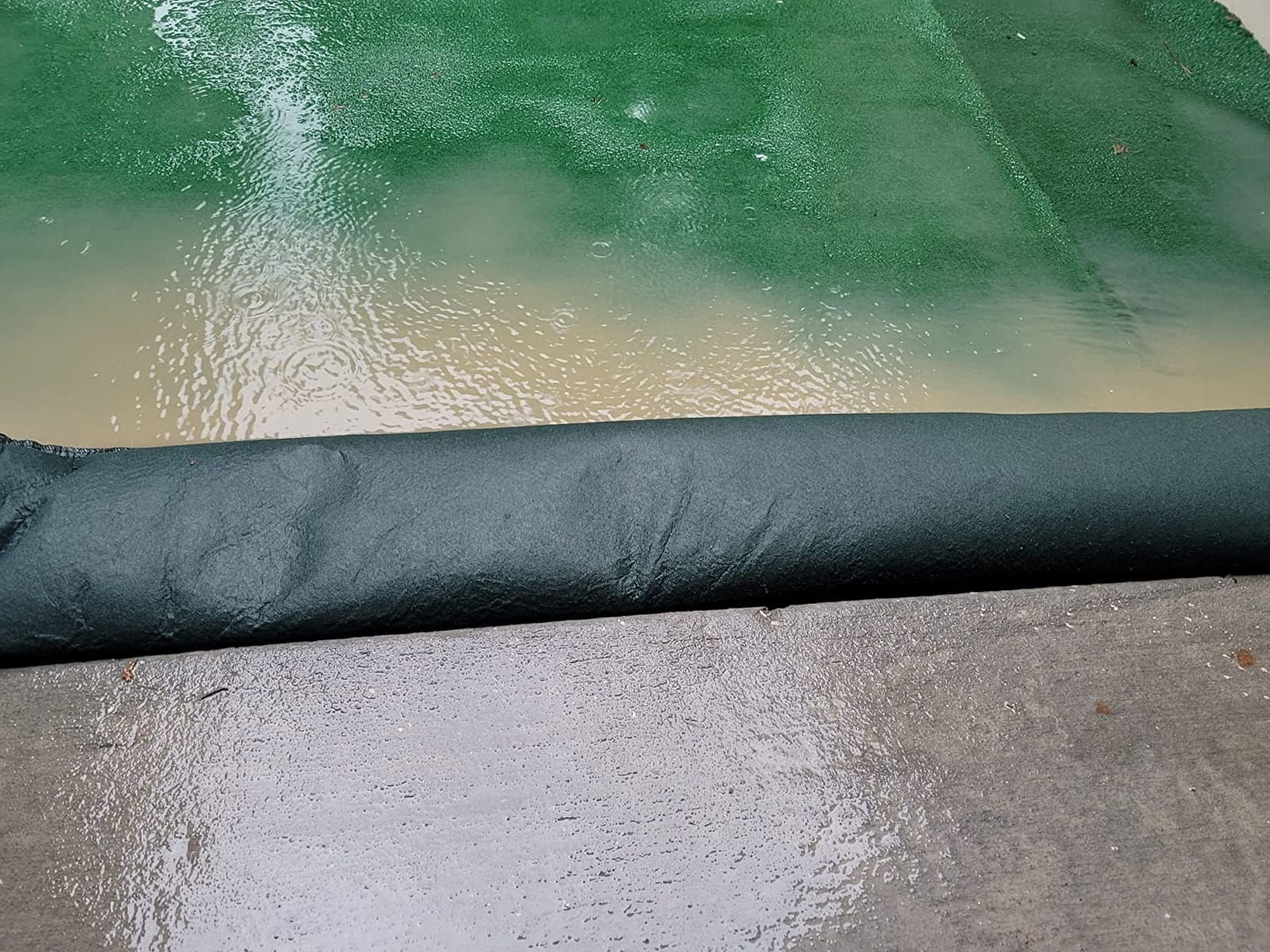
The Flibyt is the fastest-activating barrier in the roundup. Where most gel bags take a few minutes to reach full height, this one is documented at three to four inches in roughly five, and each piece weighs about 1.4 pounds.
That combination of speed and weight is the reason it keeps showing up in answers for seniors and anyone with back problems. You can carry a two-pack to a basement stairwell, lay it out, and wet it before the water finishes coming down the steps.
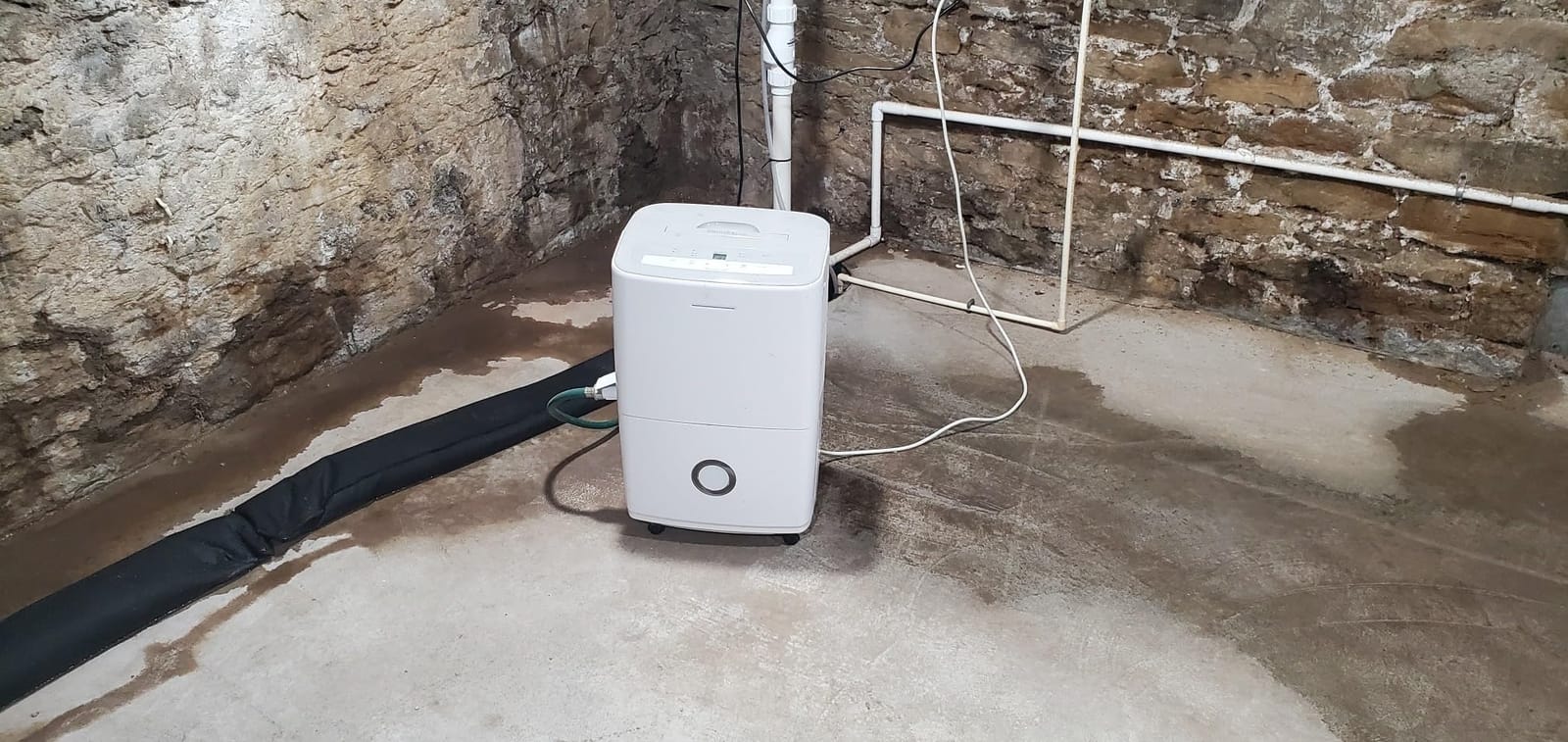
The important context is its review spread. It averages 4.0 stars with about 55 percent five-star and a one-star share near 10 percent, the widest distribution of any barrier here. Buyers who like it praise the tool-free setup; the critical reviews concentrate on coverage length and durability across seasons.
Against the Quick Dam, this is a faster and lighter product with a shorter effective life. The manufacturer states the barrier stays active for roughly three to four months per use and can be dried for reuse, which is a different promise from the multi-season reuse the fillable tubes deliver.
Where it earns its place in your kit
Pick it when activation speed is the deciding factor and coverage area is small. A single doorway, a laundry room, a kitchen when the dishwasher fails, a garage entry after a hard rain. Those are all jobs where five minutes is the difference.
The stated uses include basements, driveways, gardens and doorways, and for indoor emergencies the material is non-toxic and safe around children and pets.
What it will not do for you
It will not cover a wide opening. At five feet per piece, a two-car garage needs multiple pieces laid end to end, and every seam between them is a place water can find. Plan the layout before you start wetting anything.
It also has a real shelf life question. If a piece sits wet for months it needs to be fully dried out or replaced rather than put back in storage wet, and a gel bag that has been exposed to contaminated floodwater should not go back into service at all.
7. HydraSorber 11ft Sandless Sandbag – Longest Single-Unit Coverage
Watershed Innovations HydraSorber Water Absorbent Sandless Sandbags, 11-Foot Long by 8-inch Wide
11 ft long
4 in high when inflated
2 lb dry
Natural woven jute
Pros
- Eleven feet of coverage in a single piece with no seams
- Self-inflates to 4 inches in under 3 minutes
- Only 2 lb dry so it stores flat
- Jute outer is non toxic and eco friendly
Cons
- Disposable once used and not built for repeated seasons
- Highest complaint share here with 11 percent one-star
- Jute outer degrades and tears if left saturated long term
The HydraSorber solves the seam problem that trips up every short gel bag. It is eleven feet long in one piece, self-inflates to four inches in under three minutes, and weighs two pounds when dry, so it covers a whole wall line or a long basement window without a joint in the middle.
The mechanism is the same as the gel bags. Lay it in water or let rain fill it and the superabsorbent polymer core swells into a solid dam. The difference is the outer skin, which is a heavy-duty 100 percent natural woven jute rather than a synthetic sleeve.
Compared with the Quick Dam, you gain length and a slightly taller finished profile, and you lose the ability to bend it into tight curves as easily. A jute skin is stiffer, which helps it hold a straight line and hurts it in an L-shaped doorway.
Where it earns its place in your kit
It suits long straight runs. Along a garage wall, across a low window ledge, in front of a storage room door, or stretched the width of a hallway when water comes in under a door from one side.
It is also the friendliest indoor option from a materials standpoint. The jute cover and the polymer core are described as non-toxic, which matters if you are deploying it near pets, children or food storage.
What it will not do for you
It is a single-season item. The manufacturer describes it as robust enough to last a season, and the reviews are blunt about the rest. The one-star share runs around 11 percent, the highest in this group, and the complaints trace almost entirely to the fact that it has to be discarded once damaged.
And the jute outer degrades if it stays saturated for an extended period. Do not plan on storing one wet and using it next year. This is a buy-it-again-next-spring product, and the honest comparison is the unit cost against the multi-season fillable tubes.
8. VEVOR 4-Pack Flood Barriers – 16 Ft of Coverage in One Set
Flood Barriers, Sandbag Alternative Flood Bags 4 Pack, Flood Barrier for Home, Water Barriers for Flooding, Doorway, Driveway(4FTx6in)
Four 4 ft bags
0.47 cubic meters each
8.8 lb empty
High strength PVC
Pros
- Four hose-fillable pieces give 16 ft of coverage in one set
- Fixing clips let you pin bags down with weights
- Covers doorways gates garage entrances and basements
- Folds into a cabinet at 8.8 lb total
Cons
- Each 4 ft piece is short so most installations use all four
- Must be dried fully before storage
- Keep clear of sharp objects that can puncture the PVC
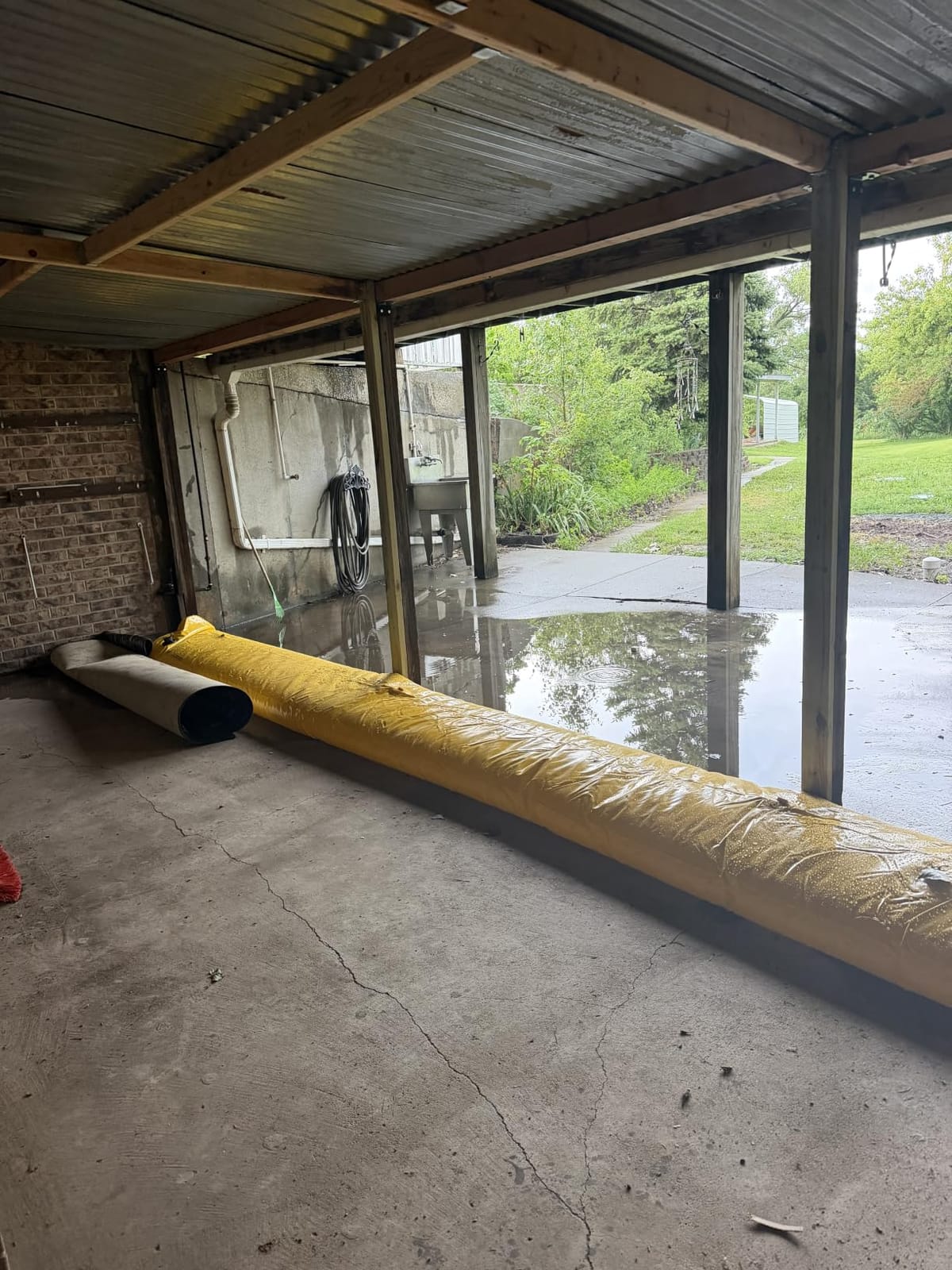
The VEVOR four-pack is the practical answer when a house has several openings rather than one. Four hose-fillable bags, each about four feet long and six inches high, give you sixteen feet of barrier in a single purchase, and the whole set weighs 8.8 pounds empty.
Filling is straightforward. Open the valve, insert a hose, fill, close. Each bag holds about 0.47 cubic meters of water, and the supplied fixing clips let you pin them down with bricks or other heavy objects so they do not slide while the water is going in.
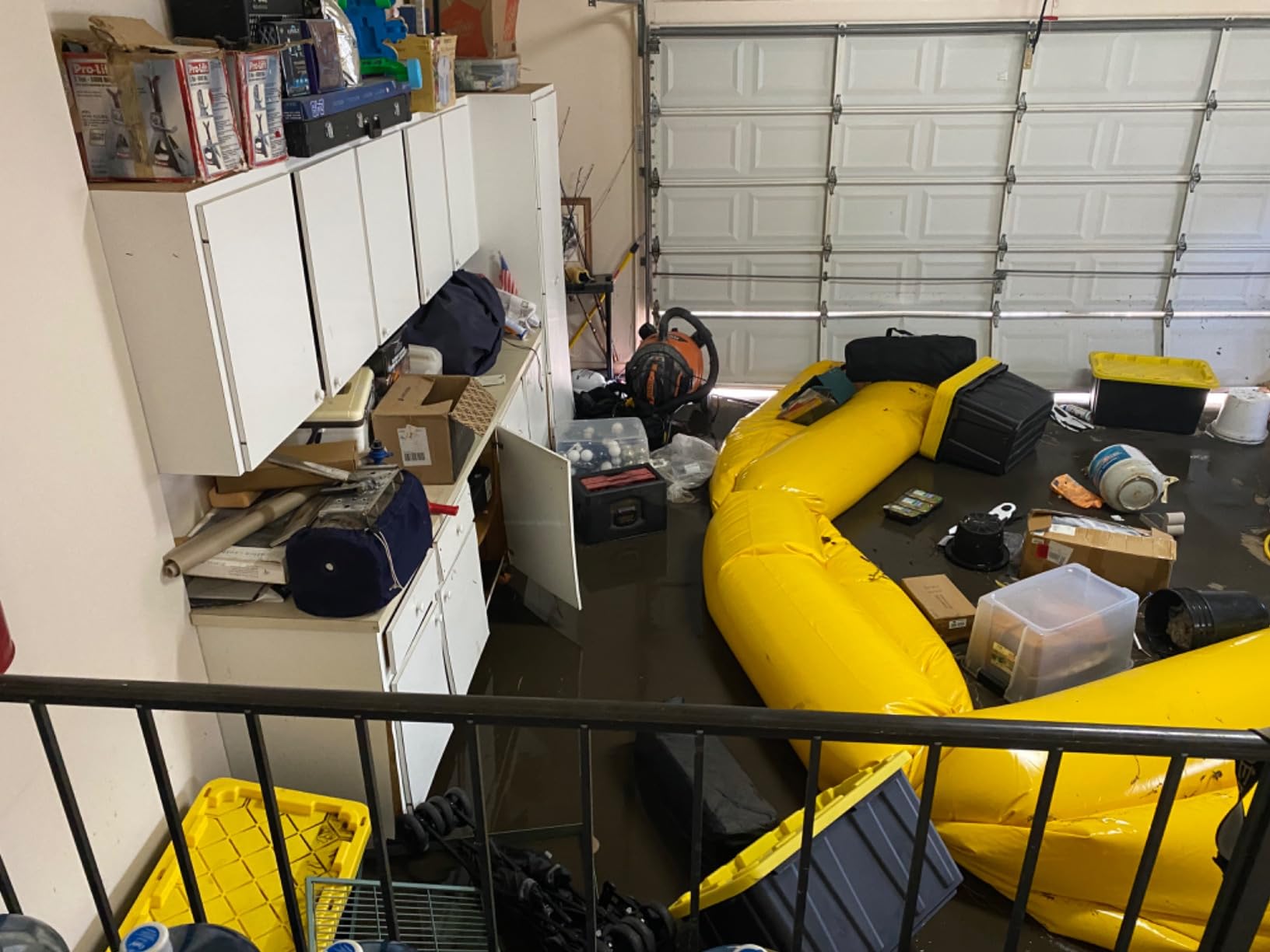
That clip detail is the one people miss. A smooth, water-heavy tube on a driveway will migrate, and a migrating tube leaves a gap. The clips are the difference between a barrier that stays on its line and one that does not.
Against the HydraBarrier Standard, the trade is coverage against wall thickness. The VEVOR bags are PVC tarpaulin rather than 20 mil industrial vinyl, and reviewers comparing them directly note the thinner feel. For a wide, multi-opening layout the arithmetic still favours the four-pack, for a single doorway the thicker tube is the safer call.
Where it earns its place in your kit
It is built for the house with a front door, a side gate, a garage entrance and a basement window, all of which need protecting on the same night. The listed use cases run to fences, gates, parking lots, garden gates and basements.
Storage is a genuine strength. Eight and a half pounds empty, folding into a cabinet, and unlike the gel bags it is not absorbent, so a damp unit does not have a chemical shelf life attached to it.
What it will not do for you
Each piece is short. Four feet is about the width of a doorway, so a nine-foot garage opening needs a layout where the pieces meet and the joint is dealt with. Water finds joints, and you need to plan that before filling rather than after.
Drying matters too. The manufacturer is explicit that the bags must be thoroughly dried before storage, both to avoid damage and to prevent mildew. And keep them clear of sharp tools, brackets and debris, because a puncture in PVC tarpaulin ends the deployment instantly.
9. Osmo 10ft Commercial Grade Barrier – Lightest Weight in the Set
Commercial Grade Osmo Flood Barrier – Activated by Water, Alternative to Sand Bags, 10ft Long
10 ft commercial length
13.1 oz weight
Made in the UK
50 percent reclaimed material
Pros
- Weighs 13 ounces so it is easy to store and stage
- Absorbs water quickly for garage and garden ingress
- Non toxic and non hazardous material
- Built with 50 percent reclaimed content
Cons
- Smallest review base in the roundup at 256 ratings
- Some buyers dispose of it after drying rather than reuse
- Pack quantity is unclear in the listing
- English language detail is sparse
The Osmo is the lightest barrier in the roundup by a factor of roughly three. At 13.1 ounces and ten feet long, it is the one you can genuinely forget you own until the week you need it, and still carry to a garage or garden gate in one hand.
It is a water-activated unit made in the UK using OSMO superabsorbent polymers, built with 50 percent reclaimed material and described as non-toxic and non-hazardous. Commercial grade refers to the ten-foot length rather than to any flood rating, and it is sold as a diversion line rather than a dam.
We included it with a caveat. At 256 ratings, it has the smallest review base in this group by a wide margin, which means less real-world evidence behind it than the alternatives here. Buyers who have used it report it handles garage and garden water ingress well and stores small once dry.
Where it earns its place in your kit
It fits people who cannot lift a 60-pound filled tube and do not want a gel bag that takes half a morning to react. Thirteen ounces is a weight most people can carry with a full arm full of groceries, and that changes who can respond to an emergency.
It is also the product to consider for anyone focused on disposal footprint. The reclaimed content and non-toxic classification are specific manufacturer claims, and they matter for households near gardens or waterways.
What it will not do for you
It has the least proven longevity. A recurring thread in the reviews compares it unfavourably to a leading US-made brand on durability, and some owners report disposing of it after drying rather than reusing it. Treat the reusability claim as aspirational.
Documentation is also thinner than the alternatives. The listing shows two pieces without making the pack quantity clear, and the English-language detail is sparse. If you need to know exactly what you are getting in the box, that is friction you will pay for at the wrong moment.
10. Solim Water Weights Aqua Bag – Best Budget Training Alternative
Water Weights Aqua Bag, Workout Sandbag Alternative Strength Training Sand Bag Portable Stability Fitness Equipment – Ultimate Core and Balance Training for Home Gym – 33 LBS
Rated 33 lb filled
24.4 in tall
Four handles
Tested to 450 lb pull
Pros
- Visible water level markings make weight changes fast
- Folds to a packable size when empty for travel
- Heavy duty stitching and a no leak closure
- Four handles give a balanced grip for carries
Cons
- Shifting load makes balance work harder than a static sandbag
- Must be filled drained and dried away from sharp objects
- Only 126 ratings so long term durability is thin
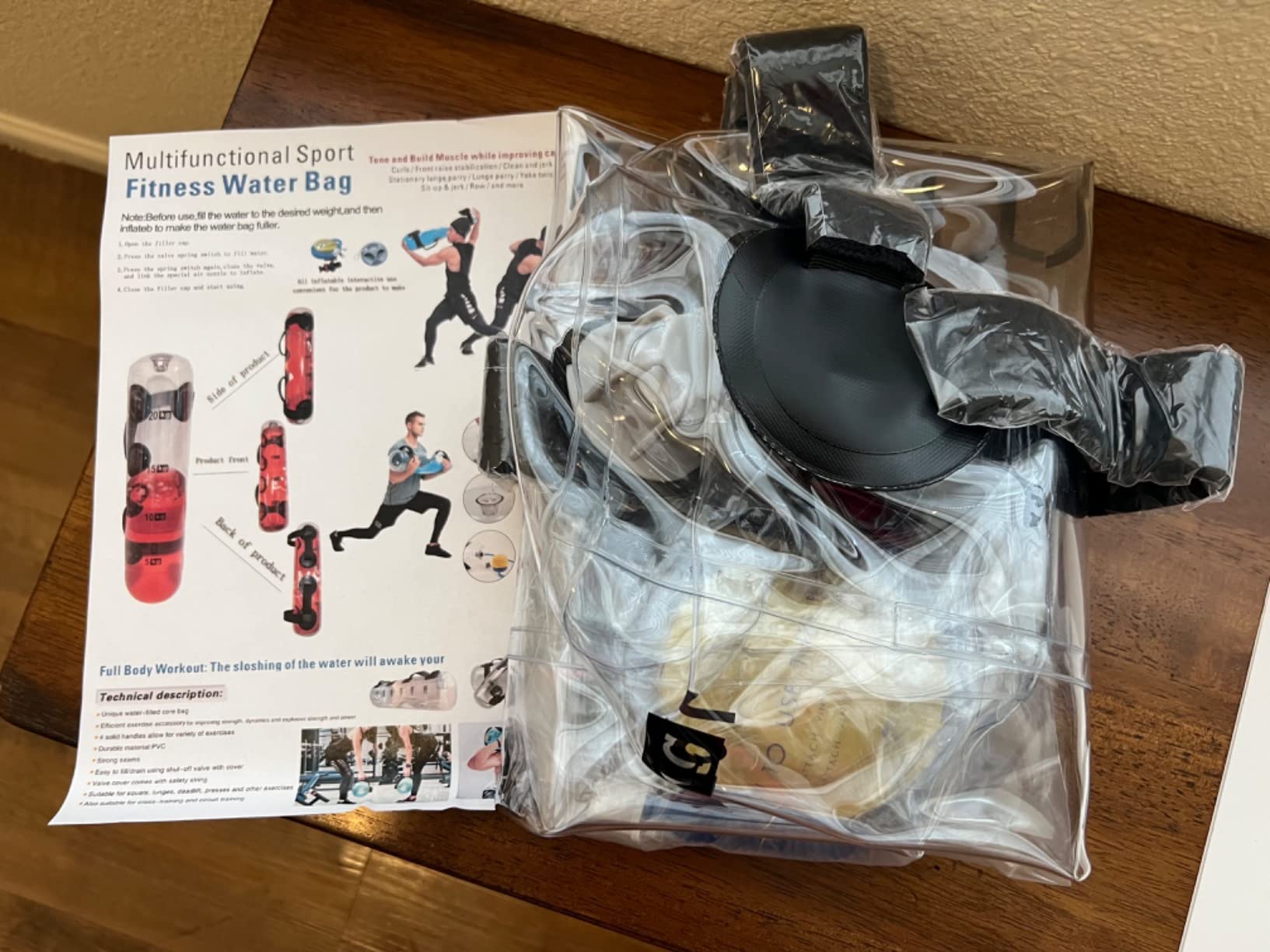
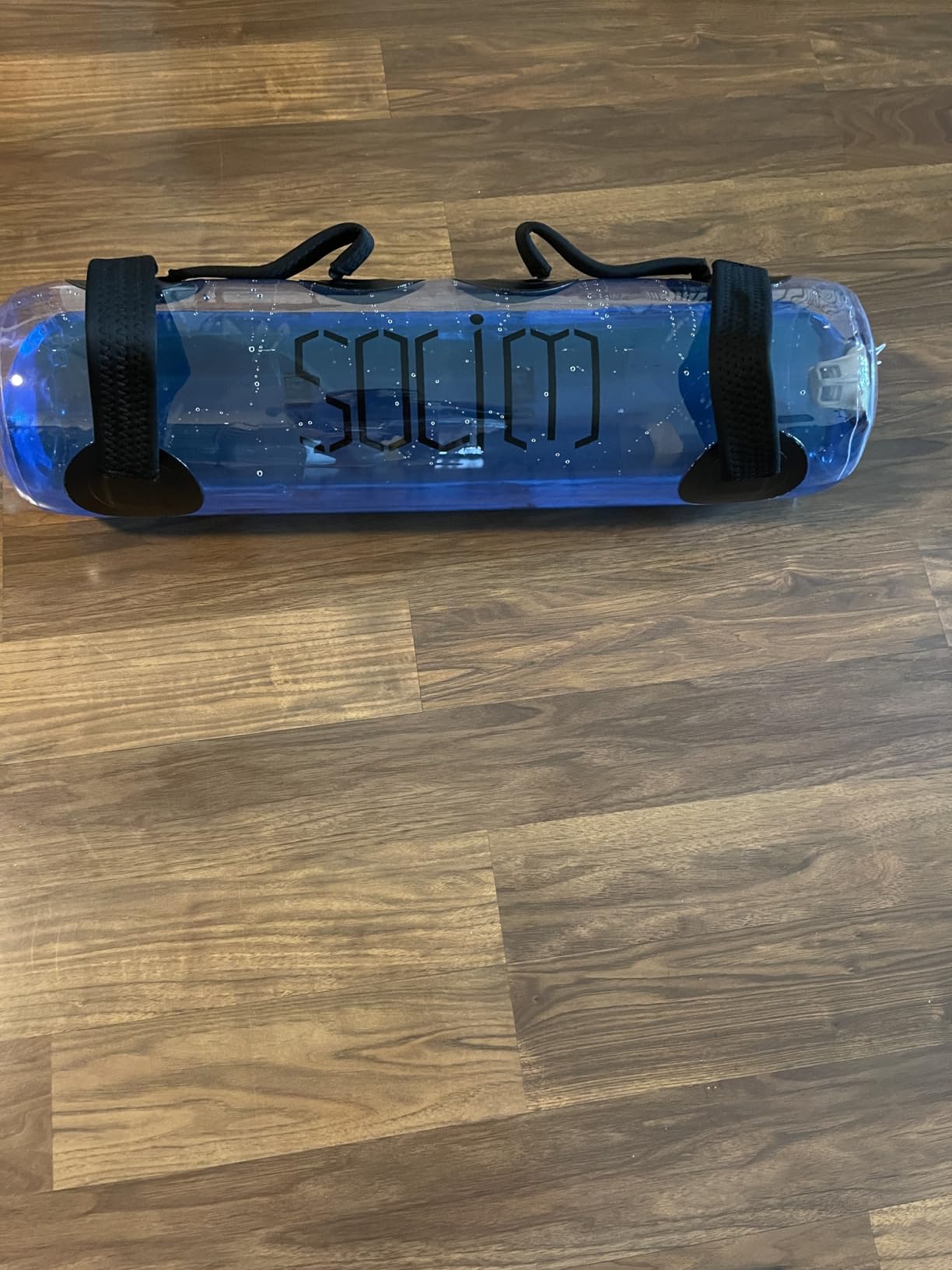
The Solim is a straight swap for a training sandbag if you want one device that does both. It is a water-weight bag rated at 33 pounds, about 24 inches tall and seven and a half inches wide, with four carry handles and a foot pump for filling.
Owners value the visible water-level markings most, because they turn weight adjustment from guesswork into a two-minute job. The bag is empty roughly 2.3 pounds, so it packs into a gym bag or a car boot, and the no-leak closure is stitched to a standard tested to 450 pounds of pulling force.
Compared with the Tidal Tank, this one is smaller in weight range and narrower in styling, but it has carry handles where the Tidal Tank is a plain tube. If your training is carries, farmer walks and suitcase work rather than core rotation, the handles are the deciding feature.
The honest limit is the review base. At 126 ratings with a 4.4 average, the rating is good but the evidence is thin. We would not build a training program around a product nobody has stress-tested over a year.
Where it earns its place in your kit
It works for home gym users who want a reactive, sandbag-like load for core and balance work without storing sand or dealing with a leaking grain sack. Pack it flat, fill it at the gym, and drain it when you finish.
The shifting water load is the feature. Unlike dry sand, which compacts and stays predictable, water moves inside the bag and changes the challenge on every rep, which is exactly what makes it worth owning over a fixed dumbbell.
What it will not do for you
It is not precise, and it is not indestructible. Because the load moves, you cannot compare it load-for-load against a fixed weight, and balance work will be harder than you expect from a 33-pound label.
It also needs care between uses. Fill it, drain it, and dry it away from sharp objects, because a punctured bag means a wet floor. And given the limited long-term data, replace it rather than trust it to a decade of daily use.
Where Sandbag Alternatives Fail First
The most common failure is not water going over the top of the barrier. It is water going around the ends. Every product here is rated for the depth across its face, and almost none of them solve the gap where the barrier stops.
Second is floating and sliding. A filled tube on a driveway is a smooth, heavy cylinder on a hard surface, and it will migrate if you do not anchor it before the water arrives. The VEVOR set is the only one in this roundup that ships with supplied fixing clips for pinning bags down with weights.
Third is stack instability. The gel bags are frequently described by owners as bags of jelly that slip off one another unless they are stacked against a solid structure. Stacking works against a wall. Stacking in the middle of a basement floor does not.
Fourth is puncture. A water-filled tube has no redundancy. One thorn, one shard of debris, one sharp tool in the garage and the deployment is over. This is why the 20 mil industrial vinyl of the HydraBarrier line is a meaningful upgrade over thinner PVC tarpaulin.
Fifth is the shelf life of long-stored gel bags. A superabsorbent polymer that has been damp in a sealed bag for years can creak, tear, and fail to activate properly. Dry storage matters just as much for the gel bags as for the fillable tubes.
And there is a practical ceiling most marketing ignores. Everything in the flood section of this roundup protects somewhere between three and twelve inches of water. Above roughly a foot of moving water, none of these products is the answer, and no stacking arrangement changes that.
How to Choose a Sandbag Alternative That Survives a Real Storm
Start with the water, not the product. Slow-moving freshwater in an opening is what these products handle well. Salt water, moving water, and water more than about a foot deep are outside the range of every option here.
Choose barrier type by job. Water-activated gel bags are for doorways, window wells and indoor leaks. Water-filled PVC tubes are for diverting a flow along an exterior wall or across a driveway. Flood panels, threshold seals and door covers are for a specific opening that keeps taking water, and they are usually the cheapest fix of all.
Measure the span before you buy. This is the error we see most often. A five-foot gel bag across a nine-foot garage opening leaves four feet of wet floor. Add the length of your opening plus overlap, then buy coverage in a single piece where the product allows it, because every seam is a weak point.
Match the filled weight to what you can actually move. The HydraBarrier Standard is 60 pounds filled, the Ultra is around 200. If you live alone or have any back or mobility issue, the 200-pound option is not deployable by you, and no review will change that. Read the filled weight, not the empty weight.
Treat reusability carefully. The fillable tubes drain, fold and go back in the cupboard, which is a real multi-season saving. Gel bags that have taken on floodwater are a different story because of sewage and chemical contamination, and the responsible move is to discard them rather than store them for next year.
Check the hose fitting before storm week. Several of the fillable tubes use a non-standard valve, and a quick connect adapter is a two-minute fix that people routinely discover at the worst possible moment. This is the same category of mistake as fixing a joint with the wrong compound: a small mismatch discovered early versus a failed job discovered late.
Plan storage before you buy, because the storage footprint is the real reason people switch away from sand. Gel bags and light tubes live in a closet. Anything heavier may need a shelf, a garage, or a second person.
How to Deploy a Flood Barrier So It Does Not Fail
Position first, fill second. An empty gel bag is 1.4 pounds and an empty tube is under four, so the cheapest time to move anything is before the water is in it. Decide the full line on dry ground.
Anchor before you fill. Bricks, concrete blocks, sandbags you already own, or the supplied clips. A water-filled tube on a smooth surface will move, and a moving tube leaves a gap at exactly the point where you needed it sealed.
Put the fill valve at the low end. Air trapped at the high end reduces the volume of water inside, which is the volume resisting the pressure outside. This single detail appears in the setup advice of nearly every review of the HydraBarrier line.
Seal the ends. Water finds the gap between the barrier and the wall faster than it finds the top of the barrier. Overlap the last piece past the corner and run the line tight against the surface you are protecting, with nothing to flow around the end.
Test with the hose before the storm. A minute of hose spray shows you every weak joint while the barrier is still empty and correctable. Every experienced user in the reviews does this, and the ones who skip it are the ones who report water going around the ends.
How to Store and Dispose of Used Flood Barriers Safely
Drain and dry completely before folding. The VEVOR set is the clearest on this point, and it applies to everything: a barrier stored damp will mildew, and a gel bag stored damp loses its activation performance for the next season.
Assume floodwater is contaminated. Any barrier that took on floodwater has been in contact with whatever was in that water, which can include sewage, fuel, chemicals and animal waste. Gloves are not optional, and wash your hands and tools afterwards regardless of what the packaging claims about the material.
Do not compost or spread the contents. Sodium polyacrylate is not proven biodegradable, and the activated gel is not a soil amendment. Bag the spent contents and put them in your normal waste rather than moving them into a garden or a waterway.
Discard gel bags that contacted floodwater rather than saving them. The reusability claim on the packaging is written for light, clean water. Multi-season savings only apply to tubes you drained before they saw contaminated water, which is why the fillable products are the ones worth buying for repeat use.
Sandbag Alternatives for Strength Training and Field Use
If your interest in sandbags is lifting rather than flooding, the substitution logic reverses. You are not removing weight, you are replacing a shifting dry medium with a shifting wet one, and portability usually matters more than capacity.
Water-filled aqua bags are the closest functional match. The Tidal Tank carries up to 70 pounds, the Solim 33. Both slosh, both adjust by volume, and both fold flat when empty. Expect them to feel heavier than the printed number because the load never settles.
Stone-loaded bags are the other common route. Filling a heavy canvas bag with landscaping stone or concrete pavers gives you a dead-steady load closer to a real sandbag, and it travels if the stones do not. The cost is that you are back to handling a bag of rubble, just without the sand.
Weighted vests and plate-loaded duffel bags cover the volume training branch. A duffel filled with plates changes weight in small increments the way sand does, and it survives being dropped in a vehicle boot, which a filled water bag does not.
Kettlebell and dumbbell substitutes exist for the farmer carry and suitcase carry pattern, where a rigid handle is an advantage rather than a problem. Anyone training for a specific strongman event should check whether the implement must be flexible, because a rigid substitute changes the lift.
For field use, the deciding factor is volume and freight, not weight. Water is the cheapest load you can find anywhere, which is why aqua bags are popular with people who travel to train. The trade is that a water bag needs somewhere to drain, and in cold weather a wet bag in a vehicle is a problem.
Our honest take: if you lift a sandbag for competition, no substitute fully replaces it. For general conditioning, core work and carries, a water-filled bag is a genuine upgrade on a leaking sand sack and it will not end up in the back of a closet forever.
Frequently Asked Questions
What can be used instead of sandbags?
Three product families replace sandbags for flooding: water-activated gel bags that swell when wet, water-filled PVC tubes filled with a garden hose, and air-inflatable tubes with a weighted skirt. Non-product options include flood panels, door threshold seals, straw bales and tarp L-shaped barriers. All are temporary measures, most protect only a few inches of water, and none work in salt water.
Do sandless sandbags work?
Yes, for slow-moving fresh water in doorways, basements and window wells. They reach about 3 to 4 inches of height within minutes of getting wet, need no sand or tools, and store flat. They are unstable when stacked unless backed by a solid structure, they let some water through rather than sealing it, and they must not be used with salt water because that causes deflation.
What can I use instead of sandbags for flooding?
For a doorway or basement stair, use water-activated gel bags, which deploy in minutes and need no lifting. To divert water along a wall or driveway, use water-filled PVC tubes filled with a hose. For a single opening that keeps taking water, a flood panel or threshold seal is cheaper and more permanent. Above roughly 12 inches of moving water, none of these is sufficient.
What is the most effective flood barrier for homes?
It depends on the water. For slow-moving fresh water at openings, water-activated gel bags are the most effective and the fastest to deploy. For redirecting a flow around a property, water-filled PVC tubes hold far more water and provide a taller wall. For whole-property protection, a permanent floodwall or floodproofing measures are the only real answer, because every portable barrier here tops out near a foot of water.
Are sandless sandbags reusable?
It depends on what the water was. A gel bag that only got clean water or rainwater can be fully dried out and reused, though drying can take weeks. Any bag that took on floodwater should be discarded, because floodwater can carry sewage, fuel and chemicals, and repeated saturation also degrades the outer sleeve. That is why fillable PVC tubes are the better buy for households facing repeated storms.
Can you use flood barriers in salt water?
Generally no. Quick Dam states explicitly that salt water causes chemical deflation, and gel polymers are not designed for a saline environment. If you are on a direct storm-surge coastline, a gel bag is the wrong product. Look instead at a rigid permanent floodwall, a deployable flood panel system, or professional mitigation guidance, and check with your local emergency management office for what is permitted inside a flood zone.
What can I use instead of sandbags for exercise?
A water-filled aqua bag is the closest match, because the shifting water gives an unstable, sandbag-like load for core, balance and carry work. It adjusts by volume, folds flat when empty and is far cheaper than shipping sand. Stone-loaded canvas bags give a steadier load closer to real sand, weighted vests cover conditioning, and plate-loaded duffel bags cover volume training with fine weight increments.
The Bottom Line: Which Sandbag Alternative Wins in 2026
The Quick Dam 5ft Flood Barrier is the best sandbag alternative for most households in 2026. It deploys in minutes, weighs 1.4 pounds, holds a steady line in a doorway, and has the deepest review base of anything in this roundup, which is how you find out about its limits before you buy it.
Pick the HydraBarrier Standard instead if you face repeated storms and want one barrier that drains and folds back into the cupboard. Pick the Ultra if you need twelve feet of span, and pick the Tidal Tank or Solim if the sandbag you meant was the one you lift.
Whatever you choose, stage it before the season starts, test the line with a hose, anchor before you fill, and keep it clear of saltwater. Check each current listing for the latest specifications and coverage before you buy, and take the free training and repair advice on offer with any of them.