
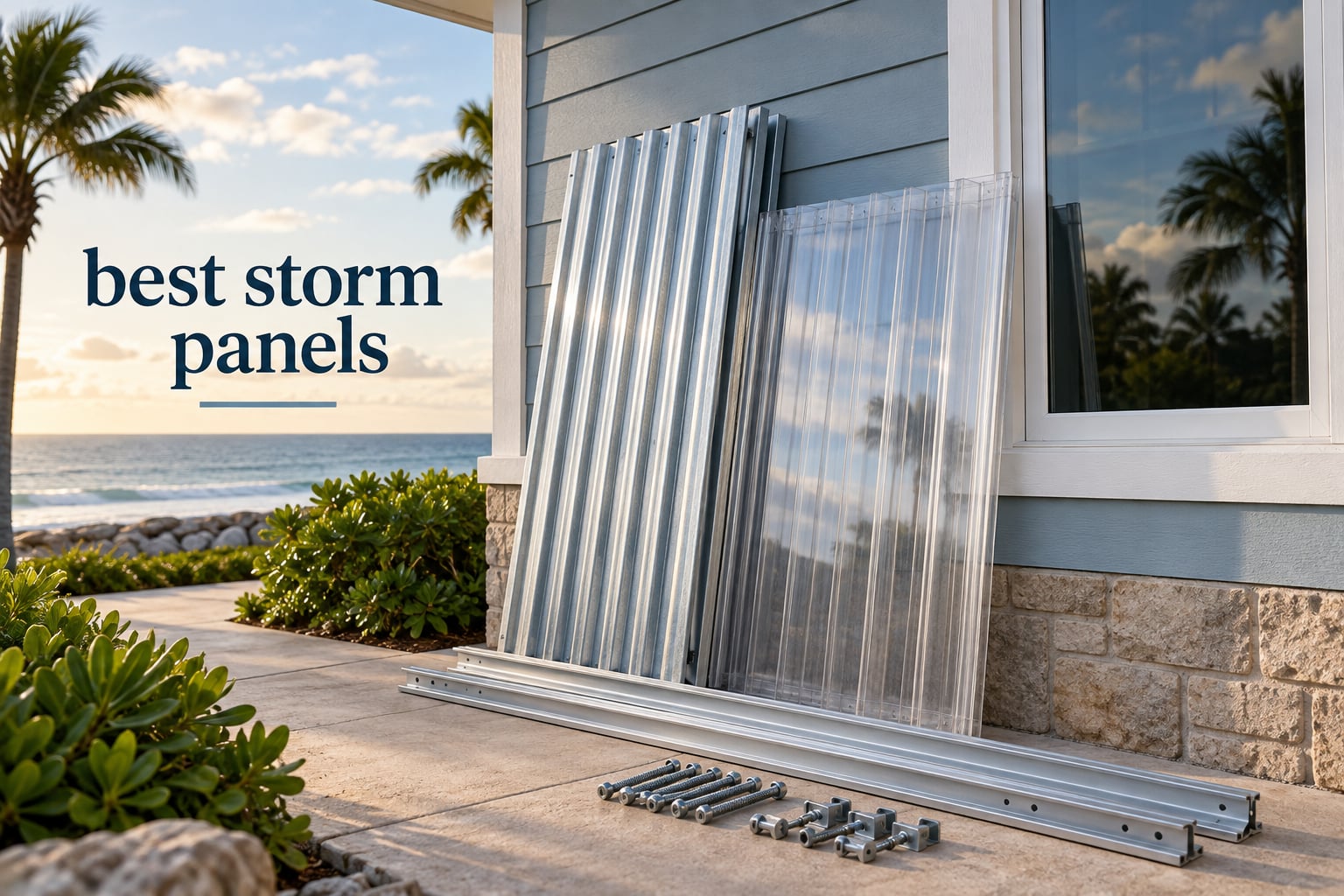
A storm panel is a removable sheet of aluminum, galvanized steel, or clear polycarbonate that you fit over a window or door opening before a storm, then take down and store afterwards. The panel takes the hit from windborne debris so the glass underneath stays intact, which stops wind and rain from getting into the house and causing damage far beyond the window itself. Panels mount to permanent tracks or bolt-on anchors around the opening, and each one is sized to overlap the opening on every side.
Two hard truths shaped how we put this list together. First, approval documentation beats brand loyalty every time: a panel with a Miami-Dade Notice of Acceptance or a Florida Product Approval is a tested system, while a panel without one is only sheet metal. Second, almost nobody chooses by brand. They choose by material, by the size and shape of the opening they need to cover, and by whether one person in the household can lift the panel in the short window before landfall.
That last filter matters more than most product pages admit. Homeowners on r/florida describe aluminum shutters going up in a couple of hours with a wing-tipped drill bit, while owners on r/StPetersburgFL frame steel as the heavy option and aluminum as the one that is much lighter and easier to install and more compact to store. The best storm panels for your home are the ones your household can actually deploy when a watch is issued, not the ones with the longest specification sheet.
We compared six storm panel systems that are actually purchasable today, weighing material, thickness, opening coverage, mounting style, documented code approval, and the real-world weight and handling question. Prices and approval status change, so verify your local code requirements before you buy. If you also need a broader look at home protection gear, our picks for solar panels for van conversions cover a different kind of off-grid planning entirely.
Table of Contents
Top 3 Best Storm Panel Picks for 2026
These three are the ones we would look at first, and the reasons they top the list are different from each other. One wins on documentation, one on price, one on fit.

WDB Custom DIY Hurricane…
- Custom cut to your exact opening
- Lexan clear panel lets light in
- Wind resistant to 150 mph
Safeguard 0.050 Aluminum…
- Miami-Dade NOA approved
- Rolled 0.050 inch aluminum
- 2 inch keyholes at each end

The Safeguard panel is the only product in this roundup with a Miami-Dade Notice of Acceptance number printed in its spec sheet, and in the High-Velocity Hurricane Zone that document is the whole ballgame. The WDB panel is the only one you can order cut to your exact opening, and it is the only clear Lexan panel here, so daylight still gets in during an outage. The Eyewall kit ships panel and tracks together, which removes the most common reason a storm panel project stalls: the hardware never arrives.
All Six Storm Panels Compared (September 2026)
Here is the full lineup in one place, with the material, coverage, documentation and mounting style for each panel.
| Product | Specs | Action |
|---|---|---|
| WDB Custom DIY Hurricane Shutter Panel |
|
Check Latest Price |
| Safeguard 0.050 Aluminum Storm Panel |
|
Check Latest Price |
| Eyewall 20×20 Aluminum Panel Kit |
|
Check Latest Price |
 US Discount Shutters 20×30 Aluminum Kit US Discount Shutters 20×30 Aluminum Kit |
|
Check Latest Price |
 ObegShare Perforated Roll Up Shutter ObegShare Perforated Roll Up Shutter |
|
Check Latest Price |
 GISONTONE End-Locking Roller Shutter GISONTONE End-Locking Roller Shutter |
|
Check Latest Price |
1. WDB Custom DIY Hurricane Shutter Panel: Best Overall
Custom DIY Hurricane Shutter Panels – Custom Length x Custom Height, Overlapping Storm Panels for Window & Door Protection, Easy DIY Installation
Clear Lexan panel
Custom cut length and height
150 mph wind resistance
15 pounds
Pros
- Cut to your exact opening dimensions
- Clear panel lets natural light in during outages
- Overlapping panels can be stacked for wider coverage
- Installs with basic DIY tools
- Components designed for removal and repeat use
Cons
- One panel per order so you add units for each window
- Fixed 14 inch width and stacking reduces coverage by 2 inches
- Only one verified review so long-term durability is undocumented
This is the panel that answered the question most buyers arrive with, which is whether their oddly sized doorway or casement window can be covered at all. You choose the length and height when you order, so a 43 by 57 inch opening gets a panel built for a 43 by 57 inch opening rather than a stack of panels that overlap the frame by inches. That is the difference between a system you can trust and a system you spend storm night hoping about.
It ships at 15 pounds, which puts it in the weight class that one person can realistically carry and lift into place. A homeowner on r/florida put the installation at a couple of hours with a wing-tipped drill bit once the panels are up on their track, and that is the pace to plan around. Our single verified buyer reported the materials arriving without problems ahead of schedule and being satisfied with the end result after some expected modification during installation, which is a fair description of any custom-fit panel job.
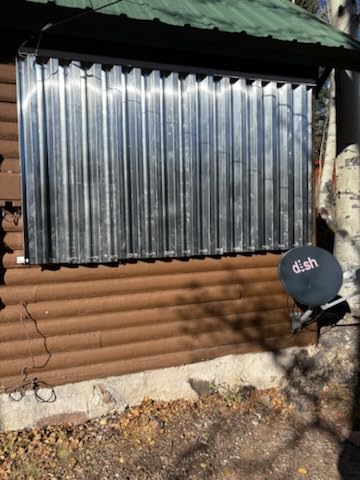
The Lexan construction is the other reason this one stands out. A clear panel keeps daylight and visibility during a power outage, so the room stays usable rather than becoming a cave, and clear polycarbonate is the profile most coastal homeowners end up preferring once they have lived with a dark house for two days. The spec sheet claims engineering for hurricane-force winds up to 150 mph, and the panel is rated for vertical track mounting or direct-to-wall horizontal installation, so it works on a retrofit where permanent tracks are not practical.
When this panel fits your house
It fits best on openings that are not standard sizes, because the custom height and length are the entire point. Buyers covering standard double-hung windows with matching openings can also use it, and the overlapping design means you can stack panels to reach a wider span, provided you account for the 2 inches lost per panel where they overlap.
The light transmission is a genuine advantage if you plan to use the house during the storm or lose power for a stretch, and the 15-pound weight means an upstairs window or a wide door is realistic for a two-person job rather than a professional crew. The buy is a made-to-order item, so measure carefully before you commit.
When to skip it
Skip it if you need several openings covered and do not want to place several separate orders, because coverage is one panel per order. Skip it if the added stacking overlap is a problem, because each stacked panel narrows your effective coverage by 2 inches.
Also weigh that the durability story here rests on a single review. The engineering claim is specific, but long-term field data is thin, so if your jurisdiction insists on a filed test report rather than a manufacturer claim, this panel will not satisfy that on its own.
2. Safeguard 0.050 Aluminum Storm Panel 15×47: Best Value
Safeguard Hurricane Protection PNL-W-047 0.050 Aluminum Storm Panel, 15-Inch x 47-Inch
0.050 inch rolled aluminum
15 by 47 inches
Miami-Dade NOA 12-0403.02
Keyholes at both ends
Pros
- Carries a Miami-Dade Notice of Acceptance number
- Rated to withstand 1000 pounds of force per square inch
- 2 inch keyholes allow several mounting options
- Panels stack for compact storage
- Powder coat option on a mill finish
Cons
- Fixed 15 by 47 inch size only
- No track or mounting hardware included
- Single one-star review gives no positive signal
The reason this panel ranks where it does is one line in its technical data: Miami-Dade County approved under Notice of Acceptance 12-0403.02. If you live in Miami-Dade or Broward, that is the High-Velocity Hurricane Zone, and a NOA is the document a building department, a wind mitigation inspector, and your insurer will actually recognise. A panel without one is a guess dressed up as a spec sheet.
Construction-wise it is a proper .050 inch rolled aluminum panel rated to withstand 1000 pounds of force per square inch, which is a real figure rather than a marketing adjective. The 2-inch keyholes at each end are the detail that separates a usable panel from a decorative one, because they let the same panel mount on a track, on side channels, or direct to the wall depending on the opening and the substrate.
The fixed 15 by 47 inch size is the constraint. Anything wider than 15 inches needs two panels side by side or a stack, and anything taller than 47 inches needs a second run, so the number of panels per opening is a real budget line rather than a rounding error. The panel is bare and sold without a track or mounting hardware, so plan the hardware separately or you will be improvising anchors in the week a storm is announced.
How to verify the approval before you buy
Ask the seller for the NOA number and look it up in the Miami-Dade product control section rather than taking a screenshot on trust. The number 12-0403.02 identifies the approved system, and a system-level approval covers the manufacturer configuration, the track and anchor spacing, and the fasteners you are required to use.
Then confirm the approval covers your installation. Approvals are specific about mounting style and anchor spacing, and a panel installed with generic screws on a wider spacing than the report allows is no longer the approved assembly. If you are outside the High-Velocity Hurricane Zone, check your own state product approval instead, since the same logic applies through a different database.
What you are accepting
You are accepting a bare panel with no hardware in the box, so the track and anchor cost is a separate line in your budget. You are also accepting a fixed size, which means a window wall needs a plan for stacking and overlap rather than a single clean panel per opening.
Lastly, be honest about the review data. This listing has one review and it is a one-star rating, so there is no positive owner signal to lean on here. The documentation is the case for this panel, and the documentation is strong.
3. Eyewall Aluminium Storm Panel 20×20 Kit: Best on a Budget
Eyewall Aluminium Storm Panel 20in (Width) X 20in (Height) Full Kit with Tracks (Silver)
20 by 20 inch aluminium panel
Tracks included
Silver finish
US Discount Shutters
Pros
- Panel and tracks arrive as one kit
- Compact size suits small to medium openings
- Aluminium keeps handling weight down for solo installs
Cons
- No customer reviews to validate performance
- Fixed 20 by 20 inch coverage only
- Listing does not itemise what the hardware includes
Most storm panel projects do not fail on the panel. They fail because the panel arrived and the tracks did not, and the homeowner discovered the gap the afternoon a storm watch was issued. This kit exists to remove that failure mode, because the panel and its mounting tracks come in the same purchase.
At 20 by 20 inches it is a small- to medium-opening panel, and aluminium is the right material for a first-time buyer who needs one person to handle it. Homeowners in Florida repeatedly describe aluminium as the lighter and easier material to install and the more compact one to store, and that advantage compounds across every opening on the house.
What you are buying here is a straightforward, portable panel. It is sold by US Discount Shutters in a silver finish, and the square profile suits bathroom windows, small casements, and any opening where a rectangular panel would overhang the frame awkwardly.
Where this kit makes sense
It makes sense for a first deployment on a small coastal home, a rental or second property, or a retrofit where you want a working panel system in place without a custom order. The all-in-one kit also makes it a low-risk way to learn the mounting routine before committing to a full house of panels.
Because aluminium is the material, expect a lighter panel than a steel equivalent of the same coverage, and expect it to store flat and stack. That matters in a garage in a small house where every square foot of floor is spoken for.
Where it falls short
Twenty inches of width is the hard limit. Standard windows and any sliding glass door will need several panels, so this is not a whole-house solution, and the overlap math eats into the effective coverage just like any stacked system.
There are no customer reviews on this listing, so there is no owner feedback on fit, finish, or how the tracks actually behave over time. The hardware contents are not itemised, so confirm what arrives with the kit before you plan the install around it.
4. US Discount Shutters 20×30 Aluminum Kit: Best for Taller Openings
Aluminium Storm Panel 20in (Width) X 30in (Height) Full Kit with Tracks
20 by 30 inch panel
Aluminum 1100 series
Tracks included
Residential grade
Pros
- Taller 30 inch height covers more of a standard opening
- Tracks included in the kit
- Aluminum 1100 is a durable corrosion-resistant alloy
- Residential grade rating suits a single-story home
Cons
- No customer reviews to validate performance
- Fixed 20 by 30 inch size limits coverage
- Listing gives no thickness or force rating
This is the Eyewall kit’s taller sibling, and the extra ten inches of height is the whole reason to choose it. A 20 by 20 panel leaves a lot of glass exposed on a taller window, and every exposed inch is an inch of glass that can break and let the interior of your house take the storm.
It is built from Aluminum 1100 series and carries a residential grade rating, which is a sensible pairing for a single-story coastal home where the panels are handled by whoever is available in the short pre-landfall window. Like the smaller kit, the tracks are included, so the hardware problem that stalls so many panel projects is already solved.
Aluminum 1100 is one of the more corrosion-resistant common aluminum alloys, which matters in a salt-air environment where a cheaper alloy will start spotting around the edges. If your house is within a mile or two of surf, that is a reasonable tiebreaker between two kits that otherwise look similar.
Choosing between the two aluminium kits
Choose the 20 by 30 kit when your openings are taller than they are wide, or when the bottom half of a tall window is what you most want covered. Choose the smaller square kit when your openings are genuinely small and you want the most compact panel you can find.
Both are aluminium and both include tracks, so the real differentiators are coverage area per panel and the number of panels you need to reach each opening. Measure every window before you order, because the count of panels is the number that drives both the budget and the storage footprint.
What to confirm first
Confirm the thickness and any force rating with the seller, because the listing does not state them and those are the numbers an inspector will ask about. Confirm which state’s product approval covers the kit in your area, and whether that approval names this specific part number.
There are no customer reviews on this listing, so treat it as an undemonstrated product and pair it with your own measurement plan. The kit format and the alloy are the reasons it earns a place here, not owner feedback.
5. ObegShare Perforated Roll Up Shutter: Best for Light and Privacy
ObegShare Storm Window Protection – Impact Roll Up Shutters for Homes, Patio, Counter, Metal Perforated Defense Panels (Brown)
Perforated aluminium slats
Remote automatic operation
33 pounds
Water resistant
Pros
- Retracts completely when not needed
- Perforated slats give daylight and privacy together
- Spring system with precision bearings
- Handles windows
- patios and garage doors
- Five colour options
Cons
- No customer reviews to validate storm performance
- Motor hardware adds cost and complexity
- Face-fit mounting likely needs professional installation
Everything else in this roundup is a panel you carry out and bolt on. This one stays attached to the building and rolls up into a box, which is a fundamentally different answer to two questions at once: how does the house look on a normal Tuesday, and who has to do the work before landfall.
The perforated slats are the reason it earns a place in a storm panel roundup rather than a roller shade roundup. Solid slats would block your daylight and your view; perforated slats let light and some airflow through while keeping the view from outside largely obscured, so the room stays lit and you keep privacy. It comes in white, beige, dark grey, light grey, and brown, so the colour can match an existing exterior rather than fighting it.
It weighs 33 pounds and mounts face-fit, which is the honest catch. At that weight and with face-fit mounting, this is a two-person or professional job rather than a solo pre-landfall install, and the motorised remote operation adds a wiring or battery element you would not have with a bolt-on panel.
Who this suits
It suits a house where appearance matters and the household cannot count on anyone being available to install anything. A permanently mounted system that goes up with a remote changes the calculus for a second home, a rental left vacant for weeks, or a property where an elderly owner will not be lifting panels this year or next.
It also suits larger openings, since the listing is framed for windows, patios, and garage doors. Remote operation means one person can close several openings quickly once the units are fitted.
What to check before committing
Check the code documentation carefully, because this is the category where marketing language outruns testing more often than not. A roll-up shutter that is described as impact rated still needs a product approval or test report for your jurisdiction before it counts for a wind mitigation credit.
Check the mounting requirement too. The listing says face-fit and tells you to contact the seller for other installation methods, and face-fit on a large opening usually means a frame has to be built accurately and bolted into sound substrate. There are no customer reviews here, so treat it as an unproven listing and confirm what you are actually buying before you plan around it.
6. GISONTONE End-Locking Roller Shutter: Best for Heavy Openings
GISONTONE Exterior Hurricane Shutter Typhoons Resistance, Blinds Outdoor Aluminum Curtain Rolling Up Motorized Security for Window Screen White (Aluminum+Sidelock)
Double layer 1.2mm aluminium slats
End-locking slat design
Crank or motorised
132 pounds
Pros
- Double layer slats at 1.2mm give a thicker curtain
- End-locking slat design resists wind uplift
- Crank drive included for manual operation
- Outside mount suits a retrofit
- Custom sizes and colours offered
Cons
- No customer reviews to validate hurricane performance
- Heaviest unit here at 132 pounds so fitting needs two people
- Highest cost of the six options compared
This is the heavy-duty end of the range, and the design choices are aimed at uplift resistance rather than appearance. The end-locking slat mechanism is the piece that matters most in a real storm, because a curtain of slats that can be peeled open at the edges is a curtain that fails at the corners first.
Double-layer aluminium slats at 1.2mm give it a thicker section than a single-layer slat, and the system runs on a crank drive included in the package or on a motorised drive for a permanent installation. Outside-mount mounting is genuinely useful for retrofits, since it goes over the opening rather than requiring the recess to be rebuilt.
At 132 pounds this is the heaviest item we looked at by a wide margin, and that fact drives everything else about it. This is not a solo pre-landfall job. It is a fitted installation, done once, ideally by a professional, and then operated by anyone with a crank.
When the weight is justified
The weight makes sense on a large opening where a lightweight panel would be the weak link, or on a commercial storefront or garage opening where the fix is fitted once and left alone for years. If the install is going to be done properly and never repeated, a heavier permanently mounted curtain is a reasonable trade for never lifting anything again.
The crank option also removes the electrical dependency, which matters in a storm where the power is likely to be out for the entire event you are sheltering through.
What gives us pause
There are no customer reviews on this listing, and hurricane performance claims without a test report or product approval are worth very little next to the documentation on the 0.050 inch aluminum panel in position two. Ask for the test standard and the approval number before you treat this as storm protection rather than a heavy-duty roller shutter.
Also confirm the weight is a realistic figure for the opening you have in mind, and plan the install for two people or a crew. This is the option with the least owner evidence behind it, and it is also the one where a professional fitting matters most.
Storm Panel Materials Compared
Material is the decision that follows approval, and the forum consensus is unusually consistent on the trade-off. On r/StPetersburgFL a homeowner framed it directly: aluminum costs more up front, but it is a one-time purchase, much lighter and easier to install, and more compact to store. Steel buys you strength at the price of handling.
Aluminium is the practical default for most coastal homeowners. It is light enough for one person, corrosion resistant in salt air, and easy to cut or order to a specific opening. Steel is heavier and stiffer, which suits large openings and upper stories, but it is a two-person job and it eats storage space. Clear polycarbonate or Lexan is the one that keeps daylight in, which matters more than buyers expect once they have spent a day in a dark house during an outage.
Fabric and woven-polymer storm screens are the fourth option and the lightest of all, which makes them the answer for anyone who physically cannot lift a rigid panel. Their weakness is documentation: they must still carry an approval in your jurisdiction to count for a wind mitigation credit. And roll-up shutters, whether perforated aluminium or steel, solve the deployment problem rather than the material problem, because they stay mounted and go up with a crank or a remote.
One more distinction worth keeping straight: a panel that looks like protection is not protection. Decorative shutters and improvised roofing sheets have no test report behind them, and neither an insurer nor a wind mitigation inspector will treat them as an opening protection system.
How to Choose Storm Panels: 7 Criteria
Start with approval, and let it eliminate options before you fall in love with one. Look for a Miami-Dade Notice of Acceptance, a Florida Product Approval, a Texas Department of Insurance product evaluation, or the equivalent in your state, and check that the document covers the manufacturer configuration, the mounting style, and the anchor spacing you intend to use. In the High-Velocity Hurricane Zone covering Miami-Dade and Broward, this step is not optional; it is the only thing that makes the assembly compliant.
Next, match the panel to the opening. Panels are fixed-size or made to order, and a panel narrower than the opening plus a proper overlap is a waste of money. Measure width and height, then check the overlap requirement on each side. A sliding glass door will need a multi-panel plan, and a second-story window will need a plan for how a person gets the panel up there safely.
Then work through the rest of the checklist:
1. Mounting style: decide between a permanent track system, C-channel above and below, side channels, or direct bolt-on. Tracks cost more in labor and take time to install correctly, but they make deployment dramatically faster once the storm window opens.
2. Material and weight: aluminium and clear polycarbonate for solo installs and easy storage, steel for large openings and upper stories, fabric or screens when lifting is simply not possible.
3. Storage footprint: stack panels flat against a garage wall on shelving rated for the load, and count the panels per opening. A house with twenty openings and two panels each is forty panels to store between storms, and that is a real planning task rather than a detail.
4. Opening size and shape: tall windows, arched windows, and sliding doors each need their own answer, and off-the-shelf square panels are the least flexible option available.
5. Deployment time: plywood takes more than an hour per window and is single use, accordion shutters take roughly half an hour for a whole home, and approved panels sit in between. Budget your own hands against those numbers, because the deployment window after a hurricane watch is short and handymen may not be available in it.
6. Insurance and wind mitigation credits: a wind mitigation report evaluates how your openings are protected from flying debris, and an approved tested system is what earns the credit. Check your state’s approved list, because an assembly that is not on it may protect the house without moving the premium.
7. Supply timing: buy before storm season, not during a watch. Lumberyards and home improvement stores see demand spike right before landfall, and pre-cut or pre-labelled panels remove the last-minute shopping problem entirely.
Can You Install Storm Panels Yourself?
For most homes, yes, if the panel material is aluminium or clear polycarbonate and the opening is at ground level. A homeowner on r/florida described aluminum shutters going up in a couple of hours with a wing-tipped drill bit, and that is a realistic figure for a prepared house with tracks already installed and panels already labelled. The prep work is what makes the difference, not the storm-night hours.
Know when to hire help. Large sliding glass doors, second-story windows, and anything over roughly 30 pounds per panel are where solo installs break down, and threads on r/HomeImprovement and r/321 repeatedly describe a resident who is responsible for putting up shutters with nobody to help. The two roller systems in this roundup at 33 pounds and 132 pounds belong in the hire-someone column from the start.
Verify the finished installation before you need it. A homeowner on r/HomeImprovement noticed that some of the panels their contractors had fitted had visible side gaps, and that is a real quality-control failure that gets worse under load. Check the overlap on every side, check that each fastener matches the spacing in the approval document, and check that panels sit square in their tracks rather than forced into them.
On installation method, our picks lean on guide material for metalwork and drilling technique if you need to refresh the fundamentals before mounting anything permanent. Our step-by-step on drilling out spot welds covers the drilling discipline, and our overview of sheet metal for patch panel fabrication is useful if you are cutting or forming your own panel stock.
Finally, consider a deployment service. Several Florida threads ask whether a company will put panels up and take them down during a storm, and for older owners, single parents, and anyone without help on call, that is a reasonable thing to budget for rather than a service to be embarrassed about using.
Frequently Asked Questions
Are hurricane panels worth it?
Yes, when your home sits in a windborne debris zone and the panels carry a product approval valid for your jurisdiction. The payoff is that the glass stays intact, so wind and rain never enter the house, and an approved opening protection system can qualify for wind mitigation credits. The honest counterweight from Florida homeowners is that value depends on how often you expect to deploy them, and some owners skip deployment for lower-category forecasts.
Are hurricane shutters worth the money?
Judge the total cost as panel plus tracks and hardware plus labor, and price it per opening rather than per house. Approved panels are a one-time purchase that can be redeployed every season, unlike plywood, which is single use and warps. The value drops sharply if the panels are stored in a way you will not actually retrieve them from when a watch is issued.
Do hurricane shutters lower insurance?
In many states with wind mitigation programs, yes, but only when the system appears on that state’s approved list. A wind mitigation report evaluates how your openings are protected from flying debris, and an approved, tested shutter is one of the measures the inspector looks for. Florida, Texas, and the coastal Carolinas all run such programs, and the credit is applied at renewal rather than immediately.
Can I install storm panels myself?
Usually, if the panels are aluminium or clear polycarbonate and the openings are at ground level. Aluminium is described by Florida homeowners as much lighter and easier to install than steel, with a wing-tipped drill bit and a couple of hours of work per opening. Hire help for sliding glass doors, second-story windows, and any panel heavy enough that one person cannot safely lift it into the track.
Do homes look better with or without shutters?
Removable storm panels leave nothing on the facade once deployed and taken down, which is the aesthetic argument for panels over permanently mounted systems. Accordion, roll-down, and Colonial or Bahama shutters change the look of the house year round. A perforated roller shutter is a middle ground, since it retracts into a compact housing when it is not in use.
The Best Storm Panel Verdict
The decision rule is simple: verify the approval first, then pick the material your household can deploy, then size it to the opening. For most coastal homeowners, that lands on the custom clear Lexan panel in position one, because cut-to-order fit and daylight during an outage solve two problems at once, and 15 pounds is a solo-installable weight. If you are in Miami-Dade or Broward and want documentation you can hand an inspector, the 0.050 inch aluminum panel in position two carries the Notice of Acceptance that no other product here has.
Before you order, measure every opening, confirm the anchor spacing in the approval document matches what you will actually install, and plan where forty panels live between June and November. Approval documentation and deployability are what separate real storm protection from expensive sheet metal, and the best storm panels for your home are simply the ones that pass both tests. Check the listings below and verify your local code requirements before committing.