
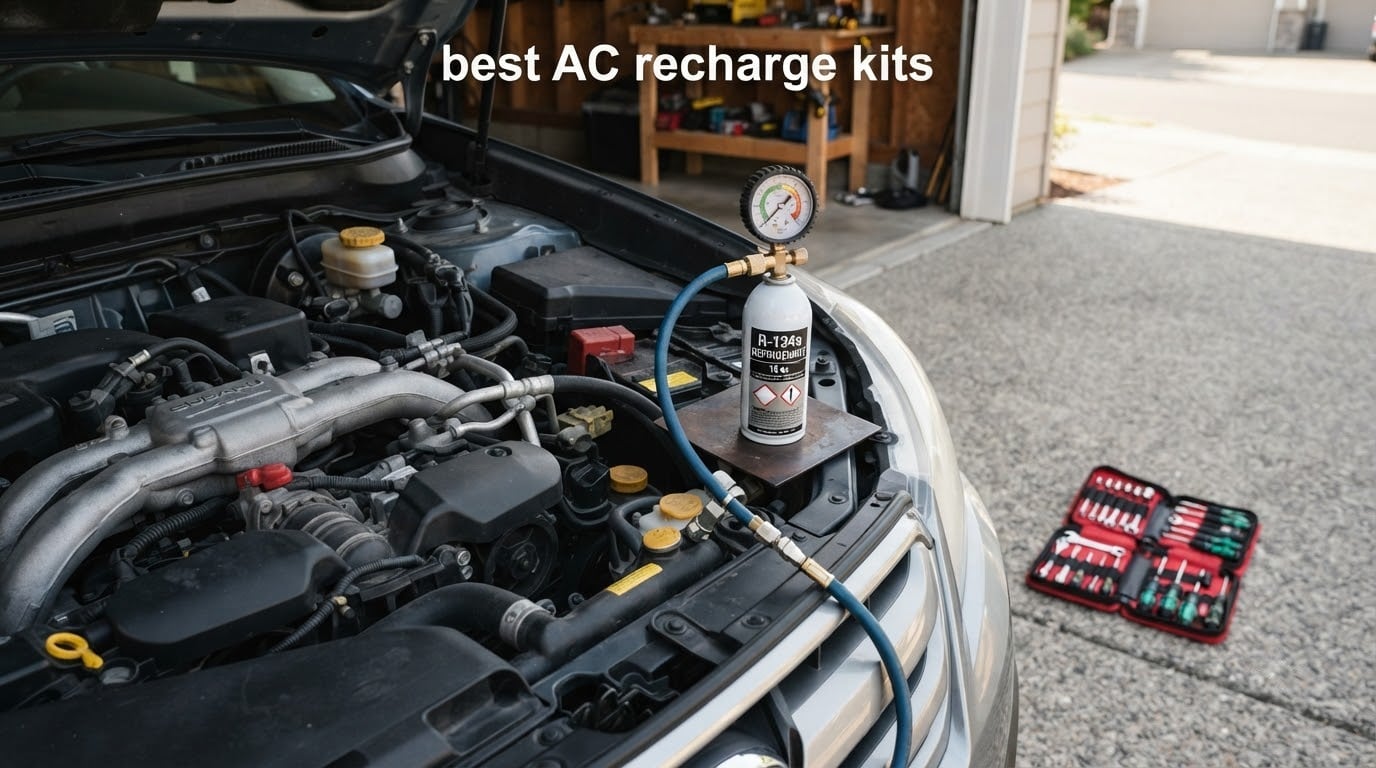
If your car’s air conditioning still blows air, but it has gone warm and clammy, you are looking at the most common complaint in this whole category. Usually it is one of two things: a slow refrigerant leak, or a system that has simply lost its charge. Both are fixable in a driveway, and both start with one of the best AC recharge kits for 2026. We worked through eight of them for this guide, comparing the fittings, the pressure hardware and the review patterns across every one.
One thing is worth clearing up before anything else, because it trips up most first-time users. Most of the top-rated “kits” are not cans of gas in a box. They are the working end of the job: a charging hose, a low-side quick coupler, a can tap, and in most cases a pressure gauge. You buy the refrigerant can separately, screw the tap onto the can, and the gauge tells you when to stop. Only one pick in this roundup actually ships with refrigerant included.
That distinction matters because it changes what you are buying. A hose-and-gauge set is a tool you keep for years and refill, not a consumable you throw away after one job. The can tap style is what ties the kit to your refrigerant, and getting that wrong is the number one reason a kit sits in a garage unused. Our DIY AC recharge kit guide covers the same hardware in more procedural detail.
Everything below is based on published specifications and thousands of owner reviews, not on marketing copy. We also tell you where a kit is the wrong tool, because a can of refrigerant will not fix a failed compressor, condenser or evaporator, and plenty of owners have learned that the expensive way.
Table of Contents
Top 3 Best AC Recharge Kits Compared (October 2026)

A/C Pro R-1234yf Gauge and Hose
- 24 inch charging hose
- Extra large readable gauge
- Trigger dispenser
- Push-on quick coupler

Lichamp R-134a Tap and Gauge Set
- Both piercing and self-sealing taps
- 5ft hose
- 250 psi gauge
- Bullet valves with L keys
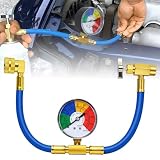
Ketofa R-134a Charge Hose Kit
- Clear low side pressure gauge
- 1/2 inch ACME can fitting
- Quick coupler
- Safety valve
Our top pick is the A/C Pro R-1234yf gauge and hose: the widest review base of the R-1234yf-ready tools here, an easy-to-read dial and a trigger dispenser that makes a top-off feel simple. The Lichamp set wins on hardware count, because it carries both can tap styles, and the Ketofa kit is the cheapest honest way to get a working low-side reading on an older car.
All 8 AC Recharge Kits at a Glance in 2026
| Product | Specs | Action |
|---|---|---|
| A/C Pro R-1234yf Gauge and Hose |
|
Check Latest Price |
| Lichamp R-134a Recharge Kit |
|
Check Latest Price |
| Ketofa R-134a Charge Hose Kit |
|
Check Latest Price |
 SURIEEN R-134A Recharge Hose Kit SURIEEN R-134A Recharge Hose Kit |
|
Check Latest Price |
 A/C Pro 8 Inch R-134a Hose and Can Tap A/C Pro 8 Inch R-134a Hose and Can Tap |
|
Check Latest Price |
 BACOENG R-134a Kit with BPV-31 Valve BACOENG R-134a Kit with BPV-31 Valve |
|
Check Latest Price |
 ZeroR R134a Replacement Two-Can Pack ZeroR R134a Replacement Two-Can Pack |
|
Check Latest Price |
 Orion Motor Tech 4-Way Manifold Set Orion Motor Tech 4-Way Manifold Set |
|
Check Latest Price |
1. A/C Pro Certified R-1234yf Gauge and Hose – Best Overall
A/C Pro InterDynamics Certified Air Conditioner Gauge and Hose, R-1234yf
R-1234yf dispenser
24 inch charging hose
Extra large gauge
Trigger valve
Pros
- Extra large gauge is easy to read while charging
- 24 inch hose reaches difficult ports
- Push-on quick connect coupler
- Trigger dispenser for effortless recharging
Cons
- Only suits R-1234yf systems and does nothing for R-134a cars
- Refrigerant cans are sold separately
This is the A/C Pro CERTYF102-4, a gauge-and-hose dispenser built for R-1234yf, the refrigerant most 2017 and newer cars run. It weighs 8.9 ounces, ships in a box roughly 10.6 x 7.2 x 3.1 inches, and holds a 4.4 rating from 1,228 owner reviews. That review base is the reason it leads our list: it is the most thoroughly documented of the R-1234yf-capable tools we looked at.
The four components are the ones that matter. A 24 inch charging hose reaches ports that sit in tight engine bays, the gauge face is deliberately oversized so you can read it while crouched over the fender, the coupler pushes on without threading, and the trigger valve lets you dispense in bursts instead of dumping the whole can into the system.
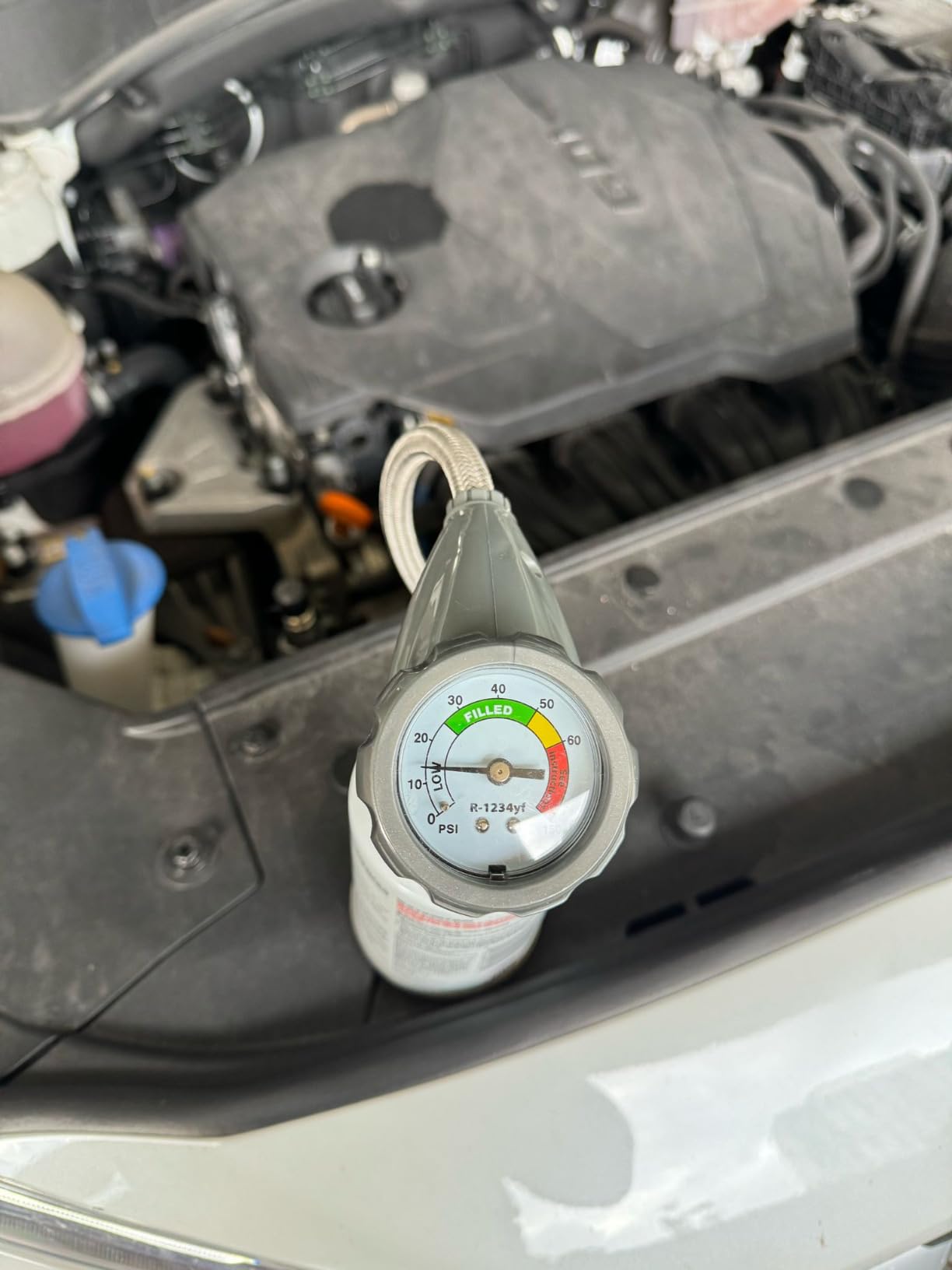
Owner feedback lines up with the spec sheet. Buyers point at the readable gauge, the generous hose length and the simple quick-connect trigger, with roughly three quarters of ratings at five stars. The gauge doubles as a diagnostic instrument, which is arguably the most valuable part of the package: you can check low-side pressure before you ever open a can and know whether the system is low or simply not cooling for another reason.
There is one hard limit, and it is not a soft preference. This tool is made for R-1234yf systems. On an R-134a car it does nothing useful, so check the under-hood service sticker before you order. The second limit is that no refrigerant comes in the box, so you are buying a tool, not a refill.
Who this kit suits
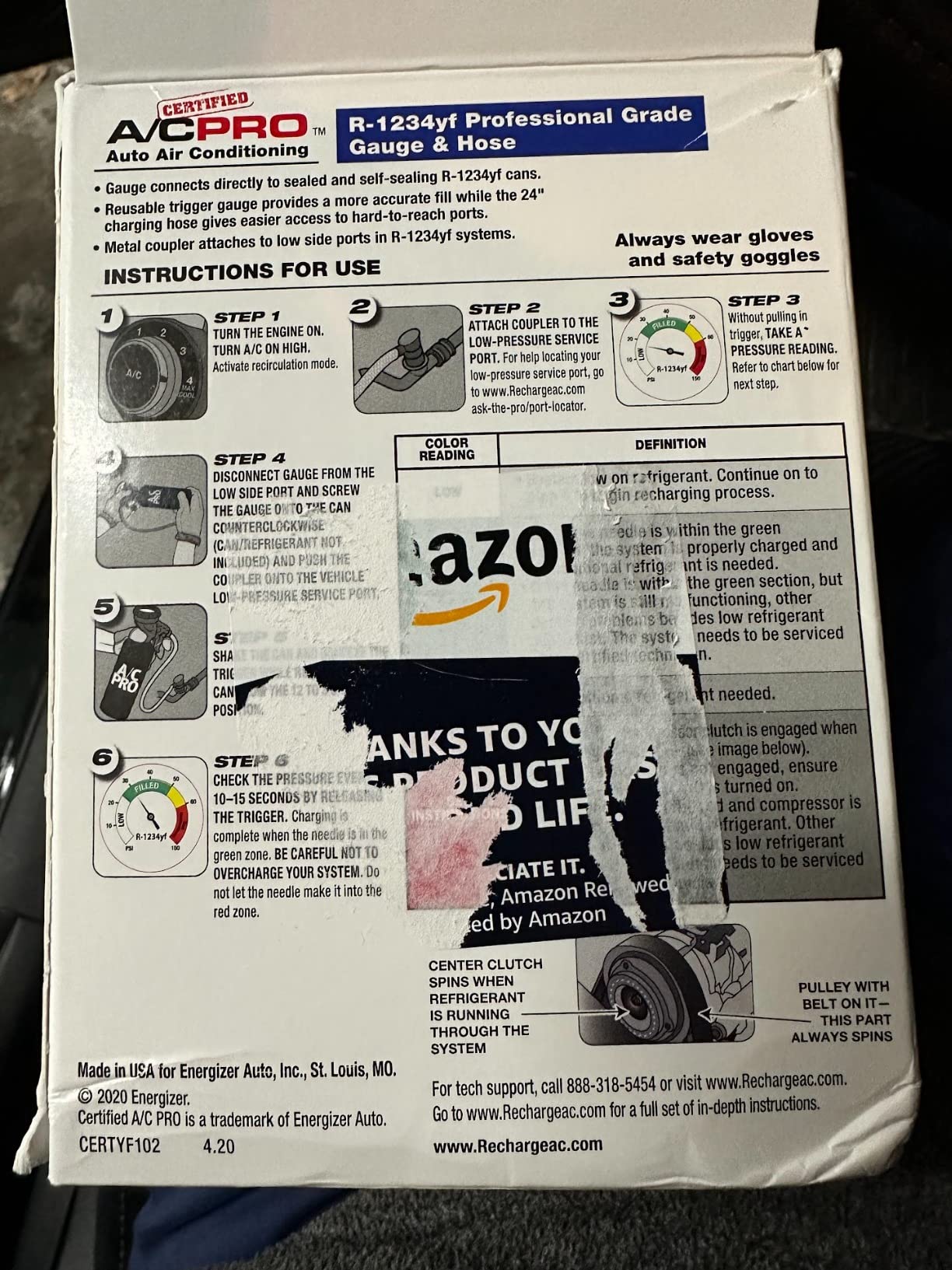
It suits anyone whose under-hood sticker says R-1234yf, which covers most cars built from 2017 onward. If your cooling has faded gradually over a few months and the vent air is only mildly warm, you are in exactly the situation this tool handles: read the pressure, add refrigerant in short bursts, close the valve.
What to check before you buy
Two things. First, confirm the refrigerant, because getting it wrong wastes the whole purchase. Second, look at the can type you plan to use. Self-sealing valve cans and 1/2 inch ACME piercing cans need different taps, and this listing does not spell out a can restriction, so check the packaging on your can before assuming the tap will thread onto it.
2. Lichamp R-134a Recharge Kit with Bullet Piercing Valve – Most Hardware in One Box
Lichamp A/C R134A Refrigerator Freon Recharge Kit with Bullet Piercing Valve, Piercing and Self-Sealing Can Tap 134A
Low pressure gauge
5ft hose
Both can tap styles
Bullet valves with L keys
Pros
- Complete parts list in one box
- Extra large color coded dials with a Celsius scale
- Brass fittings throughout
- Handles piercing and self sealing cans
Cons
- No written instructions in the box
- Some buyers report a broken valve arriving
- Dial wording is hard to read
The Lichamp AGS-R13452 is the most parts-dense set in this group, and that is the entire argument for it. The box holds a low-pressure gauge, a 5 foot hose, a suction side coupler, a piercing can tap, a self-sealing can tap, and two bullet valves with L keys. Carrying both can tap styles means one kit covers old piercing-style cans and modern self-sealing cans without a second purchase.
The materials are serious for a DIY tool. Fittings are brass, the gauge is rated to 250 psi, and the hose is rated to 600 psi working pressure with a 3000 psi burst rating. The package measures 5.28 x 7.09 x 1.97 inches and weighs 1.5 pounds, so it is a real piece of equipment rather than a plastic gizmo.
Owners used it well beyond cars. Reviews describe successful work on car air conditioning, refrigerators and freezers, which is what the bullet valves are for: they pierce the small copper tubes found on household appliances. At 4.4 from 1,531 ratings, with about 70% of reviewers at five stars, it is the most-reviewed tool we evaluated.
The complaints are honest and small. There are no written instructions, so first-time users end up on video tutorials. The wording printed around the dial is difficult to read in daylight. And a few buyers report a valve arriving cracked, which is a packing problem rather than a design flaw.
Who this kit suits
It suits a mixed fleet, meaning a household with a car and a few window or chest units, or a small garage that does not want to track which can type each machine takes. The dual taps are the reason to pick it over a cheaper single-tap kit.
What to check before you buy
Two cautions. Nobody has verified the gauge accuracy against a calibration standard, so treat the reading as a rough reference rather than a shop-grade number. And if your only job is topping off one car, you are paying for refrigeration hardware you will never touch.
3. Ketofa R-134a Charge Hose Kit with Gauge – Best for a First Diagnostic Reading
R134A Car AC Refrigerant Charge Hose Kit with Gauge, A/C 1/2 Recharge Measuring Kit Piercing-Type Can Tap Air Conditioning Pressure Gauge R134A by Ketofa
Fits 1/2 inch ACME piercing cans
Clear low side gauge
Quick coupler
Built in safety valve
Pros
- Clear gauge gives real time low side readings
- Quick coupler locks onto the vehicle low side port
- Built in safety valve helps reduce accidental release
- Weighs just 0.16 kg
Cons
- Designed for 1/2 inch ACME piercing type cans only
- No instructions included
- Listed as not compatible with 2018 Honda Civic or 2018 Hyundai Tucson
The Ketofa kit is the stripped-down answer. You get a clear low-side gauge, a reinforced rubber hose, a quick coupler and a built-in safety valve designed to reduce accidental refrigerant release, in a package that weighs 0.16 kg and measures 39 centimeters. That simplicity is the point: fewer joints means fewer places to leak.
It rates 4.3 from 1,207 reviews, with roughly 68% of buyers at five stars. What owners mention most is that the clear gauge works as a diagnostic tool, letting you watch pressure in real time before deciding whether to add anything at all.
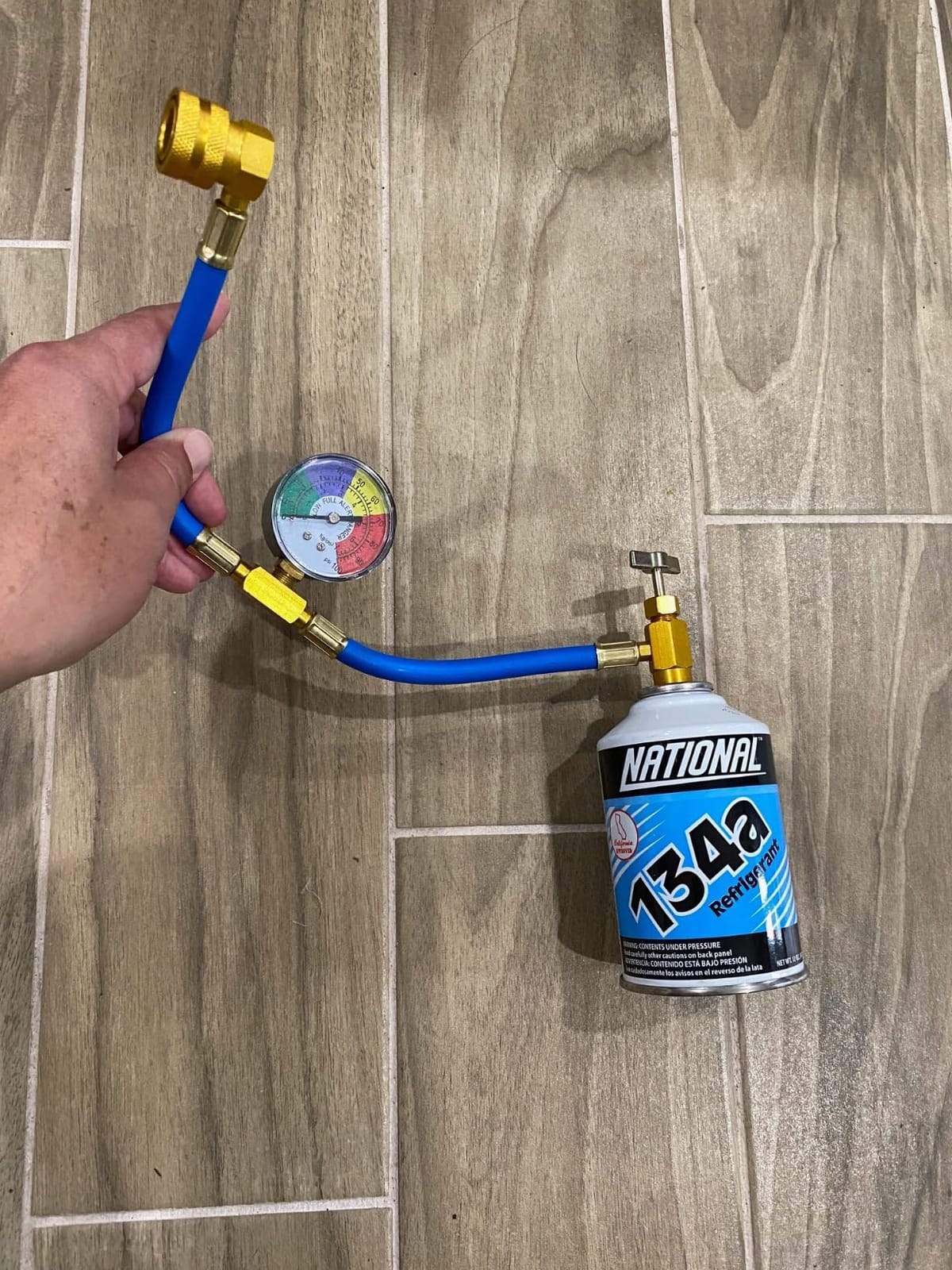
Be careful with the can compatibility, because the listing is internally inconsistent. The stated design is for 1/2 inch ACME piercing-type cans and explicitly not for self-sealing cans, yet some reviewers describe using it with standard 12oz self-sealing R-134a cans. Treat the specification as the source of truth and check the can in your hand before ordering.
There are also fitment notes worth reading twice: the listing calls out the 2018 Honda Civic and 2018 Hyundai Tucson as incompatible, and a few owners report coupler tolerances so tight that the quick connect barely seats on the low-side port.
Who this kit suits
It suits an older R-134a car where the port is easy to reach and the owner wants to know whether the system is low before spending money on gas. Reading the gauge first is genuinely the cheapest diagnostic step available.
What to check before you buy
Confirm the can type and the coupler fit. The listed maximum pressure on this unit is 100 psi, lower than the 250 psi dials on the Lichamp and SURIEEN sets, so it is a charging and reading tool rather than a high-pressure recovery tool.
4. SURIEEN R-134A Recharge Hose Kit – Most Versatile with a Zeroable Dial
SURIEEN R134A AC Refrigerant Recharge Hose Kit 1/2” Piercing Can Tap Valve
15 inch hose
2.76 inch gauge
90 degree push and lock coupler
1/2 inch ACME can tap
Pros
- One year manufacturer warranty
- Push and lock coupler has an auto shut off
- Gauge needle can be zeroed from the back knob
- Aluminium and brass construction
Cons
- 15 inch hose is often too short to reach the low side port
- Dial mixes R134a and R22 and R12 scales
- Listed as not compatible with several 2017 to 2018 models
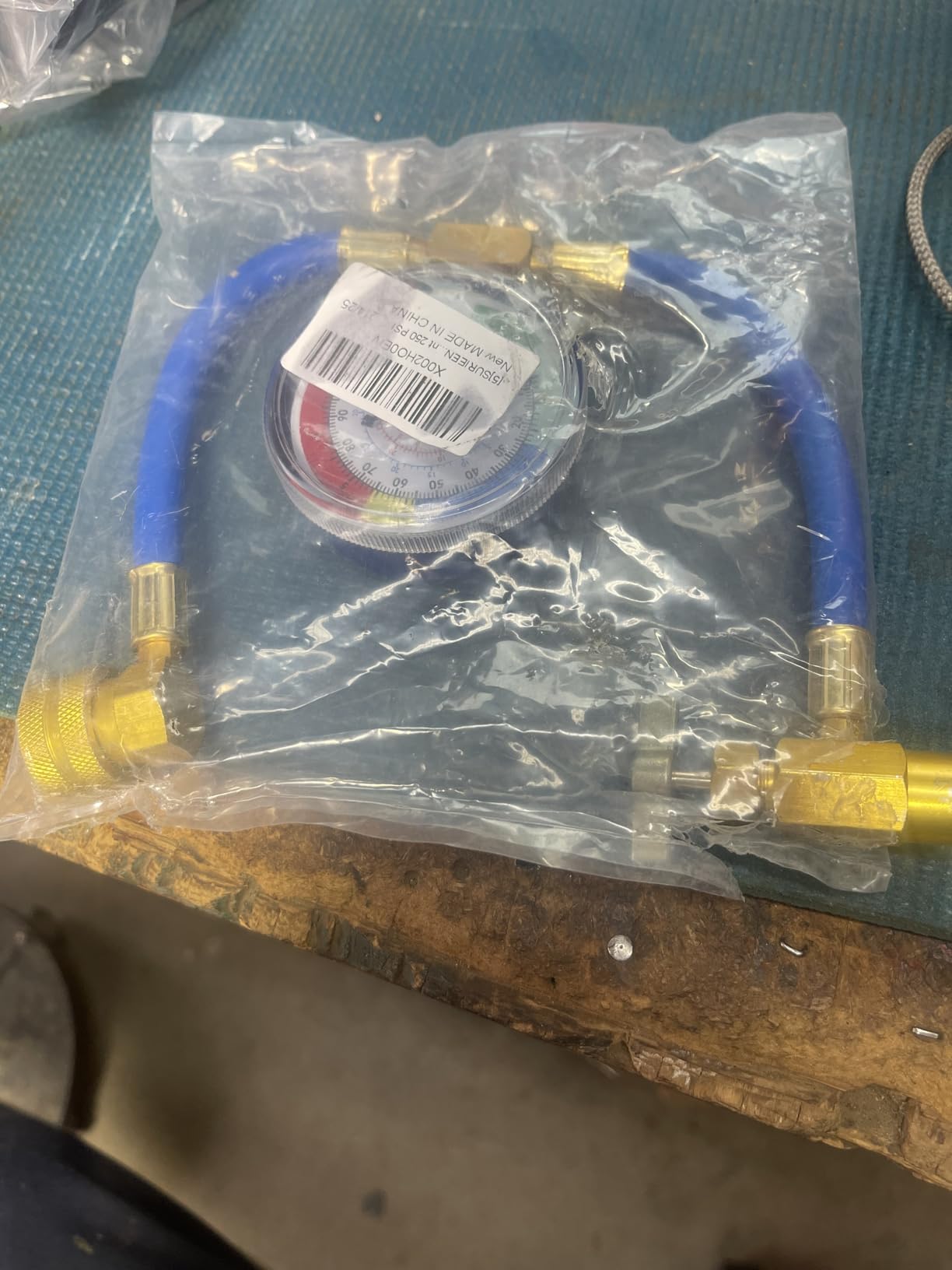
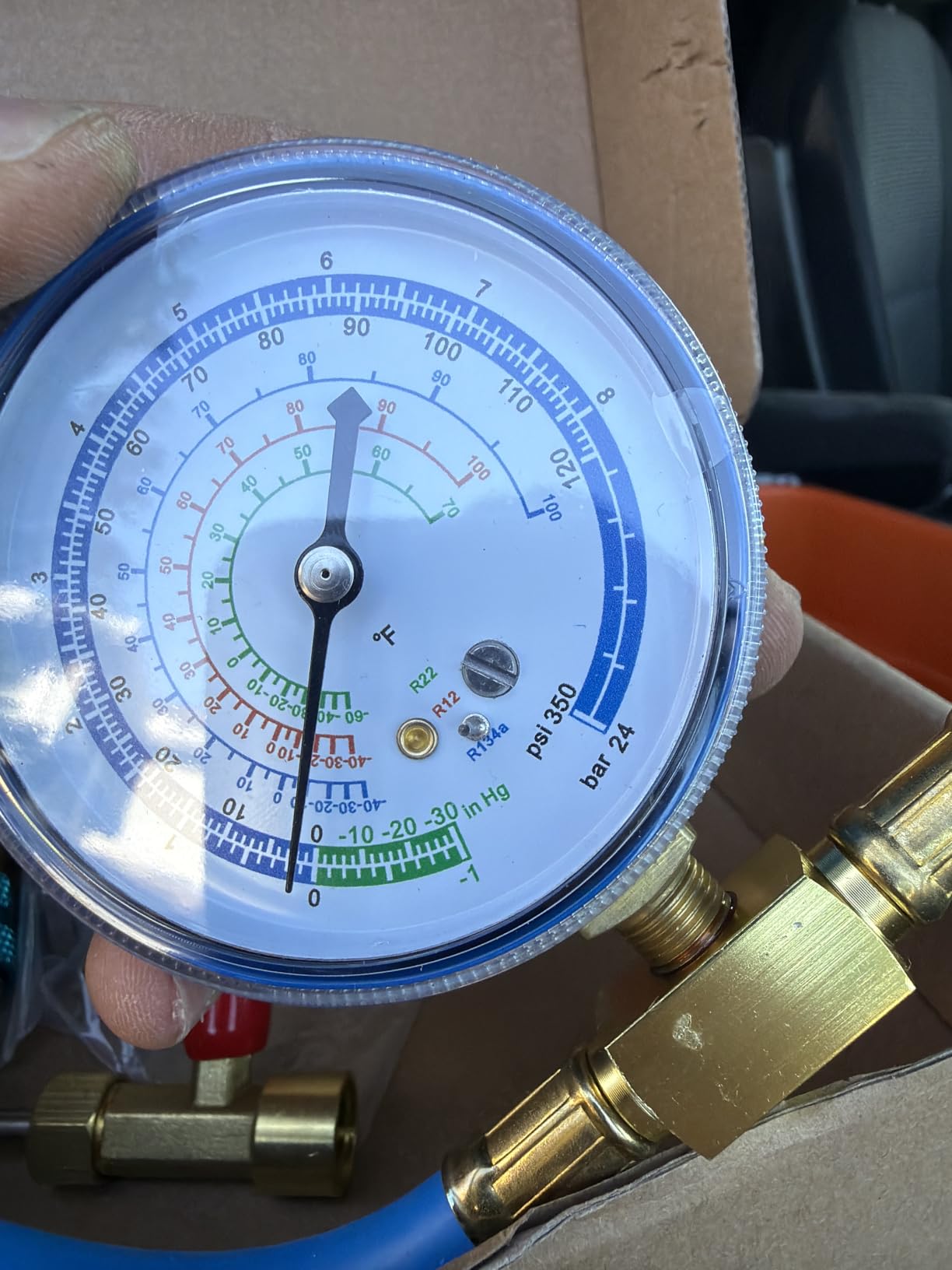
The SURIEEN set pairs a 15 inch hose with a 2.76 inch gauge, a 1/2 inch ACME piercing can tap and a 13mm low-side quick coupler in aluminum and brass. Two details stand out for the money: the 90 degree push-and-lock coupler has an auto shut-off, and the gauge needle can be re-zeroed from a knob on the back of the dial.
That zeroing function is not cosmetic. A gauge that reads a few psi off at rest will have you chasing a leak that is not there, and the back knob lets you reset it before you start. There is also a one year manufacturer warranty behind it.
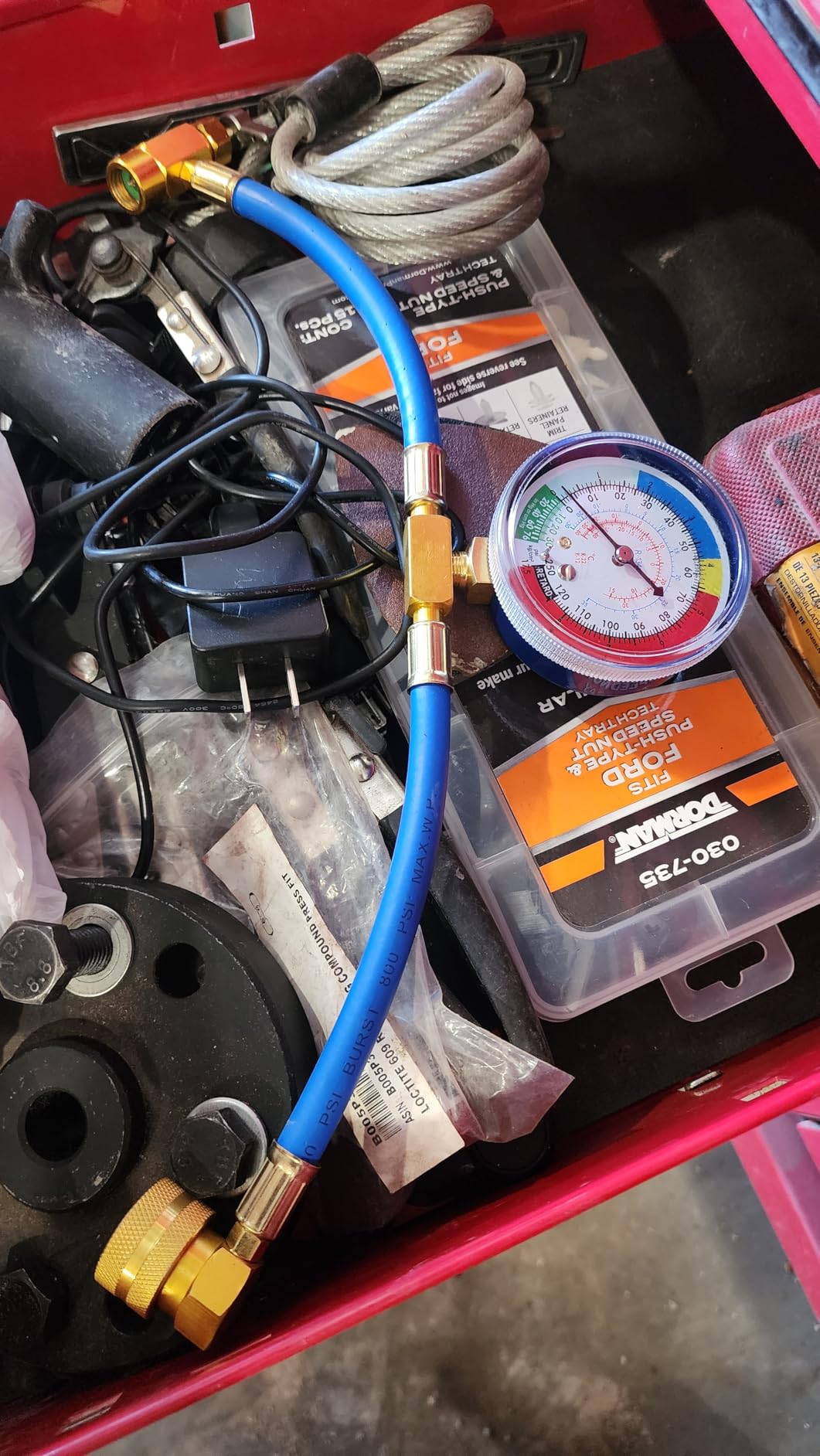
The ratings tell a more divided story. It scores 4.1 from 1,184 reviews, with about 66% at five stars but a notable 15% at one star. That spread comes almost entirely from the hose length and the can-type restriction, not from build quality.
The 15 inch hose is the recurring complaint, because plenty of low-side ports sit down behind the engine or up against the firewall. The dial also carries R-134a, R-22 and R-12 scales on the same face, which is convenient for appliance work and dangerous for a car owner who does not realise which needle they are reading.
Who this kit suits
It suits a car with an accessible low-side port and a single 1/2 inch piercing can in the fridge. If your port is in open air, the short hose is a non-issue and the zeroable dial is a genuine advantage over cheaper fixed-face gauges.
What to check before you buy
Check the listed exclusions before you buy: the manufacturer calls out fitment problems with the 2018 Honda Civic, 2018 Hyundai Tucson, 2018 Kia Soul and 2017 Chevy Silverado. And pick the refrigerant scale before you start charging, not during.
5. A/C Pro 8-Inch R-134a Hose and Can Tap – Best for Tight Port Access
A/C Pro Certified Car Air Conditioner Refrigerant Recharge Kit, AC Recharge Kit Compatible with Self Sealing Valve Cans of R-134A, Includes Hose and Can Tap Dispenser, 8 in, A/C Pro
8 inch reusable rubber hose
90 degree coupler
Can tap dispenser
Self sealing R-134a cans
Pros
- Highest rated in this group at 4.5
- Reusable rubber hose
- 90 degree coupler reaches ports in tight positions
- Taps standard self sealing R-134a cans
Cons
- No gauge included so there is no pressure feedback
- Short 8 inch hose
- Basic plastic fittings
This is the most stripped-back A/C Pro in the group: a reusable rubber hose, an 8 inch length, a 90 degree coupler and a can tap dispenser, designed to work with R-134a cans that have a self-sealing valve. It weighs 0.12 kg and the whole thing is 8 inches long with a 1 inch outside diameter.
It carries a 4.5 rating from 280 reviews, the highest average score in this roundup, with about 75% of buyers at five stars. Owners describe it as simple, no-fuss hardware that opens a standard can and does the job. The 90 degree coupler is the specific feature people praise, because it reaches ports that a straight coupler will not.
Who this kit suits
It suits an owner who already has a gauge, or who is comfortable charging without one because the car is a simple, well-understood system. It also suits anyone who wants a can tap that lives in a toolbox rather than a shop.
What to check before you buy
There is no gauge in this box, so you get no pressure feedback and no way to confirm a finished charge. Add that to the short 8 inch reach and the fact that it only fits self-sealing valve cans, and it is a supplement to a kit rather than a replacement for one.
6. BACOENG R-134a Recharge Kit with BPV-31 Bullet Piercing Valve
BACOENG R134a Refrigerant Recharge Kit, AC AUTO R134a/R-12/R-22 Freon Refrigerant Hose Can Tap with Gauge, BPV31 Bullet Piercing Valve, R134a Quick Coupler
BPV-31 bullet piercing valve
Fits 1/4 and 5/16 and 3/8 inch tubes
Brass body
Extra large dial
Pros
- BPV-31 valve replaces common AP4502525 and GPV31 valves
- Works with R134a and R-22 and R-12
- Extra large easy to read pressure dial
- Brass connections and high strength hoses
Cons
- Only 81 ratings so long term durability is thin
- Accessories arrive as loose parts that need assembly
The BACOENG P0230FUSA is built around one specific part: the BPV-31 bullet piercing valve, which uses a composite sealing O-ring and replaces the common AP4502525 and GPV31 valves found on household refrigeration tubing. It fits 1/4, 5/16 and 3/8 inch tubes, and the body is brass.
The package includes a pressure gauge, hose, R-134a low-side quick coupler, a puncture can tap and the bullet piercing valves, measuring 5.11 x 1.96 x 7.47 inches and weighing 1.2 pounds. It is rated 4.3 from 81 reviews, with about 72% at five stars.
Who this kit suits
It suits someone whose existing piercing valve has dried out and started weeping, or who services refrigerators and freezers alongside a car. The interchangeability with common valve models is the reason to choose it over a generic tap.
What to check before you buy
Two things give us pause. The review base of 81 ratings is thin, so there is not much long-term durability history yet. And the accessories arrive as separate pieces that you assemble yourself, which is normal for this category but not something beginners enjoy.
7. ZeroR R134a Replacement Two-Can Pack with Charging Hose
ZeroR AC Recharge Kit R134a Replacement – Eco-Friendly Refrigerant Gas with 24-Inch Charging Hose Tool for SSV Cans, 2-Cans
Two 6oz self sealing cans
Hydrocarbon R134a replacement
24 inch SSV charging hose
Refrigerant included
Pros
- Refrigerant and hose in the same box
- Self sealing cans keep unused gas from venting
- Hydrocarbon blend is chemically compatible with R134a systems
- Two can pack covers a full top off
Cons
- Hydrocarbon blend is flammable and needs careful handling
- Labeled for non-MVAC DIY use only
- Piercing style taps cause slow or no flow
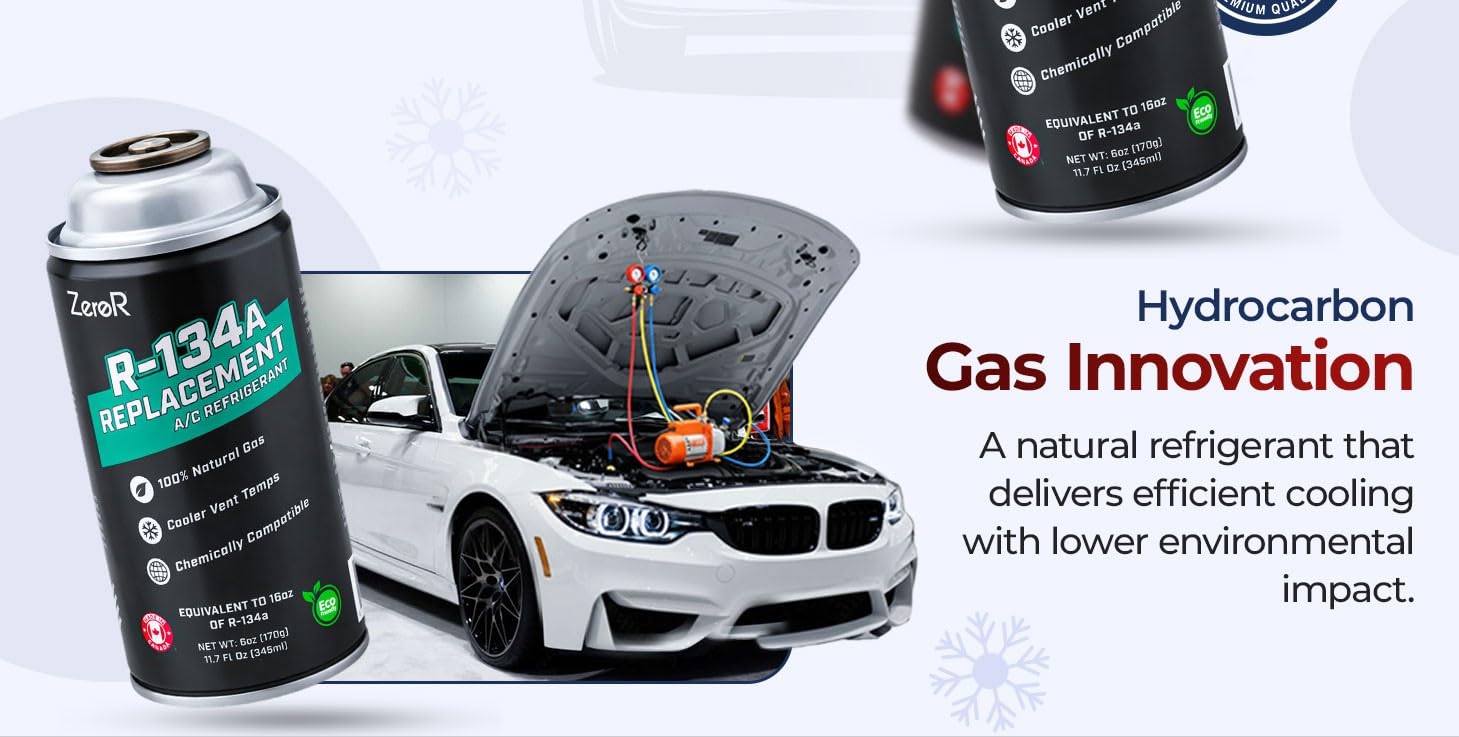
This is the odd one out in the roundup, and the only pick that includes the refrigerant. The ZeroR pack contains two 6oz cans, which is 11.7 fluid ounces each, of a hydrocarbon blend marketed as an R-134a replacement, plus a 24 inch charging hose built for self-sealing valve cans. Refrigerant is compressed gas and is measured by weight, which is why the pack is a 10 x 10 x 10 inch box.
It rates 4.0 from 716 reviews, with about 65% at five stars and 17% at one star. That spread is worth understanding: the lower ratings almost all point at the same thing, the strict tool requirement. The cans are self-sealing valve type, so a piercing-style tap gives slow flow or no flow at all.
The blend is described as a natural hydrocarbon with no ozone impact and low global warming potential, and chemically compatible with existing R-134a systems. The self-sealing cans matter practically, because leftover gas stays in the can instead of venting away in a garage.
Read the label cautions. The product is flammable, so it needs careful handling and storage away from heat and ignition. It is also labeled for non-MVAC DIY use, meaning it is not the refrigerant a regulated professional servicing operation would use.
Who this pack suits
It suits a driver who wants a genuine one-box answer, with no separate can purchase and no separate tool purchase. It also suits an R-134a owner who would rather avoid a high global-warming refrigerant for a one-time top-off.
What to check before you buy
Confirm you have an SSV-compatible tool or will use the included 24 inch hose, and confirm your car runs R-134a. If your vehicle takes R-1234yf, this does not apply to you, and if you are storing unused cans, treat them as a flammable product.
8. Orion Motor Tech 4-Way Manifold Gauge Set – Best for Full System Diagnostics
OMT AC Manifold Gauge Set with 5ft Hoses for R1234yf R404a R134a, 4 Way
Four way manifold
Four reinforced hoses
Oil filled gauge cores
Covers three refrigerants
Pros
- Calibration screws hold accuracy within 1.6 percent
- Color coded hoses rated to 800 psi working
- Works with R1234yf and R404a and R134a
- Aluminium body with copper fittings and one year warranty
Cons
- Bulky at 8.4 pounds with four hoses to manage
- Analog dials instead of a digital readout
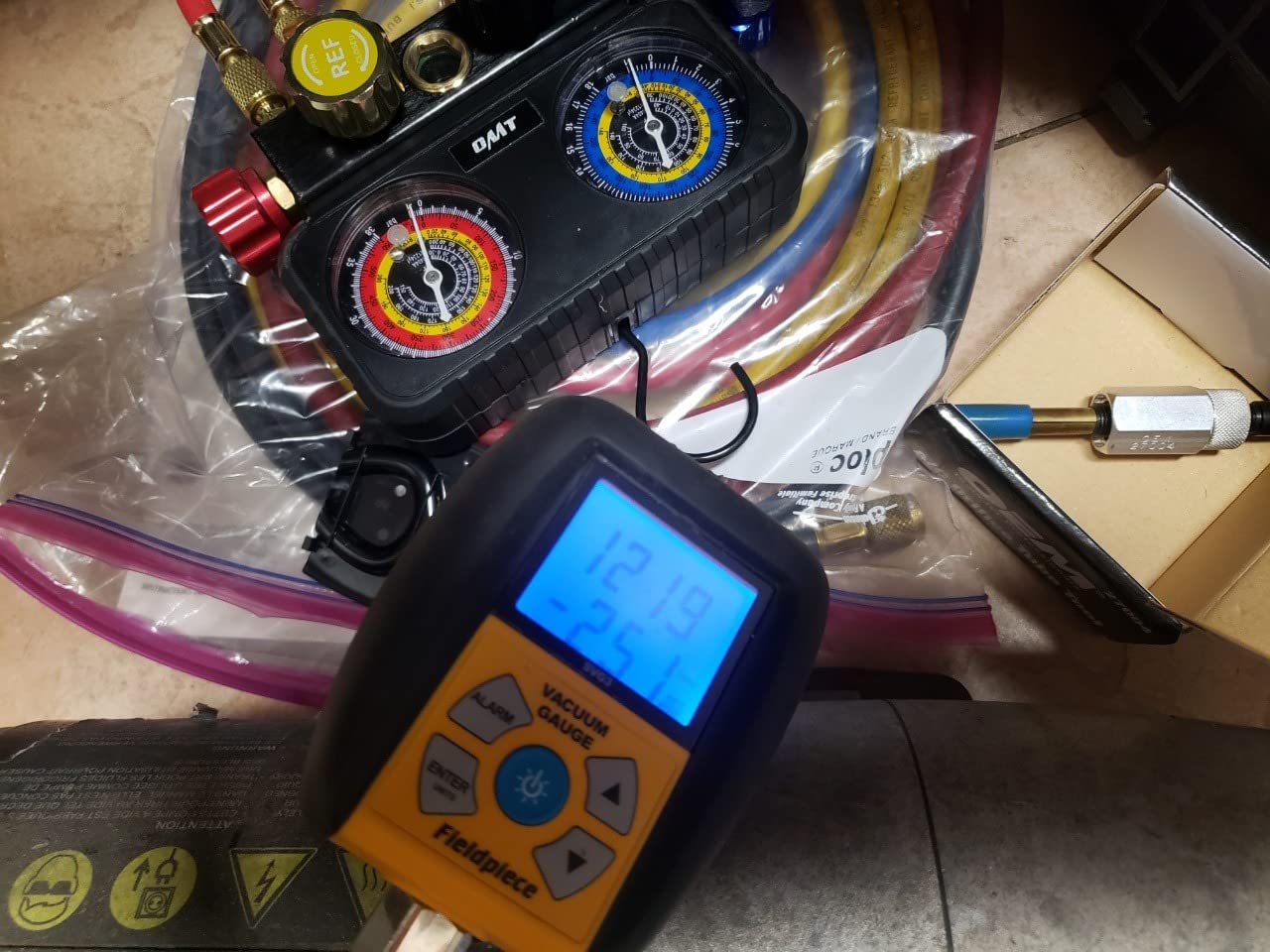
The Orion Motor Tech FBA-DMG12344W is not a top-off hose, it is a manifold set, and that distinction makes it the right choice for a different job. A four-way manifold lets you read both sides of the system at once, which is how you tell a low charge apart from a compressor that will not hold pressure. That is diagnosis, not replenishment.
It handles R-1234yf, R-404a and R-134a, and the box carries four color-coded PVC hoses with four reinforced layers rated to 800 psi working pressure and 4000 psi burst. The gauge uses an oil-filled core to resist wear and shock alongside a dry dial for better cold-weather performance, and the calibration screws hold accuracy within 1.6%.
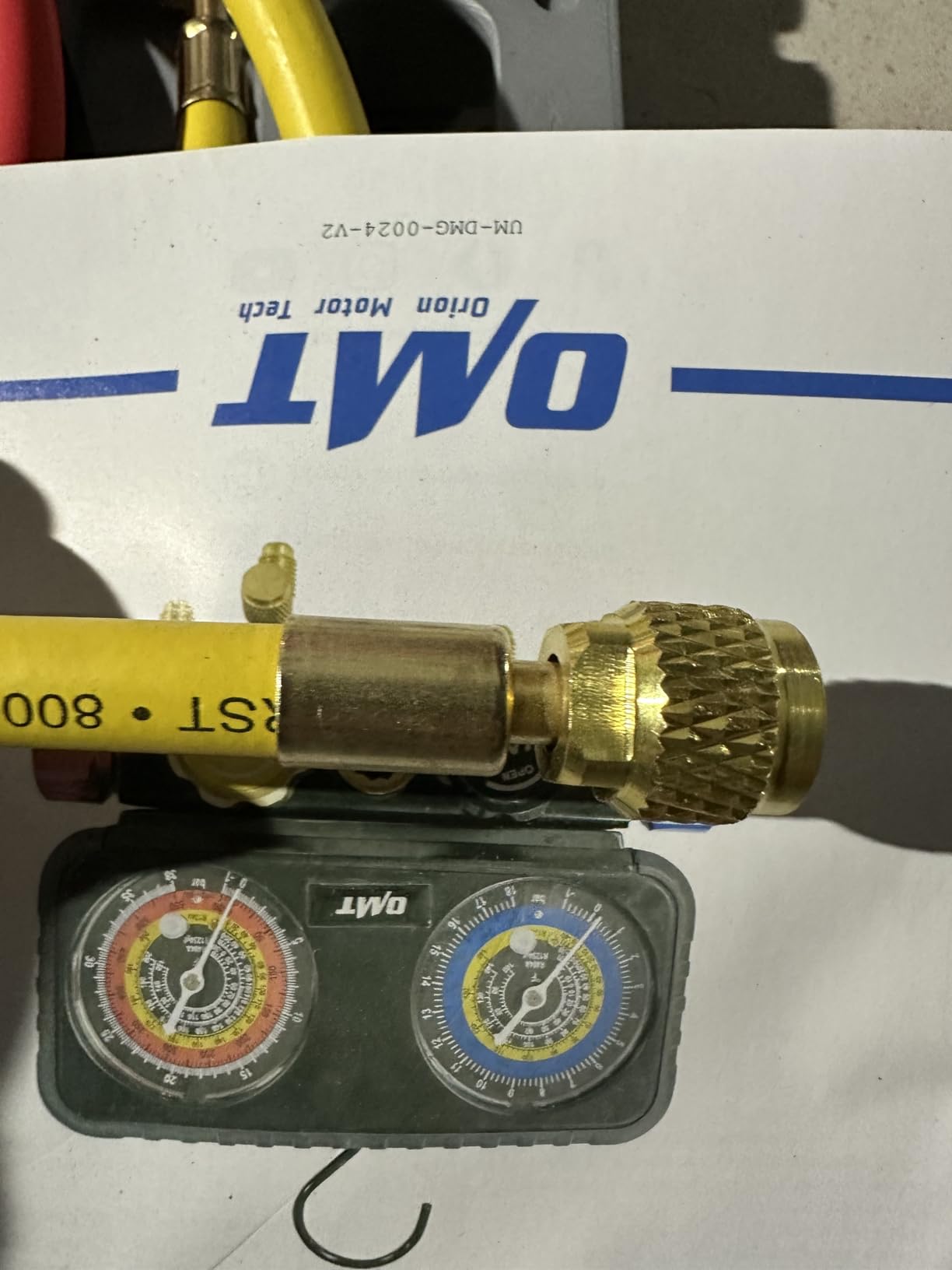
Everything needed to connect is included: R-1234yf and R-134a quick couplers, self-sealing can taps for both refrigerants, left-hand and right-hand 1/4 inch to 1/2 inch adapters, a valve core wrench and a screwdriver. The aluminium body and pure copper fittings are chosen for corrosion resistance, and there is a one year warranty.
It rates 4.5 from 389 reviews, with about 75% of buyers at five stars. The tradeoff is size and weight: 8.4 pounds and 12.6 x 11.81 x 3.74 inches, with four separate hoses to coil and store. The dials are analog rather than digital, which some owners prefer because they cannot fail with a dead battery.
Who this set suits
It suits a serious home garage or a small shop that wants one tool covering three refrigerants and both sides of the system. If you are chasing an intermittent cooling complaint, this is the kit that can actually tell you where the fault is.
What to check before you buy
Check your storage and your ambition. A four-way manifold is a diagnostic instrument, not a shortcut to a top-off, and 8.4 pounds of aluminum and brass in a small garage is a commitment. Owners who just need to add gas are better served by one of the hose-and-tap kits above.
What to Look For in an AC Recharge Kit
These eight tools differ less in refrigerant than in the small decisions that determine whether you can actually finish a job. Here is what we checked on each one, in the order that matters.
Refrigerant compatibility first. R-134a and R-1234yf are not interchangeable, and a kit built for one is useless on the other. Check the under-hood sticker before anything else.
Can tap style. Self-sealing valve cans and 1/2 inch ACME piercing cans use different threads. The Lichamp set carries both, which is why it works across so many machines.
A gauge, if you are charging rather than just tapping cans. Without low-side pressure feedback you have no way to know when to stop, and overcharging is the most common DIY mistake.
Gauge clarity, not just gauge presence. A 2.76 inch dial is readable in daylight. A needle that can be re-zeroed from the back of the dial saves you chasing a phantom leak.
Hose length and coupler angle. 8 and 15 inch hoses are fine on open engine bays and useless behind a firewall. A 90 degree coupler solves a different set of port positions than a straight one.
Pressure ratings. For car work, look for a 250 psi rated gauge and a hose rated well above the working pressure. Kits quoting 100 psi are charging tools, not service tools.
Reusability. A hose-and-tap kit pays for itself the second time you use it. A single-job can of refrigerant is a consumable.
Included extras that earn their place. Bullet piercing valves matter for household appliances. Valve core and adapter fittings matter for multi-refrigerant work.
One more consideration that is easy to miss. If you plan to hunt the leak rather than just mask it, you will want UV dye in the system and a UV lamp to find it. Our UV dye kit guide covers that side of the job.
R-134a vs R-1234yf: Check the Sticker Under Your Hood
Your car’s refrigerant is written on a sticker on the radiator support, the engine cover or the strut tower, and in the owner’s manual. It takes thirty seconds and it decides which of these kits you can use at all. Vehicles built up to around 2016 overwhelmingly use R-134a, while 2017 and newer models frequently moved to R-1234yf, and some brands switched while others did not.
R-1234yf operates at lower pressure and a different pressure-temperature relationship, which is why tools for it are sold separately and why a kit built for one refrigerant is not a substitute for the other. If your sticker says R-1234yf, the A/C Pro R-1234yf dispenser and the Orion Motor Tech manifold are the two tools here that speak its language.
If your sticker says R-134a, you have the wider field: the Lichamp, Ketofa, SURIEEN, A/C Pro 8 inch hose, BACOENG and ZeroR packs all apply. There is no penalty for buying an R-1234yf capable tool as a first purchase, but there is a real cost to buying the wrong one and improvising.
How to Recharge Your Car AC With a Kit
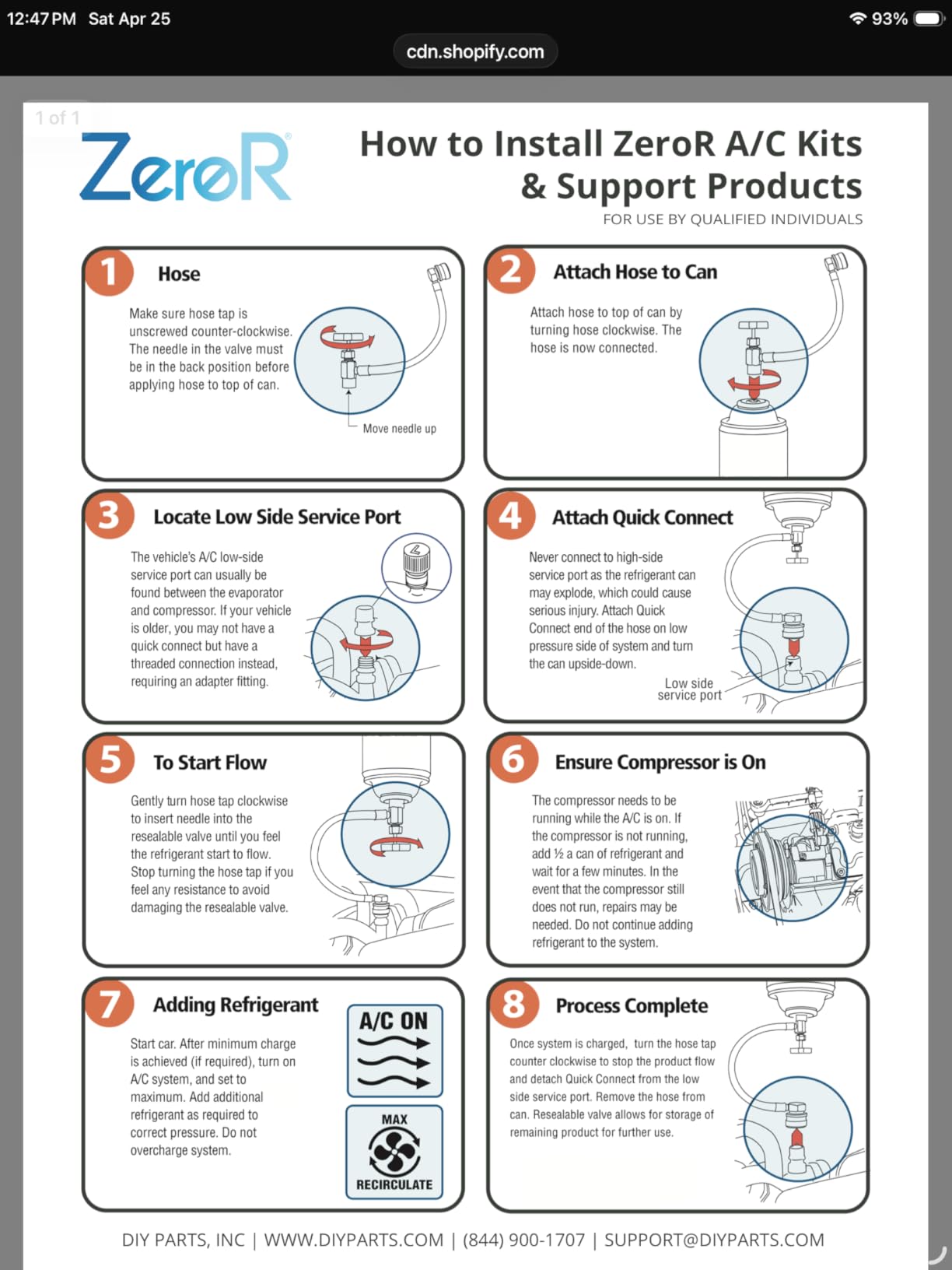
Recharging from a can is a top-off procedure, not a full recovery. It adds refrigerant to a system that still holds a vacuum of some kind, and it works when the system is slightly low. Use these steps and stop if anything feels wrong.
Identify the refrigerant. Read the under-hood sticker and confirm your kit and can match it exactly.
Check the can. Make sure the can type fits your tap. Self-sealing valve cans and 1/2 inch ACME piercing cans are not the same fitting.
Find the low-side port. It is the larger of the two aluminum fittings near the condenser, usually with a cap. The small one is the high side and is not where you charge.
Attach the coupler. Push the low-side coupler on until it clicks and confirm the auto shut-off lever is set correctly.
Start the engine and turn the air conditioning on high. Open a window first. Do this before charging so the compressor is actually moving refrigerant.
Open the can and watch the gauge. Squeeze the trigger in short bursts and watch the low-side needle climb. Add refrigerant gradually and never in one continuous pour.
Stop at the manufacturer pressure. Aim for the low-side range specified for your car with the engine running and the vents open. If you overshoot, stop and let it settle rather than venting.
Close the valve, then shut down. Close the trigger, turn the air conditioning off, let the engine idle briefly, and only then disconnect the coupler. Disconnecting under pressure can vent refrigerant.
Recheck the vent temperature. After a few minutes of driving, the air at the center vent should be noticeably cold. If it is not, stop and diagnose rather than adding more.
Wear eye protection when you open a can, work in a ventilated space, and never deliberately vent refrigerant to the atmosphere. Under US rules, refrigerant handling for motor vehicles falls under technician certification and the law treats deliberate venting as illegal release. Recovering refrigerant is a shop task.
When a Recharge Kit Is the Wrong Fix
Refrigerant is not consumed in a sealed system. A system that has lost cooling over months has a leak, and adding gas treats the symptom. The single most common owner mistake on these forums is topping off a car that needed a diagnosis.
Signals that a can is not enough: the air was blowing cold and stopped abruptly, the compressor makes a grinding or clicking sound, the condenser fan never runs, or the vent air is warm at every speed including idle. Frequent top-offs every 6 to 8 months, a pattern r/DubaiPetrolHeads owners describe from their own cars, point to a leak that needs finding rather than another refill.
There is a second failure mode that costs more later. Sealant additives and UV dye are useful, and enthusiasts on bobistheoilguy.com generally advise plain refrigerant with no additives for a straightforward top-off. Mechanics on Bogleheads warn that discount-store can-and-hose kits drive owners into professional service work, often because a sealant-laden system needs a flush and a full recovery next time. You can read our guides to AC compressors, AC condensers and AC evaporators for the parts that no recharge kit can rescue.
One honest exception: on a high-mileage car where the compressor is already tired, a modest top-off with a good gauge is a reasonable way to buy a few more summers of cooling. r/AskMechanics owners weigh exactly that trade-off, and the deciding factor is usually how much you plan to keep the car.
Frequently Asked Questions
Do those AC recharge kits really work?
They work for one specific job: restoring a system that is slightly low on refrigerant, usually after a slow leak or after a component has been replaced. A can adds refrigerant through the low-side port while you watch the gauge, and it cannot fix a failed compressor, a plugged condenser or a leak large enough to empty the system. If the air went from cold to warm in a day, a kit will not solve it.
What is the best AC recharge kit for a car?
For most R-1234yf cars, the A/C Pro Certified gauge and hose dispenser is the strongest all-round choice, with an extra large readable gauge, a 24 inch hose and a 4.4 rating from 1,228 reviews. For older R-134a cars, the Lichamp kit wins on hardware because it includes both piercing and self-sealing can taps. Match the kit to the refrigerant on your under-hood sticker.
Are DIY AC recharge kits any good?
The good ones are genuinely useful, and the gauge is the part that earns its keep. A clear low-side gauge lets you check pressure before and after adding gas, which turns a blind top-off into a measured one. The weak kits are the ones with no gauge, a hose too short to reach your port, or a tap that only fits one can type.
Are all AC recharge kits the same?
No, and the differences are the whole point. Can tap style decides which refrigerant cans work, hose length decides which ports you can reach, coupler angle decides which positions you can get an angle on, and gauge clarity decides whether you can read it outdoors. Kits that cover self-sealing and piercing cans together are rarer, and the Lichamp set is the clearest example in this roundup.
Which AC refrigerant is best for my car?
Neither is better in general. R-134a fits most vehicles built up to around 2016, and R-1234yf fits many built from 2017 onward, and the two are not interchangeable. Your car uses whatever the under-hood service sticker and the owner’s manual say, so that sticker is the only reliable source. Buy the matching kit and the matching can, and never mix refrigerants.
Final Verdict: Which AC Recharge Kit to Buy in 2026
Our pick is the A/C Pro Certified R-1234yf gauge and hose dispenser, as long as your under-hood sticker says R-1234yf. It has the largest reviewed base of the R-1234yf-capable tools, a gauge you can read outdoors, a 24 inch hose and a trigger valve that makes topping off controllable.
If your car runs R-134a, start with the Lichamp set when you want one kit that handles both piercing and self-sealing cans, and with the Ketofa kit when you only want to read low-side pressure cheaply before deciding to add anything. For a genuine one-box refill, the ZeroR two-can pack is the only option here that includes refrigerant, and it demands an SSV-compatible tool and careful handling because the blend is flammable.
Whichever you buy, confirm the refrigerant, confirm the can type, and read the gauge rather than pouring by feel. A recharge kit is a measuring tool with a can attached, and that is exactly enough to solve a slightly low system and not enough to fix a broken one.