
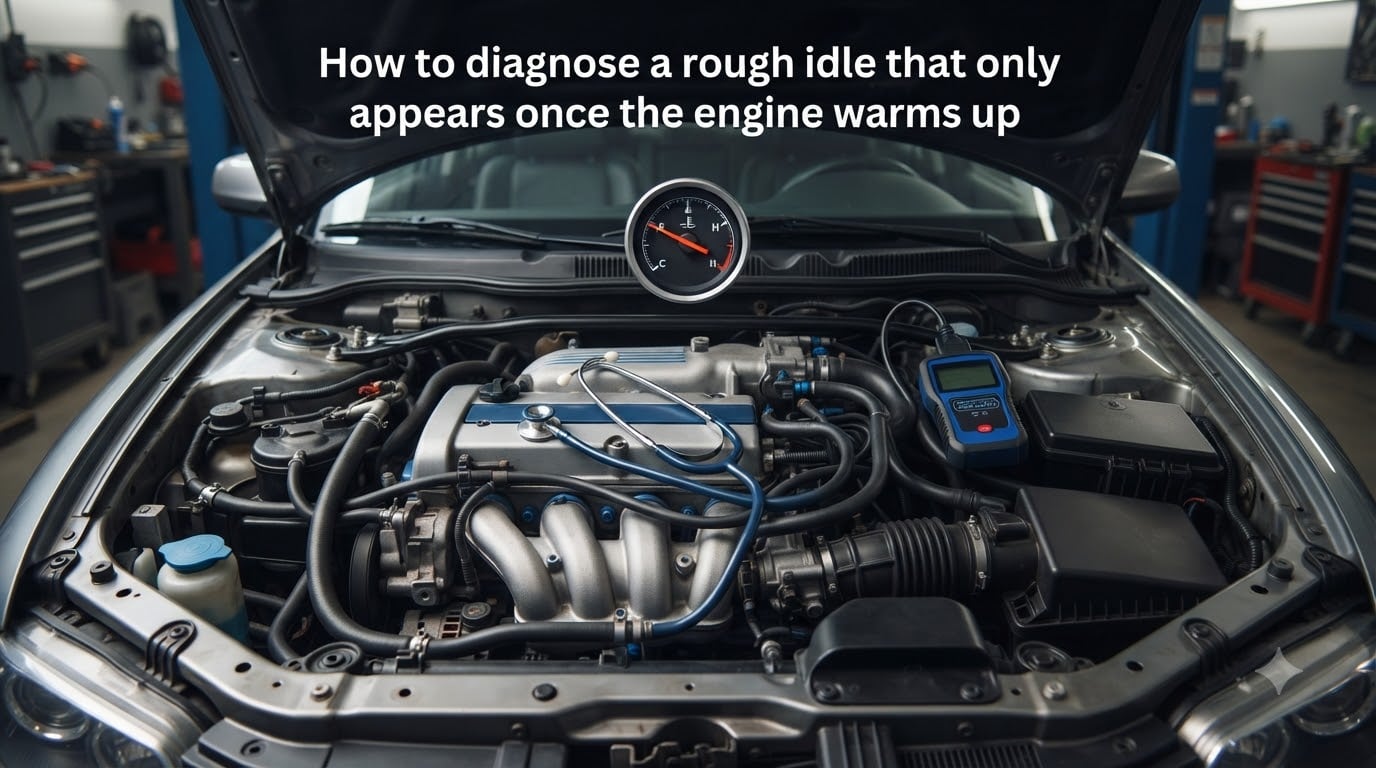
If your car starts and idles perfectly when cold but starts shaking, sputtering, or hunting for RPM the moment the temperature gauge climbs to the middle, you’re dealing with a rough idle when warm. I’ve spent the last 15 years tracking down this exact symptom on everything from daily commuters to high-mileage work trucks, and I can tell you this: warm-only idle problems are some of the most diagnosable issues in automotive repair, once you know what changes when the engine heats up.
This guide walks you through every check I run, from the no-tools five-minute inspection to scanner-based fuel trim analysis. By the end, you’ll know exactly what’s causing your rough idle after the engine warms up, what it costs to fix, and when to stop diagnosing and call a shop.
Table of Contents
Why Warm-Engine Idle Issues Are Different?
A rough idle that only appears once the engine warms up behaves differently from cold-start roughness. The engine runs on an open-loop fuel map when cold, meaning the ECU ignores most sensors and runs a rich pre-programmed mixture. Once coolant temperature climbs above 160 degrees F, the ECU switches to closed-loop mode and starts trusting the oxygen sensors, MAF sensor, and coolant temp sensor to balance the air-fuel ratio.
That switch is where most warm-only idle problems hide. Anything that behaves differently between room temperature and operating temperature gets exposed the moment closed-loop kicks in.
Here is what physically changes when the engine heats up:
Metal components expand, including intake manifold gaskets, throttle body shafts, and exhaust manifolds near oxygen sensors.
Vacuum hoses soften, harden, or develop micro-cracks that only open under heat.
Sensor resistance values drift as temperature changes, exposing weak sensors.
Ignition coils lose insulation resistance when hot, weakening the spark.
Fuel injectors can varnish or coke internally, and hot fuel has different flow characteristics than cold fuel.
Because all of these changes happen near operating temperature, the symptom shows up only after warmup. The check engine light often stays off because the fault is gradual, not a hard failure.
Understanding this temperature-driven behavior is the single biggest key to a quick diagnosis. If you treat a warm-only idle problem the same as a cold-start or all-the-time rough idle, you’ll chase the wrong parts and waste money.
How to Diagnose a Rough Idle That Only Appears Once the Engine Warms Up
The diagnostic order below is what I use in my own shop. Start with the zero-cost visual and listening checks, then move to the smoke test and OBD scanner. Each step eliminates a category of causes so the next step gets faster.
Step 1. Confirm the symptom pattern. Cold-start the engine and let it idle. Watch the RPM and the hood vibration. Note exactly when the roughness begins. If it shows up the instant the cooling fans cycle on, the cooling fan clutch, electric fan draw, or A/C compressor clutch engagement could be loading the engine. If it starts when the temperature gauge reaches the middle, that’s thermal closure of a leak or sensor drift.
Step 2. Inspect the intake and vacuum system with the engine idling. Pop the hood and listen for a high-pitched hiss around the intake manifold, vacuum hoses, and brake booster line. Use a long screwdriver or mechanics stethoscope to pinpoint the source. A common warm-only leak point is the lower intake manifold gasket on V6 and V8 engines, which only separates once expansion loosens the bolts.
Step 3. Smoke-test the intake system. Borrow or rent a smoke machine and feed smoke into the intake with the engine off. Any vacuum leak will show as a thin stream of smoke. This is the single most reliable no-disassembly test for vacuum leaks, and it catches the small leaks that cause rough idle when warm but don’t trigger an engine code.
Step 4. Pull the trouble codes and live data. Plug an OBD-II scanner in and look at both stored codes and pending codes. Then watch the short-term fuel trim and long-term fuel trim at warm idle. If STFT and LTFT are both above +10 percent, the engine is adding fuel to compensate for a lean condition, which points to a vacuum leak or weak fuel pressure. If both are below -10 percent, the engine is trimming fuel back, suggesting a leaking injector or a faulty MAF sensor reading high.
Step 5. Check the idle air control valve and throttle body. With the engine off, remove the intake hose at the throttle body and look inside. Carbon buildup looks like a black ring around the throttle plate. On older vehicles with a separate IAC valve, remove it and clean it with throttle body cleaner. On drive-by-wire systems, the throttle body itself needs cleaning. A dirty or sticking IAC at warm temperature is one of the top three causes of this exact symptom.
Step 6. Test fuel pressure and ignition output. Hook up a fuel pressure gauge to the Schrader valve on the fuel rail. Pressure should hold within spec for at least 10 minutes with the engine off. A drop in pressure points to a bad fuel pump check valve or leaky injector. Then pull a spark plug and inspect it. A white insulator tip suggests a lean condition. A black sooty tip suggests rich. A burnt or oil-fouled plug points to compression or oil-control issues.
Step 7. Verify mechanical health with a compression test. If everything above checks out, run a compression test on all cylinders when warm. Low compression on one or two cylinders usually means a burned valve, worn piston ring, or damaged cam lobe. Mechanics on forums like ih8mud and SCCOA regularly flag compression loss as the cause when warm idle roughness has no obvious air, fuel, or spark explanation.
Common Causes of Rough Idle When Warm
Here is the shortlist I’ll narrow down on any rough idle when warm job, ordered by how often I see each one:
Vacuum leaks that open up with heat (intake gaskets, vacuum hoses, PCV valve)
Dirty or sticking idle air control valve
Failing ignition coils that break down under heat
Carbon-fouled fuel injectors at warm idle
MAF sensor contamination causing lean or rich fuel trim
Failing oxygen sensor that drifts at operating temperature
Coolant temperature sensor sending incorrect closed-loop signal
Low compression from worn valves, rings, or cam lobes
Exhaust leaks near the O2 sensor confusing the air-fuel reading
Stretched timing chain affecting cam timing at warm idle
The next sections walk through each cause with the specific checks and fixes that work.
Vacuum Leaks and Unmetered Air
Vacuum leaks are the single most common cause of rough idle when warm on vehicles with more than 60,000 miles. Unmetered air enters the engine after the mass airflow sensor has already measured the incoming charge, so the ECU thinks the mixture is correct while it actually runs lean.
Why warmth makes it worse: plastic intake manifolds expand more than aluminum or iron, so a gasket that seals perfectly cold can leak the moment the engine reaches operating temperature. Rubber vacuum hoses also harden with age, and heat cycles accelerate the cracking. PCV valves and hoses are particularly vulnerable because they handle crankcase fumes that carry oil vapor.
How to find the leak without a smoke machine: with the engine idling and warm, spray small bursts of brake cleaner, carb cleaner, or propane around suspected leak points. When you hit the leak, the engine RPM will jump briefly as the extra fuel compensates. Move slowly and listen.
How to find the leak with a smoke machine: this is the gold-standard test. Seal off the intake and feed smoke through a vacuum port. Smoke will pour out of any leak. Common leak locations include the lower intake manifold gasket, brake booster hose, PCV valve and hose, and the vacuum line to the fuel pressure regulator on older engines.
Fix: replace the failed gasket or hose. For lower intake manifold gaskets, the parts are cheap (often under $40) but the labor is heavy, around 3 to 6 hours on a transverse V6. PCV valve replacement is a 15-minute job that costs less than $20 in parts.
Idle Air Control Valve Problems
The idle air control valve (IAC valve) is a small solenoid or stepper motor that controls how much air bypasses the throttle plate when your foot is off the gas. It manages idle speed during warmup, when accessories engage, and when the engine load changes.
At cold start, the IAC opens wide to let in extra air for the cold-start enrichment. As the engine warms, the ECU pulses the IAC closed to bring RPM down to target idle speed. Carbon buildup inside the IAC passage or on the throttle plate interferes with this movement, especially as the engine reaches operating temperature and the tolerances tighten.
Symptoms specific to a failing IAC: idle that hunts up and down between 600 and 1,200 RPM when warm, engine that stalls when the A/C compressor kicks on, and idle that drops low when you put the car in gear.
How to check it: on older engines with a separate IAC, remove it and clean it with throttle body spray. Reinstall and see if the idle smooths out. On drive-by-wire systems without a separate IAC, clean the throttle body and re-learn the throttle position. Most vehicles require a throttle relearn procedure with a scanner after cleaning.
Fix: cleaning fixes the majority of IAC-related rough idle problems. If the motor is electrically failed, replacement is straightforward on older vehicles. On drive-by-wire systems, the throttle body assembly usually needs replacement as a unit if cleaning doesn’t help.
Ignition System Issues (Plugs and Coils)
Ignition coils are the most heat-sensitive component in the ignition system. As coil windings heat up, their internal resistance can change, and insulation that was marginal when cold breaks down entirely when hot. The result is a weak spark or no spark in one or more cylinders, only at operating temperature.
Spark plugs also matter. A plug with too wide a gap from age, or with deposits that build up during heat cycles, can fail to fire under the higher cylinder pressure at idle. Most platinum and iridium plugs last 60,000 to 100,000 miles, but copper plugs need replacement every 30,000 miles.
How to diagnose: swap the suspected coil with one from a neighboring cylinder. If the rough idle moves to that cylinder on the scanner, the coil is bad. For plugs, pull them and inspect. Look for cracked insulators, worn electrodes, oil fouling, or carbon tracking.
Forum mechanic advice: mechanics on the ih8mud forum regularly note that rough idle only when warm with no codes is often a coil issue because the fault is below the misfire threshold that triggers a code. A spark tester connected to each plug wire or coil output will show a weak or inconsistent spark on the failing cylinder.
Fix: replace spark plugs on schedule, replace individual failed coils rather than the whole set unless they’re all original. On a 4-cylinder engine, a coil swap test takes 10 minutes.
Fuel Delivery Problems at Warm Idle
Fuel injectors sit in the intake manifold and are exposed to constant heat cycling. Over time, varnish and carbon deposits build up inside the injector tip, restricting the spray pattern. When the engine is cold, the rich open-loop mixture masks the poor spray. When the engine warms and goes closed-loop, the imbalance shows up as a rough idle.
Fuel pump check valves can also fail, causing pressure to bleed off after shutdown. This produces hard starts and rough idle for the first few seconds after restart when the engine is warm. If your rough idle appears immediately after a warm restart but smooths out after a minute, suspect a weak fuel pump.
How to check fuel pressure: connect a gauge to the fuel rail Schrader valve and watch the pressure at idle. Compare to spec. Most port-injected engines run 35 to 45 psi; many direct-injection engines run 500 to 2,000 psi and require a special gauge. If pressure drops more than 5 psi over 10 minutes with the engine off, the check valve is leaking.
Fix: a can of fuel injector cleaner added to a full tank of premium fuel can clear mild deposits in 200 to 300 miles. For heavier buildup, professional ultrasonic cleaning or replacement is required. Fuel pumps cost $150 to $400 for the part, and replacement typically takes 1 to 2 hours.
Sensor-Related Causes (MAF, O2, CTS)
Sensors that affect rough idle when warm include the mass airflow sensor, oxygen sensors, and coolant temperature sensor. Each one feeds the ECU information it uses to balance the air-fuel ratio in closed-loop mode.
Mass airflow sensor (MAF): contamination on the MAF hot wire or film causes it to under-report or over-report incoming air. Under-reporting makes the ECU run lean (causing rough idle and possible misfire). Over-reporting makes it run rich. Cleaning the MAF with dedicated MAF cleaner spray usually restores accuracy. Do not use carb cleaner or throttle body cleaner on a MAF, because they leave residue.
Oxygen sensors (O2): narrow-band O2 sensors wear out gradually and become slow to respond. At warm idle, a sluggish O2 sensor causes fuel trim to oscillate. Bank 1 sensor 1 (upstream) failures cause rough idle directly. Downstream sensors affect emissions but not idle quality. Most O2 sensors last 60,000 to 100,000 miles.
Coolant temperature sensor (CTS): the CTS tells the ECU when the engine has reached operating temperature. A stuck or inaccurate CTS may signal cold when the engine is actually hot, causing the ECU to keep the rich cold-start mixture active too long. The result is rough idle, high fuel consumption, and elevated emissions until the engine fully heats up.
How to check: with the engine warm, watch the scanner live data. Coolant temp should match the actual temperature (within a few degrees). Long-term fuel trim at idle should stay within plus or minus 5 percent on a healthy system. Anything beyond plus or minus 10 percent indicates a sensor or vacuum leak issue.
Fix: MAF cleaning ($10 in spray), O2 sensor replacement ($30 to $100 per sensor, 30 minutes each), CTS replacement ($15 to $40, 20 minutes).
Mechanical Causes: Compression and Timing
If everything above checks out and the rough idle when warm persists, mechanical causes move to the top of the list. The most common are compression loss from burned valves, worn piston rings, or worn cam lobes, plus timing chain stretch.
Why warmth triggers it: as metal expands, a slightly bent valve that seals when cold may leak when hot. Worn piston rings seal less effectively when the cylinder is at full operating temperature. Worn cam lobes lose lift profile, and the lower oil pressure at idle exposes this weakness.
Forum mechanic insight from ih8mud and SCCOA threads: experienced techs point out that a misfire at warm idle only, with no codes and good fuel trims, is often compression-related. The diagnosis is to run a compression test on all cylinders when the engine is at operating temperature. A reading below 100 psi on any cylinder, or more than 10 percent variation between cylinders, indicates a mechanical problem.
Timing chain stretch: as the chain wears, cam timing drifts. At high RPM the drivability may still feel normal, but at idle the overlap is enough to cause roughness. A scanner can show cam/crank correlation on engines with that sensor. A stretched chain usually throws a P0016 to P0019 code, but mild stretch can stay below the code threshold.
Fix: compression loss usually means a head job, valve replacement, or engine rebuild depending on severity. These are big-ticket repairs ($1,500 to $4,000) and warrant a professional diagnosis. Timing chain replacement runs $800 to $2,000 on most engines.
OBD-II Codes to Look For
While many warm-only idle problems don’t trigger a code, here are the ones that frequently do, and what each one means for diagnosis.
P0171 / P0174: system too lean (Bank 1 / Bank 2). Vacuum leak, weak fuel pressure, or failing MAF.
P0172 / P0175: system too rich. Leaking injector, high fuel pressure, or faulty MAF reading high.
P0300 to P0308: random or cylinder-specific misfire. Ignition coil, spark plug, compression, or injector issue.
P0505 to P0507: idle control system malfunction. IAC valve or throttle body issue.
P0101 to P0103: MAF sensor range or performance problem.
P0131 to P0136 / P0151 to P0156: O2 sensor circuit or response problems.
P0128: coolant temperature below thermostat regulating temperature. Stuck-open thermostat or bad CTS.
P0016 to P0019: camshaft/crankshaft correlation. Timing chain stretch or VVT issue.
Even if no codes are stored, watch fuel trim live data carefully. A consistent long-term fuel trim over +10 percent or under -10 percent tells you the engine is compensating for something, even when the check engine light stays off.
When to Seek Professional Help?
Stop the DIY diagnosis and take the car to a shop if you see any of these warning signs.
The check engine light is flashing, not just solid. A flashing light means an active misfire that can damage the catalytic converter within minutes. Drive gently to the nearest shop or stop the engine.
Compression test shows one or more cylinders below 100 psi. Mechanical repairs are not usually DIY-friendly and require specialty tools.
Fuel pressure is outside spec and dropping rapidly. Fuel system work near hot engine components carries fire risk. A professional should handle fuel pump and injector replacement.
Rough idle is paired with engine stalling at stoplights, hesitation under acceleration, or visible smoke from the exhaust. These symptoms indicate a more serious underlying problem that needs scan-tool deep diagnosis.
You’ve replaced two or three suspected parts and the symptom persists. At that point you’re throwing money at guesses. A shop with a smoke machine, fuel pressure gauge, and lab scope can isolate the cause in under an hour.
Rough idle diagnosis at a typical independent shop runs $80 to $200 depending on your region. That’s cheaper than two wrong parts, and it includes the peace of mind of knowing exactly what to fix.
FAQs
Why does my car idle rough after it warms up?
A rough idle that appears once the engine warms up is almost always caused by a component that behaves differently at operating temperature. The most common culprits are vacuum leaks that open up as metal expands, a dirty idle air control valve, ignition coils that break down under heat, and sensors like the MAF, O2, or coolant temperature sensor that drift out of spec as temperature changes. When the ECU switches from open-loop to closed-loop fuel control at warmup, any weakness in air, fuel, or spark gets exposed immediately.
Why does my car sputter after it warms up?
Sputtering specifically points to a fuel or air delivery issue rather than an ignition problem. The most likely causes are a vacuum leak that worsens with heat, a partially clogged fuel injector, or a failing fuel pump check valve that loses pressure after a warm restart. A fuel pressure test and a smoke test on the intake will isolate the cause in most cases.
What sensors can cause rough idling?
The four sensors most likely to cause a rough idle are the mass airflow sensor (MAF), oxygen sensors (O2), coolant temperature sensor (CTS), and throttle position sensor (TPS). The MAF measures incoming air and contaminates easily. The O2 sensors measure exhaust oxygen and wear out gradually. The CTS tells the ECU when to switch to closed-loop. The TPS reports throttle plate angle and affects idle detection on drive-by-wire systems.
Is a rough idle an easy fix?
It depends on the cause. Cleaning a dirty throttle body, IAC valve, or MAF sensor takes 15 to 30 minutes and costs under $20 in supplies. Replacing spark plugs, ignition coils, or vacuum hoses is a 30-to-90-minute job with parts ranging from $20 to $150. Compression loss, timing chain stretch, or internal fuel pump failure are not easy DIY fixes and typically cost $1,000 to $4,000 at a shop.
Can seafoam fix rough idle?
Seafoam and similar fuel additives can help with mild carbon buildup in the throttle body, intake, and fuel injectors. For a warm-only rough idle caused by light varnish deposits, a tank of treated fuel may smooth the idle over 100 to 200 miles of driving. For heavier deposits, vacuum leak, or sensor failures, additives will not help and may mask the underlying problem by temporarily changing fuel composition.
Why is my engine rough at idle only?
An engine that runs fine while driving but rough only at idle usually has an air metering issue, an idle control issue, or a low-RPM-specific weakness. At idle the engine runs at low RPM with high vacuum, so small air leaks and idle air control problems dominate. While driving, RPM and load cover those faults. Common causes are vacuum leaks, IAC valve carbon buildup, weak ignition coils that fire fine under load but fail at low spark energy, and fuel pressure drops that only show at idle demand.
Conclusion
A rough idle when warm is not a mystery once you understand that heat changes the behavior of air, fuel, spark, and sensors. Start with the cheapest and easiest checks: a careful listen for vacuum leaks, a throttle body cleaning, and a MAF sensor spray. Pull codes and live data if those don’t solve it. Run a fuel pressure test if the symptom persists. Save the compression test for last, because mechanical repairs are the most expensive.
If your car has a rough idle that only appears once the engine warms up, walk through the seven diagnostic steps in this guide in order. Most owners find the cause by step three or four, and the repair is usually under $100 in parts and an afternoon of work. When the diagnosis points to compression, timing, or fuel pump replacement, take it to a trusted shop and let them confirm before committing to the repair.