
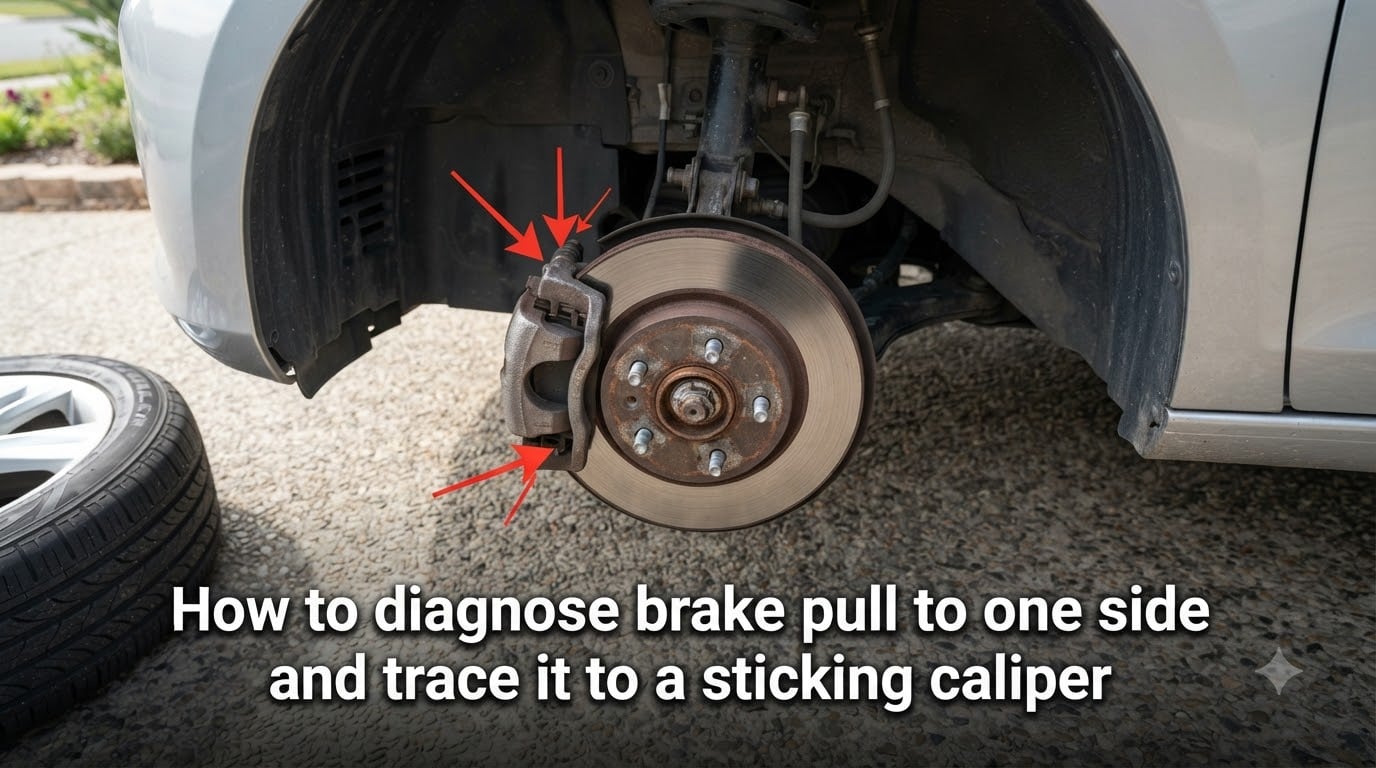
Safety first: If your car pulls hard to one side under braking, minimize driving until you confirm the cause. A dragging caliper can overheat a rotor, glaze pads, and in extreme cases start a wheel-well fire. Park on level ground, let the wheels cool fully before touching them, and use jack stands if you lift the vehicle.
I have walked dozens of frustrated drivers through this exact problem. Most assume it is alignment, swap a tire, and still feel the pull. The truth is that how to diagnose brake pull to one side and trace it to a sticking caliper is a logical sequence of simple tests you can run in a driveway with a basic infrared thermometer and a flashlight. This guide walks you through that sequence in the order I use it professionally.
Table of Contents
What Is Brake Pull and Why It Matters?
Brake pull is the sensation that your vehicle veers left or right while you are applying the brakes. The car should slow in a straight line. If it does not, one wheel is generating more stopping force than its partner on the other side.
A small amount of pull under hard braking can come from road crown, crosswinds, or suspension geometry. Pull that grows stronger the harder you brake, or that shows up only when you press the pedal, almost always points to a braking system problem rather than alignment.
Why this matters: one wheel doing more work than the other causes uneven pad wear, overheated rotors, brake fade on long descents, and reduced fuel economy from constant drag. I have also seen forum posts from drivers whose cars caught fire in the wheel well because a seized caliper cooked the rotor for weeks.
How a Brake Caliper Works (and Why It Sticks)?
A disc brake caliper is a hydraulic clamp. When you press the pedal, the master cylinder sends brake fluid through hoses to the caliper, where one or more pistons push the inner pad against the rotor. The caliper body slides outward so the outer pad also clamps the disc. When you release the pedal, the piston seal relaxes and slide pins retract the pads away from the rotor.
A caliper sticks when one of those return actions fails. The three most common failure points are:
Seized slide pins. The two pins that let the caliper float are greased at the factory. Road salt, heat cycles, and time bake that grease into gum. The caliper can clamp, but it cannot slide back.
Corroded piston bore. The piston seal relies on the piston retracting a fraction of an inch when pressure is released. Pitting rust or a swollen seal keeps the piston pressed against the pad.
Collapsed brake hose. The inner liner of a rubber hose can deteriorate so the hose acts as a one-way check valve, holding pressure on one caliper after you release the pedal. We will cover this in detail below.
Any of the three leaves brake fluid pressure on a single caliper when you are not braking, which is what drags the rotor and makes the car pull.
Common Symptoms of a Sticking Brake Caliper
Before you touch a tool, confirm the symptom pattern matches a sticking caliper rather than something else. I look for these six signs, and I need at least three to suspect the caliper:
Pull only under braking. The car tracks straight when coasting, but darts hard left or right when you press the pedal.
Hot wheel after driving. One wheel hub is noticeably hotter than the opposite side 10 minutes after parking.
Burning smell from one wheel. Acrid, chemical, almost like an overheated clutch. It will not smell like an engine bay leak.
Visible smoke or heat shimmer at one wheel after a hard stop, even at low speed.
Uneven pad wear. The inner pad on the suspect caliper is paper-thin while the outer pad still has meat, or vice versa. Lopsided wear is the giveaway.
Reduced fuel economy. A dragging caliper adds rolling resistance. I have seen 2 to 3 MPG drops in customer cars that turned out to be a single stuck caliper.
Forum users frequently report the same confusion: they swap brake pads and rotors, and the pull stays. That is the strongest clue that the caliper itself is the culprit.
Step-by-Step Diagnostic Procedure to Trace Pull to a Sticking Caliper
This is the sequence I run in my shop and the order I teach home mechanics. Each step rules out one cause and confirms the next.
Confirm the symptom is brake-related, not alignment-related. Drive at 30 mph on a flat, straight road. Release the steering wheel briefly while coasting. If the car drifts, suspect alignment or tire issue. If the car drifts only when you press the brake, suspect the braking system.
Check tire pressures cold. A 4 PSI difference between sides can mimic a brake pull. Inflate to the door-jamb spec and retest before going further.
Inspect each wheel visually. With the wheel cool, look for a glazed rotor, blueing on the rotor edge, or pad material packed against the rotor face. Use a flashlight and look at the dust pattern on the rotor.
Measure hub temperature after driving. Drive 5 minutes with normal braking, park, and immediately touch each hub with an infrared thermometer. The stuck caliper side will read 30 to 80 degrees Fahrenheit hotter than the others.
Jack up the suspect wheel and spin it by hand. A healthy wheel spins freely with a faint brush of the pads. A dragging wheel feels gritty and stops within one rotation.
Remove the wheel and inspect caliper slide pins. Push the caliper inward by hand. It should slide smoothly 2 to 3 millimeters. If it locks up, the slide pins are seized. Try to retract the piston slightly with a C-clamp. If the piston will not retract, the bore or seal is the problem.
Run the bleeder screw test. Open the bleeder on the suspect caliper while a helper holds light pressure on the pedal. If fluid squirts out under low pedal force, the caliper is holding residual pressure. That pressure is the smoking gun.
Compare pad wear side to side. Lopsided pad wear on one caliper confirms a sticking or non-releasing caliper.
If you reach step 8 with lopsided pads, hot hub, gritty spin, and either seized pins or held pressure at the bleeder, you have isolated a sticking caliper. Everything else was process of elimination.
How to Identify Which Wheel Has the Problem
The pull direction almost always points to the bad wheel on the opposite side of the pull. If the car yanks left under braking, the right-side brake is the one doing more work. The right caliper is dragging, so the left side is being overcome.
There are three reliable ways to confirm which wheel is at fault:
Heat test. After normal driving, touch each hub with an infrared thermometer or carefully with the back of your hand near (not on) the wheel. The sticking caliper side is the hot one.
Pad inspection. Pull both front wheels. The sticking caliper will show uneven pad thickness between inner and outer pads, or pads worn at an angle.
Wheel spin test. With the car safely lifted and supported on jack stands, spin each wheel by hand. The bad caliper side will not turn freely or will stop quickly.
A community mechanic on Reddit described this exactly: his car pulled left during braking but tracked straight while coasting. A heat check showed the right-front hub was 70 degrees hotter than the left. The right caliper had seized slide pins. Once you see this pattern once, you cannot unsee it.
The Hose Effect: A Hidden Cause of Brake Pull
A collapsed brake hose can mimic a sticking caliper, and it is the cause most home mechanics miss. The rubber outer hose looks fine from the outside, but the inner liner can balloon under pressure and fail to spring back, turning the hose into a one-way valve.
The diagnostic is straightforward:
With the engine off, slowly press the brake pedal several times to bleed off residual pressure.
Loosen the brake line fitting at the suspect caliper by a half turn.
Have a helper press and release the brake pedal.
If fluid trickles out only when the pedal is pressed and stops cleanly when the pedal is released, the hose is suspect. A healthy hose releases and re-pressurizes symmetrically.
For a more confident test, a professional brake pressure gauge reads hydraulic pressure at each wheel. A gauge on the suspect side that does not drop to zero when you release the pedal confirms a restriction. Most home mechanics will skip this step and go straight to replacing the hose if symptoms match. A new rubber hose costs less than a caliper, so the trial replacement is reasonable.
Non-Caliper Causes of Brake Pull You Should Rule Out
Brake pull does not always mean a caliper. Before you commit to a caliper repair, confirm you have ruled out four other common causes. This is the area where most online guides fall short.
Tire pressure mismatch. A 3 to 5 PSI difference creates a noticeable pull under braking, especially on front tires. Equalize pressure before doing anything else.
Mismatched tires. Two different brands, models, or even tread depths on the same axle will pull under braking because of differing friction coefficients. Check the sidewalls.
Wheel alignment. Worn ball joints, bushings, or a bent control arm can pull only during weight transfer, which is when you brake. Alignment correction may fix it if the pull grows with steering input, not braking input.
Wheel bearing failure. A worn bearing lets the rotor tilt, which the caliper reads as alignment change. A growling noise that grows under braking or cornering is the clue.
The fastest mental test: if the pull happens only when braking, suspect braking components. If it happens during straight coasting too, suspect tires or alignment. If the pull changes with steering angle, suspect suspension geometry.
Common Diagnostic Mistakes to Avoid
These are the mistakes I see most often on forum threads and in my own shop’s intake lane.
Touching a hot rotor. Even after a short drive, a dragging caliper can push rotor temperatures past 400 degrees Fahrenheit. Use an infrared thermometer, not your hand.
Bleeding only one caliper and assuming the other is fine. A bad proportioning valve or master cylinder can mimic a single-side pull. Compare both front calipers and both rear calipers when the symptom is mild.
Ignoring the rear brakes. A sticking rear caliper causes a pull just like a front one, especially in lighter vehicles where the rear brakes do a higher percentage of stopping.
Replacing pads and rotors first. New pads on a seized caliper will wear out within a week. Diagnose the caliper before you spend money on pads.
Trusting the ABS light as your guide. ABS will not flag a stuck caliper because no wheel is locking up. The caliper is failing to release, not failing to apply.
When to Seek Professional Help
Most of these tests are driveway-friendly. That said, I send the job to a shop in three situations: when the brake pedal goes soft or spongy at the same time as the pull, when the wheel-on fire risk is obvious (visible smoke or melting paint), and when the bleeder test shows held pressure but a hose replacement does not fix it. A sticking caliper that does not respond to a hose swap usually means a bad proportioning valve or master cylinder, both of which need pressure gauges and proper bleeding equipment to diagnose and repair.
If your car is under warranty, do this work at the dealer. A seized caliper on a 2-year-old vehicle is a manufacturer defect, not a maintenance issue.
For everyone else, you now have a complete diagnostic framework that walks you from a vague “my car pulls” complaint to a confirmed sticking caliper or a confirmed different cause.
FAQs
What causes a brake caliper to stick on one side?
A brake caliper usually sticks because the slide pins seize from corrosion and old grease, the piston bore pits from rust, or the rubber brake hose collapses internally and acts as a one-way valve holding pressure on one wheel after the pedal is released.
How to determine if a brake caliper is sticking?
Drive the car, then touch each wheel hub with an infrared thermometer. The sticking caliper side will run 30 to 80 degrees Fahrenheit hotter than the others. A wheel that will not spin freely by hand after jacking up the car confirms the same finding.
Can a stuck caliper unstick itself?
No. A stuck caliper rarely unsticks itself. Heat and pressure keep it seized, and the condition usually worsens until the slide pins are cleaned and re-greased or the caliper is rebuilt or replaced.
How do you free up a sticking caliper?
Remove the caliper, clean the slide pins and bores with brake cleaner, apply fresh high-temperature silicone or synthetic caliper grease, and inspect the piston seal. If the piston will not retract when you remove the pads and press the bore with a C-clamp, replace the caliper rather than rebuild it.
Final Thoughts on Diagnosing Brake Pull From a Sticking Caliper
How to diagnose brake pull to one side and trace it to a sticking caliper comes down to three rules I keep coming back to: the pull direction points to the opposite wheel, the hot wheel confirms it, and a non-spinning wheel proves it. Run that triangle of evidence on every brake pull complaint, and you will catch the caliper issue faster than throwing parts at the problem.
Start with the free tests: tire pressures, a visual rotor and pad check, and a careful finger test near each wheel hub. If those point to one side, lift that corner, spin the wheel, and inspect the slide pins. If a caliper rebuild feels over your head, the right move is to take the diagnosis you have to a trusted shop so they do not start from scratch.