
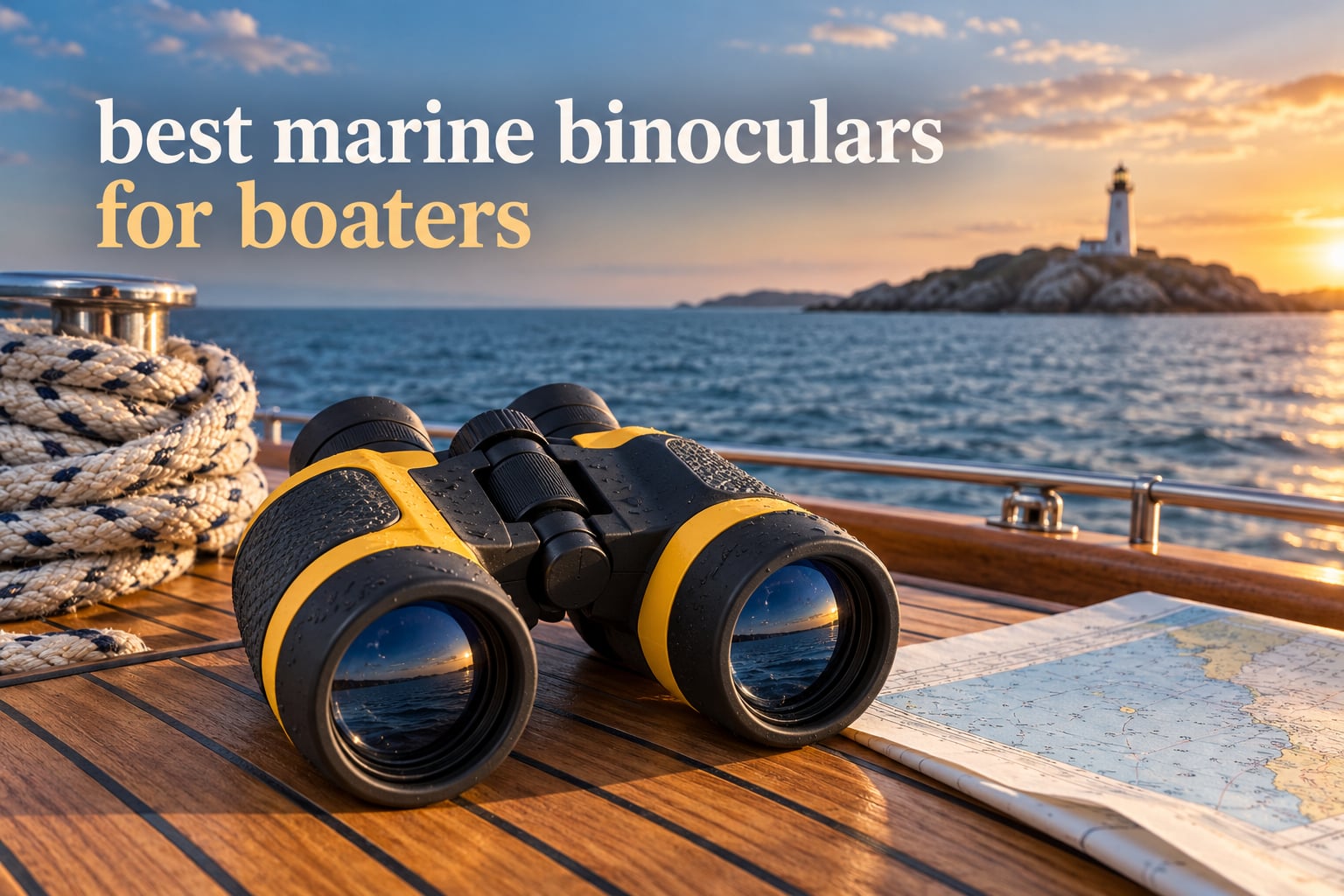
The best marine binoculars for boaters are 7×50 models with nitrogen-purged, rubber-armored bodies, and the Steiner Marine 7×50 is the one we would put on the helm first. Seven power with a 50mm objective is the size you can actually hold steady on a rolling deck, and the 50mm end gathers enough light to read a name on a hull at dusk. Our top budget pick is the Hooway 7×50, which adds an illuminated compass and a rangefinder reticle for very little extra money.
That is the short answer. The longer version is that almost every pair in this roundup is built around the same logic: moderate magnification, a large objective, sealed glass, and enough eye relief to wear glasses or a polarized sunglass over the top. Where they split is weight, feature set, and how honestly the compass reads.
We compared twelve marine binoculars on specifications, owner feedback, and the practical things that show up after a season of spray and glare. We also weighed what forum owners say on CruisersForum, The Hull Truth, and SailingAnarchy, where the same consensus keeps surfacing: 7x is holdable on a moving boat, and 10x is only useful when you are braced or sitting in a lee.
While you are outfitting the boat, it is worth getting the electrical side sorted too. Our picks for deep cycle marine batteries and marine battery chargers cover the house bank that keeps your electronics alive when you are far from a plug.
Table of Contents
Top 3 Best Marine Binocular Picks for Boaters (October 2026)

Steiner Marine 7×50
- 7x50 with Sports Auto Focus
- 356 ft field of view
- Floating prism system
- Lifetime warranty
Hooway 7×50
- Illuminated compass and rangefinder
- 22mm eye relief
- Floats when dropped
- Budget build

Fujinon Mariner 7×50
- Illuminated world compass
- Rangefinder reticle
- Waterproof and nitrogen filled
- Proven over decades
All 12 Marine Binoculars Compared in 2026
| Product | Specs | Action |
|---|---|---|
| Steiner Marine 7×50 |
|
Check Latest Price |
 Steiner Military-Marine 8×30 Steiner Military-Marine 8×30 |
|
Check Latest Price |
| Hooway 7×50 |
|
Check Latest Price |
 Bushnell Marine 7×50 Bushnell Marine 7×50 |
|
Check Latest Price |
| Fujinon Mariner 7×50 WPC-XL |
|
Check Latest Price |
 Nikon OceanPro 7×50 CF WP Nikon OceanPro 7×50 CF WP |
|
Check Latest Price |
 Barska Floatmaster 7×50 Barska Floatmaster 7×50 |
|
Check Latest Price |
 USCAMEL 10×50 Marine USCAMEL 10×50 Marine |
|
Check Latest Price |
 AOMEKIE 7×50 Marine AOMEKIE 7×50 Marine |
|
Check Latest Price |
 USCAMEL 10×50 Rangefinder USCAMEL 10×50 Rangefinder |
|
Check Latest Price |
 QUNSE 10×50 Marine QUNSE 10×50 Marine |
|
Check Latest Price |
 ESSLNB 7×50 Marine ESSLNB 7×50 Marine |
|
Check Latest Price |
1. Steiner Marine 7×50 – The Best All-Rounder for Boats
Steiner Marine Binoculars for Adults and Kids, 7×50 Binoculars for Bird Watching, Hunting, Outdoor Sports, Wildlife Sightseeing and Concerts – Quality Performance Water-Going Optics, Black
7x50
Multi-coated optics
356 ft FOV at 1000 yd
20mm eye relief
1 kg
Pros
- Sharp high-contrast image across 20 yd to infinity
- Sports Auto Focus means no refocusing while scanning
- Floating prism system absorbs shock and drops
- Steiner Heritage lifetime warranty
Cons
- No built-in compass or rangefinder reticle
- Costs more than generic marine binoculars
- Auto focus is poor for repeated close refocusing
This is the pair we recommend to most people. At 4.8 stars across 506 owner reviews, it holds the highest rating in the group, and the reason is simple: it does one thing extremely well. You set the focus once, and everything from about 20 yards to infinity stays sharp.
That matters more on a boat than most spec sheets suggest. Scanning a horizon for an unlit vessel means jumping between a headland at two miles and a fishing float at forty yards. With a conventional center-focus pair you are refocusing constantly on a deck that is moving under you.
The optical performance is the real story here. Owners describe consistent high-contrast, true-to-life color from close range to infinity, with a 356 foot field of view at 1000 yards that feels wide enough to keep a whole horizon in frame. The 50mm objective is the right size for dawn and dusk work.
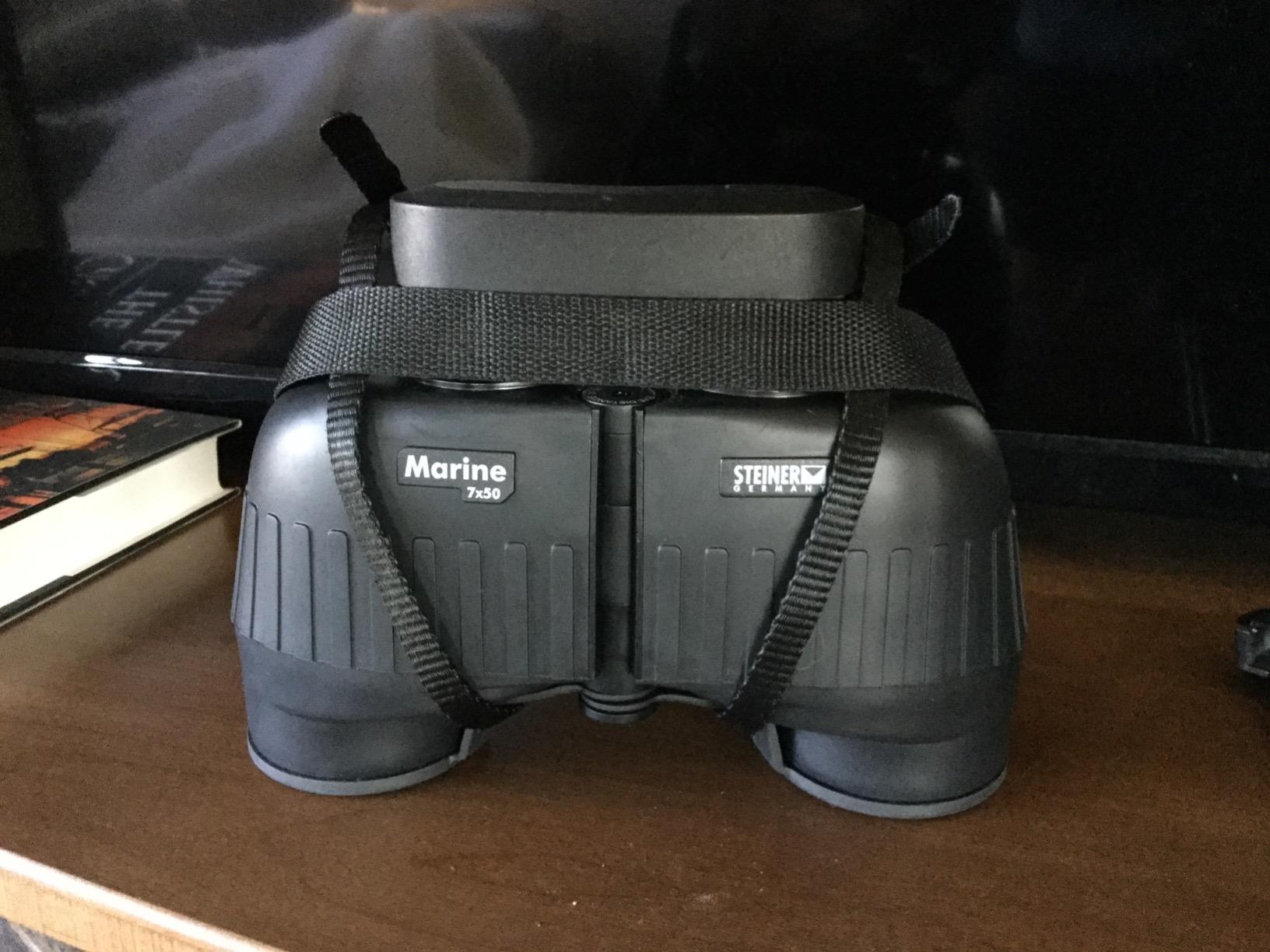
Construction is where the money went. The floating prism system uses flexible silicone lens mounts so the optics stay aligned after a drop onto a wet teak deck, and the body is fully rubber-armored with grip ridges that stay workable with wet hands. Owners running these through salt seasons report the rubber and glass holding up without the corrosion problems that end cheaper optics.
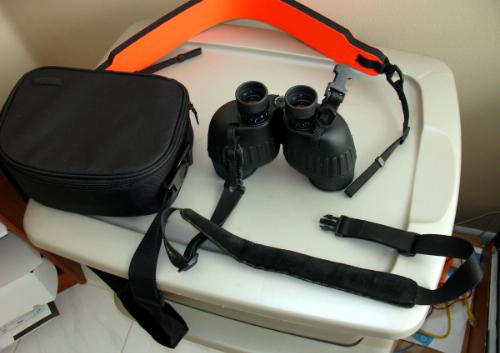
The warranty is the Steiner Heritage lifetime repair-or-replace plan, which matters if you keep the same boat for a decade. Weight is listed at 1 kg, so it is a real pair rather than a featherweight, but the balance is centered and it stays comfortable through a full watch.
Who the Steiner Marine 7×50 suits best
It suits the cruiser who keeps a proper lookout and wants one pair to do everything: spotting unlit boats at dusk, reading a name on a hull, checking entrance buoys on a reef pass, and watching the horizon through a long night watch. The auto-focus behaviour rewards exactly that kind of scanning work.
It also works as a dual-purpose pair. Owners use the same binoculars for shore birding from anchor and for stargazing from the cockpit, and the bright, neutral image suits both.
Where the Steiner Marine 7×50 falls short
The obvious gap is navigation hardware. There is no built-in compass and no rangefinder reticle, so if your lookout routine depends on taking a bearing on a lighthouse or estimating distance to a target, you will carry a compass or plotter alongside.
Auto focus is also a compromise. It is built for fixed-distance viewing, so if you repeatedly switch between something at your feet and something at infinity, a center-focus pair with diopter adjustment will serve you better. And it costs noticeably more than the generic marine binoculars in this roundup.
2. Steiner Military-Marine 8×30 – Lightest Pair for Long Watches
Steiner Military-Marine 8×30 Binoculars – Professional Grade High-Contrast Optics with Sports-Auto-Focus, Floating Prism Shock Absorption, and Heritage Warranty
8x30
17.1 oz
Fully coated
Makrolon with NBR rubber
6.7 inch body
Pros
- Lightest pair here at 17.1 ounces
- Makrolon body with NBR rubber rated to 11 G impact
- Sports Auto Focus sharp from 20 yd to infinity
- Floating prism system
- Compact enough for a small locker
Cons
- 30mm objective is dim at dusk compared with 50mm glass
- 8x suits spotting rather than identification
- No compass or rangefinder reticle
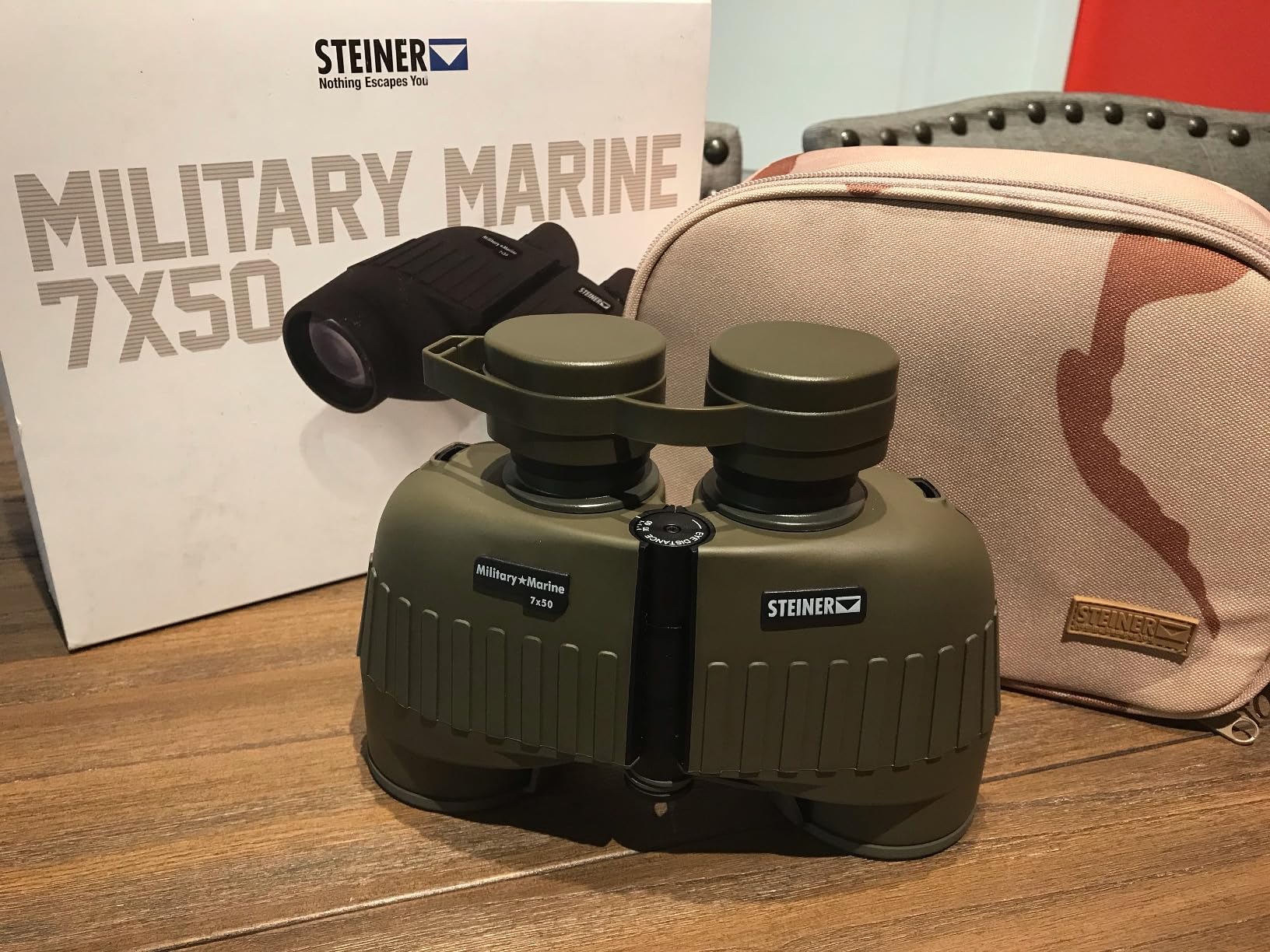
Everything in this roundup is a compromise, and this one makes a different one. Instead of 7×50, you get 8×30: a little more magnification, a smaller objective, and a body that weighs 17.1 ounces. That weight is the headline. On a four-hour night watch it is the difference between a pair you keep at the eye and one that ends up around your neck.
The chassis is genuinely tough. A Makrolon polycarbonate body with NBR long-life rubber armoring is rated to 11 G impact, and the construction is described as oil, petroleum, and chemical resistant, which matters in a cockpit where hydraulic fluid and fuel are present.
Auto focus works the same way as the bigger Steiner, set once per eyepiece and sharp from 20 yards out. The floating prism system with flexible silicone lens mounts keeps the optics aligned after a knock.
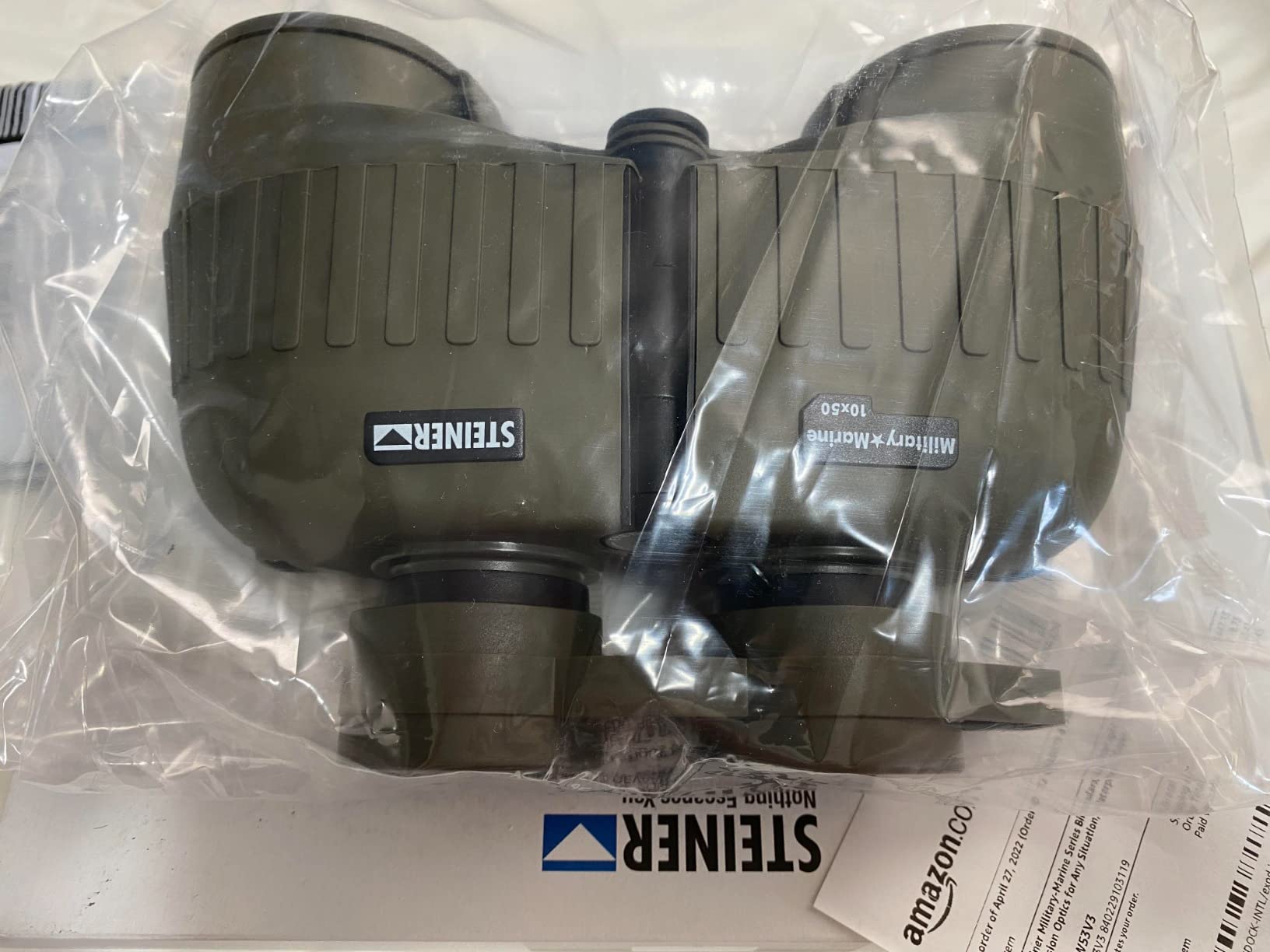
The compact dimensions matter too. At 6.7 inches long by 2.2 inches wide, it stows in a small runabout console or a sailboat locker where a full-size 7×50 does not, and it carries the same transferable Steiner Heritage lifetime warranty.
Owners treat it as the tough, throw-it-in-the-bag binocular. The 4.7 rating reflects broad satisfaction with the build and the set-and-forget focusing rather than any excitement about the optics.
Who the Steiner Military-Marine 8×30 suits best
It suits anyone who watches for long stretches and values a light, compact pair over maximum light gathering. A solo cruiser on an overnight passage, a small-boat angler who needs to find other boats before they become a hazard, or anyone stowing optics in a helm locker with no room will find this the most practical option here.
It is also a good fit for dry, bright coastal work where you are identifying a rig type rather than reading nav lights at dusk.
Where the Steiner Military-Marine 8×30 falls short
The 30mm objective gives up light. At twilight, when you are trying to identify an unlit vessel or read a navigation mark, a 50mm objective is meaningfully brighter than a 30mm one. Owners accept this trade, but it is a real limitation for night and dusk work.
Eight power also nudges you past the point where hand shake becomes obvious without stabilization. Standing and scanning on a moving deck, 8x is workable; picking out small features on a distant hull is not. And like its bigger sibling, there is no compass or rangefinder built in.
3. Hooway 7×50 – Full Marine Feature Set at a Budget Price
Hooway 7×50 Waterproof Fogproof Military Marine Binoculars w/Internal Rangefinder & Compass for Navigation,Boating,Fishing,and More
7x50
22mm eye relief
396 ft FOV
Illuminated compass and rangefinder
2.2 lb
Pros
- Illuminated compass and internal rangefinder at this price
- 22mm eye relief suits glasses and polarized lenses
- Bright crisp image from BAK4 prism and multi-coating
- Floats if dropped overboard
- Fast customer service on defects
Cons
- Individual eyepiece focus is tedious between near and far targets
- Some pairs have an air bubble in the compass window
- Compass reading can sit about five degrees off
- Rubber eyecups deteriorate after a couple of seasons
This is the pick that keeps coming up in forum threads when owners compare budget marine glass. At 4.5 stars across 787 reviews, it carries more owner feedback than almost anything else here while adding two things that premium glass often leaves out: an illuminated compass and an internal rangefinder.
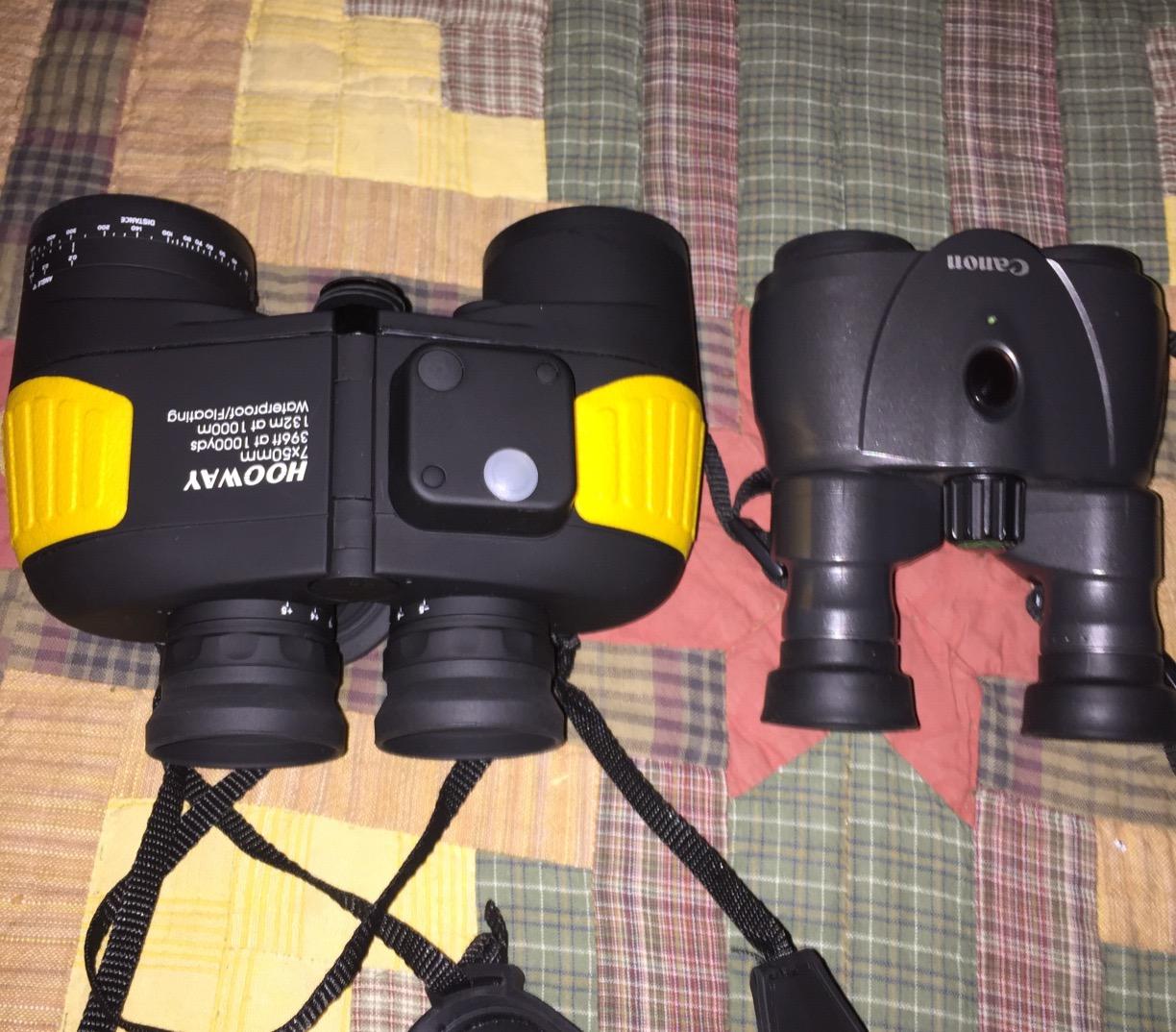
The specifications are straight marine standard. Seven power, a 50mm objective, 396 feet of field of view at 1000 yards, a 6.8mm exit pupil, and 22mm eye relief, which is generous enough for glasses or a polarized sunglass without the black-edged tunnel effect that shorter eye relief produces.
Owners consistently praise the brightness and crispness for the money, coming from a BAK4 prism with fully multi-coated optics. The porro prism layout also gives a comfortable, wide, dimensional image that reads well across open water.
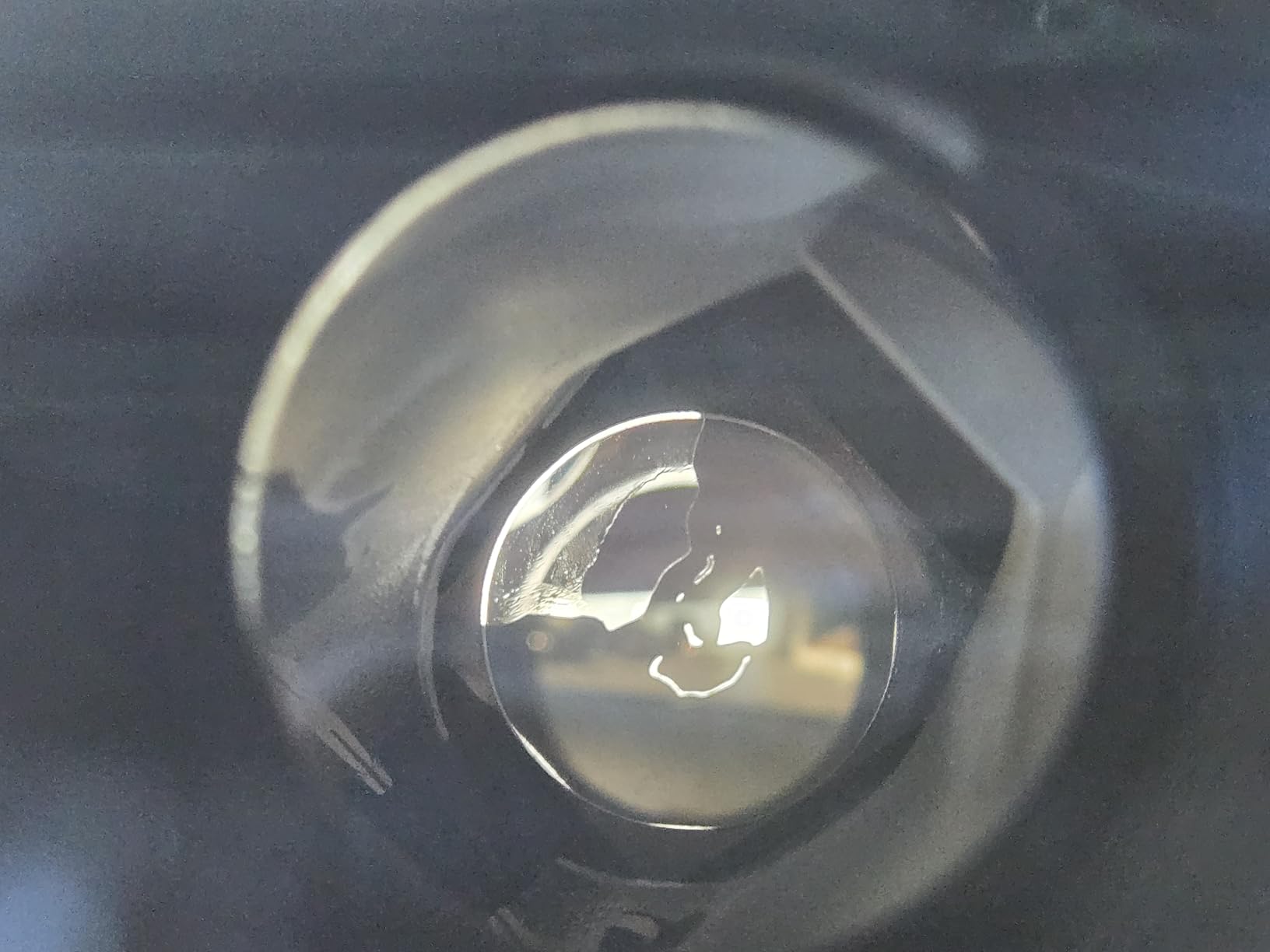
Separately adjustable diopter rings are a genuine advantage if your eyes are uneven, and folding rubber eyecups let you collapse them for a bare-eye view. The non-slip rubber armor holds a wet grip, and a tripod adapter fitting is included for long watches from a fixed position.
Service response is another quiet strength. Owners report fast replacement of a faulty strap, which is the kind of thing that only becomes important the week something breaks.
Who the Hooway 7×50 suits best
It suits the boater who wants navigation features without paying for them separately, and who wears glasses or polarized lenses. The 22mm eye relief is one of the more comfortable figures in this roundup, and separate diopter adjustment handles uneven eyesight that a single center wheel cannot.
It also suits anyone who wants a floating pair as a man-overboard safety net, and anglers running from a small boat where a lighter pack matters.
Where the Hooway 7×50 falls short
Individual eyepiece focus is the recurring ergonomic complaint. There is no center wheel, so switching between a near object and the horizon means adjusting each side separately, and doing that on a moving deck is annoying. Users who are comfortable setting focus once and leaving it rate this far higher.
The compass needs a caveat. Some owners report an air bubble inside the compass window, and reported readings can be off by roughly five degrees. Treat the compass as a quick reference rather than a primary bearing instrument, and keep a separate compass on the helm for real navigation.
4. Bushnell Marine 7×50 – Sealed Build for Harsh Coastlines
Bushnell Marine 7×50 Waterproof Binoculars, Blue
7x50
BaK-4 prisms
18mm eye relief
7.1mm exit pupil
1.02 kg
Pros
- Hermetically sealed and corrosion resistant
- Excellent light gathering with a bright crisp image
- Coast Guard recommended 7x50 configuration
- Limited lifetime manufacturer warranty
- Works with no batteries at all
Cons
- Bulky and heavy for a handheld pair
- Individual focus rather than a center wheel
- Interpupillary setting must be re-done each time
- No compass or rangefinder
The Bushnell Marine 7×50 is the simplest, most honest pair in the roundup. It is a 7×50 with BaK-4 prisms and fully multi-coated UV-protected optics, and it asks for no batteries, no switches, and no setup. The seal is hermetic and the body is corrosion resistant, which is the whole argument.
Owners across CruisersForum and angling forums treat it as the dependable backup pair, valued precisely because it is sealed tight enough to survive a dunking and keeps working after a season of salt. It also needs no maintenance thinking at all, which matters when the glasses live in a wet locker.
Light gathering is the standout. The 7.1mm exit pupil and 7.5 degree apparent field give a bright, wide view that holds up well in low light compared with smaller-objective alternatives in this list.
The porro prism system contributes a wide field of view and a well-spaced image, and the non-slip, non-skid rubber armor keeps it secure on a wet deck. Coverage is backed by a limited lifetime manufacturer warranty.
Who the Bushnell Marine 7×50 suits best
It suits coastal and near-shore work where salt spray is constant and reliability beats features. People who want one pair for a small boat, a duck boat, or a runabout console will find it easy to live with, because there is nothing to set and nothing to break.
It also suits anyone who has been disappointed by a cheap binocular with a dim image. The glass quality here is consistently reported as crisp and bright, and owners often note it outperforms department-store alternatives in the same bracket.
Where the Bushnell Marine 7×50 falls short
It is bulky and heavy. At a listed 1.02 kg this is one of the larger pairs in the roundup, and owners consistently flag size and weight as the main drawback, particularly for a full night watch.
Focus is individual left and right rather than a single center wheel, and the interpupillary width has to be reset each time the glasses come out of the case. Users note that setting focus once and marking the diopter scale largely solves this. There is also no compass or rangefinder, so bearing work stays on the chart table.
5. Fujinon Mariner 7×50 WPC-XL – The Legacy Bearing Compass Pair
Fujifilm Fujinon Mariner 7×50 WPC-XL Porro Prism Binocular
7x50 porro prism
Illuminated world compass
Rangefinder reticle
18mm eye relief
7.14mm exit pupil
Pros
- Illuminated world compass that owners report reads accurately
- Outstanding Fujinon optics with a bright low-light view
- Rangefinder reticle in the eyepiece
- Proven longevity with owners replacing the same model after 18-plus seasons
- Floats with the supplied strap
Cons
- Hard plastic casing is not rubber-armored
- Individual eyepiece focus only
- Included strap is bulky and lens caps feel cheap
- No hard carrying case included
If you want a pair whose compass you can trust to take a bearing, this is the one that shows up most often in long-term ownership threads. Owners on CruisersForum describe it as the pair they have replaced after 18 and even 20 sailing seasons, which is about as strong a durability signal as consumer gear gets.
The optics are the real headline. Fujinon glass is described by owners as outstanding, matching or beating more expensive Nikons, with a bright, crisp low-light view driven by a large 7.14mm exit pupil. The 18mm eye relief is adequate for glasses, though not the most generous here.
The built-in illuminated world compass is the reason this model appears in so many bearing discussions. To use it, you view the target through the compass window, centre the bearing on the reticle, and read the degree mark against the lubber line. It takes practice, and it is a genuinely useful way to fix a relative bearing on a lighthouse or headland.
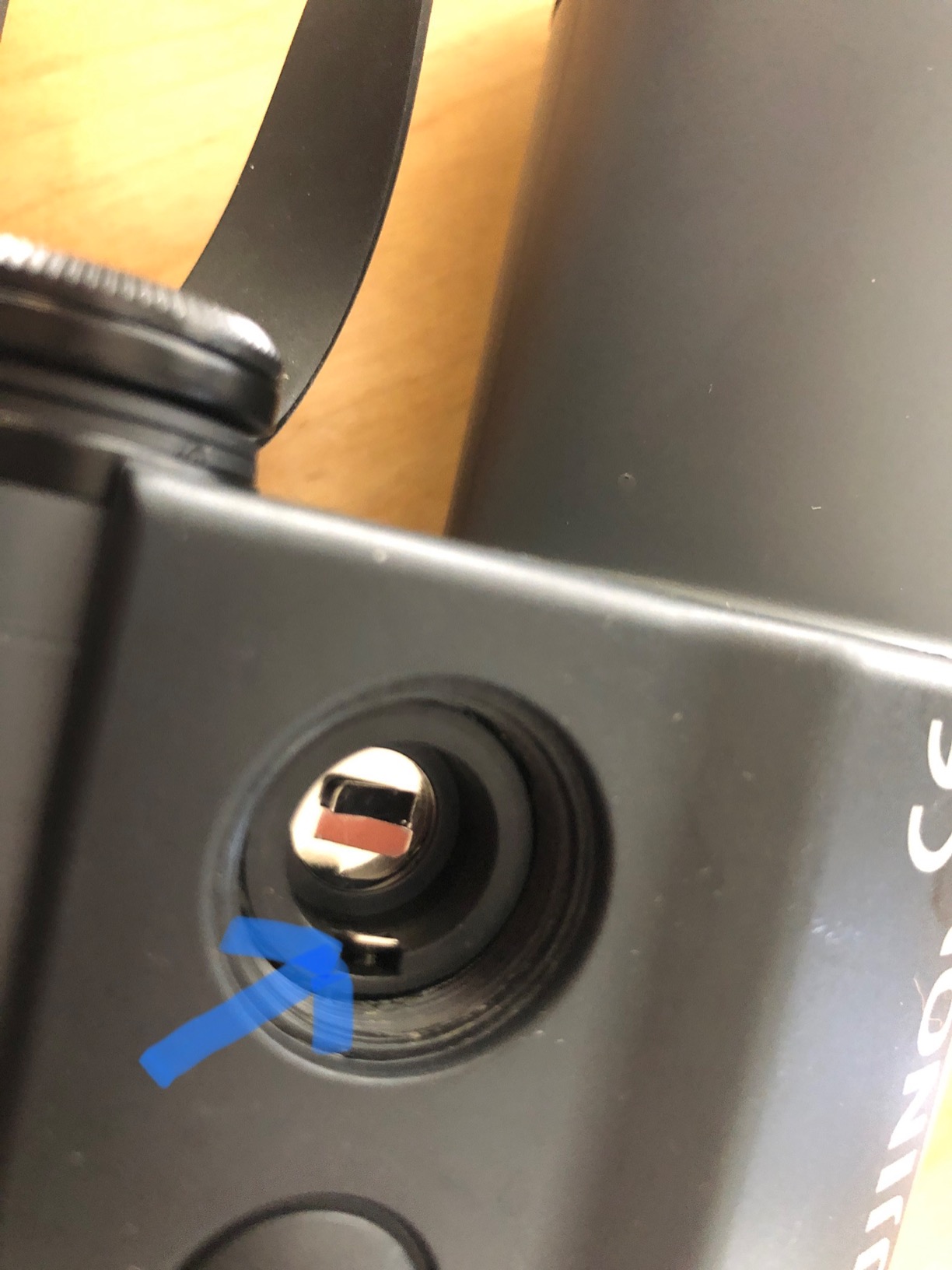
The rangefinder reticle in one eyepiece lets you estimate the distance and size of an object, which is still useful for judging an approach even with radar and AIS aboard. Those two electronic tools tell you what a transponder is transmitting; binoculars tell you what a vessel with no transponder is doing.
The body is waterproof and nitrogen filled, and it floats when paired with the supplied strap. That makes it a reasonable choice for a man-overboard scenario.
Who the Fujinon Mariner 7×50 WPC-XL suits best
It suits sailors and offshore cruisers who take bearings as part of a real navigation routine rather than as an occasional check, and who want the compass and the optics from one manufacturer that has decades of marine pedigree.
It also suits anyone buying once. The design has been in production long enough that parts and advice are easy to find, and the long ownership record suggests it will outlast several boats.
Where the Fujinon Mariner 7×50 WPC-XL falls short
The body is hard plastic rather than rubber-armored. It will survive spray, but it asks more care on a hard deck than a rubberized chassis, and the supplied flotation strap is bulky and lens caps are thin enough that many owners cut them off.
Focus is individual eyepiece only, so you cannot dial both sides at once, and no hard carrying case is included. A small number of reviews also mention misaligned tubes on newly delivered pairs, so check the barrels on arrival.
6. Nikon OceanPro 7×50 CF WP – Most Precise Global Compass
Nikon 7×50 OceanPro CF WP Global Compass Marine Binocular (Black)
7x50
Multicoated Eco-glass
22.7mm eye relief
Global compass
3.8 lb
Pros
- Global compass with automatic hemispheric declination
- Integral scale for subject size and distance
- Multicoated Eco-glass image is crisp and bright
- Rubber-armored polycarbonate body
- 22.7mm eye relief
- Center focus with floating nylon strap
Cons
- Heaviest pair here at 3.8 pounds
- Center focus means no per-eye diopter correction
- Smallest review base in the roundup at 60 reviews
The differentiator is the compass, and it is a real one. The illuminated global compass handles declination automatically for both hemispheres, which means it stays correct on a crossing to higher latitudes rather than quietly drifting the way a fixed-magnetic card does.
Below that, the pair is a straightforward premium 7×50 with multicoated Eco-glass optics that owners describe as crisp and bright for marine use. Center focus lets you bring a target to sharpness in one movement, which is faster than the individual-focus pairs elsewhere in this roundup.
At 22.7mm, the eye relief is one of the better figures here, which makes this a comfortable pair for glasses wearers and for anyone shooting over a polarized sunglass. The rubber-armored polycarbonate body is built for harsh conditions, and a nylon floating strap is included for recovering a dropped pair.
The integral scale handles subject size and distance calculation, letting you measure an object and derive its range from its known dimensions. That is old-school practice, and it still works when electronics are down or when you want an independent check.
Who the Nikon OceanPro 7×50 CF WP suits best
It suits anyone whose passage plan crosses latitudes or hemispheres, or who simply wants a compass card that does not need periodic correction. It also suits eyeglass wearers who want fast center focus and generous eye relief in one package.
For cruisers who already have good radar and AIS, the value is an independent cross-check on what the electronics report, plus the ability to look at a vessel that is transmitting nothing at all.
Where the Nikon OceanPro 7×50 CF WP falls short
It is the heaviest pair in this roundup at 3.8 pounds, and owners with long watches flag that. On a smaller boat, a lighter 7×50 with a similar feature set is simply more comfortable to hold.
Center focus means no independent diopter correction, so if your eyes are uneven you will need glasses adjusted for the binocular. It also carries the smallest owner feedback base here, at 60 reviews, which means less long-term data behind the reputation than the Steiner or Fujinon picks.
7. Barska Floatmaster 7×50 – Best Balance of Float and Eye Relief
Barska AB12738 Floatmaster 7×50 Waterproof Floating Marine Binoculars for Boating, Hunting, Fishing, Sports, etc, Yellow
7x50
23mm eye relief
7mm exit pupil
367 ft FOV
Center focus
2.3 lb
Pros
- 23mm eye relief works with glasses even with eyecups folded
- Center focus wheel for quick target acquisition
- Sealed nitrogen-purged body that floats
- Fully multi-coated optics with BAK-4 prisms
- Large 7mm exit pupil is easy to line up
Cons
- Heavy for its class despite the floating claim
- Focus wheel can be stiff
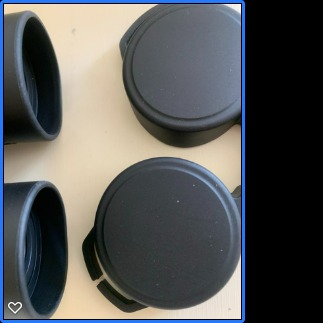
- Lens covers are not attached by a cord and get lost
The Floatmaster is named for the thing it does best, and the 7×50 layout is textbook: center focus, a 7mm exit pupil, and a 367 foot field of view at 1000 yards. The optical package is fully multi-coated optics behind BAK-4 prisms, and owners report a clear, bright image with good light gathering.
The standout number is eye relief. At 23mm this is the most generous figure in the roundup, and owners specifically note that it still works with glasses worn under the binoculars even with the eyecups folded down. If you wear a polarized sunglass on deck, that is the difference between a full view and a black-edged circle.
Center focus is the other quiet win. One wheel brings a target to sharpness quickly, which matters more than it sounds when a target appears at three miles and you have two seconds to identify it.
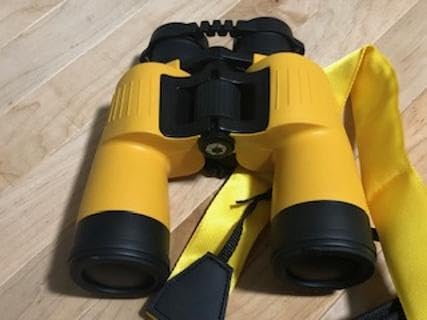
Construction is sealed and dry nitrogen purged, described as waterproof, fogproof, shockproof, and buoyant. That means it floats if it goes over the side, which a few owners treat as a genuine man-overboard safety feature rather than a spec-sheet curiosity.
Non-slip ergonomic rubber armor, a neck strap, and a carrying case are included, which covers the basics most owners would otherwise have to buy separately.
Who the Barska Floatmaster 7×50 suits best
It suits eyeglass and polarized-sunglass wearers first and foremost, because no other pair here offers this much eye relief. It also suits anyone who wants a floating pair with simple, fast focusing and no batteries or electronics to fail.
It is a good all-rounder for coastal boaters and anglers who want one pair for day lookout, dusk, and shore birding from the anchorage.
Where the Barska Floatmaster 7×50 falls short
It is heavy for its class at a listed 2.3 pounds, which is a mild contradiction of the floating claim rather than a flaw. On a long watch you will notice it.
The focus wheel can be stiff, particularly when wearing gloves, and the close focus distance of roughly 75 to 80 feet limits close-range use if you want to examine something alongside the hull. Lens covers are not tethered to the body and are easily lost in a cockpit.
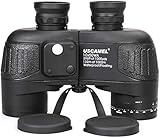
8. USCAMEL 10×50 Marine – Most Owner Feedback in the Group
USCAMEL 10X50 Marine Binoculars for Adults: Binoculars for Sailing Boating
10x50
Illuminated compass and rangefinder
396 ft FOV
IPX7 and floats
1.22 kg
Pros
- Largest owner feedback base in the roundup at 2581 reviews
- Illuminated compass plus mil-based rangefinder reticle
- IPX7 waterproof nitrogen filled body that floats
- Fully multi-coated BAK4 optics
- Includes batteries strap and carry bag
Cons
- Stated 10x is disputed by some owners who measure nearer 7x
- No center focus wheel
- Included compass batteries sometimes arrive dead
- Heavier than comparable priced marine pairs
By a wide margin this is the pair with the most owner feedback in the roundup, at 2581 reviews and a 4.4 average. That volume matters, because it means the reported problems are the ones many people actually hit rather than a handful of isolated complaints.
The feature list is full for the category: 10x magnification with a 50mm objective, an illuminated built-in compass, an internal rangefinder in one eyepiece, a BAK4 prism with fully multi-coated lenses, and an IPX7 waterproof nitrogen-filled body that floats. Foldable eyecups and plus or minus 5 diopter rings suit glasses wearers.
Owners consistently praise clarity, sharpness, and colour fidelity for the money, and several describe it as matching or beating department-store brands in the same bracket. The magnesium enclosure and included harness strap add to the sense of a serious tool.
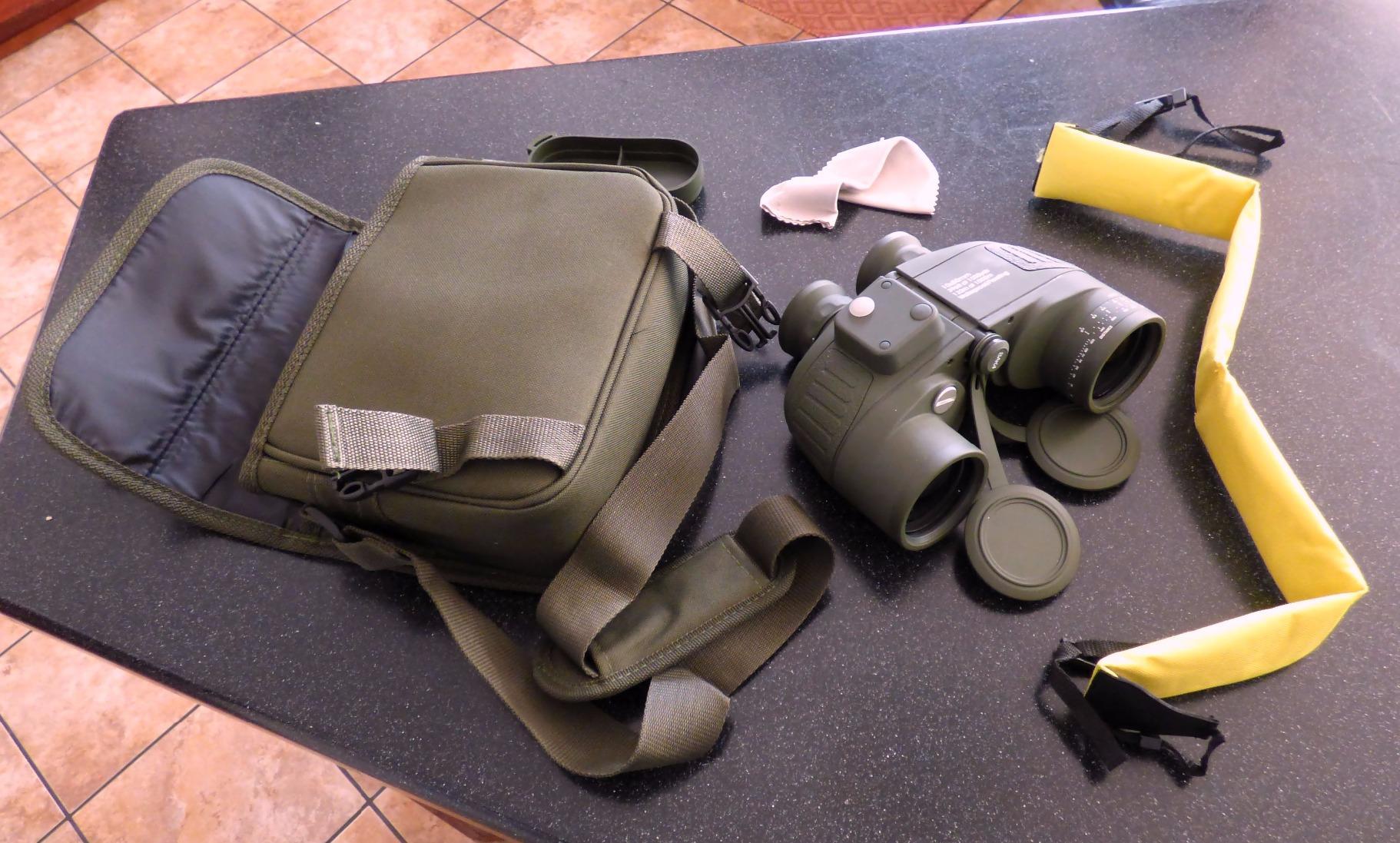
The 396 foot field of view at 1000 yards is wide for a 10 power design, which is unusual and helps a lot when scanning rather than locking onto a single target.
The warranty is listed at one year, which is the shortest in the roundup, so this is a pair you would expect to replace sooner than a Steiner or Bushnell if you keep the boat long term.

Who the USCAMEL 10×50 Marine suits best
It suits boaters who want to identify rather than merely spot, and who mostly observe from a stable platform, a flybridge, or a lee. At ten power you can pick out rig types and read shapes on distant hulls that seven power leaves ambiguous.
It also suits anyone who wants a floating pair with both a compass and a rangefinder, plus the reassurance of thousands of owners reporting the same behaviour.
Where the USCAMEL 10×50 Marine falls short
The most reported issue is the magnification. Some owners measure the actual power nearer 7x than the stated 10x, which makes the instrument behave more like the marine standard than the spec suggests. Verify it before you rely on it for identification.
There is no center focus wheel, so each eyepiece is adjusted separately, and the included compass batteries have arrived dead often enough to matter. Carry spares. At a listed 1.22 kg it is also heavier than comparable priced marine pairs.
9. AOMEKIE 7×50 – Bright Glass and a Buoyant Body
AOMEKIE 7×50 Marine Binoculars for Adult Waterproof Rangefinder & Compass
7x50
BaK4 prisms
Fully multi-coated
Illuminated compass and rangefinder
2.8 lb
Pros
- Bright wide sharp view from BAK4 prisms and multi-coated 50mm objectives
- Waterproof fogproof and buoyant for marine use
- Illuminated compass and rangefinder reticle for navigation
- Roughly 22mm eye relief with foldable eyecups
- Rubber armor gives a secure wet grip
Cons
- Lens and eyecup covers are loose and easily lost
- Carry bag is too narrow for the body
- Magnitude labelling inconsistent with some 10x markings
- Heavy build for the magnification class
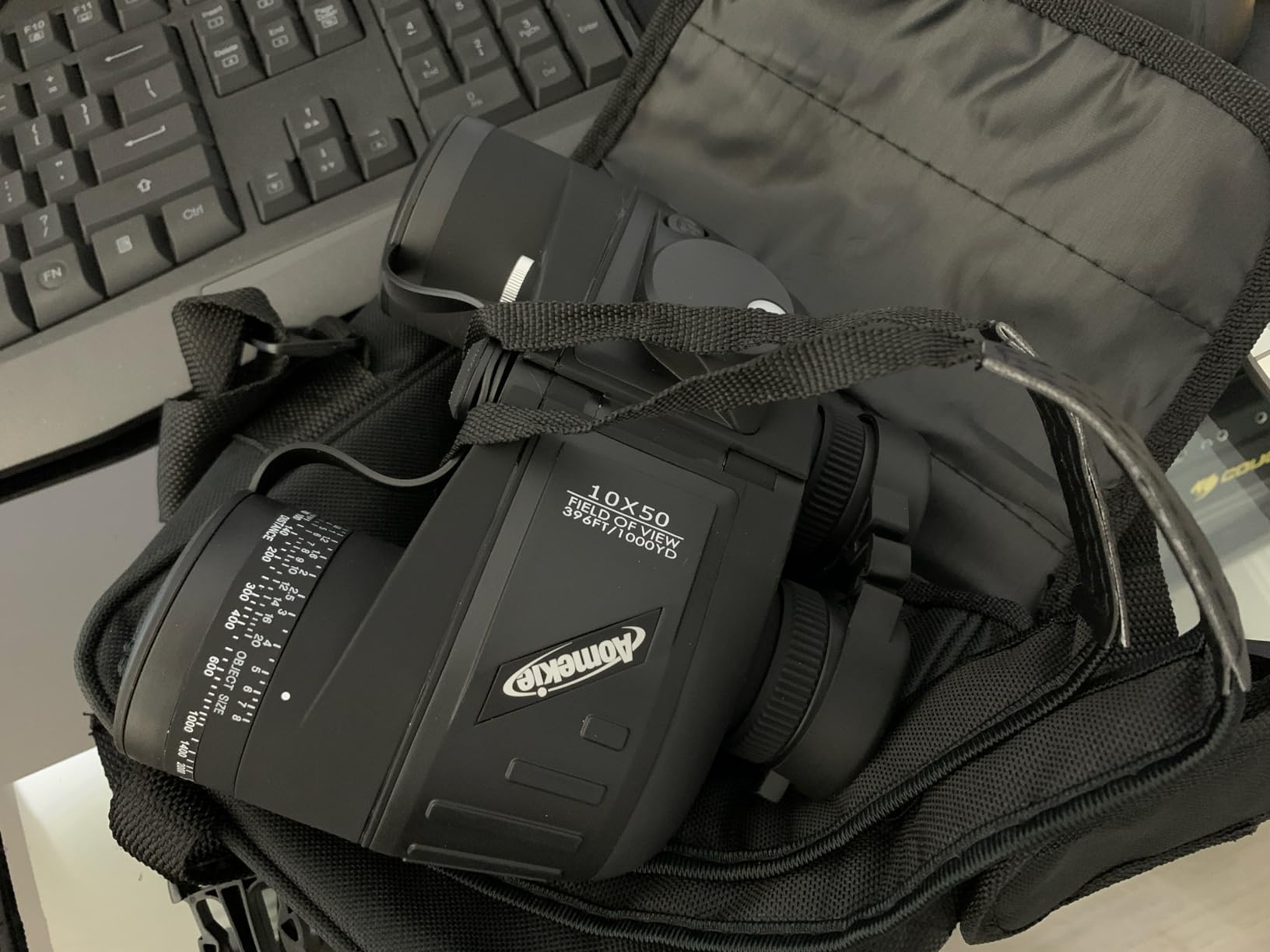
This pair covers the marine feature list in full at a low price: a 7×50 layout with BAK4 prisms and fully multi-coated 50mm objectives, an illuminated compass, a rangefinder reticle, and a waterproof, fogproof body that floats. Reviewers with 1033 ratings behind them repeatedly describe the glass as clear and bright for the money.
Eye relief of roughly 22mm is genuinely useful, and with foldable eyecups it works for glasses wearers. The rubber armor gives a secure grip, and a carry bag and neck strap are included.
The wide field of view helps when you are sweeping open water rather than holding a single target. With 1033 owner reviews at 4.4 stars, the volume of feedback here is second only to the USCAMEL in this roundup.
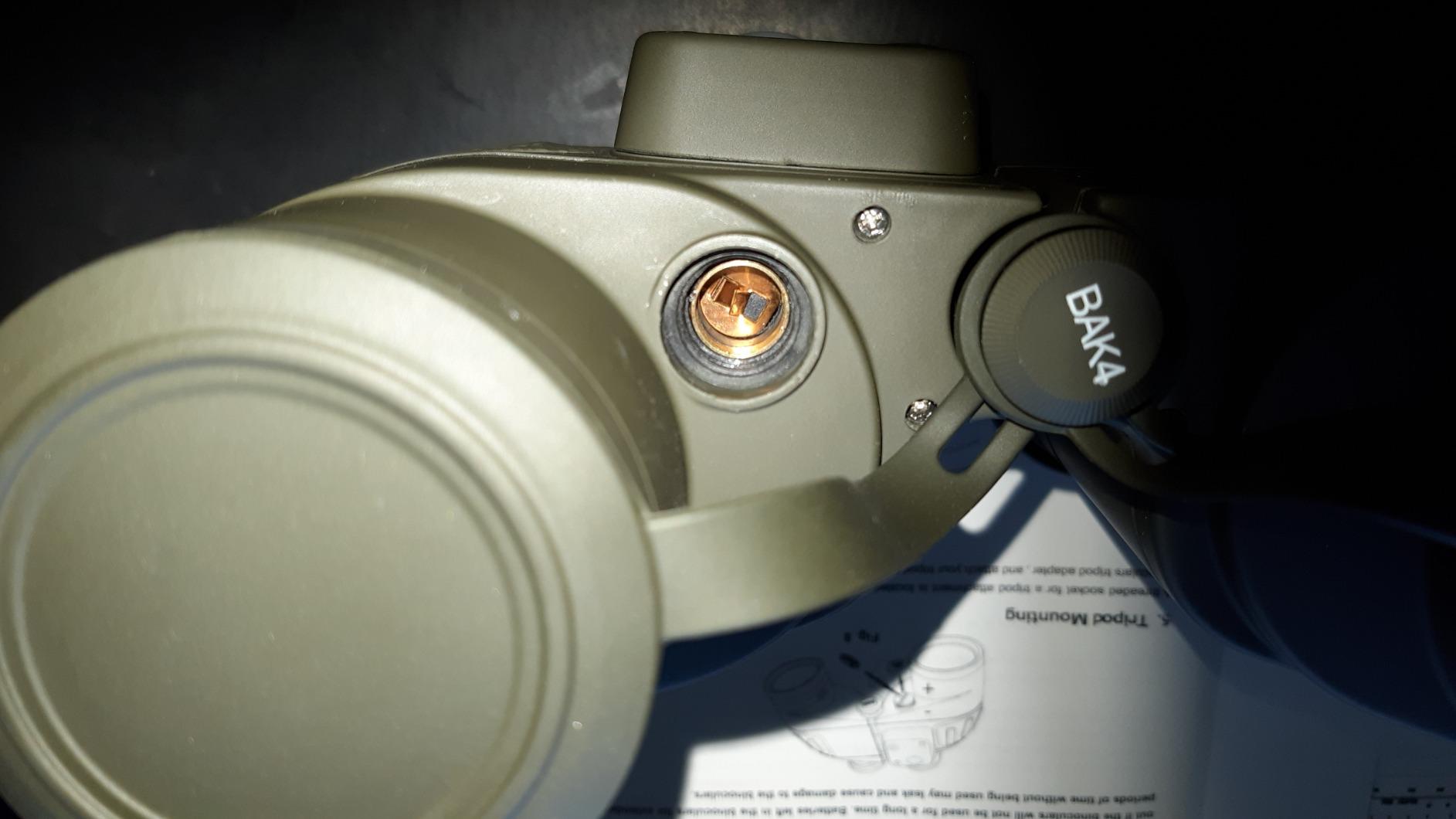
One thing worth flagging up front: the complaints about this pair are almost entirely about the accessories rather than the glass. Loose lens and eyecup covers, a carry bag that does not fit the body properly, and batteries for the compass light that sometimes do not work out of the box.
Magnitude labelling is also inconsistent, with some units reporting 10x markings on a body sold as 7×50. Check the actual magnification on arrival if identification at range is important to you.
Who the AOMEKIE 7×50 suits best
It suits budget buyers who still want the full marine feature set rather than a stripped-down pair. Brightness on a 7×50 layout, a compass, a rangefinder, and a floating body cover most of what coastal and inland boaters ask for.
It is also a strong candidate as a second pair. Owners frequently end up with one pair on the helm and another stowed in a ditch bag or a console locker.
Where the AOMEKIE 7×50 falls short
The build is heavy for a 7×50, listed at 2.8 pounds, and that weight is felt on a long watch. Owners also report loose, unsecured lens and eyecup covers that are easy to lose over a season, and a carry bag that does not close properly around the body.
The supplied batteries for the compass illumination are unreliable enough to check before you need them. And with inconsistent magnification labelling, confirm what you are actually holding before you trust it for distance work.
10. USCAMEL 10×50 Rangefinder – Compass and Range in One Housing
10×50 Marine Binoculars Waterproof Rangefinder Compass BAK4 FMC for Adults
10x50
396 ft FOV
BaK4 with green multi-coating
Nitrogen filled and floats
1.22 kg
Pros
- Compass and internal rangefinder in one body
- Floating sealed nitrogen filled construction
- Bright BAK4 prism with green multi-coating
- Plus or minus 5 diopter rings and foldable eyecups for glasses wearers
Cons
- Small 5mm exit pupil and 7.1mm eye relief are hard on glasses wearers
- Individual focus only with no center wheel
- Compass illumination only works in low light
- Heavier than most pairs at this magnification
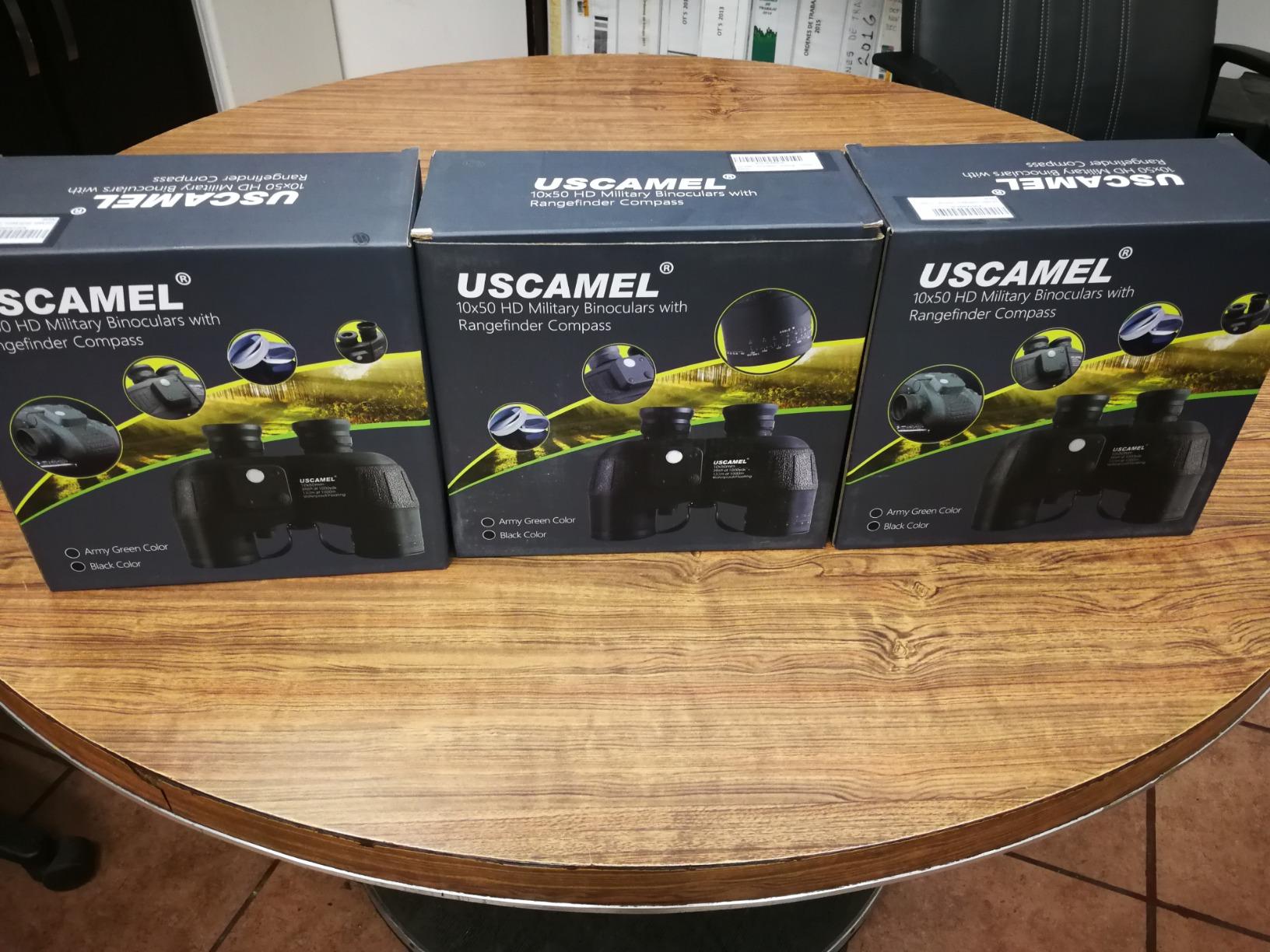
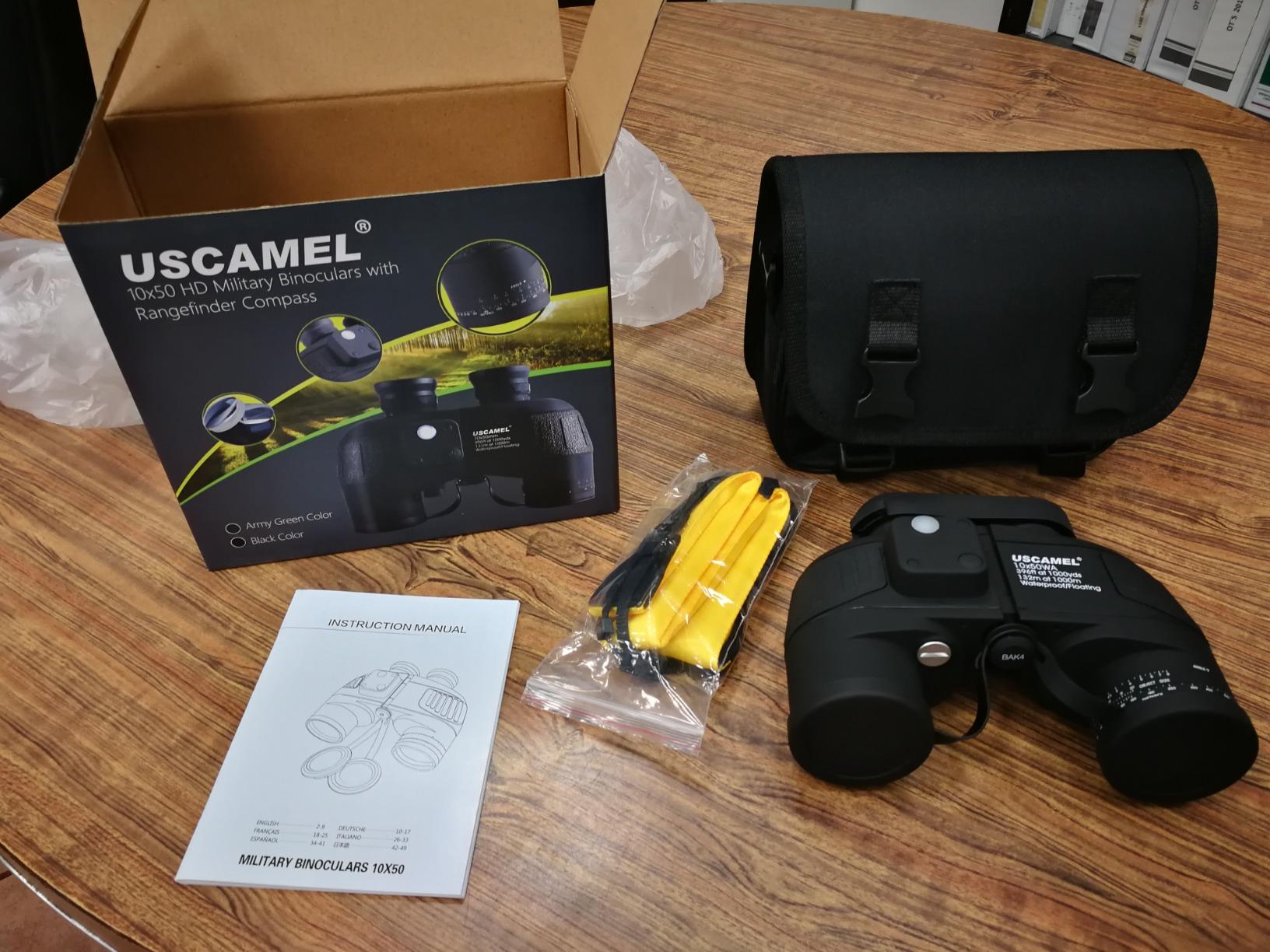
This is the same basic platform as the higher-volume USCAMEL, configured as a floating 10×50 with a high-refractive BAK4 prism and green multi-coating. Owners rate the glass brightness and the sealed, floating, fogproof construction as its strongest attributes.
The attraction is convenience: an illuminated compass and an internal rangefinder in one housing, so you can take a rough bearing and then estimate distance on the same target without reaching for another instrument. For spotting an unlit boat and working out how far away it is, that is a useful combination.
The 50mm objective with a 396 foot field of view at 1000 yards gives a wide scan for the magnification, which helps more than the number suggests when you are sweeping rather than tracking.
Diopter rings at plus or minus 5 and foldable eyecups are included, which is generous given the eye relief figure. The body is O-ring sealed and nitrogen filled, and it floats.
At 4.4 stars across 522 reviews, the sentiment is solidly positive, with the caveats concentrated on ergonomics rather than optical performance.
Who the USCAMEL 10×50 Rangefinder suits best
It suits boaters who want more identification power than 7x without leaving behind the navigation features, and who can brace themselves or watch from a stable position. A flybridge helm, a trawler’s raised wheelhouse, or a boat in a lee are all good use cases.
It also suits anyone who wants a floating pair with a compass in the housing rather than carrying a separate instrument on a lanyard.
Where the USCAMEL 10×50 Rangefinder falls short
The 5mm exit pupil and 7.1mm eye relief are the weakest ergonomic figures in this roundup. Glasses wearers in particular may see a black-edged, tunneled image even with the eyecups folded.
There is no center focus wheel, so each eyepiece is adjusted separately. The compass illumination only operates in low light rather than in total darkness, which is a limitation if you are trying to read it in a dark cockpit. And at a listed 1.22 kg it is heavy for what it is.
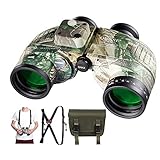
11. QUNSE 10×50 – Center Focus at 10 Power
QUNSE 10X50 Marine Binoculars Adults Waterproof Rangefinder Compass
10x50
22mm eye relief
396 ft FOV
Center focus
2 lb
Pros
- Center focus wheel at a magnification where most rivals use individual focus
- 22mm eye relief and 6.8mm exit pupil suit glasses wearers
- Nitrogen filled O-ring sealed body that floats
- Illuminated compass and internal rangefinder
- Carry bag and strap included
Cons
- Lowest average rating in the lineup at 4.2 stars
- Compass illumination depends on batteries that are not always reliable
- Camouflage finish suits outdoor use more than a clean console look
The reason this pair earns a place is the focus design. Most 10×50 marine binoculars in this roundup adjust each eyepiece separately, which is fiddly when you are tracking a distant target. The QUNSE uses a single center focus wheel, so one movement brings the target to sharpness.
Eye relief of 22mm with a 6.8mm exit pupil is a good combination at ten power and is one of the more glasses-friendly sets here. The 396 foot field of view at 1000 yards is wide for the power rating.
Satisfied owners highlight a bright 10×50 image, comfortable eye relief, and a buoyant waterproof body built from glass and rubber with a nitrogen-filled, O-ring sealed housing.
The illuminated compass and internal rangefinder sit in one eyepiece, which gives this pair the same navigation convenience as the other budget 10×50 options, plus the focus wheel they lack.
Who the QUNSE 10×50 suits best
It suits anyone who wants ten power and glasses compatibility in the same package, and who prefers a single focus wheel over per-eye adjustments. For an older angler with a touch of presbyopia, the eye relief figure is the point.
It also suits boaters who want the combination of floating body, compass, and rangefinder without moving up a tier.
Where the QUNSE 10×50 falls short
At a 4.2 average, this pair carries the lowest rating in the roundup, with a larger share of one and three star reviews than the others. Reading the feedback, the complaints cluster around the compass illumination and the general finish rather than the optics, but the consistency of the complaint is the reason to look elsewhere if reliability is the priority.
The camouflage finish also reads as an outdoor pattern rather than a bridge-console one, which some owners find less at home on a helm. Expect to carry spare batteries for the compass light.
12. ESSLNB 7×50 – Documented IPX7 Submersion Rating
ESSLNB 7×50 Marine Binoculars, IPX7 Waterproof with Compass & Rangefinder
7x50
BaK4 prisms
396 ft FOV
IPX7 to 1 meter
Illuminated compass and rangefinder
3.1 lb
Pros
- IPX7 O-ring sealed housing rated for immersion to 1 meter for 30 minutes
- Bright 7x50 view with BAK4 prisms and a wide field of view
- Illuminated compass and rangefinder reticle with switchable lighting
- Floating body and floating neck strap included
- 22mm eye relief with fold-down eyecups
Cons
- Heaviest chassis in the lineup at 3.1 pounds
- Individual focus rather than a center wheel
- Compact achieved with a chunky body
- Compass and rangefinder accuracy not documented by owners
This is the pair with the clearest documented waterproof specification in the roundup. The IPX7 rating means the O-ring sealed housing is rated for immersion to one meter for thirty minutes, which is a meaningful line when the glasses live in a wet locker or a splashy runabout.
The optical side is a bright 7×50 with BAK4 prisms, a 6.8mm exit pupil, and a 396 foot field of view at 1000 yards, which is the widest figure in this list and good for sweeping open water.
Navigation features are present: an illuminated compass and a rangefinder reticle with switchable lighting. Individual diopter adjustment and fold-down eyecups handle glasses wearers, and the accessory list includes a carry bag, a floating neck strap, lens covers, and batteries.
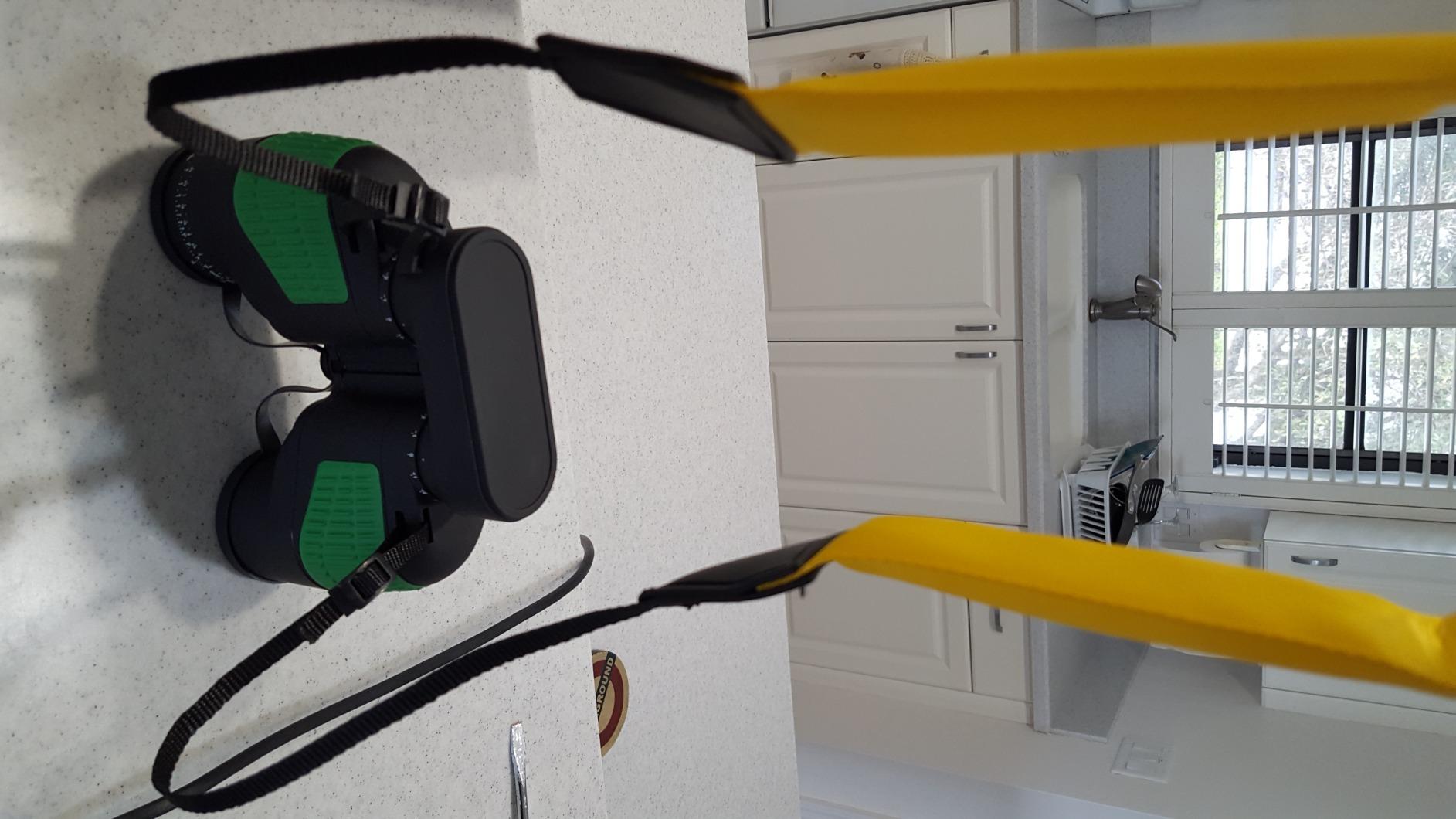
What pulls the rating down to 4.3 is weight and handling. At a listed 3.1 pounds, this is the heaviest chassis here, and the compact external dimensions are achieved with a chunky body rather than a genuinely small one. On a long watch that is tiring.
Owners also do not consistently document compass or rangefinder accuracy, which is fair criticism of any illuminated compass in a budget housing. Treat both as coarse references.
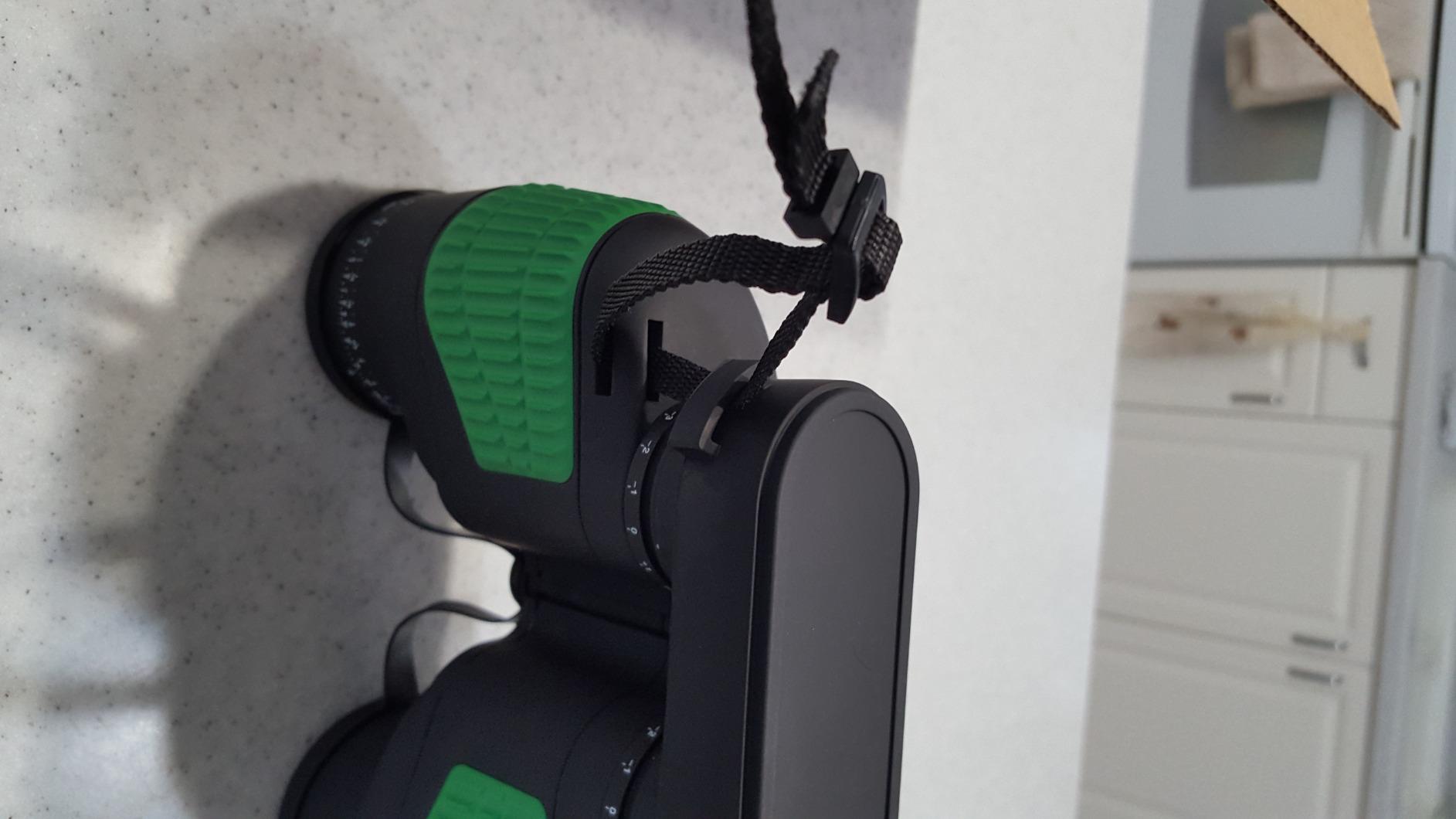
Who the ESSLNB 7×50 suits best
It suits people who want a stated, tested immersion rating rather than a general waterproof claim, and who want a wide field of view for scanning. Small-boat and center-console owners who take spray regularly are the obvious audience.
The included floating neck strap and floating body also make it a reasonable choice if recovering a dropped pair matters to you.
Where the ESSLNB 7×50 falls short
Weight is the main issue. At 3.1 pounds it is the heaviest pair in the roundup, and anyone doing a multi-hour watch will feel it in their hands and arms.
There is no center focus wheel, so refocusing is done per eyepiece. The compass and rangefinder accuracy is not documented by owners, so do not lean on them for precise navigation, and keep a proper compass on the helm.
How to Choose Marine Binoculars That Last a Season
Why 7×50 is the marine standard
Seven power with a 50mm objective is the marine standard because it balances three things you cannot have separately. First, seven power is the highest magnification most people can hold steady against a moving deck. Second, a 50mm objective gathers enough light to read navigation marks and vessel lights at dawn and dusk. Third, the combination is compact enough to live on a helm and rugged enough to drop onto a deck.
Forum consensus across SailingAnarchy, CloudyNights, and The Hull Truth lands on the same point: while more powerful binoculars exist, ten power is hard to hold steady on a boat to be really useful. Boaters tend to favour 7×50 porro prisms, waterproof rugged construction, good eye relief, and twist-up eyecups.
The 50s also earn their place at dawn and dusk. Owners repeatedly describe them as the best option for evening or morning low light, because a bigger objective is simply brighter in the same light.
Waterproofing, fog proofing, and nitrogen purging
Sealed and nitrogen purged is the baseline, not an upgrade. Dry nitrogen inside the body prevents internal fogging when you move from a warm cabin to a cold cockpit, which is the transition that ruins ordinary binoculars.
Look for two separate claims: waterproof sealing, which is usually specified to an IPX rating, and a floating body, which means the binoculars surface if they go overboard. Pairs that make both claims here include the USCAMEL 10×50, the Hooway 7×50, and the Barska Floatmaster.
Built-in compass: useful or gimmick?
A compass in the eyepiece is useful when you understand what it is for. You view the target through the compass window, centre it on the reticle, and read the bearing against the lubber line. That gives you a relative bearing to a lighthouse or headland without leaving the glass.
It is not a substitute for a magnetic compass on the helm, because it is affected by the boat’s own steel, electronics, and engine, and because a cheap illuminated card is not always accurate. Two owners reported readings roughly five degrees off, and the budget pairs with the most reviews rarely document compass accuracy at all. Treat the eyepiece compass as a quick confirmation, and calibrate against your primary compass.
Illumination matters at night. Pairs with switchable or low-light-only illumination, like the Fujinon Mariner and the Nikon OceanPro, tend to be more useful after dark.
Marine binoculars versus regular binoculars: what actually changes
The differences are narrower than most marketing suggests. A good land binocular and a good marine binocular often share the same optics, and plenty of experienced owners use premium general-purpose glass at sea because the optical performance is more important than the label.
What genuinely differs is construction and navigation hardware. Marine models add rubber armoring and sealed nitrogen-purged bodies to survive salt and impact, often add flotation, and frequently include a compass and rangefinder reticle. Land models usually omit all three.
Two places the difference really bites: fogging on a cabin-to-cockpit transition, and corrosion. Cheap rubberized bodies degrade in salt air, eyecups flake, and coatings pit. That is where a marine-grade body earns its cost, and it is why generic high-grade glass can still work well for coastal use even without marine internals.
Image stabilization: worth it or overkill on a boat?
Stabilization exists because hand shake limits you on land at ten power and above. On a boat the limiting factor is usually the vessel’s motion, which no electronic stabilization can cancel. That makes it far less useful than it sounds.
It also adds weight, battery dependency, and moving parts, and stabilized bodies are typically bulkier. Only one pair in this roundup carries stabilization in its feature listing, and its most-cited drawbacks are still ergonomic. For most boaters, a stable 7×50 with good eye relief beats a heavier stabilized 10×50.
Eye relief for glasses and polarized-sunglass wearers
Eye relief is the distance between your eye and the lens, and anything under about 15mm makes glasses a problem. Short eye relief and hard rubber eyecups produce a tunneled, black-edged image, which is the single most common complaint from polarized-sunglass wearers.
In this roundup the figures range from 7.1mm on the two 10×50 USCAMEL pairs up to 23mm on the Barska Floatmaster. If you wear glasses, treat anything above 20mm as the threshold. Fold-down or twist-up eyecups matter as much as the number, because they let you collapse them for a bare-eye view.
Weight and handling on a rolling deck
Weight is the spec people underrate and then complain about. Listed weights here run from 17.1 ounces on the Steiner Military-Marine 8×30 to 3.8 pounds on the Nikon OceanPro, which is more than a two-fold spread across the same category.
For a four-hour night watch, anything near or above 1.2 kg starts to matter. A lighter pair you actually keep at your eye is a better lookout tool than a heavier one that ends up hung around your neck.
Salt spray and maintenance
A short routine keeps marine glass readable for years. Rinse the binoculars with fresh water after every outing in salt air, especially the eyecups and hinge, and pay attention to the O-ring seals and any lever or button that can trap grit.
Check that the eyecups are still pliable rather than hard and cracked, since that is where deterioration usually starts. Store the pair in a dry locker with a desiccant pack rather than in a warm, damp console. Never wipe dry grit across a coated lens, and replace the compass batteries between seasons rather than waiting for the light to fade.
While you are working through the maintenance list, it is a good moment to check the electrical items that depend on the same salt air. Our guides to onboard marine chargers and dual purpose marine batteries cover the parts most affected by damp locker conditions.
7×50 vs 10×50 for Boating: Which One Should You Buy?
Seven power is the right answer for almost every boater. Seven by 50 is the only combination most people can hold steady while standing on a moving deck, and the 50mm objective is bright enough to make out navigation marks and unlit vessels at dusk. Ten by 50 gives you more identification power and a narrower, twitchier view that only works when you are braced, seated, or in a lee.
Here is how they actually compare in use. Seven power shows you more scene at once, which is what collision-avoidance watchkeeping demands, because you need to see a developing situation rather than one magnified patch of it. Ten power shows you more detail on a single object, which is what you want when you are already locked onto a vessel and trying to read a name or a hull shape.
Light gathering is roughly equal on paper, since both use a 50mm objective, so the brightness difference is small. The real differences are hand stability, field of view, and exit pupil. A 10×50 has a smaller exit pupil, around 5mm, which makes it harder to line up and dimmer in poor light for some users, while a 7×50 typically runs near 7mm.
Choose 10×50 if you observe from a stable position, run a raised flybridge or pilot house, spend time in a lee or at anchor, or need to identify distant vessels rather than simply locate them. Choose 7×50 if you stand watch, work from a small boat, or want the widest possible scan of open water.
Owners on sailing forums put it bluntly: typical marine binoculars are 7×50, and while more powerful, 10×50 will be hard to hold steady on a boat to be really useful. The nuance they add is worth keeping, though. Ten power is not useless, it is situational. It works from a fixed position, and it works when you are braced.
Frequently Asked Questions
What binoculars are best for boating?
Most boaters do best with a 7×50 marine binocular that is nitrogen purged, rubber armored, and sealed against water. The Steiner Marine 7×50 is the strongest all-rounder for scanning, while the Hooway 7×50 adds an illuminated compass and rangefinder at a budget price.
Which binoculars are better for boating, 7×50 or 10×50?
For most boaters, 7×50. Seven power is the highest magnification you can hold steady on a moving deck, and the 50mm objective is bright enough for dawn and dusk lookout. Choose 10×50 only if you observe from a stable position such as a flybridge, or mainly want to identify distant vessels rather than scan for them.
What is the difference between marine binoculars and regular binoculars?
Marine binoculars add sealed nitrogen-purged bodies, rubber armoring, flotation, and usually a built-in compass and rangefinder reticle. Regular binoculars often use similar optics but skip the corrosion protection and navigation hardware. Marine construction matters most for fogging on cabin-to-cockpit transitions and for salt corrosion.
Is a built-in compass in marine binoculars actually useful?
Yes, as a quick reference for taking a relative bearing on a lighthouse or headland. It is not a replacement for the magnetic compass on your helm, because the boat’s steel and electronics affect it. Check the reading against your primary compass, and expect budget compasses to be off by a few degrees.
What is the best magnification for marine binoculars?
Seven power is the standard for boating. It is stable enough to hold on a rolling deck while the 50mm objective keeps the image bright at dawn and dusk. Ten power adds identification detail but only stays usable when you are braced, seated, or in a lee.
Conclusion: Which Marine Binoculars Should You Buy?
The Steiner Marine 7×50 is our pick for most boaters. It holds the highest rating in the roundup, the sports auto focus removes the single biggest annoyance of marine glass on a moving deck, and the lifetime warranty means it can stay on the helm for as long as you own the boat.
If your lookout routine includes bearing work, the Fujinon Mariner 7×50 WPC-XL is the pair with the most trusted compass and the longest service record among owners. If you want navigation features without spending much, the Hooway 7×50 is the answer. For long watches, the Steiner Military-Marine 8×30 at 17.1 ounces is the one you will still be holding at three in the morning.
Whatever you choose, look for a nitrogen-purged sealed body, enough eye relief for glasses, and a field of view wide enough to scan. Then rinse it in fresh water after every salt-air outing. The best marine binoculars for boaters are the ones that still work in year five, and that is mostly a maintenance habit.