
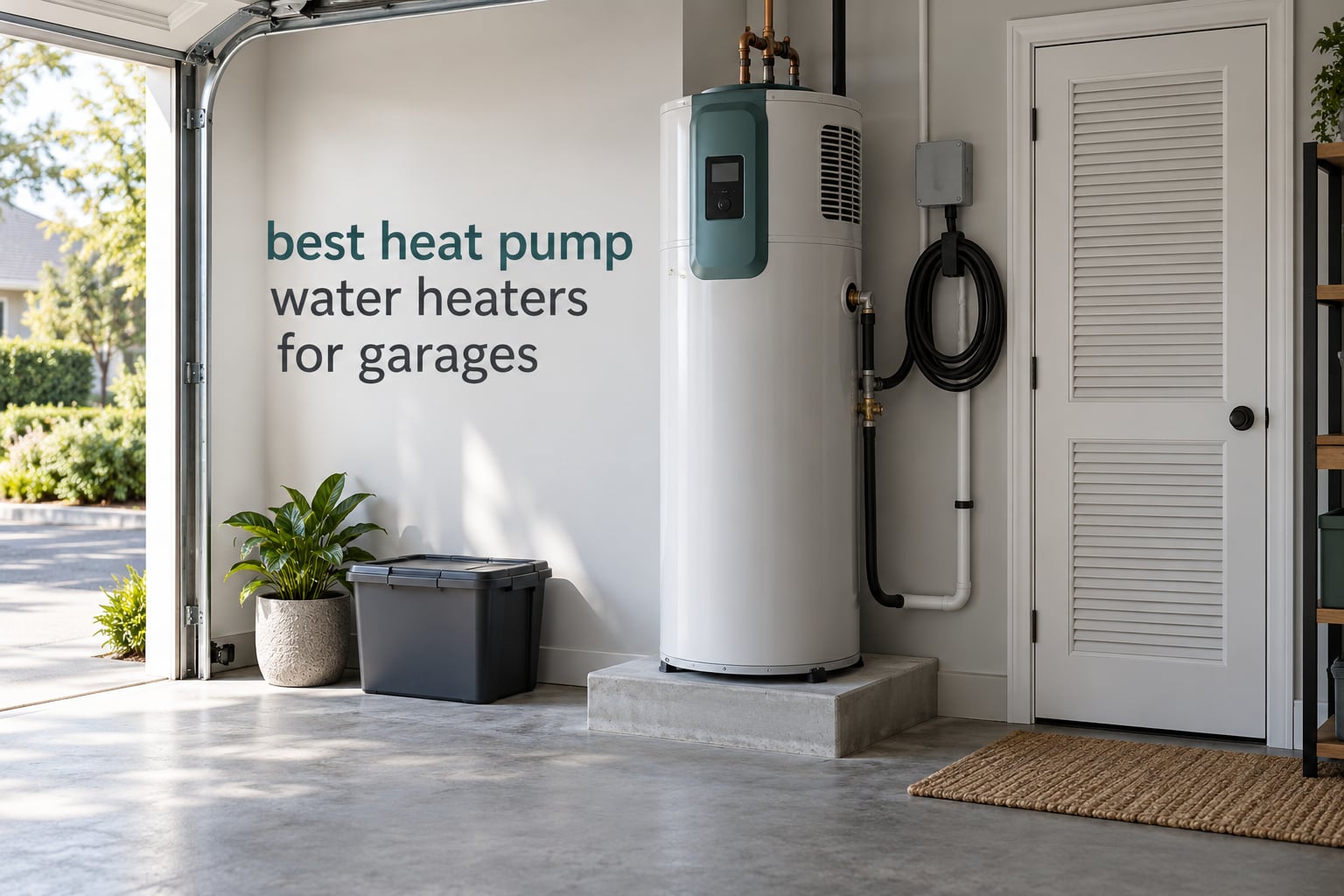
A heat pump water heater in a garage is one of those upgrades where the wrong answer costs you twice. The right unit pulls heat out of the garage air and cuts your water heating energy use dramatically, while also acting as a small air conditioner for the space in July. The wrong unit either labors in cold air, roars louder than your table saw, or never drains the condensate it produces.
Most roundups rank these tanks on efficiency alone. We went a different direction with the best heat pump water heaters for garages, judging every unit on how it behaves in the space itself: room air volume, ambient temperature limits, physical clearance, noise figures, and where the condensate goes when your garage has no floor drain.
We compared six genuine hybrid units across 50, 58, 65, and 80-gallon capacities. Each review below carries a garage fit verdict so you can see at a glance whether a tank passes in an average single-car garage or needs duct work first. Numbers come from manufacturer specifications and owner reviews, not from marketing copy.
Table of Contents
Can I Use a Heat Pump Water Heater in My Garage?
Yes, if your garage stays between roughly 40 and 90 degrees Fahrenheit year-round, has about 1,000 cubic feet of free air volume or a louvered door, has a place to send the condensate drain, and has a dedicated 30-amp 240-volt circuit. Below that air temperature the unit drops out of heat pump mode and falls back to resistance heating.
Three conditions disqualify a garage install outright, and we have flagged them throughout our picks:
An unheated garage that sees freezing temperatures. Most of these units are rated for indoor spaces and some specify a floor threshold near 37F. Under that, you pay for a heat pump that never runs.
A garage too small to hold enough air. A typical single-car garage at roughly 8 feet by 20 feet with an 8-foot ceiling sits close to the 1,000 cubic feet mark before you account for vehicles and shelving.
A sealed garage with no condensate path. A heat pump water heater makes a surprising amount of water, and most garages cannot legally discharge it into the floor drain or the unit drain pan.
Top 3 Best Heat Pump Water Heaters for Garages in October

Senville SENWH-HP50US 50 Gal
- 3.75 UEF
- 69-gal FHR
- UL and AHRI Certified
- 7-year parts and 10-year compressor
The 6 Heat Pump Water Heaters We Compared for Garages in 2026
| Product | Specs | Action |
|---|---|---|
| Senville SENWH-HP50US 50 Gal |
|
Check Latest Price |
 ACiQ 50 Gal Hybrid ACiQ 50 Gal Hybrid |
|
Check Latest Price |
 Rinnai REHP50 Rinnai REHP50 |
|
Check Latest Price |
 Rinnai REHP65 Rinnai REHP65 |
|
Check Latest Price |
 Rinnai REHP80 Rinnai REHP80 |
|
Check Latest Price |
 Stiebel Eltron Accelera 220 E Stiebel Eltron Accelera 220 E |
|
Check Latest Price |
1. Senville SENWH-HP50US 50 Gallon – Best Overall for a Garage
Senville Hybrid Heat Pump Electric Water Heater, Energy Star, 50 Gallon
50 gallons
3.75 UEF
69-gal FHR
218 lb
66.5 in tall
ENERGY STAR
Pros
- 3.75 UEF with a 69-gallon first-hour rating
- Full-wrap microchannel condenser instead of a belly-wrapped tube
- UL and AHRI certified
- Reported noise close to a running refrigerator
Cons
- 218 pounds needs at least two people
- Thin control panel documentation
- Only three reviews available
The SENWH-HP50US is the unit we would put in an average garage without hesitating. The tank runs at a 3.75 uniform energy factor with a 69-gallon first-hour rating, which is enough hot water for a household of three to five people while the compressor handles recovery.
What sets it apart from the other 50-gallon tanks here is the condenser design. Instead of a small aluminum tube wrapped around the belly of the tank, this one uses a microchannel coil wrapped around the full circumference. A licensed plumber and HVAC installer who has fitted six of these described the heavier tank wall, the larger compressor, and the full-wrap coil as the reason this is the best electric heat pump water heater currently on the market.
Owners also report a cooling side effect worth planning for. In summer the unit exhausts cool, dry air into the garage, which is exactly the airflow you want moving through a workspace, and one owner specifically noticed the room feeling noticeably better.
The warranty coverage splits in a useful way. You get 7 years on parts and 10 years on the compressor, so the expensive failure mode, the compressor, carries the longer clock.
One caveat worth naming plainly. The listing carries three reviews, all recent and all five stars, which tells you the early owners are happy but tells you very little about year eight. Long-term data on this model does not exist yet.
What makes it work in a garage
At 21.4 inches wide and 66.5 inches tall it fits in a typical garage utility corner without relocating a wall. The full-wrap coil draws ambient heat efficiently, so the unit performs well in a space that cools down overnight but never drops to the low 30s. Owners installing it behind louvered closet-style doors report that the noise becomes inaudible from living spaces.
Where it falls short
At 218 pounds, this is a two-person lift, and shipping damage on a unit that heavy is a real risk to plan around. The control panel functions are not clearly explained in the manual, which makes setting operating modes an afternoon of guesswork unless your installer walks you through it. And with three reviews on record, you are early enough to be an owner as much as a buyer.
2. ACiQ 50 Gallon Hybrid – 49.5 dBA and Built for Garage Air
ACiQ 50 Gallon Electric Residential Hybrid Heat Pump Water Heater Tank
50 gallons
3.75 UEF
49.5 dBA
69-gal FHR
700-1000 cu ft air
Pros
- Only unit here with a published 49.5 dBA figure
- Explicitly marketed for garages and basements
- LED display shows temperature in large numbers
- 12-year tank and parts warranty
Cons
- Extremely heavy and top-heavy on delivery
- Plumbing and TPR valve in non-standard locations
- Manufacturer support described as unresponsive
The ACiQ is the only tank in this lineup with a published sound rating you can actually verify before buying. At 49.5 dB(A) it sits near the refrigerator benchmark that owners of these units keep citing as the reference point. If you work in your garage on a regular basis, that number matters more than UEF.
The manufacturer is also the most explicit about garage conditions here. The documentation states 700 to 1,000 cubic feet of required air circulation, proper drainage, and indoor installation only, with a warning against unheated spaces below 37F. One owner on the ACiQ Home forum favored this brand specifically because it stays in heat pump mode where there is a basement, garage, or a warm climate.
The efficiency story is dramatic in heat pump mode. Owners measure roughly 600 to 800 watts against about 4,000 watts for a conventional electric tank, with no shortage complaints from a four-person household. The unit also works with off-grid power systems, which matters if your garage is on a separate panel.
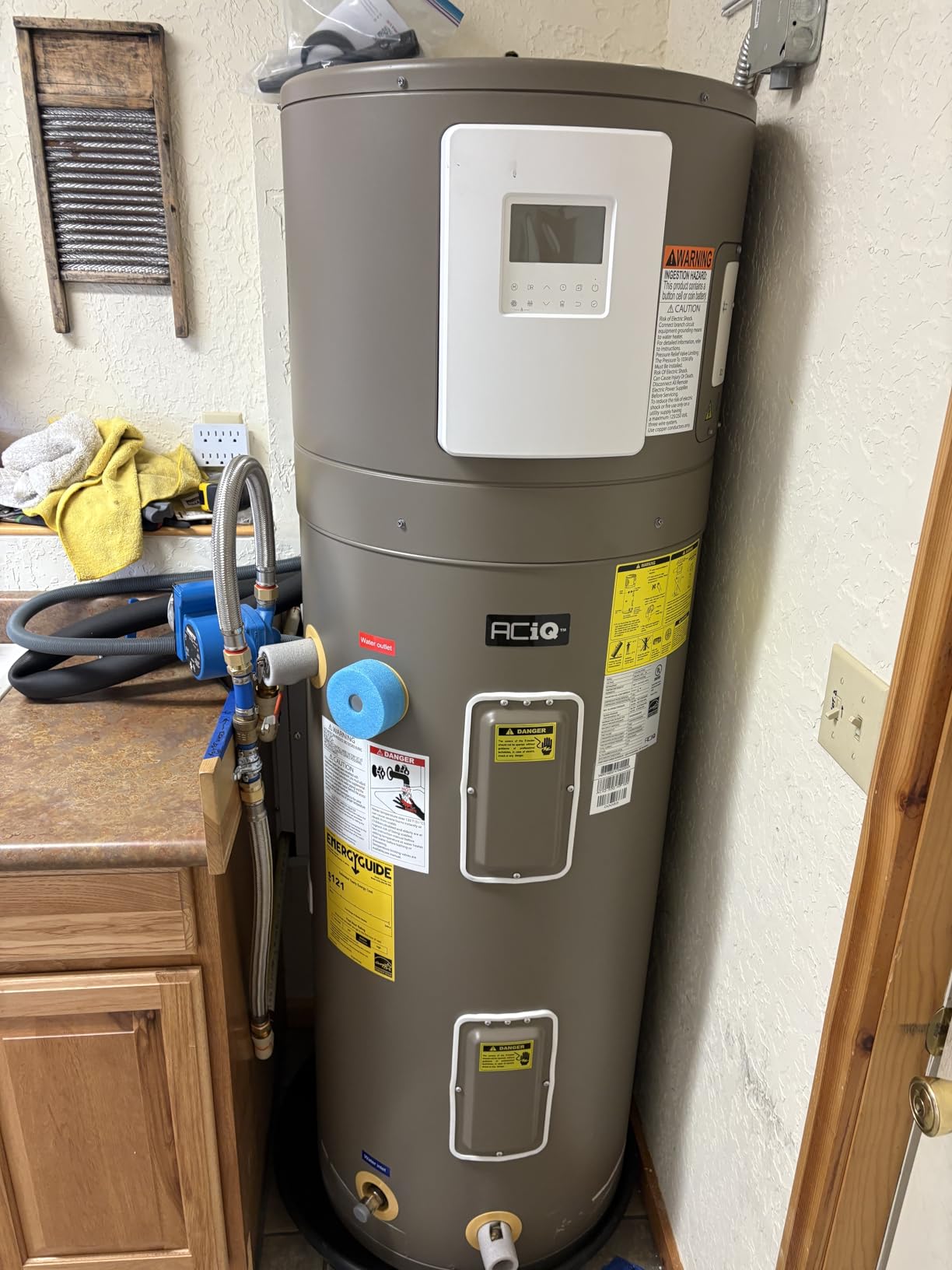
The 3.9-star average comes from a split sample. Four owners are enthusiastic, and one detailed one-star report from a retired licensed contractor carries the negative weight. That review is worth reading in full before you buy, because it is about logistics rather than performance.
What makes it work in a garage
The 49.5 dBA figure and the garage-specific air volume language make this the least ambiguous install. A licensed installer notes the heavier steel tank and the 1-ton heat pump deliver faster recovery than units using quarter-ton mini compressors, which matters in a garage that shares its air with a vehicle and a workbench.
Where it falls short
Shipping and placement are the hard parts. Owners describe it as extremely heavy and top-heavy, needing three strong people to get it off the pallet, with only two handholds provided. The hot and cold supplies and the TPR valve sit in different locations than on a conventional tank, so existing plumbing and sometimes the wall itself may need relocating, plus a new condensate line drilled through an exterior wall.
The single biggest risk is after-sales support. The same contractor reports that technical support calls were routed to staff who had not worked on this heat pump water heater, and that the undocumented control board shut the unit off twice with no explanation. A 3-star review from a trade blog clarifies that the DR indicator the reviewer saw is the utility demand response program, not a fault, which is helpful context but does not address the support issue.
3. Rinnai REHP50 – Zero Clearance for Tight Utility Corners
Rinnai REHP50 Electric Heat Pump Water Heater 50 Gallon Energy Star
50 gallons
3.75 UEF
73-gal FHR
240V 30A
66.8 in tall
Pros
- Zero clearance on top back and sides
- Standard 3/4 inch MNPT connections reuse existing plumbing
- 73-gal first-hour delivery
- Verified owner reports no bill increase coming off gas
Cons
- Only one review on the listing
- 212 pounds needs two people
- R134a refrigerant loop
The REHP50 is the retrofit-friendly pick. Its zero-clearance rating on top, back, and sides means you can push it into a tight garage utility area where most 50-gallon hybrids would need breathing room, and the standard 3/4 inch MNPT connections mean your existing household plumbing can usually stay as it is.
That combination matters more in a garage than in a closet. Most garage water heater locations were built around a standard electric tank footprint, and a unit that needs service clearances on every side often means moving a stud or losing a shelf.
The verified owner who replaced a gas water heater with this unit reports that it pulls heat out of the garage and that the switch to hybrid electric did not noticeably raise their power bill. That is the central claim for any garage installation, and it is the one data point we have for this model.
Specifications are straightforward: 3.75 UEF, 73-gallon first-hour delivery sized for three to four people, 240V on a 30-amp circuit, R134a refrigerant heat transfer, and UL and NSF certification. Warranty is 10 years on the residential tank and 10 years on parts with 1 year of labor.
What makes it work in a garage
Zero clearance plus standard connections means the install is mostly plumbing. At 22 inches wide and 66.81 inches tall it fits where the old electric tank sat, which keeps the job short and keeps labor costs down. Demand-response enablement can also cut peak-hour energy cost with participating utilities.
Where it falls short
The honest problem here is evidence, not hardware. The listing has one review, and it covers a short ownership period, so nobody has reported on noise, recovery, or durability over years. At 212 pounds you still need a second person for handling. Treat the 5-star rating as a single favorable data point rather than a track record.
4. Rinnai REHP65 – Highest UEF at 4.00 for Bigger Homes
Rinnai REHP65 Electric Heat Pump Water Heater 65 Gallon Energy Star
65 gallons
4.00 UEF
80-gal FHR
240V 30A
65 in tall
Pros
- Highest UEF figure in the REHP range
- 80-gal first-hour delivery covers 4-5 people
- Zero clearance and standard connections
- 10-year tank and parts
Cons
- Essentially no owner feedback on record
- 250 pounds requires a professional install
- Demand response can curtail heating at peak
The REHP65 is the efficiency leader of this group at a 4.00 uniform energy factor, and the first-hour delivery number rises to 80 gallons, sized for households of four to five. If your garage is your whole hot water supply for a family, this is the capacity that keeps up without leaning on the backup elements.
It is also physically smaller than its capacity suggests. At 65 inches tall and 22.69 inches wide, it is a shorter unit than the 50-gallon REHP50, so vertical clearance in a garage ceiling with exposed joists is rarely the constraint. Zero clearance on top, back, and sides keeps the placement flexible.
Everything else matches the rest of the line: 240V on a 30-amp circuit, 3/4 inch MNPT inlet and outlet, R134a refrigerant, UL and NSF certification, demand-response enablement, and the same 10-year residential tank and parts warranty with 1 year of labor.
What makes it work in a garage
Drawing more heat from the room rather than from the elements means a bigger tank in a garage does not automatically mean a bigger energy bill. The 4.00 UEF is the best figure available here, and a 65-gallon tank in a moderate-volume garage still has plenty of air around it.
Where it falls short
No review text came back with this listing, so every quality signal available comes from the manufacturer specification sheet. At 250 pounds this is effectively a professional-install job. Also note that demand response lets your utility curtail heating during peak events, which is a benefit on your bill and a tradeoff in comfort.
5. Rinnai REHP80 – 91 Gallons in the First Hour
Rinnai REHP80 Electric Heat Pump Water Heater 80 Gallon Energy Star
80 gallons
3.90 UEF
91-gal FHR
240V 30A
74.6 in tall
Pros
- Largest first-hour delivery here at 91 gallons
- ENERGY STAR certified tank
- Zero clearance and standard connections
- Demand response lowers peak cost
Cons
- Lowest rating in the line at 3.0
- Only two reviews with a sharply split distribution
- Heaviest and largest footprint at 270 pounds
The REHP80 delivers 91 gallons in the first hour, the largest first-hour rating in this lineup and the right capacity for households of five or more. If your garage is carrying the whole house, capacity stops being the interesting question.
Geometry is the interesting question instead. At 25.69 inches wide and 74.56 inches tall, this is both the heaviest and the largest unit here at 270 pounds. Measure your alcove width against the studs and the overhead against your garage door tracks before you commit.
Specifications list a 3.90 uniform energy factor in the technical data, though the listing headline references 4.00, so confirm the UEF on the spec sheet before you compare it against the 65-gallon model. Everything else matches the REHP line: zero clearance, standard 3/4 inch MNPT, R134a, UL and NSF certified, 240V on a 30-amp circuit, and a 10-year residential tank and parts warranty.
What makes it work in a garage
If you need this much hot water, a hybrid still makes more sense than a larger electric tank, because the compressor does the recovery work instead of the elements. Zero clearance means you can set it tight to a wall even at this width, which helps when a 26-inch alcove feels like a squeeze.
Where it falls short
The rating here is the weak point. At 3.0 stars from two reviews with roughly half of reviewers at one star, this is an unusually polarized result for a product family, and with no review text returned the causes cannot be attributed. The 3.0 is statistically fragile rather than a reliable signal, but it is the only signal buyers have, and at 270 pounds you want a professional crew on site.
6. Stiebel Eltron Accelera 220 E – 58 Gallons on a 15 Amp Circuit
Stiebel Eltron 233058 Accelera 220 E Heat Pump Water Heater; 240V; 324 CFM; 58-gallon Capacity; 15A Circuit Braker; Temperature Range Between 42 and 108 Degrees Fahrenheit; Digital Display
58 gallons
240V on 15A
324 CFM airflow
264 lb
42-108F range
Pros
- Runs on a 15-amp circuit instead of 30 amps
- Large wrap-around condenser isolated from potable water
- Glass-lined tank with superior insulation
- Digital display across a 42-108F range
Cons
- Only review on the listing is a warranty failure report
- 264 pounds and 27.1 inches wide
- Support reportedly unresponsive after a leak claim
This unit breaks the pattern the rest of the lineup follows, and that is either its selling point or its problem. It delivers 58 gallons on 240 volts with a 15-amp circuit breaker, where every other 50 to 80 gallon hybrid on this list wants 30 amps. If your garage panel has no spare 30-amp capacity, this is the only tank here that fits without new breaker work.
The physical design is also distinct. It uses a large wrap-around aluminum condenser that never touches the potable water, a glass-lined tank, a rolling piston compressor motor, and a heavy-duty quiet fan moving 324 CFM of air. The adjustable 42 to 108F range and digital display give more control than most competing panels.
One more differentiator for a garage specifically. A user on a GreenBuildingAdvisor discussion board singled out this manufacturer for fantastic warranty and product support and a lifetime powered anode. That reputation is exactly what makes the review below frustrating.
What makes it work in a garage
The 15-amp circuit requirement is the whole argument. Many detached garages run a small subpanel with limited spare capacity, and a 30-amp-only hybrid forces an electrical upgrade before installation even starts. The wrap-around condenser draws evenly on room air, which suits an open garage volume better than a compact unit fighting a corner.
Where it falls short
The only review on this listing is a one-star warranty failure report. The owner describes a slow leak from the underside of the tank within two years, followed by a warranty claim that went unanswered even after plumber diagnostics were submitted as requested, with the manufacturer eventually stopping responses. Mechanical design details like the quiet fan and rolling piston motor cannot be judged from any owner feedback at all.
It is also the widest and one of the heaviest units here at 27.12 inches wide and 264 pounds, so it needs real floor space. Our verdict is to hold off unless you can confirm local service and warranty handling in writing before you order.
Garage Requirements Checklist Before You Buy
Check these nine items before you pick a tank, because every one of them can turn a good unit into an expensive mistake. The first four decide whether the unit works at all; the last five decide whether the installation passes inspection.
Room air volume. Target about 1,000 cubic feet of free air, or use a louvered door or duct kit. A single-car garage at 8 by 20 feet with an 8-foot ceiling is roughly 1,280 cubic feet before you subtract a vehicle and shelving.
Ambient temperature range. Keep the garage between 40 and 90F year-round. The ACiQ is the strictest on record here, specifying indoor install only and warning against unheated spaces below 37F.
Louvered door or duct kit. If the space is tight, sized louvers or a duct kit restore the required air volume. Just know the louvers themselves add noise, which one HomeImprovement thread flagged as a reason to avoid them entirely.
Condensate drain. A dedicated line or a condensate pump rated around 2 gallons per day. One user on r/heatpumps framed priorities correctly: not noise, but ventilation in and out, and that condensate drain.
Dedicated 30-amp 240-volt circuit on 10 AWG copper. The Stiebel Eltron is the exception at 15 amps.
Drain pan and expansion tank. Manufacturers treat a missing pan as an improper installation, which can void coverage.
18-inch minimum elevation. The base of the tank sits at least 18 inches off the floor.
Temperature and pressure relief valve with a discharge route and a dedicated shutoff valve on the cold supply.
Bottom board or platform beneath the unit, plus an appliance-rated surface if the floor is unfinished.
Working through a checklist like this is the same systematic habit we use for cooling system diagnostics on this site, from replacing a water pump without repeating a coolant leak to timing belt and water pump cost estimates by vehicle. The structure transfers, even though the components do not. If the same garage also needs a sprayer for sealant or coating work, our best pump sprayers reviewed roundup applies the same fit-and-durability test, and evacuating a refrigerant circuit before a service visit is exactly where a vacuum pump for AC evacuation earns its place.
Air Space Rules: Louvered Door or Duct Kit?
When manufacturers disagree on room air volume, use the stricter number and then engineer around it. Published guidance ranges from about 700 cubic feet on some documentation to roughly 1,000 cubic feet in ENERGY STAR program materials, and one brand documents its requirement in metric at around 200 cubic meters.
That conflict is the single most confusing part of garage installation, and no competitor page we read explains it. The practical rule is simple. Size your space to the largest requirement any of your candidate units publishes, then treat anything under that as requiring engineered airflow.
Open room air works when your garage already has enough free volume. Nothing to buy, nothing to maintain.
A louvered door restores airflow through a closet-style enclosure. It is cheap and effective, but it adds a rattle and air restriction of its own, which is the noise complaint you will hear most often in discussions about these units.
A duct kit pulls intake air from a higher or adjacent space and can exhaust to the attic or outside. It is the quietest option and the most involved to install.
Attic ducting with a switchable damper is the workaround garage owners ask about most, letting intake come from a plenum in warmer months and room air in winter.
One caution about exhaust routing. A user on r/HomeImprovement noticed cold air coming out of the exhaust and started wondering about venting, and a separate poster reported a laundry room going cold because nothing was ducted. If you exhaust into living space, you are moving conditioned air out of your house.
Noise: The Honest Take
A heat pump water heater is quieter than a standard electric tank, but it is not silent. The compressor and the fan both produce sound, and the published figure available in this lineup is 49.5 dB(A) for the ACiQ. Owners describe the practical result as roughly the sound of a running refrigerator.
That benchmark, no louder than a typical refrigerator, is the comparison homeowners keep sharing because it is the only reference point that means something outside a spec sheet. Senville owners report the same experience, noting the unit is inaudible from living spaces when installed behind louvered closet doors.
Three real noise complaints come up repeatedly in garage discussions. Users report loud, labored compressor noise that changes character over time, rattling from cabinet or duct work rather than the unit itself, and a high-pitched whine that people notice most in a quiet workshop. If your bench work depends on hearing fine detail, test the position before you commit, because placement changes the sound field more than the model does.
The genuinely good news is that a garage is one of the least-bad rooms for this appliance. An occupied bedroom or a quiet office would be a poor fit. A detached workshop, a utility corner, or a half-finished basement is close to ideal, and ENERGY STAR program guidance points out the same thing, noting these appliances are best installed in less frequently occupied spaces like garages and basements.
Cold Garages and When a Heat Pump Water Heater Is the Wrong Answer
A heat pump water heater is a water heating appliance, not a space heater. If your goal is a warm workspace in winter, this is the wrong purchase and no brand or capacity will fix that. One garage owner weighing options for a workspace at minus 20F was comparing a 4,800-watt electric heater, which is the correct product category for that problem.
For water heating, the cold-garage warning signs look like this:
The garage drops below 40F on cold nights, or below the 37F floor some documentation specifies.
Your backup resistance elements run often, and the compressor starts and stops on a short cycle.
Your energy bill stops tracking with your hot water use and starts tracking with your indoor temperature.
Savings shrink each winter and recover each summer, which is normal and worth modeling before you buy.
The honest pattern is a seasonal curve rather than a flat discount. Units in unheated spaces fall back to resistance heating when room air drops out of range, and that is exactly when you want hot water most. If your garage is truly unheated, budget for a hybrid unit whose manufacturer explicitly approves the install, plus the backup element cost you will pay in deep winter.
Two things help. Keeping the garage door closed during the day retains heat and raises the average air temperature, and adding an R-7 or better insulation blanket around the tank reduces standby losses. Neither replaces a thermostat-controlled garage when the goal is comfort.
Installation and Maintenance Schedule
Most of these tanks last longer than people expect when the air filter and condensate line get attention. The schedule below is the routine that keeps a compressor healthy in a workshop environment.
Every 3 months: clean or replace the washable air filter. In a garage this matters more than anywhere else, because drywall dust, lint, and sawdust foul the filter faster and force the compressor to run harder.
Monthly: flush sediment from the tank, following the manufacturer’s procedure.
Annually: bleach or clear the condensate line and check the drain route before it silts up.
Around year 5: inspect the anode rod. Powered anodes on some models are a different service procedure, so check the manual before touching it.
Ongoing: keep a service log. Warranty claims are easier when the maintenance history exists, and registration deadlines are real.
Watch for warranty exclusions specific to workshop environments. Drywall dust, lint, paint solvents, and stored pool chemicals are the ones that come up most, and a missing drain pan is routinely treated as an improper installation that voids coverage. Beyond the appliance itself, if you are running any coolant or refrigerant service alongside this project, our guide on replacing a water pump without repeating a coolant leak covers the containment habits that keep a garage floor serviceable, and estimating repair costs by vehicle covers the labor-rate math you will be quoting against.
Frequently Asked Questions
Can I use a heat pump water heater in my garage?
Yes, if the garage stays between roughly 40 and 90 degrees Fahrenheit, has about 1,000 cubic feet of free air or a louvered door, has a condensate drain route, and has a dedicated 30-amp 240-volt circuit. Below the unit temperature range it falls back to resistance heating.
How much space does a heat pump water heater need?
About 1,000 cubic feet of free air is the figure to design around, plus clearance for the unit itself. Sizes here run from 21.4 inches wide and 66.5 inches tall up to 27.12 inches wide and 74.56 inches tall, and most need 18-inch elevation above the floor.
Are heat pump water heaters noisy?
They are quieter than standard electric tanks but not silent. The only published figure in this lineup is 49.5 dB(A), and owners describe the sound as comparable to a running refrigerator. Louvers and ducts can add their own noise, and garages are among the best rooms for it.
Does a heat pump water heater need a drain?
Yes. The unit produces condensate like any air conditioner, and most garages cannot discharge it into the floor drain or the unit drain pan. Install a dedicated condensate line or a pump rated around 2 gallons per day, with the drain routed to an approved disposal point.
What is the downside of a heat pump water heater?
The main drawbacks are a high purchase cost, a 200-plus-pound unit that is difficult to move, an added 240-volt circuit, and the need for adequate air volume and drainage. In a cold garage the compressor stops earning its keep and the backup elements carry the load.
Will a heat pump water heater work in 100 degree weather?
Yes. These units handle hot weather well, and the refrigerant loop pulls heat out of already-warm air efficiently. In summer the exhaust air is cool and dry, which means the appliance doubles as a small air conditioner for the garage.
Why is my electric bill high with a heat pump water heater?
Common causes are a clogged air filter from workshop dust, insufficient room air volume, running constantly in electric-only mode, an undersized unit for the household, or a garage that falls below the operating range so the resistance elements take over. Check the filter and the mode settings first.
Who makes the most reliable heat pump water heaters?
Reliability claims are hard to verify because review volumes on these products are small. In this group Rinnai covers the tank and parts for 10 years, the ACiQ offers 12 years with registration, and Senville splits 7 years on parts with 10 years on the compressor. Warranty service responsiveness matters as much as length.
Bottom Line: Which Heat Pump Water Heater Fits Your Garage
The Senville SENWH-HP50US is our pick for most garages in 2026. At 21.4 inches wide with a full-wrap microchannel coil and a 69-gallon first-hour rating, it fits standard utility corners and pulls heat efficiently from moderate garage air, and early owners report refrigerator-level noise.
If noise in a working garage is your top concern, take the ACiQ 50-gallon hybrid. It is the only unit here with a verifiable 49.5 dB(A) rating, it is the only manufacturer that states garage and basement suitability outright, and its 12-year warranty is the longest on offer, with the caveat that you must plan for a demanding install and questionable support.
If your garage utility area is tight, the Rinnai REHP50 wins on placement. Zero clearance on top, back, and sides plus standard 3/4 inch MNPT connections mean it drops into an existing electric tank footprint with minimal wall or stud work. Households of four or five should step up to the REHP65 at a 4.00 uniform energy factor, and larger households can consider the REHP80 after measuring the width and height carefully.
Skip the Stiebel Eltron unless you need a 15-amp circuit and can confirm warranty handling locally first, and skip the entire category if your garage drops below 40F regularly. In that case, a garage heater is what you actually need, not a heat pump water heater.