
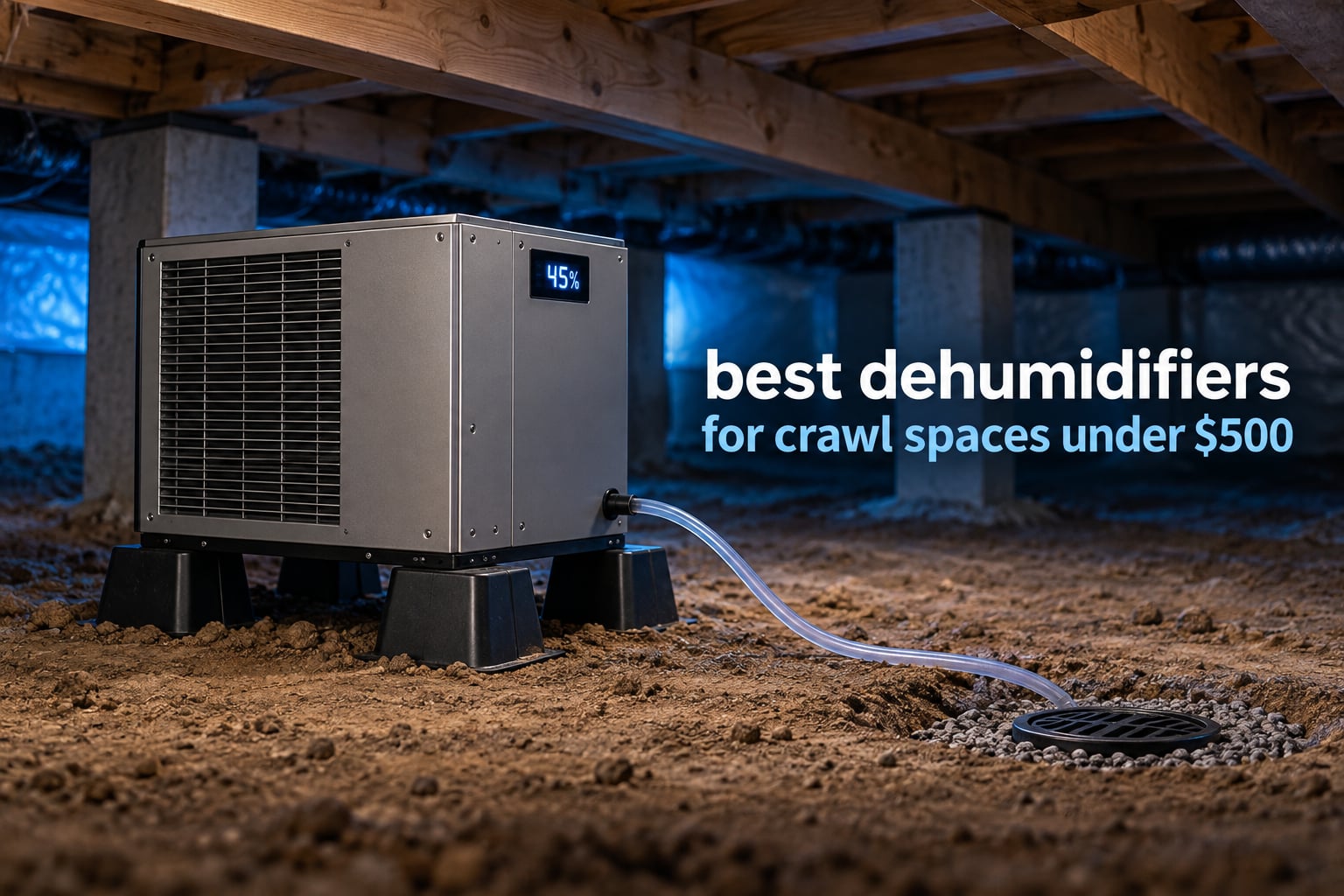
The best dehumidifiers for crawl spaces under 500 dollars in 2026 are the commercial-style continuous-duty machines, not the kitchen-cabinet models most sellers push. Our top pick is the ALORAIR Sentinel HD55: 53 pints per day at AHAM conditions, a tankless gravity drain, automatic defrost, a 19.2 by 12.2 by 13.3 inch footprint that passes through a standard access hatch, and a 6-year limited warranty backed by 1,211 buyer reviews.
That framing matters more than any spec sheet. A crawl space is a low-clearance, unconditioned, dirt-floored cavity where air barely moves, and the machines rated for kitchens are not built for it. Every pick below is a metal-bodied, continuous-duty unit with a humidistat, year-round defrost, and a hardwired drain.
One number decides more purchases than any other: a standard dehumidifier coil frosts below about 65°F and stops extracting water, so a unit without automatic defrost is a liability in a winter crawl space. All eight machines here defrost automatically. Four of them also carry a built-in condensate pump, which decides whether you can discharge water uphill or to a distant drain.
We also owe you an honest warning before the list. What you give up below this price line is covered in its own section near the end, and the honest answer is: no true crawl-space-rated flagship, shorter expected service life, and no remote controls in the box. If you would rather read the general category first, our guide to the best crawl space dehumidifiers overall covers the higher tiers.
Table of Contents
Top 3 Best Crawl Space Dehumidifiers Under $500 in 2026

ALORAIR Sentinel HD55
- 53 PPD at AHAM and 113 PPD at saturation
- 1200 sq ft coverage
- Tankless continuous drain
- 6-year warranty

Aiusevo 130-Pint with Pump
- 130 PPD and 265 CFM airflow
- Built-in pump plus gravity hose
- Ductable outlet
- Auto restart
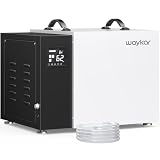
Waykar 158-Pint with Pump
- 158 PPD at 95F and 90 percent RH
- Up to 7500 sq ft
- 16.4 ft pump hose
- 10 to 90 percent RH range
Quick Comparison 8 Crawl Space Dehumidifiers in October
| Product | Specs | Action |
|---|---|---|
| ALORAIR Sentinel HD55 |
|
Check Latest Price |
| Aiusevo 130-Pint with Pump |
|
Check Latest Price |
| Waykar 158-Pint with Pump |
|
Check Latest Price |
 ALORAIR Sentinel HD35P ALORAIR Sentinel HD35P |
|
Check Latest Price |
 Moiswell Defender M145 Moiswell Defender M145 |
|
Check Latest Price |
 Airecoler GT-X5 Airecoler GT-X5 |
|
Check Latest Price |
 Yaufey 70-Pint Energy Star Yaufey 70-Pint Energy Star |
|
Check Latest Price |
 Abestorm Guardian SN35P Abestorm Guardian SN35P |
|
Check Latest Price |
Why a Crawl Space Needs Its Own Dehumidifier
Soil moisture wicks up through piers and framing by capillary action, then evaporates into the crawl space air. Warm moist exterior air enters through vents and through the floor, and that moisture has nowhere to go. The result is condensation on ductwork and joists, elevated relative humidity, and a musty odor that migrates into the living space through floor register penetrations.
Hold relative humidity near 50 to 55 percent and you prevent most of the damage people actually pay to repair: mold bloom, mildew, rot in wood framing, and wood-destroying insect activity. That same band is what keeps the smell from coming back after you dry everything down once.
Why not just use a household dehumidifier? Three reasons. Household machines are built to run a few hours a day, not continuously, and they are built to be carried. Crawl space work is continuous duty, in an unheated space, in a room with a hatch opening. And a residential coil in a space that drops to the 40s overnight will ice up without an effective defrost system.
An r/hvacadvice owner running an AlorAir in a crawl space reported stable humidity maintenance after about a year with no complaints. That is the outcome we are looking for from every pick on this list, and it is why we weighted review volume as heavily as star ratings.
1. ALORAIR Sentinel HD55 113-Pint Crawl Space Dehumidifier
ALORAIR 113 Pints Crawlspace Dehumidifier for Commercial, Sentinel HD55
53 PPD at AHAM
113 PPD saturation
1200 sq ft
120 CFM
41.7 lb
460 W
Tankless gravity drain
Pros
- Largest review base of any crawl space unit here at 1211 ratings
- Metal casing with cETL listing
- Tankless continuous drainage with no bucket to empty
- Compact body that passes through a standard crawl space hatch
- 6-year limited warranty
Cons
- Evaporator coils can ice up in cool conditions
- Several buyers report refrigeration failures inside two years
- Replacement filters cost more than expected
- Blue HD55 variant is not Energy Star certified
The ALORAIR Sentinel HD55 is the machine we would put under a house without hesitating. It pulls 53 pints per day at AHAM conditions and 113 pints per day at saturation, which puts real capacity behind a crawl space of roughly 1,200 square feet. The metal shell and cETL listing feel like equipment rather than appliance.
There is no tank inside. That single design choice matters more in a crawl space than anywhere else, because a tank that fills at 2 a.m. in January is a tank that spills or gets switched off. This machine drains by gravity line and runs continuously.
Two numbers frame the rest of the review data. The rating distribution runs 70 percent five-star and 9 percent one-star across 1,211 ratings, and reviewers repeatedly point at the metal casing, the tankless drain, and a visible drop in musty smell within days of starting.
The cooling side of that scorecard has real weakness. The most common complaint is heavy evaporator icing in cool conditions that cuts into actual moisture removal, and a subset of buyers report refrigeration system failures inside roughly two years of use. Those same buyers say AlorAir support replaced or refunded the unit, which is worth knowing when you weigh the failure reports against the warranty response.
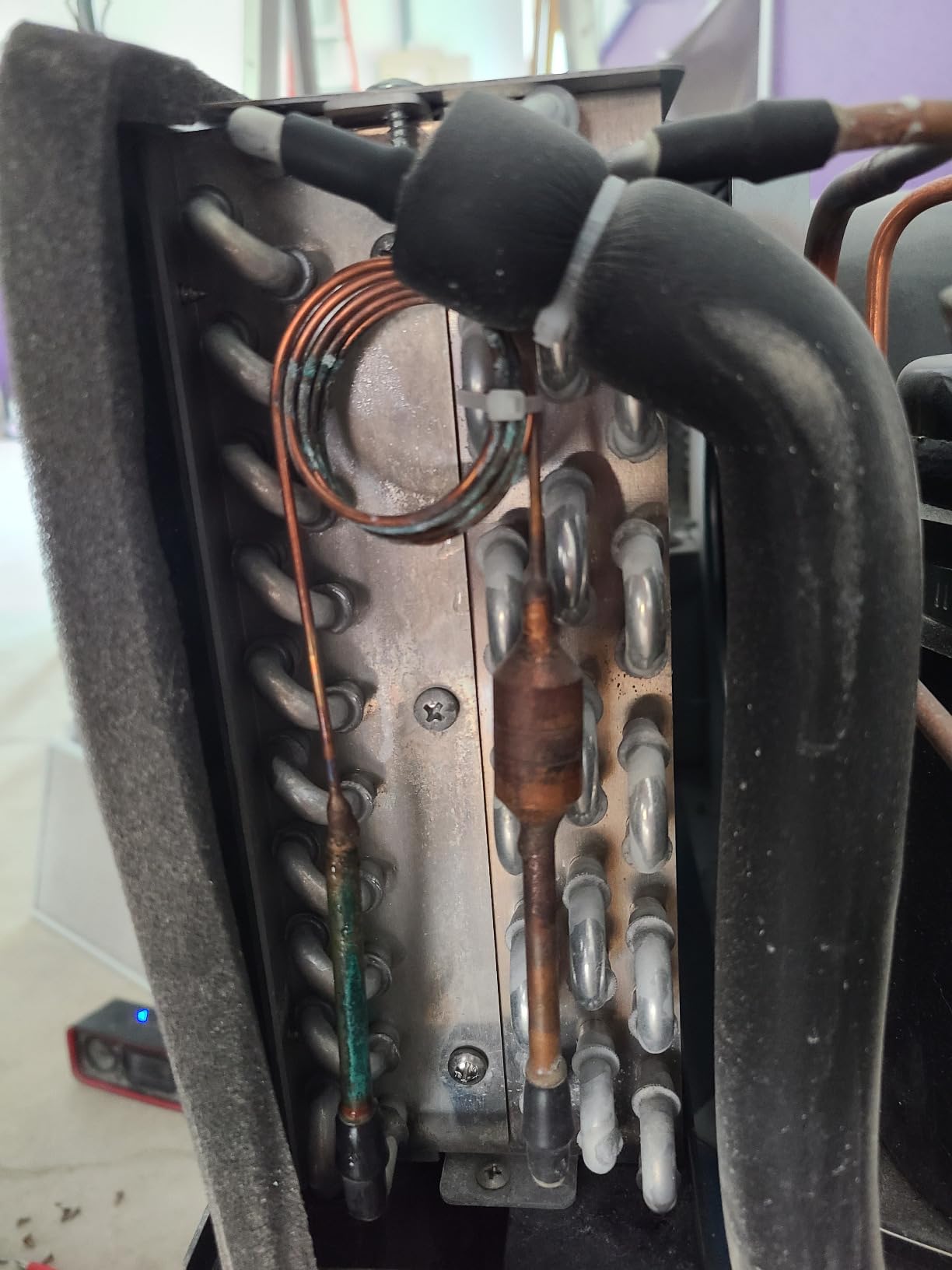
What you get that smaller machines cannot
At 41.7 pounds and 19.2 by 12.2 by 13.3 inches, the Sentinel HD55 is heavier than a kitchen model but light enough for one person to carry down a ladder and slide through a typical 16 by 24 inch hatch. The MERV-1 filter protects internal components from the dust that comes off a dirt floor.
The 6-year limited warranty is the longest on this list, with full coverage on the first two years. That length of coil and compressor cover is the single most valuable spec on the box, because corrosion in acidic condensate is what ends most of these machines.
Where it will disappoint you
At 460 watt-hours it draws more than the lighter machines here, and the blue HD55 variant carries no Energy Star certification. If your crawl space sits at the far end of a long duct run, plan the placement carefully, because 120 CFM is moderate airflow for a large space.
2. Aiusevo 130-Pint Crawl Space Dehumidifier with Built-In Pump
125Pints Crawl Space Dehumidifier with Pump and Drain Hose up to 6500 Sq.Ft
130 PPD at 95F and 90 percent RH
265 CFM
Up to 6500 sq ft
51 lb
Built-in pump
Touchscreen panel
Pros
- Second-highest review count here at 1181 ratings
- Genuinely useful pump discharge over long runs and uphill
- Dual drainage options shipped in the box
- Ductable outlet opens up HVAC integration
- Reviewers report quiet operation
Cons
- Settings reset after power cycles
- Some units fail to power on reliably
- Buyers report real capacity below the advertised figure
- Optional remote is sold separately
The Aiusevo AS610 is the most flexible drainage story on this list. It ships with a 16.4 foot pump hose and a 6.6 foot gravity hose, so the same machine covers a flat space with a floor drain and a sloped space where water has to travel. At 1,181 ratings and a 4.3 average, it is the second most proven machine here.
Its 265 CFM airflow and stated coverage of up to 6,500 square feet make it the right call for a wide crawl space under a large house. The 6-inch ductable outlet also means you can push dried air into an adjoining HVAC trunk instead of relying only on space mixing.
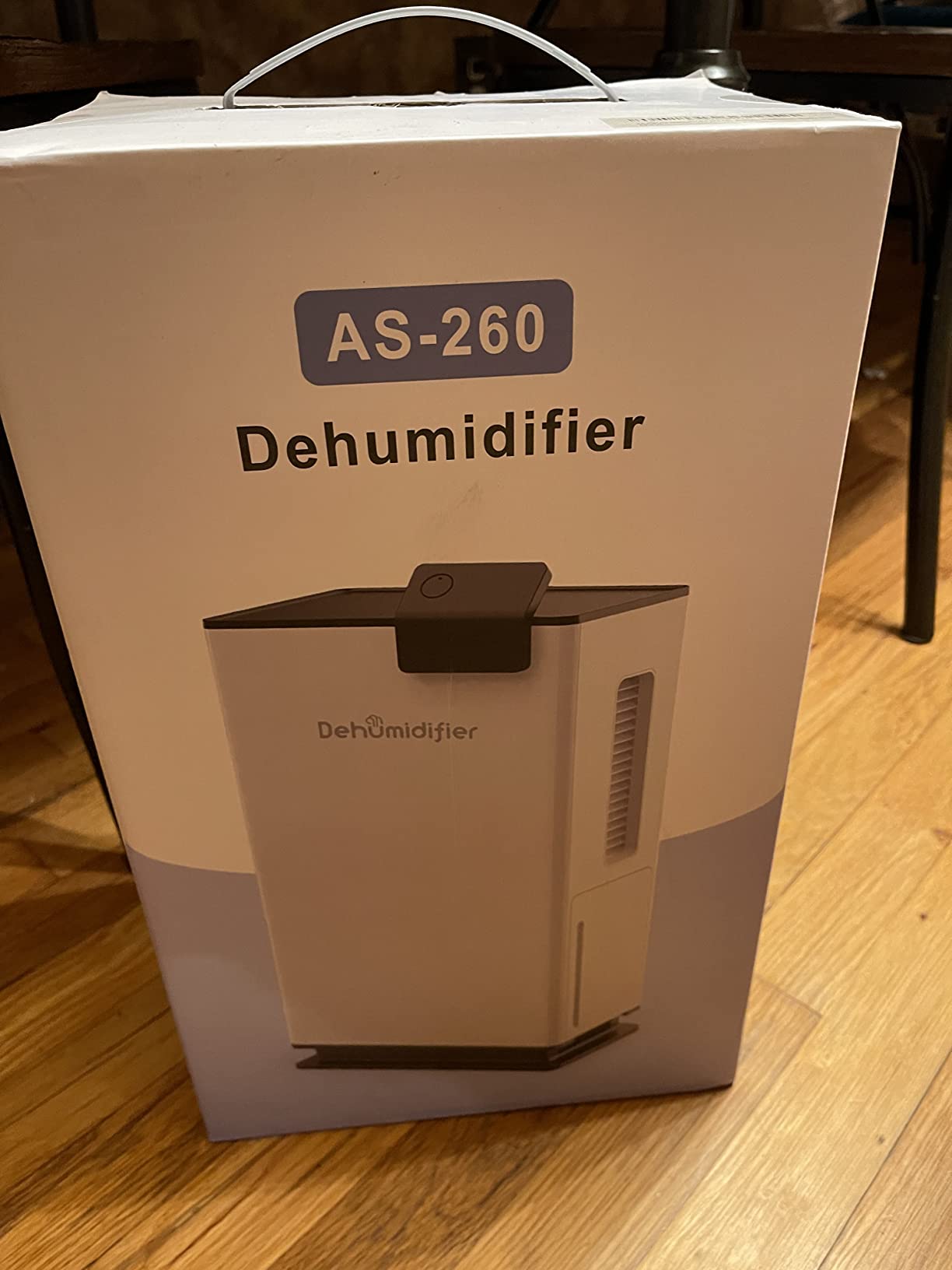
Reviewers describe large humidity drops within a few days of starting, and they call the unit quiet enough to sleep beside. In practice that quietness matters less under a house, but it matters if your crawl space adjoins a bedroom or a quiet home office.
The control panel shows a live temperature readout alongside humidity and timer settings, with error codes on the display. Auto restart after an outage is present, but settings are not retained across power cycles, so the panel light resets and you re-enter your setpoint. That is an annoyance, not a failure.
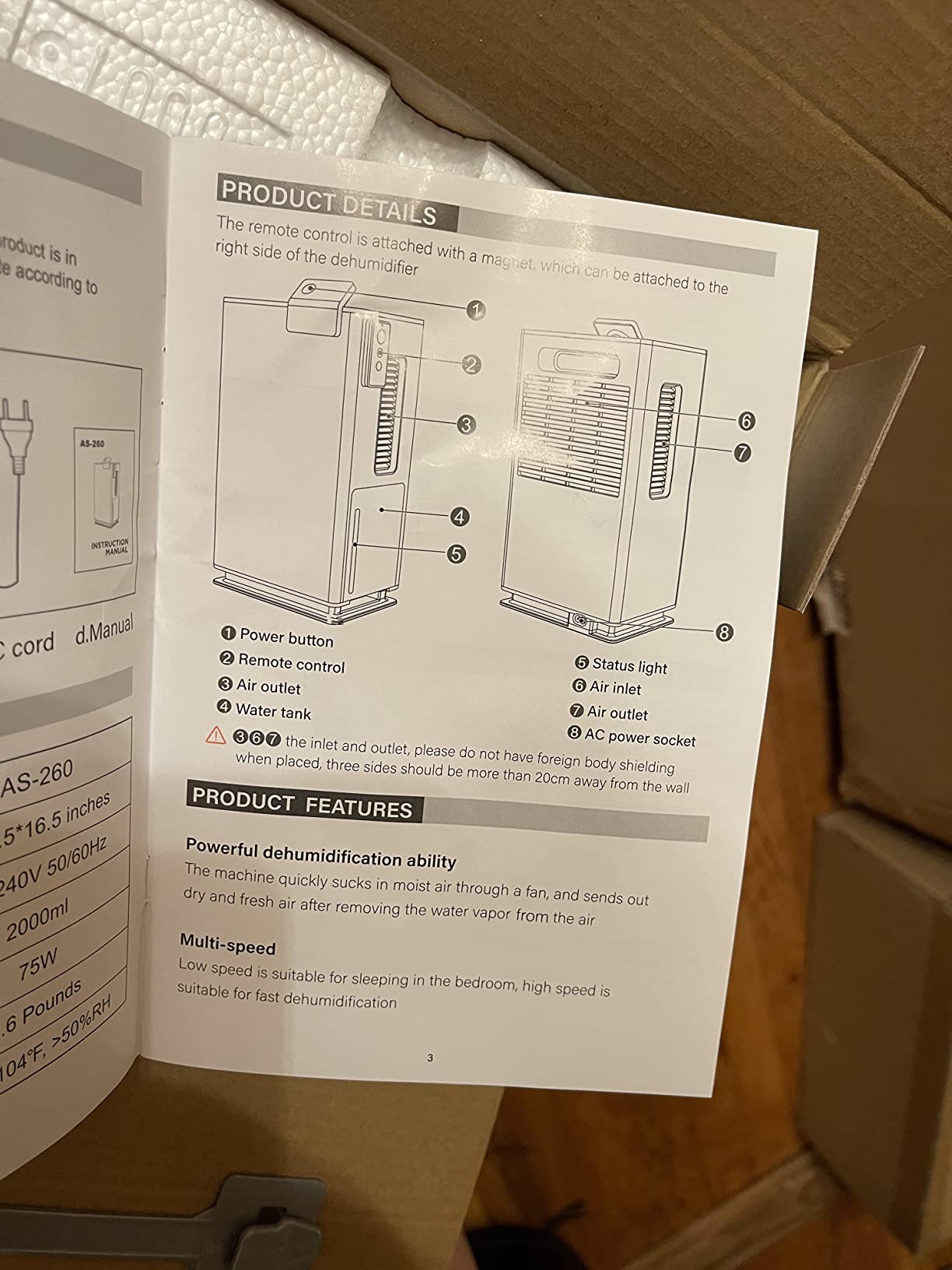
Where the pump earns its keep
If your lowest drainage point sits below the crawl space floor, or if the nearest drain is 60 feet away around a corner, a gravity-only machine is a non-starter. The built-in pump handles that geometry and removes the need to buy a separate condensate pump and a float switch.
The 19.3 by 17.8 by 17.5 inch body is larger than the Sentinel HD55, and at 51 pounds it is a two-hand carry. Check your hatch before you commit, because the body was designed to sit between floor joists rather than to thread through a narrow opening.
What the reviews argue about
The critical minority reports intermittent power-on behavior that needs a unplug-and-replug, and several reviewers describe the machine as far smaller than its stated capacity suggests. Treat the 130 pint figure as a saturation number at 95°F and 90 percent RH, not as a crawl space extraction rate.
The optional wired remote control is sold separately, which adds to the total once you account for installation. Budget for it if you do not want to crawl under the house every time you want to check the reading.
3. Waykar 158-Pint Crawl Space Dehumidifier with Pump
Waykar 158 Pints Crawl Space Dehumidifier with Pump, 7500 Sq. Ft.
158 PPD at 95F and 90 percent RH
205.9 CFM
Up to 7500 sq ft
73.9 lb
530 W
16.4 ft pump hose
Pros
- Highest stated coverage area here at up to 7500 sq ft
- Pump hose lifts water further than most competing models
- Adjustable 10 to 90 percent RH setpoint range
- Metal casing with adjustable feet for stability
- Power-off memory restores settings after an outage
Cons
- Heaviest machine here at 73.9 lb and hard to move through a hatch
- Remote control is not included
- Headline pint capacity depends on saturation conditions
- 12 percent of reviews are one-star
The Waykar covers the most ground on paper of anything under this ceiling. At 158 pints per day at 95°F and 90 percent RH and up to 7,500 square feet of stated coverage, it is the pick for a large crawl space under a big house where a smaller machine would sit at full duty cycle trying to keep up.
Its pump hose handles a 16.4 foot vertical lift, beyond the 10 to 13 foot most competing models manage. The humidity setpoint range of 10 to 90 percent RH is the widest here, which lets you set a genuinely low target rather than fighting a 30 to 80 percent floor.
The 3+4 layer condenser is claimed to improve heat exchange efficiency by 20 to 30 percent, and adjustable feet cut noise and vibration by up to 30 percent. Those are manufacturer figures, but the feet are a real feature on a machine this heavy, because an unbalanced 74-pound box rattles against joists all night.
Check the hatch before you order
At 73.9 pounds and 22 by 20 by 15 inches, this is the hardest machine here to get into a crawl space. Two people, a set of blocks, and a plan B are the realistic minimum. If your access is tight, the ALORAIR Sentinel HD35P is a far better physical fit.
Warranty structure is 1 year on the unit, 2 years with registration, and 5 years on the compressor. That compressor cover is meaningful, since compressor failure is the leading failure mode reported across this whole category.
Where the marketing and the reality diverge
The 158 pint figure is measured at 95°F and 90 percent RH, which is a saturation condition most crawl spaces never reach. Rated against the AHAM standard used by the AlorAir units, the equivalent number is far lower. Do not compare a saturation figure to an AHAM figure and conclude one machine is twice as powerful.
With 12 percent one-star ratings, the largest dissatisfaction group here, the complaints cluster around capacity that did not match the headline number and the missing remote. If you need remote control, add it to the plan.
4. ALORAIR Sentinel HD35P 70-Pint Dehumidifier with Pump
ALORAIR 70 PPD Dehumidifier with Pump for Crawl Space and Basement
35 PPD at AHAM
70 PPD saturation
1000 sq ft
Under 50 dB
38.2 lb
Built-in pump
Pros
- Smallest footprint here at 15.2 by 11.2 by 11.4 inches
- Built-in pump lifts water 19.6 ft
- Runs under 50 dB
- Lightest machine here at 38.2 lb
- 6-year limited warranty and ETL listing
Cons
- Smallest coverage area here at 1000 sq ft
- Rated to a 90F upper temperature limit
- 16 percent one-star ratings tied for the highest share
- Several buyers report units that stopped condensing after about two years
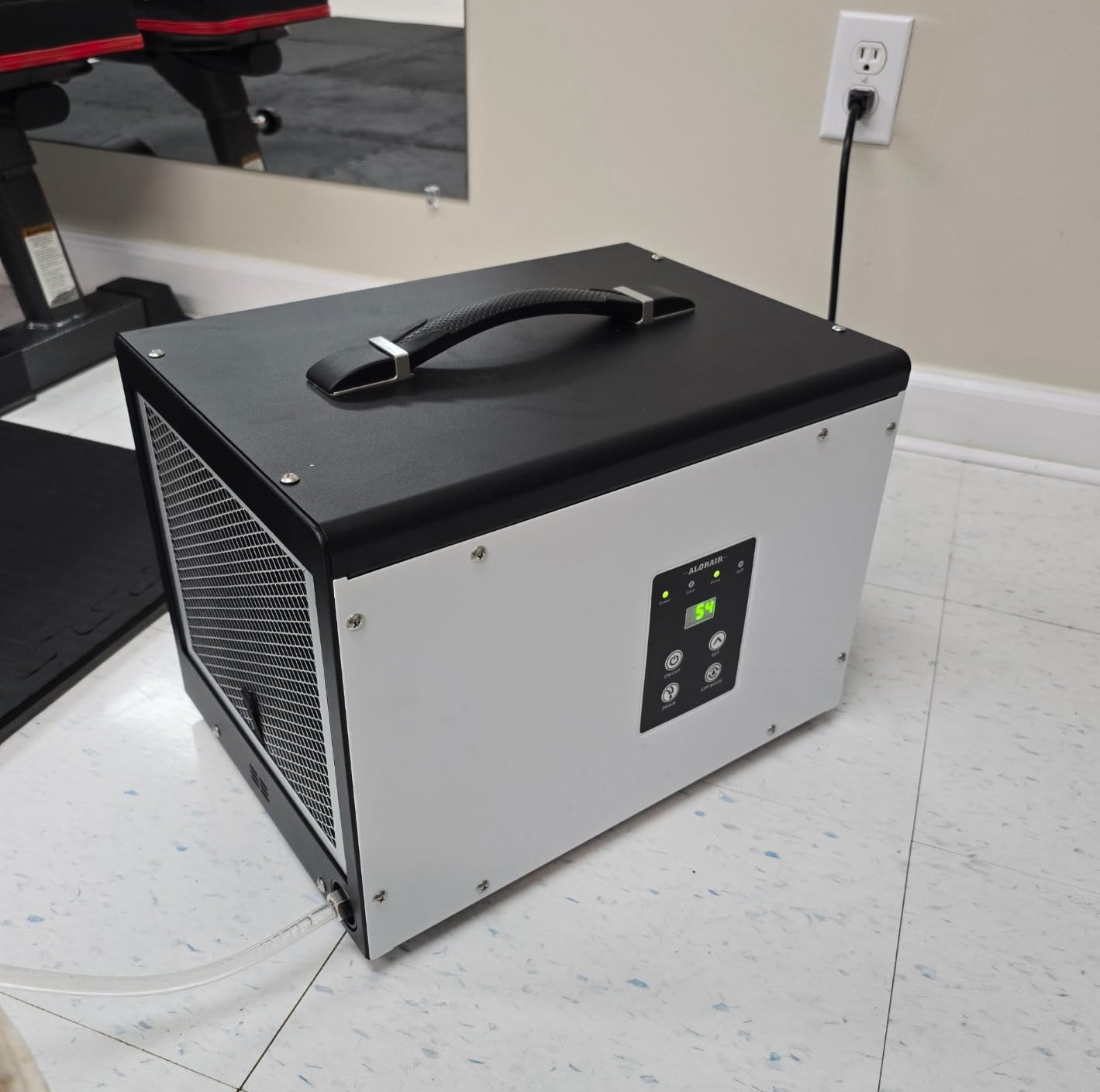
The Sentinel HD35P is the physical answer to the most common crawl space complaint, which is that the machine will not fit through the opening. At 15.2 by 11.2 by 11.4 inches and 38.2 pounds, it passes through openings that stop every other machine on this list.
It still carries a real built-in condensate pump with a 19.6 foot lift distance, and the hose is included. For a small space where the drain sits below the unit, that removes the most common add-on cost in this category.
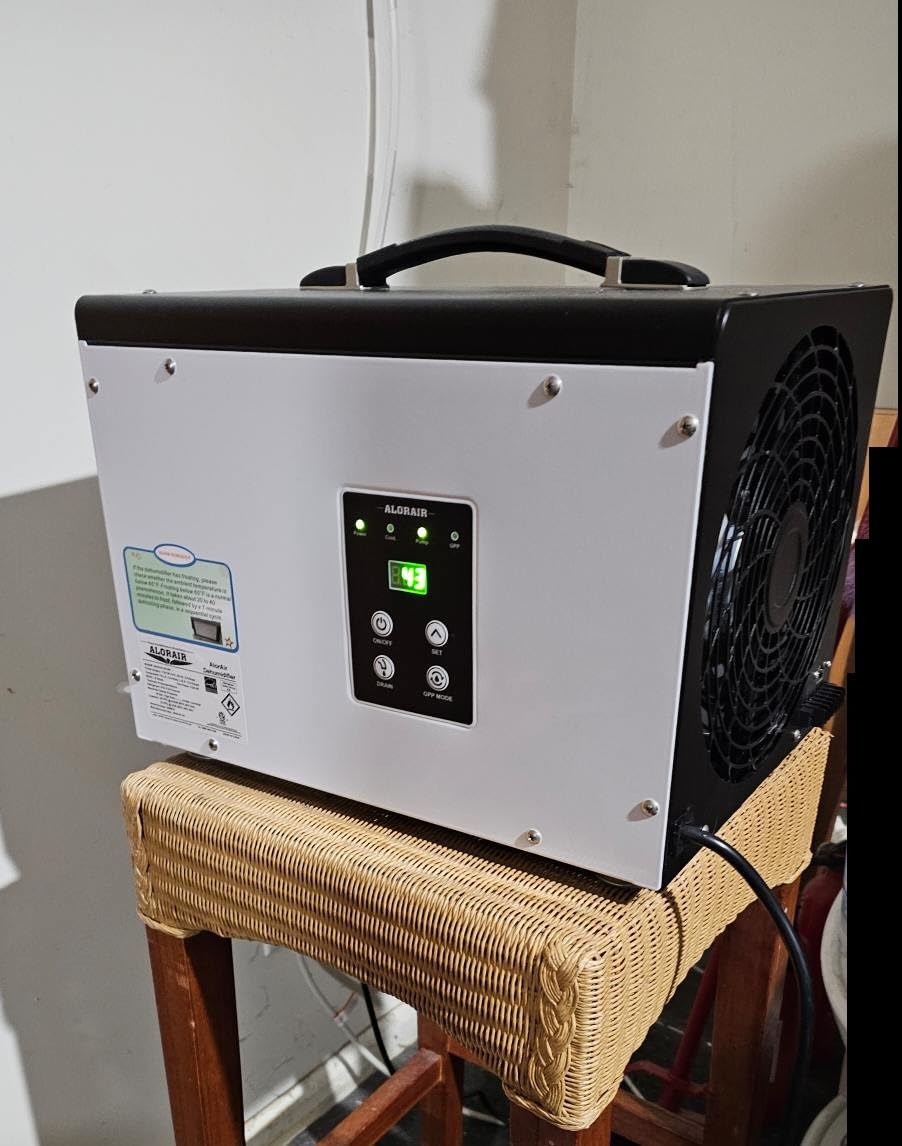
Buyers consistently single out three things: the footprint, the genuine pump lift, and the noise floor. Running under 50 dB makes it the only machine here you could reasonably install beside living space without planning around it.
Drainage is flexible, because you can choose the gravity port or the pump depending on where the water has to go. Auto restart after a power interruption is present, which matters in a space where power trips happen during storms.
Where this machine fits best
A crawl space of 500 to 1,000 square feet is the sweet spot. Below 500 square feet you can go even smaller, and above 1,000 square feet this machine will run at full duty cycle trying to keep up, which shortens its life.
The MERV-1 filter traps dust and fine particles before they reach the internal components, which matters more than usual over a dirt floor. The 331 watt-hour draw is the lowest among the AlorAir machines here, so the running cost sits at the low end of this list.
What the 16 percent one-star share is about
This machine carries the highest share of one-star reviews here at 16 percent, and the complaints are about durability rather than performance. Multiple reviews describe the refrigeration system failing after 18 to 24 months of use.
That pattern is not unique to this model. Across this category, reports of three-year lifespans are common regardless of brand, and one r/heatpumps commenter advised not spending more than roughly 300 dollars and sizing up heavily instead. Plan to treat the machine as a wear item and write the purchase date on the housing.
5. Moiswell Defender M145 155-Pint Energy Star Dehumidifier
Moiswell 155 Pint Commercial Dehumidifier with Drain Hose for Crawl Spaces
70 PPD at AHAM
155 PPD max
265 CFM
Up to 6000 sq ft
63 lb
860 W
Energy Star
Pros
- Highest average rating here at 4.5 out of 5
- 78 percent five-star reviews
- Energy Star certified which is rare in this class
- Horizontal body fits between floor joists or mounts overhead
- 5-year warranty
- 265 CFM airflow in a 63 lb body
Cons
- Highest power draw here at 860 watts
- Gravity drain only with no built-in pump
- Smaller review base than the AlorAir machines
- Limited to about 6 ft of added ducting
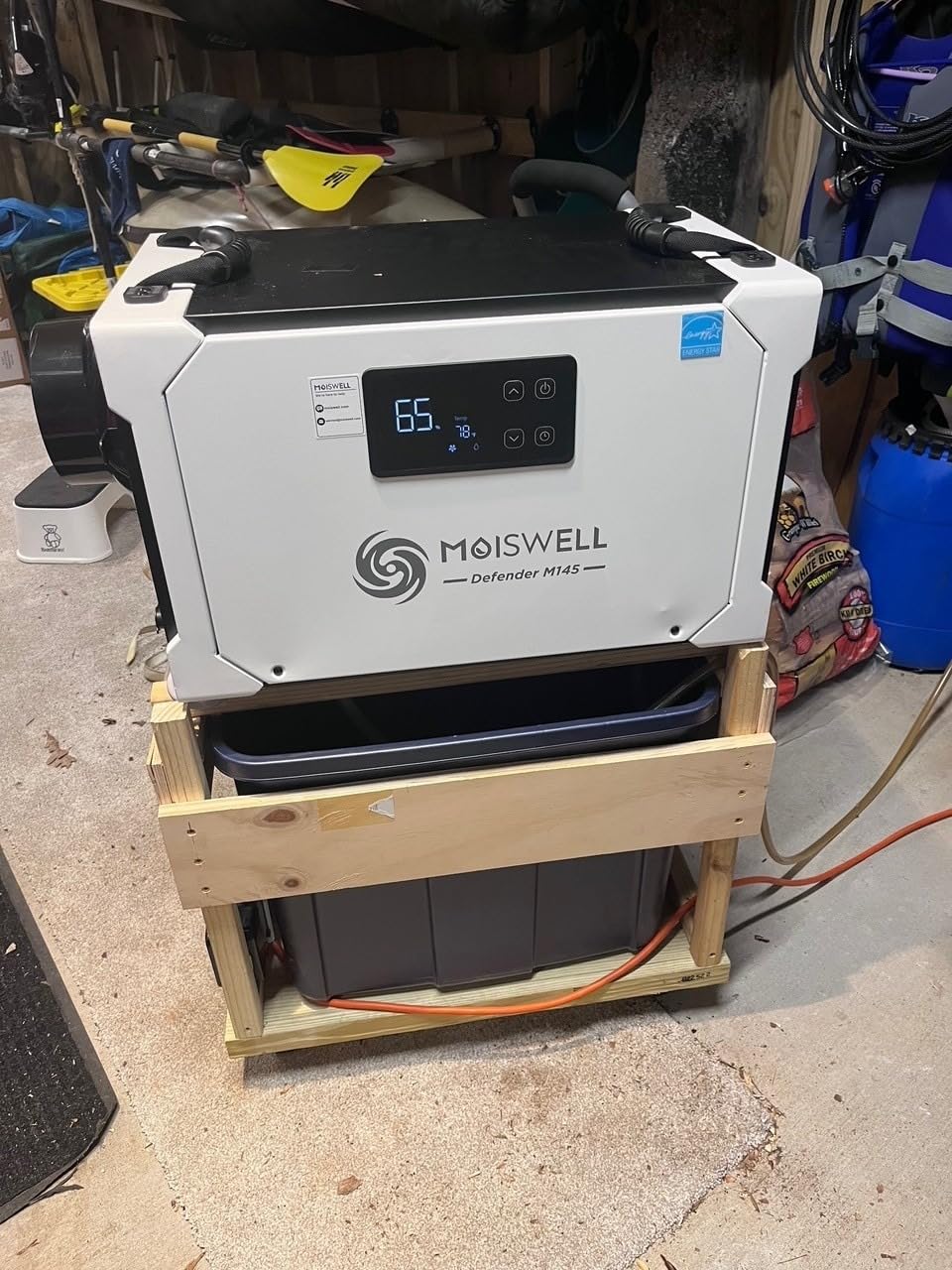
The Moiswell Defender M145 has the strongest satisfaction numbers of anything on this list: a 4.5 average with 78 percent five-star reviews and only 6 percent one-star. Reviewers point at the Energy Star efficiency, the low-profile joist-friendly shape, and strong drying of genuinely damp spaces.
Its 22.5 by 14 by 14.7 inch horizontal body is unusual in this category. Most commercial crawl space machines are upright cubes, and this one is designed to slide between floor joists or hang overhead, which solves a clearance problem you may not have thought about until installation day.
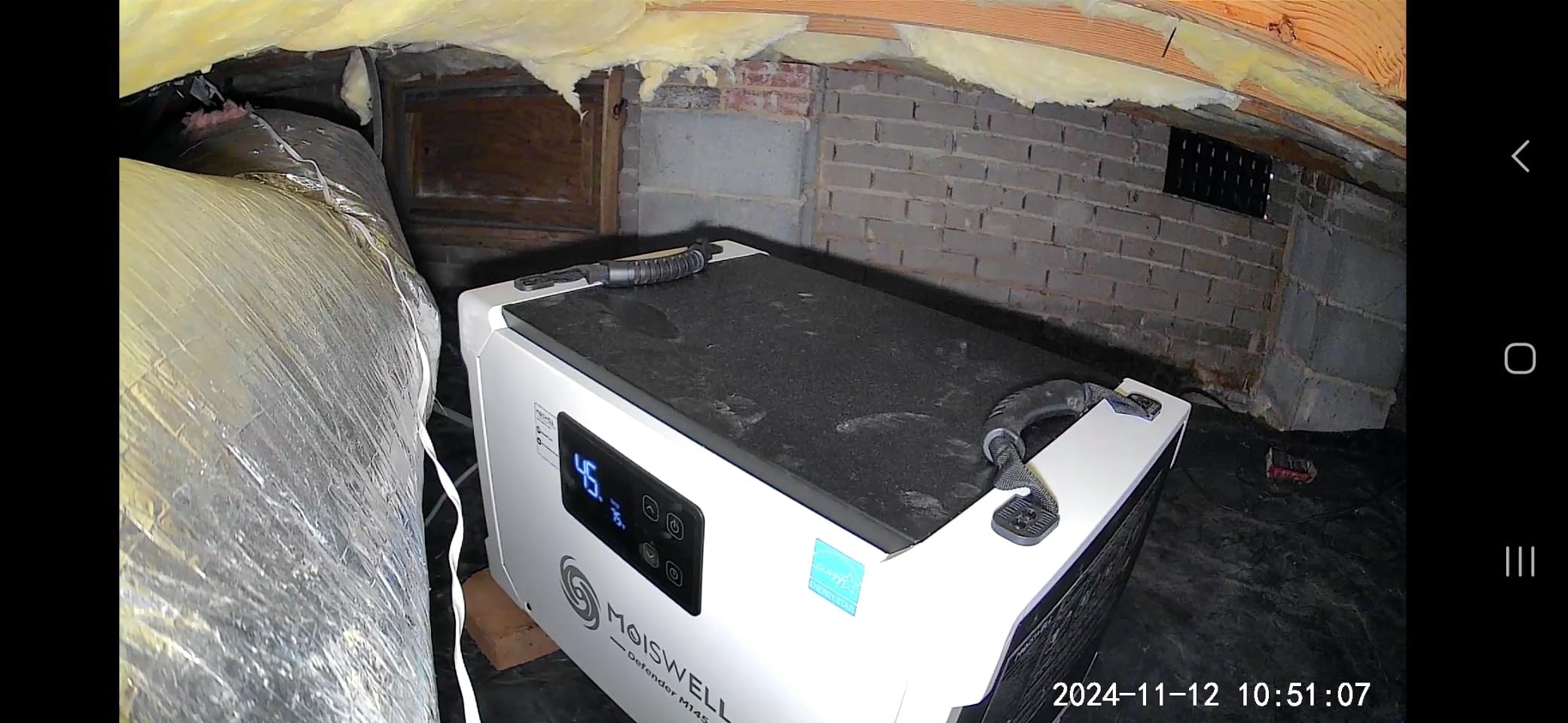
Extraction is 70 pints per day at AHAM conditions and 155 pints per day maximum, with 265 CFM airflow and coverage up to 6,000 square feet. The unit cycles automatically to hold your set humidity, with a 24-hour timer, auto drain, auto defrost, and auto restart after an outage.
The warranty runs 5 years, split as 2 years on the whole machine and 3 years on parts. The upper temperature rating of 95°F is comfortable for a crawl space in most climates.
Why Energy Star changes the math
At 860 watts this is the highest draw in the group, and without Energy Star certification that would be a serious running cost over years of continuous duty. The certification offsets it, and ENERGY STAR sizing guidance generally favors oversizing because a small machine at 100 percent duty cycle dies young.
If your crawl space is large and damp, this is the machine that stays alive. The combination of high capacity, high airflow, and certified efficiency is exactly the profile that survives continuous operation.
The drainage limitation to plan around
There is no built-in pump. Water leaves by gravity only, which means the unit has to sit above a floor drain or a lower outlet, and the included hose is what it is. If your drainage point is uphill or far away, add a condensate pump to the plan before you buy.
You can add roughly 6 feet of ducting to distribute air. That is enough to reach a far corner of a medium space, and not enough to serve two widely separated halves of a large crawl space.
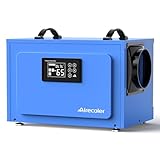
6. Airecoler GT-X5 125-Pint Commercial Dehumidifier
Airecoler 125 Pints Commercial Dehumidifier for Crawl Space & Basement
60 PPD at AHAM
125 PPD max
265 CFM
Up to 6000 sq ft
50 lb
R32 refrigerant
830 W
Pros
- One of the smallest footprints here at 19.2 by 12.2 by 13.4 inches
- 50 lb body is light enough to reposition inside the crawl space
- Mounts freestanding
- countertop
- or suspended between joists
- 4.4 average with 74 percent five-star reviews
- R32 refrigerant and 24-hour timer
Cons
- No built-in pump so discharge is gravity only
- 830 W is among the highest draws here
- Smallest review base here at 290 ratings
- Gravity hose is only 6.56 ft
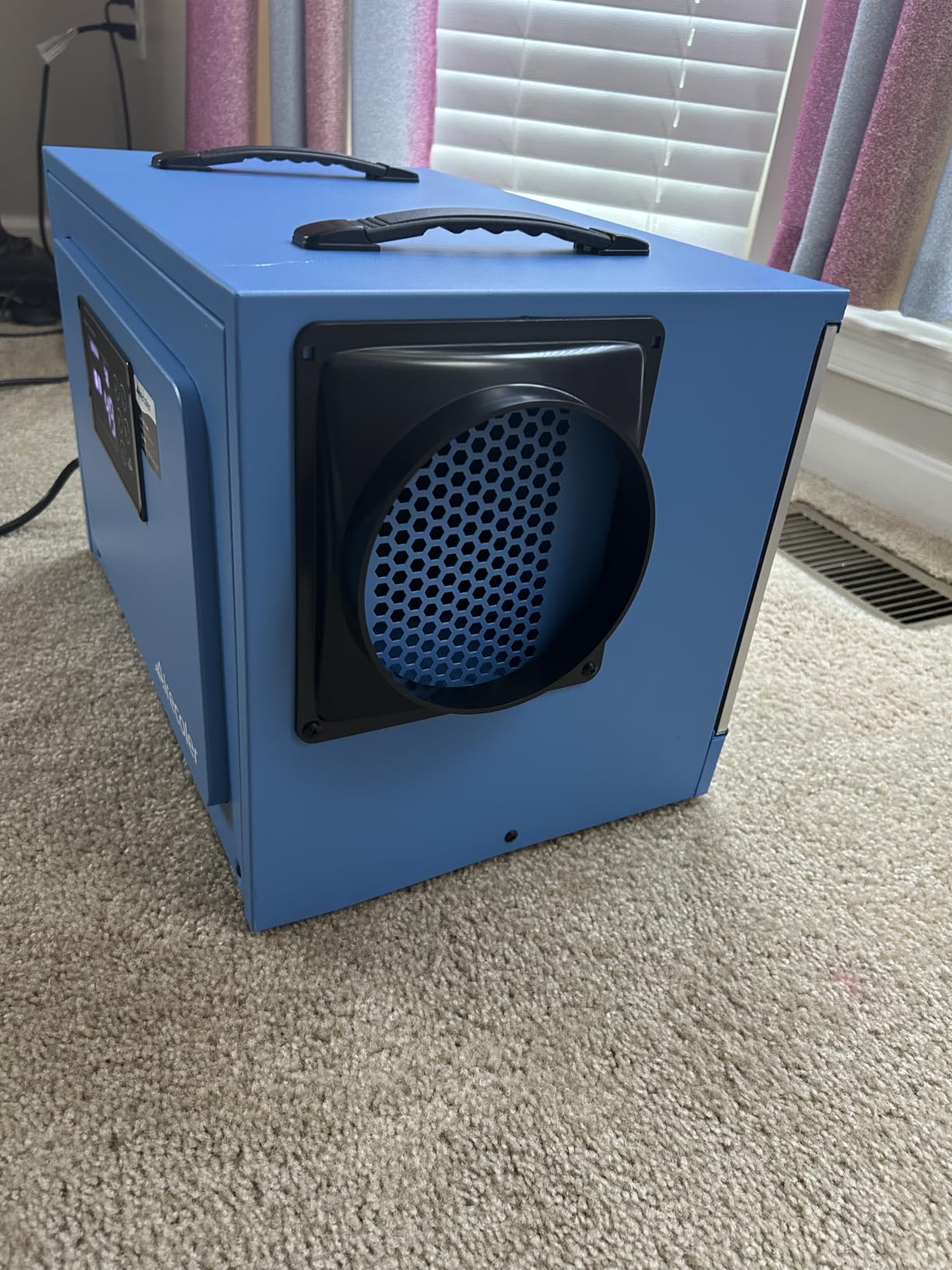
The Airecoler GT-X5 is the compact answer for anyone who needs real capacity in a genuinely low-clearance space. At 19.2 by 12.2 by 13.4 inches and 50 pounds, it carries 265 CFM airflow and coverage up to 6,600 square feet without taking up much floor.
Three mounting options are specified: freestanding, countertop, or suspended between floor joists. That flexibility is what earns it a place on this list, because it lets you use vertical clearance that most upright machines waste.
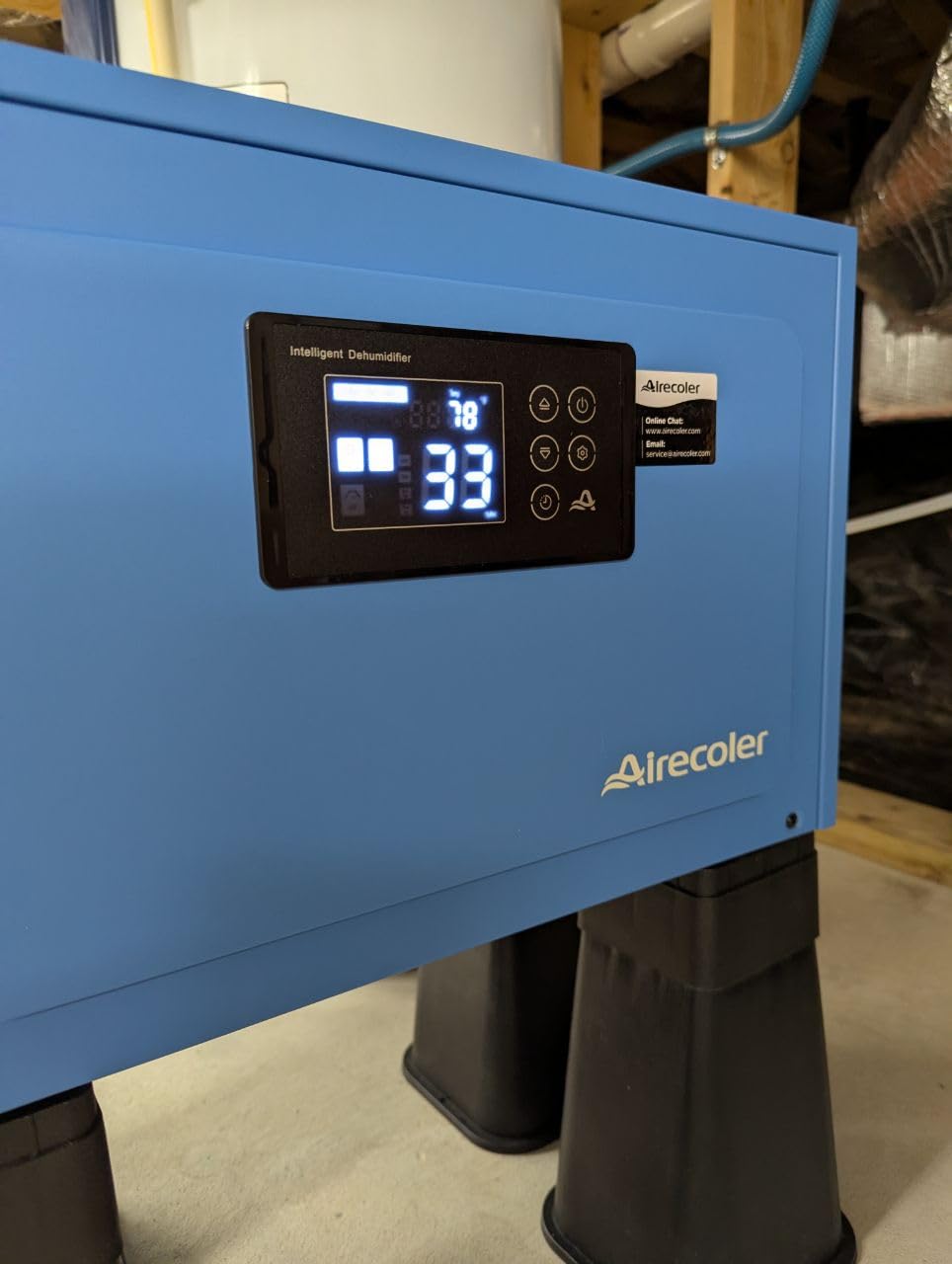
The extraction figures are 60 pints per day at AHAM conditions and 125 pints per day maximum, which puts it ahead of several more expensive machines on the standardized rating. It also uses R32 refrigerant and includes a 24-hour auto ON and OFF timer to cut power use when the space is dry.
Controls cover auto drain, auto defrost, continuous mode, and auto restart after a power outage. Coverage is 5 years, split as 2 years on the whole unit and 3 years on the dehumidification system.
Where it beats the bigger machines
Its footprint is close to the ALORAIR Sentinel HD55 while carrying a slightly different capacity profile, and it weighs less. For a crawl space with 12 to 16 inches of clearance between joists, the suspended mounting option is the difference between installing a dehumidifier and giving up.
The R32 system is a genuine efficiency choice. Combined with the timer, it makes this a reasonable pick for a moderately damp space that does not need the machine running flat out.
What the thin review base means
With 290 ratings, this is one of the two smallest evidence bases here. The distribution is genuinely good at 74 percent five-star and 5 percent one-star, but long-term failure patterns are less well documented than for the Alorair and Waykar machines.
Plan around gravity drainage. If your drain geometry is awkward, the Airecoler will need an external pump added to the install budget, and at 830 watts it draws far more power than the low-wattage machines on this list.
7. Yaufey 70-Pint Energy Star Dehumidifier for Crawl Spaces
Yaufey 70 Pints Energy Star Commercial Dehumidifier with Drain Hose for 5000 Sq. Ft. Crawl Space, Basement, Industrial, 10-90% RH Humidity Control, 24/7 Continuous Drainage,TUV Certified,5-Yr Coverage
70 PPD at 95F and 90 percent RH
159 CFM
Up to 5000 sq ft
41.3 lb
265 W
Energy Star
Pros
- Lowest power draw here at 265 watts
- Energy Star certified with R32 refrigerant
- Widest stated setpoint range at 10 to 90 percent RH
- Metal housing with automatic defrost
- Joist-mountable at 12.99 by 16.54 by 11.81 inches
- 5-year compressor coverage
Cons
- Gravity drain only so it must sit above a floor drain
- Lowest airflow here at 159 CFM and 5000 sq ft coverage
- 13 percent of reviews are one-star
- Only 211 reviews so the track record is thin
The Yaufey AYD1.5D is the running-cost winner here. At 265 watts with Energy Star certification and R32 refrigerant, it is the machine to buy if your crawl space is damp enough to need a dehumidifier but not so damp that it demands maximum extraction.
The control range of 10 to 90 percent RH is wider than the typical 30 to 80 percent found on home dehumidifiers, which lets you set a genuinely low target rather than fighting a floor limit. Automatic defrost covers cold operation, and the upper temperature rating of 100°F is the highest here.
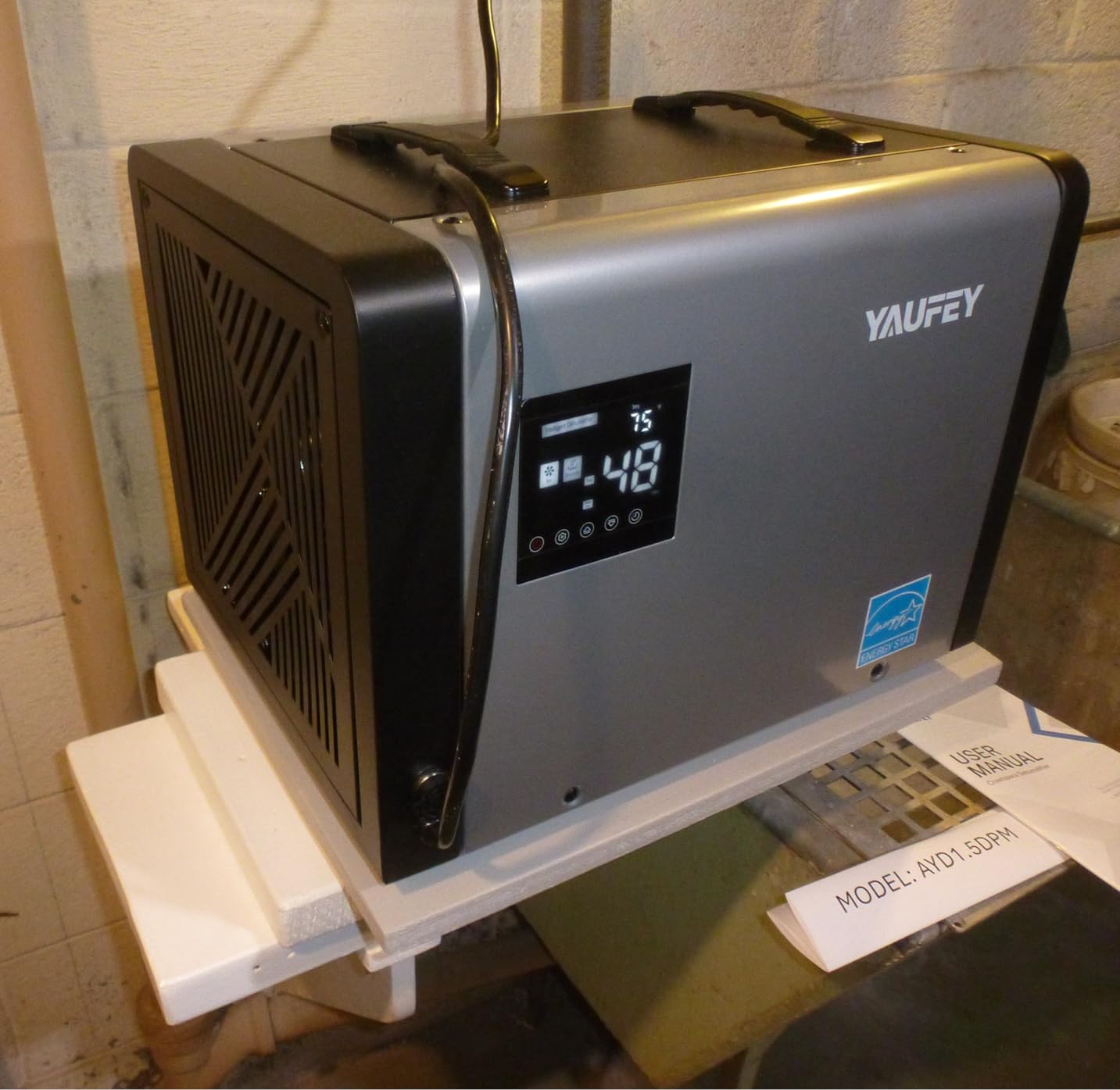
At 41.3 pounds and 12.99 by 16.54 by 11.81 inches, it mounts freestanding, on a countertop, or between joists. The all-metal housing is described as corrosion resistant, which is the right material choice for a space with acidic condensate and a dirt floor.
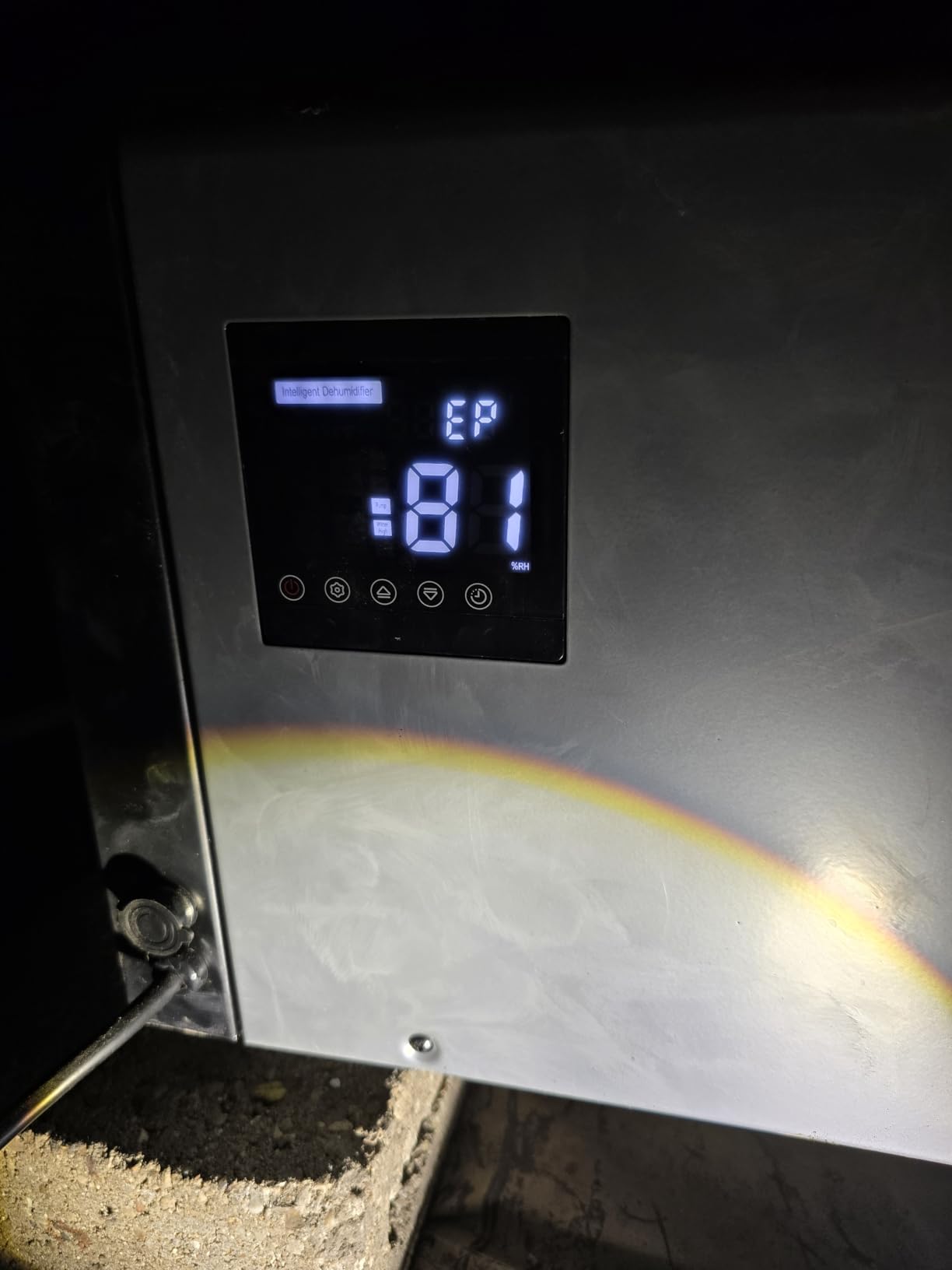
Controls sit on a digital display with target humidity adjustment and a 24-hour timer, plus a 3-minute compressor delay, overheat protection, and anti-spill. The included washable filter is a nice touch for a space where dust never stops.
When the low draw decides the purchase
At roughly a third the wattage of the largest machines here, the Yaufey costs far less per year of continuous operation. If you plan to run a humidistat cycle around the clock across multiple seasons, that difference compounds into the real cost of ownership.
Its tradeoff is airflow. At 159 CFM it moves less air than any other pick here, and its stated coverage of up to 5,000 square feet is the smallest of the commercial group. In a confined crawl space with a low ceiling, less airflow can mean a dead zone near the far wall.
Plan the drain before you commit
Drainage is gravity only, through a port with a 6.56 foot hose included. The unit has to sit above a floor drain or a lower outlet, and there is no pump to add to the plan. That constraint is the main reason to choose a different machine.
With 211 ratings, the durability record is thinner than the higher-count machines. Write the purchase date on the housing and budget for a replacement as a wear item.
8. Abestorm Guardian SN35P 70-Pint Dehumidifier with Pump
Abestorm 70 PPD Dehumidifier with Pump & Hose for Crawl Space & Basement
35 PPD at AHAM
70 PPD saturation
1000 sq ft
38.2 lb
Built-in pump with 19.6 ft lift
Pros
- Built-in pump with 19.6 ft lift handles uphill discharge
- Compact 15.2 by 11.4 by 11.2 inch body at 38.2 pounds
- Buyers report a stable 45 to 55 percent humidity band
- Packaging uses a box within a box with foam
- 5-year warranty with lifetime technical support
Cons
- Reports of units running but no longer condensing after 6 to 16 months
- Warranty service requires the buyer to pay return shipping
- Controls are not intuitive
- Audible pump and compressor hum
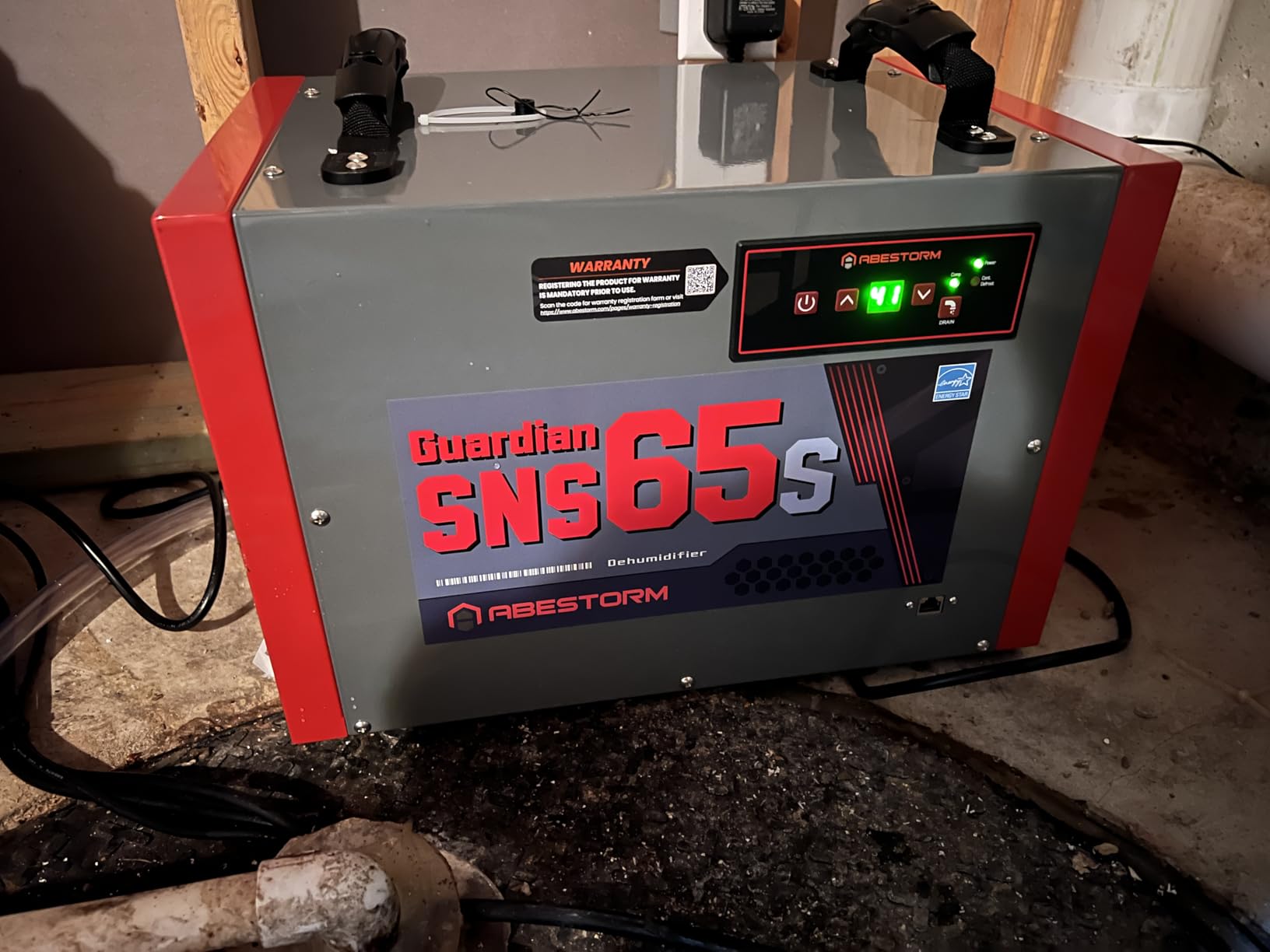
The Abestorm Guardian SN35P covers 1,000 square feet with a built-in condensate pump that lifts water 19.6 feet. That combination makes it the pick when your crawl space floor slopes toward a drain you cannot get underneath, which is a geometry that rules out half the machines on this list.
Auto defrost uses temperature sensors to prevent frost buildup, and the unit auto-stops at your set humidity and restarts when humidity rises, including after a power interruption. Owners report holding a 45 to 55 percent band in real crawl spaces, which is the target range we look for.
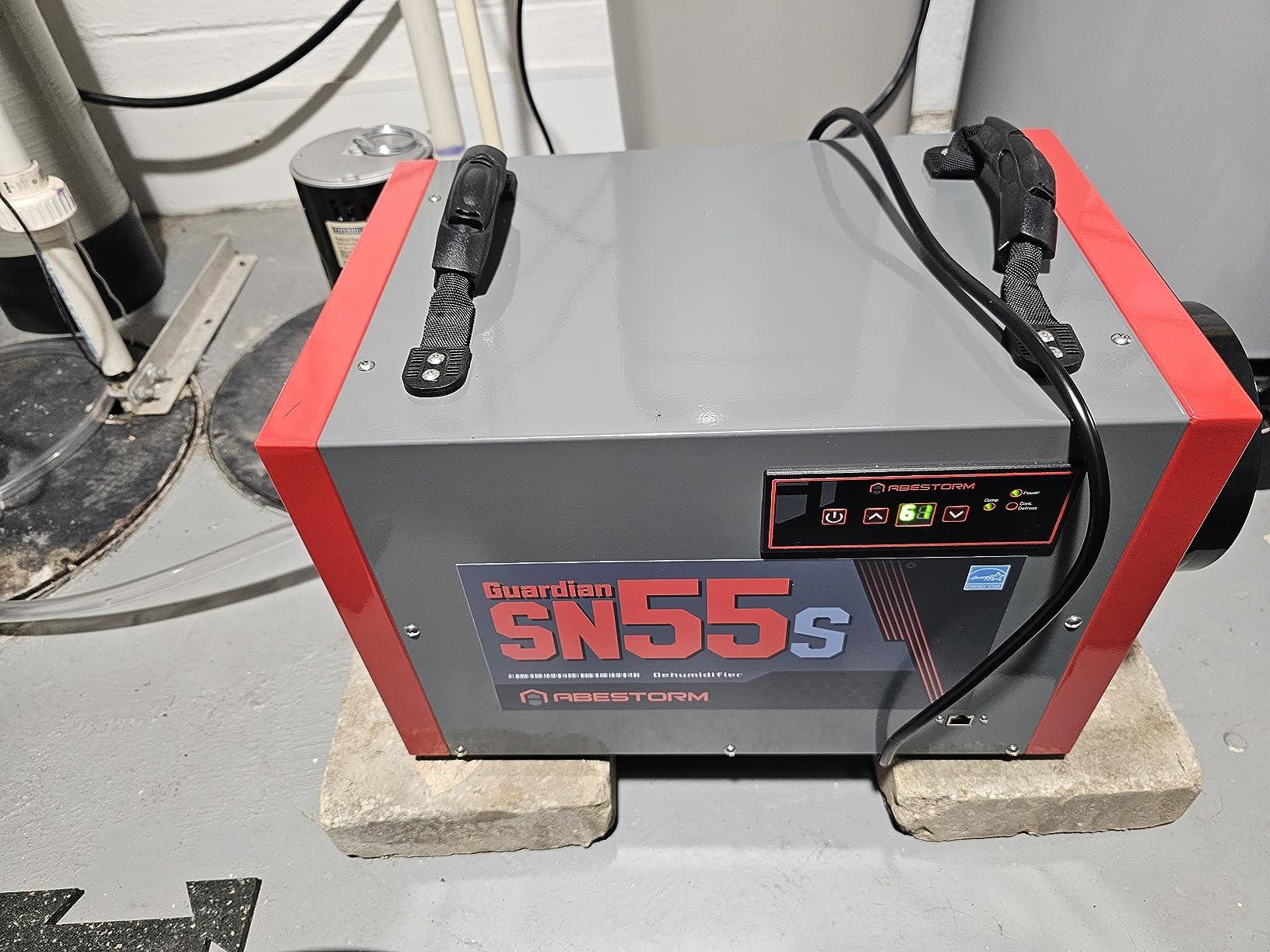
You can also switch to gravity drainage through the hose connection if the space cooperates. The body is a metal and plastic hybrid at 15.2 by 11.4 by 11.2 inches and 38.2 pounds, which reviewers describe as sturdier than residential units of the same size.
Build details get called out more often than usual: the paint finish, the handle, and the screw quality. Shipping protection is a box within a box with foam sheets, which matters when a replacement has to be dragged back under a house.
The pump and the target band
A 19.6 foot lift handles the uphill runs that defeat gravity drainage, and the machine holds its setpoint without manual cycling. If your problem is a persistent musty smell tied to a sloped floor, the drain geometry is often the reason a previous unit failed.
At 35 PPD AHAM, this is a right-sized machine for a space up to 1,000 square feet. Oversize it deliberately if your crawl space runs larger, because a machine pinned at continuous duty ages faster.
The durability reports are the honest problem
Sixteen percent of its reviews are one-star, and multiple reviews describe units that still run but no longer condense, between 6 and 16 months in. That is faster than any other pick on this list, and it is worth weighing seriously.
Warranty service requires the buyer to pay shipping, which on a 38-pound unit is substantial, and one buyer reported support going quiet for weeks until a public review was posted. Buy it for the pump and the target band, and treat it as the shortest-lived machine in this roundup.
How to Choose a Crawl Space Dehumidifier Under 500 Dollars
Every machine above is a commercial-style crawl space unit. The differences that matter at install time are temperature rating, capacity in pints per day, drainage geometry, airflow, and how the machine gets through your hatch.
Match the machine to your winter floor temperature: the 65 degree line
A standard dehumidifier coil begins to frost below roughly 65°F, and once frost builds the machine extracts less and less water while burning the same electricity. A single freeze event inside an unconditioned crawl space can end the machine. Every pick on this list has automatic defrost, and that is the first thing to confirm before anything else.
Next, check your actual winter floor temperature rather than the outdoor number. A crawl space in a warm climate may sit comfortably above the line even when the yard freezes, while a crawl space in a northern state can drop into the 40s. If yours sits in the 40s regularly, prioritize defrost quality and a stated low-temperature rating over peak pint capacity.
Trade discussion supports the caution. An hvac-talk thread titled around killing crawl space dehumidifiers reflects a recurring trade view that cold-climate operation is what ends units in unconditioned spaces. The wider industry move toward coated coils came from the same corrosion and frost failure pattern.
Size by pints per day, not square footage
Coverage claims on the box are the least reliable number in this category. Compare them anyway, but size on capacity. AHAM PPD is the standardized figure measured at 80°F and 60 percent relative humidity, and it is the only number you can compare honestly across brands.
Saturation capacity, the headline 113, 125, 130, 155, and 158 pint figures here, is measured under near-condensation conditions such as 95°F and 90 percent RH. A crawl space will never sit there. Two units can carry identical saturation numbers and very different AHAM numbers, and only the second one tells you how the machine performs in your space.
Measure or estimate your crawl space in square feet.
Pick a unit whose AHAM PPD comfortably exceeds what a damp day demands, rather than matching it exactly.
Check that AHAM PPD exists on the spec sheet at all. Several picks here only publish a saturation figure.
Prefer airflow above 200 CFM for a confined space so air actually circulates past the intake and output collars.
Oversize deliberately. ENERGY STAR guidance favors oversizing because a small machine at continuous duty cycle ages fast.
If you want the basement-style context, our basement dehumidifier picks cover larger rooms where humidity loads are heavier than a crawl space produces.
Condensate drainage: gravity line vs pump vs bucket
Pick a machine with continuous drainage. A bucket-based unit gets emptied enthusiastically for a few weeks and then unplugged by October, and a crawl space you forget about in November is worse than no machine at all.
Among these picks, the ALORAIR Sentinel HD35P, the Abestorm Guardian SN35P, the Waykar, and the Aiusevo all include a built-in condensate pump. The ALORAIR Sentinel HD55 drains by gravity from a tankless design, and the Moiswell, Airecoler, and Yaufey are gravity only with a hose included.
Gravity drainage works when the unit sits above a floor drain or a lower outlet and the run is short. If the drain is uphill, more than 20 feet away, or around a corner, add a pump to your install budget. A small condensate pump plus a float switch is a modest addition that keeps the machine running unattended.
Humidistat, auto-restart and continuous duty
The humidistat is the single most important feature. It cycles the compressor to hold your target rather than running constantly, which cuts both energy use and wear. A machine without one either runs nonstop or is switched off by hand, and neither outcome is good under a house.
Auto-restart is second. Storms trip breakers, and a machine that forgets its setpoint after an outage will come back running full tilt until someone notices. All eight picks restart automatically after power interruption; the Aiusevo restarts but does not retain its settings.
Target 50 to 55 percent relative humidity in a crawl space, measured with a hygrometer placed at the far end of the space from the machine. Measuring right at the intake tells you almost nothing.
Airflow, noise and energy draw
Power draw ranges from 265 watts on the Yaufey to 860 watts on the Moiswell. Since a crawl space dehumidifier is meant to run for years, wattage is a running cost decision, not a spec-sheet detail.
Noise only matters if the unit sits near living space. The Sentinel HD35P is the quietest here at under 50 dB. The Abestorm is reported as audibly louder than a refrigerator, which is fine in an unoccupied space and noticeable in one.
Weight and dimensions deserve a check before purchase. The range runs from 38.2 pounds to 73.9 pounds and from a 15.2 by 11.2 by 11.4 inch footprint to 22 by 20 by 15 inches. Measure your hatch, then measure the machine.
What You Give Up Staying Under 500 Dollars
The crawl space-rated category above this ceiling runs from roughly 800 to 1,500 dollars for brands like Santa Fe and AprilAire. r/BuyItForLife consensus leans toward those brands for crawl spaces and dismisses big-box models on price and durability, and that recommendation comes with a real trade-off. Here is what the budget route accepts.
No true low-temperature rating on the flagship. The machines above all defrost automatically, but they are not the same as a dedicated crawl space unit built for sub-65°F spaces and continuous year-round duty with a longer coil life.
Shorter expected service life. Owners on r/heatpumps and other forums report that modern dehumidifiers rarely last beyond three years regardless of price, and coil corrosion in acidic condensate is the leading cause of death. Several picks here carry reports of refrigeration failures between 18 and 24 months, and the Abestorm reports failures between 6 and 16 months.
Accessories sold separately. The Waykar remote and the Aiusevo remote are both optional purchases. Add them to the install budget or plan on crawling under the house to read the display.
Thinner long-term data on the newer brands. The Moiswell, Airecoler, Yaufey, and Abestorm have far fewer reviews than the AlorAir units, so failure patterns are less well documented. That is an information gap, not a defect.
Some drainage math comes out of your pocket. Four gravity-only machines here need either a favorable drain geometry or an added condensate pump. That is a modest cost, but it is a cost the boxed price does not show.
The counter-argument is arithmetic. At this price tier you can replace the machine several times before reaching the purchase price of a rated flagship. One r/BuyItForLife owner reported choosing moisture control first and finding that a larger-than-needed consumer unit made a noticeable difference within weeks. If you seal the space and keep the vapor barrier intact, a budget machine on a maintenance plan is a defensible strategy.
Installation Checklist for a Crawl Space Dehumidifier
Work through this list before the unit arrives. Every step here comes from install details that decide whether the machine works or gets abandoned.
Seal the crawl space first. If the floor is bare dirt and the vents are open, the machine dehumidifies the neighborhood instead of the space.
Verify the vapor barrier is continuous and the ground is covered with a durable liner.
Measure the access hatch against the unit’s stated dimensions and weight before you order.
Raise the machine on blocks above the dirt floor, never sitting directly on soil or on standing water.
Use a dedicated grounded outlet, not an extension cord running back through the hatch.
Route the drain line before you position the machine, and test the fall with a cup of water.
Add a condensate pump if the drain is uphill or more than 20 feet away.
Install duct collars so air is pulled in at one end and discharged at the far end, rather than short-circuiting back to the intake.
Place the hygrometer at the far end of the space, not beside the machine.
Set the humidistat to 50 to 55 percent and write the purchase date on the housing.
If you also want garage-rated options for a nearby space, our garage dehumidifier picks cover a similar continuous-duty problem in a different room.
Frequently Asked Questions
What is the best brand of dehumidifier for a crawl space?
AlorAir is the strongest brand here on evidence: its Sentinel HD55 leads this roundup with 1,211 buyer ratings, a 6-year limited warranty, cETL listing, and tankless continuous drainage rated to 53 pints per day at AHAM. Trade forums lean toward AprilAire and Santa Fe, but those sit well above this price ceiling.
What dehumidifier is best for a 500 sq ft crawl space?
The ALORAIR Sentinel HD35P fits a 500 sq ft space best: a 15.2 by 11.2 by 11.4 inch body at 38.2 pounds, 35 pints per day at AHAM, a built-in condensate pump with a 19.6 foot lift, and operation under 50 dB. Under 500 square feet you can size down further, but never below what keeps the humidistat cycling.
Is it worth putting a dehumidifier in a crawl space?
Yes, when the space is damp enough to show condensation on joists or ductwork and to push a musty odor into living space. Holding relative humidity near 50 to 55 percent prevents mold, mildew, rot, and insect activity. A machine left to run for years is cheaper than remediation, and most owners treat it as a wear item with a three to eight year life.
What size dehumidifier do I need for a crawl space?
Size on AHAM pints per day rather than square footage. Pick a unit whose AHAM rating comfortably exceeds what a damp day demands, check that an AHAM figure exists at all rather than only a saturation number, and favor airflow above 200 CFM in a confined space. Oversizing helps because a small machine at continuous duty cycle ages fast.
What is the best rated dehumidifier for crawl spaces?
By average rating the Moiswell Defender M145 leads at 4.5 out of 5 across 500 ratings, with 78 percent five-star reviews and Energy Star certification. By evidence volume the ALORAIR Sentinel HD55 leads with 1,211 ratings at 4.3. Both sit comfortably under the 500 dollar ceiling with automatic defrost and continuous drainage.
How much should a crawl space dehumidifier cost?
Purpose-built crawl space dehumidifiers from brands like AprilAire, Santa Fe, and AlorAir run roughly 800 to 1,500 dollars. Below 500 dollars you buy commercial-style continuous-duty machines with automatic defrost, a humidistat, and continuous drainage instead. Add budget for a condensate pump if your drain is uphill or far away.
Will a crawl space dehumidifier work without encapsulation?
It will run, but it works far harder and costs more. With bare dirt and open vents, the machine tries to dehumidify air arriving from outside rather than air held in the space. Encapsulating the floor with a vapor barrier and controlling the vents cuts the moisture load, which is why most crawl spaces that succeed had the barrier addressed first.
Does crawlspace encapsulation cause mold?
Poorly done encapsulation can, because sealing in damp material without drying it first traps the moisture it was supposed to block. Mold appears where the encapsulation is incomplete, where a dividing wall creates an unreachable dead zone, or where the space was never dried before sealing. Dry the space, seal it fully, and dehumidify continuously.
What are the downsides of crawl space encapsulation?
The main downsides are upfront cost, the loss of ventilation in hot weather, and the risk of sealing in moisture. Encapsulation can also create dead zones a single machine never reaches, such as behind a dividing wall, and it makes every later repair more expensive because access is slower. Monitor humidity after sealing rather than assuming the work is finished.
Why does my crawl space smell musty after encapsulation?
The smell usually means moisture was sealed in rather than removed. Common causes are a bare dirt floor that was never covered, gaps where walls and piers meet the liner, and vents left open. Run a dehumidifier to dry the space down first, then check every seam with a moisture meter before assuming the encapsulation failed.
Which Crawl Space Dehumidifier Should You Buy?
Buy the ALORAIR Sentinel HD55 if you want one answer. It carries the largest evidence base of any crawl space unit under this ceiling at 1,211 ratings, a 53 pint per day AHAM figure, tankless continuous drainage, automatic defrost, a footprint that fits through a standard hatch, and a 6-year limited warranty.
Buy the Aiusevo 130-Pint with Pump if your drain runs uphill or a long distance, since it ships with both a 16.4 foot pump hose and a gravity hose. Buy the Waykar 158-Pint if your crawl space is large and you can handle 73.9 pounds through the hatch.
Buy the ALORAIR Sentinel HD35P for a small space or a tight access opening, and the Abestorm Guardian SN35P for the same footprint with a pump in a sloped space, while weighing its shorter reported life. Buy the Moiswell Defender M145 for the best rating and Energy Star efficiency, the Airecoler GT-X5 for joist mounting in low clearance, and the Yaufey 70-Pint for the lowest running cost.
Whichever you choose, seal the crawl space first, set the humidistat to 50 to 55 percent, and give the machine continuous drainage. Those three decisions decide whether the unit still runs in three years.