
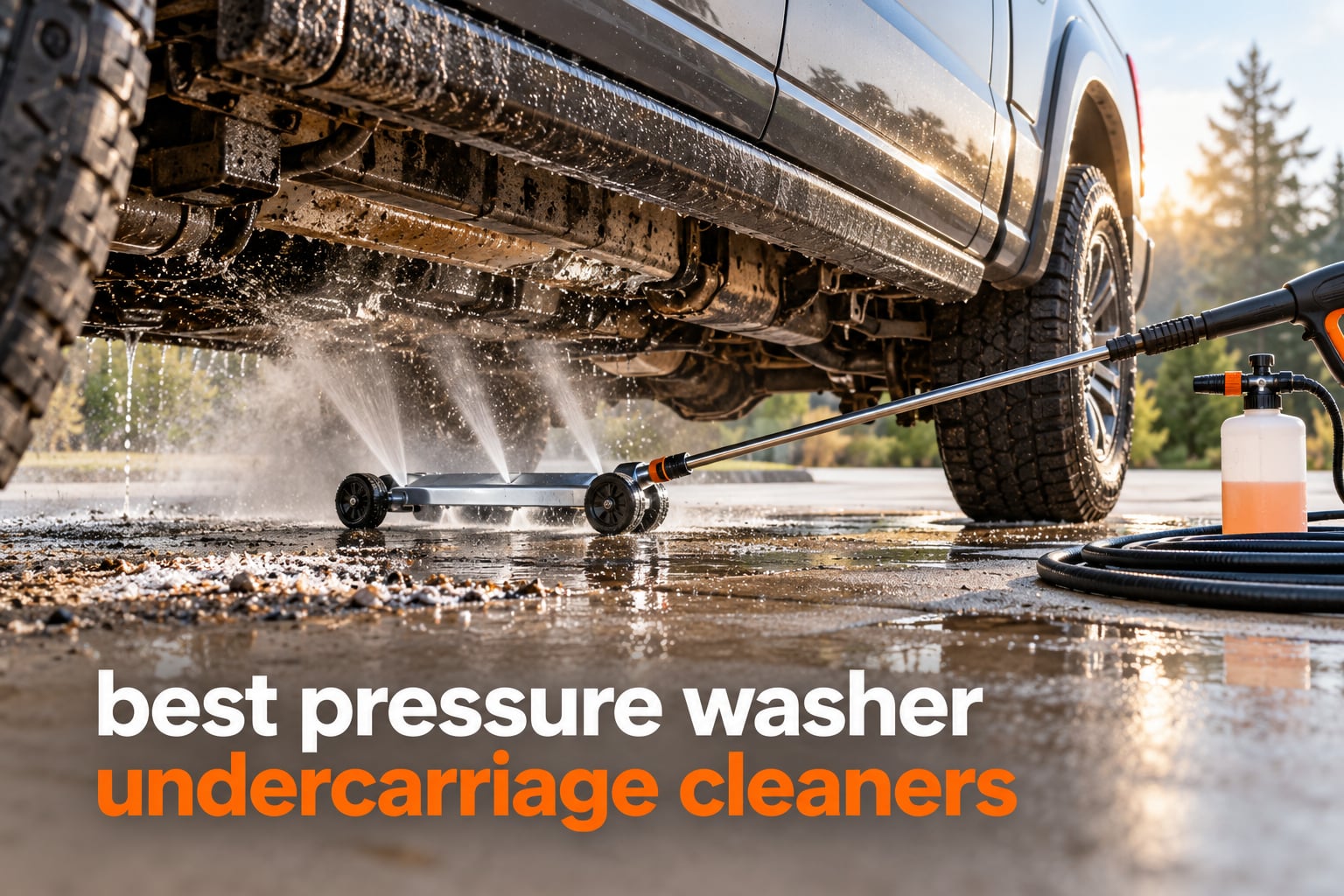
A pressure washer undercarriage cleaner is a low-profile attachment that clips or screws onto your spray gun and lays a wide horizontal fan of water across the underside of a vehicle, so you can strip road salt, mud, oil and winter grime off your frame, exhaust and suspension without lying on a concrete driveway. The single most important spec is not the nozzle count or the wheel type, it is the pressure coming out of your washer. Below about 2,000 PSI you are rinsing grime around. From 2,500 PSI upward the tool starts to move caked-on road film. At 3,000 PSI and above you get the kind of clean that a detailing shop charges real money for.
That threshold is the one number to carry through this whole guide, and it shows up repeatedly in owner reports. A Reddit user in r/BestPressureWasher described a 16-inch wheeled cleaner as exceptional on a 2,500 PSI setup and nothing more than a gentle rinse below that. A second owner in r/trustyconsumer reported strong results on a 3,200 PSI gas washer and named 2,500 PSI as the point where these tools start working properly. Both owners are describing the same threshold I have used as my filter across the eight products below.
This roundup covers the eight pressure washer undercarriage cleaners that matter most in 2026, from an entry-level dual-mode broom to a stainless steel kit with spinning jets and four steerable wheels. Every one of them is an attachment, not a pressure washer, so if you do not own a washer yet start with our pressure washer picks under 200 for DIY use and come back. We also flag where a broader surface cleaner makes more sense than an undercarriage tool, and how to pick a foam cannon if your plan is a full detail rather than a winter salt bath.
Table of Contents
Top 3 Picks for Best Pressure Washer Undercarriage Cleaning in 2026
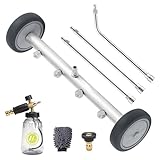
M MINGLE 16 Inch with Foam…
- Foam cannon plus 4000 PSI rinse
- Low-profile rolling wheels
- Works 1500-4000 PSI

Tool Daily 16 Inch Dual…
- Undercarriage and water broom modes
- 90-degree wand plus two extensions
- 1/4-inch quick connects

RIDGE WASHER 16 Inch
- Straight and curved extension wands
- Four nozzles and two casters
- Hot and cold water compatible
The M MINGLE takes the top slot because it is the only unit in the group that handles both halves of the job. The included foam cannon lays down pre-treatment and the same head switches to a 4,000 PSI rinse, which is exactly the pre-soak-then-spray order that forum evidence says makes these tools work. It also has the lowest rolling profile in the group, so it slips under lowered chassis without jacking the car up. Across 2,807 reviews it holds a 4.5 rating, the strongest combination of score and sample size in this roundup.
Tool Daily takes the value slot. It ships a 90-degree angled wand plus two 16-inch extensions and a pivoting coupler that flips between undercarriage mode and water broom mode with a pull and a turn, and it uses standard 1/4-inch quick connectors so it will pair with almost any gun. RIDGE WASHER rounds out the top three for anyone washing a truck or trailer: the straight and curved wand pair gives you real reach, and the body accepts hot water as well as cold.
All 8 Pressure Washer Undercarriage Cleaners Compared (October 2026)
| Product | Specs | Action |
|---|---|---|
| M MINGLE 16 Inch Undercarriage Washer with Foam Cannon |
|
Check Latest Price |
| Tool Daily Dual-Function Undercarriage Cleaner 16 Inch |
|
Check Latest Price |
| RIDGE WASHER Undercarriage Cleaner 16 Inch |
|
Check Latest Price |
 ZALALOVA Undercarriage Cleaner 16 Inch Water Broom ZALALOVA Undercarriage Cleaner 16 Inch Water Broom |
|
Check Latest Price |
 Westinghouse Universal 16 Inch Undercarriage Cleaner and Water Broom Westinghouse Universal 16 Inch Undercarriage Cleaner and Water Broom |
|
Check Latest Price |
 Siebwin Undercarriage Attachment with 6 Nozzles Siebwin Undercarriage Attachment with 6 Nozzles |
|
Check Latest Price |
 VIGRUE 24 Inch 2-in-1 Undercarriage Attachment VIGRUE 24 Inch 2-in-1 Undercarriage Attachment |
|
Check Latest Price |
 JOEJET Undercarriage Attachment with 4 Wheels JOEJET Undercarriage Attachment with 4 Wheels |
|
Check Latest Price |
1. M MINGLE 16 Inch Undercarriage Washer with Foam Cannon: Best Overall
M MINGLE 16 Inch Undercarriage Washer Attachment with Foam Cannon, 4000PSI
4000 PSI max
16 inch cleaning width
5.2 pounds
1500-4000 PSI working range
Pros
- Foam cannon and high-pressure rinse in one attachment
- Low-profile wheels that slip under low-slung chassis
- Includes a car wash mitt and extra wands for body work
- Works across sedans
- SUVs and trucks with standard fittings
Cons
- Foam and rinse modes need different nozzles
- No wrench included for the nozzle swap
This is the unit I keep reaching for because it collapses two steps into one. Most undercarriage tools do one thing, blast water. The M MINGLE carries a foam cannon and a large-aperture brass undercarriage nozzle, so you soak the underside first, let the chemistry work, then rinse without putting the attachment down. The foam blaster also doubles as a body-surface cleaner once you fit the black nozzle and one of the wands.
Its low-profile small wheels are the reason it handles lowered cars better than most of the field. You roll it under a slammed chassis at ground level instead of needing ramps or jack stands, which saves a lot of awkward positioning. Measured across 2,807 reviews it holds a 4.5 rating, and owners consistently point to the same two things: the foam-plus-rinse combination and the wheels that fit where bigger tools do not.
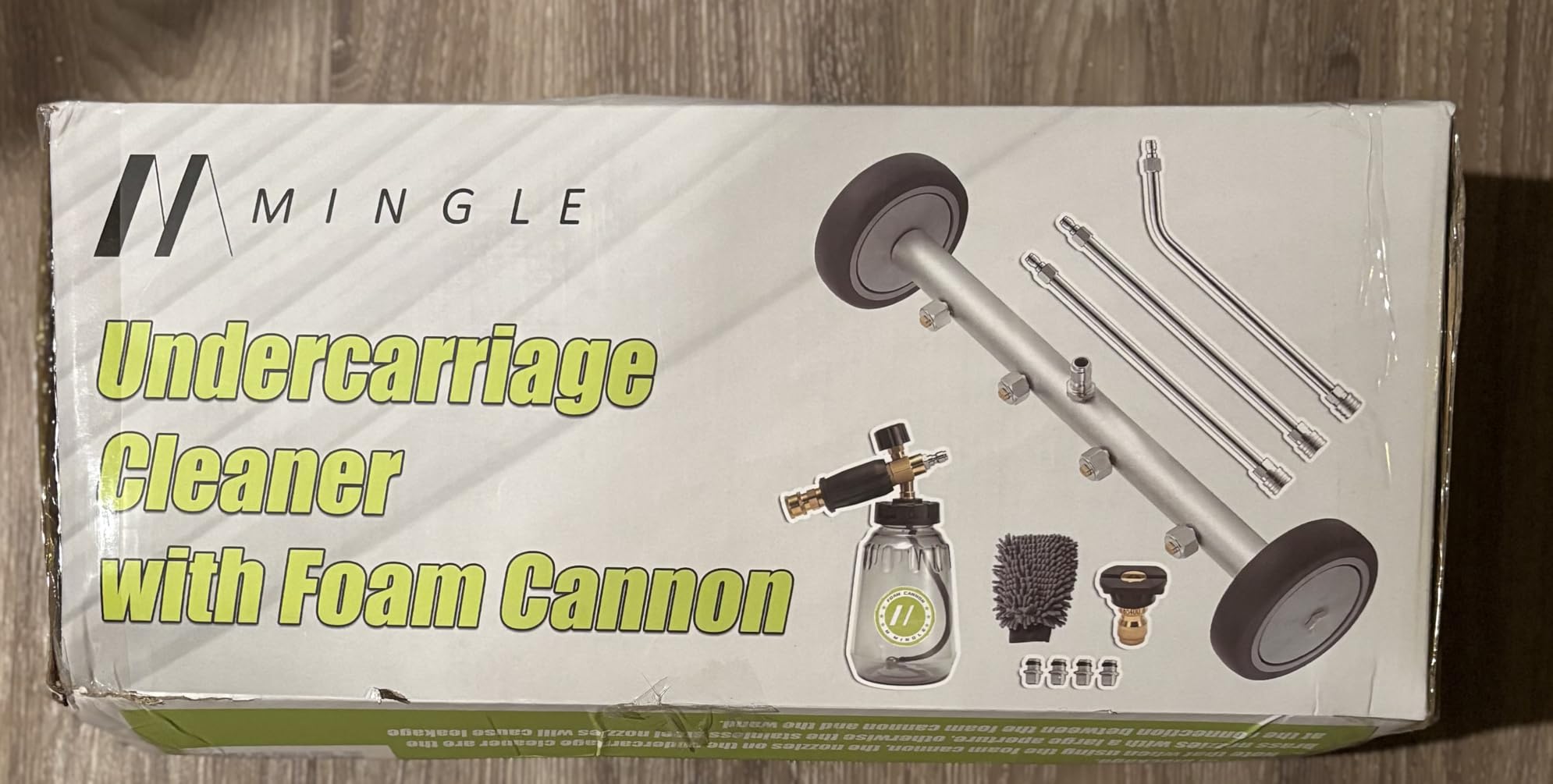
What stands out on the spec sheet is the 1,500 to 4,000 PSI working range. That is not a marketing maximum, it is a real operating band, and the manufacturer recommends 2,500 PSI or higher, which lines up with what owners report in practice. The body is 16 inches wide and the unit weighs 5.2 pounds, light enough to reposition with one hand while holding the gun in the other.
The friction point is the mode switch. Foam and rinse use different nozzles, so you physically change parts mid-wash, and no wrench is included to make that swap easier. Some owners who want both functions end up buying a second unit rather than stopping to swap. If you will only ever use the rinse, ignore this entirely, because the rinse side is the stronger half.
What PSI do you need for the foam cannon mode?
The foam cannon side of this attachment is a low-pressure function. It only needs enough flow to build and hold foam on a dirty underbody, so any working washer in the stated range will do it. The requirement comes from the rinse mode, where 2,500 PSI or higher is what turns packed road film into runoff. If your washer sits at the lower end of the range, the foam step still helps because dwell time is doing the work rather than pressure.
Is it worth it if you already own a foam cannon?
Probably not, and this is the honest limitation. If you have already got a separate foam cannon that you like, the M MINGLE still wins on its low-profile wheels and its 4,000 PSI rinse head, but you are paying for foam capability you could already access. In that case the RIDGE WASHER or the Westinghouse cover the same cleaning job with nothing left over. The foam cannon is what makes this the best all-rounder, not what makes it the best value.
2. Tool Daily Dual-Function Undercarriage Cleaner 16 Inch: Best Value
Tool Daily Dual-Function Undercarriage Cleaner 16 Inch, 3 Extension Wand
4000 PSI max
16 inch width
90-degree angled wand plus two 16 inch extensions
Dual function with pivoting coupler
Pros
- Two functions in one tool
- Angled wand plus two extensions for real reach under vehicles
- Pivoting coupler switches modes in one pull and turn
- Standard 1/4-inch quick connectors fit most pressure washer guns
Cons
- Needs a separate wand for edges and corners
- Performance drops off on low-powered pressure washers
The Tool Daily is the one I recommend to anyone who wants one attachment to earn its keep twice a week. Flip the pivoting coupler nut and it stops being an undercarriage cleaner and becomes a water broom for the driveway. Owners use it exactly that way, knocking road dirt, oil and fuel residue off trucks, SUVs, cars and trailers, then sweeping sand, leaves and light soil off concrete without switching tools.
The reach package is what sets it apart at this tier. You get a 90-degree angled wand measuring 13 inches by 3.7 inches, plus two 16-inch extensions, and the undercarriage body itself runs about 15.5 inches long and 4.9 inches high. That combination means you can lay the head flat on a flat pan and still reach into the corners of a frame rail, which is where most of the road film hides.
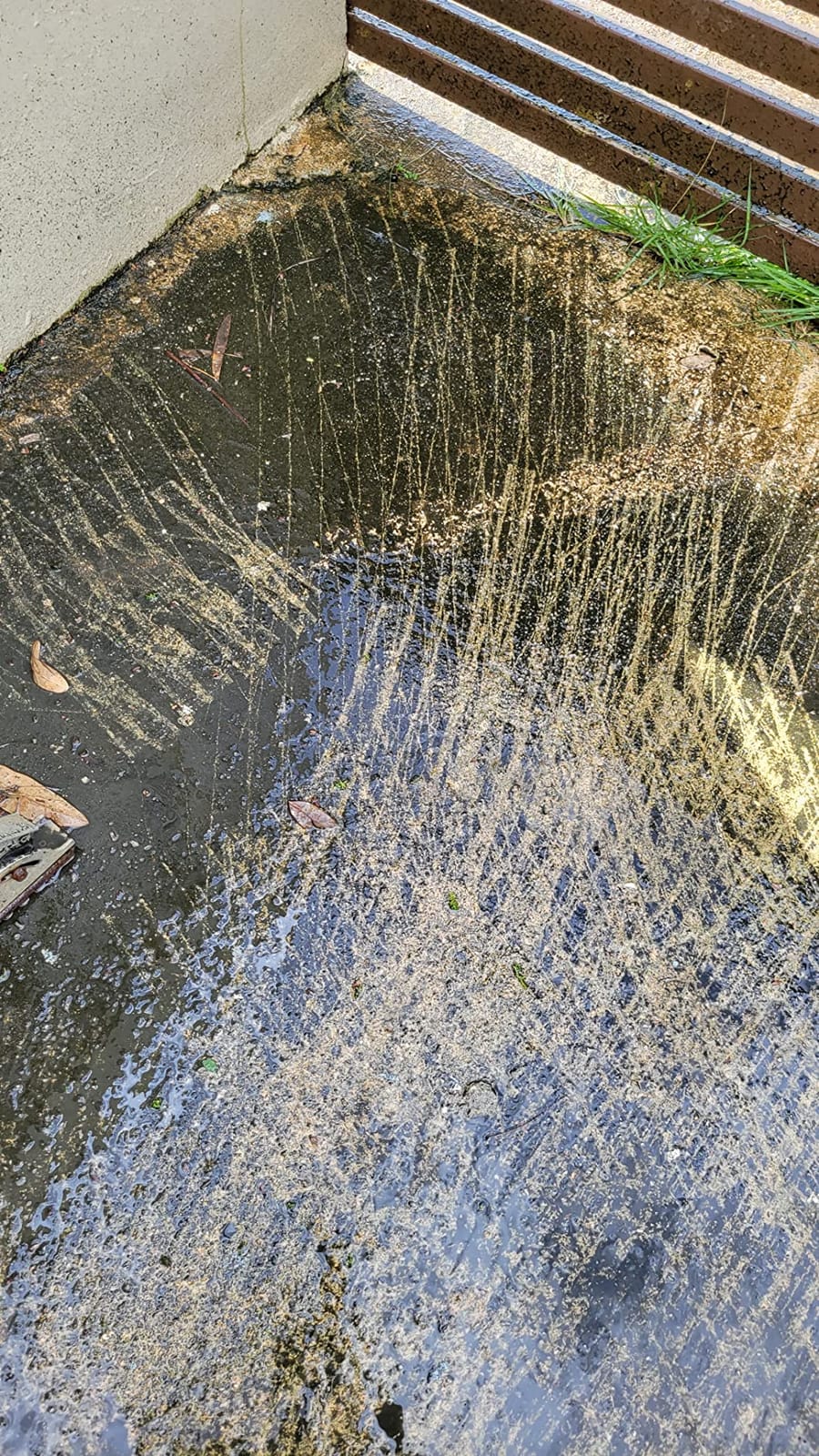
The mode switch is the part owners single out. You pull the nut out on the pivoting coupler, rotate the coupler to the opposite end, and the nut locks itself. Reviewers describe it as simple and secure, and there is no ball valve to lose or a separate fitting to track. Everything uses standard 1/4-inch quick connectors, so it will pair with most pressure washer guns without adapters.
Two honest limits. The 16-inch body cannot reach chassis edges and tight gaps, so a standard wand is still part of the workflow. And performance is tied directly to your washer, with reviewers consistently noting that a strong machine is required for the best result, which makes the 2,500 PSI guidance worth repeating one more time.
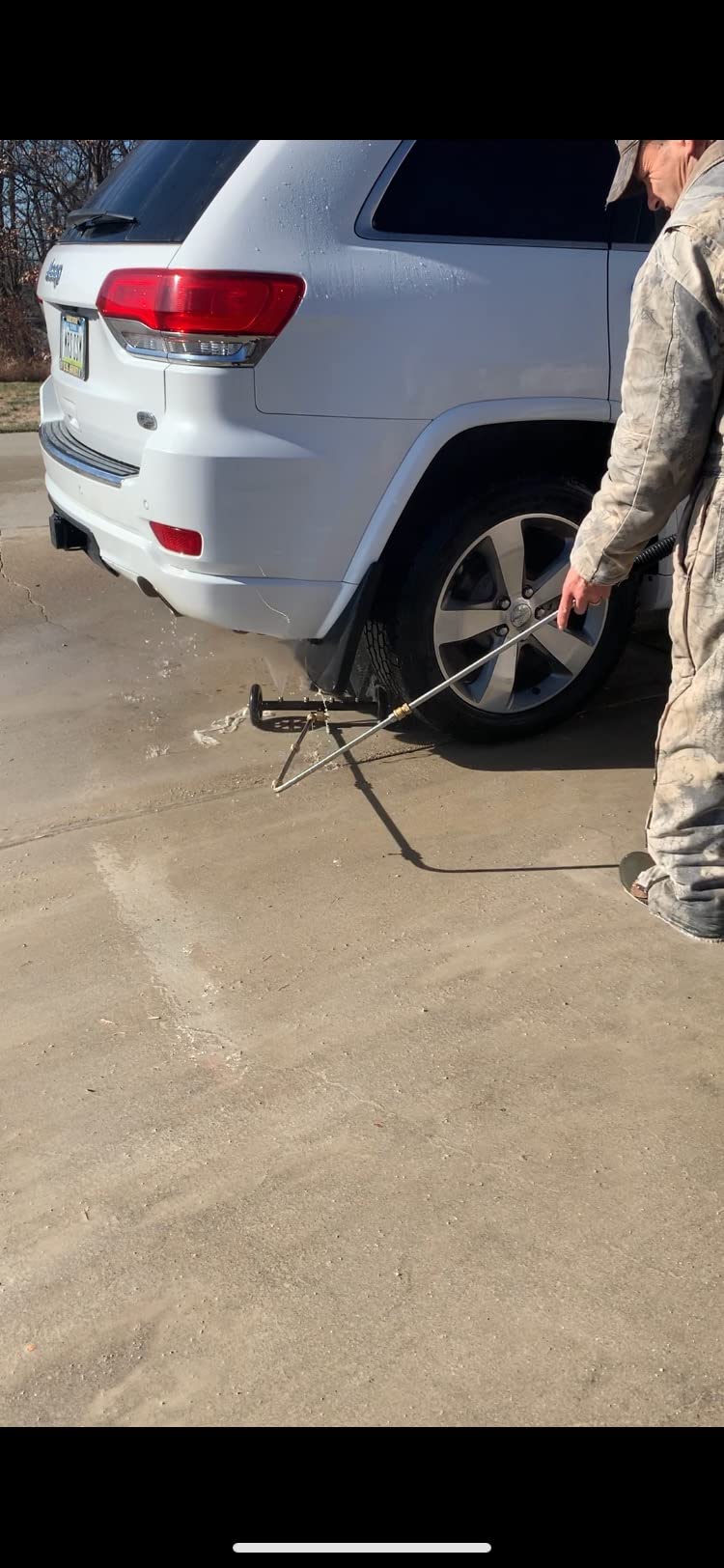
Why do you still need a normal spray wand with this?
Because the head sprays in a flat horizontal fan from a fixed nozzle bank, it can only cover surfaces parallel to the ground. Wheel arches, frame rail edges, the pinch weld seam along a rocker panel and the area right behind a skid plate all sit at angles the flat head passes straight over. A standard wand with a narrow nozzle gets into those places. Treat the Tool Daily as the broad sweeper and keep the wand for the detail work.
Is the pivoting coupler a gimmick or genuinely useful?
It is genuinely useful, and the reason is that it keeps one tool in your hand instead of two on the floor. The alternative dual-function designs make you physically reconfigure plumbing, which is where leaks and lost washers come from. A single pull-and-turn at one nut is fast enough that flipping between undercarriage and broom mode mid-task is realistic rather than aspirational.
3. RIDGE WASHER Undercarriage Cleaner 16 Inch: Best for Trucks and SUVs
RIDGE WASHER Pressure Washer Undercarriage Cleaner, 16 Inch, 4000 PSI
4000 PSI max
16.1 inch body
3 pounds
Straight and curved 15.7 inch wands
Four nozzles and two casters
Pros
- Three-piece setup with straight and curved extension wands
- Works with both hot and cold water pressure washers
- Brass and stainless nozzle sets cover soaping and rinsing
- Large over-sized body compared with similar cleaners
Cons
- Quick-connect joints add play between wand sections
- Outer jets are not angled outward so passes must overlap
- Two-piece extension arrangement is awkward to maneuver
This is the one that shows up in the r/BestPressureWasher thread as exceptional. The owner ran it on a 2,500 PSI setup and called the result exceptional while describing the same machine as little more than a gentle rinse below that number. They also credited the nozzle count for beating four-nozzle rivals and pointed to the stainless fittings for durability, which lines up with what the wider review set says.
What makes it good for trucks is the reach and the body size. The package includes a 16.1-inch undercarriage washer, a 15.7-inch straight extension wand and a 15.7-inch curved wand, and the body is deliberately larger than typical units in this category. Assembly is four steps: straight wand into the washer, curved wand onto the straight wand, then quick-connect the gun to the angled wand. The curved top section is what lets you angle the head upward into a frame rail.
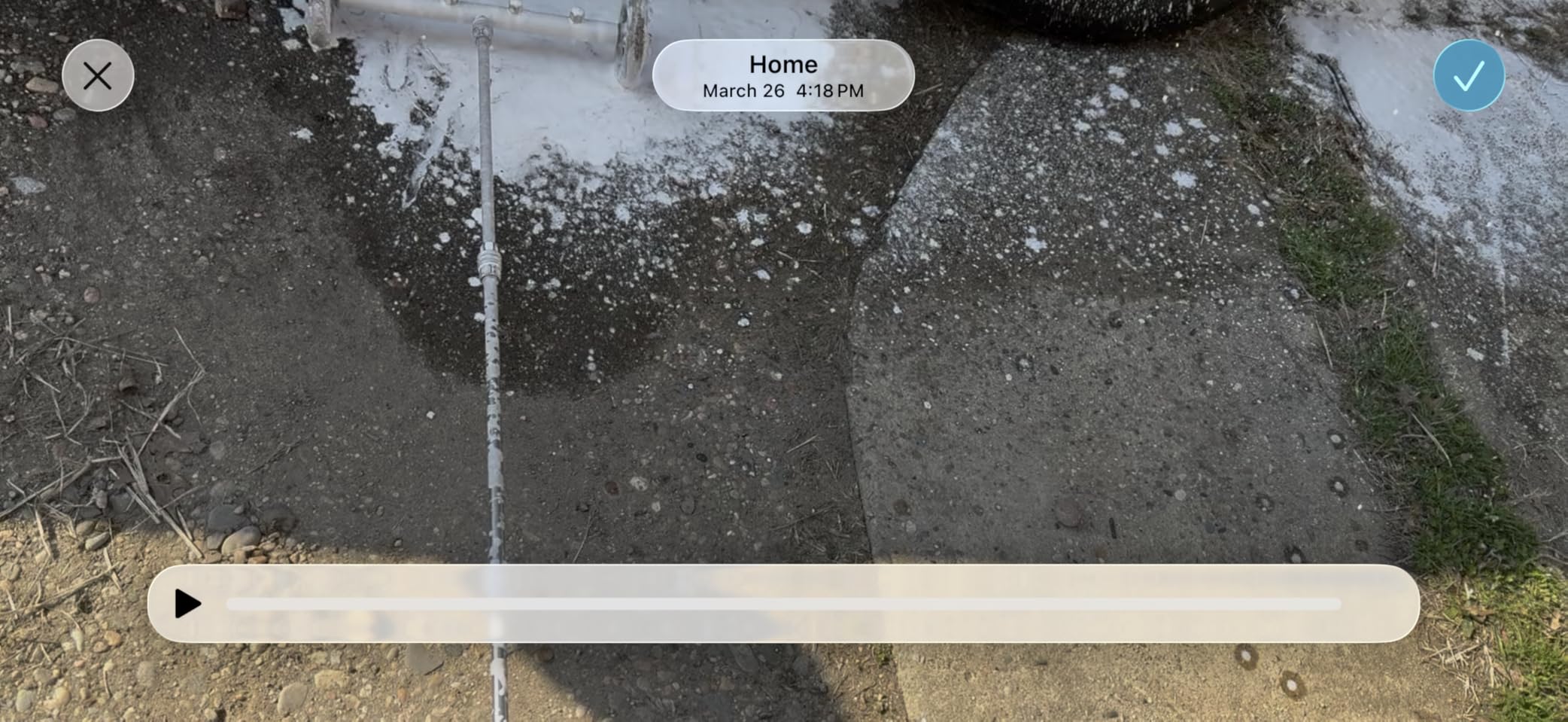
It also runs on hot water pressure washers as well as cold, which is unusual at this level and useful if you have access to a hot water unit. Two nozzle sets ship with it, brass and stainless, and owners recommend the stainless set for soaping and the brass set for rinsing. At 3 pounds it is the second-lightest body here, so repositioning under a long truck bed is manageable with one hand.
Coverage is the main caveat. The outer jets spray straight rather than fanning outward, so you have to overlap each pass by roughly half the width or you will see streaks. The quick-connect joints also add a little play between wand sections that can feel flimsy, and the two-piece extension arrangement is more awkward to maneuver than a single piece would be.
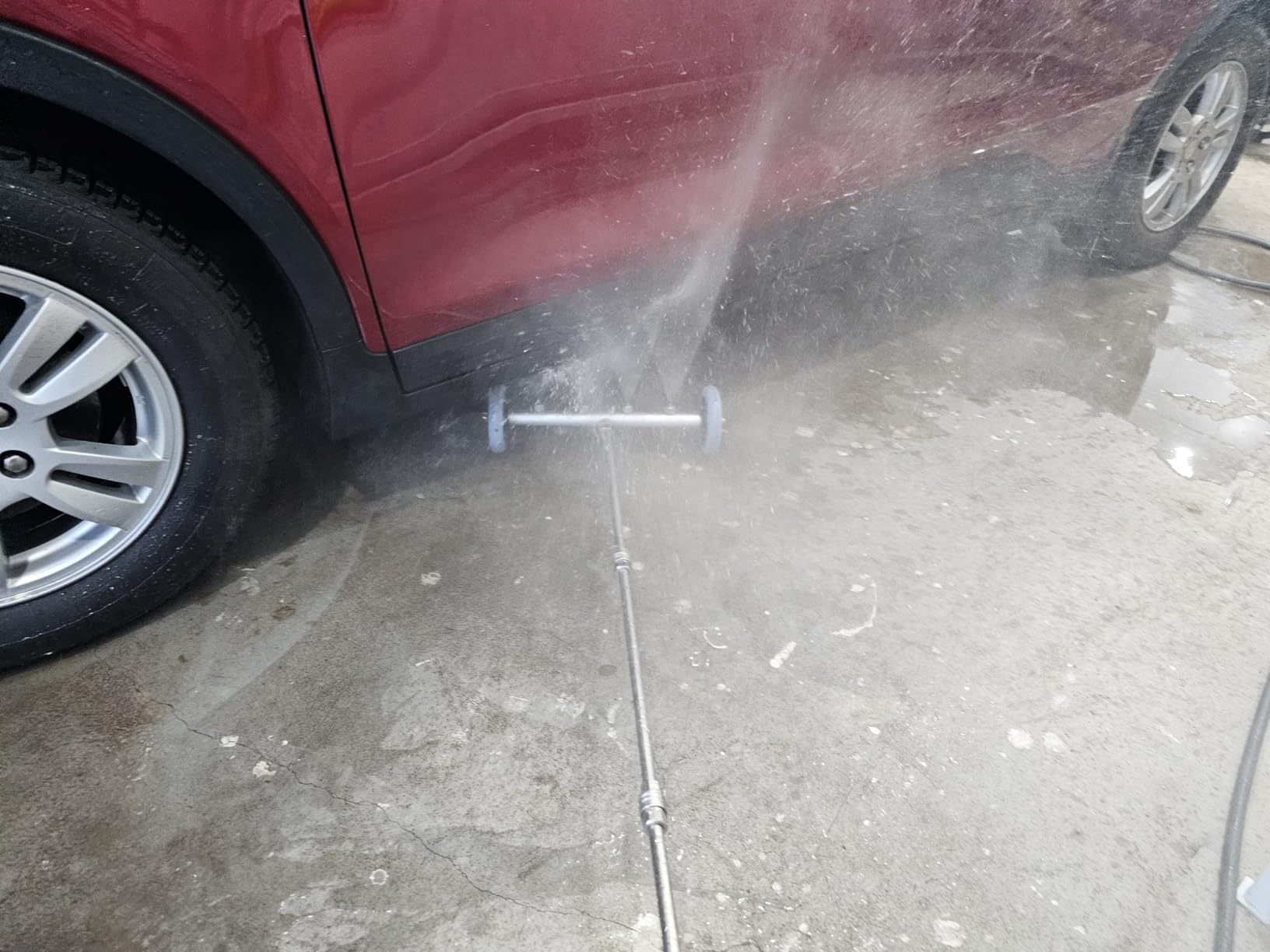
Does the curved wand change what you can reach?
It does, and it is the reason to pick this over a flat-head-only kit. The straight wand gets you under a flat pan, then the curved section angles the head back up so you can spray the underside of frame rails, exhaust tubing and suspension components from below without craning your wrist. On a truck or trailer with a deep frame that difference is the whole job, and most owners buying for a full-size vehicle specifically mention it.
Is the overlapping-pass issue a real problem?
It is noticeable, but it is a technique adjustment rather than a defect. Because the outer jets point straight ahead, the spray does not spread beyond the body width, so two side-by-side passes leave a clean stripe of dirty film down the middle. Owners who overlap by half a width get even coverage and stop noticing it. Budget for roughly a third more passes than the width number suggests, and expect streaks if you rush.
4. ZALALOVA Undercarriage Cleaner 16 Inch Water Broom: Best on a Budget
Pressure Washer Undercarriage Cleaner, 16 Inch Water Broom 4000 PSI
4000 PSI max
16 inch wand length
Blue or orange
60-degree angled wand plus two 16 inch extensions
Pros
- Mode switch is a quick pull-and-turn of the coupler nut
- Wheels roll fast and the unit flips to spray up or down
- Useful on garage floors and concrete as well as under vehicles
- Includes a 60-degree angled wand and two 16-inch extensions
Cons
- Locking pin can be hard to seat and needs the hex nut tightened
- Included adapters may be shorter than existing spray wand connectors
- No cleaning pin is included in the kit
The ZALALOVA does the same job as the tools above it for less money, and the cleaning result is generally fine. Buyers report that it reaches tight spaces, rolls easily, works with soap or plain water, and handles garage floors and concrete as well as vehicle undersides. It shares the same dual-mode layout, with a 15.75-inch cleaner body, a 17.25-inch 60-degree angled wand and two 16-inch extensions, all on 1/4-inch quick connects.
Its 4.2 rating is the lowest of the well-reviewed group, and the complaints cluster around hardware rather than performance. Multiple owners hit a locking pin that would not seat fully and needed the hex nut tightened to hold a position, and one unit arrived with metal shavings in the nozzle. That points at quality control rather than design, which is worth factoring in if you are patient with returns.
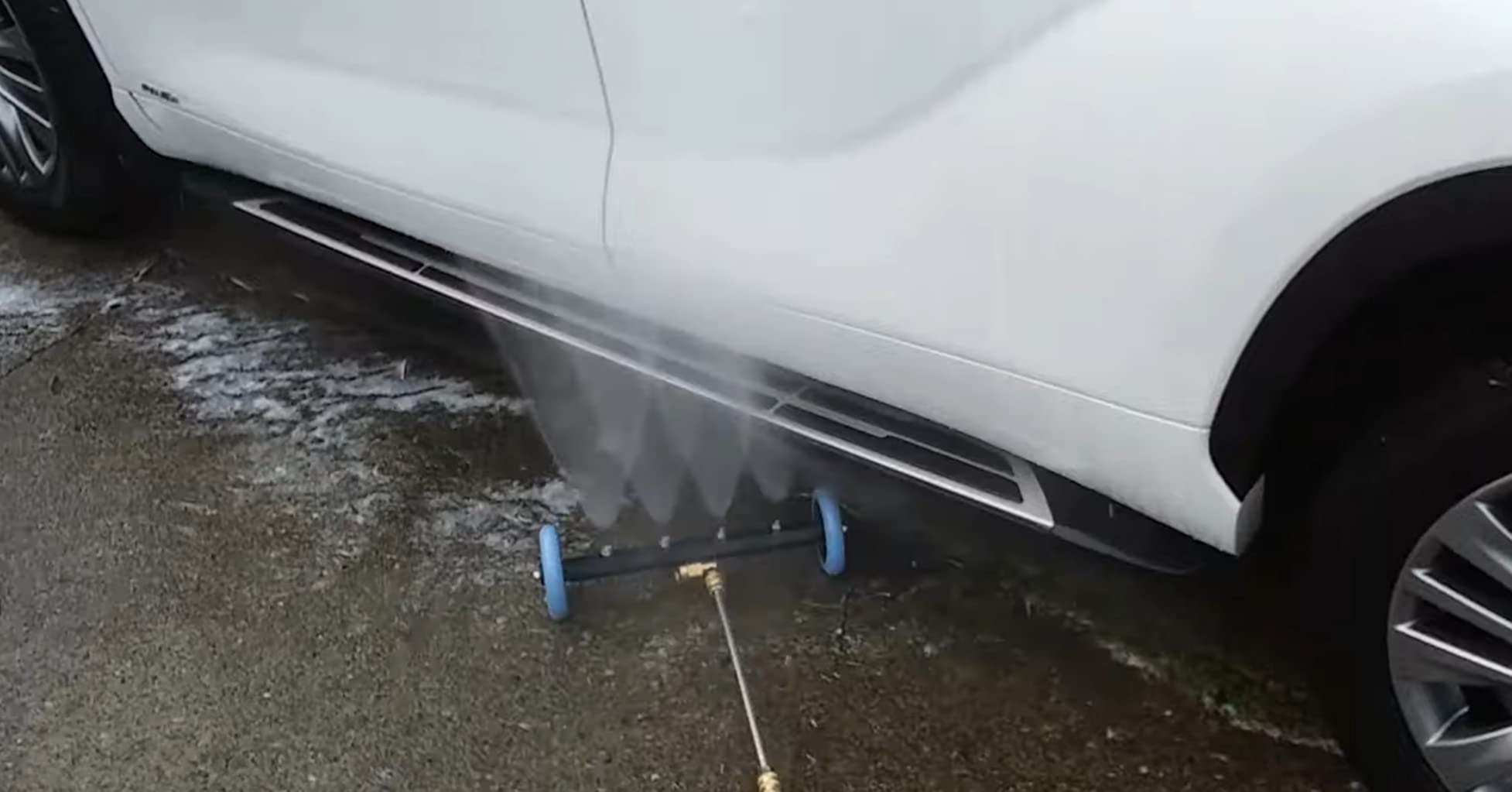
Two practical notes. First, the manifold ports block with fine sand and are not easily removable for cleaning, and no cleaning pin ships in the kit, so you will want to flush the head after every use on a gravel drive. Second, the outer jets again spray straight, so overlapping passes are needed to avoid streaking. Both are the same trade-off the RIDGE WASHER has, at a lower price.
One more constraint worth knowing before you buy: this is not a hose-end tool. It will not connect to a garden hose, a water hose or a direct faucet, and it needs a pressure washer in the 1,500 to 4,000 PSI range. If you do not own a washer, that changes the whole calculation, and you should read our undercarriage pressure washer guide first.
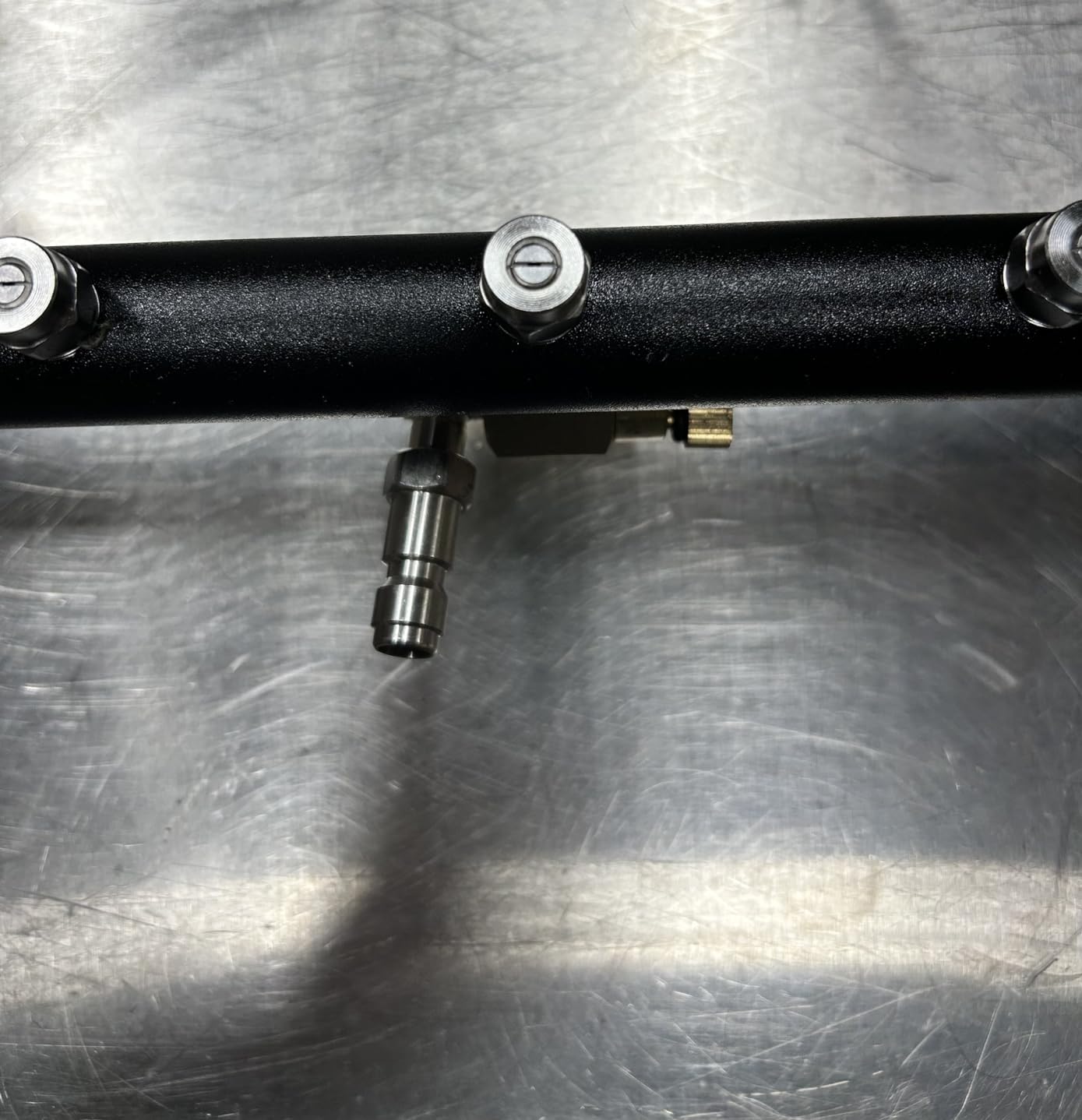
Why does sand block these nozzles so fast?
Because the jet openings are small and sit flush with the manifold face, and these tools are designed to be run along the ground where grit is the surface. A single pass over a gravel drive pushes particles into the ports, and once they start to constrict the spray fans weaken and stop overlapping. Flush the head with clean water after each use, and if you work on gravel regularly, pick a kit that ships a cleaning needle. The VIGRUE and the JOEJET both include one.
Is it worth paying more to move up a tier?
If you wash once a season in a dry climate, the ZALALOVA is a defensible choice and it does the core job. If you wash monthly through a salt season, the upgrade usually pays for itself in fittings alone, because the swivel joint is the failure point that the forum crowd reports most often on budget units. A metal body with a metal quick-connect survives repeated connect-and-disconnect cycles better than a plastic-collared one.
5. Westinghouse Universal 16 Inch Undercarriage Cleaner and Water Broom: Best Built
Westinghouse Universal 16″ Pressure Washer Undercarriage Cleaner and Water Broom Attachment – 4400 PSI, 1/4″ Connector – for Gas and Electric Pressure Washers
4400 PSI max
16.9 inch long
4 pounds
Hot water up to 194 F
180-day warranty
Pros
- Highest rating in this roundup with a 79 percent five-star share
- 16-inch width gives faster coverage than a standard wand
- 1/4-inch connector fit the washer first time with no assembly
- Handles undercarriage grime plus driveway and garage floors
Cons
- Water broom mode is redundant for some buyers
- Flat slabs still need several passes in different directions
- 90-degree wand can be straightened to a shallower angle
The Westinghouse has the highest rating in this roundup, and it comes from a long-established brand rather than a generic listing. At 4.6 across 644 reviews, with a 79 percent five-star share, it is the one I point people to when they ask which attachment will still work in five years. The 180-day Westinghouse warranty is a real differentiator in a category where most listings offer nothing at all.
It is also the most capable attachment in the group on paper. Maximum pressure is rated at 4,400 PSI, above everything else here, and it handles hot water up to 194 degrees F as well as cold, which matters if you have access to a hot water unit. Four nozzles cover the spray, and the long curved extension wand gives you the reach to get under a vehicle without crouching.
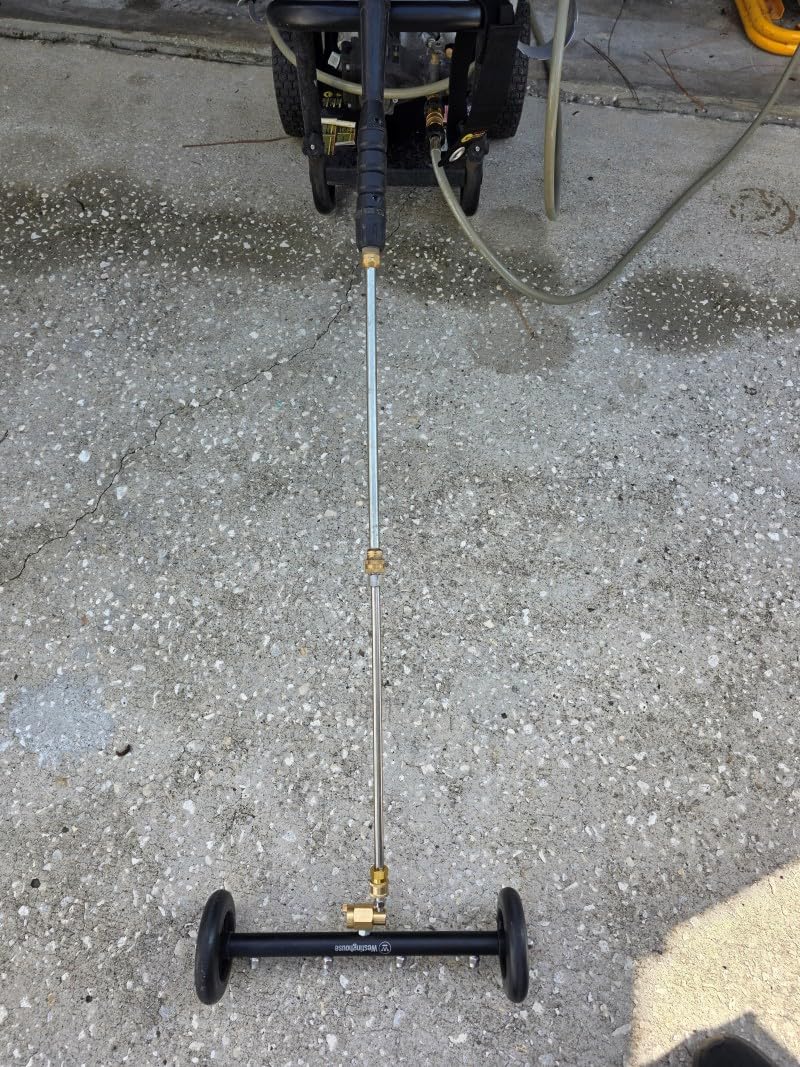
Fitment was the least frictionful of any unit we looked at. The M22 1/4-inch quick connectors worked on the first try with no assembly, and they are compatible with most gas and electric pressure washers. Off-road and sand-heavy users report that it pulls mud and beach sand out from under a body quickly enough that they can stand upright instead of lying on the ground, and one owner found the spray strong on heavy mud yet gentle enough on a painted pool deck.
Two refinements come up repeatedly. The 90-degree wand is often straightened to a shallower angle so it stops scraping the ground, which improves clearance and control. And a handful of owners say the water broom half adds little over a regular attachment for flat surfaces, which is fair, since a hose clears a driveway faster than a pressure-fed broom.
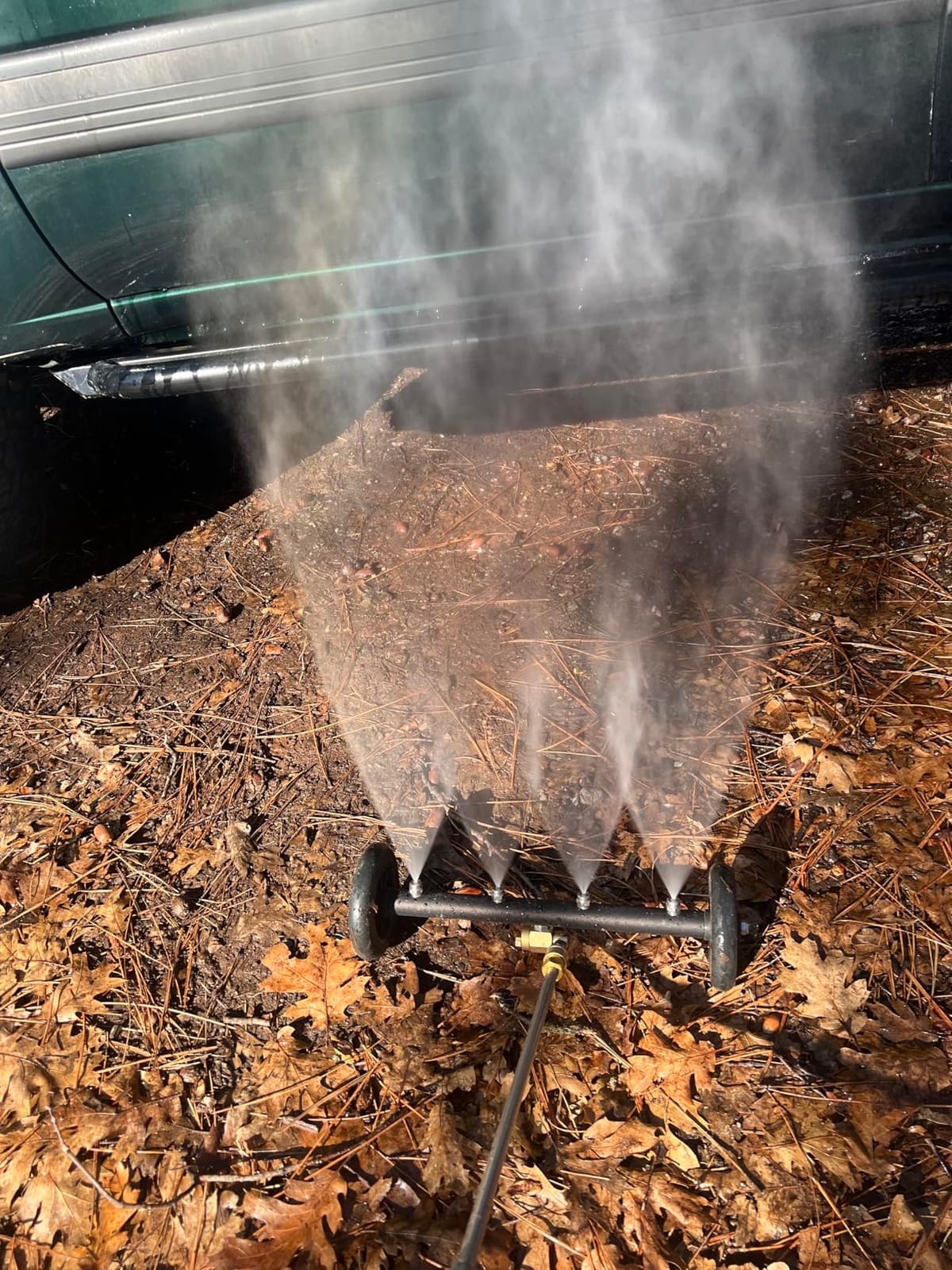
Why is the 4,400 PSI rating meaningful when your washer is lower?
Because the rating is a ceiling on what the attachment survives, not a promise of output. Every unit in this roundup is rated at 4,000 PSI or above because that is the practical maximum of consumer and gas machines, so a higher rating does not make the Westinghouse clean better than the others at the same washer. What it does tell you is that the head and plumbing are built with headroom, which is why this one tends to age better.
Is a dual-function broom worth the money here?
It is worth something, but less than the marketing suggests. The mode flip is a genuine convenience when you are already dirty and already holding the gun, since it saves the walk to the garage for a separate surface cleaner. If you already own a good surface cleaner, the broom mode will mostly sit unused. Where it does earn its place is flat garage floors with oil spots, which it handles without any chemical at all.
6. Siebwin Undercarriage Attachment with 6 Nozzles: Best Nozzle Count
Undercarriage Pressure Washer Attachment with 6 Nozzles, 16″ Water Broom
4000 PSI max
16 by 5 by 5 inches
Stainless steel body
Six stainless steel nozzles
Pros
- Six stainless nozzles give more spray than four-nozzle rivals
- Owners report cutting driveway cleaning time to about a third
- Light enough to move under a truck or trailer
- Quick-connect extensions hooked straight into existing wands
Cons
- 90-degree wand angle is too sharp for some users
- Wand joints between sections can be loose or sag
- Wand pole is reported to rust quickly
The reason buyers single out the Siebwin is the nozzle count. Six stainless steel nozzles where most competing 16-inch units ship four, and several owners credit that directly with the speed difference. Multiple people report cutting driveway cleaning time to roughly a third of whatever they used before, because a denser spray pattern covers more ground per pass. For undercarriage work the same logic applies, just over a smaller surface.
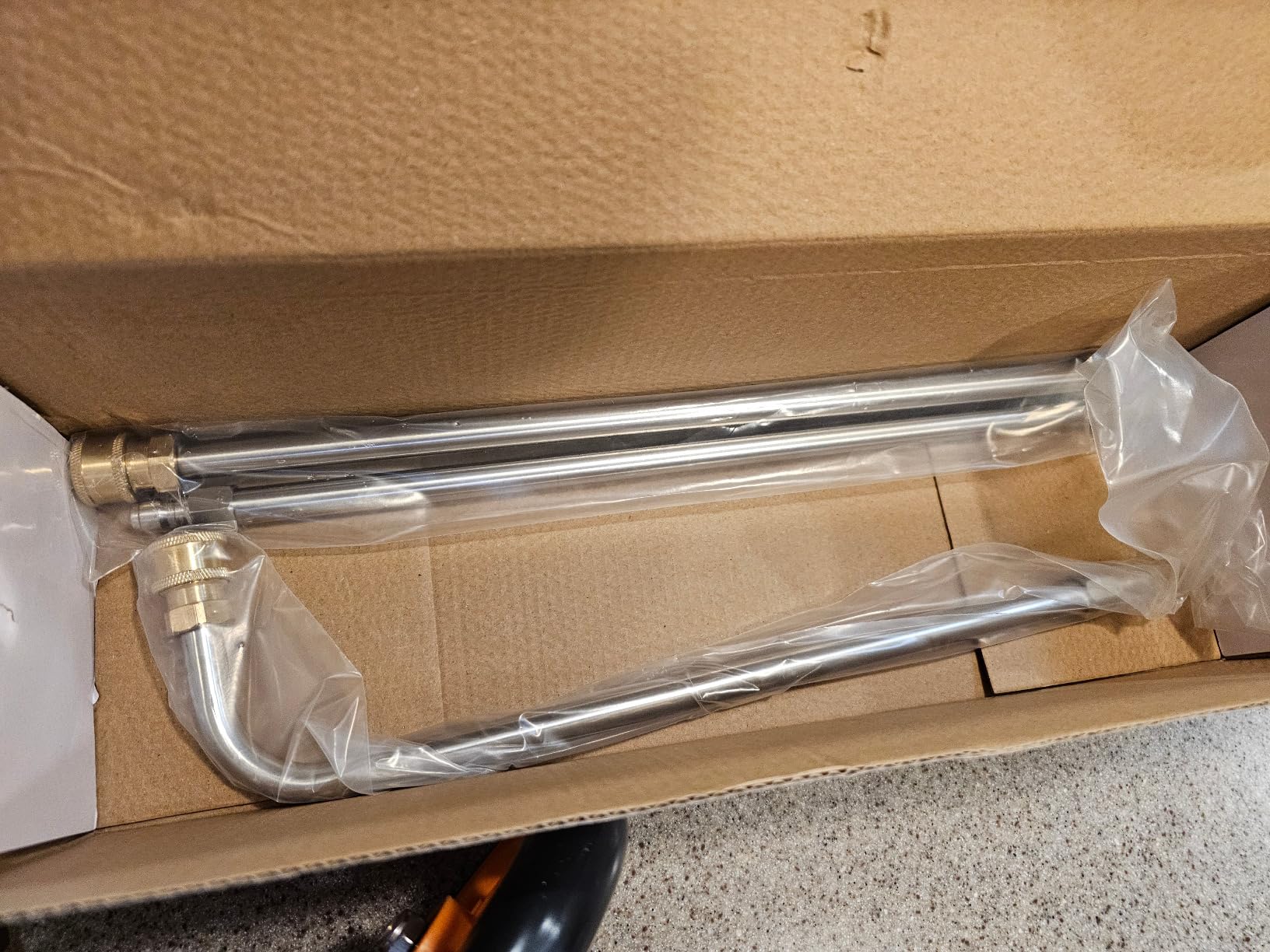
It is a dual-mode design as well, switching from undercarriage cleaning to water broom with a rotating connector nut that locks automatically once you turn it. The package includes two 16-inch straight wands and one 13.5-inch 90-degree curved wand with quick connect plugs, plus an instruction manual and an operation video. Operating range is 1,500 to 4,000 PSI with 2,500 or higher recommended, the same guidance as the rest of the field.
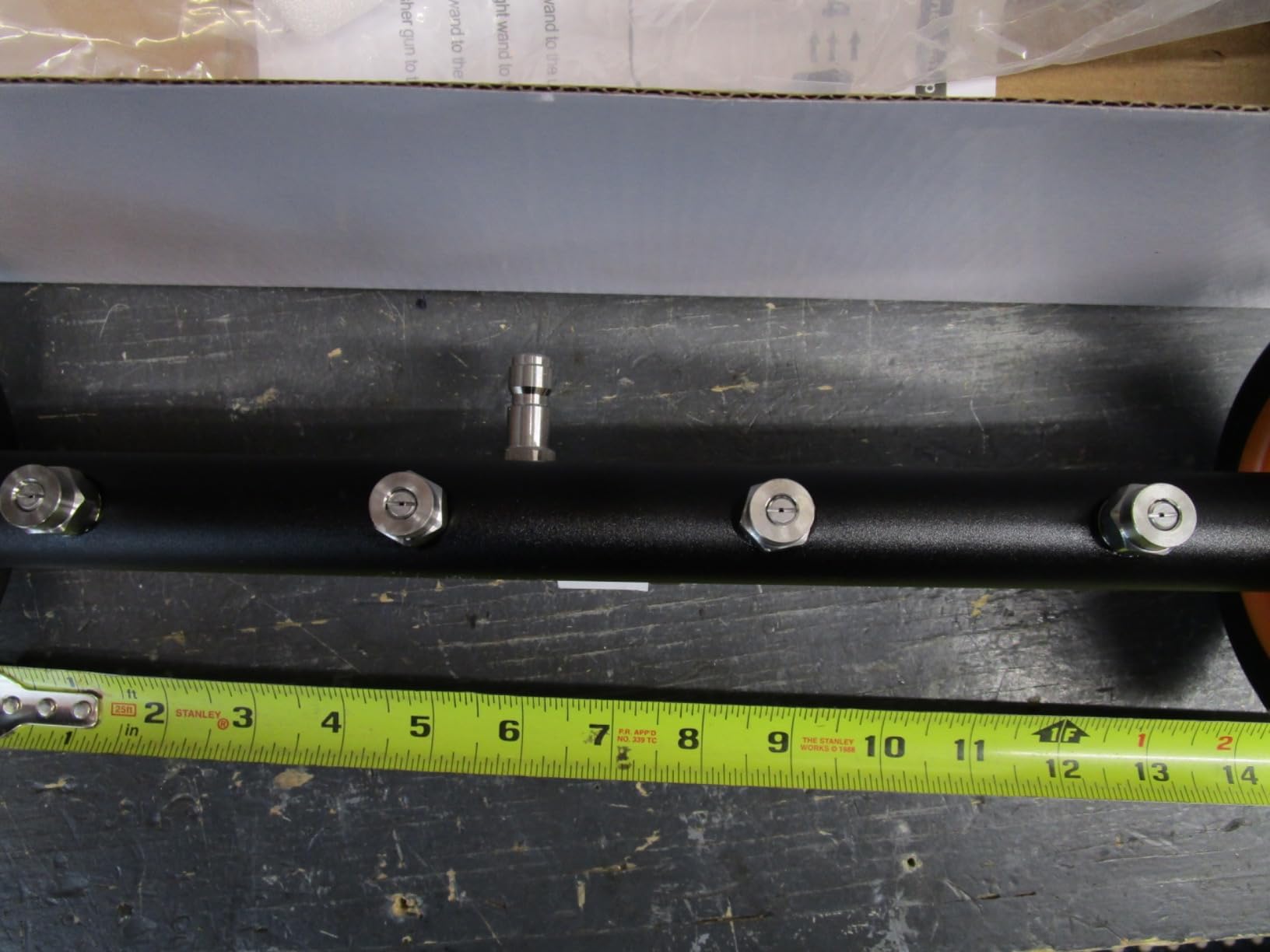
The complaints here are mechanical rather than cleaning-related, which is an unusual split. Owners report that the wand sections between included pieces can feel loose, bend or sag, and that the 90-degree bend is too sharp an angle for some setups, with a preference for working it closer to 45 degrees. One owner’s standard pressure washer collar would not accept the supplied wands without modification, so check your collar before you commit.
There is also a rust report on the wand pole, which matters more than it sounds in a category where the tool lives in a damp garage or on a salty driveway. If you store it outside or rinse it with road salt water, dry the pole properly. A handful of owners also found the pressure insufficient for deeply embedded dirt, which again comes back to washer strength rather than the head.
Do six nozzles actually clean better than four?
They clean faster over a wide flat area, and that is the honest answer. More nozzles mean a denser pattern and better coverage per pass, which shows up clearly on driveways, decks and pool surrounds. Under a vehicle the gain is smaller because you are working in a narrower band and the surface is not flat. The added nozzles also split the available flow, so on stubborn grime you may still need a second pass rather than a single pass that works better.
What should you check before buying a wand-heavy kit?
Check whether your pressure washer collar will accept the supplied quick connect plugs, because this is the most common compatibility complaint in the group. Some collars need modification, and some users found their existing wands would not take the included adapters. Confirm the wand length you need against your ground clearance as well, since a 13.5-inch curved section plus two 16-inch extensions gives a reach very different from a shorter kit.
7. VIGRUE 24 Inch 2-in-1 Undercarriage Attachment: Best Wide Coverage
VIGRUE 2-in-1 Undercarriage Pressure Washer Attachment,24 Inch Pressure Washer Water Broom with 7 Nozzles, Under Car Washer Cleaner with 3 Pieces Extension Wand,4000 PSI,Orange
4000 PSI max
24 inch cleaning width
Seven stainless nozzles
Aluminum frame with brass fittings
Pros
- Widest cleaning swath at 24 inches with seven nozzles
- Slides under trucks
- SUVs and RVs without crawling underneath
- Smooth wear-resistant wheels and tubes
- Three-piece wand can be shortened when less reach is needed
Cons
- Nozzles cannot tilt enough to overlap their spray fans
- Extension wand bends easily and is not robust
- Pivot point can drag if the detent pin is not set precisely
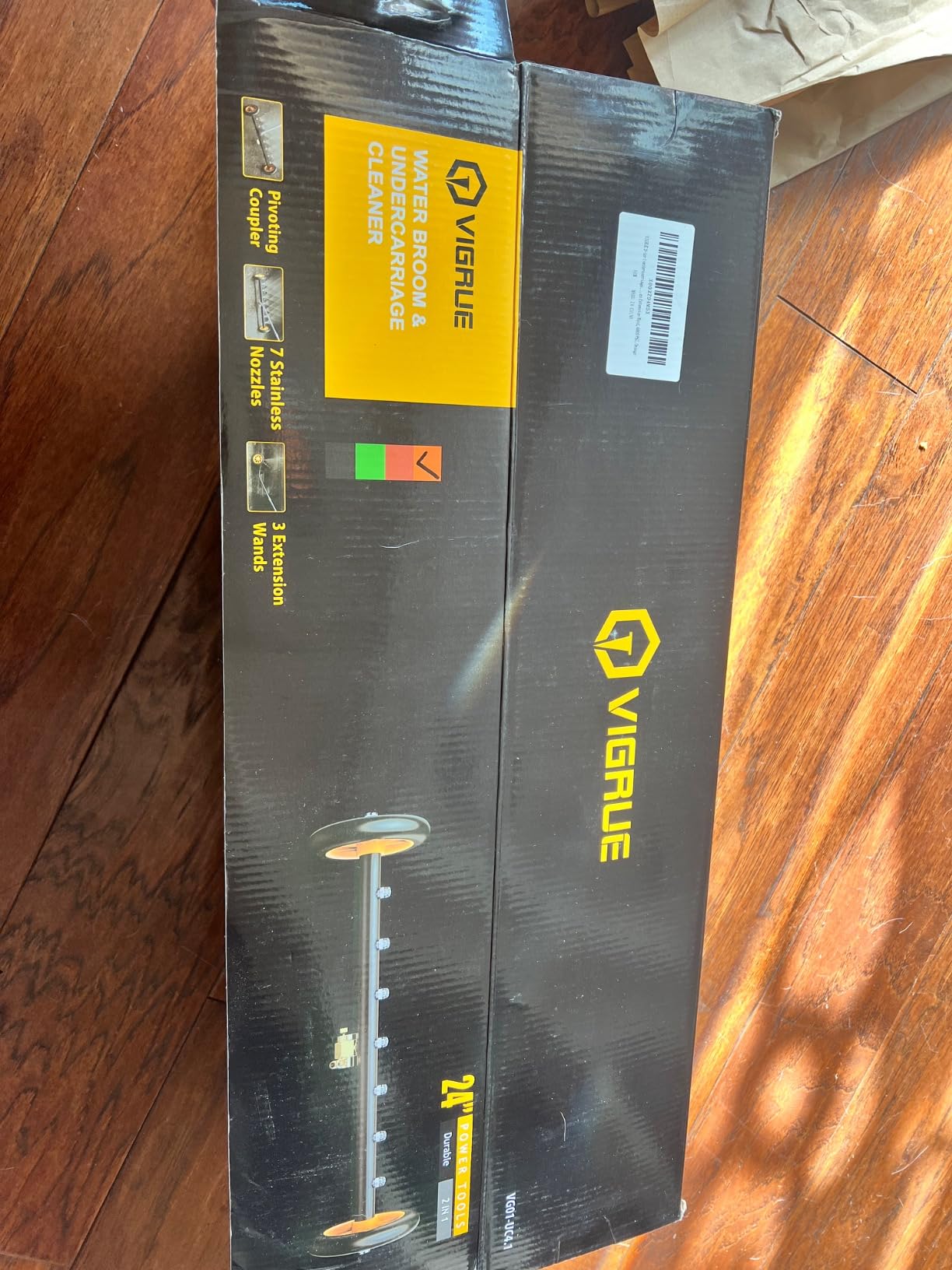
The VIGRUE is the width play in this group, and the r/trustyconsumer reviewer of this 24-inch unit reported strong results on a 3,200 PSI gas washer while stating the tool operates best above 2,500 PSI. That matches the pattern across the whole category. At 24 inches with seven upgraded stainless nozzles, it covers roughly 50 percent more width per pass than a 16-inch unit, and users finishing a pool area or large patio report cutting that job roughly in half.
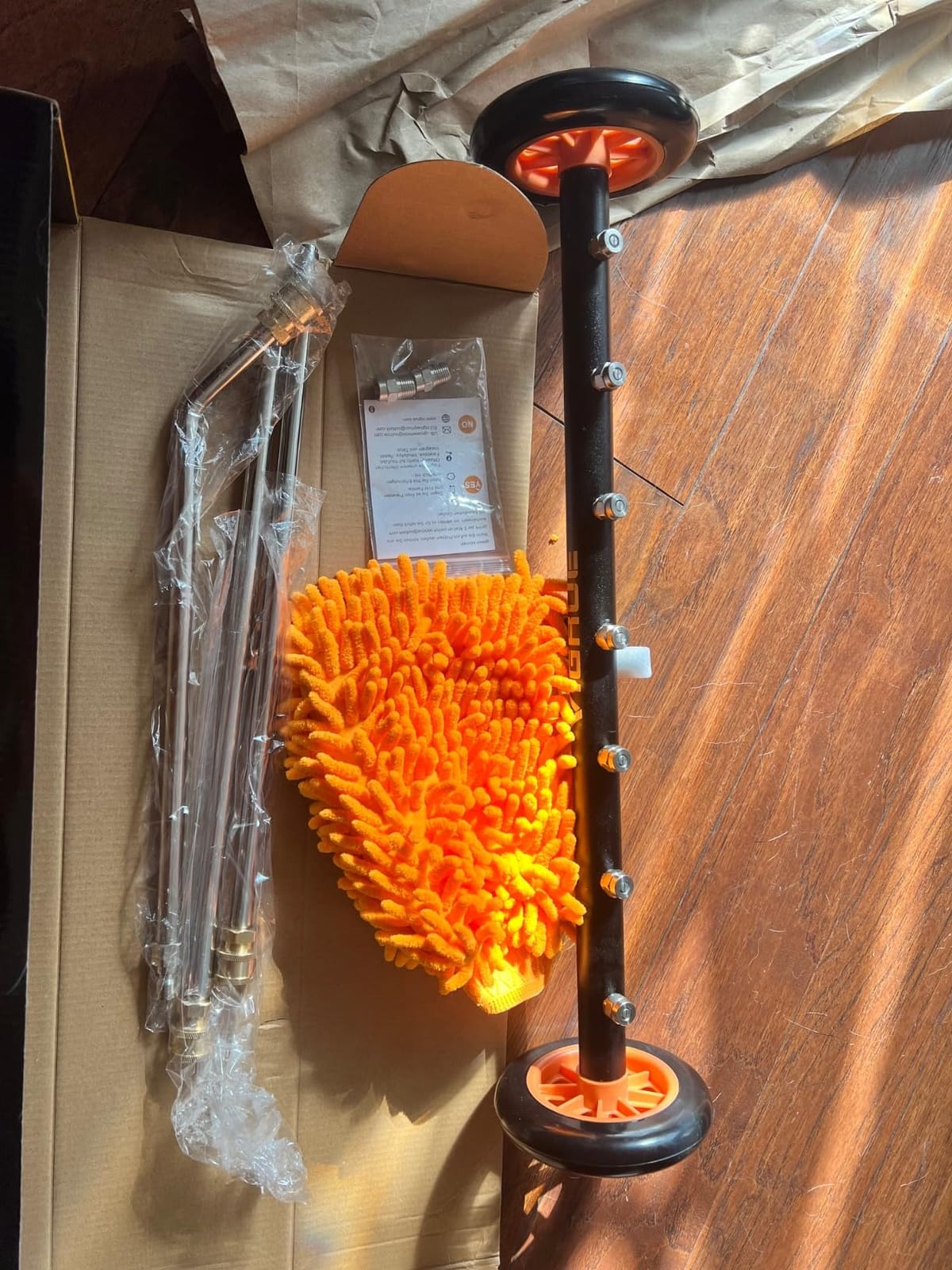
The build is the most premium in the roundup. A rigid aluminum frame with industrial brass fittings is a different materials story from the plastic-collared budget tools, and owners repeatedly praise the smoothness of the wheels and tubes. The package also includes an anti-clog needle, which matters more than it sounds on a tool this wide, plus a wash mitt and three extension wands with 1/4-inch quick connect plugs giving about 3 feet of extension.
The mode switch is a pivoting coupler that flips the nozzles up for chassis cleaning or down for sweeping debris, which is the same mechanism the Tool Daily and Siebwin use. It works well in principle, but the detent pin needs to be set precisely or the pivot point drags on the ground. Owners also note the swivel handle moves when the unit is stopped or started, with no way to lock its position, which is a small annoyance that shows up when you are repositioning under a vehicle.
The real trade-off here is coverage against pressure. Seven nozzles spreading the flow means each fan is weaker, and the nozzles cannot tilt forward enough to overlap, leaving clean lines and dirt bands between them. Stubborn grime may need a second pass. At 2.31 kg it is also a substantial tool to lift, so the 24-inch width is a genuine workout for anyone working under a car rather than across a patio.
Is a 24-inch swath worth it under a vehicle?
Under a vehicle, width helps more than people expect, because you are covering a long narrow strip and a wider head means fewer back-and-forth strokes on a surface that is awkward to work from. The bigger win is on flat slabs, where a 24-inch head on a pool deck or driveway genuinely halves the job. If your undercarriage work is occasional and your driveway work is frequent, the width pays for itself in the driveway.
Why do the fans not overlap?
Because the nozzle bank is rigid and the nozzles point straight out rather than angling toward each other, so each fan ends at the edge of its own port with a thin dead strip between neighbours. The result is a repeating pattern of clean stripe and dirt stripe as you sweep. You can work around it by overlapping passes more aggressively than you would on a fanned head, but it does mean the seven-nozzle layout trades impact for width rather than adding both.
8. JOEJET Undercarriage Attachment with 4 Wheels: Best Maneuverability
JOEJET Undercarriage Pressure Washer Attachment with 3 Extension Wands
4000 PSI max
14 inch cleaning width
7.3 pounds
Stainless steel body
Four 360-degree wheels
Pros
- Rotating high-pressure jets clean stronger than fixed nozzles while using less water
- Four 360-degree wheels steer around obstacles instead of moving in straight lines
- Stainless steel body with a heavy-duty bearing system
- Most complete kit in the group with extra nozzles and O-rings
Cons
- 14 inch width is narrower than the 16 and 24 inch options
- Heaviest unit here at 7.3 pounds
- Standard spray wand still needed along chassis edges
The JOEJET is the one to buy if steering is your problem. Four 360-degree rotatable wheels let you move in any direction instead of only travelling in a straight line, and that is the single most praised feature in its reviews. On gravel, dirt or a sloped drive where caster-equipped tools fight you, being able to pull the tool sideways toward you rather than backing it up is a genuine ergonomic difference.
It is also the only one here with a different jet design. The dual high-pressure jets spin rapidly, which delivers more cleaning power than a conventional fixed spray-nozzle undercarriage washer while using less water. The body is stainless steel with a heavy-duty bearing system, described as rustproof and corrosion resistant, and at 4000 PSI maximum with 2500 recommended it matches the field standard.
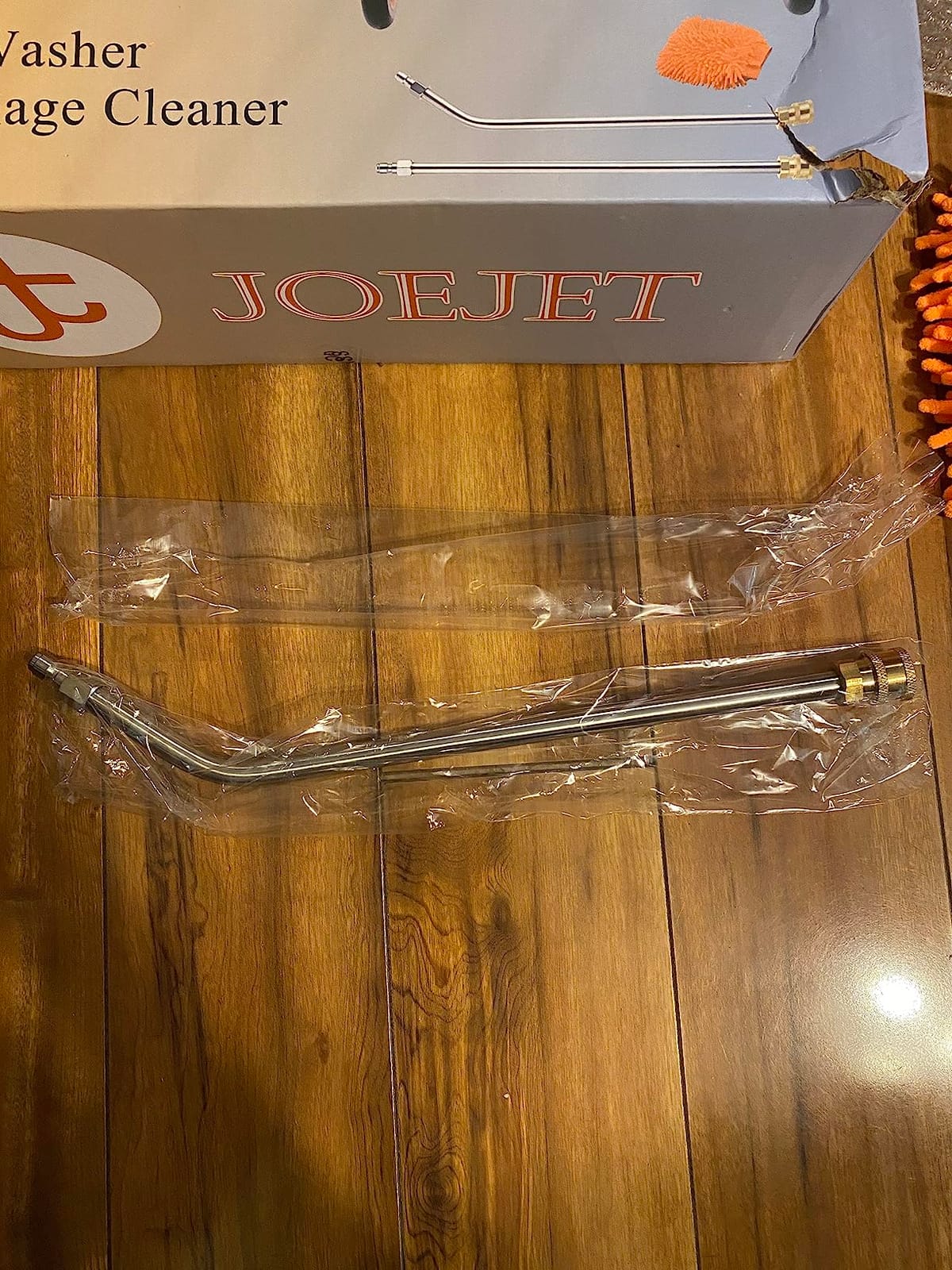
The kit is the most complete in the roundup by a wide margin. It ships a 14-inch undercarriage washer, a 30-degree stainless steel rod, two 17-inch straight stainless rods, four O-rings, two extra nozzles, a raw material band and a small cleaning needle. Those spare O-rings and the needle are small things that decide whether a tool still works in three years, since the swivel joint is the failure point the forum crowd reports most often on cheaper units.
Width is the compromise. At 14 inches it covers less per pass than the 16-inch and 24-inch options, so you make more strokes over the same frame, and it still needs a standard spray wand for chassis edges and narrow gaps. At 7.3 pounds it is the heaviest unit in the group, which is a fair trade for the stainless build and the ball-bearing steering.
Do the spinning jets really clean more than fixed nozzles?
Owners report more cleaning power and noticeably lower water consumption than fixed-nozzle undercarriage washers, and the spinning action is the mechanical reason. A jet that rotates sweeps a wider arc of the surface per second than a stationary one, so the same flow covers more ground. The trade-off is that the total coverage width is narrower here, so you get a stronger but smaller swath, which is why the 14-inch figure is the main complaint.
Are four wheels worth more than two?
It depends entirely on your ground. On flat concrete, two wheels are enough because you naturally sweep side to side, and one Autopia poster who ran a wheeled tool on a salt-and-snow-laden truck judged the wheels possibly unnecessary given that natural side-to-side motion. On gravel, dirt or a slope, four 360-degree wheels are the difference between repositioning the tool and wrestling it.
How to Choose a Pressure Washer Undercarriage Cleaner
Match the attachment to your pressure washer first
Every tool in this roundup is rated for a working range that tops out at 4,000 PSI or above, and every one of them says the same thing: 2,500 PSI or higher. That number is not marketing, it is the recurring figure in owner reports across multiple forums. A user in r/BestPressureWasher called a tool exceptional at 2,500 PSI and a gentle rinse below it, and a second owner in r/trustyconsumer set the same threshold on a 3,200 PSI gas machine.
So the question is not whether the attachment is good, it is whether your washer clears the bar. A compact electric unit in the 1,500 to 2,000 PSI band will run any of these tools, and you will get a rinse rather than a clean. A gas machine or a high-output electric in the 3,000 PSI range will make the tool feel like a different product. If you are still choosing a washer, our guide to the best pressure washers for undercarriage cleaning breaks down which classes hit which bands.
Measure your ground clearance before you buy
Almost nobody does this, and it is the most common reason a good tool ends up useless. Park on level ground, take a tape measure, and put it under the car at the lowest point of the chassis between the wheels. That figure is your real limit. Add the height of the attachment body itself, because a tool with a 5-inch tall frame will not pass under a 5-inch gap even if the measurement technically matches.
For context, the bodies in this roundup run about 4.9 inches high for the Tool Daily, 5.1 inches for the Westinghouse, 5 inches for the Siebwin and JOEJET, and the M MINGLE uses deliberately small low-profile wheels to get under a low-slung chassis without jacking the vehicle up. Lowered cars with four inches or less between you and the pavement need the low-profile pick, and honestly, even then you may be better off with ramps than a squeeze.
Decide between wheeled and non-wheeled designs
Wheels are the deciding factor for most people, and the reasoning is about your back rather than your wallet. The single most cited advantage of a wheeled design in forum threads is that it takes stress off the lower back by letting you stand and push rather than lie on a driveway and sweep by hand. That is worth a real premium if you are doing this monthly through a salt season.
The counter-argument is real. A poster on the Autopia thread ran a wheeled undercarriage tool on a salt-and-snow-laden truck, got a flood of dirty salt water off with zero scrubbing, and still judged the wheels possibly unnecessary because the natural side-to-side sweeping motion does the same job. If you only clean twice a year on flat concrete, a plain head with good extension wands is enough. If you are on gravel or do it often, wheels are close to mandatory.
Look at nozzle count, wand length and fittings
Nozzle count is the clearest differentiator between tiers. Four nozzles is the baseline, six on the Siebwin, seven on the VIGRUE, and more nozzles means faster coverage on wide flat surfaces because each fan covers more of the pass. The trade-off, as the VIGRUE owners note, is that the flow is spread thinner, so deeply embedded grime still needs a second pass.
Wand length decides how deep you can reach, and the kits in this roundup range from a 13-inch angled wand plus two 16-inch extensions to three wands giving about 3 feet of total extension. The 90-degree curved section is worth more than raw length, because it lets you angle the head upward into frame rails instead of only spraying flat pans. Fittings matter too: standard 1/4-inch quick connectors appear on nearly everything here, with the Westinghouse using M22 1/4-inch, and a threaded collar that will not accept the supplied plugs is a return you do want to avoid.
Understand the four attachment types
Water broom and undercarriage cleaner are often treated as synonyms in listings, and understanding the difference saves money. A dedicated undercarriage cleaner sprays a horizontal fan and is built low and narrow to pass under a vehicle. A water broom does the same job on flat surfaces, which is why most of these tools flip between the two modes with a pivoting coupler. A hose-end tool runs on tap pressure with no washer, and a forum veteran reports using one for over 35 years with brushes as the main workhorse.
A dedicated wheeled cleaner is the fourth option, and it is the one that gets closest to a professional setup with a dedicated frame, wheels and rotating jets. It is also the category the Autopia enthusiast community built its own tools around. For a homeowner, the dual-mode attachment is the value play because you get both jobs from one tool, and that is why seven of the eight products here are dual-mode.
Undercarriage Washing Safety: What Not to Spray
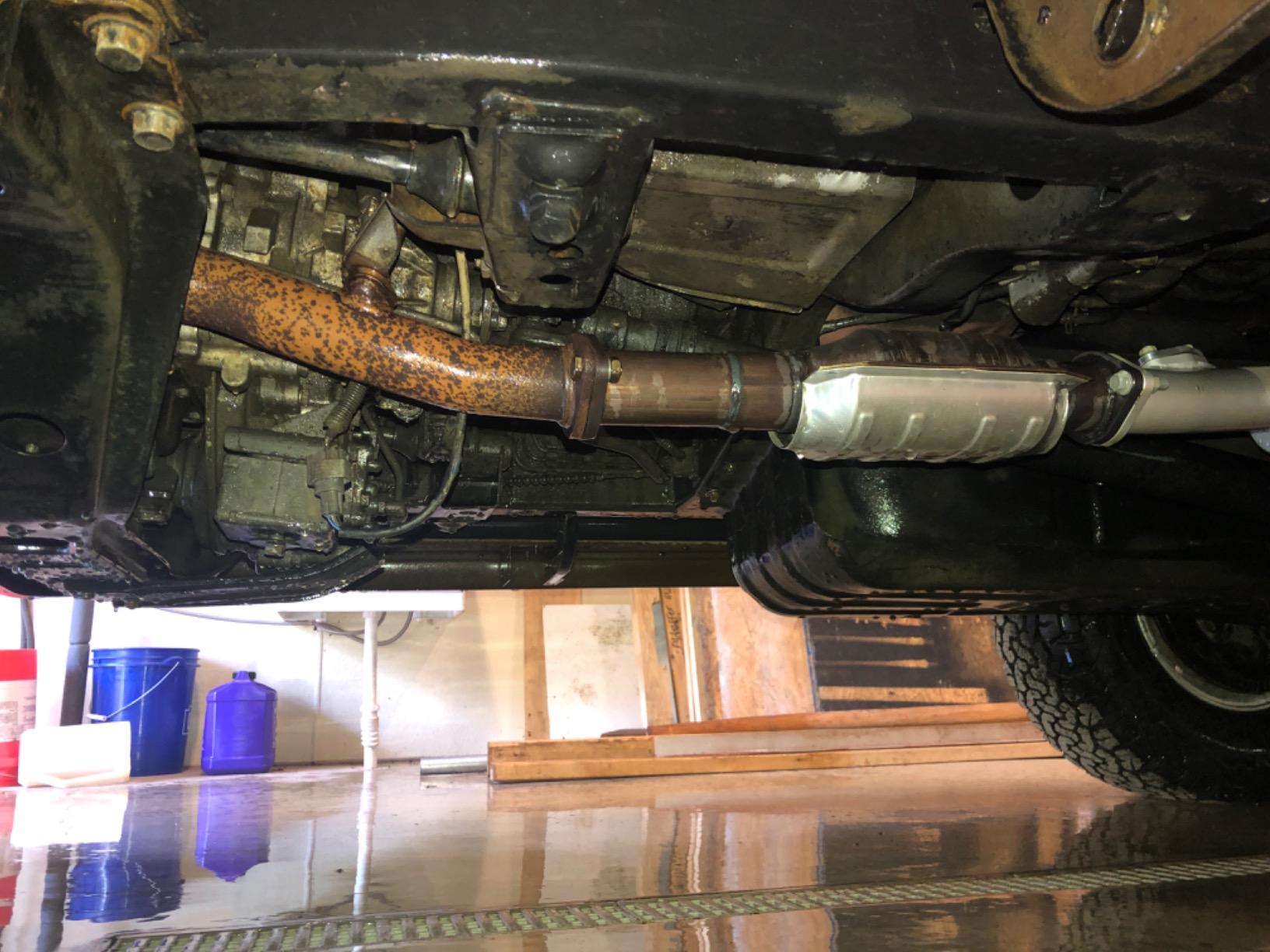
Yes, undercarriage pressure washers are safe, provided you know which zones to leave alone and you never spray a connector, a boot or a bearing seal at close range. Water ingress into a CV boot, a wheel bearing or an electrical connector is the one failure that turns a cleaning job into a repair bill, and it is entirely avoidable by pointing the fan at dirt rather than at seals.
The never-spray list covers CV axle boots, wheel bearings, the exhaust and catalytic converter, wiring harnesses and electrical connectors, painted surfaces, and any plastic underbody trim. Aim at frame rails, subframes, suspension components, brake lines and the flat floor pan. Keep the nozzle moving, keep your distance, and use the wider flat spray rather than a concentrated jet whenever you are near a seal or a connector.
One habit from the Autopia thread is worth adopting immediately. Before you pull the tool out from under the vehicle, close the gun shutoff valve first, because an open trigger while withdrawing means you soak yourself and the driveway. Then rinse the underside with clean water, drive the vehicle around for a few minutes, and let it dry, because trapped salt solution crystallises inside frame cavities and keeps attacking metal long after the wash is over.
Rinse-to-prevent-salt-crystal is the step people skip. Once the underbody is clean and dry, a rust inhibitor spray gives you an extra layer against the next winter, and we have a dedicated guide to the best rust inhibitor sprays for undercarriage use that covers timing and coverage.
How to Use It: Pre-Soak, Raise, Sweep, Rinse, Dry
The attachment cannot do the job on its own, and this is where most disappointment comes from. An undercarriage cleaner moves water, it does not loosen caked-on oil, so the chemical step is what makes the difference. The order below is the sequence that owner reports back up, and it is why the foam cannon configuration on the M MINGLE outperforms attachments without one.
Pre-soak with a degreaser. Park on level ground with the vehicle cold, spray a good automotive degreaser or an all-purpose cleaner onto the underside, and leave it for the dwell time on the label. An APC pre-soak is what breaks the bond between road film and metal.
Raise the vehicle safely. Use ramps or rated jack stands if your ground clearance allows. Never work under a vehicle held only by a jack.
Sweep with the attachment. Attach the wand, start at the rear and work forward, overlapping each pass by about half the width. Keep the head flat and the fan aimed at surfaces, not at seals.
Foam if the tool has it. Flip the mode, work the foam cannon over the frame, let it dwell, then flip back for the rinse. This is the step that makes one tool do the work of a separate pre-treatment.
Rinse clean, then dry. Final rinse with plain water, drive for a few minutes to let the heat evaporate trapped water, and only then consider a rust inhibitor for the next season.
For oil specifically, the best way to clean it off is a three-stage approach. Degrease first and let it dwell, then hit it with the highest pressure you have working from a distance rather than up close, then rinse and repeat. Forum posters using a salt-removal dilution attachment reported a flood of dirty water coming off with zero scrubbing, but that is with a strong washer behind it, not with a garden hose and optimism.
On the degreaser question, the practical answer is a citrus or alkaline automotive degreaser for general grime, an APC pre-soak for oily and greasy film, and a dedicated underbody degreaser if you work on vehicles that leak fluids. Avoid household degreasers with strong solvent content around plastic underbody trim, and never mix a degreaser with the foam cannon unless the cannon is rated for it.
Frequently Asked Questions
What PSI pressure washer is recommended for car detailing?
For undercarriage work specifically, 2,500 PSI or higher is the threshold that owner reports consistently point to, and 3,000 PSI or above is where these attachments feel genuinely powerful. Between 1,500 and 2,000 PSI the tools will run and rinse grime around but will not strip caked-on road film. For general car detailing on body panels, lower pressure is safer, which is why detailers use foam cannons and wide fans rather than concentrated jets. Flow rate matters too, and a washer that delivers pressure at a low gallons-per-minute rate will feel weak no matter what the pressure number says.
Are undercarriage pressure washers safe?
Yes, as long as you respect the never-spray zones. Avoid pointing the spray at CV axle boots, wheel bearings, the exhaust and catalytic converter, wiring harnesses, electrical connectors and painted surfaces. Keep the fan moving, keep a working distance, and raise the vehicle on ramps or rated jack stands rather than working under a car held up by a jack. Always close the gun shutoff before pulling the tool out from under the vehicle, or you will soak yourself and the driveway. Rinse clean and dry the underside afterward so trapped salt solution does not crystallise inside the frame.
What is the best undercarriage pressure washer attachment?
The M MINGLE 16 inch unit is the most complete attachment in this roundup because it pairs a foam cannon with a 4,000 PSI rinse in the same head, and it uses low-profile wheels that slide under low-slung chassis. Tool Daily is the better value pick with a 90-degree wand and two extensions at a lower entry point, and the Westinghouse is the most durable option with a 4,400 PSI rating, hot water compatibility and a 180-day warranty. For wide coverage on large flat surfaces, the VIGRUE 24-inch unit cuts a pool deck or patio job roughly in half.
Will a 2,000 PSI pressure washer clean a car undercarriage?
It will rinse it, but it will not properly clean it. Owner reports across multiple forums describe 2,000 PSI results as a gentle rinse, with 2,500 PSI being the point where these attachments start breaking down road salt and packed mud, and 3,000 PSI and above delivering a professional-looking result. A lower-pressure washer can still be useful if you accept more dwell time and a stronger chemical pre-soak, but the fan will not shift hardened grime on its own. If you own an electric washer in that range, the tool is worth having, just with expectations set accordingly.
Are undercarriage washers worth it?
They are worth it if you wash in a road-salt climate, own a lowered vehicle, run a truck or off-road build, or detail professionally. They are less worth it if you clean twice a year on flat concrete, because a standard wand plus a degreaser and brushes will get you most of the way there. A forum veteran has used a hose-end undercarriage tool with brushes for over 35 years and never moved to an attachment, which is a fair counterpoint. The most commonly cited benefit is not cleaning power, it is that a wheeled design lets you stand up instead of lying on a driveway.
What is the best way to clean oil off the undercarriage of a car?
Work in three stages. Degrease first with an automotive degreaser or an all-purpose cleaner and let it dwell for the time on the label, because an attachment moves water and will not dissolve oil on its own. Then use the highest working pressure you have, aimed from a distance at the flat floor pan rather than up close at a seal. Finally, rinse with plain water, drive the vehicle for a few minutes to help trapped water evaporate, and repeat if the film is still tacky. Add a rust inhibitor spray once the underside is dry and clean.
Final Verdict: The Best Pressure Washer Undercarriage Cleaner for 2026
The M MINGLE 16 inch attachment is the best pressure washer undercarriage cleaner for most people in 2026, because it is the only unit here that does both halves of the job. The foam cannon and the 4,000 PSI rinse live in the same head, which is the pre-soak-then-spray order that makes these tools work, and the low-profile wheels get under a lowered chassis without jacking the car up. It carries the strongest combination of rating and review volume in this roundup at 4.5 across 2,807 reviews.
Buy the Tool Daily if you want the same dual-mode layout and a full wand package for less. Buy the Westinghouse if you want the highest rating, the highest pressure ceiling and a 180-day warranty from a known brand. Buy the VIGRUE if flat surfaces are half your workload, and buy the JOEJET if you work on gravel and steering matters more than coverage per pass.
Whatever you pick, the tool only reaches its potential above 2,500 PSI, and it only performs well behind a degreaser pre-soak. Measure your ground clearance, avoid the seals, close the shutoff before you pull the tool out, and dry the underside before you call it done.