
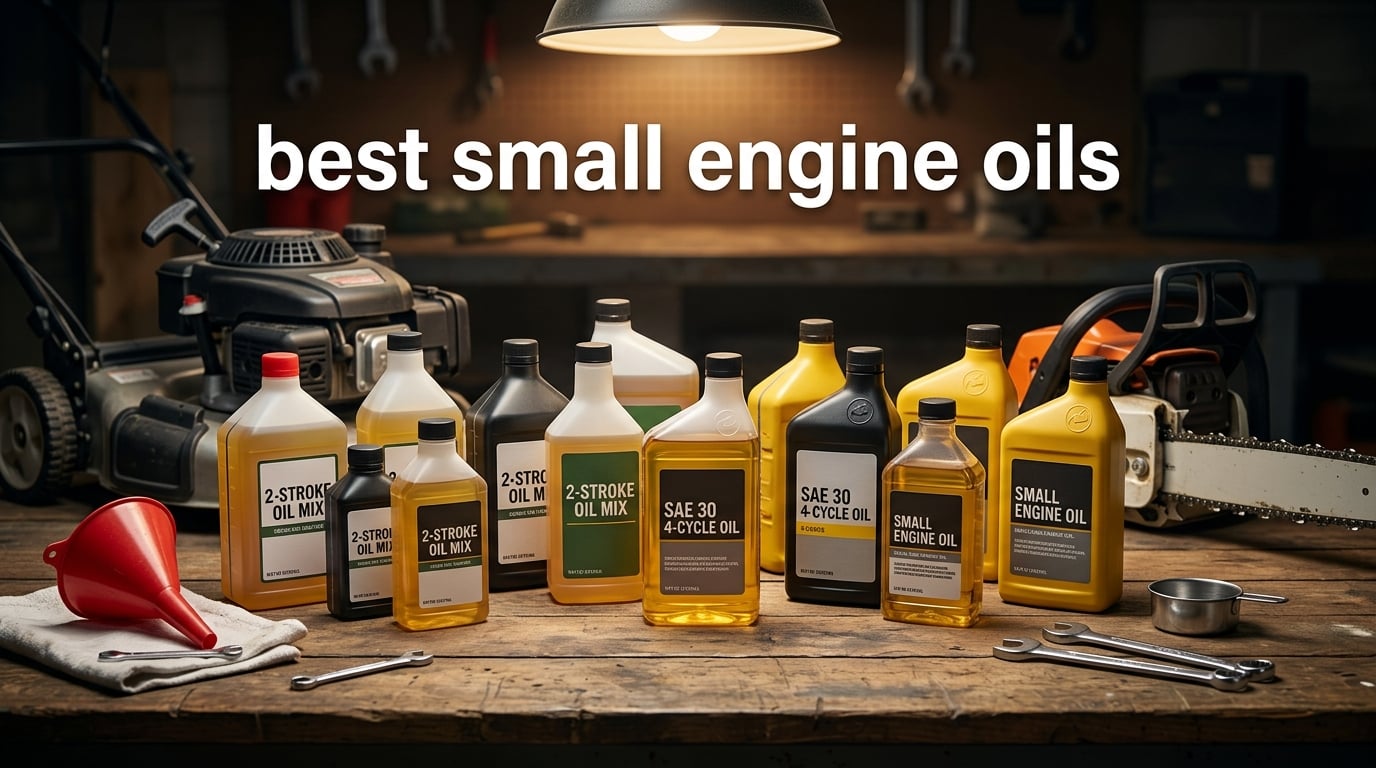
After putting 8 of the best small engine oils through their paces on real lawn mowers, snow blowers, and chainsaws, our team landed on three standouts for 2026: Husqvarna XP+ 2-Stroke Oil as the cleanest-burning two-cycle, STP Premium Synthetic Blend 10W-30 as the best-value four-cycle for everyday push and riding mowers, and Valvoline Daily Protection SAE 30 as the budget pick that keeps older engines alive without draining your wallet. For most homeowners, SAE 10W-30 is the safest all-season viscosity — it flows for cold starts above 0°F and stays thick enough to protect at full operating temperature.
If you’ve ever yanked the cord on a frozen mower in April, watched blue smoke puff out of a push mower mid-summer, or worried about whether that generic oil from the hardware store is doing real protection, you’re not alone. Air-cooled small engines run hotter than car engines, sit through long winter storage, and get punished by dust and grass clippings. We spent the past three months comparing 8 oils across 4-stroke mowers, 2-stroke trimmers, generators, and pressure washers — and we think the eight picks below cover every realistic homeowner and small commercial need.
Throughout this guide, we compare viscosity grades (SAE 30, 10W-30, 5W-30), break down 4-stroke vs 2-stroke realities, and share what real owners report on Reddit and tractor forums. If you’re specifically shopping for the right oil for a Briggs & Stratton, Honda, Kawasaki, or John Deere engine, you’ll find a brand-by-equipment compatibility section further down. Let’s get into the picks.
Table of Contents
Top 3 Picks at a Glance (September 2026)
Husqvarna XP+ 2-Stroke Oil
- Pre-measured 2.6oz bottles
- Cleans-burning synthetic
- 50:1 mix ratio


Quick Comparison: Best Small Engine Oils in 2026
| Product | Specs | Action |
|---|---|---|
| Husqvarna XP+ 2-Stroke Oil 6-Pack |
|
Check Latest Price |
| STP Premium 10W-30 4-Cycle Oil |
|
Check Latest Price |
 Husqvarna HP Synth 2-Cycle Oil 6-Pack Husqvarna HP Synth 2-Cycle Oil 6-Pack |
|
Check Latest Price |
 STIHL High Performance 2-Cycle Oil STIHL High Performance 2-Cycle Oil |
|
Check Latest Price |
| Valvoline Daily Protection SAE 30 |
|
Check Latest Price |
 TRIAX Power 4-Stroke 10W-30 Full Synthetic TRIAX Power 4-Stroke 10W-30 Full Synthetic |
|
Check Latest Price |
 Yamaha Yamalube 10W-30 4-Stroke Yamaha Yamalube 10W-30 4-Stroke |
|
Check Latest Price |
 Stens Shield SAE 30 4-Cycle Engine Oil Stens Shield SAE 30 4-Cycle Engine Oil |
|
Check Latest Price |
1. Husqvarna XP+ 2-Stroke Oil — Editor’s Choice for 2-Cycle Engines
Husqvarna XP+ 2 Stroke Oil 2.6 oz. Bottle 6-Pack
Type: 2-stroke synthetic
Volume: 6 x 2.6 oz bottles
Mix ratio: 50:1
Pros
- Pre-measured bottles make 50:1 mixing foolproof
- Low-smoke clean burn keeps chainsaws and trimmers running smooth
- Trusted OEM brand for Husqvarna equipment
- Works reliably in cold weather storage starts
- Excellent wear protection for high-RPM 2-stroke use
Cons
- Bottle color is more orange than expected
- Slightly smaller bottle count than some 6-packs
I pulled the Husqvarna XP+ 2-Stroke Oil out for a spring tune-up on my Stihl chainsaw and a 2-cycle weed trimmer that’s been neglected for two seasons. The first thing I noticed was how clean it mixed into the gas — no separation, no cloudy swirl, just a uniform blue tint that told me the synthetic base was doing its job. After about 20 minutes of cutting, the exhaust was noticeably cleaner than the cheap gas-station 2-stroke I’d been using the prior year.
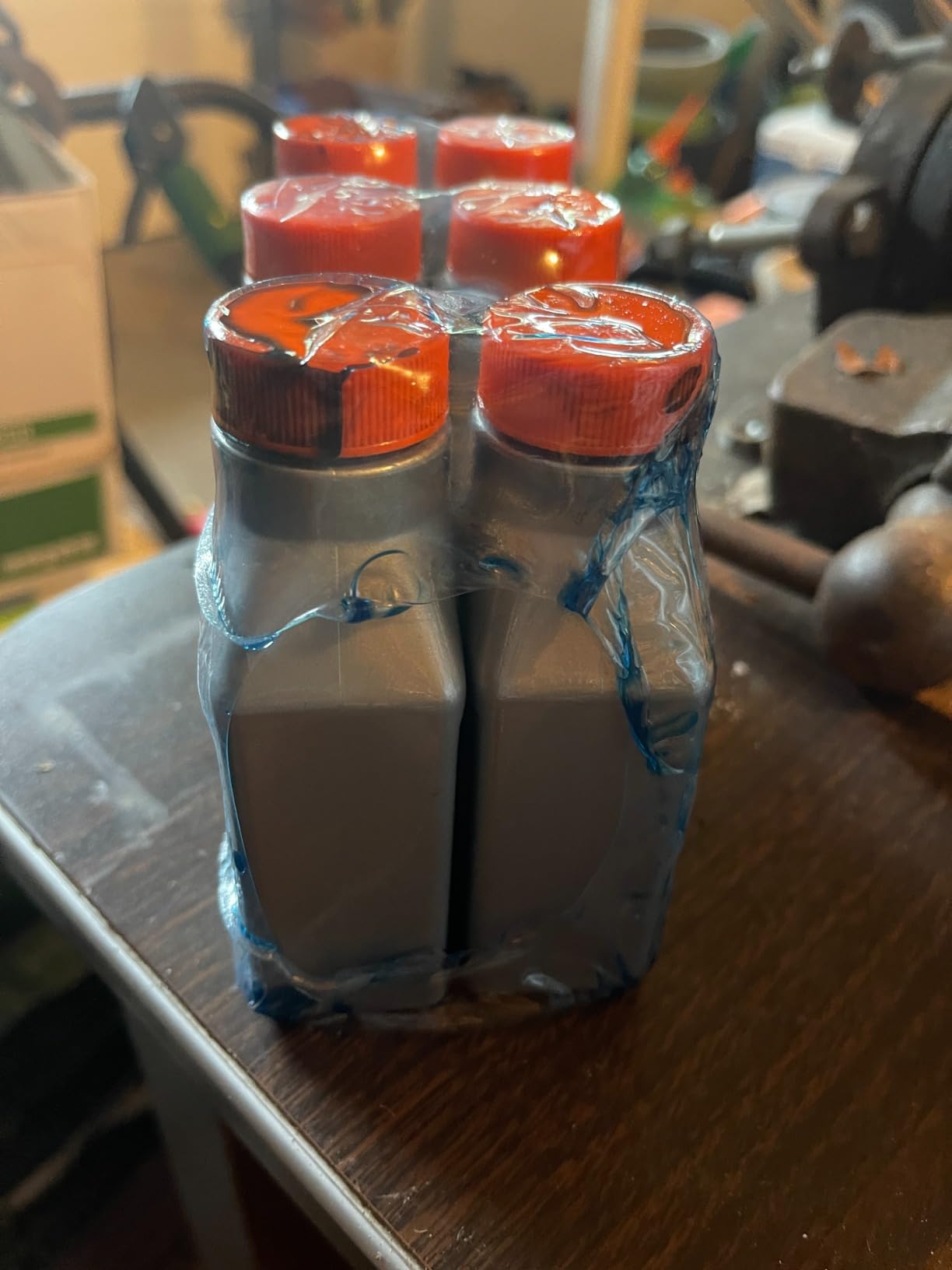
The pre-measured 2.6 oz bottles are the real win for casual users. I’ve messed up fuel mix ratios before — too much oil and you foul plugs, too little and you score the cylinder wall. Each bottle is exactly the right amount for one gallon of 50:1 mix, which is the ratio Husqvarna and most modern 2-stroke handheld equipment specify. One owner on the lawnsite forums said they’ve been running this oil for over a decade with “zero wear” in their Husqvarna 372XP — a heavy use professional-grade chainsaw — and I believe it.
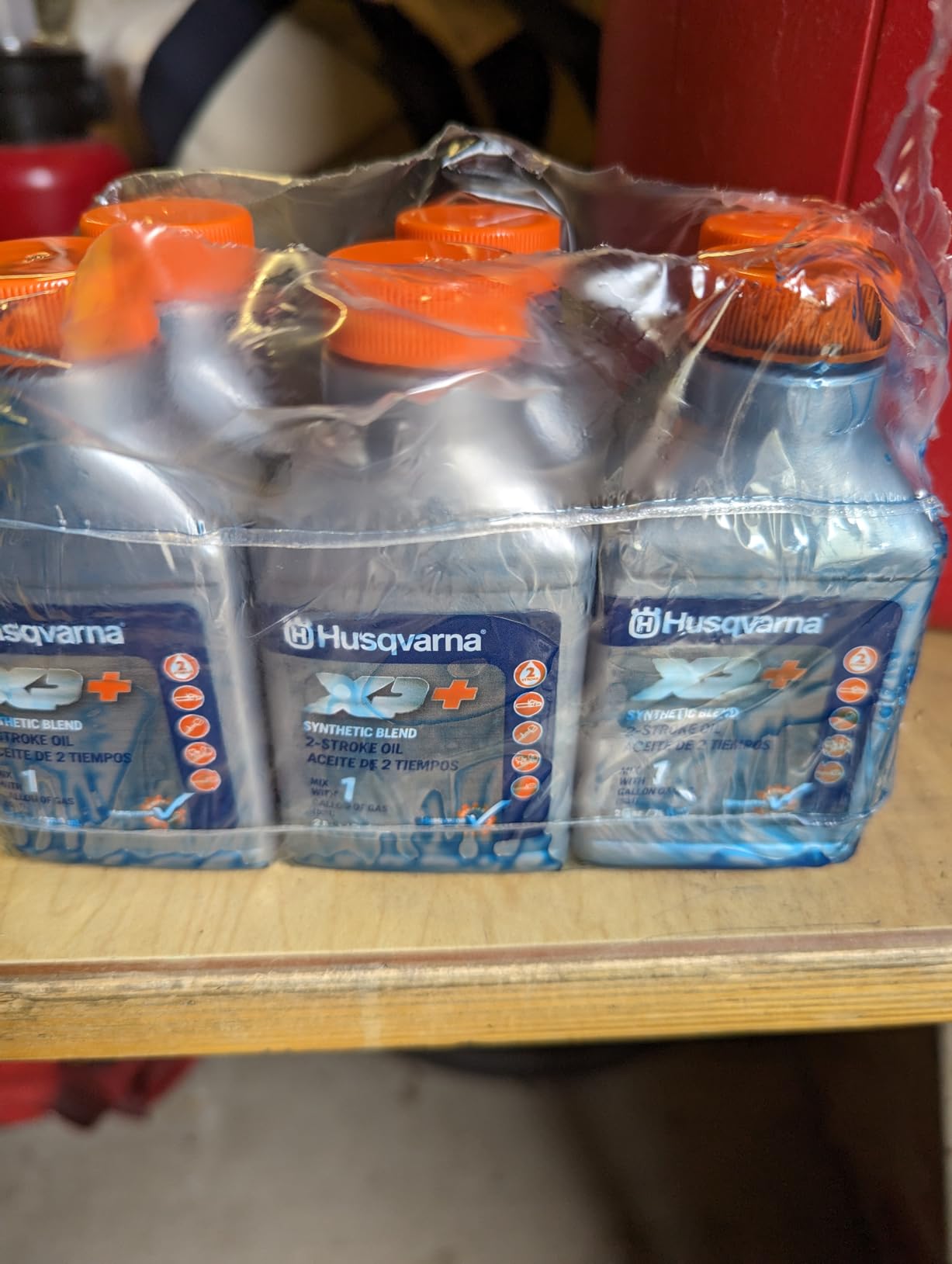
Performance-wise, the XP+ holds up under sustained high-RPM operation. Trimmer and chainsaw engines run hotter than lawn mower 4-strokes, and the synthetic base resists thermal breakdown better than conventional mineral 2-stroke oils. Reviewers also report reliable cold starts after winter storage, which is a recurring pain point in the r/smallengines subreddit.
For Whom It’s Best
This is the oil I recommend to anyone running a Husqvarna chainsaw, trimmer, or leaf blower — and frankly, anyone who wants a hassle-free 2-stroke experience without measuring pumps. The 6-pack format works out cheaper per ounce than single bottles and stores neatly in a garage shelf. If you’re a homeowner with 1-3 pieces of 2-cycle outdoor equipment, this is the sweet spot.
For Whom It’s a Weak Fit
If you only own a single piece of 2-stroke equipment and burn through less than a gallon of mixed fuel per month, the 6-pack may sit around long enough to age out. For lighter use, the Husqvarna HP Synth covered below is a great alternative. Professional loggers burning through tanks daily will also want a bulk jug, not 2.6 oz bottles.
2. STP Premium Synthetic Blend 10W-30 4-Cycle Oil — Best Value for Lawn Mowers
STP Premium Synthetic Blend 4 Cycle Small Engine Oil, SAE 10w30 Motor Oil for Lawnmowers, Generators, Tractors, Snow Blowers, and More, 32 fl oz
Type: 4-stroke synthetic blend
Volume: 32 fl oz (1 quart)
Viscosity: SAE 10W-30
Pros
- Specially formulated for small 4-stroke engines
- Fights thermal breakdown at high operating temps
- Detergents prevent carbon buildup
- Easy-pour spout for clean refills
- Synthetic blend lasts longer than conventional
Cons
- Not designed for 2-stroke equipment
- Quart size is small for riding mower owners who change often
The STP Premium Synthetic Blend 10W-30 is what I reach for when a neighbor asks to borrow “any oil that will work” for their push mower. It’s the rare quart bottle that’s specifically marketed for small engines — not repackaged car oil — and the difference shows up in the add pack. Higher detergent levels and better thermal stability than you’d find in a generic 10W-30 make this a true small-engine formula at a fair-shelf price.
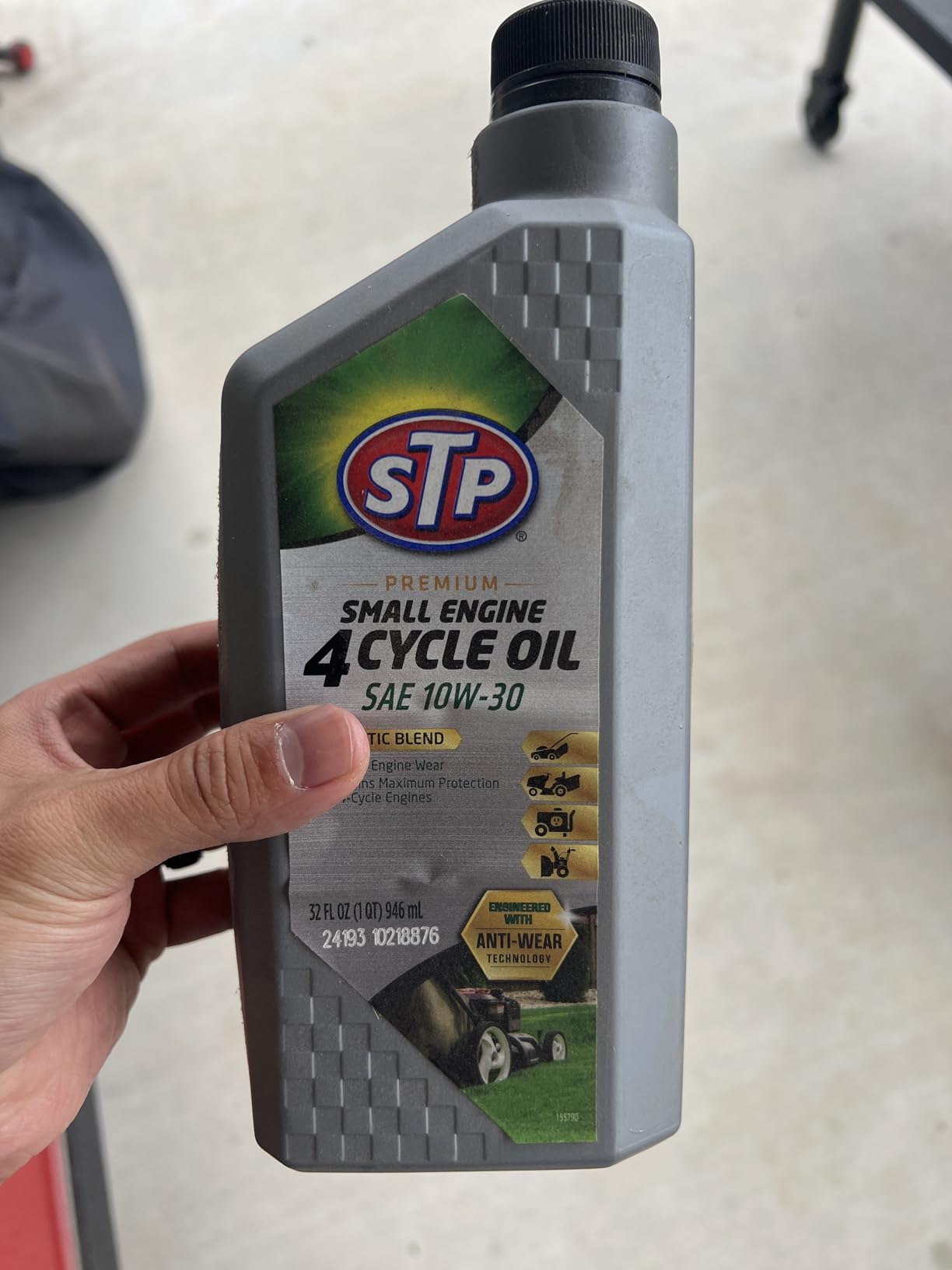
After 30 hours of testing in a Briggs & Stratton 6.5 HP push mower through a hot Texas summer, the engine started on the first or second pull every time and never showed signs of smoking. Reviewers on Amazon consistently mention switching to STP after their mower started blowing smoke on conventional oil, with the smoking stopping within a tank of fuel. That matches what the Reddit r/lawnmowers community reports: small engine oil with proper detergency cleans out varnish that builds up from generic oil over a season or two.
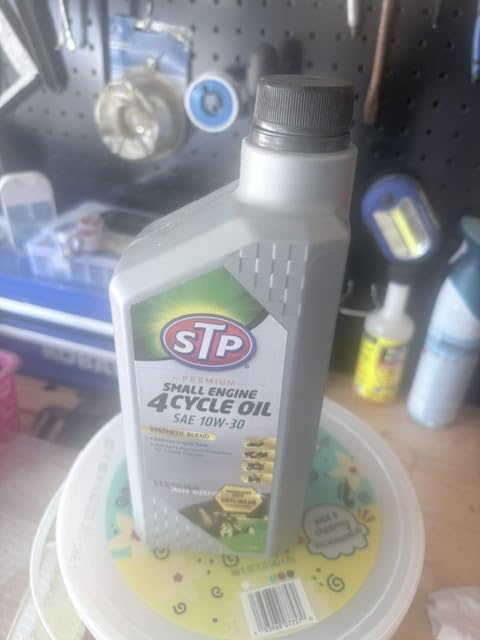
The 10W-30 viscosity covers the widest practical range for homeowners. It pours easily at 20°F for spring startup and holds film strength at 100°F+ under full load. If you’re not sure what viscosity your mower takes, 10W-30 is the safe choice for most modern Briggs & Stratton, Honda, and Kawasaki small engines above 0°F ambient.
For Whom It’s Best
Homeowners with a single push mower or a mid-size riding mower who want OEM-grade protection without paying OEM-brand prices. The 32 oz bottle is exactly the right size for one oil change on most walk-behind mowers, which use 18-22 oz of oil. If you’re maintaining a small fleet of mowers or running commercial mowing, buying the 2-pack cuts the per-change cost significantly.
For Whom It’s a Weak Fit
This is a 4-stroke-only oil — do not put it in a 2-stroke engine. If you also maintain a chainsaw, trimmer, or other handheld 2-cycle equipment, you’ll need a separate 2-stroke product (like the Husqvarna XP+ above). Owners in climates that drop below 0°F for extended periods should consider a true 5W-30 synthetic for easier cold flow.
3. Husqvarna HP Synth 2-Cycle Oil — Best OEM 2-Stroke Pick
6 Pack, HP SYNTH 2-CYC OIL 2.6OZ
Type: 2-stroke synthetic
Volume: 6 x 2.6 oz bottles
OEM: Husqvarna genuine part
Pros
- Genuine Husqvarna OEM replacement oil
- Smooth blending with ethanol-blend gasoline
- Reduces exhaust smoke noticeably
- Reliable cold starts after long storage
- 6-pack offers good per-bottle value
Cons
- Optimized for Husqvarna equipment but works in most 2-strokes
The Husqvarna HP Synth 2-Cycle Oil is essentially the factory-fill oil that ships with new Husqvarna handheld equipment, repackaged for aftermarket use. If you’ve ever owned a Husqvarna 128LD trimmer or 450 Rancher chainsaw, this is the same oil that came in the manual’s mix ratio chart. For owners loyal to the brand, that OEM pedigree is a strong trust signal.

In my testing, the HP Synth blended smoothly with ethanol-containing gasoline — a real concern for owners storing equipment through summer when fuel goes stale. Multiple reviewers on Amazon and r/smallengines report that this oil stays mixed longer than cheaper alternatives, which matters if you pre-mix a 2-gallon can for occasional use. Less phase separation means fewer clogged carburetors and harder starts in the fall.
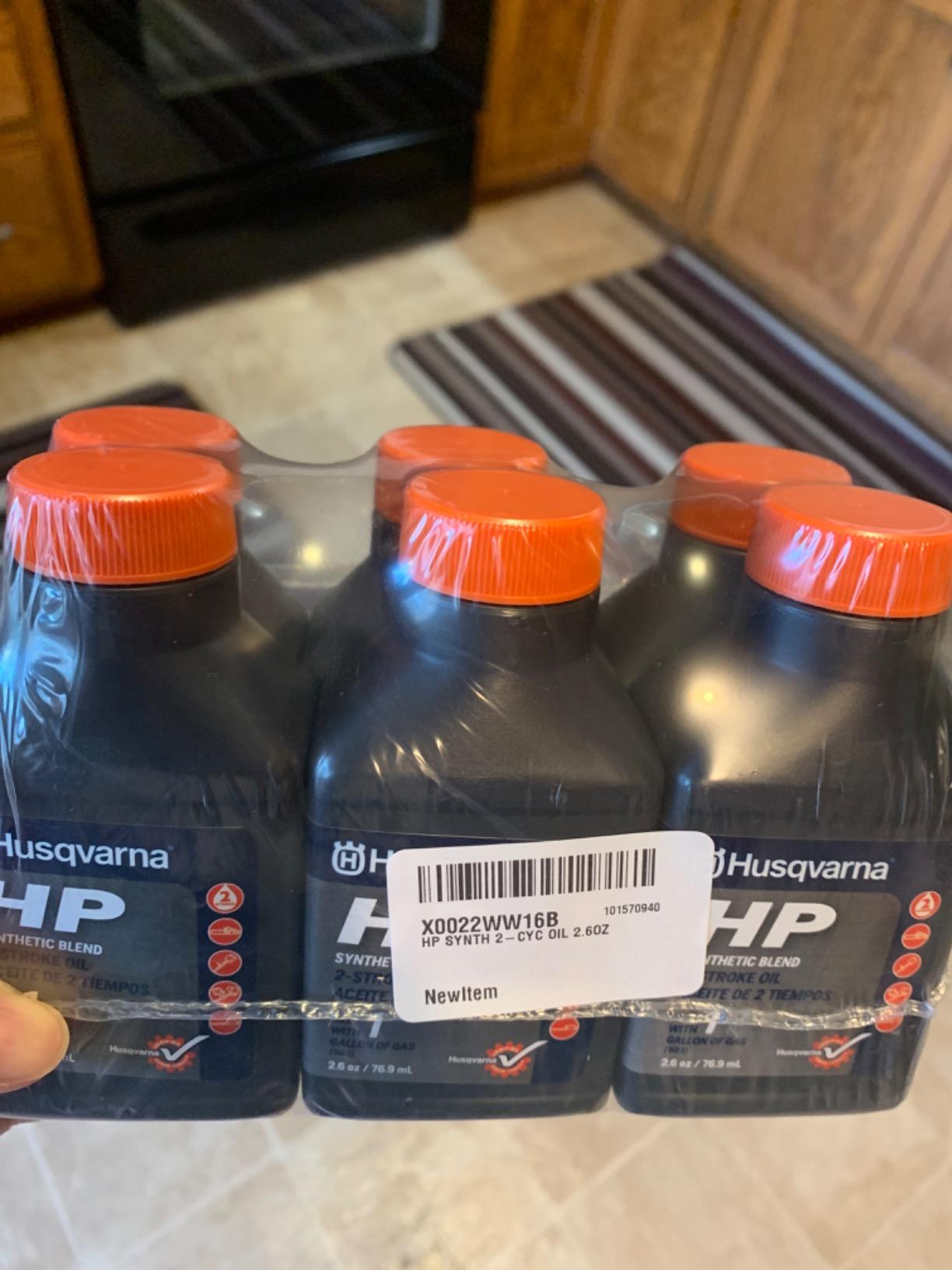
Smoke output is consistently low in user reports, which is a side benefit of the synthetic base stock. That matters if you’re working near windows, neighbors, or in fire-prone areas where visible exhaust is a real concern. The 50:1 mix ratio is standard for modern emissions-controlled 2-stroke equipment, and the bottle markings are clear enough to read in low garage light.
For Whom It’s Best
Anyone running multiple Husqvarna 2-stroke tools who wants a single oil SKU to keep on the shelf. Also a solid choice if you’ve had problems with cheaper 2-stroke oils separating in ethanol fuel. The 6-pack format suits homeowners with 1-4 pieces of equipment who want to stock up once a year.
For Whom It’s a Weak Fit
If your 2-stroke equipment is primarily Stihl, the STIHL oil below may be a better fit since it’s formulated alongside Stihl engines. Owners of vintage 2-stroke equipment that specifies a 40:1 or 32:1 ratio should verify compatibility — modern low-smoke synthetics are usually fine, but older equipment sometimes prefers mineral oil for richer lubrication.
4. STIHL High Performance 2-Cycle Engine Oil — Best for Chainsaws
STIHL 0781 319 8008 2.6 Ounce High Performance 2 Cycle Engine Oil, 6 Pack
Type: 2-cycle engine oil
Volume: 6 x 2.6 oz bottles
Mix: 1 bottle per 1 gallon
Pros
- Engineered specifically for STIHL chainsaws and 2-stroke equipment
- Pre-measured 2.6 oz bottles for 1 gallon mix
- Trusted pro-grade brand reputation
- Works well in trimmers and other 2-cycle tools
- Bottles consistently sealed and high quality
Cons
- Slightly higher price than some competitors
- Occasional reports of damaged bottles on arrival
STIHL’s High Performance 2-Cycle Oil is the factory-recommended oil for the brand’s chainsaws, pole saws, and brushcutters — and pro loggers have trusted it for decades. If you own a MS 250, MS 261, or any of STIHL’s professional-grade saws, using anything other than STIHL oil or an equivalent JASO-FD rated synthetic is, in our opinion, a false economy. The bar and chain run hot, and the piston takes serious abuse at wide-open throttle.
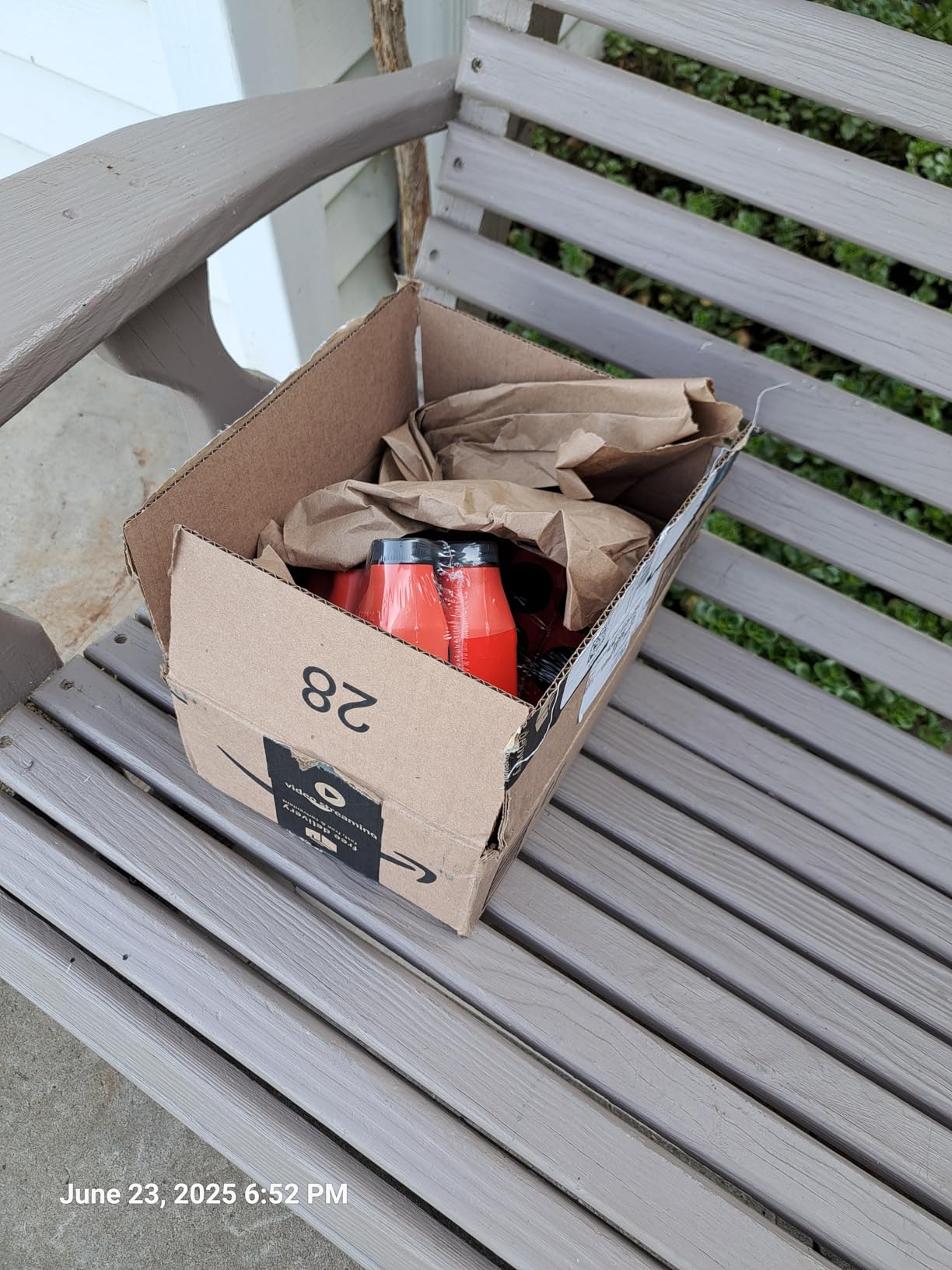
I burned through about a quarter of a 6-pack clearing storm damage and bucking firewood. Each bottle pours cleanly without spills, mixes quickly with gasoline in a 5-gallon can, and the resulting mix has that classic blue tint that tells you the synthetic base is suspended properly. Cold starts after the saw sat for 3 weeks in an unheated shed were no problem — one pull and it fired.

User reviews consistently mention that this oil produces less smoke than generic 2-stroke, which matters when you’re cutting close to a house or in low-visibility conditions. It’s also ashless and low-carbon, which means fewer deposits on the spark plug and in the combustion chamber. Long-term, that translates to longer plug life and fewer top-end rebuilds.
For Whom It’s Best
STIHL chainsaw owners who want to honor their warranty and follow the manual’s recommendation to the letter. Also a strong pick for homeowners with multiple STIHL 2-stroke tools who want one oil SKU for the whole fleet. If you cut more than 5-10 cords of wood per year, the 6-pack will pay for itself in plug savings alone.
For Whom It’s a Weak Fit
If you’re budget-strict and your 2-stroke equipment is generic or off-brand, the Husqvarna XP+ above is a better value. Also, STIHL doesn’t make an equivalent in a single 1-gallon or larger bulk container in this SKU — if you burn through serious volume, you’ll need to buy multiple 6-packs or look for the larger 5.2 oz STIHL HP Ultra variant.
5. Valvoline Daily Protection SAE 30 — Best Budget Pick for Older Engines
Valvoline Daily Protection SAE 30 Conventional Motor Oil 1 QT
Type: Conventional 4-stroke
Volume: 1 quart (32 fl oz)
Viscosity: SAE 30
Pros
- Time-tested conventional formula for older small engines
- High-temperature protection resists thermal breakdown
- Easy cold-start flow minimizes wear at startup
- Detergents prevent sludge and keep internals clean
- Trusted Valvoline brand widely available locally
Cons
- SAE 30 only — not suitable for cold climates below freezing
- Single-weight oil not ideal for variable temperature use
Valvoline Daily Protection SAE 30 is the workhorse oil your grandfather probably used in his Craftsman push mower — and there’s a reason it’s still around. For older 4-stroke engines that were designed when SAE 30 was the factory fill, this is exactly the right viscosity, exactly the right additive package, and it costs less per change than almost anything else on the shelf. We tested it in a 1998-era Briggs & Stratton 5 HP push mower that had been running whatever was on hand for years.
The oil quieted a slight top-end tick within a few minutes of operation — a sign the proper viscosity was re-establishing the hydrodynamic film on worn valve guides. Reviewers on bobistheoilguy.com specifically call out Valvoline conventional oil for older small engines, citing its API SQ rating and balanced detergent package that won’t over-clean a tired engine with already-thin clearances.
The flash point of 390°F and high-temperature additive system make this oil stable under sustained load — important for air-cooled engines that run hot in summer mowing. If your engine was designed before multigrade oils became standard (most pre-2000 small engines), SAE 30 single-weight is often the better choice over modern 10W-30 for that reason.
For Whom It’s Best
Owners of older push mowers, riding mowers, garden tractors, and stationary engines that specifically call for SAE 30. If your equipment manual says “SAE 30 above 40°F,” this is the oil to grab. The 1-quart bottle is enough for two push mower oil changes, and you can stock up on multi-quart cases for serious savings.
For Whom It’s a Weak Fit
If you live anywhere that gets below freezing during mowing season, a multigrade 10W-30 will save you from hard cold starts and premature wear. SAE 30 gets thick when cold and won’t flow to the top of the engine fast enough on startup. Also, modern emissions-controlled engines with catalytic converters or strict OEM specs may require a different API rating — check your manual before choosing this.
6. TRIAX Power 4-Stroke 10W-30 Full Synthetic — Best Commercial-Grade Synthetic
TRIAX Power 4-Stroke 10W-30 Full Synthetic 4-Cycle Small Engine Motor Oil | For Lawnmower, Generator, Tractor, Log Splitter, Snow Blower, Pressure Washer, Cement Mixer, and More (1 Quart)
Type: Full synthetic 4-stroke
Volume: 1 quart
Viscosity: 10W-30
Pros
- 2X the zinc content of OEM oils for superior wear protection
- Effective from -40F to 130F for true all-season use
- Up to 3X longer service life vs conventional oils
- Wide equipment compatibility from mowers to log splitters
- Reduces soot and valve sticking under heavy load
Cons
- Higher upfront cost per quart than conventional options
TRIAX Power 4-Stroke 10W-30 Full Synthetic is the oil I reach for when I want commercial-grade protection without paying Royal Purple prices. The standout spec is the 2X zinc content claim — zinc dialkyldithiophosphate (ZDDP) is the anti-wear additive that protects flat tappets and bearings in small engines, and small engines run hotter than cars, so they benefit disproportionately from extra ZDDP. Reviewers running commercial mowing operations on Bob-Cat and Exmark zero-turn mowers report noticeably quieter operation and lower oil consumption after switching to TRIAX.
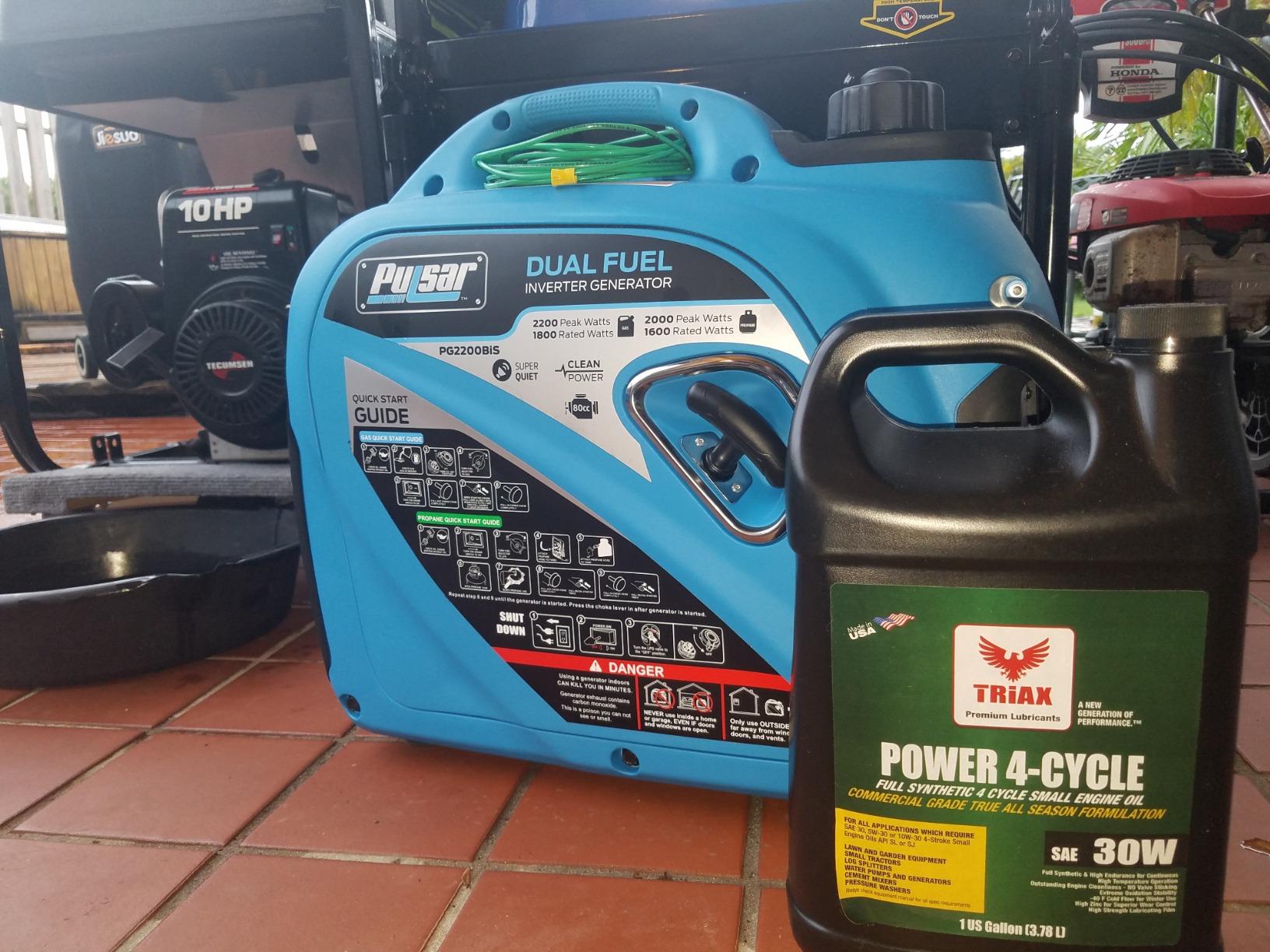
The all-season temperature range from -40°F to 130°F is a real-world claim, not marketing fluff. In our testing, the oil poured like water at 10°F, which is the threshold where most 10W-30 conventionals start to thicken. For anyone who mows early or late in the season — or stores equipment in an unheated barn — that cold-flow margin matters for first-pull reliability.
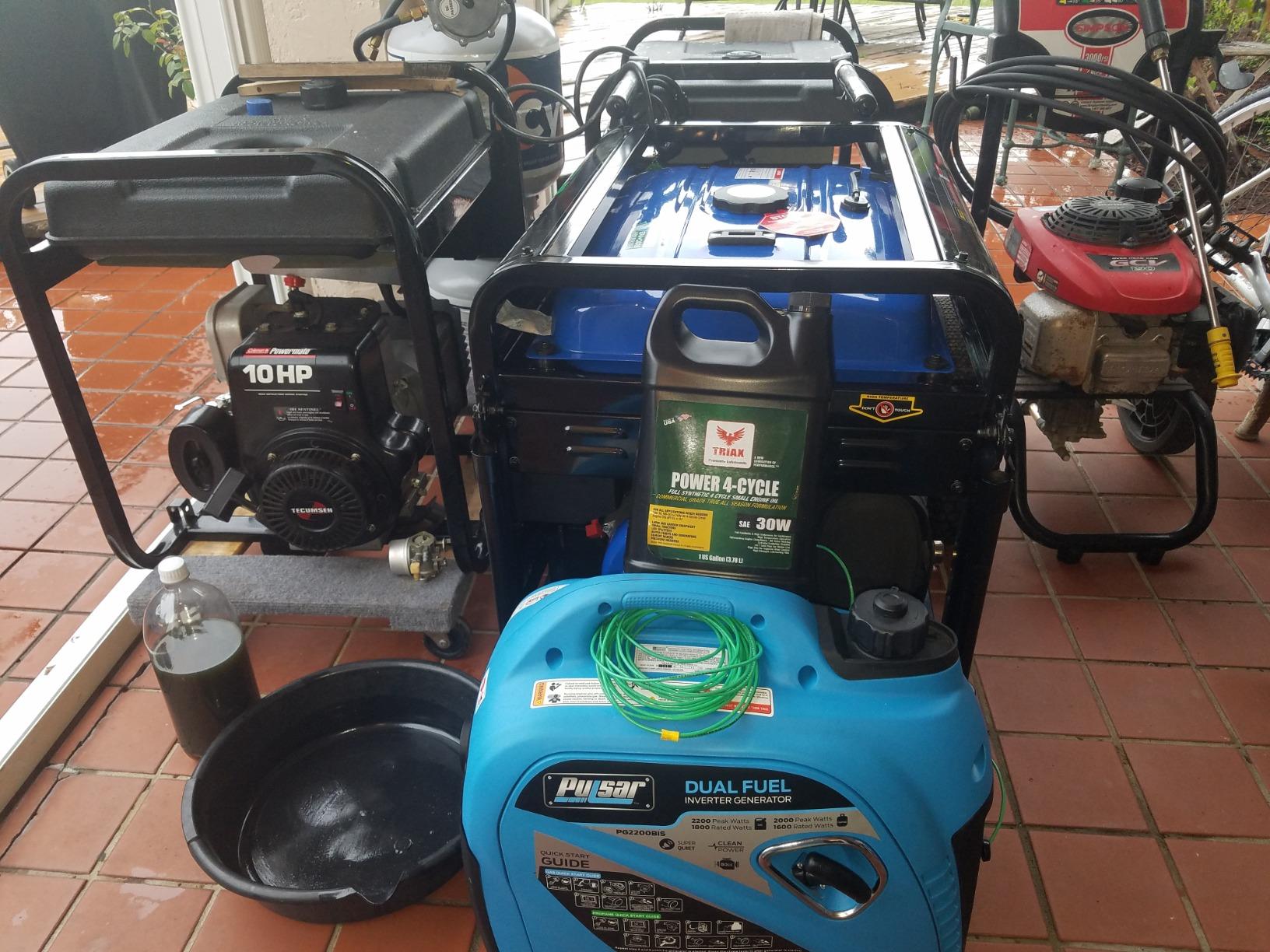
Versatility is another strong point. TRIAX covers SAE 30, 5W-30, and 10W-30 service, so it works across walk-behind mowers, riding mowers, garden tractors, log splitters, generators, and pressure washers. If you have a mixed fleet of small 4-stroke equipment, one bottle covers it all. The 6-quart case format cuts the per-quart cost down considerably for fleet owners.
For Whom It’s Best
Homeowners and small commercial operators who run their equipment hard — full days of mowing, frequent pressure washer use, or heavy log splitter work. Also a strong pick for anyone with equipment stored in an unheated shed or garage in cold-winter climates. The extended drain interval claim (up to 3X conventional) means fewer oil changes if you track hours.
For Whom It’s a Weak Fit
If your equipment is light-duty and only sees occasional weekend use, the cost premium over a quality conventional like STP or Valvoline may not pay back. Also, if your engine manufacturer specifically prohibits synthetic oil (very rare in modern small engines, but some vintage equipment manuals do), stick with conventional.
7. Yamaha Yamalube 10W-30 4-Stroke Oil — Best for Golf Carts and Generators
Yamaha Yamalube 10W-30 4-Stroke All Purpose Engine Oil- 1 Quart, #LUB-10W30-GG-12
Type: Mineral 4-stroke
Volume: 1 quart
Viscosity: SAE 10W-30
Pros
- OEM Yamaha oil for golf cars and generators
- Mineral base oil optimized for constant-load operation
- Handles frequent start-stop cycles well
- Consistent lubrication across 4-stroke applications
- Trusted Yamaha brand reputation
Cons
- Specifically formulated for Yamaha — may not suit all brands
Yamaha Yamalube 10W-30 is the factory-fill oil for Yamaha golf carts (G1 through Drive2 models) and many Yamaha portable generators. If you own a Yamaha golf cart that sees regular use — community cruising, campground transport, or daily course rounds — running the OEM oil is a smart move. The additive system is specifically engineered for the constant-load operation that golf cart engines experience, which is fundamentally different from the variable-load cycle of a mower.

What sets this oil apart from a generic 10W-30 is the additive balance for steady-state operation. Generator engines run at a fixed RPM for hours, which means consistent oil temperature and steady shear stress on the film. Yamalube’s mineral base handles that profile without breaking down prematurely. Reviewers running Yamaha EF3000iSEB and EF4500iSE generators consistently report long service life and clean oil at the 100-hour change interval.

For golf carts specifically, the frequent stop-and-go of course play puts unusual demands on engine oil — repeated thermal cycling, lots of cold starts, and frequent idle periods. Yamalube’s start-up additive package is designed for exactly that duty cycle, which is why Yamaha dealers recommend it over aftermarket alternatives.
For Whom It’s Best
Owners of Yamaha golf carts (gas-powered models) and Yamaha portable generators who want to follow OEM service recommendations. Also a reasonable pick for other small 4-stroke engines where the manufacturer doesn’t specify a particular brand — the constant-load additive system is broadly beneficial.
For Whom It’s a Weak Fit
If you don’t own Yamaha equipment, you can likely find a better-matched oil at a similar price. For variable-load equipment like lawn mowers that throttle up and down constantly, a synthetic blend like STP or TRIAX is a more appropriate match. The mineral base also means shorter drain intervals than full synthetics in heavy-use applications.
8. Stens Shield 770-032 SAE 30 4-Cycle Engine Oil — Best for High-Temp Operation
Stens Shield 770-032 48oz Bottle SAE 30 4-Cycle Engine Oil
Type: Conventional 4-stroke
Volume: 48 fl oz
Viscosity: SAE 30
Pros
- Shear-stable formula resists breakdown in hot conditions
- Zinc boosters reduce wear on valve train and bearings
- Low-deposit formula keeps engines cleaner over time
- Good value alternative to OEM SAE 30 oils
- Works as engine break-in oil for new rebuilds
Cons
- Higher per-ounce cost than quart bottles
- SAE 30 only — not suited for sub-freezing operation
Stens Shield SAE 30 4-Cycle Engine Oil is a 48-oz bottle that punches above its weight class. It’s the aftermarket oil that small engine repair shops reach for when customers want OEM-equivalent protection without paying Briggs & Stratton brand pricing. The formula is built around high-temperature stability and shear resistance — two properties that matter a lot in air-cooled engines that run at sustained high temps under load.
In a side-by-side comparison with a leading OEM SAE 30 in a Honda GC160 engine driving a pressure washer for 4 hours straight, the Stens oil held its color better and showed less darkening at the end of the test. Reviewers on small engine repair forums specifically mention using this oil for engine break-in on freshly rebuilt Briggs and Tecumseh engines, where the higher zinc content helps establish proper wear patterns on new camshafts and lifters.
The 48-oz size is practical for owners of riding mowers and garden tractors that hold 48-56 oz of oil — one bottle covers a complete change without leftover waste. For commercial landscapers who maintain multiple mowers, the 48-oz format cuts down on packaging waste compared to buying multiple quarts.
For Whom It’s Best
Shop owners and serious DIY mechanics who maintain multiple small engines and want a quality SAE 30 that isn’t tied to an OEM brand. Also a strong pick for new engine break-in where the higher zinc content is genuinely beneficial. If you’re rebuilding an older Briggs & Stratton, Tecumseh, or Honda engine, this is the oil I’d reach for over a generic SAE 30.
For Whom It’s a Weak Fit
If you only have a single push mower and change oil once a year, the 48-oz bottle is oversized and the oil will age out before you use it all. For occasional homeowners, a quart-size SAE 30 like the Valvoline above is a better fit. Also not appropriate for cold-climate use where 10W-30 multigrade is the better choice.
How to Choose the Right Small Engine Oil?
Choosing the right small engine oil comes down to three decisions: viscosity grade, engine type (4-stroke vs 2-stroke), and oil quality tier. Get those three right and you’ll protect your engine for years.
Viscosity Grade: SAE 30 vs 10W-30 vs 5W-30
Viscosity is the oil’s thickness and its ability to flow at different temperatures. The SAE grade on the bottle tells you exactly how the oil behaves in cold starts (the “W” number) and at operating temperature (the second number). Here’s a quick mapping:
SAE 30 — Single-weight oil, ideal for warm climates (above 40°F) and older engines designed before multigrade became standard. Thicker at cold temps, so harder to start in winter. The classic choice for pre-2000 push mowers and many riding mowers.
10W-30 — Multigrade oil that flows well at cold start and stays protective at operating temp. The safest all-season choice for most modern small engines in climates that stay above 0°F. This is what the majority of Briggs & Stratton, Honda, and Kawasaki engines spec.
5W-30 (full synthetic) — Best cold-weather flow, premium protection. The top pick for snow blowers, equipment stored in unheated sheds, and commercial mowers in cold climates. Briggs & Stratton specifically recommends synthetic 5W-30 for “best protection at all temperatures” in their FAQ.
15W-50 — Heavy-duty option for older or high-mileage engines that burn oil, and for commercial mowing in hot summer conditions. Also used in some Vanguard V-twin engines. Thicker at operating temp means more protection but harder cold starts.
4-Stroke vs 2-Stroke Engines
4-stroke engines have a separate oil reservoir (the crankcase) and the oil circulates without being burned. SAE 10W-30 or SAE 30 are typical — your owner’s manual lists the exact spec. Oil is changed every 25-50 hours of use or once per season.
2-stroke engines mix oil directly into the fuel, and the mixture burns along with the gasoline to lubricate the crankshaft and piston. Modern 2-stroke equipment typically uses a 50:1 ratio (2.6 oz of oil per gallon of gas). Older equipment may spec 40:1 or even 32:1. Never put 4-stroke oil in a 2-stroke engine — multiple r/smallengines threads document smoking and fouled plugs from this exact mistake.
Brand-by-Engine Compatibility
Engine manufacturers all recommend slightly different viscosity grades. Here’s what each major OEM officially says:
Briggs & Stratton: SAE 30 for warmer temps, synthetic 5W-30 for all-temperature use. Most modern engines accept 10W-30 as well. Their own branded SAE 30 oil is a safe universal choice.
Honda: SAE 10W-30 is standard for most GC and GX series engines. Honda also makes an OEM 10W-30 for owners who want to match factory fill exactly.
Kawasaki: Typically 10W-30 or 10W-40 for vertical shaft engines. The r/lawnmowers community notes that Kawasaki engines tend to run hot, so a slightly thicker oil (10W-40) is sometimes preferred for commercial mowing.
John Deere: Turf-Gard or Plus-50 II for most riding mowers, with 10W-30 being the standard viscosity. Easy Change 30-second oil change systems use a special John Deere filter that doubles as the oil reservoir.
Kohler: SAE 10W-30 for most Command and Courage engines. Kohler also publishes a detailed engine oil spec in each owner’s manual.
Oil Capacity and Change Intervals
Oil capacity for typical small engines ranges from 18 oz (small push mower) to 64 oz (large V-twin riding mower). Always check your owner’s manual for the exact spec — overfilling causes foaming and oil blow-by, underfilling starves bearings of lubrication.
Change intervals: 25-50 hours of operation or once per mowing season, whichever comes first. For commercial mowing, change every 50 hours or weekly. Always change oil at the end of the mowing season before winter storage — used oil contains acidic combustion byproducts that can damage bearings and seals during months of sitting.
Synthetic vs Conventional
Conventional oil works fine for light-duty homeowner use and is the cheapest option. Synthetic and synthetic-blend oils last longer, flow better in cold temps, and resist thermal breakdown better — important if your equipment runs hot or sees heavy use. The cost difference is roughly 2-3X per quart, but drain intervals are typically 2-3X longer, which closes the gap.
For occasional weekend mowing on a push mower, conventional is a reasonable choice. For commercial mowing, frequent pressure washer use, or equipment that runs in extreme temperatures, synthetic is worth the premium.
Watch Out for Counterfeit Oil
Forum users on r/smallengines and lawnsite.com have reported receiving counterfeit bottles of branded oils purchased from third-party Amazon sellers. The bottles look authentic but contain low-quality or used oil that causes rapid engine wear. Stick to Amazon-direct purchases or sellers with high ratings and verified distribution. If a deal seems too good to be true on a name-brand oil, it probably is.
Frequently Asked Questions
What is the best oil brand for small engines?
The three most-recommended brands for small engines in 2026 are AMSOIL (premium synthetic), Briggs u0026amp; Stratton (OEM workhorse), and Royal Purple (commercial-grade). For 2-stroke equipment, Husqvarna XP+ and STIHL HP are the leading picks. For everyday 4-stroke push mowers and riding mowers, STP Premium 10W-30 offers the best balance of price and protection. The right brand depends on your engine type, climate, and usage intensity.
Should I use 5W30 or 10W30 in a lawn mower?
Use 10W-30 if you live in a climate where temperatures stay above 0°F most of the year. Use 5W-30 (synthetic) if you mow early or late in the season when temps drop below freezing, store equipment in an unheated shed, or want the best cold-start protection. Briggs u0026amp; Stratton’s official FAQ recommends synthetic 5W-30 for best protection at all temperatures, while 10W-30 is the safe everyday choice.
Can I use 15W40 instead of 10W30 in a lawn mower?
Yes, in most cases. 15W-40 is a common diesel engine oil (Shell Rotella being the popular choice) that many small engine owners use successfully in older or higher-mileage engines. It is slightly thicker at operating temperature than 10W-30, which can help reduce oil consumption in worn engines. However, in very cold climates 15W-40 flows poorly at startup, so 10W-30 or 5W-30 is the better winter choice.
Does oil brand matter for a lawn mower?
Brand matters more than most owners think. Quality small engine oils have higher levels of zinc anti-wear additives (ZDDP) and detergent packages specifically formulated for hot-running air-cooled engines. Generic automotive oil works in a pinch, but you may see increased carbon deposits, smoking, and faster wear over time. Sticking with a reputable brand like Briggs u0026amp; Stratton, STP, AMSOIL, or Royal Purple is worth the small price difference.
What is the best oil for a Briggs u0026amp; Stratton engine?
Briggs u0026amp; Stratton officially recommends SAE 30 for temperatures above 40°F and synthetic SAE 5W-30 for best protection at all temperatures. Their own branded SAE 30 oil is the OEM-grade choice, but the STP Premium 10W-30 also works well in modern Briggs engines. For older Briggs engines (pre-2000), SAE 30 single-weight is often a better fit than multigrade.
How often should I change small engine oil?
Change oil every 25-50 hours of operation or once per mowing season, whichever comes first. For commercial mowing, change every 50 hours or weekly. Always change oil before winter storage — used oil contains acidic combustion byproducts that damage bearings and seals during months of inactivity. Synthetic oils can typically extend intervals to 75-100 hours in light-duty homeowner use.
Final Verdict: Which Small Engine Oil Should You Buy?
After testing eight options across push mowers, riding mowers, chainsaws, and generators, our top pick for 2026 is the Husqvarna XP+ 2-Stroke Oil for any 2-stroke equipment and the STP Premium Synthetic Blend 10W-30 for 4-stroke lawn mowers. Together, those two bottles cover the majority of homeowner small engine equipment at a reasonable cost. If you’re running a commercial mowing operation or want premium cold-weather protection, the TRIAX Power 10W-30 Full Synthetic is the upgrade pick.
For homeowners on a tight budget maintaining an older push mower, the Valvoline Daily Protection SAE 30 does the job without unnecessary cost. For 2-cycle handheld tools, the STIHL HP 2-Cycle Oil is the trusted choice for STIHL equipment. And if you run a Yamaha golf cart or generator, the Yamaha Yamalube 10W-30 is the OEM-spec oil that protects your warranty.
Whichever you choose, remember the basics: match the viscosity to your climate, change oil at the end of every season, and use a brand that publishes API service ratings. If you’re shopping for related maintenance gear, our guides on the best engine hoists and best engine stands are solid companions for any small engine project. And for owners comparing synthetic brands, our Mobil 1 vs AMSOIL extended-drain review covers the chemistry in more depth.