
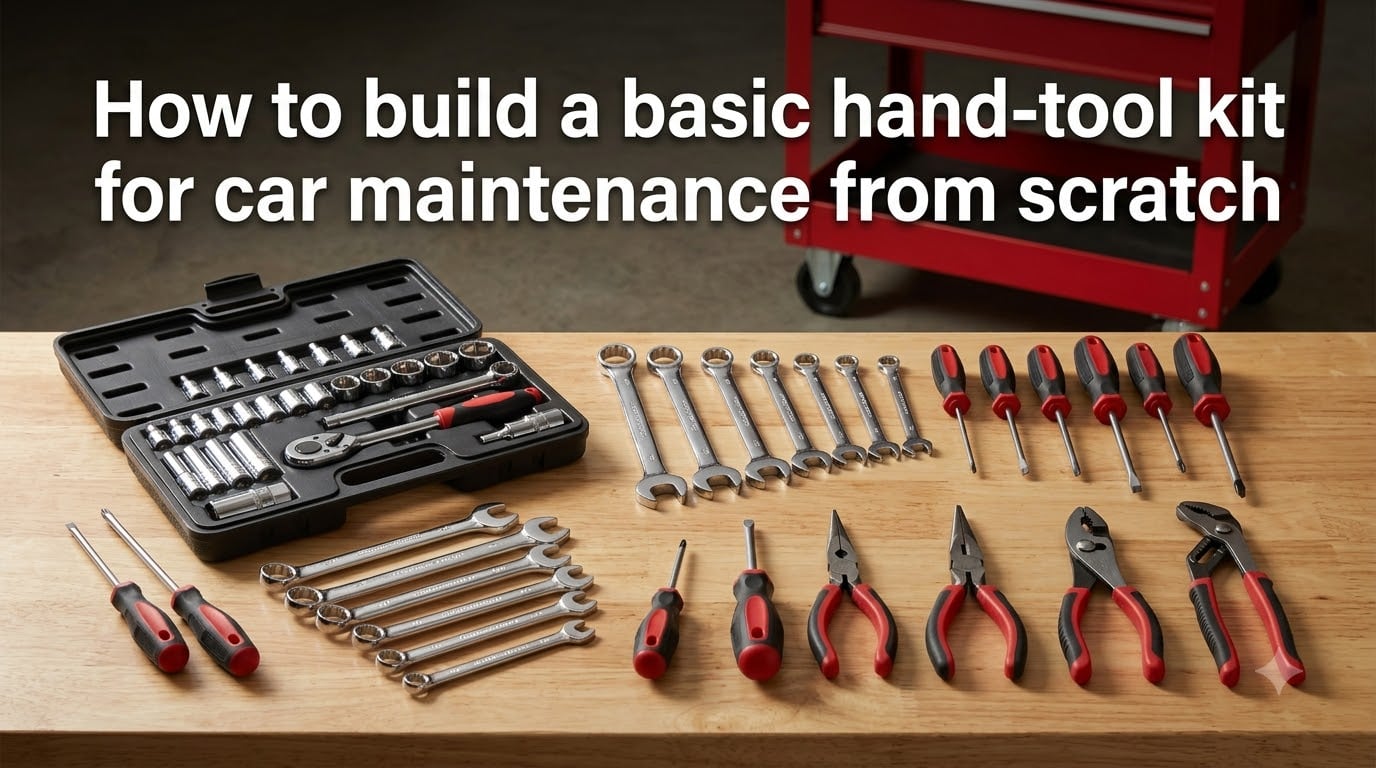
Learning how to build a basic hand-tool kit for car maintenance from scratch is one of the most practical skills any car owner can develop. When I started working on my own vehicles, I had a cheap screwdriver and a vague sense of determination. That lasted about one oil change before I realized I needed the right gear.
The average mechanic labor rate sits between $100 and $150 per hour. A single oil change at a shop can run you $70 or more, and that is before they find “additional issues.” Doing your own basic maintenance pays for a starter toolkit in just two or three services.
This guide walks you through every tool you need, in the order you should buy them. I will cover what to get first, what can wait, and how to avoid the common traps that waste money. Whether you are planning oil changes, tire rotations, or brake pad swaps, you will have a clear checklist by the end.
No prior experience needed. If you can turn a wrench, you can use this guide to assemble a functional kit for under $200 to start.
Table of Contents
Metric vs SAE: Which Does Your Car Need?
Before you buy a single socket, you need to know which measurement system your car uses. This is the number one confusion point for new mechanics on forums, and getting it wrong means buying tools you cannot use.
Here is the simple rule: if your car was built by an Asian or European manufacturer (Toyota, Honda, Subaru, BMW, Volkswagen, Kia, Hyundai), it uses metric fasteners. You need metric sockets and wrenches, typically ranging from 8mm to 19mm.
If you drive an older American vehicle (pre-2000s Ford, Chevy, Dodge), it likely uses SAE (Society of Automotive Engineers) sizes. Common SAE sizes range from 5/16 inch to 3/4 inch.
Newer American cars have largely switched to metric as well. A 2010+ Ford or GM vehicle will use mostly metric fasteners. When in doubt, check your owner’s manual or look at the bolts on your engine. A quick visual tells you everything: metric bolts have numbers stamped on the head (like “10.9” or “8.8”), while SAE bolts often have radial lines.
Many experienced DIYers own both sets, but if you are just starting, buy the one that matches your car. Adding the other later is easy.
Step-by-Step: How to Build a Basic Hand-Tool Kit for Car Maintenance from Scratch
Follow these five steps in order. Each one builds on the last, so resist the urge to skip ahead and buy everything at once.
Step 1: Start with storage. Before you own a single wrench, get a toolbox or a rolling cart with drawers. Loose tools scattered across a garage bench or car trunk will slow you down and lead to lost pieces. A simple 4-drawer rolling cart from Harbor Freight or a heavy-duty toolbox from Lowe’s works great for beginners. Socket racks and wrench organizers fit inside and keep everything visible.
Step 2: Buy a socket set. This is your most-used tool category. A 3/8-inch drive socket set with both shallow and deep sockets covers 80 percent of car maintenance tasks. Pair it with a ratchet that has a fine-tooth mechanism (72 teeth or more) for smooth action in tight spaces.
Step 3: Add combination wrenches. Sockets cannot reach every bolt. Combination wrenches have an open end on one side and a box end on the other, giving you access where a ratchet will not fit. Get the sizes that match your socket set.
Step 4: Get screwdrivers and pliers. These handle electrical connections, hose clamps, interior trim, and countless small jobs. A basic set of three screwdrivers (small flathead, large flathead, Phillips #2) plus a pair of needle-nose pliers and slip-joint pliers covers most needs.
Step 5: Add safety gear and lifting equipment. Safety glasses, mechanic’s gloves, a floor jack, and jack stands are not optional. You will be under a vehicle that weighs thousands of pounds. Never trust a hydraulic jack alone to hold a car up.
Core Tools Every Kit Needs
These four categories form the backbone of any car maintenance toolkit. Every job you do will involve at least one of them.
Socket Sets and Ratchets
A socket set is the single most important purchase you will make. It handles oil drain plugs, lug nuts, caliper bolts, spark plugs, and dozens of other fasteners across your vehicle.
The 3/8-inch drive is the all-purpose sweet spot. It is large enough to handle serious torque but small enough to fit in most engine bay spaces. A typical beginner set includes a 3/8-inch ratchet, an extension bar, a universal joint, and sockets from 8mm to 19mm (metric) or 5/16 to 3/4 inch (SAE).
Deep well sockets are essential for spark plugs and bolts threaded onto long studs. Without them, you simply cannot reach certain fasteners. Most quality socket sets include both shallow and deep sockets.
Consider adding a 1/4-inch drive set for small fasteners in interior trim, sensor mounts, and electrical components. A 1/2-inch drive set is useful later for heavy-duty work like axle nuts and large suspension bolts, but it can wait until phase two.
Look for chrome vanadium steel construction. It is the industry standard for hand tools, offering good strength and corrosion resistance at a reasonable cost. Most reputable brands use it, and you will see “CrV” stamped on the metal.
Combination Wrenches
Combination wrenches go where sockets cannot. The open end slides over bolts in tight spaces where a socket would not clear surrounding components. The box end grips all six or twelve points of the bolt head for maximum torque.
Ratcheting combination wrenches are worth every penny. Instead of lifting the wrench off the bolt after every turn, a ratcheting box end lets you keep working without resetting. Reddit users consistently recommend these over standard wrenches, and I agree after using both for years.
Get a set that matches your socket sizes. If you bought metric sockets, buy metric wrenches. A basic set covering 8mm through 19mm handles most jobs. The 10mm, 12mm, 14mm, and 17mm sizes see the most use on modern vehicles.
Six-point box ends grip better and are less likely to round off bolts than twelve-point versions. However, twelve-point wrenches offer more positioning options in tight spots. For beginners, six-point is the safer choice until you build confidence.
Screwdrivers
Screwdrivers handle interior panels, battery terminals, hose clamps, and sensor connectors. You do not need a massive set, but you need the right types.
Start with flathead and Phillips head screwdrivers in two sizes each. A small flathead (3/16 inch blade) handles interior clips and electrical connectors. A larger flathead (3/8 inch blade) works for prying and larger screws.
Torx and hex (Allen) drivers are essential for modern cars. Many European and newer American vehicles use Torx fasteners on brake calipers, interior panels, and engine covers. A set of Torx bits in T20 through T50 covers most applications. Hex keys in 3mm through 10mm handle European cars and many aftermarket parts.
Magnetic tips are genuinely useful. They hold small screws in place while you position them, which saves you from dropping fasteners into engine bays. Some screwdrivers come with magnetic bit holders that accept interchangeable bits, giving you versatility without carrying a dozen separate tools.
Pliers and Gripping Tools
Pliers grip, cut, bend, and hold. Four types cover the majority of car maintenance needs.
Needle-nose pliers reach into tight spots for small clips, rings, and electrical connectors. Their long, pointed jaws are perfect for retrieving dropped parts from engine bays. Slip-joint pliers handle larger gripping tasks like hose removal and general holding.
Locking pliers (often called Vise-Grips) clamp onto rounded or stuck fasteners when nothing else works. They lock in place, freeing both your hands. Every mechanic keeps at least one pair.
Diagonal cutters (wire snips) handle electrical work, zip tie removal, and small wire jobs. If you plan to do any wiring or sensor replacement, these are non-negotiable.
A good pair of mechanic’s gloves rounds out your hand tools. They protect your knuckles from sharp edges and give you better grip on oily parts. Nitrile gloves underneath keep your hands clean for the actual wrenching.
Specialty Tools Worth Adding
Once your core kit is in place, these specialty tools make specific jobs dramatically easier. Some are safety-critical, so prioritize accordingly.
Breaker Bar: Your Best Friend for Stuck Bolts
A breaker bar is a long, non-ratcheting handle that accepts sockets. It provides massive leverage for loosening stubborn bolts that a regular ratchet cannot budge. Lug nuts that have been overtightened, rusted exhaust bolts, and crankshaft pulley bolts all yield to a breaker bar.
Think of it as a cheater bar that is actually designed for the job. Unlike using a pipe on your ratchet (which breaks tools), a breaker bar is built to handle extreme torque. It has no ratcheting mechanism to damage.
Get one in the same drive size as your main socket set. A 3/8-inch drive breaker bar handles most car maintenance tasks. A 1/2-inch drive version is worth adding later for heavy suspension and axle work.
Forum users consistently call the breaker bar essential. It costs far less than a torque wrench and prevents stripped bolts that happen when you muscle a ratchet beyond its design limits. Every experienced DIYer I know keeps one within arm’s reach.
Torque Wrench: Why Precision Matters
A torque wrench tightens bolts to a specific, measured force. This matters because both over-tightening and under-tightening cause problems. Too tight and you strip threads or snap bolts. Too loose and components vibrate apart at speed.
Lug nuts are the classic example. Overtightened lug nuts warp brake rotors and make roadside tire changes impossible. Undertightened lug nuts allow wheels to loosen. A torque wrench set to your car’s spec (usually 80 to 100 lb-ft) eliminates guesswork.
For beginners, a click-type torque wrench in the 10 to 80 lb-ft range handles most maintenance tasks. A larger 50 to 250 lb-ft version covers lug nuts and suspension components. You can start with just the larger one if budget is tight.
Many mechanics recommend deferring the torque wrench purchase until after your core tools are in place. The breaker bar handles loosening, and you can tighten by feel for non-critical bolts. But for anything safety-related (lug nuts, head bolts, suspension fasteners), a torque wrench is mandatory.
Lifting Equipment: Floor Jack and Jack Stands
If you plan to do anything underneath your car, you need proper lifting gear. A floor jack raises the vehicle, and jack stands hold it there. Never, under any circumstances, get under a car supported only by a hydraulic jack. Jacks can fail without warning.
A 2-ton or 3-ton hydraulic floor jack handles most passenger vehicles. Look for one with a low profile if your car sits close to the ground. A rolling floor jack is far easier to position than a bottle jack.
Jack stands are rated by the weight they can support in pairs. A pair of 3-ton jack stands is the minimum recommendation for cars and small SUVs. For trucks and larger SUVs, look at 6-ton stands. Always place them on the manufacturer-recommended lift points.
Chock the wheels that stay on the ground before lifting. A car that rolls off jack stands is deadly. This is the one area where I never compromise on quality.
Oil Filter Wrench and Trim Tools
An oil filter wrench grips the round canister of your oil filter when hand strength is not enough. Several types exist: strap wrenches, cap-type wrenches that fit specific filter sizes, and three-jaw claw wrenches. The cap type is the cleanest option if you know your filter size, but a strap wrench works on almost any filter.
Trim removal tools are plastic pry bars designed to pop interior panels and exterior trim clips without damage. Metal screwdrivers crack plastic clips and scratch paint. A $15 set of nylon trim tools saves you from breaking expensive interior pieces.
Both of these are small investments that save big headaches. I waited too long to buy trim tools and broke several dashboard clips before learning my lesson.
Tools by Budget: What You Get at Each Price Tier
You do not need to buy everything at once. Here is what to expect at three common budget levels, based on real-world pricing from Harbor Freight, Lowe’s, Amazon, and local auto parts stores.
The $100 Starter Tier. At this level, you can assemble a functional kit for basic maintenance. A 40-piece metric socket set with a 3/8-inch ratchet runs about $30 to $40 at Harbor Freight. Add a basic combination wrench set ($20), a screwdriver assortment ($15), and a pair of pliers ($10). A small toolbox or bag keeps it organized for another $15. You can do oil changes, battery replacements, and filter swaps with this kit. Skip the torque wrench and lifting gear for now, or borrow them.
The $200 Intermediate Tier. This adds the tools that make maintenance safer and more efficient. Start with everything from the $100 tier, then add a breaker bar ($20), a pair of 3-ton jack stands ($35), a basic floor jack ($40), and an oil filter wrench ($10). You can now do tire rotations, brake pad inspections, and work safely under the car. A magnetic parts tray ($8) and a work light ($15) round out this tier nicely.
The $500 Serious DIY Tier. This gets you into quality territory with tools that last decades. Upgrade to a mid-range socket set from a brand with a lifetime warranty ($80 to $120). Add ratcheting combination wrenches ($60 to $100 for a set), a click-type torque wrench ($50 to $80), a 1/4-inch drive set for small fasteners ($25), and trim removal tools ($15). A rolling tool cart with drawers ($80 to $120) replaces the basic toolbox. At this point, you can handle nearly any routine maintenance task including brake jobs, belt replacement, and suspension work.
At every tier, buy tools as you need them for specific jobs. This prevents overspending on tools that collect dust. Many beginners buy a 200-piece set only to use 15 pieces regularly.
Common Mistakes to Avoid When Building Your Kit
I have made most of these mistakes myself, and forum threads confirm they trip up nearly every new mechanic. Learn from them before you spend money.
Buying ultra-cheap tools that strip fasteners. The cheapest sockets at dollar stores are made of soft metal that rounds off bolt heads. Once a bolt is stripped, removal becomes a ten-minute job turning into a two-hour ordeal. Stick to brands with a lifetime warranty, even at the budget level. Harbor Freight’s Pittsburgh line and Lowe’s Kobalt offer good entry-level quality without breaking the bank.
Not buying storage first. Tools without a home get lost, dirty, and disorganized. A socket that rolls under your workbench during an oil change is a socket you will not have for the next job. Buy the box before the tools that go in it.
Getting the wrong measurement system. Buying an SAE socket set for a Honda means you cannot use half your tools. Always check metric vs SAE before purchasing. If you own both types of cars, budget for both sets.
Overspending on rarely-used tools. A $300 cordless impact wrench is useless if you only do oil changes. Build your core kit first, then add specialty tools as specific jobs demand them. Borrow or rent tools for one-time tasks.
Running to the store mid-repair. Nothing is more frustrating than having your car apart on a Sunday and realizing you are missing a 14mm socket. Read through your repair procedure beforehand, list every tool mentioned, and verify you have each one before starting.
Tool Care and Maintenance Tips
Hand tools are an investment that can last decades if you treat them right. A few simple habits keep everything working smoothly and looking good.
Wipe tools clean after every use. Oil, grease, and road grime corrode metal over time and make handles slippery. A rag and a quick wipe-down take thirty seconds and prevent rust.
Store tools in a dry environment. Moisture is the enemy of chrome vanadium steel. If your garage is humid, consider moisture-absorbing packets in your toolbox drawers.
Use socket racks and wrench organizers. They let you see every tool at a glance, so you immediately notice if something is missing. Organized tools also save time during repairs.
Lubricate ratchets occasionally with a few drops of light machine oil. This keeps the gear mechanism smooth and prevents the clicking action from getting stiff. Follow the manufacturer’s instructions if your ratchet is serviceable.
Replace broken tools immediately. Most reputable brands offer lifetime warranties that cover defects and breakage. Keep your receipts and take advantage of replacements. A broken wrench in your box does no one any good.
Frequently Asked Questions
What are some good basic tool kits for a car?
Good starter brands for car tool kits include Harbor Freight Pittsburgh for budget picks, Kobalt from Lowe’s for mid-range quality, and Tekton or Gearwrench for enthusiast-grade hand tools. Look for sets that include a 3/8-inch drive socket set, combination wrenches, screwdrivers, and pliers. A 40 to 50-piece mechanics set from any of these brands covers most basic maintenance tasks.
What tools are needed for DIY car maintenance?
The essential tools for DIY car maintenance are a metric or SAE socket set with ratchet, combination wrenches, flathead and Phillips screwdrivers, needle-nose and slip-joint pliers, a breaker bar for stuck bolts, jack stands and a floor jack for lifting, and safety glasses. Add a torque wrench for critical fasteners like lug nuts and an oil filter wrench for oil changes.
How to make your own car kit?
Build your own car kit in five steps: start with a toolbox or rolling cart for storage, buy a 3/8-inch drive socket set matching your car’s fastener type (metric or SAE), add combination wrenches in the same sizes, get basic screwdrivers and pliers, then add safety gear including jack stands and safety glasses. Expect to spend about $100 for a starter kit and $200 to $500 for a more complete setup.
What should a basic tool kit include?
A basic car maintenance tool kit should include a socket set (8mm to 19mm metric or 5/16 to 3/4 inch SAE) with a ratchet and extension bar, combination wrenches, flathead and Phillips screwdrivers, needle-nose pliers, slip-joint pliers, locking pliers, a breaker bar, safety glasses, and mechanic’s gloves. For working under the car, add a floor jack and a pair of jack stands rated for your vehicle’s weight.
Conclusion
Building a basic hand-tool kit for car maintenance from scratch is not complicated, but it does require a plan. Start with storage, then add a socket set, combination wrenches, screwdrivers, and pliers. Layer in a breaker bar, jack stands, and safety gear as your budget allows.
The key is buying tools in the order you need them, not all at once. A $100 starter kit handles oil changes and basic maintenance. Expand to the $200 tier when you want to work safely under the car. Reach the $500 tier when you are ready for brake jobs and suspension work.
Pick the right measurement system for your car, avoid ultra-cheap tools that strip fasteners, and keep everything organized. Your toolkit will grow with you over the years, and every tool you add pays for itself in saved labor costs. Grab a socket set this week and start with your next oil change.