
That metallic rattle from your engine on a cold morning could be nothing. It could also be the warning sign that saves your engine from total destruction. Knowing how to diagnose a rattling timing chain and stretched chain symptoms separates a $150 oil change from a $4,000 engine replacement.
I have spent years tracking down engine noises, and the timing chain is one of the most misunderstood components in modern vehicles. The problem is that timing chain symptoms overlap with dozens of other issues, from harmless cold start rattle to catastrophic rod knock. This guide walks you through a clear diagnostic process so you can tell the difference.
You will learn what a timing chain does, every symptom of a failing chain, a step-by-step diagnostic procedure you can perform yourself, and clear safety guidelines on when to keep driving versus when to pull over. I will also cover the difference between stretched, worn, and broken chains because that distinction determines whether you have weeks or minutes to act.
Whether you drive a high-mileage commuter or a vehicle with known timing chain issues like certain BMW, Audi, VW, Honda, or Nissan models, this guide gives you the knowledge to diagnose the problem confidently.
Table of Contents
What Is a Timing Chain and Why It Matters?
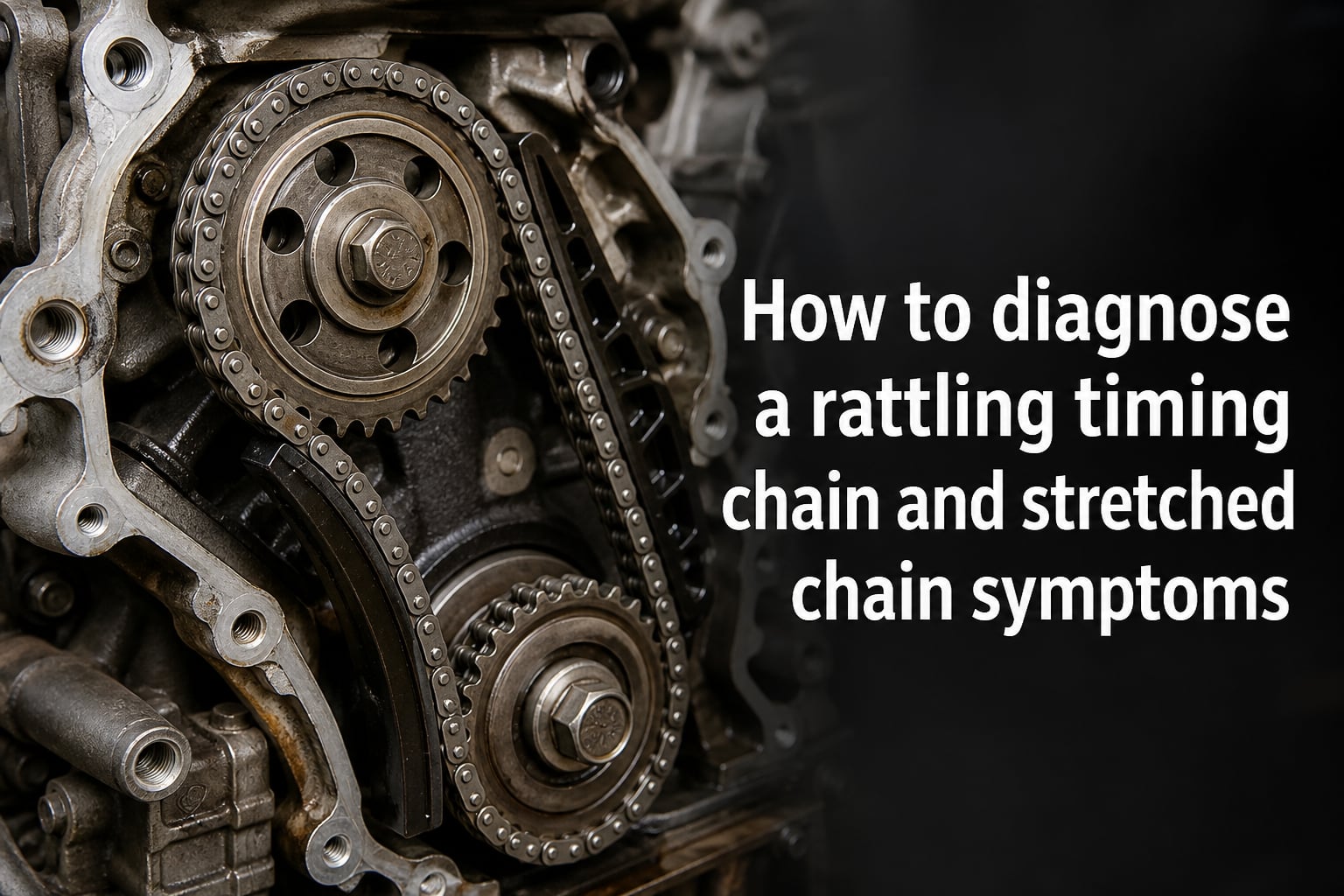
A timing chain is a metal chain inside your engine that synchronizes the rotation of the crankshaft and the camshaft(s). Think of it as the conductor of an orchestra, keeping every valve opening and piston movement in perfect rhythm. When that chain is healthy, your engine runs smooth, quiet, and efficient.
The chain rides on sprockets connected to the crankshaft at the bottom and the camshaft(s) at the top of the engine. As the crankshaft turns, the chain transfers that rotation to the camshaft, which opens and closes the intake and exhaust valves at precisely the right moment relative to piston position. This synchronization is called valve timing.
Unlike a timing belt made of rubber, a timing chain is designed to last the life of the engine under normal conditions. But chains stretch, tensioners fail, and guides wear down. When any of these components degrade, the chain loses tension, slaps against the engine case, and produces that characteristic rattling sound.
A failing timing chain matters because if it jumps teeth on the sprockets or snaps entirely, the synchronization between valves and pistons breaks. In an interference engine, which most modern vehicles are, the pistons can smash into the open valves, destroying the engine in milliseconds.
Types of Timing Chains: Link vs Roller vs Silent
Not all timing chains are the same, and knowing which type your engine uses helps with diagnosis. There are three main types found in modern engines.
Roller chains use cylindrical rollers that ride on sprocket teeth, similar to a bicycle chain. These are durable and common in older or heavy-duty engines. They tend to make a distinct metallic clatter when worn.
Silent chains (also called link chains) use a series of interlocking link plates with inverted teeth that mesh with the sprockets. These run quieter than roller chains and are common in modern passenger vehicles. BMW, Audi, and many Honda engines use silent chains. When they stretch, the noise is more of a whir or low rattle than a sharp clatter.
Bush chains are a hybrid, using bushings instead of rollers. They are less common in automotive engines but appear in some diesel applications. Each chain type wears differently and produces different sounds, which is why understanding your engine matters before diagnosing noise.
Common Symptoms of Timing Chain Problems
A bad timing chain rarely fails without warning. Your engine will send signals, sometimes for weeks or months before complete failure. The key is recognizing what those signals mean and how urgent they are.
Rattling noise from the engine is the most common symptom, especially on cold startup. The noise comes from the front of the engine where the chain, tensioner, and guides live. If the rattle disappears after the engine warms up and oil pressure builds, the chain tensioner may be weak but the chain could still have life left.
Engine misfires occur when a stretched chain throws off camshaft-to-crankshaft timing. The valves open at the wrong time relative to the pistons, causing incomplete combustion. You feel this as hesitation, rough idle, or stumbling under acceleration.
Check engine light illuminates when the engine computer detects timing correlation errors between the camshaft and crankshaft position sensors. Codes like P0016 and P0017 are strong indicators of chain stretch.
Metal shavings in the oil are a serious red flag. As chain guides wear and the chain stretches, material gets ground off and circulates through the oil. If you or your mechanic find metallic flakes during an oil change, inspect the timing chain immediately.
Reduced engine power and poor acceleration happen because retarded valve timing from chain stretch kills engine efficiency. The vehicle feels sluggish, especially under load or when climbing hills.
Engine vibration at idle can indicate timing chain problems, though it also points to many other issues. When combined with rattling or misfire codes, it strengthens the timing chain diagnosis.
How to Diagnose a Rattling Timing Chain
Diagnosing a rattling timing chain requires a systematic approach. Rushing to conclusions based on a single noise leads to misdiagnosis. Follow these steps in order.
Step 1: Listen on Cold Startup
Start the engine cold after it has sat overnight. A failing timing chain rattles loudest during the first 2 to 5 seconds after startup because oil pressure has not yet reached the hydraulic tensioner. Listen for a metallic, vibrating rattle from the front of the engine, near the valve cover and timing cover.
If the rattle lasts only a second or two and disappears completely, the tensioner may be bleeding down overnight but the chain itself could be fine. If the rattle persists for 5 to 10 seconds or longer, the chain and tensioner need inspection.
Step 2: Check at Idle and Under Acceleration
Let the engine warm up to operating temperature. Listen at idle with the hood open. A healthy timing chain is nearly silent. A worn chain produces a steady, light rattling or whirring from the timing cover area.
Have a helper rev the engine to 2,000 to 2,500 RPM. A rattling timing chain often changes pitch with RPM, while rod knock tends to be loudest under load and disappears at certain RPM ranges. Timing chain rattle stays present across the rev range.
Step 3: Inspect the Oil
Drain a small amount of oil into a clean container and shine a light through it. Look for fine metallic glitter or flakes settling at the bottom. Metal shavings indicate something inside the engine is wearing rapidly, and timing chain guides are a prime suspect.
If you find significant metal, do not drive the vehicle further. The shavings will damage bearings and other components quickly.
Step 4: Scan for Diagnostic Trouble Codes
Plug in an OBD-II scanner and check for stored codes. Look specifically for camshaft-crankshaft correlation codes: P0008, P0009, P0016, P0017, P0018, and P0019. These codes trigger when the engine computer detects that camshaft and crankshaft positions are out of sync, which directly indicates chain stretch.
Note that a stretched chain does not always throw a code, especially in early stages. The absence of codes does not rule out a timing chain problem.
Step 5: Perform a Timing Chain Tension Check (Advanced)
If you have mechanical experience, remove the valve cover and inspect the chain slack at the tensioner. With the chain under no load, push on the longest run of chain between sprockets. Excessive deflection, typically more than half an inch, indicates significant stretch.
This step requires mechanical knowledge and the right tools. If you are not comfortable, a mechanic can perform this inspection in about an hour of labor.
How to Tell If Your Timing Chain Is Stretched?
Chain stretch does not mean the metal links are physically elongating like a rubber band. It refers to the cumulative wear at every pin and link joint. Each joint wears a tiny amount, and across hundreds of links, that wear adds up to measurable elongation.
A stretched timing chain causes the camshaft timing to retard, meaning the valves open and close slightly later than the engine computer expects. This produces a cascade of symptoms.
The first sign of a stretched chain is usually a check engine light with camshaft-crankshaft correlation codes. The engine computer monitors the exact position of both shafts using sensors. When the chain stretches enough, the positions no longer match the programmed parameters, and the computer flags the discrepancy.
You may also notice gradual performance degradation. The engine feels less responsive, fuel economy drops, and cold starts become rougher. These changes happen so slowly that many drivers do not notice until the chain has significant stretch.
The most reliable way to confirm chain stretch is with a scan tool that reads camshaft-crankshaft deviation in real time. A healthy engine shows near-zero deviation. As the chain stretches, the deviation increases. Most manufacturers specify a maximum allowable deviation, often around 3 to 5 degrees, beyond which the chain needs replacement.
Some shops also use a mechanical timing chain wear gauge that measures physical elongation. This requires removing the timing cover, so it is usually done when other symptoms already point to the chain.
Stretched vs Worn vs Broken: Knowing the Difference
One of the biggest sources of confusion I see on forums is the distinction between a stretched chain, a worn chain, and a broken chain. These are three different failure modes with different symptoms, urgency levels, and outcomes.
Stretched Timing Chain
A stretched chain is still intact and functioning, but it has elongated due to pin and link wear. Symptoms include check engine codes, reduced performance, and a subtle rattle. You can often drive a stretched chain for weeks to months, but you should schedule replacement rather than ignore it.
Worn Chain with Damaged Components
When people say the chain is worn, they usually mean the chain, tensioner, guides, and sprockets are all degrading together. Plastic chain guides crack and break apart, the tensioner loses hydraulic pressure, and the sprocket teeth wear unevenly. Symptoms are louder rattling, metal shavings in oil, and more frequent misfires. This stage requires prompt attention because broken guide pieces can jam the chain.
Broken or Jumped Timing Chain
A broken chain snaps, usually at a worn link. A jumped chain has not broken but has skipped teeth on the sprockets, throwing valve timing completely off. Both scenarios cause immediate, severe symptoms: the engine runs extremely rough, stalls, or refuses to start. In interference engines, pistons hit valves, causing catastrophic damage. If this happens, stop driving immediately and have the vehicle towed.
Distinguishing Timing Chain Noise from Other Engine Sounds
This is where many DIYers get tripped up. Multiple engine problems produce rattling, ticking, or knocking sounds. Here is how to tell a timing chain rattle apart from the most common imposters.
Timing chain rattle vs rod knock: Rod knock is a deep, heavy thudding sound that intensifies under load and at higher RPM. It comes from the bottom of the engine, near the oil pan. Timing chain rattle is lighter, more metallic, comes from the top front of the engine, and is often loudest at startup and idle rather than under heavy load.
Timing chain rattle vs lifter tick: Lifter tick is a sharp, rhythmic tapping that matches engine speed. It often comes from the top of the engine, similar to timing chain noise, but lifter tick is usually constant and does not change with throttle position. Timing chain rattle has a more chaotic, vibrating quality.
Timing chain rattle vs exhaust leak: An exhaust leak near the manifold produces a ticking sound that speeds up with RPM. It often sounds like a card in bicycle spokes. Exhaust leaks are loudest under acceleration and typically quieter at idle, while timing chain rattle is often loudest at idle and startup.
Timing chain rattle vs heat shield rattle: A loose exhaust heat shield rattles against metal and sounds tinny. It usually appears at specific RPM ranges and disappears at others. Timing chain rattle is more consistent across the RPM range.
Check Engine Light and Diagnostic Codes
The check engine light is one of the most reliable indicators of timing chain stretch, but only when you read the actual codes. Here are the codes most commonly associated with timing chain problems.
P0016 and P0017 are camshaft-crankshaft position correlation codes for bank 1. These are the most direct indicators of chain stretch. They trigger when the engine computer detects that the camshaft and crankshaft are out of sync by more than the allowed tolerance.
P0008 and P0009 indicate engine position system performance on bank 1 and bank 2 respectively. These appear in engines with multiple camshafts and often point to a stretched chain that has shifted timing on one bank.
P0018 and P0019 are the bank 2 sensor circuit correlation codes, again pointing to timing misalignment.
Variable valve timing (VVT) codes like P0010 through P0015 can also appear because VVT systems depend on precise camshaft control, which a stretched chain undermines.
Yes, a stretched timing chain does throw a code in most modern vehicles, but it depends on how far the stretch has progressed. Early-stage stretch may not trigger a code because the deviation is still within the computer’s tolerance window. By the time codes appear, the chain typically needs replacement soon.
When to Stop Driving: Safety Warning
This is the section I wish more guides included. Knowing when a timing chain problem means schedule a repair versus when it means stop the engine right now can save you thousands of dollars.
Keep driving and schedule repair if: The rattle appears only on cold startup for 1 to 3 seconds and disappears completely. The check engine light is on with timing correlation codes but the engine runs smoothly with no misfires. Performance feels normal and no metal shavings are present in the oil. You have days to weeks to address this.
Drive directly to a shop, no highway, if: The rattle persists beyond cold startup and is audible at idle. You feel misfires, hesitation, or power loss. The check engine light is flashing, which indicates active misfires that can damage the catalytic converter. Schedule repair within days.
Stop driving immediately and tow the vehicle if: The engine suddenly runs very rough, loses significant power, or stalls. You hear loud metallic clanging or grinding. The engine shakes violently. The check engine light flashes continuously. These symptoms indicate the chain may have jumped or is about to break, and continued operation risks catastrophic engine damage.
From my experience on mechanic forums, the most common mistake drivers make is ignoring the early rattle because it goes away after warmup. By the time the rattle becomes constant, the chain and tensioner are already badly worn, and replacement costs climb because guides, sprockets, and sometimes the VVT actuators need replacement too.
What Causes Timing Chain Problems?
Understanding the causes helps you prevent premature wear and recognize whether your vehicle is at higher risk.
Infrequent oil changes are the number one cause of premature timing chain wear. The chain tensioner relies on clean oil at proper pressure to maintain chain tension. Dirty oil acts as an abrasive, accelerating wear at every pin and link joint. Skipping oil changes by even a few thousand miles on engines with known chain issues can significantly shorten chain life.
Wrong oil viscosity can starve the tensioner of adequate pressure. Some owners switch to thicker oil hoping to quiet chain rattle, but this can actually reduce flow to the tensioner and make the problem worse. Always use the manufacturer-specified oil viscosity.
Tensioner failure is common, especially in engines with hydraulic tensioners. The tensioner uses oil pressure to push against the chain and maintain tension. If the tensioner leaks or its internal seal fails, it bleeds down when the engine is off, leaving the chain slack at startup. This is why cold start rattle is often the first symptom.
Chain guide wear occurs because most guides are made of plastic that becomes brittle over time and with heat cycling. When guides crack and break, the chain has nothing to ride on and slaps against the engine case, accelerating wear on everything.
Known problem engines include certain BMW N20 and N47 engines, Audi and VW EA888 2.0 TFSI engines, some Honda K-series and J-series V6 engines, Nissan VQ V6 engines, and specific MINI Cooper models. If you own one of these, pay extra attention to timing chain symptoms and consider preemptive inspection at recommended mileage intervals.
FAQs
How do I tell if my timing chain is stretched?
The most reliable signs of a stretched timing chain are camshaft-crankshaft correlation codes (P0016, P0017, P0008, P0009), reduced engine performance, poor fuel economy, and a subtle rattle from the timing cover area. A scan tool that reads camshaft-crankshaft deviation in real time can confirm stretch by showing timing misalignment beyond manufacturer tolerances, typically above 3 to 5 degrees.
How long will a timing chain last once it starts rattling?
A timing chain that rattles only on cold startup for a few seconds may last weeks to months. Once the rattle becomes constant at idle or under acceleration, the chain and tensioner are significantly worn and should be replaced promptly. There is no fixed mileage, because continued driving risks chain jump or breakage, which causes catastrophic engine damage. Schedule diagnosis as soon as the rattle appears.
How to diagnose a timing chain rattle?
Diagnose a timing chain rattle in five steps: listen on cold startup for metallic rattling from the front of the engine, check the noise at idle and under acceleration, inspect the oil for metal shavings, scan for camshaft-crankshaft correlation codes like P0016 and P0017, and inspect chain tension by removing the valve cover if you have mechanical experience.
Is it worth fixing a stretched timing chain?
Yes, fixing a stretched timing chain is almost always worth it. The repair typically costs between $1,000 and $2,500 depending on the vehicle. Ignoring a stretched chain risks chain jump or breakage, which can destroy the engine in an interference design and cost $4,000 to $8,000 or more to replace. Early repair is always cheaper than engine replacement.
What happens if your timing chain is stretched?
When a timing chain stretches, the camshaft and crankshaft fall out of synchronization. This retards valve timing, causing reduced engine power, poor fuel economy, rough idle, misfires, and check engine codes. If left unrepaired, a stretched chain can jump teeth on the sprockets or break entirely, causing pistons to hit valves in interference engines and destroying the engine.
Would a stretched timing chain throw a code?
Yes, in most modern vehicles a stretched timing chain throws a code. The engine computer detects the misalignment between camshaft and crankshaft positions and triggers codes like P0016, P0017, P0008, or P0009. However, early-stage stretch may not trigger a code because the deviation is still within the computer’s tolerance window. By the time codes appear, the chain typically needs replacement soon.
Conclusion
Learning how to diagnose a rattling timing chain and stretched chain symptoms puts you in control of your vehicle’s health and your wallet. The diagnostic process comes down to five steps: listen on cold startup, check at idle and under load, inspect the oil, scan for codes, and inspect chain tension if you are mechanically inclined.
The most important takeaway is the safety decision. A few seconds of cold start rattle with no codes means schedule a repair at your convenience. A constant rattle with misfires and metal in the oil means get to a shop without delay. Sudden rough running, stalling, or loud clanging means stop and call a tow truck.
If you suspect your timing chain is failing, buy or borrow an OBD-II scanner and check for codes today. That $30 tool can tell you whether the noise is a worn tensioner or a chain about to jump. Catching the problem early saves thousands in repair costs and keeps you off the side of the road.
1 thought on “How to Diagnose a Rattling Timing Chain and Stretched Chain Symptoms in 2026?”