
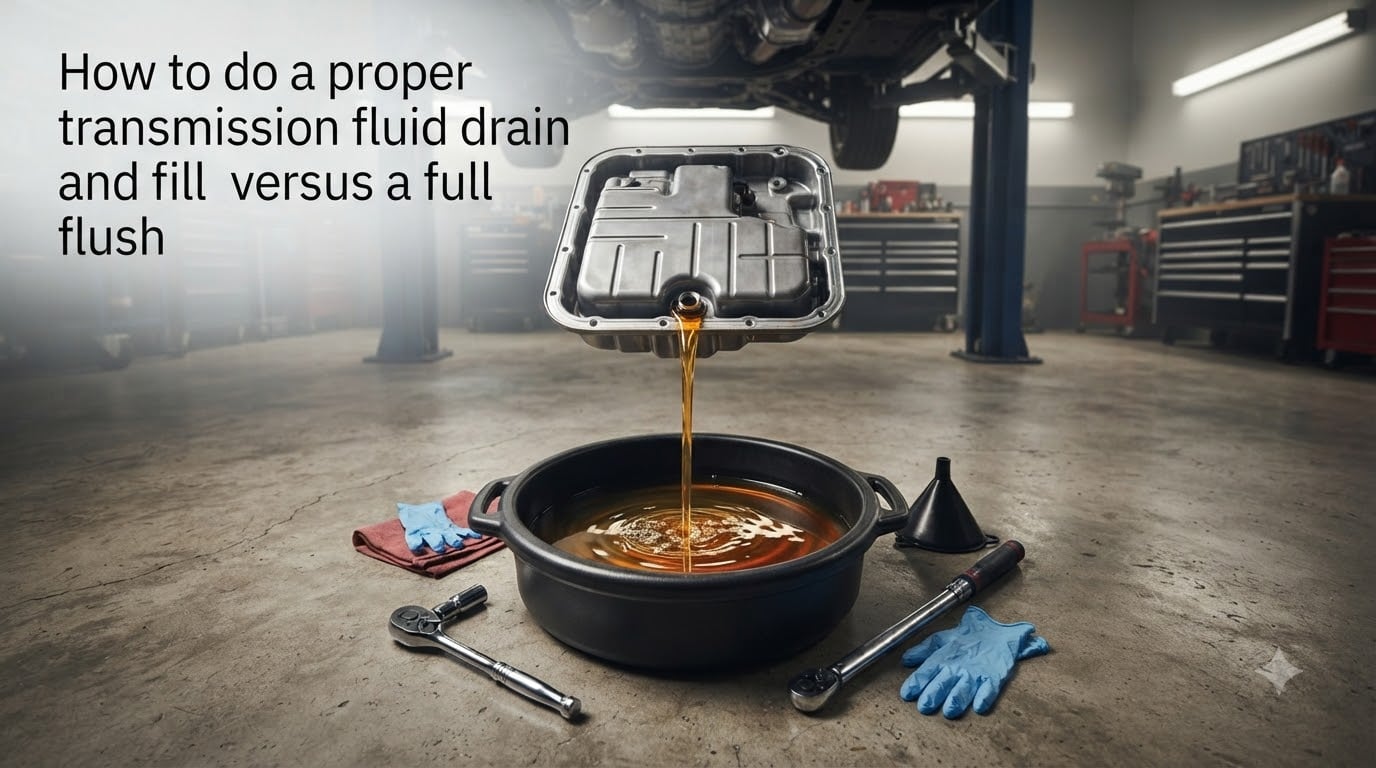
If you’re trying to decide between a transmission fluid drain and fill vs flush, you’re not alone. I talked to mechanics and read hundreds of forum threads on Bob Is The Oil Guy and Reddit to settle this debate. Both methods replace old ATF, but they work differently and carry different risks. This guide explains what each service does, when to choose one over the other, and how to do a proper drain and fill at home.
The short answer: a drain and fill removes about 30 to 50 percent of your old transmission fluid through the pan drain plug. A flush uses a machine to push new fluid through the system, replacing up to 100 percent of the fluid including what’s in the torque converter and cooler lines. Each method has its place, and choosing the wrong one for an older or neglected transmission can actually cause damage.
By the end of this article, you’ll know exactly which method fits your vehicle, how to do a drain and fill yourself, and how to spot the warning signs that mean you need service now rather than later.
Table of Contents
What Is a Transmission Fluid Drain and Fill?
A transmission fluid drain and fill is the simpler and safer of the two services. The technician (or you, working in your driveway) removes the drain plug from the transmission pan, lets the old fluid gravity-drain out, then refills through the dipstick tube or fill port with fresh ATF. That’s the entire process.
Here’s what happens mechanically. Your automatic transmission holds between 8 and 14 quarts of fluid, depending on the vehicle. But only about 3 to 5 quarts actually sit in the pan where gravity can reach them. The rest lives inside the torque converter, valve body, cooler lines, and transmission passages. When you pull the drain plug, you only get the pan fluid. The fluid inside the torque converter and cooler lines stays put.
This is actually a good thing in many cases. Old fluid sitting in those passages has built up a thin coating of varnish and sediment that helps seal tiny clearances. Replacing all of it at once can dislodge that coating and expose worn seals. A drain and fill leaves roughly half to two-thirds of the old fluid in the system, mixing with the new fluid you add.
Pros of a Drain and Fill
- Safer for high-mileage and older transmissions
- Costs less (DIY under $50 in fluid and a new pan gasket)
- No specialized equipment required
- Lower risk of dislodging debris that clogs passages
- Easy to do at home in about 45 minutes
Cons of a Drain and Fill
- Only replaces 30 to 50 percent of the fluid
- Doesn’t clean out the torque converter
- Won’t fully remove sludge or contamination in one service
- Old fluid mixes with new, diluting its protective properties
What Is a Transmission Flush?
A transmission flush goes much further than a drain and fill. A shop connects a flushing machine to the transmission cooler lines, then runs new fluid through the entire system under pressure. The machine pushes the old fluid out while simultaneously adding new fluid, so the transmission never runs dry during the process.
The advantage is clear. A flush can replace 100 percent of the fluid, including the fluid trapped inside the torque converter and the long cooler lines that run to the radiator. The new fluid is forced through every passage, valve, and clutch pack. This gives you the cleanest possible fluid condition in a single service.
The downside is what that pressure can dislodge. Years of varnish, metal fragments, and sludge that have accumulated inside the transmission can break free during a flush. Those particles then travel through the system and can clog small passages, stick valves, or damage the pump. This is why many mechanics refuse to flush transmissions that have never been serviced or have over 100,000 miles with unknown fluid history.
Pros of a Transmission Flush
- Replaces nearly all old fluid in one service
- Cleans the torque converter and cooler lines
- Removes more sludge and contamination
- Restores shift quality faster on neglected transmissions
- Professional equipment ensures proper pressure and flow
Cons of a Transmission Flush
- Higher cost (typically $150 to $300 at a shop)
- Risk of dislodging debris in older transmissions
- Can expose worn seals by removing all varnish coating
- Not recommended for high-mileage vehicles with unknown service history
- Requires specialized machine and trained technician
Transmission Fluid Drain and Fill vs Flush: Side-by-Side Comparison
The table below breaks down the key differences between these two transmission services. Use it to decide which method fits your vehicle and budget.
| Factor | Drain and Fill | Transmission Flush |
|---|---|---|
| Fluid replaced | 30 to 50 percent | Up to 100 percent |
| Equipment needed | Basic hand tools | Flushing machine at a shop |
| Typical cost (DIY) | Under $50 | Not practical DIY |
| Typical cost (shop) | $80 to $150 | $150 to $300 |
| Time required | 45 minutes to 1 hour | 1 to 2 hours at shop |
| Risk to old transmissions | Low | Moderate to high |
| Cleans torque converter | No | Yes |
| Removes sludge | Partial | Full |
| Best for high mileage | Yes | Use caution |
| Filter replacement | Optional but recommended | Usually not done |
The biggest practical difference comes down to risk. A drain and fill is gentle and forgiving. A flush is thorough but aggressive. For most daily drivers with regular service history, either method works fine. For a vehicle with 120,000 miles and no record of fluid changes, the drain and fill is the safer choice.
When Should You Use a Drain and Fill vs a Flush?
The right method depends on your vehicle’s age, mileage, and service history. Here’s how I break it down based on what mechanics actually recommend.
Choose a Drain and Fill If:
- Your vehicle has over 75,000 miles
- You’re unsure when the fluid was last changed
- The transmission shifts normally with no major issues
- You want to save money and do it yourself
- You’re preparing to sell or trade the vehicle
Choose a Flush If:
- Your vehicle is under 60,000 miles with regular service history
- You notice dark fluid with a burnt smell
- The transmission has harsh shifting or delayed engagement
- You’re buying a used car and want a clean fluid baseline
- A trusted shop recommends it after inspecting your fluid
If your transmission is showing symptoms like slipping, hard shifts, or whining noises, neither service is a guaranteed fix. Those symptoms often point to internal wear that fluid alone won’t solve. Get a professional diagnosis before spending money on either method.
The Multiple Drain and Fill Method: A Safer Alternative
This technique comes up constantly in mechanic forums, and it’s the smartest compromise I’ve found. Instead of one aggressive flush, you do two or three consecutive drain and fills spaced a few hundred miles apart. Each service replaces 30 to 50 percent of the fluid, so after three services you’ve refreshed nearly 90 percent of the system without the pressure or risk of a flush machine.
Here’s how it works in practice. You start with a standard drain and fill, then drive normally for 500 to 1,000 miles. The new fluid mixes with the old and starts cleaning internal deposits. You then do another drain and fill, which removes more of the now-diluted old fluid. After a third service a few weeks later, the fluid in your transmission is almost entirely fresh.
This approach is widely recommended on Bob Is The Oil Guy for high-mileage vehicles and transmissions with unknown history. It costs more in fluid over time (three drain and fills at $30 each vs one flush at $200), but you avoid the risk of dislodging chunks of debris that cause immediate damage. Most forum regulars say the multiple drain and fill method gives flush-like results with drain-and-fill safety.
The tradeoff is time. Spreading the services over a month or two means your transmission runs on diluted fluid longer. But many mechanics argue this is actually gentler on seals and clutch packs than one big flush.
How to Do a Proper Transmission Drain and Fill (Step-by-Step)
I’ve done this on my own cars several times, and it takes about 45 minutes from start to finish. You’ll need basic hand tools and the right fluid for your transmission. Always check your owner’s manual for the exact ATF specification. Using the wrong fluid can damage your transmission.
Tools and Supplies You’ll Need
- Socket wrench set with the correct size for your drain plug
- Drain pan that holds at least 8 quarts
- New transmission fluid (check spec in your manual)
- New pan gasket if your pan has a gasket (some use RTV sealant)
- Funnel with a long neck that fits the fill tube
- Jack and jack stands or ramps to lift the vehicle
- Shop rags and gloves
Step-by-Step Instructions
Step 1: Warm up the transmission by driving the car for 10 to 15 minutes. Warm fluid flows out faster and more completely than cold fluid. Don’t make it hot. Just bring it up to normal operating temperature.
Step 2: Lift the vehicle safely using jack stands or ramps. Make sure the car is level or slightly tilted forward so fluid drains toward the pan. Never work under a car supported only by a jack.
Step 3: Place your drain pan directly under the transmission pan. Position it to catch fluid from the drain plug without making a mess on your driveway.
Step 4: Remove the drain plug with the correct socket. On many vehicles, this is a square-headed plug that requires a specific tool. If your pan doesn’t have a drain plug, you’ll need to remove the entire pan (more involved, includes filter replacement).
Step 5: Let the fluid drain completely. This takes 10 to 15 minutes. You can gently remove the fill cap from the engine bay to help the fluid flow faster by breaking the vacuum.
Step 6: Reinstall the drain plug with a new crush washer if your vehicle uses one. Tighten to the spec in your manual. Over-tightening can crack the pan.
Step 7: Lower the vehicle back to the ground. Now refill through the dipstick tube or transmission fill port using a long-neck funnel. Add the exact amount of fluid you drained, plus about half a quart extra to account for fluid that didn’t fully drain.
Step 8: Start the engine and let it idle for 2 to 3 minutes. Shift through each gear (Park to Reverse to Drive to Low) for about 10 seconds each. This circulates the new fluid through the torque converter and passages.
Step 9: Check the fluid level with the engine running and the transmission in Park. Add fluid slowly until it reaches the full mark on the dipstick. Do not overfill. Overfilling causes foaming and shifting problems.
Step 10: Take the car for a 15-minute test drive. Pay attention to shifting quality. If shifts feel normal and there are no leaks under the car, you’re done.
A few tips from my own experience. Always double-check that you used the right ATF spec. Dexron III, Mercon, ATF+4, and many manufacturer-specific fluids are not interchangeable. Mixing the wrong fluid can cause immediate shifting issues or seal damage.
Warning Signs You Need Transmission Service
Your transmission usually tells you when something is wrong. Watch for these symptoms, and don’t wait too long to address them.
Fluid Color and Condition
Healthy ATF is bright red and slightly sweet-smelling. If your fluid is dark brown or black, has a burnt odor, or feels gritty between your fingers, it needs changing immediately. You can check the fluid yourself with the engine running and the transmission warm.
Shifting Problems
Harsh shifts, delayed engagement when you put the car in Drive or Reverse, or slipping between gears all suggest the fluid is worn out. Sometimes a fresh drain and fill fixes these issues. Other times they indicate internal wear that fluid alone won’t repair.
Unusual Noises
A whining or humming noise that changes with vehicle speed often points to low fluid or a failing pump. Grinding or clunking sounds during shifts suggest worn synchronizers or clutches. Get a diagnosis before assuming fluid service will fix the problem.
Fluid Leaks
Red or brown fluid spots under your car mean a leak. Common leak points include the pan gasket, cooler line connections, and seals at the front or rear of the transmission. A low fluid level causes the same symptoms as old fluid, so leaks need prompt attention.
Service Interval Guidelines
Most manufacturers recommend a transmission fluid change every 60,000 to 100,000 miles under normal driving. Severe conditions (towing, heavy loads, stop-and-go traffic, extreme temperatures) cut that interval in half. If you drive hard or carry heavy loads often, plan on changing fluid every 30,000 to 50,000 miles.
Here’s a quick guide by driving type:
- Normal driving: Change every 60,000 to 100,000 miles
- Towing or heavy hauling: Change every 30,000 to 50,000 miles
- Stop-and-go city traffic: Change every 40,000 to 60,000 miles
- Extreme heat or cold climates: Change every 40,000 to 60,000 miles
Cost Comparison: Drain and Fill vs Flush
The cost difference between these two services is significant. A DIY drain and fill runs $30 to $50 for fluid and a new gasket, plus the cost of any tools you need to buy. A shop drain and fill typically costs $80 to $150 including labor. A flush at a shop runs $150 to $300 depending on your vehicle and location.
If budget is your main concern, doing the drain and fill yourself is the obvious choice. The savings easily pay for a basic socket set and a few drain pans if you don’t already own them. For most people, the bigger question is risk versus thoroughness, and that’s where the drain and fill wins for older vehicles.
Frequently Asked Questions
Is it better to do a transmission flush or just a drain and fill?
For most vehicles, especially those with over 60,000 miles or unknown service history, a drain and fill is the safer choice. A flush is more thorough but carries risk of dislodging debris in older transmissions. A drain and fill only replaces 30 to 50 percent of fluid but won’t damage seals or clog passages. For newer vehicles with regular service history, either method works well.
How many times should I do a transmission drain and fill?
For routine maintenance, one drain and fill every 60,000 to 100,000 miles is sufficient. If you are using the multiple drain and fill method to approximate a flush on a high-mileage vehicle, do 2 to 3 consecutive services spaced 500 to 1,000 miles apart. After three services, roughly 90 percent of the fluid will be refreshed.
Can a transmission flush damage your transmission?
Yes, a transmission flush can damage your transmission under certain conditions. The main risk is on vehicles with high mileage or unknown service history where sludge and metal fragments have accumulated inside. The flush machine pressure can dislodge these deposits, which then clog small passages or stick valves. This is why many mechanics recommend drain and fill for older vehicles.
How much transmission fluid does a drain and fill replace?
A standard drain and fill replaces approximately 30 to 50 percent of the total fluid capacity, which typically works out to 3 to 5 quarts out of a total system capacity of 8 to 14 quarts. The remaining fluid stays trapped in the torque converter, cooler lines, and internal passages.
Is it too late to change transmission fluid on a high mileage car?
It is almost never too late to change transmission fluid on a high mileage vehicle, but the method matters. Use a drain and fill instead of a flush, and consider doing 2 to 3 consecutive services for the best results. Avoid aggressive flushing machines on transmissions with over 100,000 miles and unknown service history.
Final Verdict on Transmission Fluid Drain and Fill vs Flush
Here is the bottom line on transmission fluid drain and fill vs flush. For most drivers, especially those with vehicles over 60,000 miles or unknown service history, a drain and fill is the smarter and safer choice. It costs less, you can do it yourself, and it carries minimal risk of damage. A flush has its place on newer, well-maintained transmissions, but it is not the universal answer that some shops make it out to be.
If you want the cleanliness of a flush without the risk, try the multiple drain and fill method. Three consecutive services spaced a month apart will give you nearly fresh fluid throughout the entire system, including the torque converter. This approach has strong support from experienced mechanics on Bob Is The Oil Guy and Reddit for a reason: it works without the downsides of a flushing machine.
Whatever method you choose, use the correct ATF specification for your vehicle, follow the torque specs when reinstalling the drain plug, and don’t ignore warning signs like dark fluid, burnt smell, or shifting problems. A little preventive maintenance now is far cheaper than a transmission replacement later.