
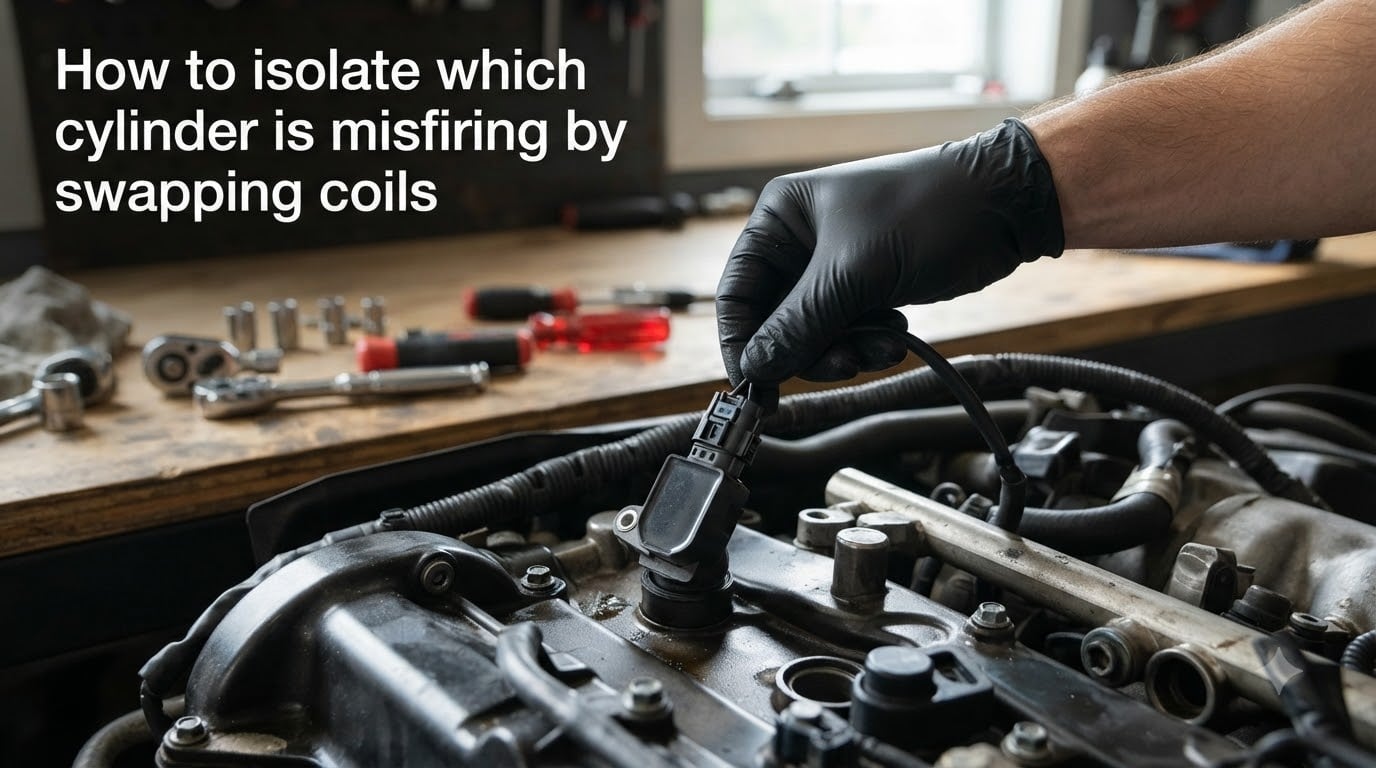
When your check engine light flashes and the engine starts sputtering, you need a fast, reliable way to find the bad cylinder. I have used this method on dozens of vehicles in my own garage, and it consistently narrows down the problem in under 30 minutes. Below is the exact procedure I follow for how to isolate which cylinder is misfiring by swapping coils, plus how to read each result.
Table of Contents
What Is a Cylinder Misfire and Why Coil Swapping Works?
A cylinder misfire happens when the air-fuel mixture in one combustion chamber fails to ignite properly. The engine control unit (ECU) detects the missing power stroke and logs a diagnostic trouble code.
Common misfire codes follow a clear pattern:
P0300: Random or multiple misfires detected
P0301 through P0308: Specific cylinder misfire (1 through 8, depending on engine)
The coil swap test works on a simple principle. If you move a coil from the suspected bad cylinder to a known good cylinder and the misfire follows the coil, the coil is bad. If the misfire stays in the original cylinder, the spark plug, injector, or wiring is the problem. This logic gives you a definitive answer without expensive scan tools.
Tools and Safety Precautions You Need Before Starting
You only need a few basic items to perform this diagnostic. I keep them in a small tray so I am never searching the toolbox with oily hands.
OBD2 scanner: A basic code reader under 50 dollars works fine. Bluetooth adapters paired with a phone app also do the job.
Insulated gloves: Coil-on-plug systems carry 30,000+ volts.
Socket wrench or ratchet set: For removing engine covers and securing coils.
Notepad or phone: To log which cylinder you tested and the result.
Service manual (optional): Confirms coil arrangement, especially on engines with non-sequential cylinder numbering.
Safety first. The ignition system can deliver a serious shock even at 12 volts input because coils step it up dramatically. Always disconnect the negative battery terminal before physically removing a coil. Never touch coil terminals or spark plug boots with wet hands or while the engine is running unless you are performing the disconnection test on purpose.
Keep flammable materials away from the exhaust manifold. The engine will be hot, so let it cool for 15 minutes before touching any components.
Step 1: Run an OBD2 Scan to Confirm the Misfiring Cylinder
Start by reading the diagnostic trouble codes. Plug your OBD2 scanner into the port, usually under the dashboard on the driver’s side. Turn the key to the on position without starting the engine.
Record every code that appears. Focus on the P03XX series codes. If you see P0303, for example, the ECU has flagged cylinder number 3 as the source of the misfire. Write this down. You will need this number throughout the test.
Clear the codes after noting them, then start the engine and let it idle for a few minutes. Re-scan to confirm whether the same cylinder code returns. If it does not return immediately, the misfire may be intermittent and harder to diagnose.
Step 2: Perform the Coil Disconnection Test
The disconnection test gives you a baseline. With the engine idling, disconnect one ignition coil connector at a time and listen for a change in engine smoothness.
When you unplug a coil on a healthy cylinder, the engine note drops noticeably and gets rougher. That cylinder was contributing to the idle. When you unplug the coil on the already-misfiring cylinder, the engine sound barely changes because that cylinder was already not firing.
This test confirms your scan results before you start swapping parts. Note which cylinders responded strongly and which one had no change.
Step 3: How to Isolate Which Cylinder Is Misfiring by Swapping Coils
Now the actual coil swap procedure. Shut off the engine and disconnect the negative battery terminal for safety.
Identify the suspected bad cylinder from your OBD2 scan (for example, cylinder 3).
Pick a known good cylinder nearby, ideally the next one in firing order, such as cylinder 1 or 4.
Label both coils with tape so you remember which one came from where.
Remove the coil from the suspected bad cylinder by disconnecting the electrical connector and pulling straight up. A gentle rocking motion helps if it sticks.
Remove the coil from the known good cylinder the same way.
Swap the coils, installing the suspected bad coil into the known good cylinder and vice versa.
Reconnect everything, reattach the battery terminal, and clear the OBD2 codes.
Start the engine and let it idle for 2 to 3 minutes.
Re-scan the ECU and note which cylinder code returns.
The pattern of the new code tells the whole story. The misfire code “follows” the bad component to its new home.
Interpreting the Results: What Each Outcome Means
This is where the diagnostic pays off. Match your scan result to the scenario below.
Scenario A: Misfire moved to the new cylinder. If your original P0303 became P0301 (the cylinder where you installed the suspect coil), the coil is bad. Replace it and your problem is solved. The spark plug in the original cylinder is fine.
Scenario B: Misfire stayed in the original cylinder. The coil works. The spark plug in that cylinder is the prime suspect. Remove it and inspect for fouling, cracks, or excessive gap.
Scenario C: Both cylinders now show misfire codes. You may have disturbed a wiring connector. Re-seat both coil connectors fully and re-test. If codes persist, inspect the wiring harness for chafing or corrosion.
Scenario D: No codes return at all. You may have a marginal coil that only fails under load. Drive the car and monitor for the return of the code.
Scenario E: Multiple unrelated cylinders misfire. This points away from ignition. Fuel pressure, vacuum leaks, or a failing crankshaft position sensor are more likely. Skip ahead to the next diagnostic.
If the Misfire Persists: Test Spark Plugs, Injectors, and Compression
When the coil swap test shows the coil is fine but the misfire remains, focus on the spark plug next. Pull the plug and inspect it. A normal plug should be light tan or gray. Black and sooty means the engine is running rich. White and blistered points to a lean condition or overheating.
Swap the suspect spark plug with one from a known good cylinder using the same swap logic. If the misfire follows the plug, replace it. If not, move on to the fuel injector.
Injector testing requires a noid light or a scan tool that can command the injector to fire. Listen for the clicking pulse at each injector with the engine running. A silent injector is dead.
A wet spark plug (smells like fuel) confirms an injector stuck open. A dry spark plug with no spark after a coil swap suggests deeper problems like low compression, which requires a compression test.
When to Stop DIY and Call a Mechanic
I am a strong DIYer, but I also know when to hand off the keys. Stop and call a professional if you see multiple cylinder codes after a clean coil swap, if compression test results are uneven across cylinders, or if the misfire returns immediately after replacing both coil and spark plug.
Wiring harness faults, timing issues, and internal engine problems need scan tools and expertise most home garages do not have. Spending 200 dollars on a diagnostic is better than guessing on a 3,000 dollar engine repair.
FAQs
How do I figure out which cylinder is misfiring without a scanner?
Without a scanner, use the coil disconnection test on a running engine. Unplug each coil one at a time and listen for engine roughness. A healthy cylinder will cause a noticeable drop in idle quality when its coil is unplugged. A cylinder that produces no change when disconnected is the one already misfiring.
Can swapping ignition coils cause problems?
Swapping coils is safe when done with the engine off and the battery disconnected. The only risk is mislabeling the coils during the swap, which leads to confusing results. Always label each coil with tape before removal so you can put them back in the correct location if needed.
Why is my coil pack still misfiring after I just replaced it?
A new coil can still misfire if the spark plug is bad, the connector is loose, or the wiring harness has corrosion. It can also happen if the misfire was never ignition-related to begin with, such as a fuel injector or compression issue. Always confirm the misfire follows the component with a swap test before replacing parts.
Can an ignition coil cause a cylinder misfire?
Yes. A weak or failed ignition coil will not deliver enough voltage to jump the spark plug gap, causing the cylinder to misfire. This is one of the most common causes of a single-cylinder misfire code on modern engines with coil-on-plug systems.
Do I need to reset the ECU after changing the ignition coil?
Yes. Clear the OBD2 codes after the repair and then drive the vehicle through a full warm-up cycle. The ECU relearns the new component values during this drive. If the same code returns, the underlying issue was not the coil.
Final Thoughts on Coil Swap Diagnosis
The coil swap method is one of the most efficient diagnostic tools for a single-cylinder misfire. It costs nothing but a few minutes of your time and saves the cost of guessing which part to replace. Follow the steps in order, label everything, and interpret the results using the scenarios above. When you understand how to isolate which cylinder is misfiring by swapping coils, you will solve most ignition-related misfires without ever visiting a shop.