
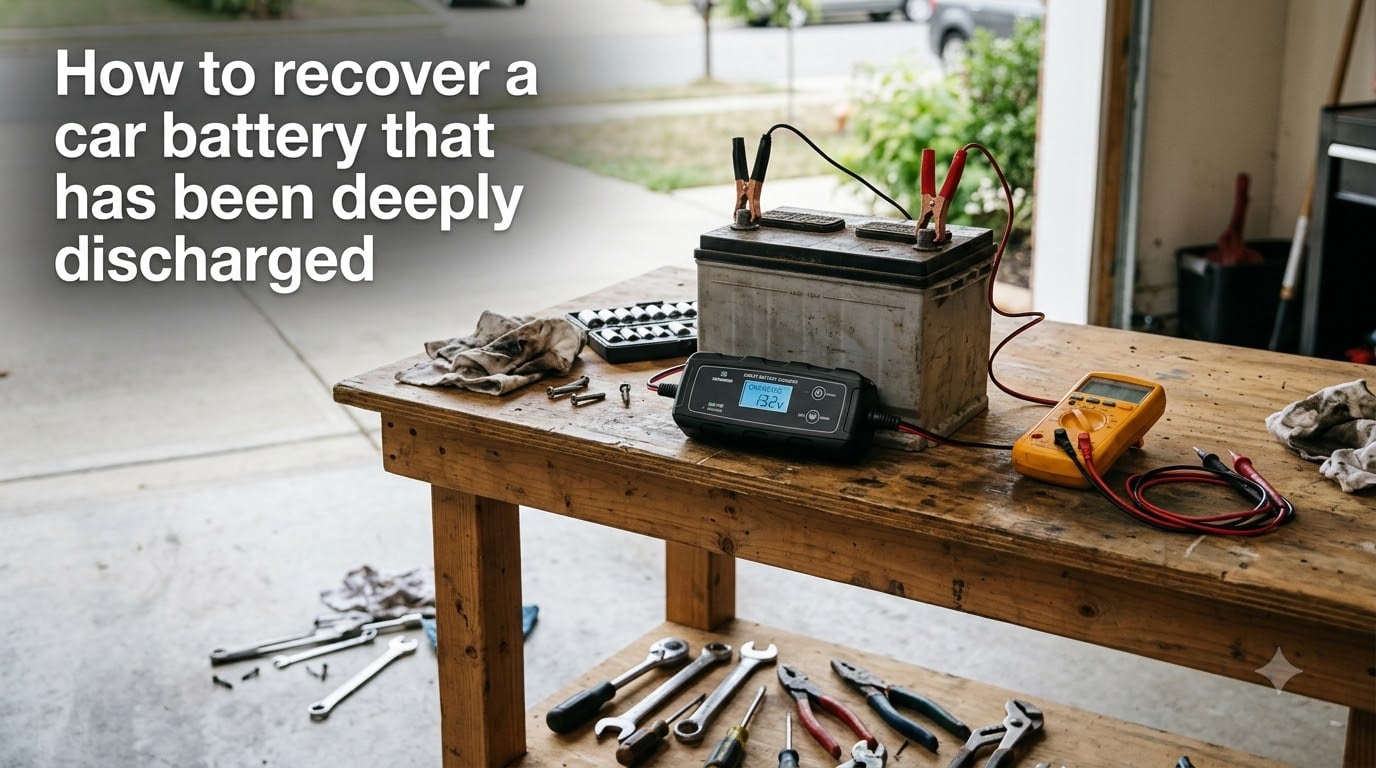
I left my car’s dome light on for three days last spring. The battery sat at 8.2 volts. I assumed it was junk and almost bought a new one. Then I tried to recover it first, and it is still cranking the engine a year later. That single experience is why I wrote this guide: most people replace a deeply discharged battery without ever trying a proper recovery, and most dead batteries are more recoverable than you think.
If you are trying to figure out how to recover a car battery that has been deeply discharged, this guide walks you through what deep discharge actually is, how to tell whether recovery is even worth trying, and the exact recovery method I now use whenever a battery drops below the safe range. I will also cover the safety warnings you absolutely need to read first, the differences between flooded lead-acid and AGM batteries, and the honest list of situations where replacement is the only sensible answer.
Quick note before we start: this is an informational guide about a process, not a product review. I am not recommending a specific charger or brand. I am going to walk through the method that works.
Table of Contents
What Counts as a Deeply Discharged Car Battery?
A 12-volt car battery is considered deeply discharged once it drops below about 11.8 volts at rest. That number matters because once a battery sits below that threshold for any length of time, internal chemistry starts breaking down. A normal, healthy battery should read 12.4 to 12.7 volts when the engine is off and rested.
Here is a quick reference for what different voltage readings mean after the surface charge has been allowed to settle (sit for at least an hour without charging or starting):
12.6 to 12.7 V: Fully charged. No action needed.
12.3 to 12.5 V: Slightly discharged. Drive the car or top up with a maintainer.
11.8 to 12.2 V: Moderately discharged. Recharge promptly.
10.5 to 11.7 V: Deeply discharged. Sulfation damage begins. Recovery is still likely.
Below 10.5 V: Severely discharged. Some cells may have reversed. Recovery odds drop sharply.
Below 8 V or near zero: Almost certainly damaged internally. Replacement is the safer bet.
If you have not measured your battery yet, take a voltage reading first. A basic multimeter is enough. The reading will tell you immediately whether you are in “easy recovery” territory or “long-shot recovery” territory.
Why Deep Discharge Damages Batteries (The Sulfation Problem)?
Inside every lead-acid battery there are lead plates sitting in a sulfuric acid solution. When the battery is discharging, soft lead sulfate crystals form on those plates. While you drive and the alternator recharges the battery, those crystals get dissolved back into the electrolyte. That cycle is normal.
The problem starts when a battery sits below 11.8 volts for more than a few days. The soft crystals harden into permanent crystals that block the active plate surface. The battery loses capacity because the crystals literally take up space the chemical reaction needs. This process is called sulfation, and it is the single biggest reason dead batteries die.
Two factors decide how bad the sulfation is:
How low the voltage dropped: The lower the voltage, the more aggressive the sulfation.
How long the battery sat dead: A battery dead for a week has recoverable soft sulfation. A battery dead for a year has hardened crystals that are much harder to reverse.
That is why time matters more than voltage. A battery at 10 volts for one day is usually recoverable. A battery at 10 volts for six months might still come back, but only with dedicated desulfation over days or weeks. A battery at 8 volts for a year is usually scrap.
Is It the Battery, the Alternator, or the Starter? Diagnose First
Before you spend two days trying to recover a battery, make sure the battery is actually the problem. I have watched friends revive a perfectly good battery only to find out the alternator was the real issue, and the dead battery kept coming back. Here is how to figure out which part is failing.
Test 1: Jump start and measure voltage at idle. Connect jumper cables or a battery booster and start the engine. With the engine running, put your multimeter on the battery terminals. A healthy charging system will show 13.8 to 14.4 volts. If you see 12 volts or lower while running, the alternator is not charging, and your “dead battery” symptom will return within hours.
Test 2: Listen to the starter. A clicking sound with no crank points to a dead battery or bad connections. A slow, labored crank on a warm day also points to the battery. A single loud click followed by silence usually means the starter solenoid or starter motor has failed.
Test 3: Headlights test. Turn the key off, then turn on the headlights without starting. Dim headlights mean the battery has very little charge. Normal-brightness headlights mean the battery has at least some usable power and the issue may be the starter or cables.
If all three tests point to a dead battery, recovery is worth attempting. If the alternator test shows under 13.8 volts at idle, fix that first, then decide whether the battery is still good.
Safety First: What to Check Before You Try to Recover a Battery
Before you connect any charger, look at the battery itself. A few visible signs mean the battery is dangerous and recovery is not worth the risk:
Rotten egg smell: That smell is hydrogen sulfide gas. A small amount is normal during charging. A strong smell means the battery is venting gas and the case may be compromised. Charge the battery outdoors, in a well-ventilated space, and never indoors near living areas.
Bulging or swollen case: A swollen battery has overheated or frozen internally. Stop and replace it.
Cracked case or visible leaks: Acid on the outside of the battery means the seals are broken. Do not charge it. Recycle it.
Corroded terminals: Heavy white or blue-green corrosion should be cleaned with a baking soda and water paste before charging. Disconnect the negative cable first.
When you do begin recovery, work in a garage with the door open or outdoors. Do not smoke near the battery. Keep any sparks or flames away. A charging battery releases hydrogen gas, which is explosive in enclosed spaces.
Wear safety glasses and gloves. Sulfuric acid is no joke on skin or in eyes.
How to Recover a Car Battery That Has Been Deeply Discharged: Step-by-Step?
Here is the method I use when I need to recover a deeply discharged battery. The whole process takes anywhere from 12 hours to several days depending on how dead the battery is. Patience is the main ingredient.
Step 1: Confirm the Battery Type and Voltage
Look at the battery label. It will say “Flooded,” “AGM,” or “Gel.” Flooded lead-acid is the cheapest and most recoverable. AGM is recoverable but more sensitive to overcharge. Gel batteries need a specific charger profile; using a standard charger on a Gel battery can ruin it.
Measure the resting voltage with a multimeter. Note the number. You will compare it at the end to confirm recovery worked.
Step 2: Use a Smart Charger With a Desulfation or Repair Mode
This is the core of the recovery process. A smart charger is not just a power supply. It has a multi-stage charging program: bulk charge, absorption, float, and most importantly, a pulse or desulfation mode that pushes short bursts of high-frequency current into the battery to break down sulfate crystals.
Connect the charger to the battery (red to positive, black to negative, or follow the charger’s instructions). Select the correct battery type (flooded or AGM). Select the lowest amp setting if available, especially if the battery is severely discharged. Some chargers refuse to start at very low voltages for safety reasons. If yours does not turn on, hold the “repair” or “force start” button if it has one, or briefly parallel the battery with a second charged battery just long enough to get above the charger’s cutoff voltage.
Step 3: Run the Desulfation Cycle
Once the charger accepts the battery, let it run. The desulfation cycle can take 24 to 72 hours. The charger will pulse voltage through the battery, gradually dissolving the sulfate crystals.
Do not interrupt this process early. Sulfate crystals need sustained exposure to the pulse pattern to break down. A quick 30-minute charge does nothing for desulfation.
Step 4: Check Voltage and Specific Gravity
After 24 hours, disconnect the charger and wait at least an hour. Measure the resting voltage again. If it has climbed to above 12 volts, the battery is responding. If it is still under 11 volts, run another desulfation cycle.
If you have a flooded lead-acid battery and a hydrometer, you can also pull a small sample of electrolyte from each cell and measure the specific gravity. A reading between 1.265 and 1.285 means a healthy cell. A reading below 1.220 means that cell is weak or dead.
Step 5: Finish With a Full Absorption Charge
Once desulfation has pushed the voltage back into a normal range, switch the charger to its standard charging mode and run a full absorption charge. This brings the battery to 100 percent state of charge. After this, the battery should hold 12.5 to 12.7 volts at rest.
Step 6: Load-Test the Battery
A battery that reads 12.6 volts but cannot crank the engine is not actually recovered. Take the battery to an auto parts store for a free load test. The store will apply a simulated load and measure how the voltage responds under stress. A recovered battery should hold above 9.6 volts during a 15-second load test at half its CCA rating. If it drops below that, the battery has lost too much capacity and is not safe to rely on.
Flooded Lead-Acid vs. AGM: Recovery Differences That Matter
Not all 12-volt batteries behave the same way under recovery. Here is the practical difference between the two types you are most likely to own:
Flooded lead-acid batteries are the most common and the easiest to recover. The electrolyte is liquid, the cells are accessible, and a simple equalization charge (a controlled overcharge that bubbles the cells and mixes the acid) can help break up sulfate. These batteries tolerate the slow, low-amp recovery process very well.
AGM batteries (absorbed glass mat) have the electrolyte suspended in fiberglass mats. They do not have removable caps, you cannot equalize them, and they are much more sensitive to overvoltage. Use a charger with a dedicated AGM mode, set the amp rate low, and never exceed 14.7 volts during charging. AGM batteries that have sat dead for months often have permanently damaged mats and may not recover even if the voltage comes back.
Gel batteries are even more sensitive and should only be charged with a Gel-compatible charger. Standard lead-acid chargers will permanently damage a Gel battery.
If you are not sure which type you have, check the label. If the label is gone, the battery is usually AGM if it is sealed (no caps on top) and flooded if you can see round cell caps.
How Long Does Battery Recovery Take and What Results to Expect?
Realistic expectations matter here. A deeply discharged battery is not a smartphone you can fast-charge in an hour. Recovery takes time, and the results are not always perfect.
For a battery that sat dead for less than a week: most smart chargers will recover this in 8 to 24 hours. You should see voltages climb from below 10 volts up to 12.5 volts or higher within the first day.
For a battery dead for 1 to 3 months: expect 2 to 5 days of desulfation cycling. The battery will likely come back but with reduced capacity. Instead of holding a full charge for the original rated reserve, it might hold 70 to 85 percent.
For a battery dead for 6 months or more: recovery is possible but uncertain. Some users on r/MechanicAdvice and r/batteries have revived batteries dead for over a year using dedicated desulfators, with the battery continuing to work for weeks or months afterward. Others have tried and failed. The success rate drops sharply with time.
A recovered battery is not the same as a new battery. Plan to budget for replacement within 6 to 12 months even after a successful recovery. Use the recovered battery as a bridge while you save for a new one.
When to Replace the Battery Instead of Reviving It?
Some batteries are not worth recovering, no matter how good your charger is. Replace the battery instead if any of these are true:
The voltage will not rise above 10 volts after 48 hours of desulfation.
The battery fails a load test below 9.6 volts under load.
Specific gravity readings vary by more than 0.050 between cells (one weak cell kills the battery).
The case is swollen, cracked, or leaking.
The battery is more than 5 years old and has been deeply discharged before.
The battery was dead for over a year and shows no voltage improvement after a full desulfation cycle.
Cost also matters here. A new economy flooded battery runs $80 to $120, and an AGM runs $150 to $250. If the battery is borderline, replacing it is often cheaper than the hours you would spend trying to revive it. Factor in your time when deciding.
How to Prevent Deep Discharge in the First Place
Prevention is much easier than recovery. A few habits will keep you from ever needing this guide again:
Use a battery maintainer on any vehicle you do not drive at least once a week. Maintainers cost $20 to $50 and pay for themselves the first time they save a battery.
Disconnect the negative cable if you are storing a vehicle for more than a month. Most cars have parasitic drain that will slowly discharge the battery even when everything is off.
Check for parasitic drain if you keep finding dead batteries. Pull the negative cable and connect an ammeter between the cable and the post. A reading above 50 milliamps with the car off usually means something is drawing power it should not be.
Drive the vehicle regularly. A battery needs 30 minutes of driving to recover from a normal start. Short trips never let the alternator fully recharge the battery.
Clean the terminals twice a year with a wire brush and baking soda paste. Corrosion adds resistance and prevents the battery from charging fully.
Frequently Asked Questions
Can you save a fully discharged car battery?
Yes, in most cases. A fully discharged 12-volt battery that has not sat dead for more than a few weeks can usually be recovered using a smart charger with a desulfation mode. The longer the battery has sat dead, the lower the recovery success rate.
How long does it take to recover a deeply discharged battery?
Most deeply discharged batteries take between 8 hours and 5 days to recover, depending on how long the battery sat dead and how discharged it was. Batteries dead for over a year may require weeks of desulfation cycling and still may not recover fully.
Can a battery be too dead to jump start?
Yes. If a battery is below about 8 volts, many modern vehicles will not recognize a jump start attempt, and traditional jumper cables may not be enough. A smart charger is more reliable for very low-voltage batteries because it can ramp up slowly without overloading the system.
What voltage is too low for a car battery to recover?
There is no exact cutoff, but below 8 volts recovery odds drop sharply. Some users have revived batteries as low as 4 to 5 volts with dedicated desulfators, but success is uncommon. The bigger factor is usually how long the battery sat at that low voltage, not the voltage itself.
Is it safe to charge a dead battery indoors?
It is not recommended. Charging a lead-acid battery releases hydrogen gas, which is explosive in enclosed spaces. A small amount of venting is normal, and a strong rotten egg smell means hydrogen sulfide is escaping. Always charge in a garage with the door open or outdoors.
Does Epsom salt really revive a dead battery?
Some users have reported success adding a saturated Epsom salt solution to deeply discharged flooded lead-acid cells, but the results are inconsistent and the method carries risk of contaminating the electrolyte. A smart charger with a desulfation mode is the safer and more reliable approach for most people.
How do you tell if a battery is dead or just discharged?
Measure the resting voltage after the car has been off for at least an hour. A reading of 12.4 volts or higher means the battery is healthy but possibly drained. A reading below 11.8 volts means the battery is deeply discharged. A reading below 8 volts or a battery that will not hold above 10 volts after charging is most likely permanently dead.
Will a battery maintainer revive a dead battery?
No. A maintainer is designed to keep a healthy battery topped up, not to recover a dead one. It does not produce the high-voltage pulses needed to break down sulfate crystals. You need a smart charger with an explicit repair or desulfation mode for recovery.
Final Thoughts on Recovering a Deeply Discharged Battery
Recovering a car battery that has been deeply discharged is not magic, and it is not guaranteed. It is a controlled process using a smart charger with a desulfation mode, run patiently over hours or days, on a battery that has not been dead for too long. Most batteries dead for less than a month will come back. Many dead for a few months will come back with reduced capacity. Batteries dead for a year or more are a gamble that does not always pay off.
If you take one thing away from this guide, let it be this: measure first, diagnose second, recover third. Do not spend three days reviving a battery only to discover the alternator was the problem all along. And do not gamble on a battery that is clearly damaged, swollen, or venting gas. Safety and accuracy matter more than saving fifty dollars.
The right way to recover a deeply discharged car battery in 2026 is the same way it has always been: take your time, use the right tool, and know when to call it.