
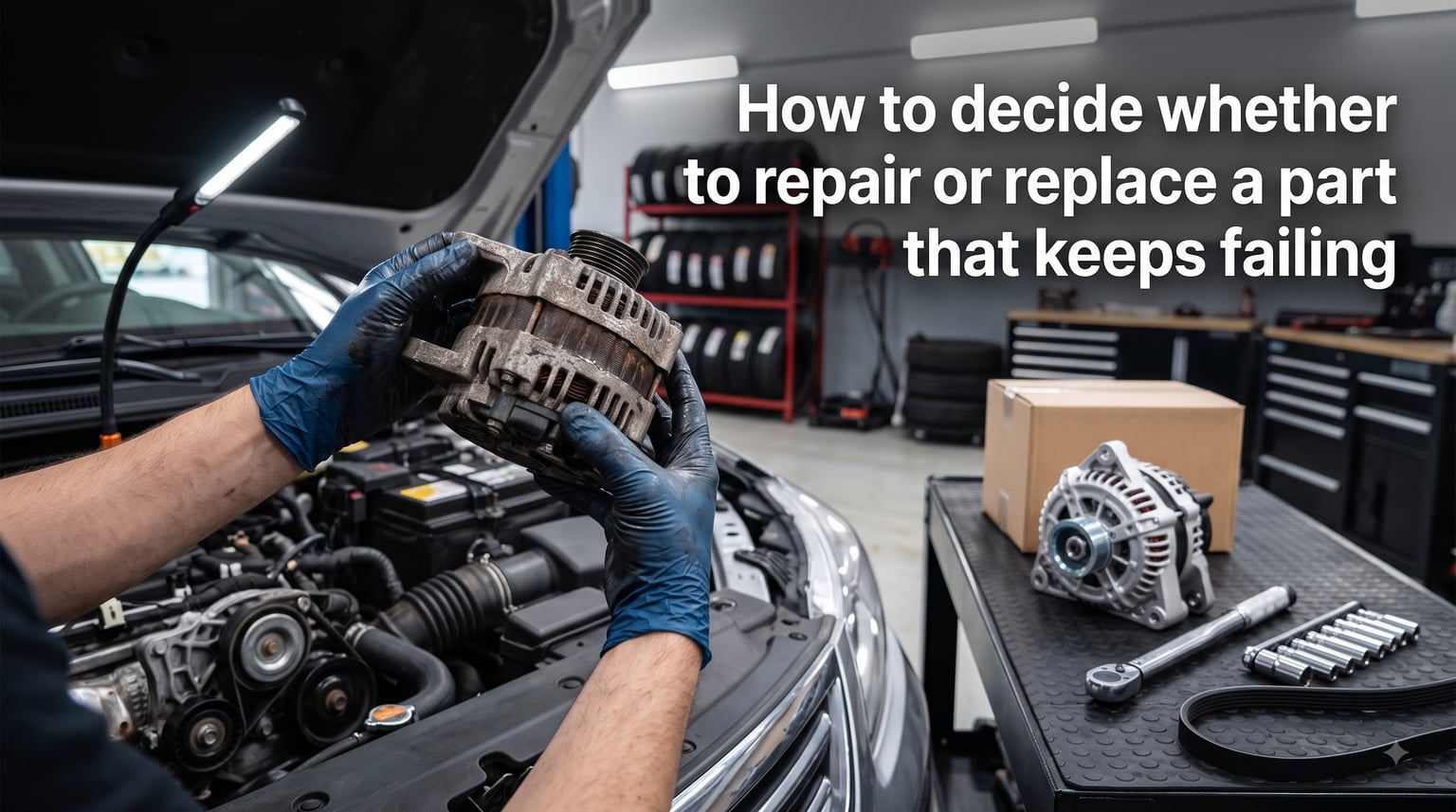
Learning how to decide whether to repair or replace a part that keeps failing is one of the most frustrating challenges any vehicle owner faces. You fix the same component, it breaks again, and the cycle repeats. Our team has spent years analyzing repair data, forum discussions, and real-world owner experiences to build a clear framework for this exact situation.
The decision comes down to three things: cost, reliability patterns, and safety. If you can evaluate those three factors honestly, the right answer usually becomes obvious. In this guide, we walk through practical decision rules, real cost calculations, and the warning signs that tell you it is time to stop repairing.
Table of Contents
The Core Decision Framework: How to Decide Whether to Repair or Replace a Part That Keeps Failing
The decision to repair or replace a failing part comes down to comparing three factors: the cost of continued repairs, the reliability of the vehicle after repair, and the safety risk if the part fails again. When all three point the same direction, the answer is clear.
Most owners get stuck because they only look at the immediate repair bill. That number feels manageable in isolation. But a single repair quote does not tell you whether the part will fail again in three months or three years.
Factor One: Cost
Compare the repair cost to the value of the vehicle and the cost of full replacement. If a single repair approaches half the vehicle’s market value, you are entering replacement territory. We cover the specific thresholds in the cost comparison section below.
Factor Two: Reliability Patterns
One repair is an event. Three repairs on the same system is a pattern. Reddit users on r/Cartalk and r/Frugal consistently report that recurring failures on the same component signal a deeper problem, not a fluke.
Ask yourself whether the failure is isolated or systemic. A single alternator failure at 120,000 miles is normal wear. A third alternator in two years suggests an underlying electrical issue that repairs alone will not fix.
Factor Three: Safety
If the failing part affects braking, steering, suspension, or airbag systems, safety overrides every cost calculation. A part that keeps failing in a safety-critical system should be replaced entirely or the vehicle should be retired.
Forum discussions across r/askcarguys confirm that safety concerns are the number one deal-breaker for most owners. Nobody wants to risk a brake failure or a suspension collapse on the highway.
Cost Comparison Methods: The 50% Rule, the $3000 Rule, and Cost-Per-Mile
Three practical cost formulas help you cut through the emotion and make a data-driven repair vs replace decision. Each works best in slightly different situations, so we recommend running all three.
The 50% Rule
If the repair cost exceeds 50% of the replacement cost (or the vehicle’s market value for full-vehicle decisions), replacing is usually the smarter financial move. This rule comes up repeatedly across dealership advice and personal finance forums.
For example, if your car is worth $6,000 and a transmission rebuild costs $3,500, you are at 58%. That crosses the threshold. Replacing the vehicle likely makes more sense than sinking over half its value into a single repair.
The $3000 Rule for Cars
The $3000 rule is a simple benchmark used by many mechanics and financial advisors. If your annual repair costs exceed $3,000 in a single year, the vehicle has likely crossed into money-pit territory.
This threshold works because $3,000 per year roughly matches a typical monthly car payment of around $250 multiplied by twelve. Once your repair spending equals what a replacement vehicle payment would cost, the financial argument for keeping the old car disappears.
Cost-Per-Mile Calculation
Cost-per-mile is the most objective metric for this decision. Add up all repair and maintenance costs over the past 12 months. Divide that total by the number of miles you drove in the same period.
For example, $2,400 in repairs over 12,000 miles equals $0.20 per mile. Most owners consider anything under $0.15 per mile acceptable for an older vehicle. Once you exceed $0.25 per mile consistently, replacement becomes financially justified.
Reddit users on r/personalfinance specifically value this calculation because it removes emotional attachment from the equation. The numbers either support keeping the car or they do not.
Comparing Repair Cost to a Car Payment
One of the most practical approaches we have found is comparing repair costs directly to a monthly car payment. If you are spending $400 per month on average repairs, a new vehicle at $350 per month with a warranty starts looking like the better deal.
Factor in the warranty coverage, improved fuel efficiency, and reduced stress. The real cost of an unreliable vehicle includes tow bills, missed work, rental cars, and the mental toll of never trusting your car to start.
Recognizing Failure Patterns: Normal Wear vs Early Decline
Understanding the difference between normal wear and early decline is the key to deciding whether to repair or replace a part that keeps failing. Normal wear follows a predictable schedule. Early decline means the vehicle is losing reliability faster than it should.
What Normal Wear Looks Like
Normal wear follows expected timelines. Brake pads last 30,000 to 70,000 miles. Alternators typically last 80,000 to 150,000 miles. Water pumps fail around 90,000 to 120,000 miles. When components fail within these ranges, a repair is usually the right call.
Forum data from Prius owners shows vehicles with 180,000-plus miles still running reliably because their failures follow predictable patterns. Routine maintenance and expected wear-item replacements keep these cars on the road without surprises.
What Early Decline Looks Like
Early decline shows up as multiple system failures in a short window. If your alternator, water pump, and suspension components all fail within a few months, the vehicle is telling you something. Individual parts are not the problem. The overall vehicle is aging faster than you can maintain it.
Reddit threads about a 2014 Mazda CX-5 highlight this exact scenario. Owners report repair bills stacking up to $4,500 across multiple systems. When failures cluster like this, repairs are treating symptoms while the underlying vehicle deteriorates.
Pattern Recognition: The Three-Strike Guideline
While no universal rule exists for how many repairs are too many, the community pattern is clear. Three significant repairs on the same system within 18 months strongly suggests replacement. Two repairs might be bad luck. Three is a pattern.
European luxury vehicles like the Audi A4 show this pattern frequently in forum discussions. Owners describe chasing electrical and mechanical gremlins that never fully resolve, with each repair costing $1,000 to $2,000.
Safety Considerations That Override Cost
Safety is the one factor that overrides every financial calculation. If the failing part is in a safety-critical system and it keeps failing, replace the component or replace the vehicle. There is no third option worth considering.
Safety-critical systems include brakes, steering, suspension, tires, airbags, and seatbelts. A recurring brake issue, a steering rack that keeps leaking, or a suspension component that fails repeatedly all demand decisive action.
Our team has seen forum posts where owners describe near-miss experiences from recurring failures. One r/askcarguys user described a brake caliper that seized twice before they finally replaced the entire braking system. The cost of the full replacement was significant, but the alternative was potentially catastrophic.
Vehicle Age and Mileage Context
Vehicle age and mileage provide essential context for the repair vs replace decision. A $2,000 repair on a 5-year-old car with 60,000 miles is very different from the same repair on a 15-year-old car with 180,000 miles.
The 100,000-Mile Threshold
Most vehicles enter a higher-maintenance phase after 100,000 miles. This does not mean the car is doomed. It means you should expect more frequent wear-item replacements and budget accordingly.
Jeep Cherokee owners on forums report $2,000 to $3,000 in non-wear maintenance costs over several years past 100,000 miles. They consider this acceptable because the vehicle remains their daily driver without major reliability concerns.
Major Component Lifespans
Engines and transmissions are the big-ticket items. A well-maintained engine can last 200,000 miles or more. Transmissions typically last 150,000 to 200,000 miles. If either fails before these thresholds, investigate the root cause before replacing.
If both have already been rebuilt once and a new problem appears, the vehicle is likely past the point of diminishing returns. Replacing a second major component rarely makes financial sense on an older vehicle.
Environmental Impact of Repair vs Replace
Manufacturing a new vehicle generates significant carbon emissions, so keeping an older car running can be the greener choice. However, older vehicles burn more fuel and produce more emissions per mile, which complicates the environmental math.
If your aging vehicle gets 18 mpg and a replacement would get 35 mpg, the fuel savings and emissions reduction can offset the manufacturing footprint within a few years of driving. This angle is almost never covered by competitors, but it matters to environmentally conscious owners.
The practical takeaway: if your failing vehicle is also a gas guzzler, replacement carries both financial and environmental benefits.
Questions to Ask Your Mechanic Before Deciding
Before committing to any repair, ask your mechanic three questions that forum data shows most owners never think to ask.
First, ask whether the failure is a symptom or a root cause. A failed alternator might be caused by a failing battery or a wiring issue. Fixing the alternator without addressing the cause guarantees another failure.
Second, ask what other components are likely to fail soon on a vehicle of this age and mileage. A trustworthy mechanic can give you a 12-month repair forecast that helps you plan.
Third, ask whether they would spend their own money on this repair. Mechanics see the full picture daily. Their honest answer often clarifies the decision instantly.
Common Scenarios From Real Owners
Forum discussions reveal several recurring scenarios that help illustrate the repair vs replace decision in practice.
Scenario one: a 2014 Mazda CX-5 with $4,500 in stacked repairs across multiple systems. Multiple owners report this pattern. The consensus across r/Frugal and r/Cartalk is that once repairs cluster across unrelated systems, replacement is the rational choice.
Scenario two: a Prius with 180,000 miles needing a single $1,200 hybrid battery replacement. Owners overwhelmingly recommend the repair because the rest of the vehicle remains reliable and the battery is a known wear item with a predictable replacement interval.
Scenario three: an Audi A4 needing its third repair in a year on the electrical system. European vehicle owners on forums consistently report that chasing recurring issues on aging luxury cars becomes a money pit. The recommendation is almost always to sell or trade.
FAQs
What is the $3000 rule for cars?
The $3000 rule states that if your annual repair costs exceed $3,000 in a single year, the vehicle has likely become a money pit. This threshold works because $3,000 per year roughly equals a typical monthly car payment of around $250 over twelve months, making replacement financially comparable to continued repairs.
How do you decide whether to repair or replace a component?
You decide by evaluating three factors: cost, reliability patterns, and safety. Use the 50% rule to check if repair costs exceed half the vehicle’s value. Look at whether failures are isolated events or recurring patterns. If the part is safety-critical and keeps failing, replace it or the vehicle without hesitation.
What is the 30 60 90 rule for cars?
The 30 60 90 rule refers to scheduled maintenance intervals at 30,000, 60,000, and 90,000 miles. At each milestone, specific services like fluid changes, filter replacements, and inspections are due. Following this schedule helps prevent premature part failures and makes the repair vs replace decision easier because you can distinguish normal wear from unexpected decline.
What are the 3 C’s of vehicle repair?
The 3 C’s of vehicle repair are Complaint, Cause, and Correction. The Complaint is the symptom you describe. The Cause is the underlying reason the part failed. The Correction is the fix. Identifying the Cause is essential when a part keeps failing, because treating only the Complaint without addressing the Cause guarantees repeat failures.
Conclusion: Making the Right Call
Knowing how to decide whether to repair or replace a part that keeps failing comes down to running the numbers and being honest about patterns. Use the 50% rule and the $3000 rule as your financial benchmarks. Track your cost-per-mile for an objective view. Watch for clustering failures that signal early decline rather than normal wear.
When safety is involved, the decision makes itself. When costs stack up across multiple systems, replacement is almost always the right financial move. And when you are ready for your next step, use these frameworks to evaluate any vehicle you consider buying.