
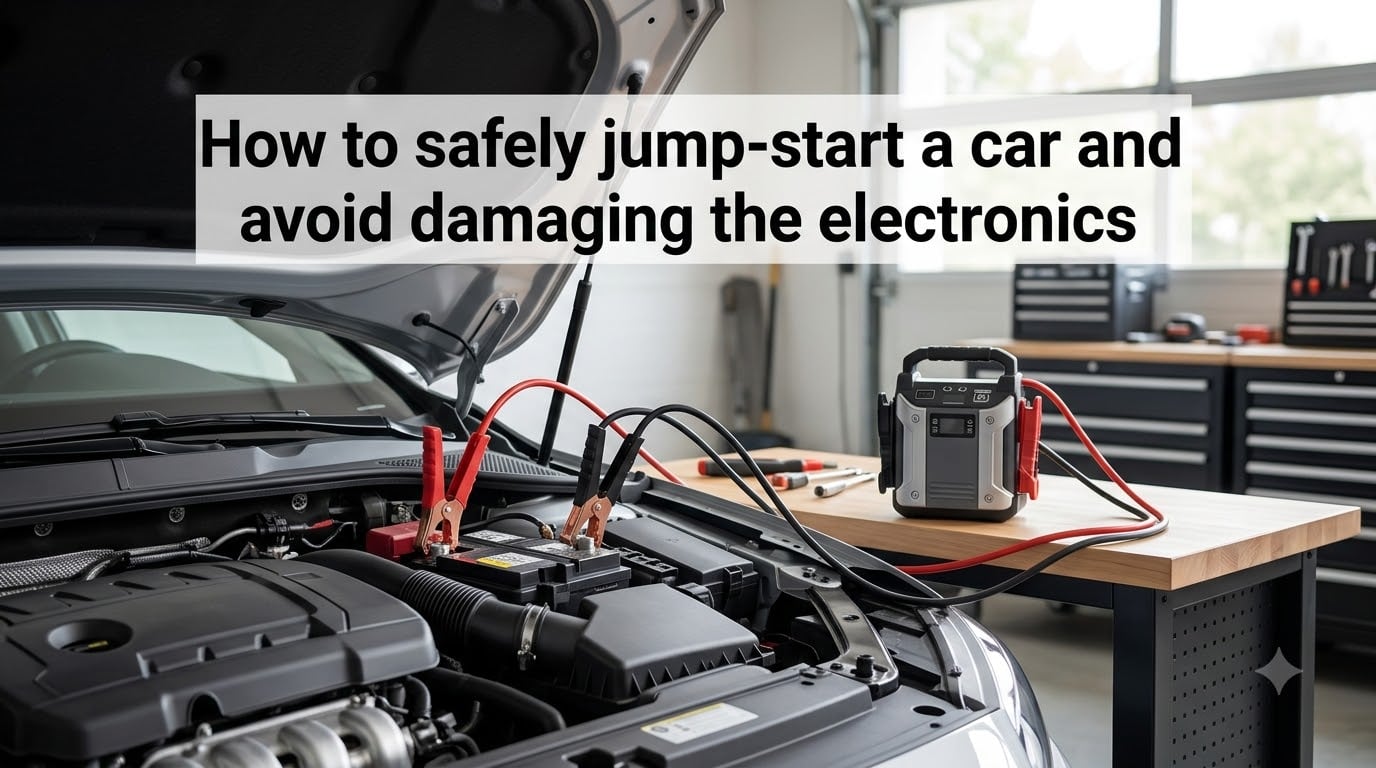
Yes, jump-starting a car can damage modern electronics. A voltage spike or a reverse-polarity mistake can fry the ECU, the body control module, infotainment screens, and even the airbag sensors in a single moment. Done correctly, however, the procedure is one of the safest roadside skills a driver can have. I have jump-started everything from a 2026 pickup to a 12-year-old hybrid, and the difference between a successful boost and a tow-truck ride always comes down to the same handful of rules. This guide walks you through the exact sequence I use, why each step matters, and what to do if something goes wrong.
Modern cars rely on dozens of small computers. The engine control unit, transmission control module, and body control module all run on regulated 12 to 14 volts. When you hook up jumper cables the wrong way, even for a second, the alternator on the donor vehicle can push 40 to 80 volts of unregulated current straight into that network. That is enough to weld a sensor open or scramble the memory chips in your radio. Knowing how to safely jump-start a car means respecting that risk before you touch a single clamp.
Table of Contents
What Can Jump-Starting Damage in a Modern Car?
Modern vehicles are more sensitive than the trucks of the 1990s, and the gap keeps widening each model year. A single wiring mistake during a jump start can cost more than the original dead battery ever did.
The most expensive component at risk is the ECU, the engine control unit that manages fuel delivery, ignition timing, and emissions. Right behind it sits the body control module, which runs your power windows, interior lights, and security system. Replacing either unit, plus the required programming fees, routinely runs into four-figure territory. Sensors for the airbags, anti-lock brakes, and adaptive cruise control can also be wiped out by a single voltage spike.
There are three ways a jump start can send those spikes into your wiring.
Reverse polarity. Connecting the red clamp to the negative terminal or the black clamp to the positive terminal creates a direct short. Fuses usually blow, but the surge before they trip can already reach the ECU.
Voltage spike on disconnect. Pulling a clamp while the engine is running can collapse the alternator’s magnetic field and produce a brief but sharp over-voltage.
Ground path through the dead battery. Attaching the final negative clamp to the dead battery posts forces current through the cell vents, where hydrogen gas may have collected. A small spark is enough to ignite it.
That last point is why the order of cable hookup is non-negotiable. We will come back to it shortly.
Safety Precautions Before You Connect Any Cables
Take two minutes here and you will save yourself from the most common jump-start mistakes I see on forums. Every experienced mechanic I have worked with runs through the same mental checklist.
First, inspect both batteries. Look for cracks in the case, a bulging side, white or blue-green corrosion on the posts, or a sulfur smell. Any of these mean the battery is venting gas or has internal damage, and a jump start should not be attempted. If you see frozen or warped casing in cold weather, treat the battery as compromised and call for roadside assistance instead.
Second, set up the cars correctly. Park the donor vehicle close enough that the cables reach comfortably, but make sure the two cars never touch. Metal-to-metal contact can create a parallel ground that bypasses the cables. Put both cars in park or neutral with the parking brake set. Switch off the headlights, climate control, radio, and any plugged-in accessories in both cars. Modern infotainment systems draw enough idle current to complicate a marginal jump.
Third, gear up. Remove rings, watches, and any loose jewelry. A metal watch across a battery post is a fast way to burn skin and weld the band. Wear safety glasses if you have them. Pop the hood and identify the positive terminal, marked with a plus sign and usually a red cover, and the negative terminal, marked with a minus sign and usually black.
If your car has jump-start lugs under the hood instead of direct battery access, use them. Many automakers, including BMW, Mercedes, and Ford, route the positive connection through a dedicated post to protect the battery monitoring sensor. Your owner’s manual will show you exactly where to clamp.
How to Safely Jump-Start a Car: Step-by-Step
Once you have done the prep, the connection itself takes about five minutes. Follow the order below exactly. Reversing any step in this list is how people damage electronics or trigger small explosions.
Connect the red clamp to the dead battery’s positive terminal. Wiggle it to make sure it bites clean metal.
Connect the other red clamp to the donor battery’s positive terminal.
Connect the black clamp to the donor battery’s negative terminal.
Connect the final black clamp to an unpainted metal ground on the dead car, such as an engine bracket, alternator bracket, or designated ground bolt. Stay at least 12 inches away from the dead battery.
Start the donor vehicle and let it idle for two to three minutes. Revving slightly helps push current across, but do not hold the engine above 2,000 rpm.
Try to start the dead vehicle. Hold the key for no more than five seconds. If it does not start, wait 30 seconds and try again. Three attempts is the safe maximum before you stop and look for another problem.
Once the dead car is running, leave both engines idling for two to three minutes to stabilize the voltage.
Disconnect in the exact reverse order. Black ground clamp from the previously dead car first, then the donor negative, then the donor positive, then the positive clamp on the revived car.
Keep the revived car running for at least 20 minutes, or drive it for a solid 30 minutes on the highway, before shutting it off again. That gives the alternator enough time to put meaningful charge back into the battery. If the car will not restart after that drive, the battery is no longer holding a charge and needs replacement.
Why the Engine Block Ground Matters More Than the Battery
This is the single most common question I see on Reddit and mechanic forums, and the answer is genuinely safety-critical.
Lead-acid batteries vent hydrogen gas during normal operation, and a deeply discharged battery vents even more. Hydrogen is lighter than air, so it rises and pools around the battery, the vents, and the surrounding wiring. A small spark anywhere near those vents can ignite the gas, blow acid mist into your face, and crack the battery case.
When you attach the final negative clamp to the donor battery, current flows through the jumper cables to the positive post of the dead battery. If you then attach the last negative clamp to the dead battery’s negative post, the circuit completes at the battery itself, right where hydrogen gas is likely collecting. Even a tiny spark from a loose clamp connection is enough to ignite it.
Clamping to the engine block, an alternator bracket, or a designated ground bolt moves the final spark away from the battery by 12 inches or more. The current still flows through the chassis ground back to the donor battery, but the spark, if there is one, happens in open air away from the gas. This is the technique professional tow-truck drivers use on every call, and it is the procedure recommended in every owner’s manual I have read for 2026 model year vehicles.
When NOT to Attempt a Jump Start
Knowing when to walk away is just as important as knowing how to safely jump-start a car. A bad call here can mean a battery explosion in your face or a fried ECU.
Skip the jump start and call for professional help if you see any of the following:
Cracked, bulging, or leaking battery case. The internal plates are damaged and acid is already escaping.
Frozen battery. In cold climates, a fully discharged battery can freeze solid. Jump-starting a frozen battery can crack the case and spray sulfuric acid.
Strong sulfur or rotten-egg smell with no visible leak. This signals active venting at unsafe levels.
Wet cells with low electrolyte. Top up with distilled water only if the case is intact and you can clearly see the plates; otherwise, replace the battery.
48V mild-hybrid systems. Vehicles with mild-hybrid electrical architectures, including many 2026 model year Audis, Mercedes, and some Fords, use a high-voltage battery pack that cannot be jump-started with standard 12V cables.
Repeated failure to start after three attempts. The problem is no longer the battery, and forcing more cranking only overheats the cables.
AAA reported more than 5.7 million battery-related service calls in 2026, and a meaningful share of those involved drivers who tried to force a start on a battery that should have been replaced. If the headlight test (dim or yellow beams) and the dash test (slow cranking) both point to a battery that is past saving, your safest move is a tow or a mobile battery replacement service.
Portable Jump Starters vs Jumper Cables
I keep both in my garage, and each has a clear role. The right tool depends on your situation.
Traditional jumper cables are cheap, reliable, and effective for healthy batteries in donor cars. The downside is you need a second vehicle, you depend on the donor battery being in good shape, and you have to manage the cable sequence by hand. For someone who already knows the procedure, this is still the fastest solution.
Portable lithium jump starters are a different animal. A modern unit the size of a paperback book can deliver 1,000 to 2,000 peak amps, enough to start most V8 engines several times on a single charge. They include built-in reverse-polarity protection, spark-proof clamps, and USB ports to charge your phone in a real emergency. They also work when you are parked alone, which is the situation most drivers actually face.
The trade-off is maintenance. Lithium jump packs self-discharge over a few months and need to be topped up every 60 to 90 days to stay ready. They also do not perform as well in extreme cold, where capacity can drop by 30 percent or more. If you live in a cold climate, store the pack indoors and consider a model with built-in battery warming.
For most drivers in 2026, I recommend owning both. Keep the cables in the trunk for the rare donor-car scenario, and keep a charged lithium pack in the cabin for solo emergencies.
Emergency Response: Acid, Sparks, and What to Do Next
Almost no guide covers this, and it is the one section I hope you never need. If something goes wrong during a jump start, the first thirty seconds decide whether you walk away with a story or a trip to the emergency room.
If battery acid splashes on skin or eyes: Flush with clean running water for at least 15 minutes. Remove any contaminated clothing. Do not try to neutralize with baking soda on your skin, the heat reaction can worsen burns. Get medical attention even if the irritation feels mild.
If the battery explodes or vents violently: Move everyone at least 20 feet away and upwind. Battery acid aerosol can damage lungs on contact. Vent the area if you are in a garage. Call poison control if anyone inhaled visible mist.
If the cables spark, smoke, or get hot: Turn off both vehicles, disconnect the cables in reverse order, and separate the cars. A hot cable usually means a poor ground connection or a reversed clamp. Let everything cool for ten minutes before you inspect anything. A cable that melted its insulation needs to be replaced.
None of these events are common with a careful procedure, but I would rather you have the steps memorized than have to look them up with burning acid on your arm.
Preventing a Dead Battery in the First Place
The cheapest jump start is the one you never need. A few small habits will keep most batteries healthy for five years or more.
First, watch for parasitic drain. Modern cars draw a small current to keep clocks, alarm systems, and key fob receivers alive. That draw should be under 50 milliamps. If your battery keeps dying after sitting for a week, an aftermarket accessory, a stuck relay, or a failing body control module is pulling more than it should. A free multimeter and a 10-minute YouTube tutorial is all you need to find the culprit.
Second, use a battery maintainer if you store a car for more than two weeks. Maintainers deliver a slow, regulated trickle that keeps the battery at full charge without overcharging it. This is especially valuable for weekend cars, motorcycles, and snow tires vehicles that sit through a 2026 winter.
Third, get the battery load-tested once a year. Most parts stores and dealerships do this for free. A battery that fails a load test is one cold morning away from leaving you stranded. Replace it on your schedule rather than the battery’s.
Finally, check the terminals twice a year. A thin layer of corrosion is normal and easy to clean with a wire brush and a paste of baking soda and water. Heavy buildup, especially a white powdery crust that reforms quickly, means the battery is venting and is on its way out.
Knowing how to safely jump-start a car gives you a useful skill, but knowing how to avoid needing one in the first place saves you time, money, and stress. Keep your battery tested, your terminals clean, and your cables stored in the trunk, and you will rarely have to put these steps into practice.
FAQs
Can jump starting a car ruin electronics?
Yes. A voltage spike, a reverse-polarity mistake, or a spark near battery vents can damage the ECU, body control module, infotainment system, and airbag sensors. Repairs often run into four-figure territory, so following the correct cable sequence is worth the extra minute.
What is the safest way to jumpstart a car?
Connect red to dead positive, red to donor positive, black to donor negative, and black to an unpainted engine ground on the dead car. Start the donor, wait two to three minutes, then crank the dead car for no more than five seconds at a time. Disconnect in the exact reverse order.
Can you ruin your battery by jumping another car?
It is rare with healthy batteries, but possible. A deeply discharged or sulfated donor battery can be pushed past recovery if you crank the working car for too long. Limit cranking to five seconds and wait 30 seconds between attempts.
What to avoid when jump starting a car?
Do not reverse the clamps, do not attach the final negative to the dead battery, do not crank for more than five seconds, do not jump a frozen or cracked battery, and do not attempt to jump-start 48V mild-hybrid systems with standard 12V cables. Remove jewelry and wear safety glasses.
The Bottom Line on Jump-Starting Safely
The whole job takes about ten minutes once you have done it a few times. The single rule that protects every modern car is the connection order: red to dead positive, red to donor positive, black to donor negative, and black to an unpainted engine ground on the dead car. Reverse the sequence to disconnect. Keep each crank under five seconds, give the battery 20 minutes of run time afterward, and replace any battery that needs more than three attempts to start.
That is the entire skill. The rest is just patience and a careful eye for warning signs. Keep your owner’s manual in the glove box, keep your cables or lithium jump pack charged, and you will be the person on the parking lot who can help instead of the one calling for a tow.