
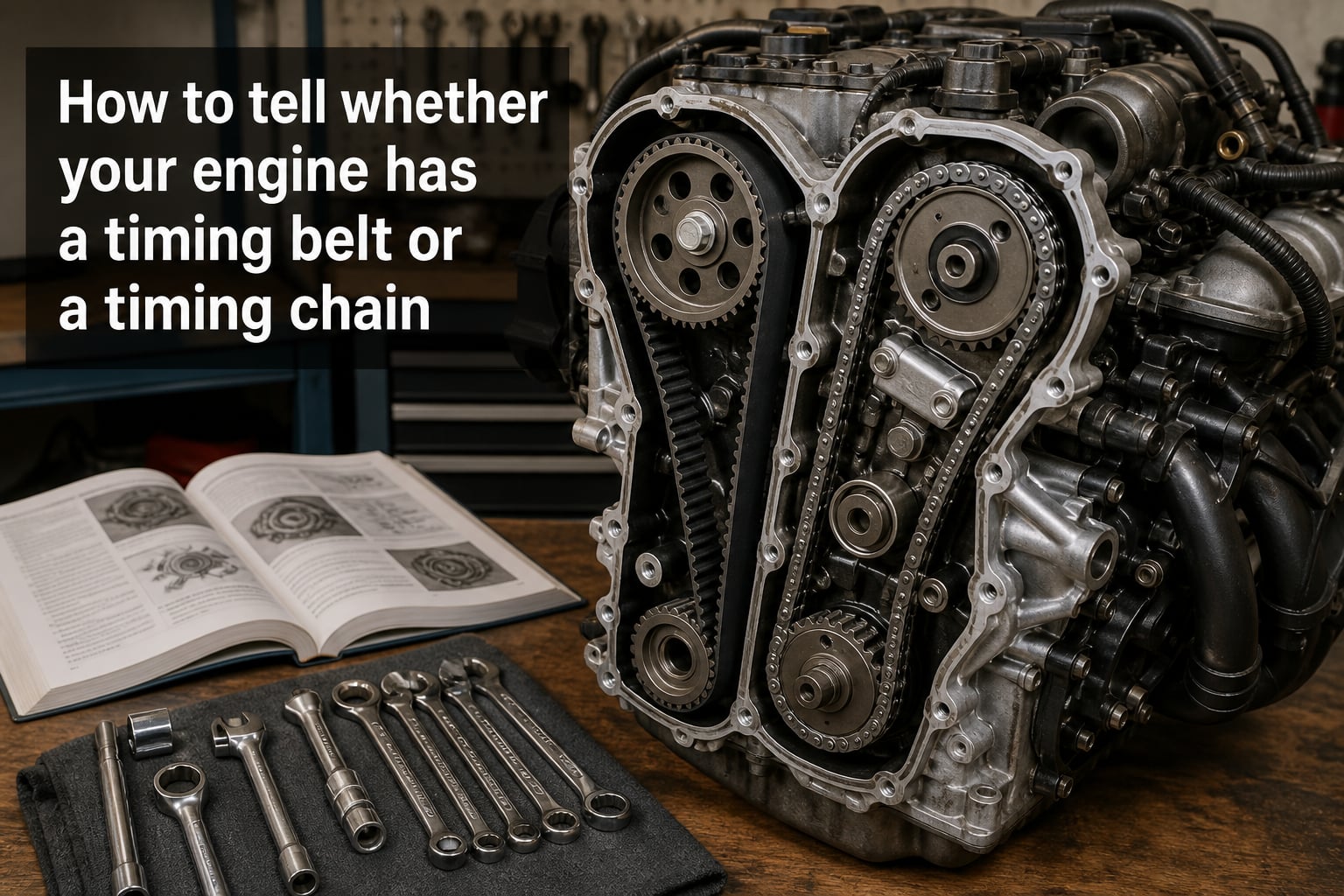
The fastest way to tell whether your engine has a timing belt or a timing chain is to look at the timing cover on the side of the engine: a plastic cover almost always means a timing belt, while a metal cover almost always means a timing chain. If you cannot see the cover or it is buried under accessories, your owner’s manual will list the timing component under “maintenance schedule” or “engine specifications,” and a dealer parts department can confirm it from your VIN in under a minute.
That answer solves 90% of cases, but there are a few real exceptions. Some engines hide the cover deep under intake manifolds. Some vehicles now use a “wet belt” that lives inside the engine and runs in oil. And a handful of cars use gears instead of either component. I have helped friends identify their setup on everything from a 2003 Honda Civic to a 2022 Ford F-150, and the same three-step process works on all of them.
This guide walks through exactly what I look for, what to do if the answer is not obvious, and the warning signs that mean you should not wait for the next service interval. Let us get into it.
Table of Contents
What Does a Timing Belt or Chain Actually Do in Your Engine?
Your engine has two shafts that must turn in perfect sync: the crankshaft (which moves the pistons up and down) and the camshaft (which opens and closes the valves). The timing belt or chain is the physical link between these two shafts. If the link slips, breaks, or stretches too far, the pistons and valves can collide, and on most modern engines that destroys the motor.
Engines that risk this collision are called “interference engines.” Engines where the pistons and valves never share the same space are “non-interference.” Either way, your engine will not run at all if the timing component fails completely. The component itself is not optional. The only real question is whether it is a rubber-reinforced belt, a metal chain, or, in rare cases, a set of gears.
Timing Belt vs Timing Chain: The Core Differences
A timing belt is a rubber-and-fiber toothed belt that drives the camshaft from the crankshaft. It is usually hidden behind a plastic cover and needs replacement on a fixed schedule. A timing chain is a metal roller chain that lives inside the engine and is lubricated by the engine oil. Chains are heavier, last longer, and rarely need scheduled replacement if the oil is changed on time.
Here is the quick side-by-side I use when comparing them for friends:
Material: Belt = rubber with high-tensile fiber cords. Chain = steel roller chain, similar to a bicycle chain.
Cover: Belt sits behind a plastic cover. Chain sits behind a metal cover or no external cover at all.
Lubrication: Belt runs dry. Chain runs in engine oil.
Noise: Belt is nearly silent. Chain makes a light ticking at idle.
Service life: Belt = 60,000 to 100,000 miles typically. Chain = intended to last the life of the engine.
Failure mode: Belt snaps suddenly. Chain stretches or skips teeth gradually.
Belts are lighter, quieter, and cheaper to make, which is why they show up in many four-cylinder economy cars. Chains are heavier but more durable, which is why most American V6 and V8 engines use them. Either design works fine when it is maintained correctly.
How to Tell Whether Your Engine Has a Timing Belt or Chain?
There are three reliable ways I use to identify a timing belt or chain, in order of speed. Try the first one, and only move on if you cannot get a clear answer.
Step 1: Look at the Timing Cover
Pop the hood and find the side of the engine where the accessory drive belts spin the crankshaft pulley. Just above that pulley, look for a smooth cover, usually with the engine name or “DOHC” stamped into it. If that cover is black or gray plastic (or composite), the engine has a timing belt. If the cover is bare aluminum or cast metal that matches the engine block, it has a timing chain.
This rule works for most mainstream cars built after 2000. The exceptions are engines where the timing cover is buried under the intake manifold, like some V6 and V8 configurations. If you cannot see the cover after removing a couple of engine covers, move to step 2.
Step 2: Check the Owner’s Manual
Your owner’s manual lists every maintenance item by mileage. Look for the section labeled “Maintenance Schedule” or “Scheduled Service.” Belts are listed as “Timing Belt – Replace” with a mileage interval (commonly 60k, 90k, or 100k miles). If no timing belt replacement appears in the schedule, the engine has a timing chain.
If you do not have a paper manual, the manufacturer’s website almost always hosts a digital copy. Toyota, Honda, Ford, GM, and BMW all have free PDF downloads indexed by year and model. Search for “[your car year make model] owner’s manual PDF” and the result is usually the first link.
Step 3: Run a Free VIN Lookup
Several free and paid tools decode your VIN to list the timing component. NHTSA’s VIN decoder gives you the engine code, which you can then match to the manufacturer spec sheet. Once you have the engine code (something like “2GR-FKS” or “B48B20”), a Google search for that code plus “timing belt or chain” returns a definitive answer.
You can find your VIN on the dashboard near the windshield, on the driver-side door jamb sticker, or on your registration card. The 8th character of the VIN is the engine code on most vehicles built after 1995.
Bonus Step: Ask a Dealer Parts Department
Any dealership parts counter will look up your VIN and tell you whether the engine uses a belt or a chain, often without charging anything. They can also tell you whether the part is in stock. This is the fastest option if you happen to be near a dealership and want a written answer.
How to Use Your VIN or Dealership to Confirm?
The VIN method is the most reliable for used car shoppers and anyone who lost their manual. Your VIN is a 17-character code that uniquely identifies your vehicle. Here is the process I use:
Locate the VIN on the dashboard, driver-side door jamb, or registration card.
Note the 8th character. This is the engine code on most modern cars.
Search “[engine code] timing belt or chain” or check NHTSA’s free VIN decoder at vpic.nhtsa.dot.gov.
Cross-reference the result against the manufacturer’s specification page for that engine.
If the engine code is unclear, call any dealership parts department with your VIN ready. They will look it up and confirm the component in a single call. Mechanics at independent shops can do the same thing if you already trust one.
Signs Your Timing Belt or Chain Is Wearing Out
Belts and chains fail in very different ways, and the warning signs show up months before a catastrophic failure. Knowing these signs has saved me from being stranded more than once.
Timing Belt Warning Signs
Visible cracks or fraying on the belt itself if you remove the cover.
Ticking or clicking noise from the front of the engine that disappears after warm-up.
Engine misfires at idle, especially right after a cold start.
Oil leaks from the front of the engine near the timing cover.
Vehicle will not start even though the battery and starter are fine.
Timing Chain Warning Signs
Rattling noise on cold start that fades after a few seconds (classic chain tensioner symptom).
Persistent rattling at idle that gets louder with RPM.
Check engine light with codes P0016, P0017, P0018, or P0019 (camshaft-crankshaft correlation).
Engine runs rough or feels down on power.
Metal shavings in the engine oil during an oil change.
If you hear any of these noises, do not wait for the next oil change. The repair cost difference between a proactive replacement and a roadside tow can be thousands of dollars, especially on interference engines.
Timing Belt and Chain Replacement Intervals
Belts have a fixed replacement interval. Chains are designed to last the life of the engine, but can stretch if oil changes are skipped. Here is the rough schedule I use as a starting point, then I always confirm against the owner’s manual:
Timing belt (dry): Replace every 60,000 to 100,000 miles, or every 7 to 10 years, whichever comes first.
Wet belt: Replace every 100,000 to 150,000 miles, but inspect at 60,000 miles.
Timing chain: No fixed interval. Inspect if you hear cold-start rattle or see the warning signs above.
Most mechanics recommend replacing the water pump, tensioner, and idler pulleys at the same time as a timing belt, since they live behind the same cover and the labor overlaps. This is why a timing belt job usually costs more than just the belt.
Wet Belts, Interference Engines, and Other Modern Exceptions
The three exceptions that catch most DIY owners off guard are wet belts, interference engines, and gear-driven timing. Knowing which applies to your car changes everything about how you plan maintenance.
Wet Belts
A wet belt is still a rubber timing belt, but it runs inside the engine bathed in oil. You will not see it from outside the engine, and it does not have a service cover. Ford EcoBoost 1.0 engines and some Mini/BMW engines are the most common examples. Wet belts have caused widespread failures on certain model years, so it is worth confirming with the VIN lookup if your car is on the affected list.
Interference vs Non-Interference Engines
In an interference engine, the pistons and valves occupy the same space at different times. If the timing slips, they collide and the engine is destroyed. In a non-interference engine, the pistons and valves never share space, so a slipped timing component simply kills the engine without bending valves. Most modern engines are interference designs, which is exactly why a timing failure is so expensive.
Gear-Driven Timing
A few classic and specialty engines use cut steel gears instead of a belt or chain. These are nearly indestructible but very heavy, which is why almost no modern passenger car uses them. If you drive a pre-1990s vehicle or a high-performance specialty car, gear drive is possible.
Manufacturer Quick Reference: Belt or Chain by Brand
This is the rule of thumb I share at the shop. It is not perfect, but it gets the right answer about 80% of the time and saves people from a wild guess.
Honda and Toyota: Mostly timing chains since the mid-2000s, with belts still on certain four-cylinder engines. Always check by VIN.
Ford and Chevrolet: Mostly chains on V6 and V8 engines. Belts common on smaller four-cylinders, including some EcoBoost models.
Subaru: Mostly timing chains on recent models, though the FB and EJ series mix both.
BMW and Mercedes: Chains on most modern engines, with wet belts on a handful of four-cylinder models.
Volkswagen and Audi: Mostly chains now, though older 1.8T and 2.0T engines used belts.
Hyundai and Kia: Chains on most recent engines, belts on some older four-cylinders.
The number one mistake I see is assuming that a brand “always” uses one or the other. Honda owners often insist their car has a belt, then learn it has had a chain since 2008. Always confirm with the VIN or the owner’s manual, even if you are pretty sure.
What I Recommend Before You Plan Any Replacement
If you have identified the timing component and now need to plan a replacement, here is the short checklist I run through with anyone who asks:
Confirm the exact component (belt, chain, or wet belt) using your VIN.
Look up the manufacturer’s recommended replacement interval in miles and years.
Get at least two written quotes from independent shops, not just the dealer.
Ask whether the water pump, tensioner, and idler pulleys are included in the quote.
Keep records of the replacement date and mileage so future buyers can see the service history.
On interference engines, do not put off a timing belt replacement. A snapped belt usually totals the engine. On chain-driven engines, stay current on oil changes. Skipped oil changes are the number one reason timing chains stretch early.
Frequently Asked Questions
How do I know if I have a timing chain or a timing belt?
Look at the timing cover on the side of the engine. A plastic cover means a timing belt. A metal cover means a timing chain. If the cover is hidden, check your owner’s manual under the maintenance schedule. If no timing belt replacement interval is listed, your engine has a chain.
How to check if a car is timing belt or chain?
Use the three-step method: 1) Look at the timing cover (plastic = belt, metal = chain). 2) Check the owner’s manual maintenance schedule for a timing belt replacement interval. 3) Look up your VIN at a dealer parts counter or use the 8th character of the VIN as the engine code, then search for that engine online.
What vehicles do not have a timing chain?
Vehicles that use timing belts are typically smaller-displacement four-cylinder engines, especially in economy cars and certain import brands. Many Honda, Toyota, Subaru, and Volkswagen four-cylinder models from the 1990s through mid-2000s used belts. Most modern V6 and V8 engines use chains.
What year did cars stop having timing belts?
Cars did not stop using timing belts at a single year. Manufacturers have been gradually switching to chains since the 2000s. Most major brands phased out belts on new engines by the mid-2010s, but some four-cylinder engines still use them in 2026, especially in compact and economy segments.
Is it better to have a timing chain or timing belt?
Neither is universally better. Timing chains last longer and rarely need scheduled replacement, but they are heavier and can stretch if oil changes are skipped. Timing belts are lighter, quieter, and cheaper to replace, but they have a fixed replacement interval and snap suddenly if ignored. Choose based on your maintenance habits, not the component alone.
Is it cheaper to replace a timing belt or timing chain?
A timing belt replacement is usually cheaper than a timing chain replacement because belts are less complex jobs on most engines. Chains sit deeper inside the engine and often require removing the timing cover, guides, and tensioners. The exact cost depends on the engine, but belt jobs are typically the more affordable service.
Do timing chains or belts last longer?
Timing chains are designed to last the life of the engine, often 200,000 miles or more with regular oil changes. Timing belts typically last 60,000 to 100,000 miles before they need replacement. Chains can fail early if oil changes are skipped, while belts degrade with age and mileage regardless of oil quality.
Final Thoughts on Identifying Your Engine’s Timing Component
Identifying whether your engine has a timing belt or a timing chain takes about five minutes if you use the three-step method: look at the cover, check the manual, or run a VIN lookup. The answer matters because belts have fixed replacement intervals and chains need clean oil to last. Either way, you now have a clear plan.
If your car has a belt, find the replacement interval in your manual and budget for the job before that mileage hits. If your car has a chain, stay current on oil changes and listen for cold-start rattle. Either component can give you 200,000 miles of service when you respect the schedule. That is the whole game.