
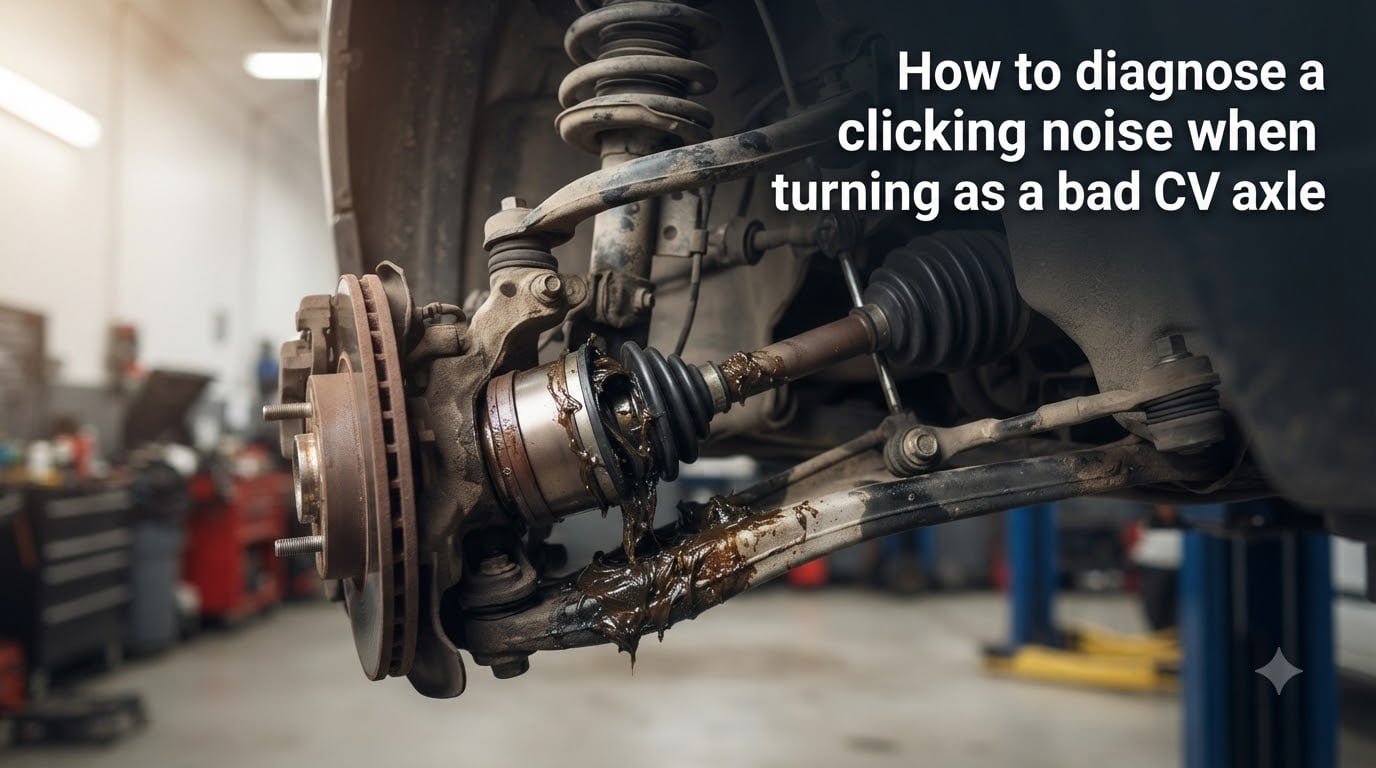
If your car makes a rhythmic clicking or popping sound every time you turn the steering wheel, especially at low speeds, the most likely culprit is a failing CV joint. In this guide, I’ll walk you through exactly how to diagnose a clicking noise when turning as a bad CV axle so you can confirm the problem before paying for repairs. Our team has helped thousands of DIY drivers sort this exact symptom, and the process below works on most front-wheel-drive, all-wheel-drive, and independent rear suspension vehicles.
Table of Contents
What Is a CV Axle and Why Does It Click?
A CV axle (also called a half shaft) transfers power from your transmission to the wheels while allowing the suspension to move up and down and the wheels to turn side to side. Each axle has two joints: an inner CV joint near the transmission and an outer CV joint near the wheel. Both joints use a ball-and-cage mechanism packed in heavy grease and sealed inside a rubber CV boot.
The joint clicks because, when the ball bearings inside the cage lose their smooth rolling action, they actually skip across the grooves of the outer race every time the joint is loaded. That skip is the click you hear. Grease loss from a torn boot is the number one reason a CV joint starts clicking.
Why Clicking Noises Occur When Turning?
A CV joint only clicks when it is under torque and at an angle. Turning sharply loads the outer joint while the suspension compresses and the steering angle changes, which is exactly when the worn ball bearings slip. Straight-line driving does not load the outer joints the same way, which is why the noise shows up only in turns.
The classic description from mechanics and Reddit users is “a playing card in a bicycle spoke” – a steady tick-tick-tick that speeds up as you turn sharper or accelerate. A single loud clunk is usually something else, like a bad tie rod. A continuous hum is usually a wheel bearing.
Step-by-Step Diagnostic Procedure
Follow this numbered checklist in order. Most readers confirm a bad CV axle within 15 minutes using just their ears, a flashlight, and a flat driveway.
Find a quiet, empty parking lot. Background noise makes the clicking almost impossible to isolate.
Drive at 5 to 10 mph in slow circles. Turn the steering wheel fully to the left and listen to the front end. Repeat to the right.
Note which direction triggers the click. This identifies the bad axle side (covered in detail in the next section).
Increase speed to 15 mph and turn sharply again. A bad joint will get louder under load. A good joint stays silent.
Release the steering wheel briefly and listen. If the clicking stops, you have confirmed a CV joint, not a wheel bearing.
Stop the car and visually inspect both CV boots. Look behind the front wheels for any torn rubber boot or fresh grease splatter on the inner edge of the tire or suspension arm.
Grasp the axle by hand (if you can reach it). Try to wiggle it back and forth. Any clunking or play beyond a millimeter or two means the cage is worn.
Repeat on the opposite side to confirm the noise is isolated to one axle.
If steps 2 through 5 give you a clear click that changes with steering input, you have a bad CV joint. Step 6 is the visual proof that points to which side.
Left vs Right Turn: Identifying the Bad CV Axle
Yes, the direction of the turn tells you which CV axle is failing, and this is one of the most common questions on mechanic forums. When you turn left, the weight and drivetrain load transfer to the right-side wheels. That extra load stresses the right outer CV joint, which is why a click while turning left almost always points to a bad right CV axle. Turn the logic around: clicking while turning right means the left CV axle is failing.
This rule holds for front-wheel-drive and most all-wheel-drive vehicles. The exception is rear-wheel-drive cars with independent rear suspension, where the load transfer works the same way but the noise will come from the rear. If both sides click at the same time, suspect inner CV joints or a transmission issue instead.
CV Boot Inspection Guide
The CV boot is the cheapest part to replace and the most common cause of joint failure, so inspecting it first can save you hundreds. Each axle has two accordion-style rubber boots, one on the inner joint near the transmission and one on the outer joint near the wheel. They hold the grease inside and keep water and dirt out.
To inspect, turn the steering wheel fully to one side to expose the outer boot, then look for cracks, splits, or grease flung onto the surrounding suspension. A torn boot leaks grease onto the inside edge of the tire, which is one of the strongest visual signals you can find without pulling the axle apart. Inner boots are harder to see and usually require the vehicle on jack stands.
If the boot is torn but the joint is still quiet, replace the boot immediately. A new boot and fresh grease pack can extend the life of the joint by years at a small fraction of the cost of a full axle.
Differentiating CV Joint Noises from Wheel Bearings and Tie Rods
Many drivers misdiagnose a clicking noise because three different front-end parts make similar sounds. Use this quick comparison to confirm what you are hearing.
Bad CV joint: Rhythmic clicking that gets louder in sharp turns at low speed and disappears when driving straight.
Bad wheel bearing: Continuous humming or grinding that changes with vehicle speed but not steering angle. Usually gets louder in sweeping highway turns.
Bad inner or outer tie rod: Single clunk or rattle when you turn the wheel at low speed, often felt through the steering wheel. No rhythm.
Loose sway bar link: Rattle or clunk over bumps rather than during steering input.
If you hear a continuous hum that does not change when you turn, you are looking at a wheel bearing, not a CV axle. This single test solves more misdiagnoses than any other.
Safety Warnings and Driving Recommendations
You can drive short distances with a clicking CV joint, but every mile accelerates wear. Once the ball bearings start skipping, the joint progresses from clicking to vibration to complete separation. A joint that comes apart at speed can lock up a wheel, damage the brake assembly, and leave you stranded.
A loose rule from working mechanics is that a CV joint with a torn boot can fail within 1,000 to 3,000 miles, while a clicking joint with an intact boot may last a few thousand more. Wet climates and salted roads shorten that window because water washes grease out through even tiny boot cracks. If you must keep driving, avoid highway speeds, minimize sharp turns, and avoid standing water.
Repair Versus Replacement and Cost Considerations
Once you confirm the diagnosis, you have three realistic options: replace just the CV boot and repack with grease, replace the entire CV axle assembly, or take it to a shop. The boot-only repair is a 30-minute DIY job if you catch it before the joint is damaged. A complete axle replacement runs roughly 150 to 450 for the part depending on vehicle make, plus one to two hours of labor if a shop does it.
Inner CV joints are usually integrated into the axle and cannot be rebuilt separately. Outer joints can sometimes be replaced as a unit on certain Toyota, Honda, and Ford models, which cuts the cost significantly. If the joint is already clicking loudly and you have play in the axle, skip the boot repair and replace the whole axle. The labor to swap an axle is the same whether the joint is good or bad, so rebuilding a worn joint is wasted time.
Frequently Asked Questions
What causes a CV axle to click when turning?
A worn ball-and-cage mechanism inside the outer CV joint slips under load. When you turn at low speed, the joint angle and drivetrain torque force the worn balls across the race grooves, producing a rhythmic click that speeds up with sharper turns.
What can be mistaken for a bad CV joint?
Wheel bearings, inner and outer tie rods, loose sway bar links, and worn steering knuckles can all produce similar noises. Wheel bearings usually hum continuously, tie rods produce a single clunk through the steering wheel, and sway bar links rattle over bumps rather than during turns.
How long will a CV joint last once it starts clicking?
A CV joint with a torn boot typically fails within 1,000 to 3,000 miles. A joint with an intact boot may last several thousand additional miles, though wet weather, salted roads, and aggressive driving shorten that window significantly.
Is it bad to drive with a clicking CV joint?
Yes. The joint will progress from clicking to vibration to complete separation. A failed joint at speed can lock a wheel, damage the brake, and leave you stranded. Limit driving to short trips at low speed until you can replace the axle.
How to fix clicking noise from CV axle?
Replace the entire CV axle assembly for a worn joint. If the boot is torn but the joint is still quiet, you can replace just the boot and repack it with fresh grease, which is a cheaper preventive repair that extends axle life.
How much does it usually cost to fix a CV axle?
A complete CV axle assembly typically runs 150 to 450 for the part depending on the vehicle, plus one to two hours of shop labor. A boot-only repair costs roughly 20 to 40 in parts and is well within DIY reach on most vehicles.
Conclusion
You can reliably diagnose a clicking noise when turning as a bad CV axle in under 15 minutes by following the steps above. Confirm the rhythm and turn direction, inspect the CV boots, and rule out the wheel bearing and tie rod noises. Once you are sure it is the CV axle, decide between a budget-friendly boot replacement and a full axle swap based on how worn the joint already is. Take action quickly, and the repair is one of the most straightforward jobs on any front-wheel-drive car.