
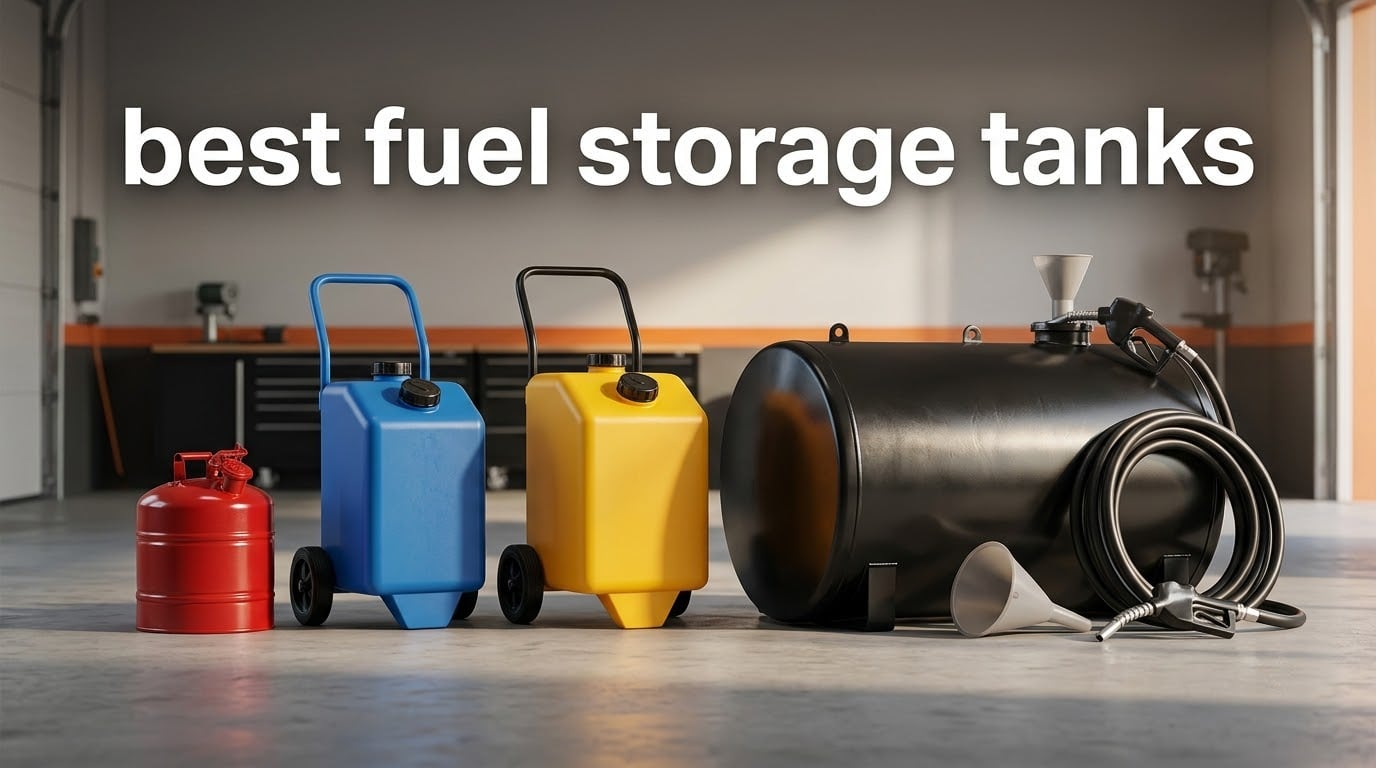
Fuel handling is one of those chores that looks trivial until you try it in the rain at the back of a property with no fuel station within ten miles. Picking the right container decides whether that refuel takes two minutes or twenty, and whether you are dealing with a pump that still works after the third season. We pulled together the best fuel storage tanks available right now, from certified 5-gallon safety cans to 116-gallon diesel transfer tanks with electric pumps.
Instead of ranking twelve random containers, we sorted them by the job they do. Small safety cans live in garages and boat lockers, wheeled caddies move fuel around a job site or a farm, and larger transfer tanks ride in a pickup bed or sit on a skid for equipment that burns through serious volume. The three construction materials you will meet, steel, polyethylene and aluminum, behave very differently outdoors, and that choice matters more than most buyers expect.
Everything below reflects manufacturer specifications and what owners report after living with these tanks. Where the reviews point to a real weakness, we name it. If you want the practical fuel-side detail too, our fuel stabilizer guide covers keeping stored gasoline and diesel usable once it is in the tank.
Table of Contents
Top 3 Picks for Best Fuel Storage Tanks in 2026

Eagle 5 Gallon Type I Safet…
- OSHA 1910.106 and NFPA 30 compliant
- Flame arrestor and self-closing spout cap
- Galvanized steel with powder-coat finish

Justrite Type II Gasoline…
- Flexible metal hose for controlled pouring
- FM
- UL/ULC and TUV certified
- Self-closing leak-tight lid

Scepter 12 Gallon Portable…
- Built-in sight gauge
- Two-way vented cap releases pressure above 5 PSI
- Accepts standard 1/4 NPT marine fittings
Best Fuel Storage Tanks at a Glance (September 2026)
The table below is the fastest way to narrow the field. Capacity, material and how the fuel leaves the tank determine which of these fits your situation, so read across the row rather than the star rating alone.
| Product | Specs | Action |
|---|---|---|
| Eagle 5 Gallon Type I Safety Can |
|
Check Latest Price |
 Scepter Duramax Flo N Go 14 Gallon Caddy Scepter Duramax Flo N Go 14 Gallon Caddy |
|
Check Latest Price |
| Scepter 12 Gallon Portable Marine Tank |
|
Check Latest Price |
 JohnDow 15 Gallon Fuel Station JohnDow 15 Gallon Fuel Station |
|
Check Latest Price |
 Better Built 36 Gallon Transfer Tank Better Built 36 Gallon Transfer Tank |
|
Check Latest Price |
 VEVOR 58 Gallon Diesel Tank with Pump VEVOR 58 Gallon Diesel Tank with Pump |
|
Check Latest Price |
 VEVOR 30 Gallon Fuel Gas Caddy VEVOR 30 Gallon Fuel Gas Caddy |
|
Check Latest Price |
 TUFFIOM 30 Gallon Portable Gas Caddy TUFFIOM 30 Gallon Portable Gas Caddy |
|
Check Latest Price |
 PAMBEE 15 Gallon Fuel Caddy PAMBEE 15 Gallon Fuel Caddy |
|
Check Latest Price |
 VEVOR 116 Gallon Portable Diesel Tank VEVOR 116 Gallon Portable Diesel Tank |
|
Check Latest Price |
| Justrite Type II Gasoline Safety Can |
|
Check Latest Price |
 SureCan 5 Gallon Type II Container SureCan 5 Gallon Type II Container |
|
Check Latest Price |
Which Fuel Storage Tank Capacity Tier Do You Need?
Match the tier to how much fuel moves through your equipment and how far you travel from a fuel station. A 5-gallon can is a top-up tool, not a supply line, and buying one because it is cheap tends to end in many trips to the pump.
For garage, boat and mower work, the 5-to-12-gallon tier is the sweet spot. Certified safety cans in this range are built to NFPA 30 and OSHA rules, and they are the only class here meant to be carried and poured by hand. If you are refueling a car from one, look for a vented cap and a flexible hose.
Between 14 and 58 gallons you are in wheeled caddy and transport territory. These serve lawn care crews, generators, small tractors and job sites, and the deciding factor is how you move fuel: a hand pump, gravity feed, or a 12V electric pump. Our fleet fuel transfer tank picks cover the larger end of that range in more detail.
Past 100 gallons, you are looking at diesel transfer tanks for pickups, skid mounts and equipment fleets. Pump speed matters enormously here, and polyethylene tanks win on weight while alloy steel wins on dent resistance. Whichever you pick, plan for two people or a forklift to reposition it.
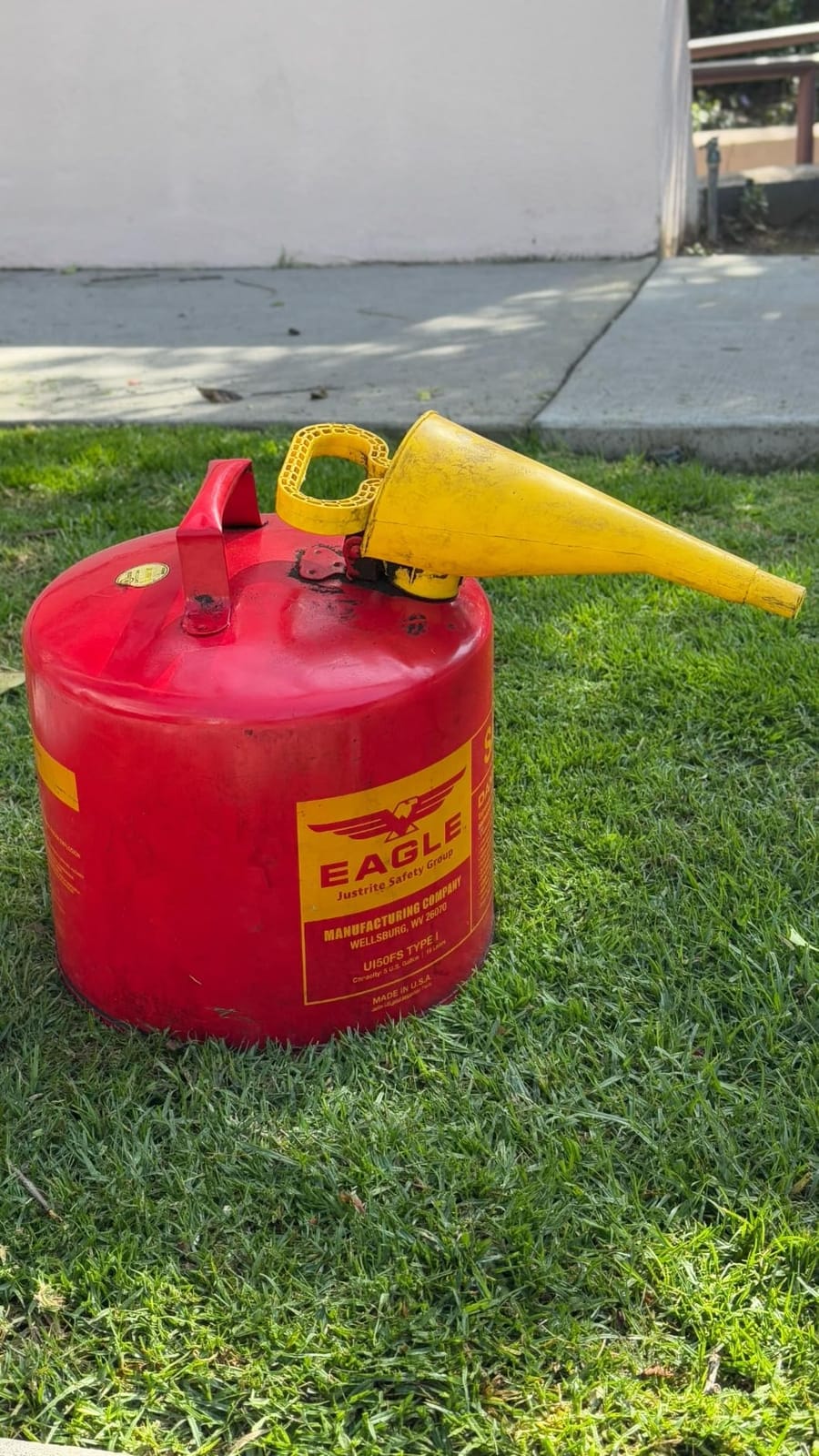
1. Eagle 5 Gallon Type I Safety Can – The Certified All-Rounder
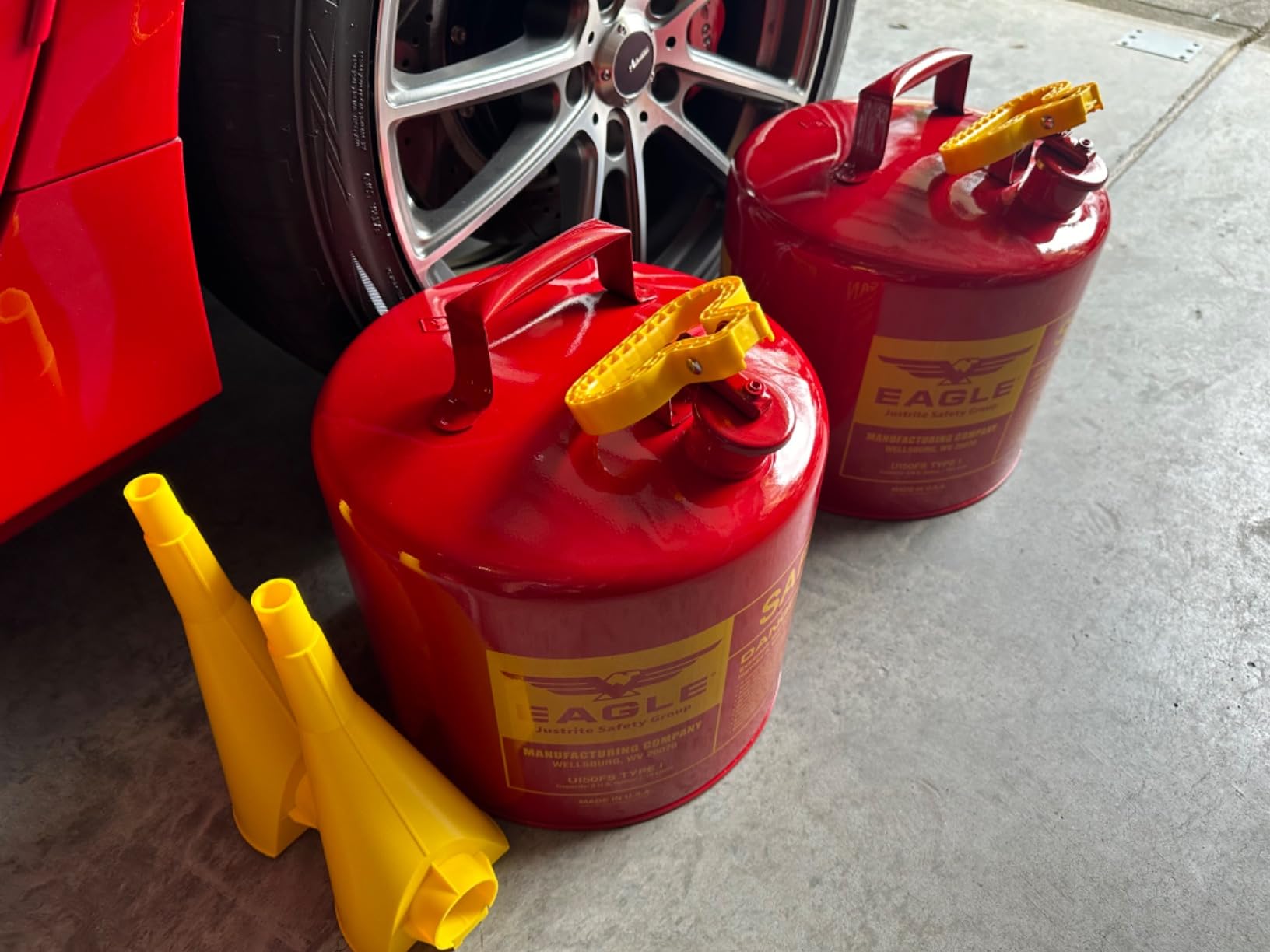
Eagle 5 Gallon Type I Red Safety Gas Can for Gasoline
5 gallon galvanized steel body
OSHA 1910.106 and NFPA 30 compliant
FM, UL and ULC approved
Pros
- Flame arrestor and self-closing gasketed spout cap
- Galvanized steel resists rust and dents
- Funnel included
- Fixed handle and double interlock seam
Cons
- Single opening is less precise than a Type II can
- Heavier than plastic cans when full
This is the can we keep coming back to. The single opening is simple, the cap self-closes, and the flame arrestor is a non-sparking mesh that stops a flashback from reaching the vapour space. It carries the widest certification set of anything we looked at: OSHA Standard 1910.106, NFPA code 30, FM, UL and ULC.
Weighs 5.3 pounds empty at 12.5 by 13.5 inches, which is noticeable when full but fine for a short walk to a mower or a generator. Owners report the powder coat holding up over years, and the included funnel is a small thing that comes up again and again in reviews.
The honest drawback is dispensing control. A Type I can has one opening, so pouring into a small tank filler or an awkward neck is less precise than a Type II can with a flexible hose. There is no gauge either, so you track remaining fuel by weight or by feel.
Galvanized steel is also the heavier choice next to a plastic can of the same size. For a garage that matters little, but if you are carrying fuel any real distance, the weight adds up fast.
Who this tank suits
Anyone who needs a compliant gasoline container for lawn equipment, a generator, or emergency reserve. It is the default choice for a reason: the approvals are documented, the steel is American-made, and the warranty runs a year on workmanship.
Who should look elsewhere
If you pour into tight openings often, or you carry fuel across uneven ground regularly, a Type II can with a hose or a wheeled caddy will save you spills. This can is built for storage and controlled transfer, not convenience.
2. Scepter Duramax Flo N Go 14 Gallon Caddy – Best Value Wheels and Hose
Scepter Duramax Flo ’N Go 14 Gallon Gas Caddy, 53 Liter Fuel Tank, Red
14 gallon HDPE tank on 6 inch wheels
Gravity flow or 2.0 GPM hand pump
10 foot automotive grade hose
Pros
- Large review base and proven tank body
- 10 foot hose reaches equipment on the ground
- Brass shut-off valve for quick disconnect
- Two fueling modes plus child safety lock
Cons
- Hose kinks at the tank connection
- Hand pump has no hold-open
- Pump handle can weep after repeated use
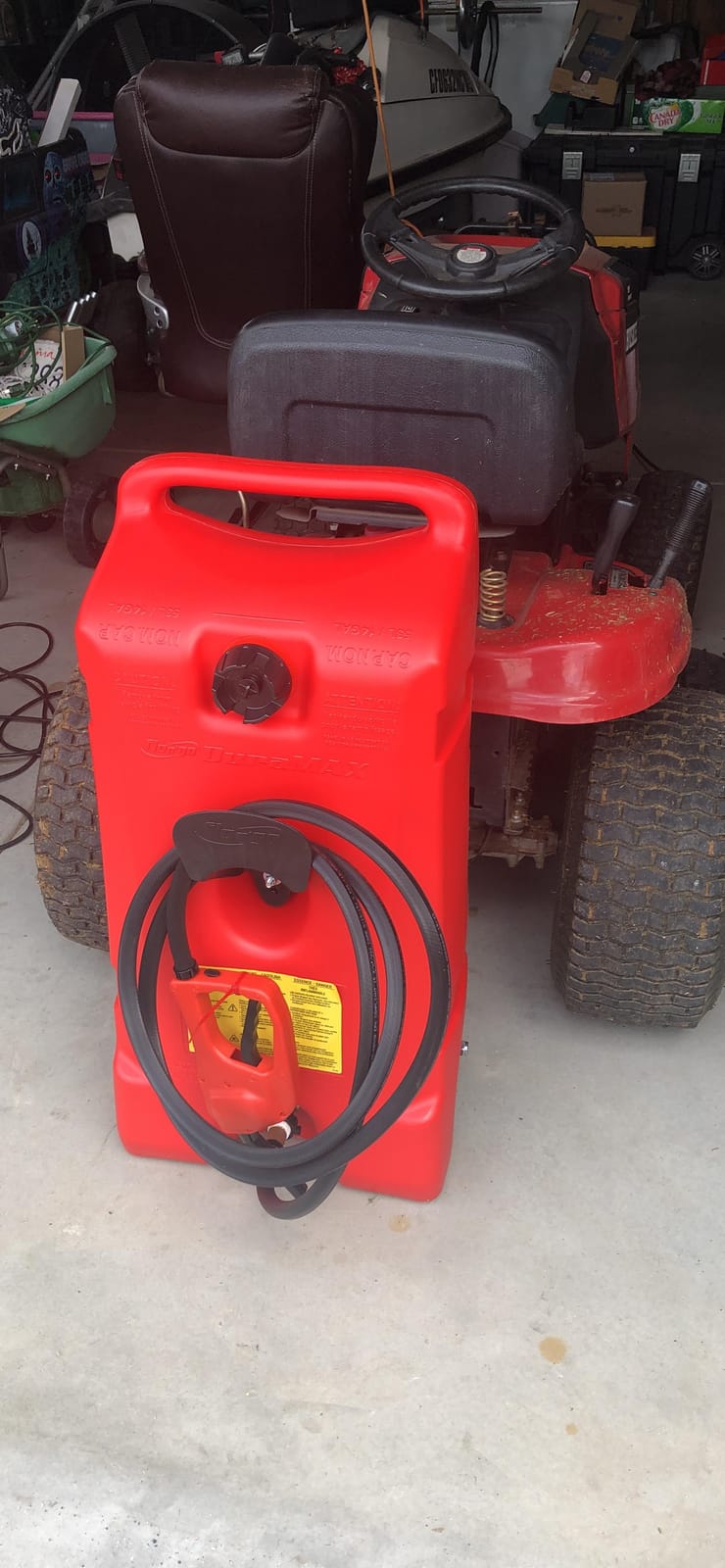
This is the caddy most people picture when they hear the term, and the two fueling modes are the reason. Elevated above the tank you are filling, it gravity-feeds. Set it on the ground and you work the pump for 2.0 GPM through the 10-foot hose.
The high-density polyethylene body is the strength here. Long-term owners report it staying air and liquid tight and never deforming, which is the opposite of what happens to cheap plastic when it sits in summer sun. Scepter also backs the pump, and customers describe receiving replacement pump assemblies from the brand.
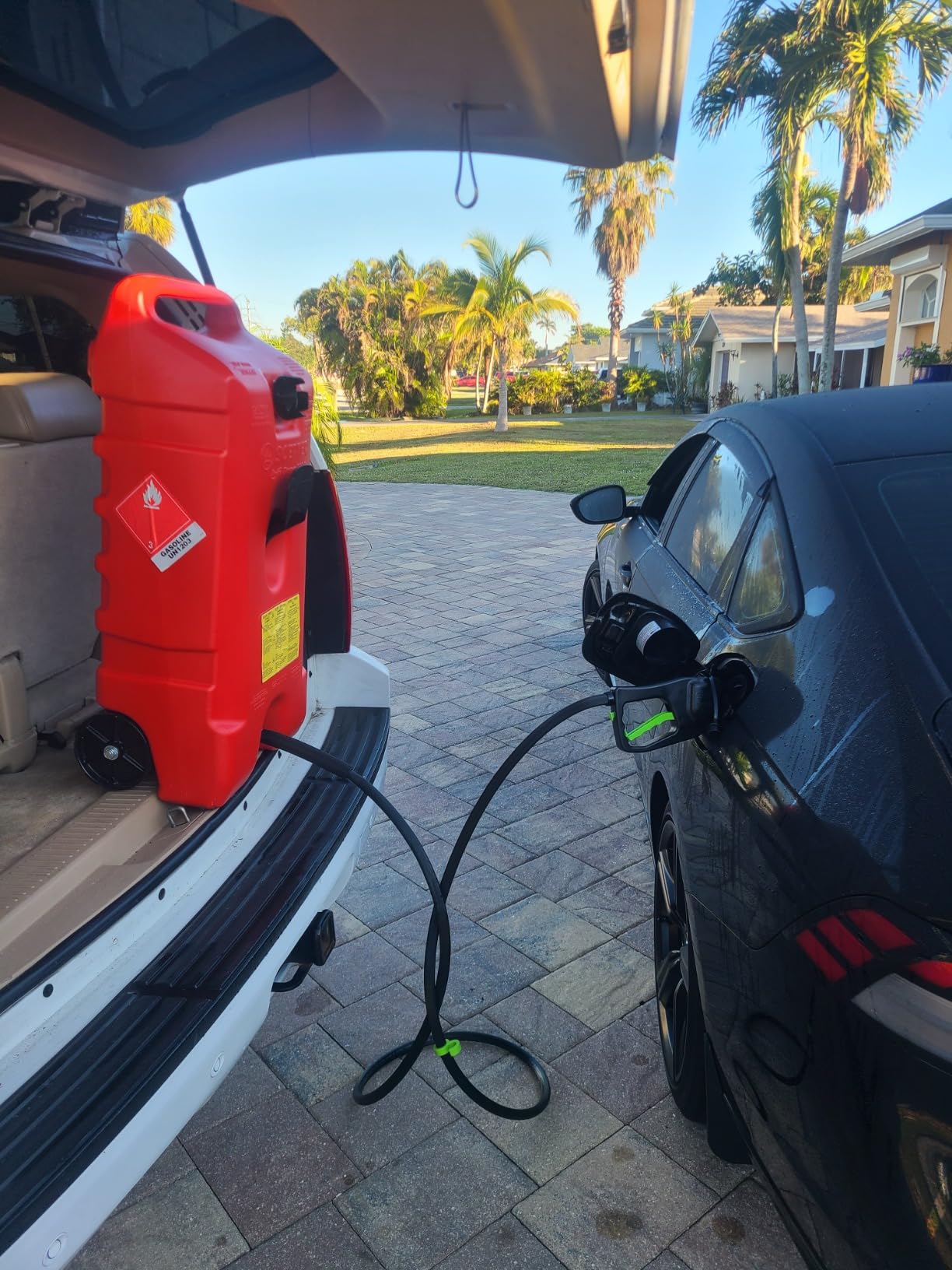
Where it disappoints is in the pumping hardware. The hose kinks where it screws into the tank, the pump handle has no hold-open so slow fills need a prop, and that handle can weep after months of use. At 19 pounds empty and 16.25 by 33.8 inches, this is a tall unit, and roughly 1 to 2 gallons tend to sit in the bottom until you tilt the whole caddy.
The wheels are simple plastic discs on a short axle, which roll fine on pavement and gravel but can bind on soft ground.
Who this tank suits
Homeowners with several gas machines, boaters who want range beyond the dock, and anyone refilling a vehicle or multiple cans in one trip. The dual-mode design handles both raised and ground-level filling.
Who should look elsewhere
If you fill large equipment regularly, 2.0 GPM by hand is slow. Electric pump options move fuel several times faster. Steel-bodied alternatives also tolerate drops and job-site abuse better than a plastic caddy.
3. Scepter 12 Gallon Portable Marine Tank – Best for Boats
Scepter 12 Gallon Portable Marine Gas Can, Large Capacity Boat Fuel Tank
12 gallon HDPE boat fuel tank
Built-in combination pick-up and sight gauge
Two-way vented cap, 1/4 NPT marine fittings
Pros
- Top seller in boat engine fuel tanks
- Built-in gauge removes a separate indicator
- Vented cap releases pressure above 5 PSI
- Works with diesel and ethanol-blended fuel
Cons
- Fuel line sold separately
- A small share of buyers hit venting or fitting issues
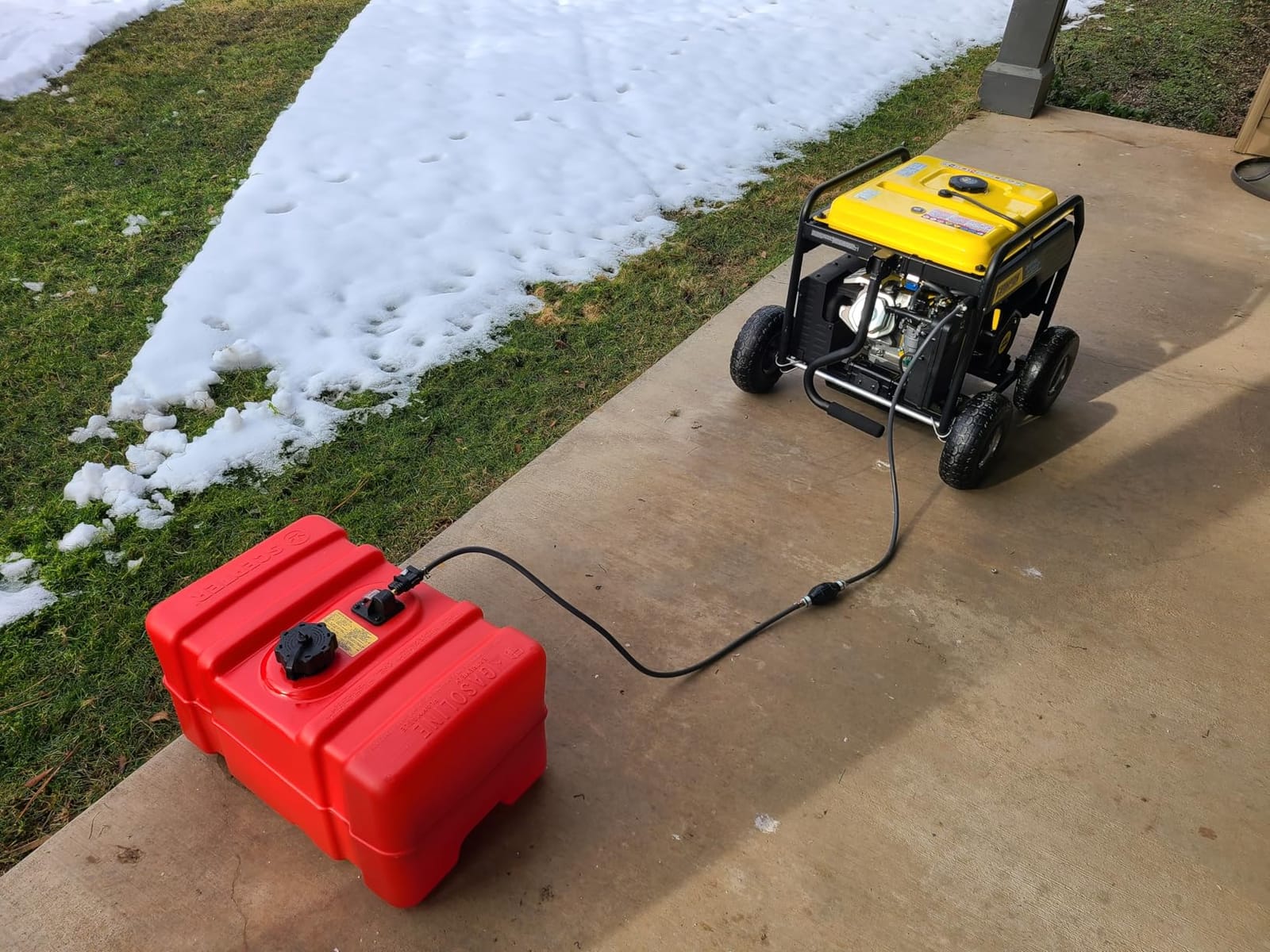
Boats are the use case this tank was designed around, and the details show it. The built-in gauge combines the fuel pick-up with a sight window, so you read remaining fuel on the can itself rather than through a separate indicator. The cap vents while you fill and releases pressure automatically above 5 PSI to stop vapour build-up.
It accepts standard 1/4 NPT marine tank fittings, which matters if you are connecting a fixed tank rather than filling by hand. The one-piece, five-layer HDPE shell resists rust, corrosion and UV damage, and molded hand holds make lifting and securing it straightforward.
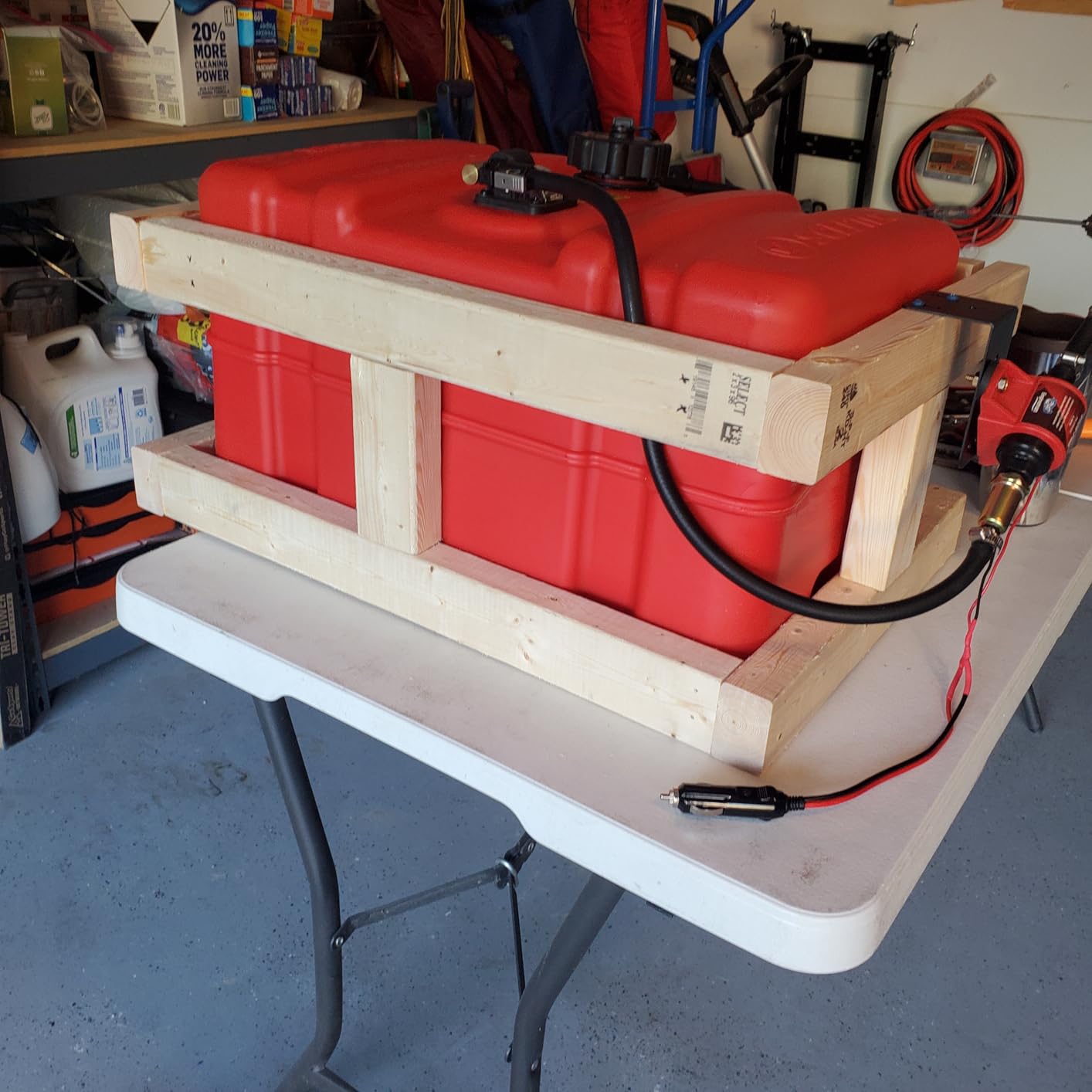
Two things catch people out. The fuel line is not included, so a full setup needs a second purchase, and about 9 percent of reviews report venting or fitting problems. At 6.8 pounds empty it is one of the lighter tanks here, and the 22.9 by 14.3 by 13.9 inch footprint fits a cockpit locker better than most.
If you are storing this long-term, remember that a vented cap is also a slow exchange path for humidity. Pair the tank with a stabilizer and a rotation schedule.
Who this tank suits
Boat owners running an outboard beyond a single tank of dock fuel, and anyone who needs a portable tank that accepts standard marine hardware. The gauge is a genuine convenience when you are topping up away from a marina.
Who should look elsewhere
Handlers who need maximum capacity in a small footprint want the 14-gallon wheeled caddy instead. Anyone storing fuel for months without treating it should plan a treatment routine regardless of the tank.
4. JohnDow 15 Gallon Fuel Station – Best for Pump-Free Gravity Feed
JohnDow Industries JDI-FST15 15 Gallon Fuel Station – Durable and Convenient Fuel Storage and Dispensing Solution,Red
15 gallon welded cold rolled steel
10 foot hose with shut-off valve
Ground wire and UN/DOT road approval
Pros
- No pump to maintain or replace
- Ground wire and alligator clip included
- UN/DOT approved for road transport
- Bolt mount fits a trailer or flatbed
Cons
- Real capacity closer to 13-14 gallons
- Drain port sits above the very bottom
- Some units arrive dented
The logic here is simplicity. There is no pump, so there is no pump to seize, leak or replace, and fuel flows through a 10-foot hose with a built-in shut-off valve and a squeeze-handle dispenser. Welded cold-rolled steel owners report as leak-free after years of service, and the ground wire with alligator clip handles static.
It is UN/DOT approved for road transport, which is why you see these bolt-mounted to trailers for landscaping and farm work. Gasoline, diesel and E85 are all within spec, so one tank can cover a mixed equipment yard.
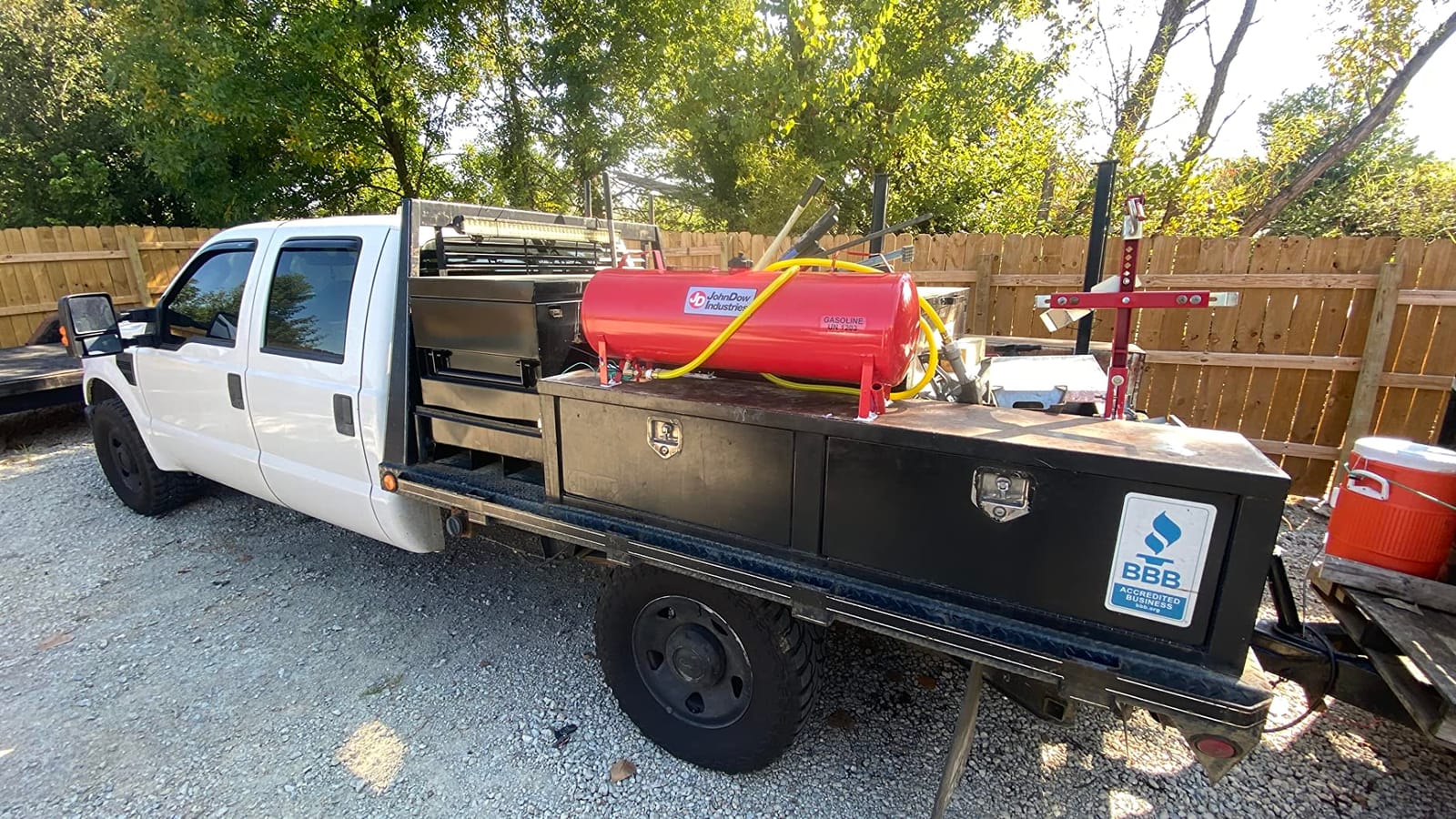
The limitations are physical rather than mechanical. At 30 pounds empty and 39 by 15 inches, it is a big object to move, and gravity flow is only quick when the tank sits well above the receiving container. The drain port is not at the very bottom either, so the last of the fuel needs a tilt.
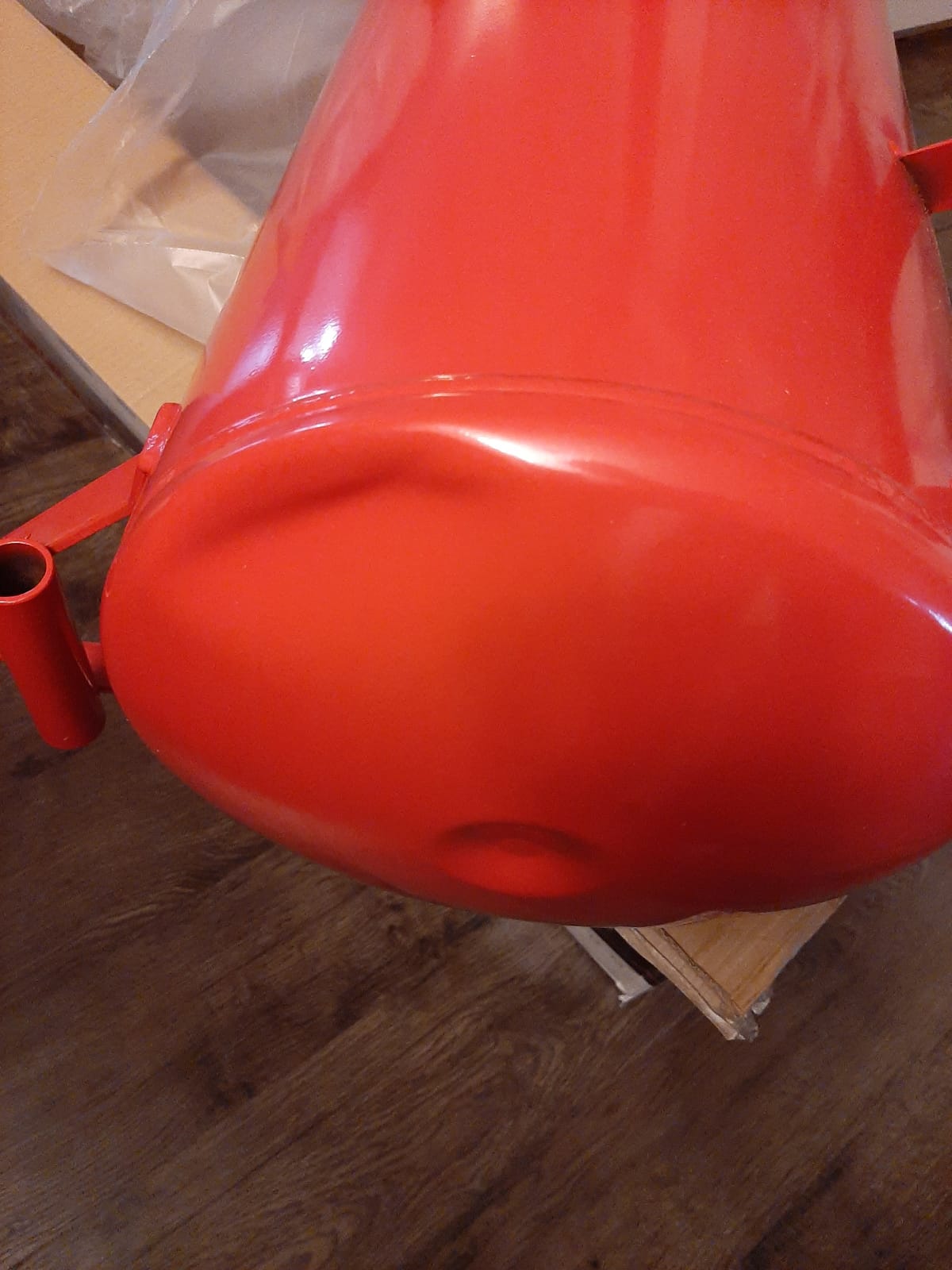
Reviewers also mention the hose stiffening and cracking in cold weather, and a small number of units arriving dented from shipping damage.
Who this tank suits
Anyone who wants a low-maintenance fuel station for a trailer-mounted setup, a farm rig, or a fixed generator. If the tank can be mounted high and stay there, the lack of a pump is an advantage rather than a limitation.
Who should look elsewhere
Buyers who refill while the tank is on the ground should choose a hand or electric pump instead. Also note the shortfall between the stated 15 gallons and the usable volume buyers report.
5. Better Built 36 Gallon Transfer Tank – Best for Pickup Beds
Better Built Steel Transfer Fuel Tank – 36-Gallon, Rectangular, Black, Model Number 29211584
36 gallon alloy steel transfer tank
Internal baffles and overfill restriction
Lockable cap, flush 2 inch bungs
Pros
- Baffles stop slosh during transport
- 3 year warranty
- Overfill restriction shuts the pump off automatically
- Lockable vented cap for theft deterrence
Cons
- 40 pounds empty and hard to lift alone
- No pump included
- Fit and finish are not flawless
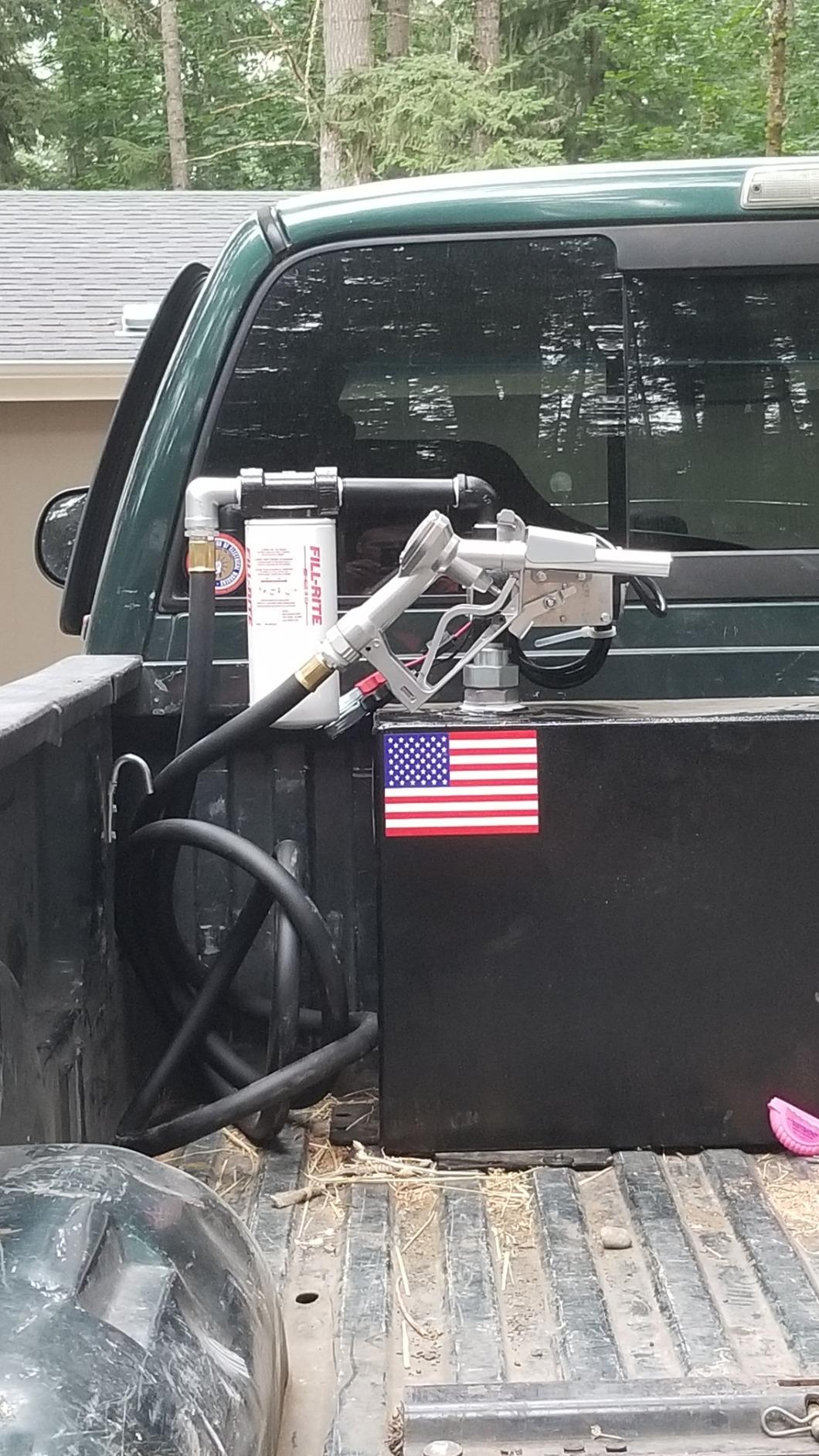
Built for a truck bed, this alloy steel tank handles diesel at 36 gallons. The internal baffles are the detail that matters in a moving vehicle: they add structural strength and stop the contents sloshing, which is what actually cracks fittings. Flush-mounted 2-inch inlet and outlet bungs suit a pump-equipped transfer setup.
The overfill restriction shuts the pump off automatically at the limit, and the lockable vented cap covers the one opening thieves target. At 40 pounds empty and 11 by 17 inches, it is a permanent fixture once mounted rather than something you lift weekly.
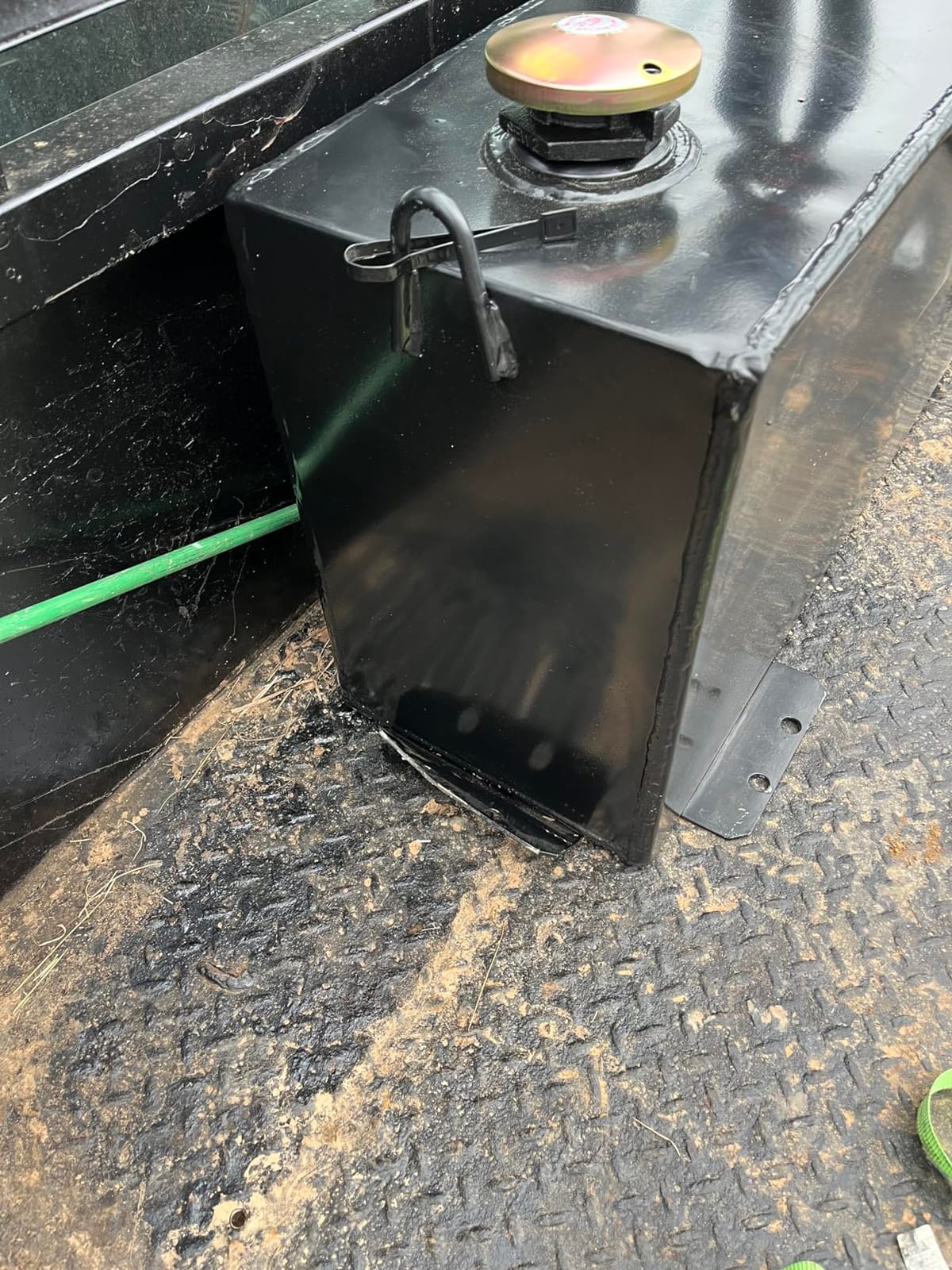
Owners are consistent about the tradeoffs. Nothing pumps fuel out of the box, so you are buying a 12V transfer pump and mounting hardware as a second step. The weight is the other one: two people to get it into a bed, and that is before it is full.
About 10 percent of reviews point to fit and finish that is not flawless, so check the welds and bung threads on arrival. The 3-year warranty is the longest in this group.
Who this tank suits
Truck owners who move diesel to equipment away from a road, and anyone who cares more about dent resistance and slosh control than about saving 20 pounds. The lockable cap and overfill shutoff are real conveniences for regular use.
Who should look elsewhere
Single-vehicle users who load and unload often should look at a lighter polyethylene tank with a pump already fitted. Steel here is about durability, not portability.
6. VEVOR 58 Gallon Diesel Tank – Best for Fast Diesel Refills
VEVOR Portable Diesel Tank, 58 Gallon Capacity & 10 GPM Flow Rate, Portable Fuel Tank with 12V Electric Transfer Pump and 13.1ft Rubber Hose, PE Diesel Transfer Tank for Easy Fuel Transportation Black
58 gallon polyethylene tank
12V electric pump at 10.6 GPM
Duplex filtration and automatic shutoff nozzle
Pros
- Electric pump refills equipment far faster than hand pumps
- Lighter than an equivalent steel tank
- Automatic shutoff nozzle prevents overfilling
- Forklift pockets and transport grooves
Cons
- Usable volume closer to 48-51 gallons
- Fasteners and filter can arrive loose
- Gauge accuracy is disputed
Flow rate is the reason this tank earns its place. A 140W 12V pump moving diesel at 10.6 GPM turns a tractor or skid steer refill into a couple of minutes rather than a quarter of an hour of pumping. The automatic shutoff nozzle stops the flow when the receiving tank is full, which prevents both spillage and wasted fuel.
Construction is 6mm polyethylene, thickening to 12mm at the thickest point, with UV resistance and a copper lock on the upper lid. The duplex filter pairs an inner front-end screen with an outer filter that catches smaller metal and colloid particles, which matters more for injectors than most buyers expect.
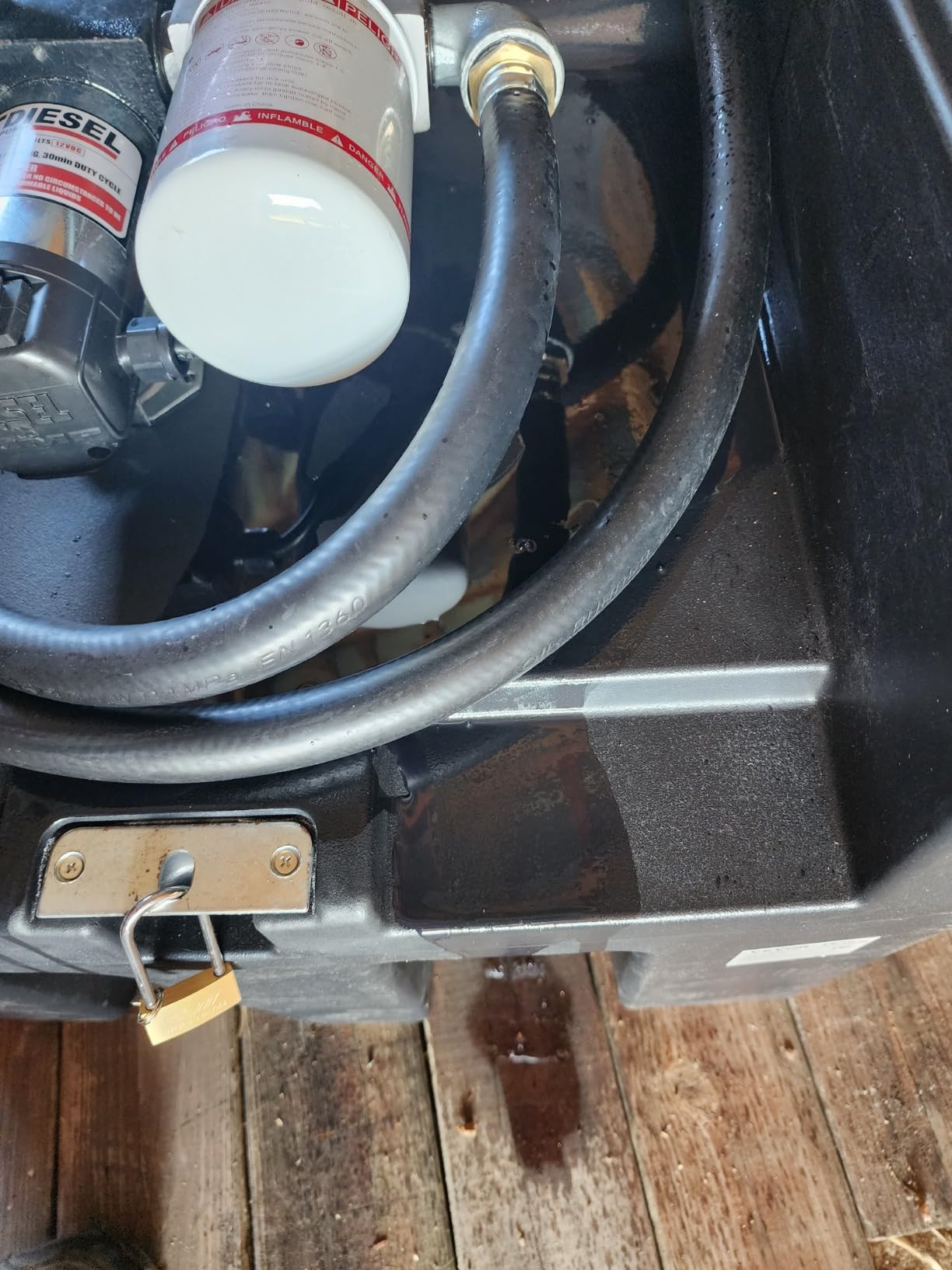
Here is the honest part. The advertised 58 gallons is not what you get: safe fill capacity is stated as 52 gallons, and owners report usable volume around 48 to 51 gallons. Several also report loose factory fasteners and a filter that needs tightening, plus an O-ring that stretches and can squeeze out at the pump mount.
The mechanical fuel gauge is reported as inaccurate, and the pump top collects water if the tank stands outdoors with the nozzle resting in it. At 65.5 pounds empty, one person can still load it alone, which is a genuine advantage over steel at this size.
Who this tank suits
Contractors and farmers refilling diesel equipment daily, where pump speed saves more time than tank weight costs. The lockable lid and shutoff nozzle make it a sensible theft-deterrent setup too.
Who should look elsewhere
Buyers who need precise volume planning should size for actual usable gallons, not the headline number. Anyone storing diesel long-term should add a biocide and treat the tank before it sits, since a large volume ages slowly but not indefinitely.
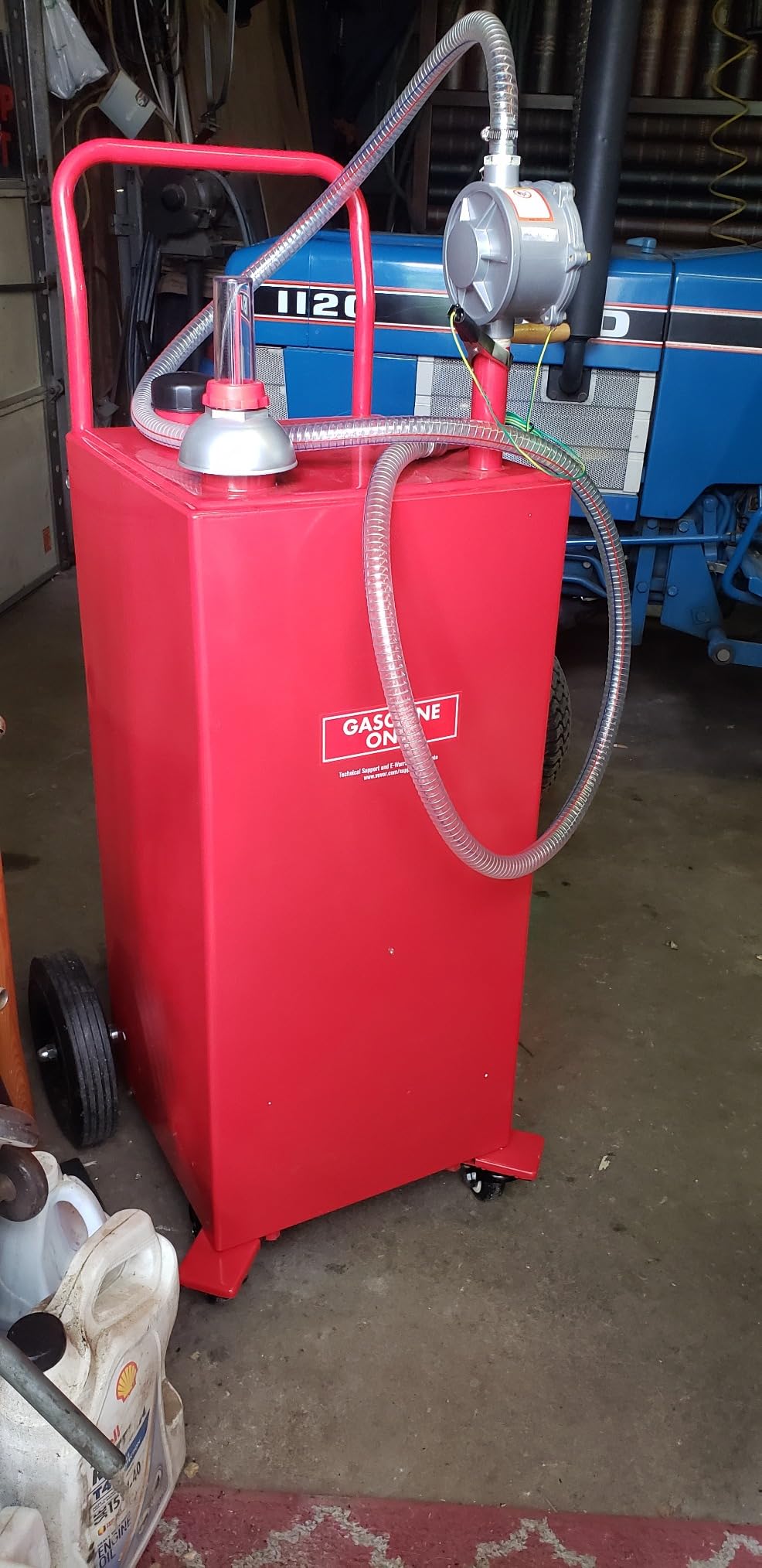
7. VEVOR 30 Gallon Fuel Gas Caddy – Best for Mowers and Small Tractors
VEVOR 30 Gallon Fuel Gas Caddy, Carbon Steel, Portable Fuel Transfer
30 gallon carbon steel caddy
Bi-directional hand pump, no power needed
Large rubber wheels, powder-coated finish
Pros
- Steel body and reinforced ribs survive daily work
- Bi-directional pump dispenses or siphons
- Wheels roll over grass
- snow
- gravel and concrete
- Powder coating resists rust outdoors
Cons
- 49.4 pounds empty
- awkward when full
- Fittings need assembling before first use
- Some finish inconsistencies on arrival
A 30-gallon caddy sits in the gap between a safety can and a transfer tank, and this one is built for lawn and garden work. The carbon steel body has reinforced support ribs and a rust-resistant powder coat, and it handles both gasoline and diesel in the same container.
The bi-directional hand pump is genuinely useful: turn it one way to dispense and the other to siphon, with no power required. That makes it workable on a property where a generator outlet is not close by.
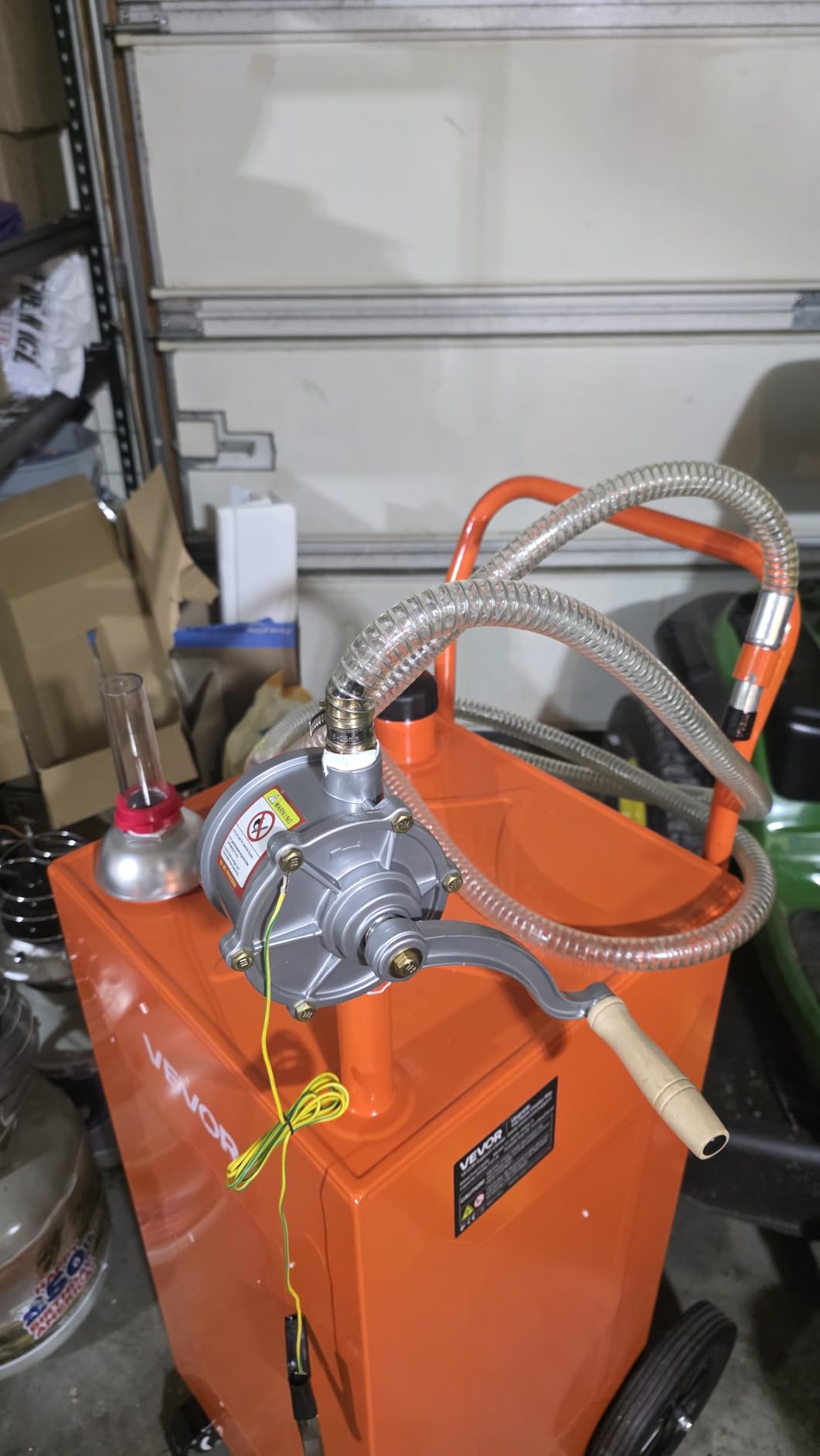
At 49.4 pounds empty and 21.9 by 50.2 inches, this is a heavy, tall unit, and full it is awkward to lift. You will push it rather than carry it, and the large rubber wheels are the reason that works across grass, snow, gravel and concrete.
Some assembly of the fittings is required before first use, and about 10 percent of reviews point to finish inconsistencies on arrival. Check the pump shaft and hose threads before you rely on it.
Who this tank suits
Lawn care operators, small farms, and homeowners who want a real supply of fuel without driving to the station every time a machine needs filling. Steel tolerates daily handling better than plastic in this role.
Who should look elsewhere
Anyone who has to load the tank into a vehicle regularly should consider a lighter polyethylene or HDPE option. If you fill diesel equipment only, a dedicated diesel tank avoids cross-contamination entirely.
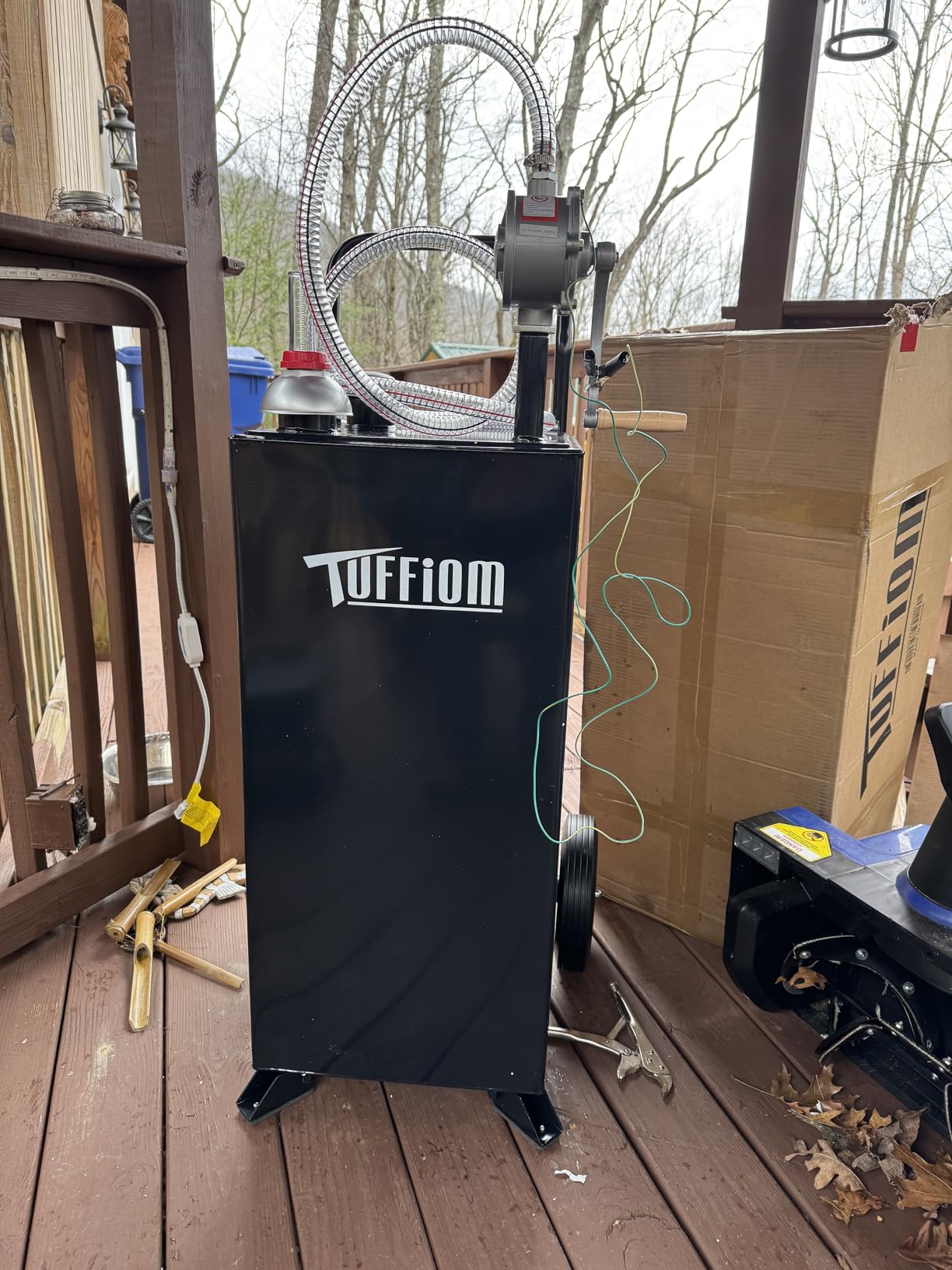
8. TUFFIOM 30 Gallon Gas Caddy – Best for Steering and Maneuvering
TUFFIOM 30 Gallon Portable Gas Caddy w/Swivel Wheels,Fuel Storage Tank, Gasoline Diesel Can with Fuel Transfer Rotary Hand Siphon Pump for Automobile ATV Car Mower Tractor Boat Motorcycle
30 gallon heavy-duty iron tank
Four wheels with two universal swivel wheels
8.9 foot kink-free hose and ground clamp
Pros
- Swivel wheels steer where fixed wheels do not
- Reversible pump recovers fuel left in the hose
- Iron tank resists deformation
- Anti-static grounding clamp included
Cons
- Factory debris can damage the soft aluminum pump rotor
- Undocumented fine-thread suction fitting
- Very heavy when full
- Hand crank only
Most wheeled caddies roll straight and turn badly. This one has four wheels with two universal casters, and owners consistently call that the difference in tight spaces like a garage bay or a shed doorway. The pushable handle makes it steerable rather than merely movable.
Other details worth noting: the reversible rotary hand pump sucks the fuel remaining in the hose back into the tank, which is a small saving repeated often, and the anti-static grounding clamp is fitted for safe dispensing. The 8.9 foot hose is described as kink-free, and a vent and oil level gauge make it easy to see what is inside.
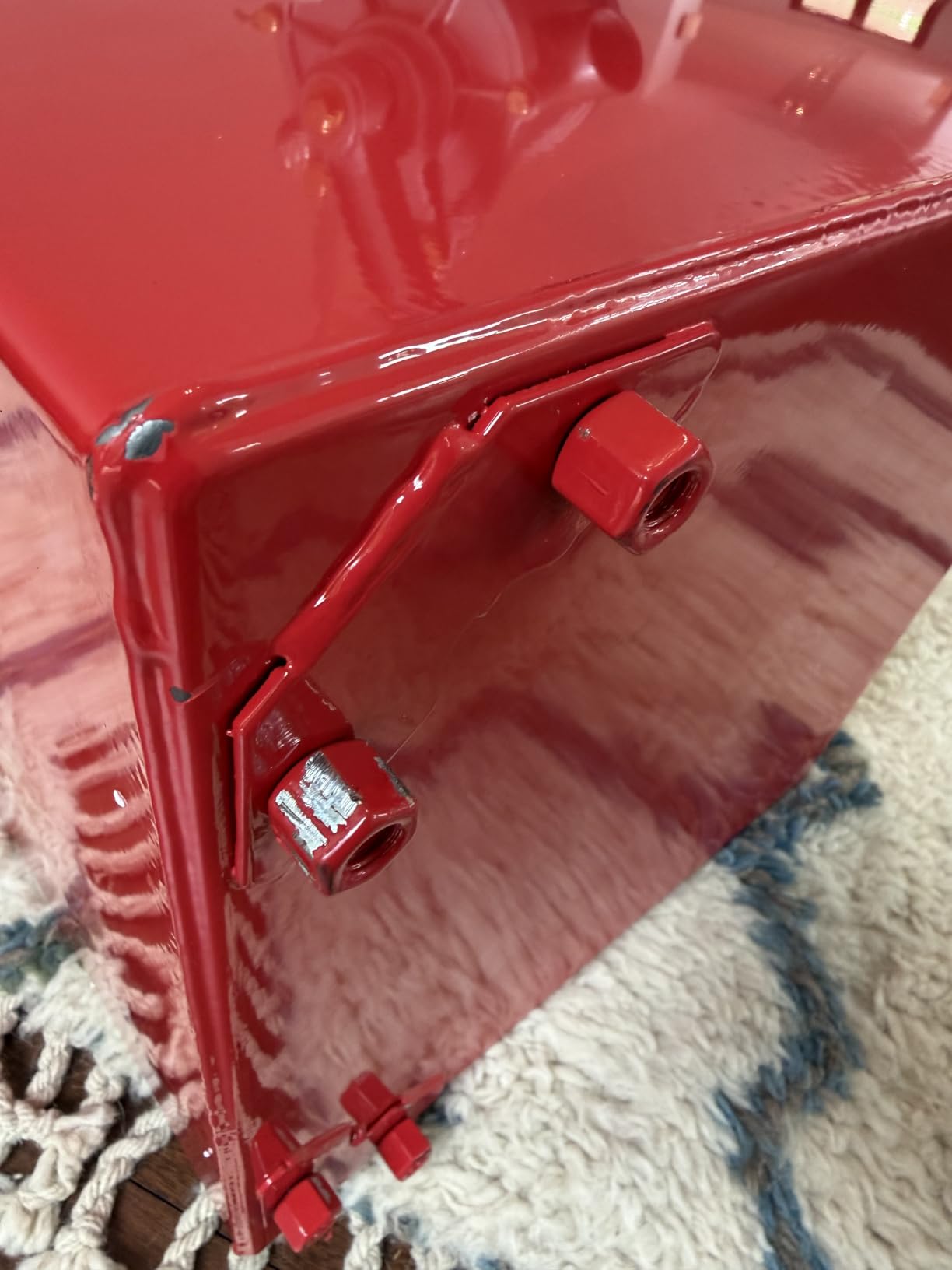
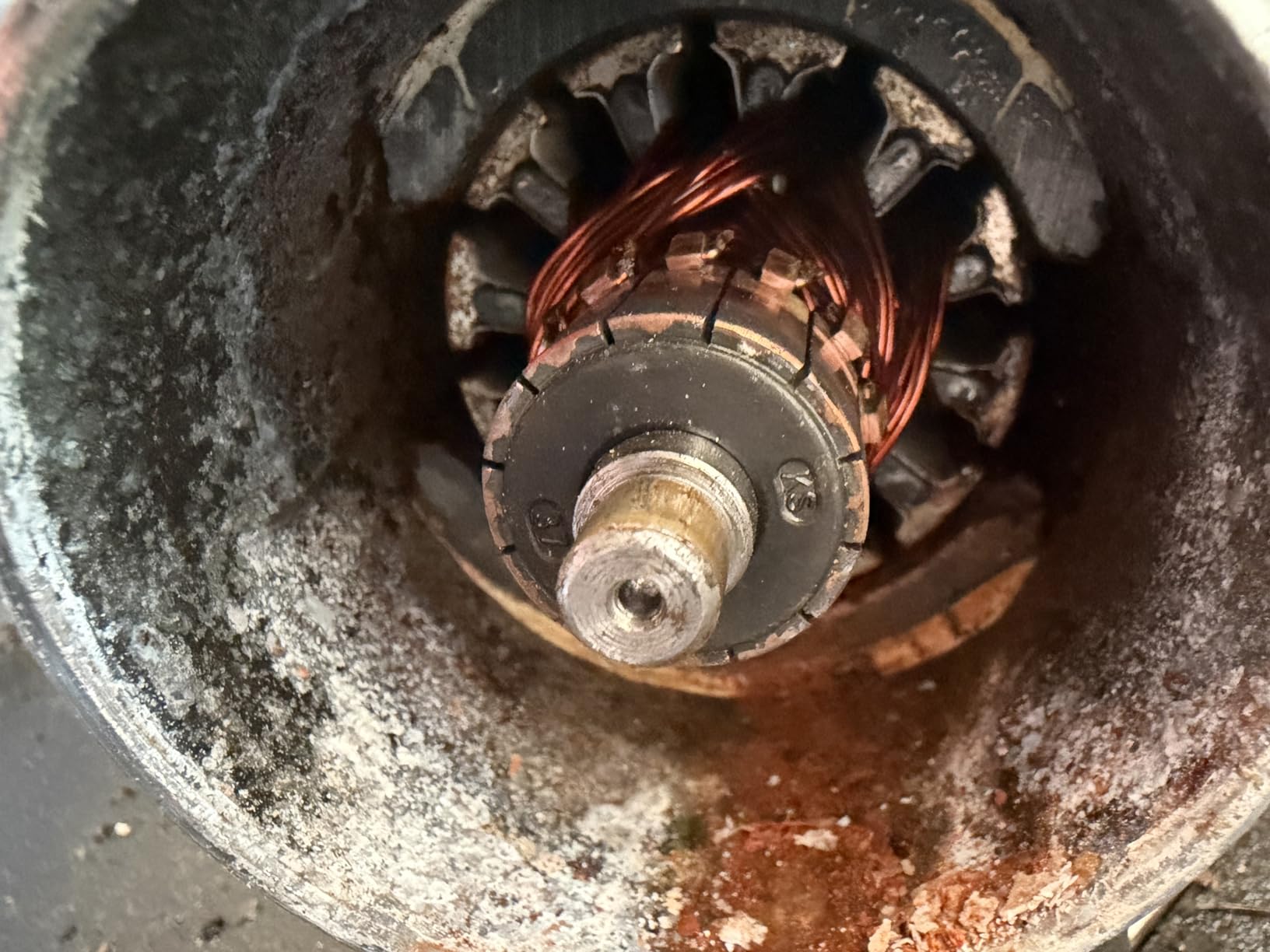
The problems show up in assembly quality. Several owners found factory debris in the tank that reached and destroyed the soft aluminum pump rotor. The suction line also uses a fine thread that the listing does not mention, which complicates fitting an aftermarket pump.
Units can arrive scratched or dented with a bent float indicator rod, and the tank is very heavy once filled. Only a hand crank is included, so an electric pump has to be added separately.
Who this tank suits
Users with awkward storage spaces who spend time maneuvering a caddy in and out of a vehicle or around equipment. The four-wheel steering layout solves a problem the category ignores.
Who should look elsewhere
Buyers who want a turnkey electric pump setup should skip this and choose a tank that ships with one. Anyone near salt water or coastal air should inspect the finish closely and treat rust early.
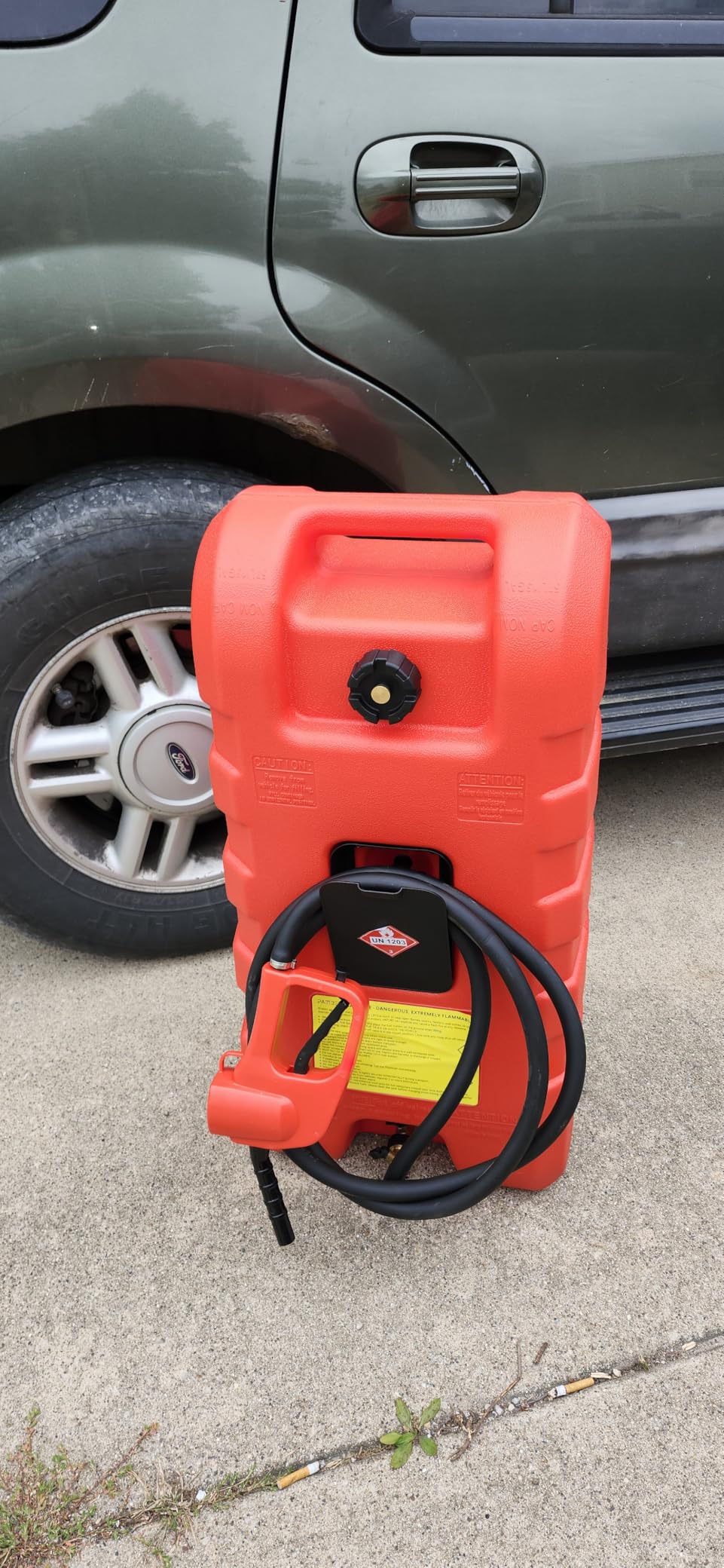
9. PAMBEE 15 Gallon Fuel Caddy – Best for Truck Boot Storage
15 Gallon Fuel Caddy, Portable Gas Can Fuel Tank with Manual Siphon Pump & 10FT Hose, Wheeled Fuel Container for Gasoline Diesel Storage, Car, ATV, Boat, Lawn Mower, Generator, Red
15 gallon HDPE tank and nozzle
3 GPM siphon mode, gravity feed supported
10 foot hose with two brass shut-off valves
Pros
- Will not rust like a steel caddy
- Two brass valves let the hose disconnect without draining
- 23.1 pounds empty
- Top handle and 6 inch wheels
Cons
- 3 GPM siphon flow is slow
- Manual pump only
- Some leakage and fitting complaints
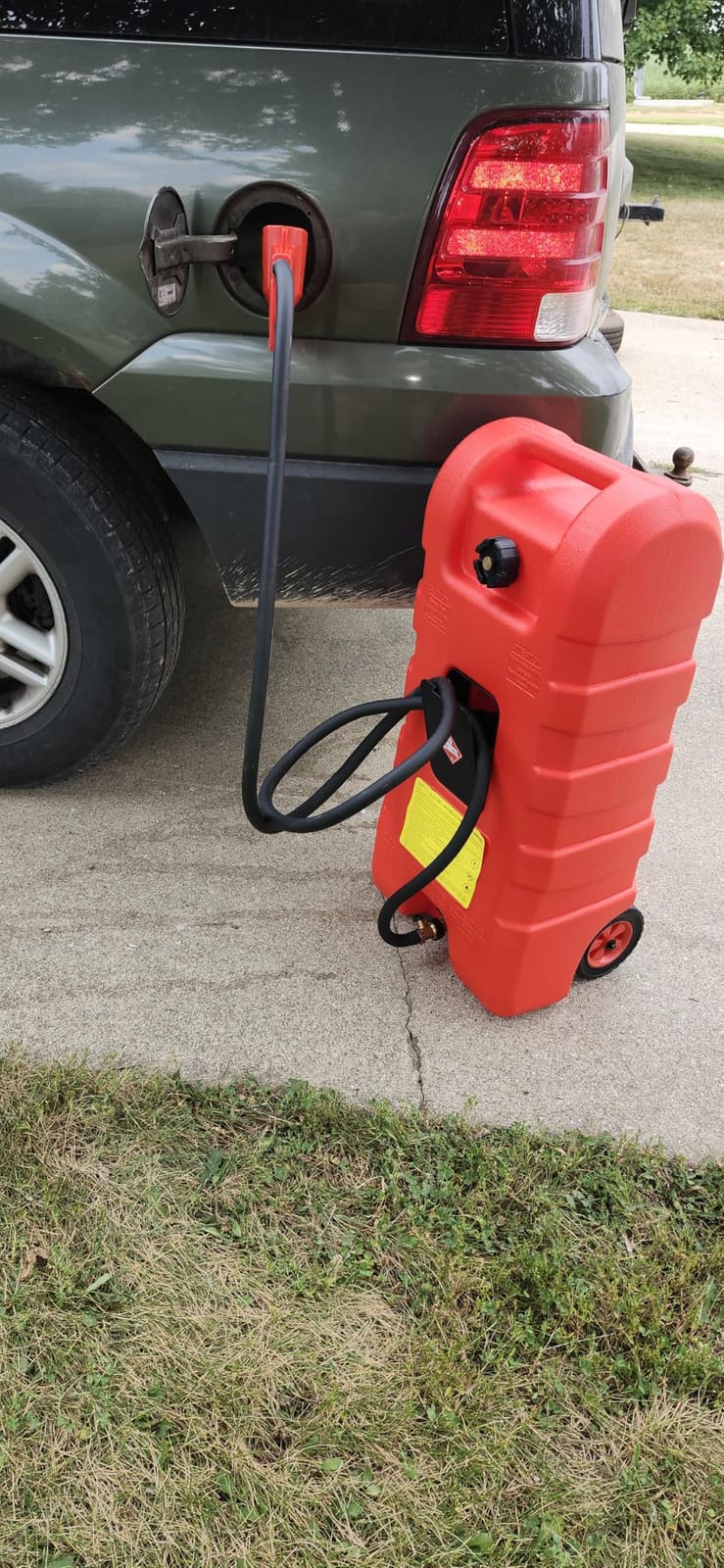
This caddy is shaped by where it lives. At 16.14 by 34 inches and 23.1 pounds empty, it fits a truck boot, a garage corner or a shed without dominating the space, and the HDPE body and nozzle will not rust in a damp vehicle bed.
The two brass shut-off valves, one at the tank and one at the hose, let you disconnect the line without draining the tank. That single feature saves more mess than any other detail on the list. It supports both gravity feed and siphon mode at 3 GPM, and handles gasoline and diesel.
The flow rate is the limit. Three gallons per minute depends on how hard you press the manual pump, and for filling a truck or a boat tank you will want more. There is no electric option fitted, and pumping stays manual.
Around 9 percent of reviews mention leakage or fitting complaints, so check both brass valves and the hose seated correctly on the first fill. In return, the 10-foot hose and 6-inch wheels cover good ground from a truck bed.
Who this tank suits
Drivers who keep a fuel supply in the vehicle for cars, motorcycles, boats, mowers, snow blowers and generators. The dual valves and rust-proof body suit intermittent, on-the-go use.
Who should look elsewhere
Anyone filling large volumes regularly needs a faster pump, and 3 GPM will test patience. For long-term storage, pair it with a stabilizer and keep it full, since less air means less condensation inside.
10. VEVOR 116 Gallon Portable Diesel Tank – Best for Fleet Diesel
VEVOR Portable Diesel Tank, 116 Gallon, Black
116 gallon polyethylene diesel tank
12V electric pump at 10.6 GPM, 140W output
Duplex filter, automatic shutoff nozzle, copper lock
Pros
- Largest capacity in this roundup for diesel
- 10.6 GPM pump beats every hand-pumped option
- Light polyethylene body for the volume
- Forklift pockets make truck loading straightforward
Cons
- 104.1 pounds empty
- needs two people or a forklift
- Fasteners need checking on arrival
- Gauge accuracy unverified
At 116 gallons, this is the tank for operations running multiple diesel machines. It carries the same 12V pump at 10.6 GPM and the same automatic shutoff nozzle as the 58-gallon version, so a full fill still takes minutes rather than a pumping session.
Polyethylene is the deciding material at this weight. At 104.1 pounds empty, a comparable steel tank would be far harder to move, and the integrated forklift pocket plus two transport grooves are there because of it. The 4.4 average across reviews is the strongest in the large-tank group.
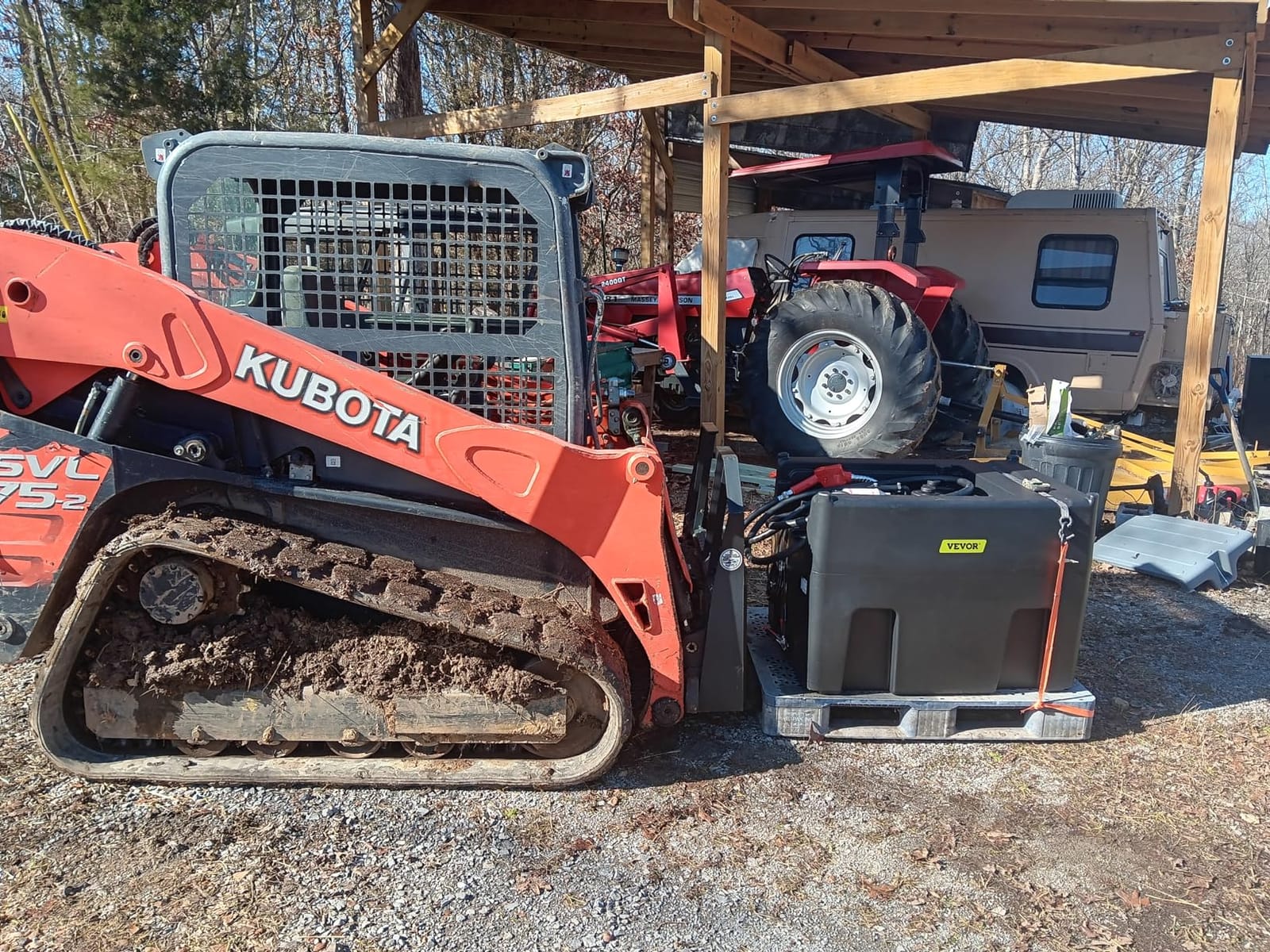
Even with those pockets, repositioning takes two people or a forklift. Owners report the same assembly looseness pattern as the smaller sibling, so check fasteners and the pump mount seal before the first fill, and treat the mechanical gauge as approximate rather than precise.
Capacity here should be treated with the same caution. Advertised maximum volume is not usable volume, and buyers of the smaller model report filling closer to 85 percent of the headline figure.
Who this tank suits
Farms, landscaping crews, and small fleets that refuel several diesel machines a day from one source. The pump speed and volume together remove most of the downtime a small on-site tank saves.
Who should look elsewhere
Smaller operations should step down to the 58-gallon version, which one person can load. Anyone storing diesel beyond a season should treat the tank before it sits, since volume slows fuel age but does not stop microbial growth.
11. Justrite Type II Gasoline Safety Can – Top Rated for Controlled Pouring
Justrite Type II Gasoline Safety Can, Red Galvanized Steel, FM Approved
5 gallon galvanized steel Type II can
Flexible metal hose and Safe-Squeeze trigger
FM, UL/ULC and TUV certified
Pros
- Pours accurately into small openings
- Trigger gives glug-free flow control
- Stainless steel flame arrester and self-closing lid
- Pressure-tested galvanized steel body
Cons
- Heaviest 5 gallon can here at 8.7 pounds
- Costs more than a basic safety can
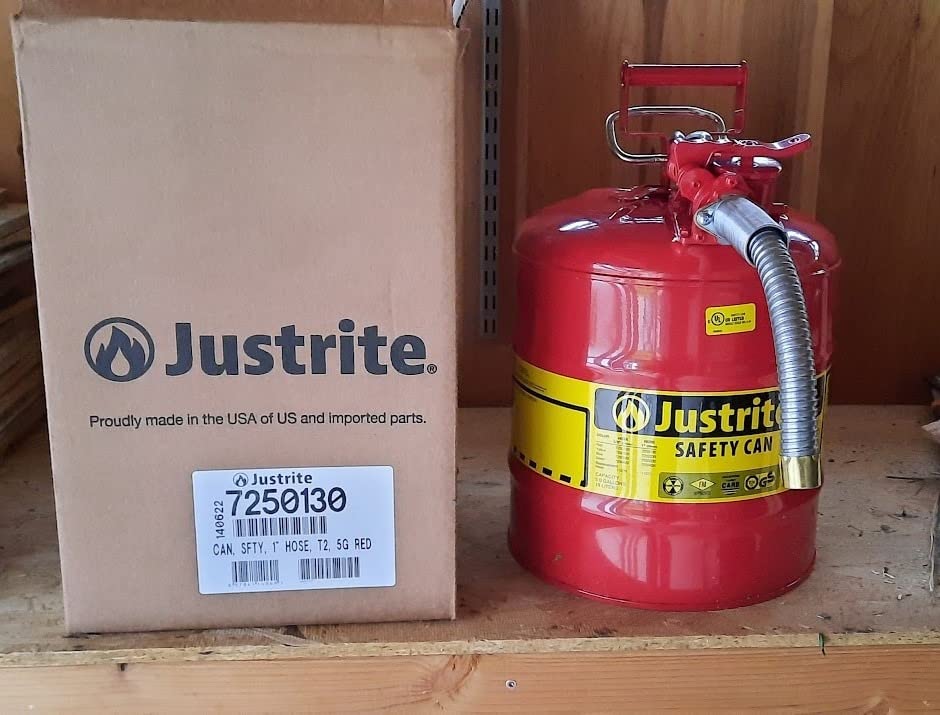
The Type II layout solves the exact weakness of the Type I design. A flexible metal hose directs fuel into small openings instead of the wide spout, and the patented manifold with the Safe-Squeeze trigger gives smooth, glug-free flow. Shops and industrial users rely on that control near sensitive equipment.
Certification is the other headline. It is FM Approved, UL/ULC Listed and TUV Certified, and it is built to support OSHA and NFPA 30 compliance. A stainless steel flame arrester and a self-closing, leak-tight lid cover the fire-protection side.
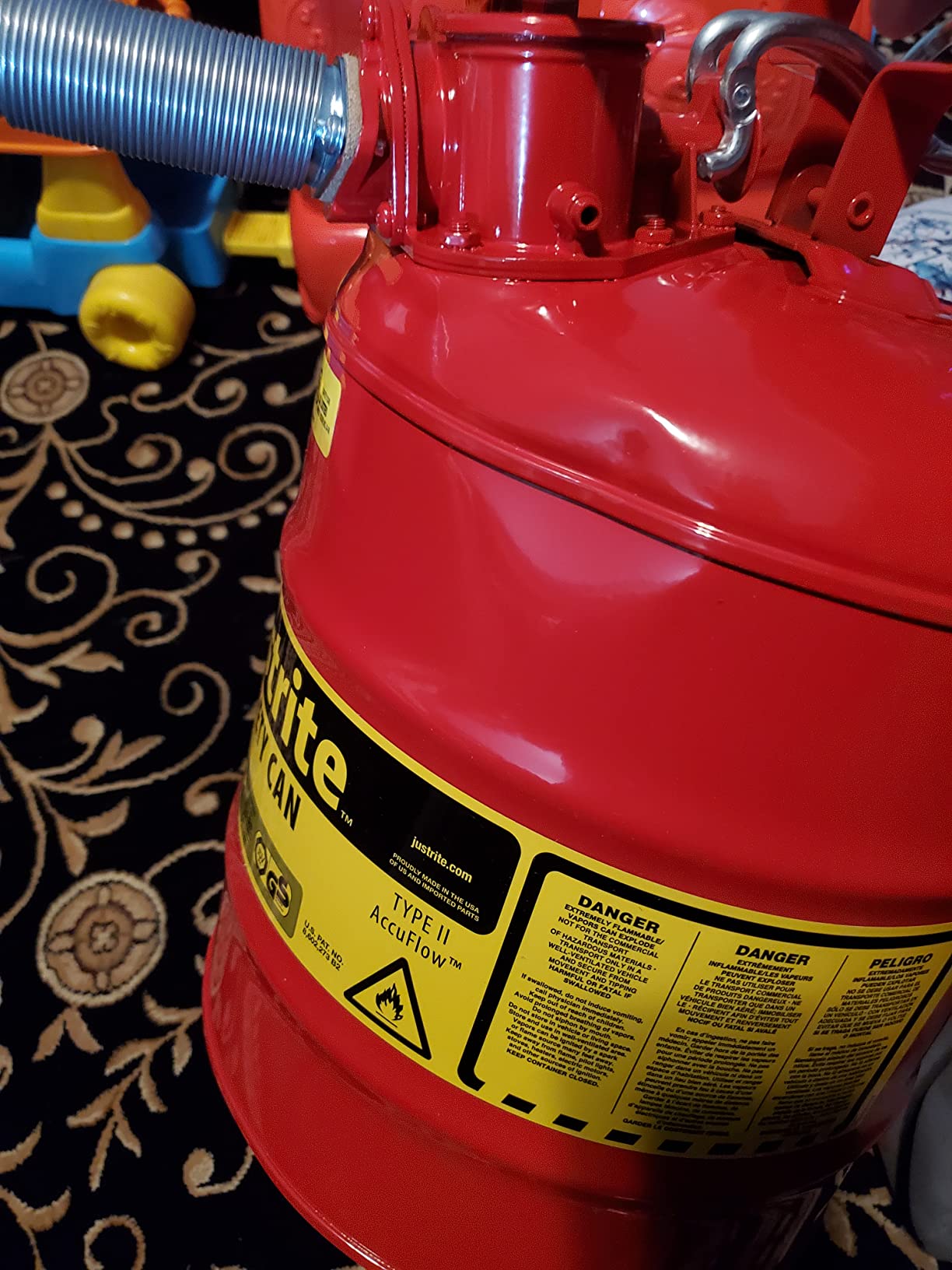
At 8.7 pounds empty, this is the heaviest 5-gallon can in the roundup, and the galvanized steel body with chemical-resistant powder coat costs more than a plain plastic safety can. Buyers accept both as the price of industrial certification and precise dispensing.
The ergonomic lift lever speeds refilling, and the can is pressure-tested for repeated commercial duty. If you only refill a mower twice a month, you are buying capability you will rarely touch.
Who this tank suits
Workshops, maintenance shops, and anyone who transfers fuel into small or awkward tanks. The certification set is the reason it shows up in commercial and industrial settings rather than garages.
Who should look elsewhere
Casual yard users should start with a lighter plastic can and save the weight. If certified steel matters but weight does not, the Type I steel can gives approval at a lighter carry weight.
12. SureCan 5 Gallon Type II Container – Best Budget Controlled Dispensing
SureCan 5 Gallon Type II Storage Container – Rotating Spout, Self-Venting Design & Spill-Controlled Dispensing – Durable Multi-Purpose Utility Can (Red, SUR5SFG2)
5 gallon self-venting Type II container
Downward rotating spout with thumb trigger
3 year limited warranty
Pros
- Rotating spout removes the tipping routine
- Lightest 5 gallon can here at 4 pounds
- Double O-ring seal plus leak-blocking trigger
- Replacement parts sold separately
Cons
- Spring-loaded fill lid can pop off mid-fill
- Fill cap is not designed to be removed
This is the can that changed how people carry fuel. Instead of tipping a rigid spout into a filler neck, the spout rotates downward and a thumb trigger meters the flow, so you can refill a mower, chainsaw or generator without a mess. The Type II self-venting design keeps flow steady and cuts splashing.
Owners report buying several, which is the clearest endorsement a container can get, and they single out the 5-gallon size as the most useful. At 4 pounds empty, it is the lightest 5-gallon option here, and the 3-year limited warranty is the longest on the small cans.
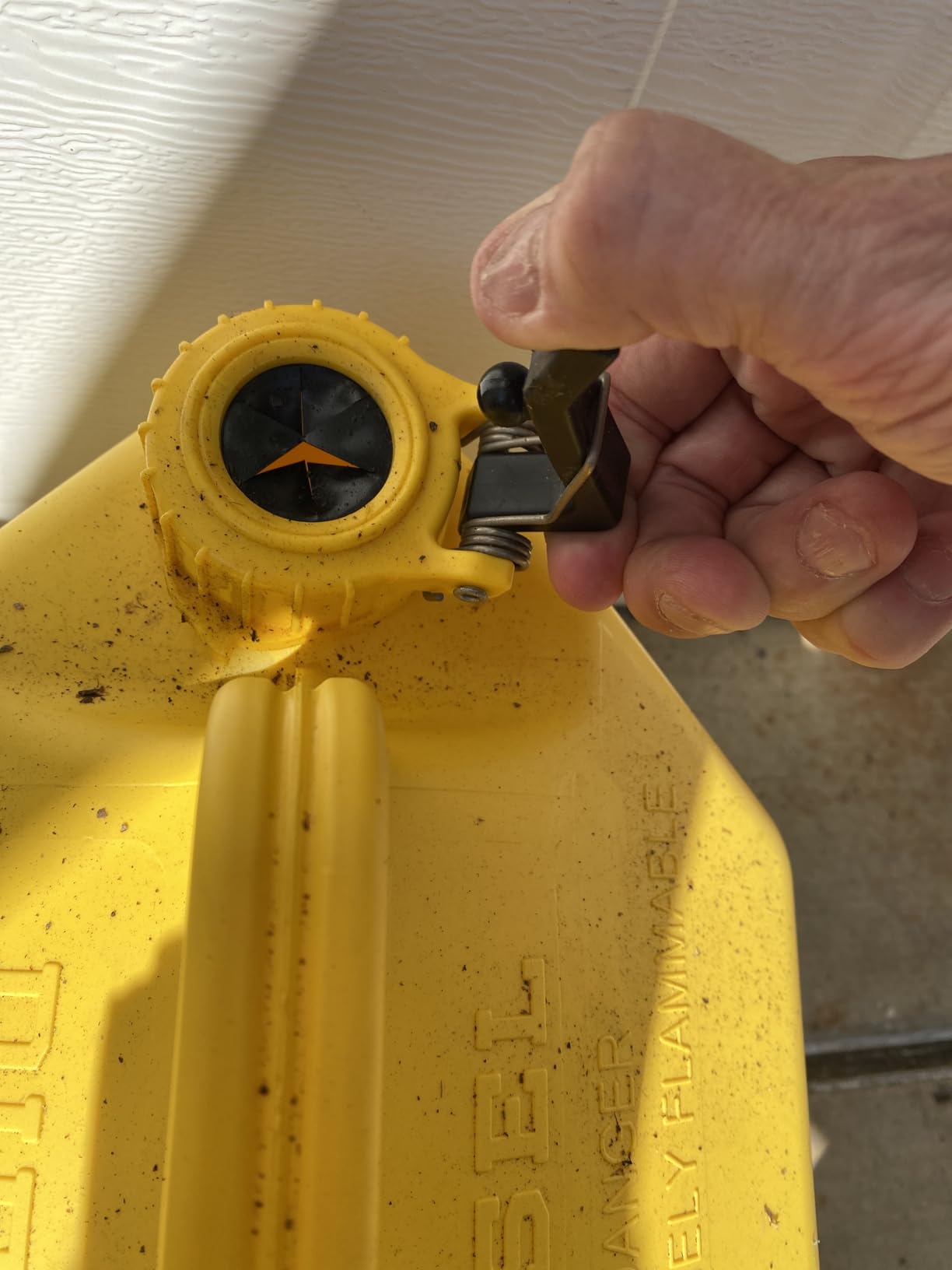
The gripes are about the fill side, not the dispensing. The spring-loaded fill lid can pop off during a fill at the pump, and the fill cap is not designed to come off, so opening it means forcing it. One review also reported a piece of plastic left inside the can on arrival, so check before you fill it.
The ball-socket seal on the fill opening comes loose if you do not watch it, and replacement parts are sold separately, which is convenient given the seal is a wear item. It also costs more than a standard plastic safety can.

Who this tank suits
Homeowners, campers and anyone who refills small equipment regularly and has been fighting with rigid-spout cans for years. The weight difference alone changes how usable a 5-gallon container is.
Who should look elsewhere
Commercial and shop environments that need FM, UL or OSHA documentation should choose a certified steel can. For marine use, confirm the approval markings fit the environment before you rely on it.
Fuel Storage Tank Buying Guide – Capacity, Material, Pumps and Rules
Sizing is arithmetic before it is preference. Estimate how much fuel your equipment burns in a week, add a reserve you are willing to store safely, and buy to that number rather than to the biggest tank that fits. Over-sizing creates a fuel-age problem, and diesel does not stay fresh indefinitely even in a good tank.
Material is the next decision, and it comes down to where the tank lives. Polyethylene never rusts and stays light, steel shrugs off dents and heat, and aluminum is light but is usually reserved for specific fittings rather than whole tanks. Our transfer tank roundup compares the steel and polyethylene options head to head.
How fuel leaves the tank matters as much as capacity. A hand pump suits occasional top-ups, a rotary pump gives you siphon recovery, a gravity feed needs elevation to flow fast, and a 12V electric pump moves fuel several times faster for a fixed amount of power. Match the pump to the volume you actually move.
Long-term storage has rules that forums agree on even when the science is quiet. Keep the tank full, because air and humidity drive condensation, treat gasoline with a stabilizer, add a biocide to diesel that will sit unused, and move or circulate the fuel every few months. A resource for the treatment side is our stabilizer testing guide.
Theft deterrence is mostly the cap and the site. A lockable or alarmed cap blocks the easy opening, a pump-mounted design means the fuel is not reachable with a siphon from a distance, and a camera pointed at the tank does more than a padlock on a fence post.
Rules vary by state and county, so treat the following as a checklist to verify rather than a legal answer. Confirm how much fuel you may store, what separation distance applies from buildings and property lines, whether registration is required, and whether your tank carries a UL 142 or UL 2085 FireGuard listing. UL 2085 adds thermal and leak protection beyond the basic listing, and NFPA 30 governs flammable liquid storage practice. Your local fire marshal and zoning office are the authoritative sources, and portable containers are also worth checking for EPA and CARB approval markings before you buy.
Frequently Asked Questions
What is the best container for long-term gasoline storage?
A certified steel safety can built to NFPA 30 is the most dependable answer for gasoline stored beyond a few months. Choose one with a flame arrester and a self-closing cap, fill it as full as practical to limit air and condensation, and add a fuel stabilizer. Rotate the fuel and use it within its rated storage window.
What is the best gas fuel tank?
It depends on volume. For hand-carrying to a mower or generator, a Type II safety can with a flexible hose pours cleanly and spills less. For filling a car or several machines, a 14 to 30 gallon caddy with gravity and hand-pump modes is the practical pick. For equipment that burns diesel daily, an electric-pump transfer tank moves fuel fastest.
How long will gasoline stay good in a storage tank?
Untreated gasoline begins to degrade within weeks, losing octane and starting to form gum. With a stabilizer dosed at fill time and a full tank kept tightly sealed, gasoline stays usable for roughly six to twelve months. Ethanol blends can phase-separate sooner, which is why treated fuel and a rotation schedule matter more than the tank material.
Is it better to store gasoline in metal or plastic?
Metal wins for safety and long-term storage because it does not permeate, resists UV degradation and takes a flame arrester and certified cap more easily. Plastic containers are lighter and will not rust, but they are a better fit for short-duration carry and transfer. Either way, an approved container and a stabilizer matter more than the material alone.
What is the best container to store diesel fuel in?
A steel or polyethylene transfer tank with a lockable cap and a proper vent is the standard answer for diesel. Steel resists dents during transport, polyethylene stays light for larger volumes, and either should have a drain low enough to empty fully. Add a biocide before diesel sits unused to prevent microbial growth and diesel bug.
What are the OSHA requirements for aboveground fuel tanks?
OSHA 1910.106 sets baseline requirements for flammable liquid storage, and tanks should carry a UL 142 or UL 2085 FireGuard listing. NFPA 30 covers practice details, and state fire codes add siting rules such as separation from buildings, containment and registration above certain capacities. Verify your specific setup with your local fire marshal and zoning office before installing.
Final Verdict – Which Fuel Storage Tank Should You Buy?
For most people, the best fuel storage tanks come down to one certified can and one caddy. The Eagle 5-gallon Type I earns our editor’s choice because it carries the widest set of approvals and a 4.7 rating across more than 8,000 reviews, and it is the piece of equipment you will reach for most often.
Match the rest to the job. Certified steel Type II cans pour cleanly into tight openings, wheeled caddies handle lawn and farm volume, and electric-pump transfer tanks are the only sensible answer once you are refilling diesel equipment daily. Check the compliance requirements with your local fire marshal before you install anything permanent, and treat stored fuel on a rotation schedule.