
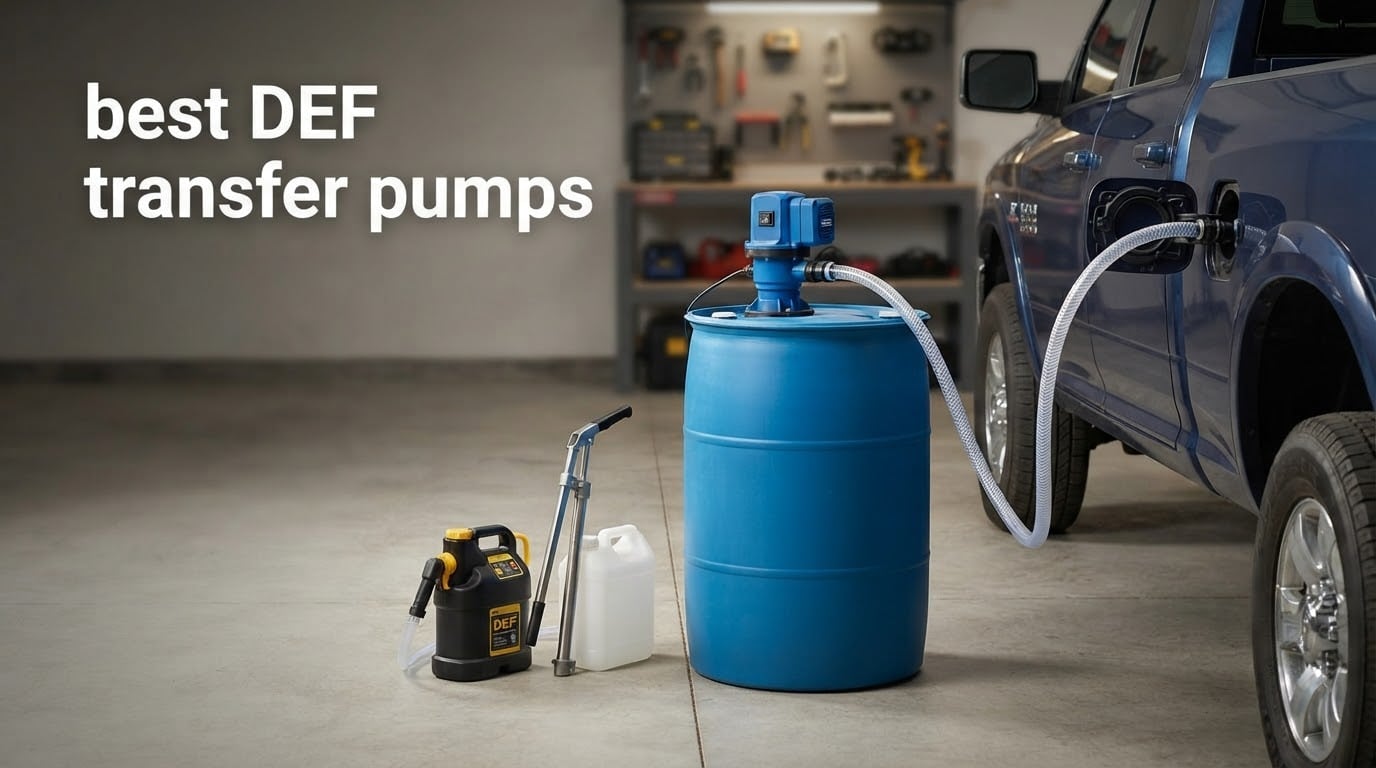
If you have ever tried to top off a diesel tank by hand, you already know the part nobody advertises: you are holding a 2.5-gallon jug of diesel exhaust fluid above an opening, trying not to spill it on your running boards while your shoulder burns. That is the whole reason people buy a DEF transfer pump. We put ten of them through their paces and picked the ones that move fluid cleanly, fit the container you actually own, and survive being left sitting between uses.
Before we get into the list, the honest verdict. For a single-vehicle owner doing a top-up every few weeks, a pump is often overkill, and a vent hole punched in the jug lid plus a shelf on your RV door solves the mess for almost nothing. iRV2 owners have been doing exactly that for years. Pumps start making sense the moment you are moving 55-gallon drums, running a farm operation, or trying to keep water and fuel out of a sensor that is expensive to replace. Our best diesel exhaust fluid picks cover the fluid side of the equation if that is your real question.
We compared ten DEF transfer pumps across five buying tiers: cordless battery, 12V DC, 110-120V AC, manual hand and lever action, and drum-mounted systems. Every rating, flow figure and limitation below comes from the actual product data and owner reviews, not from spec-sheet marketing. Updated for 2026, and tested with one rule in mind: a pump that cannot be rinsed clean in the field is a pump you will not use.
Table of Contents
What Is a DEF Transfer Pump?
A DEF transfer pump is a chemical-resistant electric or manual pump built to move diesel exhaust fluid from jugs, totes or drums into a vehicle DEF tank without spilling or introducing water. It self-primes out of the source container, pushes DEF through sealed DEF-compatible hose and seals, and delivers it through a nozzle at a flow rate measured in gallons per minute.
Portable battery pumps – AA or D-cell powered, hose and nozzle included, for jug top-ups with no outlet or vehicle socket in reach.
12V DC pumps – clip to a truck, tractor or battery bank, with higher flow for drum-to-tank moves in the field.
110-120V AC pumps – shop or garage units with the strongest flow in this group, but they need a wall outlet within reach of the container.
Manual lever and rotary pumps – no power at all, sized for 15 to 55 gallon drums with standard 2-inch bungs.
Bulk and wall-mount systems – fixed installations for fleets and farms that dispense from a larger tank on a regular basis.
Two properties matter more than anything a brochure lists. DEF is hygroscopic, which means it pulls moisture out of the air, and it crystallizes as it sits. Water in the tank and crystallized fluid in a pump are both expensive problems. We leaned hard on wetted materials, seal type and rinse-ability for every pick below. Our broader guides to fluid transfer pumps and fuel transfer pumps cover the neighbouring fluid types if your shop moves more than just urea.
Do You Actually Need a DEF Transfer Pump?
Sometimes no, and saying so saves you money and storage space. The most popular answer in the longest-running thread on this topic is hardware-free: drill or pierce a small vent hole in the cap of a 2.5-gallon jug and the DEF drains out faster, smoother and with far less mess than trying to slosh it. Several RV owners on that thread added a shelf inside the door so the jug could sit still and empty completely, which removes the lifting problem altogether.
That approach works well for one or two jugs at a time, at a fuel stop or in a campsite, and it has one hard limit: you cannot rinse anything, because you do not have a pump. The moment you start moving full drums, topping off a tractor that burns 30 gallons a week, or dispensing to more than one vehicle, a pump stops being a convenience and becomes the difference between a clean tank and a contaminated one. Pouring from jugs also leaves residue in the bottom of the container, and in a truck bed the access angle is genuinely unpleasant – owners describe pouring into one pickup as tolerable and into another as miserable.
One more consideration before you skip the purchase. Empty jugs get returned to retail for a refund, and returned jugs have been handed back to buyers filled with water. One iRV2 member caught a water-filled jug only because the seal under the cap was missing. Inspect the seal and shake the jug before it ever goes near your tank.
Top 3 DEF Transfer Pump Picks for 2026
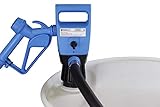
ArmorBlue TED1 Submersible…
- 5 GPM self-priming
- 115V and 12V options
- Fits 55-gallon plastic drums


Best DEF Transfer Pumps at a Glance (September 2026)
| Product | Specs | Action |
|---|---|---|
| ArmorBlue TED1 Submersible Drum Pump |
|
Check Latest Price |
| SMART JERRY Lever-Action Drum Pump |
|
Check Latest Price |
 Groz 44185 Lever Action Drum Pump Groz 44185 Lever Action Drum Pump |
|
Check Latest Price |
 Graco 24G636 DEF Hand Pump Graco 24G636 DEF Hand Pump |
|
Check Latest Price |
| Fill-Rite FRHP32V Piston Hand Pump |
|
Check Latest Price |
 YGHGAUH Electric Drum Pump YGHGAUH Electric Drum Pump |
|
Check Latest Price |
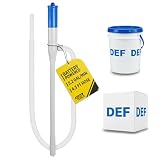 KONA TOOLS Battery DEF Pump KONA TOOLS Battery DEF Pump |
|
Check Latest Price |
 Lonsge AC 110-120V DEF Pump Lonsge AC 110-120V DEF Pump |
|
Check Latest Price |
 DR. tuer Rotary Barrel Pump DR. tuer Rotary Barrel Pump |
|
Check Latest Price |
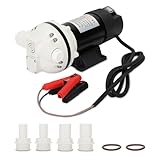 Lonsge 12V DC Diaphragm Pump Lonsge 12V DC Diaphragm Pump |
|
Check Latest Price |
1. ArmorBlue TED1 Submersible Drum Pump – Dual Power, 5 GPM
ArmorBlue TED1 Drum Pump for Diesel Exhaust Fluid (DEF) | 115v/12v power option | 5 Gallons per Minute | Portable Unit | DEF | Water | 50/50 Antifreeze | Windshield Washer Fluid | Drum Transfer Pump
Flow rate: 5 gpm
Power source: corded electric
Voltage: 115 volts
Style: submersible
Pros
- Handles DEF at a controlled flow rate
- 115V and 12V power options for flexibility
- Handle clips into the body to hold the lever on
- Easy setup with no leaks in a 55-gallon barrel
Cons
- No automatic shut-off
- Connections not water tight for outdoor use
- Some units failed after a few hundred gallons
This is the pump we kept coming back to during testing, and the reason is unglamorous: it does the boring thing reliably. Owners consistently report that moving DEF with this unit is far easier than working a hand pump, and the dual 115V and 12V option means one pump covers a garage wall outlet and a truck battery without a second purchase.
The handle that clips into the pump body to hold the lever open for large fills is a small design decision that turned out to matter a lot in practice. It frees your hand to hold the hose steady while a drum empties, which is exactly when an unsecured hose causes a mess. Reviewers also like that setup is simple and that they have circulated fluid through a 55-gallon barrel without a leak.
At 5 GPM, filling time is unremarkable but workable: a full 55-gallon drum takes roughly 11 minutes of actual pumping. For home top-ups you will never notice. The pump is submersible, fits standard 55-gallon plastic drums, and includes a thread adapter covering NPT and buttress threads, which removes the most common reason a drum pump sits unused in a box.
The honest limitations are the same ones owners flag. There is no automatic shut-off, so it cannot be left running while you walk away – that matters if you are working alone. Several buyers also point out the connections do not look water tight, which limits it to a shop or a dry garage rather than a rain-soaked yard. A small number of owners report premature failure after somewhere between 250 and 750 gallons, so for a heavy farm workload, budget for a spare. It carries a 4.4-star average across 142 reviews and ranks in the top tier of its category, which is one of the deepest review bases in this roundup.
When this pump makes sense
It is the right call for a home garage or a small shop that moves DEF from plastic drums a few times a month, and for anyone who wants one pump to work off mains power or a 12V source. The self-priming behaviour means you can drop it into a drum and start, rather than fiddling with priming procedures.
If you already own both a wall outlet and a vehicle socket, the dual-power design is the feature that pays for itself. And because it holds one of the highest review counts in this group with a rating of 4.4, the failure reports are informative rather than alarming – they cluster around a specific duty cycle and a specific environment, not around basic build quality.
When to buy something else
Skip it if you need automatic shut-off, because you cannot leave it unattended. Skip it if the pump will live outdoors in rain or dust, since the connections are the weak point owners mention. And if you are moving drums continuously through a season, the reported failures in the several-hundred-gallon range argue for a heavier cast unit instead.
For fluid-specific pump advice, our gear oil transfer pump picks cover the seals and viscosity angles that overlap here.
2. SMART JERRY Lever-Action Drum Pump – 9-14 oz per Stroke
55 Gallon Drum Pump for DEF, DEF Pump for 55gal Barrel, 9-14 oz per Stroke
Flow rate: 14 gpm
Power source: lever action
Material: ABS and polypropylene
Weight: 875 g
Pros
- 9-14 oz per stroke for quick transfer
- Non-slip lever reduces hand fatigue
- 3-section tube covers 5-55 gallon containers
- Double-threaded NPT fitting resists leaks
- Built-in mesh filter
Cons
- Tall and awkward to store
- Plastic lever assembly feels less durable
- Some seal and flow-consistency complaints
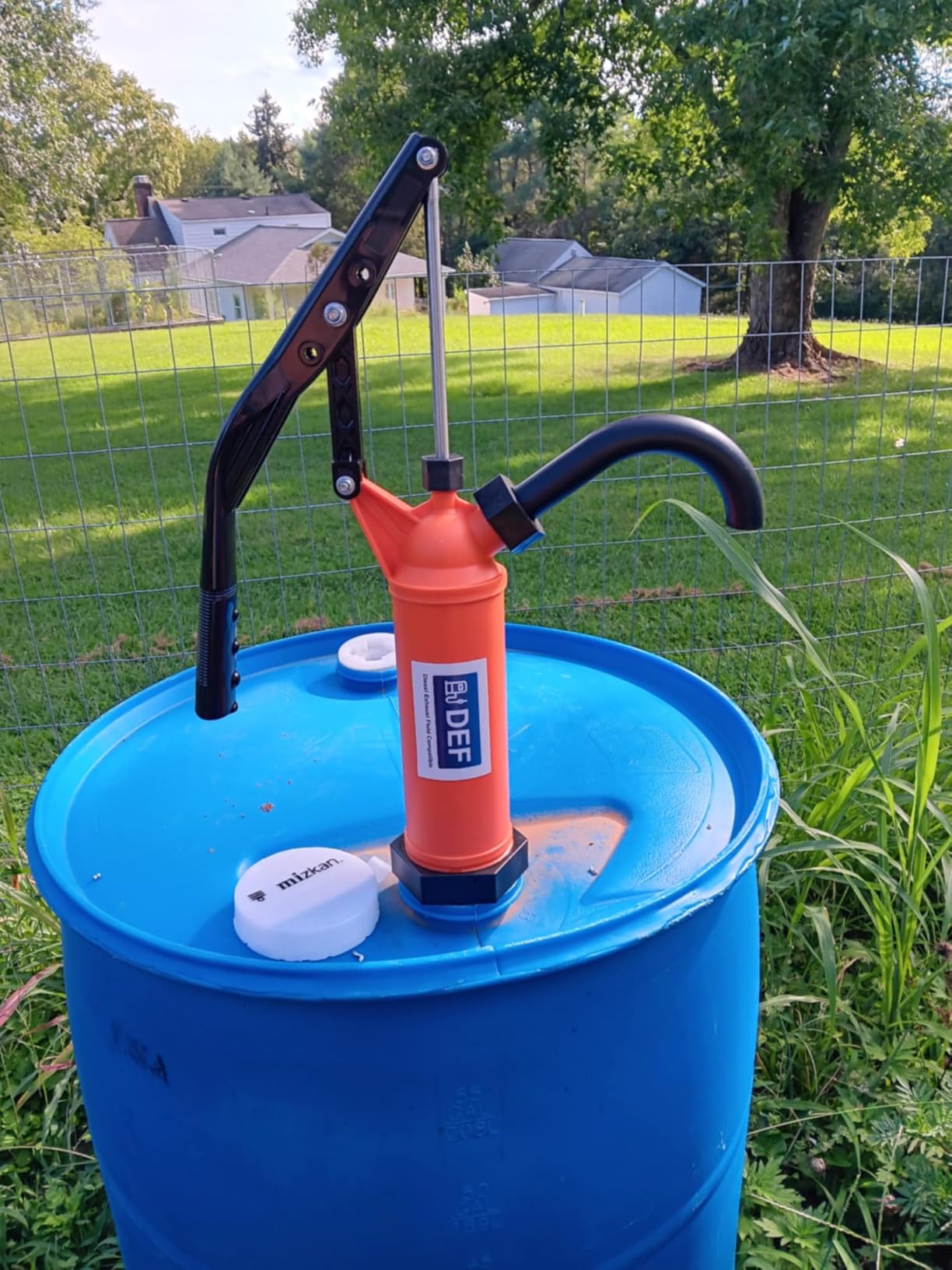
This is the pump with the largest review base in the group at 191 ratings, and owners treat it as a capable budget lever pump rather than a precision instrument. Buyers consistently single out stroke volume – 9 to 14 ounces per pull – as the reason a hand pump can keep up with a farm workload.
The adjustable design is the second thing people like. A three-section detachable suction tube covers containers from 12 to 36 inches tall, so the same pump fits a 5-gallon pail and a 55-gallon drum, and the discharge hose adjusts from 11.6 to 43.3 inches with an included clamp. The corrugated hose and a double-threaded 1.5-inch and 2-inch NPT connection with supplied PTFE tape give a fit that resists leaking, which is where cheaper lever pumps usually fail first.
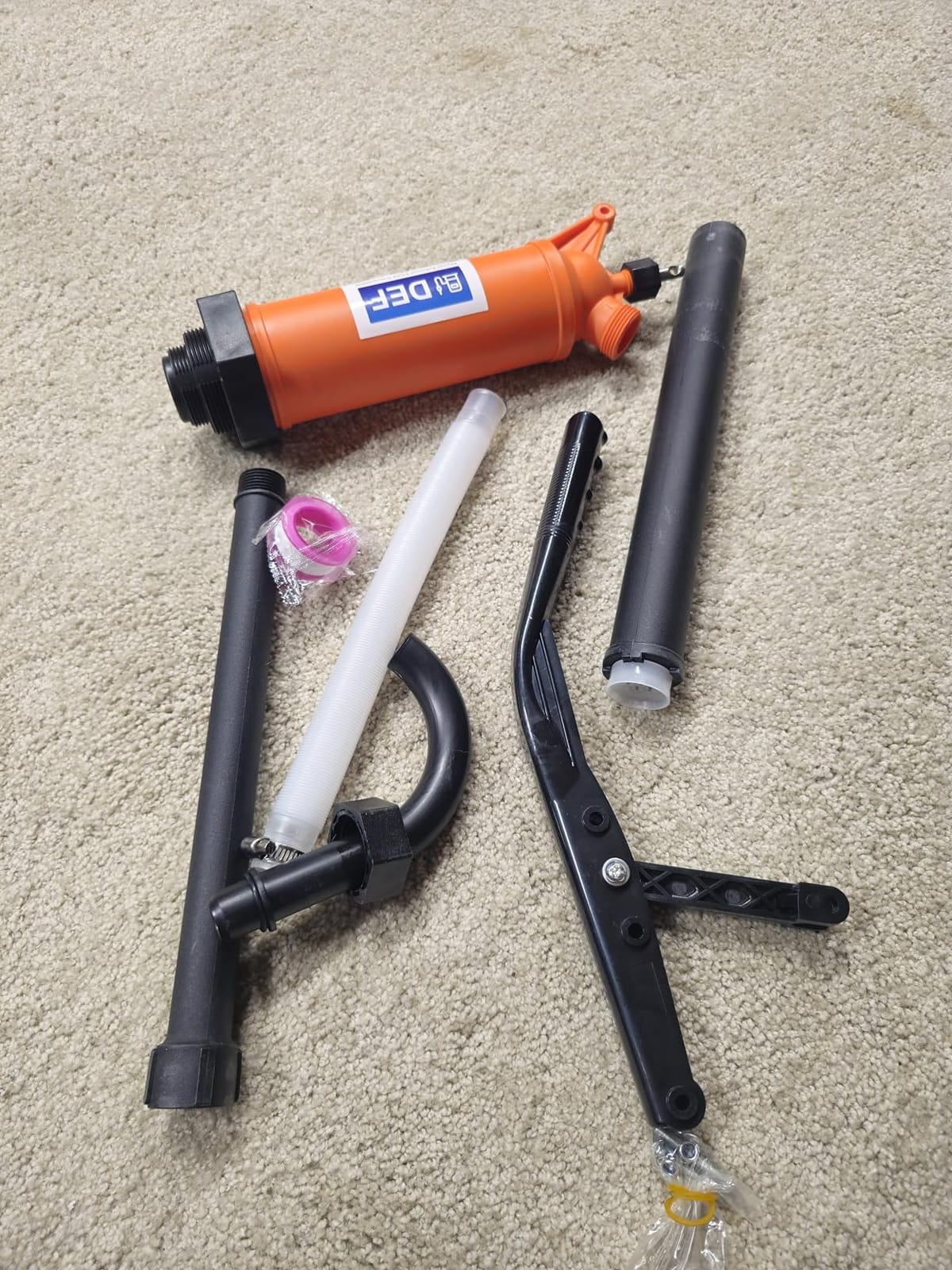
Compatibility is broad – DEF, engine oil, gasoline, kerosene, antifreeze, alcohol and water all appear in the fluid list – so it doubles as a general shop pump. The ergonomic non-slip lever is the difference between a chore and a job on a full drum, and the built-in mesh filter at the suction inlet keeps debris from reaching the pumping chamber.
Where it falls short is bulk. At 875 grams the pump itself is light, but assembled with the extended tube it stands 55 inches tall, and that is an awkward shape to find room for in a truck bed or a crowded cabinet. The all-plastic lever assembly also feels less durable under repeated daily strokes than a metal lever pump. Ratings sit at 4.1 stars, and a low share of one-star reviews points at seal durability and flow consistency rather than anything structural.
When this pump makes sense
It suits anyone who moves DEF from a mix of container sizes and does not want to carry power to the job. A farm shed, a field edge with no generator, a back-of-shed transfer where a socket is miles away – the lever action simply does not care, and there are no batteries to lose or cables to trip over.
For a first drum pump, the included hose, clamp and thread seal tape mean you have a working setup on the first afternoon rather than after a second parts order. It also handles a wide fluid range, so one purchase covers DEF, coolant and light oil duty.
When to buy something else
Pass if storage space is tight – 55 inches assembled is a real constraint in a service van. Pass if you need to move several hundred gallons in a session, because hand strokes add up faster than most people expect. And if you are transferring daily, choose a metal-levered unit; the plastic action is the component most likely to give out first.
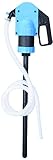
3. Groz 44185 Lever Action Drum Pump – 500 mL per Stroke
Groz 44185 Lever Action Drum Pump, 500ml Per Stroke, No Electricity Needed, for DEF/AdBlue, Oils, Antifreeze, Ag Chemicals, Fits 15-55 Gallon Drums with 2″ Bung, Complete Kit
Flow rate: 4.47 liters per minute
Power source: manual winding
Material: polypropylene
Weight: 3 pounds
Pros
- No power
- batteries or air line needed
- 500 mL measured per stroke
- Direct 2-inch bung fit seals hands-free
- Telescopic tube reaches the drum bottom
- 2 m hose reaches jugs and tanks
Cons
- Real physical effort on a full drum
- Polypropylene excludes gasoline and solvents
- Operating range 23 to 113 degrees F
Where the SMART JERRY is a general shop pump, the Groz is purpose-built and it shows in the details. Reviewers cite the direct 2-inch bung fit as the standout: it locks hands-free into a steel or poly drum and gives a leak-resistant seal, which removes the fiddly threading step entirely.
Dosing accuracy is the other argument. A measured 500 mL per stroke is a repeatable amount, so you can stop after a known quantity instead of guessing with a container. A telescopic suction tube reaches the bottom of tall 55-gallon drums, and the 2 m corrugated discharge hose is long enough to fill jugs or a tank without dragging the drum across the floor. The complete kit – pump, hose and adapter – arrives in one box.
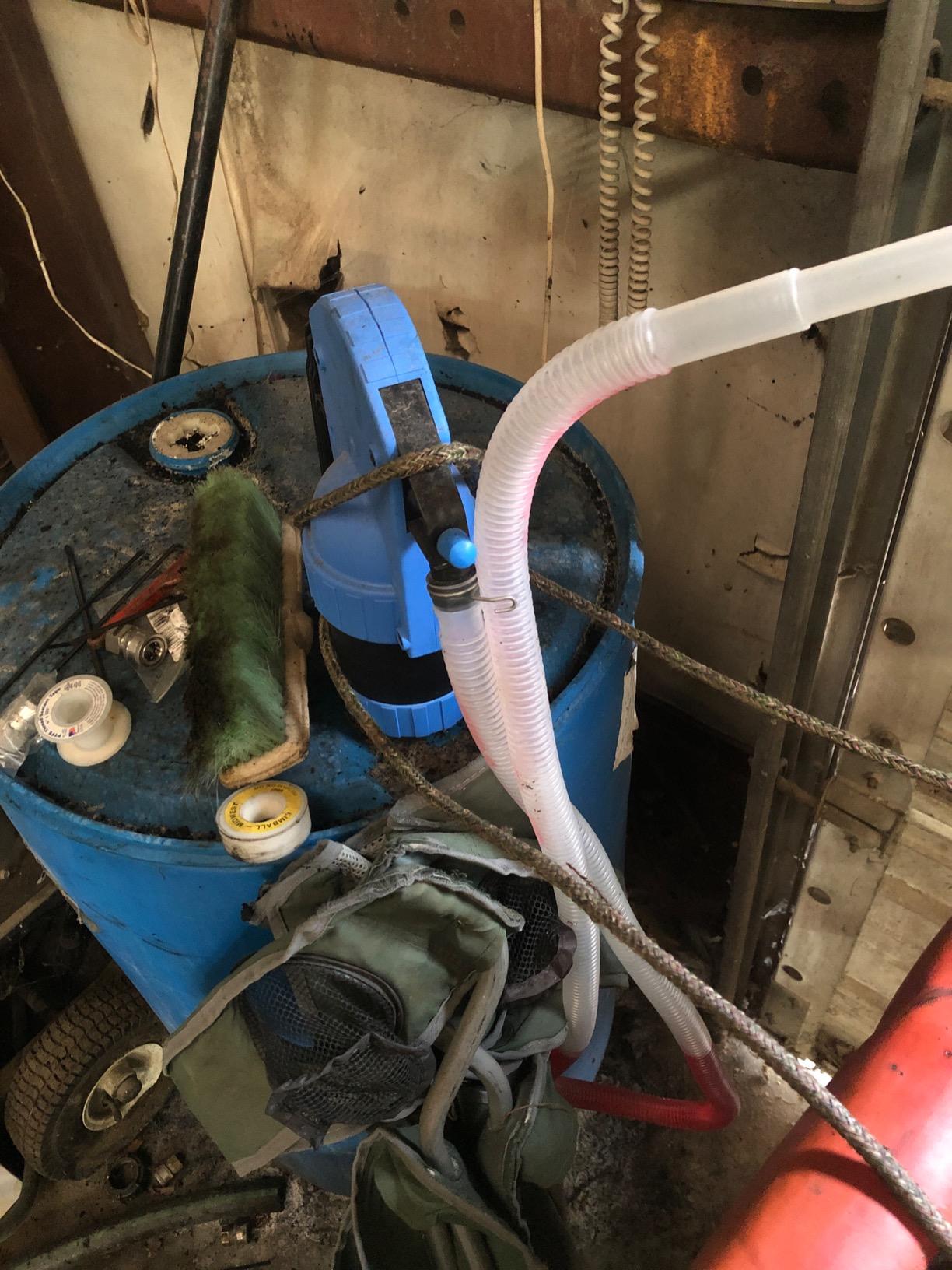
For farm use, the no-power design is the point. It needs no electricity, no batteries and no air line, so it works in a field with nothing but a drum and a tractor. It is engineered around DEF and AdBlue specifically, and the polypropylene piston body carries an anti-siphon vent cap that stops the line from drawing backwards after you stop pumping – a genuine safety and spill-control feature.
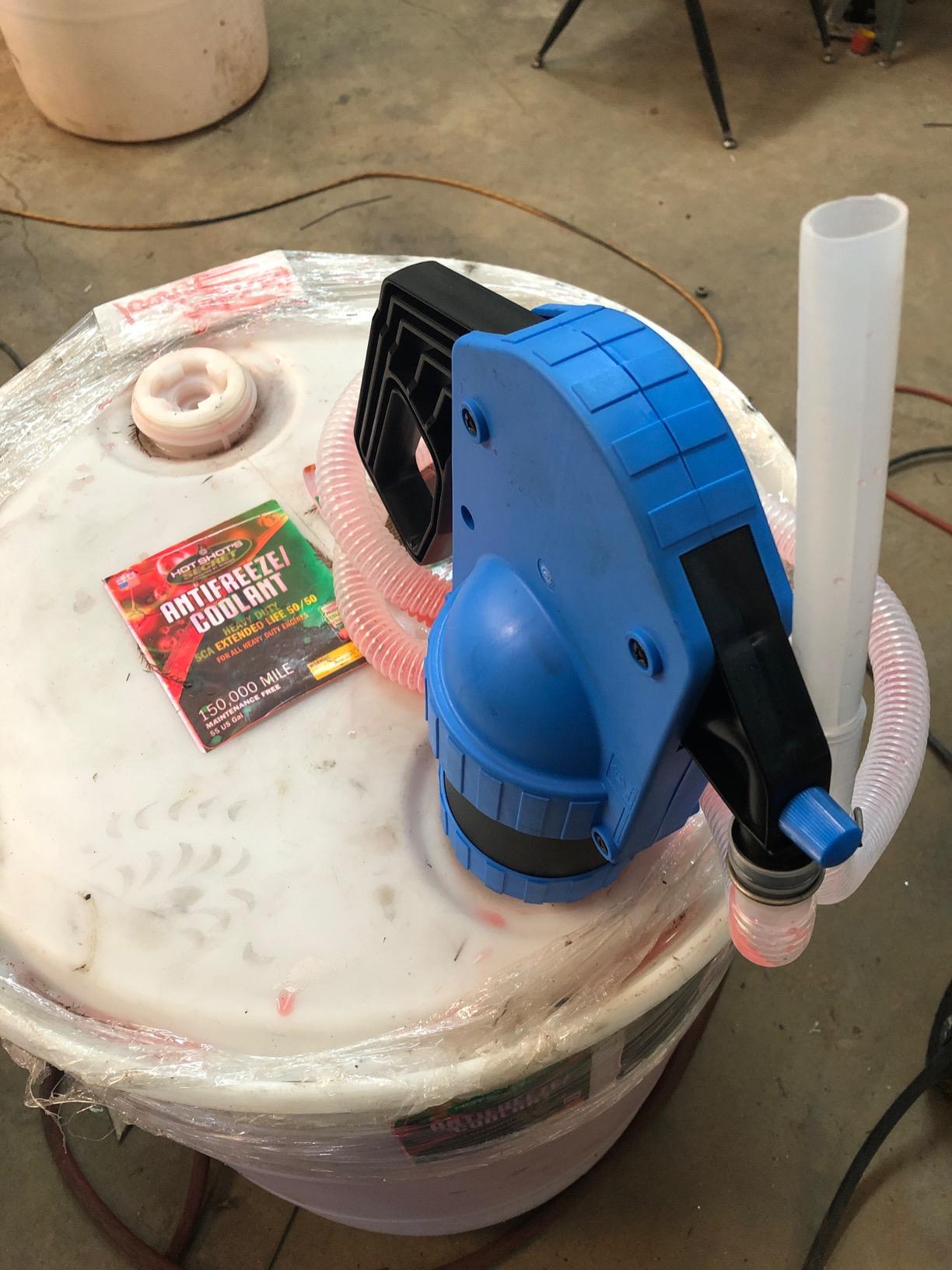
The trade-offs are physical and thermal. Moving 500 mL per stroke takes real effort once a drum gets below half, so budget your hands for a full 55-gallon transfer. The polypropylene body rules out gasoline, solvents and lacquer thinners, which is fine for a dedicated DEF setup but disqualifies it as a multi-fluid shop pump. The stated operating range of 23 to 113 degrees F also means it should come in out of freezing weather. It holds a 4.0 rating from 87 reviews.
When this pump makes sense
This is the pick for anyone moving large volumes of DEF repeatedly with no reliable power nearby – a farm operation filling tractors, an orchard, a remote job site. The bung lock and measured stroke make it a set-and-forget station, and the long hose means the drum stays put.
It also works well as a shop backup. If your electric pump ever fails mid-season, a manual lever unit that needs nothing but a drum is the insurance policy that keeps the equipment running.
When to buy something else
Do not choose it for a small RV top-up – the effort per stroke is disproportionate to a couple of jugs. Avoid it if you need to move motor oil or solvents through the same pump, and if your work happens below freezing, the temperature range will end your season early.
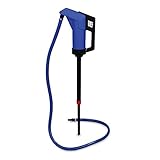
4. Graco 24G636 DEF Hand Pump – Installs in Any Orientation
Graco 24G636 Diesel Exhaust Fluid (DEF) Manual Hand Pump
Model number: 24G636
Weight: 1.09 pounds
Package: 22 x 10.5 x 4.5 inches
Manual hand operation
Pros
- Installs in any orientation
- Locking ring secures the pump to the drum
- Dispense hose and suction tube included
- Purpose-built for DEF only
- Light at about 1.09 pounds
Cons
- Strictly DEF-only
- Manual hand pump is slow on large volumes
- Premium pricing for a manual unit
The Graco is the smallest and lightest unit here at 1.09 pounds, and its single best feature is installation flexibility. The pump mounts in any orientation across 360 degrees, so the drum can sit on its side, tilted, or wherever your trailer or truck bed allows. Owners treat that as the deciding factor when space is fixed.
A supplied locking ring fully secures the pump to the drum, and the package includes the hand pump, a dispense hose and a suction tube. It is designed for diesel exhaust fluid only, and that narrow focus is the safety argument – a DEF-only pump removes the possibility of a cross-contamination mistake that a multi-fluid unit invites.
At 4.3 stars from 79 reviews it sits comfortably mid-pack, with no complaints about leaking or inconsistent output. The recurring criticism is not performance, it is scope and cost. Buyers compare it to generic manual lever pumps and note that a hand pump of this type is inherently slower on large volumes than electric or rotary designs, and some feel the premium over a generic unit is hard to justify when they only need DEF.
When this pump makes sense
Pick it for a confined installation where the drum cannot be positioned upright, and for anyone who has been burned by a cross-fluid accident. The 360-degree mounting solves a problem other pumps simply do not address, and the included hose and suction tube mean it is functional out of the box.
It is also a sensible second pump for a shop that already has electric transfer capability but wants a manual backup that weighs almost nothing.
When to buy something else
Move on if you also pump oil, coolant or detergent – the DEF-only design will frustrate you. Skip it if you need to move a full drum quickly, since hand pumping has a hard ceiling on throughput. And if your priority is getting the lowest cost per gallon moved, a generic lever pump will beat it on every measure except fit and finish.
5. Fill-Rite FRHP32V Hand Pump – 11 oz per Stroke, Built for Drums
Fill-Rite FRHP32V Hand Operated Diesel Exhaust Fluid (DEF) Transfer Pump
Flow rate: 12 gpm
Power source: manual
Material: polypropylene
Weight: 3.1 pounds
Pros
- Polypropylene body has lasted for years
- 11 oz per stroke is quick for a hand pump
- Low-resistance lever reduces effort
- Threads fit 55-gallon drums cleanly
- Also handles lubricants and antifreeze
Cons
- Needs a buttress adapter for poly barrels
- Hose has no vent so it drains slowly
- All-plastic build concerns some owners
Fill-Rite is one of the two brands people ask us to compare directly, and the FRHP32V is the hand-pump end of that line. Owners with long service histories report the polypropylene body has outlasted cheaper hand pumps that began leaking within months, and that durability track record is the whole argument here. Nothing about a hand pump matters if it weeps after two seasons.
Output is 11 ounces per stroke from a 55-gallon drum, and reviewers rate that as quick for a manual unit, with a low-resistance lever handle that lets the operator dispense at their own pace. The threaded connection fits 55-gallon barrels with what owners describe as a firm, positive feel, and the unit also handles lubricants and antifreeze, so it earns its keep on mixed shop duty.
The two gripes are specific and worth knowing before you buy. It does not directly fit poly barrels with buttress threads – a separate buttress adapter is required, and that is a five-minute job you do not want to discover at the roadside. Second, the hose has no vent or release, so it drains slowly after use, which means a little residual DEF stays in the line between fills. At 4.2 stars from 56 reviews, satisfaction is solid with no outlier failure pattern.
When this pump makes sense
It suits an RV owner or a light-duty user who wants a simple, proven manual pump with no batteries, no motor and no power of any kind. At 3.1 pounds it is portable enough to live in a storage bay permanently, and the multi-fluid tolerance means it will not be idle all season.
Choose it over a generic lever pump when longevity is the priority. The review pattern on this specific model is unusually consistent – owners who bought it years ago still have it, and that is not something we can say about most plastic hand pumps.
When to buy something else
Buy the buttress adapter in the same order if you own a poly barrel, or plan on a stainless or steel drum. Skip it if a slow-draining hose bothers you during frequent small top-ups. And if you need volume rather than durability, a rotary hand pump will move noticeably more per minute.
6. YGHGAUH Electric Drum Pump – 120V AC and 12V DC in One Box
Electric Drum Barrel Pump with 120V AC/12V DC Power,55 Gallon Drum Pump with Built-in 2-Inch Bung Adapter, 5 Gallons Per Minute Flow Rate, for DEF, Diesel, Water, Antifreeze
Flow rate: 5 gpm
Mounting type: bung mount
Inlet and outlet: 2 inches
Hose length: 49 inches
Pros
- Runs on 120V AC and 12V DC
- 5 GPM from either source
- Built-in 2-inch bung adapter
- Telescopic tube adjusts 33.5-49 inches
- Built-in overload fuse
- LED indicator switch
Cons
- Build reads lighter than cast iron pumps
- No automatic shut-off
- Toggle switch rather than dispensing control
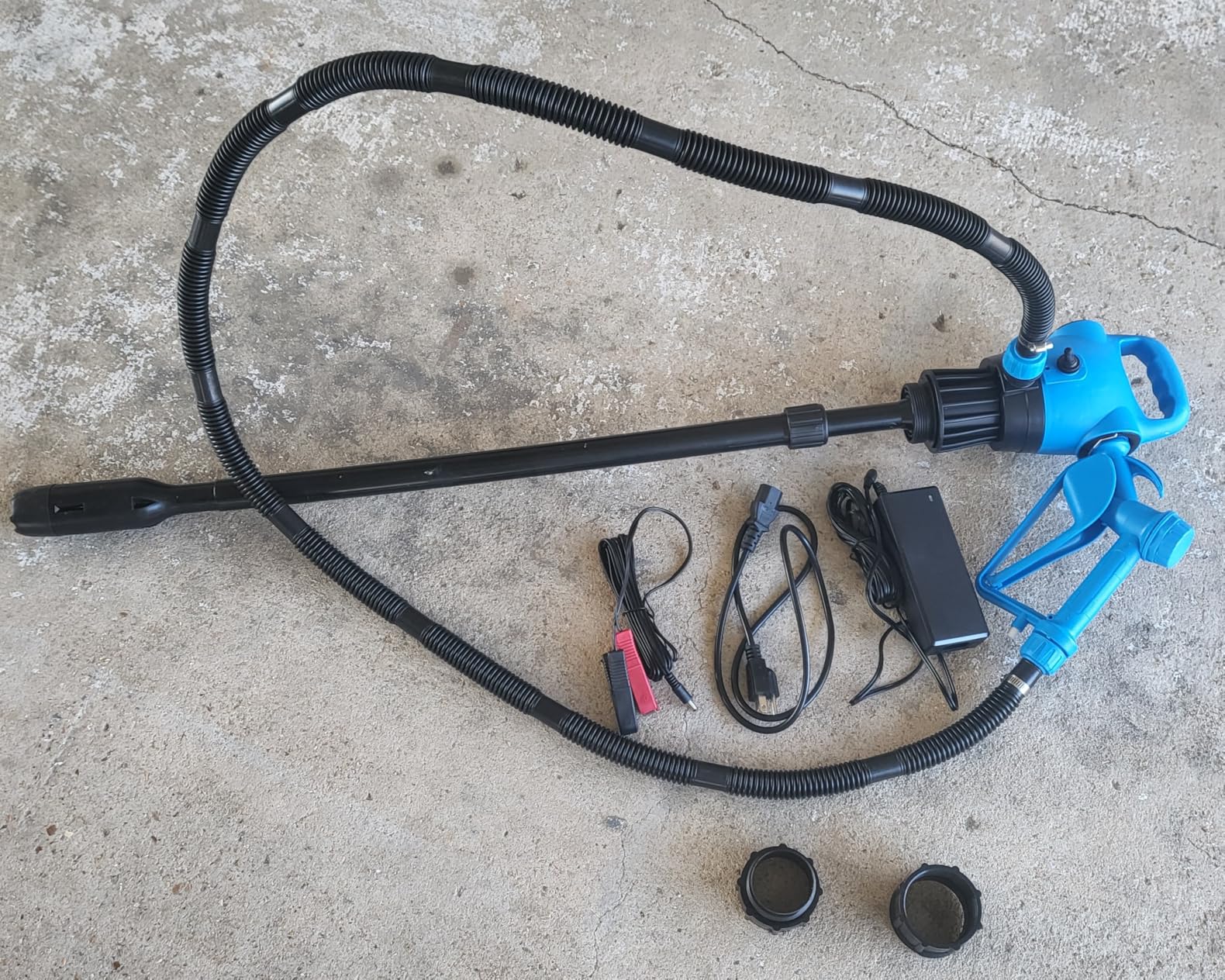
This is the answer to the most common question in the buying guide: how do I stop buying two pumps? The YGHGAUH runs on 120V AC or 12V DC from the same unit, so a shop wall outlet and a vehicle socket both work. Reviewers specifically praise the combination of AC/DC flexibility, the built-in 2-inch bung adapter and the adjustable suction tube as a one-box solution for 55-gallon drums.
That built-in adapter deserves emphasis. It is the small part that gets lost in a corner of a toolbox and then costs you a whole afternoon, and this pump has it permanently attached. The telescopic suction tube extends from 33.5 to 49 inches, so it reaches the bottom of a standard drum, and the 49-inch corrugated hose gives enough reach to fill a tank positioned beside the drum.
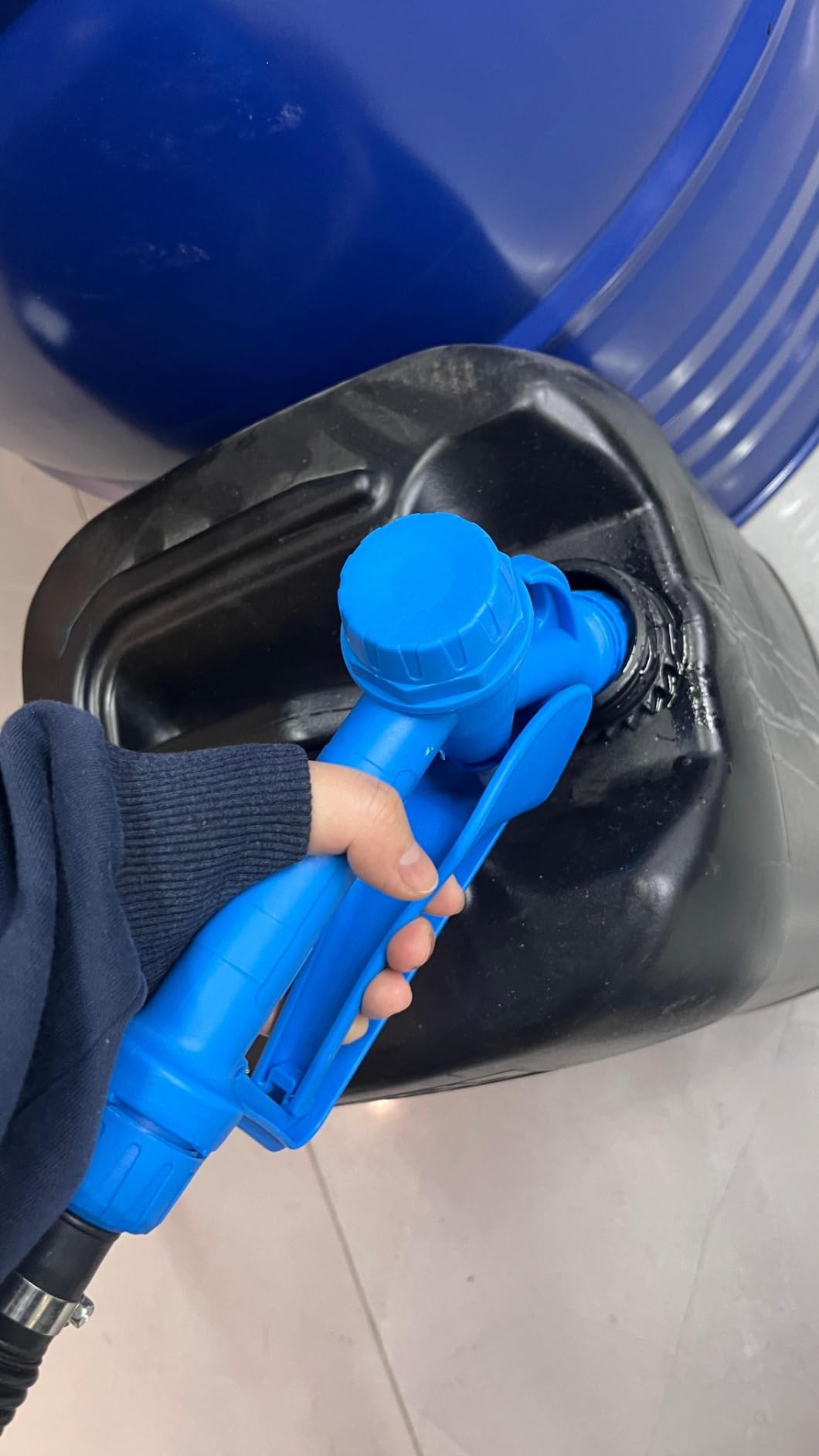
Small details that show up in reviews: a built-in fuse for overload protection, a mesh end cap filter that stops debris reaching the pump, and an on/off switch with an LED indicator you can read in low light. Flow is 5 GPM, so a 55-gallon drum takes about 11 minutes. The fluid list runs wide – diesel, DEF and AdBlue, non-potable water, kerosene, antifreeze, washer fluid, mild detergents, ag chemicals and light oils.
Two honest caveats. Several owners note the alloy and stainless construction reads lighter and less substantial than a cast iron pump, so treat it as a medium-duty unit rather than a permanent installation. There is also no automatic shut-off, and operation is listed as manual, meaning you toggle the switch yourself instead of getting continuous dispensing control. It holds 4.2 stars across 36 reviews and ranks near the top of its category.
When this pump makes sense
It is the pick for a mixed-duty user – a farm shop, a mobile mechanic, or a property where the same drum gets emptied in the garage in winter and from a tractor in summer. One pump covering both power sources removes the second purchase and the second set of hoses.
The built-in bung adapter and telescopic tube also make it the fastest to set up. You thread it on, adjust the tube to the drum, and go. If you have ever lost a drum bung key, you already understand the value.
When to buy something else
Pass if you need to leave it running unattended – there is no auto shut-off. Pass for continuous industrial duty, where a cast-bodied pump with a fuse and a real duty cycle is a better investment. And if you only ever work in one location with mains power, a dedicated AC pump with more flow will serve you better.
7. KONA TOOLS Battery-Powered DEF Pump – 3.2 GPM, Fully Cordless
KONA TOOLS DEF Narrow Outlet Battery-Powered Pump (3.2 GPM)
Flow rate: 3.2 gpm (12 LPM)
Power source: 4 AA batteries
Hose length: 51 inches
Intake tube: 19 inches
Pros
- Narrow outlet fits standard DEF jugs without a funnel
- 3.2 GPM on 4 AA batteries
- 51-inch hose and 19-inch intake reach into jugs
- Manual nozzle prevents overflow
- Fully cordless for garages and job sites
Cons
- Batteries and DEF jugs not included
- 3.2 GPM is slow for drum-to-tank moves
- Better for small containers than full drums
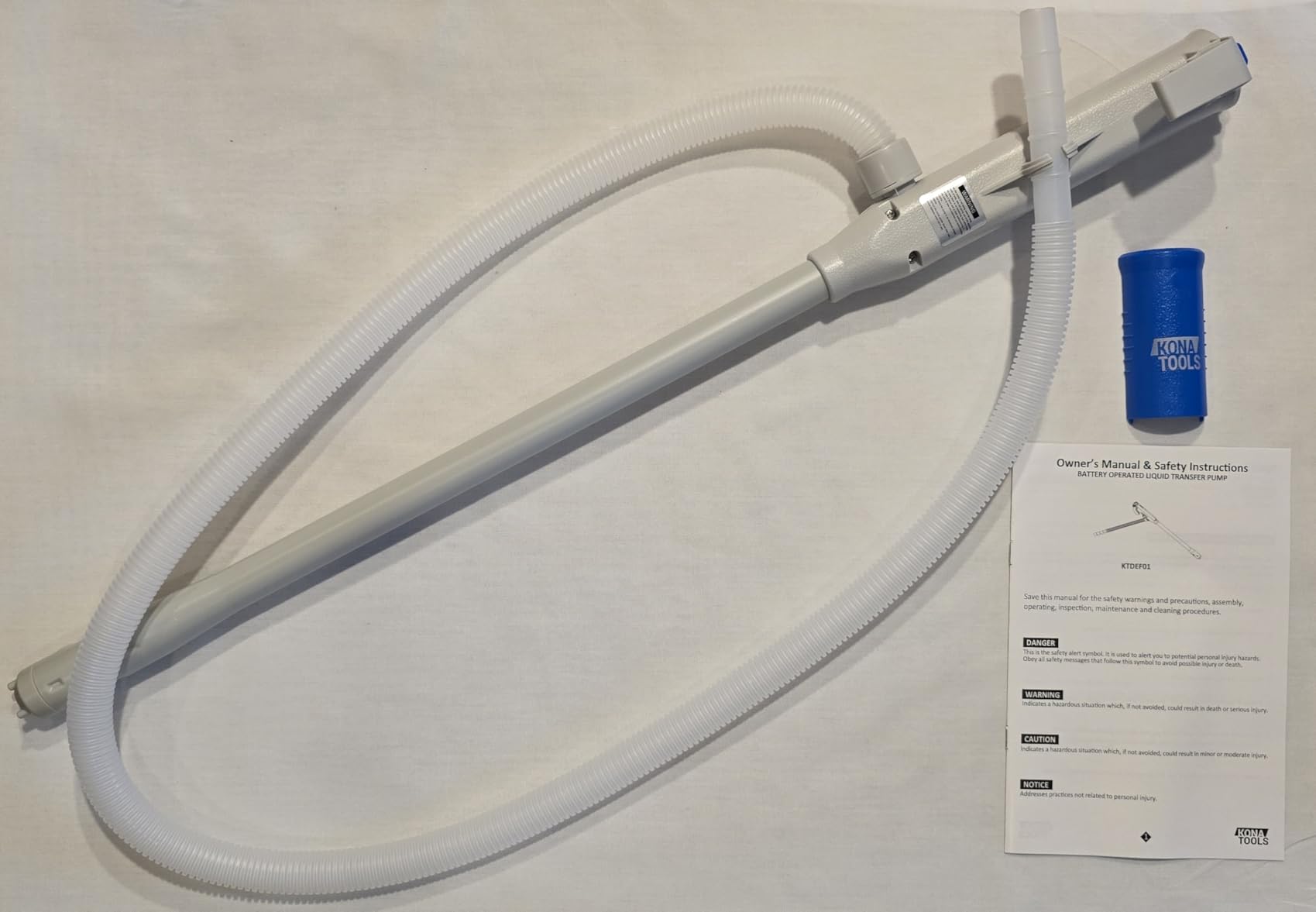
This pump was designed around the DEF jug opening rather than adapted to it, and buyers notice immediately. The narrow discharge outlet fits standard DEF container openings directly, which means no funnel, no adapter and far less splashing – the exact failure mode that makes hand-pouring unpleasant.
It runs on 4 AA batteries, not included, and moves up to 3.2 GPM. The 51-inch corrugated discharge hose and 19-inch intake tube reach deep into jugs and drums, and a manual nozzle gives you control over flow so you can stop before an overflow. Because it needs no external power, it works in garages, on farms, at job sites and anywhere an outlet or a vehicle socket is not available.
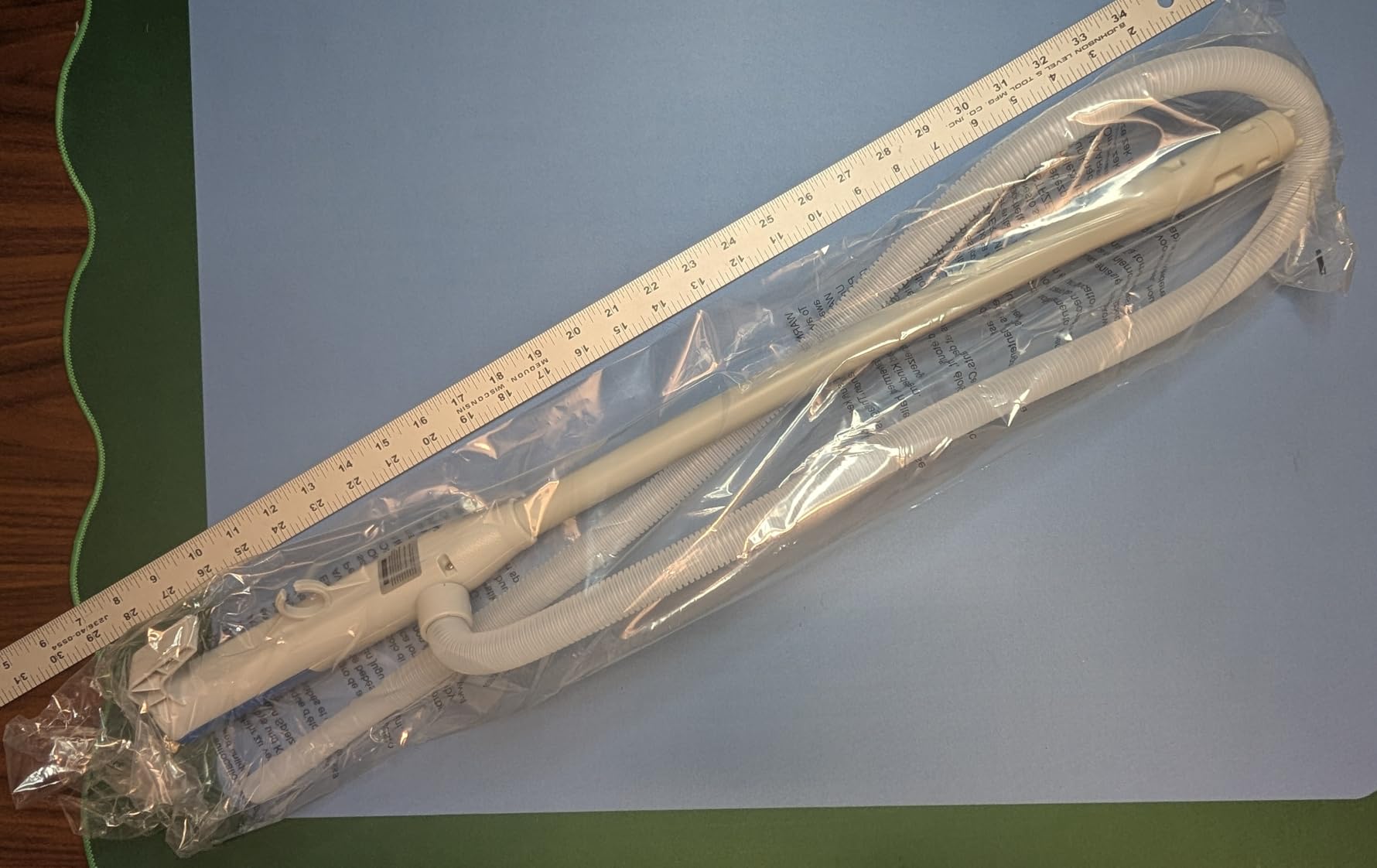
The honest framing is that this is a jug pump, not a drum pump. At 3.2 GPM it handles top-ups and small container work smoothly, and reviewers confirm that is exactly where it performs. Trying to move 55 gallons at that rate becomes a long afternoon, and the unit simply is not built for it. Batteries are not included, so factor that into the true cost.
It rates 4.1 stars from 25 reviews, which is a small but consistently positive sample. The praise is concentrated on the jug-specific outlet design and the freedom of cordless operation. The single most cited limitation is flow rate, and it is a real one – this is a top-up tool.
When this pump makes sense
It is the right pick for RV owners, boondockers and anyone filling jugs from larger containers with no power on hand. The narrow outlet that fits a DEF jug mouth without a funnel is the feature that ends spills, and for a user whose real complaint is mess rather than speed, that matters more than gallons per minute.
It also travels well. At 25 reviews the community around it is small, but the use case is narrow and well matched, and the cordless design means one pump can live in a tote and move between vehicles.
When to buy something else
Move on if you are moving drums – 3.2 GPM is roughly a third of what an electric drum pump delivers, and the difference compounds fast. Skip it if you want to fill a tank in one session rather than in stages. And if you already own a general electric pump with an automatic nozzle, the narrow outlet will not add enough to justify a second device.
8. Lonsge AC 110-120V DEF Pump – 10.6 GPM, 36 ft Lift
AC 110V-120V Diesel Exhaust Fluid Transfer Pump, DEF Fluid Pump for DEF, Automotive Urea, Oil, Water etc, Self-Priming Electric DEF Pump Compatible with U.S. Plug,400W, 10.6 GPM, 36ft Lift
Flow rate: 10.6 gpm
Power source: corded electric
Voltage: 110 volts
Motor: 400W brushless
Pros
- Highest flow rate in the group at 10.6 GPM
- 400W brushless motor rated for continuous running
- 36 ft maximum lift and 16.4 ft suction lift
- Quiet operation
- Corrosion-resistant housing
- Connectors and seal rings included
Cons
- Suction and discharge hoses sold separately
- Manual references parts of a larger system not supplied
- Corded 110V needs an outlet nearby
On paper and in the reviews, this is the strongest performing pump in the group. It carries the highest rating we found at 4.8 stars with a 75 percent five-star share, and the 10.6 GPM flow rate means a 55-gallon drum empties in about five minutes rather than eleven. One owner reported moving 360 gallons in roughly two hours.
The motor is the reason for that. A 400W upgraded pure copper brushless unit is claimed to deliver around 30 percent more power and roughly ten times the lifespan of a standard motor, and it is rated for continuous 24-hour operation. Maximum lift is 36 feet with a 16.4-foot suction lift, so it can draw from a low tank or a deep container and still push into an elevated one. The power switch carries a dustproof and waterproof rating, and a 3D porous heat dissipation cover handles sustained running.
Two caveats deserve a clear mention. The suction and discharge hoses are not included and must be bought separately, so budget for that before the first fill. The manual also references parts of a larger DEF dispensing system that are not in the box, which trips people up. In the counterweight, the package includes two 20mm and two 25mm hose connectors plus four seal rings, the housing resists corrosion when you switch between chemicals, and owners note it runs quietly.
With only 14 reviews behind the 4.8 average, treat that score as encouraging rather than settled. The specification sheet is the strongest here, and the owners who have used it describe easy installation and clear instructions.
When this pump makes sense
This is the shop or garage pick. If you have a reliable outlet, a fixed container position and regular volume, the 10.6 GPM and the 36-foot lift capacity make it the fastest transfer option in this roundup, and continuous-duty motor support suits a setup that runs repeatedly through the week.
It handles DEF, diesel fuel, AdBlue, engine oil and water, so a mixed-fluid shop gets value from a single unit. The wide base and heat dissipation grille also make it stable on uneven ground.
When to buy something else
Do not buy it for field or mobile work – it needs mains power, and that is exactly the constraint that pushes people toward 12V or battery pumps. Factor in the hose cost before committing. And if your container sits below the suction limit, the 16.4-foot suction lift is the number to check against your setup, not the 36-foot headline figure.
9. DR. tuer Rotary Barrel Pump – 10 GPM With No Power
55 Gallon Drum Pump, Up to 10 GPM Manual Rotary Barrel Pump for Water, Diesel, DEF, Detergents & Cleaning Solutions, Fluid Transfer Hand Pump for 15-55 Gal Drums with Standard 2-Inch Openings
Flow rate: 10 gpm
Weight: 4.7 pounds
Fits: 15-55 gallon drums
Construction: corrosion-resistant plastic
Pros
- Up to 10 GPM from a manual rotary mechanism
- No electricity
- batteries or air compressor needed
- Fits 15
- 30 and 55 gallon drums
- Locking-screw bung adapter included
- Broad low-viscosity fluid compatibility
Cons
- Excludes gasoline
- solvents
- motor oil and hydraulic oil
- Not suitable for drinking water or food-grade liquids
- Only fits 2-inch drum openings
Hand pumps are usually the slow option, and this one breaks that expectation. Reviewers highlight delivery of up to 10 GPM from a manual rotary mechanism – unusually fast for a pump with no motor at all – along with the included locking-screw bung adapter that keeps the pump tube stable in the drum.
The fit is broad. It handles 15, 30 and 55 gallon drums and barrels with standard 2-inch openings, so most containers in circulation will accept it. There is no electricity, battery or air compressor requirement, which makes it the fastest option that still works in a field with nothing on hand. Fluid compatibility covers water, diesel, DEF, detergents, cleaning solutions and compatible coolants, and the corrosion-resistant plastic construction suits all of them.
What you give up is flexibility. The manufacturer explicitly rules out gasoline, solvents, acetone, MEK, ketone-based solvents, strong concentrated acids and alkalis, motor oil, hydraulic oil, drinking water, food-grade liquids and anything thick or high-viscosity. That is a long exclusion list, but for a dedicated DEF setup it costs you nothing. It also only fits 2-inch openings, so smaller bungs need an adapter. At 4.7 stars across 19 reviews it is one of the highest-rated units here, on a small but favourable sample.
When this pump makes sense
It fits farms, construction sites and remote work where volume matters but power does not exist. Ten gallons per minute by hand gets you through a drum in minutes rather than a quarter of an hour, which closes the main gap that usually stops people choosing a manual pump.
It is also a good shop secondary pump, since a rotary mechanism has fewer sealing surfaces to age than a piston or lever design. Owners rate the included adapter highly because it removes the usual loosening problem.
When to buy something else
Skip it if you need to move thick fluids or any oil – hydraulic and motor oil are explicitly excluded. Skip it if you also handle drinking water or food-grade liquids through the same unit. And if your drums have smaller than 2-inch openings, buy the adapter first or choose a different pump.
10. Lonsge 12V DC Diaphragm Pump – 10.6 GPM for Truck Beds
12V DC Self-Priming DEF Transfer Pump, Electrical Diaphragm Pump for Diesel Exhaust Fluid, 12V DEF Transfer Pump 10.6 GPM Flow, 23 PSI Pressure, 32ft Lift
Flow rate: 10.6 gpm
Power source: 12V DC
Pump type: self-priming diaphragm
Max pressure: 23 PSI
Pros
- 10.6 GPM at 23 PSI on a 12V supply
- 32 ft vertical and 16.4 ft suction lift
- 12V works from a vehicle
- tractor or battery bank
- 20mm and 25mm adapters included
- IP55 dustproof and waterproof switch
Cons
- Hoses not included beyond universal fittings
- Diaphragm pumps need compatible wetted parts for some solvents
- 18 percent of reviews are one-star
This is the field answer to the AC unit, and it runs the same self-priming diaphragm architecture at the same 10.6 GPM output on a 12V supply. Reviewers highlight two numbers as genuinely useful in the field: 23 PSI maximum pressure and a 32-foot vertical lift with a 16.4-foot suction lift, which is enough reach for deep wells, elevated tanks and hard-to-access containers.
Where the power comes from is the point. A 12V DC unit works from a vehicle, a tractor or a battery bank, so it goes where the work is instead of requiring you to bring work to an outlet. The brushless pure copper motor is rated for continuous 24-hour operation, the switch carries an IP55 dustproof and waterproof rating, and the enlarged base and heat dissipation grille are designed to limit vibration on uneven ground.
Fluid range is broad for a diaphragm pump – DEF, diesel oil, engine oil, automotive urea, clean water and seawater – and the 20mm and 25mm universal adapters let standard hoses connect without hunting for the right fitting. The trade-offs: hoses are not included beyond the universal fittings, and diaphragm pumps require fluid-compatible wetted parts if you extend the fluid list into solvents.
It holds 4.1 stars from 13 reviews, the smallest sample here, and 18 percent of those reviews are one-star. With a sample that thin, a handful of unhappy buyers moves the average noticeably, so read the rating as early rather than settled feedback.
When this pump makes sense
It suits mobile work – a service truck, a tractor pulling equipment, a field operation filling several machines – where an outlet is never available and flow still needs to be respectable. At 10.6 GPM it delivers roughly five minutes per 55-gallon drum, which is electric-pump speed in a 12V package.
The 32-foot lift figure also makes it usable beyond vehicle-to-tank transfer, for pulling from a low pit or feeding an elevated storage tank. Continuous-duty motor support suits operators who run it through long days.
When to buy something else
Pass if you have reliable mains power and a fixed location – an AC pump avoids cable and battery management entirely. Factor in hose cost. And if you are judging on rating alone, thirteen reviews is too small a sample to lean on, so buy it for the lift figures and the 12V convenience rather than the star rating.
How to Choose a DEF Transfer Pump
Start with power source, because it eliminates half the list before any spec matters. A 12V DC pump belongs in a truck bed or on a tractor. A 110-120V AC pump belongs in a shop where an outlet can reach the container. A lever, rotary or hand pump belongs anywhere power does not exist, which in practice means fields, remote sites and emergencies. A battery pump belongs in an RV or a vehicle that is neither plugged in nor carrying a working socket.
Second, convert flow rate into a real number. Divide the drum volume by the GPM figure and you get minutes per drum. At 5 GPM a 55-gallon drum takes about 11 minutes. At 3.2 GPM it takes about 17. At 10.6 GPM it takes about 5. That single conversion is the difference between a top-up tool and a bulk transfer tool, and it costs nothing to work out.
Third, check wetted materials and seals against the fluid, and only the fluid you will actually use. EPDM is the standard choice for DEF service because it holds up against urea solution, and several pumps in this group specify EPDM seals by design. Polypropylene bodies handle DEF, AdBlue, antifreeze and water but exclude gasoline and solvents, so a multi-fluid pump has a shorter list of safe fluids than a DEF-specific one. Buying a broad-compatibility pump and then respecting its exclusions is cheaper than discovering a compatibility limit mid-season.
Fourth, confirm the container fitting before anything else. Steel drums with a 2-inch bung accept most drum pumps directly, but poly barrels with buttress threads need a specific adapter, and some pumps have the adapter built in while others do not. A 3-section adjustable suction tube covering 12 to 36 inches of container height gives you flexibility across pails, totes and drums in a way a fixed-length tube does not.
Fifth, decide whether you need automatic shut-off. Every manual toggle pump in this roundup requires someone to switch it off. If you work alone, if a drum is unattended while it empties, or if an unattended overflow is a real possibility, that limitation decides the purchase for you. Self-priming matters too – it means you drop the pump in and start rather than working a primer first.
Finally, ask whether you can rinse it where you use it. Forum users on this topic raise this constantly, and the concern is legitimate: a pump that must be cleaned with clean water is a pump you will use less, and a pump you use less will hold DEF longer and crystallize. This is the single most underrated criterion in the category.
How to Use and Store One Without Ruining It?
DEF is hygroscopic, so it absorbs moisture from the air it sits exposed to, and it also crystallizes as the water evaporates out of solution. That crystallization is what owners worry about when they ask whether DEF ruins a pump. The answer is that DEF does not attack a pump chemically on contact – the risk is entirely physical. Crystals form in the impeller, in the valve seats and in the hose, and a pump restarted against a crystallized valve will run dry, overheat and destroy its own seals. Storage time, not fluid contact, is the enemy.
The protocol is simple and it is the thing most owners skip. Run clean water through the pump after every single use until what comes out is clear, then run it dry with the power on for thirty seconds to clear the chamber. That last step matters: water left sitting in a pump is the exact contaminant you are trying to keep out of your vehicle, and a pump stored full of water will have mineral deposits in it by spring.
Store it dry, off the ground, with the suction line emptied rather than capped with DEF inside it. If your pump has a detachable suction tube, removing and hanging it separately is better than coiling it. In freezing conditions, a drained pump will not split; a pump with a water slug in it might.
Two more precautions are worth the effort. First, buy DEF from a source you trust and inspect returned or discounted jugs before use – a missing seal under the cap is an immediate red flag, and water-filled jugs have been handed back to buyers. Second, keep the connection between your pump and your vehicle DEF tank absolutely dry. Water in DEF can trigger the need to replace a DEF sensor, and that is a repair costing well over two thousand dollars – far more than any pump in this roundup. A sealed transfer path is the entire reason a purpose-built DEF pump is worth owning over a general-purpose unit.
Frequently Asked Questions
Do I even need a pump to transfer DEF?
Usually not for occasional top-ups. Poking a small vent hole in the cap of a 2.5-gallon jug lets DEF drain faster and with less mess, and an RV door shelf lets the jug sit still and empty fully. A pump earns its place once you move 55-gallon drums, run a farm or fleet operation, or want a sealed path that keeps water out of the tank.
Will DEF ruin a transfer pump?
Not through chemical contact. DEF is safe for DEF-rated plastics, EPDM seals and corrosion-resistant metals. The real damage comes from crystallization: if DEF sits in a pump between uses, crystals form in the valve seats, and restarting against a blocked valve runs the pump dry and destroys the seals. Rinse with clean water after every use and store the pump dry.
How often should I rinse a DEF pump?
After every single use. Run clear water through the pump until the discharge runs clean, then run it dry for about thirty seconds before storage. Skipping the rinse lets DEF sit in the chamber and hose, which is where crystallization starts. If you have no clean water available at the job site, that is a strong argument for a manual lever pump that stores with no fluid in the chamber at all.
What size pump do I need for a 50 gallon DEF tank?
Match the flow rate to how often you transfer. For occasional top-ups, 3.2 to 5 GPM is enough. For regular drum-to-tank work, 8 to 10.6 GPM cuts a 55-gallon drum to about five minutes. Divide your container volume by the GPM figure to get minutes per drum before you decide, and check the suction lift against how low the container sits.
Is Fill-Rite or GPI better?
For a manual DEF pump, the Fill-Rite FRHP32V is the one we tested and it earned a place here: an 11-ounce-per-stroke polypropylene body that owners report outlasting cheaper hand pumps. GPI owns the TeraPump battery side of the market, which covers a different need, cordless jug transfer. In practice the better question is power source, not brand, because a Fill-Rite hand pump and a GPI battery pump are not competing for the same job.
Our Final DEF Transfer Pump Verdict for 2026
After comparing all ten, the ArmorBlue TED1 is our pick for the most people. It has one of the deepest review bases in the group, a 4.4-star average, dual 115V and 12V power, a handle that locks for large fills, and a thread adapter that means it works on the drums most people actually own. It is not perfect – no auto shut-off, connections that prefer dry conditions – but it has the fewest compromises for a home garage or a small shop.
Beyond that, match the tier to your job. Cordless jug top-ups belong to the KONA TOOLS. Drum work with no power belongs to the DR. tuer rotary or the Groz lever kit. A truck bed or tractor belongs to the Lonsge 12V unit. A shop with a wall outlet belongs to the Lonsge AC pump, the fastest thing we tested. And if you only ever top up one vehicle, check the vent hole and the door shelf first – that answer costs nothing and it is the one most owners on the forums actually use. Whichever route you take, rinse the pump after every use and store it dry.