
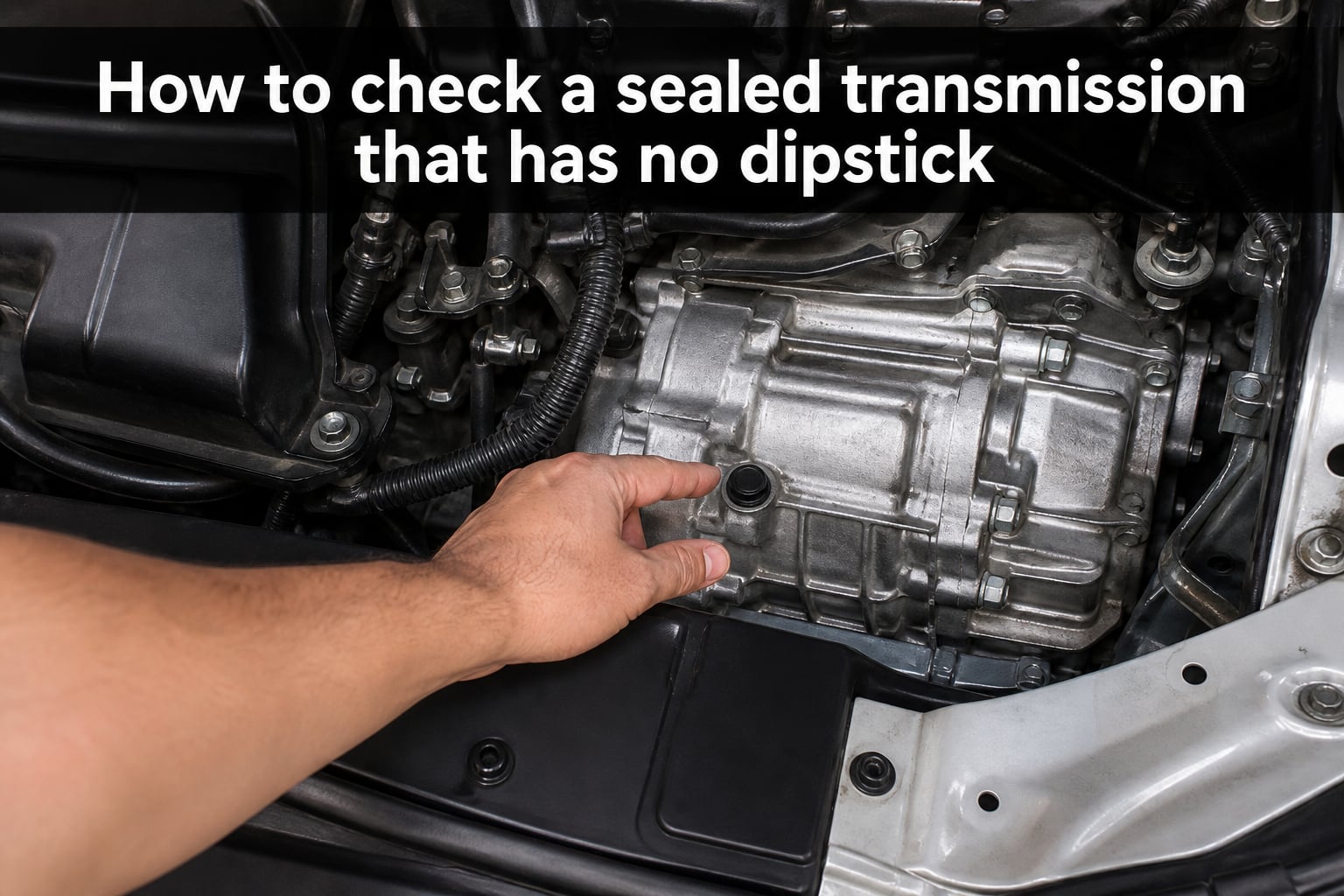
If you popped the hood of your car looking for the transmission dipstick and found nothing, you are not alone. Learning how to check a sealed transmission that has no dipstick feels frustrating at first, but it is entirely doable once you understand the process.
Most vehicles built after 2010 use sealed transmissions. Manufacturers removed the dipstick tube and replaced it with a fill plug system that requires a different approach to checking fluid level and condition.
In this guide, I will walk you through three practical methods for checking your transmission fluid without a dipstick. I will also cover how to add fluid, what signs indicate low fluid, and brand-specific tips for Toyota, Honda, Ford, Nissan, and Subaru vehicles.
Table of Contents
What Is a Sealed Transmission?
A sealed transmission is a transmission housing designed without a dipstick tube for manual fluid checking. Instead of pulling a dipstick, you check the fluid level through a fill plug on the side of the transmission case or by using electronic monitoring through the vehicle’s onboard computer.
Manufacturers adopted sealed transmissions to reduce improper fluid top-offs, prevent contamination from dirty dipsticks, and simplify maintenance for the average driver. Many automakers also label the fluid as “lifetime,” though that term is misleading.
The difference between a sealed transmission and a dipstick transmission comes down to access. A traditional transmission lets anyone pull a dipstick, wipe it, reinsert it, and read the level. A sealed transmission requires either a special service tool, the fill-hole overflow method, or an OBD scanner to verify fluid level.
How to Tell If Your Vehicle Has a Sealed Transmission?
The quickest way to tell if your vehicle has a sealed transmission is to look under the hood near the firewall for a dipstick tube labeled “Transmission.” If you only see an engine oil dipstick and a brake fluid reservoir, your transmission is likely sealed.
Your owner’s manual will also confirm this. Check the maintenance schedule section. If the transmission fluid section mentions a “fill plug” or refers you to a dealer for fluid level checks, you have a sealed system.
Brands that commonly use sealed transmissions include Toyota, Honda, Ford, Nissan, Subaru, Chevrolet, Volkswagen, and BMW. Most CVT transmissions and many six-speed and eight-speed automatics built after 2010 fall into this category.
How to Check a Sealed Transmission That Has No Dipstick: Method 1
The first method uses a special dipstick tool designed for your specific vehicle. This is the most direct way to check a sealed transmission that has no dipstick, and it mimics the traditional dipstick method.
You can buy a universal flexible transmission dipstick or a vehicle-specific service dipstick online or at an auto parts store. The tool inserts into the fill plug opening on the transmission case.
Step-by-Step: Using a Special Dipstick Tool
Step 1: Park your vehicle on a level surface. Set the parking brake firmly.
Step 2: Start the engine and let it warm up to operating temperature. The transmission fluid must be warm for an accurate reading.
Step 3: Locate the fill plug on the side of the transmission case. On many vehicles, it is behind the bell housing on the right side of the transmission. Check your service manual for the exact location.
Step 4: Remove the fill plug using the correct size socket or wrench. Some plugs require a Torx or Allen bit.
Step 5: Insert the special dipstick tool fully into the fill plug opening. Pull it out and read the fluid level against the marked bands on the tool.
Step 6: Compare the reading to the service manual specifications. The correct level is usually between the “MIN” and “MAX” marks when the fluid is at operating temperature.
Step 7: Reinstall the fill plug and tighten it to the torque specification listed in your service manual.
Method 2: Using the Fill Hole Technique
The fill hole technique is the second method and works on most sealed transmissions without buying a special tool. The principle is simple: when the fluid is at the correct level, a small amount will trickle out of the fill plug opening.
This method relies on the transmission being designed so the fill hole sits at the correct fluid height. If fluid slowly drips out when you remove the warm plug, the level is correct.
Step-by-Step: Fill Hole Check
Step 1: Park on level ground and set the parking brake. The surface must be flat for an accurate reading.
Step 2: Warm up the engine and transmission by driving for 10 to 15 minutes. Shift through all gears while idling to circulate the fluid.
Step 3: With the engine still running, locate and remove the fill plug on the transmission case.
Step 4: Check if fluid slowly seeps from the opening. If a small trickle comes out, your level is correct. If nothing comes out, the fluid is low.
Step 5: If the fluid is low, add the correct transmission fluid through the fill opening until a small amount begins to overflow.
Step 6: Reinstall the fill plug while the engine is still running.
Warning: The engine must stay running during this check. If you turn it off, fluid will drain back into the pan and give a false high reading.
Method 3: Using an OBD Scanner
Some modern vehicles monitor transmission fluid temperature and level electronically. An OBD2 scanner can read this data, making it a clean and tool-free way to check fluid status on compatible vehicles.
This method works best on newer vehicles with advanced onboard diagnostics. BMW, Mercedes, and some Ford and GM models support electronic fluid level readings through the OBD port.
Step-by-Step: OBD Scanner Check
Step 1: Plug an OBD2 scanner into the diagnostic port under your dashboard.
Step 2: Start the engine and navigate to the transmission module on your scanner.
Step 3: Look for a live data parameter labeled “Transmission Fluid Temperature” or “Fluid Level Status.”
Step 4: Bring the transmission fluid to the specified temperature range shown in your service manual. This is usually between 95 and 113 degrees Fahrenheit.
Step 5: Read the fluid level status. The scanner will display “OK,” “Low,” or “High” depending on the reading.
Step 6: If the scanner reports low fluid, use the fill hole method to top off the fluid to the correct level.
How to Add Fluid to a Sealed Transmission?
Adding fluid to a sealed transmission requires accessing the fill plug on the transmission case. There is no dipstick tube to pour into, so you need a hand pump, a squeeze bottle, or a transfer pump.
Always use the exact fluid specified in your owner’s manual. Using the wrong fluid type can cause shifting problems, slipping, and expensive transmission damage. CVT fluids in particular are not interchangeable with standard automatic transmission fluid.
To add fluid, warm the engine and transmission, remove the fill plug, and pump fluid in slowly until a small amount trickles back out of the fill opening. That trickle means you have reached the correct level.
Warning: Do not overfill. Too much fluid causes aeration, foaming, and pressure buildup that can blow seals and damage the transmission. Add fluid in small amounts and check frequently.
Signs Your Sealed Transmission Fluid Is Low
Even without a dipstick, your vehicle will warn you when fluid is low. Watch for these signs of transmission fluid problems.
Slipping gears is a common symptom. The engine revs up but the vehicle does not accelerate smoothly, as if the transmission momentarily loses connection.
A burning smell coming from under the hood or under the vehicle often indicates overheated transmission fluid. Low fluid reduces cooling capacity and causes the fluid to break down.
Delayed engagement happens when you shift from park into drive and the vehicle takes a second or two before it actually moves. This lag signals low fluid pressure.
Other warning signs include rough or harsh shifts, a humming or whining noise from the transmission, and a transmission temperature warning light on the dashboard.
Brand-Specific Guidance
Different manufacturers handle sealed transmissions differently. Here is what to expect from common brands.
Toyota
Toyota sealed transmissions typically use a 24 mm fill plug on the transmission case. Toyota specifies WS (World Standard) fluid for most models built after 2004. The fill plug is usually on the right side of the transmission, accessible from underneath the vehicle.
Honda
Honda uses a unique fill bolt design rather than a side fill plug on some models. Honda fluid is specific to the brand and should never be substituted. Some Honda models still have a dipstick, so check your manual first.
Ford
Ford sealed transmissions, including the 6F35 six-speed used in many Ford and Lincoln vehicles, use a fill plug with an internal standpipe. The engine must be running to check the level. Ford specifies Mercon LV or Mercon ULV fluid depending on the model year.
Nissan
Nissan CVT transmissions use NS-2 or NS-3 fluid depending on the model year. The fill plug is typically a 10 mm Allen bolt on the side of the transmission case. Nissan CVTs are sensitive to fluid condition, so check the fluid color and smell as well as the level.
Subaru and CVT Notes
Subaru CVT owners are among the most frustrated with sealed transmissions, based on forum discussions. Subaru uses a specific CVT fluid and a fill plug that requires removing an underbody panel. CVT transmissions in general are more sensitive to fluid condition than standard automatics, making regular checks and changes even more important.
Sealed Transmission Maintenance Tips
The “lifetime fluid” label on many sealed transmissions does not mean the fluid never needs changing. It typically means the fluid lasts for the manufacturer’s defined service interval, often around 60,000 to 100,000 miles under normal driving conditions.
Forum mechanics consistently recommend changing sealed transmission fluid every 60,000 miles, especially for CVT transmissions. Severe driving conditions like towing, heavy traffic, or mountainous terrain warrant even shorter intervals.
Knowing when to seek professional help matters. If your transmission is slipping, making noise, or showing a temperature warning, take it to a qualified shop. Modern sealed transmissions require factory scan tools for complete diagnostics, and DIY fixes on electronic transmission problems can make things worse.
FAQs
Can you check a sealed transmission?
Yes, you can check a sealed transmission using three methods: a special dipstick tool inserted through the fill plug, the fill hole overflow technique, or an OBD2 scanner on compatible vehicles. The engine must be running and the vehicle on level ground for an accurate reading.
Can you add fluid to a sealed transmission?
Yes. Remove the fill plug on the transmission case with the engine running and warm, then use a hand pump or squeeze bottle to add the correct fluid type until a small amount trickles back out of the fill opening. Never overfill, as excess fluid causes foaming and seal damage.
What happens if your car doesn’t have a transmission dipstick?
If your car has no transmission dipstick, it uses a sealed transmission. You check the fluid level through a fill plug on the transmission case or with an OBD2 scanner. The system is designed to reduce contamination and improper top-offs but still requires periodic fluid checks and changes.
Does a sealed transmission need fluid change?
Yes. Despite the lifetime fluid label, sealed transmissions need fluid changes. Most mechanics recommend changing the fluid every 60,000 miles for standard automatics and CVTs. Severe driving conditions may require shorter intervals.
Can you add a dipstick to a sealed transmission?
In most cases, no. Sealed transmissions are not designed with a dipstick tube, and adding one is not practical. The correct approach is to use a special service dipstick tool temporarily through the fill plug opening to check the level.
Why do some cars have no transmission dipstick?
Manufacturers removed dipsticks to reduce fluid contamination, prevent improper top-offs with wrong fluid, and lower emissions from evaporating fluid. Sealed transmissions are also cheaper to manufacture and align with extended service intervals.
Conclusion
Knowing how to check a sealed transmission that has no dipstick puts you in control of your vehicle’s maintenance. Whether you use a special dipstick tool, the fill hole overflow method, or an OBD2 scanner, the process is manageable with the right preparation.
Always park on level ground, warm the engine, and use the exact fluid specified by your manufacturer. Watch for slipping gears, burning smells, and delayed engagement as signs of low fluid.
Your next step is to locate the fill plug on your specific vehicle, gather the correct tools and fluid, and perform a check at your next maintenance interval. If you spot any warning signs or feel unsure about the procedure, a qualified mechanic with factory scan tools can verify everything quickly.