
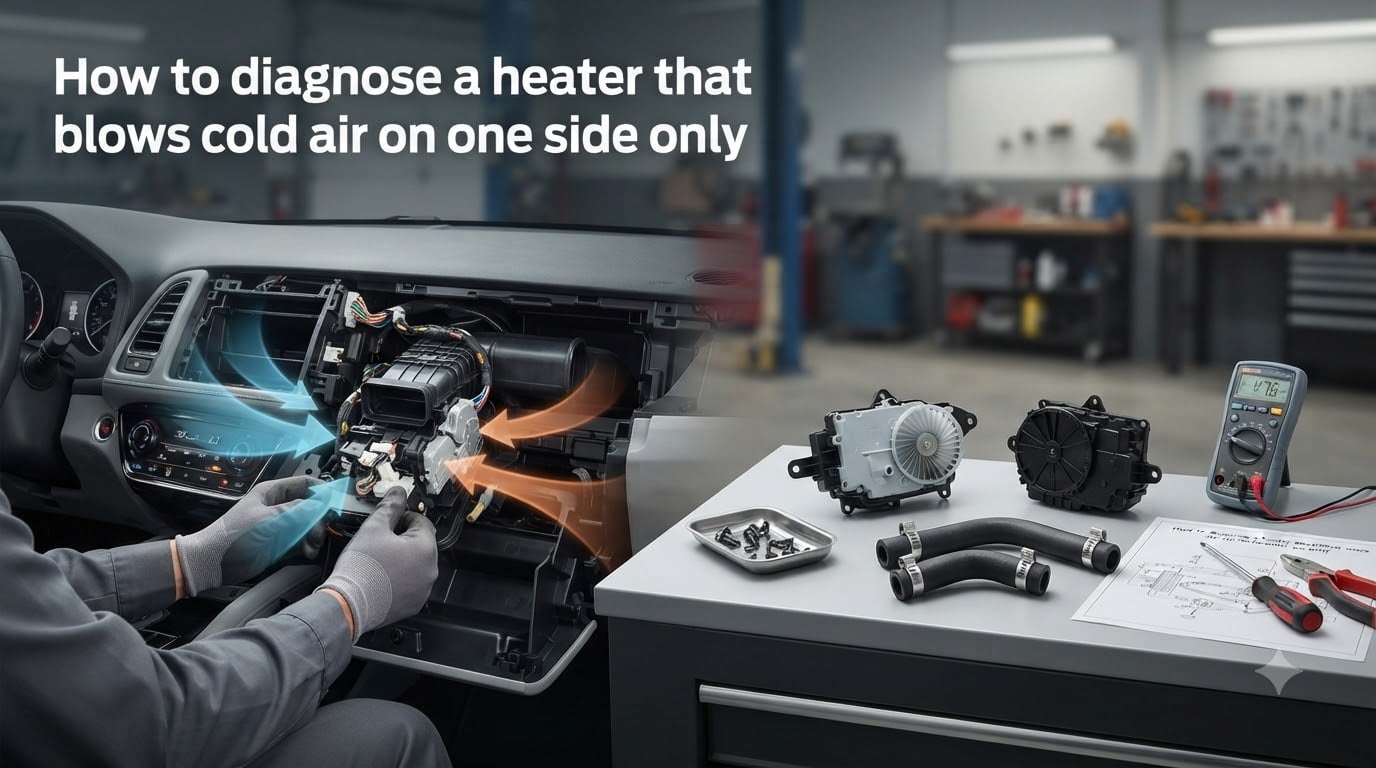
If your heater blows cold air on one side only, you’re not alone. This is one of the most common HVAC complaints our team hears about, and it usually shows up right when winter hits and you need that warm air most. The good news is that most causes are fixable without a full dashboard teardown, and you can diagnose the issue yourself in under an hour with basic tools.
In this guide, I’ll walk you through how your car’s heating system works, the exact diagnostic steps to run at home, the five most likely culprits behind one-sided cold air, what each repair typically costs, and when it’s time to hand the keys to a mechanic. I’ve broken it down so you can start at the top and skip the steps that don’t apply to your situation.
Table of Contents
How Your Car’s Heating System Works?
Your car heater uses hot engine coolant to warm the cabin. Coolant circulates from the engine through a small radiator called the heater core, which sits inside your dashboard. A blower fan pushes cabin air across the heater core, and that warmed air comes out your vents.
In a single-zone system, one blend door controls how much air passes through the heater core versus the AC evaporator, giving you one cabin temperature. In dual-zone climate control, two blend doors work independently, one for the driver side and one for the passenger side. That second blend door is why one side can blow cold air while the other blows hot.
The blend door actuator is a small electric motor that moves the blend door between hot and cold positions. When you turn the temperature dial, the actuator rotates to open or close the door. If that motor fails, the door gets stuck, and one side loses its ability to mix in hot air.
Step-by-Step DIY Diagnostic Process
Before you spend money on parts, run through these diagnostic steps in order. Most one-sided heating problems reveal themselves within the first three checks.
Step 1: Confirm the symptoms. Start the engine, let it warm up for 10 minutes, and turn the heat to maximum on both sides. Note exactly which side is cold, driver or passenger. Listen for clicking or tapping from behind the dashboard when you change the temperature setting. A stuck blend door actuator often makes a repeated clicking noise.
Step 2: Check coolant level. Open the hood and locate the coolant reservoir. The level should sit between the MIN and MAX lines when the engine is cool. Low coolant reduces flow through the heater core and can cause uneven heating, especially in dual-zone systems.
Step 3: Feel both heater hoses. With the engine warm and the heat on full blast, touch the two small heater hoses that enter the firewall. Both should be hot and roughly the same temperature. If one is cool or much cooler than the other, the heater core is likely partially clogged on that side.
Step 4: Recalibrate the climate control. Many vehicles have a calibration procedure that resets the blend door actuators. Try this: turn the ignition on without starting the engine, set the temperature to 60 degrees, wait 30 seconds, then set it to 90 degrees, wait another 30 seconds, and turn the ignition off. Restart and test.
Step 5: Inspect for visible leaks. Look under the car for coolant drips, check the carpet on the cold side for wetness or a sweet smell, and inspect the heater hose connections at the firewall. A leaking heater core often soaks the passenger-side footwell carpet.
Step 6: Swap sides to test the actuator. If your vehicle allows it, swap the driver and passenger blend door actuators. If the cold side follows the actuator to the other position, you’ve confirmed the actuator is bad. This step works on many GM, Ford, and Chrysler models with accessible actuators.
Top Causes of a Heater Blowing Cold Air on One Side
From what I’ve seen across hundreds of owner reports and forum threads, these five causes account for roughly 95% of one-sided heating complaints:
Faulty blend door actuator (about 60% of cases)
Clogged or partially blocked heater core (about 20%)
Low coolant or air pocket in the cooling system (about 10%)
Electrical issues in the climate control module or wiring (about 5%)
Stuck or broken blend door (mechanical, not actuator) (about 5%)
Blend Door Actuator Failure (Most Common Cause)
A blend door actuator failure is the leading reason your heater blows cold air on one side only. The symptoms are usually clear: clicking or tapping from behind the dashboard, temperature that doesn’t respond to adjustments, and heat working perfectly on one side while the other stays cold.
The actuator itself is a small electric motor with plastic gears that wear out over time. Heat cycling, vibration, and age cause the gears to crack or strip. On many vehicles, the actuator is accessible by removing a glove box or a small panel under the dash, and replacement takes 30 to 60 minutes with a socket set and a screwdriver.
Common vehicles with known actuator issues include Chevrolet Silverado, GMC Sierra, Ford F-150, Toyota Camry, Honda Accord, and many Chrysler products. Aftermarket actuators cost less than OEM but use plastic gears that can fail again within a year. OEM or upgraded metal-gear replacements last longer.
Heater Core Problems
A clogged heater core restricts coolant flow and prevents proper heat transfer. In dual-zone systems, a partial clog often affects one side more than the other because the coolant passages split inside the core.
Symptoms include foggy windows even with the defroster on, a sweet coolant smell inside the cabin, wet carpet on the passenger side, and both heater hoses feeling cool when the system is at full temperature. A coolant flush can clear minor blockages, but a severely clogged core usually requires replacement, which means removing the dashboard.
Coolant System and Electrical Control Issues
Low coolant is easier to overlook than you’d think. Even a level slightly below MIN can reduce heater core flow enough to cause uneven heating. Air pockets trapped in the cooling system after a recent coolant service create the same problem.
Bleeding the cooling system properly restores full flow. Most vehicles have a bleeder screw on the thermostat housing or a procedure that involves running the engine with the radiator cap off and the heat on full blast until steady bubbles stop.
Electrical problems show up less often but still matter. A failed climate control module, a broken temperature sensor, or a damaged wiring harness can stop one side from responding. Scan tools that read HVAC codes, available at most auto parts stores for free, can pinpoint these issues fast. Common codes include B2623, B2625, and U0167 depending on the manufacturer.
Repair Cost Estimates
These ranges reflect typical pricing for common vehicles and assume professional labor. Your actual cost varies by location, vehicle make, and model year.
Blend door actuator replacement: parts under $75 for most vehicles, labor adds $100 to $200 if done professionally.
Coolant system flush and fill: parts under $50, professional service under $150.
Cooling system bleeding after coolant service: under $100 in most cases.
HVAC control module replacement: parts range from $150 to $500, labor adds $100 to $300 for programming.
Heater core replacement: parts under $200, labor runs $800 to $1,500 because the dashboard usually comes out.
When to Seek Professional Help?
Some repairs are clearly DIY territory, and others call for a shop. Here’s how I draw the line.
Go ahead and try it yourself if the issue is a coolant top-off, a coolant flush, a climate control recalibration, or an accessible blend door actuator on a common vehicle. These jobs use basic tools and don’t require special training.
Take it to a mechanic if you smell coolant inside the cabin, see wet carpet that won’t dry, have a heater core that’s clearly clogged on both hoses, need an actuator buried behind the dashboard, or see HVAC error codes that point to module or wiring faults. These jobs need diagnostic scanners, specialty tools, or significant disassembly that’s easy to do wrong.
Avoid driving with a leaking heater core for long periods. Low coolant from a leak can lead to engine overheating, which costs far more to fix than the heater core itself.
How to Prevent One-Sided Heating Problems?
A few habits go a long way toward keeping your HVAC system healthy. Flush the coolant on the manufacturer’s schedule, usually every 60,000 to 100,000 miles. Run the heat and AC for a few minutes each month even in summer to keep blend door actuators moving. Replace cabin air filters on time to maintain airflow. And address small leaks early before they turn into low-coolant emergencies.
Frequently Asked Questions
Why is my heater blowing cold air on one side?
The most common cause is a faulty blend door actuator that controls airflow on the cold side. Other possibilities include low coolant, a partially clogged heater core, an electrical fault in the climate control module, or a stuck blend door. Start by checking coolant level and listening for clicking from behind the dashboard when you change the temperature.
Why is my car blowing cold air on one side and not the other?
Dual-zone climate control systems use two blend doors that move independently. When one side blows cold and the other blows hot, one blend door is stuck or its actuator motor has failed. The system is mechanically capable of delivering different temperatures to each side, so a working actuator is what makes the difference.
Why does my heat work on one side but not the other?
Heat works on one side because the blend door actuator on the cold side has failed, the heater core is partially clogged on that side, or low coolant is restricting flow to one half of the core. In most vehicles, the actuator is the cause and can be replaced in under an hour with basic tools.
Why is my Chevy blowing hot air on one side and cold on the other?
Chevy trucks and SUVs are well known for blend door actuator failures, especially in Silverado, Tahoe, and Suburban models. The actuators are relatively accessible and replacement parts are inexpensive. Aftermarket plastic-gear actuators can fail again within a year, so consider an OEM or upgraded metal-gear replacement for longer life.
Can I drive with a heater blowing cold air on one side?
Yes, in most cases it’s safe to drive, especially if the engine temperature stays normal. The bigger risk is reduced defrosting capability in cold or humid weather, which affects visibility. If the cause is a leaking heater core and coolant level is dropping, address it quickly to avoid engine overheating.
Final Thoughts on Diagnosing One-Sided Heater Problems
A heater that blows cold air on one side only almost always traces back to a blend door actuator, and replacing one is a satisfying DIY job that costs little and takes less than an hour. Start with the simple checks, coolant level, hose temperatures, and listening for clicking noises, before assuming the worst. If the cause turns out to be a heater core or a control module, you’ve now got the information to talk to a mechanic with confidence and avoid being upsold on repairs you don’t need.