
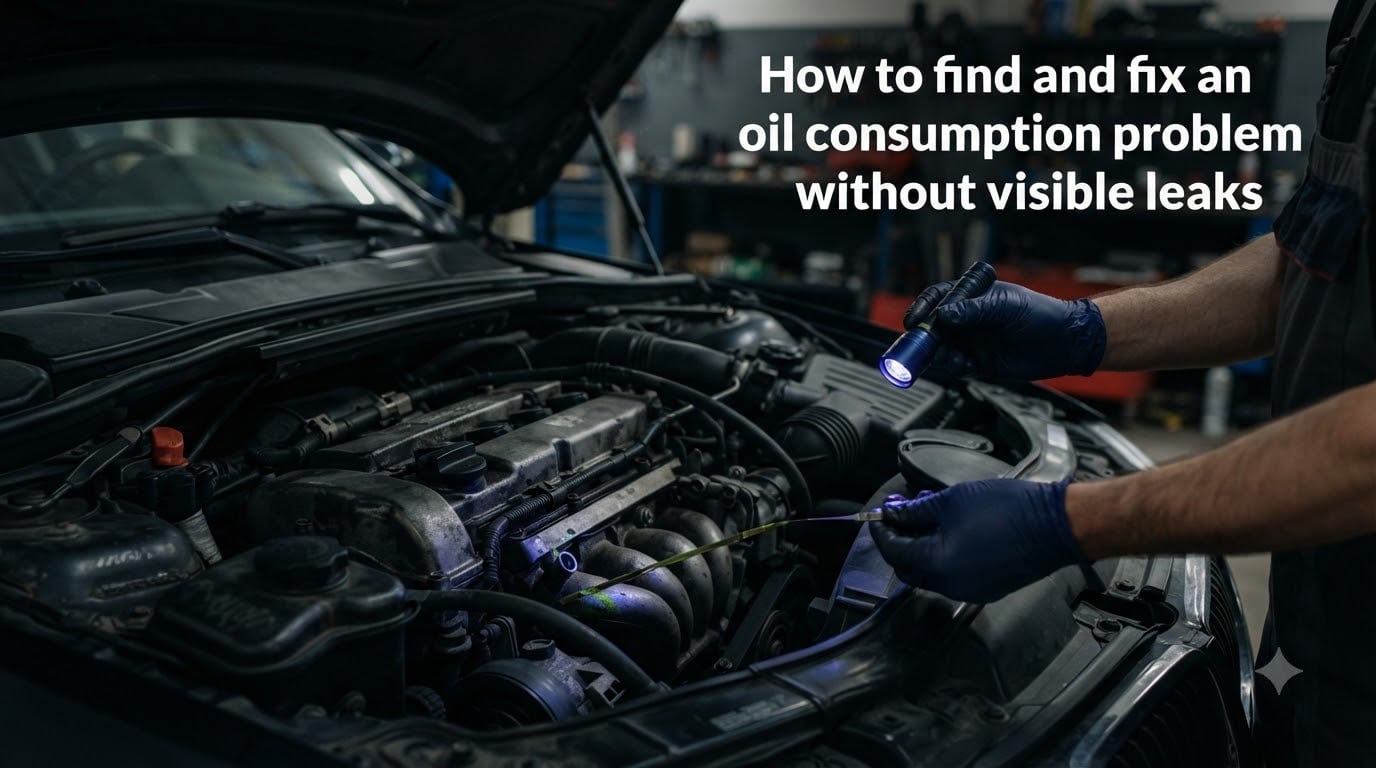
You pull the dipstick and the oil level is low again. But there is no puddle under your car, no drip on the driveway, and no obvious stain on the engine block. So where is the oil going?
This scenario frustrates more drivers than you might think. Our team has seen it hundreds of times across forums like r/MechanicAdvice and bimmerforums, where owners report losing a quart every 300 to 1,000 miles with zero visible evidence. The answer almost always points to an oil consumption problem without visible leaks, meaning your engine is burning oil internally rather than dripping it externally.
The good news is that you can diagnose and sometimes fix this yourself without a shop visit. This guide walks you through every cause, symptom, and step-by-step diagnostic test so you can pinpoint the problem and decide on the right repair before engine damage sets in.
Table of Contents
What Is an Oil Consumption Problem Without Visible Leaks?
An oil consumption problem without visible leaks occurs when engine oil burns inside the combustion chamber or gets pulled through crankcase ventilation rather than pooling under the car. Instead of dripping onto your driveway, the oil quietly disappears through the engine’s internal passages.
Every engine consumes a small amount of oil during normal operation. Manufacturers generally consider up to 1 quart per 1,000 to 1,500 miles acceptable for older or high-mileage engines. When consumption exceeds that threshold or suddenly increases, you have a problem worth investigating.
The tricky part is that internal consumption often produces no puddles and sometimes no visible smoke. Modern catalytic converters are efficient at trapping and burning off oil residue before it exits the tailpipe, which means you can be burning significant oil and never see a wisp of smoke.
Common Causes of Internal Oil Consumption
Internal oil consumption traces back to a handful of root causes. Understanding each one helps you narrow down your diagnosis without guessing.
Worn Piston Rings
Piston rings seal the gap between the piston and cylinder wall, keeping combustion gases above and oil below. When rings wear down, lose tension, or get carbon-fouled, oil slips past them into the combustion chamber and burns with the fuel.
Ring wear is the most common cause of oil consumption in high-mileage engines, especially those with over 100,000 miles. You might notice acceleration feels sluggish or the engine runs rougher than before. A compression test or leak-down test can confirm worn rings without opening the engine.
Hardened or Cracked Valve Stem Seals
Valve stem seals sit at the top of the engine and prevent oil from running down the valve stems into the combustion chamber. Over tens of thousands of heat cycles, the rubber hardens, cracks, or loses its grip on the valve.
A telltale sign of bad valve seals is a puff of blue smoke when you start the engine after it has been sitting overnight. Oil pools down through the worn seal while parked, then burns off in the first few seconds of running. The smoke may clear quickly, making it easy to miss if you are not watching.
Faulty PCV System
The Positive Crankcase Ventilation (PCV) system routes crankcase gases back into the intake to be burned rather than vented to the atmosphere. When the PCV valve sticks open or the system develops excess vacuum, it can pull liquid oil into the intake manifold.
This is the cheapest cause to fix. A PCV valve typically costs $20 to $80 and takes 10 minutes to replace. BMW and Mini owners in particular report CCV (crankcase ventilation) failures as a frequent culprit, with oil consumption disappearing entirely after replacing the system.
Turbocharger Seal Wear
If your vehicle is turbocharged, worn turbo seals are a prime suspect. The turbo spins at over 100,000 RPM and relies on pressurized oil for lubrication. When the internal seals wear, oil leaks into the intake or exhaust side of the turbo.
Subaru owners frequently report oil loss through turbo return lines, while VW and Audi TSI engines are known for turbo seal failures. You can check for turbo oil consumption by inspecting the intercooler pipes. If you pull an intercooler hose and oil drips out, the turbo seals are likely gone.
Small External Leaks That Burn Off
Not all invisible oil loss is internal. A slow leak from the valve cover gasket, oil pan gasket, or timing cover can seep oil onto hot engine surfaces like the exhaust manifold. The oil burns off as you drive, leaving no puddle and very little trace.
This is the most commonly overlooked cause. A thin film of burnt oil residue on the engine block, a persistent burning smell after driving, or slight discoloration near the exhaust manifold are all clues pointing to this type of leak.
Signs Your Car Has an Oil Consumption Problem
Catching oil consumption early can save you thousands in engine repairs. Here are the symptoms to watch for, ranked from most common to most severe.
Frequent low dipstick readings are the number one sign. If you check your oil regularly and the level keeps dropping between changes without any visible leak, your engine is consuming oil internally. Start tracking how many quarts you add per 1,000 miles.
Blue or grayish exhaust smoke on startup, acceleration, or deceleration indicates oil is entering the combustion chamber. Smoke on startup points to valve seals. Smoke under acceleration or heavy load suggests piston rings.
A burning oil smell from the engine bay or through the climate control vents often means oil is leaking onto a hot surface and burning off. Check around the valve cover and exhaust manifold for residue.
Spark plug fouling is another indicator. If your spark plugs come out coated in oily black residue rather than the normal tan or gray color, oil is reaching the combustion chamber. This is particularly telling if only one or two plugs are affected, pointing to a cylinder-specific issue.
Check engine light with misfire codes (P0300 through P0312) can result from oil-fouled spark plugs. The oil contaminates the plug, causing weak spark and misfire. If you keep getting misfire codes on the same cylinder after replacing plugs, suspect oil consumption.
Keep in mind that modern catalytic converters can mask oil burning by cleaning up the exhaust before it exits. Many owners on Toyota and Scion forums report consuming significant oil with zero visible smoke, so do not assume everything is fine just because the tailpipe looks clean.
How to Find and Fix an Oil Consumption Problem Without Visible Leaks: Step-by-Step Diagnosis
Follow these diagnostic steps in order, starting with the easiest and cheapest checks. Each test narrows the possibilities and helps you avoid spending money on the wrong repair.
Step 1: Track Your Oil Consumption Rate
Check your dipstick at every other fuel fill-up and log the level. If you are adding more than 1 quart per 1,000 miles, you have confirmed an oil consumption problem. Write down the mileage each time you add oil so you can calculate the exact rate.
Step 2: Inspect the PCV Valve
Remove the PCV valve and shake it. You should hear a metallic rattle, which means the internal valve moves freely. If there is no rattle, the valve is stuck and likely pulling oil into the intake. Replace it immediately, as this is a $20 to $80 part that takes minutes to swap. Check the PCV hose and breather tube for cracks or oil saturation while you are at it.
Step 3: Check for Hidden External Leaks With UV Dye
Add a bottle of UV-compatible oil dye to your engine oil and drive normally for 50 to 100 miles. Park over clean cardboard and inspect the engine with a UV flashlight. Even tiny seeps that burn off on hot surfaces will glow brightly under UV light. Focus on the valve cover gasket, oil filter housing, oil pan, timing cover, and camshaft seals. This test catches the leaks that evaporate before they ever hit the ground.
Step 4: Perform a Compression Test
A compression test measures how well each cylinder holds pressure. Remove all spark plugs, thread the compression gauge into each cylinder one at a time, and crank the engine for several seconds. Healthy cylinders typically read between 130 and 180 PSI, with less than 15 PSI variation between cylinders. Low compression across all cylinders points to worn piston rings. Low compression on one cylinder suggests a localized problem like a scored wall or damaged ring.
Step 5: Run a Leak-Down Test
If compression is low, a leak-down test tells you exactly where the pressure is escaping. You pressurize each cylinder at top dead center using compressed air and listen for where the air escapes. Hissing from the oil fill cap means worn rings. Air from the exhaust points to exhaust valves. Air from the intake suggests intake valves. Hissing from the coolant reservoir indicates a blown head gasket. This test pinpoints the exact cause without opening the engine.
Step 6: Inspect Spark Plugs for Oil Fouling
Pull all spark plugs and examine their color. A normal plug has a dry, tan or gray electrode. An oily, black, wet plug means oil is entering that cylinder. If the oil-fouled plugs are on the same bank or cylinder that showed low compression, you have confirmed the problem area.
Step 7: Check Turbocharger Components (If Applicable)
For turbocharged vehicles, remove the intake pipe from the turbo compressor outlet and inspect for oil. A small film is normal, but pooled oil or dripping indicates failed compressor seals. Next, check the intercooler by removing the lowest intercooler hose and seeing if oil runs out. If it does, plan for turbo rebuild or replacement. Also inspect the turbo oil drain line for kinks or blockages, as a restricted drain can force oil past the seals.
How to Fix Oil Consumption Based on the Diagnosis
Once you have identified the cause, the fix ranges from a quick weekend job to a full engine teardown. Here is what each repair involves and what to expect.
Fixing PCV System Issues
Start here, always. A faulty PCV system is the cheapest and easiest cause to address. Replace the PCV valve, any cracked breather hoses, and the oil separator if your vehicle has one. BMW CCV systems require replacing the entire crankcase ventilation kit, which costs $100 to $300 in parts.
Many owners report oil consumption dropping to normal levels after a PCV replacement alone. If your consumption was caused by a stuck PCV pulling oil into the intake, this single repair solves it.
Addressing Worn Piston Rings
If compression and leak-down tests confirm worn rings, start with a less invasive approach before committing to engine teardown. Run a high-quality engine flush through the oil before your next change to dissolve carbon deposits that may be sticking the rings. Follow up with a top-end cleaner like Seafoam or CRC GDI Intake Valve Cleaner introduced through the intake to break up carbon on the ring packs.
Some owners report reduced consumption after this process, especially in direct-injection engines that build carbon. If the flush does not help, ring replacement requires removing the cylinder head and oil pan, honing the cylinder walls, and installing new rings. Expect $2,000 to $5,000 at a shop depending on the vehicle and labor rates.
Replacing Valve Stem Seals
Valve seal replacement is labor-intensive but sometimes doable without removing the cylinder head. Some shops use a compressed-air tool to hold the valves closed while removing the springs and swapping seals in place. This reduces cost significantly compared to a full head removal.
Typical costs run $800 to $2,000 depending on whether the head comes off and your engine layout. Boxer engines (Subaru) are more expensive because the cylinder heads sit low and access is tight. Inline-four engines are generally the most affordable.
Turbocharger Repair or Replacement
If the turbo is consuming oil, you have two options: rebuild or replace. A turbo rebuild by a specialized shop costs $300 to $700 and replaces all internal seals and bearings. A new or remanufactured turbo runs $500 to $2,000 depending on the vehicle.
Always inspect the oil supply and return lines when replacing a turbo. A clogged return line causes the same oil leak through the seals and will destroy a new turbo in short order. Replace the lines if there is any sign of carbon buildup or restriction.
Using High-Mileage Oil and Seal Conditioners
Switching to a high-mileage synthetic oil can reduce consumption caused by hardened seals. These oils contain seal conditioners that soften and swell aging rubber seals, helping them seal better. This is not a permanent fix, but it can reduce consumption by 30 to 50 percent in some engines and buy you time.
Oil additives like Bar’s Leaks Oil Seal work on the same principle, using polymers to condition seals and reduce seepage. They are worth trying on engines with over 100,000 miles before committing to major repair costs. Just know that additives cannot fix physical damage like cracked rings or broken turbo seals.
When to Seek Professional Help
If your oil consumption exceeds 1 quart per 500 miles, you are in the danger zone. At that rate, the risk of running the engine dry between checks is high, and internal damage from oil starvation can occur rapidly. Professional diagnosis is warranted.
When consumption is between 1 quart per 700 and 1,000 miles and you have already replaced the PCV valve, tried high-mileage oil, and ruled out external leaks with UV dye, a shop visit for a proper compression and leak-down test makes sense. These tests require specialized equipment and experience to interpret correctly.
The financial decision matters too. If repair quotes come in at $3,000 to $5,000 for piston rings or valve seals, compare that against the value of the vehicle. On a car worth $4,000 to $6,000, a $3,500 repair may make sense if the rest of the vehicle is solid. On a car worth $2,000, you may be better off monitoring the oil level and planning a replacement vehicle.
Get at least two quotes. Dealerships often quote significantly higher than independent specialists for the same job. Independent European or Japanese specialists typically have the experience and tooling for engine work at lower labor rates.
Frequently Asked Questions
Can you have an oil leak without seeing it?
Yes. Oil can burn internally through worn piston rings, hardened valve seals, or a faulty PCV system without ever reaching the ground. It can also seep onto hot surfaces like the exhaust manifold and burn off completely, leaving no puddle.
How to find a leak that’s not visible?
Use UV dye added to your engine oil, then inspect the engine with a UV flashlight after driving 50 to 100 miles. Even tiny leaks that evaporate will glow under UV light. For internal consumption, perform a compression test and leak-down test to identify worn rings or valves.
What can be mistaken for an oil leak?
Condensation from the air conditioning system, power steering fluid leaks, transmission fluid seepage, and coolant dripping can all be mistaken for engine oil. Check the color and consistency of any fluid to identify it correctly. Oil is amber to dark brown and slippery between your fingers.
Why does my car burn oil but it doesn’t smoke?
Modern catalytic converters are highly efficient at trapping and burning off oil residue before it exits the tailpipe. You can be burning a significant amount of oil and never see visible smoke. Some engines also burn oil slowly enough that the smoke dissipates before it becomes noticeable.
Is it worth fixing a car that’s burning oil?
It depends on the cause, the cost, and the vehicle value. A PCV valve replacement at $20 to $80 is always worth doing. Major repairs like piston rings at $2,000 to $5,000 are worth it if the vehicle is in good condition overall. Compare repair cost against the car’s market value before deciding.
How long will a car last after it starts burning oil?
An engine burning moderate amounts of oil (1 quart per 1,000 miles) can last years if you keep the oil topped off and change it regularly. Heavy consumption above 1 quart per 500 miles risks oil starvation and catalytic converter damage, which can lead to failure within months if ignored.
Can you just keep adding oil to a car that burns oil?
You can as a temporary measure, but it is not a permanent solution. Topping off oil masks the problem while the underlying cause worsens. Burning oil also contaminates the catalytic converter over time, turning a $500 engine fix into a $2,500 repair. Diagnose the root cause as soon as possible.
Conclusion
Dealing with an oil consumption problem without visible leaks is frustrating, but the diagnostic path is straightforward when you work through it methodically. Start with the cheapest and most common fix, a $20 to $80 PCV valve, and work your way up to compression tests, leak-down tests, and UV dye inspections.
The most important thing is to take action. Every mile driven with low oil accelerates engine wear, and ignoring consumption can turn a manageable $80 fix into a $5,000 rebuild. Track your oil consumption rate starting today, run through the diagnostic steps in this guide, and address the root cause before it compounds into bigger problems.
Your engine gave you years of reliable service. Catch the consumption early, fix the right component, and it will keep running for many more.