
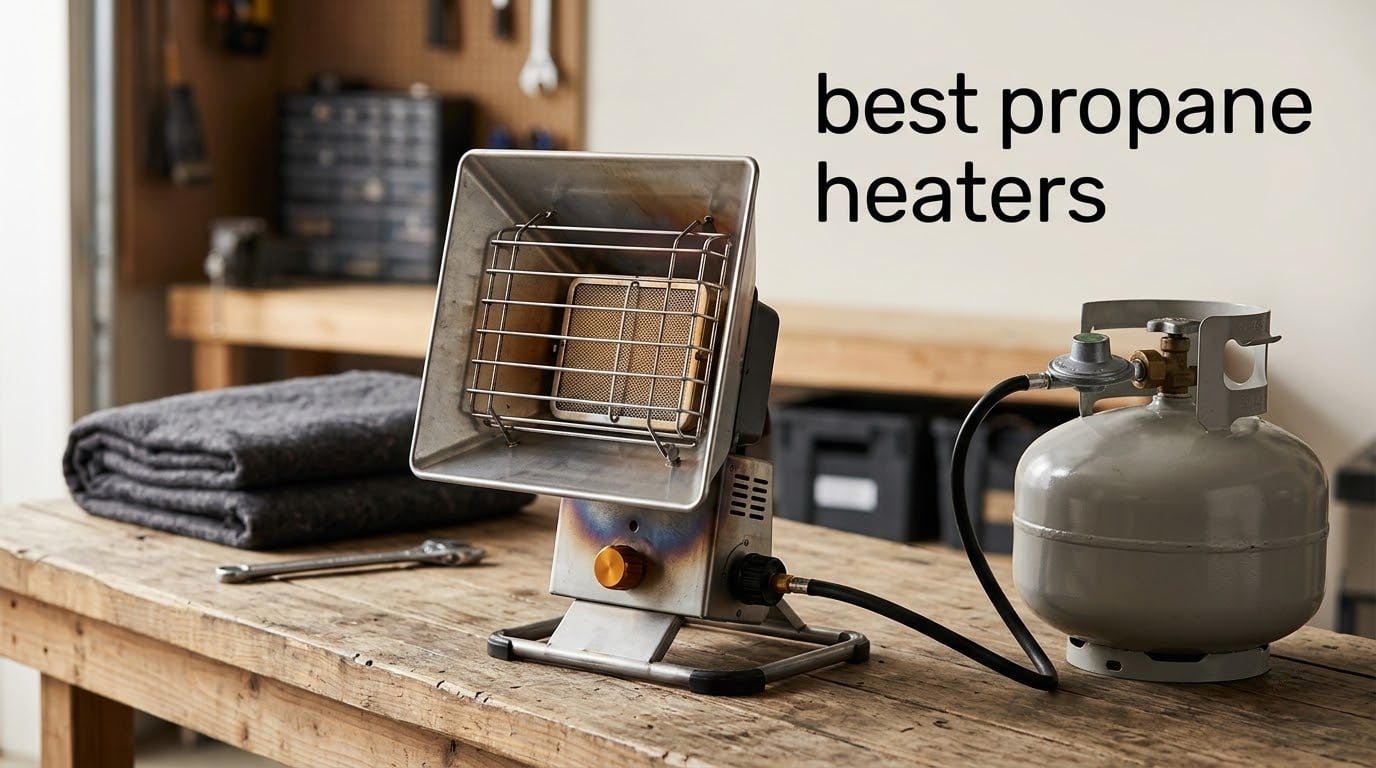
The power goes out on a January night, the house drops to 48 degrees, and every electric heater you own is suddenly a paperweight. A propane heater is the one heat source that does not care about the grid. It also happens to be the fastest way to warm a 1,500 sq ft garage, the only practical way to heat an RV in winter, and the standard answer for keeping a patio usable in the shoulder season.
After reading through owner threads on garage and van-life forums and weighing the specs on dozens of current models, the picture that kept repeating was simple: there is no single best propane heater, because the right answer depends almost entirely on which of four jobs you need done. Indoor emergency heat, garage and workshop heating, tank-top radiant heat for a porch or covered deck, and patio heating for an outdoor dining area each reward a different design and punish a different mistake.
That is what this roundup of the best propane heaters for 2026 is built around. Ten picks, sorted by use case, with the published BTU, room-size claim, run time per tank and safety shut-offs spelled out for each one, plus the sizing and safety detail that most roundups skip. We looked hard at input BTU versus usable heat, at what indoor-rated legally means, and at the tank sizes that quietly limit how long any of these will run.
One note before we start: every heater here burns propane directly, so all of them produce carbon monoxide. That is not a defect to be engineered around, it is physics. The difference between a safe indoor heater and an unsafe one is whether the manufacturer fitted an oxygen depletion sensor and a tip-over switch, and whether you keep it in a ventilated space. We come back to that in the safety section, because it is the single most important thing on this page.
Table of Contents
Top 3 Best Propane Heaters for 2026
Our top three cover the three highest-volume use cases: a room you might actually sit in during an outage, a small space where the smallest legal indoor output matters, and broad outdoor radiant heat that keeps a garage or covered deck usable.
Mr. Heater Portable Buddy…
- 4000 or 9
- 000 BTU radiant output
- Heats approx 225 sq ft
- Indoor and outdoor approved
- Low-oxygen emergency shutoff
Mr. Heater 540-Degree Tank…
- 45000
- 36000 and 30000 BTU
- Mounts directly to a 20 lb tank
- 540-degree radiant head
- Approx 9.5 hrs on high with a 20 lb tank

Mr. Heater Little Buddy…
- 3800 BTU radiant output
- Heats up to 95 sq ft
- ODS and tip-over shut-off
- Connects to a 1 lb cylinder
Best Propane Heaters at a Glance (October 2026)
Ten picks, grouped by the job each one does best. The category column is the fastest way to find your answer.
| Product | Specs | Action |
|---|---|---|
| Mr. Heater Portable Buddy 9,000 BTU |
|
Check Latest Price |
 Amazon Basics 46000 BTU Patio Heater Amazon Basics 46000 BTU Patio Heater |
|
Check Latest Price |
| Mr. Heater Little Buddy 3800 BTU |
|
Check Latest Price |
| Mr. Heater 540-Degree Tank Top 45000 BTU |
|
Check Latest Price |
 Dura Heat TT-360 Tank Top 40000 BTU Dura Heat TT-360 Tank Top 40000 BTU |
|
Check Latest Price |
 GASLAND 18000 BTU Cabinet Heater GASLAND 18000 BTU Cabinet Heater |
|
Check Latest Price |
 Dyna-Glo Delux 30000-60000 BTU Forced Air Dyna-Glo Delux 30000-60000 BTU Forced Air |
|
Check Latest Price |
 Remington 60000 BTU Forced Air Heater Remington 60000 BTU Forced Air Heater |
|
Check Latest Price |
 DEWALT 68000 BTU Forced Air Heater DEWALT 68000 BTU Forced Air Heater |
|
Check Latest Price |
 XtremepowerUS 30000 BTU Dual Burner XtremepowerUS 30000 BTU Dual Burner |
|
Check Latest Price |
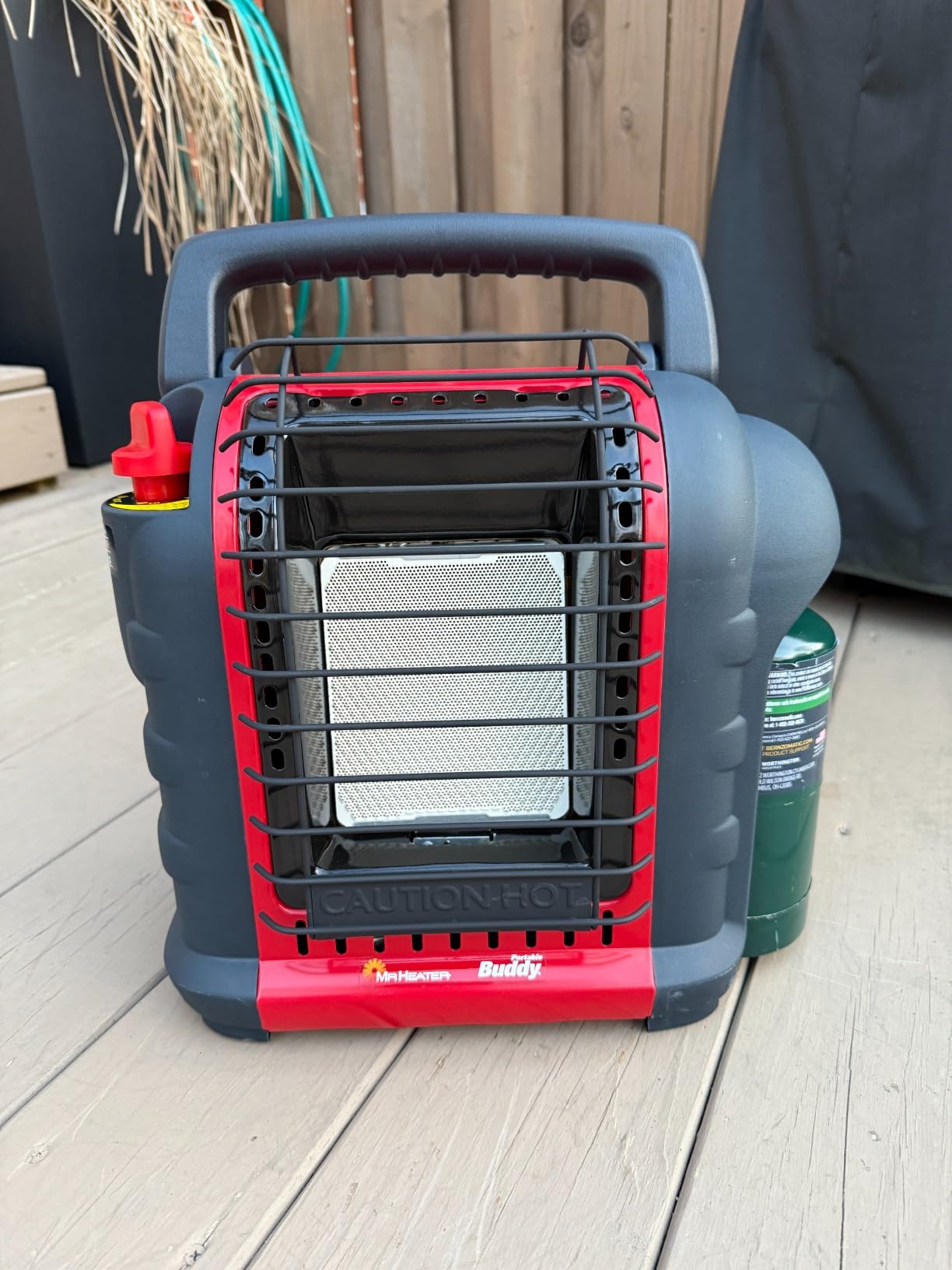
1. Mr. Heater Portable Buddy 9,000 BTU – The Best All-Rounder for Indoor and Outdoor Use
Mr. Heater 9,000 BTU Portable Buddy Radiant Propane Heater
Fuel: Propane
4,000 or 9,000 BTU/hr
Heats approx 225 sq ft
Indoor and outdoor rated
Pros
- Two heat settings for flexible output
- Approved for both indoor and outdoor use
- Heats up to approximately 225 square feet
- Emergency low-oxygen safety system
- Self-extinguishing materials
Cons
- Only 2.4 hours per 1 lb cylinder on the high setting
- Needs clearance from combustibles when used indoors
The Portable Buddy is the heater I recommend to people who ask a single question: which one should I just buy. It pairs the highest rating in this roundup with the deepest owner base, and that volume of long-term use is itself useful information. It is the unit that shows up in camper vans, in mudroom emergency kits and in the corner of a garage, and it has been doing both jobs long enough that owners have a settled opinion about it.
What separates it from the small heaters is the two-position control. At 4,000 BTU it behaves like the Little Buddy and is appropriate for a smaller room or a tent. Push it to 9,000 BTU and it becomes the primary heat source for a roughly 225 sq ft space during a real outage. That range is why it earns the top slot here rather than a unit with a higher headline number.
Ignition is a piezo push button, so there is no battery, no igniter wire and no power cord to lose in a blackout. That sounds minor until you are doing it at 2 a.m. in the dark during a power cut, which is exactly the scenario this heater exists for.
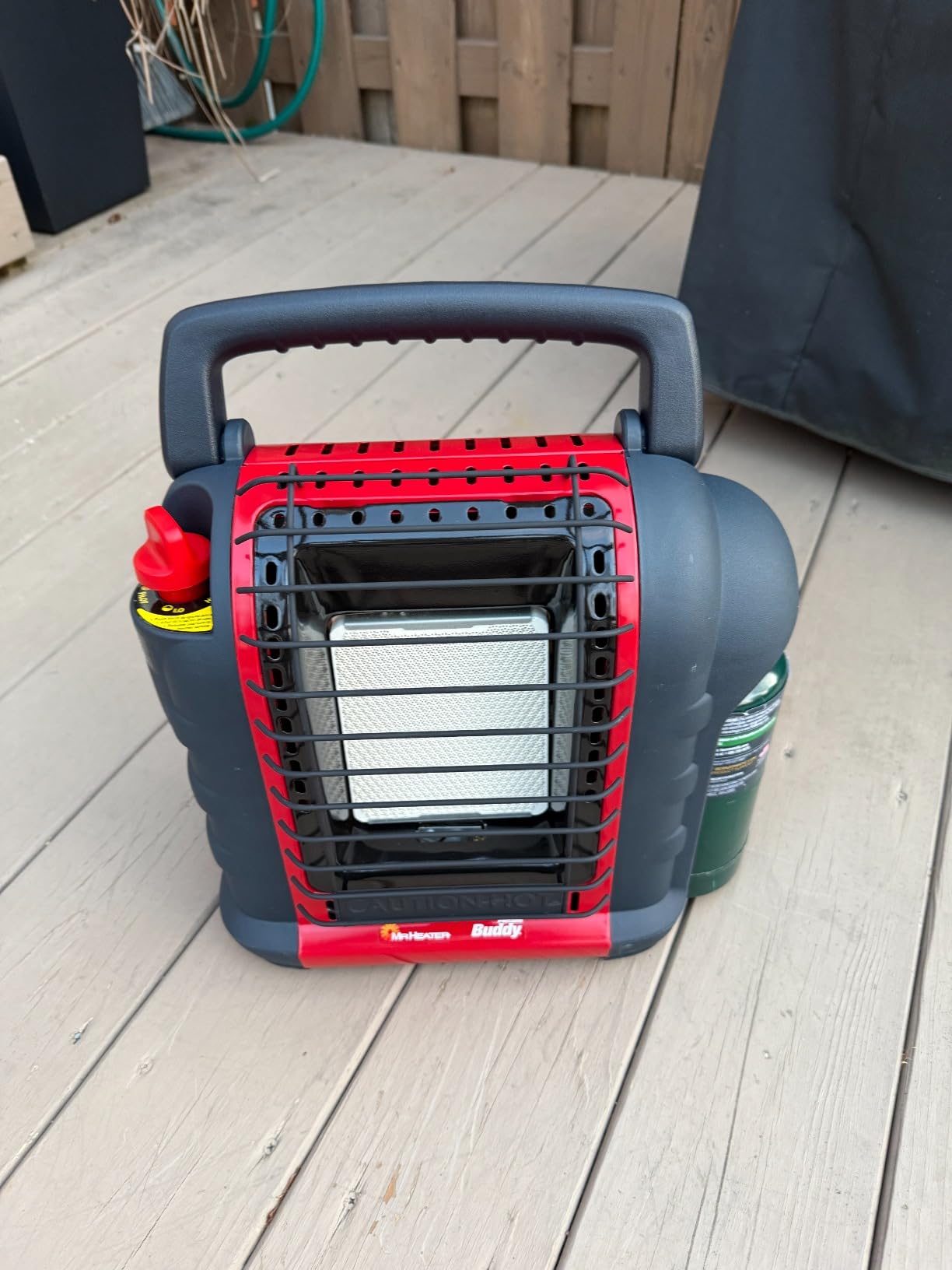
Technically it is a radiant heater, not a forced-air one. That means it warms you and the surfaces you are sitting near rather than stirring the air, and it does so with almost no noise at all. In a quiet room during an outage that is the whole point. The trade-off is that it heats a person efficiently and a room less evenly than a fan-driven unit, and it needs to be pointed at where you are sitting.
Run time is the honest weak spot. On a 1 lb cylinder you get roughly 5.4 hours on low and 2.4 hours on high, so a single throwaway cylinder is an evening of warmth, not a night of it. Owners who need more than that pair it with a 20 lb tank through an adapter and hose. The stated coverage of about 225 sq ft is a reasonable figure for a moderately insulated room with the door shut.
Who the Portable Buddy suits
This is the correct pick for a home office, a bedroom during a winter outage, a small living room, or an RV where the propane line already ends in a cylinder fitting. Its dual indoor and outdoor approval also makes it the one to keep in the garage for a tent, a van or an emergency, since the same unit covers both.
For buyers who want a single heater that handles emergencies and occasional outdoor use, it removes the decision entirely. At 7.1 pounds it is also light enough to carry between rooms without thinking about it.
Where the Portable Buddy falls short
The 2.4 hour high-setting run time on a 1 lb cylinder is the constraint people complain about most, and it is real. Any room larger than about 225 sq ft will not hold temperature with the door open or with a leaky window, and there is no fan to move air, so warm air stratifies near the ceiling.
Because it is an indoor-approved radiant unit, it still needs ventilation and clearance from anything combustible. The oxygen depletion system is an emergency cutoff, not a substitute for airflow, and the self-extinguishing materials are a fire-containment measure rather than a reason to set it against a curtain.
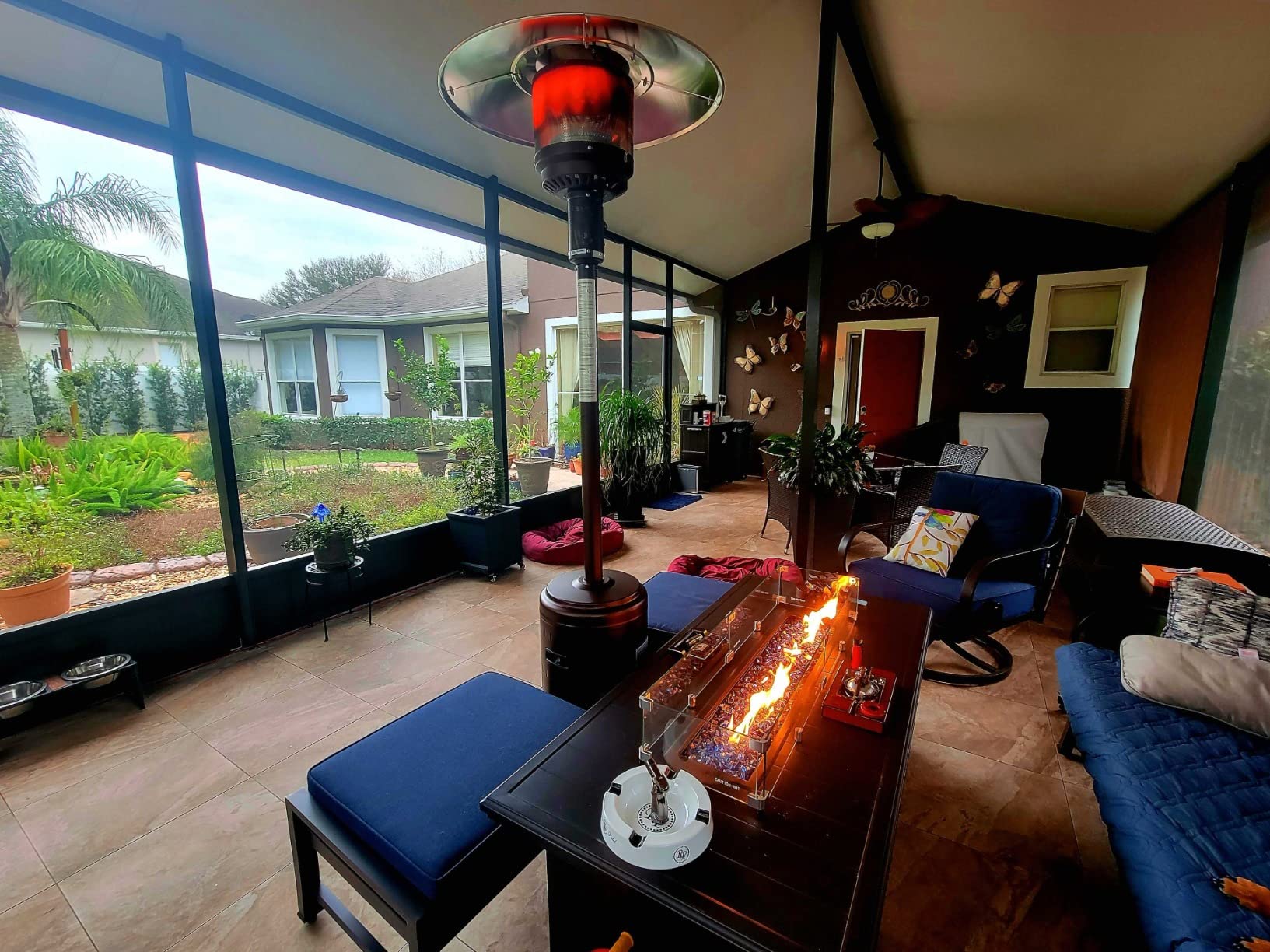
2. Amazon Basics 46,000 BTU Patio Heater – Best for Patios and Outdoor Dining
Amazon Basics 46,000 BTU Portable Outdoor Propane Patio Heater with Wheels, Commercial & Residential with Water Tank, Adjustable Heat Output, 9-Foot Radius, Slate Gray, 32.1″L x 32.1″W x 91.3″H
Fuel: Propane
46,000 BTU output
9 ft heating radius
Outdoor rated
Wheels and one-touch ignition
Pros
- 46000 BTU covers a 9-foot radius
- Wheels make it easy to move into position
- One-touch ignition for quick startups
- Tilt safety auto-shut-off and water-box base
- Adjustable temperature knob
Cons
- Requires a separate 20 lb liquid propane tank
- Outdoor rated only
- Tall pole design needs a dedicated footprint
A patio heater solves a problem electric heaters cannot touch at all: an open-air table in October. This tower-style unit is the shape most restaurant patios and back yards use, and with 46,000 BTU across a stated 9-foot radius it is powerful enough to push past a table of eight rather than just warm one corner of it.
Wheels are the detail that gets it recommended far more than the raw output would. A 91 inch tall column on a fixed base is genuinely awkward to reposition, and once these have castors you can roll the heat where the guests actually moved, which is often the difference between a heater people cluster around and a heater they ignore.
One-touch ignition is a proper electronic push-button rather than a piezo spark, so starting it does not require a steady hand or a lighter. Combined with the adjustable temperature knob, that makes it easy to run low through a cool evening and turn up when the temperature drops after dark.
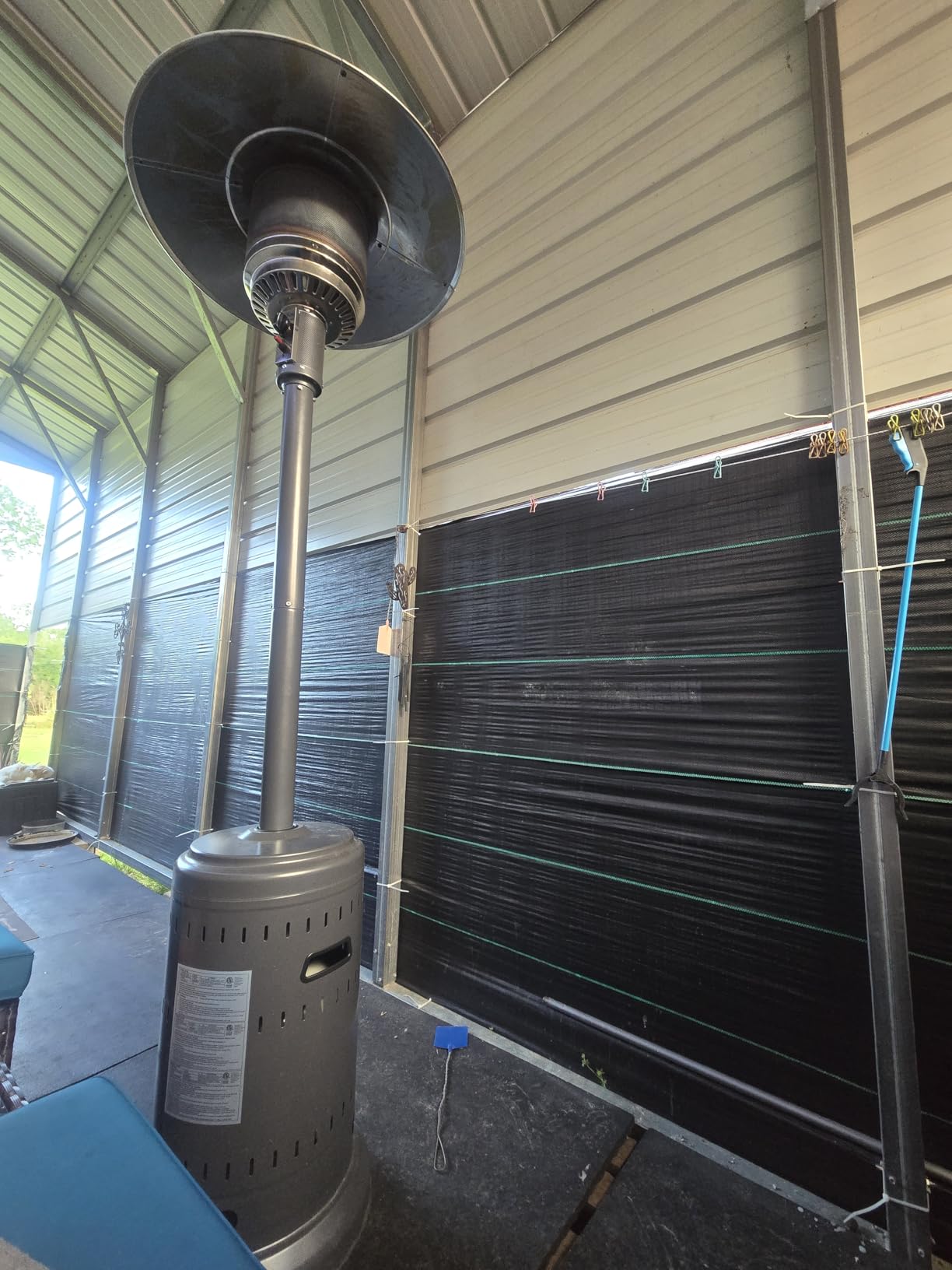
The safety design is worth noting because a tall pole of heated metal on a patio is exactly the sort of thing that tips over. This unit pairs a tilt safety auto-shut-off valve with a water-box base that acts as ballast, plus a security chain for anchoring. The water box is a genuine stabilizer on a level patio, and the tilt valve means that if it does go over, the gas stops rather than continuing to burn.
At 46,000 BTU the output is roughly five times the Portable Buddy’s high setting, so run time per tank is much shorter and fuel consumption at full tilt is noticeable. A 20 lb tank is the intended fuel source and is not included, which is normal for this category but catches out first-time buyers who assume the unit is complete.
Who the Amazon Basics patio heater suits
It is the right call for anyone heating an outdoor dining table, a covered deck, a balcony or a small commercial patio where guests need warmth at head and shoulder height. The 9-foot radius is a genuine circle around the base, so measure the table and its chairs and check that the whole group fits inside it.
It also works for a garage or workshop that is open to the weather or well ventilated, since the output is far beyond what any indoor-rated unit offers.
Where the Amazon Basics patio heater falls short
It is an outdoor unit, full stop. Never bring one into a garage, a porch enclosure or a room with a ceiling low enough that the rising heat collects above you. There is no oxygen depletion sensor because outdoor-rated equipment is not built for occupied enclosed air.
The 32 inch by 32 inch base needs clear, level ground and enough ceiling height to swing the unit around, and the tall column can be knocked by children or pets. If your patio is small or the ceiling is low, a tank-top radiant heater directs heat at people instead of heating a volume of air, and is often the better physical fit.
3. Mr. Heater Little Buddy 3,800 BTU – Best Budget Pick for Small Indoor Spaces
Mr. Heater 3,800 BTU Little Buddy Portable Radiant Propane Heater
Fuel: Propane
3,800 BTU radiant
Heats up to 95 sq ft
ODS and tip-over shut-off
1 lb cylinder
Pros
- Low 3800 BTU output suited to indoor use with ventilation
- Heats up to 95 sq ft for small rooms and RVs
- Tip-over and low-oxygen shut-off protection
- Connects directly to a 1 lb propane cylinder
- Quiet
- clean
- odor-free operation
Cons
- Single heat output with no adjustment
- Modest 95 sq ft coverage
- 3 year limited warranty excludes unauthorized attachments
The Little Buddy exists because of one rule: the less heat a propane heater puts into a room, the safer it is to run in an occupied space. At 3,800 BTU it is the smallest output in this roundup, and that is precisely why it is the most defensible indoor choice for a bedroom, a camper van or a home office where ventilation is limited.
In practice it does what a 95 sq ft room needs. Sit in a closed office or a small camper with the door shut and it will hold a comfortable temperature, and because it is radiant it warms you rather than the air, so you feel the effect immediately instead of waiting for the whole room to turn over.
It is also one of the most compact units here at 5.6 pounds, with an 8 inch round stand that uses almost no floor space. That matters in a van, a tent or a dorm room where a rectangular footprint you cannot walk past is a real problem.
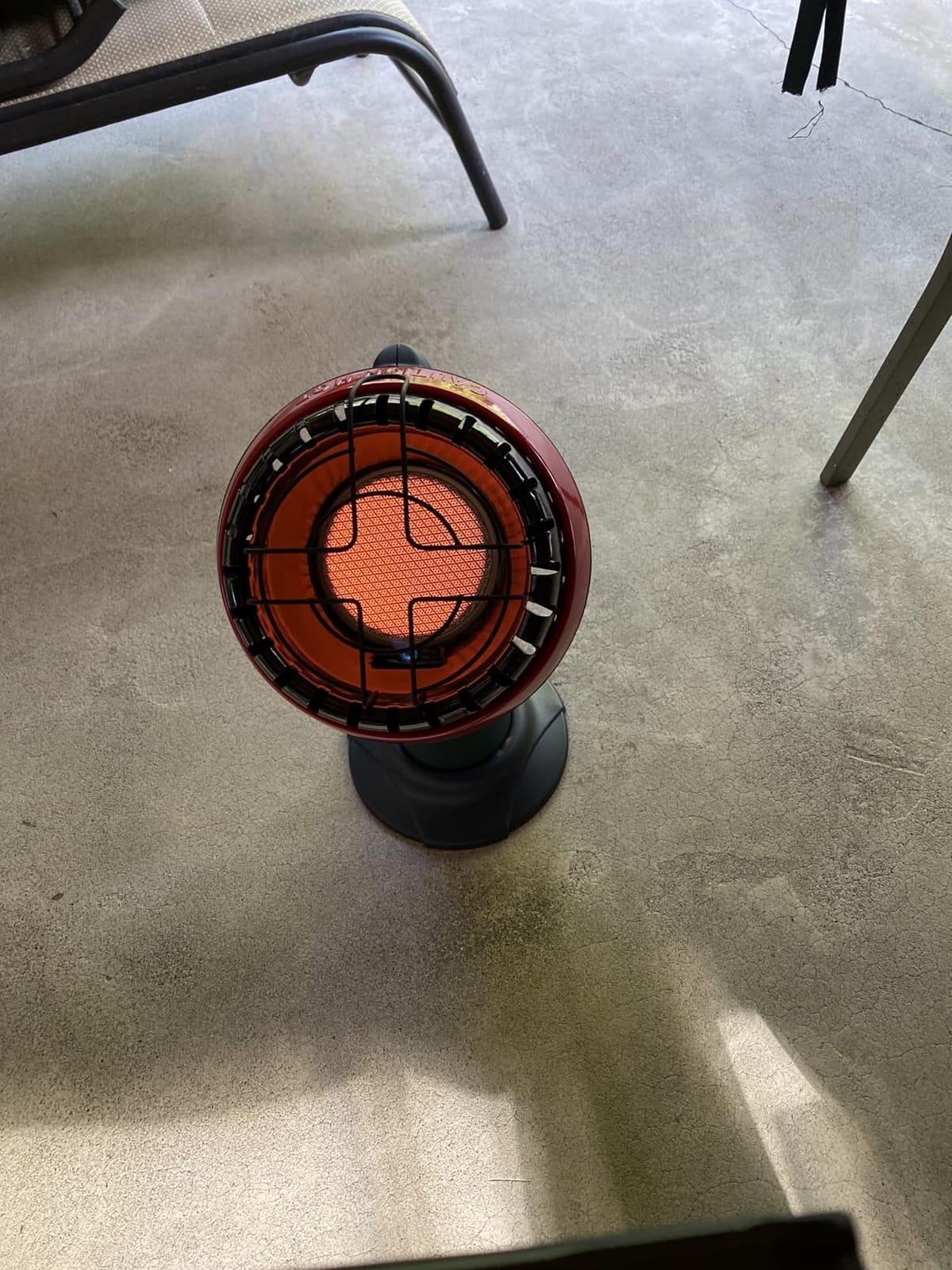
The single button ignition and the lack of any fan or motor mean it runs in complete silence, with no moving parts to fail and nothing to service. It connects directly to a 1 lb propane cylinder with no adapter, hose or regulator, so there is no leak-prone connection to make and nothing to bleed air out of on first light.
On the safety side it has both features that matter for an indoor unit: an automatic low-oxygen shut-off and a tip-over switch that cuts the gas if it is knocked off its stand. The warranty runs three years, which is longer than the one-year cover on most of the larger heaters in this roundup.
Its limitations are structural rather than fixable. There is one output with no setting to adjust, so you either run it or you do not, and 95 sq ft is genuinely small. It will not hold a 150 sq ft room with a window open, and it will not heat a garage, workshop or vehicle bay.
Who the Little Buddy suits
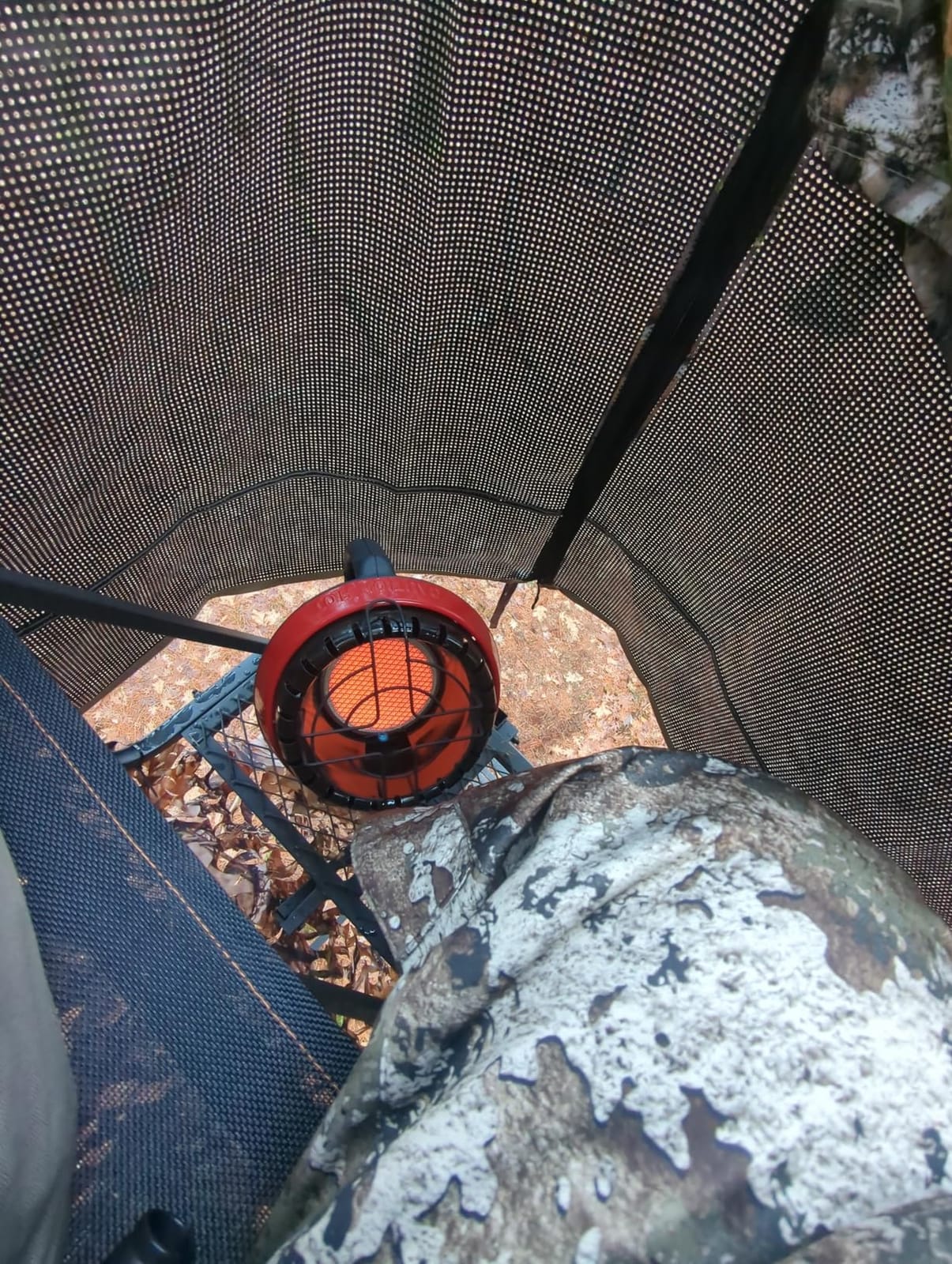
It is the strongest choice for a camper van, a pop-up tent, a small bedroom during an outage, a home office or a basement corner where the ceiling is low. Anywhere the space is small enough that 3,800 BTU is proportionate, it is the correct indoor pick.
It is also the lowest-cost way to add safe backup heat to a room, since it needs nothing beyond a 1 lb cylinder and a match-free push of a button.
Where the Little Buddy falls short
No heat adjustment means no way to respond to a cold snap or a sunny afternoon, which owners consistently put near the top of the complaint list. You also cannot use the low setting to hold a room at a stable temperature without cycling it on and off manually.
Its coverage claim of 95 sq ft assumes an enclosed, reasonably insulated space. In anything open to the air, or with a door opening regularly, the heat leaves faster than the unit can replace it, and you will exhaust a cylinder without ever reaching a comfortable temperature.
4. Mr. Heater 540-Degree Tank Top 45,000 BTU – Best for Large Outdoor Spaces
Mr. Heater Original 540-Degree 45,000 BTU Tank Top Radiant Propane Heater
Fuel: Propane
45,000 / 36,000 / 30,000 BTU
Mounts to a 20 lb tank
Approx 9.5 hrs on high
Outdoor use only
Pros
- 540-degree radiant head warms people all around the tank
- Three heat levels from 30000 to 45000 BTU
- Tip-over safety shut-off switch
- Mounts directly to a standard 20 lb propane tank
- Roughly 9.5 hours run time on high with a 20 lb tank
Cons
- Outdoor use only
- Most heat radiates upward unless the head is tilted down
- Propane use climbs quickly on the high setting
The 540-degree tank top is the heater you will find screwed onto a grill tank in thousands of garages, and it is still the most practical large-output radiant heater for a covered space. Where a patio tower heats a volume of outdoor air, this one heats a radius of people directly, which is why it performs so well in a partially sheltered garage or under a canopy.
It mounts directly to a standard 20 lb propane cylinder using the same connection as a grill, so if you already have a tank and a screw-on regulator there is nothing else to buy or plumb. That simplicity is a genuine advantage over forced-air units that need a hose and a regulator assembly.
Three heat settings at 45,000, 36,000 and 30,000 BTU give real control, and the run time of roughly 9.5 hours on high with a 20 lb tank is the figure that makes it easy to plan around. Owners running it in a garage during a cold morning routinely report the low setting being enough to keep the space usable once it has warmed up.
The reflector head is what separates it from a bare burner. It throws heat outward across a wide arc rather than letting it rise, and the head tilts, so you can aim it at a workbench or a seating area instead of at the ceiling. At 5.6 pounds and 17.5 inches tall, the whole assembly is light enough to move between a garage, a shed and a pop-up shop.
The one flaw owners mention most is heat direction. Out of the box the radiant output still favors a wide upward spread, so the single most valuable five seconds of setup is tilting the head down toward wherever people or work actually are. It also runs completely silently, which is why some owners use it to replace a noisy blower heater in a small shop.
A tip-over safety switch handles the main hazard of a unit that is literally bolted to a cylinder, cutting gas if the tank and heater are knocked over together. Note that the switch can latch after the unit is moved and needs the heater returned upright before it will light again.
Who the 540-degree tank top suits
It is the strongest pick for a garage with an open door, a covered patio, a gazebo, a shed, a market stall or a pop-up shop, and for anyone who wants substantial heat without a fan or a power cord. Because it is tank-top, it also suits people who rotate several 20 lb cylinders rather than committing to a large fixed tank.
The 30,000 BTU setting makes it practical for maintaining warmth in a space that has already been brought up to temperature, which is the cheapest way to use it.
Where the 540-degree tank top falls short
It is outdoor use only. There is no oxygen depletion sensor, no tip-over protection suited to indoor air quality and no insulation from combustion products, so it belongs outside or in a space that is effectively open to the air.
It also does not heat air, it heats surfaces and bodies, so an enclosed room with a low ceiling will end up hot at the top and cold at floor level. If you need to warm the air in a large space, a forced-air unit moves the heat through the room far faster and far more evenly.
5. Dura Heat TT-360 40,000 BTU – Best for Workshops and Tarp-Walled Spaces
Dura Heat TT-360 Propane(LP) 360 Degree Tank Top Heater, Length: 8.9in, Width: 8.9in, Height: 20.24in,Silver
Fuel: Propane
40,000 BTU radiant
Heating area up to 1,000 sq ft
Three heat levels
Outdoor use only
Pros
- Reported warming open workshops from the 20s F to the 60s F in 5-10 minutes
- Built-in tip-over shut-off triggered instantly on impact
- Quick-connect personalized L tank connection
- Chrome emitter guard and stainless steel reflector
- Quiet enough to replace blower-style heaters in a shop
Cons
- Much of the radiant heat flows straight up
- May not operate properly in windy conditions
- Tip-over switch can latch after the unit is moved
The TT-360 is the tank-top answer for a workshop that is not quite inside. Owners consistently describe using it in tarp-sided sheds, half-open carports and covered work areas where the wind is the limiting factor rather than the temperature, and the 1,000 sq ft stated heating area is among the largest coverage claims on any radiant unit in this roundup.
What owners report about performance is specific and checkable: temperatures in open structures moving from the 20s into the 60s within five to ten minutes on high. That speed comes from a wide 360 degree emitter and a stainless steel reflector that pushes heat outward rather than letting it pool above the unit.
It comes with the regulator and hose in the box, which removes the most common reason a new heater sits in a garage corner for a month. The quick-connect fitting is a personalized L tank connection, so it mates with standard grill cylinders without hunting for the right adapter.
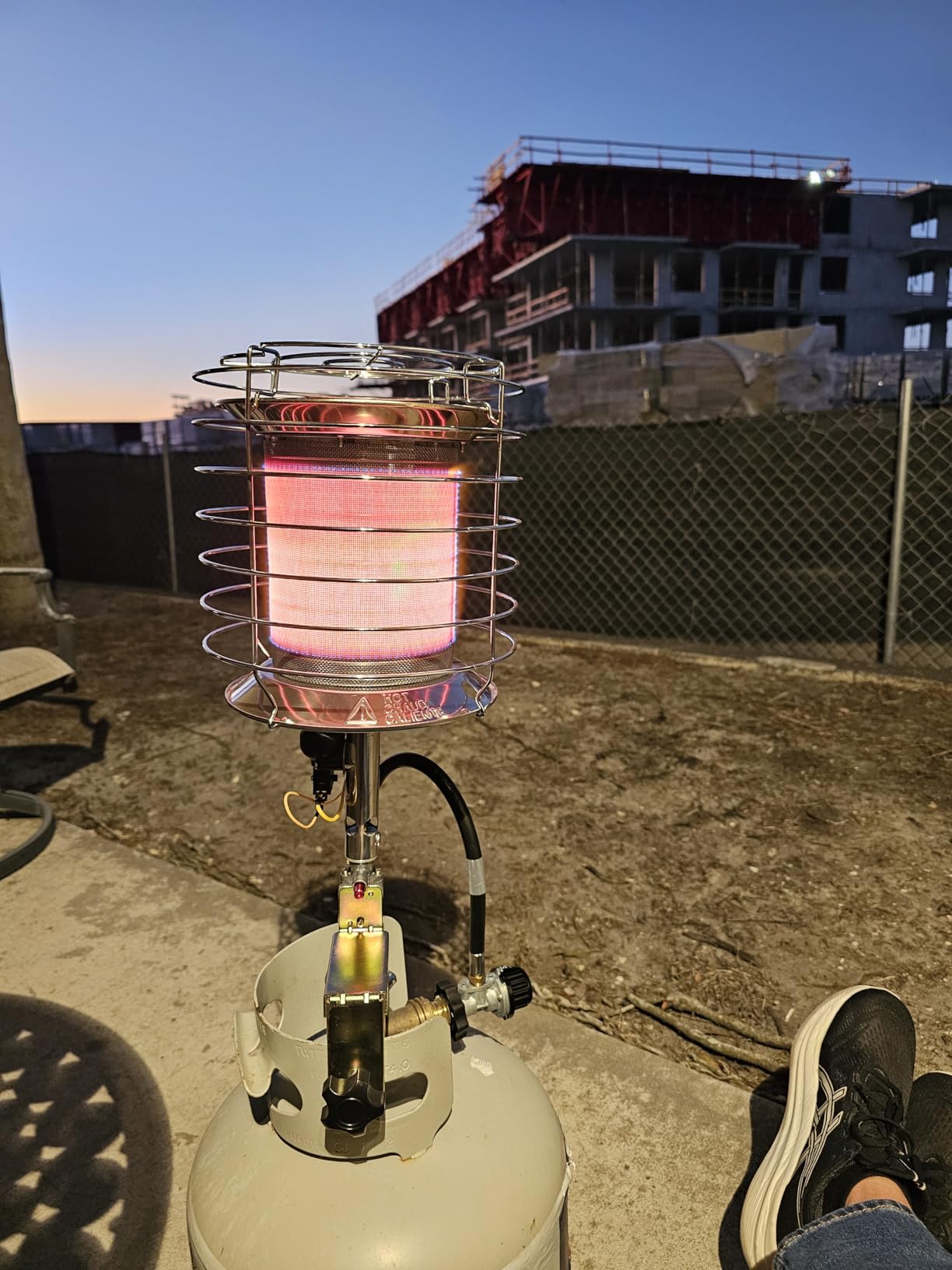
There is a chrome wind guard around the emitter, and it is not decoration. A radiant burner with an exposed element in moving air burns less efficiently and can be vulnerable to the flame being disturbed, and the guard is what lets the unit hold performance in a partly exposed structure. The tip-over shut-off is built in and has been reported triggering the instant the unit is bumped, which is exactly the behavior you want from a heater that lives on a busy shop floor.
Three heat levels give more than just an on and off, and the run is genuinely silent, so it can replace a loud blower heater in a space where you are trying to hear a radio, a conversation or a power tool running at the other end of the bench.
The recurring complaint is the same one that appears with every 360 degree radiant design, which is that a significant share of the heat still rises. A single-direction burner concentrates the output, but it also leaves cold air behind you, so the trade-off is deliberate rather than a defect. In windy conditions the manufacturer states the heater may not operate properly, which matters if your only shelter is partial.
Who the Dura Heat TT-360 suits
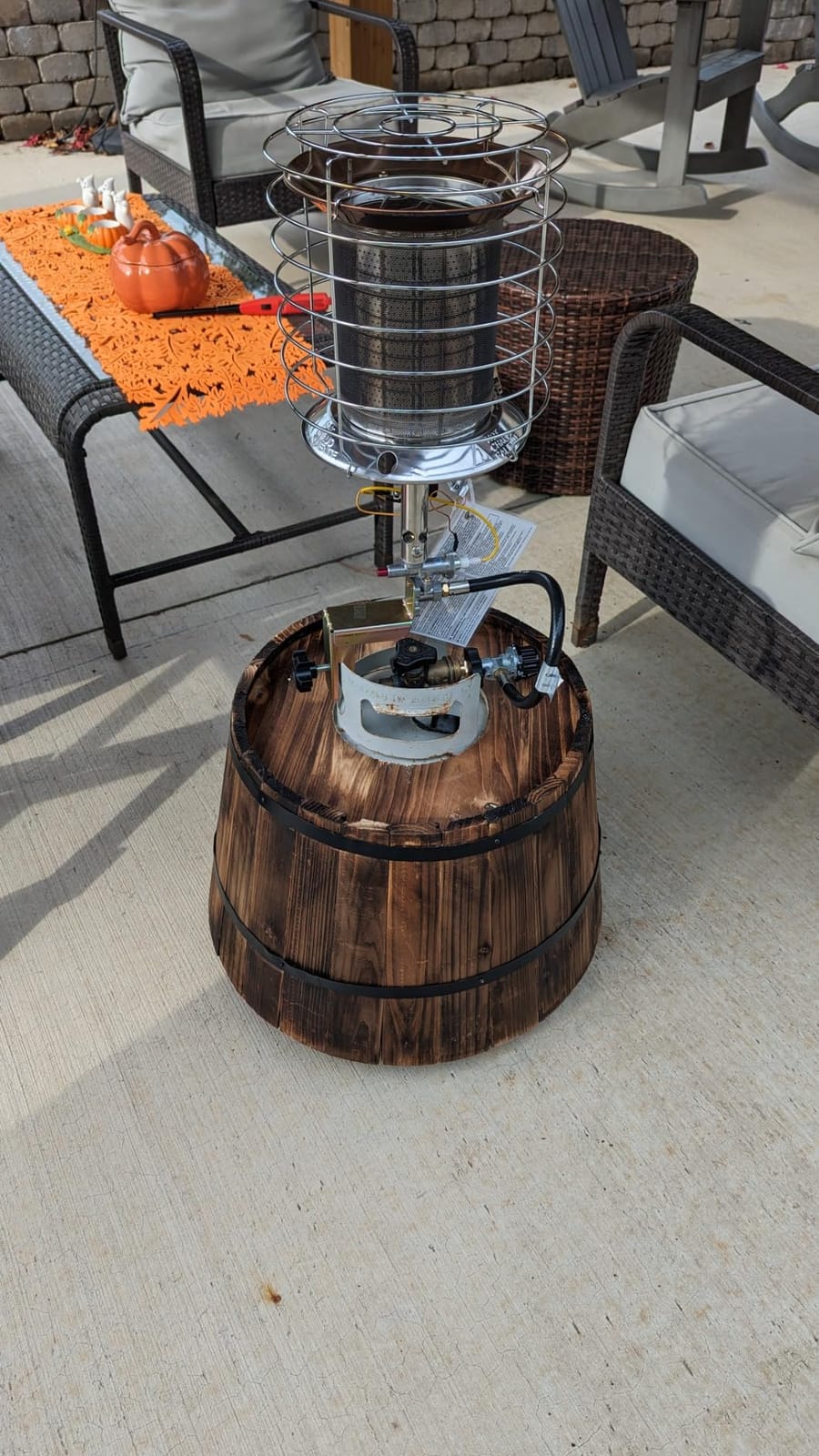
It fits a workshop, a shed, a carport, a covered deck or a jobsite where the space is open to the air but you want heat directed at people rather than at a thermostat. It is a strong choice for anyone who wants a large radiant output without carrying a fan assembly or a power cord.
Because the regulator and hose are included, it is also the least fiddly large-output heater to set up on a first attempt.
Where the Dura Heat TT-360 falls short
It is an outdoor-rated unit and should not be run in an enclosed garage. It needs a stable, flat surface for the tank, and the base mount is the part owners single out as less substantial than the rest of the assembly, so a slightly uneven floor is worth checking before you light it.
Fuel consumption is high on every setting, including low, and the tip-over switch may latch after transport and require the unit to be set upright and reset. If you need to heat air in a fully enclosed space, this is the wrong category entirely.
6. GASLAND 18,000 BTU Cabinet Heater – Best When the Tank Must Stay Out of Sight
GASLAND 18,000 BTU Propane heater Outdoor, Max Heat 450 Sq.Ft, MHA18W
Fuel: Propane
Up to 18,000 BTU in 3 modes
Spaces up to 450 sq ft
20 lb cylinder
No electricity required
Pros
- Cabinet design houses the propane tank out of sight
- Built-in rolling wheels and carry handle
- Tip-over and low-oxygen shut-off protection
- Three heating modes up to 18000 BTU over 450 sq ft
- Runs without electricity during power outages
Cons
- Outdoor rated for ventilated spaces
- Heavy cabinet build for a mid-sized space
Every tank-top heater in this roundup puts a bare propane cylinder in the middle of your floor. If that visual bothers you, the GASLAND cabinet is the alternative: the 20 lb tank sits inside the housing, the hose routing is contained, and the unit reads as a piece of furniture rather than a fuel container with a burner bolted to it.
It is also the only radiant heater in this roundup above 15,000 BTU that carries both a tip-over switch and a low-oxygen cutoff, which makes it useful in semi-enclosed settings like a garage that is closed during the day and ventilated when you are working in it, or a covered patio area with a roof and partial walls.
Three modes deliver up to 18,000 BTU across a stated 450 sq ft, which puts it in the same class as the Portable Buddy’s top setting with roughly double the coverage area. Built-in rolling wheels and a carry handle mean one person can move it between the garage, the patio and a utility building without a dolly.
It runs entirely on gas with no electrical connection required, which keeps it usable during the power outages that are the reason most people buy a propane heater in the first place. Operation is quiet enough for reading, desk work or an outdoor meal, with no fan motor running over a conversation.
Buyers describe it as suitable for construction sites, patios, workshops, small factories, barns and sporting events, and the enclosure is the reason it looks presentable in any of those. The safety package is CSA certified and includes both the tip-over switch and the low-oxygen cutoff, which sets it apart from most radiant heaters of comparable output.
It is rated for outdoor use and for ventilated spaces, and the manufacturer is clear about that. It is also physically larger than a bare tank-top heater because of the cabinet, at 17.5 by 15 by 21.7 inches, and it costs more than a plain radiant head delivering comparable BTU. Neither issue matters if appearance and safety features are your priorities, and both do if you are simply chasing the most heat per dollar.
Who the GASLAND cabinet heater suits
It is the right pick for a garage, workshop, covered patio or utility building where a visible propane tank is unacceptable, and for anyone who wants tip-over and low-oxygen protection on a radiant unit. The mobility features suit users who move heat between spaces seasonally.
It also works as emergency heat during an outage since it needs no electricity.
Where the GASLAND cabinet heater falls short
Because it is rated for outdoor use and ventilated spaces, it should not be run in a closed room. The 450 sq ft coverage claim assumes reasonable insulation, and in an open or leaky structure the output goes into the air rather than into the space you occupy.
There is no thermostat, so temperature control means choosing among three modes and adjusting them yourself, and the cabinet adds weight and bulk relative to a bare radiant head when you need to move it frequently or fit it into a tight corner.
7. Dyna-Glo Delux 30,000-60,000 BTU – Best for Variable Forced-Air Garage Heating
Dyna-Glo Delux RMC-FA60DGD 30,000 – 60,000 BTU LP Forced Air Heater
Fuel: LP gas
30,000-60,000 BTU variable
Heats up to 1,350 sq ft
10 ft hose and regulator included
Pros
- Continuously variable 30000 to 60000 BTU output
- Heats up to 1350 sq ft with adjustable heat angle
- Continuous electronic ignition prevents delayed ignition
- Overheat auto shut-off with 10 ft hose and regulator
- Arrives essentially ready to run
Cons
- Thin sheet metal and a flexing handle
- Very short power cord in practice
- No on/off switch so the fan runs when plugged in
A torpedo or salamander style forced-air heater is the right tool when you need to warm a large volume of air quickly and evenly, and the Dyna-Glo Delux is the version of that tool with the most useful control in the group. Instead of two or three fixed settings, its output is continuously variable from 30,000 to 60,000 BTU, so you can dial the heat down to hold a temperature rather than cycling the burner.
Owners report taking a 22 by 23 ft garage from 28 °F to 56 °F in about an hour on high. That kind of speed is what separates forced air from radiant: the fan pushes warmed air through the space, so you feel it at the far end of the garage within minutes rather than standing next to the unit.
The adjustable heat angle lets you aim the outlet at a workbench or a vehicle rather than heating the entire room uniformly, which is genuinely useful in a workshop with one job to do. The 1,350 sq ft coverage claim is right at the boundary of what a 60,000 BTU forced-air heater will hold in a moderately insulated space.

Ignition is continuous electronic, which means the igniter does not stop between cycles and a delayed ignition, the failure mode that causes gas to accumulate before lighting, cannot occur. Overheat auto shut-off provides a second layer of protection, and a 10 ft hose and regulator are included in the box.
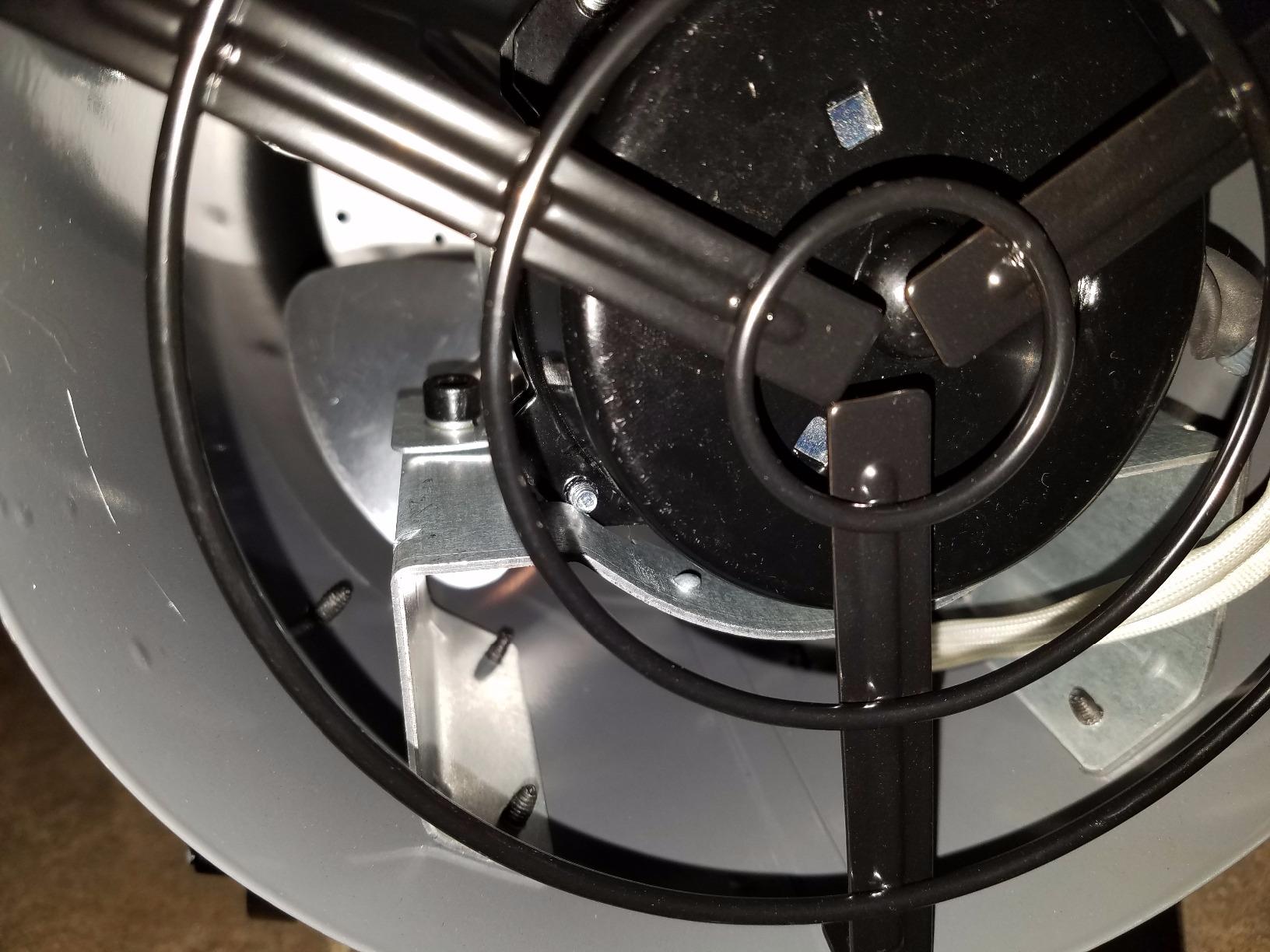
Its criticism is about build rather than performance, and owners are blunt about it. The sheet metal is thin, the carry handle flexes noticeably, and the power cord is short enough that you will be reaching for an extension. There is no on/off switch, so the fan runs the moment it is plugged in. A few units have also arrived with a bent fan blade, which is worth inspecting before the first light.
Forced air also brings noise and a moving volume of air past you, both of which matter in a space you plan to sit in rather than work in. Forum owners repeatedly point out that a heater of this class dries the air and can raise humidity problems in a space that is not well ventilated.
Who the Dyna-Glo Delux suits
It fits garages, barns, basements and workshops where the goal is to raise the air temperature throughout the space, and the continuously variable output makes it the easiest of the forced-air units here to hold a steady temperature. It is also a strong choice for spot heating a specific work area with the tiltable outlet.
Owners who want to get it running immediately will appreciate that it arrives essentially assembled with the hose and regulator included.
Where the Dyna-Glo Delux falls short
Build quality is the honest limitation. Thin sheet metal and a flexing handle will not stop it from heating a garage, but this is not a unit you want to move around repeatedly or drag across a floor, and the short cord means an extension is effectively part of the purchase.
The lack of an on/off switch, the constant igniter and the fan noise make it a poor choice for a quiet indoor room. It is also unsuited to enclosed residential spaces, where the volume of warm air it moves will carry combustion products and moisture into the room rather than exhausting them.
8. Remington 60,000 BTU Forced Air Heater – Best for Jobsites and Large Open Spaces
Remington LP Forced Air Heater, Portable 60,000 BTU Space Heater for up to 1500 Square Feet – Liquid Propane Gas Powered, Tank Not Included
Fuel: Propane
60,000 BTU forced air
Spaces up to 1,500 sq ft
11 lb steel body
20 lb tank not included
Pros
- Heats spaces up to 1500 sq ft with a warm garage in 10-20 minutes
- Heavy-duty steel construction at 11 pounds
- Variable heat settings with adjustable height
- Thermocouple
- high-temp limit and flame-out fuel cut-off
- Electronic ignition with 10 ft hose and regulator
Cons
- Very loud and unsuited to quiet indoor spaces
- Power cord is under 1 foot
- LP fitting can be stubborn on a standard grill tank
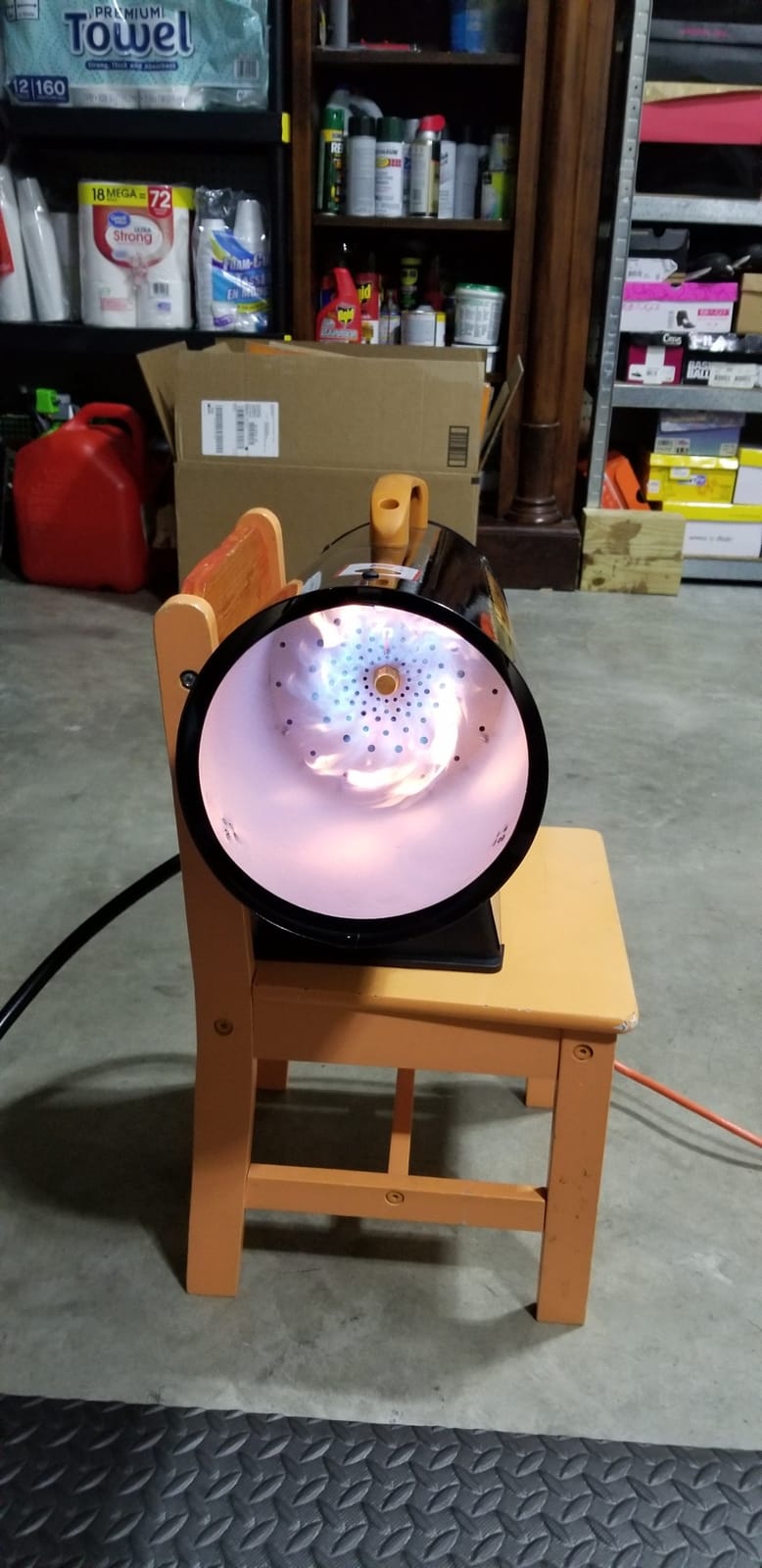
Where the Dyna-Glo trades build quality for range, the Remington trades range for construction. At 11 pounds of steel rather than thin sheet metal, it is built for a jobsite, a truck bed and a shop floor rather than for a room, and owners describe it as a workhorse without qualification.
The 1,500 sq ft stated coverage is at the top of the forced-air range here, and owners report a garage becoming comfortably warm in ten to twenty minutes. That speed comes from a 60,000 BTU burner feeding a fan that distributes the air across the space rather than relying on natural convection.
Its safety package is a three-part system. A thermocouple monitors the flame, a high-temperature limit provides an overheat cut-off, and a flame-out fuel cut-off closes the gas when the burner goes out. Electronic ignition removes the manual lighting step entirely, and a 10 ft hose with regulator is included.
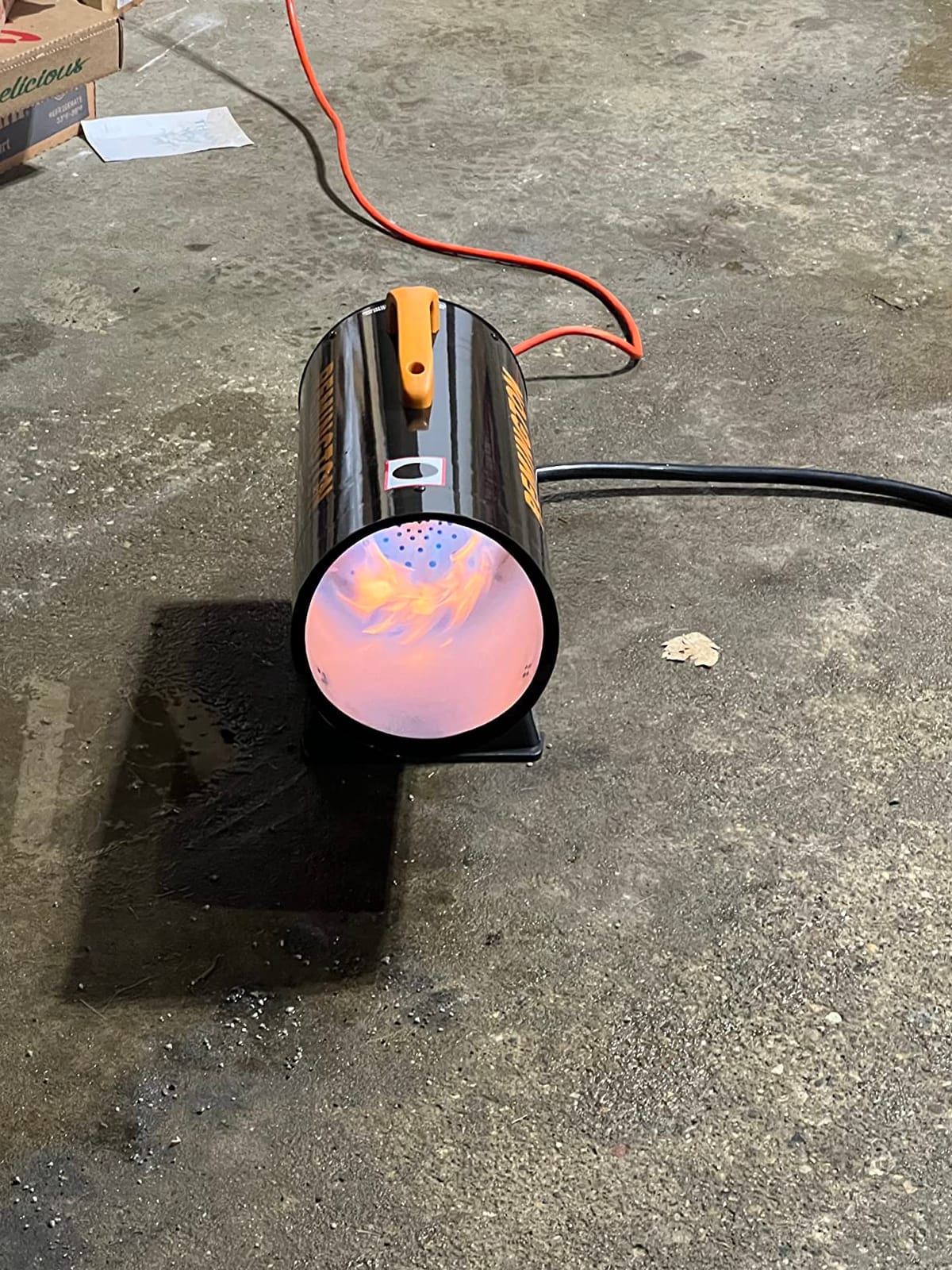
Variable heat settings plus adjustable height let you aim the output at a specific task and tune the air volume to the space. There is also a heat-sensitive indicator sticker that changes colour when the unit is cool enough to handle, which is a small courtesy that matters when you are moving equipment around it on a busy site.
Noise is the complaint that decides this heater for you. Owners describe it as very loud, and several cite noise as the reason for returning it. If you plan to work quietly nearby, or heat a room where anyone will be trying to sleep or hold a conversation, this is the wrong unit, and no amount of output compensates.
Two smaller issues are worth planning around. The power cord is under a foot long, so treat an extension as required equipment. And the LP fitting can be stubborn to thread onto a standard grill tank, so allow time and some force at first light rather than assuming something is wrong.
Who the Remington 60,000 BTU suits
It is the strongest pick for a construction site, a large open garage, a warehouse bay, a vehicle maintenance space or a workshop where durability and fast warm-up matter more than quiet. The steel body and the triple safety package suit users who will move the unit repeatedly and cannot supervise it continuously.
It runs on a 20 lb propane tank that is not included, so plan on a cylinder and a service plan for it if you are using it regularly.
Where the Remington 60,000 BTU falls short
It is rated for outdoor use and large ventilated spaces, and at 60,000 BTU it should not be run in a room where people live or sleep. Even in a large garage, run it with the door open and expect a ventilation plan.
The fan noise rules it out for quiet indoor use entirely, the sub-one-foot power cord is impractical without an extension, and the 20 lb tank is an extra cost that catches buyers who assumed the heater was complete.
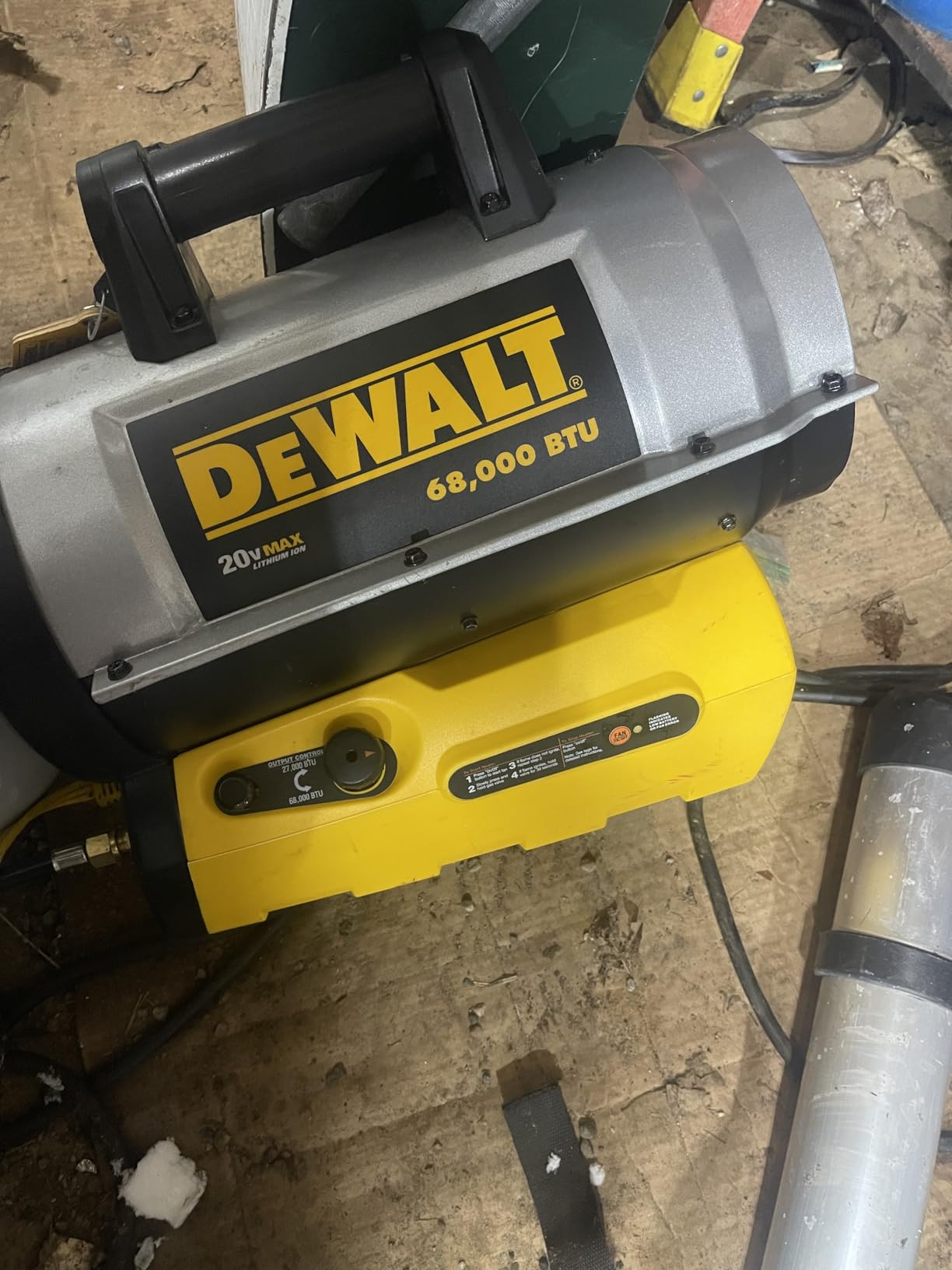
9. DEWALT 68,000 BTU Forced Air Heater – Best for Off-Grid and Battery-Powered Heat
DEWALT 68000 BTU/H 1700 SQ FT Forced AIR Propane Heater
Fuel: Propane
68,000 BTU forced air
Covers 1,700 sq ft
Runs on 20V battery or 120V AC
Pros
- Runs on DEWALT 20V or 20V MAX batteries or 120V AC
- 68000 BTU covering 1700 sq ft
- Clean propane burn with no diesel-like fumes
- Conservative fuel use so a 20 lb tank lasts days on low
- Includes hose and regulator assembly
Cons
- No built-in thermostat so it must be cycled manually
- Fan noise is loud on high
- Can be hard to start in extreme cold without a low warm-up
Every other forced-air heater in this roundup needs mains power from a wall. The DEWALT runs its fan from a DEWALT 20V or 20V MAX battery, or from 120V AC when you are near an outlet. In a barn, a horse stall, a tool trailer, a remote cabin or a construction site with no power, that single design decision is worth more than any amount of extra BTU.
Its 68,000 BTU output covers a stated 1,700 sq ft, the largest coverage figure of any unit here, and owners report taking a detached garage from 30 °F to 70 °F in about an hour. The adjustable heat angle lets you point the output at a work area or a corner rather than the whole volume.
The fuel behaviour is what makes it efficient in practice. Owners report conservative consumption with a 20 lb tank lasting multiple days on the low setting, and a clean propane burn with no diesel-like fumes or odor, which matters in an enclosed vehicle or a room where people are working.
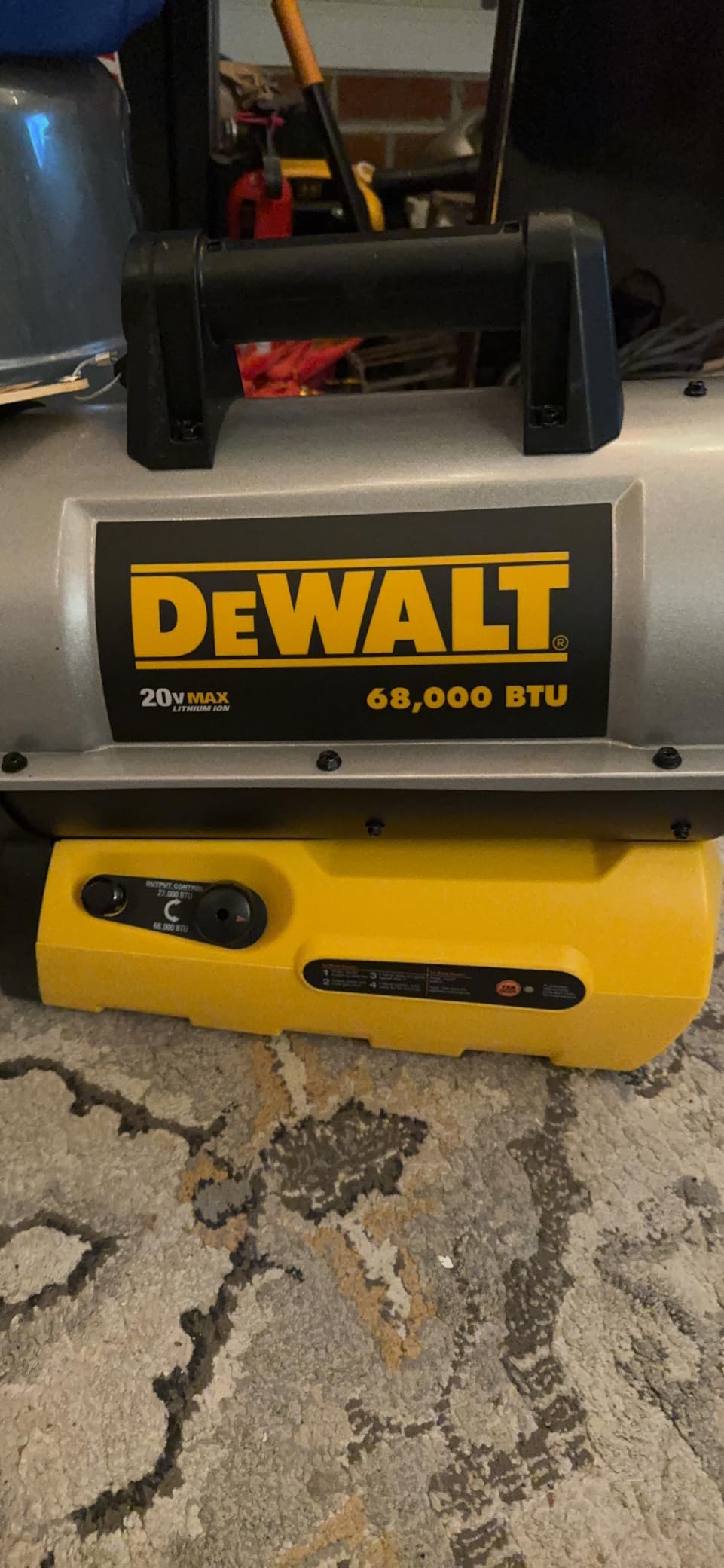
It is also quiet enough on low for a small shop or a trailer, which no 60,000-plus BTU forced-air unit can honestly claim. The hose and regulator assembly is included, and a two year parts warranty is longer than the one-year cover carried by the other forced-air heaters here.
The requests that come up most are about control and noise. There is no built-in thermostat, so you cycle it manually, and on high the fan is loud in the way all units of this size are loud. A few owners also report difficulty starting in sub-zero temperatures without a warm-up cycle on low first, which is a carburetion and fuel-pressure behaviour worth knowing about before you need it.
Because the fan is battery or mains powered, a dead battery is the new low-fuel scenario. If the site has no outlet, budget for a spare pack and for the shorter runtime it gives you on the high setting.
Who the DEWALT 68,000 BTU suits
It is the right choice for anyone already invested in the DEWALT battery platform, and for off-grid heat in barns, sheds, tool trailers, hunting camps and remote workshops with no reliable outlet. The 1,700 sq ft reach also makes it the strongest single unit for a large detached garage that needs occasional heat rather than continuous heating.
For a well-insulated space it heats quickly and economically, and it can be run quietly on low.
Where the DEWALT 68,000 BTU falls short
Without a thermostat you manage the cycle yourself, and in a large space that means walking over to adjust it repeatedly rather than setting a target temperature once. On high, the fan noise is substantial.
Starting in deep cold can require a low-setting warm-up first, and if you are running purely on battery the runtime is bounded by the pack rather than the tank. It also does not deliver the raw heat of a much larger forced-air installation, so for a very large open building you may need more than one unit or a suspended system instead.
10. XtremepowerUS 30,000 BTU Dual Burner – Best for Focused Heat on a Porch or Workbench
XtremepowerUS 30,000 BTU Propane Tanktop Heater Infrared Dual Burner Safety Shut-Off Valve, Tip-Over Switch for Garage, Camping, Hunting Double Burner
Fuel: Propane
Dual burner up to 30,000 BTU
Heating area up to 750 sq ft
Mounts to a 20 lb cylinder
Pros
- Hooks straight to a 20 lb propane cylinder with no assembly
- Three adjustable heat levels up to 15000 and 30000 BTU
- Tip-over switch cuts gas flow if knocked over
- Rust-proof steel frame with chrome emitter guard
- Metal dish focuses heat and resists wind
Cons
- Needs matches lit through the side ignition hole
- Occasional shipments arrive without mounting screws
- Heat is directed mainly to one side
This is the one heater here designed to aim heat rather than surround you with it. The metal dish reflects the output of the dual burner forward into a defined area, so if you have a specific spot to warm, a porch bench, a workbench, a hunting blind or a spot at an outdoor event, the 30,000 BTU lands there rather than dispersing.
It covers a stated 750 sq ft, mounts directly to a 20 lb cylinder with no assembly required, and offers three adjustable heat levels reaching 15,000 and 30,000 BTU. The low-profile shape also means it can be used on a porch without a ceiling or the fire risk that a taller unit brings with it.
The dish also resists wind, which is the practical difference between this and a bare burner in an exposed location. On a metal frame with a chrome emitter guard against scalding, it is also straightforward to set up: it goes on the tank and lights.
The tip-over switch shuts off gas flow if the unit is knocked, which is worth having on a heater intended for outdoor events and busy patios. The rust-proof steel frame is a sensible choice for a device that will live outdoors through the season.
The significant practical drawback is ignition. There is no push button or electronic igniter, so lighting it means putting a flame through the side ignition hole with a match or a lighter, and that is a real consideration in a dark yard, in rain or wherever children are around. Some shipments have also arrived without the mounting screws required to secure it to the tank, so check the box before you leave the porch.
Finally, heat directed mainly to one side is a feature when you want to warm a bench and a limitation when you want to warm a group sitting in a circle. Buyers who expected even 360 degree distribution tend to be the ones who return it.
Who the XtremepowerUS suits
It fits low-heat-density situations where a small group or a single spot is the goal: a porch, a patio corner, a garage workbench, a camping or hunting setup, a fishing shelter, or an outdoor event with a defined seating or working area. The low profile suits porches with limited overhead clearance.
If you want to spend the least and aim heat at one place, this is the most direct way to do it.
Where the XtremepowerUS falls short
Match lighting is the main complaint, and it is unavoidable with this design. Combined with the one-sided heat distribution, it makes the unit a poor choice for warming a whole outdoor area evenly.
It is an outdoor-rated radiant heater with no indoor safety package beyond the tip-over switch, so it has no place inside a living space. And because the 20 lb cylinder is not included and the mounting hardware can be missing from a shipment, allow for a small setup project rather than expecting a one-button start.
How to Choose a Propane Heater (October 2026)
Once you have decided the job, choosing is mostly four decisions: what kind of heat delivery you need, how many BTU the space can lose, what tank you will run, and which safety ratings the installation demands. Here is how each of those actually works.
Heater type explained: convection, radiant, catalytic and forced air
Radiant heaters emit infrared heat from a burner or a reflector. They warm you and the surfaces in front of them rather than the air, run silently with no fan, and are the most common indoor design because there is no motor to fail during a blackout. Every tank-top unit and the Buddy heaters in this roundup are radiant.
Forced-air heaters add a fan that pushes warmed air through the space. This is the only design that heats a large volume of air quickly and evenly, which is why it dominates garages and workshops. The cost is noise, a power cord or a battery, and faster combustion of fuel.
Convection heaters warm air naturally, without a fan, by relying on the chimney effect. They are gentler but slower, and they are a good match for a small closed room where noise would be unwelcome.
Catalytic heaters are a different chemistry entirely. A perforated catalytic plate burns propane at roughly 720 °F rather than the 2,100 °F of an open flame, which makes them far more fuel-efficient and produces almost no carbon monoxide. They are the standard choice for RV and van use, and they are worth considering if your heating need is continuous and unattended rather than occasional.
Input versus output is the number most buyers get wrong. A heater rated at 45,000 BTU is burning fuel at a 45,000 BTU input rate, and after flue and heat losses roughly 17 to 19 percent of that never reaches the room. That is why experienced owners talk about a 45,000 BTU input heater delivering something closer to 37,000 BTU of usable heat, and why an undersized unit in a leaky garage will run continuously without ever reaching temperature.
Sizing BTUs to your space
The rule of thumb garage owners use is 20 to 30 BTU per sq ft for a well-insulated space, and 30 to 50 BTU per sq ft for an uninsulated one. Applying that: a 1,000 sq ft insulated garage needs roughly 20,000 to 30,000 BTU, while a 1,000 sq ft uninsulated garage with a big door open needs closer to 50,000 BTU and may need more than one unit.
For living spaces the numbers are far lower. A 225 sq ft room on the Portable Buddy at 9,000 BTU is roughly 40 BTU per sq ft, which is why it holds temperature in a room and a radiant heater rated far higher would be both unnecessary and unsafe there.
Three variables change the answer more than square footage does. Insulation is the biggest of them, and forum advice is consistent: insulate before you buy. Adding R-13 fiberglass to garage walls and an insulated garage-door kit routinely outlasts a winter of propane burn, because every unit of heat you stop losing outside is a unit you no longer have to buy. Air leakage through a big garage door or a leaky window can exceed the wall loss entirely.
Ceiling height matters as well, since warm air stratifies, and altitude matters more than most buyers expect. Above roughly 6,000 ft the thinner air means less oxygen available for complete combustion, and heaters are derated or may not ignite reliably at their rated output. Above that elevation, a high-altitude-rated model or a blue flame heater with a modulating gas valve is the right choice, and you should confirm the rating before relying on a unit in a mountain cabin.
Run time per fuel tank and the cost of heat
Run time is where the published specs help most, because it is the one figure that is close to arithmetic. A propane gallon yields about 91,500 BTU of energy, and a 20 lb cylinder holds about 4.7 gallons of usable fuel, so roughly 430,000 BTU is available in a full 20 lb tank. A 1 lb cylinder holds about one twenty-fifth of that, around 21,500 BTU. At full burn, those totals are the basis for the runtime figures below.
1 lb cylinder at 4,000 BTU: about 5.4 hours, matching the Portable Buddy low setting
1 lb cylinder at 9,000 BTU: about 2.4 hours, matching the Portable Buddy high setting
20 lb tank at 18,000 BTU: about 21 to 23 hours, consistent with what owners of the larger Buddy report
20 lb tank at 45,000 BTU: about 9.5 hours on high, matching the 540-degree tank top specification
20 lb tank at 60,000 BTU: roughly 7 hours, and expect less in an uninsulated space where the unit cycles to hold temperature
100 lb tank at 20,000 BTU: on the order of 100 to 120 hours, which is several days of continuous running
100 lb tank at 60,000 BTU: roughly 30 to 35 hours
Two practical limits apply. Small cylinders have a withdrawal rate ceiling, and a 1 lb cylinder cannot supply a 40,000 BTU burner at all; pushing one causes the pressure to drop, the flame to weaken and the cylinder to cool until the liquid inside can freeze, which is the freeze-up failure owners describe most often. For anything above roughly 9,000 BTU you need a 20 lb tank or larger, and a 100 lb tank also burns less fuel per hour of heat than a 20 lb cylinder.
Moving a 100 lb tank is a real consideration, since the filled cylinder weighs well over 100 pounds. Many owners work around it with a hand truck or a stair-climbing dolly rather than trying to lift it.
Blue flame vs infrared radiant heat
A blue flame burns the propane efficiently and heats the air, which makes it the right choice for warming a whole space quickly. It also produces more carbon monoxide per unit of heat than infrared radiant output, which is why ventless blue flame units for indoor use carry strict low-BTU and safety requirements.
Infrared radiant output sends heat as light in the infrared band, which means you feel it on your skin at a distance while the air around you stays cool. That is the correct choice when you are sitting still, outdoors, or in a drafty space, and it is why patio heaters and tank-top heaters are radiant.
For a garage where you are moving around and working, forced air wins. For a patio or a porch where people are stationary, radiant wins. For a small closed room, low-output radiant wins on safety.
Installation styles: portable, tank top, suspended and wall mounted
Portable units stand on the floor and are the easiest to move, which suits emergency heat and occasional use. Tank-top heaters mount directly to the cylinder valve, which means no hose to run and no leak points beyond the tank connection, and they are the simplest option for a covered outdoor space.
Suspended forced-air units, which you can read about in our ceiling mounted heater guide, are the permanent-garage answer. Mounted above the work area, they push warm air down to where you are instead of heating the ceiling, and they leave the floor clear for a vehicle. Wall-mounted ventless infrared or blue flame units are another permanent option and save floor space, but they need a wall and they add combustion products and moisture to the room.
If your goal is a permanently heated garage, we cover the full comparison in our propane garage heater guide, and if electricity is available, our electric garage heater picks run quieter and need no combustion. We also cover the broader category in our garage heater roundup, and what to do when the power is out for a long stretch in our propane generator guide.
Propane Heater Safety: What Indoor-Rated Actually Means
Every propane heater produces carbon monoxide. Indoor-rated does not mean safe in a sealed room, it means the unit was designed and certified to shut itself down before the surrounding air becomes unsafe.
There are two sensors that matter, and both should be present on any unit you intend to run in an occupied space. An oxygen depletion sensor measures the oxygen level around the burner and cuts the gas if it drops below a safe threshold, which is the protection that matters in a closed room. A tip-over switch closes the gas valve if the unit is knocked off its feet or its base, which prevents a burning unit from dumping fuel onto a surface.
Outdoor-rated units have neither, because they are built to be used where air is replaced continuously. Bringing a tank-top heater or a patio tower into a garage, a porch enclosure or an attic is the single most dangerous mistake people make with these products, and it is worth saying plainly.
A few more rules that follow from the same logic. Do not run any propane heater in a bedroom while you are asleep unless it is specifically indoor-rated and the room has a working detector, and keep a working carbon monoxide detector in any space where fuel burning occurs. Maintain clearance from combustibles, do not extend a regulator hose beyond its rated length, and check the hose and connector for damage before every season. Keep the tank upright and outdoors when not in use.
For garage owners specifically, run any fuel-burning heater with the door open and consider the moisture it adds. Forced-air units move a large volume of air, and in a cold garage that air condenses, which can damage stored antiques, electronics and finished surfaces over time. This is the argument for insulating first and heating second.
One final caution: if you are installing a permanently mounted heater, check the local codes and any manufacturer restrictions on clearance to combustible materials, and never assume an unvented unit is acceptable simply because it is sold for garages.
Frequently Asked Questions
What type of propane heater is the most efficient?
Catalytic heaters are the most fuel-efficient, burning at roughly 720 F instead of the 2,100 F of an open flame, which cuts consumption and produces almost no carbon monoxide. Among flame heaters, continuous variable forced-air models waste less fuel than fixed-output heaters because you can dial the burner down instead of cycling it. Expect to lose roughly 17 to 19 percent of a heater’s input BTU rating to flue loss, so a 45,000 BTU input unit delivers about 37,000 BTU of usable heat.
What is the safest propane heater for indoor use?
The safest indoor propane heaters are low-output radiant units fitted with both an oxygen depletion sensor and a tip-over shut-off switch. In this roundup the Mr. Heater Little Buddy at 3,800 BTU is the most defensible indoor choice, with the Portable Buddy at up to 9,000 BTU as a step up for larger rooms. Even these must be run with ventilation and clearance from combustibles, and never as the only heat source while you sleep without a working carbon monoxide detector.
How long will a 100 lb propane tank run a 20,000 BTU heater?
A full 100 lb propane tank holds about 23 gallons, which works out to roughly 2,100,000 BTU of fuel energy. At a 20,000 BTU burner that is on the order of 100 to 120 hours of continuous running, or several days. Real-world run time runs shorter in a poorly insulated space because the heater cycles to hold temperature, and a 100 lb tank also burns less fuel per hour of heat than a 20 lb cylinder.
Is a blue flame or infrared propane heater better?
A blue flame heats air, so it warms a whole space quickly and works well in a garage or large room. Infrared radiant output heats your body and the surfaces in front of you while the surrounding air stays cool, so it feels effective immediately and suits patios, porches and quiet outdoor seating. Choose blue flame or forced air for a large enclosed space, and infrared radiant for stationary people in a drafty or outdoor setting.
How many BTUs do I need for a 1000 square foot garage?
Budget about 20 to 30 BTU per sq ft for a well-insulated garage, which puts a 1,000 sq ft insulated space at roughly 20,000 to 30,000 BTU. For an uninsulated garage with a large door opening regularly, use 30 to 50 BTU per sq ft, so 30,000 to 50,000 BTU. Remember that input ratings lose roughly 17 to 19 percent to flue loss, and that insulation and door seals frequently save more fuel than a larger heater.
How long does a 60,000 BTU propane heater last on a tank?
On a standard 20 lb propane cylinder, a 60,000 BTU forced-air heater runs roughly seven hours on high, and considerably longer on low. A 100 lb tank extends that to around 30 to 35 hours at full output. Run time shortens in uninsulated spaces because the unit cycles to maintain temperature, and a heater running continuously at high output in a leaky garage can empty a 20 lb tank faster than most owners expect.
Which Propane Heater Should You Buy?
If you take one recommendation from this roundup of the best propane heaters for 2026, take this one: the Mr. Heater Portable Buddy 9,000 BTU is the safest default. It is indoor and outdoor approved, it has a genuine low-oxygen emergency system, its owner base is by a wide margin the largest of anything here, and its two settings let you scale down to 4,000 BTU when a small room is all you have.
Match the rest to the job. For the smallest safe indoor space, the Little Buddy. For broad outdoor radiant heat in a garage or covered deck, the 540-degree tank top. For a patio table, the Amazon Basics 46,000 BTU tower. For a workshop with one spot to warm, the XtremepowerUS dish. For a garage that needs warm air, the Dyna-Glo for its continuous variable output, the Remington for its steel construction, or the DEWALT for off-grid battery power.
Whichever you choose, insulate first, ventilate second and size the tank third. That order is what separates a heater that runs all winter from one that empties a tank in an afternoon.