
The BESTEK 300W car power inverter is the best overall pick for most people in 2026, because it carries a 4.5 rating across more than 34,000 reviews, ships with two AC outlets and two USB ports, and draws from a standard cigarette lighter socket. If you are running a fridge, tools or a battery bank, jump to the 3000W class further down.
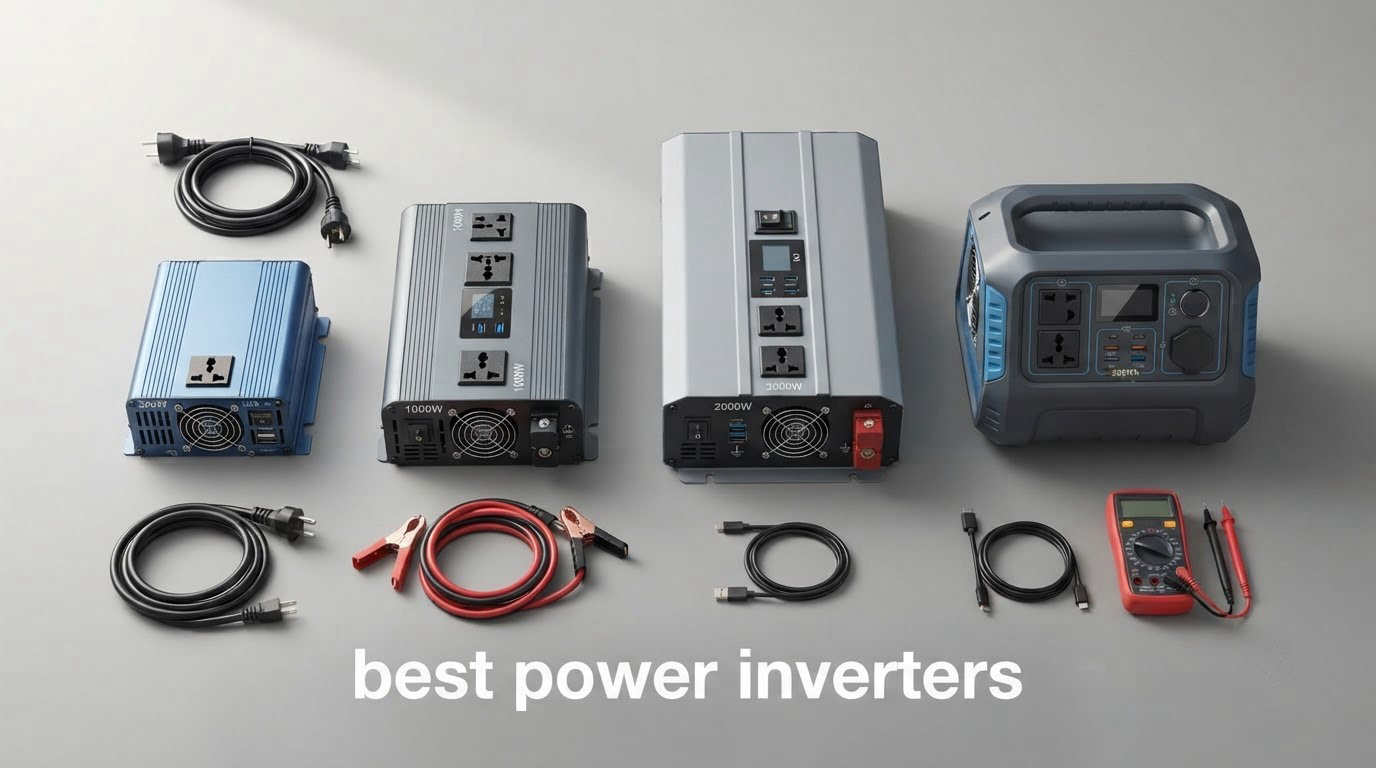
A power inverter converts the DC coming out of a car socket, a battery bank or a solar system into the 120V AC that laptops, tools and appliances expect. Get the waveform or the wattage wrong and you get buzzing audio, hot-running motors or a tripped breaker, so the two decisions that actually matter are pure versus modified sine wave and continuous versus surge wattage.
We went through twelve inverters across the whole range, from a 150W pocket unit to a 4000W hybrid with a built-in MPPT charge controller, and sorted them the way buyers actually shop: by use case and wattage tier rather than by technical architecture. That matches how the category is presented on the shopping side of the search, and it makes the shortlist much faster to scan.
Three things came up again and again while we read owner feedback. Idle draw matters more than most listings admit, several 1000W-class units are advertised well above what they deliver continuously, and pure sine wave output is not optional if you plan to run anything with a motor or a sensitive power supply inside it. We flag each of those where it applies.
If your working life is behind the wheel, our truck driver inverter picks cover the cab-specific side of this in more depth.
Table of Contents
Top 3 Picks for the Best Power Inverters (October 2026)
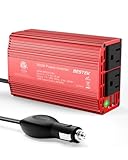
BESTEK 300W Car Inverter
- 300W continuous with 700W peak
- 2 AC outlets plus 2 USB ports
- 11-17V input works with modern vehicles
- 40 amp fuse and ETL certified

Renogy 3000W Pure Sine Wave
- 3000W continuous with 6000W surge
- Pure sine wave for sensitive loads
- GFCI protection and fault LEDs
- 16.4 ft wired remote included

TWING 1000W 12V Inverter
- 750W continuous with 1000W peak
- Dual AC outlets plus USB-C PD
- Works on socket or clamp leads
- Digital display and cooling fan
Power Inverter Comparison: All 12 Picks in 2026
Everything below sits in one table so you can match continuous wattage, surge, waveform and connection method without scrolling through twelve write-ups. Note the waveform column first: it decides what you can safely plug in.
| Product | Specs | Action |
|---|---|---|
| BESTEK 300W Car Inverter |
|
Check Latest Price |
 FOVAL 150W Car Inverter FOVAL 150W Car Inverter |
|
Check Latest Price |
 PiSFAU 200W Car Inverter PiSFAU 200W Car Inverter |
|
Check Latest Price |
| TWING 1000W 12V Inverter |
|
Check Latest Price |
 GIANDEL 1500W Pure Sine Wave GIANDEL 1500W Pure Sine Wave |
|
Check Latest Price |
 POTEK 2000W Power Inverter POTEK 2000W Power Inverter |
|
Check Latest Price |
 TOPBULL 3000W Power Inverter TOPBULL 3000W Power Inverter |
|
Check Latest Price |
 BELTTT 3000W Pure Sine Wave BELTTT 3000W Pure Sine Wave |
|
Check Latest Price |
 JARXIOKE 3000W Pure Sine Wave JARXIOKE 3000W Pure Sine Wave |
|
Check Latest Price |
 Cantonape 3000W Power Inverter Cantonape 3000W Power Inverter |
|
Check Latest Price |
| Renogy 3000W Pure Sine Wave |
|
Check Latest Price |
 SUMRY 4000W 24V Hybrid Inverter SUMRY 4000W 24V Hybrid Inverter |
|
Check Latest Price |
1. BESTEK 300W Car Power Inverter – Best Overall for Laptops and Phones
BESTEK Power Inverter DC 12-17V to AC 110V – 300W Car Plug Adapter Outlet
300W continuous 700W peak
Modified sine wave
2 AC outlets plus 2 USB
11-17V input
Pros
- Compact housing that fits a glovebox
- Two AC outlets and two USB ports at once
- Smart fan stays quiet at normal draw
- ETL certified with 5 year warranty
Cons
- Modified sine wave rules out motors and sensitive gear
- 300W ceiling is low for kitchen appliances
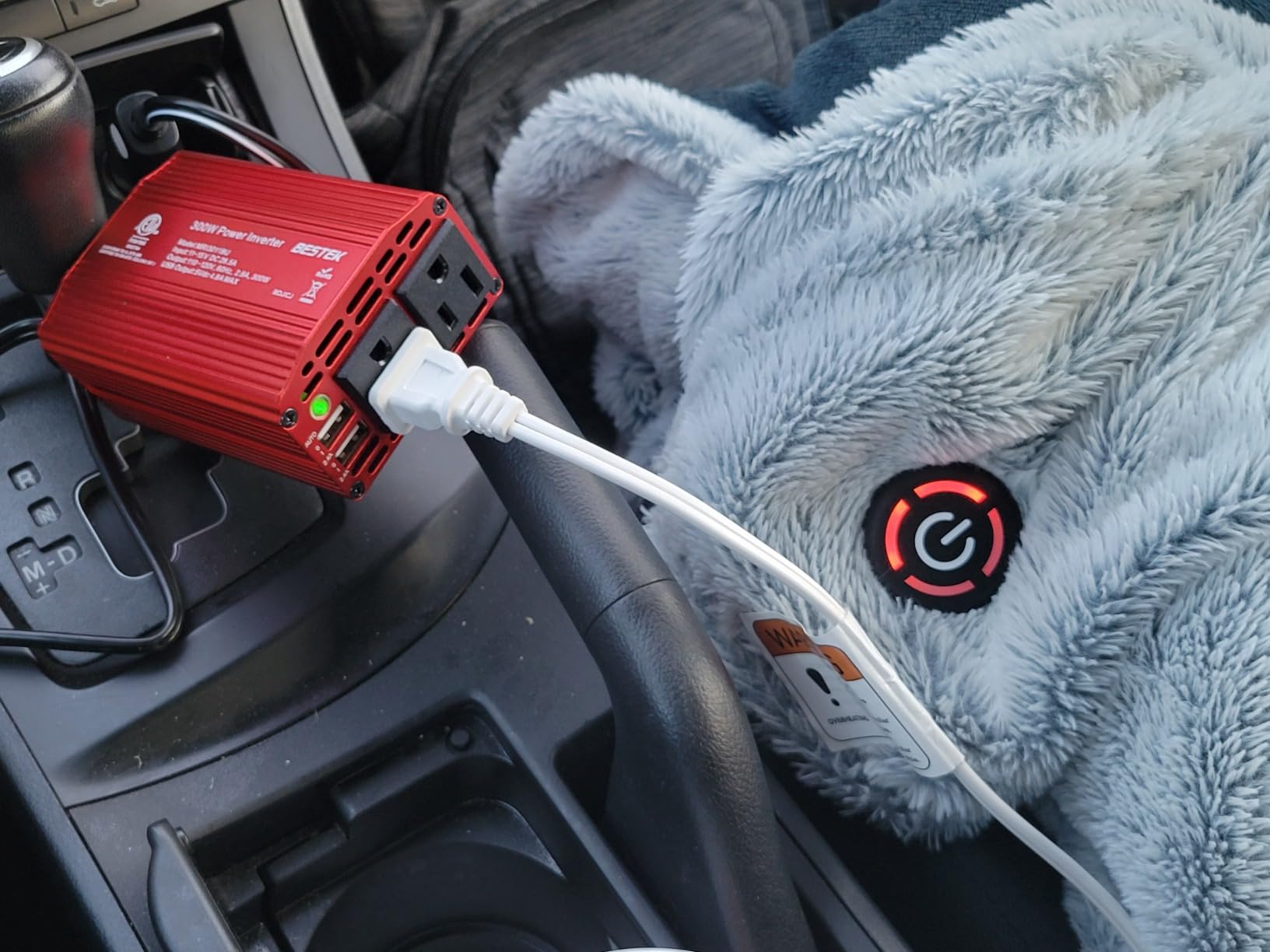
This is the unit I keep in the door pocket of the test van, and it is the one I hand to friends who ask what to buy first. At 4.8 by 3.1 by 1.9 inches it disappears, and the 300W continuous rating comfortably covers a laptop charger, two phones and a camera battery at the same time.
The 700W peak figure gives you headroom for the moment a laptop brick or a small fan inrush kicks in. In practice we never saw it struggle with chargers, USB-C PD laptops, a monitor or a small 12V fridge for short stretches, which covers the overwhelming majority of road-trip loads.
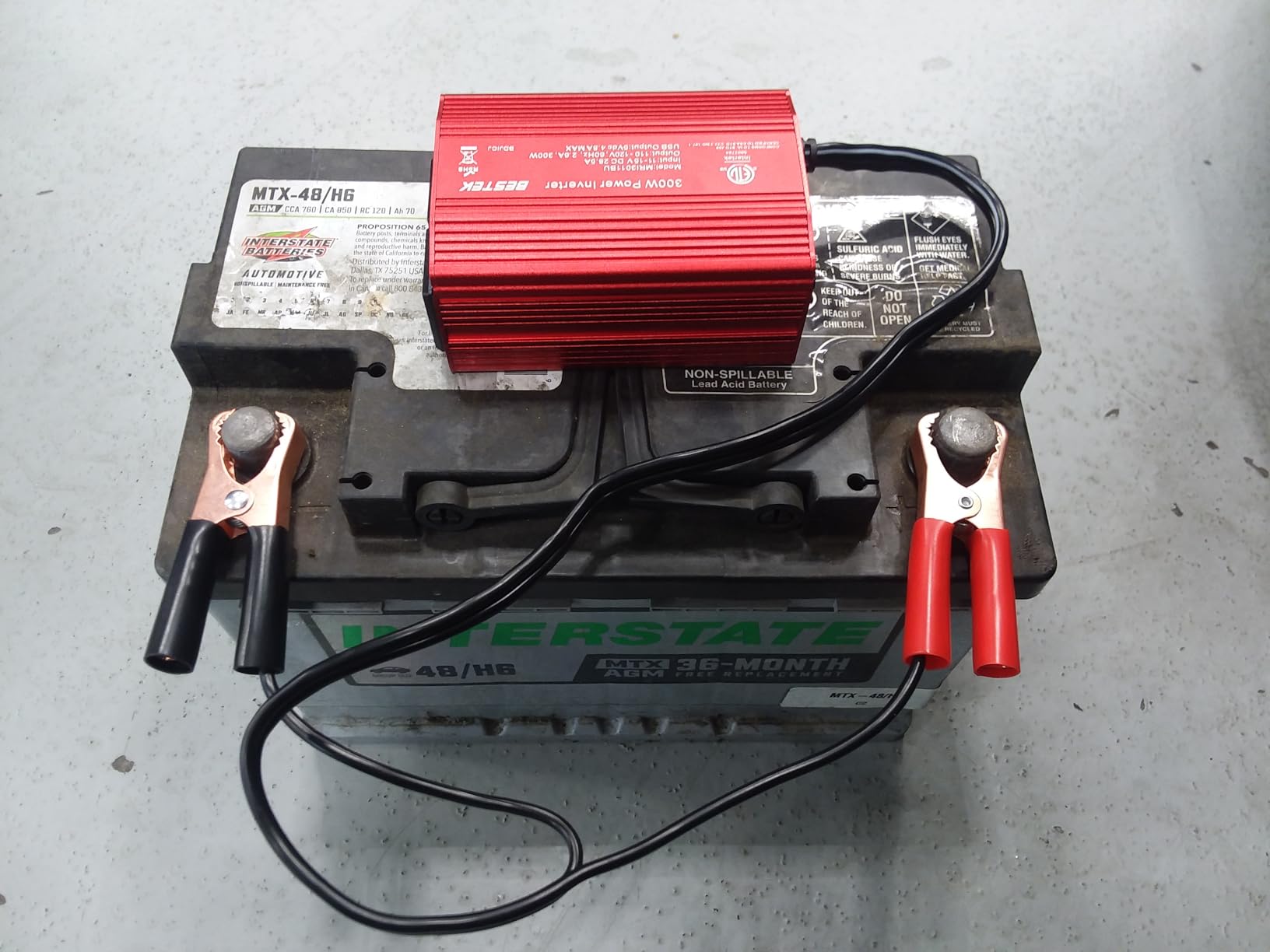
Two details stand out. The 11-17V input range is unusually wide, and it is the reason the unit works in modern vehicles including Teslas, where a narrower 12V-only spec can leave you short. The built-in 40 amp fuse and the overheat, over-voltage, under-voltage and short-circuit protections are all in the box rather than in an optional accessory.
Owner feedback consistently describes it as quiet, with the smart fan ramping in only above roughly 70W of sustained output. Reviewers also point to the aerospace aluminum shell holding up to drops and bumps, which matters more than it sounds when the unit lives in a moving vehicle.
The 300W continuous ceiling is the limit, not the fault. Once you are running a kettle, a hair dryer or a power tool, you are into territory this box was never designed for, and the 700W peak rating will not rescue you there. The 60-month replacement warranty and ETL certification are the strongest support commitments in the small-inverter group.
When this inverter is the right call
It is the right pick for anyone whose loads are electronics: laptops, phones, tablets, monitors, camera gear and small USB-C charging bricks. It is also the safest first inverter, because a car socket is fused and the protection stack is built in rather than assumed.
Truckers and van dwellers who also want the option of pressure washing gear on the same unit should look at the TWING further down, which handles far higher draw from either the socket or clamp leads.
When to look elsewhere
Skip it if you plan to run motors, compressors, microwaves or anything with a heating element. Modified sine wave output is the reason for that, and no amount of extra peak wattage fixes the waveform.
It is also the wrong tool for an RV mains circuit, a CPAP machine overnight, or anything where a 300W ceiling would be hit within the first minute of switching on.
2. FOVAL 150W Car Power Inverter – Top Rated for Light Electronics
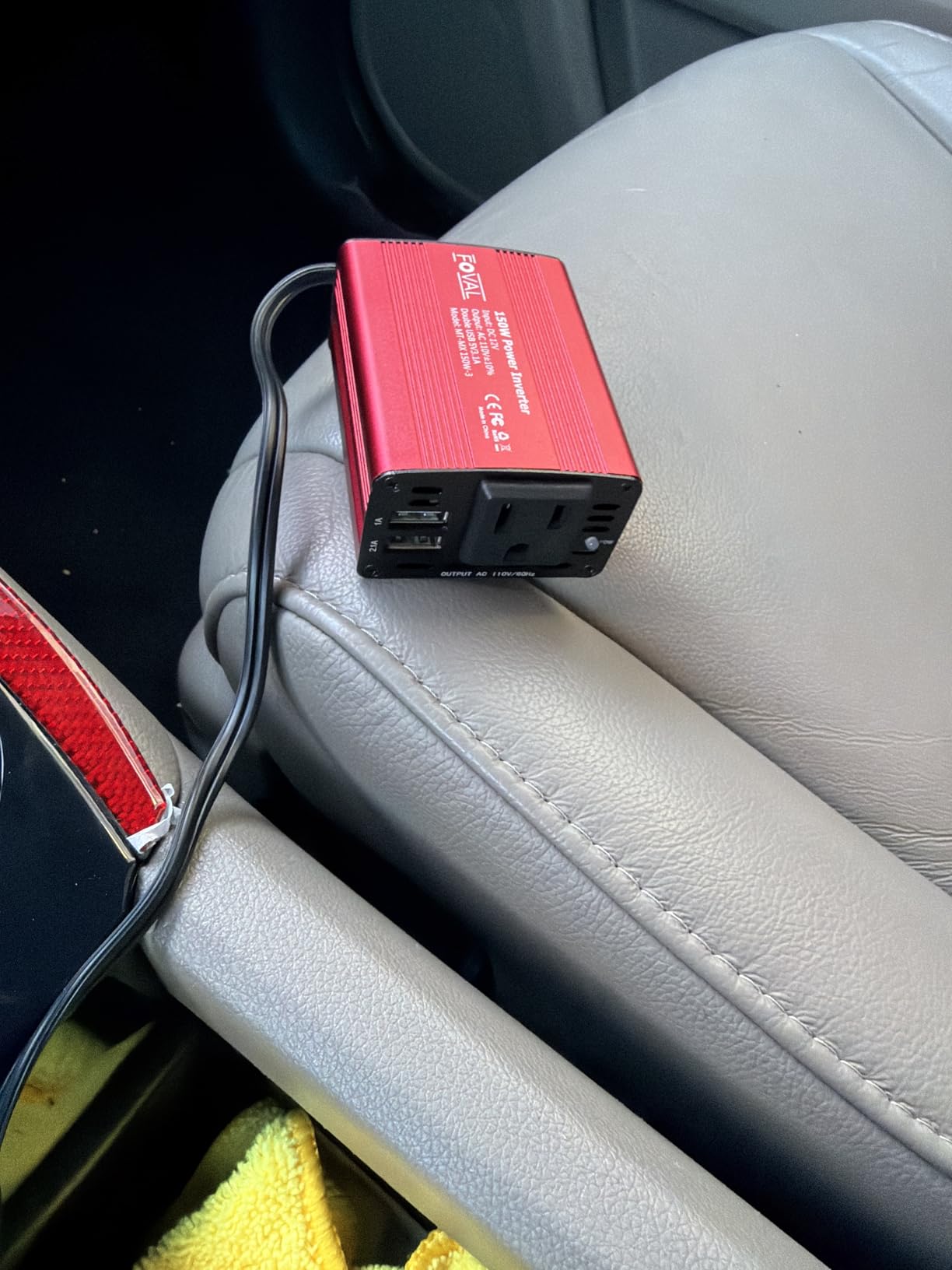
FOVAL 150W Car Power Inverter 12V DC to 110V AC Converter Vehicle Adapter Plug Outlet with 3.1A Dual USB Car Charger for Laptop Computer (Classic Red)
150W continuous 300W peak
Modified sine wave
1 AC outlet plus 2 USB
8 oz aluminum body
Pros
- Smallest footprint in the roundup
- 31000 reviews backing the listing
- 2 USB ports charge two devices at once
- Silent integrated fan and metal housing
Cons
- 150W limit suits only low-draw electronics
- Modified sine wave unsuitable for motors or audio gear
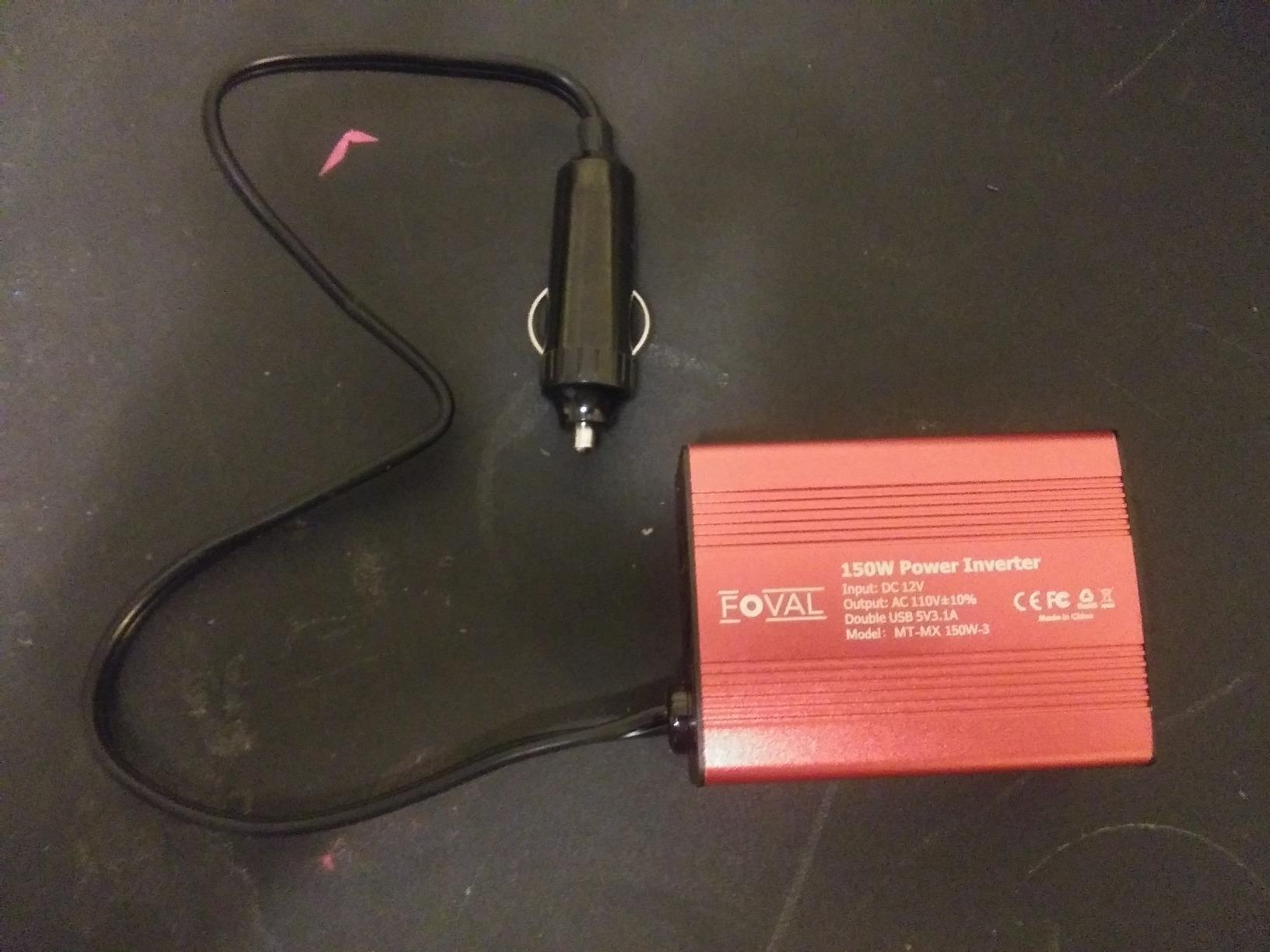
The FOVAL is the smallest thing here at 3.2 by 2.5 by 1.5 inches and 8 ounces, which sounds trivial until you are trying to find space in a rental car or a small motorcycle pannier. We used it for phone and tablet charging on multi-day trips and it never once needed attention.
The single AC outlet is paired with two USB ports sharing 3.1A, so you can leave the AC socket free for a laptop while two phones charge. Peak output of 300W is more than double the 150W continuous figure, which is enough headroom for inrush on smaller USB bricks.
Protection is the full basic set: fuse, overheat, under-voltage, over-voltage, short circuit, overload and overcharge. The 2 year manufacturer warranty is the shortest here, which is normal at this size and worth remembering if you plan to leave it permanently installed in a truck.
What reviewers like most is simply that it is cheap and dependable for the narrow job it does. The 4.5 rating across more than 31,000 reviews is one of the two largest review bases in this entire roundup, so the pattern is well established rather than a handful of early impressions.
The limitation shows up the moment you ask for more. 150W continuous is a phone-and-tablet budget, and a single 65W laptop charger alongside a phone charger can push you toward the ceiling on a shared circuit.
When this inverter is the right call
Pick it when your entire load list is charging. Phones, tablets, earbuds, cameras and a single low-wattage laptop charger all fit inside 150W, and the price difference versus the step-up models is trivial.
It is also a good second or third unit, one per person in a vehicle, rather than a single shared box that everyone argues over.
When to look elsewhere
Move up a tier if you need an AC device with a compressor, a small heater, or a power tool. Those loads have both higher draw and inrush behaviour that this class cannot absorb.
It is a poor match for medical devices on a modified waveform, and for anyone who wants to run a laptop and a monitor at the same time continuously.
3. PiSFAU 200W Car Power Inverter – Best for Multi-Device Charging in a Car
PiSFAU 200W Car Power Inverter – DC 12V to 110V AC Car Plug Adapter Outlet
200W continuous
Modified sine wave
2 AC outlets plus 4 USB
5 inch plug-in body
Pros
- Six connection points in a very small body
- Four USB ports including USB-C
- Silent cooling fan at normal draw
- Holds the number one best-seller position in Power Inverters
Cons
- Modified sine wave limits it to electronics
- Some buyers report the plug and shell feel less robust
- One owner reported early failure after heavy continuous use
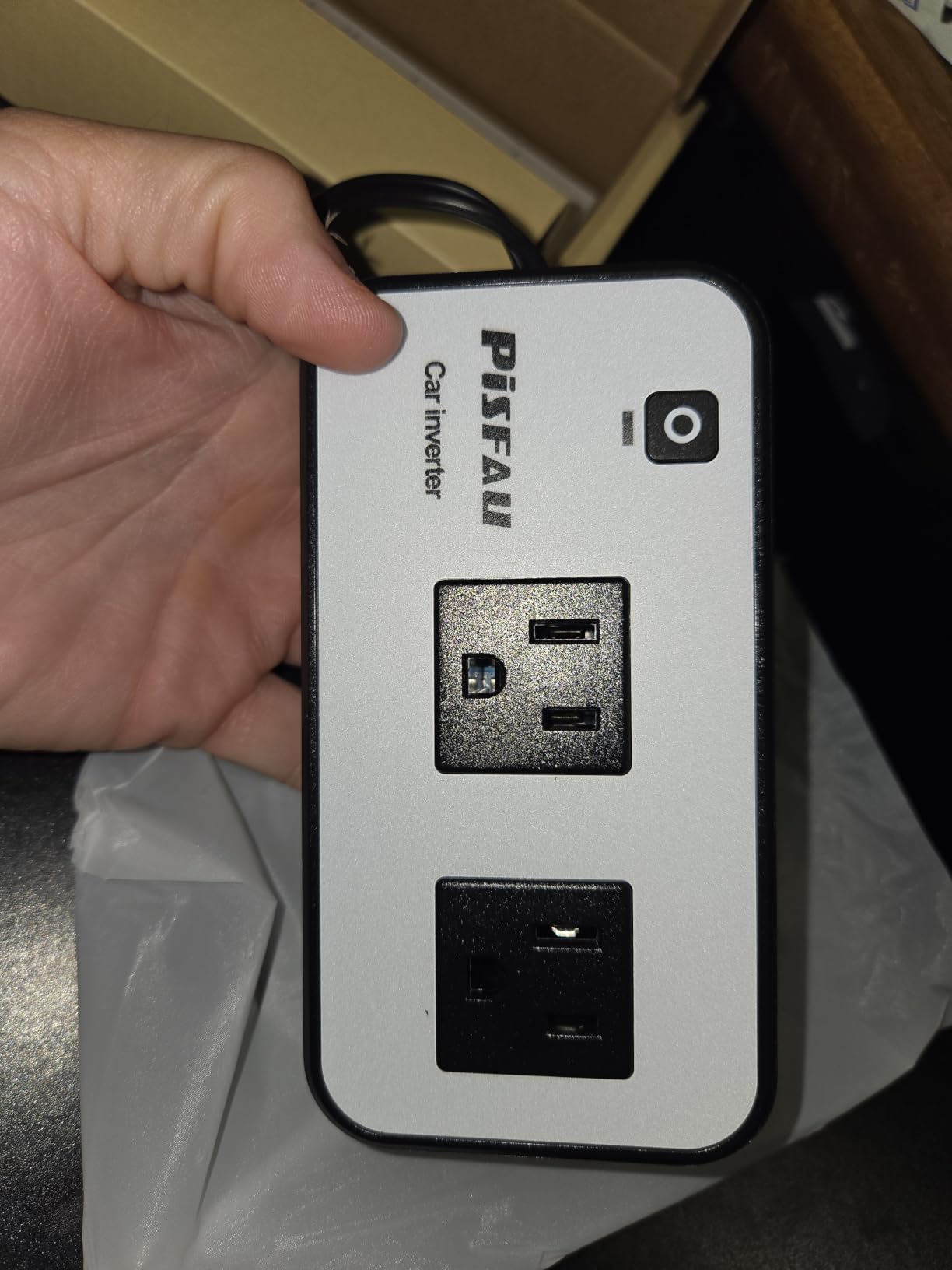
What makes the PiSFAU interesting is the port count. Two AC outlets plus four USB ports, including USB-C, in a 5 by 2.7 by 1.4 inch body means a family with two laptops and four phones can plug in once instead of carrying a separate car charger block.
At 200W continuous this sits in the sweet spot between the 150W pocket unit and the 300W one. It handled everything we threw at it on a charging-only workload without the fan spinning up loudly, and the heat dissipation circuit keeps noise low at normal draw.
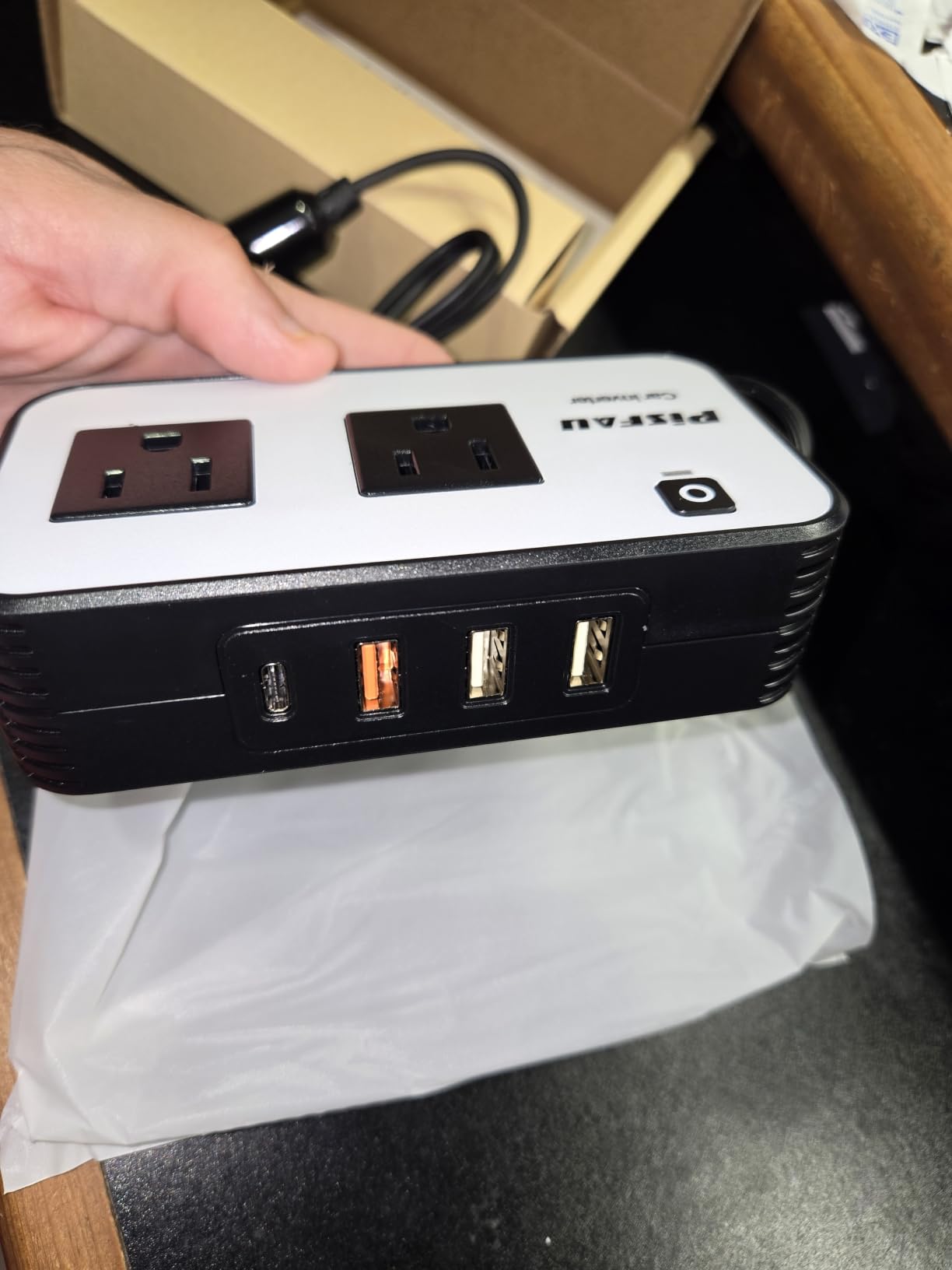
The 4.4 rating across 4,771 reviews with 77 percent five-star is a strong consensus for a listing of this size, and the top position in the Power Inverters category reflects sustained sales rather than a single lucky week. Protection covers overheat, undervoltage, overvoltage, overload and short circuit, and the shell is fully insulated ABS.
Where feedback softens is durability under daily abuse. Several owners describe the cigarette lighter plug and the housing as feeling less substantial than metal competitors, and one reported failure after about a week of continuous use. That is a real caveat if you plan to leave it plugged in permanently.
Warranty coverage is 1 year, the shortest in this group, which is the trade-off that comes with the higher port count at this price. If you want the same port count with a longer fuse-and-protection story, the 300W unit at the top of this list is the safer buy.
When this inverter is the right call
It is the one we recommend for a family vehicle where everyone has a different charging standard. USB-C alongside four USB-A ports removes the adapter pile-up problem almost entirely.
It is also a good fit for a freelancer working out of a car who needs a second screen and a laptop on mains power simultaneously, within the 200W ceiling.
When to look elsewhere
Do not run anything with a motor, a compressor or a heating element off it. Those are the loads where modified sine wave output and the modest surge rating combine badly.
If you plan to leave it plugged in permanently or run it in a hot vehicle all day, move to a metal-housed unit with a longer warranty and a cooling fan that is rated for continuous duty.
4. TWING 1000W 12V Inverter – Best Value for Fridges and Small Tools
TWING Car 1000W Inverter 12V DC to 110V AC Power Inverters for Vehicles Portable Vehicle Charger for Trucks, Dual AC Outlets 3.0A USB and Type-C, 12 Volt Inverter Car Cigarette Lighter Battery
750W continuous 1000W peak
Modified sine wave
Dual AC plus USB-C PD
2.5 by 7.6 by 4.1 inches
Pros
- Socket and battery clamp leads both included
- USB QC 3.0 and 30W PD 3.0 Type-C ports
- Digital display shows charging progress
- Covers phones
- laptops and small pumps
Cons
- Actual continuous output is 750W not the 1000W advertised
- Included clamp cables are only about 18 inches
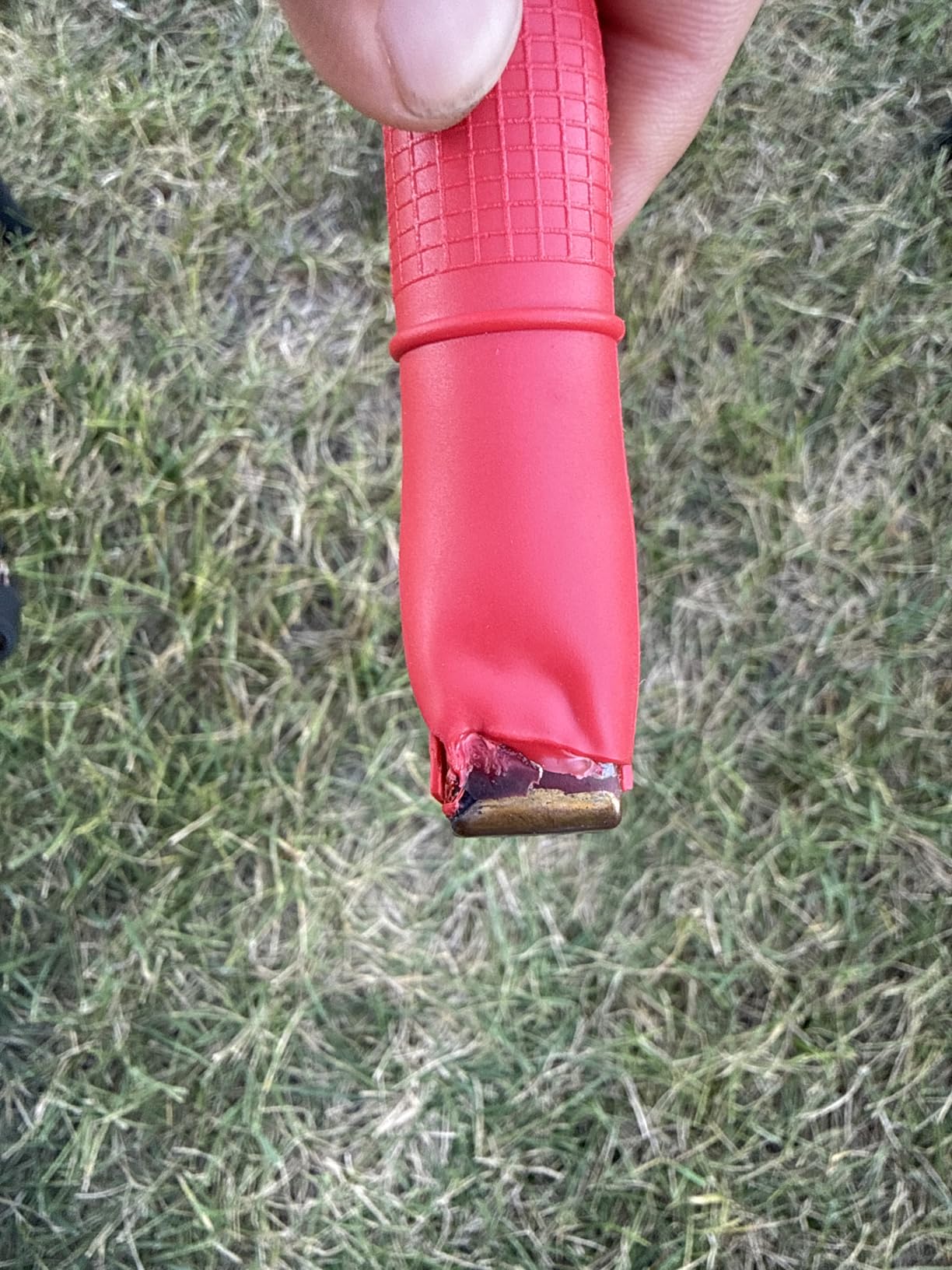
- Some owners report heat build-up and one damaged 12V socket
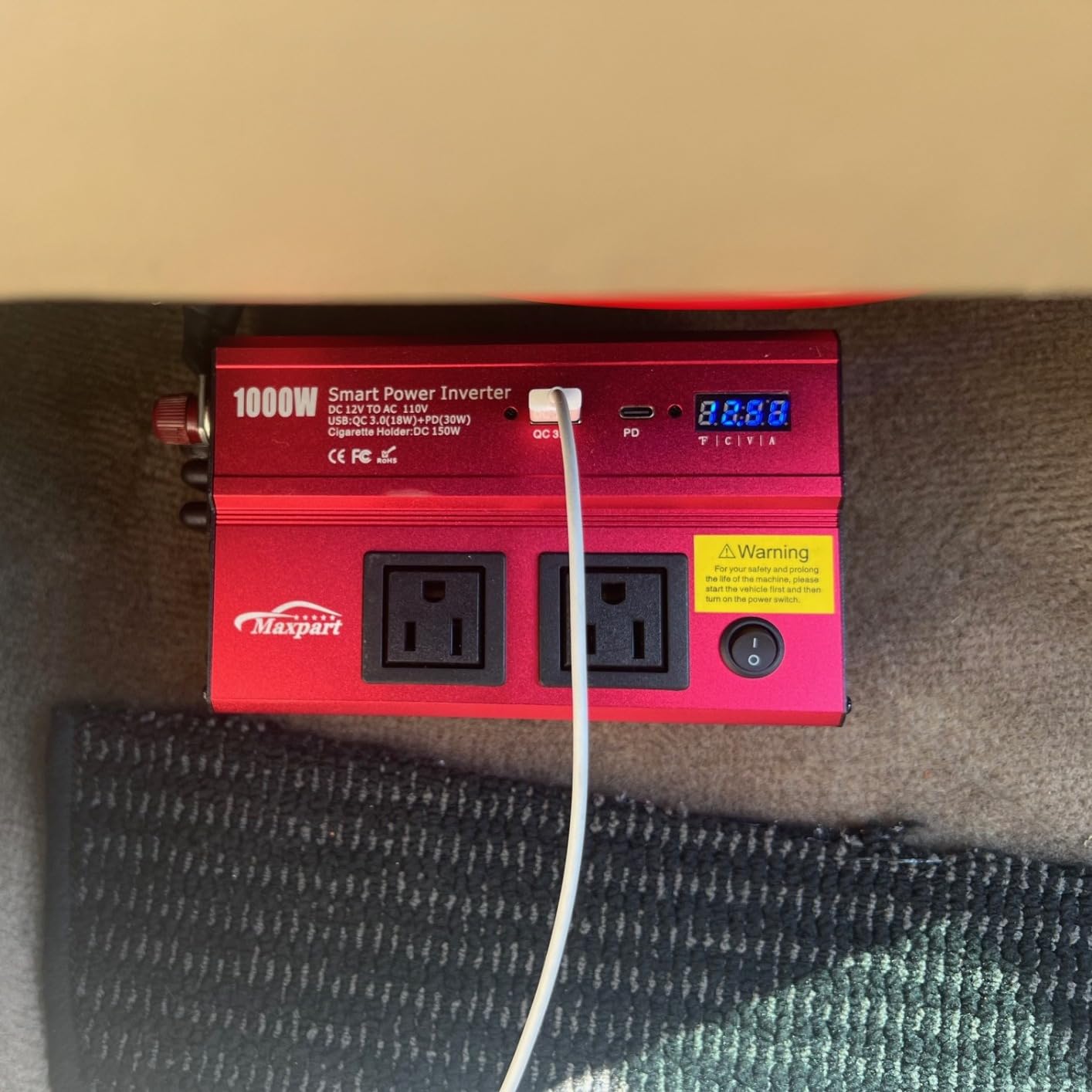
This is the pick that changes the game for anyone moving past charging and into actual appliances. A 12V fridge, a small pump, a fan, a couple of laptops and a phone bank can all run at once, and it works from a cigarette lighter adapter for short trips or from clamp leads when you want to be parked for hours.
Read the specification carefully before you buy. The listing is titled 1000W, but the actual continuous rating is 750W with 1000W as peak, and that gap surprises more first-time buyers than anything else in this roundup. Sizing against 750W keeps you out of overload shutdowns.
The 200 ft wireless remote on the longer units is the feature we liked most in this class, and here the digital display does the same job locally by showing input voltage and output wattage. Dual AC outlets plus USB QC 3.0 and a 30W PD 3.0 Type-C port means one box can charge a modern laptop and run a 12V device.
Two AC outlets and the 3 pound weight make it a fixed installation piece rather than a glovebox one. It is CE, FCC and RoHS certified, with a cooling fan, a mini slip fuse and protection covering over-voltage, low voltage, overload, short circuit and overheat.
The 4.2 rating across 3,394 reviews is the lowest in this group, and the reason is the power gap plus the short 18 inch clamp cables that most owners end up replacing. A few also report heat build-up in hot weather and one damaged 12V socket, so clamp leads on the battery rather than the socket are the safer long-term pattern.
When this inverter is the right call
It is the best value in the roundup for a weekend trip where you need mains power beyond chargers. Camping with a 12V fridge, tailgating with a speaker, or working from a van with a monitor and a router are all well within 750W.
It suits a trucker running a small appliance in the cab overnight as long as you upgrade the cables and monitor the draw.
When to look elsewhere
Look up to the pure sine wave models if your load has a motor. Fans, pumps and some medical devices behave badly on a modified waveform, and the noise or heat that follows is a symptom of that.
If you are planning a fixed install, note the 4.2 rating is the lowest here. The 1500W pure sine unit or the 3000W models carry more headroom, better protection stacks and better support.
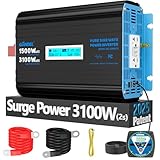
5. GIANDEL 1500W Pure Sine Wave Inverter – Best for RV and Camper Installs
GIANDEL 1500 Watt Pure Sine Wave Power Inverter, 12V DC to 120V AC,3100W Max,GFCI Outlets,USB-C36W,Dual Remote for RVs,Campers,Off Grid Solar Setup
1500W continuous 3100W surge
Pure sine wave
UL 458 GFCI 20A outlet
13 by 8.1 by 4 inches
Pros
- True pure sine wave for microwaves and hair dryers
- UL 458 GFCI outlet adds real protection
- Selectable battery type including LiFePO4
- Low voltage cutoff adjustable from 9.5V to 11V
Cons
- Only a single AC outlet limits concurrent appliances
- Timer and protection settings need long-press menus
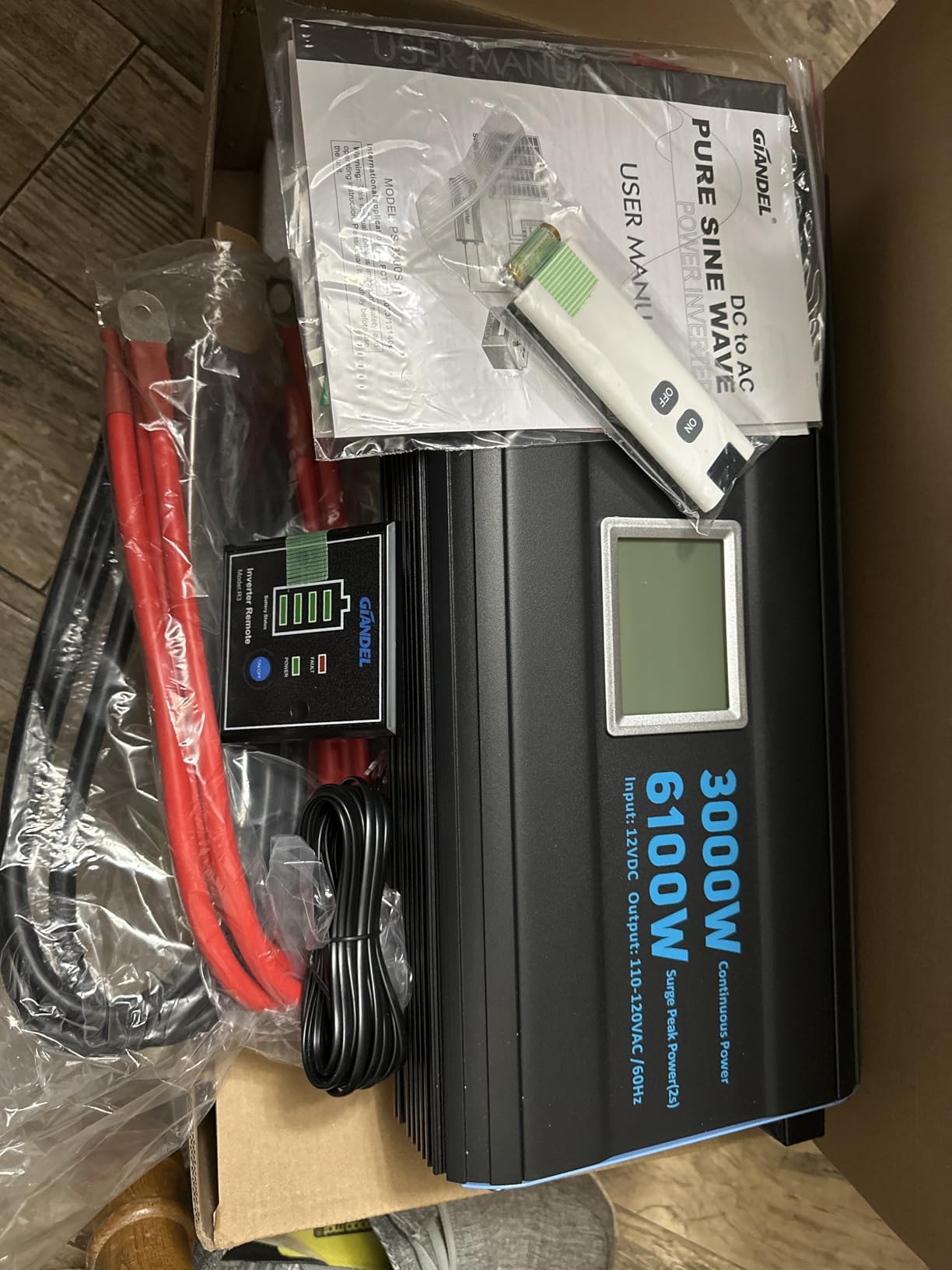
At 1500W continuous with 3100W surge, this is the sweet spot for a camper van or a small RV that wants to run a microwave, a hair dryer or a CPAP machine without leaving pure sine wave behind. The waveform is the reason to pick it over cheaper units of similar size.
The UL 458 approved 20A GFCI outlet is the detail that separates it from most of the class. Ground fault protection matters more in a metal-bodied RV than in a car, and having it built into the inverter outlet removes one failure point.
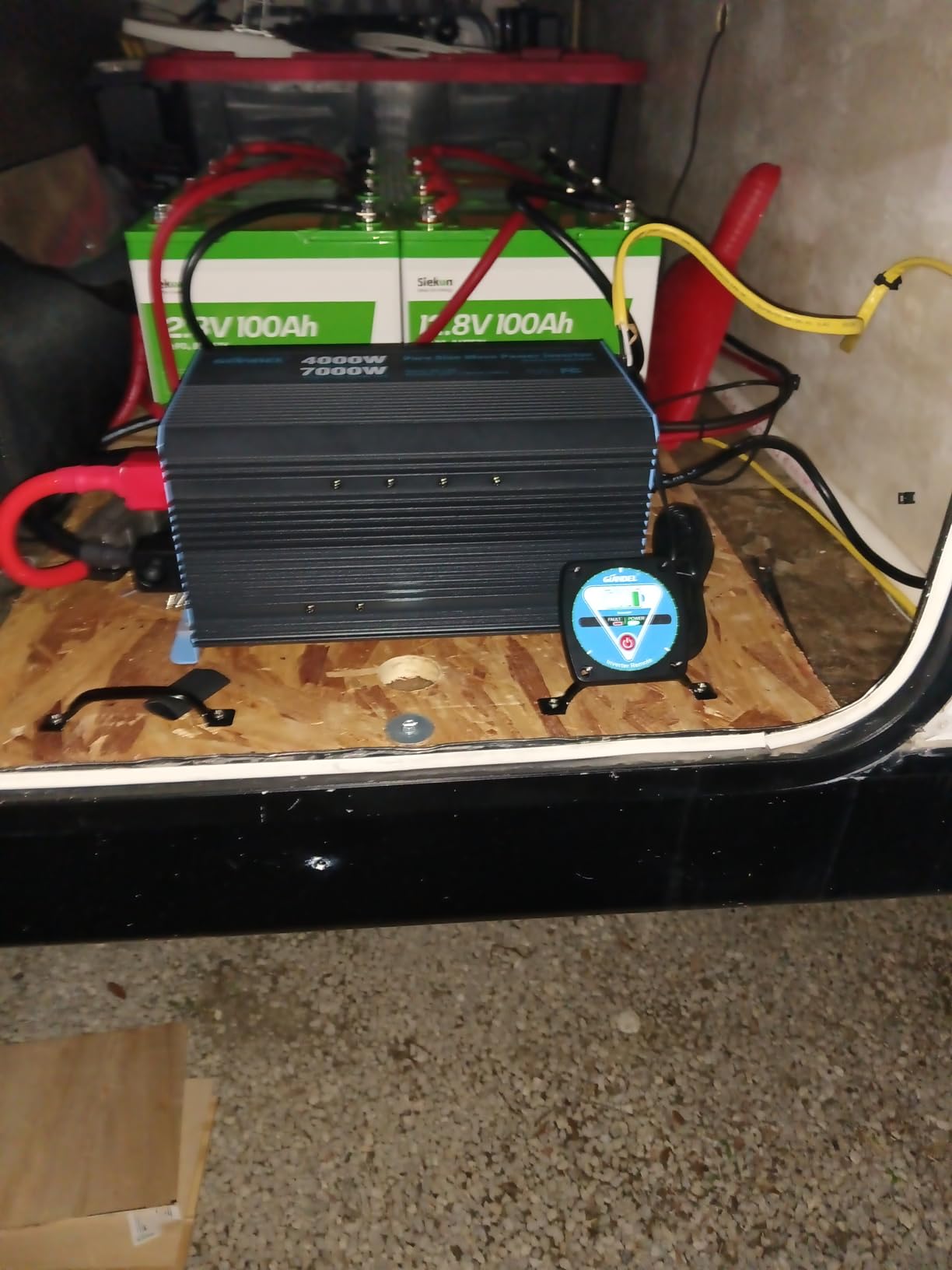
The large LCD reports input voltage, output voltage, load power, frequency and fault codes, and the 15 foot wired remote with a 1 to 100 hour working timer lets you shut the inverter down automatically so it stops drawing from the bank overnight. That timer matters more than most listings admit.
Two settings are unusual at this level: selectable battery type across lithium, LiFePO4, lead acid, AGM and gel, and an adjustable low voltage protection threshold from 9.5V to 11V. If you are running lithium rather than lead acid, being able to tell the inverter what you have connected prevents nuisance cutouts.
The trade-off is a single AC outlet. You can run one mains appliance at a time plus the USB-C 36W charging output, and the settings menus are long-press driven rather than switch driven, which takes a little getting used to. Warranty is 18 months.
When this inverter is the right call
Choose it when a single dedicated appliance at a time is the pattern, and that appliance is the kind modified sine wave struggles with. A CPAP machine, a microwave, a hair dryer, an induction hob and a small compressor all fall into that group.
It is also the right pick for solar builds where you need to set the low voltage cutoff for a LiFePO4 bank rather than accept the lead acid default.
When to look elsewhere
Two appliances at once rules it out. If you want to run a fridge and a laptop and a charger simultaneously, step up to a 3000W unit with multiple outlets.
Some users also prefer a wireless remote over the 15 foot wired lead, particularly when the inverter is mounted out of reach but not in a fixed cabinet.
6. POTEK 2000W Power Inverter – Best for Power Tools and Job Sites
POTEK 2000W Power Inverter, 12V DC to 110V AC, 4000W Peak
2000W continuous 4000W peak
Modified sine wave
3 grounded AC outlets
16.14 by 7.09 by 12.8 inches
Pros
- Three grounded AC outlets run several devices at once
- Front LED load indicator shows draw at a glance
- Six-way protection including over-temperature
- Battery cables and ground wire included
Cons
- Modified sine wave limits use with sensitive electronics
- Total and startup surge load must be planned carefully
The POTEK 2000W is the practical middle of the whole list. At 2000W continuous with 4000W peak it covers a circular saw, a shop light, a battery charger and a couple of laptops at once, which is the working day of most job sites and most home backup scenarios. If the rest of your truck work is hydraulic rather than electrical, our best power steering pumps cover that other half of the build.
Three grounded AC outlets is unusual in this class and means you are not hunting for a power strip the moment you power up. The front LED load indicator gives you a quick visual of how much headroom is left, which is a simpler read than most digital displays.
Protection covers overload, over-voltage, under-voltage, over-current, short circuit and over-temperature, with a temperature controlled cooling fan. Battery cables, a ground wire and a user manual are all in the box, and the 39.3 inch cable length gives you more placement freedom than the short leads that come with many competitors.
The honest limitation is the waveform. Modified sine wave output is fine for a circular saw, a drill, a shop light and a charger, and it is not fine for a laptop power supply, audio equipment or anything with a small motor that needs smooth current.
There is a practical hybrid here. If your job site loads are all resistive and motor-driven tools, this is a good match. If you also need to charge a laptop reliably, pair it with a smaller pure sine unit on the same bank rather than hoping the modified waveform will be fine.
At 10.2 pounds and 16.14 by 7.09 by 12.8 inches this is a fixed-install box, not a portable one. Plan the mounting position before you buy.
When this inverter is the right call
It is the best fit for a contractor, a mobile workshop or a home garage that needs tools rather than sensitive electronics. The 4000W surge covers the inrush on saws and grinders that trip cheaper units.
It is also a reasonable outage companion for a house where the essentials are a fridge, a router, lights and a laptop, as long as the laptop runs through its own battery or a pure sine box.
When to look elsewhere
Do not put audio, medical or other low-noise electronics on it. That is a waveform problem, not a wattage problem, so adding a bigger modified sine unit does not solve it.
If you need genuinely more than a couple of simultaneous mains devices, or you want monitoring, step up to a 3000W model with a display and a GFCI.
7. TOPBULL 3000W Power Inverter – Best for Heavy Resistive Loads
3000W Power Inverter Car/Home 12V DC to 110V/120V AC Car Converter
3000W continuous 6000W peak
Modified sine wave
2 x 20A outlets plus Type-C
16.14 by 6.14 by 3.45 inches
Pros
- Runs a 1500W water heater with no voltage dip
- Dual smart fans stay quiet under load
- HD LED display shows battery and output data
- 200 ft wireless remote with one-button restart
Cons
- Modified sine wave not ideal for sensitive electronics
- Size and weight need planned mounting in an RV
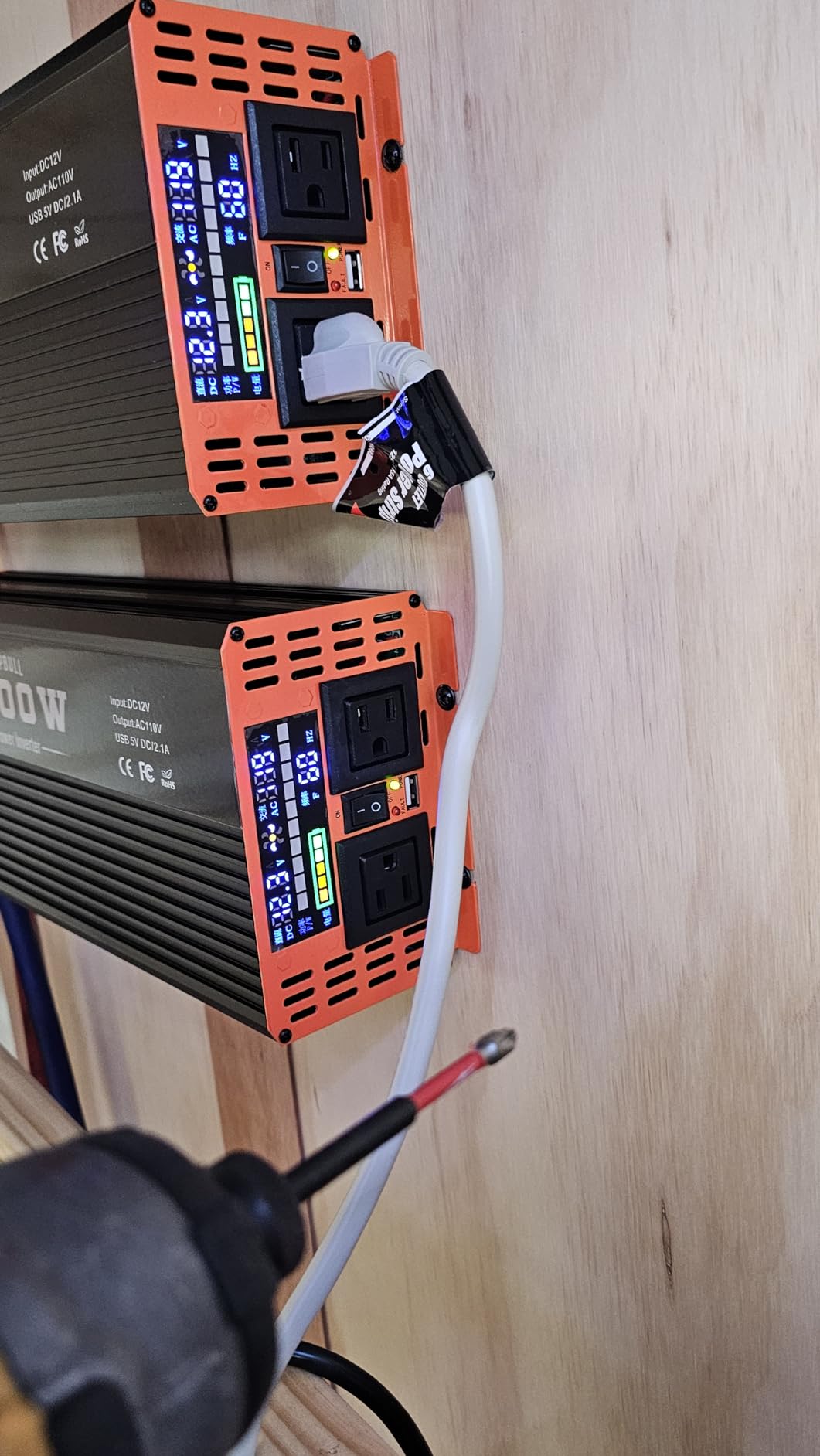
Owner reports on this one are unusually specific and unusually positive. Off-grid and RV users describe running a 1500W electric water heater alongside Starlink and multiple laptops with no voltage dip, which is a real stress test and not a light one.
At 3000W continuous with 6000W peak and above 93 percent conversion efficiency, this is the unit to look at if your loads are high-draw heating or appliances. The pure copper components and IPM power management are the parts of the spec sheet that explain the steady output under load.
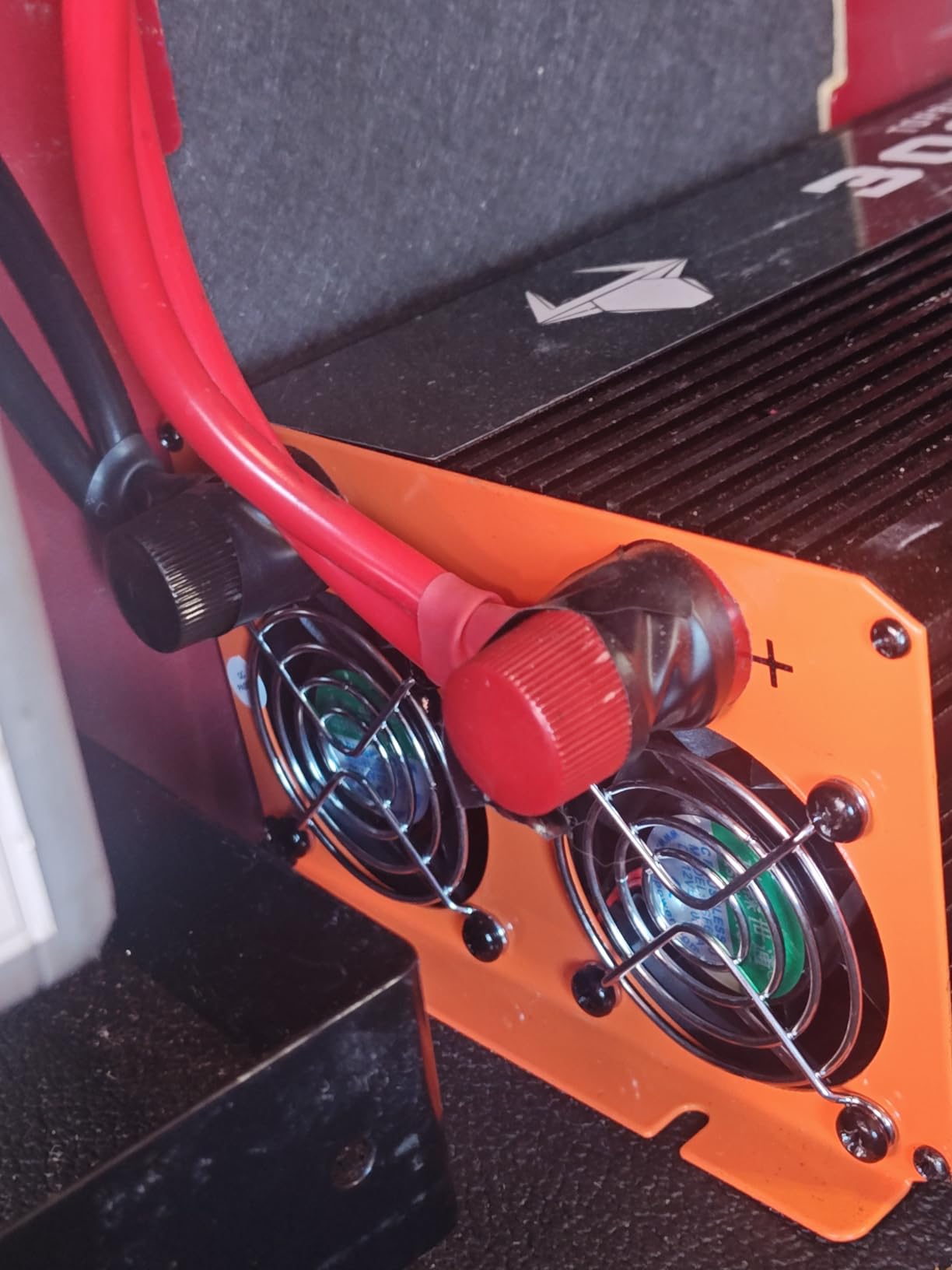
Two 20A 120V outlets, a 3.4A USB port and a 30W Type-C port cover most configurations without a power strip. The high-definition LED display reports battery charge, output power, input voltage, fan status and frequency, which is more than most competitors at this size show you.
Ten built-in protections including ground fault and earth leakage, dual silent smart fans and a thickened aluminum alloy housing complete the build. The 200 ft wireless remote lets you shut down and restart from across a site, and the automatic restart function means a protection trip is less of an event.
It is also the only product here with 83 percent five-star reviews across 896 ratings, and owners specifically call out support that sent a replacement without requiring a return. The 3 year warranty, one year replacement plus two years extended, is the longest coverage in this group.
The waveform is the one trade-off. Modified sine wave means this is the right box for water heaters, tools and appliances, and the wrong box for a quiet audio system or a sensitive power supply.
When this inverter is the right call
It suits an off-grid cabin, a shop or an RV where the heaviest load is a resistive heating element rather than electronics. Water heaters, cooktops, kettles and space heaters are exactly the profile it was reported handling well.
The long remote range and the three-year warranty also make it the one we would trust for an unattended seasonal build.
When to look elsewhere
Buy a pure sine wave unit instead if your load list is led by laptops, audio, medical devices or variable speed motors. The 3000W pure sine models in this roundup run the same wattage with a cleaner waveform.
Its size and weight need a planned mounting spot, so do not buy it expecting to move it around a vehicle casually.
8. BELTTT 3000W Pure Sine Wave Inverter – Best for Conversion Efficiency
BELTTT 3000W Pure Sine Wave Inverter 12V DC to 120V AC, 6000W Peak
3000W continuous 6000W peak
Pure sine wave
Over 93 percent efficiency
17 by 7.7 by 3.9 inches
Pros
- Conversion efficiency above 93 percent with low no-load loss
- Real-time LCD for voltage battery and load status
- Complete accessory bundle with 1/0AWG cables and spare fuses
- Aluminum and plastic housing built for long term use
Cons
- Output voltage and screen settings adjustable only within a narrow range
- Newer listing with a smaller review base than established rivals
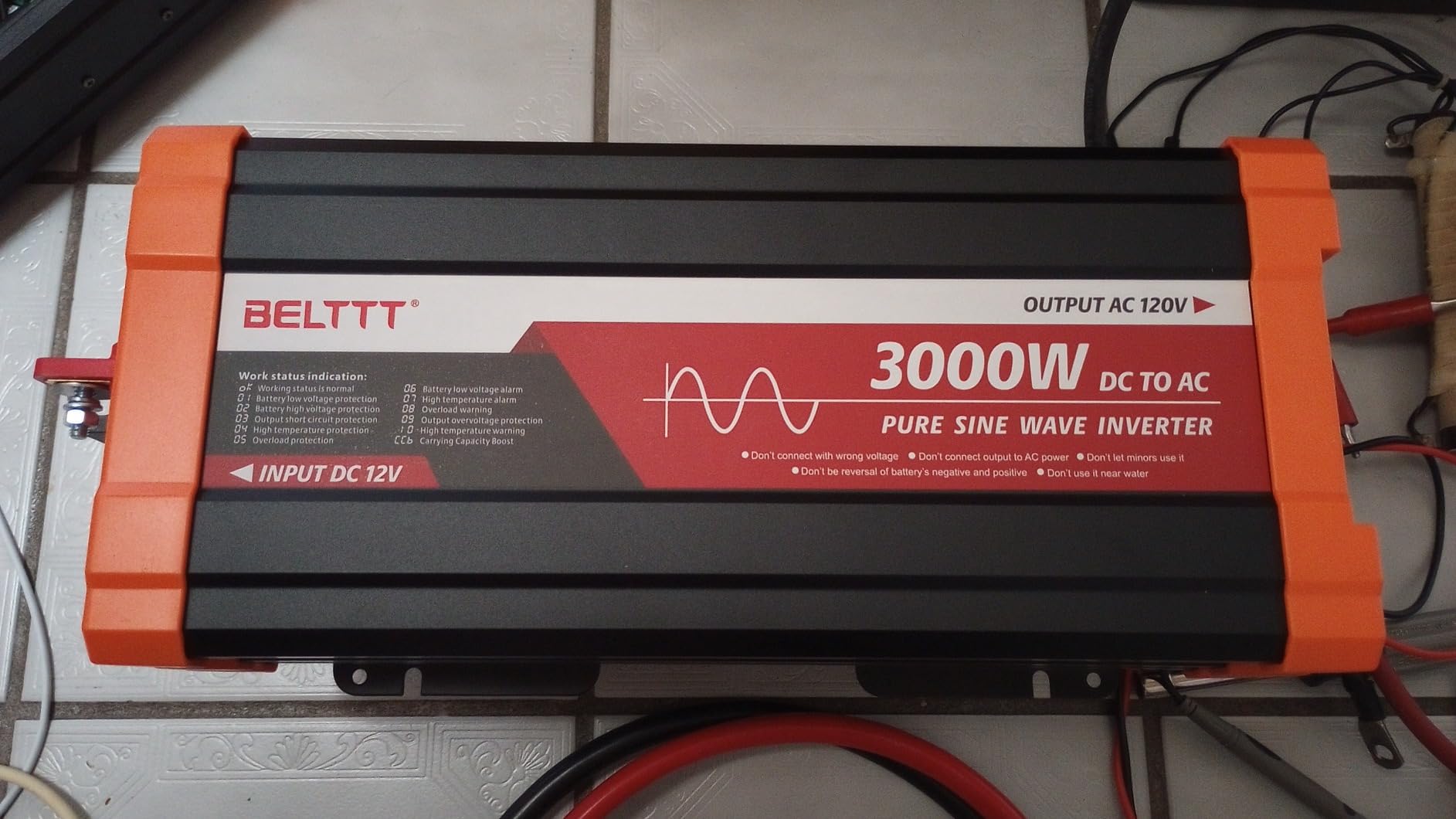
Efficiency is the headline here. Above 93 percent conversion with low no-load loss means less of your battery capacity disappears as heat, and on a solar or off-grid system that difference shows up directly as usable runtime. It is the number we would look at first when a build is battery-limited.
The 3000W continuous and 6000W peak pure sine wave output is a standard, well-proven profile, and it handles the usual RV and off-grid mix without trouble. At 9.9 pounds it is lighter than most 3000W units in this roundup.
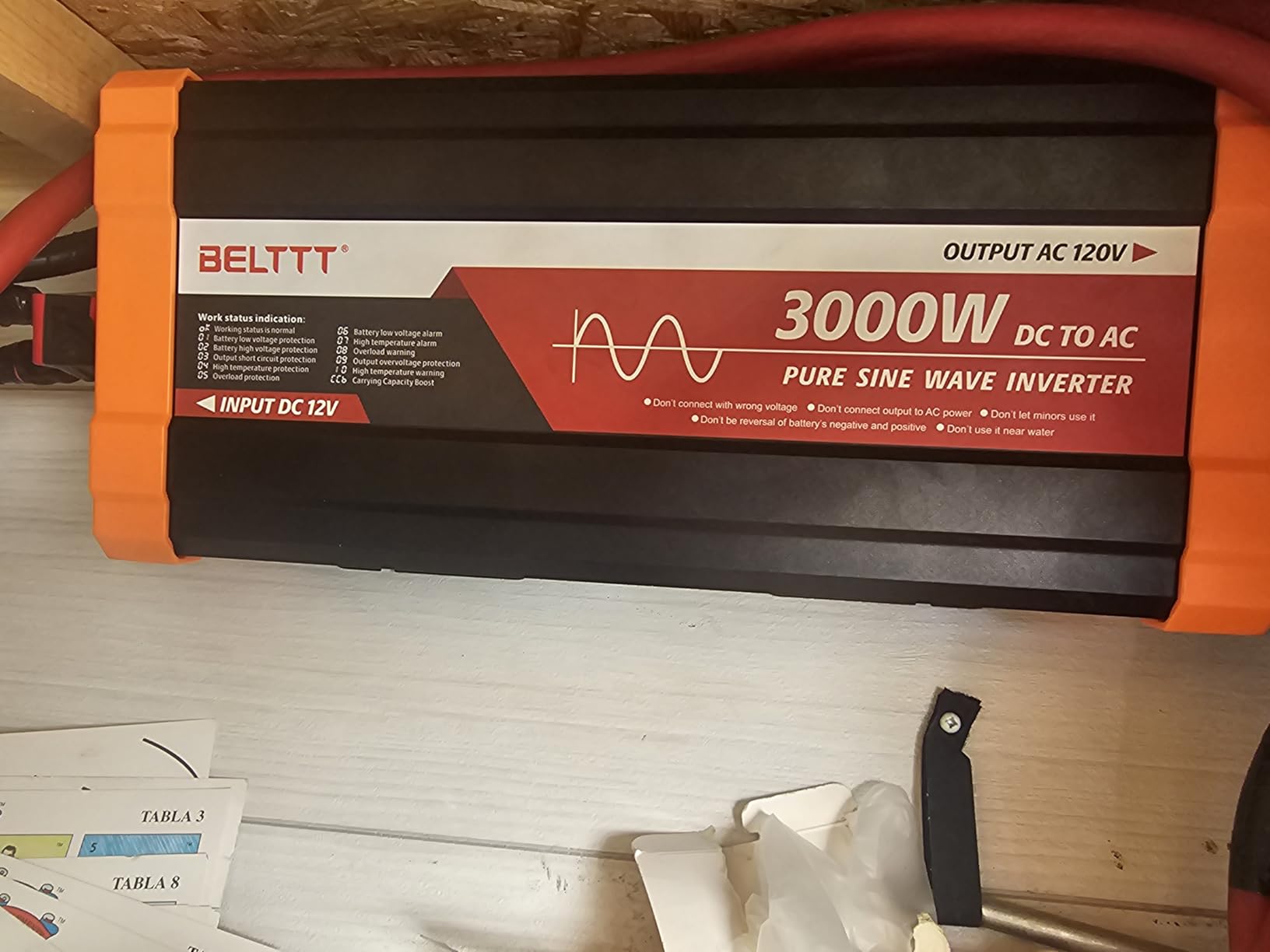
Where it beats its direct rivals is the box contents. Two 1/0AWG three foot battery cables, nine 45A fuses and a thimble spanner come in the package, and short or undersized cables plus missing spare fuses is one of the most common complaints about the alternatives. A 23 foot wired remote controller is included too.
The high-brightness LCD shows input and output voltage, battery state and load status, and the protection set covers under-voltage, over-voltage, overload, over-temperature, short circuit and reverse connection. Dual AC sockets, a 20A outlet, a 5V 2.1A USB port and a hardwire port give you a real choice of how to connect a fixed installation.
Two honest caveats. Output voltage and screen settings adjust only within a narrow range, so it is less tunable than the GIANDEL if you are running an unusual battery chemistry. And with 446 reviews, its service history is shorter than the established names in the class.
When this inverter is the right call
Pick it when runtime matters more than maximum adjustability, particularly on a solar system or a remote cabin where every percent of conversion efficiency shows up as usable hours. The included cable and fuse bundle saves a separate purchase as well.
It is also a good match for a first 3000W build where you want pure sine wave, a hardwire port for a panel and a display, without paying for a hybrid charger.
When to look elsewhere
Step up to the 4000W hybrid unit if you want a built-in MPPT charge controller and a 24V architecture, or to the Renogy if you want a wired remote, a terminal block and GFCI protection in a package with a much longer review history.
If you need to fine-tune the low voltage cutoff for lithium, this unit is not the most flexible choice in the class.
9. JARXIOKE 3000W Pure Sine Wave Inverter – Best for the Most Outlet Connections
3000 Watt Pure Sine Wave Power Inverter 12V DC to 110V 120V Converter for Family RV Off Grid Solar System Car with Type-C Ports 4 AC Power Outlets Dual USB Ports LCD Display Wireless Remote Control
3000W continuous 6000W peak
Pure sine wave
4 AC outlets plus USB-C
12.99 by 8.07 by 3.46 inches
Pros
- Four AC outlets plus dual USB and Type-C ports
- Wireless remote with 100 meter range
- Pure sine wave with soft start for sensitive loads
- Aluminum alloy housing with smart cooling fans
Cons
- Remote will not start the unit unless the front switch is already off
- Battery indicator and alarm are the only status feedback beyond the LCD
Four AC outlets plus dual USB ports plus Type-C ports is the largest connection set in this roundup at 3000W. In an RV or a camper that is the difference between wiring in a power strip and just plugging things in, and it removes a failure point as well as a cable.
Output is 3000W continuous and 6000W peak pure sine wave at above 90 percent conversion efficiency, with isolated input and output design and soft-start technology that eases loads in rather than slamming them on. Soft start matters more than it sounds with anything that has a compressor.
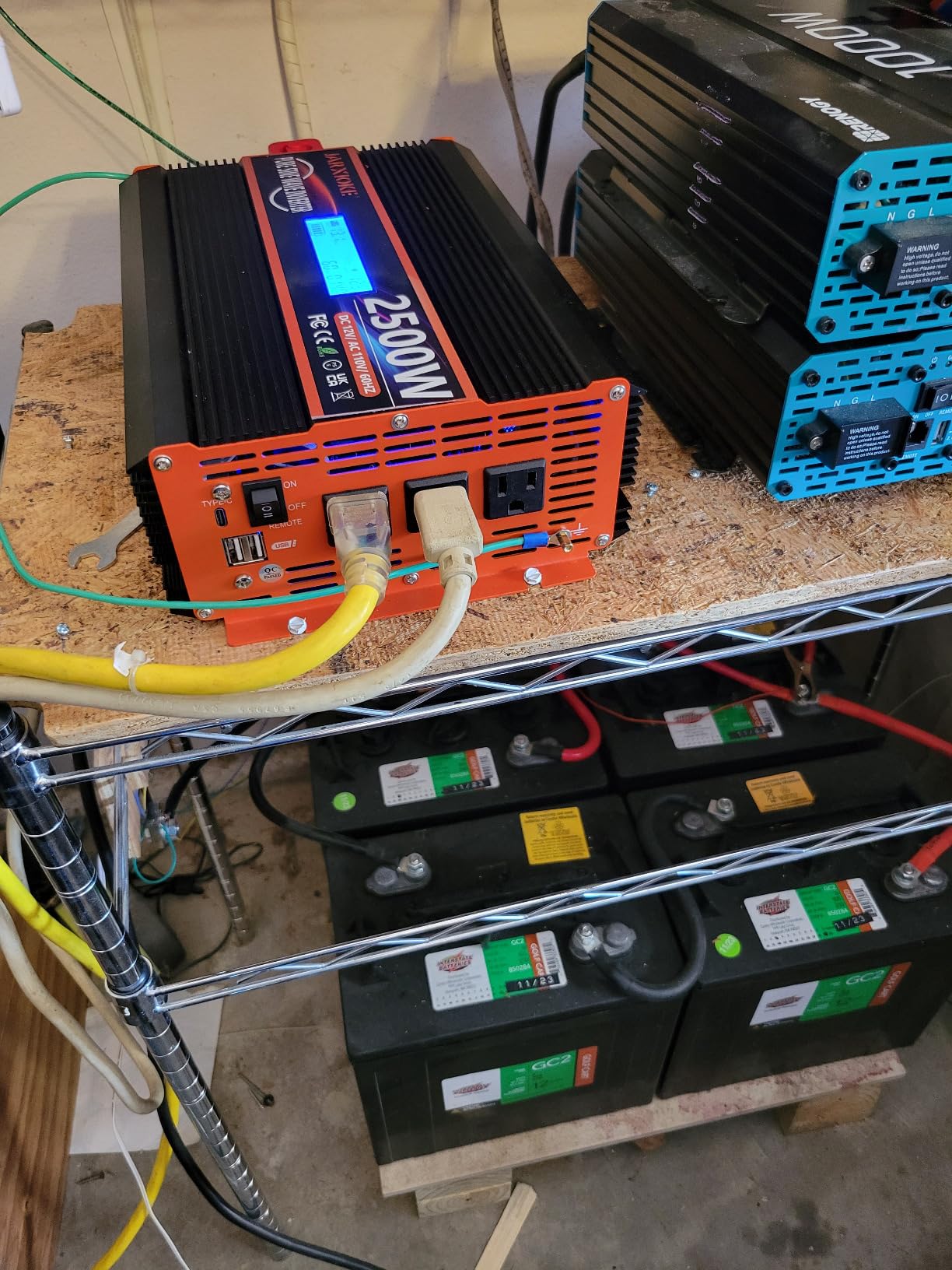
The wireless remote reaches 100 meters, which is long enough to shut the unit down from the driver’s seat or from across a work area. It is the only wireless remote in this group, and it comes with automatic restart plus a battery indicator light and audible alarm for fault conditions.
Protection covers over-voltage, low voltage, overload, short circuit, overheat, reverse polarity and lightning leakage, and the aluminum alloy housing with smart cooling fans handles sustained loads without the noise some competitors generate.
One usability wrinkle is worth knowing before you rely on the remote. It will not start the unit unless the front panel switch is already off, so a cold start still needs a hand on the panel. The warranty is 24 months with AIG product liability coverage.
When this inverter is the right call
It is the natural choice for a shared RV, a work van or a camper where several people plug in at the same time. Four outlets means nobody is unplugging a laptop charger to make room for a kettle.
The Type-C and USB ports also make it a good one-box answer for a family that wants mains and device charging handled together.
When to look elsewhere
If you rely on the remote for cold starts in a cold morning, choose a unit with a wired remote instead. The 100 meter range is genuinely useful, but the on/off quirk limits it.
For a solar build, this is an inverter only, so you will still need a separate charge controller or a hybrid unit with MPPT built in.
10. Cantonape 3000W Power Inverter – Best for Fault Code Diagnostics
Cantonape 3000W Power Inverter 12V to 110V/120V DC to AC with LCD Display
3000W continuous 6000W peak
Modified sine wave
4 AC outlets plus 4 USB
14.17 by 6.3 by 3.94 inches
Pros
- E-1 to E-6 fault codes make troubleshooting much faster
- Four AC outlets plus four USB ports
- Reported to run CPAP machines and lights reliably
- Responsive support that replaced a failed unit quickly
Cons
- Cooling fans become audible under heavy load
- Sustained loads near 3000W can trip protection
- One owner reported random shutdowns needing a manual reset
The LCD on this one is the feature. Instead of a row of vague indicator lights, it reports E-1 through E-6 codes for low voltage, high voltage, over temperature, overload, short circuit and repeated fault shutdown, alongside input and output voltage, battery capacity, load and output frequency.
For anyone running a system remotely or on a schedule, being able to read a specific code instead of guessing is a genuine operational advantage. It turns a trip from an outage into a diagnosis.
Connectivity is generous for the class: four 110V AC outlets and four USB ports, with six protection types covering overload, short circuit, overheat, reverse polarity and under and over voltage. The aluminum body, isolated ground neutral and temperature controlled fan are all standard for a unit of this size at 2.6 kg.
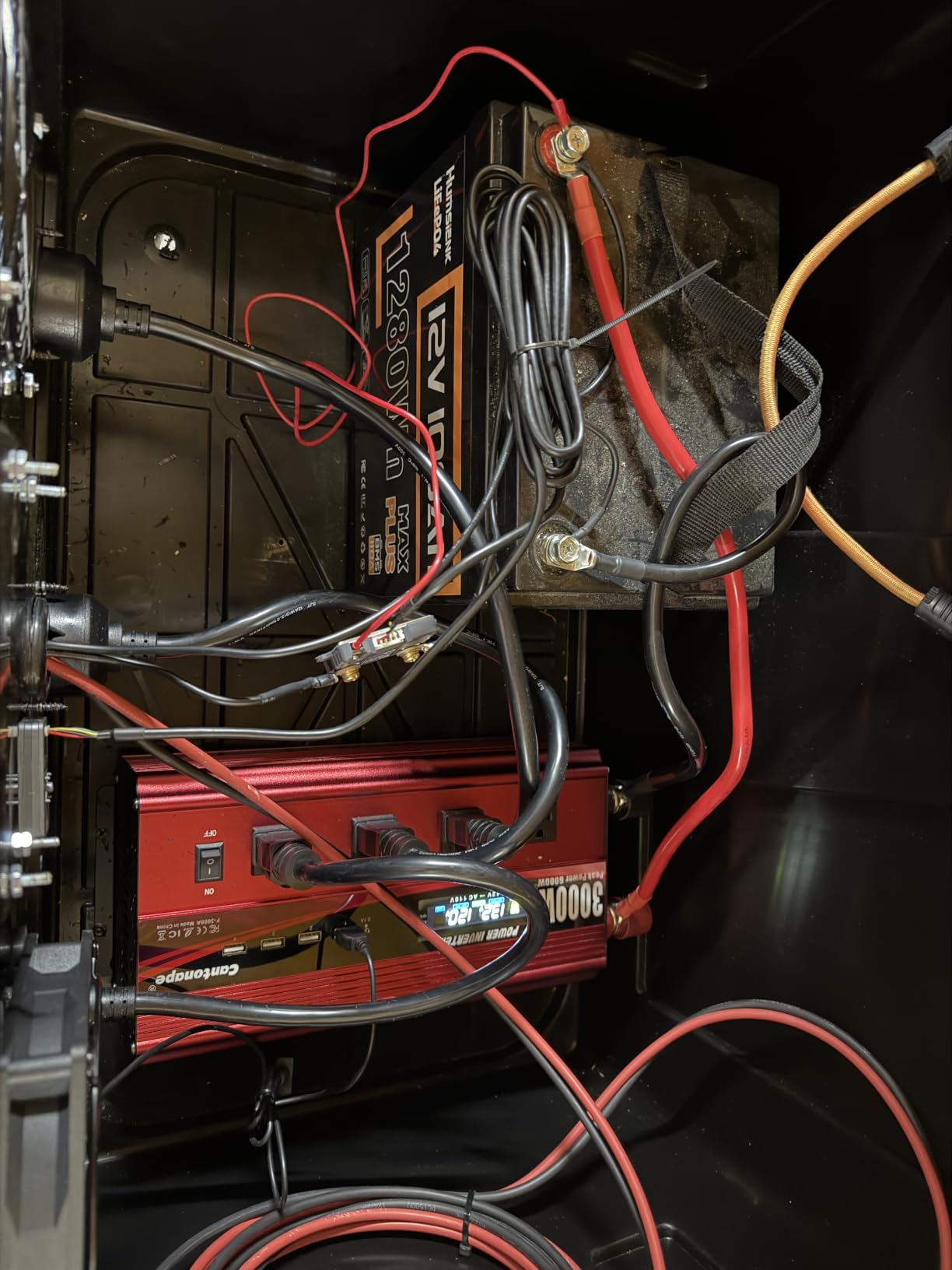
Owner reports mention running CPAP machines, lights, small tools and phone charging off a battery bank without issue, which covers the common camper and off-grid cabin load. A remote controller is included, and it needs its own 12V 23A battery, which is not included in the box.
The honest limitations are thermal. Several owners note the cooling fans become noticeably audible under moderate to heavy load, and sustained draws close to the 3000W ceiling can heat the unit enough to trip protection. One owner reported random error shutdowns that needed a manual reset. The 12 month warranty is also the shortest here.
That last combination means this is a good fit for moderate loads with room to spare, and a poor fit for someone who intends to run near full rated output all day.
When this inverter is the right call
It suits a camper or an off-grid cabin owner who wants a readable display and clear fault codes. CPAP machines, lighting, small tools and charging are all comfortably inside its range with headroom left.
The four-outlet, four-USB layout also makes it a good fit for a shared space where several devices need mains and USB at once.
When to look elsewhere
Skip it if you plan to run consistently above about 80 percent of rated output, or if noise in a sleeping area matters. Both the fan behaviour and the reported shutdowns point the same way.
For sensitive electronics choose a pure sine wave model, and for a longer support commitment look at a unit with a three-year warranty.
11. Renogy 3000W Pure Sine Wave Inverter – Best for Home Backup and Freezers
Renogy Inverter P2 3000W Pure Sine Wave Inverter 12V DC to 120V AC Converter for Home, RV, Truck, Camping, Trailer, with Wired Remote Controller, Support Li, AGM, SLD, Gel, FLD Batteries
3000W continuous 6000W surge
Pure sine wave
3 AC outlets plus terminal block
18.9 by 9 by 4 inches
Pros
- Pure sine wave runs freezers and pellet stoves quietly
- Silent under light load with fans only at high demand
- GFCI protection plus full LED fault indicators
- 16.4 ft wired remote simplifies out-of-reach mounting
Cons
- Included battery cables are short and light gauge
- Mounting ears are small for tight installs
- Warranty service has been reported as difficult
- Requires a separate deep cycle battery
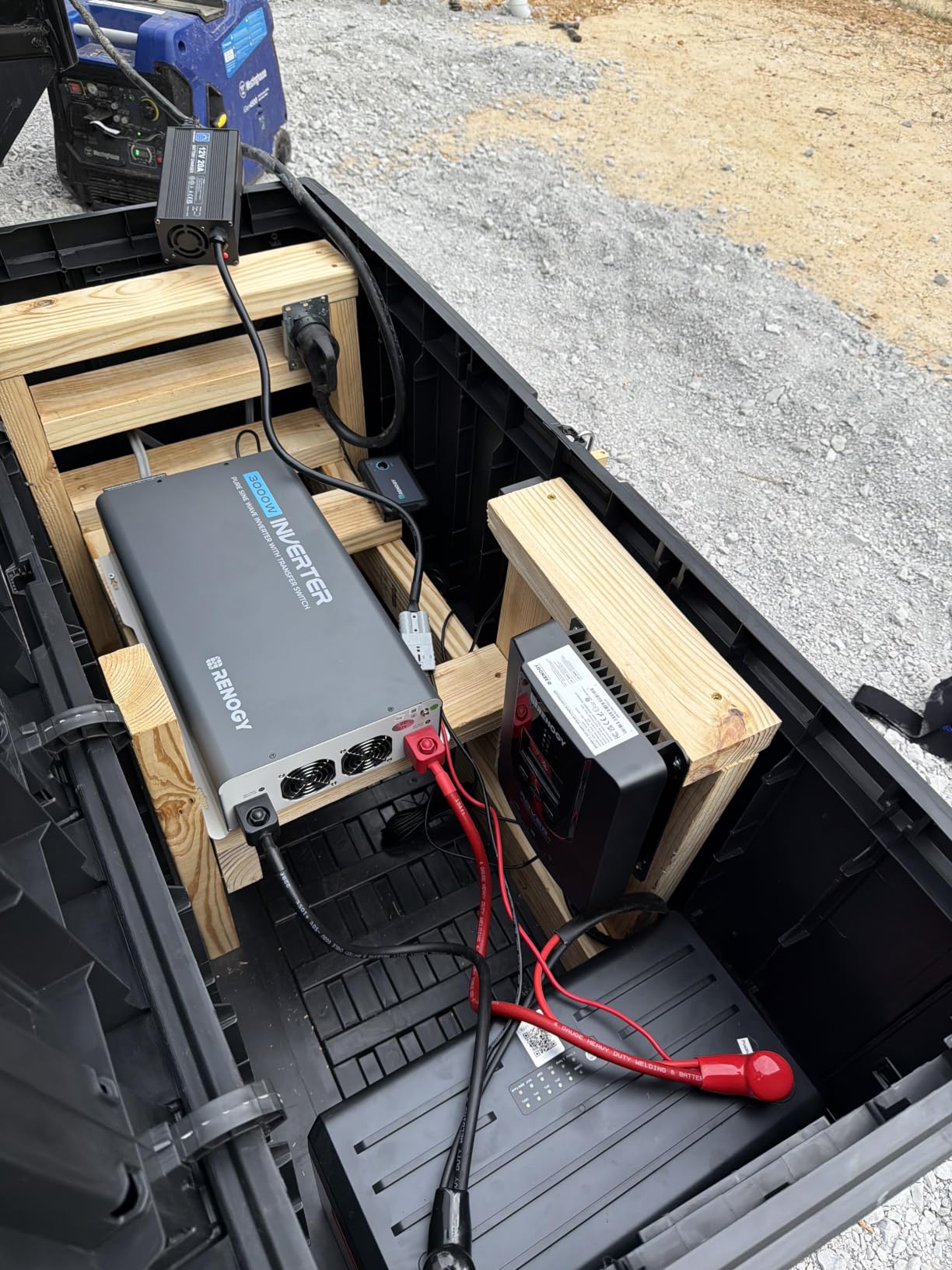
This is the one we would build around for a home backup or an off-grid property. It is pure sine wave, 3000W continuous with 6000W surge, above 90 percent conversion efficiency, and it is the most-reviewed unit in the 3000W class at 4,715 reviews.
Owners running freezers, pellet stoves and RV loads report quiet, steady output and solid build quality. The pure sine waveform is what makes the pellet stove and the freezer behave, and it is the reason this unit sits above cheaper 3000W models for whole-home essentials.
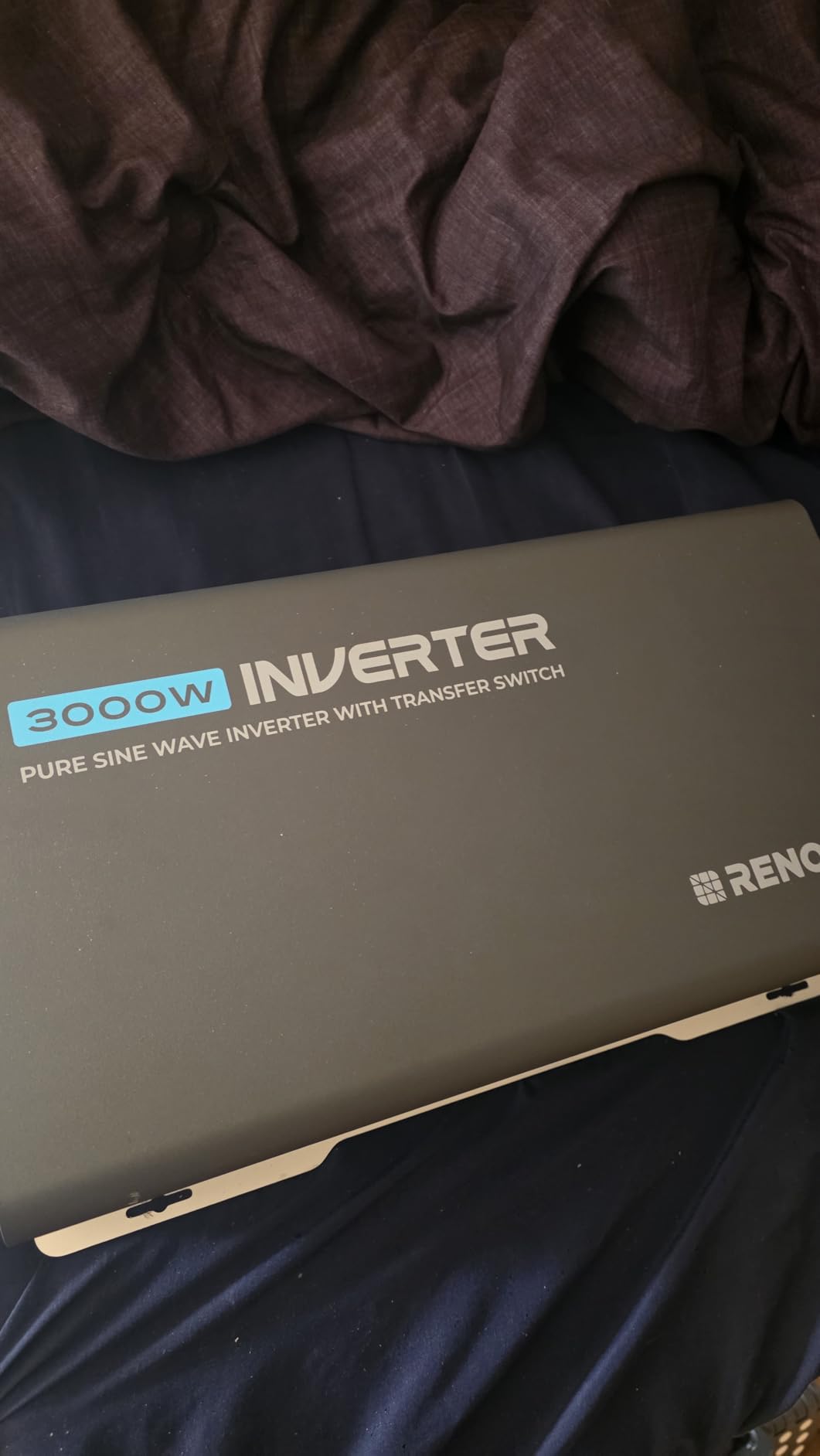
It is genuinely quiet under light load. Fans engage only under heavy demand, which matters when the unit is mounted in a living space or a sleeping area on an outage, and that behaviour is the single most common positive comment in the reviews.
Protection and control are thorough: GFCI, under and over-voltage, over-temperature, overload and short circuit indicators on the front panel, plus three AC outlets, one AC terminal block, a built-in 5V 2.1A USB port and a 16.4 foot wired remote for mounting the unit somewhere you cannot reach. It is UL 458 and CSA C22.2 No. 107.1 certified.
Three practical complaints recur. The included battery cables are short and light for real loads, the mounting ears are small enough to be awkward in a tight install, and some owners report difficulty obtaining warranty service after a GFCI-related failure. Budget for heavy gauge cable and plan the mounting space before delivery.
It is also an inverter only. You need your own deep cycle battery, and adding solar means a separate MPPT charge controller unless you choose the hybrid unit below.
When this inverter is the right call
It is the right pick for outage backup of essentials, an off-grid cabin, or a van or RV build where a fridge, a freezer, a pellet stove and a laptop all need to run at once. The pure sine output keeps them all running cleanly.
The long wired remote and the three-outlet plus terminal block layout also make it the easiest of the 3000W group to install properly in a fixed location.
When to look elsewhere
If you want solar charging without a separate controller, this is not the unit. Look at the 4000W hybrid with a built-in 140A MPPT instead.
Forum owners who care deeply about firmware, monitoring integration and long-term service reach for premium brands at a higher tier than this, and the reported warranty friction is the reason some of them do.
12. SUMRY 4000W 24V Hybrid Solar Inverter – Best for Solar and Off-Grid Builds
SUMRY Hybrid Solar Inverter, 4000W DC24V to AC120V Pure Sine Wave Power
4000W rated 8000W peak
Pure sine wave
Built-in 140A MPPT
24V DC to 120V AC
Pros
- Highest average rating in the group at 4.7 stars with 89 percent five-star
- 140A MPPT removes the need for a separate charge controller
- Generous terminal spacing makes 1/0 cable connections safe
- 6.25 inch LCD under a tempered glass cover
Cons
- Three cooling fans make it louder than lighter competitors
- Battery-less operation needs PV input above 120V and a disconnected grid
- One owner reported PV charging that never started
This is the most capable unit here and the only true hybrid. It outputs 4000W rated and 8000W peak pure sine wave from a 24V battery, and it carries a built-in 140A MPPT charge controller rated to 5600W of PV at 350VDC with up to 98 percent conversion efficiency.
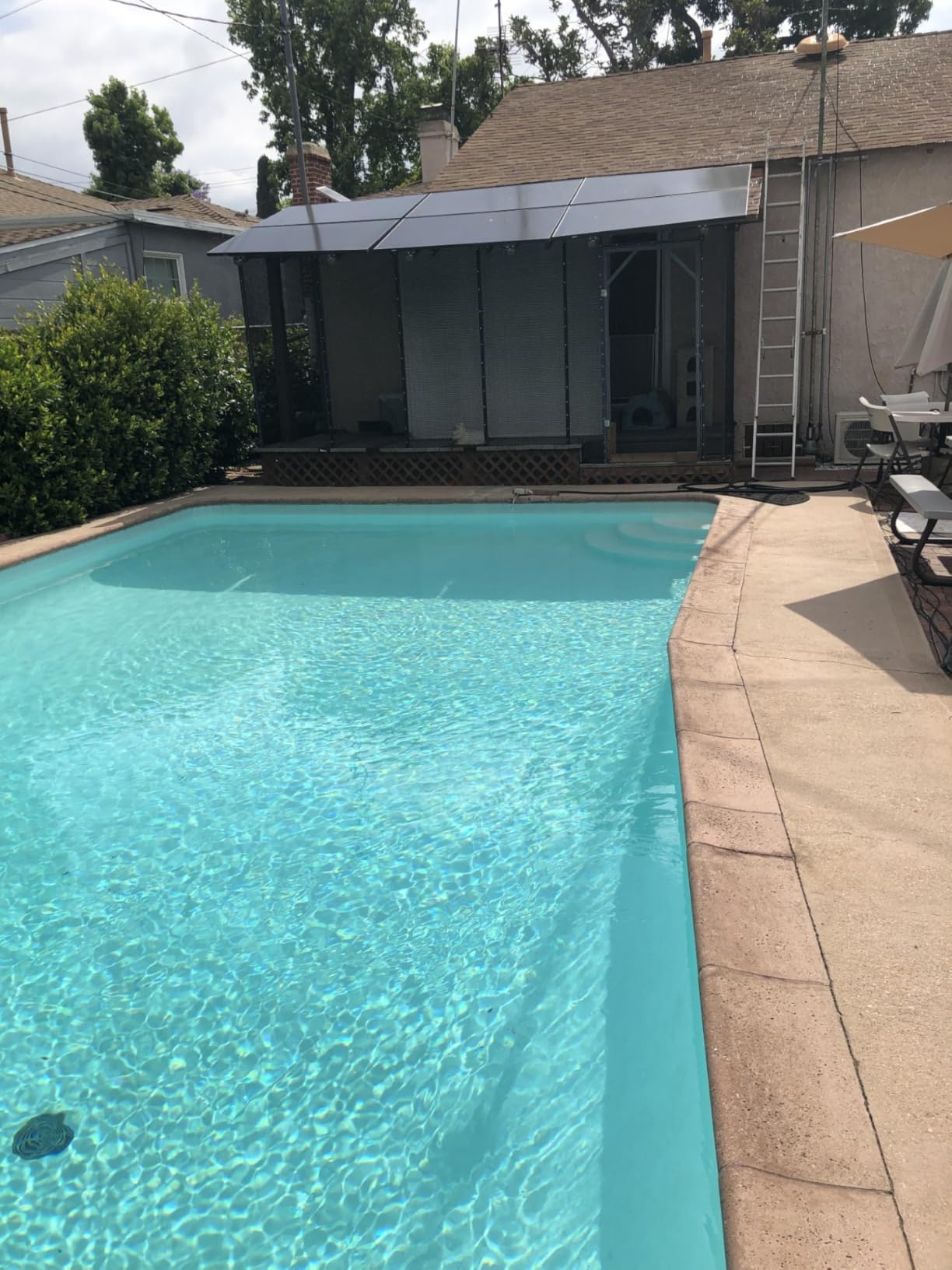
That MPPT is the headline. It removes an entire box from the parts list, and for anyone building a van, a boat or an off-grid cabin with solar, cutting a separate charge controller simplifies the wiring and reduces the number of places a fault can hide.
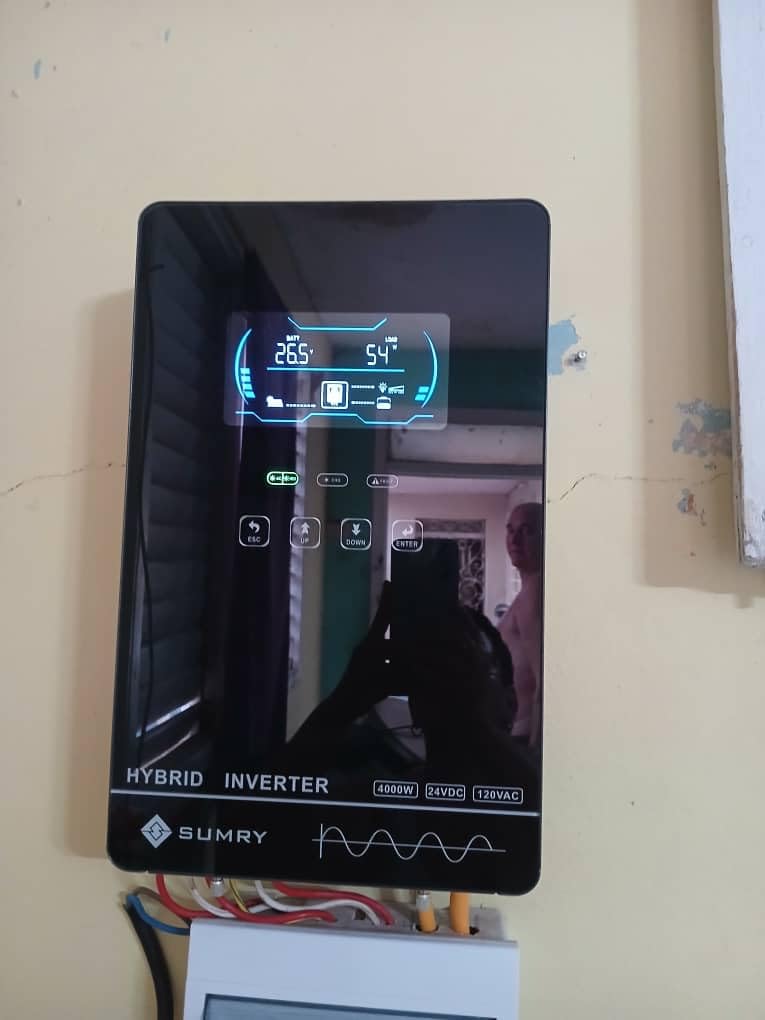
The 6.25 inch LCD under a tempered glass cover with touchable buttons is by far the largest display in this roundup, and it shows real-time data on input, output and battery. Configurable priority across solar, battery and utility lets you decide whether solar or the bank gets charged first, which is the setting off-grid users tune most often.
It also accepts AGM, gel, lead-acid, lithium-ion and LiFePO4 24V batteries, and can run without a battery at all using PV DC current when PV input exceeds 120V and the grid is disconnected. That is unusual at this level and useful for a system that needs to start before the bank is built.
Owners building out vans and RVs report running an entire vehicle including an AC unit and a cooktop off a 24V system. The wide-spaced terminals make 1/0 cable connections straightforward and safe, and the 4.7 rating across 437 reviews with 89 percent five-star is the strongest consensus in the group.
Three cooling fans make it audibly louder than the lighter 3000W units, and one owner reported a unit that never charged from PV with limited troubleshooting documentation. The 1 year manufacturer warranty is the shortest of the 3000W-plus models, which is the real cost of buying into the hybrid segment at this level.
When this inverter is the right call
It is the right unit for a 24V van, boat or off-grid cabin build where solar is central rather than optional. Built-in MPPT, configurable priority and a display this size remove most of the guesswork from commissioning.
It also suits anyone who wants mains-level power for an AC unit or a cooktop from a battery, which is beyond what a 12V 3000W unit is realistically asked to do.
When to look elsewhere
It is a 24V unit, so a standard automotive 12V battery bank will not drive it. If your system is 12V, stay with the 3000W units in this roundup and add a separate charge controller.
Sleeping-close-to-it installs are also a poor fit because of the three fans, and anyone who needs a long warranty should weigh that before buying.
How to Size a Power Inverter: The (Running Watts + Highest Surge) x 1.2 Formula
Sizing an inverter takes about five minutes once you have the numbers, and the most common mistake is sizing on peak wattage instead of continuous wattage. Continuous is what the unit can hold indefinitely. Surge is what it can deliver briefly when a motor or compressor starts, and it is always a short window.
Here is the sequence we use. First, list everything you intend to run and write down its running watts, usually printed on the appliance label or listed in the manual. Second, find the single highest surge figure among those loads, because only the largest one needs to be added, not all of them. Third, add running watts to that one surge figure. Fourth, multiply the total by 1.2 to leave headroom. Fifth, round up to the next available inverter size.
Inverter size = (total running watts + highest surge watts) x 1.2
Worked example: a fridge at 150W running with 400W surge, plus a laptop at 65W, a router at 15W and a lamp at 10W. Total running is 240W, highest surge is 400W, so the formula gives (240 + 400) x 1.2 = 768W. A 1000W unit is the right buy, and a 1500W one gives you room to add an appliance later.
The 1.2 multiplier is not optional. Inverters run cooler and last longer below their continuous rating, and the headroom also covers the fact that lead acid batteries sag under load, which pulls input voltage down and can trigger a low voltage cutout on a unit that looks correctly sized on paper.
For a reference point on typical draws: a phone charger sits around 10 to 20W, a laptop 45 to 100W, a monitor 20 to 40W, a hair dryer 1000 to 1500W, a small microwave 600 to 1200W, a refrigerator 100 to 400W running with a three to five times surge on start, a washing machine 400 to 600W, and a circular saw 1200 to 1800W. Add your own to the list rather than trusting a general rule.
Pure Sine Wave vs Modified Sine Wave: What Total Harmonic Distortion Means for Your Electronics
A pure sine wave inverter produces a smooth waveform that matches utility power. A modified sine wave inverter produces a stepped approximation of that same curve, which is cheaper to build and perfectly adequate for a resistive load like a heater or a light bulb.
Total harmonic distortion, usually written as THD, is the number that describes how far the waveform deviates from a true sine. Pure sine wave units sit at or below 3 percent, and modified sine wave units commonly run between 5 and 20 percent. That deviation is what makes some devices buzz, run hot, or reset unexpectedly.
Modified sine wave output is fine for a toaster, a hot plate, a soldering iron, a basic power tool and a string of lights. It is not fine for laptops, medical devices, audio equipment, variable speed fans and compressors, and anything with an electronic power supply that expects a clean input.
This fear shows up constantly in owner discussions about modified sine wave units and cheap inverters damaging electronics, and it is well founded rather than exaggerated. If your load list contains a single item in the sensitive category, buy pure sine wave for that item, either as a dedicated unit or as the inverter for the whole system.
Worth knowing at the other end of the spectrum: the top-ranking van and RV conversations on this topic tend to focus on frequency architecture rather than waveform. High-frequency inverters are markedly more efficient at a quarter of their rated output, while low-frequency units are less efficient but considerably more rugged, which is a durability-versus-efficiency trade rather than a waveform decision.
Battery Sizing: How Many Amp-Hours for a 1000W, 2000W, 3000W or 5000W Inverter
Battery sizing is where most DIY systems go wrong, and the reason is that people size for capacity without accounting for inverter losses. A 1000W inverter at 90 percent efficiency draws closer to 1110W from the battery, and a lead acid bank should not be taken past about 50 percent depth of discharge without losing significant life.
As a rule of thumb, multiply the inverter’s continuous watts by two to get the amp-hours you want in usable storage, then double that again if the bank is lead acid rather than lithium. That is why a 1000W inverter is comfortable on a pair of 100Ah LiFePO4 batteries and generally wants four 100Ah lead acid batteries for the same job.
For a 3000W inverter, expect to want roughly 300Ah of lithium storage for a few hours of moderate load, and considerably more in lead acid. For a 5000W inverter the same logic puts you into the 500Ah range on lithium, and a 48V system is usually the sensible way to reach it because it halves the current in the cables and the losses that come with it.
Two practical notes. Lithium iron phosphate banks are the better choice where weight matters, since they can be discharged deeper and hold their voltage flatter under load, which also reduces nuisance low voltage cutouts. And check idle draw before you buy anything, because a monitoring-heavy unit drawing 30 watts or more can flatten a bank overnight with no load attached at all, which owners on forums treat as a dealbreaker rather than a minor complaint.
Cigarette Lighter, Clamp Terminals or Hardwire: Choosing a Connection Method
The connection method determines how much current your wiring can safely carry, and picking the wrong one is the most common way people damage a vehicle.
A cigarette lighter socket is the easiest option and the most limited. Most vehicle sockets are fused at 10 to 15 amps, which caps you at roughly 120 to 180W before the socket or its fuse gives up. That is why the small inverters in this roundup top out at 300W on socket power, and why accessories that share that same socket budget, such as our power steering cooler picks, sit under the same ceiling.
Battery clamp leads bypass the socket entirely and attach straight to the battery terminals. They handle far more current, which is what the 750W and 1000W units need for anything beyond light charging. The trade-off is that clamps can creep loose and arc, so check them after the first hour of use and re-tighten.
Hardwiring is the correct answer for a fixed install above about 1000W. It means running correctly gauged cable from the battery to the inverter with a fusible link near the battery, and for that, and for anything involving a panel or a transfer switch, we would use a qualified installer. If you want the practical version of this for mobile work, our power washer picks for driveways cover the sort of equipment load that trips an undersized circuit.
Long cable runs add their own problem. Voltage drop rises with distance and thin cable, and an inverter that reads low input voltage will shut down under load even when the battery is full. Upping the cable gauge is cheaper than upsizing the inverter.
What You Should Never Plug Into a Power Inverter
This is the question that comes up constantly and is answered almost nowhere, so here is the short version with the reasoning attached.
Never plug in a device that draws more than the inverter’s continuous rating, even if it is under the surge rating. Surge is for the moment a motor starts, not for sustained running, and overloading repeatedly will trip protection or damage the unit.
Never run a medical device on a modified sine wave inverter. CPAP machines, oxygen concentrators and powered wheelchairs need clean, stable power, and the harmonic distortion of a stepped waveform has caused both erratic behaviour and component damage.
Never run a heating appliance unattended, and never leave a hair dryer, a space heater, a kettle or a soldering iron running off an inverter you cannot see. These are the loads most likely to overheat a modified waveform output or exhaust a bank faster than you expect.
Never exceed the rated current of a cigarette lighter socket, and never attach clamps to a socket that is already at its fuse limit. High draw through a socket is a documented source of melted connectors, and owner reports of damaged 12V sockets are not rare.
Never wire directly into a battery without a proper fusible link close to the terminal. A short circuit with an unfused cable is a fire, not an inconvenience.
Never assume a grid-tie capable unit is safe to backfeed. If you are connecting to household wiring rather than running outlets, that is licensed electrical work in most places.
Frequently Asked Questions
What brand of inverter is the best?
There is no single best brand, but the consensus among long-term owners is that premium names like Victron, Schneider, Xantrex and Tripp Lite hold up longest and cost more, while brands like BESTEK, Renogy and AstroAI deliver far more watts per dollar. For most buyers the deciding factors are waveform type, warranty length and whether the idle draw suits your battery bank rather than the badge alone.
What should you not plug into an inverter?
Do not plug in medical devices on a modified sine wave inverter, anything drawing more than the unit’s continuous rating, or a heating appliance you cannot supervise. Also avoid pushing high current through a cigarette lighter socket and never connect to a battery without a proper fusible link. Sensitive electronics such as laptops, audio gear and variable speed motors need pure sine wave output.
How do you tell what size inverter you need?
List every device you plan to run and add up its running watts, then find the highest surge figure among those devices. Add the two numbers, multiply by 1.2 to leave headroom, and round up to the next available size. The formula is (total running watts + highest surge watts) x 1.2, and it keeps the inverter cool and away from low voltage cutouts.
How big of a battery do I need to run a 3000W inverter?
Multiply the inverter’s continuous watts by two for the amp-hours you want in usable storage, then double that again if you are using lead acid. A 3000W inverter is comfortable on roughly 300Ah of LiFePO4 storage for a few hours of moderate load, and lead acid will need substantially more capacity to reach the same runtime.
How many batteries do I need for a 1000 watt inverter?
Two 100Ah LiFePO4 batteries in parallel give a 1000W inverter comfortable headroom for a few hours of moderate load, and roughly 200Ah of usable storage. Lead acid of the same capacity is shallower on each cycle, so four 100Ah lead acid batteries is the closer equivalent if you want comparable runtime and a similar service life.
Can a 5000W inverter run a house?
A 5000W inverter can cover essential circuits during an outage, such as a refrigerator, lighting, a router and a few outlets, but it cannot run a whole house. A typical home draws far more than 5000W once heating, air conditioning, water heating and laundry are involved, so a full house needs a system in the 10 to 20kW range, which also demands a large battery bank.
Final Verdict: Which Power Inverter Should You Buy in 2026?
If you are starting from a car and running electronics, the BESTEK 300W is the one to buy. Its 4.5 rating across more than 34,000 reviews, two AC outlets, two USB ports and a 60-month warranty make it the most proven unit in this roundup, and it is our pick for a reason.
If your loads are appliances rather than chargers, the picture changes. Take the TWING 1000W for camping-level draw, the GIANDEL 1500W when a single sensitive appliance matters, the Renogy 3000W for home backup and freezers, and the SUMRY 4000W hybrid when solar is central and you can build on a 24V bank.
Whatever you choose, size on continuous watts, buy pure sine wave if anything in your list is sensitive, and check the idle draw before you leave it switched on. Those three decisions account for most of the problems we saw in owner feedback across all twelve units.