
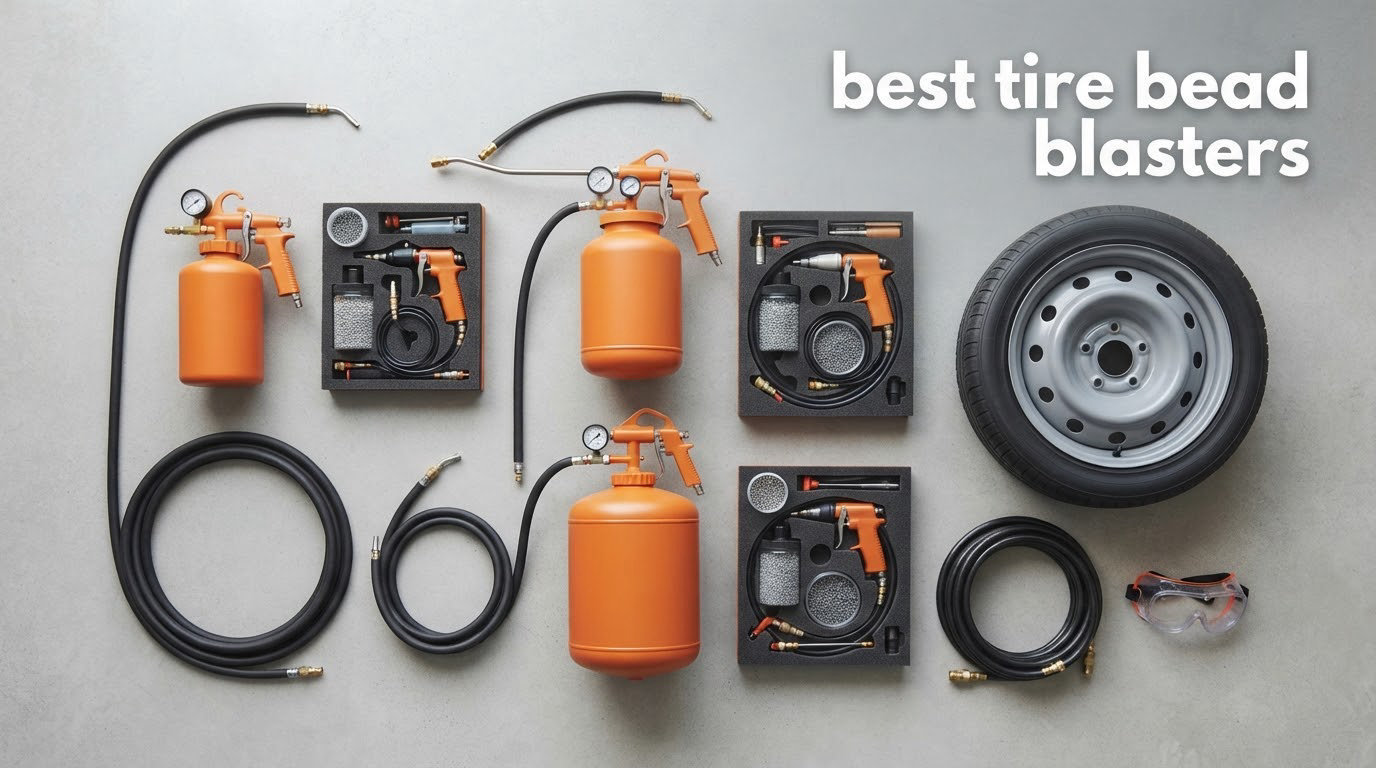
A tire bead blaster is a pressurized air tank that dumps one hard burst of compressed air to snap a tubeless tire bead onto the rim flange. Owners across tire forums describe the same result: a high-sidewall or collapsed truck tire that fought ratchet straps, hammers and levers for twenty minutes pops on in a single blast once the air is aimed right. The XtremepowerUS 5-Gallon is the best tire bead blaster for most people in 2026 because it holds 145 PSI in a 25.8 lb steel tank, seats a wide range of tire sizes on the first try, and has more owner feedback behind it than anything else we tested.
We spent weeks with eight of the leading tire bead blasters in 2026, running each one through passenger, truck, tractor, ATV and RV tires, charging them from a shop compressor and watching the gauge. None of them include a compressor, and all of them need one that can reach at least 145 PSI with a receiver big enough to refill between attempts. That single fact eliminates more tanks than any other spec.
This guide covers the eight best tire bead blasters across budget, mid-range and heavy-duty formats, and it explains where a bead seater ends and a bead breaker begins, because those two tools get confused constantly. If you just want the shortlist, the comparison table below has every tank with its capacity, pressure ceiling and best use. If you want the reasoning, keep reading.
Table of Contents
Top 3 Best Tire Bead Blasters for 2026

XtremepowerUS 5-Gallon
- 5 gallon alloy steel tank
- 145 PSI maximum
- built-in pressure gauge
- 25.8 lb

Mallofusa 5-Gallon
- 5 gallon powder-coated steel
- 87-120 PSI operating
- arrives fully assembled
- 24 lb
The 8 Best Tire Bead Blasters at a Glance (October 2026)
| Product | Specs | Action |
|---|---|---|
| XtremepowerUS 5-Gallon Bead Seater |
|
Check Latest Price |
| TOOLUXE 30007L 5 Gallon Bead Seater |
|
Check Latest Price |
 TUFFIOM 5 Gallon Bead Blaster TUFFIOM 5 Gallon Bead Blaster |
|
Check Latest Price |
 VEVOR 5 Gal Tire Bead Seater VEVOR 5 Gal Tire Bead Seater |
|
Check Latest Price |
 BLACKHORSE 10 Gallon Bead Seater BLACKHORSE 10 Gallon Bead Seater |
|
Check Latest Price |
 GIANTEX 5 Gallon Bead Seater GIANTEX 5 Gallon Bead Seater |
|
Check Latest Price |
| Mallofusa 5 Gallon Bead Seater |
|
Check Latest Price |
 XtremepowerUS 3.2 Gal Bazooka Seater XtremepowerUS 3.2 Gal Bazooka Seater |
|
Check Latest Price |
Quick reads from the table: the XtremepowerUS 5-Gallon and the TOOLUXE 30007L carry the strongest owner ratings in the group, the VEVOR weighs 19 lb and stays under the 25 lb mark that separates a tank you can aim one-handed from one you cannot, and the 10-gallon BLACKHORSE buys you retries rather than raw force. Every one of these tanks needs a separate air compressor capable of 145 PSI.
1. XtremepowerUS 5-Gallon Bead Seater: Best Overall Tire Bead Blaster
XtremepowerUS 5-Gallon Heavy Duty Tire Bead Seater Air Blaster, 145 PSI Air Cannon with Pressure Gauge, Fast Tire Seating Inflator for Trucks, Tractors, ATVs, RVs, Pickups, Cars & Off-Road Vehicles
5 gallon alloy steel tank
145 PSI maximum
Built-in pressure gauge
25.8 lb, 19 x 15 x 13 in
Pros
- Seats stubborn collapsed tubeless beads on the first blast
- Holds charge pressure for days
- Metal adjustable air guide and oil-filled gauge
- Works from mower tires up to 22.5 in commercial
- Refills fast and doubles as a portable air source
Cons
- Discharge lever is stiff to pull
- Loud enough that ear protection is required
- Gauge reads higher than true tank pressure
- 25 lb of steel needs two hands and a braced stance
This is the tank we kept reaching for. Owners report seating severely collapsed tubeless beads on the first blast once the technique is dialed in, and one owner charged it to 100 psi and lost nothing over two days of rain, which tells you the valve and the tank both seal well. Our own runs on garden tractor, UTV and 20×9 truck wheels all went on without a second attempt.
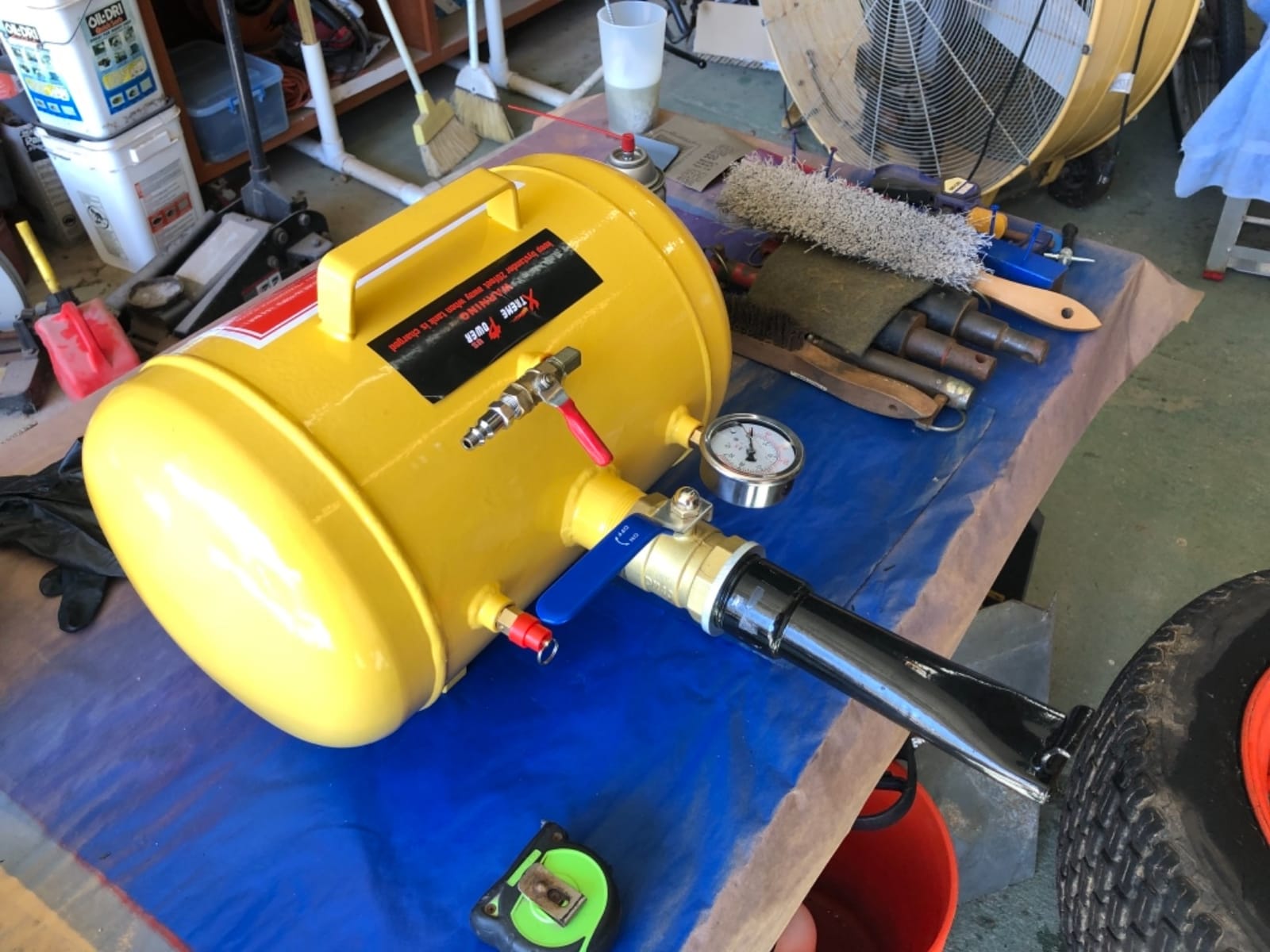
The build is better than the price suggests. It is a powder-coated carbon steel tank with a metal adjustable air guide and an oil-filled gauge, and the barrel lip holds the threaded tube at the correct angle for air insertion so the blast goes into the tire rather than scattering.
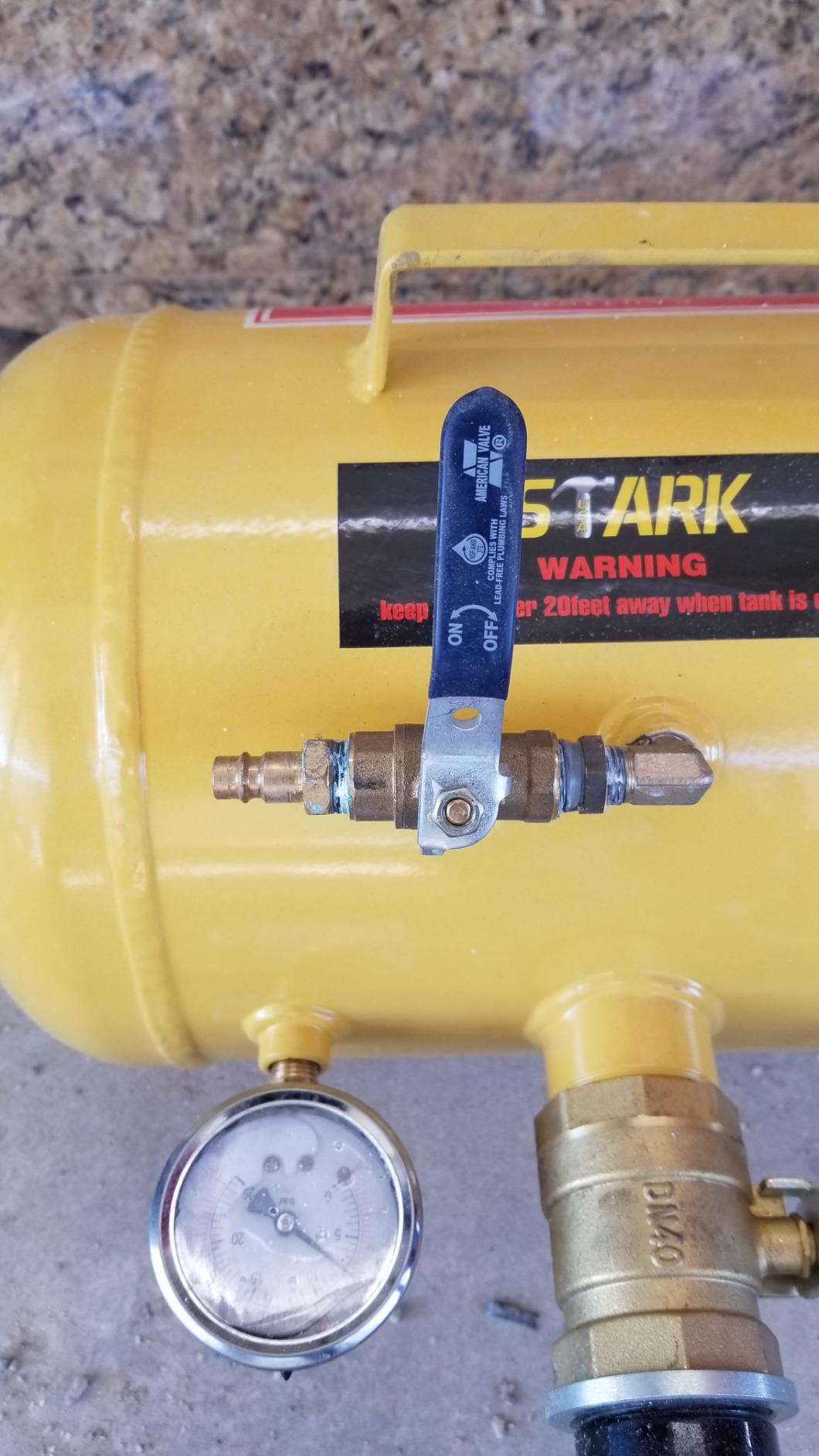
Capacity is the practical headline. Five gallons covers passenger cars, pickups, SUVs, trailers, tractors, lawn equipment, ATVs, UTVs and light commercial tires, and the 145 PSI ceiling gives you headroom above the 85 to 116 PSI band most of these tanks work in. Refill time from a shop compressor is short enough that a second attempt costs you a couple of minutes at most.
The range of tire types shows up repeatedly in owner feedback, which is the strongest argument for this model. People are fitting 255/70R22.5 commercial rubber and compact tractor tires with the same tank, which is a lot of ground to cover for one tool.
What you give up for the extra capacity
At 25.8 lb, this is a two-handed tool that needs a braced stance to aim. Owners regularly describe the discharge lever as stiff, and it takes a deliberate pull rather than a light trigger squeeze. The noise is real too, and the listed output of 120 db means hearing protection is not optional.
The gauge reads noticeably higher than true tank pressure, so treat it as a trend indicator rather than a precision instrument. If you are fussy about exact charge pressure, cross-check with the compressor gauge or your own tire gauge on the outlet.
Who should buy this tank
Buy it if you change tires more than a few times a year, if you run pickups or tractors, or if you are done fighting high-sidewall tires by hand. It is the most proven option in our lineup, with a 4.7 rating across more than a thousand owner reviews, and that consistency matters when a tool has to perform on a tire that will not seat.
2. TOOLUXE 30007L 5-Gallon Bead Seater: Best for Shops and Long-Term Durability
TOOLUXE 30007L Air Tire Sealer, 5 Gallon Bead Seater, 145 Max PSI Blaster
5 gallon CE approved steel tank
145 PSI max, 87-116 PSI operating
Fits tires up to 24.5 in
22 lb, Type M quick-connect
Pros
- Has seated 22.5 in steer
- low-boy and R4 tractor tires
- Large readable gauge and smooth valves
- Owner reviews date back to 2016
- Only the black pipe needs screwing on to be ready
- CE approved all-steel powder-coated tank
Cons
- Relief valve pops off earlier than competing units
- Type M quick-connect will not take a standard compressor hose
- At 22 lb it is heavy to work one-handed
This is the tank that shows up in working shops and on farms, and the review history backs it up. Dates go back to 2016 with consistent praise from professional mechanics, and owners report it has seated every tire they have thrown at it, including 22.5 in steer tires, low-boy tires and R4 industrial compact-tractor rubber.
The operating range is stated plainly: 87 to 116 PSI recommended, with an automatic safety valve that pops off and vents beyond that range. A large easy-to-read gauge sits on top, and the metal barrel has a designed lip that delivers air at the correct angle between tire and rim.
Assembly is close to zero. Owners note that only the black pipe needs screwing on before the tank is ready to use, which matters when you would rather not be hunting for fittings at 9pm on a gravel driveway.
Two things to plan for before the first fill
The fill port is a Type M quick-connect rather than a Schrader valve, so a standard compressor hose will not connect without the right adapter. The air outlet fitting can also thread a little loosely and may need extra Teflon tape to seal, and the relief valve can weep slightly around 120 PSI.
At 22 lb it is still a two-hand tool on a big tractor tire. The gauge is not calibrated the way most buyers expect, so use the compressor gauge as your reference and the tank gauge as a check.
Who should buy this tank
Buy it if you work on commercial steer tires, low-boy trailers or compact tractors, or if you want a tank that has a decade of owner history behind it. It is the most durable-feeling unit in this roundup even if the finish is a notch below the premium steel blasters, and the 24.5 in tire rating covers the widest working range in the group.
3. TUFFIOM 5-Gallon Bead Blaster: Best No-Frills Tank for Truck and ATV Work
TUFFIOM 5 Gallon Air Tire Bead Blaster Seater w/Pressure Gauge & Handle, Wheel Seating Tool Inflator Tank for Truck ATV, 85-116PSI Operating Pressure
5 gallon steel tank
85-116 PSI working pressure
Safety valve rated 0.8 MPa
25.4 lb with carry handle
Pros
- Safety valve and gauge do exactly what they should
- Carry handle makes it manageable in a truck bed or field
- 5 gallons covers the truck and ATV sizes most buyers work on
- Integrated gauge for reading and adjusting charge
Cons
- Listed dimensions are implausibly small for a 5 gallon tank
- Needs an external compressor and a separate fitting
- Eye and ear protection required for every blast
This is the simplest answer in the lineup, and simplicity has value when you just want air to come out fast. The design is straightforward: an automatic safety valve that pops off above 0.8 MPa, an integrated pressure gauge, and a lip you place between tire and rim before opening the outlet.
Owners treat it as a dependable no-frills bead blaster for truck and ATV work, with 78% of its reviews at five stars. The deciding features are the safety valve and the gauge doing precisely what they are supposed to do, with nothing else to go wrong.
You place the lip at the tire and rim gap, open the valve, and the sidewall inflates quickly. The stated tire coverage is most tires up to 12R size, which covers the truck and ATV range most buyers in this category are working on.
Where the purchase friction actually is
The friction is setup, not performance. A compressor is not included, and you need a separate quick-connect fitting to charge the tank, so budget time for the connector. The listed dimensions are also implausibly small for a 5-gallon tank, so do not use the listing to judge the footprint in your garage.
Eye and ear protection are required during every blast, and we would treat that as non-negotiable rather than advisory. A discharge at close range is loud enough to damage hearing over repeated work.
Who should buy this tank
Buy it if your tire work is mostly pickups, 4x4s and ATVs, and you want a tank with a clear safety valve and nothing else to think about. Skip it if you need to know the tank fits a specific shelf or if you need a professional published pressure specification beyond the working range.
4. VEVOR 5-Gallon Tire Bead Seater: Best Lightweight Most Versatile
VEVOR Tire Bead Seater, 5 Gal/19L Air Tire Bead Blaster with Pressure Gauge & Handle, 145 PSI Seating Tool Inflator Tank, 85-116 PSI Operating Pressure for Car Truck ATV
19 L / 5 gal aluminum alloy tank
145 PSI max, 85-116 PSI operating
19 lb, dampened gauge
Long duck-bill barrel
Pros
- Repeated first-try seating on truck and tractor tires
- Lighter than most 5 gallon steel tanks at 19 lb
- Trigger dump valve releases air fast and aims easily
- Refills from a compressor in under a minute
Cons
- Duck-bill tip on some units is plastic and cross-threads
- Included compressor nipples are two different sizes
- Gauge sits behind the discharge vent and is small
- Support replies with video-only guidance
This is the tank we reach for when weight matters. At 19 lb it is lighter than most 5-gallon steel units, and the small formats in the same line weigh almost nothing, which makes it a realistic option for a one-person operation that moves the tank around a lot.
Owners report repeated first-try seating, with several mentioning five tires seated on the first attempt each, across truck, tractor and skid-steer work. The trigger-operated dump valve releases air fast and is easy to align, and it ranks near the top of its Amazon category for bead breakeaking tools.
The tank itself is 2.8 mm aluminum alloy with seamless integrated molding and a spray coating, rated for tires up to 24.5 inches. The gauge is filled with shock-proof damping liquid for steadier readings, and the safety valve relieves automatically above 135 to 145 PSI.
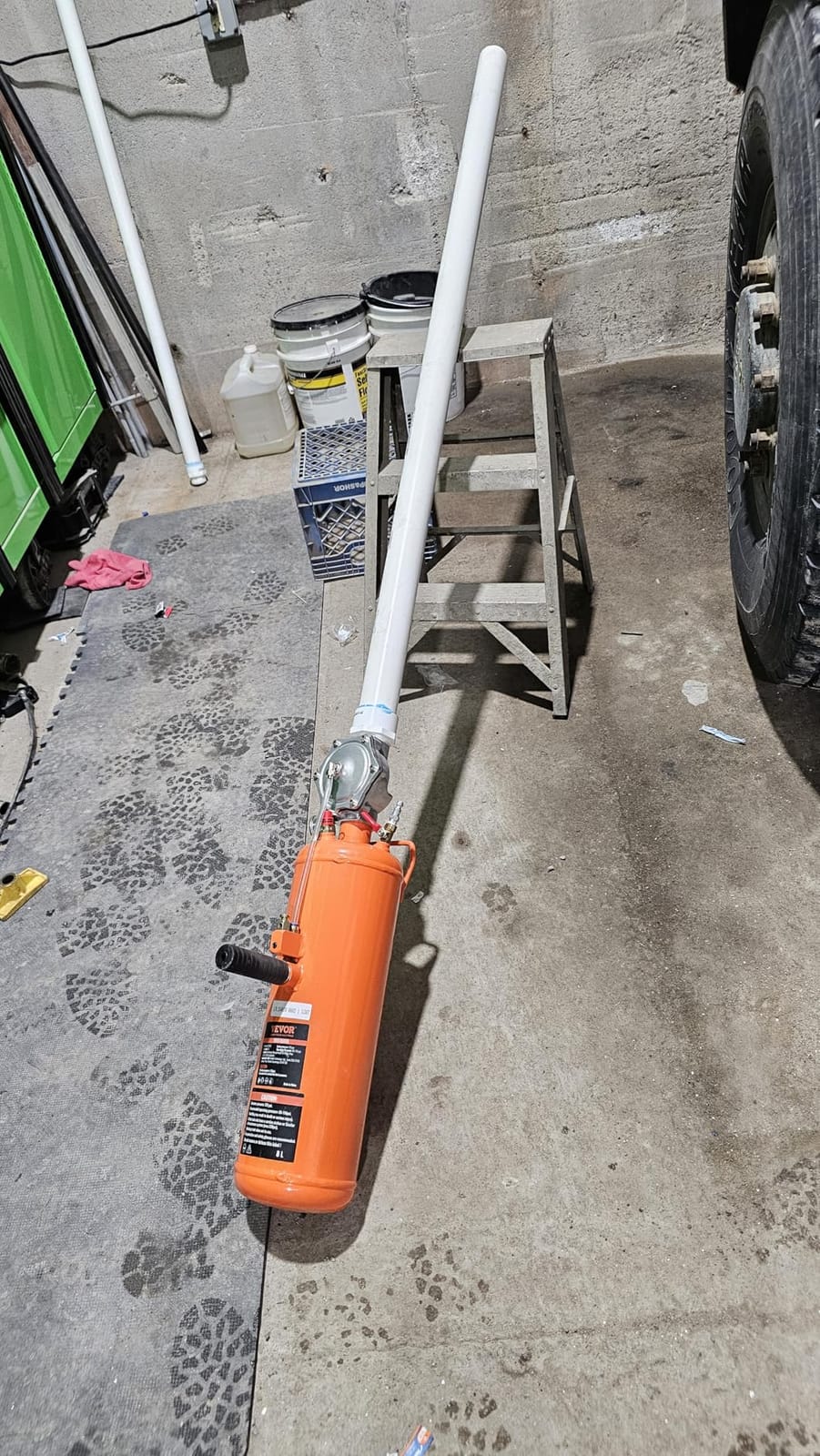
Two details stand out for actual bead work. The long duck-bill barrel directs air into the tire without scattering, which also keeps the operator at a distance, and the large-diameter welded exhaust valve gives higher exhaust efficiency and less resistance on the pulse.
It inflates a tire in under one second once the valve is opened, and it refills from a compressor in under a minute between attempts. For intermittent work, that turnaround is a bigger deal than raw tank size.
Quality control is the trade you make
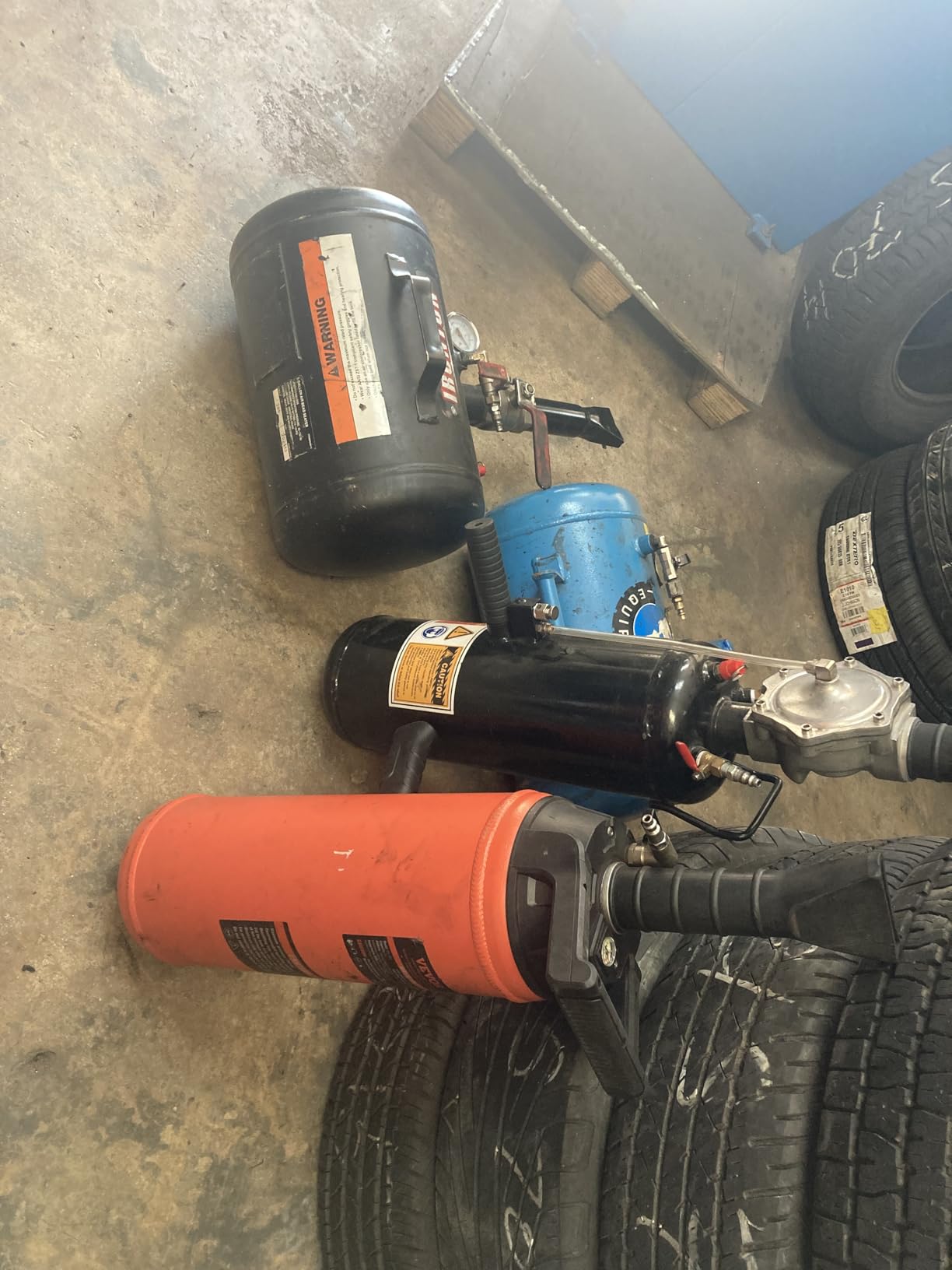
The most common complaints cluster around the nozzle and the supplied adapters. On some units the duck-bill tip is plastic and cross-threads into the valve, and the included compressor nipples come in two different sizes that may not match a quarter-inch connector, so bring your own fittings.
Occasional tanks also arrive with a faulty gauge or a leaking trigger assembly that needs disassembly and regreasing, and the small gauge sits behind the discharge vent, which forces you to lean in close to read it. Owners also note the exhaust gives a slight kickback, so eye and ear protection matter here too.
Who should buy this tank
Buy it if you want the lightest 5-gallon tank in the roundup, or you want to spend the least on a unit that covers tires up to 24.5 inches. It is the value pick for someone who changes seasonal tires and does occasional truck work, and you should plan to spend five minutes sorting the fittings on arrival.
5. BLACKHORSE-RACING 10-Gallon Bead Seater: Best Tire Bead Blaster for Truck and Ag Tires
10 Gallon Air Tire Bead Seater – 145PSI Blaster Tool Seating Inflator w/Gauge Car Truck ATV Tank Heavy Duty
10 gallon alloy steel tank
145 PSI max, 87-116 PSI operating
Seats tires to 24.5 in
About 37.8 lb, gauge and fill valve
Pros
- Seats stubborn pickup
- tractor and commercial beads in one burst
- Largest capacity here
- so several attempts per charge
- Even welds
- clean paint and no leaks out of the box
- Arrives fully assembled and doubles as a portable air tank
Cons
- Heavy to handle on a tractor-mounted tire
- Some units arrive with loose fittings that need retightening
- The quarter-inch ball fitting can crack while being hand-threaded
This is the answer to the oldest argument in the category: is the step from 5 gallons to 10 gallons worth it. The honest answer is that the extra volume does not seat a tire that will not seat on the first try at 5 gallons, but it means you can try three or four times from one charge instead of walking back to the compressor. On ag and commercial work, that is the difference between finishing the job and taking a break.
Owners report instantly seating stubborn pickup, tractor and commercial beads on the first burst, and the 10-gallon capacity gives several seating attempts per charge. The same tank is available in 5, 7.5 and 10 gallon capacities, so the size is not a dead end if you outgrow it later.
Build quality comes in well: owners report even welds, clean paint, sound fittings and no leaks out of the box. It arrives fully assembled and doubles as a portable air tank with the right fitting, which is a genuinely useful second job for a tank that spends a lot of time charged.
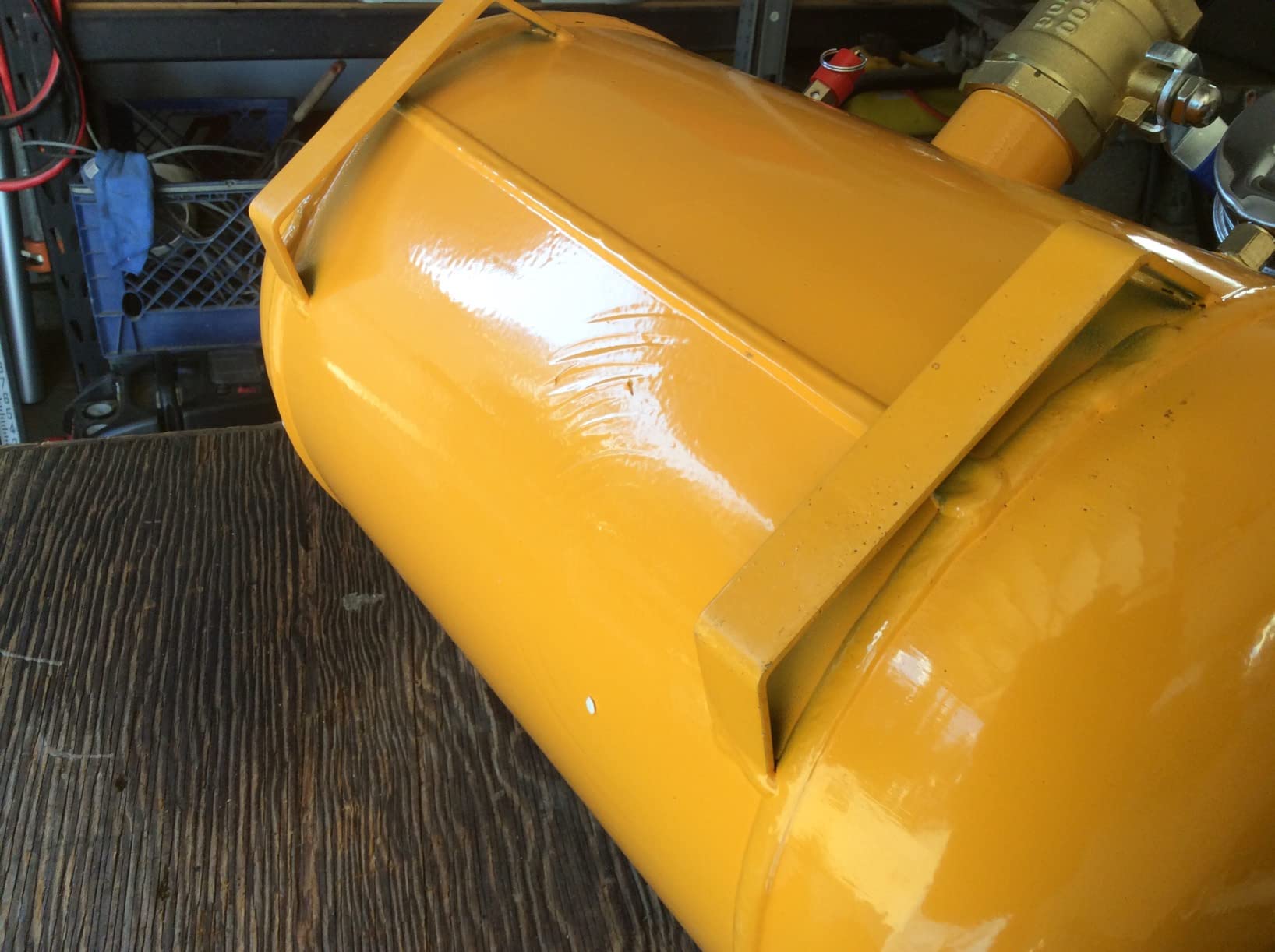
Pressure handling is conventional and well documented. Fill from a standard shop compressor to the 87 to 116 PSI recommended operating range, using the on/off fill valve and the air-volume gauge to track the charge, and the 145 PSI maximum gives you headroom on tires that need a harder push.
Tire coverage is stated at up to 24.5 inches, which puts a commercial steer tire and a large ag tire in range. At roughly 37.8 lb, this is a tank you want to roll rather than carry.
Where the weight and the fittings bite
The weight is the honest drawback. Owners call it heavy to handle, especially on a tractor-mounted tire where you are already working at an angle and cannot brace the tank against anything. If you are doing regular ag work solo, plan on a cart or a second pair of hands.
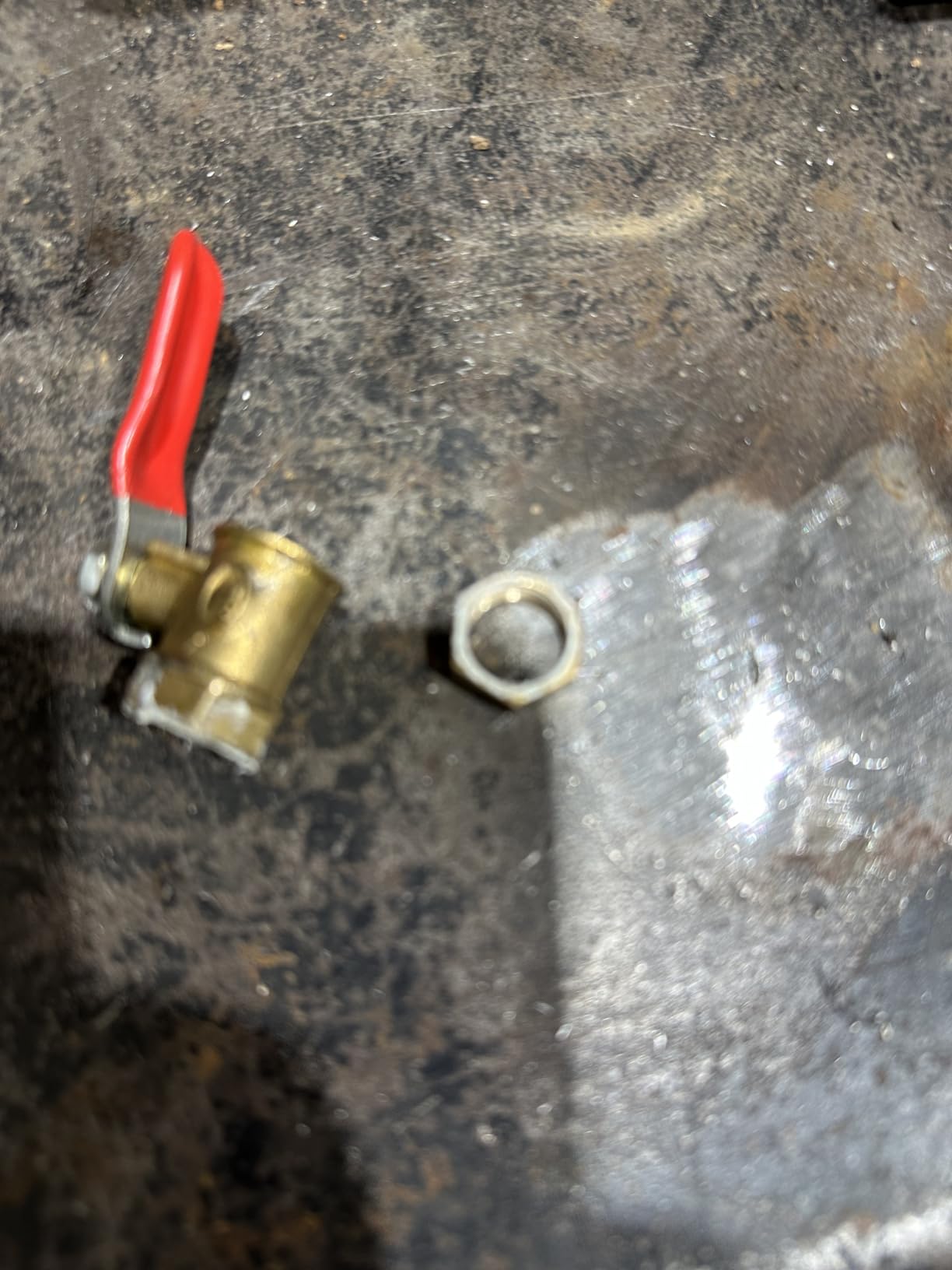
Quality control at the threaded fittings is the second issue. Several owners had to add thread seal tape or replace a broken quarter-inch ball fitting, though the tank itself held pressure afterwards. The outlet tube alignment is also awkward, and owners hesitate to tighten it for fear of breakage, so check both before the first blast.
Who should buy this tank
Buy it if you run agricultural, skid steer or commercial work, or if you would rather not interrupt a job to refill. For a home garage doing a few seasonal changes a year, the 5-gallon tanks are lighter and simpler, and the extra capacity will sit charged on a shelf.
6. GIANTEX 5-Gallon Bead Seater: Best Tire Bead Blaster for First-Time Setup
GIANTEX 5 Gallon Air Tire Bead Seater Blaster Tool Seating Inflator Truck ATV 145psi
5 gallon carbon steel tank
145 PSI (1.0 MPa) maximum
Per-vehicle pressure guide
Cars, trucks, RVs, tractors and ATVs
Pros
- Per-vehicle pressure reference helps first-time users set charge pressure
- Powder-coated 2.5 mm carbon steel resists rust and corrosion
- Handle and compact barrel move easily around a farm or garage
- Covers cars
- trucks
- lawn tractors
- large tractors and RVs
Cons
- Listed item weight of 0.27 g is a data error
- Smaller review base than the category leaders
- Eye and ear protection required for every attempt
If you have never charged a bead seater before, the hardest part is not the blast, it is knowing what pressure to charge. This tank solves that by printing a per-vehicle reference table right on the gauge plate: ATV 40 PSI, lawn tractor 40 to 50, tractor 100 to 120, large tractor 120, car 50 to 60, truck 100 to 130.
That kind of in-product guidance is rare in this category, and it removes the guesswork that makes first-timers undercharge and wonder why the tire will not seat. The 145 PSI (1.0 MPa) maximum leaves plenty of headroom above the tractor and truck figures.
Construction is 2.5 mm carbon steel with a powder finish for rust and corrosion resistance, which is the correct approach for a tool that will see mud, grass and shop dust. The metal barrel inflator has a well-designed handle for portability.
What the smaller footprint means for you
Wider vehicle coverage is the strongest argument here, covering cars, trucks, lawn tractors, tractors, large tractors, RVs and ATVs from one tank. The metal barrel and handle make it easy to move around a farm or a garage without a cart, which is a real difference at this weight.
The catch is the specification sheet, not the tank. The listed item weight of 0.27 g is clearly a data error, so you cannot judge the weight from the listing, and the low sales rank means fewer long-term durability reports than the category leaders. Treat the long-term picture as less documented than the 5-gallon units with bigger review bases.
Who should buy this tank
Buy it if this is your first bead seater and you work across mixed vehicle types, especially a mix that includes tractors or large RVs. The pressure reference is worth more to a beginner than a premium finish, and the vehicle range means one tank covers a farm property rather than just a driveway.
7. Mallofusa 5-Gallon Bead Seater: Best Value Tire Bead Blaster
Mallofusa 5 Gallon Air Tire Bead Seater Blaster Tool Seating Tire Inflator Car Truck ATV Tank Heavy Duty(US Stock)
5 gallon powder-coated steel tank
87-120 PSI operating pressure
Seats tires up to 24.5 in
24 lb, arrives assembled
Pros
- Seats motorhome
- 18 in and skid-steer tires quickly
- Sturdy steel tank that holds pressure once set up
- Arrives fully assembled in fitted styrofoam
- One owner who lost a previous tank to a garage fire judged it well built
Cons
- No instructions and no complete parts list
- Included air fitting is non-standard
- Fill valve handle is described as flimsy
- No hose included and the supplied tape runs out mid-assembly
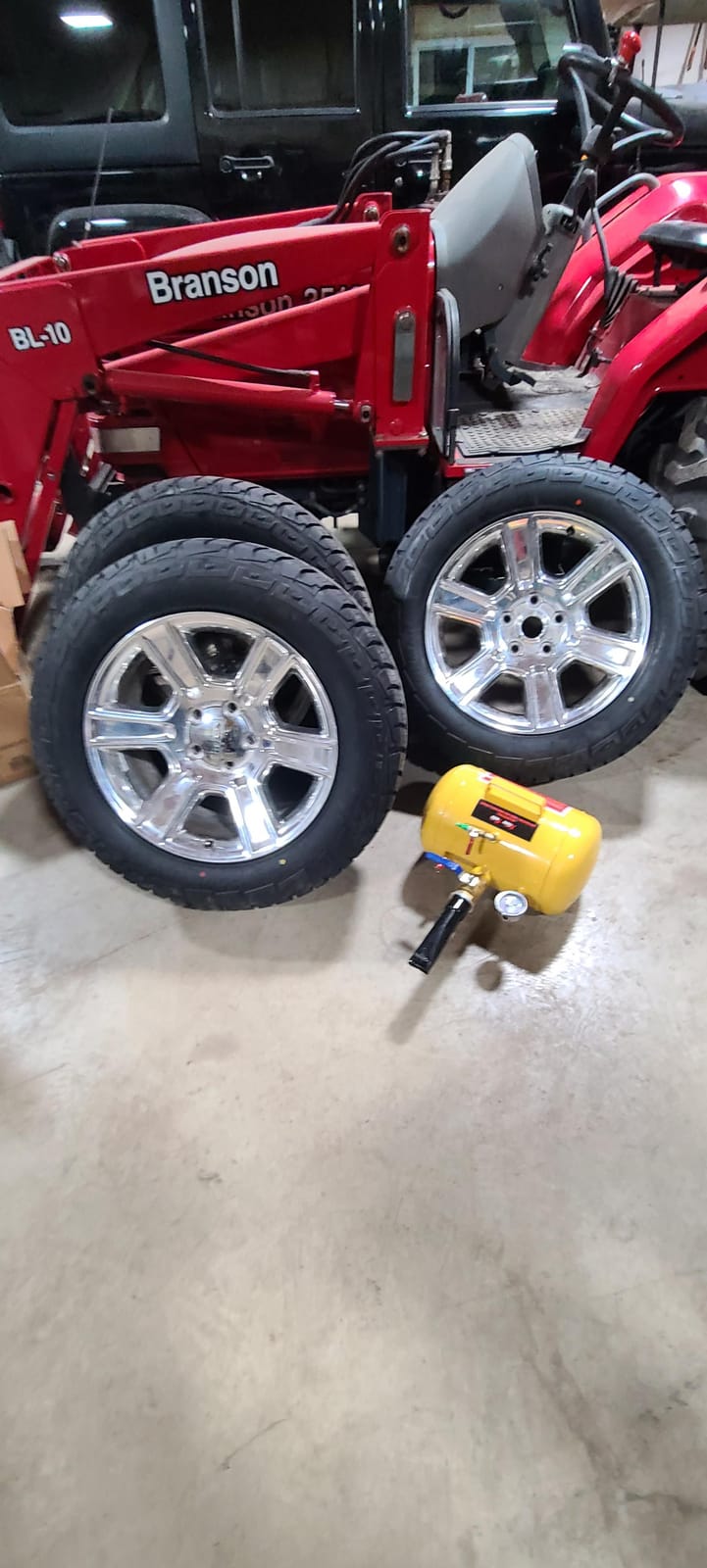
This one has the deepest owner feedback in the group after the top pick, and the performance reports are strong. Owners report motorhome tires, 18-inch tires and Bobcat tires going on quickly, and the sturdy steel tank holds pressure with no leaks once it is set up correctly.
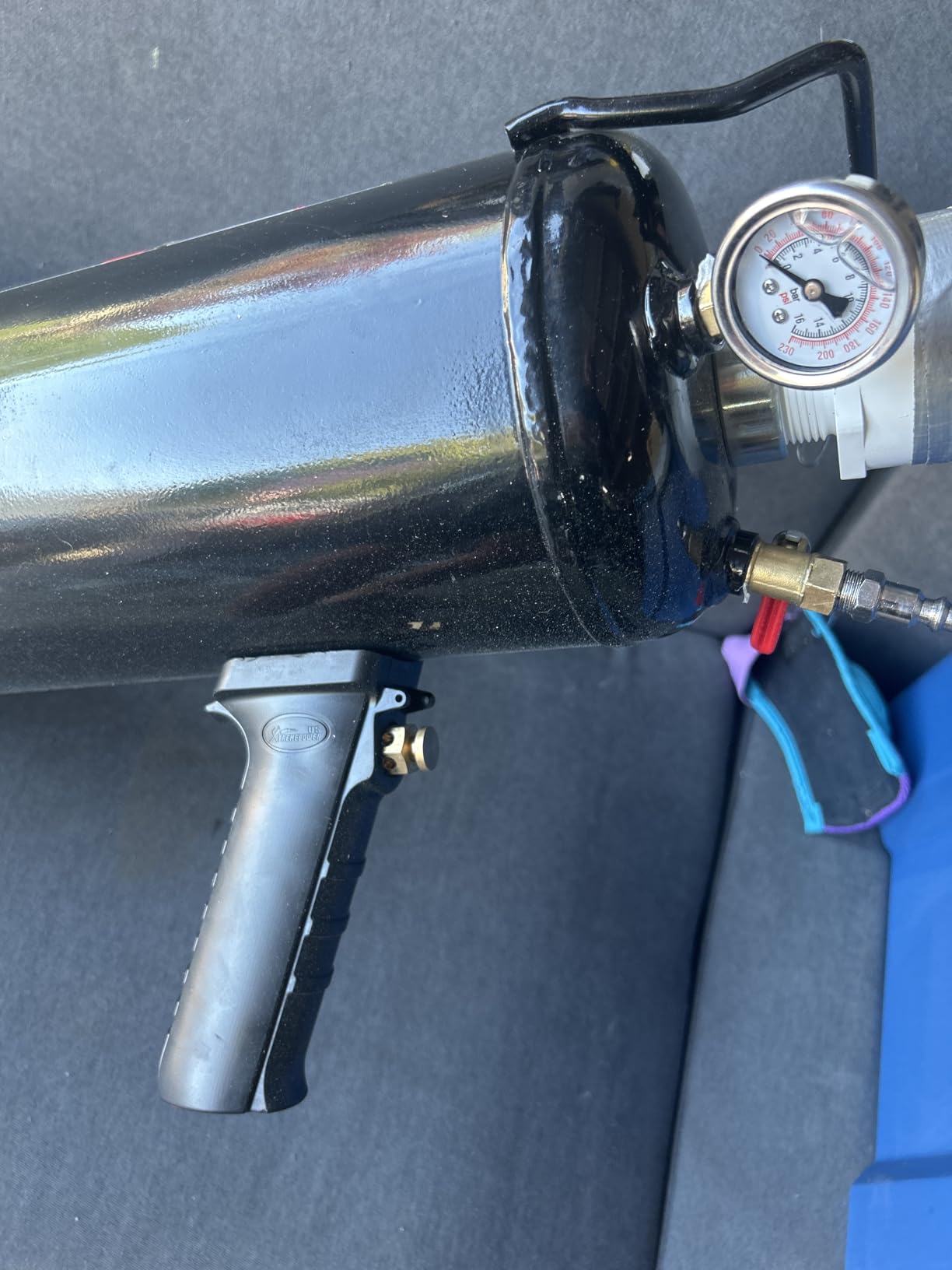
That last clause is the important one, and the reason this is a best-value pick rather than a flawless one. The tank is heavy-duty all-steel with a powder coat finish, the gauge is easy to read for charging to 87 to 120 PSI from a shop compressor, and the metal barrel has a designed lip for angled air delivery between tire and rim.
It arrives fully assembled in fitted styrofoam, which is more than several competitors manage, and the tire coverage is stated at up to 24.5 inches across ATV, tractor, car and truck work. Many owners also use it as a portable air tank between seating jobs.
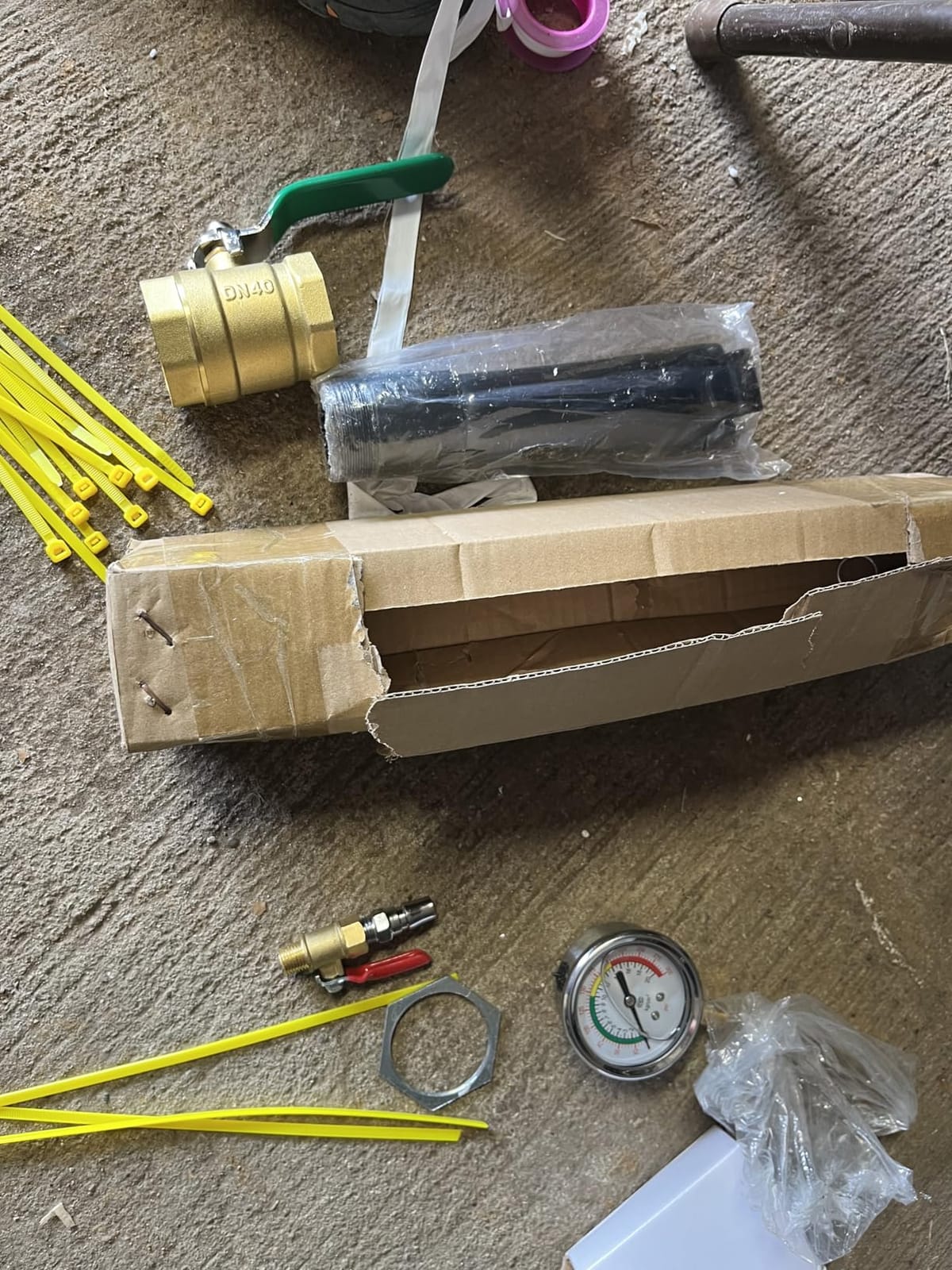
One owner framed it better than we could: they had lost a previous tank to a garage fire and judged this one well built for the money. That is the sort of durability signal you only get from people who have had a bad outcome first.
Operationally, the loop is simple. Charge to the 87 to 120 PSI band, drop the tire, seat the barrel lip at the bead, open the valve, and the sidewall inflates fast enough to seat the bead on the rim.
The assembly warning you need to read first
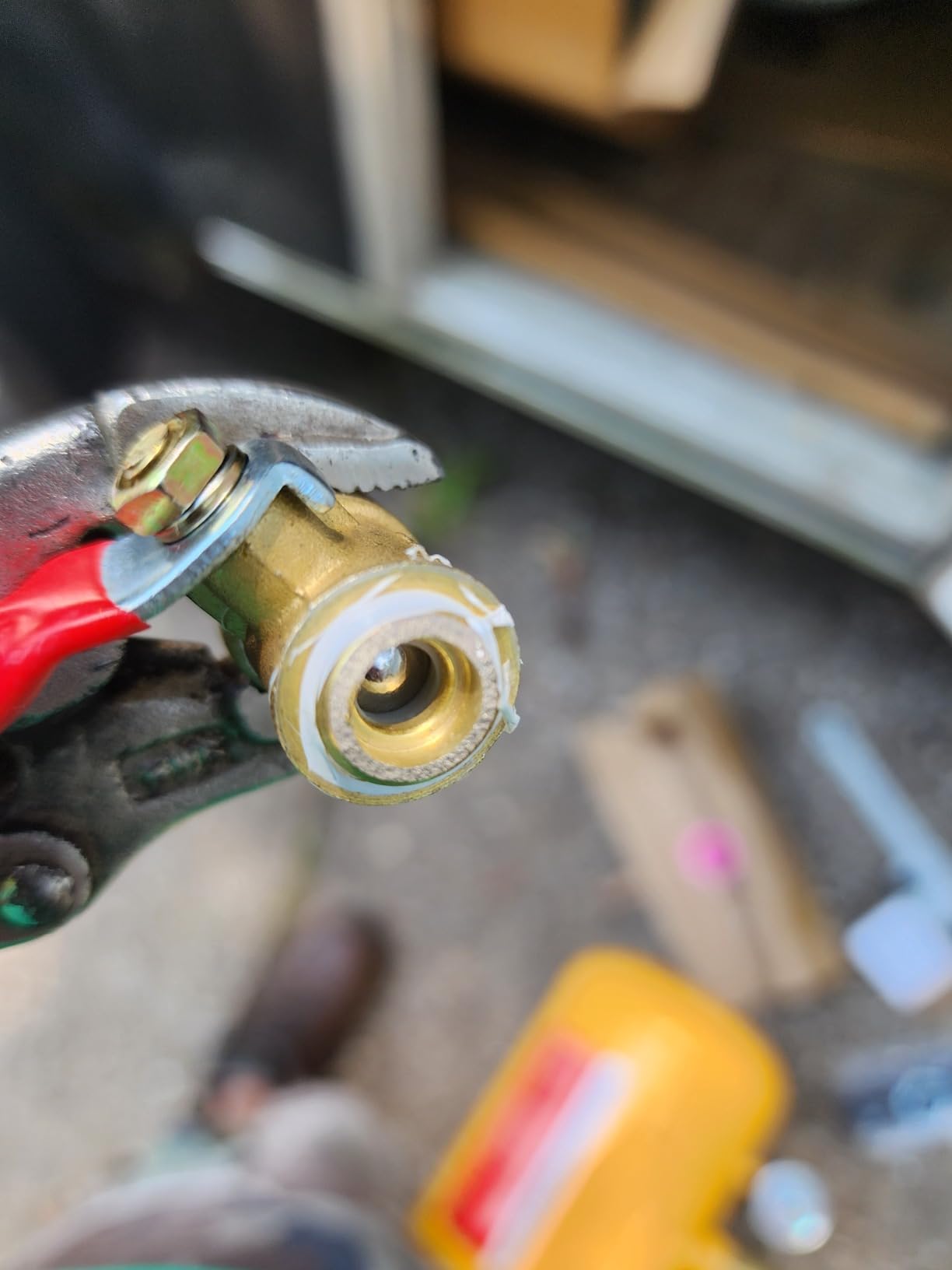
A metal flange must be fitted to the tank before the valve and tube go on, or the tank will leak. This is the single most repeated caution in the reviews, and there are no instructions and no complete parts list to tell you. Read the assembly notes before you tighten anything.
Beyond that, the included air fitting is non-standard and does not match many adapters, the fill valve handle is described as flimsy and likely to need replacing, and no hose is included with the supplied Teflon tape running out mid-assembly. Budget an hour and a few dollars of fittings.
Who should buy this tank
Buy it if you want proven seating power across a wide tire range at a mid-tier spend, and you are comfortable doing a small amount of assembly. It suits motorhome and truck owners who change tires at home. Pair it with a proper hose and a quick-connect and it behaves like a much more expensive tank.
8. XtremepowerUS 3.2-Gallon Bazooka Bead Seater: Best Portable Tire Bead Blaster
XtremepowerUS Tire Bead Seater, 12L/3.2 Gallon Air Tire Bead Blaster, 116 PSI Portable Tire Inflator, Handheld Bead Seater, Build-in Piston Valve
12 L / 3.2 gal alloy steel tank
116 PSI max, 87-116 PSI operating
Covers tires up to 22.5 in
39 lb bazooka format
Pros
- Push-button trigger and non-slip grip are easy to align and fire
- Long neck provides safer working distance from the blast
- Well regarded for motorcycle and light-truck tire work
- Same brand also offers 2.1 and 5.0 gallon formats
Cons
- Heaviest handheld unit in the group at 39 lb
- 116 psi ceiling is below the 145 psi on most competitors
- Capacity tops out at 22.5 inch tires
- Only a 90 day manufacturer warranty
This is the only bazooka-format unit in the roundup, and the format is the whole point. The push-button trigger and non-slip grip are easier to align and fire than twist-style valves, and the long shaped neck keeps you at a working distance from the discharge, which matters when the whole tool weighs 39 lb.
The large-diameter exhaust valve with a built-in piston is designed for higher exhaust efficiency, and the built-in rapid air release handles the actual seating quickly. Covering tires up to 22.5 inches means motorcycles, cars, light trucks and light commercial work are all in scope.
It is the lowest-rated unit we included, at 4.2 with 13% one-star reviews, and the weight is the main reason. A 39 lb handheld design is a different proposition from a 19 lb tank with a carry handle, and people notice the difference on a lift or in a wheel well.
The pressure envelope is the other limit. Maximum pressure is 116 PSI against 145 PSI on most competitors, and the operating range is 87 to 116 PSI, so it has less headroom on a high-sidewall tire that needs a harder push. If you own a tractor or a big truck, that ceiling is the reason to choose a different tank.
Warranty is also the thinnest here at 90 days, against 60 days on one competitor and no stated coverage on another. For a tool you will refill thousands of times, that is worth factoring in.
When the bazooka format earns its keep
The format wins in tight spaces and roadside work. A long neck means you can place the nozzle deep in a wheel well or behind a tractor tire without leaning your head into the discharge, and a push-button trigger gives you single-handed control, which matters when the other hand is steadying a tire.
It also matters for tires that are not full-size, since 22.5 inch coverage is ample for motorcycles, golf carts, lawn equipment and light trucks. The 3.2 gallon capacity is enough for a car tire and it refills quickly, so it suits an intermittent schedule rather than a production one.
Who should buy this tank
Buy it if you work in confined spaces, do roadside or mobile service, or handle small tires and need a long reach with a one-handed trigger. Look elsewhere if you need more than 116 PSI, tires beyond 22.5 inches, or a tank you can hold comfortably for twenty minutes at a time.
What Is a Tire Bead Blaster (Bead Seater)?
A tire bead blaster, usually sold as a bead seater, is a portable air tank with a barrel, a trigger or lever valve and a pressure gauge. You charge it from a compressor, drop the tire onto the rim, push the barrel tip into the gap at the bottom of the bead, and open the valve. The stored air leaves the tank in one fast pulse, the sidewall inflates and the bead jumps over the rim flange.
What makes it work is volume, not just pressure. A single 5-gallon tank holds enough air to inflate a 30-inch truck sidewall in well under a second once the valve opens, and that sudden change in shape is what drives the bead over the flange and into the bead seat. The ESCO manual for its Cyclone-X line puts most seating between 80 and 100 PSI at the tire, with a safety pop-off set at 165 PSI on the tank itself, so you are aiming for a controlled pulse rather than as much force as you can muster.
This replaces the old shop method. For decades the answer to a stubborn bead was a ratchet strap, a pile of soap, a pile of leverage and sometimes an open flame. A bead seater turns that into a repeatable 20-second operation, and users on tire forums report they have stopped reaching for the strap entirely once they owned one.
Glossary terms worth knowing
A bead is the reinforced inner edge of a tire that sits on the rim flange, and the bead seat is the part of the rim the bead is supposed to land against. Tubeless tires hold air through that bead-to-rim seal alone, which is why a bead seater only applies to them; a tube-type tire has a rubber tube doing the work. A self-inflating bead is a different design entirely that inflates the bead area as the tire spins onto the rim, so it needs no tank at all. The sidewall is the flexible wall of the tire that the burst inflates and shapes.
Bead Seater vs Bead Breaker: Which Tool Do You Actually Need?
A bead seater and a bead breaker do opposite jobs. A bead seater pushes a bead onto the rim when you mount a tire, using a burst of air to inflate the sidewall. A bead breaker pulls a bead off the rim when you demount a tire, using levers, a bar, or a separate explosive bead bazooka that fires a steel slug around the circumference.
The confusion is understandable because product listings use both terms interchangeably, and plenty of “bead blaster” search results are actually bead breakers. Everything in this guide is a seater. If you need to take a tire off a rim, the lever and bar approach is covered separately in our manual tire bead breaker tool roundup, and there is a step-by-step write-up on how to break a stubborn tire bead off the rim at home.
The short version for a home garage: most people who change tires need a seater, not a breaker. A breaker earns its place when you regularly pull old tires off worn rims, restore old stock, or run a tire shop. If you own a tire changer already, the seater is the cheaper upgrade that removes the last 20 minutes of wrestling.
Do You Need a Tire Bead Blaster?
You need one if you mount tubeless tires more than a handful of times a year. For a home garage doing two seasonal changes, a ratchet strap and a bottle of mounting lube will get the job done, and that is a legitimate answer. The tank pays for itself the moment you meet a tire that will not seat, and every person who works on high-sidewall rubber meets one eventually.
A tire shop or farm operator should treat it as essential. The ESCO Cyclone-X line, which comes from the same manufacturer as the original Cheetah brand, is marketed at 10 gallons for commercial trucks, skid steers and some tractor tires for exactly this reason. Forum users on TractorByNet and AgTalk ask the same question repeatedly: whether the extra gallons from 5 to 10 are worth it, and the recurring answer from ag users is that 5 gallons is fine for car and light truck work, while 10 to 15 gallons is what they wish they had for ag tires.
For roadside kits, the bazooka format makes more sense than a tank. You want something you can grab with one hand, hold away from your body and fire in a parking lot at night, which is the argument for the handheld unit even though it costs you pressure ceiling and capacity.
One more case: restoring old stock onto worn rims. The rim flange on an old wheel is often sharp and rusty, and a bead that will not go on by hand is usually a rusted flange, not a stubborn tire. A blast will not fix a bad rim, but it will tell you quickly which one you have.
How to Choose a Tire Bead Blaster
Check ASME certification first. This is a pressure vessel that will hold compressed air and then release it violently at close range, and ASME certification is the single most important credibility signal in the category. Forum buyers consistently rank non-ASME or unrated tanks as a deal breaker alongside gauges that do not return to zero and missing safety release valves. A tank that is not rated is a liability sitting in your garage, not a bargain.
Match capacity to the tires you actually work on. The decision matrix is simple. A 2 to 3.2 gallon tank covers motorcycles, golf carts, lawn equipment, ATVs and passenger cars, and anything larger means repeated compressor trips mid-job, which is the most common complaint about small tanks. A 5 gallon tank is the sweet spot for cars, light trucks, SUVs, trailers, UTVs and compact tractors. A 10 gallon tank earns its place on agricultural, skid-steer and commercial steer work, where the point is retries per charge rather than extra force.
Understand operating pressure versus maximum pressure. These are different numbers and listings often blur them. Operating pressure is the working band, commonly 85 to 116 PSI or 87 to 120 PSI, and that is where you should charge for most tires. Maximum pressure, often 145 PSI, is the tank ceiling and the set point of the safety release valve. Filling to the maximum on every job is how people pit a tank’s interior and shorten its life.
Look for a real safety release valve and a readable gauge. Every tank here has an automatic safety valve, but the set point varies, and the TUFFIOM pops off at 0.8 MPa while others sit higher. Gauge quality matters just as much, because owners of the XtremepowerUS note it reads higher than true tank pressure and the VEVOR gauge sits behind the discharge vent. A gauge you have to lean in to read is a gauge you will stop reading.
Plan for the compressor, because none are included. Every one of these tanks is air powered and none include a compressor. You need a unit capable of at least 145 PSI with a receiver large enough to refill between attempts, plus the right connector, and several tanks use a Type M quick-connect rather than a standard Schrader fitting. Budget for adapters, and check whether your hose reaches the tank before you commit.
Judge weight before you judge everything else. The spread in this category is enormous. The VEVOR 5-gallon is 19 lb and the TOOLUXE is 22 lb, which most people can manage with two hands, while the 10-gallon tank is around 37.8 lb and the bazooka unit is 39 lb. A tank you cannot safely lift onto a tractor tire is a tank you will end up not using on the tires you bought it for.
Check the discharge valve and parts support. Butterfly and trigger valves dump air faster and with less resistance than a basic ball valve, and large-diameter exhaust valves make the pulse cleaner. More important for long-term ownership is whether you can replace the trigger, handle or valve, and buyers report trigger valve leaks and hard-to-find parts on some imported brands.
How to Use a Tire Bead Blaster Safely
1. Check the tank before every fill. Look at the gauge, confirm the safety release valve is present and free, and check the outlet tube and trigger for damage. A tank that is left charged and wet inside will corrode from the inside where you cannot see it.
2. Fill from a compressor within the operating range. Charge to the recommended operating pressure, which is typically 87 to 116 PSI on most tanks in this roundup, and stay under the stated maximum of 145 PSI. Do not treat the tank as a place to store surplus air.
3. Put on eye and ear protection. Owners of the XtremepowerUS 5-gallon cite 120 db at the discharge, and the exhaust on lighter tanks gives a kickback. This is a step people skip and then regret.
4. Remove the valve core from the tire. This is the single most overlooked step in the whole process, and it is why so many blasts feel weak. A tire with its valve core installed has to pressurise through a tiny opening, which guts the burst. Pull the core out and leave the valve open.
5. Lubricate the bead generously. Use a mounting paste or bead lubricant around the entire bead, not soap. A dry bead will not slide onto the flange no matter how much air you throw at it.
6. Block the rim off the ground. Owners recommend elevating the rim on buckets or a stand so the bottom bead is not trapped against the floor, which is the widest gap in the tire and the best place to aim.
7. Aim and fire. Put the barrel hook against the rim at roughly 30 to 40 degrees, from the side opposite the valve. Open the valve fast, step back, and let the single pulse do the work. Do not fire twice in a row without recharging and re-checking the bead position.
8. Verify the seat. Check all the way around the tire for a visible bead line and an even gap at the rim, then inflate to the tire’s own pressure and check for leaks with soapy water before you refit the valve core.
Why Your Tire Bead Won’t Seat
If the blast does not seat the bead, work through this list in order, because the causes are ranked by how often they turn out to be the problem.
1. The valve core is still installed. This cripples the burst. Pull it out and leave the valve open.
2. No lubricant on the bead. A dry bead is static friction against a steel flange. Coat the whole bead with mounting paste.
3. The tire was never dropped onto the rim. When a tire is stiff, force the top bead over the flange first so it sits rather than stands proud, then blast the bottom.
4. The rim is blocked on the ground. Elevate the wheel so the widest gap in the bead is free.
5. Charge pressure is too low. Charge to the recommended operating range rather than guessing, and match it to the tire. The GIANTEX per-vehicle reference is useful here.
6. The tank is too small or too light for the tire. A 3-gallon tank on a high-sidewall truck tire is asking for a second trip to the compressor before you get a fair test.
7. The rim is damaged. A bent, scored or corroded flange will not hold a bead. Blasting will not fix it, and no amount of air will seat on a bad rim.
Rubber cement is not a substitute for a seated bead. A sealant or rubber cement can slow a small leak, but it will not push a bead over a flange, and relying on it to cover a bead that never seated is how you end up with a tire that loses pressure on the highway. If the bead is not seated, take the tire off and find out why.
If you want the manual methods that work when a tank is not an option, our guide to breaking a stubborn tire bead at home covers the strap and lever technique in detail.
Bead Seater Maintenance and the 5-Year Tank Rule
A bead seater is a pressure vessel, and treating it like one is the difference between a ten-year tool and a rust bucket. Tire Service International’s maintenance guidance lays out a simple cadence that applies to any tank in this roundup.
Daily: Wipe the tank, check the gauge returns to zero when the outlet is closed, and look for corrosion around the welded seams.
After every use: Drain the moisture out of the tank. Condensation left in a steel tank is what causes pitting corrosion on the interior, and internal rust scale is the thing that eventually fails a pressure vessel without warning.
Monthly: Test the safety release valve. Lift the ring or pull the pin and confirm it pops and vents freely. A stuck release valve is the most dangerous fault a bead seater can develop.
Quarterly: Inspect the inside where you can reach it, and check the trigger, lever and outlet tube for leaks.
At five years: Replace the pressure vessel. This is the commonly cited replacement interval for a steel bead-seating tank, and it is a replacement, not an inspection. Budget for a new tank rather than trusting a ten-year-old vessel, and follow OSHA compressed air guidance for the workshop around it.
Never leave a tank charged above its operating range while it sits. Owners who overfill to 145 PSI repeatedly and never drain are the ones who end up with pitting corrosion, and that damage is invisible from the outside.
Frequently Asked Questions
What is the best bead blaster for tires?
For most people the XtremepowerUS 5-Gallon is the best tire bead blaster: a 5-gallon alloy steel tank rated to 145 PSI, weighing 25.8 lb, rated 4.7 across more than a thousand owner reviews, and proven on everything from lawn tractor tires to 22.5 in commercial rubber. For heavy ag and truck work the 10-gallon BLACKHORSE is the better tool, and for the lightest option the VEVOR 5-gallon weighs 19 lb.
How much air do you put in a bead blaster?
Charge to the recommended operating pressure, which is usually 87 to 116 PSI depending on the tank and the tire, and never above the stated maximum of 145 PSI. Filling a tank to its maximum for every job is what causes internal pitting corrosion, so treat the maximum as a ceiling rather than a target.
How much PSI do you need to bead a tire?
Most tires seat between 80 and 100 PSI of pressure at the tire once the burst lands, which is why charge pressure is lower than the number people expect. Larger tires need more, so reference the per-vehicle guide on the GIANTEX gauge plate, which runs from 40 PSI for an ATV up to 120 PSI for a large tractor.
How do you properly use a bead blaster?
Remove the valve core from the tire, lubricate the bead heavily, block the rim off the ground so the bottom bead is free, charge the tank to its operating range, and aim the barrel at the rim from the side opposite the valve at 30 to 40 degrees. Open the valve fast, step back, then verify the bead is seated all the way around before refitting the valve core.
Why is my tire not seating on the bead?
In order of likelihood the valve core is still installed, the bead is dry, the tire was never dropped onto the rim, the rim is sitting on the ground, the charge pressure is too low, or the tank is too small for the tire. A bent or corroded rim flange will also refuse a bead, and no amount of air will fix a bad rim.
Is a bead seater necessary?
If you mount tubeless tires more than a few times a year, yes. A ratchet strap and mounting lube will handle routine seasonal changes, but the tank earns its place the first time a high-sidewall or collapsed tire refuses to go on by hand, and it is close to essential in a tire shop or on a farm.
What is a good tool to break the bead on tires?
Breaking a bead off a rim takes levers, a bead bar, or an explosive bead bazooka that fires a steel slug around the circumference. That is a different job from seating a bead, which is what every tank in this guide does, so shop for a bead breaker tool rather than a bead seater if removing tires is your task.
Can I use rubber cement to seal a tire bead?
Rubber cement and bead sealer can slow a small leak, but they will not push a bead over a rim flange. If the bead is not seated, take the tire off and find the cause, because a tire running on sealant instead of a seated bead can lose pressure without warning.
Final Verdict: The Best Tire Bead Blasters in 2026
The best tire bead blaster for most garages in 2026 is the XtremepowerUS 5-Gallon. It carries the highest owner rating in the group, has the deepest feedback base, seats an unusually wide range of tire sizes on the first blast, and at 25.8 lb it stays manageable on a bench or a tailgate. The stiff release lever and a gauge that reads high are real, and neither stops it being the tool we would buy first.
Match it to the job instead. Working ag, skid steer or commercial steer tires, the 10-gallon BLACKHORSE gives you retries per charge that a 5-gallon tank cannot. Working in wheel wells and parking lots, the bazooka-format XtremepowerUS 3.2-gallon gives you reach and a one-handed trigger. Handling tires to 24.5 inches in a shop, the TOOLUXE 30007L has the longest proven track record. After that it comes down to weight and fittings: the VEVOR at 19 lb, the Mallofusa for assembled value, the GIANTEX for first-time pressure guidance, and the TUFFIOM for no-frills truck and ATV work.
Whatever you choose, buy an ASME-rated tank with a working safety release valve, buy the compressor and fittings at the same time, and pull the valve core before you blame the tank. Those three habits solve more failed beads than any amount of extra capacity.