
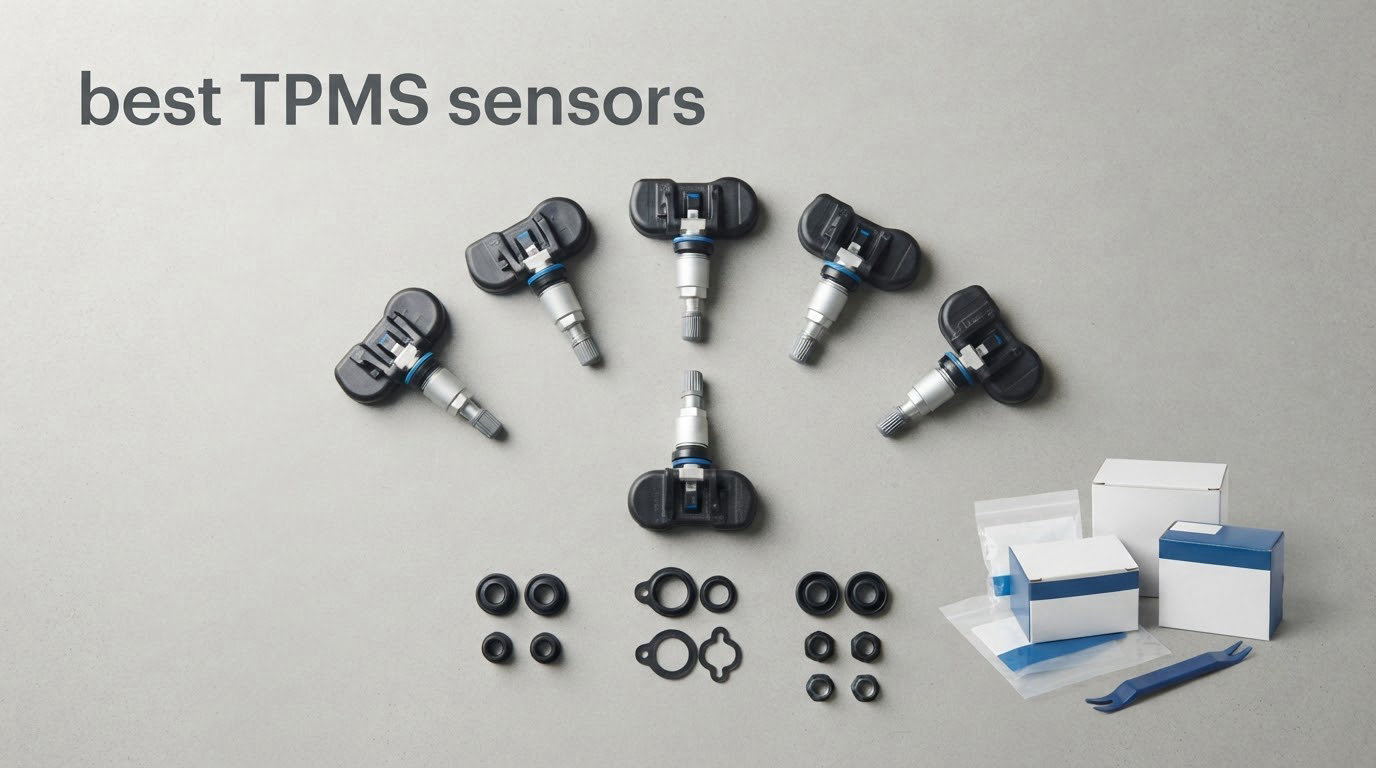
A dead tire pressure monitoring sensor is one of those faults that feels minor until you are halfway down a highway at 3 a.m. with a warning lamp you cannot diagnose. The fix is usually straightforward, but the wrong sensor will not talk to your car, and a returned sensor plus a shop visit costs far more than picking correctly the first time.
So here is the short answer. The Autel MX-Sensor is the best TPMS sensor overall because one SKU covers both 315MHz and 433MHz and can be programmed or cloned into almost any direct-TPMS car, which removes the single biggest source of returns. The Schrader EZ-Sensor 33500 is the best value option for drivers who want a recognised OEM supplier name and do not mind snap-in installation. The HUF Baolong UVS7050 is the budget pick, and the Dorman 974-001 is the pick for anyone whose vehicle self-relearns and never wants to touch a scan tool.
In the rest of this guide I break down all ten of the best TPMS sensors we evaluated, then explain the two decisions that actually control fitment: frequency coverage and programmability. I also show you how to find your own vehicle’s sensor part number before you spend anything, because that lookup takes five minutes and prevents most of the problems we saw.
Table of Contents
Top 3 Best TPMS Sensors (October 2026)
These three cover the widest range of vehicles and the widest range of driver skill levels. The Autel leads for compatibility, the Schrader for brand confidence, and the HUF for anyone who wants the lowest total cost per wheel.

Autel MX-Sensor 315+433MHz
- Dual 315MHz and 433MHz coverage
- Reprogrammable and clonable
- Interchangeable rubber and metal stems
- About 98% of direct TPMS vehicles

Schrader EZ-Sensor 33500
- 314.9MHz 315MHz and 433MHz in one SKU
- Snap-in fixed angle valve
- Requires programming before install
- OE quality construction
HUF Baolong UVS7050
- 315MHz and 433MHz dual band
- Metal valve included
- Programs in about 3 seconds
- 3 year warranty
All 10 Best TPMS Sensors Compared in 2026
Frequency and programmability decide almost everything else, so those two columns lead the table. Note how many options are locked to a single frequency or a single family of vehicles.
| Product | Specs | Action |
|---|---|---|
| Autel MX-Sensor 315MHz and 433MHz Universal |
|
Check Latest Price |
| Schrader EZ-Sensor 33500 Programmable Snap-In |
|
Check Latest Price |
| HUF Baolong UVS7050 Dual Band Universal |
|
Check Latest Price |
 VDO REDI-Sensor SE10004A 433.92MHz VDO REDI-Sensor SE10004A 433.92MHz |
|
Check Latest Price |
 A-Premium Pre-Programmed 315MHz Set of 4 A-Premium Pre-Programmed 315MHz Set of 4 |
|
Check Latest Price |
 Dorman 974-001 Self-Relearn 315MHz Dorman 974-001 Self-Relearn 315MHz |
|
Check Latest Price |
 Motorcraft TPMS3 Remote Sensor Motorcraft TPMS3 Remote Sensor |
|
Check Latest Price |
 CDWTPS Pre-Programmed 315MHz Set of 4 CDWTPS Pre-Programmed 315MHz Set of 4 |
|
Check Latest Price |
 MOBILETRON NX-S004-4 433MHz Set of 4 MOBILETRON NX-S004-4 433MHz Set of 4 |
|
Check Latest Price |
 RENECTIV 315MHz Auto-Relearn Set of 4 RENECTIV 315MHz Auto-Relearn Set of 4 |
|
Check Latest Price |
What a TPMS Sensor Does and When You Actually Need One
A tire pressure monitoring sensor is a small battery-powered transmitter fitted into the valve stem of each tire. It reads pressure and temperature, then broadcasts that data with a unique sensor ID to a receiver in the car, which lights the tire pressure warning lamp when a reading falls below the stored threshold.
Direct systems measure real pressure at each wheel. Indirect systems infer a problem by comparing each wheel’s rotation speed against the others, which means they cannot show a number and can be fooled by a full set of equally underinflated tires. You can usually tell which you have by checking the tire placard: if it lists a TPMS indicator light or a cold pressure for each tire, the car almost certainly has direct sensors in the valve stems.
You need a replacement sensor when a warning lamp stays on after you have set pressures correctly, when a scan tool reports a specific wheel as faulted, or when the battery in an aging sensor has drained. Because the internal battery cannot be replaced, sensors tend to fail one at a time rather than all together, and replacing all four at the same time often avoids a second visit within a year.
1. Autel MX-Sensor Dual-Frequency 315MHz and 433MHz – Best Overall
Autel TPMS Sensors, MX-Sensor 315+433MHz, Universal Tire Pressure Sensor
Dual 315MHz and 433MHz
11g sensor body
100 to 900kPa range
SAE J1205 and J1206 tested
4 sensors
Pros
- Reprogrammable and fully cloneable
- Covers about 98% of direct TPMS vehicles
- Interchangeable rubber and metal press-in stems
- Accurate readings checked against a gauge
- 24 month defect coverage
Cons
- Arrives unprogrammed
- Works only with Autel TPMS tools
- A few buyers report early communication failures
The MX-Sensor is the reason tire shops keep generic programmable sensors on the shelf instead of chasing part numbers for every car that rolls in. The single SKU in this list transmits on both 315MHz and 433MHz, so the frequency guesswork that sends drivers back to the store simply disappears. Coverage is quoted at about 98% of direct-TPMS passenger vehicles, and the exceptions are specific rather than vague.
Those exceptions matter. It is not compatible with 12V or 24V commercial vehicle systems, and it will not talk to Bluetooth-based TPMS setups, which is worth knowing if you work on heavy trucks. For ordinary cars, SUVs and light trucks on either frequency band, this is the sensor we would put on our own wheels.
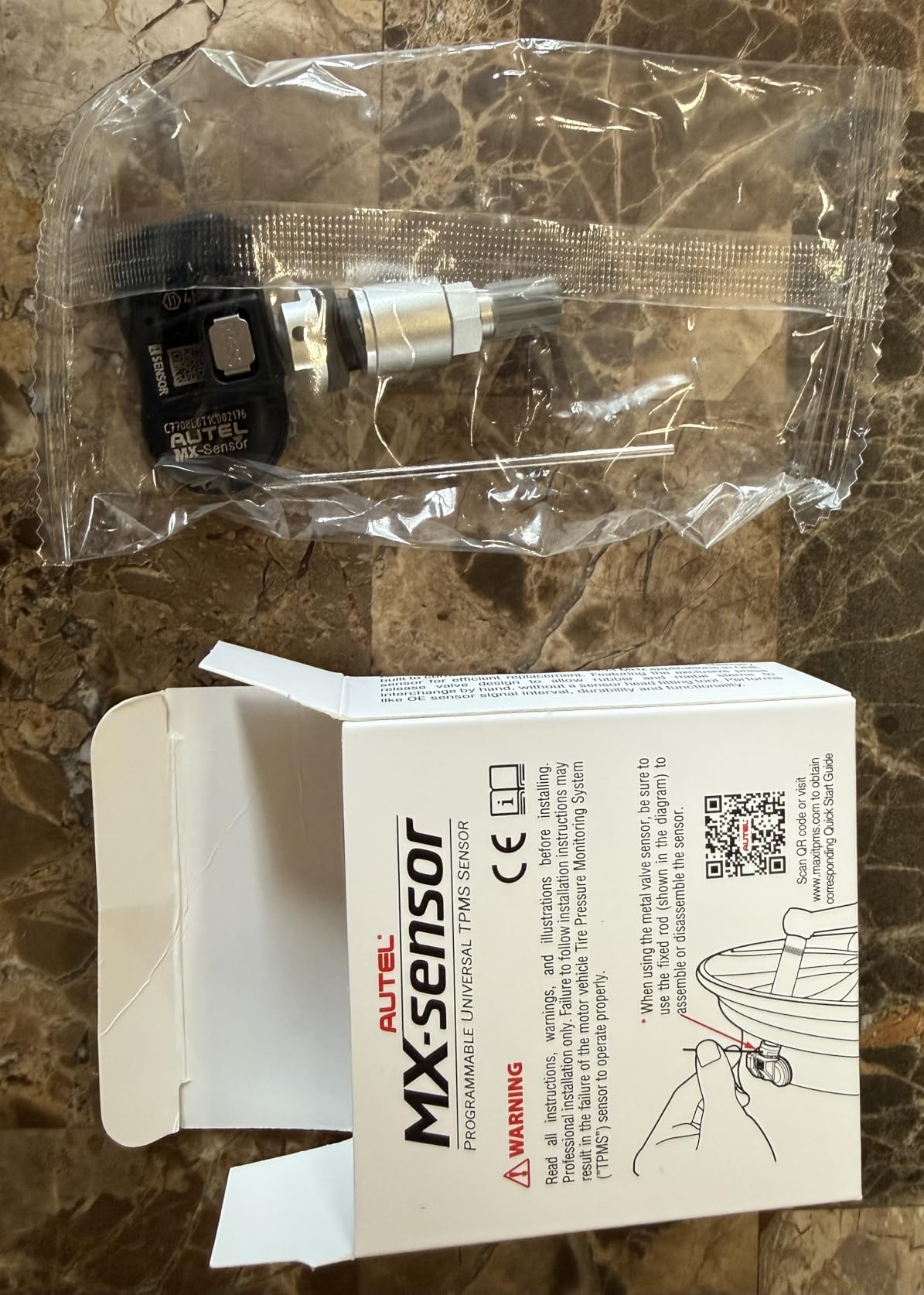
The body weighs 11g and the measurement range runs 100 to 900kPa with a stated accuracy of 10kPa, which lines up well with a good handheld gauge. Sensing distance is listed at 10 meters and response time at 20 seconds, both comfortably inside normal driving conditions. Operating temperature is rated to 125 degrees Celsius, so it handles winter wheel swaps without complaint.
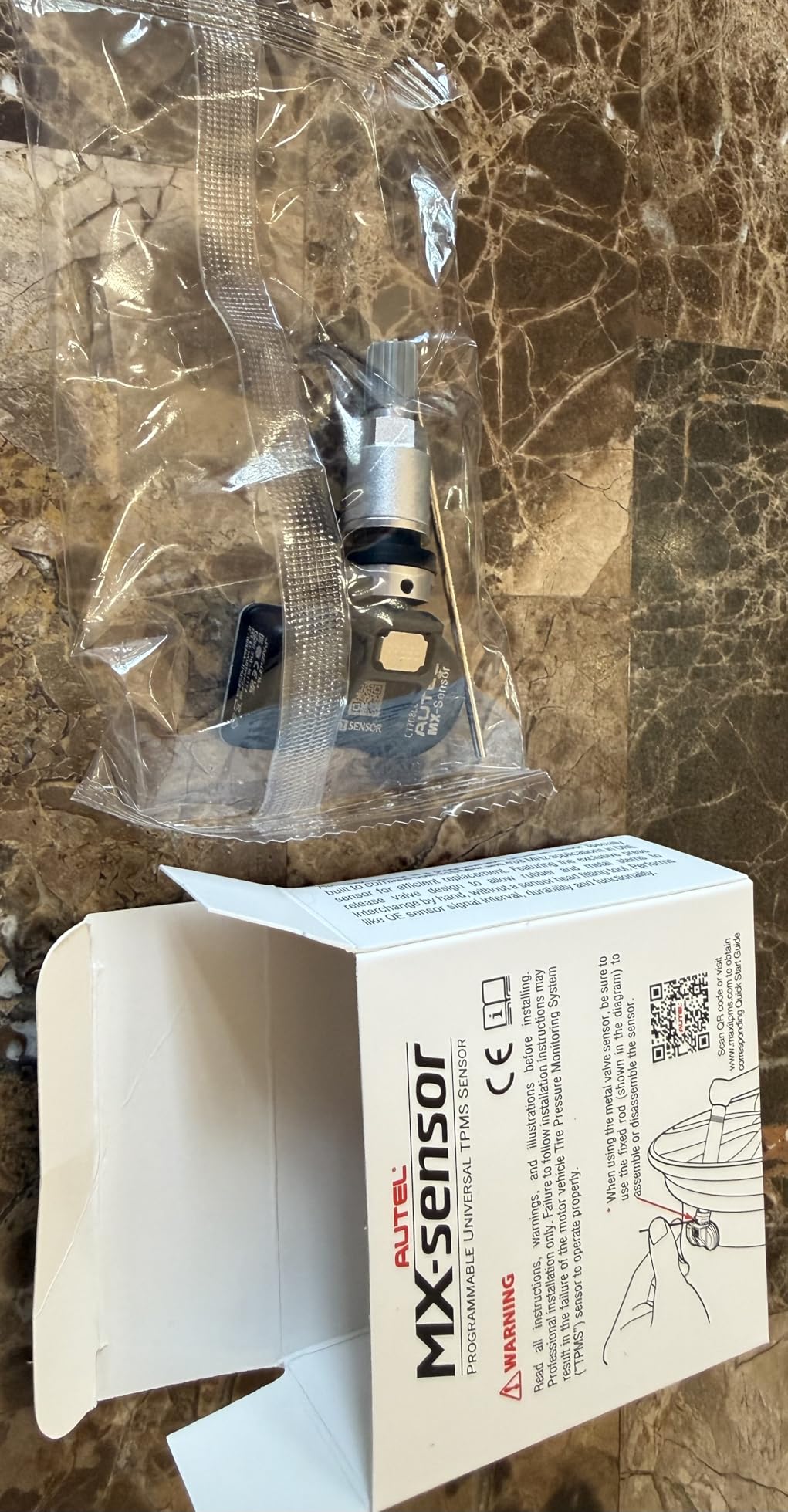
Programming happens over the air, with support for wireless batch programming of up to 20 sensors and cloning straight from the original sensor ID. The pack includes interchangeable rubber and metal press-in valve stems, so you can run metal for appearance on a car and rubber on a winter set without buying a second sensor.
Why it suits most drivers
It removes the frequency question and the part number question in one purchase, which is why it is the safest choice when you are unsure what your car needs. The trade is a hard dependency on Autel hardware, since the sensor will not work with non-Autel programming tools. Owners on r/wrx_vb describe cloning to stock sensor IDs with an Autel TS508 specifically to keep the factory setup intact, r/carflipping recommends pairing it with an Autel ITS600 for the same reason.
If you already own a quality gauge, the readings track it closely enough that setting cold pressure by hand and letting the sensor warn you still works well. We have covered that in our guide to resetting a TPMS light and relearning sensors after a tire change.
Where it falls short
The sensors arrive unprogrammed, so buying them without a way to program is the classic wasted purchase. A minority of buyers also report sensors that lost communication or stopped reading after a few months, and one reviewer described a sensor body separating from the valve stem. Plan on programming before the tire goes back on the wheel, which also means you need a scan tool capable of the job.
Our TPMS programming tool roundup covers the hardware side if you intend to code these yourself rather than pay a shop.
2. Schrader EZ-Sensor 33500 Triple-Frequency Snap-In – Best Value
Schrader 33500 EZ-Sensor Single SKU (314.9 MHz, 315 MHz, and 433 MHz) Programmable Snap-in Fixed Angle Valve Tire Pressure Monitoring Sensor (TPMS), Requires Programming Before Installation
314.9MHz 315MHz and 433MHz
Snap-in fixed angle valve
15 to 65 psi range
9g brass and rubber
1 sensor
Pros
- One SKU covers three frequencies
- Established OEM supplier brand
- Snap-in fixed angle valve
- Behaves like OE after coding
Cons
- Arrives blank and needs programming
- Requires more than a basic relearn clicker
- Some buyers report calibration loss after coding
The EZ-Sensor is the most widely trusted name in this list for a good reason: Schrader is a real OEM supplier to many automakers, not a repackager with a marketing logo. Shops and enthusiasts have long treated it as an OE equivalent, and that reputation is well earned once the sensor is coded for your vehicle.
The clever part is frequency coverage. This one body handles 314.9MHz, 315MHz and 433MHz, which is broader than most competitors and covers the 314.9MHz band found on some Japanese and European applications that a standard 315MHz part will miss. For a shop or a household with several vehicles, that simplifies storage to a single box.

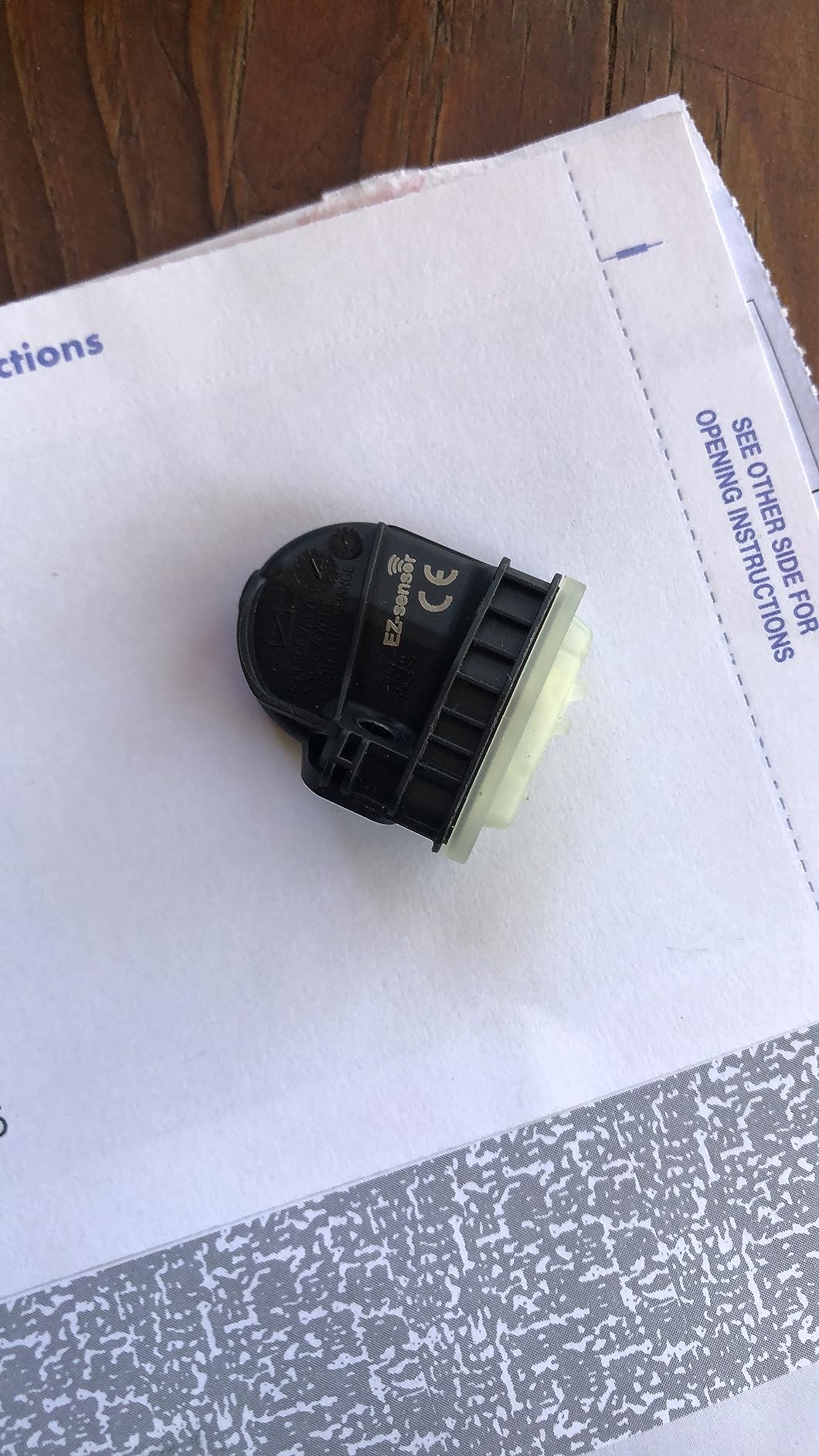
Construction is brass, plastic and rubber at 9g, with a snap-in fixed angle valve rather than a clamp-in. The measuring range is 15 to 65 psi and the response time is 2 seconds, both strong figures. One detail to check carefully is the upper temperature rating of 80 degrees Celsius, which is lower than several metal-stem rivals in this list.
After programming, the auto-locate function replicates OE sensor behaviour, so the car treats it like a factory part. Buyers frequently report that once coded correctly it performs the same as an OE replacement at a fraction of dealer cost, and the tool software needs periodic updates for the newest vehicle coverage.
Why it suits most drivers
It is the pick for anyone who trusts a brand name with a verifiable OE supply history and wants snap-in convenience. The 9g weight and rubber-gripped stem are kinder to alloy wheels than a heavy metal clamp, and installation does not require removing the tire from the rim in the way some clamp-in setups do.
It is also a strong candidate for winter wheels on a second set of rims, since you can clone the ID of the sensor you are removing and the car will keep the same wheel positions.
Where it falls short
The blank-on-arrival design is the single most repeated complaint in the reviews, and it catches first-time buyers out. You also need more than a cheap relearn clicker to write the ID. A smaller group of reviews describes sensors that would not hold calibration after programming, and failures often come in sequence, which is why replacing all four together is the sensible move.
3. HUF Baolong UVS7050 Dual-Band Universal Sensor – Budget Pick
UVS7050 – BH SENS 315MHz/433MHz OE Quality Dual Band Universal Sensor (Must be Programmed Prior to Install) – Metal Valve
315MHz and 433MHz dual band
Metal valve
Programs in about 3 seconds
30m sensing distance
1 sensor
Pros
- Low cost for a dual band sensor
- Works with ATEQ Matco SnapOn and OTC tools
- Cloning method available
- 3 year or 36000-mile warranty
Cons
- Blank until it is programmed
- A minority of sensors fail to pair
- Small review base at 115 ratings
The UVS7050 does the one thing that matters most at low cost: it covers both 315MHz and 433MHz in a single metal-stem body. HUF Baolong builds sensors for a number of major tire brands, and the spec sheet is honest about what the part is, with a stated accuracy of plus or minus 1.5% and a 30 meter sensing distance that beats several more expensive options.
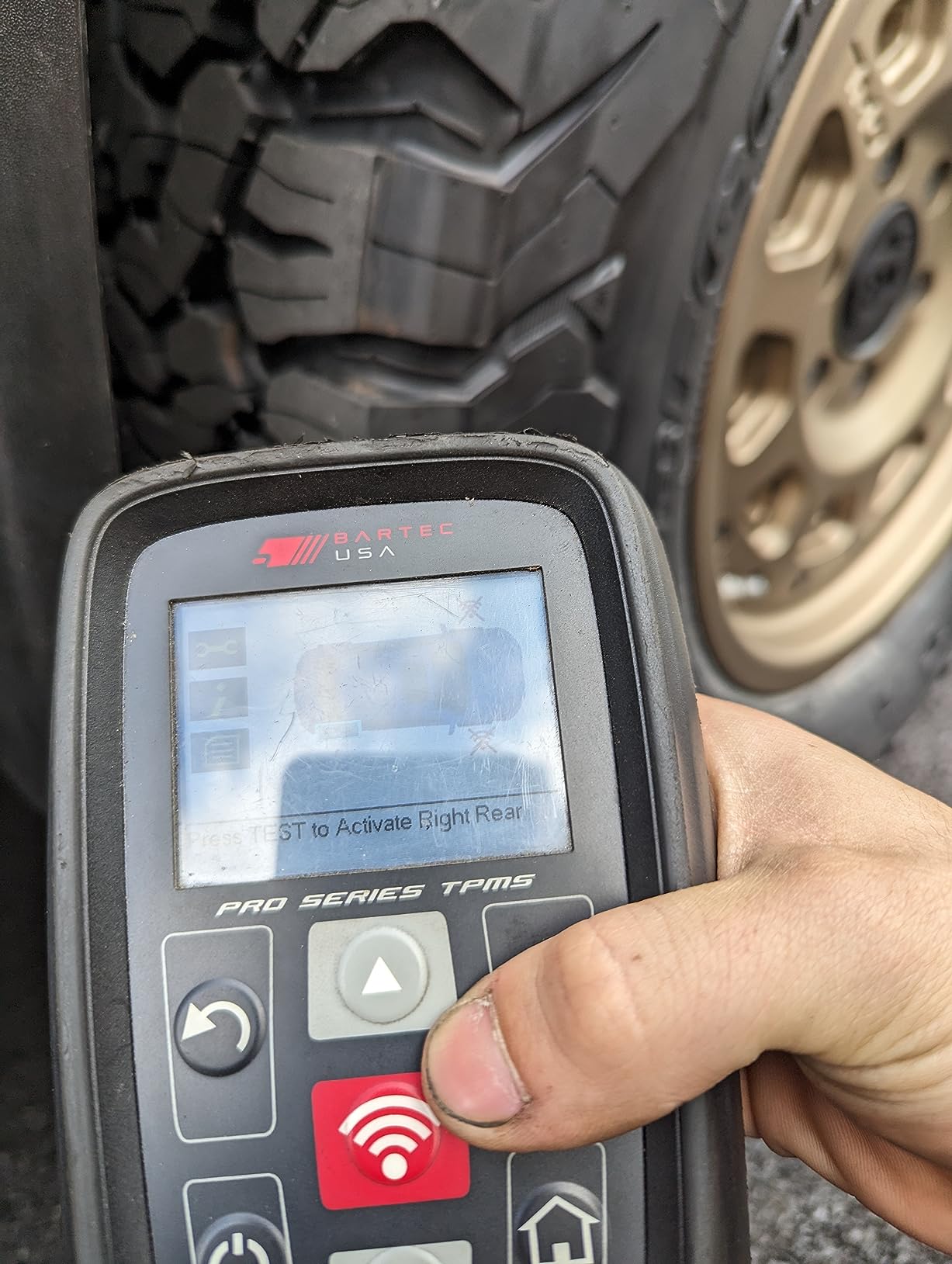
Its real strength is tool compatibility. The IntelliSens platform is supported by ATEQ, Matco, SnapOn, Mac Tools, Monster Tools, KTool, NAPA, Bartec and OTC branded scanners, and the application list can be updated through a diagnostic tool. That wide support matters if you do not own an Autel machine and want to avoid being locked into one brand.
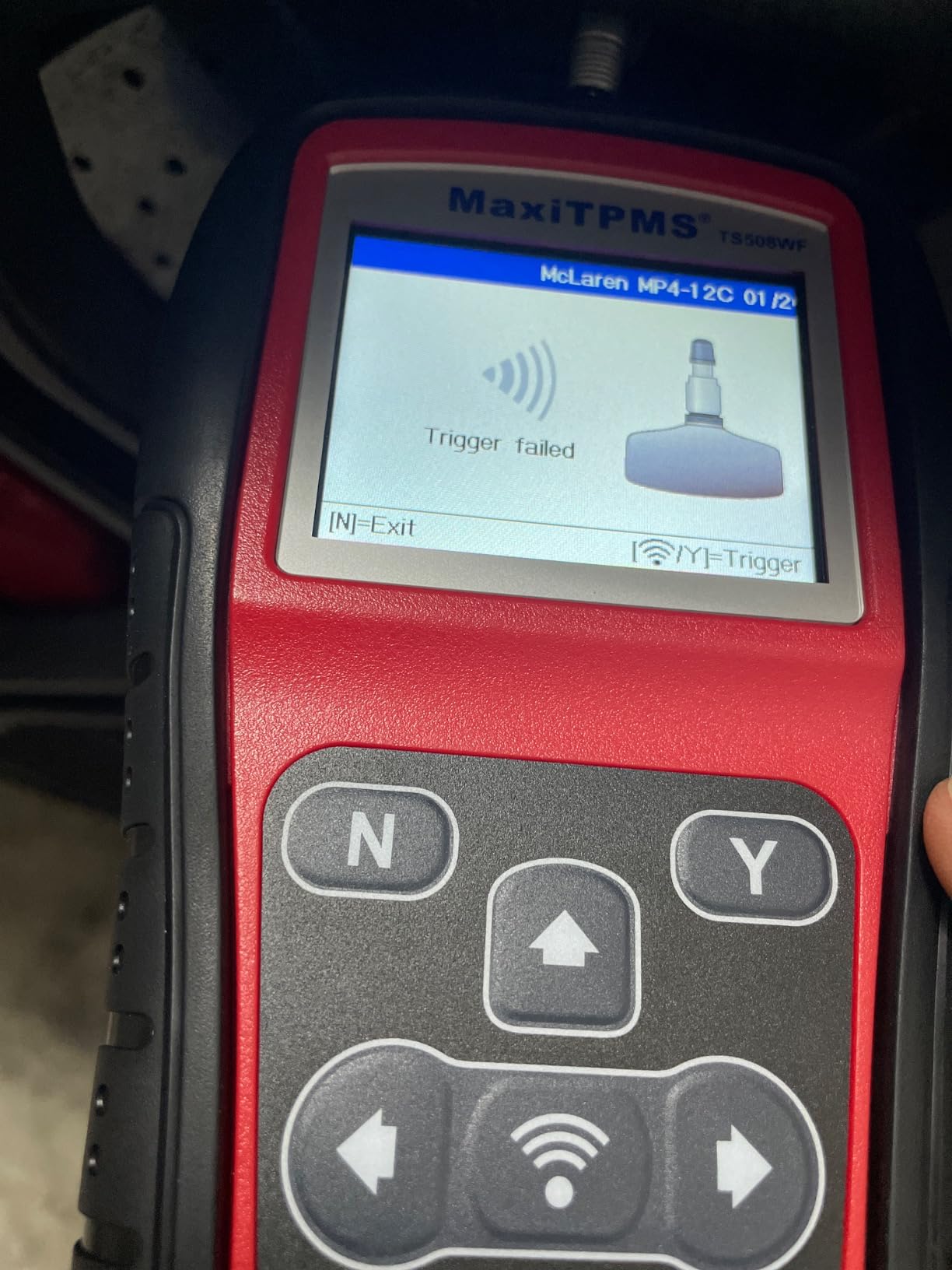
Programming is advertised at roughly 3 seconds per sensor once the vehicle application is selected, and the warranty runs 3 years or 36,000 miles, which is longer than several rivals here. The listed upper temperature rating is 122 degrees Fahrenheit, and the sensor body uses a metal valve, so it is a sensible fit for performance and enthusiast cars where appearance matters.
Buyers consistently report that the sensor works reliably once it has been unlocked and coded, and that cloning the existing ID simplifies installation considerably. The 3-year coverage is a genuine advantage over the typical one-year parts-only promise.
Why it suits most drivers
It suits budget DIYers who already have access to a mainstream scan tool, and anyone restoring a car where appearance rules out a rubber snap-in. Because the same body covers both frequency bands, it is a safe single-SKU purchase when you have not yet confirmed which frequency your vehicle uses.
The 3-year warranty also makes it more forgiving than one-year parts, since you have time to discover a pairing problem and return it.
Where it falls short
It arrives blank, so a programming tool is mandatory rather than optional. A minority of buyers report sensors that would not pair or work after installation, some installers noted difficulty pairing with certain newer vehicles, and one multi-pack order included the wrong sensor. The review base is also the thinnest in this roundup, which means the failure history is less well documented than it should be.
4. VDO REDI-Sensor SE10004A 433.92MHz – Best OE-Quality 433 Sensor
VDO SE10004A REDI-Sensor 433.92 MHz TPMS Sensor
433.92MHz pre-programmed
Clamp-in pivoting stem
OE validated
All install parts included
1 sensor
Pros
- Pre-programmed so no coding tool is needed
- Pivoting clamp-in stem fits more wheels
- OE validated design and build
- Supplied by Continental
Cons
- 433.92MHz only so not universal
- Not field programmable
- Relearn still required after fitting
The REDI-Sensor comes from Continental’s VDO arm, so the build quality is not in question, and owners rate it highly for fitting and reading without drama. It is pre-programmed and OE validated, which means you do not need a coding tool to write a vehicle ID before it will work.
Here is the catch that stops this from being a universal recommendation. It operates only at 433.92MHz, so it will not work at all on a 315MHz system, and it is not field programmable. The hard-coded ID cannot be rewritten if your vehicle needs something different, which makes the part number a hard commitment rather than a flexible choice.
Why it suits most drivers
It suits European and international vehicles running 433.92MHz where you want an OE-grade part with no programming step and the widest possible wheel clearance. Owners report a 76% five-star share, and the part arrives complete with every component needed for direct installation, including the service kit.
It is also a sensible choice when your existing tires are already mounted and you would rather not have them demounted.
Where it falls short
The frequency restriction is the deal-breaker for most North American vehicles, and the fixed ID means no escape hatch if the fitment assumption is wrong. A relearn procedure is still required after fitting, so pre-programmed does not mean zero work. If you want a sensor you can adapt to multiple vehicles, the universal options above are a better fit.
5. A-Premium Pre-Programmed 315MHz Set of 4 – Best for Ford and Lincoln
A-Premium 315MHz Pre-programmed TPMS Sensor Tire Pressure Monitoring Sensor
Pre-programmed 315MHz
Ford and Lincoln 4-pack
NXP chip
SAE J2657 tested
-40C to 120C
Pros
- No coding tool needed for a direct fit
- Covers a long list of Ford and Lincoln models
- Long-life CR2052 battery
- Includes colour boxes and a manual
Cons
- Relearn step still required
- Ford and Lincoln applications only
- 315MHz only
- Warranty covers the part not labour
This is a four-pack of pre-programmed 315MHz clamp-in sensors built around the high-precision NXP chip used in the original equipment. Testing in-house to SAE J2657 plus FCC and IC certification are the details that matter here, because the failure mode of a cheap TPMS sensor is usually a marginal transmitter that the car cannot hear reliably.
The fitment list is broad within its scope, covering the F-150, Edge, Explorer, Mustang, Ranger, Transit, Bronco, MKZ, MKC and Nautilus among others, with cross-references to F2GZ-1A189-A/D, F2GT-1A180-AB and HC3Z-1A189-A. If you own a truck rather than a sedan, this kind of coverage saves a lot of cross-referencing.
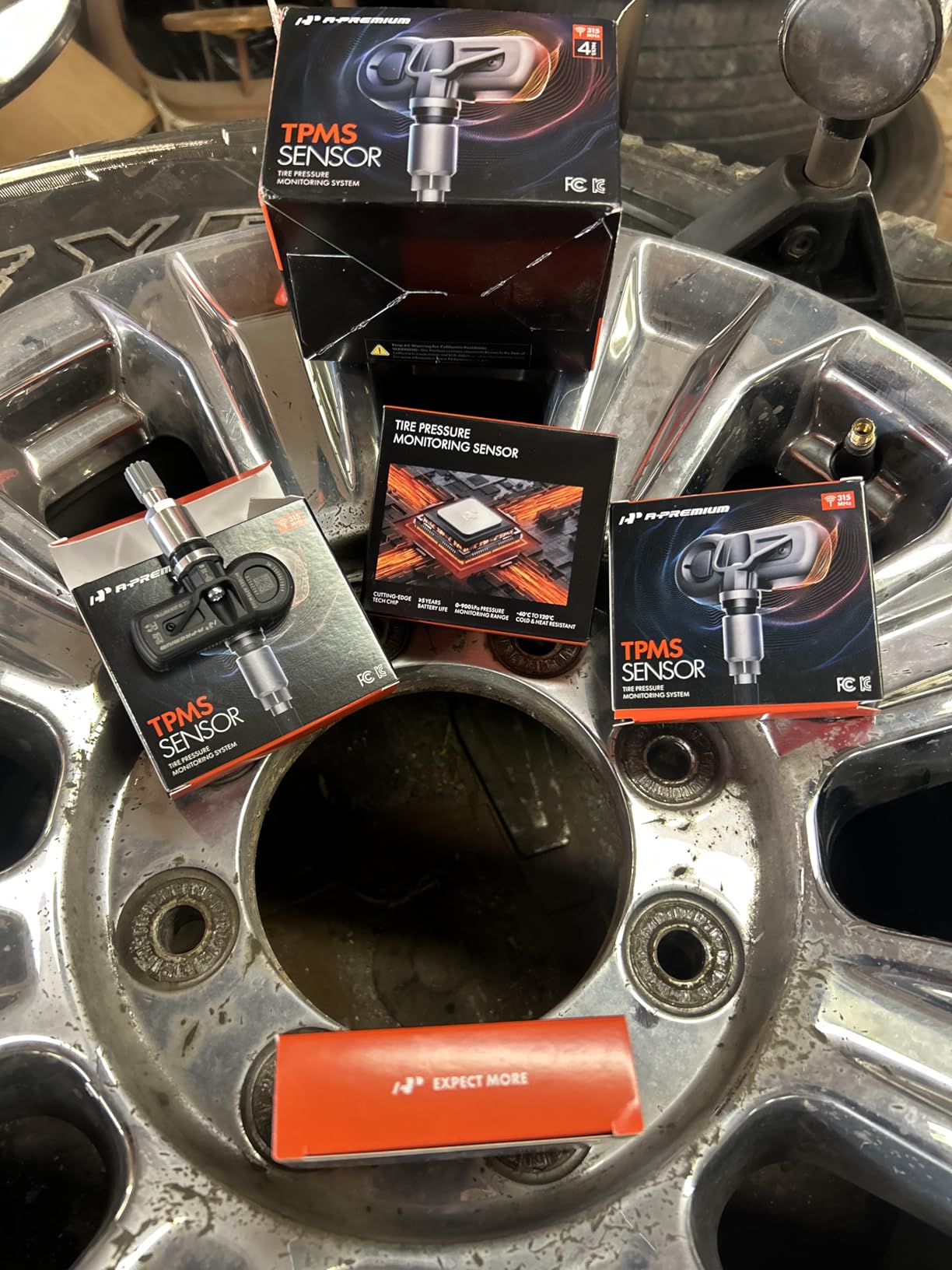
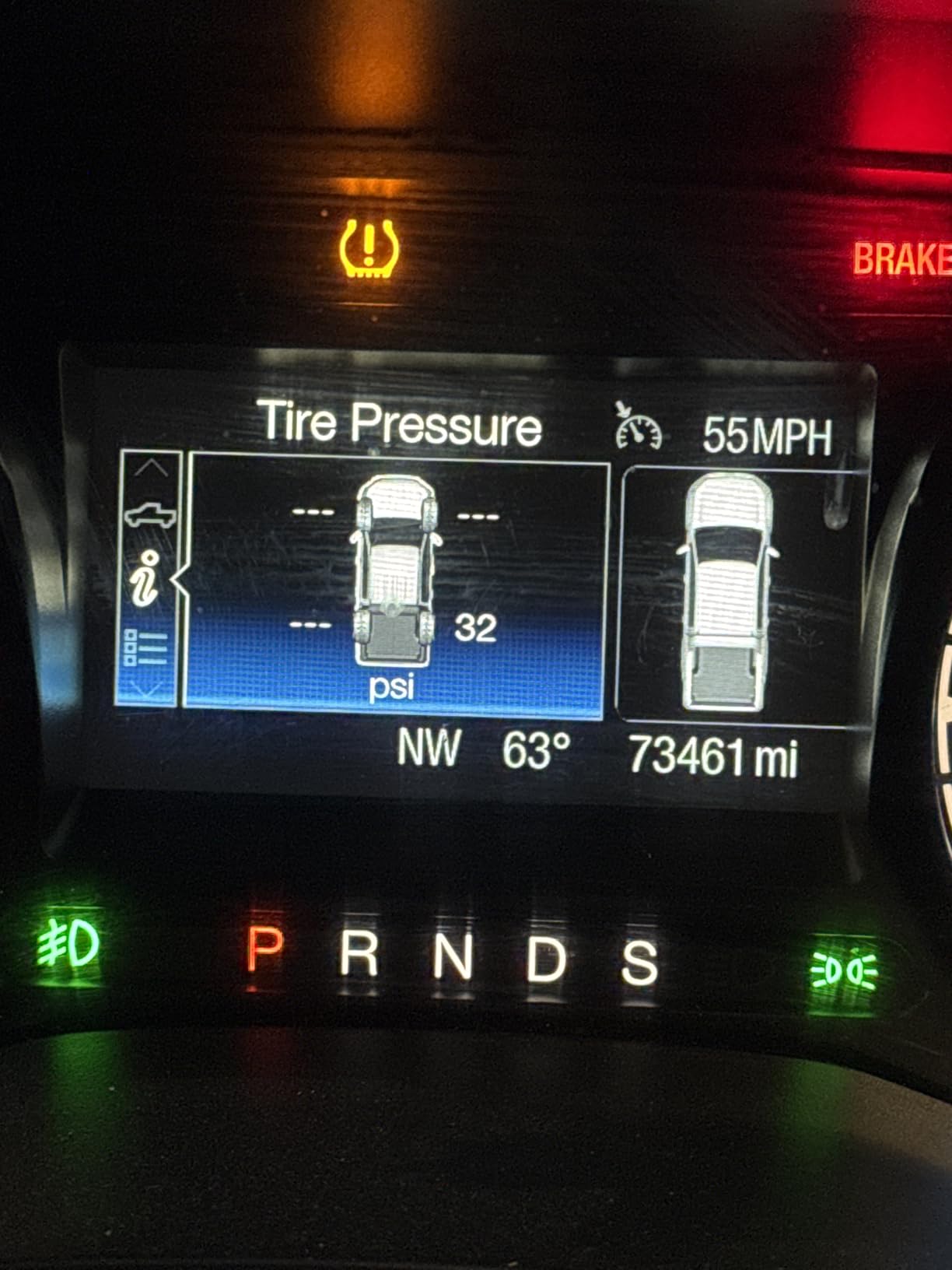
The most common buyer confusion is the difference between pre-programmed and auto-relearn. The chip is loaded with the correct vehicle data, but the car still has to be taught that the sensor is present, which is why the lamp can stay on until a relearn is completed.
Why it suits most drivers
It suits Ford and Lincoln owners replacing all four corners at once, particularly if you would rather pay a shop for a simple activation than own a programming tool. The four-pack format with individual colour boxes is convenient when you want to keep a labeled spare.
For owners running separate winter wheels, these clamp-in stems suit a sportier setup than rubber snap-ins.
Where it falls short
Fitment stops at Ford and Lincoln, and 315MHz rules out anything European. The 2-year warranty covers the part only and explicitly excludes labour, towing and related repair costs, so the real cost of a failed sensor is higher than the guarantee suggests.
6. Dorman 974-001 Self-Relearn 315MHz – Best Self-Relearning Replacement
Dorman 974-001 Tire Pressure Monitoring System (TPMS) Sensor
Direct fit 315MHz
Auto relearn with the ECU
Stainless clamp-in stem
Limited lifetime warranty
1 sensor
Pros
- Pairs automatically during a short drive
- Readings match external gauges
- Stainless stem resists corrosion
- Limited lifetime warranty
- Large installed base on the Chrysler group
Cons
- Vehicle specific rather than universal
- Some models report the wrong tire position
- A few owners still needed dealer pairing
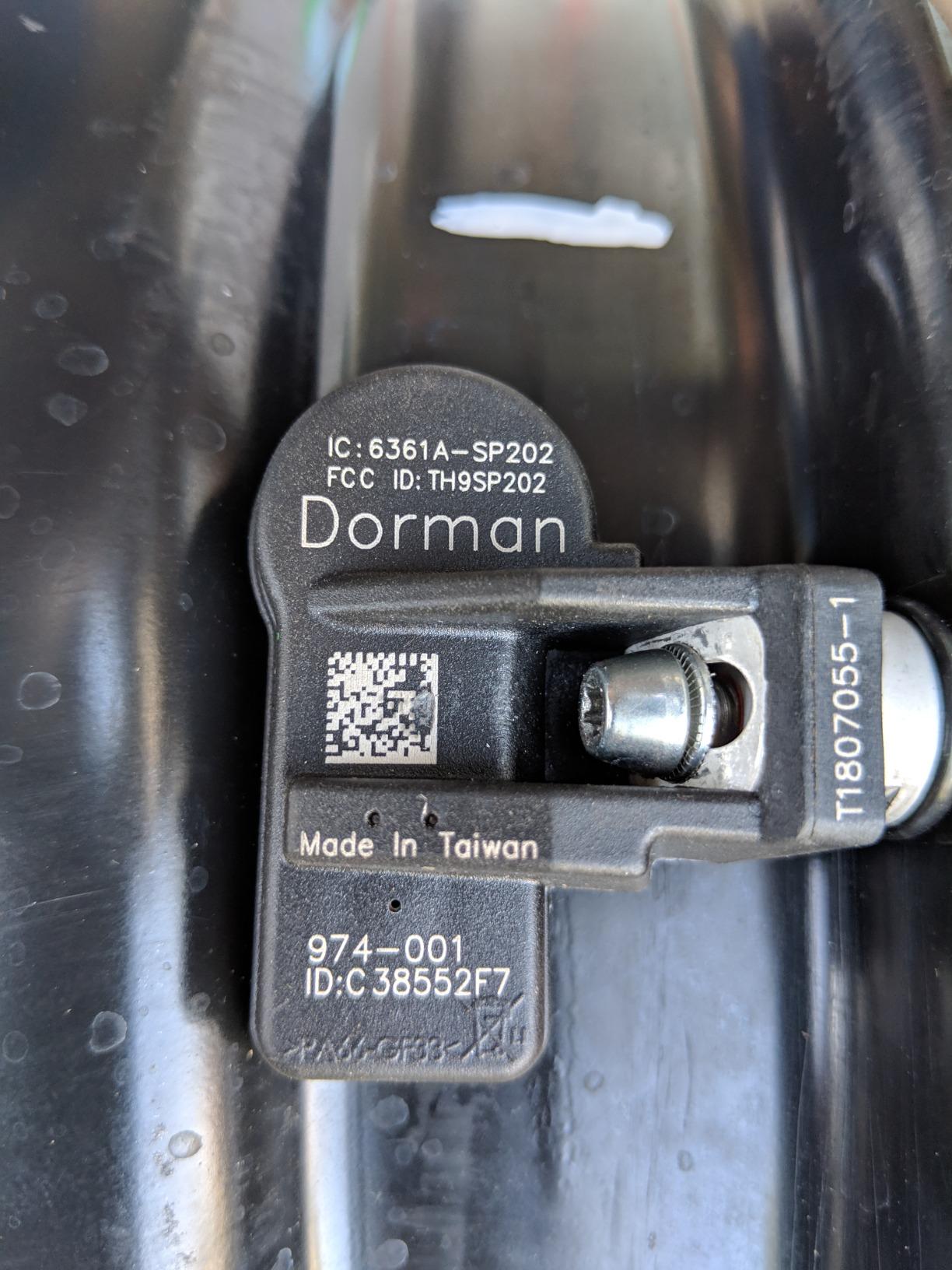
The Dorman is the least demanding sensor in this roundup to live with. It is a direct-fit 315MHz replacement with a relearn-type design that pairs automatically with the vehicle ECU, so no manual ID programming and no scan tool is required. The warning lamp typically clears within a short drive after fitting.
That simplicity is why it has such a large installed base on Chrysler, Dodge and Jeep applications, and the reviews reflect it. Owners report very accurate readings that match an external gauge, and the clamp-in stainless valve stem resists corrosion, which matters on winter-driven vehicles in road salt.
Cross-references are listed for 56029319AB, 56029465AA, 56029465AB and 56029479AA, and the part carries a limited lifetime warranty, the strongest warranty commitment anywhere in this list. The plastic body weighs 1.76 ounces and the overall dimensions are compact enough for standard wheel applications.
What buyers most often praise is cost. It is dramatically cheaper than a dealer sensor for exactly the same job, and a vehicle-specific part removes the risk of a wrong-frequency purchase entirely once you have confirmed fitment.
Why it suits most drivers
It suits anyone on a relearn-type vehicle who wants the warning lamp to go away on its own and has no interest in owning a programming tool. The limited lifetime warranty means fitment confidence matters less than with shorter guarantees, and the accuracy is good enough to trust for warning purposes.
It is also a good pick for a single failed sensor, since you can replace one without buying a set.
Where it falls short
It will only fit the listed applications, so the year, make, model and trim must be confirmed before purchase. The most persistent complaint is tire position reporting, where some models display the wrong wheel even though the pressure number is correct. A small number of owners also needed dealer programming to complete pairing, and a position cycling fault can leave a check TPMS message with no amber lamp.
7. Motorcraft TPMS3 Remote Sensor – Best OE-Style Brand Part
Motorcraft TPMS3 Remote Tire Pressure Sensor
OE brand remote sensor
Part number TPMS3
Machined finish
Vehicle specific fit
Sold singly
Pros
- Direct OE brand part number
- Correct fit for listed vehicle applications
- Compact machined body
- Alternative to dealer pricing
Cons
- Vehicle specific fitment only
- Sold as one sensor not a set
- Some early failures reported
Sometimes the right answer is simply the part number the factory used. This Motorcraft remote sensor is the choice for drivers who want an OE-brand component with a machined finish and no guesswork, and the 4.4 rating across 193 reviews shows broad satisfaction with the fit on the applications it covers.
The body is compact, at 2.17 by 1.48 by 3.79 inches and just over one ounce, which installs cleanly in standard wheel applications. The machined finish also looks correct under a wheel where a plain plastic sensor would look out of place, and for owners who care about appearance on a show car that matters more than it sounds.
Why it suits most drivers
It suits drivers who know their OE part number and want a brand-name part rather than a generic. Being sold singly, it is also the sensible choice if only one sensor has failed on a car whose sensors are known to fail individually rather than in sets.
Because the part is vehicle-specific, there is no programming decision to make, which removes a whole category of risk.
Where it falls short
Vehicle-specific fitment means it will not fit anything else, and buying four means four separate purchases. Reviews also show a small but real share of 1-star feedback pointing to early failures or fitment mismatches, so confirm the application carefully before ordering.
8. CDWTPS Pre-Programmed 315MHz Set of 4 – Best Full-Set Replacement
CDWTPS TPMS Sensors for Ford,315Mhz Set of 4 Tire Pressure Monitor Sensor
Pre-programmed 315MHz
Ford Lincoln Mercury set of 4
CR2032 battery
-40C to 125C
1 year warranty
Pros
- Activation only with no programming needed
- Matches many OE part numbers
- Every sensor factory tested
- CR2032 rated 5 to 8 years
Cons
- Ford Lincoln and Mercury only
- A scan tool is still needed
- Some sensors fail to activate or pair
With 1328 reviews, this is the most heavily reviewed product in the roundup, and the volume tells you something useful about fitment: these sensors are widely fitted to Ford, Lincoln and Mercury vehicles, so there is a large body of real-world feedback to draw on. The average rating of 4.2 is a solid result for a pre-programmed set.
The approach is simple. Each sensor is pre-loaded with the correct data and covers a long list of OE part numbers, including DE8T-1A180-AA, 9L3Z-1A189-A, ZZDA37140, TPMS12, CM5T-1A180-AA and 9L3T-1A180-AE. You do not need a programming tool, only activation with a scan tool, which is a much shorter job to pay for.
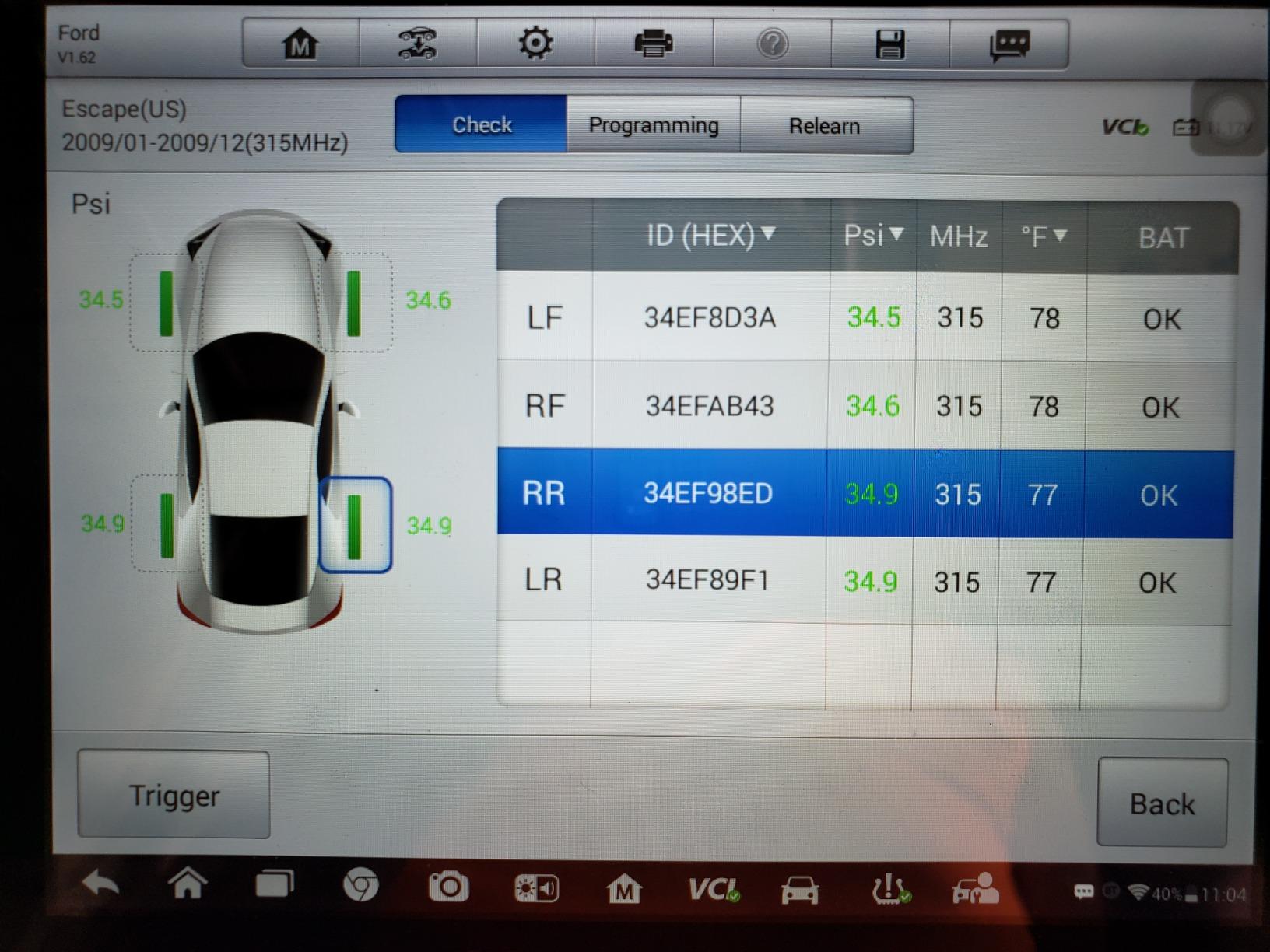
Every sensor in this roundup is individually tested before it leaves the factory, and the 900kPa chip with a CR2032 battery is rated for 5 to 8 years of normal use. The 125 degree Celsius upper limit is among the highest here, which is a genuine advantage for winter tire use.
Why it suits most drivers
It suits owners of the listed vehicles who are replacing all four sensors at once and want to avoid four separate orders. Because sensors of the same type tend to fail in sequence, replacing the full set now is the cheaper long-term decision even if only one has given up.
For anyone planning winter and summer sets, pre-programmed sensors with a broad part number list reduce the cross-referencing work considerably.
Where it falls short
The fitment ceiling is Ford, Lincoln and Mercury, and 315MHz excludes European vehicles. A scan tool is still needed for activation even though programming is not, and roughly 14% of reviews are 1-star, including sensors that would not activate or pair and needed replacing. The 1-year warranty is the shortest protection in this roundup, so check the compatibility before paying for installation labour.
9. MOBILETRON NX-S004-4 433MHz Set of 4 – Best for European Cars
MORESENSOR Signature Series 433MHz TPMS Tire Pressure Sensor 4-Pack | Preprogrammed for Select 200+ European Brand Models | Replacement for 36106856227 | Clamp-in | NX-S004-4
433MHz clamp-in 4-pack
Preprogrammed for 200+ European models
Replaces 36106856227
5 to 8 year battery
3 year warranty
Pros
- Many owners report pairing after a short drive
- Works on BMW and Mini without a tool
- Reliable signal and pressure readings
- 3 year warranty
Cons
- Preprogrammed coverage limited to select models
- Relearn can take a couple of miles
- Some sensors fail to pair on certain BMW models
European drivers are the group most underserved by North American roundups, and this 433MHz four-pack fills that gap. The sensors are preprogrammed for more than 200 European-brand models and replace OE part number 36106856227, which covers a large share of BMW and Mini applications without a programming tool.
Owners frequently report that the sensors self-programme after a short relearn drive, which is exactly the behaviour you want if you are not prepared to buy a scan tool. The reinforced plastic body with metal valve stem is a sensible combination, and the 3-year warranty sits comfortably above the one-year norms in this category.
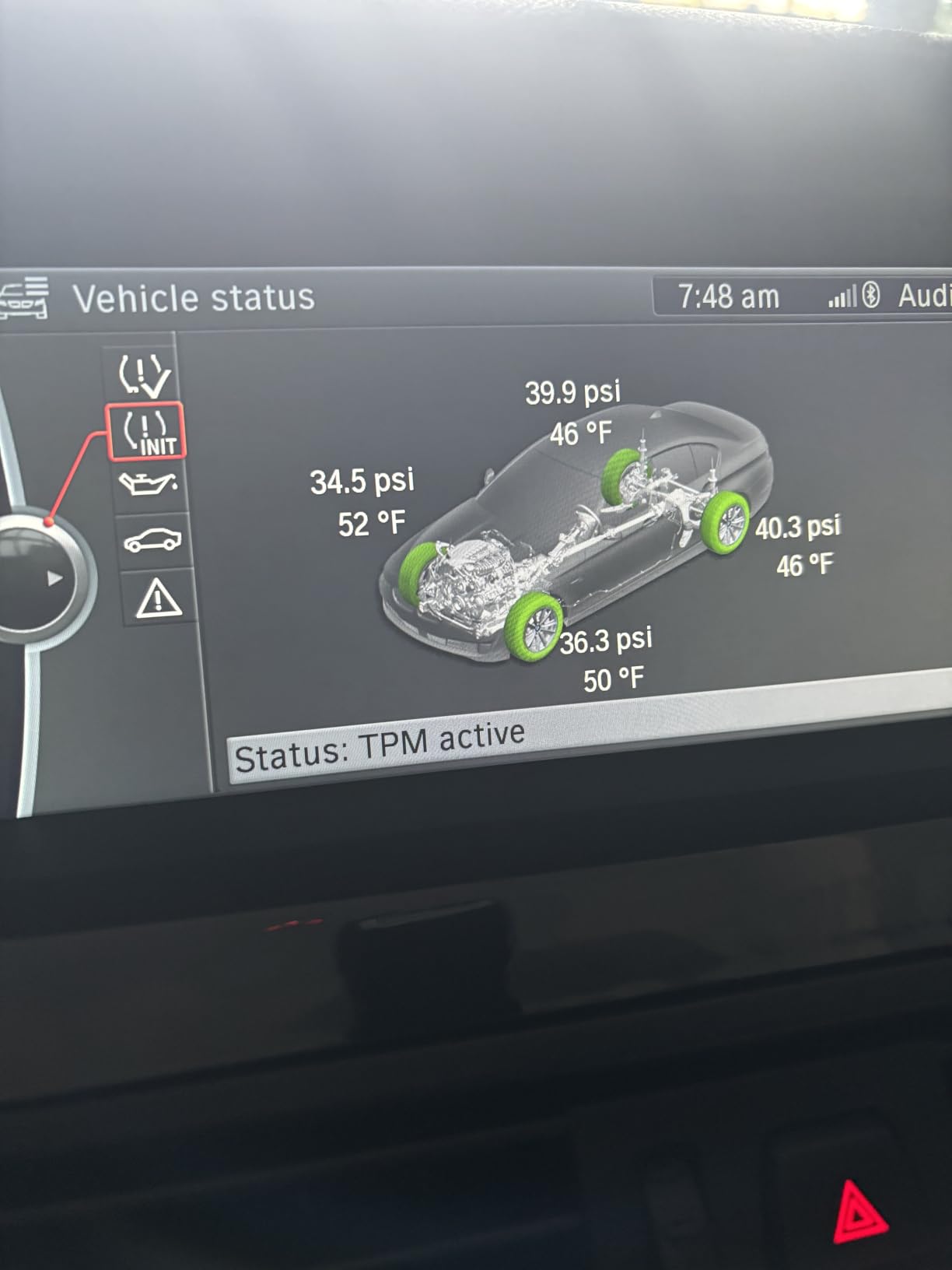
The stated measuring range is 1.8 bar to 2.5 bar, or 26 to 36 psi, and the upper temperature rating is 85 degrees Celsius. That pressure band is narrower than some rivals here, so if you run higher pressures you should confirm the reading is useful at the top of your range before committing.
Battery lifespan is rated at 5 to 8 years, and the part is a genuine four-pack, so a full vehicle replacement arrives in one order. Reviews on BMW and Mini applications are particularly strong on signal strength and reading accuracy.
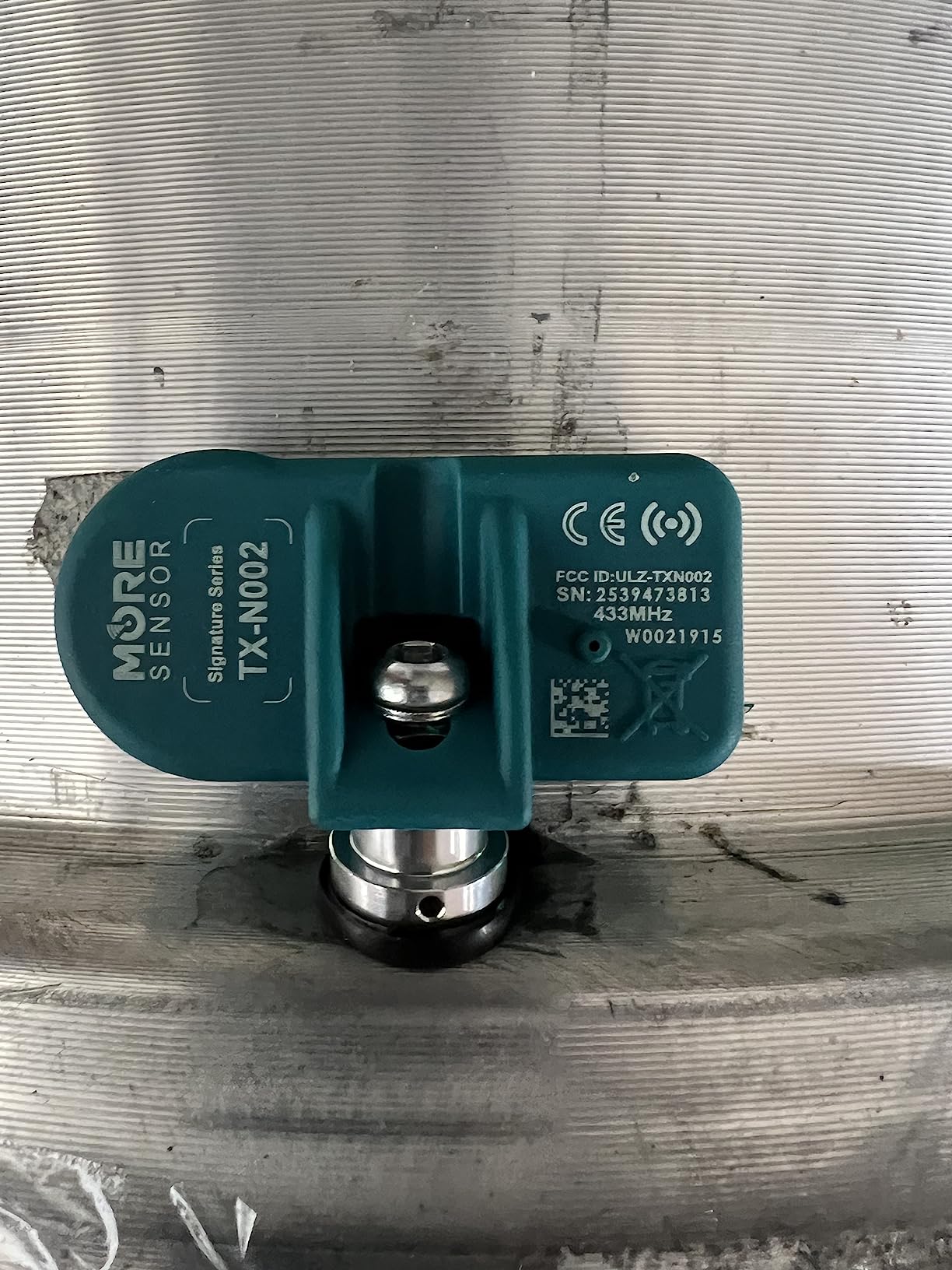
Why it suits most drivers
It suits European car owners who want a drop-in replacement without buying a programming tool, and the pairing-after-a-drive behaviour suits people who would rather not book a shop appointment. Reported accuracy at a fraction of dealer pricing is the most common theme in the reviews.
For a Mini or older BMW on a 433MHz system, this is the most direct path back to a working warning lamp.
Where it falls short
Preprogrammed coverage is limited to select European-brand models, so it is not a general-purpose answer. The relearn can take a couple of miles of driving to complete, and about 15% of reviews are 1-star, including sensors that would not pair on certain BMW models despite the preprogrammed claim.
10. RENECTIV 315MHz Auto-Relearn Set of 4 – Best for Chrysler, Dodge and Jeep
TPMS Sensor, 315Mhz Dodge Tire Pressure Monitoring System Sensor Set of 4
Pre-programmed 315MHz
Auto relearn in 20 to 30 minutes
Chrysler Dodge Jeep and Kia set of 4
Up to 110 PSI
1 year warranty
Pros
- Auto-relearn needs no coding tool
- Four sensors cover a whole vehicle
- Wide OE cross reference list
- Rated to 110 PSI in cold and heat
Cons
- Fitment limited to listed applications
- Auto-relearn needs 20 to 30 minutes driving
- One year warranty
Where the Dorman wins on warranty, this set wins on scale of coverage and convenience. Four pre-programmed 315MHz sensors cover Chrysler, Dodge, Jeep and a listed 2014 to 2016 Kia Cadenza application, and the sensors auto-relearn after 20 to 30 minutes of driving, so no coding tool is required at any point.
The cross-reference list is long, including 56053030AC, 68078861AA, 56053036AA, 56029479AA, 56029465AB, 4313057L00, 52933A5000, 68001696AA, 68001696AB, 56029479AB and 4250C276. That breadth is what makes it practical for a household with more than one vehicle in the same family.
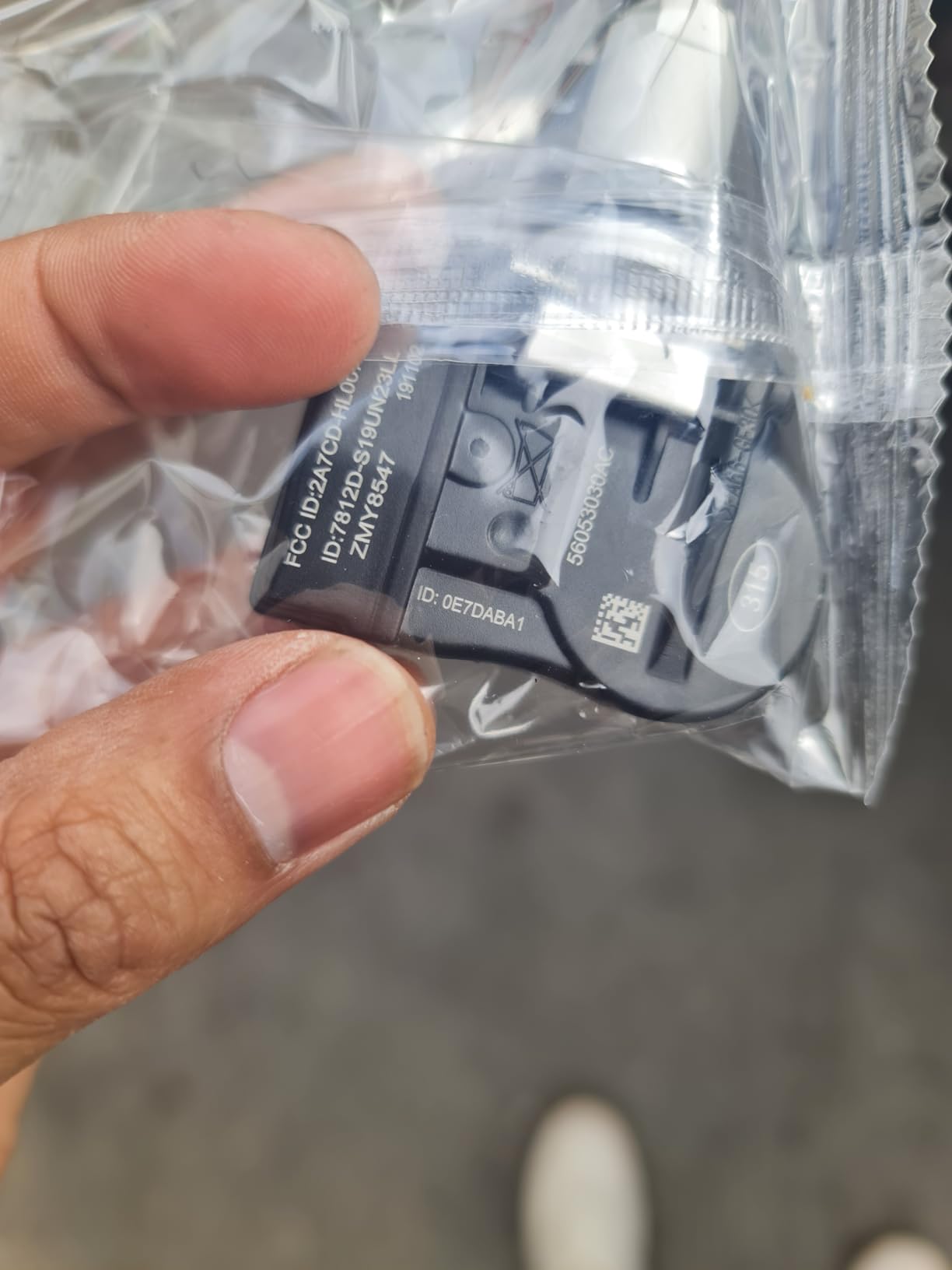
Rated to 110 PSI or higher across a minus 40 to 125 degree Celsius range, it handles the higher pressures and temperature swings found on trucks and loaded SUVs. Reviewers consistently report that the set pairs automatically after a short drive and clears the warning without any programming equipment, which is exactly the outcome you want from a straightforward replacement.
The 4.3 average rating across 269 reviews reflects that predictability, with the main deductions coming from narrow brand coverage rather than quality.
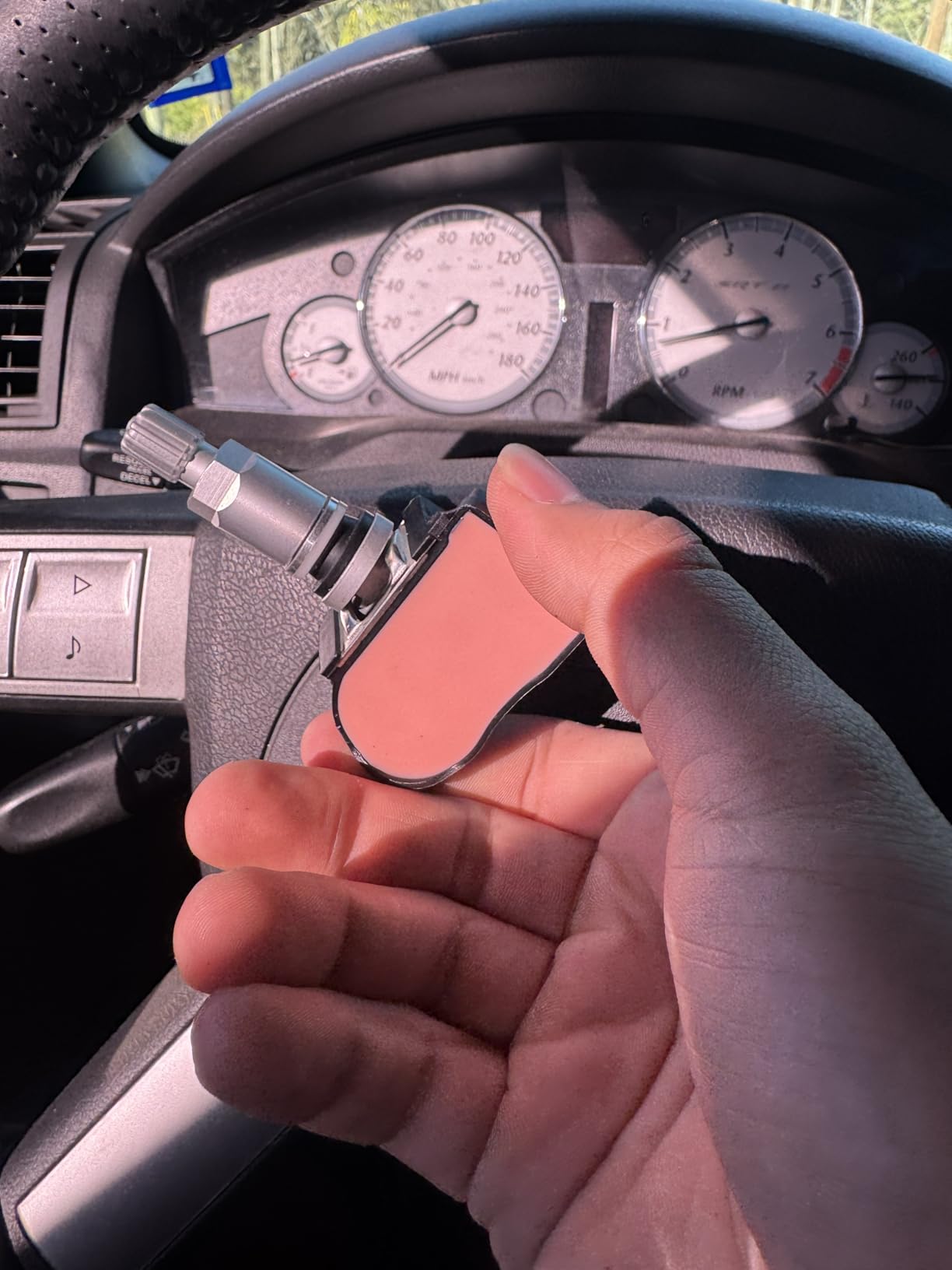
Why it suits most drivers
It suits owners of the listed vehicles who want a complete set in one order and who would rather let the car learn the sensors on a drive than visit a shop. The 110 PSI rating is a real advantage on tow-capable vehicles, and the long cross-reference list reduces the risk of buying for the wrong model year.
If your Chrysler, Dodge or Jeep has been warning for a while, this is the lowest-effort path back to a clear dashboard.
Where it falls short
Fitment is limited to the listed applications, so it is not a general answer for mixed-brand households. The 20 to 30 minute auto-relearn drive has to actually happen before the lamp clears, and the 1-year warranty is the shortest in this roundup, which is worth weighing if you are also paying for installation.
How to Find Your TPMS Frequency and Part Number Before You Buy
Almost every return we would have expected to see comes from buying the wrong part, and the fix is a short lookup before you order. Start with the tire placard on the driver door jamb, which sometimes lists a TPMS indicator and cold pressures for each tire, and note the model year.
Then do a parts lookup using year, make, model and trim. The most reliable sources are the vehicle manufacturer parts site and a major retailer with a fitment selector. Write down three things: the OE sensor part number, the frequency, and whether the vehicle uses a relearn-type design that pairs automatically or requires manual programming.
Frequency follows region more than anything else. 315MHz is standard across North America and much of Asia, while 433MHz, often listed as 433.92MHz, covers most of Europe and many international markets. If you have ever had aftermarket wheels fitted or imported a vehicle, the original frequency may not match the region the car was sold in, so verify rather than assume.
Forum users on cx50forums have documented buying programmable sensors advertised as pre-programmed that arrived blank, which turned a ten-minute job into a second purchase. If a listing does not state the frequency and the programming status clearly, treat that as a reason to look elsewhere.
Cloning vs Programming vs Relearn: What Each Term Means
These three words drive most of the confusion in this category, and they describe genuinely different operations. Knowing which one your repair needs is often the difference between a self-serve afternoon and a shop appointment.
Programming means writing a vehicle application and a sensor ID into a blank sensor using a scan tool. The HUF Baolong and the Schrader EZ-Sensor both arrive blank and must be programmed before they are mounted, which is why their boxes say so. Cloning means copying the ID from a working OE sensor into a replacement, which preserves the original identity and usually removes the need for a full relearn afterward. The Autel MX-Sensor supports both, and this is why owners on r/wrx_vb clone to the factory sensor IDs rather than programming fresh.
Relearn is the vehicle-side step where the receiver is told which ID belongs to which wheel. Manual relearns run through the OBD port with the ignition sequence, while auto-learn systems pick up new sensors during a drive of 20 to 30 minutes. Pre-programmed simply means the chip already carries vehicle data, and it is a common misconception that this eliminates the relearn entirely, as several owners of the A-Premium set discovered.
The sequence that works best is: program or clone the sensor while it is still off the wheel, mount and torque the valve, then run the relearn. Corvette owners on corvetteforum specifically recommend programming before mounting so a sensor does not have to come off twice.
Our guide to TPMS relearn tools for DIY tire changes covers the vehicle-side hardware if you want to handle the relearn yourself.
315MHz vs 433MHz vs Dual-Frequency Sensors Explained
This is the single biggest fitment variable and the one most often missed. A sensor can be perfect in every other respect and still be completely invisible to your car if it transmits on the wrong band, which is why frequency coverage is the first thing we judge.
A dual-frequency or dual-band sensor covers both 315MHz and 433MHz from one body, which removes the need to identify which band your vehicle uses before buying. The Autel MX-Sensor and the HUF Baolong UVS7050 both work this way, and the Schrader EZ-Sensor goes further by also covering 314.9MHz, a band found on some applications that a plain 315MHz sensor will not reach.
Single-frequency sensors such as the Dorman, the CDWTPS set, the A-Premium set and the RENECTIV set are entirely appropriate when you know your vehicle, and they cost less as a result. The VDO REDI-Sensor and the MOBILETRON set serve the 433MHz European side. A shop that stocks a full shelf generally keeps universal dual-band sensors for this reason.
Clamp-In Metal vs Snap-In Rubber Stems
The stem style changes how the sensor mounts, how it looks, and how much trouble a leak causes. Clamp-in metal sensors bolt to the wheel from the inside, stand up independently of the original valve, and look factory-correct on alloy wheels. The Autel, Dorman, A-Premium, VDO, MOBILETRON and HUF sensors in this roundup all use metal stems, and the Autel pack even includes interchangeable rubber stems for people who prefer them.
Snap-in rubber sensors push into the valve hole and stay close to the rim, which keeps them out of sight and out of the way of kerbs and potholes. The Schrader EZ-Sensor is the snap-in option here, and its lighter 9g body is gentler on wheels that are sensitive to weight. The trade is durability: forum owners report rubber stems cracking in cold weather, and a cracked stem can leak slowly enough to trigger a low-pressure warning.
Whichever you choose, the practical point is the same. Torque the valve to specification and check for leaks after the tire is inflated, because a slow seep is the cause of many false alerts that owners blame on the sensor.
Buying Guide: How We Judged These Sensors
We judged every sensor on the same five criteria, and none of them involved guessing. First is frequency coverage, because a sensor that cannot reach your car’s receiver is worthless regardless of everything else. Second is programmability, including whether the ID can be cloned, since that decides how many shop visits your future tire changes will cost.
Third is accuracy against a known-good gauge. TPMS readings commonly sit 2 PSI or more below a good handheld gauge, so a sensor that reads consistently low is more annoying than useful and you still need a gauge to set cold pressure accurately. Fourth is the stem and seal construction, which drives leak risk over a decade. Fifth is warranty length and return friction, and this is where the list separates sharply.
On warranty, the Dorman 974-001 leads with a limited lifetime warranty, the HUF Baolong follows with 3 years or 36,000 miles, and the MOBILETRON set offers 3 years. The VDO and A-Premium parts sit in the middle at OE and parts-only coverage, while the CDWTPS and RENECTIV sets carry the shortest terms at one year. Because these batteries cannot be replaced, warranty length is a reasonable proxy for expected service life.
On the perennial question of OEM versus aftermarket, the honest answer is that a well-made aftermarket part is not a compromise when it is pre-programmed or self-relearning for your vehicle. Genuine OE suppliers such as Schrader and Continental build to the same standards, and a pre-programmed direct-fit sensor often beats an OE part number for value. What aftermarket cannot beat is the certainty of a correct fit, which is why the vehicle-specific options here suit drivers who want zero decisions.
You can see how the tools fit into all of this in our roundup of TPMS programming tools, and our best TPMS relearn tools covers the vehicle-side step. If you are troubleshooting a different sensor complaint, our camshaft position sensor guide covers another common source of dashboard warning lamps.
Frequently Asked Questions
Are OEM TPMS sensors better than aftermarket ones?
Not in every case. A well-made aftermarket sensor that is pre-programmed or self-relearning for your exact vehicle performs the same job as an OE part and usually costs less. OE or OE-supplier parts such as the Schrader EZ-Sensor and the VDO REDI-Sensor make sense when you want a verified part number and a known seal, while universal programmable sensors win when you own several vehicles or want to clone an existing sensor ID.
Which brand of TPMS sensor is the most reliable?
Reliability tracks two things rather than the logo. First, dual-frequency coverage, because a sensor that matches your vehicle band never fails to pair. Second, warranty length, which reflects expected battery life. On those measures the Dorman 974-001 leads on warranty with limited lifetime coverage, and the Autel MX-Sensor leads on coverage and carries 1109 buyer ratings.
Do OEM tire pressure sensors need to be programmed?
It depends on the type. A pre-programmed OE replacement such as the A-Premium, CDWTPS or RENECTIV sets already carries the correct vehicle data, but the car still needs a relearn to assign it to a wheel. A relearn-type part such as the Dorman 974-001 pairs automatically during a drive. Only blank programmable sensors like the Schrader EZ-Sensor and the HUF Baolong UVS7050 need a scan tool to write the ID before installation.
Can Autel program Schrader TPMS sensors?
In practice, the Autel MX-Sensor is the safer pairing because it is designed for Autel TPMS service tools, and owners report it will not work with non-Autel programming tools. The Schrader EZ-Sensor is programmed with a compatible tool for the vehicle application rather than by cloning from an Autel unit, so the tool brand matters when you buy blank sensors.
Is direct or indirect TPMS better?
Direct TPMS is better in almost every measurable way because it reports a real pressure number for each wheel and can warn before a tire is meaningfully low. Indirect systems compare wheel rotation speed, so they cannot show a number, can be fooled if all four tires are equally underinflated, and usually need a reset after a tire rotation. Most modern passenger vehicles use direct systems.
Is my TPMS direct or indirect?
Check the tire placard on the driver door jamb. If it lists a tire pressure indicator light or a separate cold pressure for each tire, the vehicle has direct sensors in the valve stems. Another giveaway is the readout itself: a system showing four individual pressures with positions is direct, while a system with only a low-pressure warning and no numbers is indirect.
Why is my TPMS light still on after I replaced the sensors?
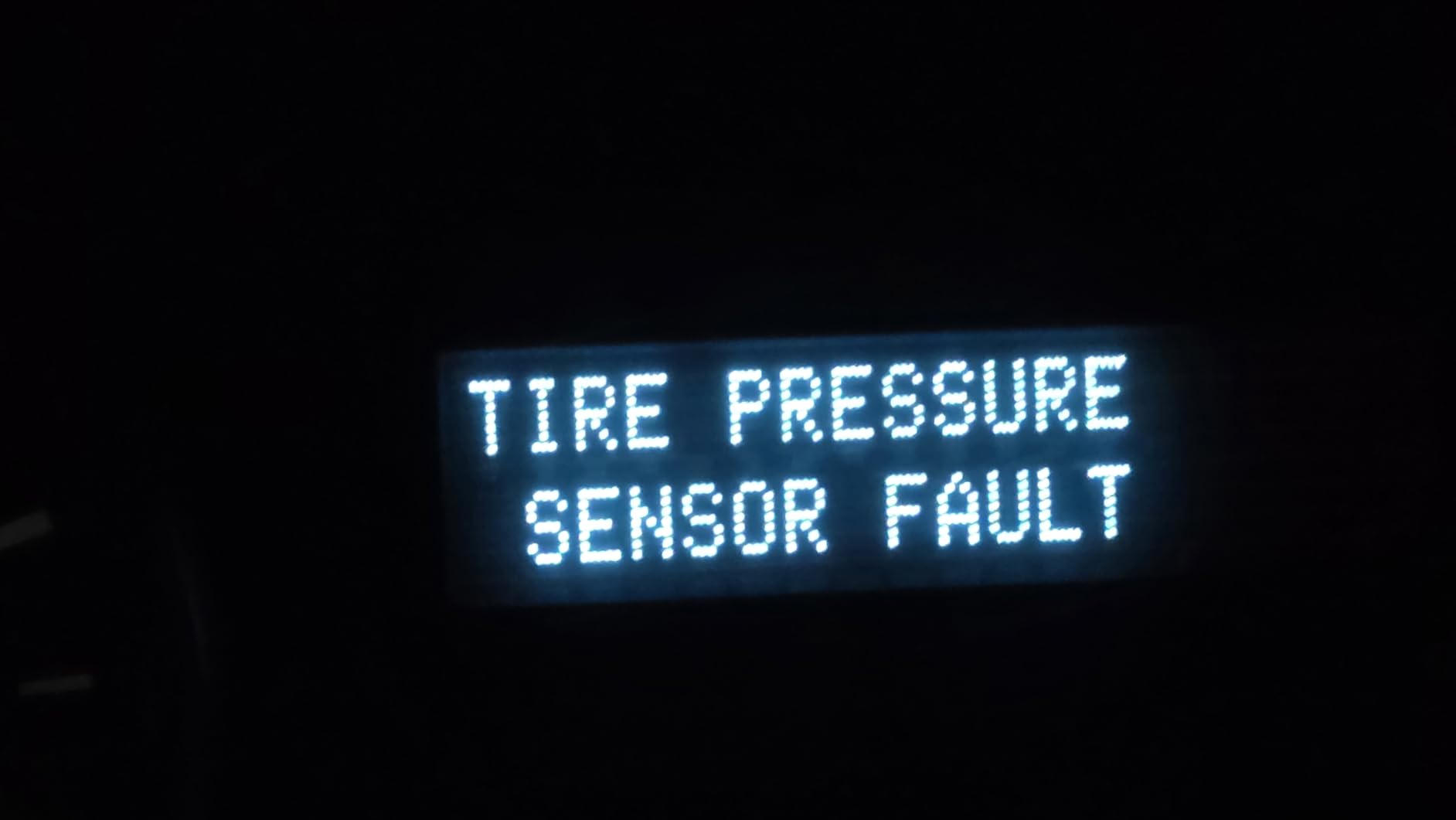
The usual cause is an unfinished relearn rather than a bad sensor. Pre-programmed sensors still need the vehicle to be taught that the ID is present, and some vehicles need 20 to 30 minutes of driving to auto-learn. Also check that the tire pressure warning reset button has been held, and confirm the vehicle is not still trying to learn a spare sensor stored in the trunk.
Do I still need a tire pressure gauge with TPMS?
Yes. TPMS readings commonly sit 2 PSI or more below a good handheld gauge, so the sensor is a warning device rather than an accurate gauge. Use a quality gauge to set cold tire pressure, then let the system alert you to slow losses between checks, which is the situation a monthly gauge check simply misses.
Final Verdict for the Best TPMS Sensors in 2026
The best TPMS sensors are the ones that match your frequency and your relearn behaviour, and on that basis the Autel MX-Sensor is our top pick for the widest range of vehicles, while the Schrader EZ-Sensor is the confident value choice and the Dorman 974-001 suits anyone who wants the lamp to clear itself. Confirm your part number and frequency before ordering, program or clone the sensor before it goes back on the wheel, and you will not be back at the store for a second set.