
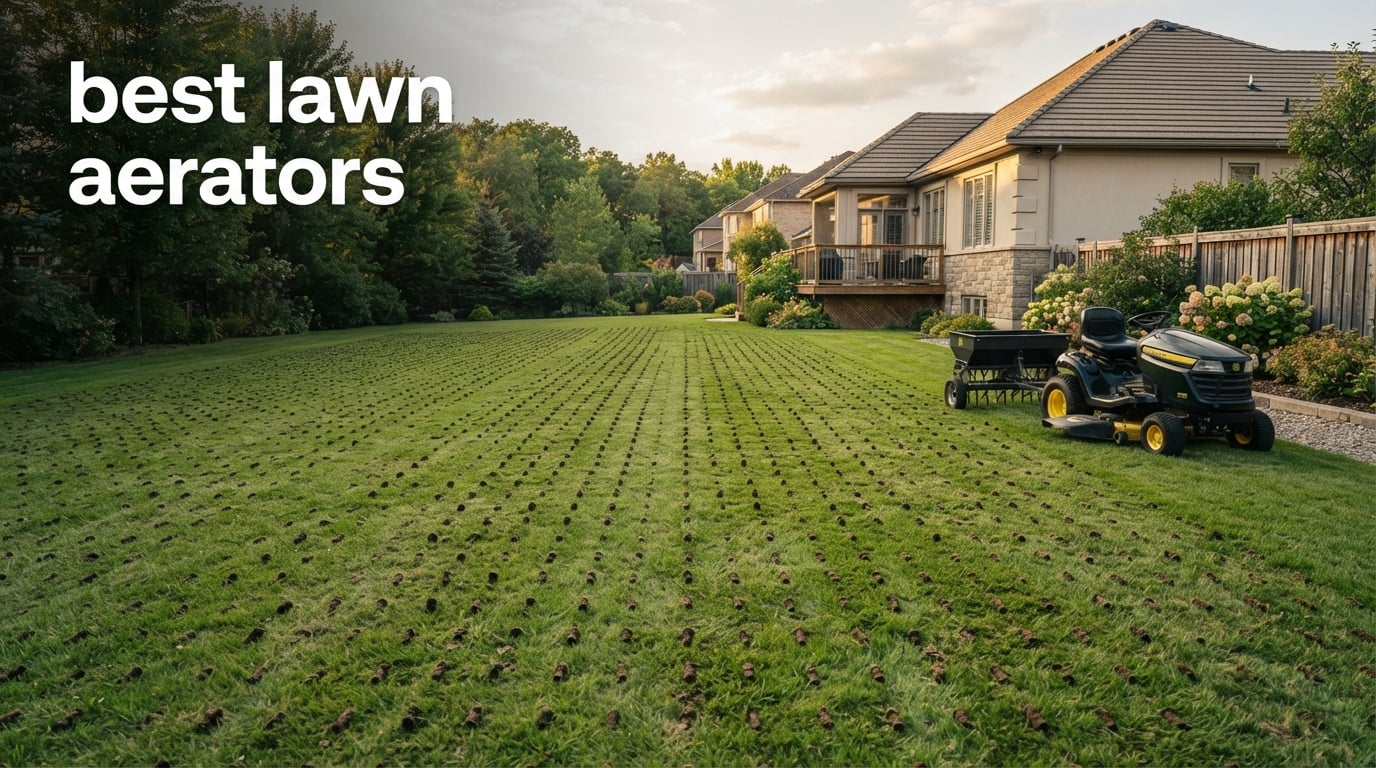
If your lawn has gone hard, patchy or pale, the fix is almost always underground rather than on top of it. Compacted soil blocks the air, water and fertilizer your grass needs, and the best lawn aerators pull that bottleneck apart. My overall pick is the Agri-Fab 48 In Tow Behind Lawn Plug Aerator, because its 32 galvanized knives and 175 lb weight tray reach real depth across a large property.
That said, a tow-behind only makes sense if you already own a riding mower or lawn tractor. Small lawns and spot problems call for a completely different tool, and clay or sandy ground changes the tine type you want. So this roundup covers ten options across every real category: tow-behind, manual coring, spike, aerator shoes and liquid aeration, with each pick scoped to the situation it actually suits.
I compared all ten on the same set of criteria: tine type and length, how much downward force the design can generate, whether it removes soil or just punctures it, assembly burden, and what reviewers say after a season of use. Every spec below comes from the manufacturer listing, and every opinion comes from buyer reviews. Updated for 2026.
Table of Contents
Top 3 Best Lawn Aerator Picks for 2026
Agri-Fab 48 In Tow Behind…
- 32 galvanized knives
- Plugs up to 3 in deep
- 175 lb weight tray
- Universal hitch

Brinly 40 Inch Tow Behind…
- 24 heat-treated spoons
- 3 in plug depth
- 150 lb enclosed tray
- Rotating tine sections

Yard Butler Manual Coring…
- Dual plug coring head
- Foot bar leverage
- Powder coated steel
- Long cushioned handle
Best Lawn Aerators in 2026 at a Glance
| Product | Specs | Action |
|---|---|---|
| Agri-Fab 48 In Tow Behind Plug Aerator |
|
Check Latest Price |
| Brinly 40 Inch Tow Behind Plug Aerator |
|
Check Latest Price |
| Yard Butler Manual Lawn Coring Aerator |
|
Check Latest Price |
 Landzie 42 Inch Hollow Tine Core Aerator Landzie 42 Inch Hollow Tine Core Aerator |
|
Check Latest Price |
 Walensee 15-Spike Manual Aerator Walensee 15-Spike Manual Aerator |
|
Check Latest Price |
 Briliantwerk Lawn Aerator Shoes Briliantwerk Lawn Aerator Shoes |
|
Check Latest Price |
 Simple Lawn Solutions Liquid Soil Loosener Simple Lawn Solutions Liquid Soil Loosener |
|
Check Latest Price |
 Covington Liquid Lawn Aerator Covington Liquid Lawn Aerator |
|
Check Latest Price |
 Jardineer 36 Inch Spike Aerator Jardineer 36 Inch Spike Aerator |
|
Check Latest Price |
 Dolibest Lawn Coring Aerator Dolibest Lawn Coring Aerator |
|
Check Latest Price |
Core vs Spike Aerators: Which One Do You Actually Need?
A core aerator pulls a plug of soil to the surface, and a spike aerator just pushes a narrow hole. That single difference decides almost everything, including how much cleanup you owe yourself afterward.
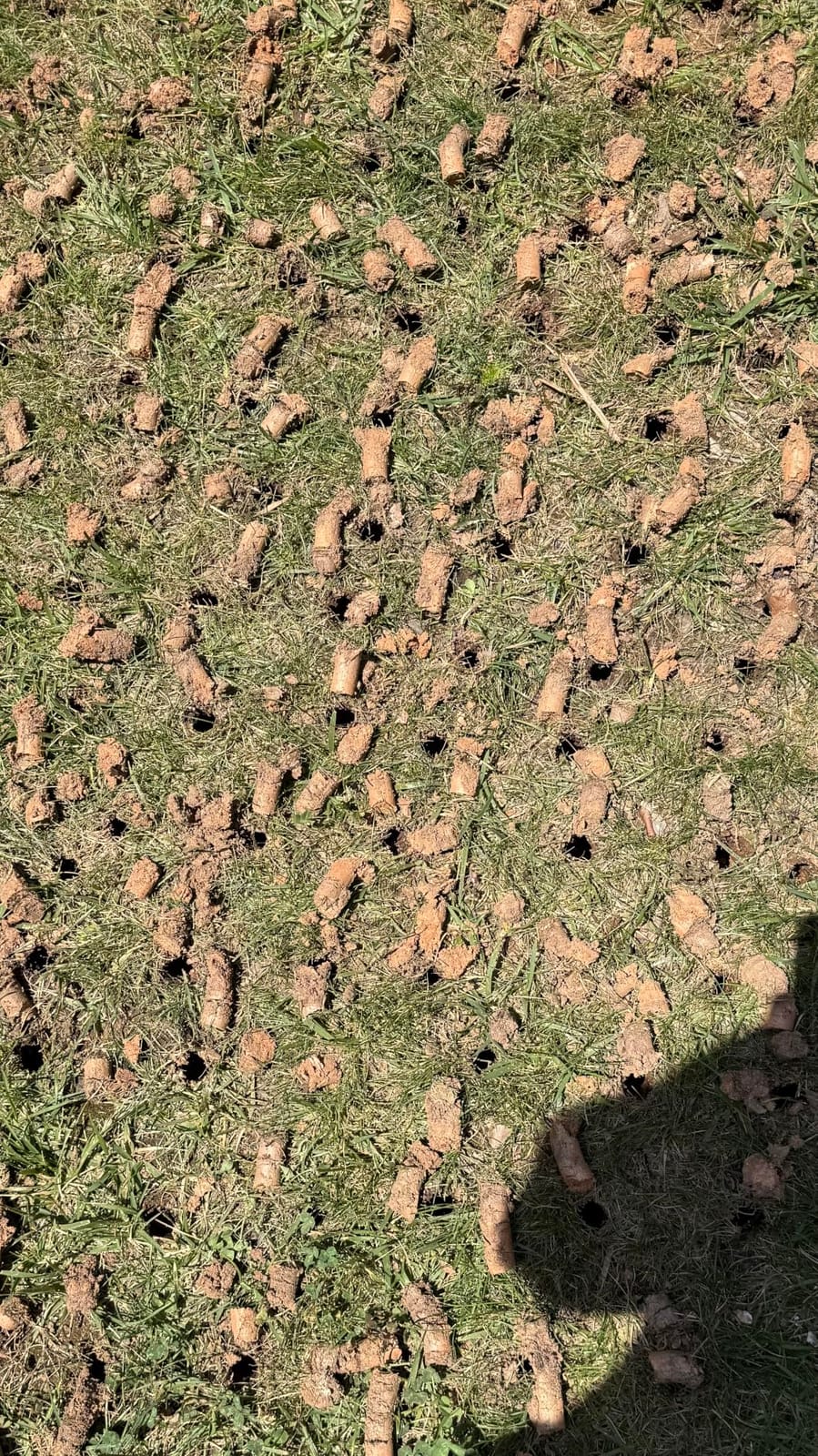
Core aeration is the real treatment for compaction. Hollow or sharpened spoons lift 2 to 3 inch plugs, which means soil volume leaves the ground, air gaps open up, and water stops sheeting off the surface. It is the method professionals use and the one that prepares a lawn properly for overseeding.
Spike aeration is a lighter intervention. The spikes are solid, so they compress a hole rather than removing anything, and the benefit is mostly thatch disruption and a bit of surface loosening. It is genuinely useful as a clay pre-treatment before coring, and useful on light traffic paths, but it will not fix hard compaction on its own.
Two more practical differences. Core aerators leave a mess of plugs to break down, which is the entire point, because those plugs are your organic matter returning to the surface. Spike aerators leave almost nothing behind, so there is no cleanup step at all.
One caution: solid spikes are the wrong tool in sticky wet clay, where they smear the pore structure they were meant to open. If your soil is heavy clay, water it a day ahead so it is damp but not saturated, and reach for hollow tines.
1. Agri-Fab 48 In Tow Behind Plug Aerator – Best Overall for Large Yards
Agri-Fab 48 In Tow Behind Lawn Plug Aerator with 32 Galvanized Knives and Universal Hitch
32 galvanized knives
Plugs up to 3 in deep
Weight tray holds 175 lbs
94 lb unit
Pros
- 32 self-sharpening galvanized knives
- Plugs up to 3 inches deep
- Flat-free tires with cantilever transport handle
- Universal hitch fits most tractors
- Weight tray supports up to 175 lbs
Cons
- Heavy at 94 lbs so moving it by hand is awkward
- Requires a lawn or garden tractor to operate
This is the one I keep coming back to for anyone with a big yard and a tractor. Thirty-two galvanized self-sharpening knives across a 48 inch width means you cover ground fast, and the listing confirms plugs come up 3 inches deep, which is the depth that actually relieves compaction.
What separates it from cheaper tow-behinds is the 175 lb weight tray. Compacted ground resists the tines, and a heavy tray is what converts horsepower into penetration. Add ballast gradually and watch how the plugs come out; if they crumble, you are going too deep for the conditions.
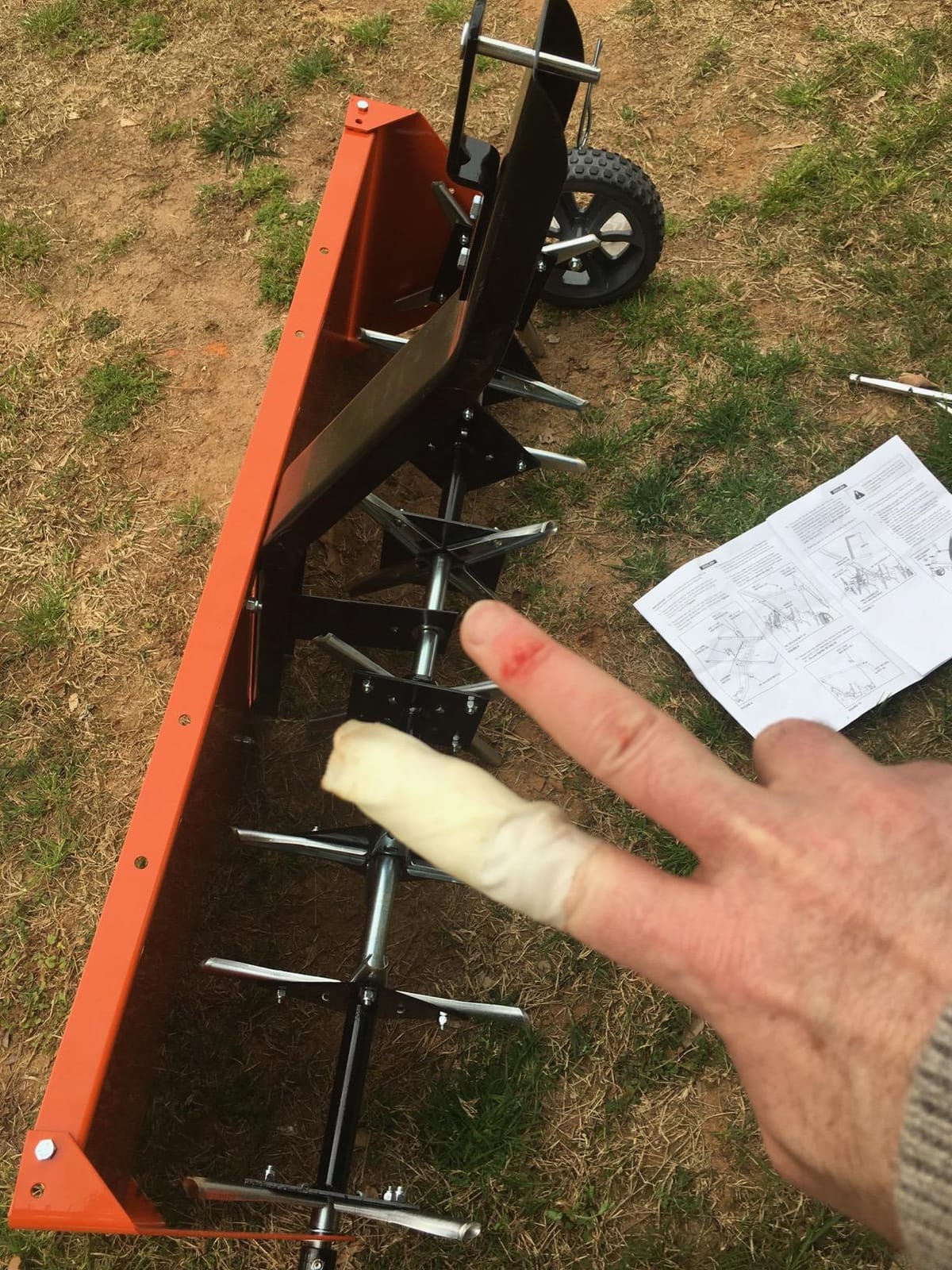
Ownership details matter more than people expect. The flat-free tires and cantilever transport handle let you raise and lower the unit from the seat, so you are not dragging spikes across a driveway every time you turn. The universal hitch means it will connect to most lawn and garden tractors without an adapter.
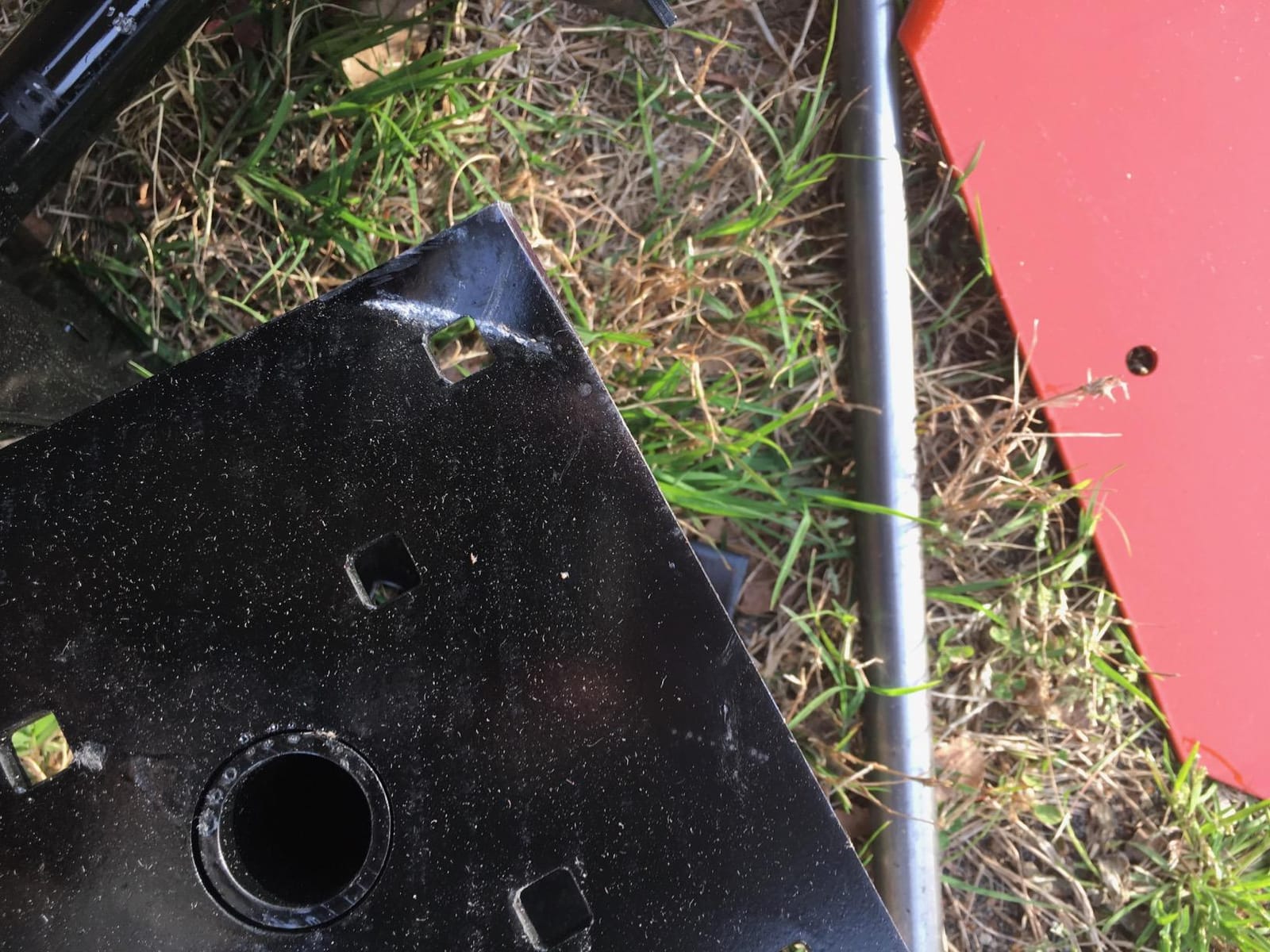
It weighs 94 pounds, and buyers say exactly that in reviews: it is a heavy unit that is awkward to reposition by hand. One owner on r/lawncare described pulling it behind a Deere lawn tractor and added that renting a big-box aerator is far more complicated than owning one.
Why it earns the top spot
Across 2,471 ratings it holds a 4.2 average with 59 percent five-star reviews, and the praise clusters on depth of plug removal and galvanized knife durability. For a property where aeration is a twice-a-year job, that review volume is a strong signal the platform holds up season after season.
Where it falls short
If you do not already own a tractor, this is the wrong purchase, and the weight makes it a two-person lift at times. It is also overkill for a lawn under a few thousand square feet, where a manual corer finishes the job in an afternoon.
2. Brinly 40 Inch Tow Behind Plug Aerator – Best for Tractor Owners
Brinly Tow Behind Plug Aerator with Universal Hitch, 40″ – Flat Black
24 heat-treated spoons
Plugs up to 3 in
Fully enclosed 150 lb tray
63.9 lb unit
Pros
- 24 heat-treated 16-gauge steel spoons
- Enclosed weight tray holds 150 lbs
- Three independently rotating tine sections
- Single-lever transport mode
- Single pin universal hitch
Cons
- Higher cost than other tow-behind aerators
- 10-inch semi-pneumatic tires can catch on rough ground
This is the highest-rated aerator in the lineup at 4.4 stars from 977 ratings, with 67 percent five-star. The Brinly name carries real heritage, and the engineering here is the most refined of the three tow-behinds I looked at.
The design detail I like most is the three independently rotating welded tine sections. Most tow-behinds have one axle line, and turning at that single point tears turf. Split rotating sections let the outer wings turn independently, so pivots stay cleaner on uneven ground.
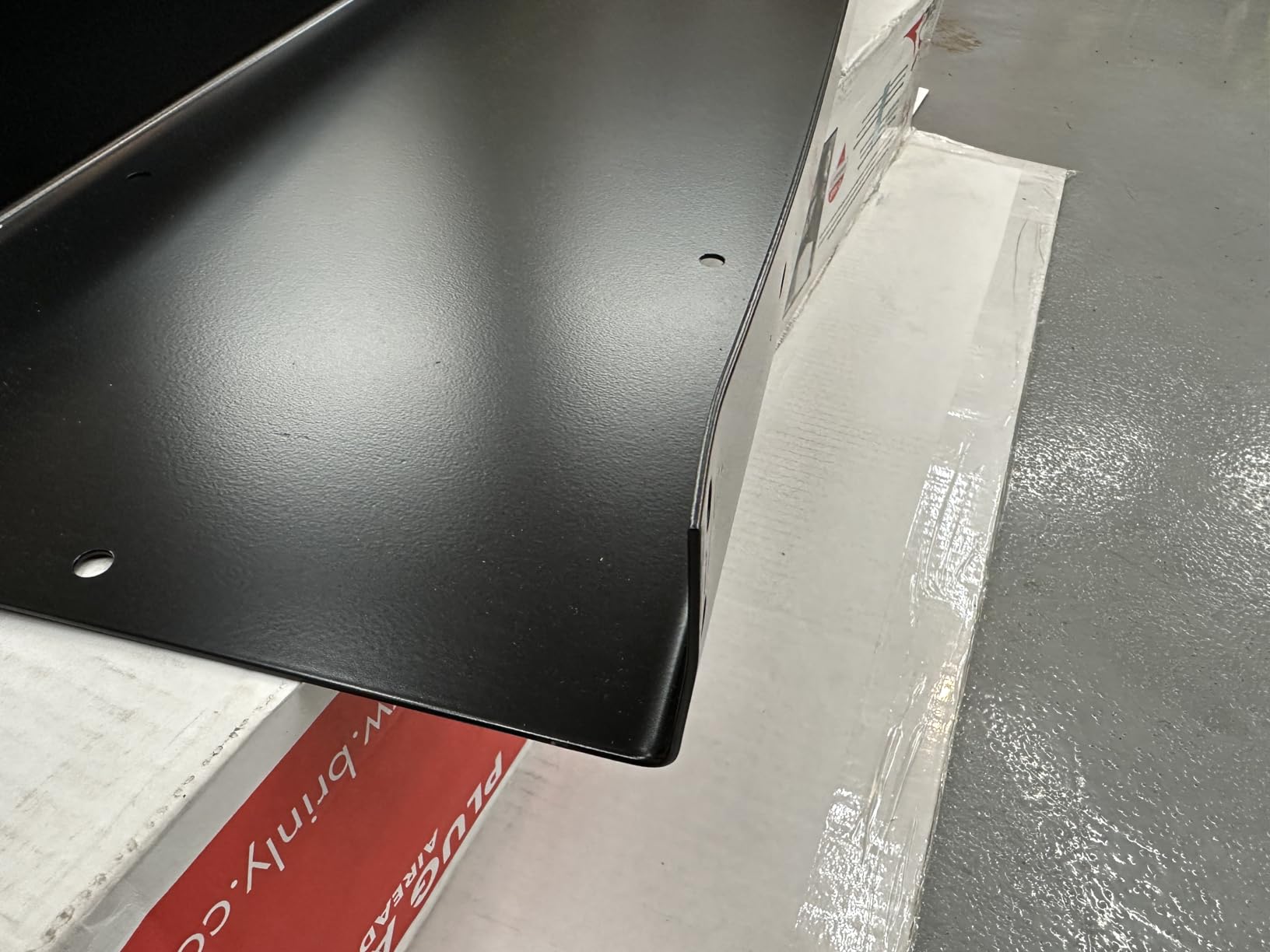
The spoons themselves are the narrow sharpened design, and reviewers note they penetrate with less added weight than wider tines. That matters on loam and sand, where a heavy tray can bottom out. The fully enclosed tray holds 150 lbs and keeps the ballast contained rather than letting it slosh.
A single lever engages transport mode, which is a nicer mechanism than a separate pin, and the 10-inch semi-pneumatic rubber tread tires roll over uneven ground without the harsh ride of small hard wheels.
Why tractor owners like it
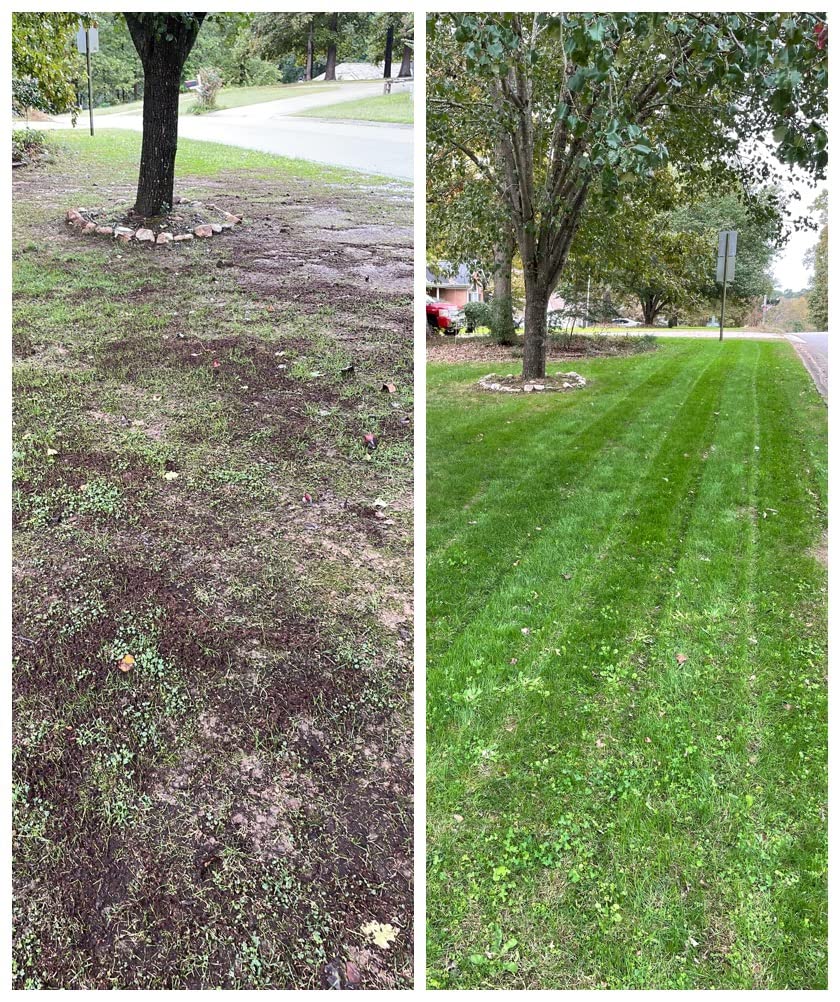
At 63.9 pounds it is noticeably lighter than the Agri-Fab, so loading it onto a trailer or repositioning takes less effort. The single pin universal hitch attaches to every lawn tractor and most zero-turn mowers and ATVs, which broadens what you can pull it behind.
What you pay for the refinement
It costs more than the other tow-behinds, and that is the most common complaint in reviews. The semi-pneumatic tires are also the weak point; buyers report they can catch on rough ground, and replacement is a bigger job than swapping a hard rubber tire.
3. Yard Butler Manual Lawn Coring Aerator – Best Manual Core Pick
Yard Butler Manual Lawn Coring Aerator, ID-6C – Lawn Care Tool for Aerating – Long-Handled – Power-Coated Steel Construction – Comfortable Cushioned Handles Garden Tool – Easy to Use
Dual plug coring head
Foot bar for leverage
Powder coated steel
1.77 lb long handle
Pros
- Most reviewed manual aerator in the group
- Powder coated steel construction
- Foot bar adds real leverage
- Long handle avoids bending over
Cons
- Light at 1.77 lbs so less force in hard soil
- Slow on anything larger than a small lawn
With 8,721 ratings, this is the most reviewed product in the entire group, and that kind of volume tells you more than any spec sheet. At a 4.3 average with 63 percent five-star, it is the safest manual coring recommendation I can make.
The mechanism is straightforward and effective. A dual plug coring head pulls two cores at a time, and the foot bar gives you somewhere to put your boot so you can push down with body weight instead of arm strength alone. That one piece of design is what separates a corer that works from one you abandon halfway across the lawn.
One r/lawncare owner put it plainly: it worked well on their lawn, though they had to clean it out a few times. That is honest and matches what you would expect from hollow tines, because soil has to go somewhere.
Where the manual approach works
This is the right pick for a small front lawn, a patchy area near the walkway, or a bed of new sod you are preparing. The long handle and cushioned grips keep you upright, which matters more than it sounds when you are repeating the same motion a few hundred times.
Where it will frustrate you
At 1.77 pounds it simply cannot generate much downward force, so compacted ground or dry soil will stop it. It is also slow, and forum buyers regularly note that once they started on a whole lawn they switched to a rented machine instead.
4. Landzie 42 Inch Hollow Tine Core Aerator – Best for Rocky Ground
Landzie – Lawn Aerator Tool 42″, Hollow Tine Core Aerator
Three hollow stainless tines
5.6 lb powder coated frame
42 in overall
No assembly required
Pros
- Hollow tines self-eject so it never clogs
- Solid stainless steel tines
- Replacement tines available separately
- No assembly needed
- Responsive customer service
Cons
- Very labor intensive over a whole lawn
- Works poorly on dry or extremely hard ground
The self-ejecting hollow tine is the whole argument for this tool. Each push drives the core up and out of the tine, so the working end stays clean and you are not stopping every ten steps to clear a packed tube. It holds a 4.3 average across 350 ratings with 68 percent five-star.
On a r/lawncare thread, one owner called it the only good option among manual aerators, adding that anything else is majorly ineffective. That is a strong claim from someone who has clearly tried the alternatives, and it lines up with the stainless steel construction here.
Because the tines are solid stainless steel rather than cheap plated steel, they tolerate rocky and stony ground that would bend a weaker spike. The powder coated steel frame needs no assembly, and the tines arrive fitted and are user-replaceable when they eventually wear.
Replacement tines are sold separately at roughly 30 dollars, which is the kind of thing that decides whether a manual tool is worth owning for a decade or two. Customer service also draws praise, including a refund issued after a critical review.
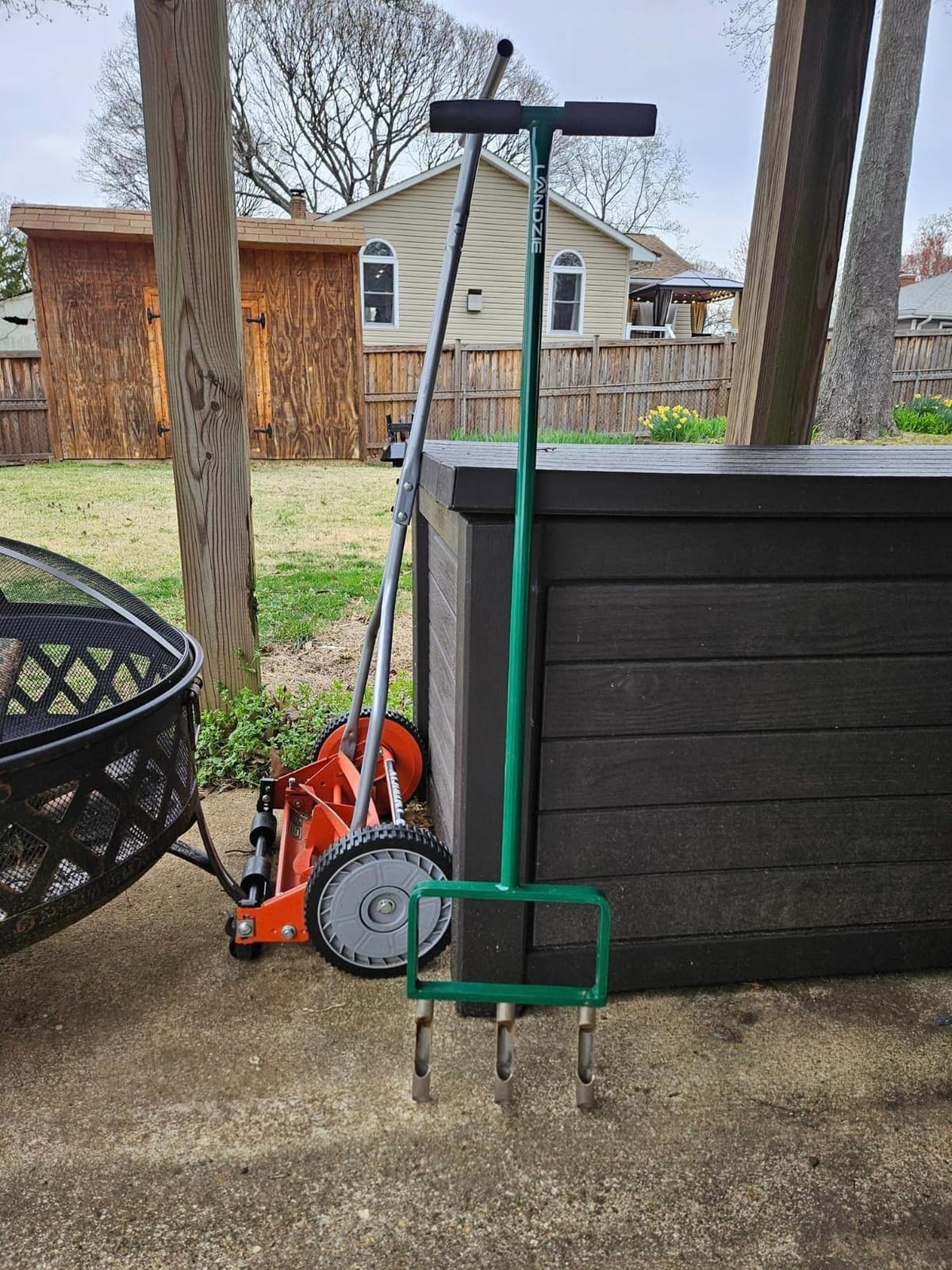
Why hollow tines matter
Owners consistently single out the clog-free design as the difference. Most hollow-tine corers jam the moment the soil is only slightly damp, and this self-ejecting pattern is the fix for that, which is why it ranks above the manual options in hard ground.
The honest limitation
It is still a 42 inch manual tool at 5.6 pounds, so it covers a lot of ground slowly. Reviewers who tried to do an entire lawn with it ended up renting a machine instead, and it needs damp soil to work at all.
5. Walensee 15-Spike Manual Aerator – Best Spike Tool for Small Lawns
Walensee Manual Lawn Aerator Tool with 15 Iron Spikes, Garden Spike Aerator
15 iron spikes
3-row spike layout
34.6 in T-handle
4.49 lb detachable
Pros
- Ranked number one in Manual Lawn Aerators
- 15 spikes across three rows
- Foot pedal and cushioned T-handle
- Steadier than strap-on aerator shoes
- Low cost
Cons
- Not suited to heavy sticky clay or rocky ground
- Spikes work well only in damp soil
This is the highest-volume spike aerator in the category, holding the number one position in Manual Lawn Aerators with 2,808 ratings at a 4.3 average and 62 percent five-star. The reason is simple: it does more per step than a single-row spike tool.
Fifteen spikes in a three-row layout means each push opens fifteen channels instead of five. On a small lawn that is the difference between finishing during a coffee break and finishing after dinner. The spikes measure about 2.8 inches long, driven by a 34.6 inch handle with a cushioned T-handle and a foot pedal for leverage.
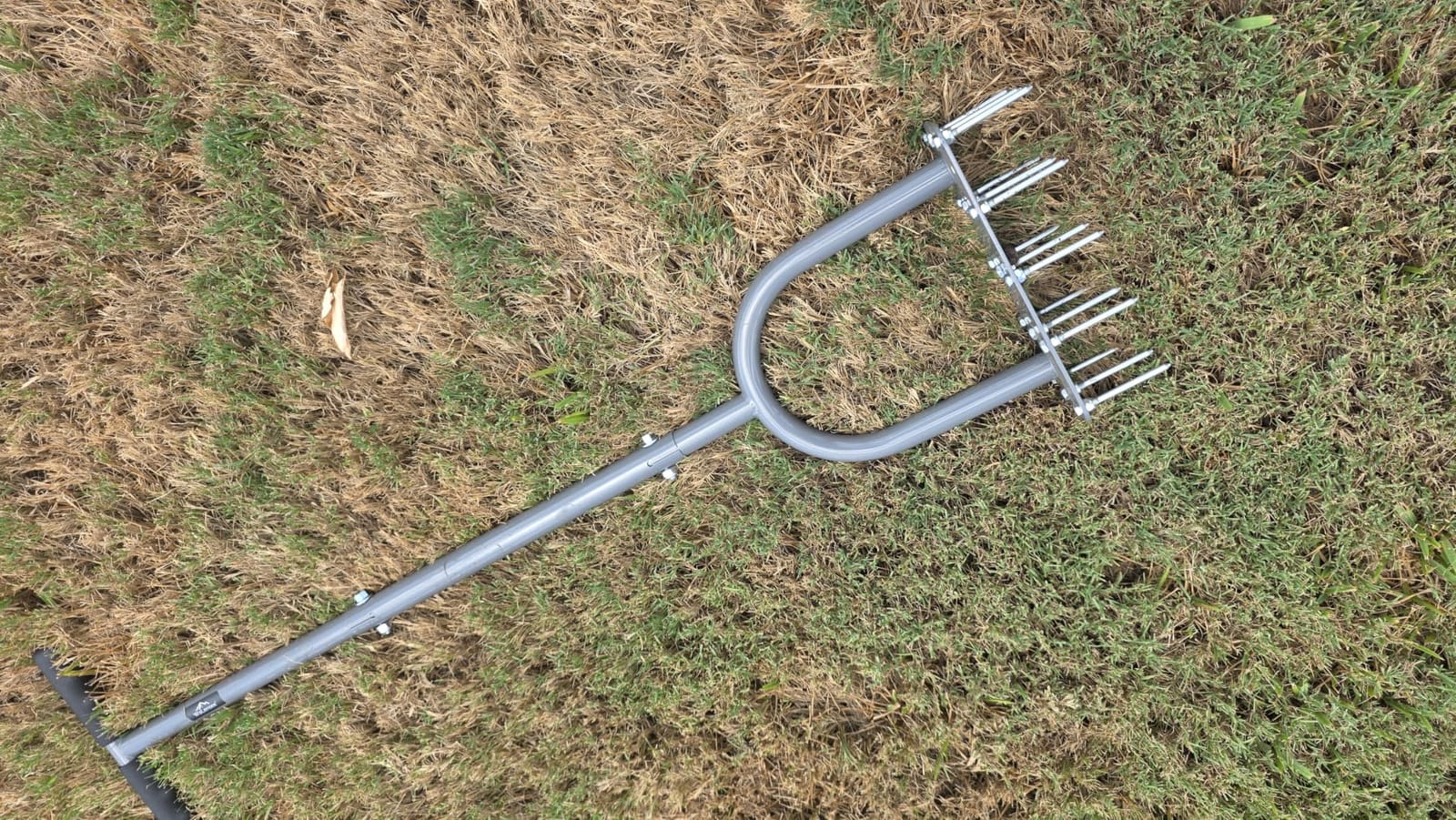
It detaches for assembly, carrying and storage, which solves a real annoyance with long-handled tools. Powder coated heavy-duty iron holds up to daily use, and the whole unit is 4.49 pounds, so it is easy to carry from a garage to a side yard.
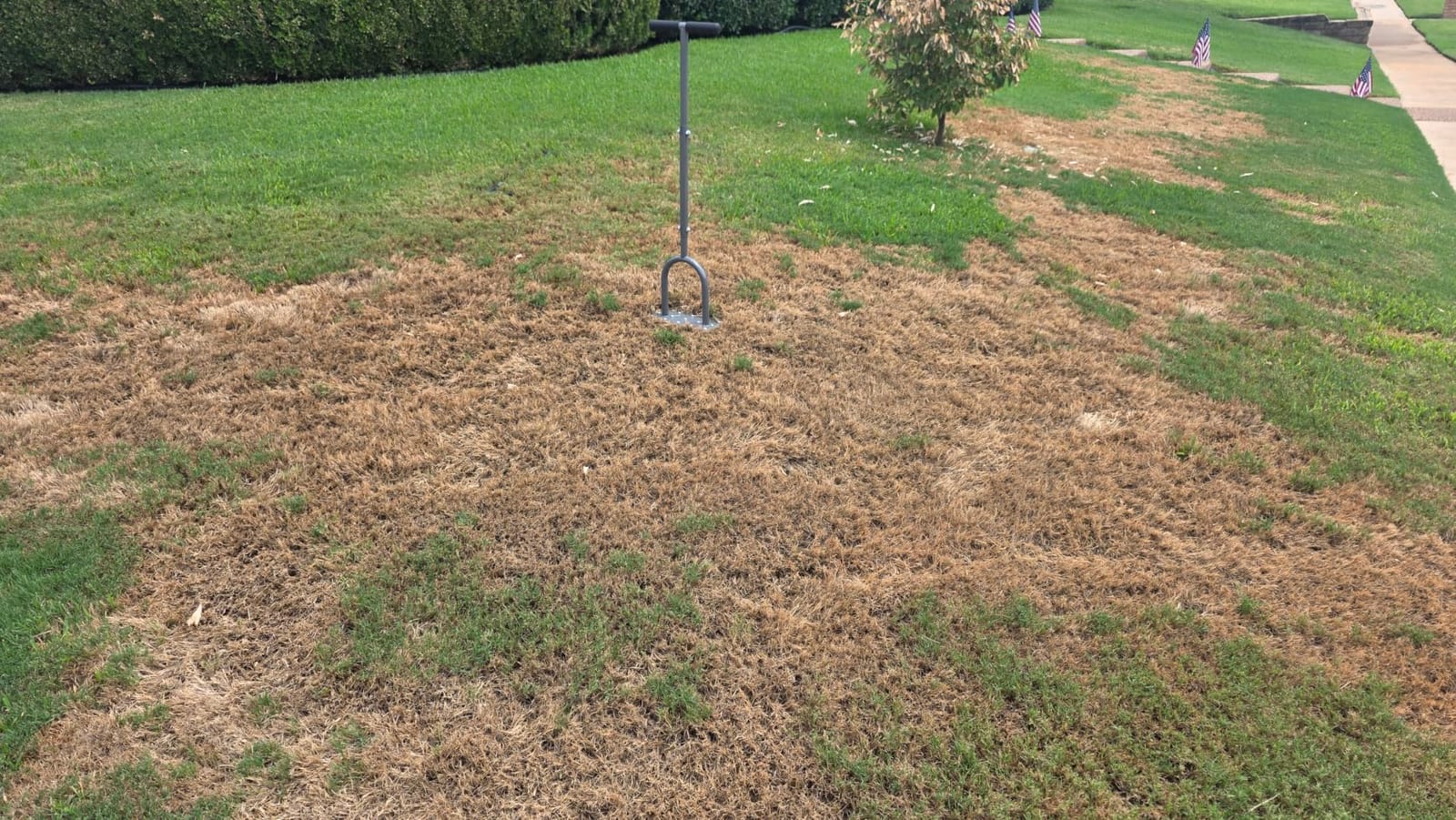
Buyers also note it feels steadier than strap-on aerator shoes, which is worth considering if you have balance concerns or uneven ground. It is the more controlled option of the two, at the cost of coverage speed.
When a spike tool is the right answer
Spiking makes sense for thatch management on an otherwise healthy lawn, for loosening the surface before laying sod, or for treating traffic paths where compaction is shallow. It also works well as a pre-treatment ahead of coring in heavier ground.
What reviewers warn about
Do not buy it for heavy sticky clay, rocky ground or a large property. The spikes are solid, so they compact the sides of the hole, and they need damp soil to penetrate, meaning you may need to water the lawn first.
6. Briliantwerk Lawn Aerator Shoes – Budget Pick for Tight Spots
Briliantwerk Lawn Aerator Shoes | Yard Aerator Lawn Tool | Screed Shoes
2 in and 1.5 in spikes
Adjustable straps
US sizes 5 to 14
2.03 lb pair
Pros
- Lowest cost way to add aeration
- Two spike lengths for two jobs
- Adjustable straps fit a wide size range
- Reaches spots a rolling drum cannot
Cons
- Missing washers in some kits
- Screws can loosen on slopes
- Straps and plate wear with ground contact
Aerator shoes exist because some corners of a yard are simply unreachable with a machine. Garden beds, tight strips along a fence, a narrow side path, the strip under a deck gate. For those, strapping spikes to your boots is the fastest fix available, and this pair holds a 4.2 average from 1,728 ratings.
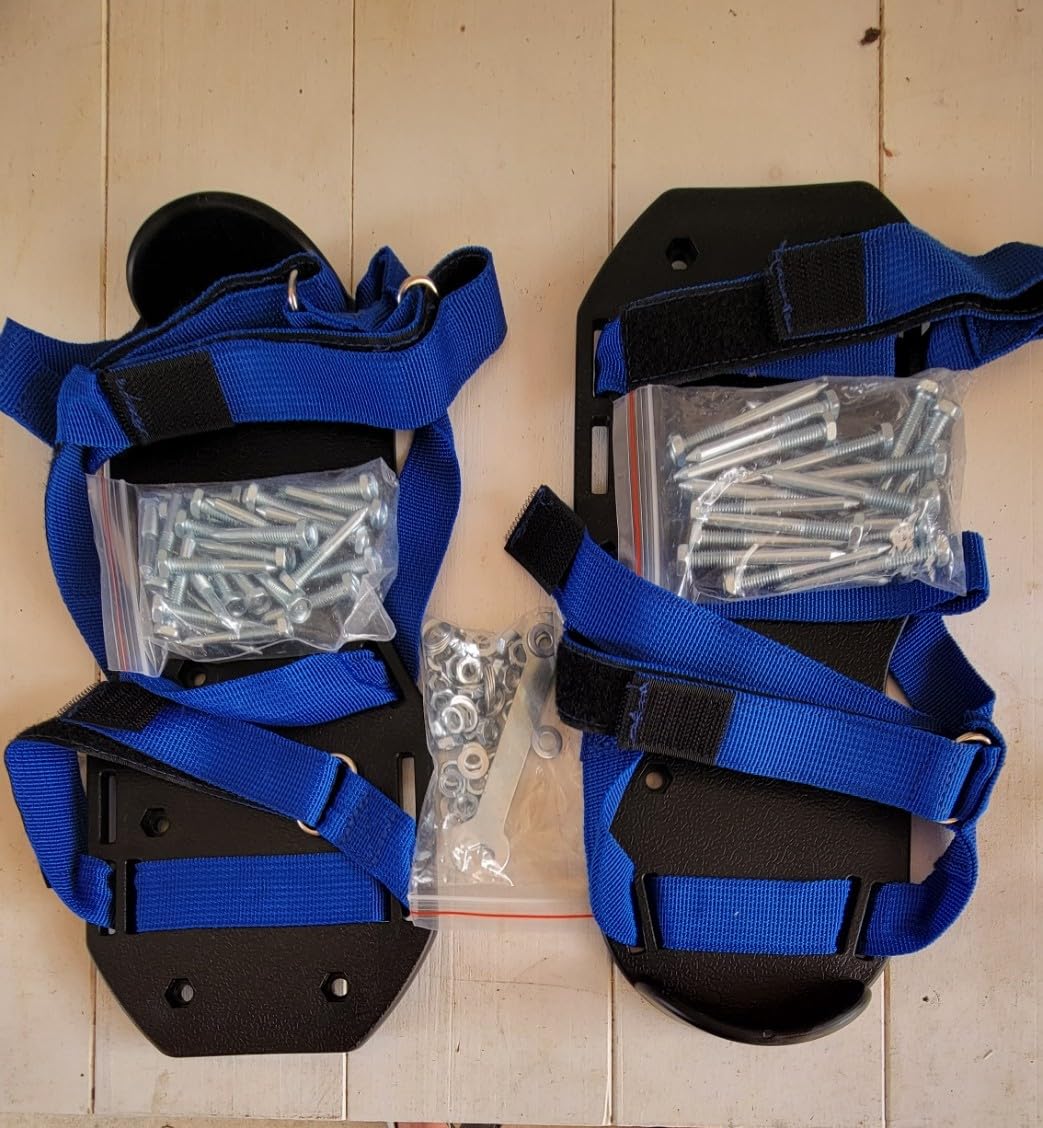
The interesting detail is the dual spike length. The 2 inch spikes handle aeration, while the 1.5 inch spikes suit light screeding, and the same pair also works for evening out epoxy flooring during installation. Hook-and-loop straps adjust to fit US sizes 5 through 14, so one pair covers most adults.
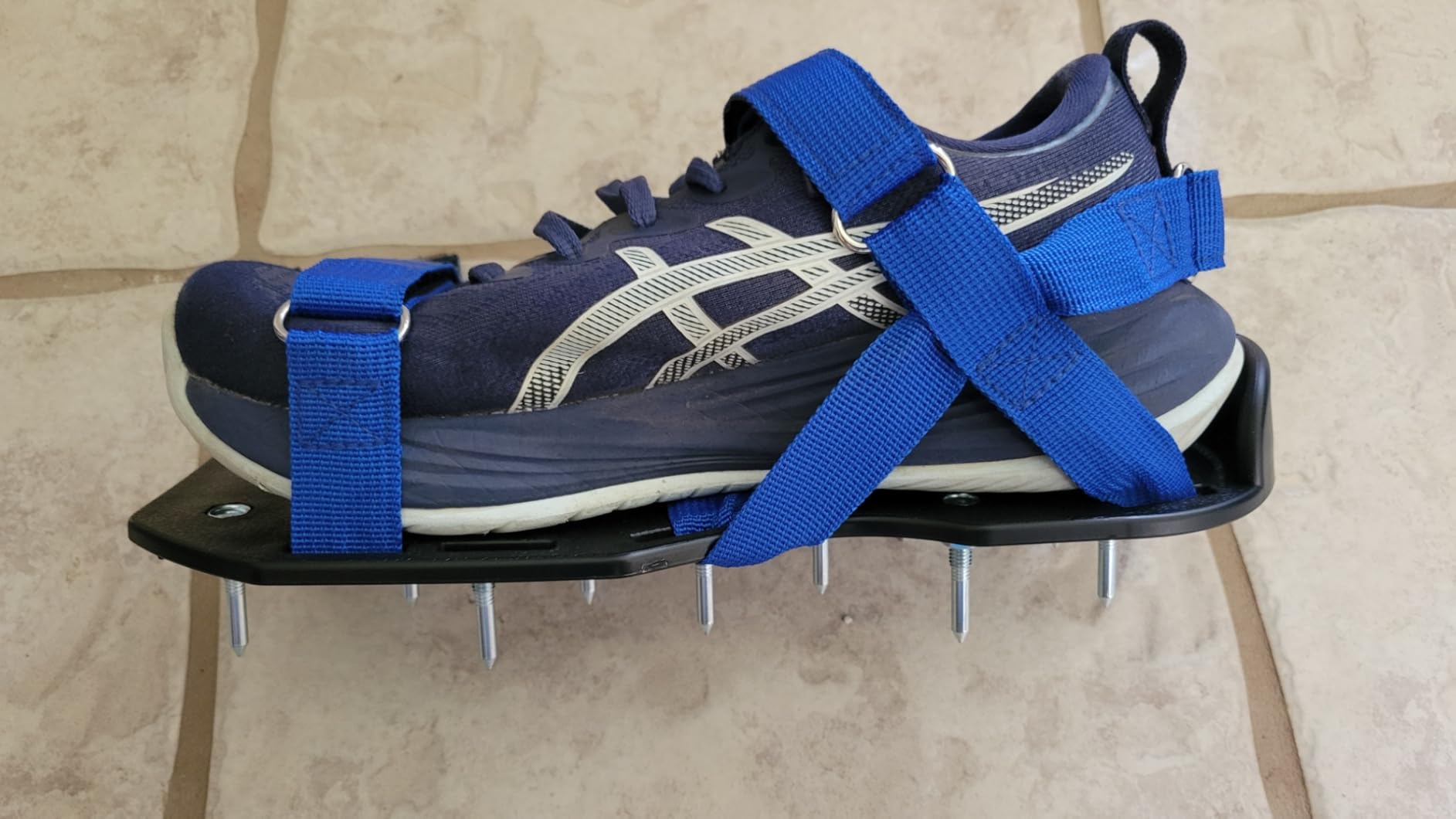
What you give up is control. Your feet are on the ground rather than behind a handle, so you are putting body weight directly into each spike, and your view of what is under your boot is limited. It is a good complement to a bigger tool, not a replacement for one.
There is a real maintenance trade-off here. Contact with the ground wears both the straps and the base plate, and the spike screws can back out under repeated torque, particularly on slopes, which is a genuine trip and ankle risk worth checking on mid-job.
Why the low cost matters
At the bottom of this range the shoes are almost disposable, and that is genuinely useful as a second tool. You can keep a pair for tight spots and leave the main tool for the open lawn, which is how most owners end up using them.
What to check before you start
Some kits arrive missing washers, and a few reviewers mention unsharpened screws, so tighten and test the hardware before you step on grass. Also keep mud and clay from packing under the sole, because that layer will kill penetration and slow you down fast.
7. Simple Lawn Solutions Liquid Soil Loosener – Best Liquid Aeration
Liquid Soil Loosener- Soil Conditioner-Use alone or when Aerating with Mechanical Aerator or Core Aeration- Simple Lawn Solutions- Any Grass Type-Great for Compact Soils, Standing water, Poor Drainage
32 oz covers 32,000 sq ft
Liquid concentrate
Hose-end sprayer
Safe for all grass types
Pros
- Largest review base in the lineup
- Softer soil and less runoff reported
- One bottle covers up to 32000 sq ft
- Works alongside mechanical aeration
- Responsive support
Cons
- Bottle sizing is unclear in the listing
- Expect heavy foaming with a hose-end sprayer
- Some see no change after a season
Liquid aeration is not a mechanical substitute, and anyone who tells you otherwise is selling something. What it does is chemically loosen compacted soil so that a later core aeration pass works deeper, or so standing water drains away. As a stand-alone treatment it works best on mild compaction.
This one carries the largest review base in the whole group at 9,217 ratings, averaging 4.2 with 59 percent five-star. Buyers frequently report softer soil and better water absorption within days of application, which is faster than most people expect from a soil conditioner.
The coverage math is what makes it practical. A 32 ounce bottle treats up to 32,000 square feet, so even a decent suburban lawn is a single application, and it can be used alone or alongside a mechanical or core aerator. It is listed as safe for Bermuda, St. Augustine, Zoysia, Buffalo, Centipede, Bahia, Fescue, Ryegrass and Kentucky Bluegrass.
It is made in the USA by a family owned business, and support draws consistent mention in reviews. If standing water sits in low spots after heavy rain, this is the least disruptive fix, because it addresses drainage chemistry rather than your soil structure.
When liquid beats a machine
It is the answer for lawns you cannot get equipment onto, for clay beds where you want to improve the soil before overseeding, and for a maintenance dose between mechanical passes. Applying it before coring is the sequence that gets the best return.
Where expectations should drop
Some users report no measurable change after a full season, and the reviews are honest about that. The listing also does not state bottle size clearly, which causes real confusion against gallon listings, and you should expect significant foaming with a hose-end sprayer.
8. Covington Liquid Lawn Aerator – Best Liquid Pick for Clay Soil
Covington Liquid Lawn Aerator (32oz) – Soil Conditioner & Softener for Lawns & Gardens – Loosens Clay & Compacted Soil for Better Water & Nutrient Absorption – Liquid Aeration Concentrate, Made in USA
32 fl oz concentrate
Humic acids, amino acids, kelp
Covers 3,500-8,000 sq ft
Available in larger sizes
Pros
- Formula includes humic acids
- amino acids and kelp
- Softer clay within days
- Easy hose-end sprayer application
- Pet and child safe
Cons
- Results take several weeks
- Some buyers see no measurable improvement
- Sprayer dial makes dosing easy to overshoot
This is the liquid option aimed squarely at clay-heavy yards, and the formulation explains why. Humic acids, amino acids and kelp are included to feed beneficial microbes, which is the mechanism that loosens clay over time rather than shocking it with salts.
It rates 4.1 out of 5 from 2,099 ratings, the lowest average among these picks, with 57 percent five-star. Fans report dramatic greening and noticeably softer soil in compacted clay areas within days, and it is made in the USA by a family-owned business with turf management experience.
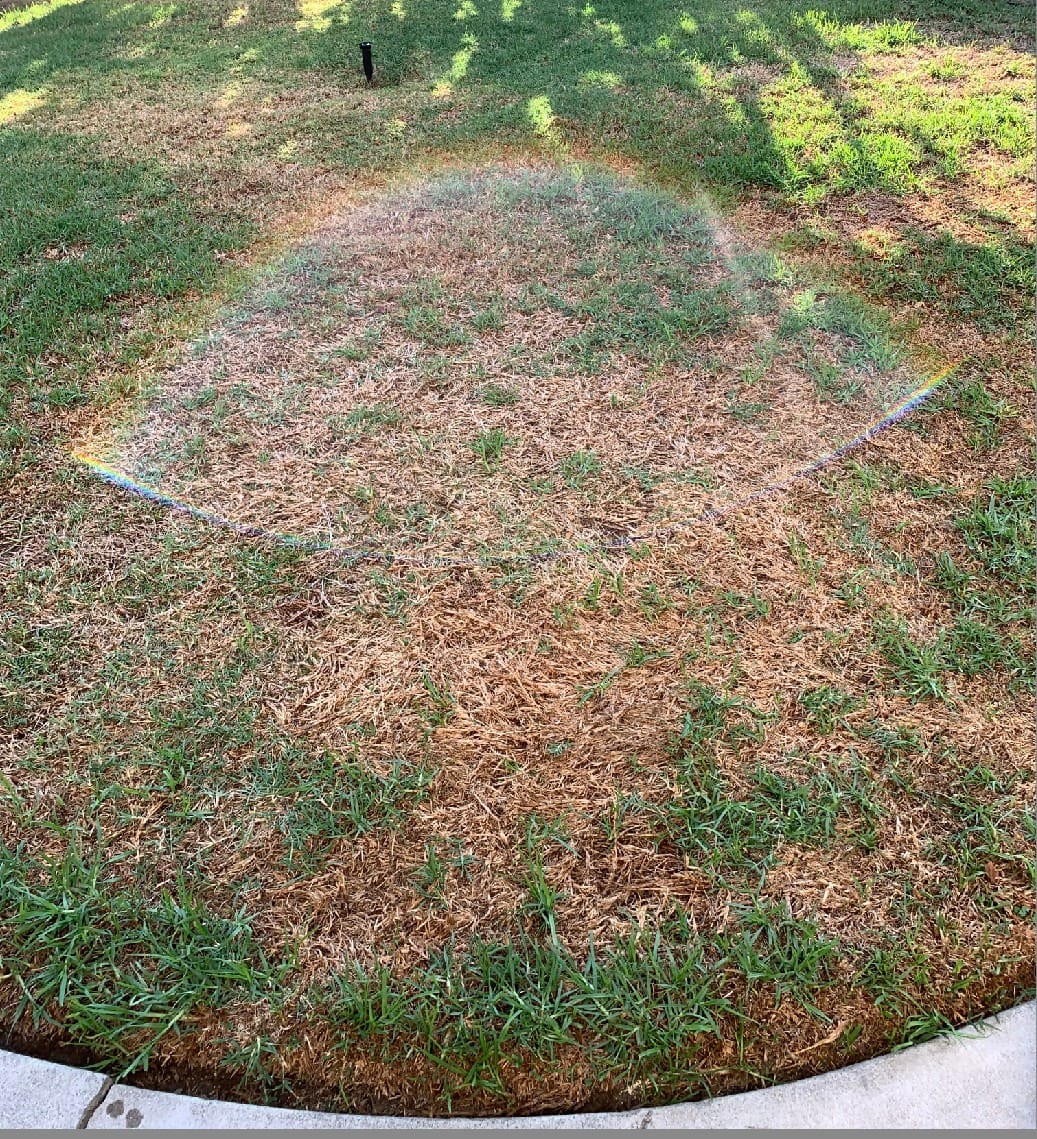
Coverage is listed at 3,500 to 8,000 square feet depending on application rate, with mixing at 2, 4 or 8 ounces per 1,000 square feet. The bottle is 32 fluid ounces, and larger 1 quart, 1 gallon and 2.5 gallon versions exist for bigger properties.
It is safe for pets and children, and it smells like molasses and seaweed when applied. That is a small detail, but it tells you what is in the concentrate and it means you do not need to keep the family off the lawn for long.
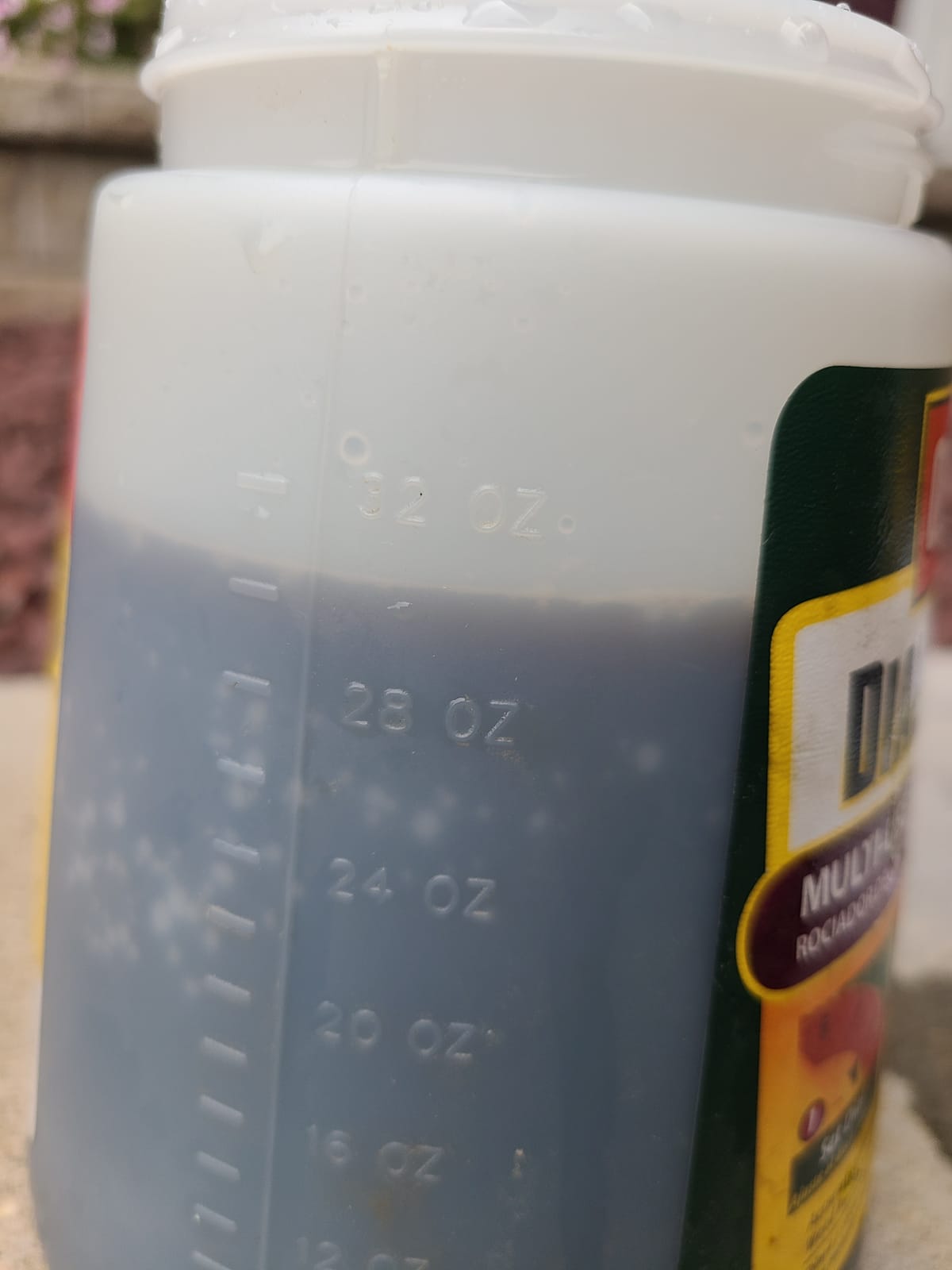
Why clay yards should look here first
Clay is the hardest soil to correct mechanically because spikes smear it and tines bottom out. Conditioning the soil chemically first, then coring, gives you a much better result than coring alone, and reviewers on clay specifically report the soil profile changing.
Be patient with the timeline
Results take several weeks, and some buyers see no measurable improvement at all, which the reviews state plainly. Dosing is also fiddly: the hose-end sprayer dial is easy to overshoot, and customer service issues around discount code redemption come up repeatedly.
9. Jardineer 36 Inch Spike Aerator – Best Pre-Assembled Option
Jardineer Lawn Aerator Tool, Updated 36″ Spike Aerator Lawn Tool with Longer Spikes, Pre-Assembled Manual Grass Aerator for Lawn Aeration, Soil Aerating
12 heat-treated spikes
2.75 in spike length
36 in back-saving height
5.1 lb detachable
Pros
- 12 heat-treated spikes in one pass
- Thick steel foot plate adds force
- 36 in height with rubber grip
- Pre-assembled with wrench included
- Works in clay
- sand and loam
Cons
- Only 2.75 in spikes
- Needs moist soil to be useful
Everything arrives assembled, with a wrench and manual in the box, so there is no build to do before you can use it. It detaches for storage afterward, which solves the long-handled tool problem that annoys most owners between seasons.
It holds a 4.2 average from 547 ratings with 62 percent five-star, and the praise concentrates on the 36 inch back-saving height and the thick powder-coated steel foot plate that bears your full body weight. The rubber grip is what keeps the effort out of your hands and lower back.
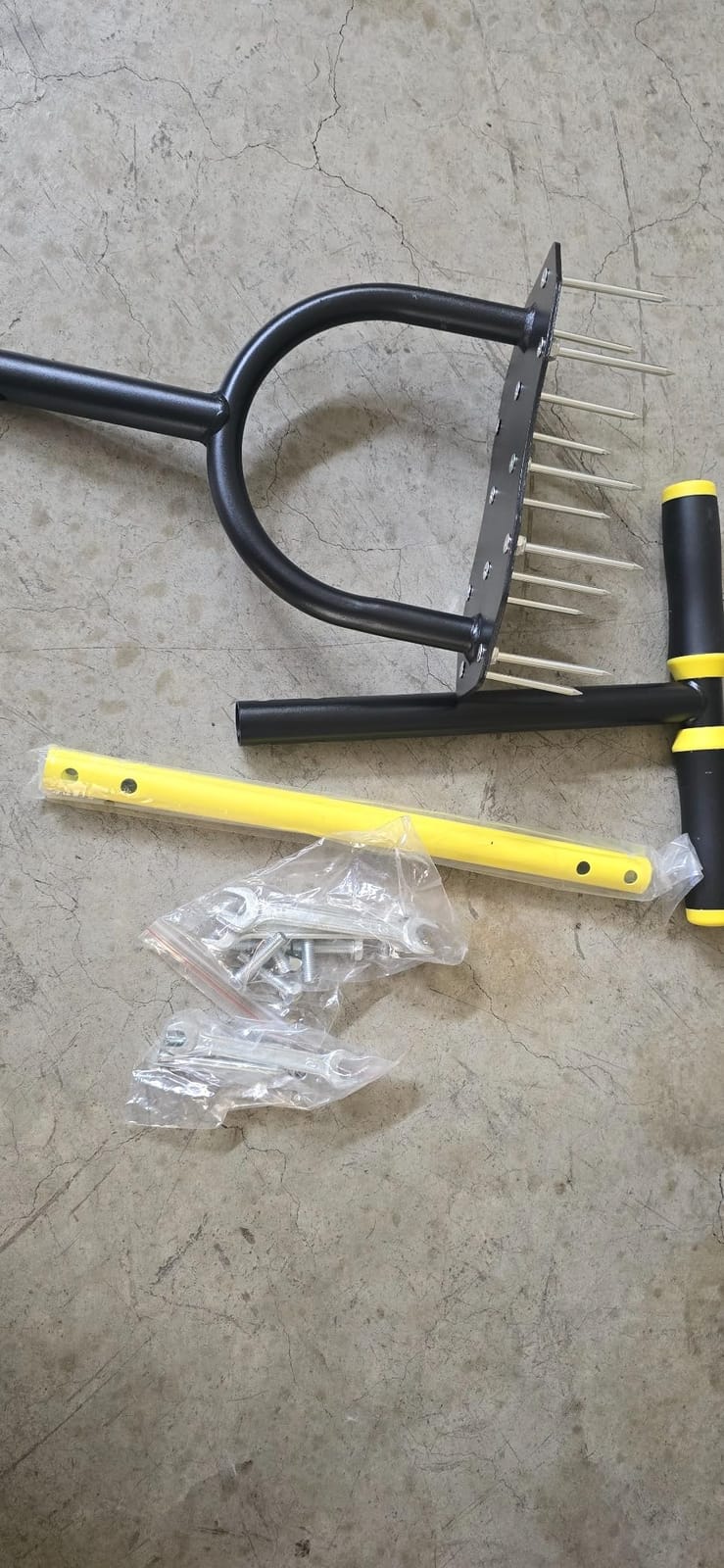
Twelve heat-treated steel spikes give it 2.75 inches of total spike length, and owners confirm it works across clay, sand, loam and already-compacted ground. For a medium lawn or a patio area that needs loosening, the single-row spike layout is enough coverage without the bulk of a three-row head.
Compared with the Walensee, the trade is coverage speed for simplicity. One row of 12 spikes is less work per step, but you get a tool that is lighter to handle, simpler to store and cheaper to replace if it takes a beating in rocky soil.
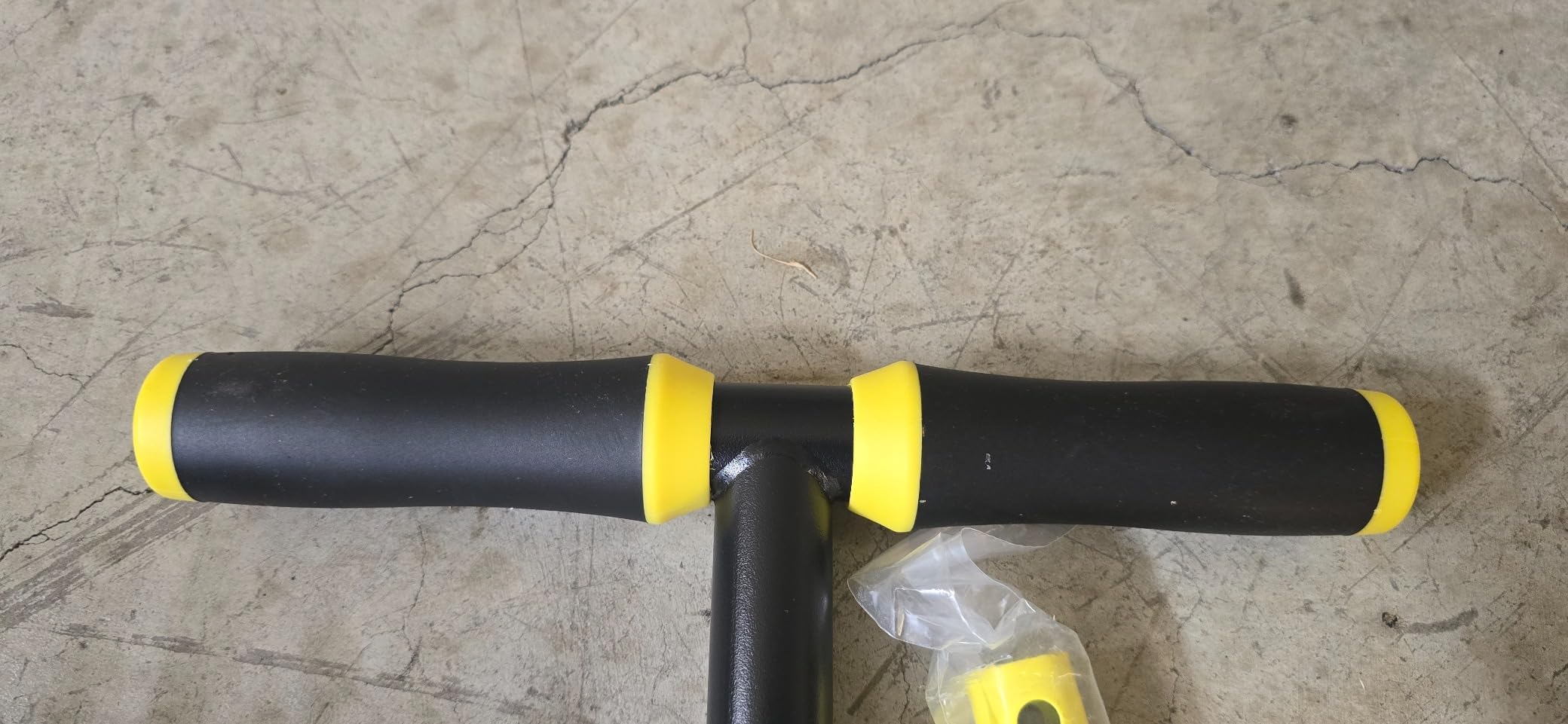
Best for patios, paths and prep work
It is well suited to loosening a garden bed before planting, breaking up a compacted side path, or prepping a patio area for seed. The 36 inch height means you are standing upright rather than bent over, and the detachable design means it lives in a corner rather than a closet.
What limits it
The 2.75 inch spikes are shallower than some competing spike aerators, and that is the main complaint in reviews. It also does nothing useful on dry ground, so watering first is not optional if you want a visible result.
10. Dolibest Lawn Coring Aerator – Best for Collecting Soil Cores
Dolibest Lawn Coring Aerator, Manual Lawn Aerator,4 Stainless Steel Corer Plug Aerator with Soil Core Storage Tray, Pre-Assembled Manual Grass Aerating Tool & Clean Hand Tool, Improving Lawn Health
Four SUS 304 stainless plugs
Stainless core storage tray
Elevated crossbar
Assembles in two minutes
Pros
- Stainless steel plugs resist rust and bending
- Storage tray collects ejected cores
- Crossbar keeps shoes clear of plugs
- Includes a 12 inch hand tool
- Works in stony ground
Cons
- Hollow tines clog in anything but wet soil
- Side ejection is messy on wet lawns
- Small 4-plug head is slow on large areas
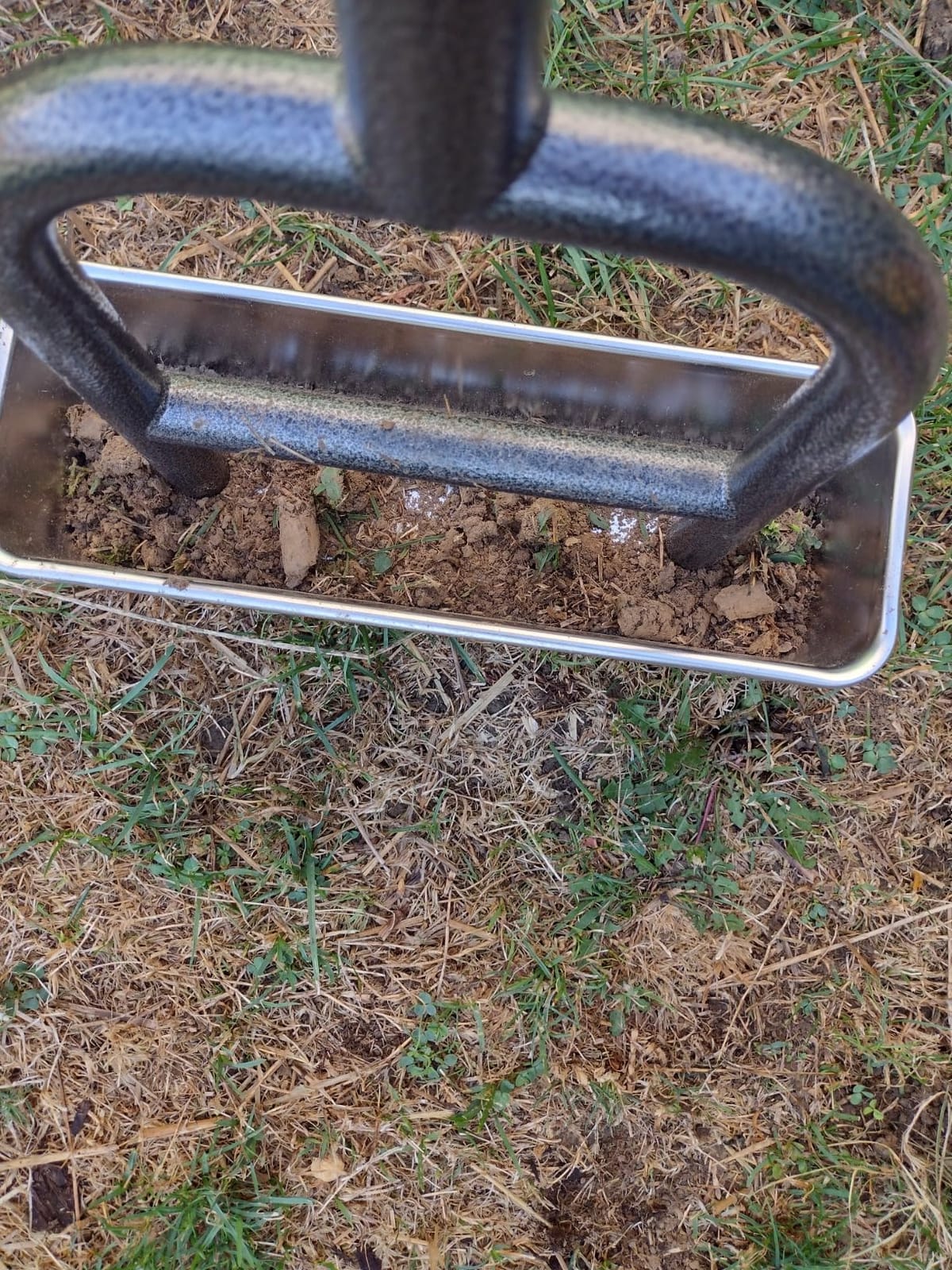
The storage tray is the feature that separates this from other manual corers. Four SUS 304 stainless steel hollow plugs eject their cores into a stainless tray, so instead of scattering plugs across your lawn you have a contained pile to deal with. It rates 4.2 from 276 ratings.
Stainless rather than plated steel is the right call for a tool that sits against wet soil, and buyers report it resists both rust and bending, including in stony ground. Assembly takes about two minutes, and a 12-inch weeding and tool-cleaning hand tool is included for clearing the tines.
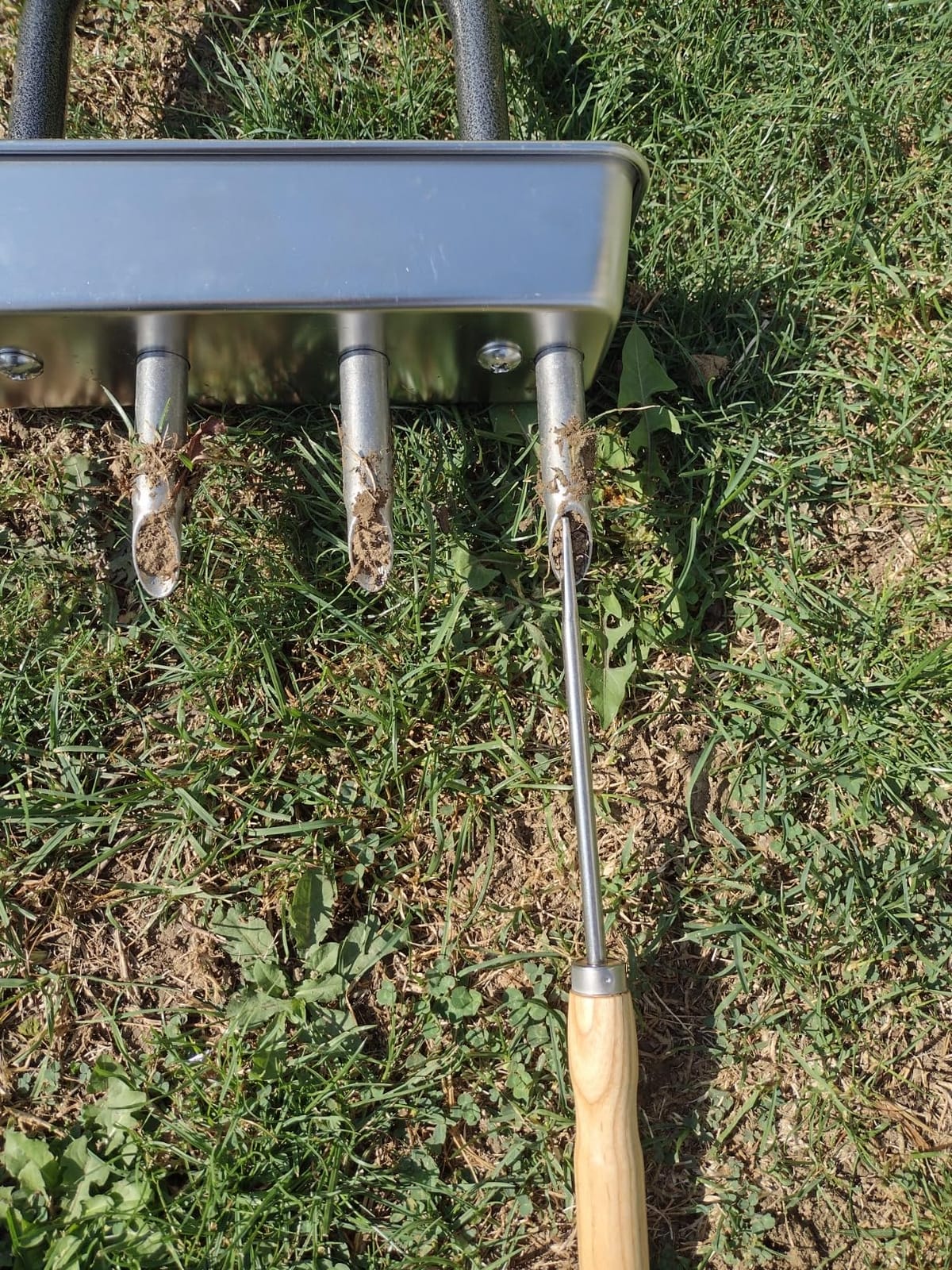
The elevated crossbar is a thoughtful ergonomic fix. It gives you a place to put your foot for leverage while keeping your shoes out of the path where the plugs fly out, which is the main reason side-ejection corers tend to smear soil across the grass.
It is available in three-plug and four-plug versions, with and without the storage tray, so the configuration can match how much lawn you actually have. The powder-coated solid steel rod underneath is the part doing the structural work.
Who the tray is really for
If your plan is to aerate and then overseed, the tray turns cleanup from a raking job into a single dump. It also suits lawns near paving, patios or walkways where you would rather not drag soil across hardscape, and the contained cores are easy to compost.
The clogging catch
Hollow tines need wet soil, and this is the biggest warning in the reviews. In anything drier than a well-watered lawn, plugs pack the tubes and need clearing out, and the side-ejection style is messy on wet lawns. It is a small-area tool at heart.
How to Aerate Your Lawn Without Mistakes
Most disappointing aeration results come down to timing and moisture, not the tool. Work through these steps in order and almost any of the ten picks above will perform well.
Water the lawn the day before. The soil should be damp enough to part cleanly and for plugs to hold their shape, not saturated. Watering a day ahead is the single most common fix for a corer that seems not to be working.
Mow first, and do not mow too short. Mowing removes bulk that would clog the tines. Leave the grass at a normal height rather than scalping it, because short crowns plus open holes is a bad combination for recovery.
Set the weight according to soil. Start light on loam and add ballast gradually. On clay, load the tray fully and work while the ground is just damp. If the plugs are coming up crumbly, you are going too deep; if they are not appearing at all, you need more weight or wetter soil.
Overlap passes. Standard spacing is around 3 inches, so a 40 inch aerator only overlaps by about 1 inch on the next pass. Match your pattern to the same direction each time rather than criss-crossing, and treat high-traffic areas twice.
Leave the plugs and mow over them. The expelled cores are decomposed organic matter returning to the surface, so you do not need to remove them. Let them dry for a few days, then mow them back in. Rake only if you are overseeding, where breaking them up helps seed reach the soil.
Overseed promptly. The open holes created by core aeration are the best seed-to-soil contact you will get all year. Water the area consistently until the new grass establishes, and skip a heavy fertilizer application for a couple of weeks so the seed is not competing with a salt-heavy topdressing.
If the tines clog, stop and reassess. Clogging means the soil is too wet, and continuing just smears the ground. Break for a day and come back. If penetration is shallow, the answer is weight or moisture, almost never a different machine.
Buying Guide: Lawn Size, Soil Type and Weight Trays
How big is your lawn? Under about 2,000 square feet, a manual corer finishes in an afternoon and there is no reason to own anything larger. Between roughly 2,000 and 8,000 square feet, a spike or rolling manual tool is realistic if you are willing to work at it. Above that, a tow-behind is the only category that respects your time, and it presumes you own a tractor or zero-turn.
What is your soil like? Clay is the hardest case, and it is where hollow tines and liquid conditioners earn their place. Spike aerators actively harm clay by compacting the hole walls, so avoid them there except as a pre-treatment. Sandy soil needs less weight because it gives up easily, and loam sits in the middle where almost any coring tool performs well.
How much weight do you need? The weight tray is the top spec buyers cite, and the reason is simple: horsepower does not help if the machine is light. Loam generally responds to modest ballast, while clay wants a full tray. The Agri-Fab takes 175 lbs and the Brinly 150 lbs, which covers the heavy end of what a lawn tractor can usefully pull.
Do you want to remove soil or not? Core aerators remove plugs, which means better results and a cleanup step. Spike aerators and aerator shoes just puncture, which means less mess and less benefit. If your problem is compaction, you want cores. If your problem is surface thatch on otherwise healthy grass, spiking is enough.
What is your storage situation? This is the quiet ownership complaint. Tow-behind units are 63 to 94 pounds and need real floor space, and they can be awkward to lift into a truck bed. Long-handled manual tools are much easier, and the Walensee and Jardineer both detach for storage. The Briliantwerk shoes win outright here since they hang on a hook.
How often will you use it? Most lawns need aeration once or twice a year, in spring and fall for cool-season grass and in early summer for warm-season grass. If you are only doing it once every few seasons, renting is the more sensible route, and one r/lawncare owner framed it well: just rent the big-box aerator once every few seasons rather than buying one. We have covered riding lawn mowers and lawn tractors if the tow-behind question comes down to which machine pulls it.
Is your thatch a real problem? If you have more than half an inch of thatch, a spike tool alone will not clear it, and that is what a dethatcher is for. Where you want both, the liquid options listed here pair naturally with a coring pass, and lawn sweepers are the right tool for clearing loose debris before you aerate.
Do you plan to overseed? Aerate and seed in the same visit, and the coring pass you make first does the heavy lifting by opening thousands of seed pockets. Pick hollow tines over solid spikes, and use the storage tray model if you want the cores contained. Our guide to self-propelled lawn mowers covers cutting height, which is the other half of successful overseeding.
Frequently Asked Questions
Which is better, a spike or plug lawn aerator?
A plug or core aerator is better for compaction because it removes soil, opens air gaps and relieves density, while a spike aerator only pushes a narrow hole and mainly disrupts surface thatch. Spike aerators are lighter, faster and leave no cleanup, which makes them useful for thatch management, for loosening a clay yard before coring, and for spot work. On heavy sticky clay a solid spike can smear the pore structure, so hollow tines are the better choice there.
What month should you aerate your lawn?
For cool-season grass such as fescue, Kentucky Bluegrass and ryegrass, aerate in early spring or early fall, when the grass is actively growing and the soil is moist but not waterlogged. For warm-season grass such as Bermuda, Zoysia and St. Augustine, the best window is late spring to early summer. Always water the lawn a day beforehand so plugs form cleanly, and avoid the hottest part of summer, when added stress does more harm than good.
Do manual lawn core aerators work?
Yes, for small lawns, spot treatments and new sod prep, which is exactly where manual corers are strongest. A model with a foot bar and a long handle lets you drive force through body weight rather than arm strength, and hollow tines pull proper cores. The limits are real though: manual tools weigh very little, so they struggle in hard compacted ground, they are slow across a full lawn, and they need damp soil. For several thousand square feet or more, a rented or towed machine is faster.
Are rolling lawn aerators any good?
Rolling aerators with a spiked drum are good at thatch disruption and surface loosening, and the fillable drum adds useful weight without a tractor. They are much less effective on genuine soil compaction, because a solid spike just punctures and compresses the hole walls rather than removing soil. They suit a healthy lawn with surface thatch, a small to medium yard, and pre-treatment ahead of coring, but they are not a substitute for a core aerator on hard clay.
How often should you aerate your lawn?
Most lawns benefit from aeration once or twice a year, and heavily trafficked or clay yards may need more. Signs you are due include water pooling or running off after rain, thin patchy growth, thatch above half an inch, and a spongy feel underfoot. If the soil already pulls apart easily in your hand and grass is dense and green, you can skip the pass. Overseeding is the other common reason to aerate, since the open holes give seed the contact it needs.
Do you leave plugs on the lawn after aerating?
Yes, leave them. The expelled plugs are decomposed organic matter that will break down and return nutrients to the root zone, which is the entire point of core aeration. Let them dry for a few days, then mow over them to knock them back into the turf. Rake or break them up only when you are overseeding, since scattering loose seed needs open soil rather than a mat of cores sitting on top.
Best Lawn Aerators: The Final Verdict for 2026
The Agri-Fab 48 In Tow Behind Plug Aerator is the pick we would buy, because 32 galvanized knives and a 175 lb tray deliver the deepest, fastest core aeration on a large property, and its 2,471 ratings back up the durability claim. If you want the highest-rated option and already pull everything with a tractor, the Brinly 40 Inch at 4.4 stars is the more refined machine.
For everyone else, match the tool to the lawn. Small lawns and bare patches take the Yard Butler manual corer or the Walensee spike tool. Rocky ground favours the Landzie hollow tines. Tight corners are the Briliantwerk shoes’ job. Clay yards benefit most from the liquid conditioners, used before a coring pass. And the Jardineer and Dolibest cover the pre-assembled and plug-collection ends of the manual market.
Whichever one you choose, water the lawn a day ahead, start light on the weight tray, and leave the plugs where they fall. That process is worth more than any model difference. Before you buy, tell yourself how big your lawn is, what your soil drains like, and whether you already own a tractor, and the right category picks itself.