
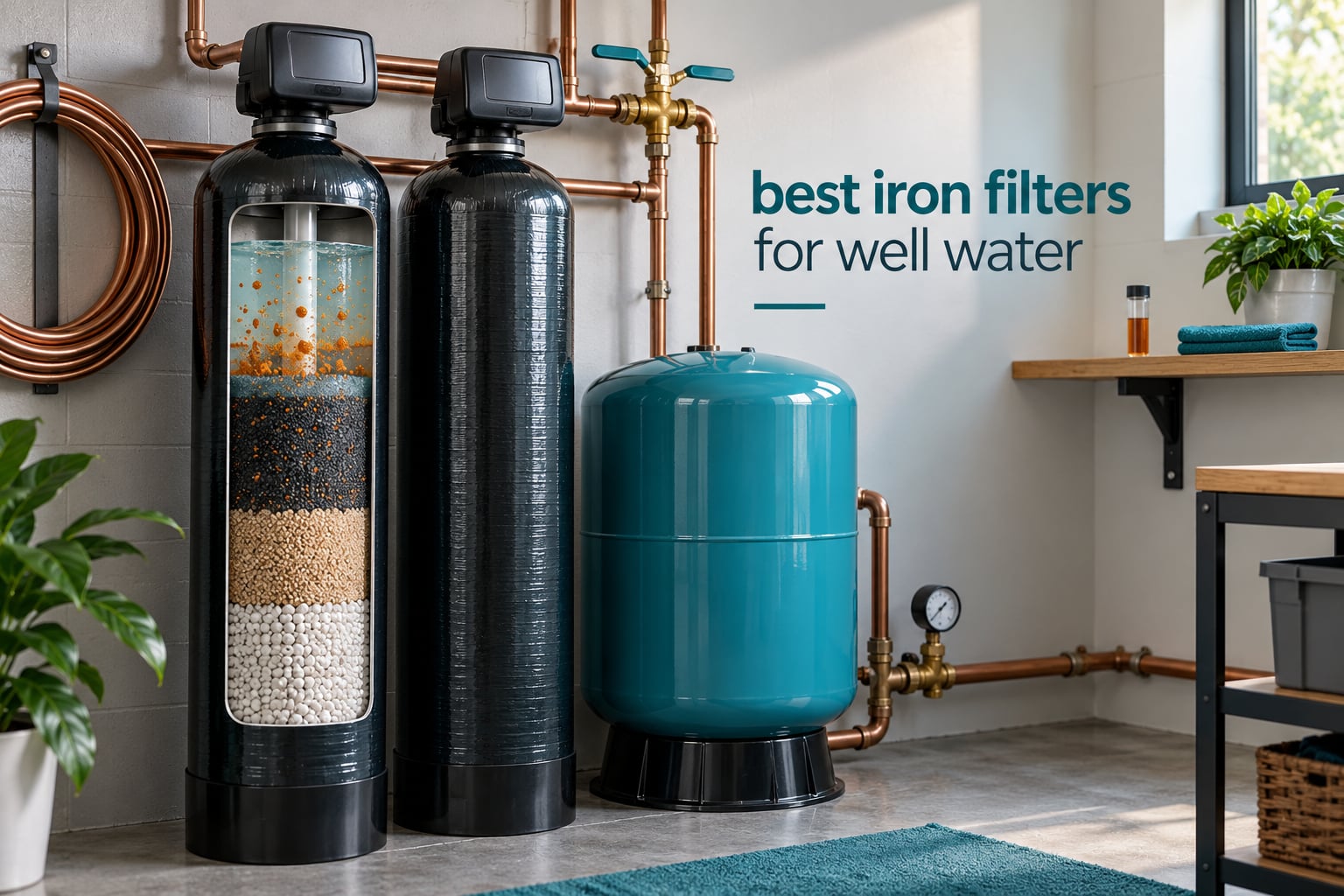
Rust-colored water running from the tap is one of those problems that looks cosmetic right up until it is not. Iron above roughly 0.3 ppm stains toilets, tubs and grout orange, gives drinking water a metallic bite, and builds rust scale inside supply lines, water heaters and appliance valves. The fix is not one product but a family of them, and the wrong pick is the most expensive mistake a well owner can make.
That is why the first thing to understand about the best iron filters for well water is that the type of iron decides the filter. Dissolved ferrous iron, red ferric iron, organically complex iron and iron bacteria each behave differently in a media tank, and a cartridge that flatters a low-iron well will simply clog and disappoint you on a 6 ppm well. Test first, then size to your pump.
We spent weeks reading spec sheets, customer review histories and installer threads on r/WaterTreatment before ranking the 12 systems below, and we picked them to span the whole range: cheap inline cartridge units for low-iron wells, mid-size multi-stage manifolds for typical rural wells, and backwashing air injection systems for wells running heavy iron plus sulfur odor. We do not sell any of these filters, and none of the brands paid for placement here. Where a rating is high but the reviews tell a different story, we say so.
One quick note before the picks: if your well pump or well casing is the problem rather than the treatment head, start with our shallow well pump guide instead, because no filter fixes a well that is pulling sediment. And if you are chasing rust stains on tools and wheels rather than in your plumbing, head to our iron remover guide for wheels instead, because that is a surface-finishing problem rather than a water problem.
Table of Contents
Top 3 Best Iron Filters for Well Water Right Now (October 2026)

All 12 Iron Filters Compared in 2026
What Actually Removes Iron From Well Water
Iron filters do not strip iron out chemically. They oxidize it first. Water carrying dissolved ferrous iron is pushed through a media tank where injected air, or an oxidizing media such as Birm, Filox, Katalox, Pro-OX or catalytic carbon, converts the dissolved particles into solid rust. Those solids lodge in the bed, and a control valve backwashes them to a drain on a timer or on measured flow. Backwashing is not optional on well water, because there is no downstream softener brine to rinse the bed.
There are four iron types worth learning to name, because they point to different hardware. Ferrous (clear-water) iron is dissolved and invisible until the water hits air, which is why a clear glass of well water can still stain the sink. Ferric (red-water) iron is already an orange solid suspended in the water and usually needs a pre-filter to keep it from blinding a media bed. Iron bacteria are not iron at all but a slime-producing organism that feeds on dissolved iron, and it leaves rust-colored streaks in toilets and a slime that defeats ordinary oxidation filters. Organically complex iron is iron bound to organic matter, which resists oxidation and needs stronger media such as Filox or Katalox.
Where your water lands on this scale decides the pick:
Under 0.3 ppm: No treatment needed. This is the EPA secondary standard for taste, staining and color.
0.3 to 4 ppm: The range every cartridge filter on this list is built for. Expect staining to disappear within days.
4 to 8 ppm: Cartridge systems will work but clog fast, often every few weeks. A backwashing oxidizing filter is the sensible upgrade.
Above 8 ppm: You need an air injection oxidation system or a media tank with a control valve. Cartridge filters are a treadmill here.
One more honest note. A water softener is not an iron filter. Ferrous iron foules ion exchange resin, and owners on r/WaterTreatment repeatedly describe installing a softener on an untested well and then finding rust sludge packed into the resin a year later. If you have iron, filter it ahead of the softener, always.
1. iSpring WGB21BM 2-Stage Whole House Filter
iSpring WGB21BM 2-Stage Whole House Water Filtration System, 10” x 4.5” Carbon Block and Iron & Manganese Reducing Filters, 1″ Ports
Iron to 3.0 ppm
Manganese to 1.0 ppm
15 GPM
50,000 gallons
1 NPT
Pros
- Huge review base with consistent 4.6 rating
- Pre-assembled bracket makes install straightforward
- 15 GPM with minimal pressure impact
- Handles chlorine odor and VOCs alongside iron
Cons
- NPT fittings need careful thread tape sealing
- Cartridge threads stop short of fully seating
- Replacement cartridges cost more than budget rivals
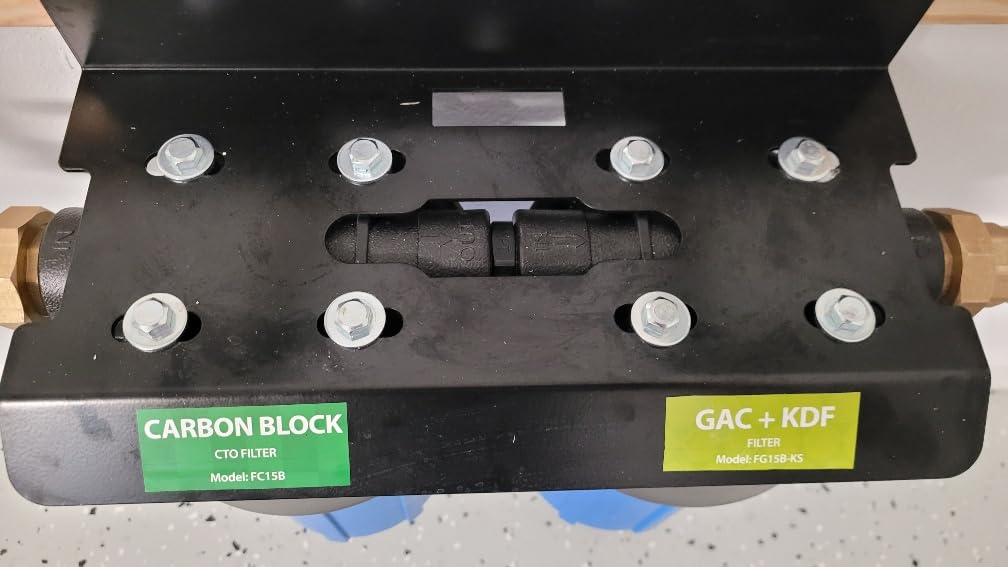
The WGB21BM is the one we kept coming back to. It pairs a 10-inch carbon block with an FM15B iron and manganese reducing cartridge, both in metal housings on a pre-assembled bracket, and the staged layout handled the sediment load that would otherwise take a single-housing unit offline.
With 4,270 reviews averaging 4.6 stars, this has the largest review base of anything we ranked, and that matters when you are trusting a stranger’s plumbing advice. Owners report a big drop in brown staining, chlorine smell and sediment, and the ratings distribution is unusually clean with 81 percent at five stars. Support gets called out repeatedly for troubleshooting leaks and sending replacement parts, which matters when you are elbows-deep in a mechanical room.
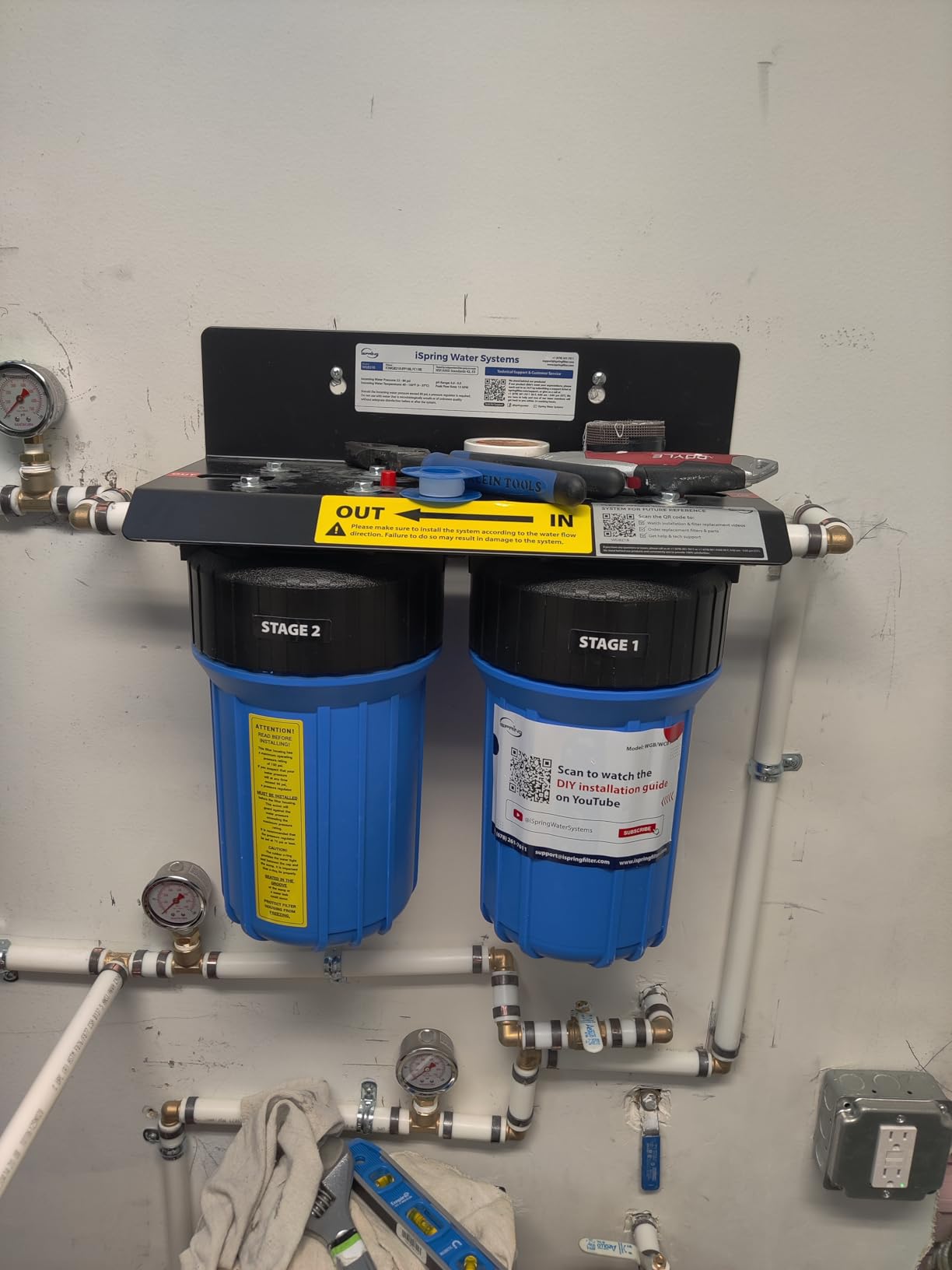
Flow is the quiet strength here. Fifteen gallons per minute through 1-inch NPT ports means it will not choke a busy household or a well pump that pushes more than a typical shower-plus-washer load. The housings are genuinely beefy, and the clear pressure behavior is one of the reasons the system keeps its rating.
What to check before you buy
Confirm your iron is under about 3 ppm and that your well pressure sits in the 25 to 80 psi band. Above 3 ppm this cartridge gives up, and no amount of housing quality changes that. Also measure your line size, because the 1-inch NPT ports will not directly suit a 3/4-inch line without reducers.
How it handles the awkward installs
The recurring complaint is fitting, not filtration. Reviewers note that cartridge threads stop short of full seating, and the manual warns against over-tightening while small leaks may actually need more torque than you expect. Budget an extra roll of PTFE tape and a little silicone grease, and budget twenty minutes.
Replacement cartridges are not the cheapest in their class, which is the running cost to plan for. The stages are widely standard sized though, which means you can eventually substitute equivalent 10-inch cartridges if you shop around.
2. Express Water 3-Stage Iron and Manganese System
Express Water Whole House Water Filter System, Iron & Manganese, 3-Stage
17 GPM
100,000 gallon rating
1 inch connections
20-80 psi
Stainless frame
Pros
- 17 GPM flow gives more headroom than other cartridge manifolds
- Pressure release buttons and gauges on each housing
- NSF certified cartridges
- Free-standing stainless frame does not need wall mounting
Cons
- Bulky and heavy at 57 pounds
- Ongoing cartridge costs add up
- Does not reduce TDS
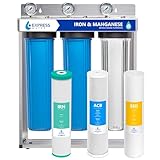
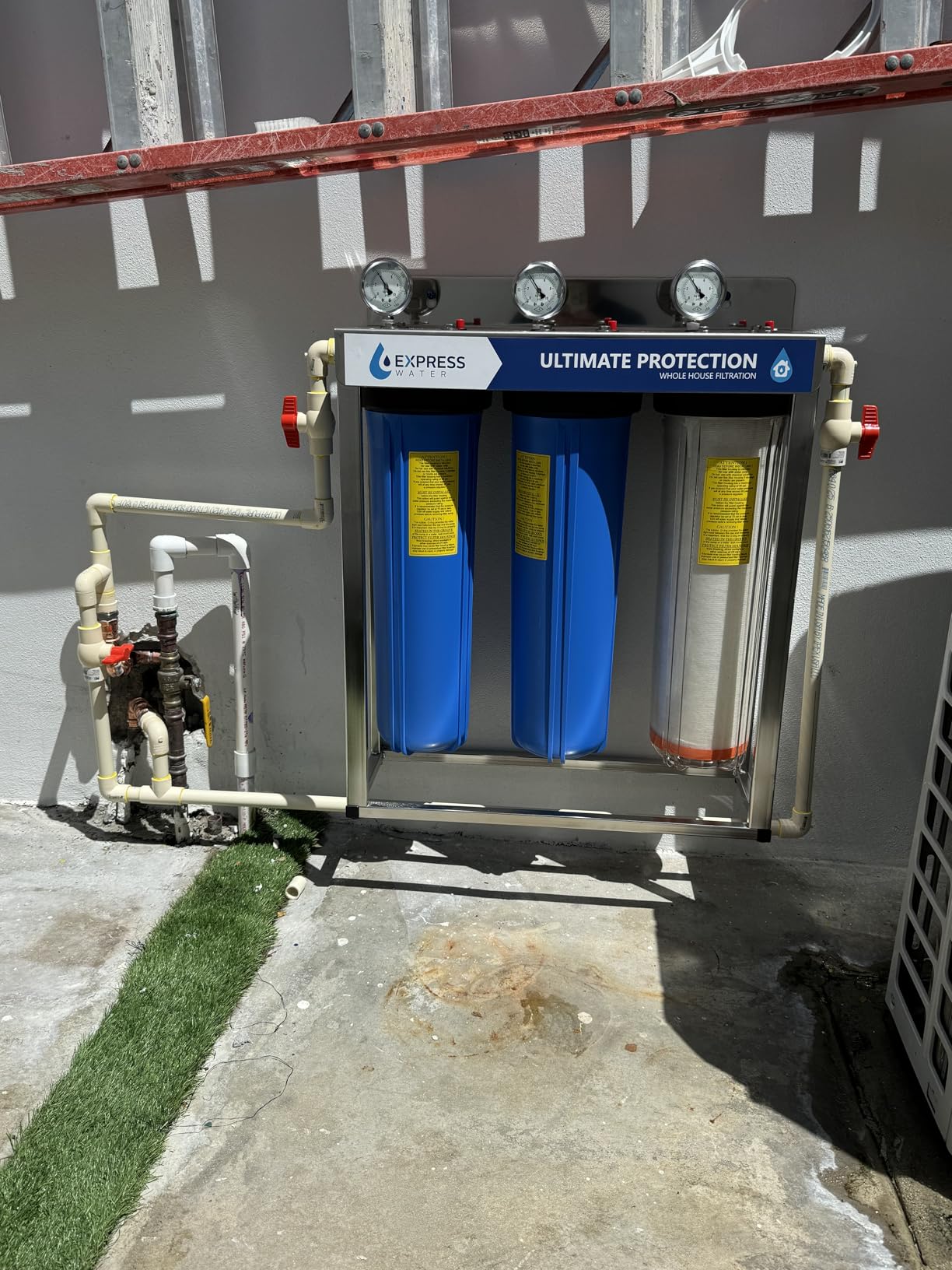
This three-stage unit targets iron and manganese by name rather than treating iron as an accessory, which makes it the most deliberate design in the roundup. Each housing carries a pressure release button and a gauge, so you can see pressure drop developing instead of discovering it when the water starts staining again.
Seventeen GPM is more flow capacity than any other cartridge manifold here, and that headroom is what makes it attractive for a household that runs two full bathrooms plus a lawn irrigation line off the same well pump. The stainless steel bracket and free-standing frame also mean it installs where a wall-hung assembly would not fit, such as a crawlspace or a utility room with odd framing.
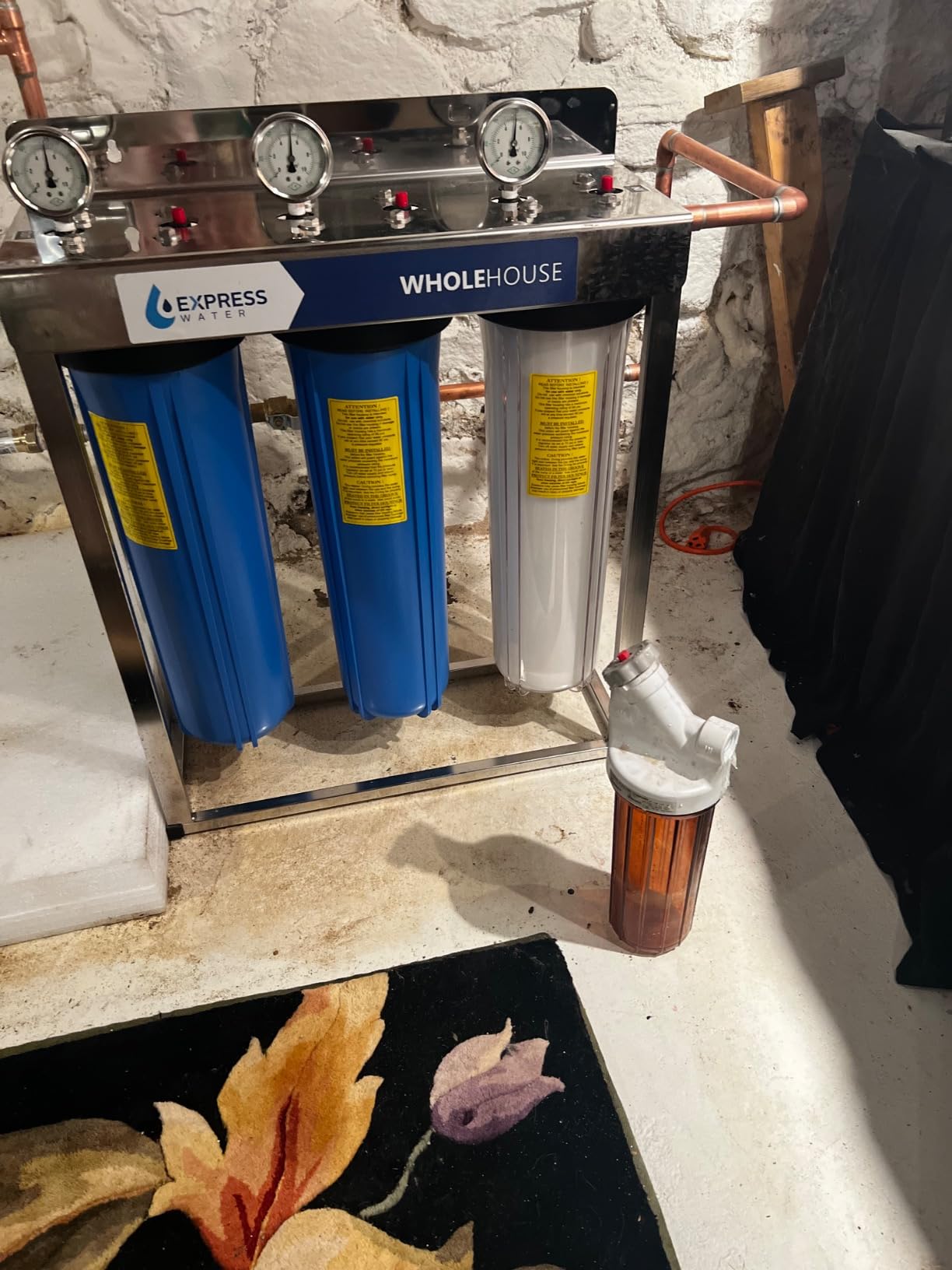
With 2,705 reviews at 4.5 stars, the feedback pattern is consistent: owners like the build quality, appreciate the gauges, and see staining, taste and odor improve within days. The manufacturer recommends installing it ahead of a water softener, which is the correct placement for iron removal and the single best habit to keep.
Where it fits your household
This is the pick for a family of four or five on a rural well with moderate iron in the 0.3 to 3 ppm band who wants visible, checkable system status. The 100,000 gallon rating and the six-to-twelve-month cartridge interval mean most households will change cartridges once or twice a year depending on iron load.
What you give up
Size and weight are the real costs. At 57 pounds and nearly 30 inches tall, this is a heavy unit in this group, and the two-person cottage owner gets more system than they need. None of the cartridges reduce TDS either, so if your water is high in dissolved solids you still need a separate stage for that.
3. iSpring WGB32BM 3-Stage Whole House Filter

iSpring WGB32BM Iron, Manganese Whole House Water Filter System
Iron to 3.0 ppm
Manganese to 1.0 ppm
15 GPM
100,000 gallons
25-80 psi
Pros
- Sediment pre-stage protects downstream softener and RO
- Catalytic media rated to last up to 3x longer than greensand
- Large 20-inch cartridges mean fewer changes
- Responsive technical support
Cons
- Heavy and awkward housings during changes
- Fitting and thread seal leaks are the common complaint
- No built-in drain ports on the housings
The WGB32BM adds a dedicated five-micron polypropylene sediment stage ahead of the carbon block and the iron cartridge, and that ordering is the point. On wells that carry sand or grit, that first stage is what keeps the iron cartridge from blinding in month two.
Iron reduction is specified up to 3.0 ppm and manganese up to 1.0 ppm, with a 100,000 gallon rating and 15 GPM throughput. The catalytic media is claimed to outlast greensand by up to three times, which matters because media replacement is the hidden cost in any of these systems.
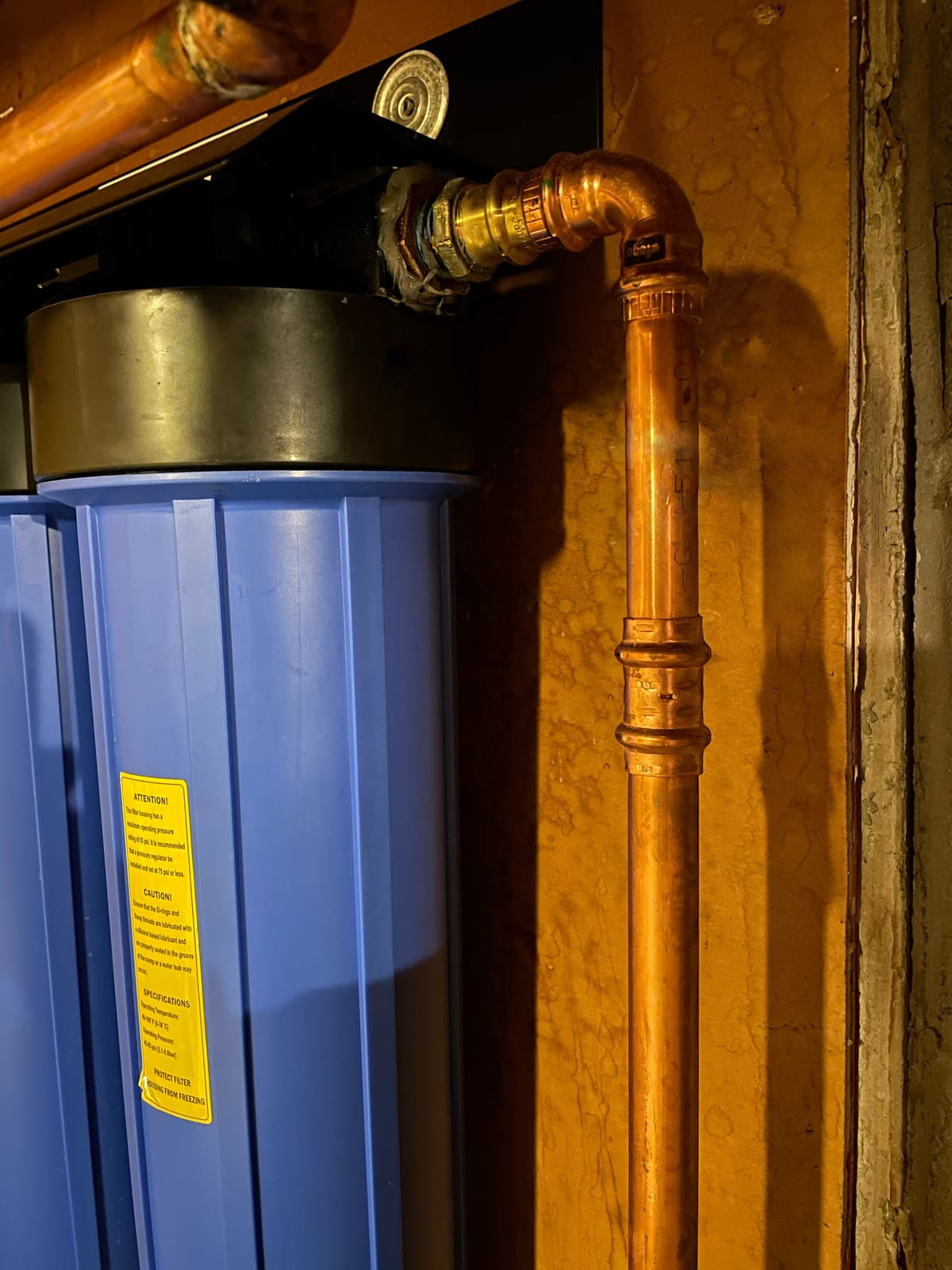
Reviewers with 1,401 ratings averaging 4.6 describe dramatic changes in water color and odor within days, and 82 percent give it five stars. The support story is a genuine strength: when fittings leak, iSpring frequently sends replacement parts or extra tubing rather than making owners chase a warranty claim.
Why the three-stage order matters
If you also run a softener or a reverse osmosis unit, the sediment stage is what keeps those downstream. Iron fines that escape an under-filtered bed will coat softener resin and foul RO membranes, and both failures cost far more than this manifold. Install this ahead of any softener without exception.
Where owners report trouble
The 20-inch housings are large and heavy when full, which is a real problem for anyone changing cartridges alone. Thread sealing on the housings and NPT fittings is the recurring friction, and the instructions telling you not to over-tighten collide with leaks that need more torque. Keep a spare O-ring set and PTFE tape in the same room as the unit.
4. iSpring WGB22BM 2-Stage 20-Inch Filter

iSpring Iron, Mangaese Whole House Water Filter System Also Eliminates Chlorine, Taste, and Odor, 2-Stage Commercial-Grade 20″ x 4.5″ Industry Standard-Sized Filters, 1″ Inlet/Outlet, Model: WGB22BM
Iron to 3.0 ppm
Manganese to 1.0 ppm
15 GPM
100,000 gallons
99% chlorine cut
Pros
- Industry standard 20-inch Big Blue sizing
- Strong chlorine taste and odor reduction
- Independently tested to NSF/ANSI standards
- One-year warranty plus lifetime technical support
Cons
- Same fitting seal issues as other iSpring manifolds
- Full housings are heavy during cartridge swaps
- Not designed for iron above 3 ppm
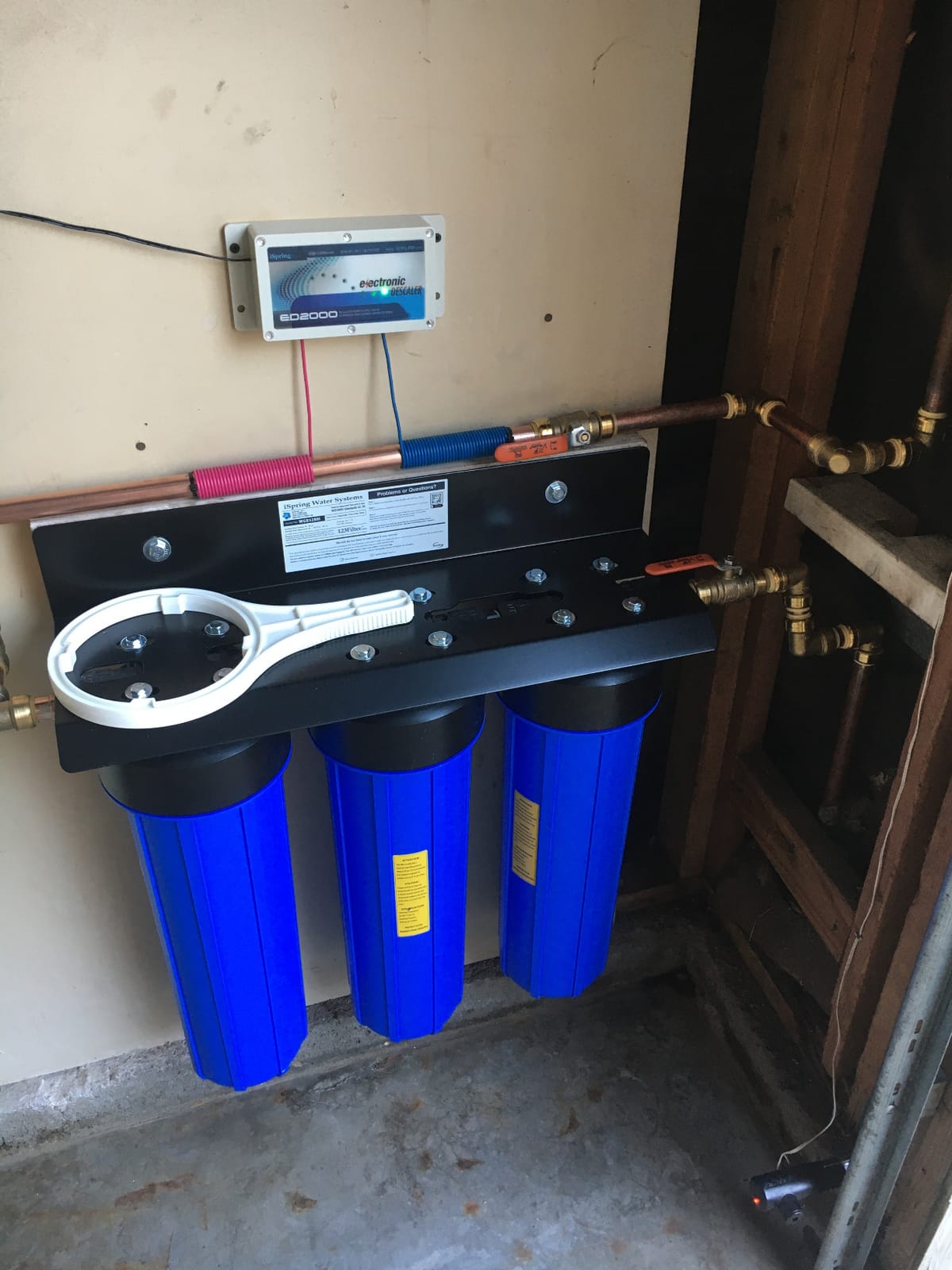
When you only need carbon and iron, the WGB22BM is the leaner sibling of the three-stage model, and its 20-inch Big Blue cartridges are the reason to choose it. Every hardware store and online seller carries standard 20 x 4.5-inch housings, so a future replacement is never a special order.
Capacity is rated at 100,000 gallons with 15 GPM flow and 1-inch NPT connections in a 25 to 80 psi operating range. The carbon block is coconut shell CTO with up to 99 percent chlorine reduction, and the iron stage handles 3.0 ppm iron and 1.0 ppm manganese.
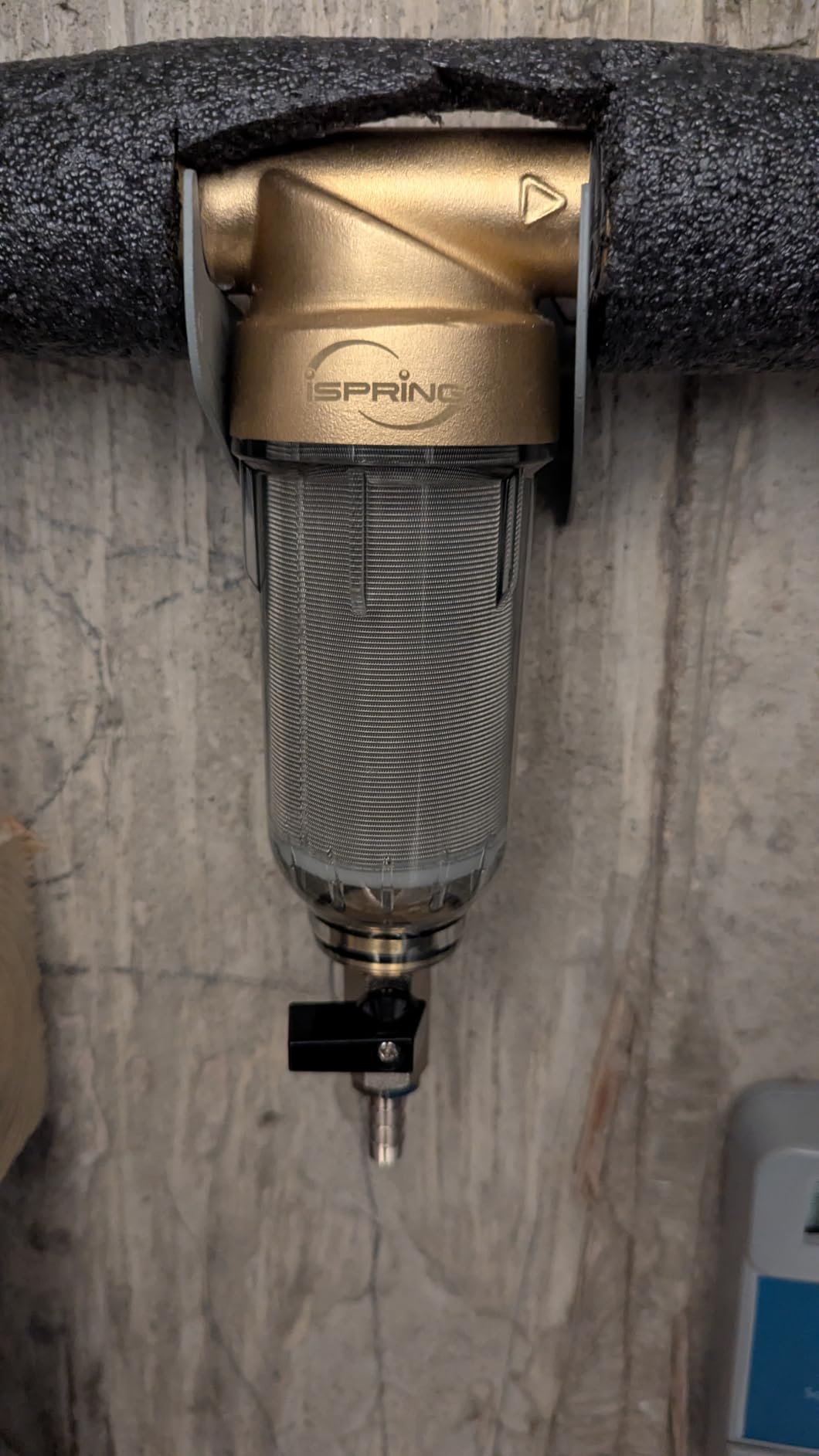
With 820 reviews at 4.6 and 83 percent five-star ratings, owners focus on odor and metallic taste disappearing and on the relief of being able to source parts locally. The manufacturer warranty plus lifetime technical support adds a layer of reassurance that budget cartridges in this category do not offer.
Best fit and setup notes
This suits a two-to-four person household on a low-iron well that also has chlorine or well-odor complaints. Install it ahead of the softener, and if your well is sandy, seriously consider a spin-down sediment pre-filter upstream because this two-stage layout has no fine sediment stage of its own.
The limitation to plan around
The 3.0 ppm ceiling is a real ceiling, and reviews include the occasional owner who arrived too late for a cartridge system. If your test report came back above 3 ppm, skip past this to one of the backwashing options further down. The other recurring note is weight, since full 20-inch housings are awkward to handle on a ladder or in a tight mechanical room.
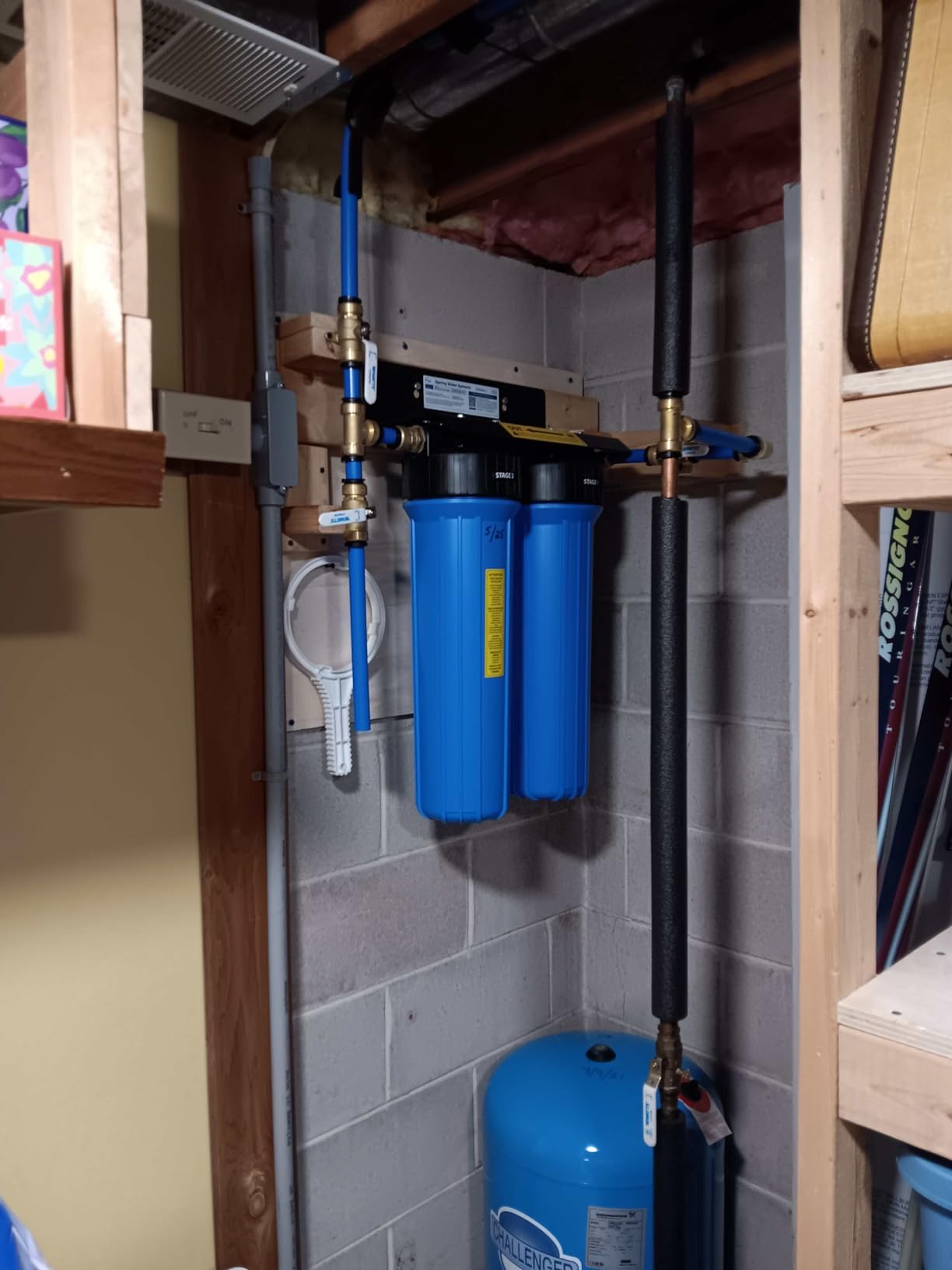
5. Pentek RFFE20-BB Iron Reduction Cartridge

Pentair Pentek RFFE20-BB Big Blue Water Filter, 20-Inch, Whole House Radial Flow Iron Reduction Replacement Cartridge, 20″ x 4.5″, White
Iron to 3 ppm
26,000 gallon capacity
Manganese activated zeolite
20 x 4.5 inch
NSF tested
Pros
- Drops into any 20-inch Big Blue housing
- Chemical-free and safe for drinking water
- Effective on metallic taste and rust staining
- Sold in multi-packs and 10-inch sizes
Cons
- Cartridge only
- needs an existing housing
- Media life shortens with high iron or heavy use
This is not a system, it is the cartridge you put inside one, and for anyone who already owns a Big Blue housing it is a long-established choice. The media is manganese activated zeolite, externally tested to NSF standards, and it reduces dissolved iron up to 3 ppm without adding anything to your water.
Capacity is approximately 26,000 gallons at 3 ppm iron, which reviewers translate to roughly three to four months for a household of four. That works out to a predictable annual cost if you set a calendar reminder rather than waiting for the water to stain again.
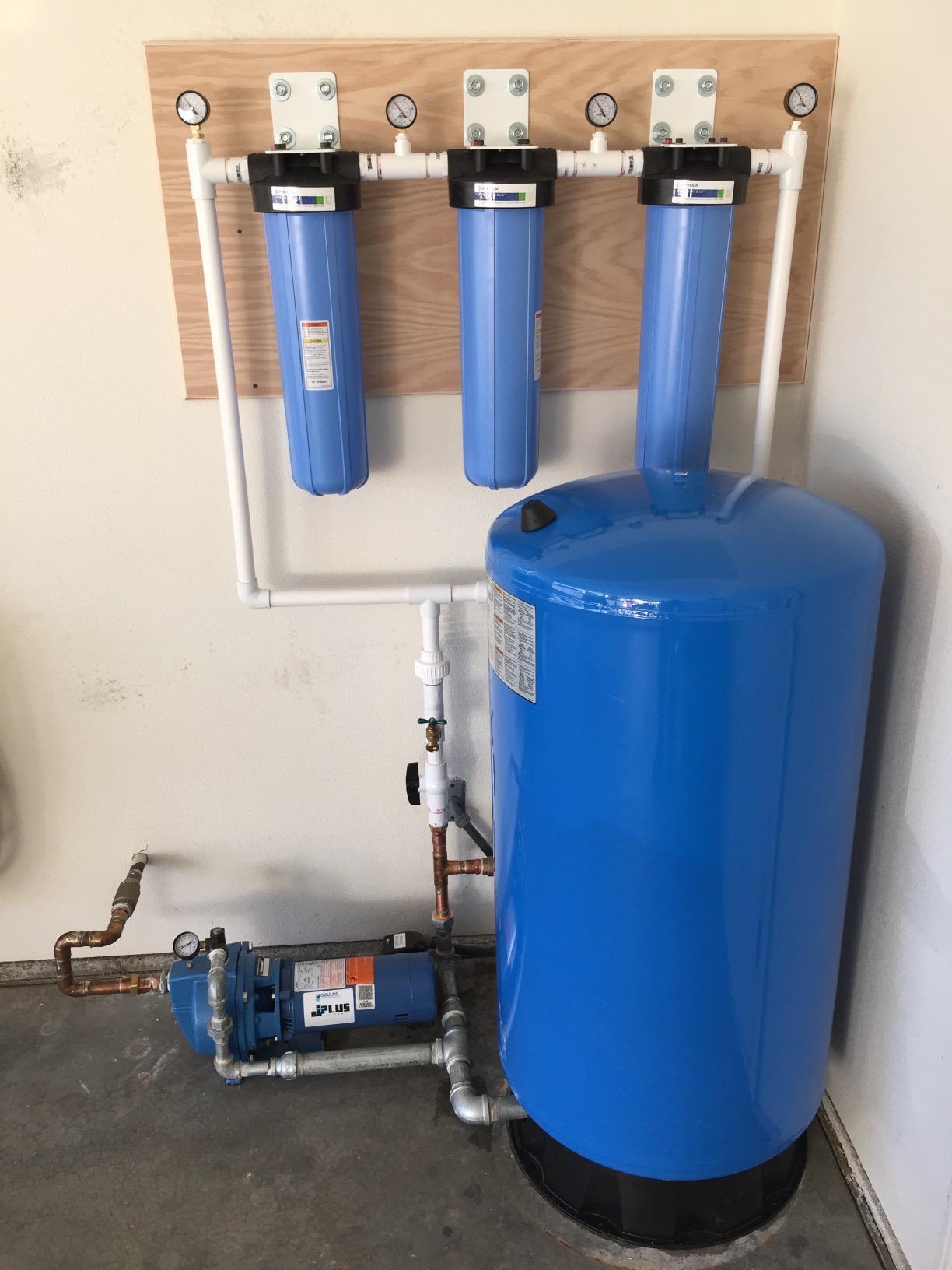
At 565 reviews and 4.6 stars, the feedback is steady and unglamorous: less metallic taste, fewer orange stains, reliable results when installed downstream of sediment protection. The most common buyer note is procedural, confirming the housing size before ordering.
Who should buy the cartridge alone
If you already have a 20-inch Big Blue housing and a sediment pre-filter ahead of it, this is the correct fix and the simplest one. The manufacturer is explicit that best results come from pairing it with sediment protection upstream and carbon downstream, and skipping that pairing is the most common reason these cartridges disappoint.
Where the limits show
It needs somewhere to live, so it is not a first purchase for a raw well. Media life shortens sharply with high iron loads or heavy household use, and on a well above 3 ppm you will be changing it far more often than the four-month figure suggests. Verify your housing diameter first, since the 10-inch version is a different part number entirely.
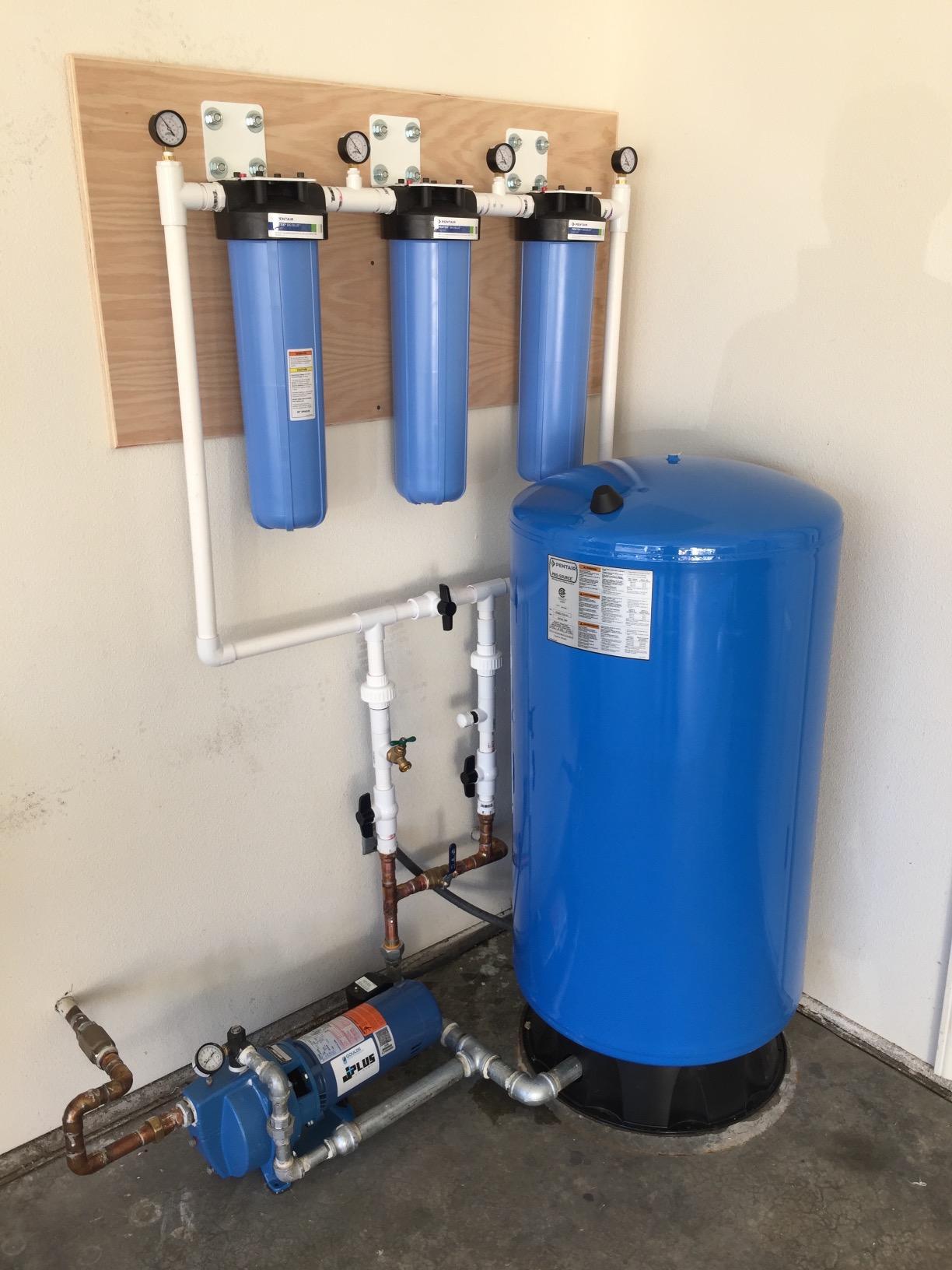
6. PUREPLUS 1-Stage Whole House Iron Filter

PUREPLUS 1-Stage Whole House Water Filter System, Iron & Manganese Reduce
10 x 4.5 inch cartridge
Iron and manganese resin
1 inch NPT port
Gauge included
Up to 1000 TDS
Pros
- Only single-housing option here
- Clear body shows sediment loading
- Gauge and pressure release valve included
- Brass NPT threads and double O-rings
- Affordable way to test whether iron is your problem
Cons
- Non-standard O-ring size is hard to source
- Included screws awkward with a standard driver
- Occasional boxes arrive leaking or missing the cartridge
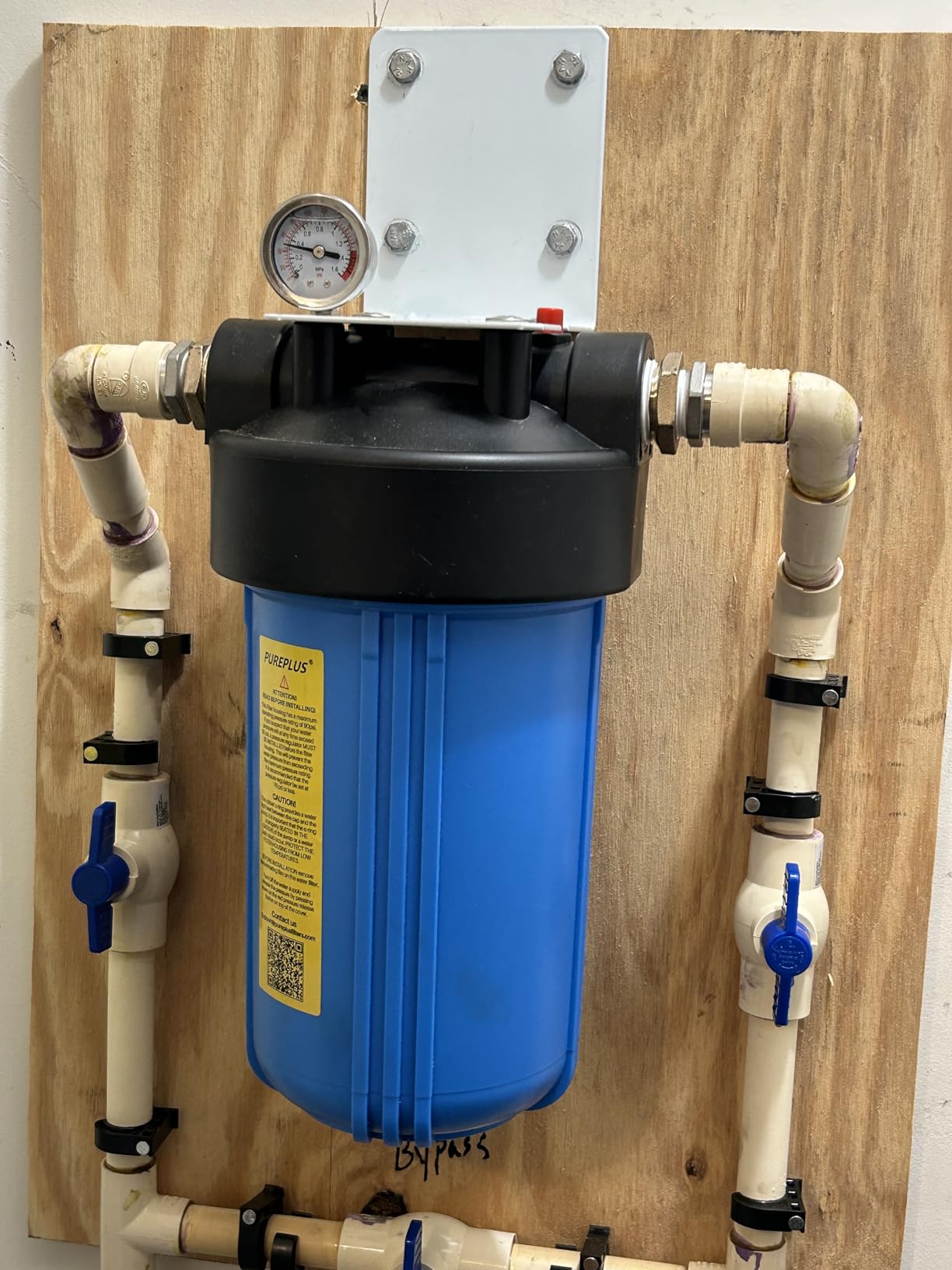
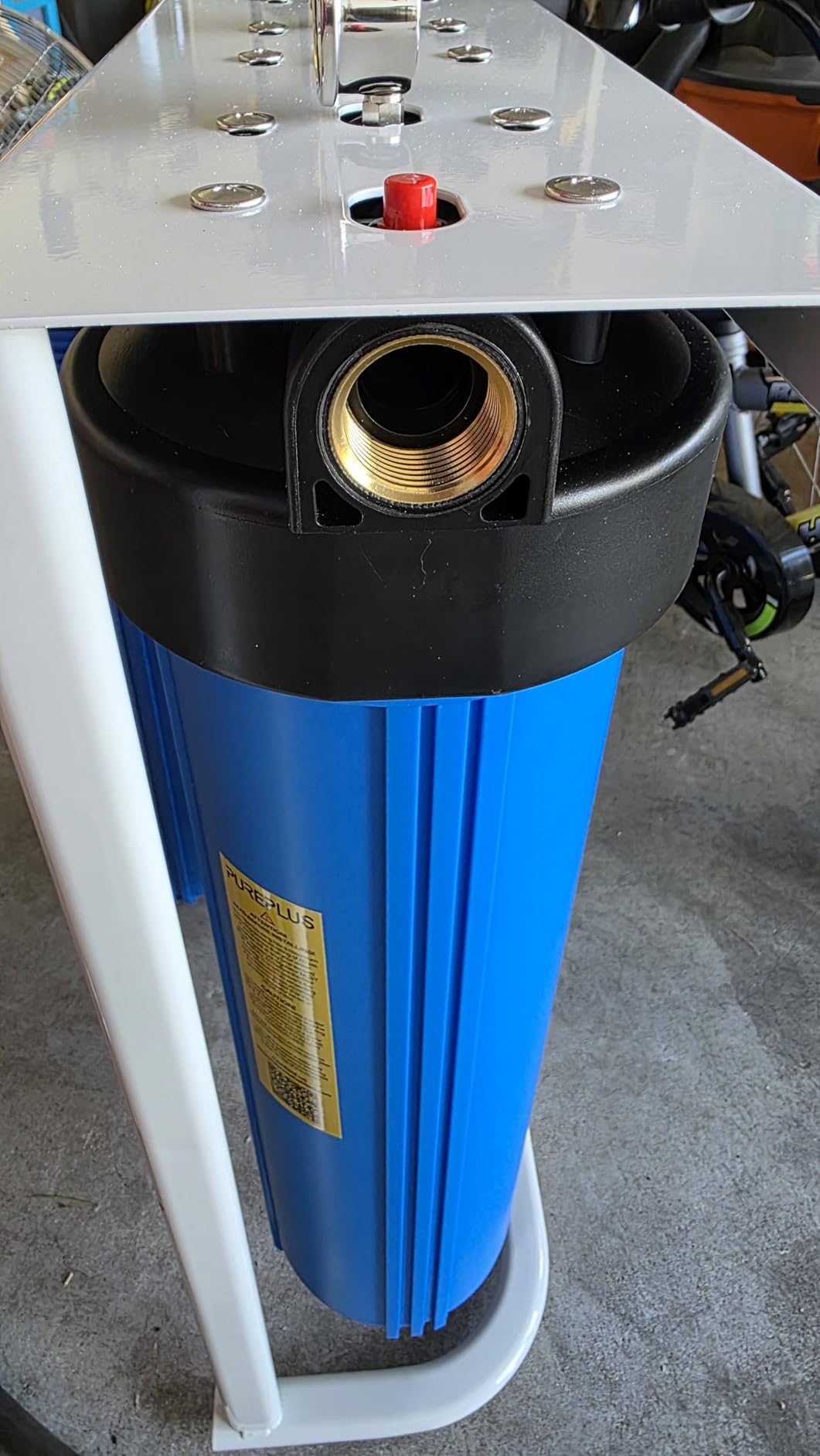
The PUREPLUS single-stage unit is the most straightforward way to find out whether iron is actually your problem. It takes a standard 10 x 4.5-inch iron and sediment cartridge in a clear housing, and it includes a pressure gauge, a pressure release valve and a steel mounting bracket, which is more than most budget housings provide.
The claims are sediment-centric, up to 99 percent reduction of sand, silt, rust, dirt and scale, with a resin cartridge designed for iron removal in domestic well water. Flow through 1-inch NPT with brass threaded junctions gives it a durability edge over plastic-threaded budget boxes.
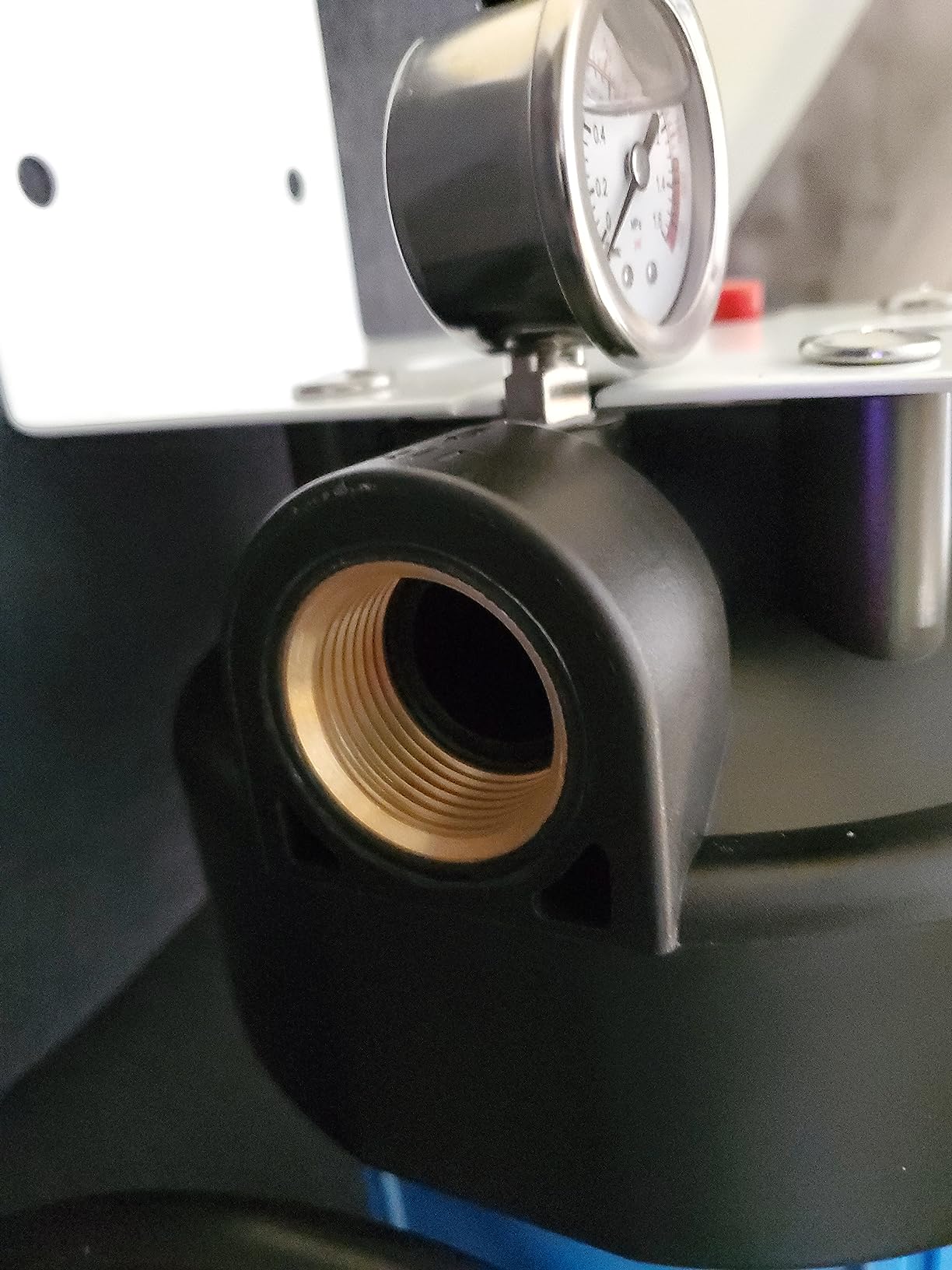
Its 411 reviews average 4.2, and the pattern behind that number is worth reading. Owners praise the housing build, the clear body and the gauge, and report real improvement in taste, odor and rust staining on well water. The complaints cluster around small parts rather than filtration.
Best used as a diagnostic step
Install this on a low-iron well first. If your staining clears, you have your answer for a fraction of what a multi-stage manifold costs, and you can step up confidently later. The clear housing genuinely helps here because you can watch the sediment load build instead of guessing.
Where the friction is
The O-rings are a non-standard size, so plan to order a spare set from the manufacturer rather than a hardware store, and the supplied screws are awkward with a standard Phillips driver. A meaningful share of one-star reviews describe boxes that arrive leaking or without the cartridge inside, so inspect everything before you start cutting pipe.
7. Home Master CFRFFE-20BB Iron and Sulfur Cartridge

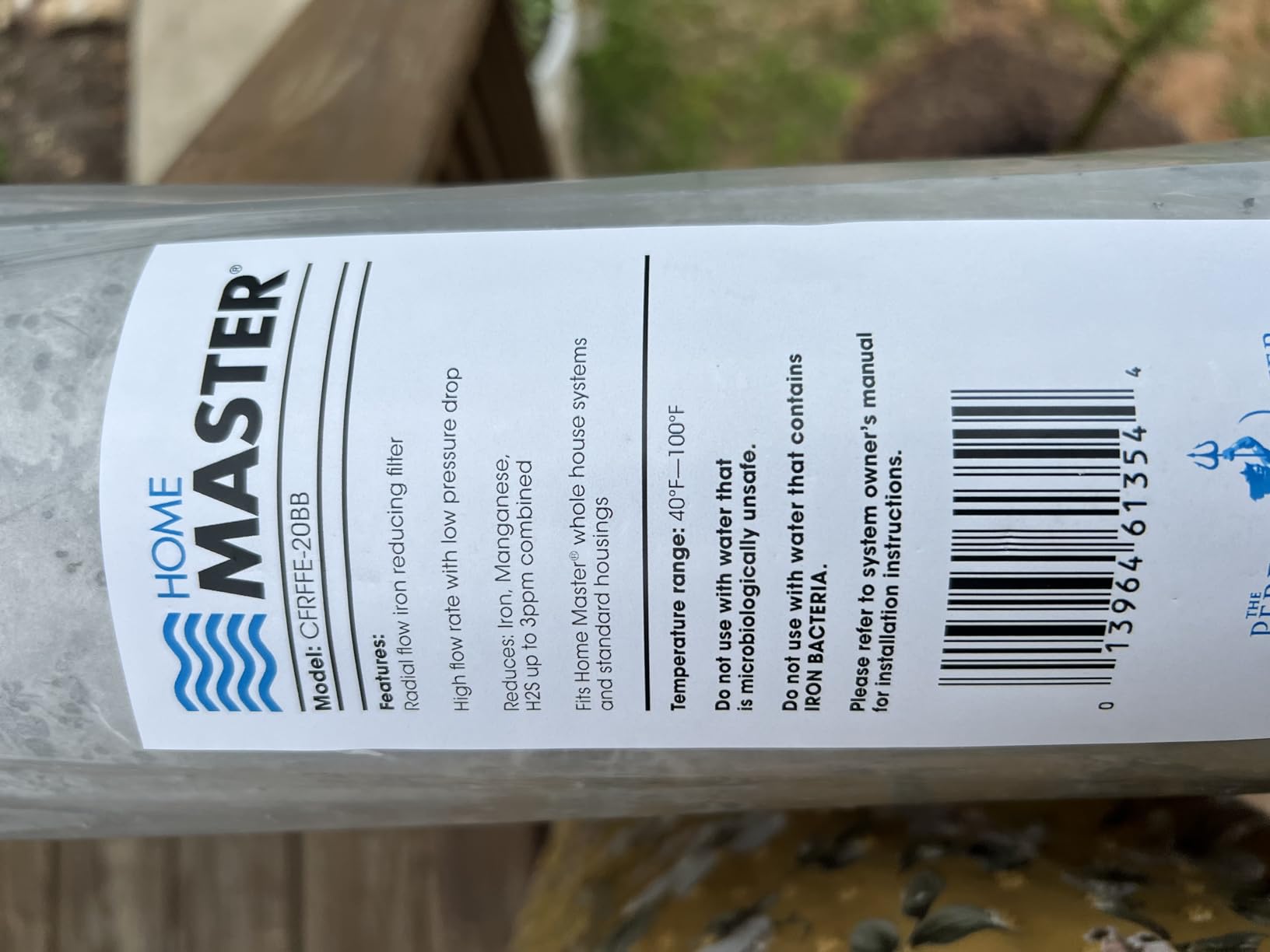
Home Master CFRFFE-20BB Replacement Whole House Iron Filter, Radial Flow 15gpm, Filters Soluble Iron, Manganese, H2S Sulfur, Up To 3ppm Combined, Stops Staining & Odors, 20” x 4.5″ Fits Big Blue
Iron manganese and H2S to 3 ppm combined
15 GPM radial flow
20 x 4.5 inch
20-100 psi
NSF tested
Pros
- Handles sulfur odor alongside iron and manganese
- Radial flow design holds pressure at 15 GPM
- Long-term owners report steady iron reduction
- Extends downstream RO filter life as pre-treatment
Cons
- Costs more than comparable iron cartridges
- Cited as needing its own compatible housing
- A small number of owners saw no sulfur improvement
The distinguishing feature here is hydrogen sulfide. Most budget iron cartridges ignore the rotten egg smell entirely, and this one is rated for iron, manganese and H2S together up to 3 ppm combined. On a well that smells like a swamp, that is often the difference between people accepting the filter and people being disappointed by it.
The radial flow geometry is the other differentiator, holding flow up to 15 GPM with minimal pressure drop. It fits standard 20 x 4.5-inch Big Blue housings, runs in a 20 to 100 psi band and a 40 to 100 degree range, and the media was updated to work across a broader pH span with a thicker shell.
Long-term owners in Home Master three-stage systems report steady iron reduction with no flow loss and fewer staining problems, and several specifically note the sulfur odor improving. At 215 reviews and 4.4 stars, the sample is smaller but the experiences are longer, which is more useful for a media cartridge.
When this is the right cartridge
Choose it when odor and staining appear together and your test shows iron and manganese in the same low range. Because it is rated to 15 GPM through a radial flow path, it also suits households where pressure loss downstream has been a recurring complaint with other cartridge designs.
What to watch
It is priced above comparable iron cartridges, and it will not work without a separate compatible housing. A small number of owners report the sulfur odor unchanged, which is normal when H2S comes from a source the cartridge cannot reach, such as a well casing off-gas. Warranty coverage on replacement media is limited to 30 days on parts, so keep receipts.
8. Home Master Three Stage Well Water Filter System

Home Master Whole House Three Stage Water Filtration System with Fine Sediment, Iron and Carbon, Blue
Iron manganese sulfur to 3 ppm
95 percent contaminant removal
15 GPM
1-inch ports
20-95 psi
Pros
- Engineered specifically for well water
- 4-layer 25-10-5-1 micron sediment cartridge
- Removes sulfur smell along with iron
- Oversized housings keep flow strong
- Backed by a 2 year parts warranty
Cons
- O-rings seat poorly in the housing groove
- Confusing replacement cartridge options
- Plastic threads can leak near soldered copper
This is the most complete assembled package in the group for a typical well, and the only one that explicitly states it was engineered for well water rather than adapted from a drinking-water design. It handles iron, manganese and sulfur up to 3 ppm combined with up to 95 percent contaminant removal.
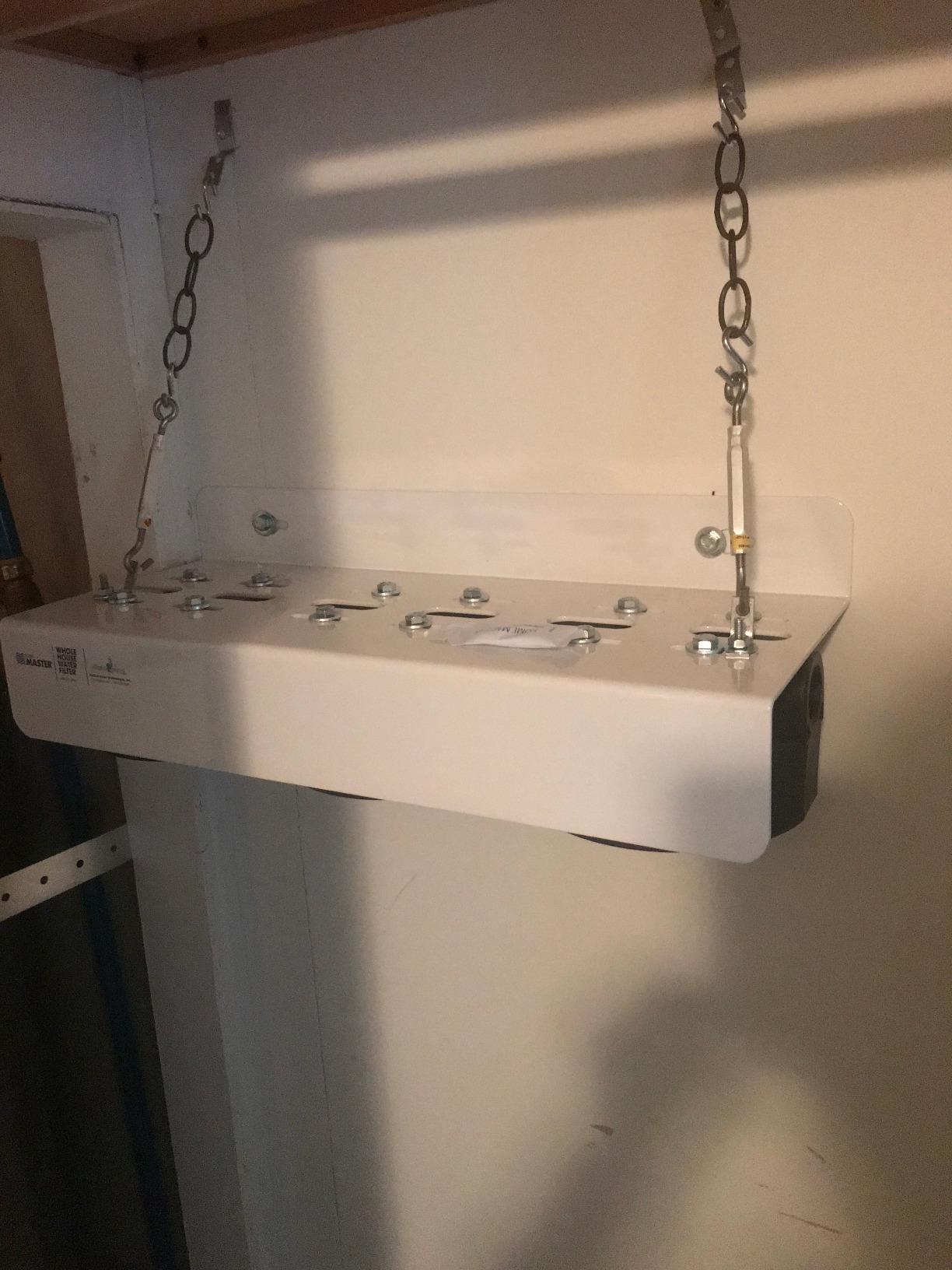
The sediment stage is a four-layer cartridge graded 25, 10, 5 and 1 micron, which is the kind of fine grading that decides whether a well with sand keeps working for a year or a month. Flow is 15 GPM on 1-inch ports across a 20 to 95 psi band, with a heavy steel bracket and wrench included.
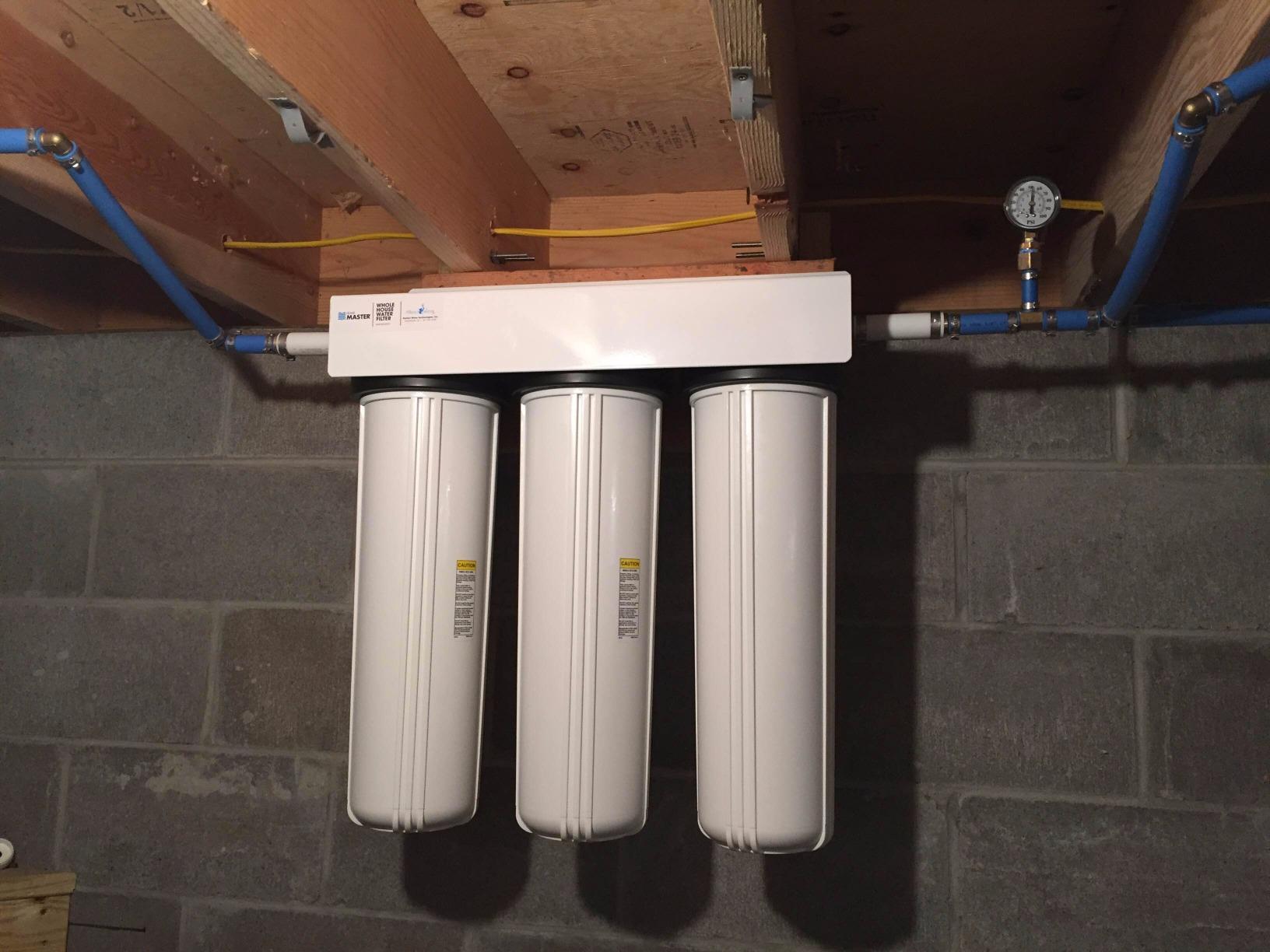
Owners consistently report cleaner tasting water and less staining within days, and several describe measurable iron drops after installation. The recurring advice in reviews is exactly right: test your water first, add a pre-sediment filter on very dirty wells, install a bypass and pressure gauges, and keep greased spare O-rings on hand.
Why the fine sediment layer earns its place
Coarse sediment is what kills iron systems over time. A 1-micron final layer catches grit that would otherwise pack the top of the iron bed and cut flow, which is why well-specific three-stage assemblies outperform drinking-water manifolds on rural wells with any sand at all.
Honest drawbacks
The O-rings lose their grip in the housing groove and are hard to seat, which is the single most repeated complaint. Replacement cartridge selection is genuinely confusing because of the number of options, so confirm the model number before ordering. A minority of owners saw brown water after install because they had not tested first, and old stains still need a cleaning product.
9. DuraWater Air Injection Iron Eater Filter

Air Injection Iron Eater Filter Great at Removing Iron Manganese, H2S Whole Home, Almond Series
Air injection oxidation
Iron to 10-15 ppm
Fleck 5600 SXT valve
1 cubic foot tank
Pros
- Handles iron levels cartridge systems cannot
- Chemical-free air injection also targets sulfur
- Automatic backwash on an adjustable schedule
- Fleck 5600 SXT valve is fully programmable
- Arrives loaded so there is no media handling
Cons
- Bypass valve threads are deep and hard to seal
- Printed instructions are minimal
- Defaults to a 1-inch yoke
Everything above this line stops working somewhere around 3 ppm. This is where the roundup changes character, because the DuraWater Air Injection system handles iron up to 10 to 15 ppm using air injection oxidation, with no chemicals involved at all.
It runs a Fleck 5600 SXT control valve, which is the industry standard digital metered valve that any installer already knows how to program. Backwash regeneration runs automatically on an adjustable cycle, the tank is a 1 cubic foot fiberglass unit with a 10 inch diameter, and the warranty runs five years.
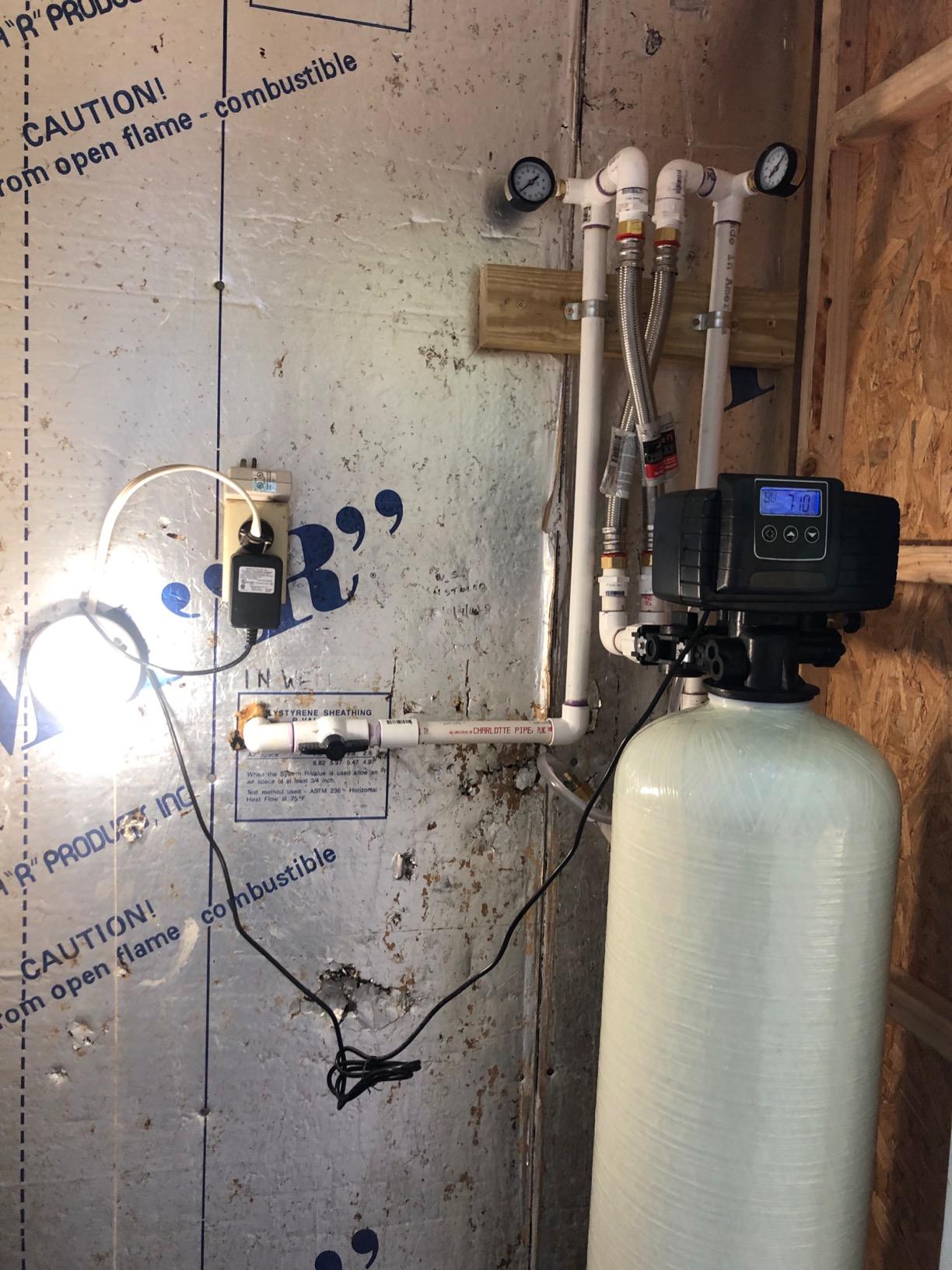
Owners on wells running 4 to 6 ppm iron with sulfur odor describe the change as transformation, with clear odor-free water and fixtures that stop staining, sometimes after years of replacing cartridge filters. At 84 reviews and 4.4 stars the base is small, but the scenario descriptions are unusually specific.
How air injection actually helps you
A Venturi injector pulls air into the top of the tank, oxygen oxidizes dissolved iron into particles, and the control valve backwashes the accumulated solids to drain on a schedule. Because capacity is set by tank volume and backwash frequency rather than a cartridge, a 10 to 15 ppm well stops being a monthly expense and becomes a monthly backwash.
What makes installation fiddly
The bypass valve threads on the outboard side are cut deep and resist sealing, and the yoke defaults to 1 inch, so a 3/4-inch line needs a different yoke before you start. Instructions in the box are minimal, so plan on install videos instead. Expect cloudy water while the media settles after commissioning and a measurable pressure drop at the head.
10. DuraWater Fleck 5600 SXT 48K Combination Unit
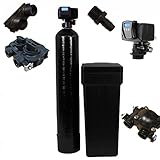
DuraWater Fleck 5600 SXT 48K Water Softener/Iron Filter, 3/4″ Bypass, Black
48000 grain capacity
14 GPM
Fine mesh resin for iron
Fleck 5600 SXT valve
Sized for 2-5 people
Pros
- Handles hardness and iron in a single unit
- Visible results within days of install
- Metered regeneration uses less salt than older valves
- Straightforward install for a handy homeowner
Cons
- Runs orange briefly after each backwash
- Discharge hose and clamp may be bought separately
- Printed instructions are poor
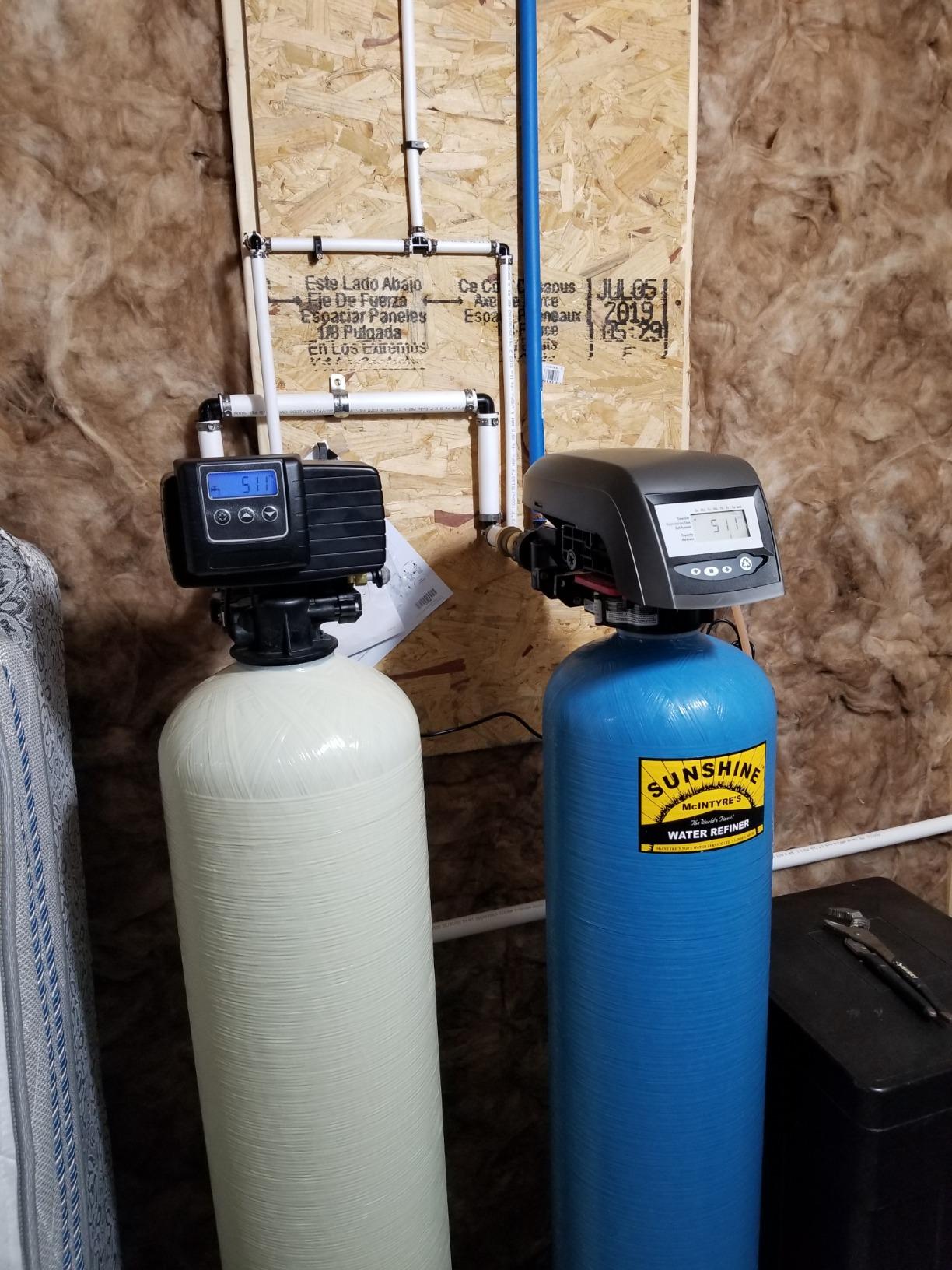
Most well owners eventually want both iron removal and hardness reduction, and this unit delivers them in one 1.5 cubic foot tank using fine mesh resin rated for iron alongside standard softening resin. That single-tank approach saves floor space, plumbing and one bypass valve compared with running an iron filter and a softener separately.
The Fleck 5600 SXT digital metered valve regenerates based on actual measured usage rather than a clock, which conserves both salt and water. Capacity is 48,000 grains, sized for homes with two to five people and two to three bathrooms, at up to 14 GPM flow.
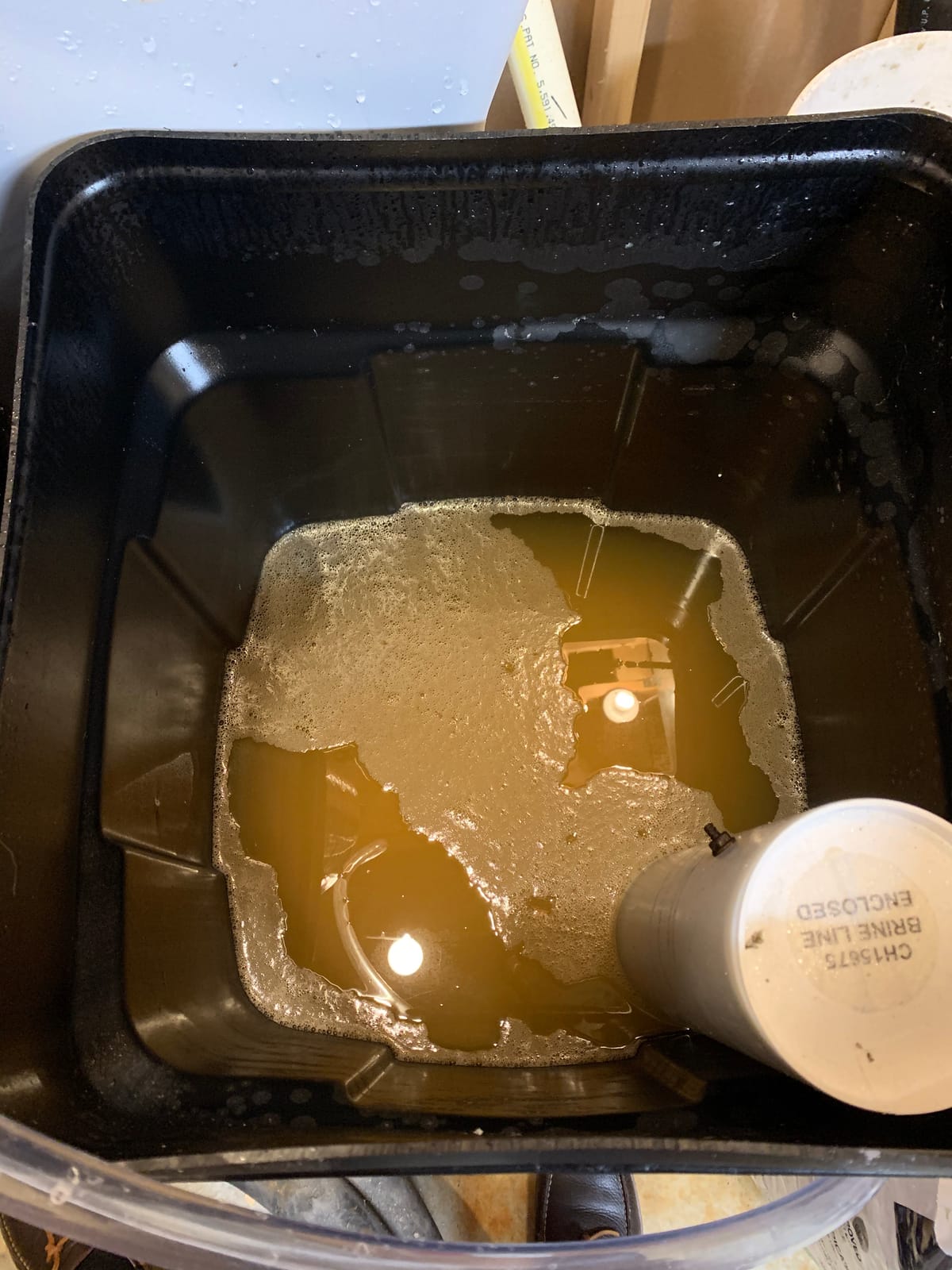
Buyers replacing aging units report clearer water, better laundry and dishwashing performance and a big drop in rust staining within days. At 139 reviews and 4.5 stars, the results are consistent even though the sample is modest.
When one tank beats two
Choose the combination unit if your iron sits in the low range, your hardness is moderate to high, and your mechanical room is tight. It is also a simpler install, since one bypass and one drain line is a much friendlier weekend project than two systems in series.
What the fine mesh resin asks of you
Fine mesh resin is more susceptible to fouling than standard resin, so pre-filtering iron properly matters more here, not less. The most-reported complaint is iron sloughing: several dozen gallons of orange water after each regeneration, which is normal at first but should diminish as the resin conditions. The discharge hose and clamp may need buying separately, and the paperwork quality is poor.
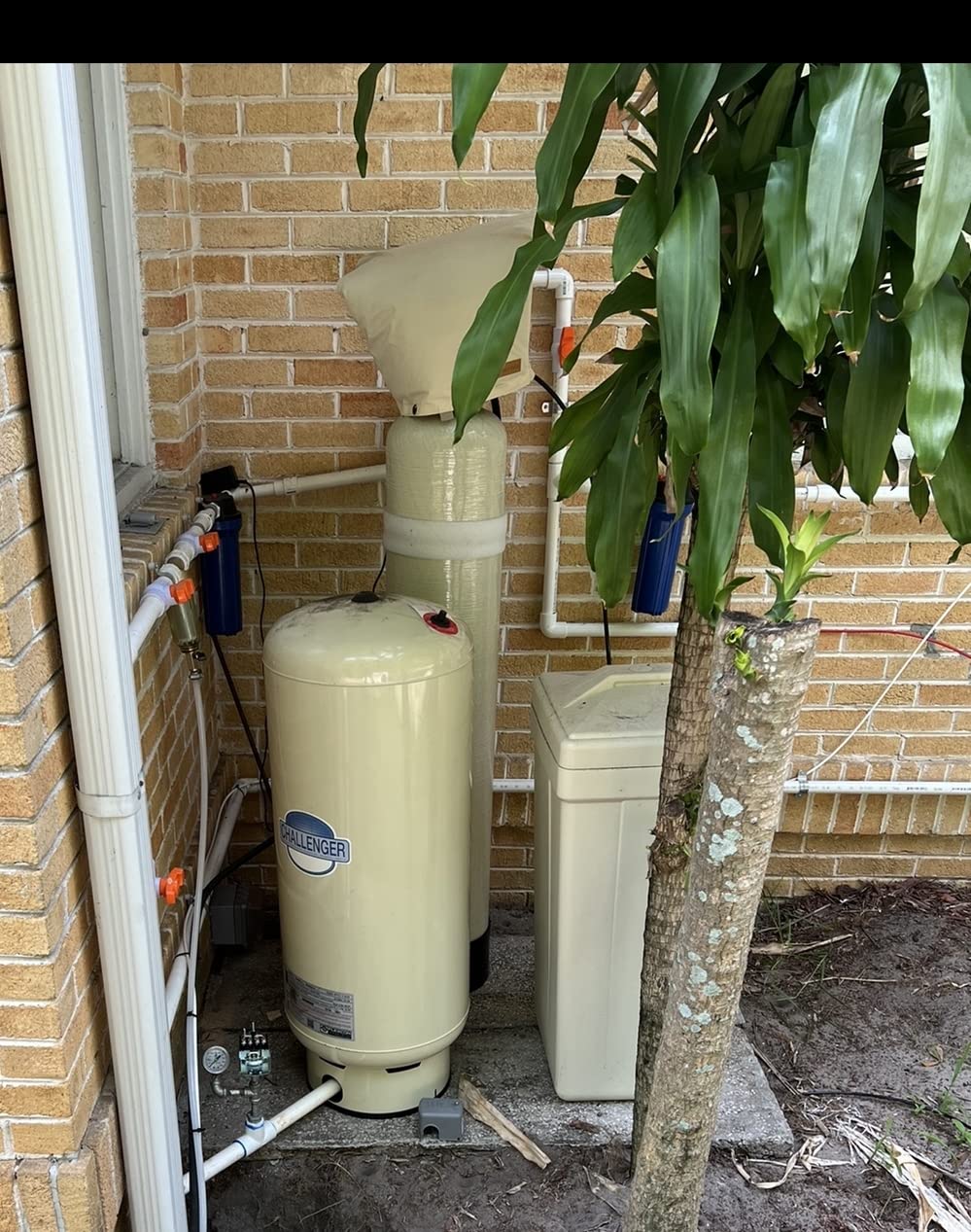
11. PUREPLUS 20-Inch 3-Stage Whole House Filter

PUREPLUS 20″ 3-Stage Whole House Water Filter, Pleated, GAC & Iron Reduce
Pleated pre-filter plus GAC
Iron to 0.01 ppm
Three pressure gauges
300 TDS ceiling
Pros
- Eliminated rotten egg sulfur smell on well water
- Thick housings with double O-ring seals
- Three gauges make pressure drop easy to spot
- Steel frame fits beside the main shutoff
Cons
- Replacement filter costs add up over time
- O-rings and wrench were absent from one delivery
- Gauge placement is hard to read at a glance
The PUREPLUS 20-inch three-stage combines a pleated pre-filter for sand and rust, a GAC carbon block for chlorine and taste, and an iron and manganese stage specified to reduce down to 0.01 ppm. It also stands on a heavy-duty steel frame with three pressure gauges built in, which is unusual at this level.
Owners on well and treated water report the sulfur smell disappearing and a marked improvement in taste, including in coffee. A master plumber reviewer noted long filter life with no pressure drop after two and a half years, which is the kind of durability data most listings never provide.
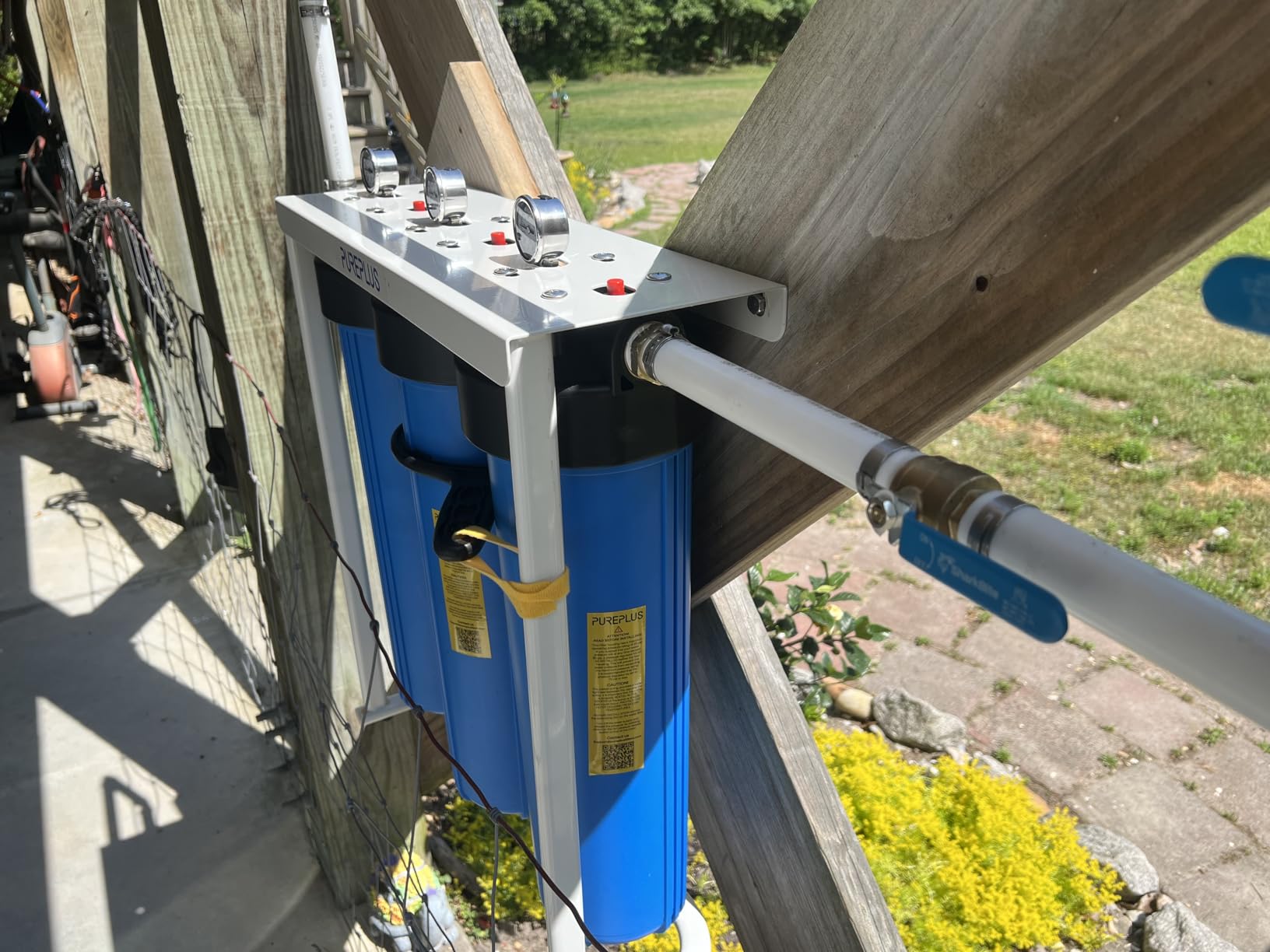
With only 53 reviews at 4.4 stars, the evidence here is thinner than anywhere else in the roundup, and we would rather say so than dress it up. The enthusiasm is real, but treat the long-term performance claims as promising rather than proven.
Why the gauges matter more than they sound
Pressure drop is the earliest warning sign that an iron filter is failing, usually weeks before staining reappears. Three inline gauges let you see which stage is loading up, and that turns maintenance from reactive to scheduled.
What to check first
The system is rated for water up to 300 TDS, so it is not suited to high-TDS well water. Filter replacement costs accumulate over time, and one delivery arrived without its O-rings or wrench. Confirm the full accessory list as soon as the box is opened and check your TDS before ordering.
12. PRO+AQUA Heavy Duty Well Water Filter System

PRO+AQUA Heavy Duty Whole House Well Water Filter System
1 cubic foot tank
Up to 10 GPM
Programmable digital control
Prefilled resin
Pros
- Automatic backwash removes the cartridge swapping habit
- Wide contaminant coverage for well water problems
- Arrives prefilled so there is no media handling
- Three connection options for flexible install
Cons
- Digital head means it is not purely passive plumbing
- 90 pound tank is bulky to position
- Extended warranty requires registration
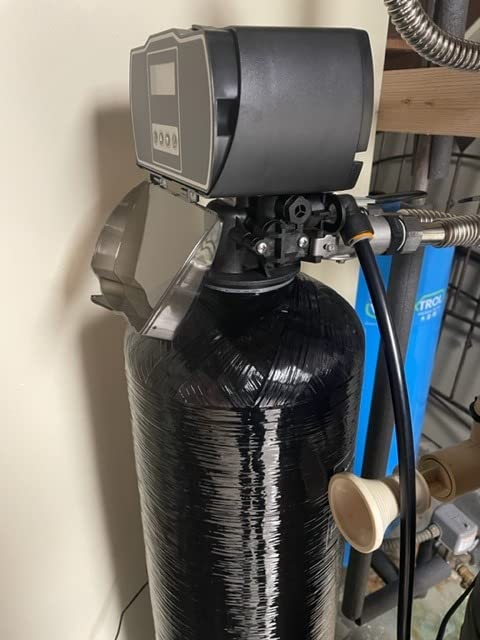
The PRO+AQUA is a 1 cubic foot tank with prefilled premium resin and a programmable backlit digital control head, and the flush intervals are adjustable based on your water rather than fixed by the factory. For a well owner tired of tracking cartridge change dates, that automation is the whole pitch.
Removal claims are broad, covering up to 99 percent of iron, manganese, H2S, heavy metals, VOCs, pesticides, lead, uranium, radium and radionuclides, with flow up to 10 GPM for households of four or more. The tank is fiberglass-lined polyethylene with a durable bypass valve.
At 464 reviews averaging 4.1, this is the lowest-rated product we recommend, and we are including it because the coverage list and the automatic control genuinely do not appear anywhere else here. Feedback is more mixed than cartridge systems, with owners noting a setup learning curve and debating the programmable display against simpler options.
What the control head actually buys you
Auto-flush means the bed regenerates on its own schedule rather than on a manual reminder, which matters on a heavy-iron well where a neglected cartridge can go from clean to unusable in weeks. Being able to widen or shorten that interval as your iron load changes is a real advantage over fixed-timing cartridge housings.
Where it falls short
Unlike the purely mechanical units here, this one is an electrical device with a control head that can fail, and the 90 pound tank is awkward to position. It does not reduce TDS, and the standard one-year warranty only extends to three years if you register the product, so do that within the window.
How to Size an Iron Filter for Your Well
Sizing errors are the most common complaint in the forums, and they go in both directions. Start with your well pump rating, which is printed on the pump or its capacitor plate, and treat it as the ceiling for continuous flow rather than the number to design around.
Find your household demand. A single shower runs roughly 2 to 3 GPM, a garden hose about 5 GPM, and a washing machine 3 to 5 GPM. Multiply the fixtures you actually run simultaneously.
Match service flow, not pump flow. Every cartridge system here is rated between 10 and 17 GPM, so a household using 6 GPM is well matched. Very large pumps need plumbed down.
Use backwash flow for tanks. A Fleck 5600 valve on a 1 cubic foot tank needs roughly 10 GPM available for backwash. Too little and the bed never cleans itself.
Plan the drain. Backwashing media needs a drain within code distance, and in some states an air gap is required.
An undersized filter restricts flow and clogs constantly. An oversized one is a different problem: on a low-flow home it never regenerates often enough, so the media never cleans and the system quietly underperforms. For the very high-iron owners on r/WaterTreatment who have exhausted a single tank, the documented escalation is parallel tanks with a Venturi injector rather than one larger unit.
If the well you are treating is at a cabin, a rental or an RV rather than a permanent house, the whole sizing conversation changes and a point-of-use setup is often the cheaper answer. Our RV water filter roundup covers that category, and it is worth reading before you plumb a treatment head into a property you may not own long term.
Cartridge vs Backwashing: When a Budget Filter Is Enough
A cartridge system is genuinely enough when your iron is under about 3 ppm and your household demand is modest. There is no valve, no drain, no electricity and no media to replace, which is why the PUREPLUS single-stage unit and the Pentair cartridge remain sensible choices for a low-iron cottage well or a short-term fix.
Two failure modes make cartridges a bad fit past that point. Inline spin-down filters clog every few weeks on high-iron water and owners describe replacing them repeatedly, and cartridge media saturates faster than the housing can be drained. When the iron sits between 4 and 8 ppm, a backwashing oxidizing filter costs more upfront and less per year.
The other decision is sulfur. Most iron cartridges do nothing for hydrogen sulfide, so if your well smells like rotten eggs you need a media rated for H2S or an air injection system. The smell can also survive a correct iron filter when it is off-gassing from the well casing, which is a plumbing problem rather than a treatment one. And if you notice rust bloom on hoses, spigots or lawn fixtures after the water itself runs clear, that is a different category of problem, and our iron remover guide for car paint covers the chemistry that strips surface rust without attacking the coating underneath.
Installation Order, Placement and the Softener Question
Install the iron filter ahead of any water softener, every time. Ferrous iron that reaches ion exchange resin coats it in rust sludge, and owners who learned this the hard way describe shortened softener life and the cost of replacing resin sooner than planned. This is the most repeated piece of advice across the installer forums.
Beyond that ordering, leave room to work. Install a real brass full-port bypass valve on every cartridge system so you can change media without shutting the house off, and add pressure gauges upstream and downstream because pressure drop is your earliest warning. Any housing you open in a freezing climate needs insulation or a heated enclosure, since ice splits fiberglass and polypropylene alike.
Finally, plan for the replacement cycle rather than the purchase. Media life runs from about three to four months for a cartridge at 3 ppm iron up to many years for a properly sized backwashing tank. Owners on forums describe the common pattern clearly: the filter works, then somewhere around 12 to 18 months staining returns, and an iron-out treatment on the media buys another year.
Frequently Asked Questions
What type of water filter can remove iron from well water?
An oxidation-filtration system removes iron from well water. Water passes through a media tank where injected air, or an oxidizing media such as Birm, Filox, Katalox or catalytic carbon, converts dissolved ferrous iron into solid particles. Those particles are trapped in the bed and flushed to a drain by an automatic backwash cycle.
What is the best whole house iron filter for well water?
For most well households the best whole house iron filter is a backwashing oxidation system sized to the well pump, because it clears iron up to 3 ppm and beyond without monthly cartridge changes. If your iron stays under 3 ppm, a multi-stage cartridge manifold such as the iSpring WGB21BM works well and costs far less to install.
Do iron filters work on well water?
Yes, iron filters are designed specifically for well water, where dissolved ferrous iron is common. They work by oxidizing dissolved iron into particles that the media bed traps and the backwash cycle removes. They do not treat iron bacteria, which produce a slime that clogs plumbing and needs a separate approach such as chlorination.
What are the symptoms of too much iron in well water?
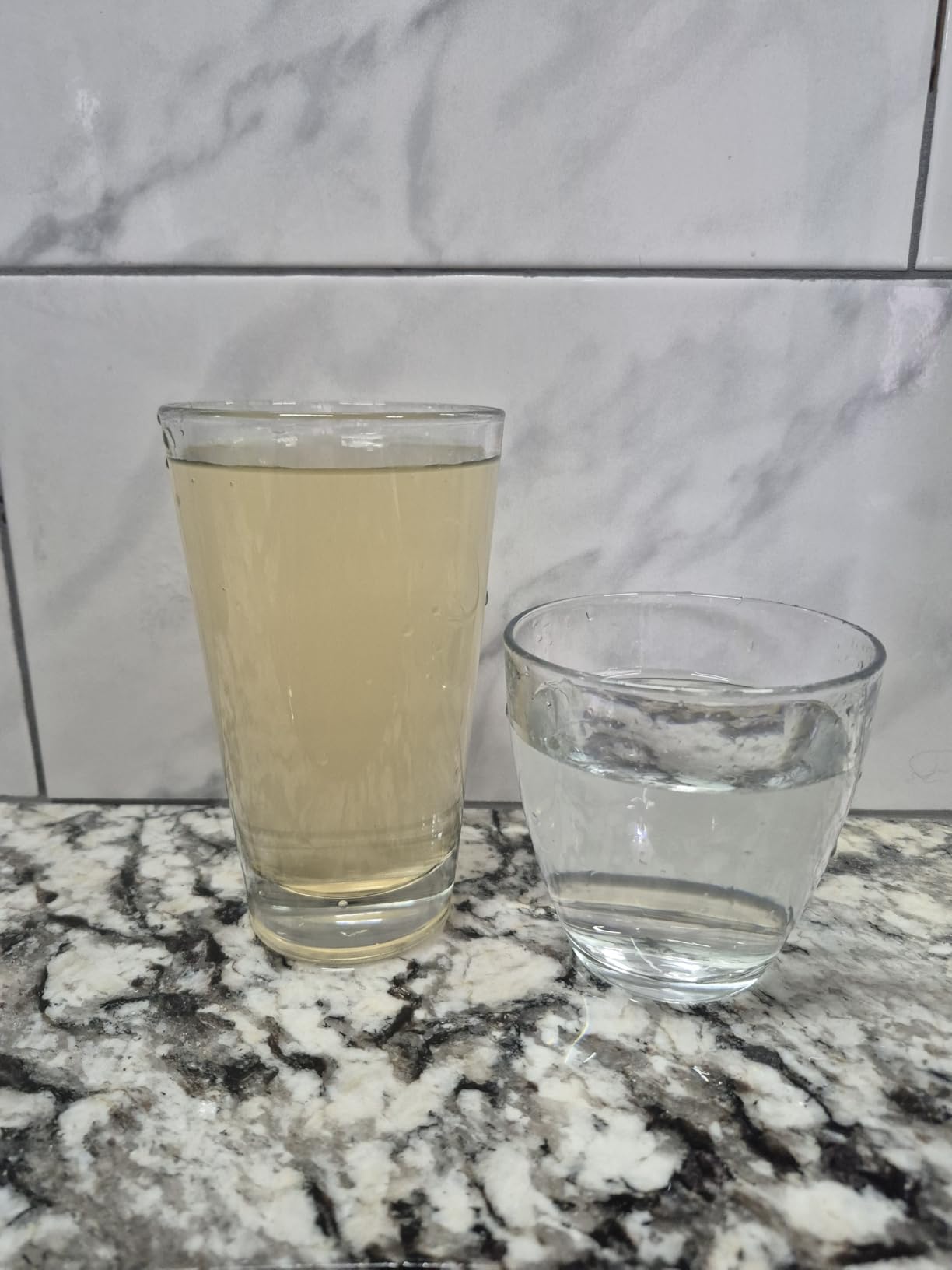
The usual signs are orange or brown staining on toilets, sinks, tubs and grout, a metallic taste in drinking water and coffee, rust-colored slime in aerators and showerheads, and rust scale building inside pipes and water heater tanks. Staining typically becomes visible once iron passes roughly 0.3 ppm.
Is it safe to drink well water that has iron in it?
Iron at typical well concentrations is generally considered a nuisance contaminant rather than a health hazard, with the EPA setting 0.3 ppm as a secondary standard for taste, staining and color. However, iron bacteria can signal other contamination, so test the well for bacteria and other parameters before assuming iron is the only issue.
How much iron in well water is too much?
Under 0.3 ppm usually needs no treatment. Between 0.3 and 4 ppm, a cartridge filter handles it well. Between 4 and 8 ppm, cartridges clog fast and a backwashing oxidizing filter is the better choice. Above 8 ppm, you need an air injection oxidation system or an equivalent tank with a control valve.
The Best Iron Filters for Well Water, Final Verdict
For most well households with iron between 0.3 and 3 ppm, the iSpring WGB21BM is the pick we would install ourselves, because the 4,270-review record at 4.6 stars is the strongest evidence base here that it holds up over years rather than months. Buyers who want visible system status and the highest flow rating in the group should step up to the Express Water three-stage system.
If your water is heavier than a cartridge can handle, the choice narrows fast. The DuraWater Air Injection filter handles iron up to 10 to 15 ppm and sulfur odor with no chemicals, while the Fleck 5600 SXT combination unit covers iron and hardness in a single tank for tight mechanical rooms. Do not install any softener until the iron ahead of it is under control, and re-test after twelve months so you can budget media replacement before staining returns.