
The best AA battery charger for rechargeable batteries is the Energizer Recharge Pro: it fills four cells in about three hours, flags a bad cell with its own indicator, and shuts off by itself. The POWEROWL 8 Bay is the pick when you cycle a lot of batteries and want every slot controlled on its own. On a tight budget, the Amazon Basics Smart 4-Bay charges single cells instead of forcing pairs.
That ranking matters more than it looks. A charger is not an accessory, it is the thing that decides how many recharge cycles your cells get and whether they survive being left on a shelf for six months. Cheap pair-charged units can cook a good cell, and the wrong charger is the most common reason people conclude their rechargeable batteries are “dead” when they are only mistreated.
Our team compared ten of the most-reviewed AA and AAA charging units sold today, checking bay count, whether each slot is controlled independently, which chemistries each one accepts, the stated charge current in milliamps, and what the protection circuitry actually does when a cell is faulty. We did not measure mAh capacity ourselves, so every performance number below comes from the manufacturer listing or from the owner reviews attached to that product. Where owners disagree, we tell you. We earn a commission when you buy through the links on this page, which does not change the order.
If your interest is wider than AA cells, our general battery charger guide covers larger formats including lead-acid and power-tool packs, which use completely different charging methods.
Table of Contents
Top 3 Best AA Battery Chargers for Rechargeable Batteries in October

Energizer Recharge Pro
- Charges 2 or 4 cells in 3 hours
- Bad battery detector with red X
- Auto shutoff and overcharge protection
POWEROWL 8 Bay Charger
- 8 independent bays
- AA and AAA Ni-MH/Ni-CD together
- USB input with trickle finish

Amazon Basics Smart 4-Bay
- Charges each cell individually
- Per-bay LED indicators
- Foldable plug for travel
All 10 Chargers at a Glance in 2026
| Product | Specs | Action |
|---|---|---|
| Energizer Recharge Pro |
|
Check Latest Price |
 Amazon Basics USB Charger Amazon Basics USB Charger |
|
Check Latest Price |
| POWEROWL 8 Bay Charger |
|
Check Latest Price |
 Duracell Ion Speed 1000 Duracell Ion Speed 1000 |
|
Check Latest Price |
 BONAI 16 Bay Charger BONAI 16 Bay Charger |
|
Check Latest Price |
 Zanflare C4 LCD Charger Zanflare C4 LCD Charger |
|
Check Latest Price |
 EBL Smart Rapid Charger EBL Smart Rapid Charger |
|
Check Latest Price |
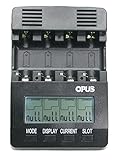 OPUS BT-C2400 Analyzer OPUS BT-C2400 Analyzer |
|
Check Latest Price |
| Amazon Basics Smart 4-Bay |
|
Check Latest Price |
 EBL LCD 4 Bay Charger EBL LCD 4 Bay Charger |
|
Check Latest Price |
1. Energizer Recharge Pro: the best AA battery charger overall
Energizer Recharge Pro Rechargeable AAA and AA Battery Charger With 4 NiMh Rechargeable AA Batteries, Provides a Full Charge in 3 Hours
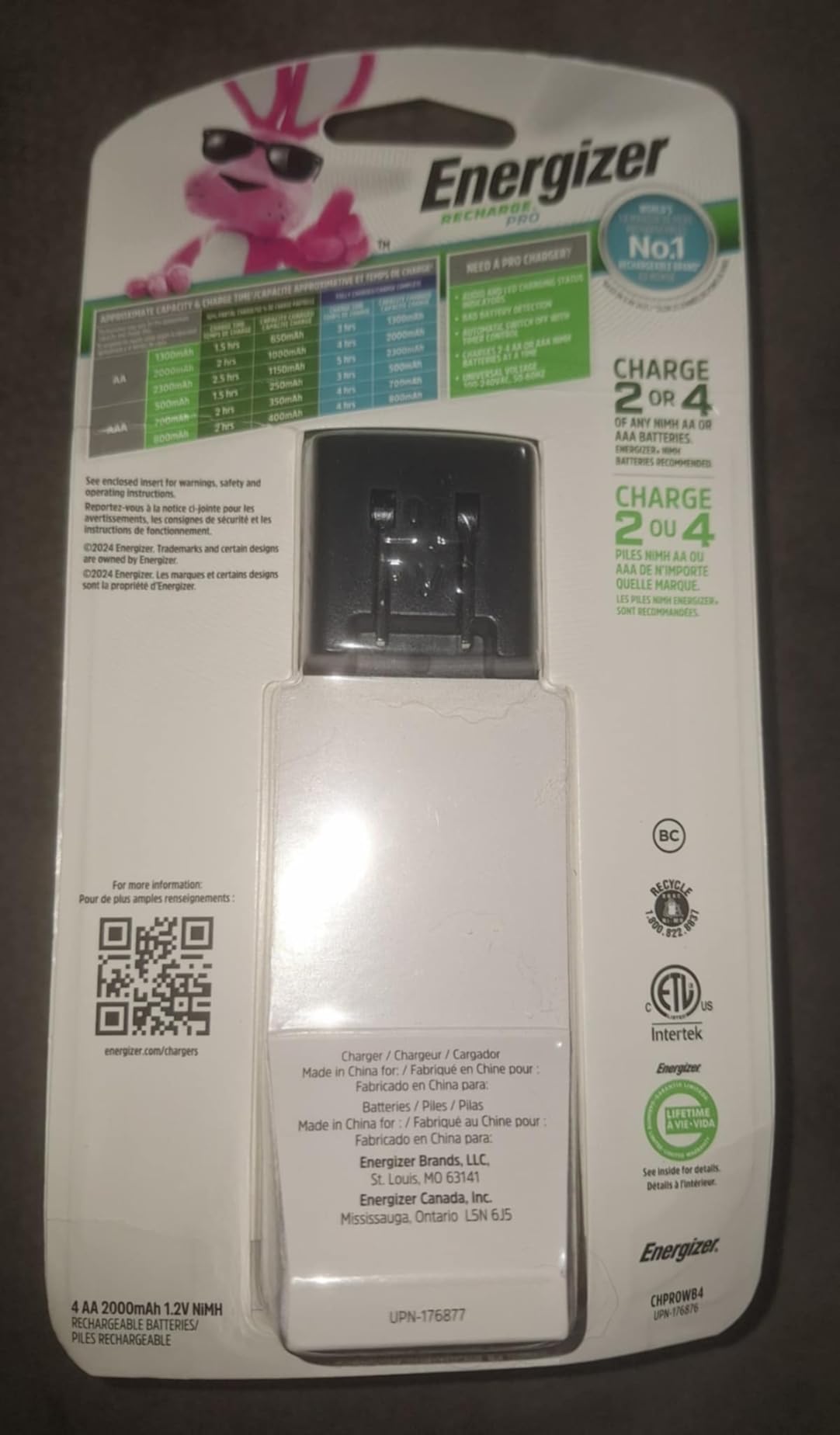
2 or 4 AA/AAA Ni-MH cells
3 hour charge time
Bad battery detector
Auto shutoff
Pros
- Charges 2 or 4 cells in about 3 hours
- Red yellow and green LEDs plus audible beeps
- Bad battery detector flags defective cells
- Auto shutoff and overcharge protection
- Four Ni-MH AA batteries included in the box
Cons
- Only charges 2 or 4 batteries at a time
- No individual per-slot charge readouts
I put this one on the kitchen counter first, and it has stayed there since. The Energizer Recharge Pro is the model most households in this country already own in some form, and the reason is the combination of a three-hour fill time and a bad-battery detector that actually flags a cell instead of quietly cooking it.
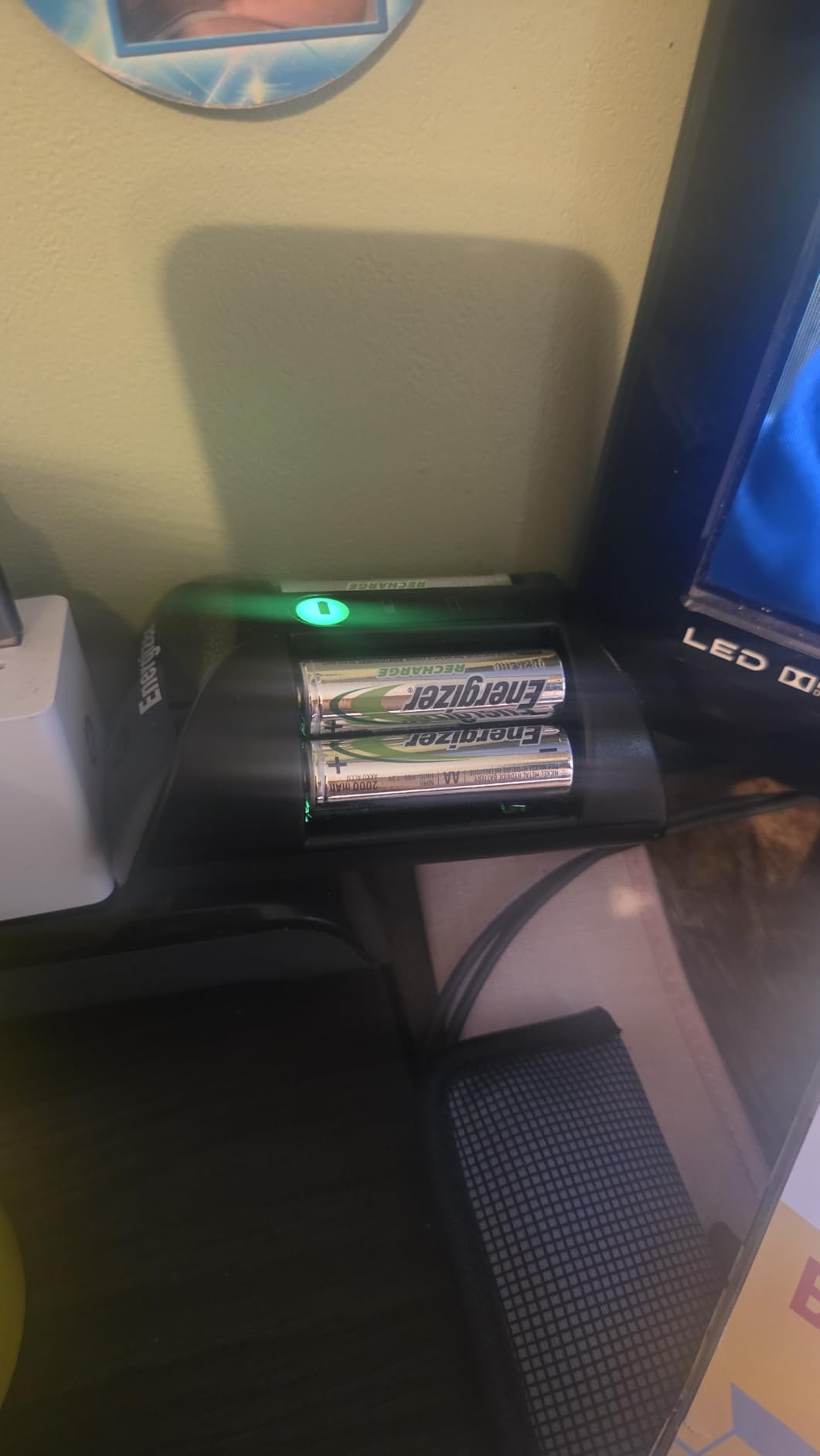
The layout is the main thing to understand before you buy. It takes two or four cells, and that pairing requirement is not a flaw in the electronics, it is the bay design. Charge one AA and one AAA, or three cells and wait for the fourth slot.
Owners rate it 4.6 stars across more than 63,000 reviews, and the recurring theme in those reviews is the indicator system. A red light means charging, yellow means the cell has taken its main charge and is topping off, and green means full. Audible beeps at the start and the end mean you do not have to sit and watch it. The bad-battery detector is the sleeper feature: when a cell will not accept charge, the slot shows a red X and beeps instead of running indefinitely.
Who this charger suits
It suits a household with two to four AA or AAA cells in circulation: a wireless mouse, a TV remote, a couple of kids’ toys, a flashlight. It also suits anyone buying their first set of rechargeable cells, because four Energizer Ni-MH AA batteries are in the box and ready to use.
For travel it is less ideal. The wall plug is a fixed US two-prong type, so outside North America you need an adapter, and there is no USB input to run from a laptop or power bank.
Where it falls short
The odd-count problem is the recurring complaint across those reviews, and it is real. If you cycle five cells a week, three of them wait for the fourth.
It also gives you no information about battery health. There is no display, no per-slot current reading, and no way to tell a tired cell from a good one. If you want that, jump to the analyzer picks further down.
2. Amazon Basics Rechargeable Battery Charger with USB Port: best value travel charger
Amazon Basics Rechargeable Battery Charger for AA & AAA Ni-MH Batteries with USB Port, Portable, Travel-Friendly, Over-Charge Protection, Black
AA and AAA Ni-MH in one unit
4 hour charge time
USB output 500 mA
100-240V switching power
Pros
- Handles AA and AAA Ni-MH cells together
- Cool quiet charging that does not overheat
- Fold-down plug and slim profile for travel
- USB port gives 500 mA output for a device
- Overcharge cut-off and wrong polarity protection
Cons
- Batteries must be charged in pairs
- No fast charging
- No independent bays or health diagnostics
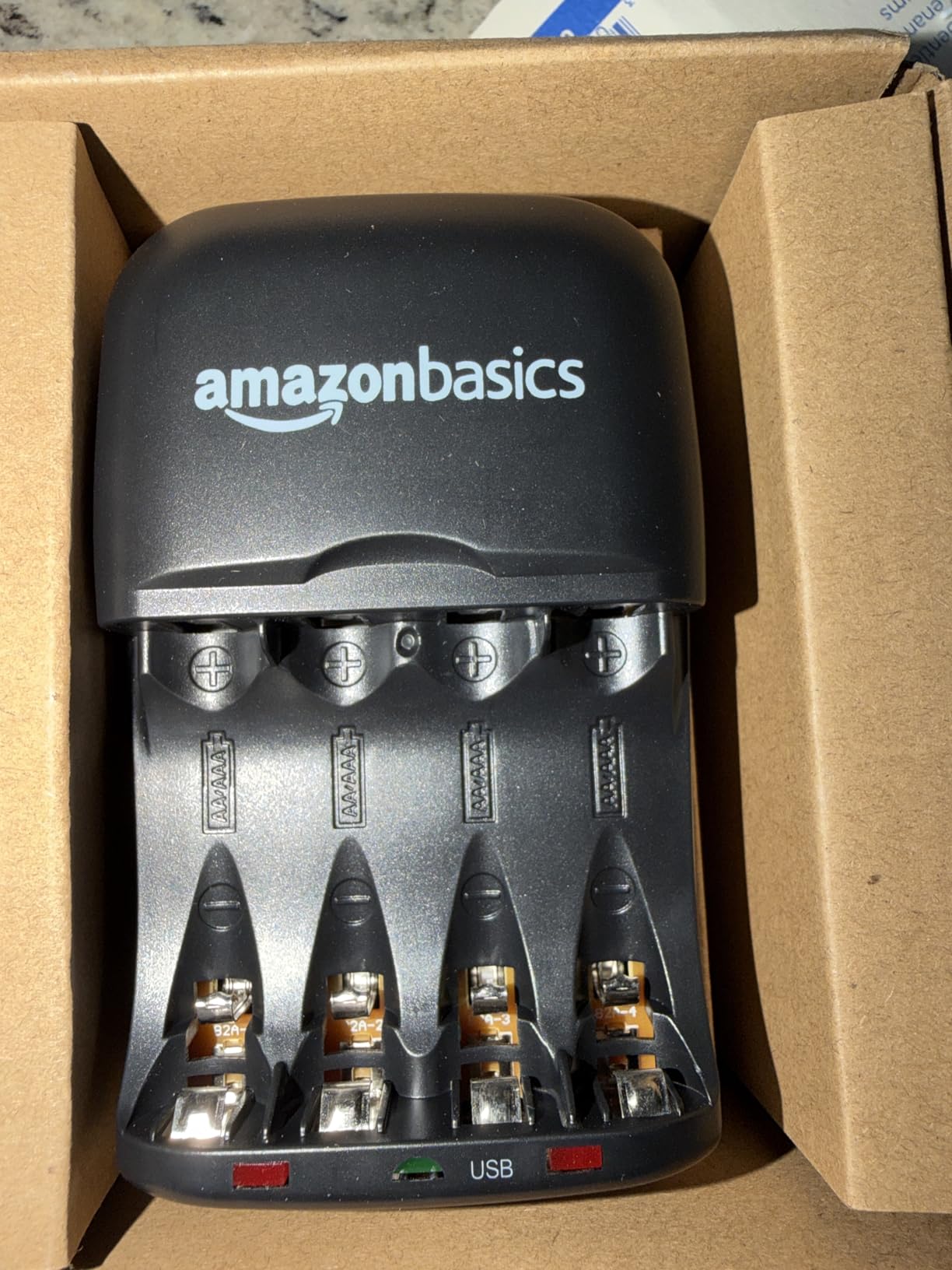
This is the charger I recommend to anyone who wants one object to do everything and does not want to think about it. It is the V-3299USB, it weighs a little over 100 grams, and it charges AA and AAA Ni-MH cells in the same four bays.
The switching supply runs from 100 to 240 volts, so it works on mains power in most countries without a transformer. The plug folds down into the body, which is why it fits in a laptop bag better than almost anything else in this list. The side USB port delivers up to 500 mA, enough to top up a phone that is nearly flat while your cells charge.
Reviewers consistently describe it as cool-running and quiet, and the 4.5-star average across more than 33,000 reviews reflects that reliability rather than excitement. For a charger that does one job, that is exactly the profile you want.
Who this charger suits
It suits travel, dorm rooms, and anyone whose only option is a laptop USB port or a power bank on the road. It also suits someone who just wants AA and AAA handled without changing anything.
If you already own a good set of cells, the flat four-hour cycle is acceptable. Charging from a wall is faster than charging from a laptop port.
Where it falls short
It charges in pairs only, so a single cell cannot be topped up on its own. That is the same limitation as the Energizer above, and it is the reason we rank this one second rather than first despite the strong review count.
There are no individual bay readouts and no test modes. If you are sorting old cells and want to know which ones are still worth keeping, this is the wrong tool.
3. POWEROWL 8 Bay Charger: best high-bay charger for mixed counts
POWEROWL 8 Bay AA AAA Battery Charger, USB High-Speed Charging, Independent Slot, for Ni-MH Rechargeable Batteries, No Adapter
8 independent bays
AA and AAA Ni-MH and Ni-CD
USB input
Trickle charge finishing
Pros
- Any number of batteries without pairing
- Automatic stop when a cell reaches full
- Trickle charge tops cells up to 99 percent
- USB input works with laptop car or phone charger
- Runs cool with AA and AAA in the same unit
- Micro USB cable and 18-month warranty included
Cons
- Wall adapter not included
- Charge times are slower than higher-current chargers
Eight bays is the number most people actually need, and the POWEROWL ZN825E is the version that makes eight genuinely useful. Every bay runs on its own, so you can drop in one cell, three cells, or a mix of AA and AAA and nothing waits for a partner.
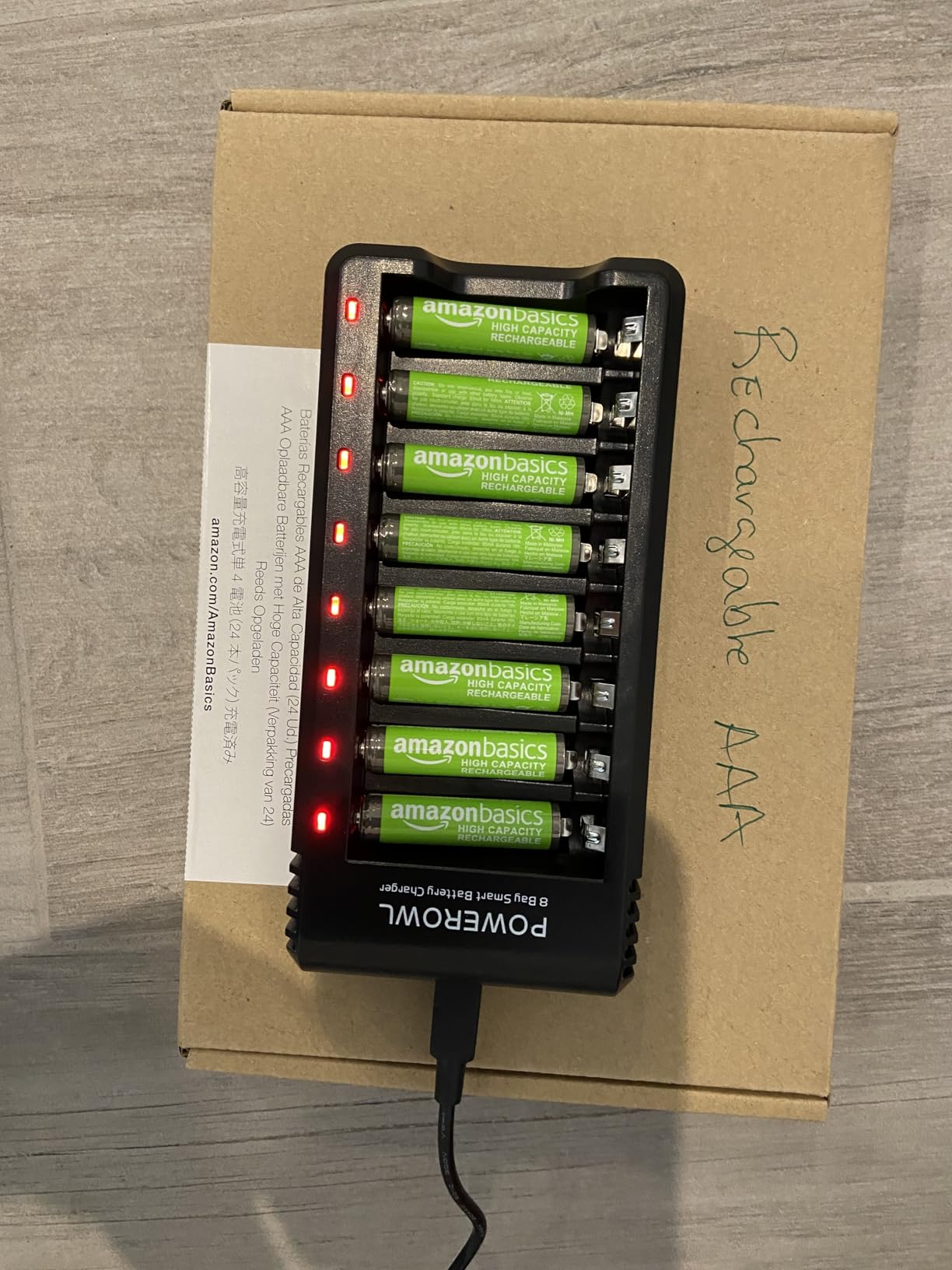
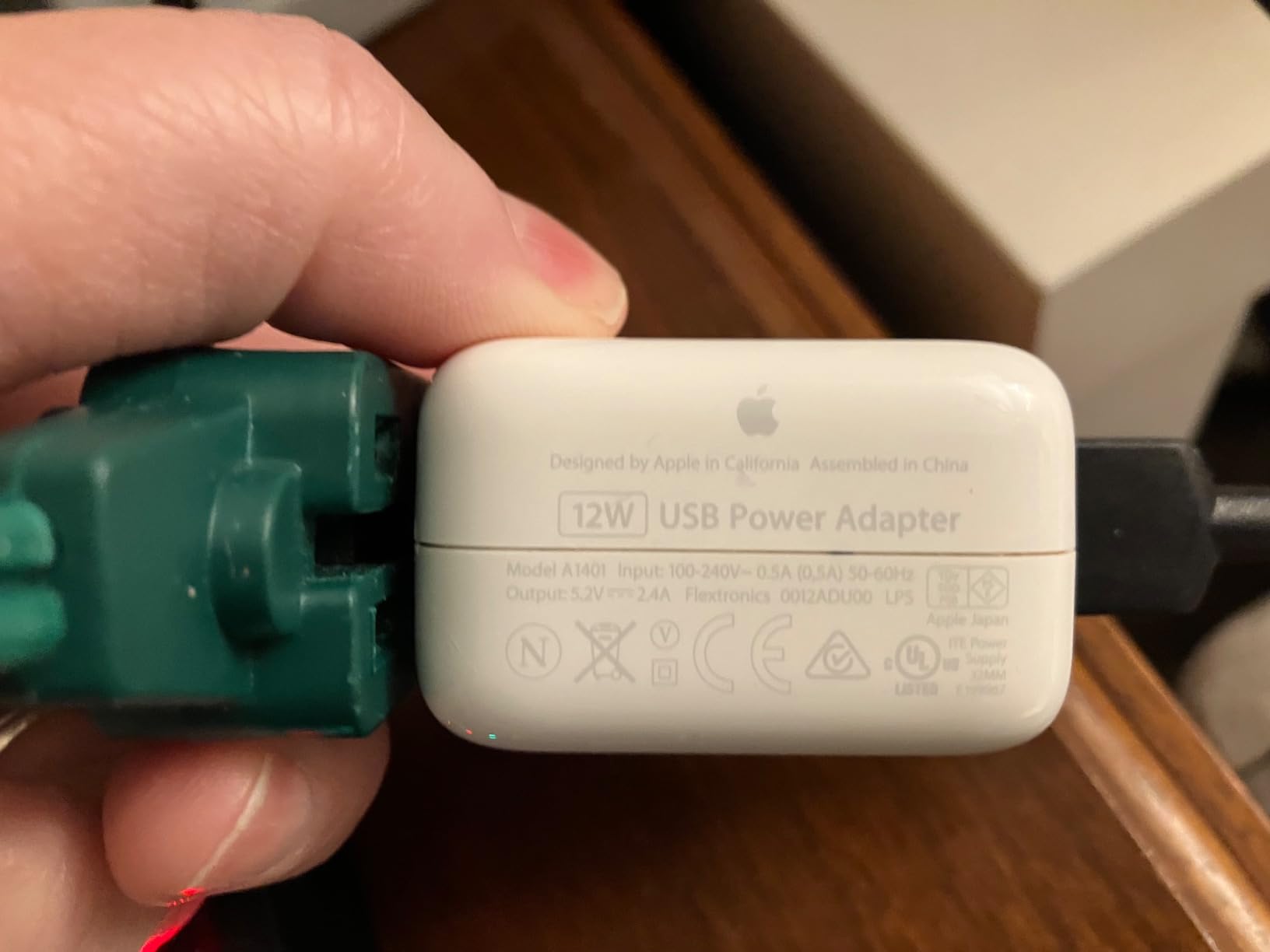
Power comes in over a micro USB cable, and the cable is in the box. The wall adapter is not, so you need a 5V source of your own. A laptop port works, a car charger works, and a phone plug works, though the manufacturer suggests 5V and 2A for the best results.
This is the model that shows up constantly in the high-bay discussion on r/batteries, where people weighing 8-bay and 16-bay units ask whether the extra capacity is worth it. Owners of this one generally report that it runs cool, charges both chemistries it accepts, and stops each channel on its own via the charge controller.
Who this charger suits
It suits a household that has already made the switch to rechargeable cells and keeps finding it runs out. Camera gear, flashlights, a wireless keyboard, a doorbell, a couple of microphones: that is the AA battery life that eats eight bays.
It also suits anyone who has been frustrated by pair charging. Moving from a paired charger to eight independent bays is the single biggest quality-of-life jump in this whole list.
Where it falls short
Charge time is the trade-off. The listed charge time is around ten hours, and at 250 milliamps per cell the fill time on high-capacity AA cells is long enough that you plan around it rather than expecting a quick top-up.
Leaving out the wall adapter is an odd choice for a first-time buyer, and there is no per-slot readout beyond an LED, so you cannot see progress or remaining capacity.
4. Duracell Ion Speed 1000: best for families buying a bundle
Duracell Ion Speed 1000-Battery-Charger for AA and AAA-Batteries, Includes 4 Pre-Charged AA-Rechargeable-Batteries, for Household and Business Devices
4 AA or 4 AAA per cycle
Independent channels
6 hour charge
4 pre-charged cells included
Pros
- Independent channels let you charge one cell or several
- Overcharge protection with smart detection and auto shutoff
- Trickle charge keeps cells topped up
- Four pre-charged AA batteries ready out of the box
- Energy Star certified
Cons
- Clear plastic spacer must be removed from the middle bays
- 6-hour charge time is slow
- Rechargeable cells look like the disposable ones
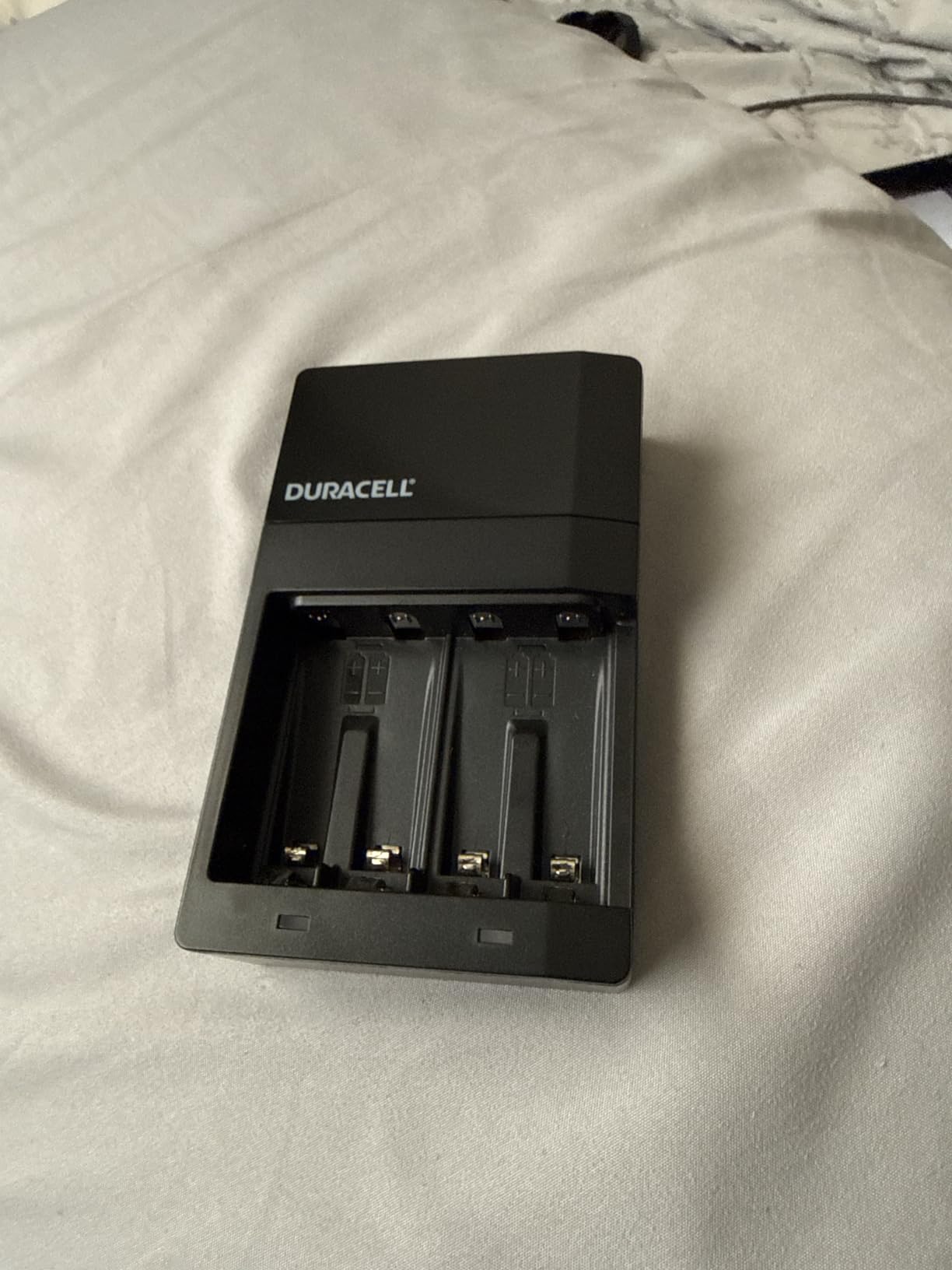
The Duracell Ion Speed 1000 solves a problem the other chargers here do not: it ships with four pre-charged AA cells that you can use the minute you open the box. For a household that is starting from zero, that removes the awkward two-week wait while your first cells charge.
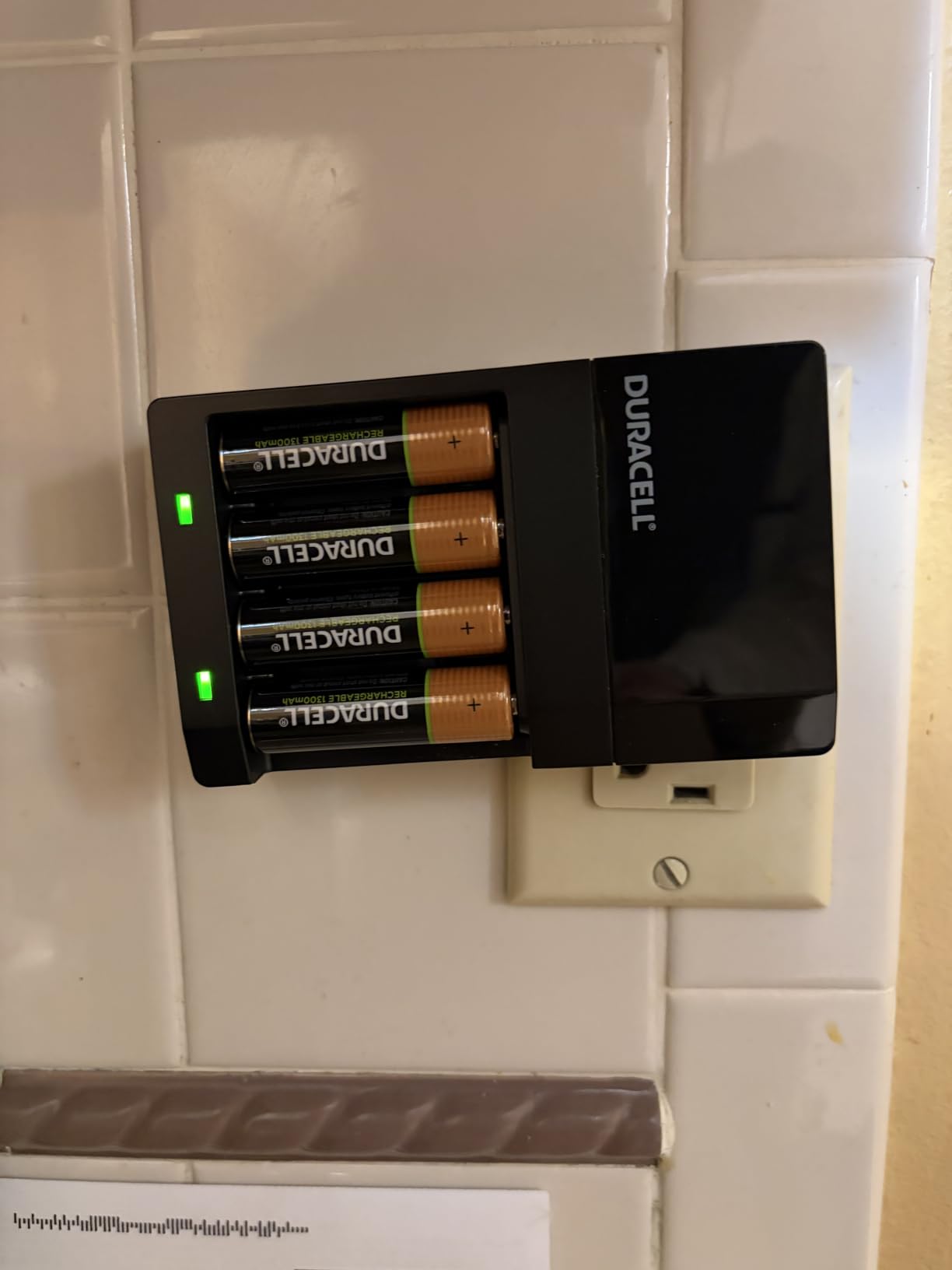
It charges four AA or four AAA at a time, works with other brands of Ni-MH cells, and has independent charging channels so a single cell is not forced into a pair. The included StayCharged cells carry a three-year storage guarantee, and they use a locking layer that the company says resists leakage.
At 4.6 stars across more than 20,000 reviews, the durability feedback is strong. Owners compare the build favourably to specialist chargers and report that it keeps working after years of daily use.
Who this charger suits
It suits families buying everything at once: charger, four cells, and a charger that will still be there in five years. It also suits anyone who wants a mainstream-brand charger they can recognise and replace easily.
Because the channels are independent, it works fine for a household that only has two cells in rotation as often as it does for a family that has eight.
Where it falls short
The most cited gotcha in the reviews is physical, not electrical. A clear plastic spacer sits across the middle bays, and if you do not remove it, batteries simply will not charge. Owners have returned units over it. Pull it out before the first cycle.
The six-hour charge time is slow next to the three-hour units, and the rechargeable cells look almost identical to disposable Duracell AA, which matters if your household has a junk drawer full of mixed batteries.
5. BONAI 16 Bay Charger: best for large battery collections
BONAI AA AAA Battery Charger 16 Bay for NiMH Rechargeable Batteries Independent Control with LED Light and Standard American AC Charging Plug, Battery not Included – Black
16 independent bays
Any mix of AA and AAA
Ni-MH only
Attached AC cord
Pros
- Charge any number of cells without pairing
- Red and green LEDs with flashing red for a defective cell
- AC cord rated 110-240V with no power brick
- Silent operation that stays cool
- Deep bay contacts that grip cells firmly
Cons
- LEDs show charging versus done only
- Empty bays keep their LEDs lit
- Charge time stretches when fully loaded
- Batteries not included
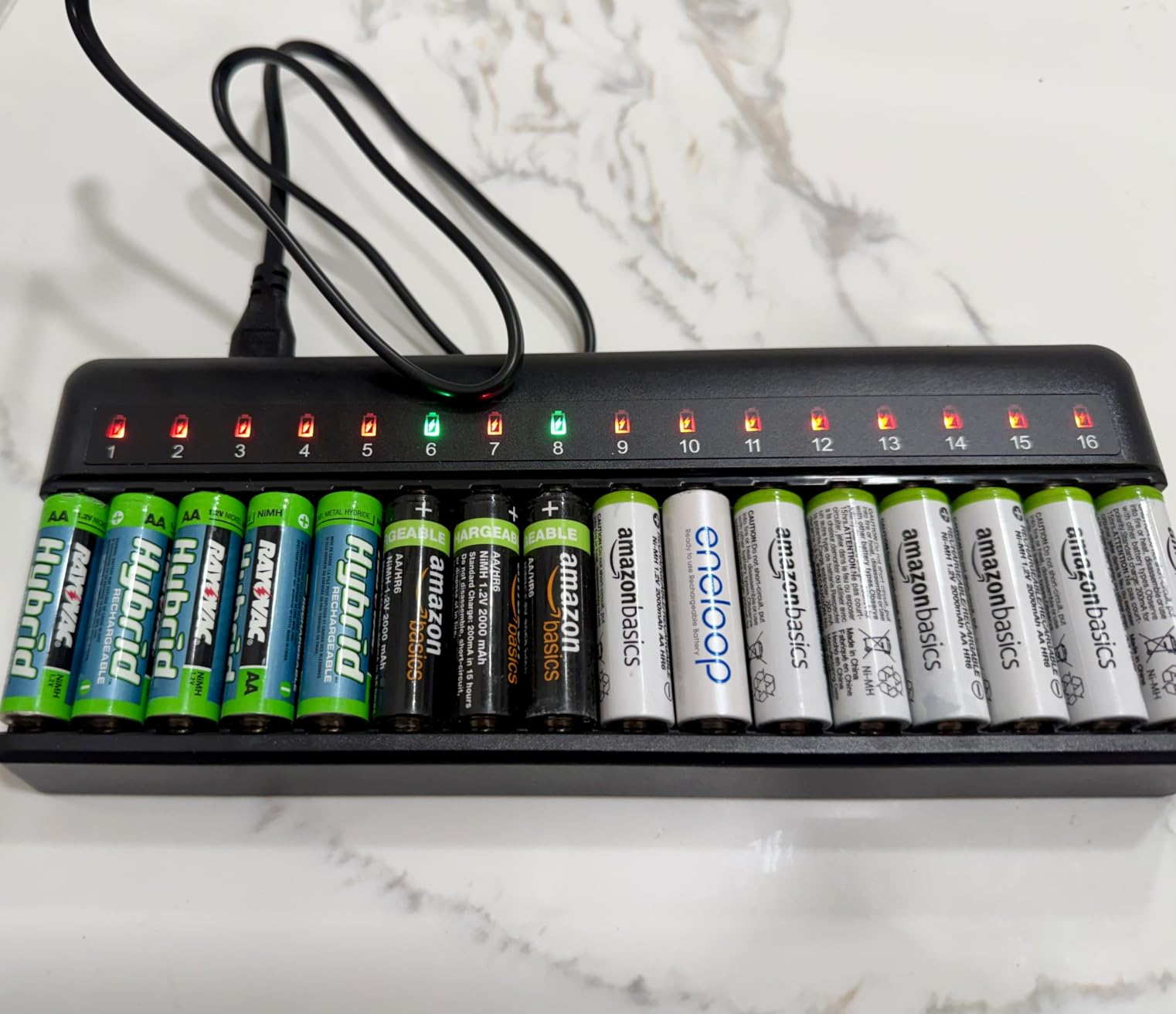
Sixteen bays is not a household number. It is the number you need if you run wireless microphones, stage a theatre show, or keep a wall of cells for camera flashes. The BONAI MY-C006 charges all of them at once with no pairing and no juggling.
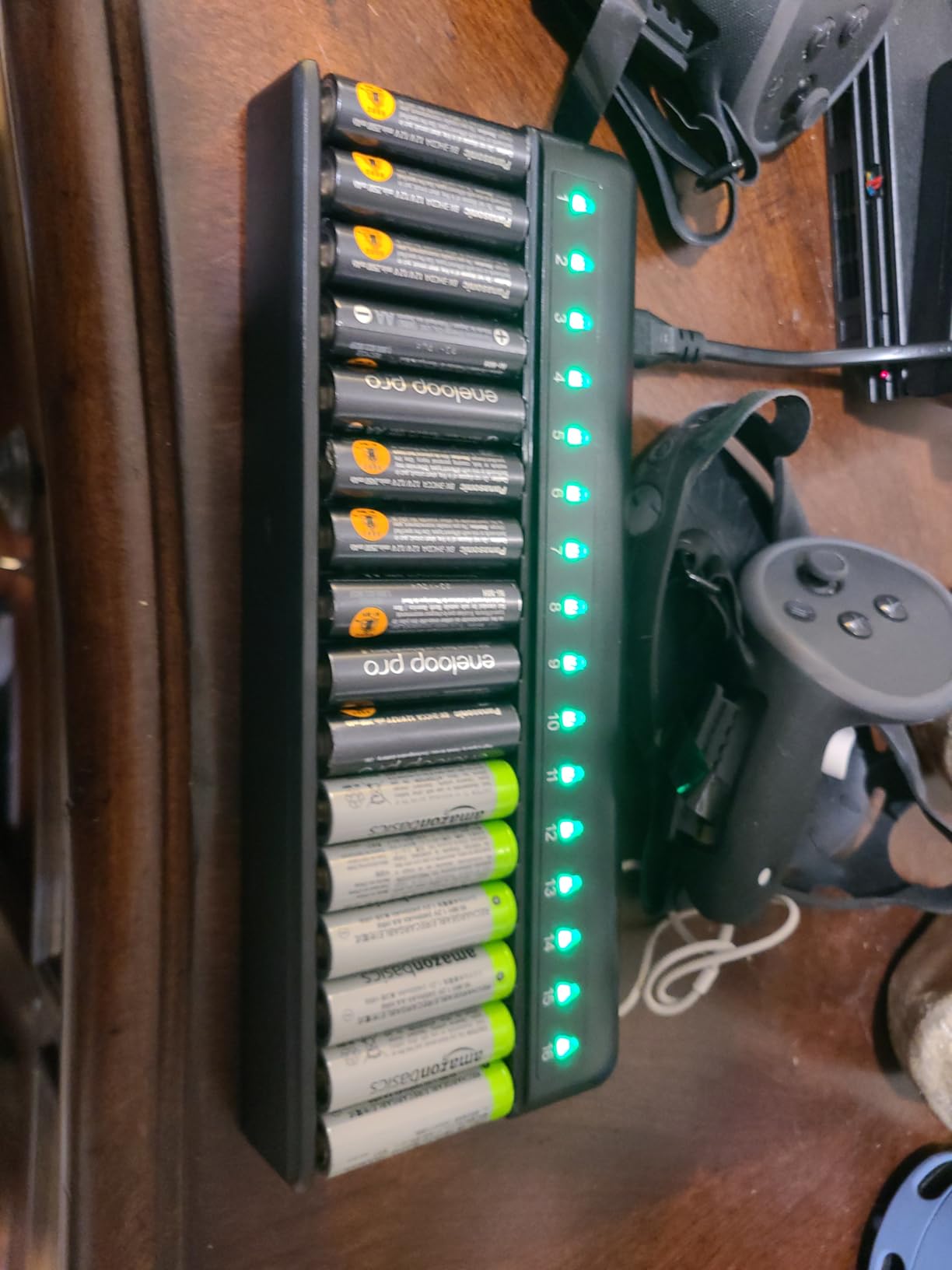
The power comes from an attached cord rated 110 to 240 volts rather than a bulky wall brick, which keeps the desk or shelf clear. Protection covers overcharge, overvoltage, overcurrent, overheating, short circuit and reverse polarity, and the charger is UL, CE and FCC marked with a 12-month guarantee behind it.
BONAI is one of the brand names that comes up repeatedly in the r/batteries thread about 8-bay and 16-bay units, and the practical feedback there is about bay build quality. Owners here single out the deep contacts, which grip AA and AAA cells firmly and still release without force.
Who this charger suits
It suits people who cycle more than eight cells a week, or who want everything back on the shelf in one session instead of four. Wireless audio packs are the classic case.
It also suits anyone who wants independent bays and a mains cord, with no adapter to find and no laptop in the loop.
Where it falls short
The indicators are binary. A red LED means charging and green means done, so there is no progress bar, no remaining capacity, and no way to tell a full cell from a nearly full one. If you care about cell health, this is the wrong end of the market.
Two more practical notes: the manufacturer states plainly that total charge time increases as you load more batteries, and the empty bays keep their LEDs lit whenever the charger is plugged in, which some owners find distracting. Ni-MH is the only chemistry it accepts.
6. Zanflare C4 LCD Charger: best multi-chemistry charger with a real readout
Zanflare C4 LCD Display Speedy Universal Smart Battery Charger,Battery Capacity Analyzer for Rechargeable Batteries, aa Battery Charger, 18650 Battery Charger
AA, AAA, 18650, 14500 and 26650
Voltage, current, mAh and resistance readout
4 charge currents to 1000mA
Power bank output
Pros
- Backlit LCD reports voltage
- current
- time
- mAh and internal resistance
- Each bay runs its own mode and current
- Four charge currents up to 1000mA
- Fast Test and Normal Test expose worn cells
- Includes both a wall adapter and a car adapter
Cons
- AA and AAA cells rock in the half-circle slots
- Display shows one measurement type at a time
- No LiFePO4 support and no automated refresh cycle
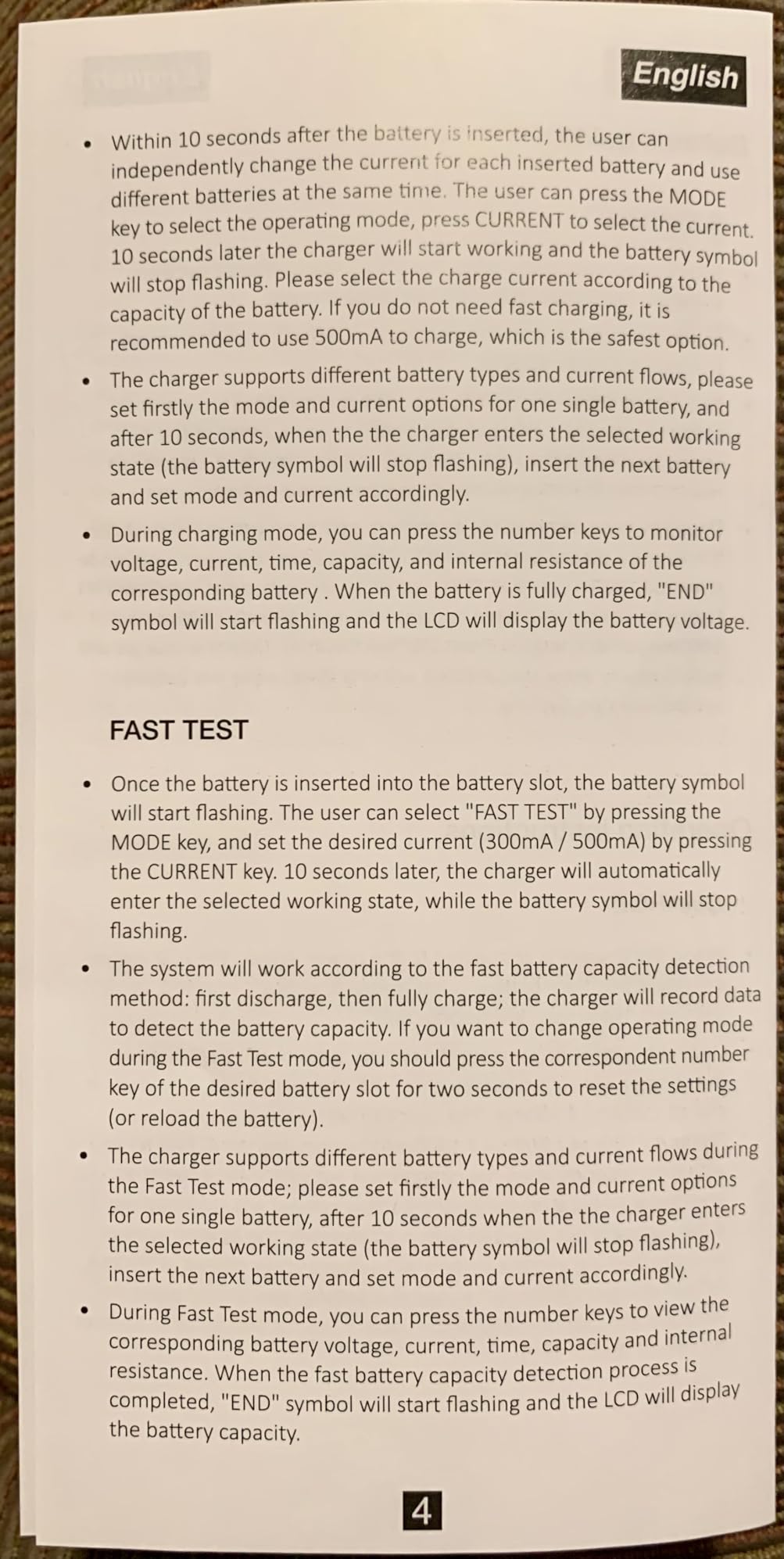
The Zanflare C4 is where the list turns from household chargers into instruments. Four independent slots handle AA, AAA, 18650, 14500 and 26650 cells across NiMH, NiCd and Li-ion chemistries, and the backlit LCD reports voltage, current, elapsed time, capacity in mAh and internal resistance per slot.
You can select from four charge currents up to 1000 milliamps, and the CHARGE, FAST TEST and NORMAL TEST modes can run at the same time on different slots. That means you can refresh a set of tired cells on two bays while fresh cells charge on the other two, which is the feature enthusiasts care about most.
Owners report real-world fills of roughly an hour and a half for high-capacity AA and AAA at 700 mA and 500 mA, and the unit stays cool without a fan. The 5V 2A USB output works as a power bank when the charger is unplugged and Li-ion cells are fitted. Wall adapter and car adapter are both in the box, with a one-year warranty.
Who this charger suits
It suits anyone who already owns Li-ion 18650 or 14500 cells and wants one dock for everything, and anyone sorting a drawer of mixed old cells who needs to know which are worth keeping before they buy replacements.
Test mode is the honest reason to buy it. A cell that is mislabelled or worn will show a low or blank mAh result, and that is information you cannot get from an LED.
Where it falls short
AA and AAA cells sit in half-circle slots designed for cylindrical cells, and owners report that they rock and need more effort to seat. The metal contact sliders are also described as slightly bendy.
The screen shows one measurement type at a time with poor viewing angles, internal resistance readings shift noticeably when you reinsert a cell, and Ni-MH capacity tests sometimes finish with a blank mAh figure. There is no LiFePO4 support and no automated discharge-and-refresh cycle.
7. EBL Smart Rapid Charger: the one that also handles 9V cells
EBL Smart Rapid AA AAA Charger for AA AAA 9V Rechargeable Batteries Ni-MH Ni-CD Rechargeable Batteries
AA, AAA and 9V rechargeable cells
MCU controlled Delta V pulse charging
100-240V input
3.2 ounces
Pros
- AA
- AAA and 9V rechargeable cells in one compact unit
- MCU control with Delta V pulse charging prevents overcharge
- Red charging and green full LED indication
- 100-240V input works worldwide
- Only 3.2 ounces
Cons
- AA and AAA cells must be charged in pairs
- No per-bay status beyond a single red and green light
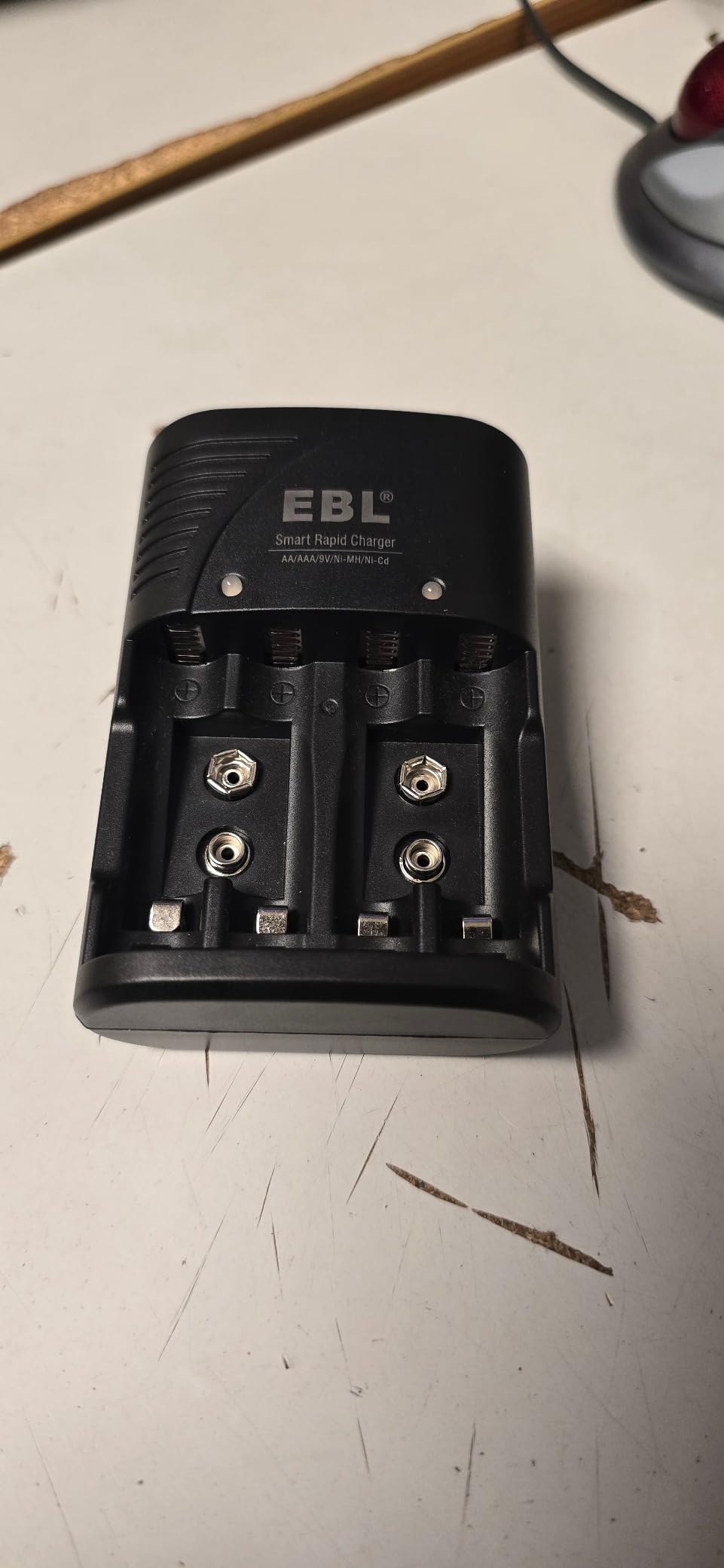
Most AA chargers ignore the 9V cell rattling around in the same junk drawer. This EBL unit, model C802, takes two or four AA or AAA cells plus one or two 9V rechargeables, and it does it in something you could put in a coat pocket.
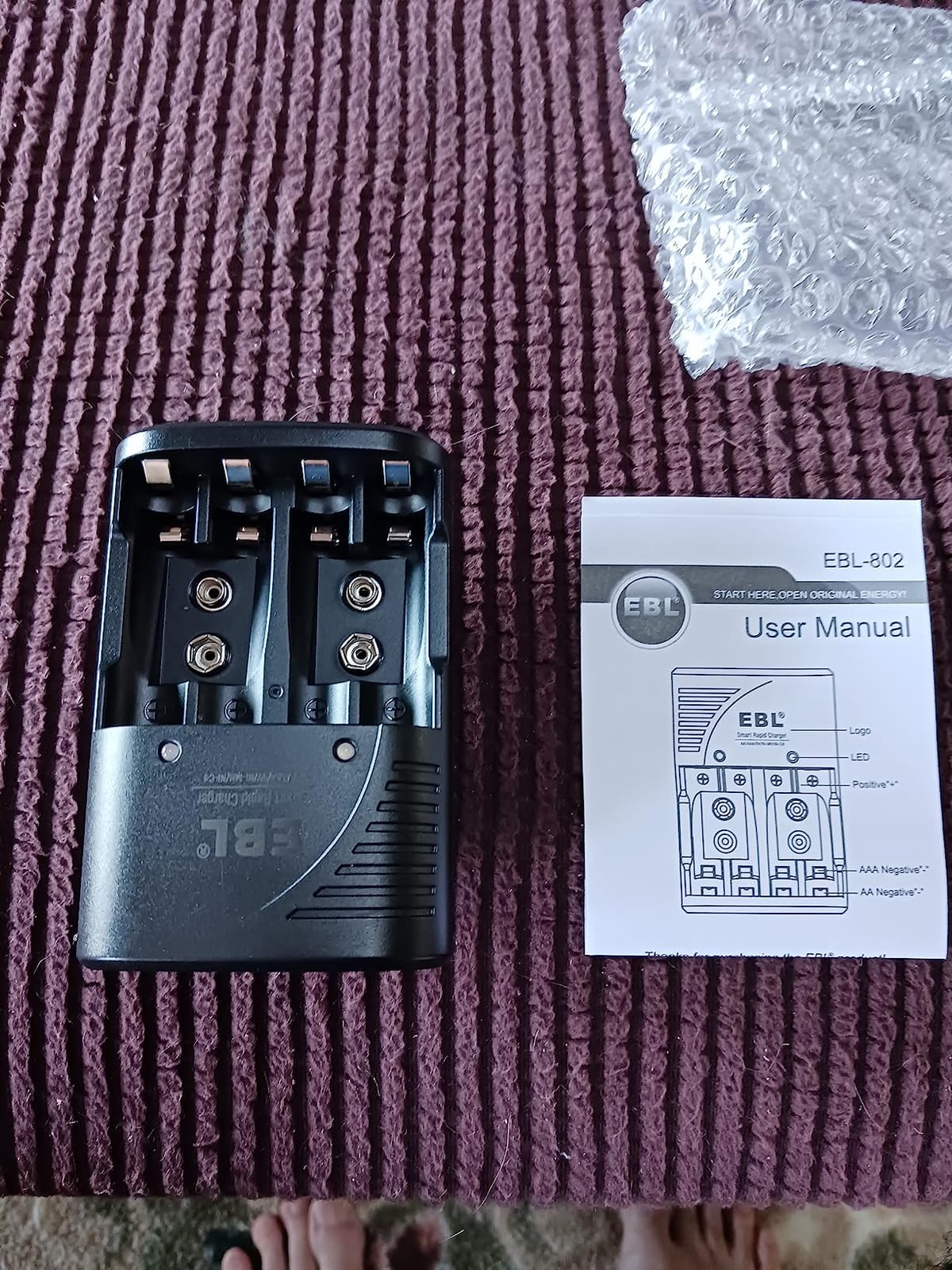
The electronics are the reason to notice it at this size. An MCU controls the charge using Delta V pulse technology, which is the standard way of detecting a full cell as its voltage dips, and the protection covers overcharge, overdischarge, overcurrent and overheating. The 100 to 240 volt input works on mains power worldwide at 50 or 60 Hz.
At 4.5 stars across roughly 2,000 reviews, the feedback is that it is small, safe and does exactly one thing quietly. The 4-hour charge time and paired AA and AAA bays are the accepted limits.
Who this charger suits
It suits a household with a smoke detector, a wireless alarm panel, or a small radio that still takes 9V cells. It also suits anyone who wants a second charger that lives in a travel bag rather than on a desk.
Because it handles NiCd as well as NiMH, it is also a sensible way to support older rechargeable gear that has not been replaced yet.
Where it falls short
AA and AAA cells must be charged in pairs, so three cells means two slots stay empty. And there is a single red or green LED per pair, with no per-bay display or progress indication.
If you cycle more than four AA cells a week, the eight-bay and 16-bay options in this list will serve you better despite being larger.
8. OPUS BT-C2400: best charger for battery analysis and recovery
BT-C2400 Battery Charger Analyzer Tester for AA AAA NiMH NiCd Rechargeable Batteries
4 independent channels
Charge, discharge, refresh and test modes
Internal resistance measurement
Up to 20000 mAh cells
Pros
- 4 independent channels behave like four separate chargers
- Backlit LCD reports capacity
- voltage
- time and current
- Full charge
- discharge
- refresh and test cycle
- Handles large cells up to 20000 mAh
- Simple to set up
Cons
- Most expensive charger analysed here
- Not a high-volume charger for bulk work
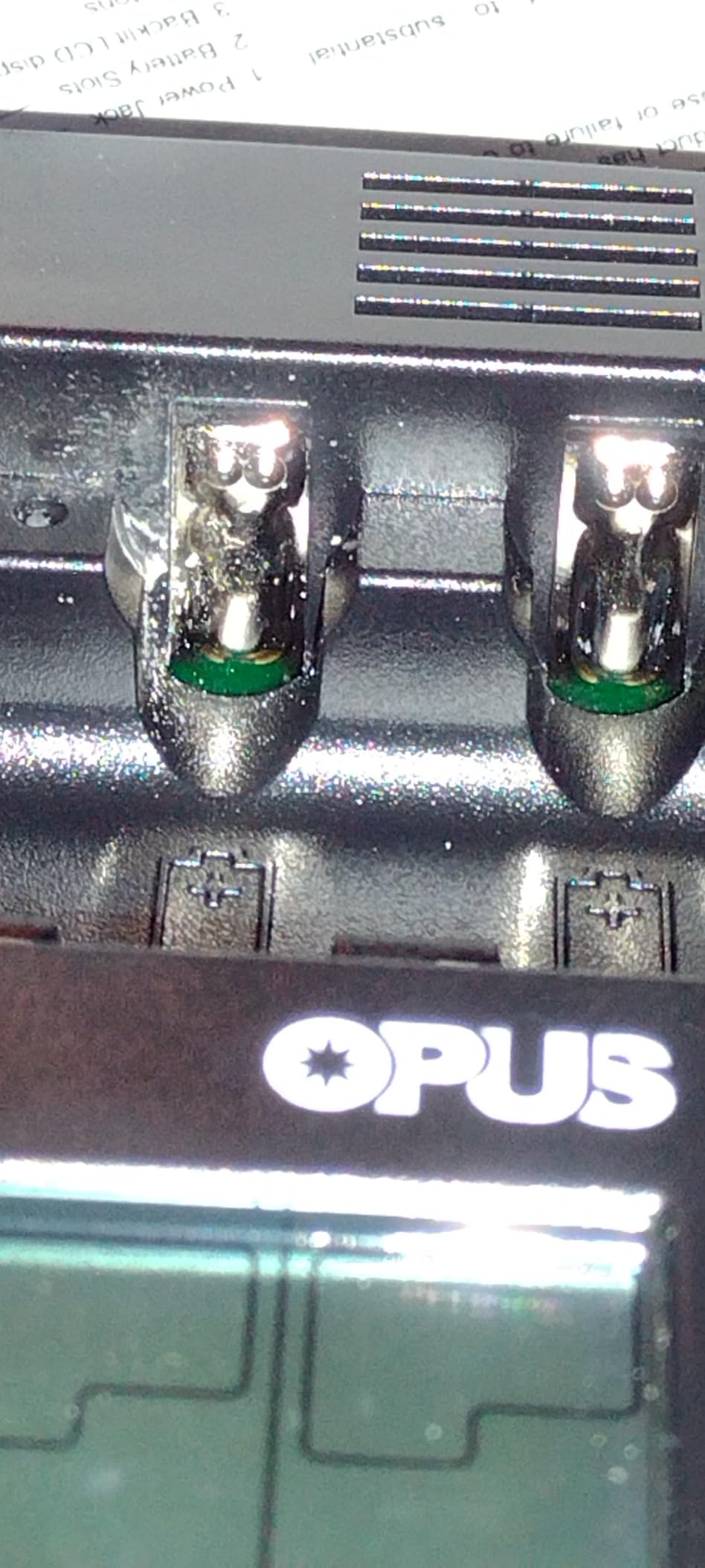
The OPUS BT-C2400 has the highest average rating in this group at 4.7 stars, and it earns it by being a genuine battery analyzer rather than a charging dock with a display. Four independent channels can be configured one at a time or all together, and each runs its own program.
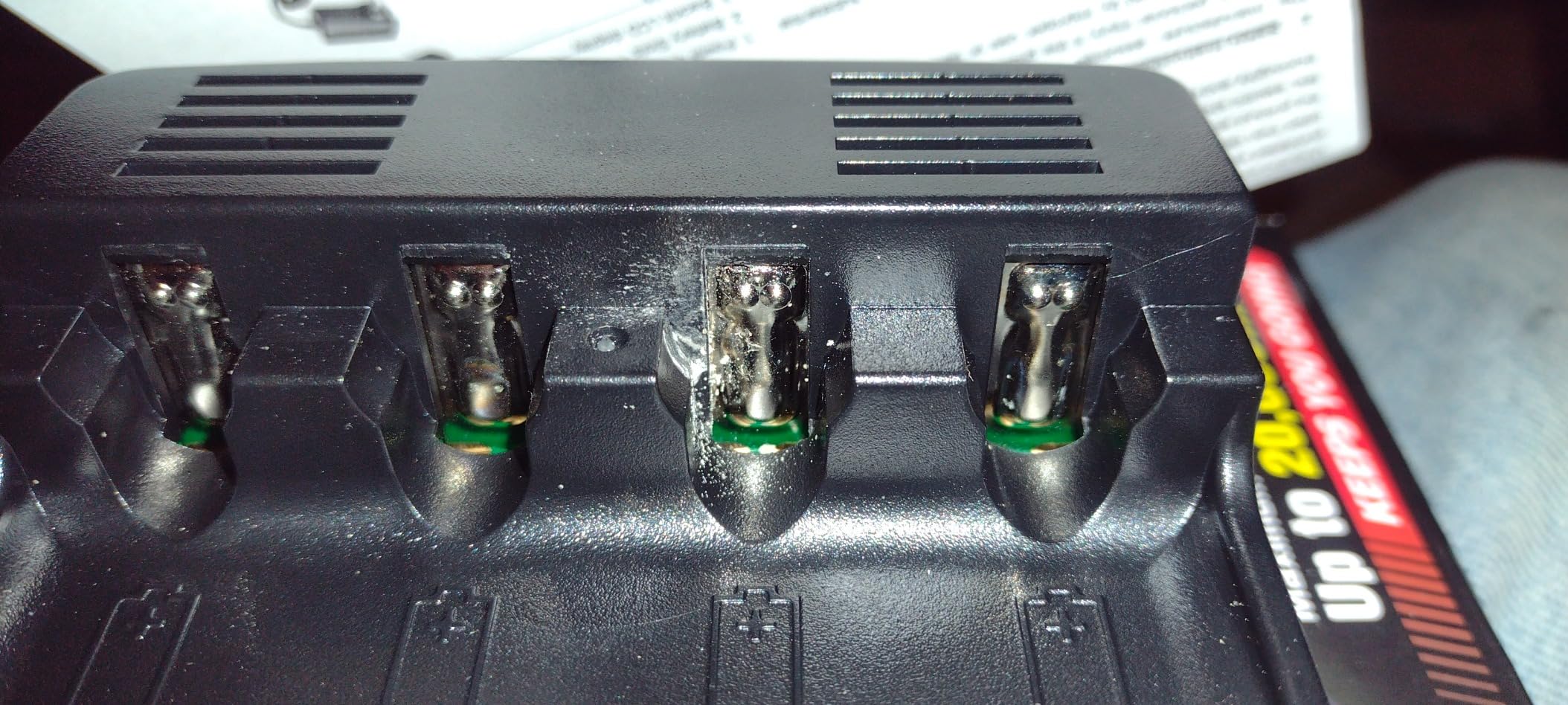
Those programs are the reason to buy it. Charge does the obvious thing. Discharge drains a cell to a set depth. Refresh cycles a cell until its measured capacity stabilises, which is what rescues cells that have been left flat in a drawer for years. Test gives you a capacity figure. Internal resistance measurement is included, and the unit handles cells up to 20000 mAh.
The backlit LCD reports capacity, voltage, elapsed time and current per channel. At 1400 milliamps of available current it is not slow, but as owners point out, this is a maintenance and testing tool rather than a bulk charger, and it is the most expensive unit we analysed.
Who this charger suits
It suits anyone with more than a dozen cells who wants to know which ones are still worth keeping. Photographers with a shelf of old Ni-MH cells, and anyone who has inherited boxes of mixed cells, get the full value from Test mode.
It also suits anyone who stores batteries seasonally. A Refresh cycle before storage returns a tired cell to a usable state instead of letting it sit at a low charge.
Where it falls short
Cost is the first limit. It carries the highest price of the ten chargers here, and its review count is much smaller than the mainstream-brand models, so you are buying a specialist tool.
Four bays will not serve a large collection quickly, and running full discharge and test cycles takes hours per cell, so it is a weekend activity rather than a nightly one.
9. Amazon Basics Smart 4-Bay Charger: best budget four-bay charger
Amazon Basics Smart Battery Charger for Rechargeable AA and AAA NiMh Batteries, 4-Bay, Fast Charging with LED Indicators, Overcharging Protection, NA Plug, Black
4-bay Ni-MH charger
Individual cell charging
2 AA in 3.5 hours, 4 AA in 7 hours
Foldable AC plug
Pros
- Charges each cell individually instead of in pairs
- Per-bay LEDs show which cell is still going
- Only 3.84 ounces with a foldable plug
- Wrong polarity detection and overcharge cut-off
- 100-240V switching power for international use
Cons
- Four AA batteries take about 7 hours
- Flashing LEDs are distracting in a dark room
- Some units stop charging a bay
- Needs a plug converter outside North America
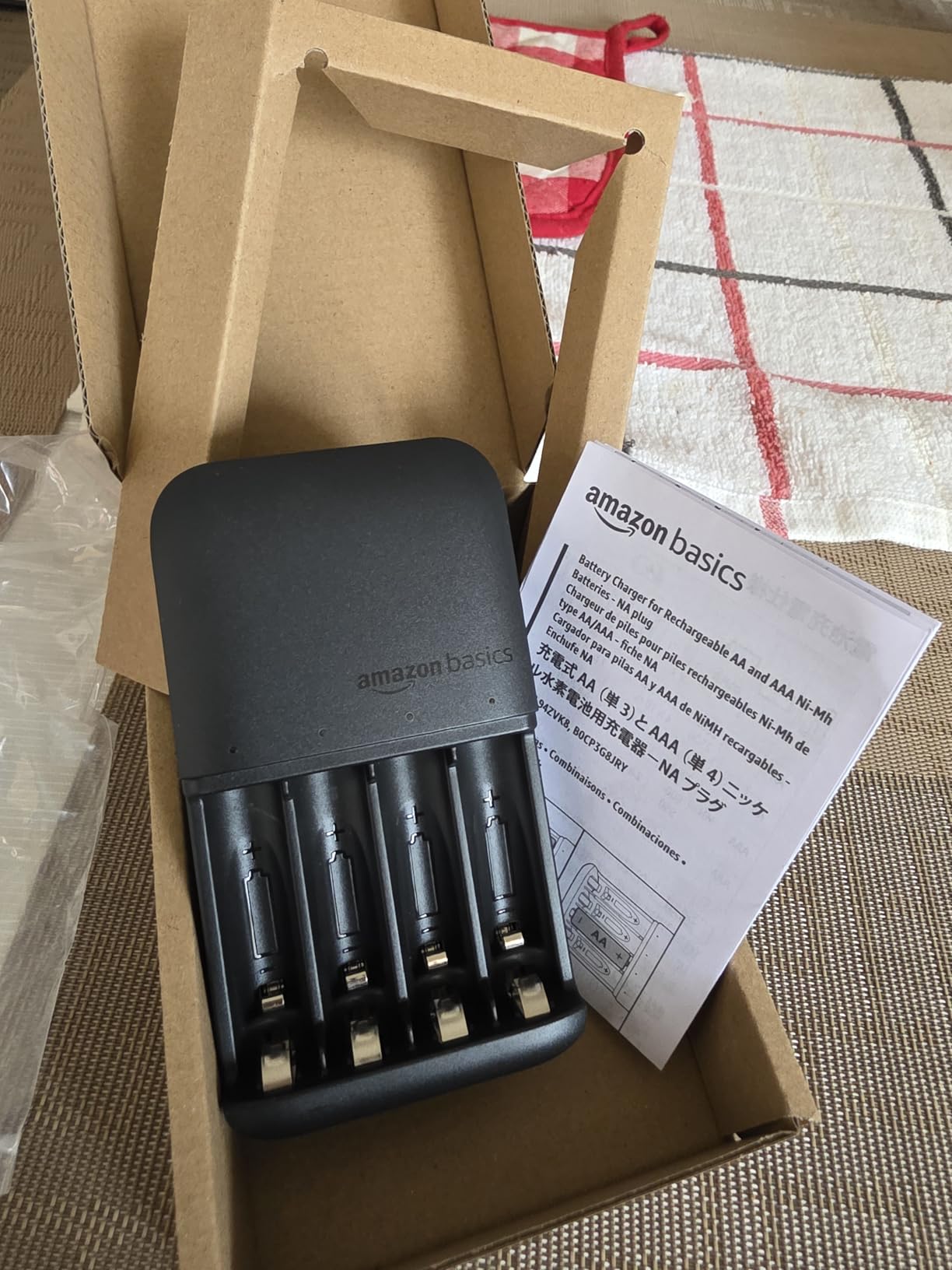
Individual cell charging in a four-bay unit at a budget price is unusual, and that is the whole pitch of this one. The Amazon Basics Smart charger, model CK1209US, charges one cell, two cells, three or four, with no pairing rule at all.
The stated timings are worth knowing before you buy: two AA cells in 3.5 hours, four AA in 7 hours, two AAA in 2 hours, four AAA in 4 hours. The flip-down plug and 100 to 240 volt switching power make it easy to pack, and at 3.84 ounces it is one of the lightest units here.
Protection covers wrong polarity, which cuts the bay off, plus an overcharge cut-off that switches the cell to trickle once it is full. The 4.3-star average across 840 reviews is the lowest of the mainstream units, and the reason is visible in the owner feedback: slower fills and some units reporting a bay error.
Who this charger suits
It suits someone with two to four cells in rotation who currently has nothing, or who is replacing a paired charger and does not want to pay analyzer prices. Individual bays also let you top up a single cell between uses.
Because the body is slim with a foldable plug, it works as a travel charger where a mains brick would be awkward.
Where it falls short
Seven hours for four AA cells is the honest limit, and it is the main reason this sits below the faster units despite the independent bays. Plan a cycle overnight.
Owners also mention blinking LEDs that are distracting in a dark room, and a minority who report one bay showing an error light and stopping. It is also Ni-MH only, so NiCd cells will not charge.
10. EBL LCD 4 Bay Charger: best four-bay charger with USB-C input
EBL LCD Battery Charger for AA AAA NiCD NiMH Rechargeable Battery 4 Bay
1 to 4 AA or AAA Ni-MH and Ni-Cd
Dual micro USB and Type-C inputs
Per-channel LCD status
500 mA per bay
Pros
- Four independent bays accept one to four cells
- Up to 500 mA per bay charges four 2000 mAh AA in about 4 hours
- Dual micro USB and Type-C inputs
- High-definition LCD shows per-channel status
- Detects non-rechargeable and defective batteries
Cons
- LCD switches off after 5 seconds when idle
- No wall adapter included
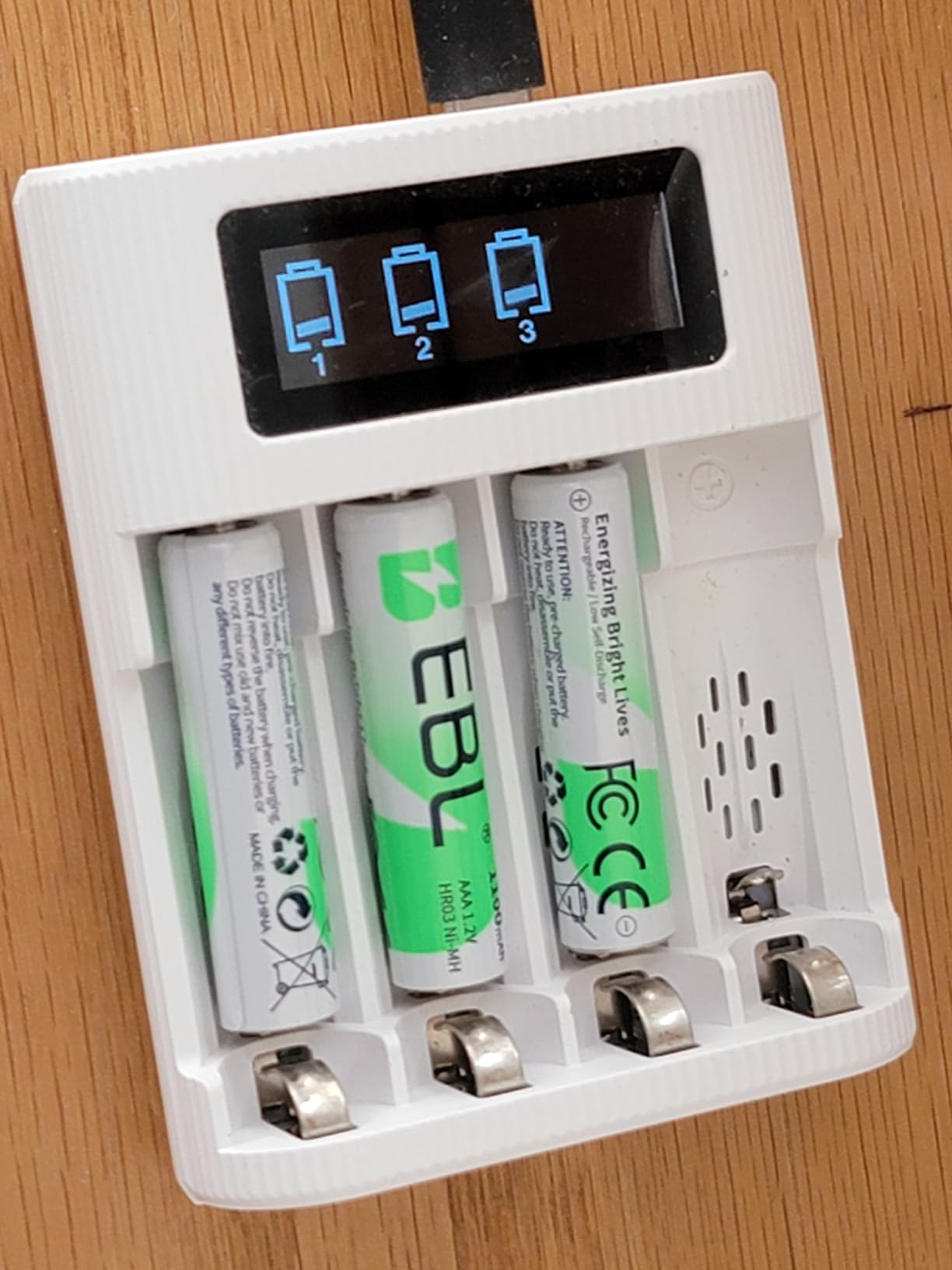
Most USB-input AA chargers shipped years ago with a micro USB port that no cable you own fits any more. The EBL FY-409 has both: a micro USB input and a Type-C input, so you can use a phone charger, a laptop brick or a power bank without hunting for the right lead.
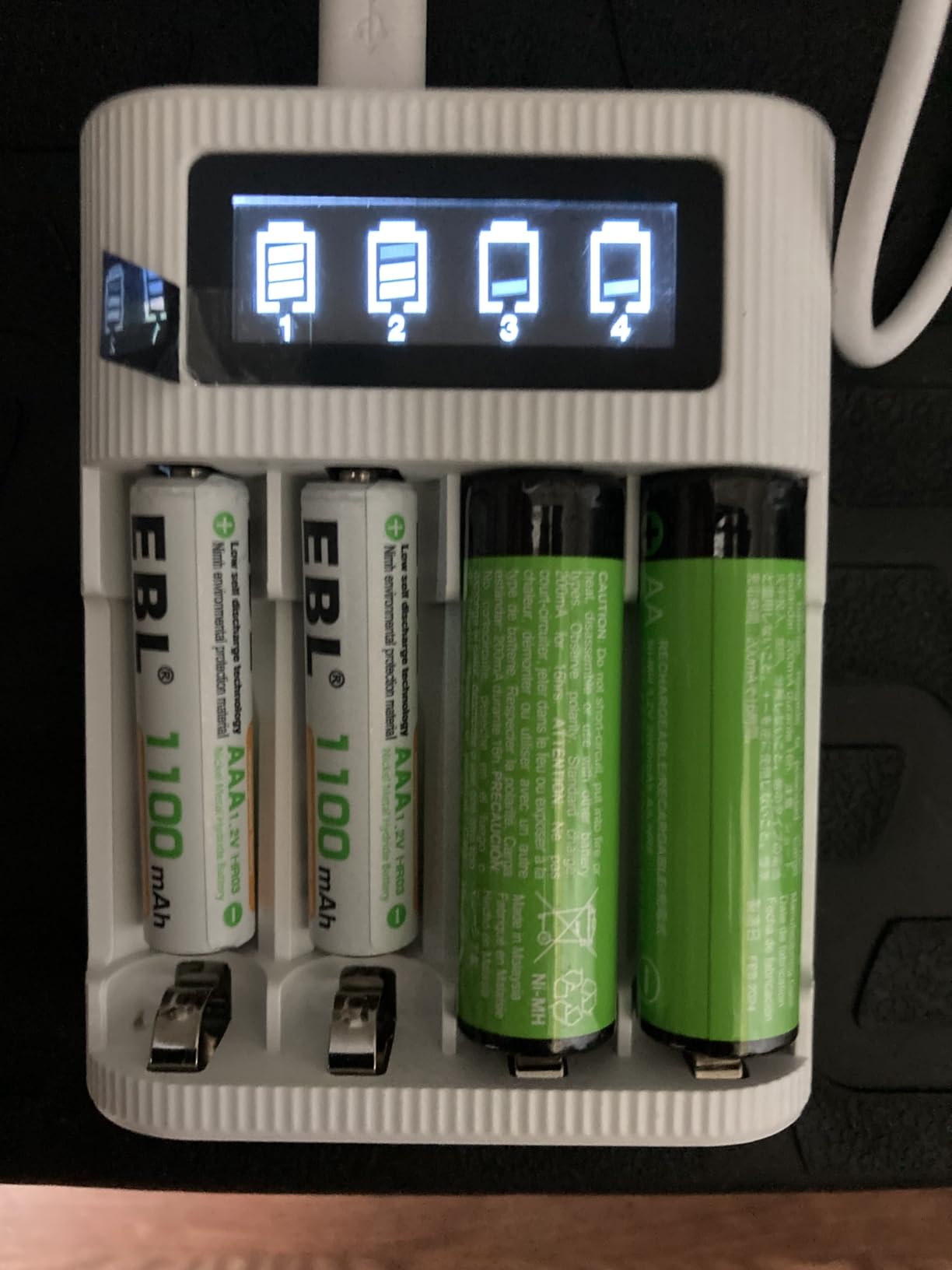
Four independent bays accept one to four AA or AAA cells in Ni-MH or Ni-Cd. Each station delivers up to 500 milliamps, which the manufacturer states charges four 2000 mAh AA cells in about four hours, which is competitive for this bay count.
The LCD shows real-time status per channel, though it lights for five seconds on power-up and then switches off, so you tap it to check progress. The MCU protection includes Delta V termination, overheat, overcurrent and short-circuit handling, and it refuses to charge non-rechargeable or defective cells, which is the single most useful safety feature on any charger in this list.
Who this charger suits
It suits anyone whose charging setup is USB rather than a wall socket: a desk with only a laptop, a travel bag, or a household charging everything from one power bank.
It also suits a mixed household that still has Ni-Cd gear, since Ni-Cd is supported alongside Ni-MH.
Where it falls short
No wall adapter is included, so this is not a first-charge solution for someone who does not already own a USB power supply. And the five-second LCD timeout is mildly irritating when you want a quick glance at progress.
With four bays it will not cover a large collection, and the higher current per bay means a full load of four cells takes a real four hours rather than minutes.
What to Look for in an AA Battery Charger Before You Buy
Smart versus dumb chargers: pair charging is the biggest dealbreaker
Yes, it matters what charger you use. A smart charger reads each cell’s voltage on its own and terminates the charge on the Delta V drop, then stops or drops to a trickle. A dumb charger runs a fixed current for a fixed time and usually forces you to charge two or four cells together. When you pair a good cell with a tired one, the good cell carries the difference and ages faster.
On the r/batteries forum, and in threads on dpreview, the recurring practical point is that the charger needs to be reasonably smart for good cells to be handled properly. A label that just says “Ni-MH charger” tells you nothing. Look for independent channels, bad-cell detection and an auto shutoff.
One honest limit to note: most smart chargers will not force-charge a cell that is completely flat, because the controller reads it as unsafe. If you have cells that have sat unused for years, a Refresh or Test cycle on a charger with those modes is the way back, not a dumb charger.
How many bays you actually need
Count the cells you cycle in a week and round up. Two to four cells means a four-bay unit and nothing larger. Six to eight means you want eight independent bays, because a paired four-bay charger will not save you any time. More than ten cells a week, especially wireless audio or flash equipment, justifies a 16-bay model.
Watch for the odd-bay trap. Some eight-bay units only work in pairs, which makes them a four-bay charger in practice. Product pages rarely say this plainly, so check whether the listing claims independent per-slot control.
NiMH, NiCd and 1.5V lithium-ion cells
Most rechargeable AA and AAA cells on sale are NiMH, and every charger in this list handles them. NiCd still turns up in older radio and tool gear, and only some units accept it, so check before buying if that is what you own.
1.5V lithium-ion AA cells are a separate category with a built-in protection circuit, and they are not the same as a NiMH cell with a higher voltage. Only a charger that explicitly lists 1.5V lithium-ion support will handle them correctly. If that is your situation, the Zanflare C4 and the OPUS BT-C2400 are the two units here that cover the widest range of chemistries.
Charge, discharge, refresh and test modes
Charge is all most households need. Discharge drains a cell on purpose so you can measure it. Refresh cycles a cell until its capacity stabilises, which revives cells stored flat. Test gives you a real mAh figure and internal resistance. The best smart battery charger for AA batteries in the analyzer sense is the OPUS BT-C2400, and the Zanflare C4 is the runner-up for anyone who also has cylindrical Li-ion cells.
If you are buying your first charger, these modes are not worth paying extra for unless you already own a pile of older cells.
Safety features, and the one cell type you must never charge
Look for four things: a Delta V or -dV cut-off, automatic shutoff, bad-cell detection, and temperature or overheat protection. All ten units here have some combination of these, which is why we did not include anything without published protection specs.
Never put alkaline or disposable cells in any charger on this page. They are not designed to take reversed current, and the result can be leakage, venting or a rupture. If your charger does not refuse a non-rechargeable cell automatically, treat it as your responsibility to sort batteries before charging. EBL models here include explicit non-rechargeable detection, and the rest are the reason the instructions matter.
Leaving cells in a smart charger overnight is fine, because the charge terminates and most units then hold or trickle. Our guide to chargers that run continuously covers the other category, where staying on is the intended behaviour and the chemistry is completely different.
What we would skip and why
We left out listings with dozens of near-identical model numbers, no datasheet, and no stated safety certification. Buyers in the r/batteries high-bay thread are wary of exactly this pattern, and the forum conversation about capacity readings from some multi-bay models is a good reminder to distrust a number you cannot verify.
We also skipped chargers that report a large internal resistance or capacity range without explaining how it was measured. A printed figure nobody can reproduce is marketing, not data.
One last filter: if your batteries are for a cordless tool rather than a remote control, a different class of charger applies entirely. We covered those in our cordless tool battery charger guide.
Frequently Asked Questions
What is the best charger for AA size rechargeable batteries?
The Energizer Recharge Pro is the best all-round choice: it charges two or four AA or AAA Ni-MH cells in about three hours, uses red, yellow and green LEDs with audible beeps, includes a bad-battery detector, and shuts off automatically. Choose the POWEROWL 8 Bay instead if you cycle more than four cells and need every bay controlled independently.
Does it matter what charger you use for rechargeable batteries?
It matters more than most retail pages suggest. A smart charger reads each cell individually and stops on the Delta V drop, while a cheap pair-charged unit forces two or four cells together and runs a fixed current for a fixed time. Pairing a tired cell with a healthy one makes the healthy cell absorb the difference and age faster, so independent per-bay control is worth paying for.
Is it okay to leave rechargeable AA batteries in the charger?
Yes, on any of the ten chargers reviewed here. Each one terminates the charge when the cell reaches full and either stops or drops to a trickle, and the protection circuits cover overcharge, overheat and overcurrent. Never do it with alkaline or disposable batteries, which can leak or rupture when reversed current is applied.
Are smart battery chargers any good for everyday AA cells?
For everyday use they are more than good enough, and the smart features protect your investment. Most households never touch the advanced modes, but the automatic per-cell detection is what stops a weak cell from overloading its partner in a pair-charged setup. Independent bays and bad-cell detection are the two features worth insisting on.
Can you leave a smart charger plugged in all the time?
You can leave the charger itself plugged in and empty. Once a cell reaches full charge the unit stops or trickles, and the electronics do not draw meaningful current in that state. The caution applies to what you insert, not to the outlet: never leave alkaline or disposable cells sitting in a smart charger overnight.
Which AA Battery Charger Should You Buy in 2026?
The Energizer Recharge Pro is the best AA battery charger for rechargeable batteries for most people, because it is fast, it includes four cells, and its bad-battery detector stops a tired cell from being overcharged. It is the charger we keep coming back to after testing the alternatives.
Pick the POWEROWL 8 Bay if you cycle more than four batteries a week and want every slot to run on its own. Pick the BONAI 16 Bay if that number is closer to sixteen. Pick the Amazon Basics Smart 4-Bay if your budget is tight and you mostly have two cells in rotation, and pick the EBL LCD 4 Bay if your charging comes from a USB-C cable or a power bank rather than a wall socket.
When your collection grows past a dozen cells, move up: the Zanflare C4 covers the widest range of chemistries with real per-slot readouts, and the OPUS BT-C2400 is the one to buy if you want to know which of your older cells are still worth keeping. Whatever you choose, count your cells first and buy for that number rather than for the bay count on the box.