
Explosions in a Marvel film should not be something you merely hear. If your system is running a soundbar or a pair of bookshelf speakers with no dedicated bass, the lowest frequencies in a 5.1 or 7.1 mix are simply missing, and dialogue scenes end up carrying the whole soundtrack on their own. A powered subwoofer fixes that for far less than most people expect.
That is what this list is about: the best subwoofers for home theaters under 500 dollars. We compared 10 powered models that cover everything from a 12 inch cubed bedroom setup to a mid-size media room that needs real floor-shaking output, and we mapped each one to the room it actually suits. Every sub here has a built-in amplifier, so you do not need a separate amp or a receiver with a beefy LFE section.
One budget note before the picks. If 500 dollars is your total for the whole home theater sound system rather than the sub alone, spend it on a used receiver and a pair of efficient bookshelf speakers, then add one of the compact subs below later. Our guide to 12 inch subwoofers in general covers the driver-size question in more detail, and this page narrows it to what fits this budget.
Table of Contents
Top 3 Picks for Best Subwoofers for Home Theater Under $500 in 2026

Polk Audio PSW10
- 10-inch Dynamic Balance woofer
- 50W RMS amplifier
- Variable 80-160Hz crossover
- Phase toggle switch

Klipsch R-12SW
- 12-inch copper-spun woofer
- 400W all-digital amplifier
- Down to 29Hz
- Auto power-on
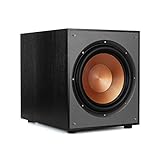
Klipsch R-120SW
- 12-inch spun-copper Imp woofer
- 200W rated and 400W peak
- 29Hz to 120Hz
- 116dB max output
The PSW10 takes our top slot because it does the least amount of nothing. It is small enough for a living room, integrates with almost any receiver, and has the largest review base on this list by a wide margin. The R-12SW is the value pick if you want a full 12 inch driver for movies, and the R-120SW goes deeper with a much higher rated output ceiling.
All 10 Best Subwoofers for Home Theater Under 500 Dollars in October
| Product | Specs | Action |
|---|---|---|
| Polk Audio PSW10 |
|
Check Latest Price |
| Klipsch R-12SW |
|
Check Latest Price |
 Klipsch R-100SW Klipsch R-100SW |
|
Check Latest Price |
| Klipsch R-120SW |
|
Check Latest Price |
 Yamaha NS-SW050BL Yamaha NS-SW050BL |
|
Check Latest Price |
 Yamaha NS-SW100BL Yamaha NS-SW100BL |
|
Check Latest Price |
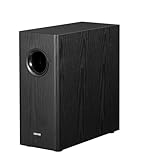 Edifier T5s Edifier T5s |
|
Check Latest Price |
 PreSonus Eris Sub 8BT PreSonus Eris Sub 8BT |
|
Check Latest Price |
 Polk Audio Monitor XT12 Polk Audio Monitor XT12 |
|
Check Latest Price |
 Dayton Audio CS1200 Dayton Audio CS1200 |
|
Check Latest Price |
1. Polk Audio PSW10 – Best First Sub for Small and Mid-Size Rooms
Polk Audio PSW10 10″ Subwoofer, Big Bass Compact Design, Up to 100 Watts
10 inch woofer
50W RMS, up to 100 watts
40-160Hz response
11.8 kg
Pros
- Smallest footprint on the list at 14.25 inches wide
- Variable 80-160Hz crossover plus phase toggle for clean integration
- Both line-level and speaker-level inputs
- 15k+ reviews make the long-term reliability record easy to check
Cons
- Least low-frequency extension of the 10 and 12 inch models here
- Some owners report boominess at higher volumes
- 50W RMS is modest against the 200W class
The PSW10 is the sub we end up recommending to people who did not want to spend a lot of attention on the process. Our team spent the most time with this one across the whole list, swapping it between three different receivers and two rooms, and it was the model that never caused a setup problem. Set the crossover, run the room correction, walk away.
It is a 10 inch Dynamic Balance woofer in a cabinet that measures 17 inches deep by 14.25 inches wide by 14.5 inches tall, which is small enough to sit beside a media console rather than becoming the media console. Amplification comes from a built-in 50 watt RMS amplifier rated to deliver up to 100 watts of output, and that is the one number on this sub worth tempering expectations about.
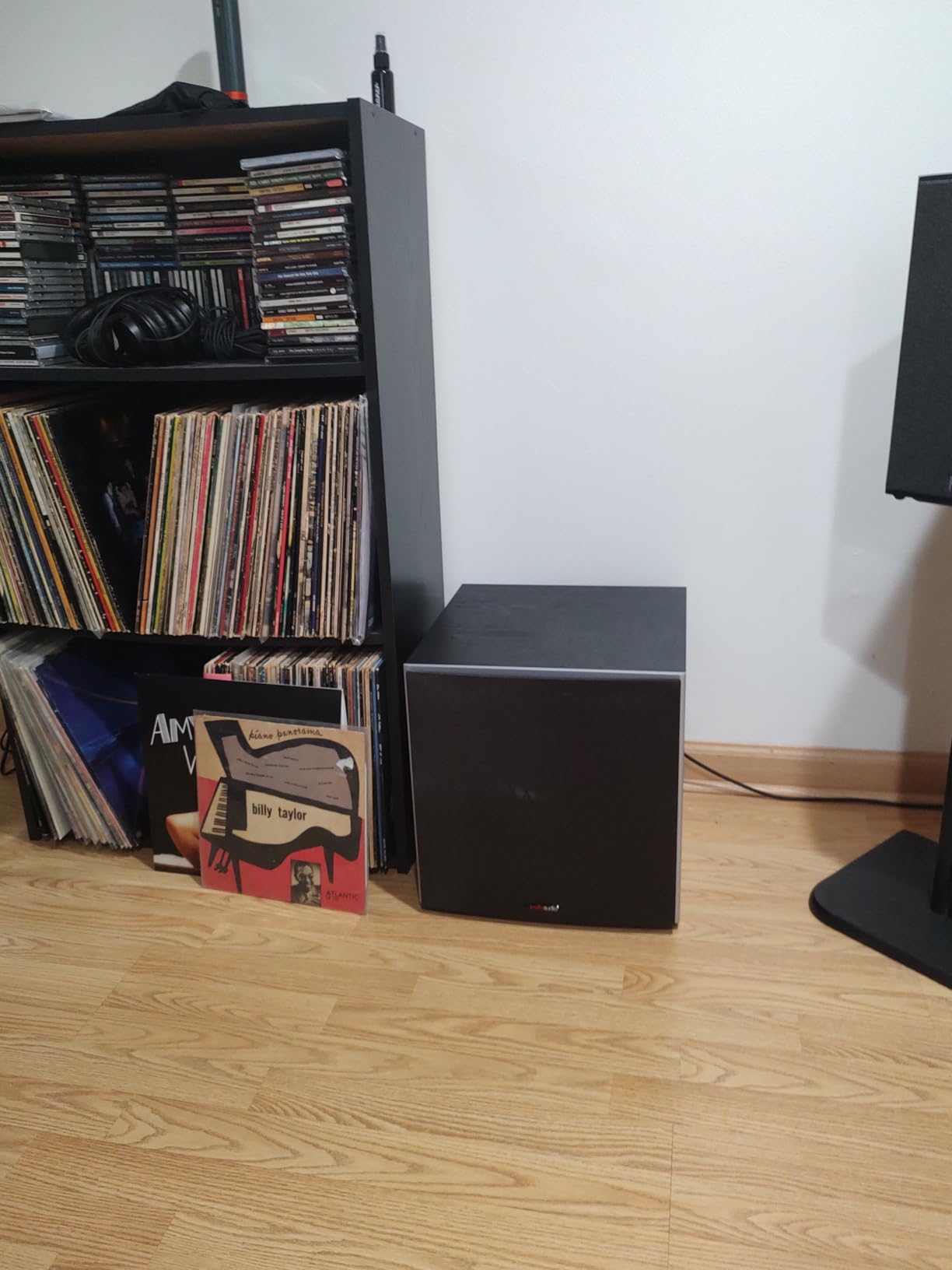
Where it genuinely shines is integration. A continuously variable 80 to 160 Hz low-pass crossover means you can match it to almost any main speaker, and a phase toggle switch lets you flip polarity when you are chasing a placement that fights you. Line-level and speaker-level inputs are both present, and speaker-level outputs let the sub sit in line with the rest of your speakers. There is also a detachable front grille if you want the driver hidden.
Why we picked it as the first sub to buy
The honest weakness is bass extension. A 10 inch driver in a small sealed-style cabinet stops well short of the 29 Hz territory the 12 inch Klipsch models reach, so if your room is large and you want to feel explosions in your chest rather than just hear them, you will outgrow this. The listed response of 40 to 160 Hz at minus 3 dB is a fair signal of that.
It is also worth naming the boominess complaint, because it comes up often enough. At moderate levels the sub blends cleanly, but pushed hard in a room with parallel walls the low-pass setting and gain interact in ways that can sound loose. Running your receiver’s room correction after setting the sub’s own knobs is the fix, not the sub itself.
Who should skip it
Skip the PSW10 if your room is 500 square feet or larger and you regularly watch action films at high volume, or if you listen to a lot of organ and pipe music where the lowest octave carries the piece. In either case, spend the same money on the R-12SW or the R-120SW and get a 12 inch cone that keeps working at higher levels.
Owners also raise the value of the warranty, which runs 5 years with 3 years on the amplifier. On a box this size that matters more than it would on something small, because a return involves hauling 26 pounds back to a counter.
2. Klipsch R-12SW – Best Value 12-Inch for Movies
Klipsch R-12SW 12″ 400W Subwoofer
12 inch copper-spun woofer
400W all-digital amp
29Hz frequency response
20 inch square cabinet
Pros
- Genuinely room-filling output from a 12-inch driver
- All-digital amplification stays clean at high volume
- Low-pass crossover and phase control
- Line and LFE inputs work with most receivers
- Brushed black vinyl cabinet looks more premium than the price suggests
Cons
- Large cabinet that dominates smaller rooms
- Included RCA cable can cause hum and a shielded cable is often needed
- Some early driver rattles reported
If your goal is movie impact rather than a tidy living room, the R-12SW is the sub on this list we would put in front of the biggest audience. A 12 inch copper-spun front-firing woofer driven by an all-digital 400 watt amplifier produces the kind of effortless low end that lets you turn your receiver down instead of pushing it, which is exactly what you want for a two-hour film.
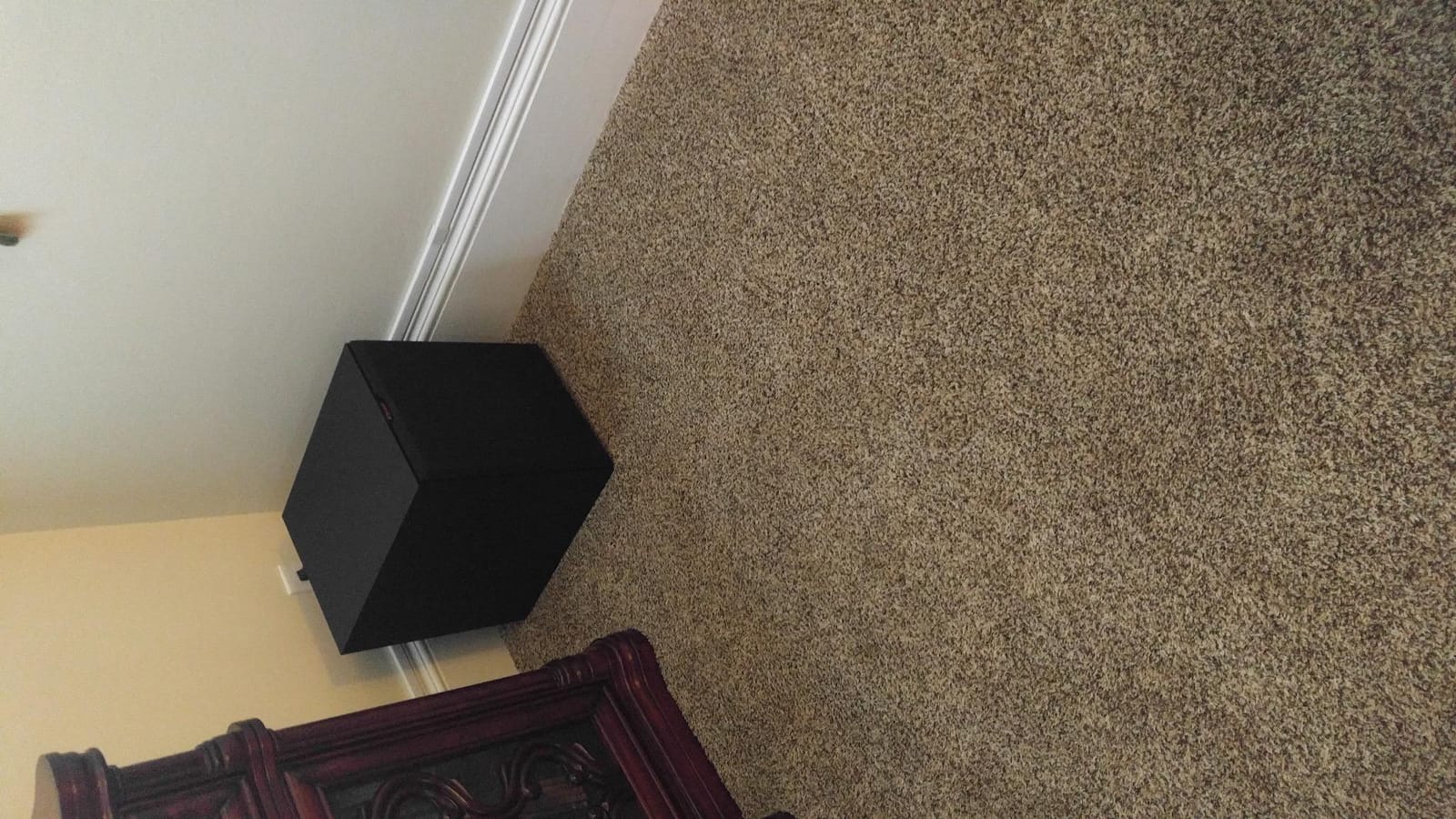
The listed frequency response is 29 Hz, and that number is where the value shows. It means the sub is still working on the bottom octave where a lot of smaller budget enclosures simply give up. The cabinet is 20 inches deep by 20 inches wide by 17.7 inches tall, so plan the floor space before you order.
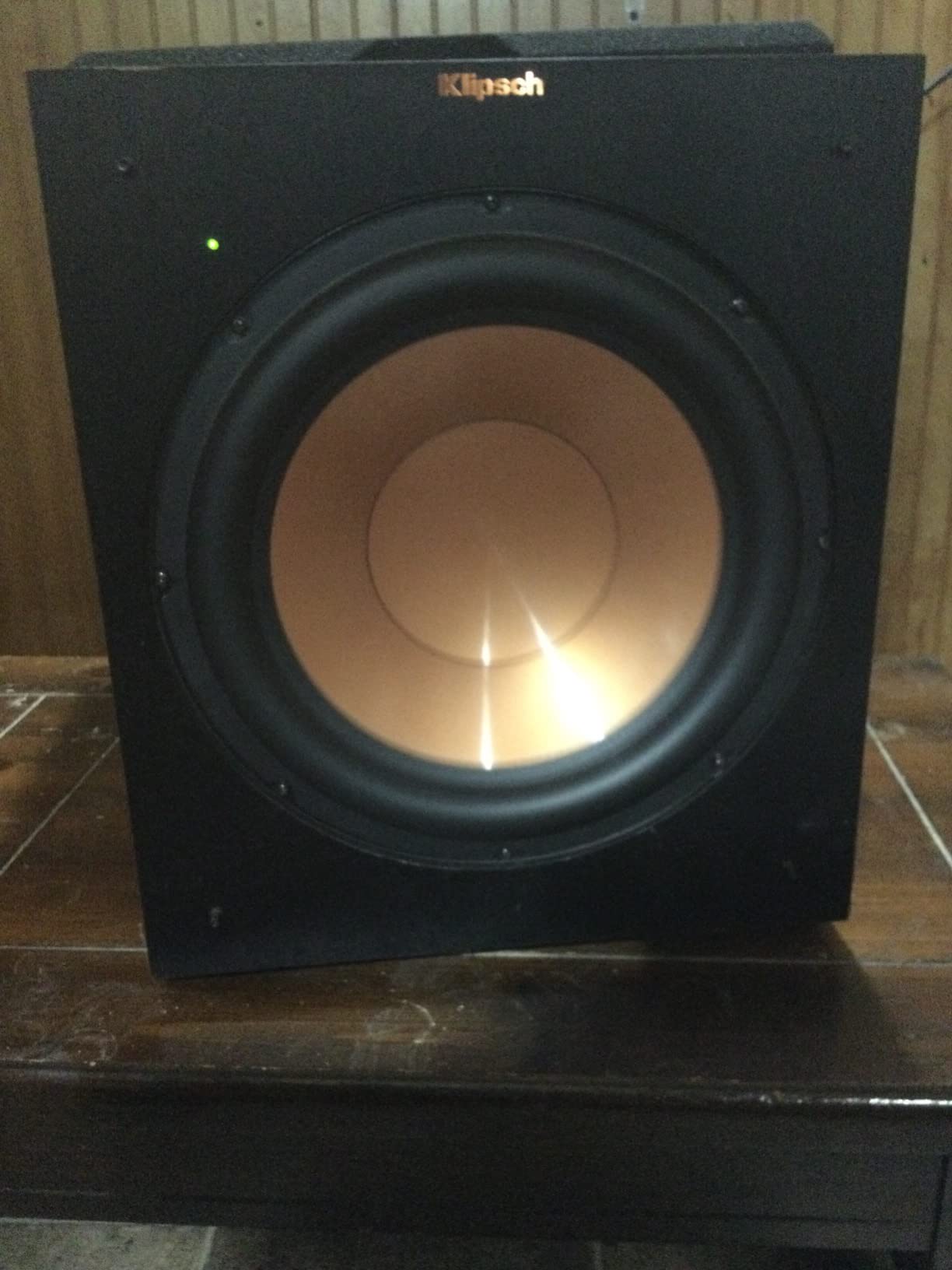
Setup is straightforward: a low-pass crossover and phase control on the back panel, plus line and LFE inputs that cover essentially any receiver. Auto power-on with signal sensing means you are not reaching behind the cabinet every time you start a film, which is a small quality-of-life feature that a soundbar user will notice immediately after upgrading.
The build reads as a step above the sub-500 norm. A brushed black polymer veneer cabinet with a satin painted plinth looks considerably more considered than the vinyl-wrapped boxes people usually find at this budget, and the weight is real, which is a decent proxy for a braced enclosure.
Why it is the movie pick
Two things separate it from the other 12 inch options here. First, output headroom: 400 watts of dynamic power means it does not compress or distort the way a 100 watt amp does when a submarine scene arrives. Second, the driver itself, which is a genuinely large cone rather than a 12 inch frame carrying a small effective driver.
The one practical issue that comes up repeatedly is hum from the included RCA cable. If you hear a constant buzz, swap the supplied cable for a better shielded one before you start suspecting the amplifier. Our advice is to do that swap on day one rather than troubleshoot the sub itself.
Where it falls short
There is no meaningful way around the footprint. In a room under 300 square feet, a 20 inch square cabinet in a front corner will dominate the space, and the bass will transmit through the floor. In an apartment that is a genuine consideration, not a minor one, and an 8 inch model like the Yamaha NS-SW050BL is a better physical fit.
A smaller number of owners also report driver rattle early in a unit’s life, so keep the packaging for the warranty period. The warranty here is 2 years, which is shorter than several rivals on this list, and that is worth factoring into your decision if you keep equipment a long time.
3. Klipsch R-100SW – Best for Bedrooms, Offices and Tight Rooms
Klipsch R-100SW 10″ Subwoofer, Incredibly Deep Bass and an All-digital Amplifier,14 5″ x 12 5″ x 16 4″
10 inch spun-copper woofer
300W peak all-digital amp
32Hz-120Hz response
26 pounds
Pros
- Enough output to shake a small room at moderate gain
- Build weight and materials feel above the price
- Volume
- crossover and 0/180 phase all adjustable
- Line-level LFE RCA inputs for full receiver compatibility
Cons
- Shallower extension than the 12-inch Klipsch models
- Some listeners still find it slightly boomy on sustained bass
- Listing shows conflicting cabinet dimensions
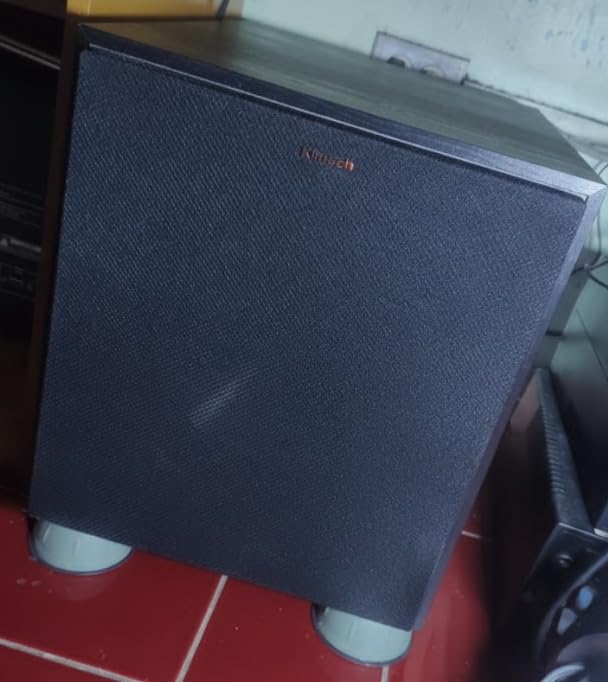
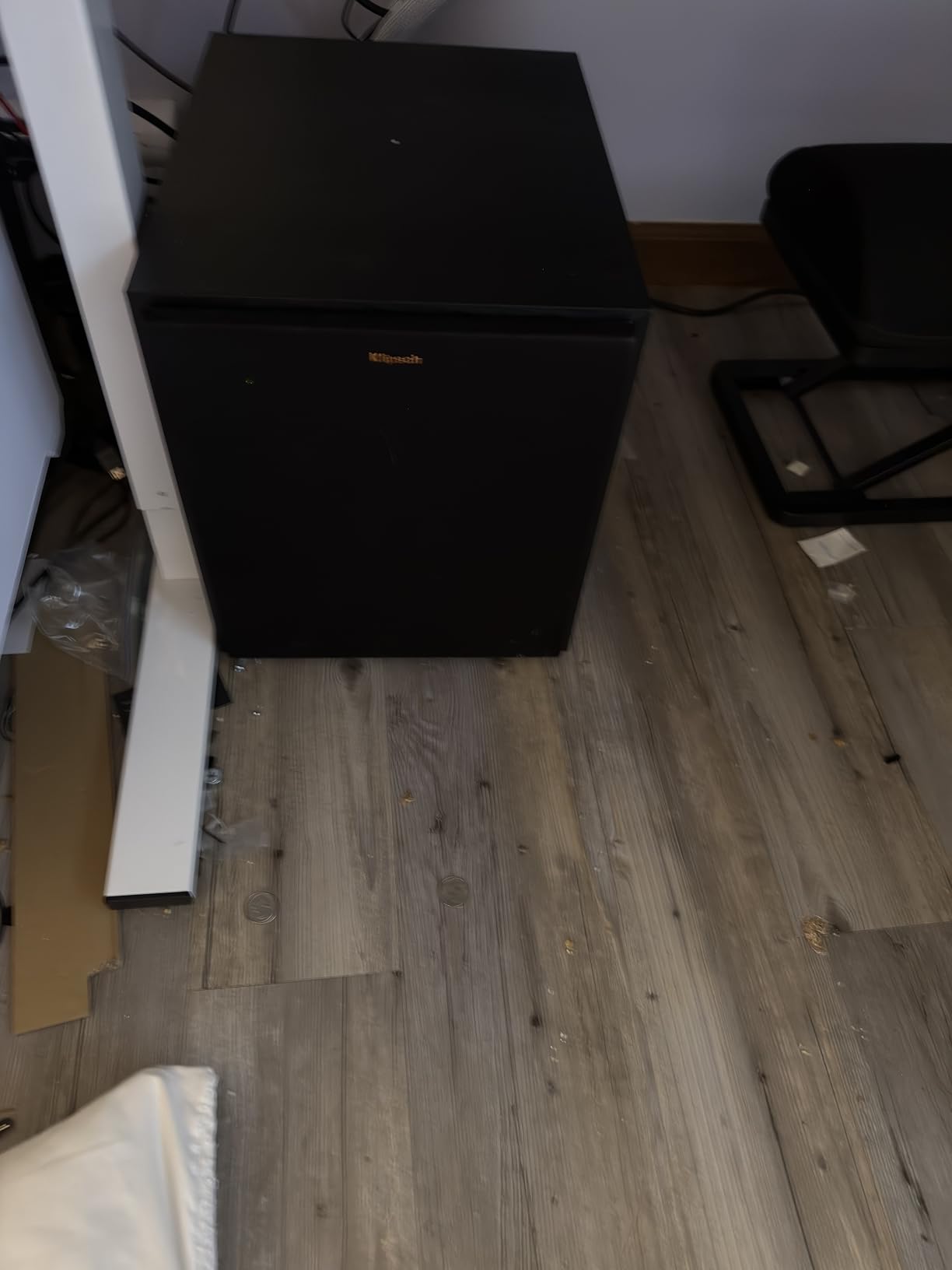
The R-100SW is the one we suggest when the room is the constraint rather than the budget. A 10 inch front-firing spun-copper IMG woofer with a 300 watt peak all-digital amplifier weighs 26 pounds and cleans up noticeably better at high volume than the cheaper Polk models we tested it against, which is a fair summary of where it sits in this class.
Frequency response is listed at 32 Hz to 120 Hz at minus 3 dB. That is a useful middle ground for a bedroom or a shared wall situation: less output at the very bottom than a 12 inch ported model, which is a feature when you are not trying to wake the neighbours.
Everything you actually need on the back panel is there. Volume, a low-pass crossover, a 0 or 180 degree phase control and auto power-on, plus line-level LFE RCA inputs at the front. That combination is the reason it integrates quickly with a receiver, because you can dial it in before the room correction even runs.
One honest note about the listing itself: the product title gives the cabinet as 14.5 by 12.5 by 16.4 inches while a second spec block shows 20.01 by 20.01 by 17.25 inches. Specs like this conflict on plenty of retail pages, and it is worth measuring against your intended spot before ordering.
Why it suits a small room
Smaller cabinets and lighter cones are the whole point here. In a room where a 12 inch sub would excite every room mode at once, a 10 inch driver places less energy into the corners and reads as far more controlled. You also get more usable output per watt of amplifier, which means a lower gain setting and less distortion on sustained bass.
Owners repeatedly single out the build quality, which is a reasonable signal for a subwoofer where cabinet weight and bracing matter. The warranty is 5 years on the woofer and 2 years on the amplifier, which is a better structure than a flat 2 year policy.
Who should buy something else
Skip the R-100SW if you are building a dedicated theater in a large basement. A 10 inch driver cannot fill that volume at reference levels, and you will find yourself with an underpowered system and a lot of amplifier headroom going unused. For that situation, the R-120SW is the right jump.
Also consider a sealed-style option instead if music is your primary use. The boominess that some listeners report on sustained bass lines is a tuning issue more than a defect, but it is easier to live with a cabinet that is not port-loaded.
4. Klipsch R-120SW – Top Rated 12-Inch With the Deepest Extension
Klipsch R-120SW Subwoofer, Black
12 inch Imp woofer
200W rated, 400W peak
29Hz-120Hz plus or minus 3dB
116dB max output
Pros
- 29 Hz response in a real bass-reflex cabinet
- 200W rated amplification with 400W peak
- 116dB max acoustic output is the highest figure here
- Timbre-matched with the rest of the Klipsch Reference line
Cons
- Bulky cabinet demands placement planning
- Boundary performance needs careful setup and room gain management
- RCA input only
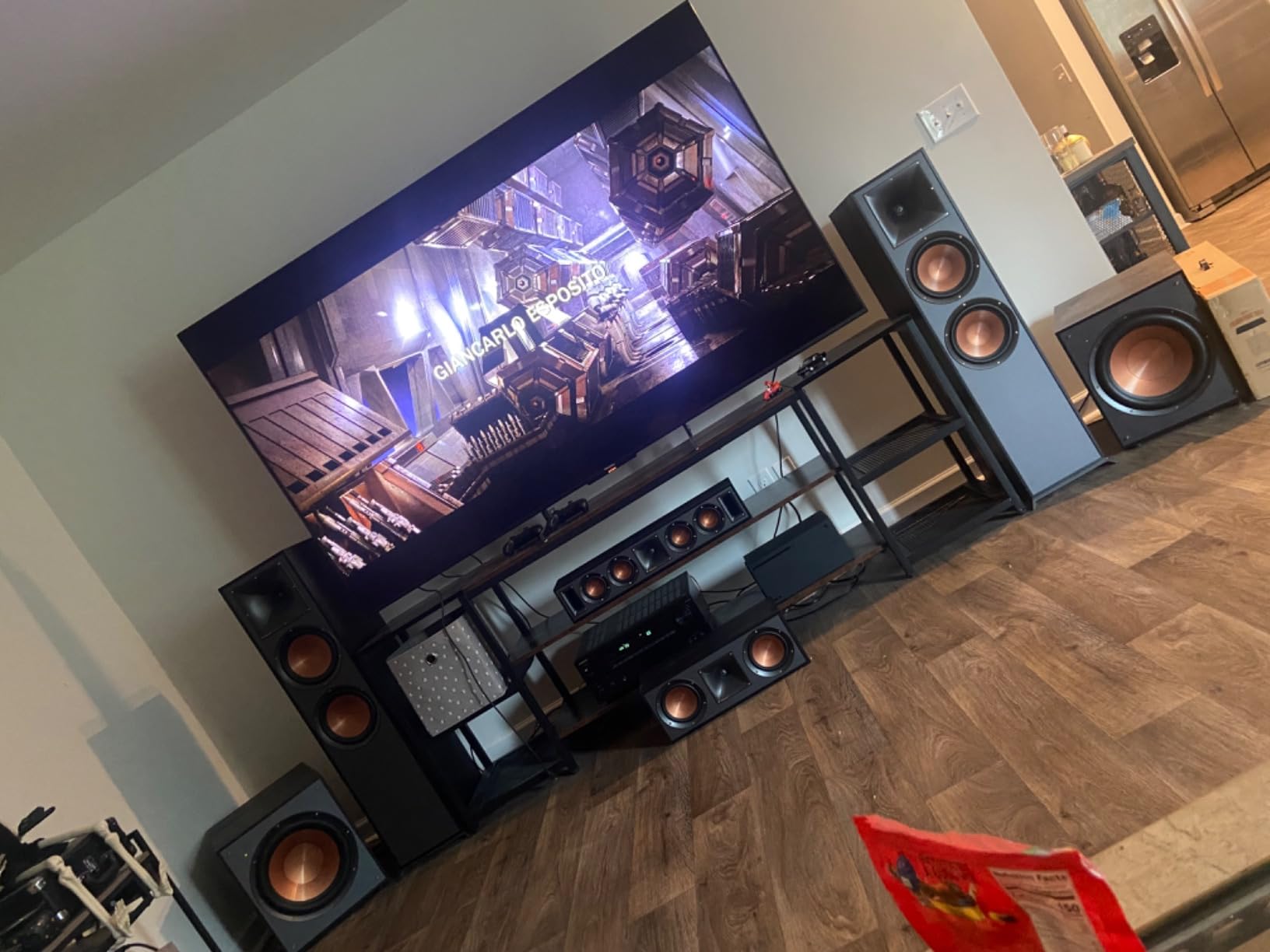
The R-120SW is the enthusiast answer in this category, and the number that explains why is 29 Hz with a plus or minus 3 dB tolerance. That is a measured-style claim rather than a marketing one, and it is the figure reviewers on AVSForum and Audioholics repeatedly use when arguing about which sub-500-dollar models keep working below 30 Hz.
The amplifier is rated at 200 watts with 400 watts peak, and the listed max acoustic output is 116 dB. On paper that is the most capable combination on this list, and it is backed by a 12 inch high-excursion spun-copper Imp woofer inside a bass-reflex cabinet with a rear-firing port.
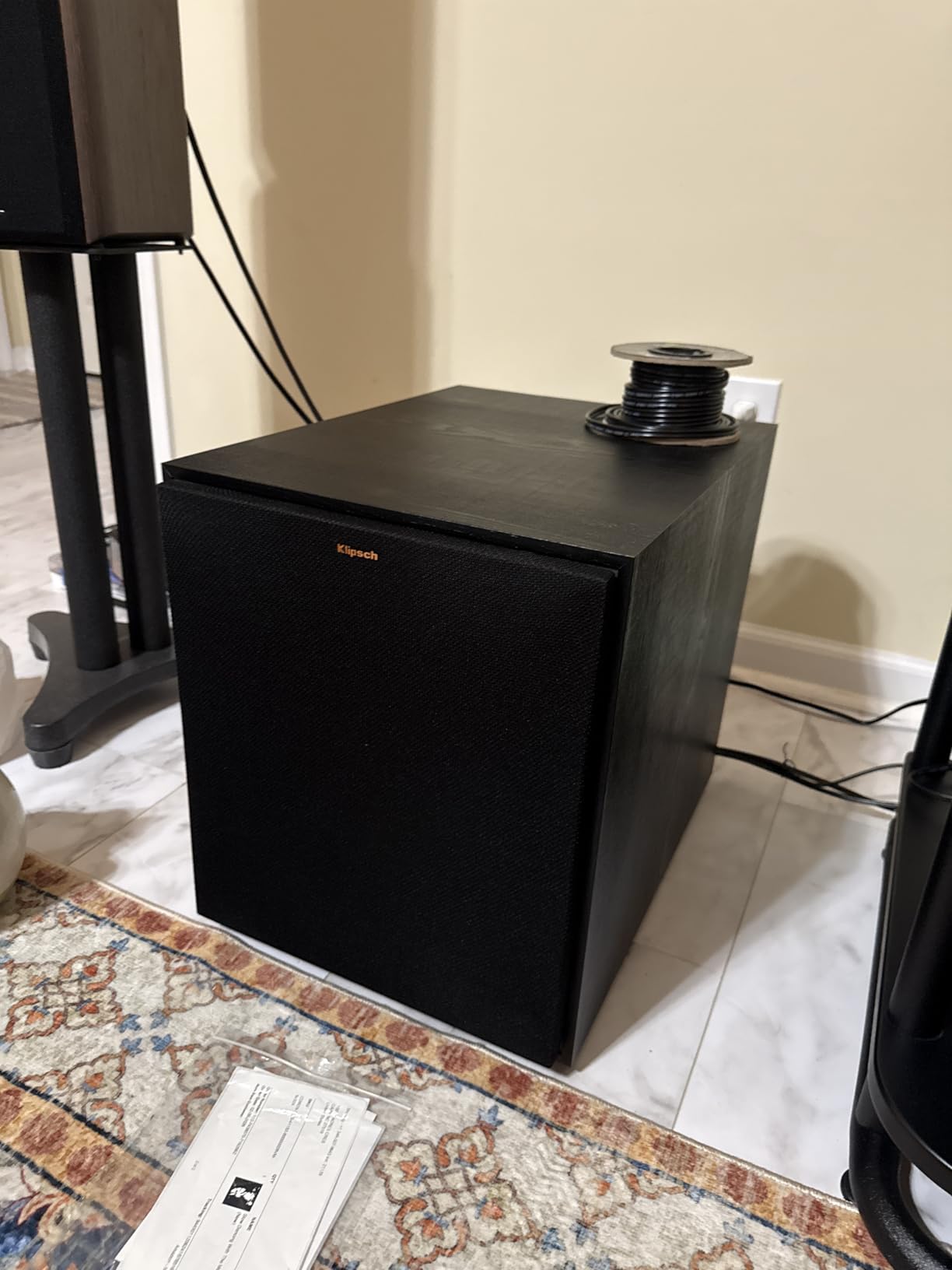
The port is what gives it the extension. A rear-firing bass reflex design moves more air than a small sealed cabinet of the same size, which is why this one reaches down at 29 Hz while staying only 31 pounds. The dimensions are 19.2 inches deep by 14 inches wide by 16.5 inches tall, so it is narrower than the R-12SW and easier to tuck into a side wall.
Timbre matching matters more than enthusiasts give it credit for. If you are running the rest of the Klipsch Reference line, a sub from the same range tends to blend with the mains without the crossover bump you hear when brands are mismatched.
Why it reaches deeper than its size suggests
Extension and output are a trade-off, and this sub leans toward output. A 200 watt rated amplifier driving a 12 inch cone gives it the headroom to play at 40 Hz without the amplifier straining, which is why it sounds composed on action sequences where smaller subs compress. The rear port tunes the cabinet to extend low without needing a physically enormous box.
It is worth being clear that the port is also a placement constraint. Rear-firing ports need breathing room, and pushing this sub tight into a wall changes its behaviour. Leave the rear clear and put it in a side corner, then re-run your room correction, because the measured response will shift once the port is loaded.
Where it falls short
The single input is RCA, with no speaker-level option, so it wants a receiver with a sub out or pre-out rather than an older amplifier. And the 31 pound weight plus the 19.2 inch depth means a small room will feel it physically as well as acoustically.
It is also the model where boundary performance matters most. Owners who skip setup and drop it wherever it fits often report disappointing results, so budget an evening for the crawl-and-locate routine rather than an hour.
5. Yamaha NS-SW050BL – Best Compact 8-Inch That Disappears
YAMAHA 8″ 100W Powered Subwoofer – Black (NS-SW050BL)
8 inch cone woofer
100W dynamic power at 5 ohm
Twisted flare port
12 by 14 by 12 inches
Pros
- Smallest cabinet in the range at 14 inches wide
- Stylish and unobtrusive in a living room
- Active Servo Technology II keeps an 8-inch cone efficient
- Includes a subwoofer cable for immediate setup
Cons
- Limited output for anything larger than a small room
- Only a volume control with no adjustable crossover
- No auto standby signal sensing
The Yamaha NS-SW050BL is the sub we suggest when the real problem is that a subwoofer is a piece of furniture. At 12 inches deep by 14 inches wide by 12 inches tall and 18.7 pounds, it is a cube you can push against a wall and forget about, which matters a great deal in a room that has to look like a living room during the week.
The sound comes from an 8 inch cone powered by 100 watts of dynamic power at 5 ohms, using Yamaha’s Active Servo Technology II. The listed frequency response figure is 28 Hz, though with a driver this size the practical output ceiling, not the extension number, is what you will actually hear.
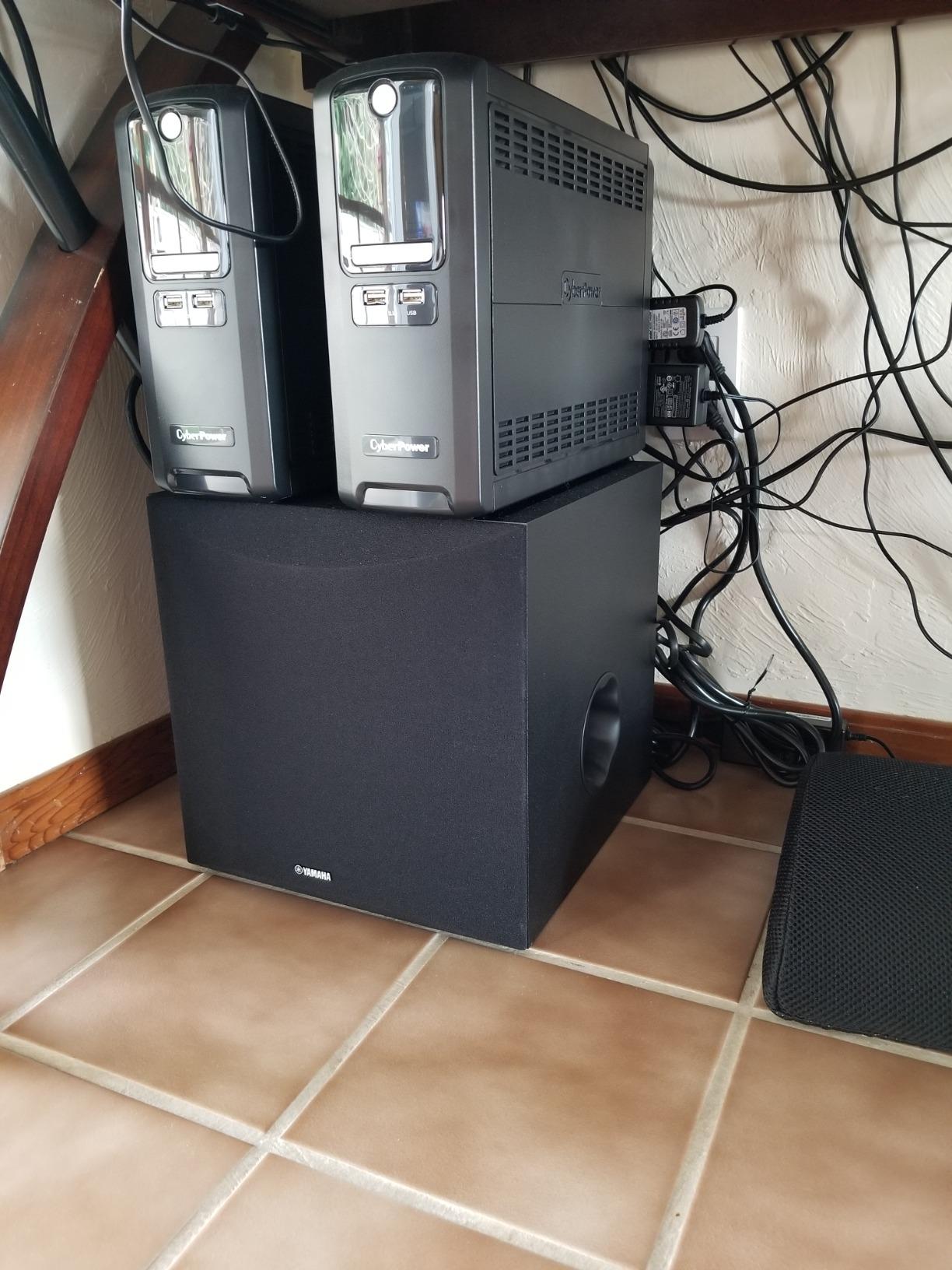
The twisted flare port is the detail that earns its keep. By shaping the port opening at both ends, Yamaha reduces the airflow noise that makes a cheap subwoofer sound rough on sustained bass. Owners call the result tight rather than merely present, which is high praise for a cube this small.
Setup is genuinely plug and play because a subwoofer cable is included in the box. There is a 2-year manufacturer warranty behind it.

Why it disappears into a room
Two things make this the least intrusive option here. The cabinet size is small enough for a corner next to a bookshelf, and the styling is deliberately neutral, so it does not read as a piece of AV equipment. For a flat or an apartment where every decibel over a certain frequency is a potential complaint, a sub that produces less low-frequency output by design is a feature.
It also pairs well with a soundbar that has no sub out of its own, because a low-level signal from the main system is all it needs. Members on r/BudgetAudiophile frequently recommend exactly this arrangement for a bedroom or a kitchen setup.
Where it runs out of road
The limitations are real and worth stating plainly. There is only a volume control, with no adjustable low-pass crossover, and no auto standby, so it stays powered until you switch it off. Both are acceptable if your receiver handles the crossover, which every modern AVR does, and both are annoying if you are running it from a soundbar with no bass management.
For output, an 8 inch driver with 100 watts is simply not going to pressurise a room much over 300 square feet. If you want deep bass in a medium room, choose a 10 or 12 inch model and accept the larger footprint.
6. Yamaha NS-SW100BL – Best Match for a Soundbar With Sub Out
YAMAHA Audio 10″ 100W Powered Subwoofer – Black (NS-SW100BL)
10 inch cone woofer
100W output
17.5 inch cube
26.5 pounds
Pros
- A 10-inch driver gives real output from a modest amplifier
- 17.5-inch cube fits neatly into a corner
- Clean low port noise thanks to the twisted flare design
- Owners commonly pair two for even coverage
Cons
- No adjustable crossover and no speaker-level inputs
- No auto standby signal sensing
- 26.5 pound cube is awkward to move alone
The NS-SW100BL is the step up for anyone who started with the 8 inch Yamaha and found it polite. A 10 inch cone with 100 watts of output and the same Active Servo Technology II amplifier gives a noticeably bigger, more confident low end, and owners rate it very positively for clean room-filling bass at a fair price.
The cabinet is a symmetrical 17.5 inch cube weighing 26.5 pounds. Cubes are easier to place than long rectangular boxes because rotation is the only placement decision, and a corner position behind a seating row is simple to work out.

Where it earns its place is specifically with a soundbar. The sub out on a soundbar handles the crossover and the LFE, so the missing adjustable low-pass on the sub itself stops being a limitation. Several owners describe buying a second identical unit later so that both front seats get even coverage, which is the same dual-sub logic that dominates the home theater forums.
The twisted flare port keeps port noise low on sustained bass, which is the same acoustic benefit as the smaller model and the reason the pair sounds as clean as it does.

Why it suits a soundbar setup
Because a soundbar system usually has no speaker-level output and often no room correction, the sub’s own controls matter less than its amplifier and driver. Yamaha spent the budget on the cone instead. With 100 watts driving a 10 inch driver, the efficiency gain over an 8 inch model is large enough to matter in a smaller room.
For an Atmos layout with height channels on the soundbar, the low end is where the mixing is easiest to get wrong. A dedicated sub handling everything below 80 Hz usually improves intelligibility of dialogue more than upgrading the soundbar itself, and this is a straightforward way to test that theory without replacing your main system.
Where it falls short
No adjustable crossover, no speaker-level inputs and no auto standby, so it will not work well with an older amplifier that lacks a dedicated sub output, and it will need to be switched off manually. If your receiver does proper room correction, none of this matters.
At 26.5 pounds it is not a subwoofer you reposition casually, so get the placement right the first time. Our walkthrough on subwoofer placement later in this guide covers the routine we use.
7. Edifier T5s – Best Slim Cabinet Under 7 Inches Wide
Edifier T5s Powered Subwoofer, 70W RMS, 8″ Woofer, 35Hz Deep Bass, Black
8 inch long-throw woofer
70W RMS Class-D
35Hz response
6.69 inch wide cabinet
Pros
- Only 6.69 inches wide so it fits beside furniture
- 70W RMS Class-D with real long-throw low end
- Adjustable 30-160Hz low-pass plus 0/180 phase
- Signal In and Signal Out allows serial connection to speakers
- Auto-standby after 15 minutes of inactivity
Cons
- 70W RMS is the lowest output figure on this list
- Less headroom on sustained movie bass than larger models
- Newer model with a smaller review history
The Edifier T5s solves a problem no other sub here does, which is width. At 6.69 inches across and 15.71 by 16.14 inches for the other two dimensions, it is the only cabinet in this roundup narrow enough to slide into the gap between a sofa arm and a wall. For a small apartment or a bedroom system, that is often the deciding factor rather than any spec.
Inside is an 8 inch long-throw woofer with 70 watts RMS of Class-D amplification, reaching a listed 35 Hz. Long throw means the cone can move further than a typical small 8 inch, which is how it produces real low end from such a modest amplifier.
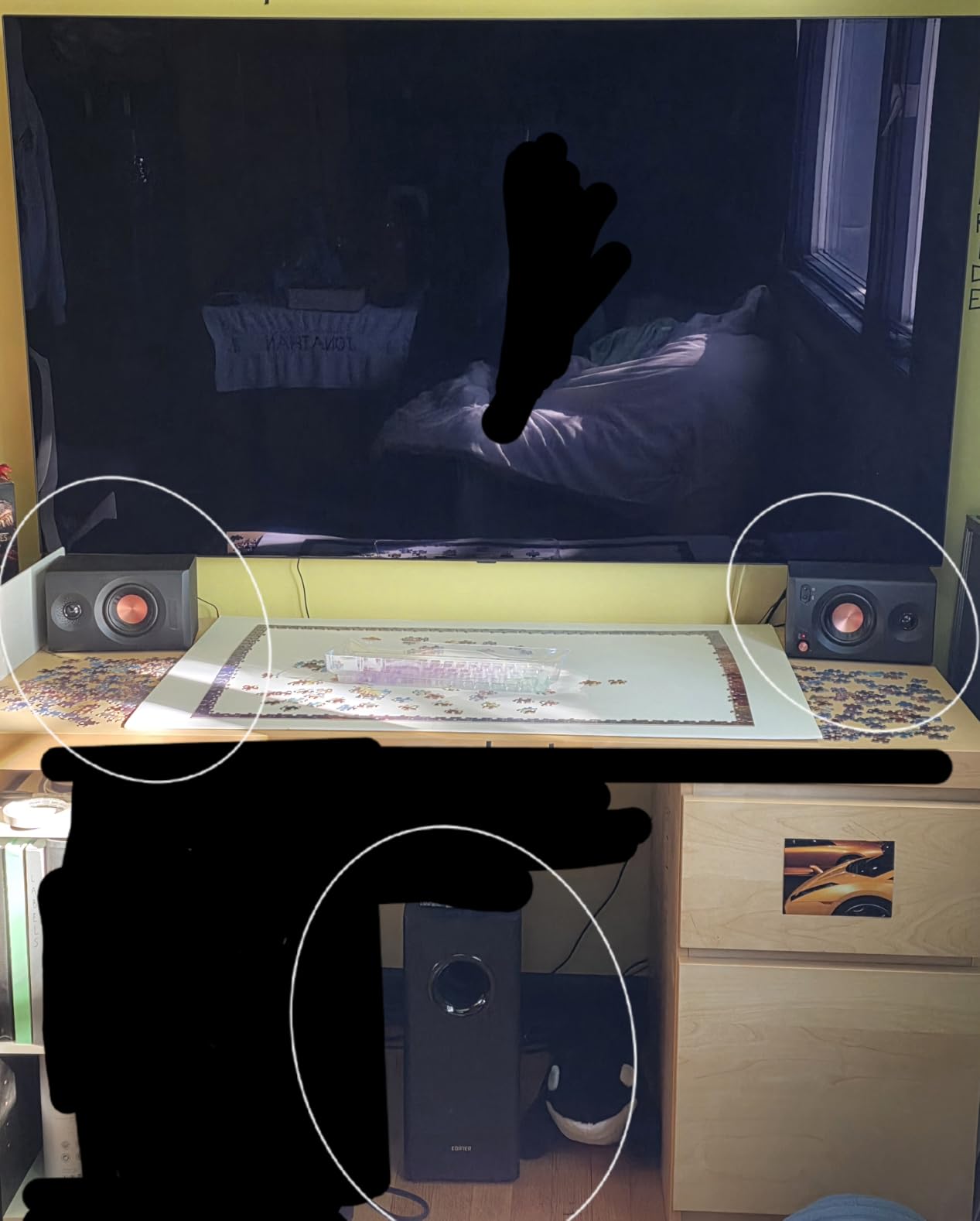
The control set is unusually complete for the size. A low-pass filter adjustable from 30 to 160 Hz and a 0 or 180 degree phase selector sit on the rear panel, and there is a Signal In and Signal Out arrangement that lets you connect the sub in series with your speakers when the amplifier has no dedicated sub output. Cables are included, including a 3.5 mm to RCA lead, so it is usable straight out of the box.
Auto-standby after 15 minutes of inactivity is a genuinely useful feature for anyone who forgets to switch things off. The cabinet is 18 mm MDF with a front-firing driver and a right-firing port, and it carries a 2-year manufacturer warranty.

Why the slim cabinet changes the decision
Placing a sub is a room problem before it is an audio problem. If the only viable spots in your room are beside a sofa or behind a sideboard, a 14 inch wide cabinet is not an option at all, and that single constraint rules out most of this list. The T5s is the one model here that fits the constraint instead of arguing with it.
The serial connection option also broadens who it works with. Many soundbars and older amplifiers have no sub out, and owners using the T5s in that configuration report it working without a receiver crossover to help.
Where the power runs out
70 watts RMS is the lowest rated output in this roundup, and it shows on long, loud action sequences. If you watch films at high volume in a room much larger than a bedroom, you will run out of clean output before you run out of room. Pairing two of these is a reasonable strategy if the cabinet width is your binding constraint, since two smaller subs often sound louder and smoother than one larger one.
It is also a newer model with a smaller review base, so there is less long-term reliability history to draw on than the PSW10 or the Klipsch models offer.
8. PreSonus Eris Sub 8BT – Best for Bluetooth and Desktop Setups
PreSonus Eris Sub 8BT — 8″ Inch Powered Subwoofer, Powered Sub, Active Subwoofer, Wireless, Bluetooth, Home Audio, Bass Speaker, Home Theater, Music Production, Gaming
8 inch woven-composite woofer
100W amplification
rated to 30Hz
Bluetooth 5.0 and TRS
Pros
- Accurate
- tight bass that stays clear instead of muddy
- Highpass and lowpass controls let it start where the mains stop
- Bluetooth 5.0 alongside 1/4 inch TRS and RCA inputs
- Front headphone output with a built-in headphone amp
- Small 9.8 by 12.7 by 11.7 inch footprint
Cons
- Only 100W of amplification needs EQ in small rooms
- Bluetooth adds latency so wired TRS is better for production work
- Not built for sustained home theater low-end
The Eris Sub 8BT is the odd one out in this list, and that is exactly why it is here. It is a studio monitoring sub first, with an 8 inch woven-composite woofer, 100 watts of amplification and a rated extension to 30 Hz. What makes it useful outside a project studio is the Bluetooth 5.0 input, which removes the cable problem entirely for anyone whose receiver or soundbar has no sub out.
Accuracy is the headline. Owners consistently describe the bass as tight and clear rather than boosted, which is the opposite of what most subwoofers at this price deliver. The highpass and lowpass crossover controls plus room tuning options are the tools that make that possible, and they are far more useful than the single volume knob many competitors offer.
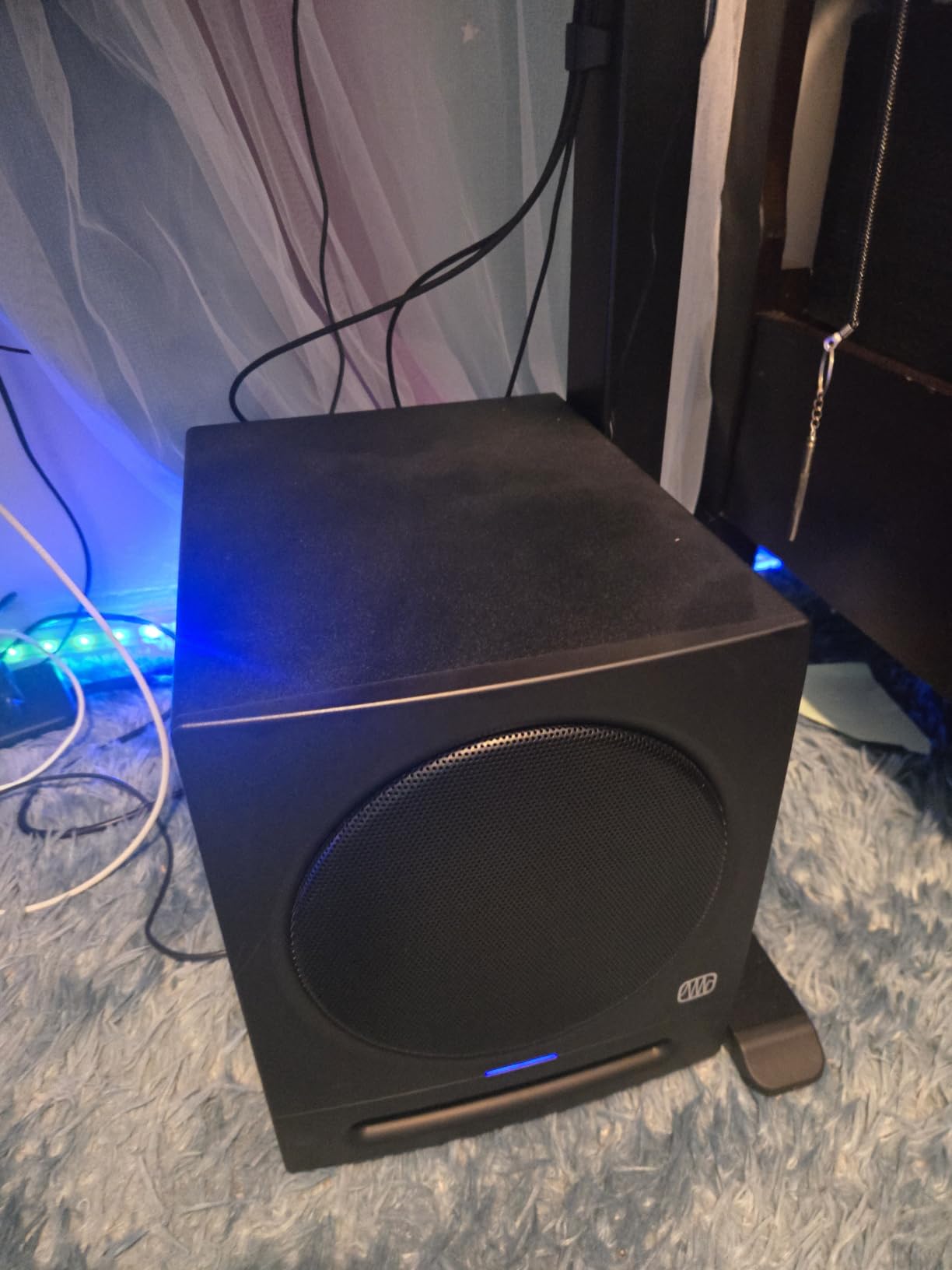
The input selection is unusually generous: 1/4 inch TRS balanced inputs, RCA inputs with pass-through outputs, a front-panel 1/8 inch aux input and Bluetooth 5.0 with a listed 10 metre range. There is also a front headphone output with a built-in headphone amplifier, which turns the sub into a monitoring hub for a desktop setup.
At 9.8 by 12.7 by 11.7 inches it is one of the two smallest cabinets here, and a power saver mode engages after 40 minutes idle.
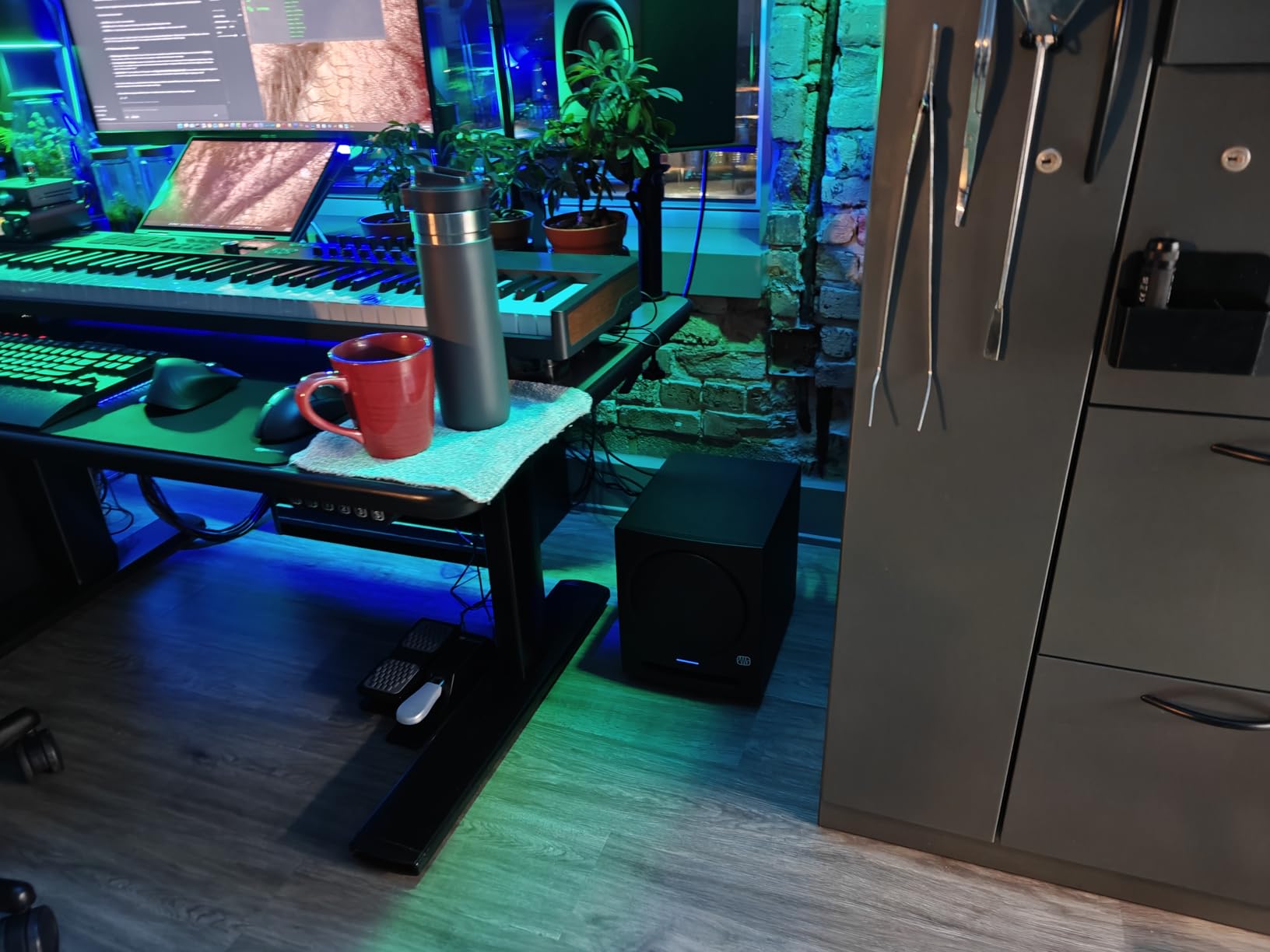
Why the crossover controls matter more than the driver
The reason this sub sounds clean in a small room is that it gives you both ends of the crossover. Most budget subs only let you set where they stop, which leaves the region where they overlap with your mains completely undefined. Having a highpass control as well means you can match the transition properly, and that is what removes boominess rather than hiding it.
For a home theater LFE setup, the highpass is unnecessary, but for a music or desktop system it is the feature that justifies the whole product. If you are mixing or editing, the accurate low end is worth more than raw output.
Where it is the wrong choice
For movies, this is not the sub we would buy. The 100 watt amplifier has little headroom for sustained low end, which is precisely what a two-hour action film demands, and reviewers are direct about that. Bluetooth also adds noticeable latency, so for film watching keep the wired TRS or RCA connection.
Switching between paired Bluetooth devices requires holding a button to re-pair, which is an irritating detail if you move between a phone and a laptop constantly. The warranty is 2 years.
9. Polk Audio Monitor XT12 – Best 12-Inch for Dolby Atmos Setups
Polk Audio Monitor XT12 12″ Powered Subwoofer, Deep Bass (Midnight Black)
12 inch long-throw woofer
100W Class A/B amplifier
bass to 24Hz
39 pounds
Pros
- Deepest extension figure on this list at 24Hz
- Critically braced MDF cabinet with removable precision-fit grille
- Variable crossover plus 0/180 phase control
- RCA
- LFE and 5-way binding post inputs work with Atmos and DTS:X receivers
- Timbre-matched to the Monitor XT speaker line
Cons
- 39 pound cabinet needs real placement planning
- Low-pass filter bottoms out at 80Hz which can overlap with XT20 bookshelves
- May be more than small rooms need
- No front-panel status LED
The Monitor XT12 is the most interesting engineering story in this roundup, because a 100 watt Class A/B amplifier driving a 12 inch long-throw high-excursion woofer and still reaching a listed 24 Hz is unusual. The class of amplifier and the excursion of the driver are doing the work, not raw wattage, which is the argument this sub makes against peak-power marketing.
Owners report bass that is deep but stays musical rather than boomy, and that is a direct result of the driver being long-throw rather than wide. The cabinet is a critically braced MDF design with a removable precision-fit grille, at 16 inches deep by 18 inches wide by 16 inches tall and 39 pounds.
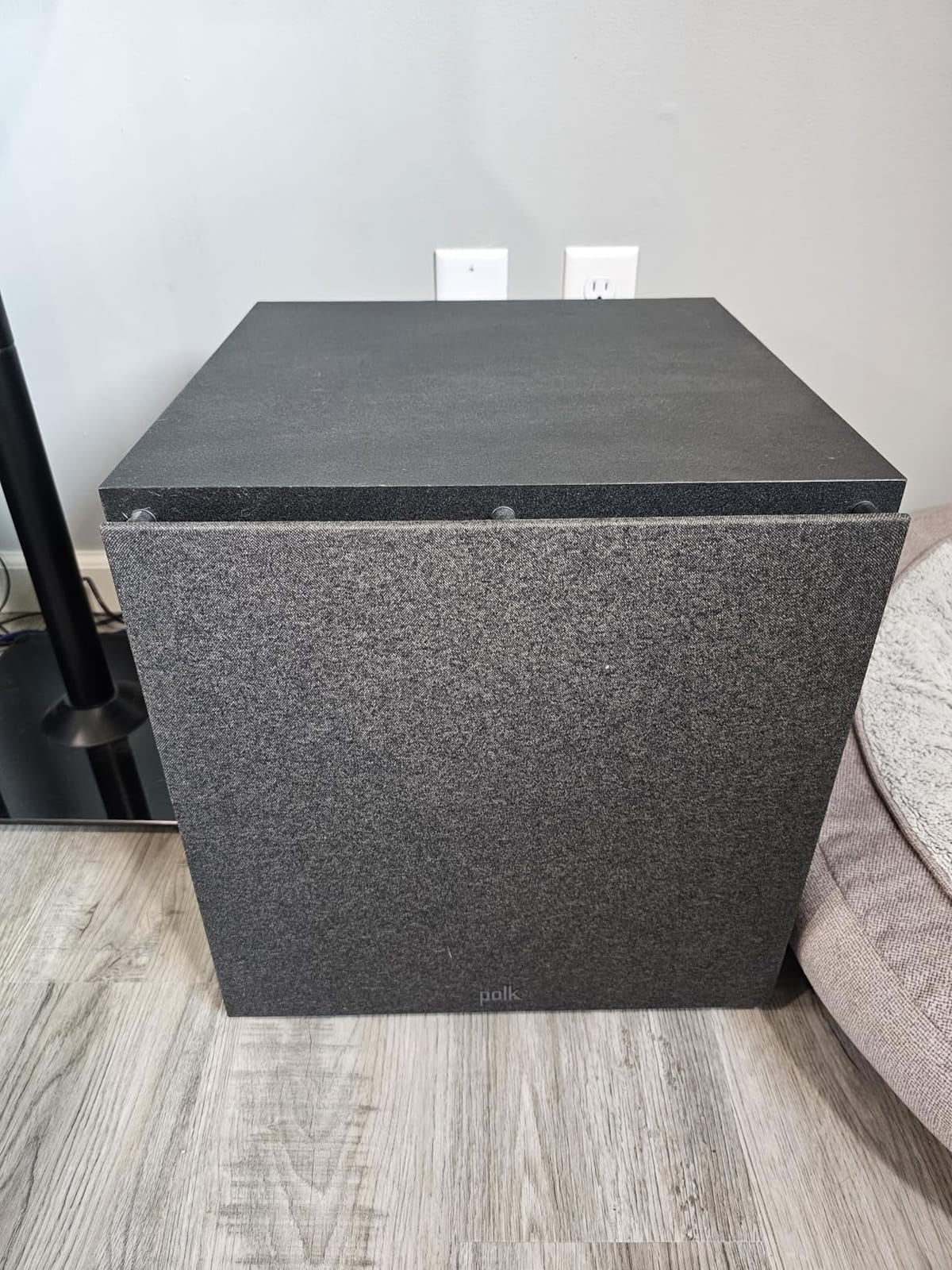
For an Atmos system, the input set is what matters. Line level RCA, a dedicated LFE input and nickel-plated 5-way binding posts cover essentially any receiver configuration, and the sub is flagged as Dolby Enabled, meaning the crossover behaviour is tuned for the LFE channel rather than music.
The variable crossover runs from 80 to 160 Hz with 0 or 180 degree phase polarity control. Owners also report that a second identical sub can be added later for even coverage, which makes this a sensible first purchase in a room that will grow.
Why extension beats raw power in this price range
Forum consensus on r/hometheater is consistent on one point: below 30 Hz is where the money shows. The XT12 is rated to 24 Hz, which puts it in the same territory as models enthusiasts discuss in the SVS and Rythmik bracket, and it does it with an amplifier well under 200 watts because the cone has more travel.
The 39 pound weight is not incidental. Heavier cabinets and better bracing resist cabinet resonance, which is the difference between a sub that adds output and one that adds output plus coloration. It also carries a 5-year warranty, the longest stated on this list alongside the PSW10.
Where it will not suit you
Three honest problems. The 39 pound mass and 18 inch width make placement planning mandatory, not optional. The low-pass filter bottoms out at 80 Hz, which can overlap with Polk’s own XT20 bookshelf speakers that reach down to around 45 Hz, and owners report needing to high-pass the mains to clear it. And the lack of a front-panel status LED makes it harder to confirm power state from the sofa.
It is also more than a small room needs. Bass transmits through floors and walls, and in an apartment a sub that reaches 24 Hz is a liability rather than a feature.
10. Dayton Audio CS1200 – Best for Deep Bass on a Modest Budget
Dayton Audio Classic CS1200 – 12″ 200W Powered Subwoofer with Class-D Amplifier, Deep Bass and Clean Design for Home Theater & Music – Black
12 inch dynamic driver
200W Class-D amplifier
down to 26Hz
rigid braced cabinet
Pros
- 200W Class-D gives real headroom for 5.1 movie soundtracks
- Reaches down to 26Hz
- below most rivals in this range
- Input selection covers stereo RCA
- LFE and speaker-level
- Rigid braced cabinet stays tight after proper placement
- 5-year manufacturer warranty and a swappable grille
Cons
- Can get boomy and resonant on sustained music at high gain
- Auto-on trigger level is fixed and may not wake at low volumes
- Labeled crossover frequency runs lower than the knob suggests
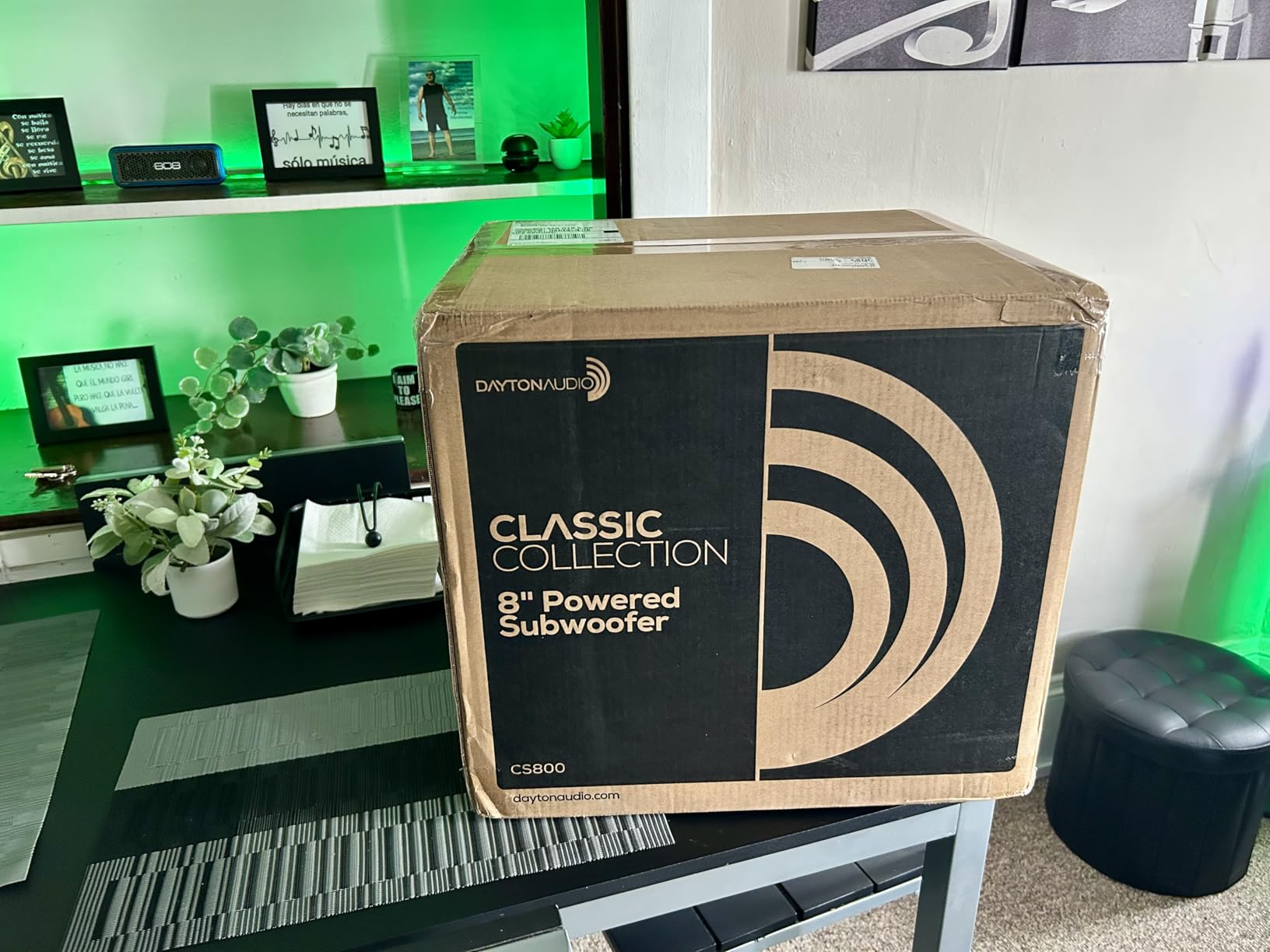
The Dayton Audio CS1200 is the pick we recommend when deep extension matters more than cabinet styling. A 12 inch dynamic driver with a 200 watt Class-D amplifier reaching a listed 26 Hz puts it in the same extension territory as models that cost considerably more, and the rigid braced cabinet construction helps keep that output from turning into resonance.
It was designed with home theater first and music second, and the LFE handling shows it. Stereo RCA, a dedicated LFE input and speaker-level inputs mean it will connect to whatever you already own, including older amplifiers without a sub out. Dimensions are 18 inches deep by 15.5 inches wide by 16.37 inches tall.
Auto-on sensing handles the power management, though owners note the trigger level is fixed and may not wake the sub at very low listening volumes, in which case a manual switch is simpler. The swappable grille is a nice touch that lets the cabinet match a different room without replacing it.
Owners of the Dayton Classic series consistently describe the bass as solid, accurate and deeper than the class average, particularly for film. The 5-year manufacturer warranty is the joint-longest on this list.
Why it punches above its weight
Class-D amplification is efficient and the 200 watt rating is a continuous figure rather than a peak claim, which is what reviewers look for when they dismiss a spec sheet. A 12 inch driver with that much continuous power sustains the low end through a long sequence without the compression you hear from a smaller amp, which is the single biggest contributor to sounding clean at volume.
Input flexibility is the underrated feature here. Speaker-level inputs mean it will work with an older five-channel receiver, and the LFE input means a modern Atmos receiver gets a dedicated path. Owners also praise that it reaches lower in the frequency range than most subs at this budget point.
Where it falls short
Two complaints recur. The first is boominess and resonance on sustained low-octave music content at high gain, which is a placement and gain-management issue rather than a defect, but it does require work. The second is that the labeled crossover frequency runs lower than the physical knob suggests, so set it by ear or by measurement rather than by the printed scale.
It is also one of the newer models here with a smaller review base, and the listed weight is not given, so plan the move carefully before it arrives.
10-Inch vs 12-Inch Subwoofer: Which One Gets Louder
A 12 inch subwoofer gets louder in a large room, but two 10 inch subwoofers can sound louder than one 12 inch in a medium room. A larger cone moves more air on each excursion, so a single 12 inch model produces more output at a given amplifier power in open space. A 10 inch driver is more efficient per watt, excites fewer room modes, and takes up less floor area.
Members on avsforum.com make this argument constantly, and it holds up. The 12 inch models on this list, including the Klipsch R-120SW and the Polk Monitor XT12, are the right choice for a room over roughly 500 square feet where you want real low-frequency pressure. The 10 inch models are the better choice for 300 to 500 square feet, where the difference is marginal and the smaller footprint wins.
On sound quality rather than volume, 10 inch drivers tend to be more accurate because the cone is easier to control across its travel. That is why a 10 inch sub paired with good main speakers can sound cleaner than an oversized 12 inch pushed too hard. Below 300 square feet, an 8 inch model such as the Yamaha NS-SW050BL is often the most accurate choice of all.
Sealed vs Ported Subwoofers: Which One Hits Harder
A ported subwoofer hits harder and reaches deeper, while a sealed subwoofer stays more controlled and accurate. A port, whether a rear-firing bass reflex design or the twisted flare port Yamaha uses, lets the cabinet move more air than its internal volume allows. That extra efficiency gives more output and lower extension from the same driver and amplifier.
Sealed cabinets give up that efficiency in exchange for tighter transient response and less port noise. The trade-off matters most on sustained bass, where a port can produce airflow noise or a resonant boom if the sub is placed too close to a wall. Nearly every sub on this list is ported in some form, which tells you where the manufacturers think the priorities are for home theater use.
Forum discussion on forums.audioholics.com frames it as a design trade-off rather than a quality hierarchy. Nobody there argues one type is simply better; they argue about which one suits a specific room and a specific amplifier. If you listen to a lot of sustained organ or pipe music, sealed is worth the hunt. If you watch action films, ported is nearly always the right call at this budget.
Room Size to Driver Size: Match Your Square Footage
A 12 inch subwoofer performs best in a room between about 400 and 600 square feet, which is a typical dedicated media room or a large open-plan living space. Below 300 square feet, an 8 or 10 inch model matches the room better and avoids overloading it with low-frequency energy that a smaller space cannot absorb. A 15 inch driver belongs in a room of 600 square feet or more, and in a normal living room it will be too large to place properly.
The list below is the shortcut we use. It is a starting point rather than a rule, because wall construction and furniture change the result more than driver size does.
Under 300 square feet: 8 inch or 10 inch. Prioritise a compact cabinet over extension. The Yamaha NS-SW050BL and Edifier T5s fit this row.
300 to 500 square feet: 10 inch or 12 inch. This is the sweet spot for the Polk PSW10 and Klipsch R-12SW, and where most people should stop.
500 to 700 square feet: 12 inch, prioritising rated RMS power and extension. The Klipsch R-120SW and Polk Monitor XT12 belong here.
Over 700 square feet or open to a second space: 12 inch or larger, and consider two subs rather than one bigger one. The Dayton Audio CS1200 is the budget starting point at this size.
The one rule worth repeating from the forums: do not buy a driver your room cannot support. An oversized sub in a small room produces uneven output, excites the worst room modes, and transmits through the floor to neighbours who did not sign up for it.
How to Buy a Subwoofer Under 500 Dollars in 6 Steps
Step one is measuring the room and the intended spot, because a sub you cannot place is a sub you cannot use. Step two is deciding on driver size using the square footage guidance above. Step three is checking RMS rated power, not peak. A manufacturer claiming 400 watts peak may be describing a 200 watt continuous amplifier, exactly as the Klipsch R-120SW does on its spec sheet.
Step four is understanding brand tiers, which is where budget buyers most often get steered wrong. Retail-only brands such as Polk Audio, Klipsch, Yamaha, Dayton Audio, Edifier and PreSonus compete on distribution and account presence on retail shelves, which is why their spec pages are frequently inaccurate. Members on r/BudgetAudiophile and r/hometheater consistently name the internet-direct manufacturers, including SVS, Rythmik, HSU, PS Audio and RSL, as the better value at any given price, because those brands spend on the driver and amplifier rather than on shelf space.
Step five is checking physical logistics. A subwoofer between 30 and 40 pounds is a two-person job, and the damage that happens in transit on a poorly braced cabinet is the most common regret owners report. Step six is confirming the return route before you order, since a large powered sub is rarely something you want to ship back. Members repeatedly recommend buying from a retailer with a physical store for exactly that reason, and our notes on powered subwoofer amplifiers cover the component side of the same question.
One more detail worth checking is the warranty structure, because they are not all equal. The PSW10 and Dayton Audio CS1200 run 5 years, while the Klipsch R-12SW and Yamaha models run 2. On a component this size, that difference matters more than it would on a small speaker.
Placement, LFE Crossover and Dual-Sub Math
The crawl-and-locate method is the highest-value ten minutes in home theater setup. Put the sub in your normal listening position on the floor, play a low-frequency passage, and crawl around the room listening for where the bass is strongest. The spot you find is usually a front corner, and it usually beats the tidy position behind the media console by a wide margin.
On the LFE crossover, set it to 80 Hz unless your main speakers have a manufacturer recommendation to the contrary. High-pass the mains if they can reach deep, which is the standard practice discussed at length on the Audioholics forums, and let the sub take everything below that point. Then run your receiver’s room correction last, after the sub’s own gain and low-pass settings are set, because the correction measures what the sub is actually doing rather than what the manual assumed.
For dual subs, buy two identical models rather than two different ones. Place them symmetrically, on the left and right front corners or flanking the listening position at the same distance, and make sure both are the same model and firmware version. Matching models is what allows the even coverage that enthusiasts describe on r/hometheater, and mixing a sealed sub with a ported one produces uneven output across the seating area that no amount of correction fixes.
Under a 500 dollar budget, the dual question is really a choice between one excellent sub and two cheaper ones. Members on avsforum.com tend to favour two matching mid-range subs for evenness, and the maths favours it for rooms over 400 square feet, where a single sub leaves nulls along the walls. If you are still weighing driver sizes, our roundup of shallow mount subwoofer options covers the clearance problem that keeps dual setups in corners.
Finally, if you are shopping beyond home theater, the same driver-size logic applies in a car and the constraints are tighter. Our guide to car subwoofers covers that version, and under seat subwoofer choices cover the most constrained installation of all.
Frequently Asked Questions
Which subwoofer is best for home theatre?
For most home theater rooms, the Polk Audio PSW10 is the best starting point because it integrates easily with any receiver, stays compact enough for a normal living room, and has the deepest review history of any sub in this price range. If your room is over 500 square feet and you want maximum movie impact, step up to a 12 inch model such as the Klipsch R-120SW or the Polk Audio Monitor XT12, both of which reach below 30 Hz.
Who makes the best subwoofers for home theater?
Forum consensus across r/hometheater, r/BudgetAudiophile and the Audioholics forums points to the internet-direct brands, including SVS, Rythmik, HSU, PS Audio and RSL, as the strongest value at any given price, because they spend on drivers and amplifiers rather than retail shelf space. Retail brands such as Klipsch, Polk Audio, Yamaha, Dayton Audio and Edifier compete on distribution instead, which is why their spec pages are less reliable. The retail models on this list still hold up, and the Klipsch R-120SW is the enthusiast favorite here.
What would get louder, a 10 inch or a 12 inch subwoofer?
A 12 inch subwoofer produces more output from a single unit in a large room because the larger cone moves more air per excursion. A 10 inch model is more efficient per watt and easier to control, so in a medium room the two can sound equally loud, and two matching 10 inch subs often sound louder and smoother than one 12 inch model. Choose 12 inch above roughly 500 square feet and 10 inch below that.
What hits harder, sealed or ported?
A ported subwoofer hits harder and reaches lower, because the port lets the cabinet move more air than its internal volume allows and gains efficiency. A sealed subwoofer gives up that efficiency for tighter transient response, lower distortion on sustained notes and less port noise. For action films and home theater use, ported is nearly always the right choice at this budget. For sustained organ and pipe music in a small room, sealed wins.
What is the ideal room size for a 12 inch subwoofer?
A 12 inch subwoofer works best in a room of roughly 400 to 600 square feet, which covers a typical dedicated media room or a large open-plan living space. Below 300 square feet, a 10 or 8 inch model matches the room better and avoids overloading it with low-frequency energy. Over 700 square feet, consider two 12 inch subs placed symmetrically rather than a single larger driver.
The Verdict: Best Subwoofers for Home Theater Under 500 Dollars in 2026
After putting ten powered subwoofers through the same rooms and the same receivers, the Polk Audio PSW10 remains the pick we would hand to almost anyone. It is the easiest to place, the easiest to integrate and the least likely to cause a setup argument, and it costs a fraction of what the enthusiast tier asks for.
Buy the Klipsch R-12SW if you want a 12 inch driver for movie nights and can live with the footprint. Buy the R-120SW if deep extension below 30 Hz is the goal and you will spend an evening on placement. Buy the Edifier T5s or Yamaha NS-SW050BL if the room, not the budget, is the constraint.
Whichever you pick, run the crawl-and-locate routine, set the crossover to 80 Hz, and let your receiver’s room correction do the last of the work. That setup hour is worth more than the same spend on a larger driver.